


1. INTRODUCTION
One of the most important factors for deep space exploration is the positioning and navigation ability of the artificial spacecraft (Jin et al., Reference Jin, Arivazhagan and Araki2013; Jin and Zhang Reference Jin and Zhang2014). However, current deep space navigation methods strongly depend on ground observations of radiometric tracking data, such as Very Long Baseline Interferometry (VLBI) (Wei et al., Reference Wei, Tang, Jin and Liu2016) and Unified S-Band (USB) (Bhaskaran Reference Bhaskaran2012). One of these ground-tracking strategies is the Deep Space Network (DSN) of the United States, which has successfully completed most of the deep space missions' navigational work. Nevertheless, with the complicated execution of the system, the errors grow with increasing distance and the resulting real-time navigation and telecommunication problems are all disadvantages of this network (Hemmati Reference Hemmati2006; Graven et al., Reference Graven, Collins, Sheikh, Hanson, Ray and Wood2008). Thus, numerous autonomous navigation and integrated navigation methods are proposed to resolve the above problems.
New autonomous methods such as Optical Celestial Navigation (OCN) and X-ray Pulsars Navigation (XNAV) have been mostly focused on deep space navigation since the 1970s. OCN was initially tested and applied densely in low orbit satellite autonomous orbit determination (Gounley et al., Reference Gounley, White and Gai1984; White et al., Reference White, Thurman and Barnes1985), in which the orbit accuracy is from several hundred metres to several kilometres. Recently, OCN techniques have been utilised in deep space exploration missions, for example, Deep Space 1, Deep Impact, Mars Reconnaissance Orbiter (MRO) and The Dawn (Soderblom et al., Reference Soderblom, Becker, Bennett, Boice, Britt, Brown, Buratti, Isbell, Giese, Hare, Hicks, Howington-Kraus, Kirk, Lee, Nelson, Oberst, Owen, Rayman, Sandel, Stern, Thomas and Yelle2002; Hampton et al., Reference Hampton, Baer, Huisjen, Varner, Delamere, Wellnitz, A'Hearn and Klaasen2005; Graf et al., Reference Graf, Zurek, Eisen, Jai, Johnstona and Ramon2005; Mastrodemos et al., Reference Mastrodemos, Kubitschek and Synnott2005; Sierks et al., Reference Sierks, Keller, Jaumann, Michalik, Behnke, Bubenhagen, Büttner, Carsenty, Christensen, Enge, Fiethe, Gutiérrez, Hartwig, Krüger, Kühne, Maue, Mottola, Nathues, Reiche, Richards, Roatsch, Schröder and Tschentscher2011). The navigation accuracy of OCN for these missions varies between several tens of kilometres and a few hundreds of kilometres. An orbit uncertainty of this magnitude satisfies the requirement for stable navigational and engineered trajectory determination, but cannot fulfil the accuracy demand of scientific applications.
Downs (Reference Downs1974) first proposed the idea of using celestial X-ray sources for interplanetary navigation. Chester and Butman (Reference Chester and Butman1981) utilised X-ray Pulsars for navigation simulation, and an accuracy of around 150 kilometres can be achieved based on their theory. Recent simulation results have shown that the navigation accuracy of this method could reach within five kilometres (Sheikh et al., Reference Sheikh, Pines, Ray, Wood, Lovellette and Wolff2006; Becker et al., Reference Becker, Bernhardt and Jessner2013; Deng et al., Reference Deng, Hobbs, You, Li, Keith, Shannon, Coles, Manchester, Zheng, Yu, Gao, Wu and Chen2013). For example, simulations using XNAV to determine spacecraft orbits around Mars show that the accuracy of this method is within two kilometres (Wei et al., Reference Wei, Jin, Zhang, Liu, Li and Yan2013). In addition, several testing plans and XNAV navigation experiments have been done or will be done, including Unconventional Stellar Aspect (USA), X-ray Source-based Navigation for Autonomous Position Determination (XSNAPD), and the Station Explorer for X-ray Timing and Navigation Technology (SEXTANT) (Hanson Reference Hanson2006; Sheikh and Pines Reference Sheikh and Pines2006; Winternitz et al., Reference Winternitz, Mitchell, Hassouneh, Valdez, Price, Semper and Yu2016). These experiments have all confirmed the feasibility of XNAV. In particular the SEXTANT ground test experiments demonstrated that the accuracy of this system could achieve an orbit accuracy of ten kilometres with current hardware configurations.
Currently, the accuracy of the time delay of VLBI is of a magnitude of nanoseconds, which equals to range errors of about 4 km per Astronomical Unit (AU) (James et al., Reference James, Abello, Lanucara, Mercolino and Maddè2009; Becker et al., Reference Becker, Bernhardt and Jessner2013; Cao et al., Reference Cao, Yong, Hu, Ma and Zheng2010). The OCN used on deep space spacecraft for autonomous navigation purposes has far poorer accuracy than the ground-based techniques. At the same time, the signal intensity of the XNAV is so weak that the observations have to be folded and integrated over several minutes to several tens of minutes according to the flux of the X-ray Pulsars (Sheikh et al., Reference Sheikh, Pines, Ray, Wood, Lovellette and Wolff2006; Becker et al., Reference Becker, Bernhardt and Jessner2013). Thus, the performance of this system is not stable and the system would suffer collapse in some cases. Accordingly, an integrated navigation system of OCN/XNAV would be a better choice for future deep space navigation.
Many integrated system and filter designs of OCN/XNAV have been simulated to calculate Earth satellite orbits and orbits circling around Mars (Wang et al., Reference Wang, Zheng, An, Sun and Li2013; Rong et al., Reference Rong, Luping, Zhang and Li2016). The current simulated accuracy of XNAV or XNAV/OCN that achieved an error magnitude of several kilometres is available, however, the techniques which achieved hundred metres accuracy would generate hardware requirements that would currently be difficult to fulfil according to the ground-testing experiments of SEXTANT. These simulations are more concerned about either the performance of the Kalman filter or the design of the filter. Most of the simulations make minor consideration of the influence of complex errors on the performance of integrated OCN/XNAV.
In this paper, the OCN/XNAV system is realized and evaluated by simulation. The spacecraft's orbit accuracy is evaluated in many different conditions such as sensors' pointing accuracy, the integration time of the XNAV, the delay errors and the clock errors. The orbit uncertainty is studied and analysed to give an autonomous, stable and high accuracy orbit solution. The paper is organised as follows: the principle of the OCN/XNAV integrated navigation system is presented in Section 2. A numerical experiment is demonstrated in Section 3 to test the accuracy and robustness of the system. The relationship between system parameters and the accuracy of the orbit is also discussed and analysed in this section. Finally, conclusions are given in Section 4.
2. METHODS AND MODELS
2.1. Dynamics model of the Mars spacecraft
Satellite Tool Kit (STK) software is utilised to generate the nominal orbit, which has the same condition and orbit manoeuvre as the Mars Pathfinder spacecraft. It should be noted that all our accuracy evaluation and observation simulation is based on this nominal orbit. Since our paper is focused on evaluating the performance of the integrated OCN/XNAV navigation system, we use a cyclo-restricted four-body model concerning the Sun, Mars, the Earth and the spacecraft to build the dynamics model to simplify the problem. Thus, the accelerated speed ${\bf a}$
of the spacecraft in the cruise phase can be expressed as:
${\bf a}$
of the spacecraft in the cruise phase can be expressed as:
 $${\bf a} = {-}{{\mu_s}\over {r_{ps}^{3}}} {\bf r}_{ps} -{\bf a}_m -{\bf a}_e +\omega$$
where μ
s
represents the heliocentric gravitational constant; ${\bf r}_{ps} $
represents the position and velocity vectors of the spacecraft in the J2000 Heliocentric Inertial Coordinate System (J2000HICS) that is defined by DE405;
${\bf r}_{ps} $
represents the position and velocity vectors of the spacecraft in the J2000 Heliocentric Inertial Coordinate System (J2000HICS) that is defined by DE405; ${\bf r}_{ps} =[ x\quad y\quad z\quad {\dot {x}} \quad {\dot {y}} \quad {\dot {z}} \rsqb ^{T}$
,
${\bf r}_{ps} =[ x\quad y\quad z\quad {\dot {x}} \quad {\dot {y}} \quad {\dot {z}} \rsqb ^{T}$
,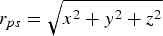 $r_{ps} =\sqrt {x^{2}+y^{2}+z^{2}}$
,
$r_{ps} =\sqrt {x^{2}+y^{2}+z^{2}}$
, ${\bf a}={\bf{\dot r}}_{ps}$
. The dot above the variable means its derivative;
${\bf a}={\bf{\dot r}}_{ps}$
. The dot above the variable means its derivative; ${\bf a}_{m}$
and
${\bf a}_{m}$
and ${\bf a}_{e}$
represent the gravitational attraction of Mars and the Earth to the spacecraft, respectively. ω is the accelerated speed noise. The perturbative force of Mars and the Earth is expressed as:
${\bf a}_{e}$
represent the gravitational attraction of Mars and the Earth to the spacecraft, respectively. ω is the accelerated speed noise. The perturbative force of Mars and the Earth is expressed as:
 $$\left\{{\matrix{{\bf a}_m = \displaystyle{{\mu_m} \over {r_{pm}^3}} {\bf r}_{pm} - \displaystyle{{\mu_m}\over {r_{sm}^3}} {\bf r}_{sm} \cr {\bf a}_e = \displaystyle{{\mu_e} \over {r_{pe}^3}} {\bf r}_{pe}-\displaystyle{{\mu_e} \over {r_{se}^3}} {\bf r}_{se}\cr}}\right.$$
where, μ
m
and μ
e
represent Mars-centric and geocentric gravitational constants, ${\bf r}_{pm}$
and
${\bf r}_{pm}$
and ${\bf r}_{pe} $
represent the position and velocity of the spacecraft relative to Mars and Earth,
${\bf r}_{pe} $
represent the position and velocity of the spacecraft relative to Mars and Earth, ${{\bf r}}_{sm}$
and
${{\bf r}}_{sm}$
and ${{\bf r}}_{se}$
are Mars and Earth position and velocity vectors in J2000HICS which can be acquired from DE405. r
pm
, r
pe
, r
sm
and r
se
are the distances of the above vectors which have similar formulae to r
ps
.
${{\bf r}}_{se}$
are Mars and Earth position and velocity vectors in J2000HICS which can be acquired from DE405. r
pm
, r
pe
, r
sm
and r
se
are the distances of the above vectors which have similar formulae to r
ps
.
2.2. Algorithm of the integrated navigation system
2.2.1. Numeric solution of the dynamic equation
In this paper, an Unscented Kalman Filter (UKF) is utilised to conduct orbit calculation to avoid linearizing Equation (1), the OCN observation equation and the XNAV observation equation.
Equation (1) can be solved by numerical integration method. Therefore, we use Runge-Kutta (RK) methods in terms of RK 7(8) to acquire the initial solution that can achieve enough solution accuracy (Dormand and Prince Reference Dormand and Prince1978). This solution also provides the initial Sigma points (Section 2.2.4).
2.2.2. Measurement model of OCN
Particularly, our paper focuses on one of the observational methods of OCN that is called Stellar Light Distance Angle (SLDA) because this observation has been put into use in several deep space spacecraft navigations (Lowman and Stauder Reference Lowman and Stauder2004). SLDA is the angle between two light rays of celestial bodies observed from sensors such as navigation camera on board the spacecraft. We simulate four angles that are illustrated in Table 1.
SLDA simulated in this paper.

The simulation process is as follows: First, the SLDA can be deduced from the unit direction vector of the stellar light as Equation (3) shows,
 $${{\bf Z}}_{{{\bf l}}} =\arccos\lpar {{\bf l}}_{p1} \cdot {{\bf l}}_{p2} \rpar +{{\bf v}}_{{{\bf l}}}$$
where ${{\bf Z}}_{{\bf l}} =[ \theta\quad \phi\quad \varphi \quad \psi \rsqb ^{T}$
is the observation vector,
${{\bf Z}}_{{\bf l}} =[ \theta\quad \phi\quad \varphi \quad \psi \rsqb ^{T}$
is the observation vector, ${{\bf l}}_{p1} =[ {{{\bf l}}_{{{\bf pb}}} }\quad {{{\bf l}}_{{{\bf ps}}} } \quad {{{\bf l}}_{{{\bf pe}}} } \quad {{{\bf l}}_{{{\bf ps}}} } \rsqb ^{T}$
and
${{\bf l}}_{p1} =[ {{{\bf l}}_{{{\bf pb}}} }\quad {{{\bf l}}_{{{\bf ps}}} } \quad {{{\bf l}}_{{{\bf pe}}} } \quad {{{\bf l}}_{{{\bf ps}}} } \rsqb ^{T}$
and ${{\bf l}}_{p2} =[ {{{\bf l}}_{{{\bf p}}s} } \quad {{{\bf l}}_{{{\bf p}}e} } \quad {{{\bf l}}_{{{\bf p}}m} } \quad {{{\bf l}}_{{{\bf p}}m}}\rsqb ^{T}$
are stellar unit direction vectors in which the subscripts p, b, s, e and m represents the centre of the spacecraft, celestial body Sirius, the Sun, the Earth and Mars, respectively. Accordingly, the unit vectors can be acquired from radius vectors.
${{\bf l}}_{p2} =[ {{{\bf l}}_{{{\bf p}}s} } \quad {{{\bf l}}_{{{\bf p}}e} } \quad {{{\bf l}}_{{{\bf p}}m} } \quad {{{\bf l}}_{{{\bf p}}m}}\rsqb ^{T}$
are stellar unit direction vectors in which the subscripts p, b, s, e and m represents the centre of the spacecraft, celestial body Sirius, the Sun, the Earth and Mars, respectively. Accordingly, the unit vectors can be acquired from radius vectors. ${{\bf v}}_{{\bf l}}$
is the noise vector of the equation. Specifically, these direction vectors are acquired from the nominal orbit and DE405. Secondly, when the true SLDA observation is deduced from Equation (3) (excluding random noise
${{\bf v}}_{{\bf l}}$
is the noise vector of the equation. Specifically, these direction vectors are acquired from the nominal orbit and DE405. Secondly, when the true SLDA observation is deduced from Equation (3) (excluding random noise ${{\bf v}}_{{\bf l}}$
), some random errors are added to the true SLDA based on the accuracy of sensors shown in Table 2 (Mastrodemos et al., Reference Mastrodemos, Kubitschek and Synnott2005; Stastny and Geller Reference Stastny and Geller2008; Sun et al., Reference Sun, Xing, Wang, You and Chu2016). The accuracy of the SLDA is evaluated by the square root of sum of squares of two point accuracy.
${{\bf v}}_{{\bf l}}$
), some random errors are added to the true SLDA based on the accuracy of sensors shown in Table 2 (Mastrodemos et al., Reference Mastrodemos, Kubitschek and Synnott2005; Stastny and Geller Reference Stastny and Geller2008; Sun et al., Reference Sun, Xing, Wang, You and Chu2016). The accuracy of the SLDA is evaluated by the square root of sum of squares of two point accuracy.
Pointing accuracy of the celestial sensors.

2.2.3. Measurement model of XNAV
The main idea of XNAV is to obtain time delay observation, which is between the Time Of Arrival (TOA) of the Pulsar's signal to the probe and the TOA of the signal to the origin of a (quasi) inertial space-time reference system. The Solar System Barycenter (SSB) is highly recommended because many theories and observations are based on the system. Nevertheless, the origin of the inertial reference system in this paper is the heliocentre for the sake of convenient simulation. A prior model (a pulse template) can predict the TOA to the origin of the inertial reference system (Sheikh et al., Reference Sheikh, Hellings and Matzner2007).
The time delay includes some corrections due to interstellar medium dispersion effect, general relativity effect and on board clock uncertainties δt c which can be corrected by prior models (Sheikh et al., Reference Sheikh, Pines, Ray, Wood, Lovellette and Wolff2006; Becker et al., Reference Becker, Bernhardt and Jessner2013). The total time delay τ should be written as:
 $$\tau =\displaystyle{{1} \over {c}} {{\bf n}}\cdot {{\bf r}}_{{{\bf ps}}} +\delta t_{roemer} +\delta t_{shapiro} +\delta t_c +v_2$$
The first term of the right side in the equation is geometry time delay τ
g
. c represents the speed of light, ${{\bf n}}$
is the direction vector of the Pulsar signal,
${{\bf n}}$
is the direction vector of the Pulsar signal, ${{\bf r}}_{{\rm {\bf sp}}}$
is the position vector of the probe,
${{\bf r}}_{{\rm {\bf sp}}}$
is the position vector of the probe, $\delta t_{romer}$
is the Roemer delay,
$\delta t_{romer}$
is the Roemer delay, $\delta t_{shapiro}$
is the Shapiro delay (Sheikh et al., Reference Sheikh, Hellings and Matzner2007) and v
2 represents observation random noise of XNAV. The Roemer delayFootnote
1
and Shapiro delay is written as the following reduced form:
$\delta t_{shapiro}$
is the Shapiro delay (Sheikh et al., Reference Sheikh, Hellings and Matzner2007) and v
2 represents observation random noise of XNAV. The Roemer delayFootnote
1
and Shapiro delay is written as the following reduced form:
 $$\left\{{\matrix{\delta t_{reomer} =\displaystyle{{1} \over {2cD_0}}[ \lpar {\bf n}\cdot {\bf r}_{{\bf ps}}\rpar ^2-r_{ps}^2 +2\lpar {\bf n}\cdot {\bf b}\rpar \lpar {\bf n}\cdot {\bf r}_{ps} \rpar -2\lpar {\bf b}\cdot {\bf r}_{ps} \rpar \rsqb \cr \delta t_{reomer} = \displaystyle{{2{\mu}_s} \over {c^3}}\ln \vert \displaystyle{{{\bf n}\cdot {\bf r}_{ps} +{\bf n}\cdot {\bf b}+\Vert {{\bf r}_{ps} +{\bf b}}\Vert} \over{{\bf n}\cdot {\bf b}+b}}\vert \cr}}\right.$$
D
0 is the initial position of Pulsars and ${{\bf b}}$
is the solar position vector in J2000 BCRS. We use first order clock error model to simulate the performance of the atomic clock on board the spacecraft:
${{\bf b}}$
is the solar position vector in J2000 BCRS. We use first order clock error model to simulate the performance of the atomic clock on board the spacecraft:
 $$\delta t_c =a_0 +a_1 \lpar t-t_0 \rpar$$
a 0 is the clock offset and a 1 is the clock drift.
To simulate the XNAV observation, firstly, geometry time delay τ g is deduced from the first term of Equation (4) based on nominal orbit and DE405. In addition, the total time delay is simulated from Equation (4) by adding the three model errors and noise. The accuracy of X-ray Pulsars is evaluated based on the theory introduced by Becker et al. (Reference Becker, Bernhardt and Jessner2013) and can be found in Wei et al., (Reference Wei, Jin, Zhang, Liu, Li and Yan2013).
2.2.4. The Kalman Filter
As illustrated as above, we use a UKF as the filter algorithm to process the OCN and XNAV observation data. The Unscented Kalman Filter was utilised to estimate nonlinear state in terms of Sigma Points (SP). In this paper, a symmetric sampling method is adopted to generate SP and the standard UKF algorithm is described by Wan and Van der Merwe (Reference Wan and Van der Merwe2000).
There are three kinds of parameter in terms of scale parameter κ, SP distribution parameter α and distribution function parameter υ that have influence on the performance of UKF (Wan and Van der Merwe Reference Wan and Van der Merwe2000). We adopt υ = 2, κ = 0 and $\alpha = 0{\cdot}1$
. Hundreds of experiments have been done to determine these values. The experiments show that the value of υ and κ have very slight influence on our UKF. However, the accuracy that the calculated trajectory obtained varies depending on the values of α from 10−4 to 1. The closer the value is to 1, the higher the accuracy that the calculated orbit can achieve (evaluated by the bias between nominal orbit and our calculated orbit). The orbit accuracy no longer decreases or increases drastically when α is around 0·1.
$\alpha = 0{\cdot}1$
. Hundreds of experiments have been done to determine these values. The experiments show that the value of υ and κ have very slight influence on our UKF. However, the accuracy that the calculated trajectory obtained varies depending on the values of α from 10−4 to 1. The closer the value is to 1, the higher the accuracy that the calculated orbit can achieve (evaluated by the bias between nominal orbit and our calculated orbit). The orbit accuracy no longer decreases or increases drastically when α is around 0·1.
Our integrated navigation system is realised by a Federal Kalman Filter (FKF) which was first introduced by Carlson (Reference Carlson1990). The main idea of FKF is to obtain a global optimal solution via merging solutions of subsystems according to a weighted principle and, in turn, the merged solution can be distributed to every subsystem in terms of an Information Distribution Factor (IDF) to form a feedback procedure and provide an accurate initial value for the subsystem.
The FKF flow chart utilised by this paper is illustrated in Figure 1. The global optimal solution ${\hat{X}}_g\lpar t\rpar $
(when t = k) can be obtained by:
${\hat{X}}_g\lpar t\rpar $
(when t = k) can be obtained by:
A simplified flow chart of Federal Kalman Filter.

 $$\left\{{\matrix{\hat {X}_g \lpar k\rpar =P_g \lpar k\rpar \cdot [ P_1^{-1} \lpar k\rpar X_1 \lpar k\rpar +P_1^{-1} \lpar k\rpar X_2 \lpar k\rpar \rsqb \cr \phantom{ \hat {X}_g \lpar k\rpar =}\ {P_g \lpar k\rpar =[ P_1^{-1} \lpar k\rpar +P_1^{-1} \lpar k\rpar \rsqb ^{-1}} \cr}}\right.$$
What is more, the IDF of the feedback procedure is as follows:
 $$\beta_j = \displaystyle{{\Vert {P_j \lpar k\rpar} \Vert ^{-1}} \over {\sum_{j=1}^2 {\Vert {P_j \lpar k\rpar } \Vert ^{-1}}}}$$
where j = 1, 2; $\Vert {P_{j}\lpar k\rpar } \Vert =\sqrt{\sum{diag\lpar P_{j}^{T}\lpar k\rpar \cdot P_{j}\lpar k\rpar \rpar }}$
. Equation (7) can integrate the information from each subsystem and the main system will feedback the state by means of the IDF illustrated in Equation (8).
$\Vert {P_{j}\lpar k\rpar } \Vert =\sqrt{\sum{diag\lpar P_{j}^{T}\lpar k\rpar \cdot P_{j}\lpar k\rpar \rpar }}$
. Equation (7) can integrate the information from each subsystem and the main system will feedback the state by means of the IDF illustrated in Equation (8).
3. SIMULATION RESULTS AND dISCUSSION
The Mars Pathfinder was launched on 4 December 1996 and landed on Mars on 4 July 1997. In the near seven-month cruise phase the ground navigation group utilised VLBI and USB of the DSN to navigate the probe. The probe conducted four orbit manoeuvrings and one end correction (Golombek et al., Reference Golombek, Cook, Economou, Folkner, Haldemann, Kallemeyn, Knudsen, Manning, Moore, Parker, Rieder, Schofield, Smith and Vaughan1997), shown in Table 3.
The timeline of orbit manoeuvrings of Mars Pathfinder.

We use the cruise phase from 1 March 1997 to 9 June 1997 because this timeline includes only one orbit manoeuvring (3rd, 97-05-06). Thus, the orbit would be very stable and is similar to our dynamic model Equation (1). Additionally, 101 days Mars Pathfinder's cruise orbit data are used and the sampling interval is 864 seconds. OCN and XNAV are first tested separately to ensure the validity of our FORTRAN program and to evaluate the performances of the single systems. After that, we use FKF to integrate the single systems and to verify the outstanding nature of the integrated system (main system).
3.1. Single system experiments
The simulated observations of OCN or XNAV are first processed by UKF to evaluate the performance of a single navigation system (OCN or XNAV). Particularly, the experiential initial variance matrix of the first step prediction of OCN and XNAV is as follows:
 $$P(0\vert 0)=[100^2\hbox{km} \quad 100^2\hbox{km}\quad 100^2\hbox{km} \quad 10^2\hbox{m/s} \quad 10^2\hbox{m/s}\quad 10^2\hbox{m/s}].$$
The observation variance of OCN and XNAV is also assumed by the pointing accuracy of the celestial navigation camera and the positioning accuracy of pulsars evaluated by profile integration time, respectively. They are $R_{1} = [ 250^{2}\,\hbox{km} \quad 350^{2}\,\hbox{km} \quad 350^{2}\,\hbox{km} \quad 350^{2}\, \hbox{km}]$
for OCN which is equal to the high accuracy navigation camera's precision and
$R_{1} = [ 250^{2}\,\hbox{km} \quad 350^{2}\,\hbox{km} \quad 350^{2}\,\hbox{km} \quad 350^{2}\, \hbox{km}]$
for OCN which is equal to the high accuracy navigation camera's precision and $R_{2} =[ 860^{2}\,\hbox{m}\quad 1560^{2}\,\hbox{m}\quad 54^{2}\,\hbox{m}\quad 1493^{2}\,\hbox{m}\quad 932^{2}\,\hbox{m}\quad 282^{2}\,\hbox{m}\quad 151^{2}\,\hbox{m}] $
for XNAV which is also equal to 500 s integration time of the pulse profile. The clock error parameters are set as a
0 = 0·1 nanoseconds and a
1 = 1 picoseconds per day. The Roemer Delay and Shapiro Delay are exclusive of this case.
$R_{2} =[ 860^{2}\,\hbox{m}\quad 1560^{2}\,\hbox{m}\quad 54^{2}\,\hbox{m}\quad 1493^{2}\,\hbox{m}\quad 932^{2}\,\hbox{m}\quad 282^{2}\,\hbox{m}\quad 151^{2}\,\hbox{m}] $
for XNAV which is also equal to 500 s integration time of the pulse profile. The clock error parameters are set as a
0 = 0·1 nanoseconds and a
1 = 1 picoseconds per day. The Roemer Delay and Shapiro Delay are exclusive of this case.
The bias between the calculated trajectory and nominal orbit of OCN is illustrated in Figure 2. δ represents bias and X, Y, Z are the three axes, respectively. The calculated orbit converges within ten epochs (8640 seconds). Moreover, both position and velocity are very stable because the biases after the tenth epoch are very smooth. The accuracy of the three axes is similar to each other and the magnitude of position and velocity errors are a hundred kilometres and several tens of metres per second.
Accuracy of the OCN system. The position and velocity accuracy are evaluated by the biases between calculated orbit and the nominal orbit in this paper.

Figure 3 illustrates the calculated orbit determined by XNAV. The biases are symmetric about the zero on all three axes. However, the biases of the position and velocity grow much larger after the 60th day. This phenomenon shows that the orbit has overlap with the nominal orbit, however, the dynamical model might not be so precise at end of the epoch because of the orbit manoeuvring on the 60th day. Moreover, the biases are not similar in the three axes, because the imperfect distribution of navigational X-ray Pulsars (most of them locate in the plane of the galaxy) and because of the nature of the simulated XNAV observations (the geometry of the observations are similar to Space-VLBI).
Accuracy of the XNAV system.

3.2. Integrated system experiments
3.2.1. General case
In this general case, the main system is integrated by the above single navigation system via FKF. The parameters such as clock errors are all the same as the single system.
Figure 4 shows that the accuracy of the integrated navigation system is better than single OCN or single XNAV. Additionally, this accuracy is also better than ground VLBI/USB techniques. The bias in the X-axis is a bit larger than the other two axes as shown in Table 4. This result illustrates that the integrated OCN/XNAV inherits both stability and high accuracy from the single navigation system due to the information fusion procedure provided by FKF. The Standard Deviations (SD) listed in Table 4 show that the integrated system converges well.
Accuracy of OCN/XNAV integrated navigation system.

Statistical accuracy of integrated system: general case.

3.2.2. Experiments with only random observation errors
In this experiment, we assume that the systematic errors of the integrated system have been eliminated or reduced to the extent that they can be neglected. The pointing accuracy of the celestial sensors in six grades and the integration time of the pulse profile of Pulsars are investigated to evaluate the performance of the system.
Parts of the testing results are illustrated in Figure 5. The statistic results including all of the cases are listed in Table 5 in terms of maximum value, minimum value, mean value and Standard Deviation. The lowest accuracy celestial sensors and shortest integration time that is shown in Table 5 (the 6th case) generate the worst orbit accuracy. The 2nd to 5th cases have minor differences to each other in all of the four indices, which indicate that the sub-OCN systems have very limited accuracy contribution to the main navigation system. The reason will be discussed in Section 3.3. In turn, the accuracy of XNAV observations has a major influence on the integrated system, which can be deduced from the comparison of best case (the 1st case) and the worst case.

The orbit accuracy statistics. The six celestial accuracy grades are shown in Table 2 and the numbers in the parentheses represent integration time of Pulsar profile.

3.2.3. Experiments with systematic errors
The Roemer delay and Shapiro delay would have a major influence on the performances of the integrated navigation system because both of these delays are systematic errors. In these experiments, the celestial sensors still have six grades and the clock errors are the same as in the single system experiments.
Figure 6 shows the accuracy of the orbit position and velocity performance when the observations of XNAV are mixed with systematic errors in terms of Roemer Delay, Shapiro Delay and clock errors. The position bias has obviously variable tendency because the two delays have a functional relationship with the position vector of the spacecraft as shown in Equation (5). The peak near the 60th day is the orbit manoeuvring which can be detected distinctly by our filter. We have completed six experiments based on the accuracy of the celestial sensors. The best performance and worst performance are shown in Table 6. There are no distinct differences among the uncertainties when the integration time is larger than 1000 seconds. The velocity of the spacecraft converges well except when the probe makes a manoeuvre (60th day) and the adjustment of the filter at the 80th day. The orbit is suffering a long-term drift under the influences of these two delays.
The systematic errors influence on orbit accuracy.

The statistical table of the orbit accuracy under the influence of Roemer Delay and Shapiro Delay.

3.2.4. Experiments with different clock errors
The errors of the measurements are added in terms of celestial sensor of medium accuracy and the integration time of 1000 s. The testing results (best and worst) are portrayed in Figures 7, 8 and 9. All of the results are shown in Table 7. The worst cases in Figures 7–9 are generated when the drift of the clock equals 10−8 seconds per day and the best cases are generated when the drift is 10−12 seconds per day. The accuracy of the orbit is stable when the clock offset is less than 10−8 seconds and clock drift less than 10−9 seconds per day. Most importantly, the worst position accuracy is within five kilometres and the worst velocity accuracy is within 4 m/s. The orbit drifts along with the drift of the clock.

The orbit accuracy with clock offset equal to 10−8 seconds.

The orbit accuracy with clock offset equal to 10−9 seconds.

The orbit accuracy with different clock errors.

3.3. Statistical evaluation of the accuracy
A general statistical evaluation of the accuracy of this paper is illustrated in Table 8 (under the condition that the Kalman Filters having converged and exclusive of orbit uncertainty caused by orbit manoeuvre). Generally, the accuracy of single OCN is very common compared with current OCN techniques that have been applied in deep space missions. However, the accuracy of single XNAV is better than the ground testing results of SEXTANT because our experiments did not take into account the orbit uncertainty caused by time-frequency transfer and profile correlation in the XNAV system.
The general statistic of the accuracy of OCN, XNAV and integrated OCN/XNAV (absolute value).

The integrated OCN/XNAV has a good performance, which is better than the single system due to the positive feedback provided by the FKF algorithm. In addition, the accuracy of the integrated system is mostly ensured by the XNAV and the stability of the system is mostly ensured by the OCN system. The ratio of IDF of OCN and IDF of XNAV is about 0·18:0·82 (Figure 10), which shows that the accuracy of the integrated system is mostly provided by XNAV. At the same time, the subsystem of OCN inherits the accuracy of the main system completely as illustrated in Figure 11.
The IDF of OCN system (β 1) and XNAV system (β 2)(General case).

The performance of OCN subsystem after the feedback adjustment (General case).

The accuracy of the XNAV subsystem is more stable than the single XNAV and the accuracy converged very well as portrayed in Figure 12. In other words, the OCN system has a very strong influence on the stability performance of the integrated system.
The accuracy performance of XNAV subsystem after the feedback adjustment (General case).

However, a few drawbacks do exist in the system. The potential disadvantages of our system might be as follows: The observational platform of OCN might be so large that the spacecraft cannot use this hardware load. This problem can be solved by using a narrow-field navigation camera such as the one on board MRO. Secondly, the number of observable X-ray Pulsars might be too many to scan. The limited number of observations will influence the stability of the XNAV.
3.4. Comparison with current ground tracking techniques
The state-of-the-art ground-based tracking techniques or observations utilised in deep space navigation are radiometric observational methods in terms of two-way Doppler, two-way range and Delta-DOR (Bhaskaran Reference Bhaskaran2012). Traditionally, two-way Doppler and range observations are acquired by ground radar in the S/X band, which is also known as Unified S-Band (USB). The Delta-DOR use VLBI antennas to observe the Quasar and the signal broadcast by the on board signal source.
The accuracy of time delay of Delta-DOR is about one nanosecond which corresponds to an orbit accuracy of four kilometres per AU (James et al., Reference James, Abello, Lanucara, Mercolino and Maddè2009). The Geocentric range of spacecraft in this paper is larger than two AU (Figure 13), that is, if we use current high accuracy Delta-DOR to navigate the probe then the orbit uncertainty would not be better than eight kilometres.
The Geocentric range of Mars Pathfinder spacecraft (s/c) in this paper.

4. CONCLUSION
In this paper, an integrated Optical Celestial Navigation (OCN) and X-ray Pulsars Autonomous Navigation (XNAV) system is realised and evaluated for the orbit of Mars Pathfinder. Our autonomous navigation system can provide a stable and high accuracy orbit solution for a Mars probe or other deep space spacecraft. The performance of the system is better than single OCN and XNAV. Firstly, the system can acquire an accuracy of position/velocity within five kilometres and 4 m/s even though the uncertainty of the celestial sensors is large and the XNAV signal process time is short. Secondly, the Roemer delay and Shapiro delay have a major influence on the orbit accuracy. Thus, these kinds of systematic errors of the system should be modelled or eliminated before the navigation. Thirdly, if the offset and drift of the clock are better than 10−9 seconds and 10−9 seconds per day respectively, these terms have limited or minor influence on navigational accuracy. Otherwise, these errors should be taken into account to obtain a precise orbit. The system's performances such as accuracy and autonomous ability are better than current ground-based tracking methods.
ACKNOWLEDGMENTS
This work was supported by the National Keystone Basic Research Program (MOST 973) (Grant no. 2012CB72000), National Natural Science Foundation of China (No. 41374012, 11173050 and 11373059), and Shanghai Science and Technology Commission Project (No. 12DZ2273300).



