

Visitors to the Grand Salon at the iconic Geneva headquarters of the International Committee of the Red Cross (ICRC) will see a mission order from 1875 displayed under glass.Footnote 1 It is a document with considerable symbolic importance for the organization and represents a milestone in the history of the ICRC – the very first time it sent delegates to conduct humanitarian work in the field. In 1875, the ICRC was still known as the International Committee for Relief to the Wounded.Footnote 2 It was a young organization, founded in Geneva in 1863, with only a handful of members.Footnote 3 This article will explore how the Montenegro mission came about, the form it took and its ramifications, especially for the International Red Cross and Red Crescent Movement (the Movement)Footnote 4 as the mission sparked a controversy over the ICRC’s role in recognizing national relief societies, prefiguring the development of the Movement’s current policies with regard to National Red Cross and Red Crescent Societies (National Societies).
In the early 1870s, severe weather and famine in Anatolia led to an income crisis in the cities of the Balkans. The Ottoman Empire increased fiscal pressure on the region, and in July 1875, a series of revolts broke out: first in Herzegovina, then in Bosnia.Footnote 5 The ensuing violence and repression led to major population movement in Dalmatia and Herzegovina. The Western press began to report on the suffering of the thousands of refugees fleeing the region, sparking alarm within the International Committee for Relief to the Wounded (hereinafter referred to as the ICRC for simplicity), which decided to take action. After weeks of hesitation and debate, three ICRC delegates left Geneva for Montenegro in December 1875 in response to a request from the Montenegrin authorities themselves. The delegates reached CattaroFootnote 6 in early January 1876 with a threefold mission: (i) establish contact with the authorities with a view to founding a national relief society in Montenegro; (ii) provide medical care to wounded and sick refugees from Herzegovina; and (iii) promote the “principles” of the original Geneva Convention of 1864 in areas affected by the violence.Footnote 7 The Principality of Montenegro was a small country which, while theoretically under Ottoman control, was independent from the Sublime Porte in practice. It did not have nearly enough resources to handle a large influx of refugees, however, which led its government to request the ICRC’s support.
Among the oldest holdings in the ICRC Archives is a slim file of documents related to the Montenegro mission, the earliest of which are dated 1876. The file is not exhaustive: it contains the mission order and several draft work plans but no daily accounting of developments in the field. Archival materials donated in the 1990s provide fuller documentation. When the Henry Dunant Institute was rebranded in 1998, its archives were transferred to the ICRC, among them some thirty bundles of papers from the private archives of Frédéric Ferrière, one of the delegates sent to Montenegro. A study of those papers, including Ferrière’s correspondence, provides a more complete picture of the ins and outs of the mission. The documents also shed light on the motivations, difficulties, disappointments and concessions of the ICRC’s first delegates. It must be kept in mind, of course, that Ferrière’s correspondence inescapably reflects his personal experience and opinions.
Designing a mission
Debate in the ICRC
The uprisings in Herzegovina were first discussed by the ICRC at its 25 September 1875 meeting.Footnote 8 Gustave AdorFootnote 9 brought attention to an article in the Journal des Débats Politiques et Littéraires about the creation of a relief committee to aid wounded Herzegovinians in Belgrade, led by a prelate named Mgr Michel.Footnote 10 Ador asked if the ICRC could take action in Serbia, to which the other members of the Committee objected that there was no Red Cross society in Serbia and that Mgr Michel’s committee was focused on Christian families, which went against the ICRC’s mandate. The ICRC’s annual report from 1875 mentions that a former employee named Brun-Perret had received “verbal notice” (“mise en demeure verbale”), also on 25 September.Footnote 11 A few days later, the same Brun-Perret delivered a letter from Gabriel de Wesselitsky, a former Russian diplomat with contacts among the Orthodox clergy.Footnote 12 Wesselitsky had founded the Central Committee for Relief to Herzegovinian Families and Wounded, in Belgrade, in 1875, and he proved an important source of information for the ICRC in preparing the Montenegro mission. Now based in Ragusa,Footnote 13 he collected information on the refugee population and relief efforts on the ground and implored the ICRC to help – but the matter was quickly set aside, partly because the call did not come from a Red Cross society and partly because the Committee considered that it had no right to intervene, given that the situation did not involve wounded or sick combatants. The latter distinction was important for the ICRC, as the only legal instrument regulating its action at the time was the original Geneva Convention of 1864, which only called for the protection of “wounded or sick combatants” in the context of an armed conflict between States; the Convention did not cover civilians fleeing violent repression.
Wesselitsky pressed the matter again in early October 1875, this time by sending the ICRC a report on the refugees’ situation and the arrival of large numbers of wounded in Dalmatia and Montenegro. He wrote:
There are now, according to governmental communiqués which correspond exactly with the reports of agents of the Committee:Footnote 14
7,000 people in the Captaincy of Ragusa,
10,000 in the village of Methowitch [Metković],
3 to 4,000 in the rest of Dalmatia,
45,000 at the western border of Montenegro,
4,000 at the eastern border.
For Croatia, the delegate can only reproduce the calculations made during his mission to Croatia which put the total number of refugees at 25 to 30,000 and the latest information shows that number must have been surpassed.Footnote 15
For Serbia: the Committee’s official information puts the number of refugees at 20 to 25,000. According to rumours which the delegate can in no way confirm, it may be much larger, and several people put it as high as 60,000.Footnote 16
Notwithstanding, at this point the ICRC still refused to organize aid for refugees who were not wounded. It did, however, try to take steps through its partners in Constantinople and Vienna. A letter was dispatched to the president of the Ottoman relief society, Marco Pasha, stressing the need to provide relief and medical care to wounded Herzegovinians,Footnote 17 but the letter did not spur much action on the part of the Ottoman authorities, whose “lethargy” was criticized by the ICRC.Footnote 18 The Austrian Red Cross was also urged to help the wounded refugees in Dalmatia, even if doing so fell outside the strict bounds of its statutes. The intransigent Austrians refused, stating:
To our regret, the general impression is that nothing authorizes our Committee to assist Herzegovinians and that our statutes formally forbid it. A “precedent” set with regard to the Carlists only confirms our view of the matter: we were obliged at that time to reply in the same manner to several letters requesting us to take action in Spain.Footnote 19
This refusal was the subject of a particularly scathing passage in the Bulletin International des Societes de la Croix-Rouge (Bulletin International),Footnote 20 in an article by the ICRC’s president, Gustave Moynier,Footnote 21 who sought to show that the ICRC was not completely passive regarding the situation in the Balkans. Moynier also published an article under his own name in the Journal de Genève in which he announced a souscription, or donation drive, for the refugees.Footnote 22 The latter article is of interest for several reasons: in it, Moynier stressed that the relief would benefit Christians, that the ICRC was “unfortunately not qualified” to respond to the situation and that creating an ad hoc committee was out of the question. In fact, the fundraiser launched by Moynier mostly helped Wesselitsky’s committee find a new partner in Geneva.
With no support forthcoming from the Austrian and Ottoman relief societies, the ICRC was left adrift. On 14 October 1875, the Committee received another letter from Wesselitsky, informing them that the Montenegrin government wanted Red Cross involvement, was inclined to accede to the Geneva Convention and would welcome an ICRC “deputation”Footnote 23 with “open arms”.Footnote 24 It was this letter that changed minds within the Committee. The minutes from 25 October 1875 show that Moynier considered a mission to Montenegro possible insofar as it was a neutral country whose government was well disposed towards the ICRC.Footnote 25 His fellow Committee members agreed, but observed that Montenegro must first accede to the Geneva Convention, and that the Montenegrin authorities must submit an official request.Footnote 26
That request – sent along with a notice of Montenegro’s accession to the Geneva Convention and signed by a Mr Radowich – reached the ICRC on 14 December. It stated:
The geographic position of Montenegro and its well-known sympathy for the Herzegovinian insurgents has earned our small country the costly duty of supporting some 40,000 refugees and bringing relief to several hundred wounded who could not hope to find care on the front lines of a war. Until the present, thanks to funds collected within Montenegro and sent by several Powers and various committees, to whom we give public thanks, we have been able to meet all these obligations; but the time will come when our resources will be outpaced by the growing number of Herzegovinian immigrants and wounded. With this idea we have resolved to write to the Committee of the Red Cross [sic], being persuaded that its voice shall be heard from one end of Europe to the other, and that it will be able to aid us powerfully in accomplishing the human endeavour which we have undertaken. Mr G. Wesselitzky [Wesselitsky,] your delegate [sic] in Dalmatia and Montenegro, has already guaranteed the greatest level of safety for any delegates the Committee might send to Montenegro; we wish to affirm once again that their cooperation will be accepted with the deepest gratitude and they will be received among us with all honour and respect due to those who bring relief to the greatly unfortunate.Footnote 27
It is interesting to note the misconceptions in the letter: the Committee is not described as “international”, and Wesselitsky is presented as working for the ICRC. Wesselitsky likely took advantage of this confusion to hasten the letter’s dispatch from Cetinje to Geneva. Either way, the letter launched preparations for the Montenegro mission. The ICRC began the process of selecting delegates at its meeting on 17 December, eventually settling on Frédéric Ferrière, Charles Goetz and Aloïs Humbert.Footnote 28
Preparation and planning
Frédéric Ferrière did not have much experience with the ICRC, but he did have experience on the battlefield – in 1870, he had worked as a field nurse alongside Dr Louis Appia during the Franco–Prussian War. Moynier welcomed Ferrière’s candidacy and wrote to him suggesting that he familiarize himself with “the organization of the Red Cross and the role of the International Committee which you will be representing, as well as the provisions of the Geneva Conventions”, along with “some of the literature on Montenegro”.Footnote 29 Ferrière was worried about the language barrier and set about learning the Serbian alphabet and some basic vocabulary.
It took longer to choose the other two delegates. Dr D’Espine and Charles Cramer were both explored as candidates but did not end up going. At the 17 December meeting, Edmond Favre had suggested a three-man team:
This will also be preferable as the majority shall decide, sparing the necessity of giving the opinion of one man a precedence that might be offensive to the other, moreover, if one man should fall ill, the deputation will not be brought to a halt.Footnote 30
Moynier agreed, though he noted that it might be difficult to find two more delegates to join Ferrière. Only a few days later, however, the team was complete. Charles Goetz, a pharmacist’s clerk from Paris, appears to have had personal ties to several ICRC members who supported his candidacy.Footnote 31 Aloïs Humbert, a Swiss biologist from Geneva, was also in contact with various ICRC members.Footnote 32 The Committee requested the Swiss authorities to issue the delegates with passports, but the first set were sent back because they specified that the delegates would be travelling to care for “wounded Herzegovinians”.Footnote 33 New passports were issued.
A large quantity of medical supplies also had to be assembled. The ICRC initially requested the help of Dr Schnyder, the Swiss army’s chief medical officer, in obtaining “partial supplies for a mountain ambulance”. Unfortunately, Schnyder did not meet that request; the ICRC was forced to buy and ship the necessary supplies itself. Ferrière – and most likely Goetz – wrote up lists of medicines and other supplies for treating wounded and sick patients. Their drafts provide a clue as to their questions and doubts, such as the last-minute decision to bring a litre of chloroform rather than 500 grams, and Ferrière’s hasty addition of two “Sobert plier racks” and a “small winch for rolling bandages”. These supplies were packed into four crates to be sent along with the delegates. The original crates were judged too heavy, however, and replaced at the last minute. In the end, the delegates set out with “6 parcels, namely: 4 crates, including a pharmacy, plus 1 bundle and 1 canvas bag”.Footnote 34
The mission order
Sources are lacking on the deliberations that produced the text of the mission order, but two drafts have been conserved that provide clues as to how the text was finalized; in comparing them against the final version, it becomes clear that several articles were amended or deleted.Footnote 35
Article 3 of the mission order, which originally called for the delegates to “provide medical and surgical care [to the wounded and sick] as their state of health requires”, in the end simply instructed them to “strive to provide the necessary care”. This change lowered expectations with regard to the delegates’ medical skills but also allowed them to treat non-combatant refugees, as long as doing so was not “detrimental to the primary objective of their mission”. That was a major shift, as the ICRC had previously been reticent to organize care for non-combatants on the grounds that its mandate was restricted to aiding wounded and sick soldiers.
Another article was deleted altogether, probably because it was considered vague and impracticable:Footnote 36
[The delegates] shall devote attention to improvements that might be made in assisting these unfortunates, and make efforts to ensure they are adopted by the persons or authorities in charge. They themselves shall contribute to the extent they have the power, time and resources to do so.
This deleted article presupposes that the delegates had expertise in organizing medical services. A precedent for such work had been set during the Second Schleswig War of 1864, when the ICRC had sent two delegates to “observe” medical services on the ground, but with little result.Footnote 37
Especially meticulous edits were made to Article 8, which initially called for the delegates to “enquire about the possibility of reducing the acts of cruelty being committed by both sides in the Herzegovinian civil war [sic] and employ themselves where appropriate to that end”.Footnote 38 The term “acts of cruelty” (“cruautés”) appears to have posed a problem, as one ICRC member wrote in the margin: “It is offensive to admit that there are acts of cruelty.” This should probably be interpreted as the Committee attempting to maintain a form of impartiality, as the word “cruelty” implied a judgement as to how the war was being conducted and assigned guilt.Footnote 39 Hoping to maintain relationships with the parties to the conflict, the ICRC sidestepped the problem by amending the article to read: “[The delegates] shall use their influence to ensure the humanitarian principles of the Geneva Convention prevail in the current war in Herzegovina.”
One last addition to Article 6 provided guidance in case Montenegro became involved in the conflict while the delegates were on the ground, specifying that they should stick to their “special mission”.
Apart from the mission order itself, a text initially titled “Details of Implementation” and later “Particular Instructions” provided specifics on a few organizational matters. The mission was planned to last up to two months.
The mission to Montenegro
Departure and discovery of the situation in the Balkans
The delegates left Geneva on 28 December 1875 and arrived in Trieste two days later. The journey from Trieste to Ragusa took another three days by ship. A “Russian ambulance” team comprised of some twenty people was aboard the same vessel, arousing considerable suspicion among the delegates: although the Russians’ luggage was marked with the red cross emblem, Ferrière expressed doubts about their motives and worried that the ICRC’s privileged relationship with the Montenegrin authorities would be undermined.Footnote 40 Once they had arrived in Ragusa, the delegates proceeded to a café to meet the French consul, from whom they received a briefing on the situation in Montenegro. That same day, they travelled to Cattaro and met an employee of the Montenegrin government named Ramadanovitch who was tasked with guiding them to the capital, Cetinje. The weather being foul and the roads impracticable, Ramadanovitch tried to persuade the delegates to wait a few days until conditions had improved. In the end, the delegates decided to make the trip on horseback despite the bad weather, leaving “all [their] bags and crates in Cattaro to be sent later”; they travelled with “a Montenegrin senator, a Montenegrin on horseback, guides on foot, and a pack horse carrying part of [their] luggage”. On 9 January 1876 they arrived in Cetinje, where they were welcomed by the aide-de-camp of Prince Nicholas I.Footnote 41
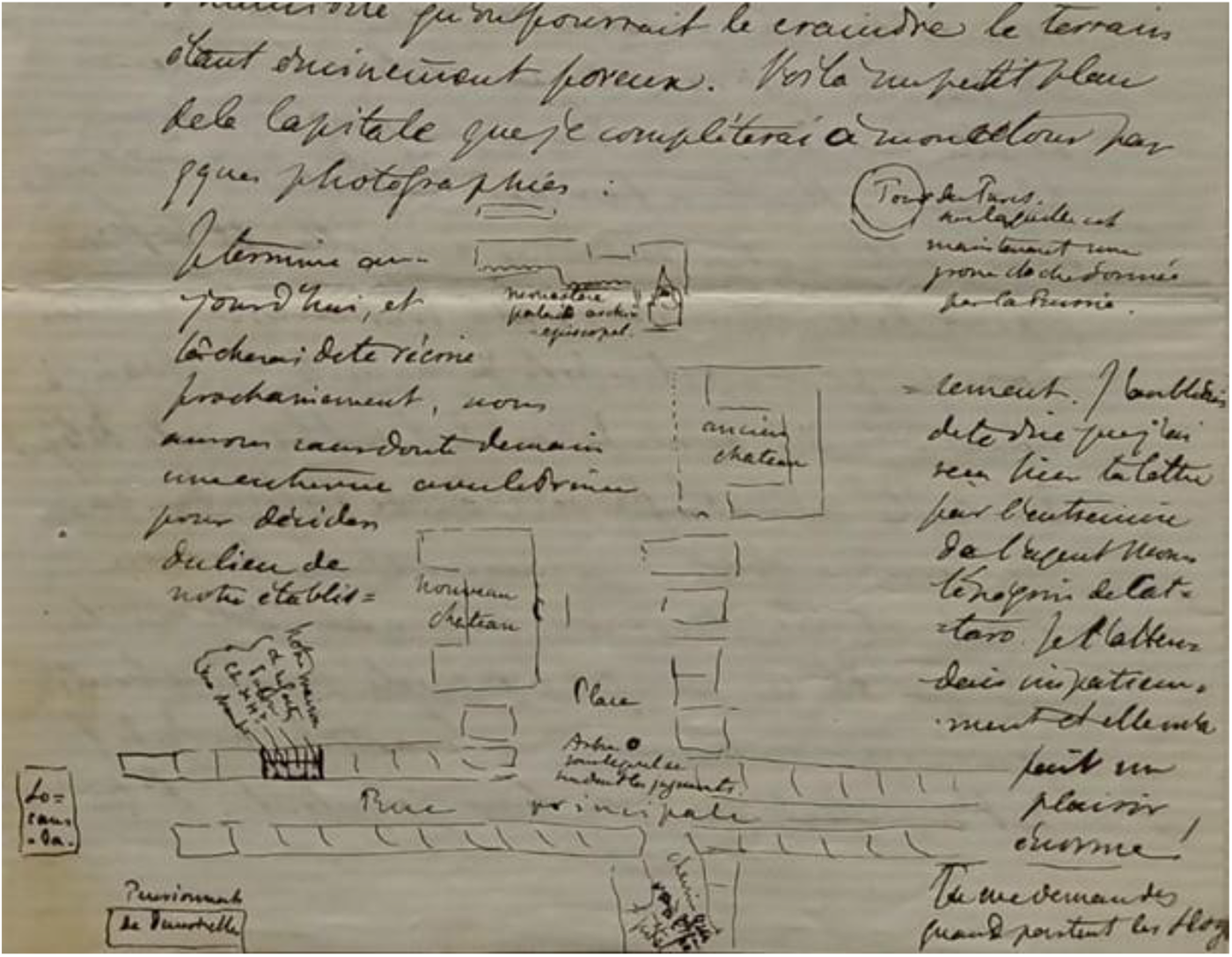
Detail from a letter by Ferrière dated 5 January 1876, including a hand-drawn map of Cetinje. ICRC Archives, P FF 03.

Two days later the delegates were received by Prince Nicholas himself, to whom they presented a letter of credence from Moynier and a red cross armband which they took “the liberty of offering to Your Serene Highness”.Footnote 42 The prince bid them welcome and expressed interest in the development of a Red Cross society in Montenegro.
The delegates were taken on several semi-official visits in the days following their arrival. The nature of these excursions suggests the Montenegrin authorities probably did not fully understand the ICRC’s mandate. On 18 January, for example, Ferrière, Goetz and Humbert were invited to visit a girls’ boarding school. A few days later, they visited the prison in Cetinje, in keeping with the eighteenth-century European tradition of carceral tours.Footnote 43 The prison in question seems to have been a Potemkin village of a sort, given the relaxed conditions that Ferrière described:
There is no need to lock the prison by day. I should add that any Montenegrin who finds himself in prison is there by order of the Prince, and an order from the Prince is such a sacred thing in this country that it suffices to remove from the prisoner’s mind not only the desire, but I would say even the idea, of escape.Footnote 44
The Montenegrin authorities appear to have seen these excursions as a way of presenting themselves in a good light and proving that Montenegro was a modern State guided by a values system and moral qualities far ahead of it time. Ferrière claimed that the death penalty had been abolished in Montenegro, for example, although he noted that other brutal means of repression persisted.
For the delegates, the visits were an opportunity to meet with various religious and secular components of Montenegrin society. At a dinner hosted by Prince Nicholas, they also met part of the Montenegrin court. The social aspect of their mission was not entirely to Ferrière’s taste; in his first letter, he wrote that he was impatient to “start taking action” and suggested that the delegates might not stay long in Cetinje, writing: “[P]erhaps we shall make for Podgorica, where there are people wounded from the fighting on the south-east border.” In his second letter, however, he remarked that while
social calls take an enormous amount of time[,] on the other hand they contribute to the success of our mission, by allowing us to actively persuade influential people to embrace the principles which it is our essential task to implant in Montenegro.
A new National Society
The primary objective of the Montenegro mission was the establishment of a new Red Cross society there. On 20 December 1875 – one week before the delegates left Geneva – the ICRC had examined an eight-point draft of statutes for the new society that was largely inspired by those of existing societies.Footnote 45 On 13 January 1876,Footnote 46 the delegates met with Mgr Hilarion, the metropolitan of Montenegro. According to Ferrière, the meeting was held in German, with two interpreters translating “into Slavic” for the clergy members:
I spoke … and explained the Convention and the Red Cross societies to these Gentlemen …. His Eminence gave most evident signs of approval and agreement. All in attendance appeared highly sympathetic to the ideas of the Red Cross.Footnote 47
In his mission report published a few months later in the Bulletin International, Humbert added that
once the matter had been made clear, the metropolitan spoke to express his warm wish that the civilizing ideas of the Geneva Convention should spread ever wider in all the countries of the world, and make headway in Montenegro in particular.Footnote 48
Two days later, the delegates met again with the metropolitan, this time accompanied by the Cetinje relief committee.Footnote 49 Ferrière presented the statutes that had been drafted in December by the ICRC in Geneva. Each article was discussed, with few objections raised. One addition was made to Article 1, to the effect that the families of wounded soldiers could also receive aid from the new society. No other corrections are mentioned in Humbert’s mission report, but if we compare the original Article 8 – concerning assistance among relief societies – against the version that was eventually adopted, amendments appear to have been made. The last sentence in the proposed draft allowed the Montenegrin Red Cross to “request support from the Red Cross Societies of neutral countries during wars in which Montenegro itself is a belligerent party, or when aiding foreign refugees”. The equivalent sentence in the adopted version is much more general and specifies neither the context nor the category of victims: “Furthermore, [the Montenegrin Red Cross] shall solicit support as needed from the Red Cross Societies of other countries.” Despite the lack of any mention of corrections in Humbert’s report, it thus appears that the discussions did produce some changes to the statutes.
The creation of the new relief society was an important victory for the ICRC – Moynier had written in an article of 29 December 1875 that it was the “essential goal of the mission”. On 10 February 1876, the Committee issued a circular announcing the creation of the Montenegrin Red Cross,Footnote 50 which was also published in the Bulletin International. This circular comprised a short timeline of the ICRC’s exchanges with the Montenegrin authorities that had led to the country signing the Geneva Convention and founding a relief society. It also included a passage which suggested that the Committee had been highly cautious throughout the process:
Our honourable correspondents know with what circumspection we have acted, whenever we have been called upon to affiliate a new society of the Red Cross; it was thus in keeping with a tradition of long date that we have sought to shed light on the conditions under which a Montenegrin society might function, before taking upon ourselves the responsibility of recommending that its sister societies welcome this young association.
This was the circular’s true purpose: encouraging the other National Societies to form ties with the new Montenegrin society and “offer fraternal assistance”. That request prompted a swift reaction from the French Red Cross, whose founder, Jean Hüber-Saladin, questioned the ICRC’s judgement in a letter dated 1 March 1876:
The Council recognizes the considerable extension of your powers at the Berlin Conference to encourage new accessions to the Geneva Convention.Footnote 51 But we wonder if this incontestable mandate requires you to impose, in a sense, the affiliation of newcomer Committees with existing societies? The word affiliation lends itself to misinterpretation. This word, so difficult to avoid, implies a bond of solidarity among independent societies which might, under certain circumstances, place them in an embarrassing position with regard to their governments or even indispose the latter towards them.Footnote 52
As Véronique Harouel has shown,Footnote 53 the French Red Cross was trying to avoid taking sides in a delicate situation: it could not directly oppose the creation of a new relief society, but it still hoped to appease the French diplomatic authorities.Footnote 54 To recognize the new society would be to recognize Montenegro’s autonomy vis-à-vis the Ottoman Empire, and the French Red Cross, intending to conform with its government’s official position, was reluctant to adopt any stance without having first received permission from the French Foreign Ministry. Moynier replied to Hüber-Saladin on 20 March 1876,Footnote 55 denying any interference by the ICRC and stating that Montenegro had claimed its right to independence and that it had freely expressed its readiness to sign the Geneva Convention without drawing any reaction from the Sublime Porte. Moreover, he wrote, Montenegro’s accession was all the more justified as the Montenegrin army did not take orders from Constantinople.Footnote 56 He stressed that the ICRC was not imposing anything on the other societies, but that solidarity among them was “desirable”:
Is the new International Committee qualified to impose, in a sense, the affiliation of new committees upon the existent? To this question, I do not hesitate to answer: no. The International Committee, since its founding, has never thought to impose anything on anyone. Even should it wish to, it could not. That solidarity which it is desirable to see practised among Relief Societies is discretionary. If for a given case, a Society feels it has good reasons to abstain from rendering assistance to others, that Society is perfectly well-founded in obeying its conscience: as we have seen in fact, during the Franco–Prussian War. It would be quite different were the Red Cross underwritten by a pact signed by all affiliated societies, then there would be formal and reciprocal commitments which they could not break without forfeiting their honour; but, under the current system, this is not the case. Each Society is absolutely free to act.
In this way, Moynier re-situated the ICRC’s role as “limited to promoting the humanitarian principles it represents, primarily in countries they have not yet reached”. The organization’s remit therefore included inviting National Societies to form “fraternal bonds” with one another. Moynier nonetheless admitted that the Montenegro mission was unprecedented in the ICRC’s short history:
It is quite true that the Committee has not habitually sent its officials into the field, as it has done for Montenegro. But would you reproach that act of prudence? Is that what you call overstepping or overzealousness? If so it would be a gross misinterpretation.Footnote 57
Moynier closed his letter by stating that the ICRC did not sympathize with either side in the conflict, and that its only goal was to grow the Red Cross. He suggested that the French Red Cross soften its stance and join other relief societies in welcoming the founding of the Montenegrin Red Cross.
Care for the sick and wounded
The ICRC had often insisted that its mandate was limited to helping sick and wounded combatants, but in the field, it proved more flexible. In a December 1875 article in the Journal de Genève, Moynier found it difficult to accept that the delegates might find themselves among victims of war “without providing any other palliative to their suffering than the distant promise of sacrifices made on their behalf by the Red Cross societies of various countries”. The health-care component of the mission to Montenegro was in fact part of the broader task of spreading the ideas of the Movement:
Of course, once [the delegates] arrive, more will be expected of them … than promises to be fulfilled far in the future, and the International Committee has understood this so well that it has instructed its delegates to make a more palpable and immediate show of solicitude in response to the suffering they encounter.Footnote 58
These rhetorical gymnastics were Moynier’s way of admitting that the delegates could indeed treat non-combatants. He was nonetheless aware of the delegation’s scant resources, and in fact, the ICRC provided much less medical aid in Montenegro than the Russian Red Cross. As noted above, the ICRC delegates had crossed paths with a Russian Red Cross team, led by Pierre Vasilchikov, while travelling to Ragusa. The twenty-one-person team had been sent to Cetinje on 26 December 1875 with enough supplies to equip about a hundred hospital beds.Footnote 59 Upon arriving in Montenegro, the “Russian ambulance”, as the ICRC called them, took over management of the hospitals in Cetinje and Grahovo and became the first medical team to wear the red cross armband in Montenegro. In an account of the mission published in 1876, Ferrière noted an interesting detail:
Their luggage is partly marked with quite misshapen red crosses. But they also say they ‘fear the Red Cross and would not wear the emblem unless in the presence of Turks.’ What were their reasons for this? We were unable to find out.Footnote 60
On 20 January, Prince Nicholas summoned the ICRC delegates to his smoking room where, according to Ferrière, he announced that the Russians would be handling the hospitals in Cetinje and Grahovo, and that the ICRC team should travel to a valley called Joupa near the border, where there were wounded people who had come from the fighting in Nikšić. Ferrière was furious: the prince had dangled the possibility that he would put Ferrière to work at the Cetinje hospital and send the better-equipped Russians to set up a field hospital closer to the areas where wounded refugees were arriving.Footnote 61
In early February, Humbert stayed in Cetinje while Ferrière and Goetz travelled to their own field hospital in Joupa. It was in terrible shape, but Ferrière was undaunted:
If one considers that we are in a place that has been invaded by the Turks a hundred times and is quite beyond the reach of post or telegraph, one must admit it has taken much pain and devotion to establish it even such as it is.
Ferrière had “some fifteen wounded and some ten sick patients, men and women” in his care, but he also decided to provide consultations for “the local inhabitants arriving in numbers from all over the Brda 3, 4 or 5 days’ hence”. Ferrière did not only treat combatants but took it upon himself to treat civilians as well, writing that “the most gravely affected at present are non-combatants, a young woman was at death’s door for two days”. The area around Nikšić did not, in fact, appear to be subject to active tensions or fighting, strictly speaking; at most, Ferrière mentions “a Montenegrin and two Turks killed at the border”. The majority of his patients appear to have sought a form of outpatient care in a place where access to a trained doctor was rare.
From this point on, Ferrière’s letters grew sloppier as his medical duties became the priority. “I have been here three days”, he wrote, “and I have seen more than 100 patients already and I [illegible] most of the day in a house where patients are brought in to me one by one.”
List of wounded patients treated by Ferrière. ICRC Archives, P FF 03.

One of the rare surgeries described by Ferrière in his correspondence was a bullet removal:
In the evening they brought us two wounded men and one dying of sickness, I immediately operated to remove the bullets, then I sutured the incision wounds, which appeared to greatly surprise the many spectators. As for the dying man, one hour later he breathed his last.
Ferrière was also confronted with the practices of local healers:
The first dressing had been made by a viechtizza (a witch). Each wound is covered with a lung from a freshly killed sheep, and the whole wrapped in the bloody skin of the same animal. The stench of this dressing is unbearable, to the extent one has the very natural impression one is choking. Under such conditions, only the medical man can remain unflinching until his task is complete.
In addition to his letters, Ferrière left a number of notes in which he lists and categorizes his patients by affliction: here, a Jakob Medjedovic, wounded on the elbow; there, a certain Nikolaw Varaic wounded in the thigh, or a Joko Jovanovic, deceased. In an undated feuillet, Ferrière lists more than sixty cases of intermittent fever, and some thirty cases of pneumonia. He was surprised to see so little conjunctivitis, as “the Montenegrins’ live amid smoke in their dwellings”.Footnote 62
Ferrière and Goetz spent most of the mission in Joupa, and Ferrière’s letters to his family during this period offer hints about the situation at the border. In early February, for example, he described an altercation in the region:
The Natchalnikest [a position roughly equivalent to a military commander] left yesterday morning for the border, and along the way they [the Natchalnikest and the people under his command] were told that 50 Montenegrins from a neighbouring village were on their way to Nikchitch [Nikšić] with the aim of [illegible] supplies. There were 20 Herzegovinian soldiers at hand from a village near the border, people who have long been very devoted to the Montenegrins: [the Natchalnikest] committed the blunder of sending them to hold back the 50 delinquents: they being offended at receiving orders from Herzegovinians fired shots at them, killing 1 and wounding 5. Last night we expected a bad business, and the whole battalion at Joupa left for the scene of the fighting. Nothing happened and after the necessary negotiations 20 individuals were shut up in a Montenegrin fortress and a telegraph was sent to Cetinje from whence a senator will surely be dispatched to adjudicate the affair.Footnote 63
Ferrière treated some of the wounded from this incident but wrote that he had to turn others away. There were two main reasons for this: some of the patients were not seriously hurt or sick, and the delegates’ stock of medical supplies was beginning to run low.
Ferrière’s letters reveal that he was considerably irritated by his patients: he calls one an “imbecile” and describes his dubious strategies for commanding their respect – a far cry from his philanthropic ideals. He was annoyed by the lack of gratitude and outright defiance he experienced, writing that “there are some who complained when we gave them powders, because they wanted ‘plaster cast’! Luckily we have our guard with us to throw them out!”Footnote 64 Despite writing several times that he felt lonely and isolated, he also took advantage of his time in Joupa to visit the surrounding countryside, go on horseback rides and participate in wolf hunts. As the mission was drawing to a close in late February, Ferrière received word from Humbert in Cetinje that Prince Nicholas hoped Ferrière would consent to prolonging his stay. Ferrière wrote that he would have gladly stayed a month longer in Montenegro, so long as he was paid by either the ICRC or the Montenegrin crown.Footnote 65 The prince’s request took more precise shape in the following days:
Humbert was invited to visit the Prince, who said: You and M. Goetz may leave but I wish M. Ferrière to stay some time longer in St Luca, and if war is declared I will wish to keep him near “my person”.Footnote 66
Ferrière was interested in the proposal, noting that “this interesting post would fill my pockets for the continuation of my studies”. But it seems his mother was opposed to the idea, and later letters make it clear that he had given it up. Ferrière and Goetz returned to Cetinje at the end of February 1876; there, they were reunited with Humbert, and all three travelled through Trieste in early March on their way back to Geneva.
Posterity and institutional memory
The first humanitarian topoiFootnote 67
While the ICRC’s first delegates faced a number of obstacles, vexations and misunderstandings of varying scale during their mission, their experience nonetheless contained important lessons for the recently established organization because it forced both the delegates and the organization as a whole to deal with instability and the unexpected – the very essence of humanitarian work. The Montenegro mission laid an essential foundation for understanding what work in the field entailed, and it gave the ICRC a better grasp on its future missions. In reviewing the difficulties faced by the delegates, it becomes clear that the same challenges could have been encountered at any time, in any context. The ICRC was thus building experience that it could draw upon when planning later humanitarian action.
The earliest difficulties that the delegates faced in Montenegro were logistical: they arrived in January, in the middle of a particularly harsh winter, which made travel difficult on several occasions and even delayed the delivery of their medical crates to Cetinje. Logistical challenges then became material ones: although the crates were too heavy for the delegates to take with them to Cetinje, the crates’ contents were also insufficient to equip the field hospital that Ferrière was trying to run. The medical and pharmacist delegates were working with limited resources in a region where advanced clinical medicine had never before been practised. On top of that, they had little support from the equivalents of today’s National Societies – as noted above, the ICRC received no tangible support from either the Austrian or Ottoman relief societies. As for the “Russian ambulance” team encountered by the delegates, there appears to have been no cooperation between the two teams at all. Worse than that, the ICRC delegates thought that the representatives of the Russian Red Cross could not be trusted, and that they gave the Red Cross a bad name and risked seriously damaging the reputation of the broader Movement. The latter fear proved unfounded during the mission, however: overall, the delegates were well received by the Montenegrin authorities, and there seems to have been no mistrust of the ICRC. On the contrary, the delegates appear to have been shown great respect – likely as part of the authorities’ strategy to present Montenegro as a modernizing country interested in the same concerns as the rest of Western Europe. The Cetinje prison visit, while not propaganda per se, should still be taken with a grain of salt; the authorities wanted to control how Montenegro was viewed by the world, and in that respect, the delegates were seen as emissaries of Switzerland, not as humanitarian workers bound by confidentiality. One episode did leave an impression on Ferrière: a voivode named Matanovich, who regularly visited the delegates during the early days of their mission, stopped coming after taking offence at an article published in the Journal de Genève. Ferrière was upset by the incident and considered the newspaper’s Ragusa correspondent to have hurt the mission “with his anti-Montenegrin articles”.Footnote 68 Controlling the media narrative around current events thus proved a challenge.
An early milestone
The mission to Montenegro can be considered the ICRC’s first field mission in terms of its diplomatic, political, medical and logistical scope. For the very first time, the ICRC had undertaken to prepare three of its representatives for a primarily political and diplomatic undertaking. The primary objective, as this article has shown, was to spread the ideas of the Red Cross and the emerging “law of war”. The founding of a Montenegrin relief society was one important outcome for the ICRC, which had lamented the total lack of support it received from the Austrian and Ottoman relief societies. But the ICRC’s engagement with the Montenegrin authorities towards establishing the new society also helped it consolidate its authority vis-à-vis the existing societies, proving that the ICRC could not only elicit the creation of new societies but also contribute to developing their statutes and policies. Although the French Red Cross reacted negatively – especially to the ICRC’s suggestion that it collaborate with the new society – the crisis soon passed.Footnote 69 In diplomatic and political terms, the ICRC emerged from the experience stronger. It was also a victory for the Movement, in that more relief societies were gradually established in the Balkans: the Serbian Red Cross was founded in June 1876 under the leadership of none other than Mgr Michel, a former member of Wesselitsky’s committee.Footnote 70
The actual humanitarian work carried out during the mission was limited, however. The care provided to wounded refugees in Montenegro was mostly seen in relation to the larger mission of spreading the ideas of the Red Cross – in other words, the medical aspect of the mission was seen as a means of supporting the ICRC’s credibility in Montenegro. The ICRC did decide, in another important development, that its delegates could treat several categories of patients, including civilians as well as combatants. The aid provided by Ferrière, Goetz and Humbert thus paved the way for a tradition of humanitarian action in the service of all people affected by war.
Did the delegates consider that their experience made them the forerunners in the emerging domain of reducing suffering amid armed conflict? The question is not easily answered. In the various sources that describe the Montenegro mission,Footnote 71 the narrative mode aligns most closely with the tradition of travel writing centred on the traveller’s discovery of a country and its customs and elites through a folkloric or – often – Orientalist lens. Although Ferrière appears to have had a philanthropic calling, his letters, especially to his family, have all the characteristics of those written by a young gentleman on his Grand Tour:
Since I cancelled the visit we have had more time and often go out in the afternoons; yesterday we went hunting but caught nothing, 2 days ago we went on a long ride on horseback with the authorities. These rides are very amusing: one goes into a plain and charges forward at full gallop while yelling, screaming, shooting one’s revolver into the air, in what could be daunting even to the most courageous of men who had never seen such a thing before.Footnote 72
Detail from a letter by Ferrière dated 10 January 1876. ICRC Archives, P FF 03.

Ferrière’s letters to his mother, written during the early days of the mission, are typical of the genre and contain observations on the local food, dress, climate and culture, as well as sketches of people the delegates had met. It is no coincidence that Ferrière later used his notes as the basis for an article about Montenegro for Le Globe.Footnote 73 Ferrière’s final letters from the mission even describe his disappointment at not being able to travel through Italy on his way back to Geneva. The letters contain little information about the victims themselves and the care provided to them; people receiving aid do not figure prominently and are reduced to an indistinct mass from which it is difficult to tease out individual stories, in contrast to the humanitarian communications strategies developed during the twentieth century. That omission aside, however, the seeds of what would become classic humanitarian themes are very much present: the difficulty of organizing a mission, compromises found with various other organizations and authorities on the ground, a lack of material resources in emergencies – all issues that the ICRC would later face and learn from as it gained in experience and authority.
This first field experience produced a few successes along with the many hazards and disappointments. The ICRC managed to create an early network of contacts, from Switzerland to the Balkans, that would prove useful during future conflicts, and on 30 June 1877, as the ICRC was considering creating an aid agency in Trieste, a number of the contacts it had made during the Montenegro mission were proposed as trusted intermediaries who might help run the new agency.Footnote 74
Return and experience-sharing
It should be emphasized that although the Montenegro mission created a network of contacts to support the ICRC’s work in the Balkans and along the Adriatic coast, its foundational action seems to have been somewhat disregarded. In other words, what did the ICRC learn from the mission? Did the Committee use what it had learned when preparing future work in the field?
Once the delegates had returned to Geneva, Humbert was asked to draw up a mission report, which was also published in the Review.Footnote 75 The aims of the report appear to have been mostly promotional, and it closes by stating that the delegates were very well received in Montenegro. Interestingly, the report does not offer any real conclusion regarding the successes or limitations of the delegates’ work in the field. There is no trace of another, more critical report on the ICRC’s activities in Montenegro among the working documents of the Committee. Despite all the difficulties that the delegates had faced, Humbert’s report does not contain any complaints, observations or even lessons learned with regard to how the mission was carried out. Reports from later missions contain observations and critiques and propose adjustments: they are intended to help the ICRC adapt its future fieldwork based on the experience. Reports are supposed to link experience to action.Footnote 76 This is not the case with Humbert’s report, which had different editorial aims. Even the idea that Goetz, Ferrière and Humbert had gained experience that gave them special expertise does not seem to have been self-evident. When the ICRC was setting up the aforementioned aid agency in Trieste one year later, in 1877, neither Goetz nor Ferrière were contacted, and Humbert’s only contribution was to say that Trieste seemed like an advantageous city for establishing such an agency.Footnote 77 Contact with the victims of war was not yet considered a source of authority when it came to fieldwork.
The delegates did seek to share their experience, however – Ferrière, for example, published several “letters from Montenegro” in the Augsburg Allgemeine Zeitung, in which he recounted the mission in instalments.Footnote 78 But the ICRC largely failed to capture any of that feedback or use it to draw lessons for the organization. Moreover, Ferrière’s articles, like his correspondence, were written more in the mode of a traveller narrating his odyssey than a humanitarian worker sharing his critical perspective on a past assignment.
Conclusion
As we have seen, the Montenegro mission left a mixed legacy at the ICRC. On the one hand, it was an important milestone that consolidated the ICRC’s place within the Movement. The ICRC had helped to establish a new National Society and had shown that it was capable of mobilizing delegates and organizing a mission under challenging circumstances. The delegates had managed to set up a field hospital in a remote part of Montenegro in the middle of winter, with limited supplies. The ICRC had also formed a network of contacts that it put to good use in 1877 amid fears of war between the Russian and Ottoman empires.
On the other hand, the ICRC apparently did not know what to do with the experience it had gained. Apart from publishing Humbert’s report in the Review, the Committee does not appear to have made arrangements for the delegates to share their experience for the benefit of future missions. This is evident given the ICRC’s administrative practices and the overall lack of documentation conserved from the mission among the Committee’s working documents. Feedback did not yet have the importance and structure that it would gain in the twentieth century; the mission to Montenegro was thus more of a milestone than a model.
The ICRC’s true operational model would be developed later, starting in the 1920s. In 1919, in what could be described as either a twist of fate or a historical irony, a certain “Frédéric Ferrière, Jr” was sent to Montenegro on a medical assignment.Footnote 79 His task? Reorganizing the hospital in Cetinje.


 Open access

