




The process of setting up new political systems in North America inherently involved what scholars have called the ‘logic of elimination’, where Indigenous polities and presences were marginalised to allow a settler-colonial perspective to flourish.Footnote 1 At the same time, from the earliest reports sent to policy-makers in London, English colonists who claimed the Chesapeake for the Crown were confronted with a sense of the vitality of the landscape and its significance to the tens of thousands of Indigenous people who already dwelled there. While initial reports such as ‘A Description of the now discovered River and Country of Virginia, with the liklyhood of ensuing ritches’, penned in the aftermath of colonists’ arrival in the spring of 1607, made their commercial aims clear, the attention to commodities was mixed with intelligence about regional herbs and Indigenous sovereignty. There was scarce what ‘we call meum et tuum [mine and yours], among them save onely the kings know there [sic] owne teritoryes, and the people their several gardens’.Footnote 2 English documents were imbued with a sense of the richness and difference of Indigenous belief systems and ways of life, even as they sought to import and impose their own polities and material sensibilities on the land.
Jamestown was established in the heart of the Powhatan confederacy, on lands its Powhatan rulers called Tsenacommacah. Even by the summer of 1607, colonists knew that the paramount ruler was ‘Pawatah’ (Powhatan/Wahunsenaca), and that the lands were maintained through his sovereign power and community-based agricultural practices. Within this region, just over a decade after Jamestown’s founding, colonists held what has become known as the First General Assembly – the first representative assembly in English/British America, inaugurated in the summer of 1619 and celebrated in subsequent centuries as the foundations for the democratic beginnings of the American nation.Footnote 3 As early as 1624, planters appeared before the Virginia Company court in London to defend their belief in the assembly’s political importance.Footnote 4 This article re-examines the assembly both through the broader context of the Indigenous Chesapeake, and through assembly members’ connections to political culture back home. As James D. Rice writes, ‘the complexities of the Chesapeake Bay region’s multisided and rapidly shifting indigenous politics in 1619 does much to explain the proceedings of the representative assembly in English America’, since various alliances, demands and forms of aid were crucial to the colony’s survival.Footnote 5 A significant challenge, however, is finding ways to tell an integrated history of political assemblies that acknowledges Algonquian lifeways on their own terms, insofar as this is feasible within the bounds of what Indigenous people have chosen to share and make known. Much of the proceedings of Powhatan assemblies remained opaque to English colonists, who built up ideas of Algonquian political organisation, hierarchies and processes of negotiation at a remove.
While colonial assemblies are often investigated in comparison to other European assemblies or in terms of their conflict or cooperation with monarchical authority, they must also be seen as processes of negotiation undertaken within other political contexts and ongoing Indigenous self-governance, closely tied to the land on which they were held. Rather than focus on the particular debates and disagreements within the General Assembly of 1619, this article examines the broader environment or political landscape in which this assembly took place, exploring how material culture such as deerskins and ruffs can shed light on processes of negotiation and political intent between English and Algonquian political actors. In the absence of direct Algonquian voices in much of the English colonial archive, material belongings and remains help centre Indigenous voices and offer one means of centring Native agency and political control. They encourage a way of seeing that pushes back against the ‘logic of elimination’.
The first section lays out the political organisation of Powhatan Tsenacommacah, examining Indigenous forms of assembly through the reliance on spiritual advisers, the role of Powhatan women, and the significance of cultural belongings in accessing and transmitting power. The second section examines how gentlemen’s attitudes to land and objects informed how they sought to establish civil order. In the absence of purpose-built halls and council chambers, portable objects in the colony’s early years became important to colonists’ attempts to maintain connections and continuities with political assemblies back home. A third section makes a case for why seeds and plants are valuable sources for understanding English plantation politics while simultaneously allowing for a greater focus on Indigenous presences. More specifically, regarding embroidered skins and seeds as Indigenous texts can help offer a more expansive archive of the political history of assemblies, one that includes and looks beyond paper trails. Such sources can help resist the idea that Indigenous people have ‘cultures but not political histories’, showing how material embodiments of spiritual and temporary authority offer a multilayered notion of assemblies and the exercise of power.Footnote 6
Deerskin and ‘Indian … places’: the view from Tsenacommacah
English colonists recognised that Algonquians lived in distinct political organisations. Tens of thousands of Native people lived in the settlements dotting the Chesapeake’s many waterways.Footnote 7 The English recognised Wahunsenaca as the chief male ruler or werowance, but they were equally aware of other groups and polities dwelling in these lands, within and beyond Wahunsenaca’s reach, that formed ‘an intricate web of relations encompassing dozens of nations’.Footnote 8 The possibilities of different alliances emerged from a whole constellation of tribally specific ambitions, concerns and defences.Footnote 9 As Jamestown’s one-time secretary, William Strachey, noted, there were ‘many severall nations of sondry Languages, which envyron Powhatans Territories’, from dozens of Algonquian groups to the Susquehannocks (Iroquoian) and Monacans (Siouan).Footnote 10 The woodlands, cornfields and coastlines the English charted were not timeless landscapes, unchanged until European intervention, but ‘memoryscapes’, as Christina DeLucia writes, ‘geographies bearing layers upon thick layers of meanings, accessible to and transmitted by Indigenous past-keepers’, ‘emotionally infused, politically potent places’.Footnote 11
Over the previous few centuries, the Chesapeake had become a space of prolonged conflict with the rise of paramount chiefdoms. Unlike Indigenous groups in other parts of what the English loosely termed ‘Virginia’, stretching from Roanoke to what would become New England, powerful werowances in the Chesapeake ‘used their authority to exact tribute … [and] compel men to go to war’, actions that in other tribal societies would require ‘an almost impossible degree of consensus’.Footnote 12 In villages and chiefdoms, small towns of household groups were ruled by local werowances, and inheritance among ruling families was frequently traced through the female line.Footnote 13 The capital settlement, Werowocomoco, situated on the present-day York River, served as an important spiritual and political site for Wahunsenaca’s consolidation of power.Footnote 14 Some nations, such as the Chickahominy, lived within Tsenacommacah but challenged Powhatan sovereignty and remained independent.Footnote 15
In Tsenacommacah, material culture served as an important connection between landscape and spiritual and temporal power. Werowances operated in ‘redistributional societies’ with a ‘prestige-goods economy’.Footnote 16 Political subordinates offered deerskin, beads, copper, maize, and pearls as tokens of loyalty.Footnote 17 Negotiations were conducted through rituals of hospitality and diplomacy. ‘If any great commander arrive at the habitation of a Werowance’, John Smith wrote, ‘they spread a Mat as the Turkes doe a Carpet for him to sit upon another right opposite they sit themselves … After this doe two or more of their chiefest men make an Oration, testifying their love.’Footnote 18 The aristocrat George Percy wrote of how the werowance of Rapahannock wore a ‘[c]rown of Deares haire coloured red … and a great plate of Copper on the other side of his head, with two long Feathers … his eares all behung with Braslets of Pearle’. The werowance’s self-fashioning, and the importance of materials in displays of sovereign power, were not lost on Percy: ‘he entertained us in so modest a proud fashion, as though he had beene a Prince of civil government’.Footnote 19 While admiring aspects of Indigenous craft, the English also benefited from this tribute system, trading large quantities of beads and copper to become important economic agents, even as they remained militarily weak.Footnote 20
The value of prestige goods was partly in the way they connected their holders to spiritual worlds beyond. Copper and light-refracting beads were ‘literally otherworldly’, serving as gifts from guiding spirits.Footnote 21 Members of a werowance’s inner circle included shamans who possessed spiritual authority that mattered to Algonquian politics, since they could intervene on behalf of the gods in times of war, sickness or natural disasters. ‘When they intend any warres’, Smith wrote, ‘the Werowances have the advice of their Priests and Conjurers, and their allies, and ancient friends, but chiefly the Priests’.Footnote 22 As Linwood ‘Little Bear’ Custalow and Angela L. Daniel ‘Silver Star’ write, the ‘political structure in the Powhatan nation was balanced between the werowances, secular chiefs, and the quiakros, the Powhatan priests. The quiakros held the power to accept or reject proposals made during the council … the quiakros had the final word.’Footnote 23
The English were aware of the close relationship between quiakros’ spiritual and temporal authority, and the way that material remains offered ways of accessing power within communities. When the shaman Uttamatomakkin travelled to London in 1616 as one of Pocahontas’ companions, he was recognised as one of ‘Pohatans Counsellours’.Footnote 24 Though the shamans were often compared to devil-worshippers and Catholic priests in Protestant rhetoric, the English recognised the political significance of such council members. Shamans guarded the ‘temples’ (quicosin) that housed the bones of deceased werowances, which perhaps explains why James I advised Yeardley to target shamans’ bodies and dwellings. Even as settlers at the assembly discussed establishing a school for Algonquian children, the reverend Jonas Stockham advised against lenience. ‘I am no States-man’, he wrote, but ‘I can find no probability by this course … till their Priests … have their throat cut’.Footnote 25 The Protestant concern over religious orthodoxy may have been used to justify the English desecration of Algonquian spiritual sites, including graves.Footnote 26 But the vehemence against shamans also implies that the English recognised that the spiritual element of assemblies was vital to Native political organisation.
While many Algonquian resources and cultural belongings were taken or destroyed, surviving artefacts within and around Tsenacommacah are part of the material archive of early seventeenth-century councils, important for interpreting Algonquian ideas about power and kinship on their own terms. ‘Cultural belongings’ is used here to emphasise the connectedness of material remains to Indigenous histories, ceremonies and memory-keeping. Viewing materials such as sassafras, woven turkey feathers or tobacco as inert matter cuts them off from the ceremonies and songs that were bound up in them. As DeLucia has written of Indigenous belongings displayed in settler museums, these artefacts have long been divorced from their places and communities of making, but ‘alternative accountings’ make it possible to see ‘Indigenous histories … radiating out [from these sources]’.Footnote 27
The material culture of assemblies can be used to acknowledge other relationships to landscape and sovereignty than those recognised in the legal and political histories formed in the ‘most convenient place’ of Jamestown. Little is known about ‘Powhatan’s mantle’, currently held at Oxford’s Ashmolean Museum. It may have featured in a series of diplomatic exchanges with Christopher Newport in 1608, or been taken from an Algonquian village in ensuing years.Footnote 28 Though its context of making remains unknown, it has been interpreted as a map or diagram of Powhatan political organisation, its clusters of circles and two animals surrounding a human figure taken to represent the groups within Powhatan’s chiefdom.Footnote 29 The size of the two animal figures are roughly equal to that of the human, suggesting (with the skin itself) the vitality and importance of the other-than-human in Powhatan sovereignty.Footnote 30 Crafted from tanned buckskin and decorated with an estimated 20,000 shells stitched with sinew, this deerskin offers an index to political authority that counters English maps of the time.Footnote 31
Attempts have been made to match this mantle with the Tradescant inventory of the mid-seventeenth century, which includes ‘Pohatan, King of Virginia’s habit all embroidered with shells, or Roanoke’.Footnote 32 Whether these artefacts are the same, embroidered deerskins provide an example of the many cultural belongings that framed exchanges between English and Algonquian political actors. Other items in the inventory, such as a raccoon-skin ‘[m]atch-coat of Virginia’ and a ‘Virginian habit of Beares-skin’ become part of the Anglo-Indigenous material archive.Footnote 33 In their labels and cataloguing, colonial leaders and chroniclers engaged in acts of cultural and linguistic translation that served to diminish the potency of skins and their ceremonial uses. In translating embroidered skins into ‘habits’ and ‘mantles’ – terms that tended to describe everyday wear, including the garments and styles of the Gaelic Irish, whom the English had long worked to colonise – settlers reduced material embodiments of Indigenous power to lifeless things. This was evident in Christopher Newport’s quite literal aim of divesting Wahunsenaca of his sovereignty in the coronation ceremony that sought to turn the paramount chief into James I’s vassal. In Smith’s description, Wahunsenaca received a ‘scarlet Cloke and apparell with much adoe put on him’, while expected to relinquish his ‘mantell’. But ‘foule trouble there was to make him kneele to receive his Crowne’, for Wahunsenaca refused to bend one knee in a gesture of subservience.Footnote 34 Given the Powhatans’ ongoing refusal to submit to English power, the deerskin may have been intended as a gift that countered English claims to the land.
Mantles connect women to Algonquian political organisation in varied ways. Made from an abundance of costly materials, the mantle would have been the end result of a series of deliberations and labour, from consulting quiakros to hunting animals and preparing the skin. While hunting animals tended to be the remit of men, preparing and sewing skins was women’s work, requiring demanding and varied physical labour.Footnote 35 Sourcing shells and making and distributing beads underpinned the Powhatan trade, tribute system and harvest ceremonies that helped maintain social cohesion and prosperity.
The inheritance of a chiefdom generally went to men through the female line, and there are later examples of younger siblings, including women, in parts of eastern North America who ruled on a town or village level within larger confederacies. In the second half of the seventeenth century, the English recognised Cockacoaeske, a Pamunkey werowansqua (female chief) and descendant of Wahunsenaca and his brother Opechancanough, as ‘queen’ of Pamunkey.Footnote 36 In 1676, the colonist Nathaniel Bacon committed a political act by stealing her dyed, pearl-embroidered ‘rich deer match coat’. Red puccoon communicated political and spiritual power ‘and visually represented women’s gathering of this plant relation and subsequent dye preparation’, and such garments ‘had been a mark of prestige in leadership politics in Tsenacommacah for almost a hundred years’.Footnote 37 In her study of Cockacoaeske’s signing of the 1677 Treaty of Middle Plantation, Hayley Negrin argues for Powhatan women’s direct involvement with treaty-making and warfare throughout the seventeenth century.Footnote 38 Smith noted that Powhatan women were present in moments of cross-cultural diplomacy and deliberation. When Ralph Hamor visited Wahunsenaca after the first Anglo-Powhatan war, the werowance ‘commanded all out of the house, but onely his two Queenes, that always sit by him’.Footnote 39
Marriage alliances, especially to paramount chiefs, further gave women political and social authority. These alliances were not ‘marriages of love, but of politics and agreement’ – temporary arrangements that served to ‘infuse all the tribes with blood from the primary leader and to provide relational ties and obligations’.Footnote 40 This element of Algonquian politics is significant for understanding why Powhatan might have offered his beloved daughter, Pocahontas/Matoaka, to John Rolfe for marriage in 1614.Footnote 41 Such a decision marked the result of an Algonquian assembly at work, as did many of the high-stakes decisions surrounding Pocahontas’ kidnapping, marriage and voyage to England. According to Mattaponi oral history, the Potowomacs called an emergency tribal council meeting after Samuel Argall demanded that their leader, Japazaw, deliver Pocahontas to the English; and Wahunsenaca chose not to retaliate after the English abducted his daughter out of concern for her life.Footnote 42 Although Wahunsenaca’s quiakros used assembly gatherings to urge him to seek revenge, these were also where Wahunsenaca convinced them to prioritise her safety.Footnote 43 Such deliberations actively shaped the Anglo-Powhatan peace that developed from the mid-1610s after years of war. From this perspective, the assembly of 1619 in Jamestown church was one of many to take place on Indigenous lands, and may only have been possible because other assemblies had first agreed on a policy of peace.
Portable objects and the first general assembly
Since its establishment in 1607, through famine, disease, frosty winters, and conflict and cooperation with surrounding Algonquians, the fate of Jamestown wavered from seemingly secure to disastrously precarious and back again. During this time, ad-hoc councils to appoint new governors or draft ordinances were held on board ships or in gentlemen’s dwellings. From 1609 to 1612, colonists were ruled by martial law. Following Pocahontas’ marriage to Rolfe, Anglo-Powhatan relations improved, but conflicting attitudes towards land management caused deep rifts among colonists and London councillors. In the later 1610s, acting governor Samuel Argall and his associates sought to divide Tsenacommacah into private estates modelled on England’s great houses. The parliamentary faction of the Virginia Company, led by Edwin Sandys, rejected private estates in favour of corporate boroughs, managed by civic regulation.Footnote 44 It was after the Sandys faction wrested control over the Virginia Company in 1619 that Yeardley was elected governor and charged with establishing a representative assembly in Tsenacommacah. Through these disagreements, the material lives of Jamestown’s gentlemen demonstrate how members of the 1619 assembly sought to establish a semblance of the elite sociability they were accustomed to in England, using portable goods to foster fantasies of the civil life and connections to Parliament back home.
For the Sandys faction and its opponents, Yeardley’s arrival as governor seemed to usher a new phase in the colony’s development. Sandys instructed Yeardley to shift towards a model of municipal corporation, with the assembly ‘intended as a forum of debate’.Footnote 45 White women were considered essential to this project, for ‘in a newe plantation it is not knowen whether man or woman be more necessary’, and Sandys believed that women were key to ensuring men settled down long term.Footnote 46 The charter conferred a renewed sense of legitimacy to the colonial project by emphasising the colony’s ties to London, while electing burgesses functioned to curb ‘popular libertie’. As one anonymous 1623 Virginia Company put it, allowing ‘the lowermost order chooseing their governours out of the uppermoste’ kept ‘the command of the forces aloft’.Footnote 47
The ‘great charter of privileges, orders, and laws’ that the Virginia Company appointed Yeardley to bring to the colony made it ‘the first experience of a plantation with a written constitution’.Footnote 48 The assembly, Smith reported, was ‘allowed by the state in England, in the nature of a Parliament’.Footnote 49 Those assembled met as a single body, consisting of the governor, his four councillors and twenty-two elected burgesses, and they met with the instructions to ‘establish one equal and uniform government over all Virginia’ and introduce ‘just Laws for the happy guiding and governing of the people there inhabiting’.Footnote 50 The decision to meet in the church in James Fort was attributed to convenience, but beginning with the Oath of Supremacy and a prayer led by the chaplain Richard Buck also reinforced the relationship between Protestant orthodoxy and political stability. Over the course of the five days, from 30 July to 4 August, councillors discussed commerce, moral behaviour, religion, inheritance rights, the transport of servants, social deviance, Anglo-Powhatan relations and building a school for Indigenous children.
The 1619 proceedings convey a sense of the unstable power relations between the English and various groups in Tsenacommacah. The minutes contain Algonquian names and places. Councillors heard complaints about captains trading for maize in the Chesapeake Bay, where men ‘had made a hard voiage, had they not mett with a [Canoe] coming out of a creeke’, and instances when ensigns forcibly took maize at gunpoint in a breach of Anglo-Algonquian diplomatic relations.Footnote 51 Though the council attempted to draw boundaries between their plantations and ‘Indian townes, habitations or places’, such demarcations were not easily drawn in practice.Footnote 52 Rules were established to prevent settlers trading ‘into the baye, either in shallop, pinnace or ship’, and none must ‘force or wrong the Indians’.Footnote 53
As Holly Brewer argued in reference to the Caribbean, there was never a single way of understanding political power among English colonial elites, since they were fiercely competitive and ‘enmeshed in elaborate power structures and legal orders that stretched into England’.Footnote 54 The tradition of dissent came partly from their involvement in deliberative assemblies at home, where disagreement, faction, and arguments were common.Footnote 55 Diaries and libels catalogued contentions and dishonourable behaviour, while James complained about the ‘flattering speeches’ and ‘vain questions’ that were used to advance contrary opinions: ‘After you talk so long of union, in all this long session of Parliament, you rise, without agreeing upon any particular.’Footnote 56
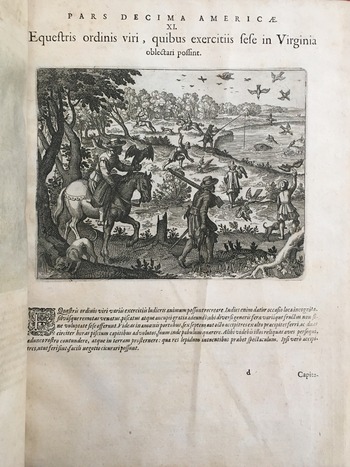
The highly contested nature of political power that had existed from Jamestown’s founding is partly what made the social practices of the colony’s leaders so vital to maintaining at least a semblance of order. The gentlemen who sat in the church in 1619 used a shared concept of the vita civile, or participation in the civil life, to create, however precariously or artificially, a sense of English civility, with its rules around decorum, hospitality, and pleasure. Theodor de Bry’s engraving (Figure 1) of English Virginia, printed the year of the assembly, neatly captures these fantasies of gentlemanly sociability, played out thousands of miles from home.Footnote 57 Here, colonists inhabit a wooded landscape teeming with fowl, where they can fish, hunt, and ride horses, living an idyllic life of gentry leisure on Algonquian homelands. The image is fanciful, but it depicted the kinds of gentlemen whom colonial promoters such as John Smith and William Crashaw criticised for expecting ‘[s]tately houses’, ‘costly apparell’, ‘rich furniture’ and other ‘pleasures’.Footnote 58 For these gentlemen, projects to turn Indigenous lands into hunting grounds and estates were central to the ‘civilising’ project, inextricably connected to land management and political authority in England.
From Theodor de Bry, Americae pars decima (1619), collected in the papers of the customs official Thomas Milles. Folger Shakespeare Library/Public domain (CC BY-SA 4.0).

Surviving objects from Jamestown’s first decades indicate the importance of clothing, jewellery and tableware in connecting political culture in London and the Chesapeake, at a time when the elite lacked the means of expressing their status through architecture, or through the heraldic devices or portraits that might hang in Jacobean interiors to articulate lineage and state service. Venetian glassware, Chinese porcelain, and signet rings mix in the soil alongside corn cobs and roanoke beads. The earliest surviving inventory of a gentleman’s estate in Virginia is that of the MP George Thorpe, who died in 1622. Thorpe’s estate contained valuables including silverware, pillows, a mohair robe, calico and the black velvet clothing that characterised the well-heeled politician, even if the notary admitted that these were now ‘quite out of fashion’.Footnote 59 Such goods evidenced Thorpe’s access to networks of global trade, from Asian textiles to silver, long extracted from the mountains of Europe but increasingly obtained in the vast silver mines of Potosí.
Archaeologists have found five goffering irons in Jamestown, suggesting that, as in de Bry’s engraving, gentlemen may have sought to dress more formally than the humid weather of the Chesapeake required.Footnote 60 The goffering irons support the possibility that ruffs were worn at the formal occasion of the assembly, perhaps to imitate political assemblies in London and to reinforce the status difference between council members and plantation labourers. From their arrival in North America in the 1580s at Roanoke, the English had been associated with their eye-catching clothes. For a time, the English believed the lands of Ossomocomuck were called ‘Wingdanacoa’, until Walter Ralegh learned that wingandacon was a comment on the newcomers’ ‘good clothes, or gay clothes’.Footnote 61
As large, bulky tools, goffering irons signal the labour behind such seemingly impractical acts of elite self-presentation. The process of starching, ironing and fastening the linen used in ruffs required servants and could take hours. Long-standing critiques of ruffs made by moralists in London reinforced the politics of such display. They lamented the amount of fabric needed even for simple pleats, and condemned the use of starch, made from wheat, to stiffen ruffs, which could be used to feed the poor. The same men who wore linen and lace neckwear did so in the midst of widespread hunger and bouts of famine, while ordering Algonquian crops to be razed during times of war, and profiting from raids on burial sites in search of pearls and copper.
Significantly, the vast majority of tobacco pipes found in gentlemen’s plantation sites are white clay pipes, rather than the elbow-shaped terracotta pipes made by Algonquians.Footnote 62 In George Sandys’ plantation, for example, around 96 per cent of surviving pipe fragments were imported. In the contact zone of the Algonquian Chesapeake, English gentlemen seemed to prefer to smoke their own plantation-sourced tobacco using pipes made from white clay, manufactured in Westminster and exported to Virginia, than to rely on local clays and firing techniques.Footnote 63 Taken together, the archaeological record offers clues as to how gentlemen at the General Assembly sought to project their authority even in seemingly minute or quotidian ways. Beyond convenience, relying on ruffs and white clay pipes demonstrated their ongoing connections to English society and its values.
Seeds and the archive of political assemblies
In addition to manufactured and imported items, plants were crucial to how political ideas were expressed and carried out. Viewing seeds as archival fragments opens up additional perspectives on colonial self-fashioning and political decision-making, while acknowledging their value as Indigenous sources that offer counter-narratives to those held by colonial administrators.
One such administrator was John Pory, Yeardley’s secretary, who became first Speaker of the Virginia assembly. The widely travelled Pory had served in Parliament and was familiar with how deliberative assemblies were structured and functioned. His letter to the diplomat and state secretary Dudley Carleton, written at the end of September 1619, made light of the colony’s instabilities while seeking to establish himself as a landholding gentleman, involved with the realm’s political affairs abroad.Footnote 64 Writing in the weeks after the assembly, he opened his letter with a note on the vulnerability of the plantation and the significance of his own responsibilities within that fragile ecosystem. ‘Here (as your lordship cannot be ignorant)’, Pory wrote, ‘I am, for faulte of a better, Secretary of Estate, the first that ever was chosen.’Footnote 65 His assembly reports appear to have been circulated in London after Carleton received them in the Netherlands. In February 1620, the letter-writer John Chamberlain wrote to Carleton, saying he had ‘received yo[u]r letter’ but ‘not yet perused Mas[ter] Pories parlement business’.Footnote 66
Although expressing a sense of disconnection from European courts, Pory’s letter focused on the civil pursuits he might enjoy in the ‘wilderness’ he now inhabited.
Vines here are in suche abundance, as where soever a man treads, they are ready to embrace his foote. I have tasted here of a great black grape as big as a Damascin [damson], that hath a true Muscatell-taste; the vine whereof now spending itself to the topps of high trees, if it were reduced into a vineyard, and there domesticated, would yield incomparable fruit.Footnote 67
Pory’s interest in grapes and vine-growing evoked the culture of classical estate management and contemporary courtly tastes. The image of vine tendrils ‘embracing’ the planter promised colonial abundance while perhaps appealing to domestic projectors who had seen James and Anna of Denmark’s experiments with vines and mulberry trees at Oatlands Palace. In a letter written to Sandys the following year, Pory professed to have ‘tasted some grapes here as good as in Greece or Italy’.Footnote 68 Describing what he saw as the disorderly landscape beyond the bounds of English settlements, Pory connected cultivation to refined sociability. Planting was about engendering culture as well as managing nature.
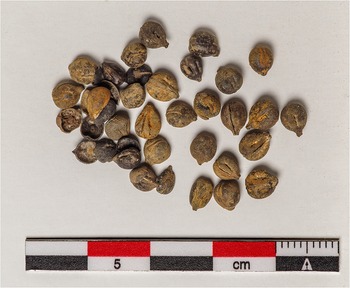
Pory’s lengthy discussion of vines and grapes demonstrates how plant cultivation played a role in gentlemanly conceptions of plantation life (see Figure 2). Another particularly prominent example is tobacco. Scholars have long been concerned with how a plant cultivated and used by Indigenous peoples across the Americas became transformed into a global commodity.Footnote 69 Not only did botanical experimentation provide the foundation for Virginia’s plantation economy, but it became a vital part of parliamentary debates about the colony’s relationship to the English state.Footnote 70 In 1621, debates in the House of Commons over the tobacco trade brought leaves and seeds into discussions of state politics and finance. Henry Poole wanted to ‘pull [tobacco] up by the roots’ and banish it altogether, while Edward Sackville believed the plant was ‘[f]it for us to study a way to enrich our own state’.Footnote 71 The agriculture of Virginia informed the politics even of those gentlemen who never planned to become colonists themselves. Deliberations in assemblies on both sides of the Atlantic about tobacco were, as Sackville put it, important to ‘our state’.
Grape seeds from the Jamestown site (possibly the seeds known by Algonquians as messamins). By kind permission of Jamestown Rediscovery Foundation/Preservation Virginia.

In the Chesapeake, Algonquians’ agriculture, notably maize, became a vital source of English sustenance, becoming central to colonists’ decisions to conduct trade or wage war. Jamestown’s archaeobotanical remains, including maize cobs and pumpkin seeds, indicate the extent to which colonists relied on Algonquian harvests for their survival. In the First General Assembly, council members ordained that every householder experiment with ‘Indian’ hemp and English flax, and ‘yearly plante and maintain ten vines’ until they had ‘attained to the art and experience of dressing a Vineyard either by their own industry or by the Instruction of some Vigneron’.Footnote 72
The instruction of French Huguenot vine-growers operated alongside Indigenous expertise. In 1615, Ralph Hamor wrote of the Chesapeake ‘yeelding without art or industry so many fruits’, as if without human intervention. However, Algonquian words were scattered throughout his botanical writing, signalling the multilingual presence of Indigenous interpreters and go-betweens.Footnote 73 Smith acknowledged that while some vines seemed to ‘beare but few grapes’, Algonquian cultivators knew how to encourage their growth: ‘[b]y the rivers and Savage habitations where they are not overshadowed from the sunne, [the vines] are covered with fruit’.Footnote 74 Smith’s chronicle contained multiple references to colonists’ dependence on Algonquian food knowledge and stores. In the ad-hoc councils and assemblies that met prior to the General Assembly, authorities discussed military defence but also foodways. The ability to enjoy the offerings from ‘[t]hese fertile Isles’ and the region’s many life-sustaining cornfields were irrevocably connected to admissions that the ‘Salvages often visited us kindly’, bringing sustenance that was necessary for immediate survival and for the longer-term plantation successes that would make English political expansion possible.Footnote 75
While gentlemen discussed the acquisition of seeds and the properties of plants in assembly reports and letters, an attention to botanical remains also illuminates Indigenous conceptions of sovereignty and storytelling. As Marcy Norton argues, scholarly notions of the ‘Columbian Exchange’ have often served to obscure Native ontologies, prioritising an understanding of the transatlantic exchange of goods in ways that inadvertently adhere to early modern narratives of progress and civility, with little regard to the political, economic or spiritual contexts of how animals or plants were understood by Indigenous peoples.Footnote 76 Within Tsenacommacah, werowances consolidated their authority by exercising control over systems of food distribution. Algonquians preserved roots, seeds, and nuts underground, storing, gathering and planting seeds in complex systems of agricultural development and processing.Footnote 77 Then as now, seeds were a collective inheritance, used to nourish and sustain generations, cared for by households and shared within lineage groups who worked with their tribal councils.Footnote 78 In gathering plants along the Chesapeake’s rivers and marshlands, Powhatan women’s environmental knowledge was crucial to this system.Footnote 79 Seeds, Megan Peiser writes, ‘hold stories; and songs, dances, histories, and folklore’; they are ‘Indigenous texts, Indigenous archives’.Footnote 80 Settlers’ attempts to exploit Indigenous knowledge and to control seed and plant access was an issue of sovereignty as well as narrative control.
Conclusion
Often, council records present the end point in a series of negotiations. In the case of the First General Assembly, these were influenced by numerous pressures and individuals, including Virginia Company instructions, ties between council members and leading members of Parliament at home, and ongoing interactions with Algonquians in their ‘Indian places’. The landscape and presence of other actors and entities informed debates and regulations. Indigenous people moved through Jamestown and were mentioned in the proceedings, if not present in the church itself. English women were perhaps ‘more necessary’ than men, in Sandys’ words, to building a society founded on the patriarchal microcosm of the household, particularly in 1619, when the prospect of the failure of the colonial project still loomed large. In the weeks following the assembly, Rolfe reported a letter to Sandys about the proceedings that Yeardley had bought some twenty Africans (now believed to be between twenty-eight and thirty-two Angolans) from English privateers.Footnote 81 One of the women, known only as Angela, lived in the household of the planter William Pierce, where she helped cultivate and gather fruit.Footnote 82 The council’s expectation that planters run trials to diversify crops depended on the labour and experimental knowledge of both free and enslaved women, even if such women were not afforded a public voice in the gatherings.
Archaeological remains show how portable objects were important to assembly members’ memories of political participation back home. Goffering irons and London-manufactured tobacco pipes were important means through which gentlemen sought to align themselves with land-owning sociability and political culture back home. Such objects shaped behaviour and informed the practice of politics, especially in the absence of purpose-built spaces. At the same time, just as wampum has been seen as a key material in reconstructing European-Haudenosaunee political assemblies and exchanges, Powhatan cultural belongings shed light on Indigenous lifeways and expressions of sovereignty that existed alongside the English reliance on imported things.Footnote 83 As gentlemen planters, thousands of miles from the House of Commons, attempted to establish English forms of governance, Algonquian political structures continued to play a part in directing and framing these encounters. The Narragansett word kekuttokâunta, as one language dictionary of the seventeenth-century recorded, meant ‘let us speak together’ – an invitation, or a plea, that was critical to negotiations across Turtle Island, but is equally important to conducting scholarship in the twenty-first century.Footnote 84
To Pory’s friend, the poet and churchman John Donne, the material world of houses, churches, and ships served the evangelical project of conversion and assimilation. ‘God taught us to make Ships, not to transport our selves, but to transport him’, Donne pressed, in a sermon for the Virginia Company in 1622.Footnote 85 Through oceanic travel and a commitment to the colonial project, you ‘shall have made this Iland, which is but as the Suburbs of the old world, a Bridge, a Gallery to the new’.Footnote 86 Englishmen who had spent time in Tsenacommacah, however, conveyed complex systems and worldviews that appeared alongside, but were not erased by, English ways of seeing. Strachey’s dictionary, with its rows of words and phrases, slipped from English to Algonquian, Algonquian to English. Nussaandg, elder. Seeds, amenacacac. A king or great lord, wiroance. The ships go home, uppoushun, mushower.Footnote 87 Compared to the multilingual world presented by Strachey, Donne’s architectural image of a Renaissance gallery connecting the ‘old world … to the new’ is elegant, but restrictive. While such imagery establishes a connection, perhaps even a two-way influence, between those who encountered each other within these imagined passages or promenades, it obscures the ‘dreams and knowings from [Native] ancestors’ that circulated in Anglo-Indigenous relations, too.Footnote 88 The ongoing work of recovering multiple histories and voices requires interdisciplinary, multilingual, more-than-human approaches. Roanoke beads and seeds as repositories of memories might become part of the larger archive of seventeenth-century political culture alongside parliamentary diaries, letters, ordinances and rhetorical handbooks. A material approach to political assemblies brings those ‘dreams and knowings’ into the council chambers, plantations, and negotiations made between the English and Algonquians, in the 1610s and beyond.
Acknowledgements
The author would like to thank Stephanie Pratt and the anonymous reviewers for their generous comments on drafts of this work, and to the organisers and fellow participants of the ‘Parliamentary Culture in Colonial Contexts’ workshop at Jesus College in September 2023 for their conversation and feedback.

 Open access

