

Location of Isfahan, Iran.

Introduction
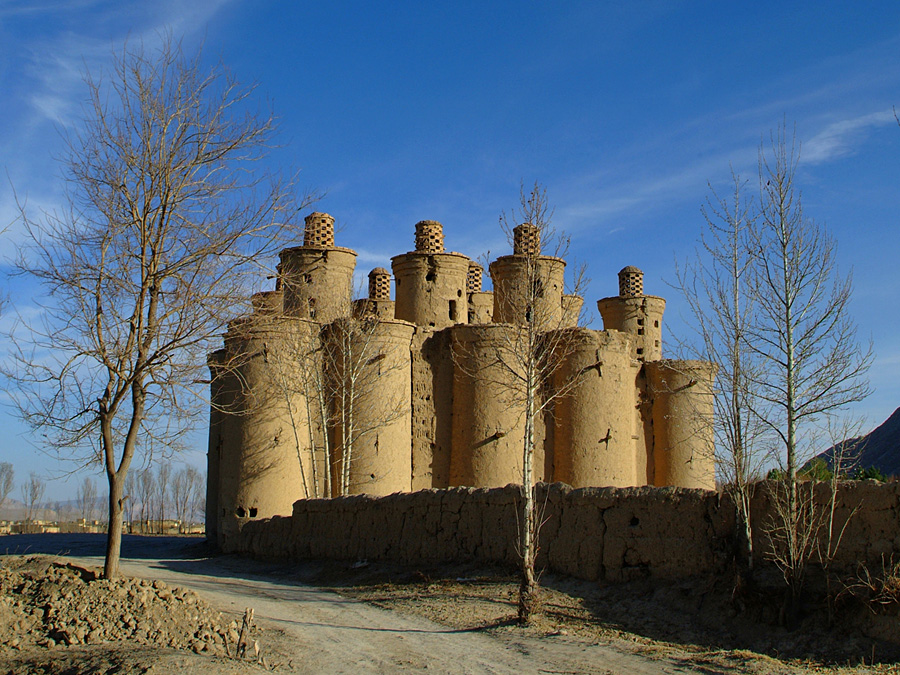
Tall towers punctuated with numerous holes are traditionally interpreted in Iran as pigeon towers or dovecotes, and hundreds of them dot the fields in the vicinity of Isfahan (Figures 1 & 2). The towers are built of clay and are thought to date back about 700 years (Reference DamirchiDamirchi 2004: 43). As well as hosting pigeons, the towers played an important role in sustaining the land as repositories of pigeon dung (Reference MirzaieMirzaie 2002). Pigeon dung was used for fertilising agricultural lands and for tanning (Reference MatthewsMatthews 1951) and thus constituted an important source of local revenue.
Typology and design
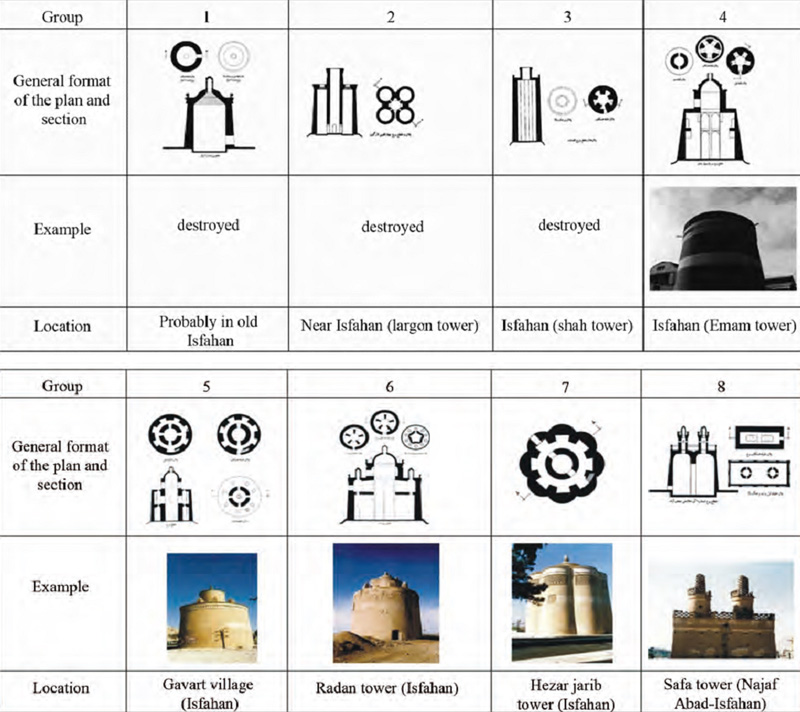
Some of the varied types of dovecotes recorded to date are summarised in Figure 3. New surveys (Reference HadizadehHadizadeh 2006: 167; Amirkhani et al. 2009) have set out to improve the typology and dating. Most of the pigeon towers appear to have been built during the Safavid era (AD 1400-1700).
Isfahan: a landscape of towers. (Photograph: Khodarahmi 2005).

Different kinds of pigeon towers in Isfahan (Amirkhani et al. 2009: 181).

Location of the dovecotes at Ejgerd (http://www.GoogleEarth.com).

The cluster illustrated in Figure 4 represents a recently recorded important addition to the corpus. It is located at the village of Ejgerd (32° 31' 15" north, 51° 31' 33" east). The design of these dovecotes has been elucidated in some detail (Figure 5). Our research recorded a number of attributes likely to be important for the use of the towers and their evolution.
Material The construction material was generally clay or adobe, abundant in the region, but brick, lime plaster and gypsum were also used. Sundried brick cannot remain intact for much more than 100 years without reconstruction, so the towers as we have them have been frequently refurbished, even if their origins are documented in the Safavid period.
External and internal views. (Photographs: Khodarahmi 2005 & 2006).

Structure The structure of the tower is designed to provide security for the pigeons and the easy supply of water and seed. The towers provide a steady temperature through the year so that pigeons may breed continually. The towers are well illuminated internally, as pigeons do not see well in the dark. The lit areas provide easy access to the tower and the nests inside it. Each pigeon tower could accommodate thousands of Persian wild pigeons.
Conclusion
This survey has established a basis for valuing these monuments. They are not only historically important, but due to their elegant profiles and the harmony of their internal spaces, could be considered as tourist attractions in the Isfahan area.