





1 Introduction
We investigate the rigidity of the Boolean algebra $P(\lambda )/[\lambda ]^{<\lambda }$
for
$P(\lambda )/[\lambda ]^{<\lambda }$
for $\lambda $
inaccessible.
$\lambda $
inaccessible.
For $\lambda =\omega $
there is extensive literature on this topic (see, e.g., the survey [Reference Farah, Ghasemi, Vaccaro and Vignati3]); some general results on
$\lambda =\omega $
there is extensive literature on this topic (see, e.g., the survey [Reference Farah, Ghasemi, Vaccaro and Vignati3]); some general results on $P(\lambda )/[\lambda ]^{<\kappa }$
can be found in [Reference Larson and McKenney5]. In [Reference Kellner, Shelah and Tănasie4] it was shown, for
$P(\lambda )/[\lambda ]^{<\kappa }$
can be found in [Reference Larson and McKenney5]. In [Reference Kellner, Shelah and Tănasie4] it was shown, for $\lambda $
inaccessible and
$\lambda $
inaccessible and $2^\lambda =\lambda ^{++}$
, that consistently every automorphism is densely trivial.
$2^\lambda =\lambda ^{++}$
, that consistently every automorphism is densely trivial.
In this article we show:
-
(Theorem 5.3)
-
If $\lambda $
is (strongly) inaccessible and
$2^\lambda = \lambda ^+$
, then there is a nowhere trivial automorphism of the Boolean algebra
$\mathcal P(\lambda )/[\lambda ]^{<\lambda }$
.
$\lambda $
is (strongly) inaccessible and
$2^\lambda = \lambda ^+$
, then there is a nowhere trivial automorphism of the Boolean algebra
$\mathcal P(\lambda )/[\lambda ]^{<\lambda }$
.


Note that the weaker variant “there is a nontrivial automorphism” follows from [Reference Shelah and Steprāns7, Lemma 3.2] (the proof there was faulty, and fixed in [Reference Shelah and Steprāns8]); and for $\lambda $
measurable, a proof (again only for “nontrivial”) was given in [Reference Kellner, Shelah and Tănasie4].
$\lambda $
measurable, a proof (again only for “nontrivial”) was given in [Reference Kellner, Shelah and Tănasie4].
We also show:
-
(Theorem 6.1)
-
It is consistent that
$\lambda $
is inaccessible,
$2^\lambda $
an arbitrary regular cardinal, and that there is a nowhere trivial automorphism of
$\mathcal P(\lambda )/[\lambda ]^{<\lambda }$
.


2 Notation
We assume throughout the article that $\lambda $
is inaccessible.
$\lambda $
is inaccessible.
For $A\subseteq \lambda $
,
$A\subseteq \lambda $
, $[A]^{<\lambda }$
denotes the subsets of A of size less than
$[A]^{<\lambda }$
denotes the subsets of A of size less than $\lambda $
; and
$\lambda $
; and $[A]^{\lambda }$
those of size
$[A]^{\lambda }$
those of size $\lambda $
. With
$\lambda $
. With $[A]$
we denote the equivalence class of A modulo
$[A]$
we denote the equivalence class of A modulo $[\lambda ]^{<\lambda }$
. We write
$[\lambda ]^{<\lambda }$
. We write $A\subseteq ^* B$
for
$A\subseteq ^* B$
for $|A\setminus B|<\lambda $
, and
$|A\setminus B|<\lambda $
, and $A=^*B$
for
$A=^*B$
for $A\subseteq ^* B\,\&\, B\subseteq ^* A$
, or equivalently
$A\subseteq ^* B\,\&\, B\subseteq ^* A$
, or equivalently $[A]=[B]$
.
$[A]=[B]$
.
However, we also use $f[A]:=\{f(a):\, a\in A\}$
. So, for example,
$f[A]:=\{f(a):\, a\in A\}$
. So, for example, $[f[A]]$
is the equivalence class of the f-image of A.
$[f[A]]$
is the equivalence class of the f-image of A. $\operatorname {\mathrm {Sym}}(X)$
is the set of the permutations of X, i.e., of the bijections from X to X.
$\operatorname {\mathrm {Sym}}(X)$
is the set of the permutations of X, i.e., of the bijections from X to X.
We consider $\mathcal P(\lambda )/[\lambda ]^{<\lambda }$
as Boolean algebra. A (Boolean algebra) automorphism
$\mathcal P(\lambda )/[\lambda ]^{<\lambda }$
as Boolean algebra. A (Boolean algebra) automorphism $\pi $
of
$\pi $
of $\mathcal P(\lambda )/[\lambda ]^{<\lambda }$
is called trivial on A (for
$\mathcal P(\lambda )/[\lambda ]^{<\lambda }$
is called trivial on A (for $A\in [\lambda ]^\lambda $
) if there is an
$A\in [\lambda ]^\lambda $
) if there is an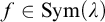 $f\in \operatorname {\mathrm {Sym}}(\lambda )$
such that
$f\in \operatorname {\mathrm {Sym}}(\lambda )$
such that $\pi ([B])=[f[B]]$
for all
$\pi ([B])=[f[B]]$
for all $B\subseteq A$
.
$B\subseteq A$
. $\pi $
is called nowhere trivial, if there is no such pair
$\pi $
is called nowhere trivial, if there is no such pair $(f,A)$
.
$(f,A)$
.
For $\delta \le \lambda $
,
$\delta \le \lambda $
, $C\subseteq \delta $
closed and nonempty, and
$C\subseteq \delta $
closed and nonempty, and $\alpha \in C$
, we set
$\alpha \in C$
, we set
 $$\begin{align*}I^*(C,\delta, \alpha):=\big\{\beta:\, \alpha\le \beta<\min\big((C\cup\{\delta\})\setminus (\alpha+1)\big)\big\}.\end{align*}$$
So the $I^*(C,\delta , \alpha )$
, for
$I^*(C,\delta , \alpha )$
, for $\alpha \in C$
, form an increasing interval partition of
$\alpha \in C$
, form an increasing interval partition of $\delta \setminus \min (C)$
.
$\delta \setminus \min (C)$
.
3 Approximations
3.1 Definition and final limits
In this section, we define the set ${\mathrm {AP}}$
of “approximations.” An approximation
${\mathrm {AP}}$
of “approximations.” An approximation ${\mathbf {a}}$
will induce a “partial monomorphism”
${\mathbf {a}}$
will induce a “partial monomorphism” ${\boldsymbol {\tilde \pi }}^{\mathbf {a}}$
defined on some sub-Boolean Algebra
${\boldsymbol {\tilde \pi }}^{\mathbf {a}}$
defined on some sub-Boolean Algebra ${\tilde {\mathbf {B}}}^{\mathbf {a}}$
of
${\tilde {\mathbf {B}}}^{\mathbf {a}}$
of $P(\lambda )/[\lambda ]^{<\kappa }$
which is trivial, i.e., generated by some
$P(\lambda )/[\lambda ]^{<\kappa }$
which is trivial, i.e., generated by some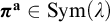 ${\boldsymbol {\pi }}^{\mathbf {a}}\in \operatorname {\mathrm {Sym}}(\lambda )$
. We will use such approximations to build a nowhere trivial automorphism
${\boldsymbol {\pi }}^{\mathbf {a}}\in \operatorname {\mathrm {Sym}}(\lambda )$
. We will use such approximations to build a nowhere trivial automorphism ${\boldsymbol {\tilde \phi }}$
of
${\boldsymbol {\tilde \phi }}$
of $P(\lambda )/[\lambda ]^{<\kappa }$
as limit (i.e.,
$P(\lambda )/[\lambda ]^{<\kappa }$
as limit (i.e.,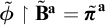 ${\boldsymbol {\tilde \phi }}\restriction {\tilde {\mathbf {B}}}^ {\mathbf {a}}={\boldsymbol {\tilde \pi }}^ {\mathbf {a}}$
) (cf. Fact 3.7).
${\boldsymbol {\tilde \phi }}\restriction {\tilde {\mathbf {B}}}^ {\mathbf {a}}={\boldsymbol {\tilde \pi }}^ {\mathbf {a}}$
) (cf. Fact 3.7).
Definition 3.1. ${\mathrm {AP}}$
is the set of objects
${\mathrm {AP}}$
is the set of objects ${\mathbf {a}}$
consisting of
${\mathbf {a}}$
consisting of ${\mathbf {C}}^{\mathbf {a}}$
,
${\mathbf {C}}^{\mathbf {a}}$
, ${\boldsymbol {\pi }}^{\mathbf {a}}$
, and
${\boldsymbol {\pi }}^{\mathbf {a}}$
, and ${{\mathbf {B}}}^{\mathbf {a}}$
, such that:
${{\mathbf {B}}}^{\mathbf {a}}$
, such that:
-
•
${\boldsymbol {\pi }}^{\mathbf {a}}\in \operatorname {\mathrm {Sym}}(\lambda )$
; -
•
${\mathbf {C}}^{\mathbf {a}}\subseteq \lambda $
club such that
${\boldsymbol {\pi }}^{\mathbf {a}}\restriction \varepsilon \in \operatorname {\mathrm {Sym}}(\varepsilon )$
for all
$\varepsilon \in {\mathbf {C}}^{\mathbf {a}}$
; -
•
${{\mathbf {B}}}^{\mathbf {a}}$
is a subset of
$\mathcal {P}(\lambda )$
.





 ${\mathbf {C}}^{\mathbf {a}}$
gives us a partition of
${\mathbf {C}}^{\mathbf {a}}$
gives us a partition of $\lambda $
.
$\lambda $
.
Definition 3.2. For ${\mathbf {a}}\in {\mathrm {AP}}$
and
${\mathbf {a}}\in {\mathrm {AP}}$
and $\varepsilon \in {\mathbf {C}}^{\mathbf {a}}$
we set
$\varepsilon \in {\mathbf {C}}^{\mathbf {a}}$
we set $I^{\mathbf {a}}_\varepsilon :=I^*({\mathbf {C}}^{\mathbf {a}},\lambda ,\varepsilon )$
.
$I^{\mathbf {a}}_\varepsilon :=I^*({\mathbf {C}}^{\mathbf {a}},\lambda ,\varepsilon )$
.
So the $I^{\mathbf {a}}_\varepsilon $
form an increasing interval partition of
$I^{\mathbf {a}}_\varepsilon $
form an increasing interval partition of $\lambda \setminus \min ({\mathbf {C}}^{\mathbf {a}})$
; and
$\lambda \setminus \min ({\mathbf {C}}^{\mathbf {a}})$
; and ${\boldsymbol {\pi }}^{\mathbf {a}}\restriction I^{\mathbf {a}}_\varepsilon \in \operatorname {\mathrm {Sym}}(I^{\mathbf {a}}_\varepsilon )$
.
${\boldsymbol {\pi }}^{\mathbf {a}}\restriction I^{\mathbf {a}}_\varepsilon \in \operatorname {\mathrm {Sym}}(I^{\mathbf {a}}_\varepsilon )$
. ${\boldsymbol {\pi }}^{\mathbf {a}}$
induces a (trivial) automorphism of
${\boldsymbol {\pi }}^{\mathbf {a}}$
induces a (trivial) automorphism of $P(\lambda )/[\lambda ]^{<\lambda }$
, and
$P(\lambda )/[\lambda ]^{<\lambda }$
, and ${\boldsymbol {\tilde \pi }}^{\mathbf {a}}$
is the restriction of this automorphism to
${\boldsymbol {\tilde \pi }}^{\mathbf {a}}$
is the restriction of this automorphism to ${\mathbf {B}}^{\mathbf {a}}$
.
${\mathbf {B}}^{\mathbf {a}}$
.
Definition 3.3.
-
•
${\tilde {\mathbf {B}}}^{\mathbf {a}}:={\mathbf {B}}^{\mathbf {a}}/[\lambda ]^{<\lambda }=\{[A]:\, A\in {\mathbf {B}}^{\mathbf {a}}\}$
. -
•
${\boldsymbol {\tilde \pi }}^{\mathbf {a}}: {\tilde {\mathbf {B}}}^{\mathbf {a}}\to P(\lambda )/[\lambda ]^{<\lambda }$
is defined by
$[A]\mapsto [{\boldsymbol {\pi }}^{\mathbf {a}}[A]]$
.



Definition 3.4. ${\mathbf {b}}\ge _{\mathrm {AP}} {\mathbf {a}}$
, if
${\mathbf {b}}\ge _{\mathrm {AP}} {\mathbf {a}}$
, if ${\mathbf {a}},{\mathbf {b}}\in {\mathrm {AP}}$
and
${\mathbf {a}},{\mathbf {b}}\in {\mathrm {AP}}$
and
-
(1)
${\mathbf {C}}^{\mathbf {b}}\subseteq ^* {\mathbf {C}}^{\mathbf {a}}$
; -
(2)
${\boldsymbol {\pi }}^{\mathbf {b}}\restriction I^{\mathbf {a}}_\varepsilon ={\boldsymbol {\pi }}^{\mathbf {a}}\restriction I^{\mathbf {a}}_\varepsilon $
for all but boundedly many
$\varepsilon \in {\mathbf {C}}^{\mathbf {b}}$
; -
(3)
${\mathbf {B}}^{\mathbf {b}}\supseteq {\mathbf {B}}^{\mathbf {a}}$
, and
${\boldsymbol {\tilde \pi }}^{\mathbf {b}}$
extendsFootnote
1
${\boldsymbol {\tilde \pi }}^{\mathbf {a}}$
.


Clearly, $\le _{\mathrm {AP}}$
is a (nonempty) quasiorder.
$\le _{\mathrm {AP}}$
is a (nonempty) quasiorder.
Lemma 3.5. If $({\mathbf {a}}_i)_{i<\delta }$
is a
$({\mathbf {a}}_i)_{i<\delta }$
is a $\le _{\mathrm {AP}} $
increasing chain such that
$\le _{\mathrm {AP}} $
increasing chain such that $\bigcup _{i<\delta } {\tilde {\mathbf {B}}}^{{\mathbf {a}}_i}=P(\lambda )/[\lambda ]^{<\lambda }$
, then
$\bigcup _{i<\delta } {\tilde {\mathbf {B}}}^{{\mathbf {a}}_i}=P(\lambda )/[\lambda ]^{<\lambda }$
, then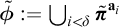 ${\boldsymbol {\tilde \phi }}:=\bigcup _{i<\delta } {\boldsymbol {\tilde \pi }}^{{\mathbf {a}}_i}$
is a Boolean algebra monomorphism of
${\boldsymbol {\tilde \phi }}:=\bigcup _{i<\delta } {\boldsymbol {\tilde \pi }}^{{\mathbf {a}}_i}$
is a Boolean algebra monomorphism of $P(\lambda )/[\lambda ]^{<\lambda }$
.
$P(\lambda )/[\lambda ]^{<\lambda }$
.
If additionally $\bigcup _{i<\delta } {\boldsymbol {\tilde \pi }}^{{\mathbf {a}}_i}[{\tilde {\mathbf {B}}}^{{\mathbf {a}}_i}]=P(\lambda )/[\lambda ]^{<\lambda }$
, then
$\bigcup _{i<\delta } {\boldsymbol {\tilde \pi }}^{{\mathbf {a}}_i}[{\tilde {\mathbf {B}}}^{{\mathbf {a}}_i}]=P(\lambda )/[\lambda ]^{<\lambda }$
, then ${\boldsymbol {\tilde \phi }}$
is an automorphism.
${\boldsymbol {\tilde \phi }}$
is an automorphism.
Proof. We use $\vee $
and
$\vee $
and $^c$
for the Boolean-algebra-operations, i.e.,
$^c$
for the Boolean-algebra-operations, i.e., $[A\cup B]=[A]\vee [B]$
, and
$[A\cup B]=[A]\vee [B]$
, and $[A]^c=[\lambda \setminus A]$
. It is enough to show that
$[A]^c=[\lambda \setminus A]$
. It is enough to show that ${\boldsymbol {\tilde \phi }}$
is injective, honors
${\boldsymbol {\tilde \phi }}$
is injective, honors $\vee $
and
$\vee $
and $^c$
, and maps
$^c$
, and maps $[\emptyset ]$
to itself.
$[\emptyset ]$
to itself.
For $X_1,X_2$
in
$X_1,X_2$
in $P(\lambda )/[\lambda ]^{<\lambda }$
there is an
$P(\lambda )/[\lambda ]^{<\lambda }$
there is an $i<\delta $
and some
$i<\delta $
and some $A_1,A_2,A_{\text {union}}$
in
$A_1,A_2,A_{\text {union}}$
in ${\mathbf {B}}^{{\mathbf {a}}_i}$
, such that
${\mathbf {B}}^{{\mathbf {a}}_i}$
, such that $[A_j]=X_j$
for
$[A_j]=X_j$
for $j=1,2$
and
$j=1,2$
and $[A_{\text {union}}]=[A_1\cup A_2]=X_1\vee X_2$
. Then
$[A_{\text {union}}]=[A_1\cup A_2]=X_1\vee X_2$
. Then
 $$\begin{align*}{\boldsymbol{\pi}}^{{\mathbf{a}}_i}[A_{\text{union}}]=^* {\boldsymbol{\pi}}^{{\mathbf{a}}_i}[A_1\cup A_2] = {\boldsymbol{\pi}}^{{\mathbf{a}}_i}[A_1]\cup {\boldsymbol{\pi}}^{{\mathbf{a}}_i}[A_2], \end{align*}$$
and
 $$ \begin{gather*} {\boldsymbol{\tilde\phi}}(X_1\vee X_2)={\boldsymbol{\tilde\pi}}^{{\mathbf{a}}_i} ([A_{\text{union}}])= [{\boldsymbol{\pi}}^{{\mathbf{a}}_i}[A_{\text{union}}]]=\\ ={\boldsymbol{\tilde\pi}}^{{\mathbf{a}}_i}([A_1])\vee {\boldsymbol{\tilde\pi}}^{{\mathbf{a}}_i}([A_2])= {\boldsymbol{\tilde\phi}}(X_1)\vee {\boldsymbol{\tilde\phi}}(X_2). \end{gather*} $$
If $X_1\ne X_2$
, i.e.,
$X_1\ne X_2$
, i.e., $A_1\ne ^* A_2$
, then
$A_1\ne ^* A_2$
, then ${\boldsymbol {\pi }}^{{\mathbf {a}}_i}[A_1]\ne ^* {\boldsymbol {\pi }}^{{\mathbf {a}}_i}[A_2]$
, i.e.,
${\boldsymbol {\pi }}^{{\mathbf {a}}_i}[A_1]\ne ^* {\boldsymbol {\pi }}^{{\mathbf {a}}_i}[A_2]$
, i.e., ${\boldsymbol {\tilde \phi }}(X_1)\ne {\boldsymbol {\tilde \phi }}(X_2)$
.
${\boldsymbol {\tilde \phi }}(X_1)\ne {\boldsymbol {\tilde \phi }}(X_2)$
.
Similarly we can show ${\boldsymbol {\tilde \phi }}([\lambda \setminus A_1])= {\boldsymbol {\tilde \phi }}([A_1])^c$
and
${\boldsymbol {\tilde \phi }}([\lambda \setminus A_1])= {\boldsymbol {\tilde \phi }}([A_1])^c$
and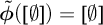 ${\boldsymbol {\tilde \phi }}([\emptyset ])=[\emptyset ]$
.
${\boldsymbol {\tilde \phi }}([\emptyset ])=[\emptyset ]$
.
Definition 3.6. For a pair $(f,A)$
with
$(f,A)$
with $A\in [\lambda ]^\lambda $
and
$A\in [\lambda ]^\lambda $
and $f\in \operatorname {\mathrm {Sym}}(\lambda )$
, we say
$f\in \operatorname {\mathrm {Sym}}(\lambda )$
, we say ${\mathbf {a}}\in {\mathrm {AP}}$
“spoils
${\mathbf {a}}\in {\mathrm {AP}}$
“spoils $(f,A)$
,” if there is an
$(f,A)$
,” if there is an $A'\in [A]^\lambda \cap {\mathbf {B}}^{\mathbf {a}}$
such that
$A'\in [A]^\lambda \cap {\mathbf {B}}^{\mathbf {a}}$
such that $|{\boldsymbol {\pi }}^{\mathbf {a}}[A']\cap f[A']|<\lambda $
.
$|{\boldsymbol {\pi }}^{\mathbf {a}}[A']\cap f[A']|<\lambda $
.
If ${\boldsymbol {\tilde \phi }}$
is an automorphism extending such a
${\boldsymbol {\tilde \phi }}$
is an automorphism extending such a ${\boldsymbol {\tilde \pi }}^{\mathbf {a}}$
, then f cannot witness that
${\boldsymbol {\tilde \pi }}^{\mathbf {a}}$
, then f cannot witness that ${\boldsymbol {\tilde \phi }}$
is trivial on A. Therefore, we have the following fact.
${\boldsymbol {\tilde \phi }}$
is trivial on A. Therefore, we have the following fact.
Fact 3.7. If $({\mathbf {a}}_i)_{i<\delta }$
is a
$({\mathbf {a}}_i)_{i<\delta }$
is a $\le _{\mathrm {AP}} $
increasing chain such that:
$\le _{\mathrm {AP}} $
increasing chain such that:
-
•
$\bigcup _{i<\delta } {\tilde {\mathbf {B}}}^{{\mathbf {a}}_i}= \bigcup _{i<\delta } {\boldsymbol {\tilde \pi }}^{{\mathbf {a}}_i}[{\tilde {\mathbf {B}}}^{{\mathbf {a}}_i}]= P(\lambda )/[\lambda ]^{<\lambda }$
, and -
• for every
$(f,A)$
there is an
$i<\delta $
such that
${\mathbf {a}}_i$
spoils
$(f,A)$
,



then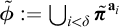 ${\boldsymbol {\tilde \phi }}:=\bigcup _{i<\delta } {\boldsymbol {\tilde \pi }}^{{\mathbf {a}}_i}$
is a nowhere trivial Boolean algebra automorphism of
${\boldsymbol {\tilde \phi }}:=\bigcup _{i<\delta } {\boldsymbol {\tilde \pi }}^{{\mathbf {a}}_i}$
is a nowhere trivial Boolean algebra automorphism of $P(\lambda )/[\lambda ]^{<\lambda }$
.
$P(\lambda )/[\lambda ]^{<\lambda }$
.
We will use this fact to get a nowhere trivial automorphism, both in the case $2^\lambda =\lambda ^+$
in Section 5, as well as in the forcing construction of Section 6.
$2^\lambda =\lambda ^+$
in Section 5, as well as in the forcing construction of Section 6.
3.2 Short sequences and their limits and good ordinals
We will often modify an ${\mathbf {a}}\in {\mathrm {AP}}$
by replacing
${\mathbf {a}}\in {\mathrm {AP}}$
by replacing ${\mathbf {B}}^{\mathbf {a}}$
with another
${\mathbf {B}}^{\mathbf {a}}$
with another ${\mathbf {B}}'\subseteq P(\lambda )$
. Let the result be
${\mathbf {B}}'\subseteq P(\lambda )$
. Let the result be ${\mathbf {b}}$
. We call
${\mathbf {b}}$
. We call ${\mathbf {b}}$
“
${\mathbf {b}}$
“ ${\mathbf {a}}$
with
${\mathbf {a}}$
with ${\mathbf {B}}^{\mathbf {a}}$
replaced by
${\mathbf {B}}^{\mathbf {a}}$
replaced by ${\mathbf {B}}'$
,” or “
${\mathbf {B}}'$
,” or “ ${\mathbf {a}}$
with X added to
${\mathbf {a}}$
with X added to ${\mathbf {B}}^{\mathbf {a}}$
” in case
${\mathbf {B}}^{\mathbf {a}}$
” in case ${\mathbf {B}}'={\mathbf {B}}^{\mathbf {a}}\cup \{X\}$
. Obviously
${\mathbf {B}}'={\mathbf {B}}^{\mathbf {a}}\cup \{X\}$
. Obviously ${\mathbf {b}}\in {\mathrm {AP}}$
. IfFootnote
2
${\mathbf {b}}\in {\mathrm {AP}}$
. IfFootnote
2 ${\mathbf {B}}'\supseteq {\mathbf {B}}^{\mathbf {a}}$
then
${\mathbf {B}}'\supseteq {\mathbf {B}}^{\mathbf {a}}$
then ${\mathbf {b}}\ge _{\mathrm {AP}} {\mathbf {a}}$
.
${\mathbf {b}}\ge _{\mathrm {AP}} {\mathbf {a}}$
.
Similarly we can get a stronger approximation by thinning out ${\mathbf {C}}$
. To summarize, we have the following fact.
${\mathbf {C}}$
. To summarize, we have the following fact.
Fact 3.8. If ${\mathbf {a}}\in {\mathrm {AP}}$
,
${\mathbf {a}}\in {\mathrm {AP}}$
, $D\subseteq {\mathbf {C}}^{\mathbf {a}}$
club, and
$D\subseteq {\mathbf {C}}^{\mathbf {a}}$
club, and $B\subseteq P(\lambda )$
with
$B\subseteq P(\lambda )$
with $B\supseteq {\mathbf {B}}^{\mathbf {a}}$
. Then
$B\supseteq {\mathbf {B}}^{\mathbf {a}}$
. Then ${\mathbf {b}}\ge _{\mathrm {AP}} {\mathbf {a}}$
, for the
${\mathbf {b}}\ge _{\mathrm {AP}} {\mathbf {a}}$
, for the ${\mathbf {b}}$
defined by
${\mathbf {b}}$
defined by ${\boldsymbol {\pi }}^{\mathbf {b}}:={\boldsymbol {\pi }}^{\mathbf {a}}$
,
${\boldsymbol {\pi }}^{\mathbf {b}}:={\boldsymbol {\pi }}^{\mathbf {a}}$
, ${\mathbf {C}}^{\mathbf {b}}:= D$
and
${\mathbf {C}}^{\mathbf {b}}:= D$
and ${\mathbf {B}}^{\mathbf {b}}:=B$
.
${\mathbf {B}}^{\mathbf {b}}:=B$
.
In the definition of $\le _{\mathrm {AP}}$
we require that some things hold “apart from a bounded set,” or equivalently, “above some
$\le _{\mathrm {AP}}$
we require that some things hold “apart from a bounded set,” or equivalently, “above some $\alpha $
.” We say that
$\alpha $
.” We say that $\alpha $
is good for an increasing sequence of
$\alpha $
is good for an increasing sequence of ${\mathbf {a}}_i$
, if the requirements for each pair are met above
${\mathbf {a}}_i$
, if the requirements for each pair are met above $\alpha $
. We will generally only be able to find such an
$\alpha $
. We will generally only be able to find such an $\alpha $
for “short sequences.”
$\alpha $
for “short sequences.”
Definition 3.9.
-
(1)
${\mathrm {AP}_\lambda }$
is the set of
${\mathbf {a}}\in {\mathrm {AP}}$
such that
$|{\mathbf {B}}^{\mathbf {a}}|\le \lambda $
. Analogously,
${\mathrm {AP}}_{<\lambda }$
is the set of
${\mathbf {a}}\in {\mathrm {AP}}$
such that
$|{\mathbf {B}}^{\mathbf {a}}|<\lambda $
. -
(2)
$({\mathbf {a}}_i)_{i\in J}$
is a “short sequence,” if
$J<\lambda $
(or more generally, J is a set of ordinals with
$|J|<\lambda $
), each
${\mathbf {a}}_i\in {\mathrm {AP}}_{<\lambda }$
, and the sequence is
$\le _{\mathrm {AP}}$
-increasing, i.e.,
$j>i$
in J implies
${\mathbf {a}}_j\ge _{\mathrm {AP}} {\mathbf {a}}_i$
. -
(3) Let
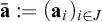
$\bar {\mathbf {a}}:=({\mathbf {a}}_i)_{i\in J}$
be short. We say that
$\alpha $
is good for
$\bar {\mathbf {a}}$
, if for all
$i\le k$
in J:-
(a)
$\alpha \in {\mathbf {C}}^{{\mathbf {a}}_i}$
. -
(b)
${\mathbf {C}}^{{\mathbf {a}}_k}\subseteq {\mathbf {C}}^{{\mathbf {a}}_i}$
above
$\alpha $
. (I.e.,
$\beta \ge \alpha $
and
$\beta \in {\mathbf {C}}^{{\mathbf {a}}_k}$
implies
$\beta \in {\mathbf {C}}^{{\mathbf {a}}_i}$
.) -
(c)
${\boldsymbol {\pi }}^{{\mathbf {a}}_k}\restriction I^{{\mathbf {a}}_i}_\varepsilon ={\boldsymbol {\pi }}^{{\mathbf {a}}_i}\restriction I^{{\mathbf {a}}_i}_\varepsilon $
for all
$\varepsilon \ge \alpha $
in
${\mathbf {C}}^{{\mathbf {a}}_k}$
. -
(d)
${\boldsymbol {\pi }}^{{\mathbf {a}}_k}[A]\setminus \alpha ={\boldsymbol {\pi }}^{{\mathbf {a}}_i}[A]\setminus \alpha $
, for all
$A\in {\mathbf {B}}^{{\mathbf {a}}_i}$
.
-
-
(4) For
${\mathbf {a}},{\mathbf {b}}$
in
${\mathrm {AP}}_{<\lambda }$
, we say
${\mathbf {b}}>_\zeta {\mathbf {a}}$
, if
$\zeta $
is good for the sequence
$({\mathbf {a}},{\mathbf {b}})$
(so in particular
${\mathbf {a}}<{\mathbf {b}}$
).










Fact 3.10.
-
(1) If
${\mathbf {a}}\in {\mathrm {AP}}_{<\lambda }$
, then
${\mathbf {b}}\ge _{\mathrm {AP}} {\mathbf {a}}$
iff
$(\exists \zeta \in \lambda )\,{\mathbf {b}}>_\zeta {\mathbf {a}}$
. -
(2) If
$\bar {\mathbf {a}}=({\mathbf {a}}_i)_{i\in J}$
is short, then
$G:=\{\alpha \in \lambda :\, \alpha \ \mathrm { good\ for } \ \bar {\mathbf {a}}\}$
is club, more concretely
$G=\bigcap _{i<\delta } {\mathbf {C}}^{{\mathbf {a}}_i}\setminus \alpha ^*$
for some
$\alpha ^*<\lambda $
. -
(3) If
${\mathbf {b}}$
is the result of enlarging
${\mathbf {B}}^{\mathbf {a}}$
in
${\mathbf {a}}$
, then
${\mathbf {b}}>_\zeta {\mathbf {a}}$
for all
$\zeta \in {\mathbf {C}}^{\mathbf {a}}$
.





Lemma 3.11. If $\bar {\mathbf {a}}$
is short, then it has an
$\bar {\mathbf {a}}$
is short, then it has an $\le _{\mathrm {AP}}$
-upper-bound
$\le _{\mathrm {AP}}$
-upper-bound ${\mathbf {b}}\in {\mathrm {AP}}_{<\lambda }$
.
${\mathbf {b}}\in {\mathrm {AP}}_{<\lambda }$
.
Proof. Set $D:=\bigcap _{i\in J} C^{{\mathbf {a}}_i}$
, and
$D:=\bigcap _{i\in J} C^{{\mathbf {a}}_i}$
, and $\zeta _0$
be the smallest
$\zeta _0$
be the smallest $\bar {\mathbf {a}}$
-good ordinal. So in particular
$\bar {\mathbf {a}}$
-good ordinal. So in particular $\zeta _0\in D$
; and any
$\zeta _0\in D$
; and any $\zeta \ge \zeta _0$
is in D iff it is
$\zeta \ge \zeta _0$
is in D iff it is $\bar {\mathbf {a}}$
-good.
$\bar {\mathbf {a}}$
-good.
Fix for now some $\zeta \in D\setminus \zeta _0$
. Let
$\zeta \in D\setminus \zeta _0$
. Let $\zeta ^+$
be the D-successor of
$\zeta ^+$
be the D-successor of $\zeta $
, i.e.,
$\zeta $
, i.e., $\min (D\setminus (\zeta +1))$
.
$\min (D\setminus (\zeta +1))$
.
For $i\in J$
, set
$i\in J$
, set $\gamma (\zeta ,i)$
to be the
$\gamma (\zeta ,i)$
to be the $C^{{\mathbf {a}}_i}$
-successor of
$C^{{\mathbf {a}}_i}$
-successor of $\zeta $
. Then the sequence
$\zeta $
. Then the sequence $\gamma (\zeta ,i)$
is weakly increasing with
$\gamma (\zeta ,i)$
is weakly increasing with $i\in J$
and has limit
$i\in J$
and has limit $\zeta ^+$
. If
$\zeta ^+$
. If $\alpha <\gamma (\zeta ,i)$
(we also say “
$\alpha <\gamma (\zeta ,i)$
(we also say “ $\alpha $
is stable at i”), then
$\alpha $
is stable at i”), then ${\boldsymbol {\pi }}^{{\mathbf {a}}_i}(\alpha )={\boldsymbol {\pi }}^{{\mathbf {a}}_j}(\alpha )$
for all
${\boldsymbol {\pi }}^{{\mathbf {a}}_i}(\alpha )={\boldsymbol {\pi }}^{{\mathbf {a}}_j}(\alpha )$
for all $j>i$
in J.
$j>i$
in J.
We define $\pi ^{\mathrm {lim}}(\alpha )$
for all
$\pi ^{\mathrm {lim}}(\alpha )$
for all $\alpha \ge \zeta _0$
as
$\alpha \ge \zeta _0$
as ${\boldsymbol {\pi }}^{{\mathbf {a}}_i}(\alpha )$
for some i stable for
${\boldsymbol {\pi }}^{{\mathbf {a}}_i}(\alpha )$
for some i stable for $\alpha $
.
$\alpha $
.
To summarize: Whenever $I:=\zeta ^+\setminus \zeta $
for some
$I:=\zeta ^+\setminus \zeta $
for some $\zeta \in D\setminus \zeta _0$
with
$\zeta \in D\setminus \zeta _0$
with $\zeta ^+$
the D-successor, we get:
$\zeta ^+$
the D-successor, we get:
-
(1)
$(\forall \alpha \in I)\, (\exists i\in J)\, (\forall j>i)\, \pi ^{\mathrm {lim}}(\alpha )= {\boldsymbol {\pi }}^{{\mathbf {a}}_j}(\alpha )$
. -
(2)
$\pi ^{\mathrm {lim}}\restriction I\in \operatorname {\mathrm {Sym}}(I)$
. -
(3) If
$i\in J$
and
$A\in {\mathbf {B}}^{{\mathbf {a}}_i}$
, then
$\pi ^{\mathrm {lim}}[A']={\boldsymbol {\pi }}^{{\mathbf {a}}_i}[A']$
where
$A':=A\cap I$
.






For (2), note that ${\boldsymbol {\pi }}^{{\mathbf {a}}_i}\in \operatorname {\mathrm {Sym}}(I)$
for all
${\boldsymbol {\pi }}^{{\mathbf {a}}_i}\in \operatorname {\mathrm {Sym}}(I)$
for all $i\in J$
. If
$i\in J$
. If $\alpha _1\ne \alpha _2\in I$
, then there is an i in J stable for both, and
$\alpha _1\ne \alpha _2\in I$
, then there is an i in J stable for both, and ${\boldsymbol {\pi }}^{{\mathbf {a}}_i}(\alpha _1) \ne {\boldsymbol {\pi }}^{{\mathbf {a}}_i}(\alpha _2)$
. So
${\boldsymbol {\pi }}^{{\mathbf {a}}_i}(\alpha _1) \ne {\boldsymbol {\pi }}^{{\mathbf {a}}_i}(\alpha _2)$
. So ${\boldsymbol {\pi }}^{\mathrm {lim}}$
is injective. And if
${\boldsymbol {\pi }}^{\mathrm {lim}}$
is injective. And if $\alpha _1\in I$
and i in J stable for
$\alpha _1\in I$
and i in J stable for $\alpha _1$
, then there is an
$\alpha _1$
, then there is an $\alpha _2\in I^{{\mathbf {a}}_i}_\zeta $
with
$\alpha _2\in I^{{\mathbf {a}}_i}_\zeta $
with ${\boldsymbol {\pi }}^{\mathrm {lim}}(\alpha _2)={\boldsymbol {\pi }}^{{\mathbf {a}}_i}(\alpha _2)=\alpha _1$
, so
${\boldsymbol {\pi }}^{\mathrm {lim}}(\alpha _2)={\boldsymbol {\pi }}^{{\mathbf {a}}_i}(\alpha _2)=\alpha _1$
, so $\pi ^{\mathrm {lim}}$
is surjective.
$\pi ^{\mathrm {lim}}$
is surjective.
For (3): Set $B:={\boldsymbol {\pi }}^{{\mathbf {a}}_{i}}[A']$
. As I is above the good
$B:={\boldsymbol {\pi }}^{{\mathbf {a}}_{i}}[A']$
. As I is above the good $\zeta _0$
, we have
$\zeta _0$
, we have $B={\boldsymbol {\pi }}^{{\mathbf {a}}_j}[A']$
for all
$B={\boldsymbol {\pi }}^{{\mathbf {a}}_j}[A']$
for all $j\in J$
with
$j\in J$
with $j>i$
. So for
$j>i$
. So for $\alpha \in A'$
, all
$\alpha \in A'$
, all ${\boldsymbol {\pi }}^{{\mathbf {a}}_j}(\alpha )$
are in B, and also stabilize to
${\boldsymbol {\pi }}^{{\mathbf {a}}_j}(\alpha )$
are in B, and also stabilize to $\pi ^{\mathrm {lim}}(\alpha )$
, which therefore has to be in B. Analogously, we get If
$\pi ^{\mathrm {lim}}(\alpha )$
, which therefore has to be in B. Analogously, we get If $\alpha \in I\setminus A$
, then
$\alpha \in I\setminus A$
, then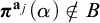 ${\boldsymbol {\pi }}^{{\mathbf {a}}_j}(\alpha )\notin B$
stabilizes to
${\boldsymbol {\pi }}^{{\mathbf {a}}_j}(\alpha )\notin B$
stabilizes to $\pi ^{\mathrm {lim}}(\alpha )$
, which therefore is not in B. As
$\pi ^{\mathrm {lim}}(\alpha )$
, which therefore is not in B. As $\pi ^{\mathrm {lim}}[I]=I$
, we get
$\pi ^{\mathrm {lim}}[I]=I$
, we get $\pi ^{\mathrm {lim}}[I\cap A]=B$
.
$\pi ^{\mathrm {lim}}[I\cap A]=B$
.
We can now define ${\mathbf {b}}$
as
${\mathbf {b}}$
as
 $$\begin{align*}{\mathbf{C}}^{\mathbf{b}}:=D\setminus\zeta_0 ;\quad {\boldsymbol{\pi}}^{\mathbf{b}}(\alpha)=\begin{cases} \alpha&\text{if }\alpha<\zeta_0\\ \pi^{\mathrm{lim}}(\alpha)&\text{otherwise;}\end{cases} \quad {\mathbf{B}}^{\mathbf{b}}:=\bigcup_{i\in J}{\mathbf{B}}^{{\mathbf{a}}_i}. \\[-42pt] \end{align*}$$
4 Initial segments
We will work with initial segments of approximations (without the ${\mathbf {B}}$
part).
${\mathbf {B}}$
part).
Definition 4.1.
-
• An “initial segment” b consists of a “height”
$\delta ^b$
, a closed
$C^b\subseteq \delta ^b$
(possibly empty), and a
$\pi ^b\in \operatorname {\mathrm {Sym}}(\delta ^b)$
such that
$\pi ^b\restriction \zeta \in \operatorname {\mathrm {Sym}}(\zeta )$
for all
$\zeta \in C^b$
. -
• The set of initial segments is called
${\mathrm {IS}}$
. -
•
$b>_{\mathrm {IS}} a$
, if
$\delta ^b>\delta ^a$
,
$\delta ^a\in C^b$
,
$C^b\cap \delta ^a=C^a$
, and
$\pi ^b\restriction \delta ^a=\pi ^a$
. -
•
$b\ge _{\mathrm {IS}} a$
if
$b>_{\mathrm {IS}} a$
or
$b=a$
. -
• For
$\zeta \in C^b$
, we set
$I^b_\zeta :=I^*(C^b,\delta ^b, \zeta )$
.









So the $I^b_\zeta $
form an increasing interval partition of
$I^b_\zeta $
form an increasing interval partition of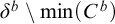 $\delta ^b\setminus \min (C^b)$
, and
$\delta ^b\setminus \min (C^b)$
, and $\pi ^b\restriction I^b_\zeta \in \operatorname {\mathrm {Sym}}(I^b_\zeta )$
.
$\pi ^b\restriction I^b_\zeta \in \operatorname {\mathrm {Sym}}(I^b_\zeta )$
.
It is easy to see that $\le _{\mathrm {IS}}$
is a partial order.
$\le _{\mathrm {IS}}$
is a partial order.
Some trivialities are as follows.
Fact 4.2. Assume that $\bar b=(b_i)_{i<\xi }$
, with
$\bar b=(b_i)_{i<\xi }$
, with $\xi \le \lambda $
limit, is a
$\xi \le \lambda $
limit, is a $<_{\mathrm {IS}}$
-increasingFootnote
3
sequence.
$<_{\mathrm {IS}}$
-increasingFootnote
3
sequence.
-
(1) If
$\xi <\lambda $
, then the following
$b_\xi \in {\mathrm {IS}}$
is the
$\le _{\mathrm {IS}}$
-supremum of
$\bar b$
, and we call it “the limit” of
$\bar b$
:
$\delta ^{b_\xi }:= \bigcup _{i<\xi } \delta ^{b_i}$
,
$C^{b_\xi }:= \bigcup _{i<\xi } C^{b_i}$
, and
$\pi ^{b_\xi }:= \bigcup _{i<\xi } \pi ^{b_i}$
. -
(2) If
$\xi =\lambda $
, then to each
$B\subseteq P(\lambda )$
there is a
${\mathbf {b}}\in {\mathrm {AP}}$
as follows, which we call “a limit” of
$\bar b$
:
${\mathbf {C}}^{\mathbf {b}}:= \bigcup _{i<\lambda } C^{b_i}$
,
${\boldsymbol {\pi }}^{\mathbf {b}}:= \bigcup _{i<\lambda } \pi ^{b_i}$
, and
${\mathbf {B}}^{\mathbf {b}}:=B$
.


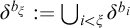

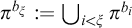


Let us call an $<_{\mathrm {IS}}$
-increasing sequence
$<_{\mathrm {IS}}$
-increasing sequence $\bar b$
“continuous” if
$\bar b$
“continuous” if $b_\gamma $
is the limit of
$b_\gamma $
is the limit of $(b_\alpha )_{\alpha <\gamma }$
for all limits
$(b_\alpha )_{\alpha <\gamma }$
for all limits $\gamma <\delta $
. We will only use continuous sequences.
$\gamma <\delta $
. We will only use continuous sequences.
Definition 4.3. Let ${\mathbf {a}}\in {\mathrm {AP}}_{<\lambda }$
and
${\mathbf {a}}\in {\mathrm {AP}}_{<\lambda }$
and $b\in {\mathrm {IS}}$
with
$b\in {\mathrm {IS}}$
with $\delta ^b\in {\mathbf {C}}^{\mathbf {a}}$
. We say
$\delta ^b\in {\mathbf {C}}^{\mathbf {a}}$
. We say $c>_{{\mathbf {a}}} b$
, if the following holds:
$c>_{{\mathbf {a}}} b$
, if the following holds:
-
•
$c>_{\mathrm {IS}} b$
. -
•
$(C^{c}\cup \{\delta ^{c}\}) \setminus \delta ^{b} \subseteq {\mathbf {C}}^{\mathbf {a}}$
. -
• For all
$\zeta \in C^{c}\setminus \delta ^{b}$
,
$\pi ^{c}\restriction I^{\mathbf {a}}_\zeta = {\boldsymbol {\pi }}^{\mathbf {a}} \restriction I^{\mathbf {a}}_\zeta $
. -
• For all
$A\in {\mathbf {B}}^{\mathbf {a}}$
,
$\pi ^{c}[A'] ={\boldsymbol {\pi }}^{{\mathbf {a}}}[A']$
where we set
$A':=A\cap \delta ^{c}\setminus \delta ^{b}$
.







For a short sequence $\bar {\mathbf {a}}=({\mathbf {a}}_i)_{i\in J}$
we say
$\bar {\mathbf {a}}=({\mathbf {a}}_i)_{i\in J}$
we say $c>_{\bar {\mathbf {a}}} b$
if
$c>_{\bar {\mathbf {a}}} b$
if $c>_{{\mathbf {a}}_i} b$
for all
$c>_{{\mathbf {a}}_i} b$
for all $i\in J$
.
$i\in J$
.
Lemma 4.4. Let ${\mathbf {a}},{\mathbf {b}}$
in
${\mathbf {a}},{\mathbf {b}}$
in ${\mathrm {AP}}_{<\lambda }$
.
${\mathrm {AP}}_{<\lambda }$
.
-
(1)
$<_{\mathbf {a}}$
is a partial order -
(2) If
$\zeta <\lambda $
,
$c\in {\mathrm {IS}}$
, and
$(d_i)_{i\in \zeta }$
is a
$>_{\mathrm {IS}}$
-increasing sequence such that
$d_i>_{{\mathbf {a}}}c$
for all
$i<\zeta $
, then also the limit
$d_\zeta $
satisfies
$d_\zeta>_{{\mathbf {a}}}c$
. -
(3) Let
$c,d$
be in
${\mathrm {IS}}$
. If
${\mathbf {b}}>_{\delta ^c} {\mathbf {a}}$
, then
$d>_{{\mathbf {b}}} c$
implies
$d>_{{\mathbf {a}}} c$
. -
(4) Assume
$\bar c:=(c_i)_{i\in \lambda }$
is a continuous increasing sequence in
${\mathrm {IS}}$
such that for some
$i_0<\lambda $
we have
$c_i<_{\mathbf {a}} c_{i+1}$
for all
$i>i_0$
.Then any limit
${\mathbf {c}}\in {\mathrm {AP}}$
of the
$\bar c$
with
${\mathbf {B}}^{{\mathbf {c}}} \supseteq {\mathbf {B}}^{{\mathbf {a}}}$
satisfies
${\mathbf {c}}>_{\mathrm {AP}} {\mathbf {a}}$
. -
(5) Let
$\bar {\mathbf {a}}$
be short,
$b\in {\mathrm {IS}}$
,
$\delta ^b$
good for
$\bar {\mathbf {a}}$
, and
$E\subseteq \lambda $
club.Then there is a
$c>_{\bar {\mathbf {a}}} b$
with
$\delta ^c\in E$
and
$C^c=C^b\cup \{\delta ^b\}$



Proof. For (5), use (the proof of) Lemma 3.11: Pick any $\delta ^c\in \bigcap _{i\in J} C^{{\mathbf {a}}_i}\cap E\setminus (\delta ^b+1)$
and set
$\delta ^c\in \bigcap _{i\in J} C^{{\mathbf {a}}_i}\cap E\setminus (\delta ^b+1)$
and set $C^c=C^b\cup \{\delta ^b\}$
and
$C^c=C^b\cup \{\delta ^b\}$
and $\pi ^c=\pi ^{\mathrm {lim}}\restriction \delta ^c$
.
$\pi ^c=\pi ^{\mathrm {lim}}\restriction \delta ^c$
.
The rest is straightforward.
We now turn to spoiling $(f,A)$
.
$(f,A)$
.
Definition 4.5. Given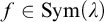 $f\in \operatorname {\mathrm {Sym}}(\lambda )$
and
$f\in \operatorname {\mathrm {Sym}}(\lambda )$
and $A\in [\lambda ]^\lambda $
, we define
$A\in [\lambda ]^\lambda $
, we define $c>^{f,A} b$
by:
$c>^{f,A} b$
by: $c>_{\mathrm {IS}} b$
,
$c>_{\mathrm {IS}} b$
, $f\restriction \delta ^ {c}\in \operatorname {\mathrm {Sym}}(\delta ^ {c})$
, and there is a
$f\restriction \delta ^ {c}\in \operatorname {\mathrm {Sym}}(\delta ^ {c})$
, and there is a $\xi ^*\in A\cap \delta ^ {c}\setminus \delta ^b$
with
$\xi ^*\in A\cap \delta ^ {c}\setminus \delta ^b$
with $f(\xi ^*)\ne \pi ^{c}(\xi ^*)$
.
$f(\xi ^*)\ne \pi ^{c}(\xi ^*)$
.
We write $c>^{f,A}_{\bar {\mathbf {a}}} b$
for:
$c>^{f,A}_{\bar {\mathbf {a}}} b$
for: $c>_{\bar {\mathbf {a}}} b\ \&\ c>^{f,A} b.$
Obviously we have the following fact.
Fact 4.6. If $b'>_{\mathrm {IS}} b$
and
$b'>_{\mathrm {IS}} b$
and $c>^{f,A} b'$
, then
$c>^{f,A} b'$
, then $c>^{f,A} b$
.
$c>^{f,A} b$
.
Lemma 4.7. Assume $(b_i)_{i\in \lambda }$
is
$(b_i)_{i\in \lambda }$
is $<_IS$
-increasing such that unboundedly often
$<_IS$
-increasing such that unboundedly often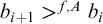 $b_{i+1}>^{f,A}b_i$
. Then for some
$b_{i+1}>^{f,A}b_i$
. Then for some $A'\in [A]^\lambda $
, every limit
$A'\in [A]^\lambda $
, every limit ${\mathbf {b}}$
of
${\mathbf {b}}$
of $(b_i)_{i\in \lambda }$
with
$(b_i)_{i\in \lambda }$
with $A'\in {\mathbf {B}}^{{\mathbf {b}}}$
spoils
$A'\in {\mathbf {B}}^{{\mathbf {b}}}$
spoils $(f,A)$
.
$(f,A)$
.
Proof. By taking a subsequence, we can assume that for all odd i (i.e., $i=\delta +2n+1$
with
$i=\delta +2n+1$
with $\delta $
limit or 0 and
$\delta $
limit or 0 and $n\in \omega $
)
$n\in \omega $
)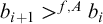 $b_{i+1}>^{f,A} b_{i}$
.
$b_{i+1}>^{f,A} b_{i}$
.
For i odd, set $I_i:=\delta ^{b_{i+1}}\setminus \delta ^{b_i}$
and let
$I_i:=\delta ^{b_{i+1}}\setminus \delta ^{b_i}$
and let $\xi _i\in I_i$
satisfy
$\xi _i\in I_i$
satisfy $f(\xi _i)\ne \pi ^{b_{i+1}}(\xi _i)={\boldsymbol {\pi }}^{{\mathbf {b}}}(\xi _i)$
.
$f(\xi _i)\ne \pi ^{b_{i+1}}(\xi _i)={\boldsymbol {\pi }}^{{\mathbf {b}}}(\xi _i)$
.
If i is odd, then ${\boldsymbol {\pi }}^{\mathbf {b}}\restriction I_{i}\in \operatorname {\mathrm {Sym}}(I_{i})$
and
${\boldsymbol {\pi }}^{\mathbf {b}}\restriction I_{i}\in \operatorname {\mathrm {Sym}}(I_{i})$
and $f\restriction \delta ^{b_{i+1}}\in \operatorname {\mathrm {Sym}}(\delta ^{b_{i+1}})$
.
$f\restriction \delta ^{b_{i+1}}\in \operatorname {\mathrm {Sym}}(\delta ^{b_{i+1}})$
.
So if $i<j$
are both odd, then
$i<j$
are both odd, then $f(\zeta _{j})>\delta ^{b_{i+1}}>{\boldsymbol {\pi }}^{\mathbf {b}}(\zeta _{i})$
; and if
$f(\zeta _{j})>\delta ^{b_{i+1}}>{\boldsymbol {\pi }}^{\mathbf {b}}(\zeta _{i})$
; and if $j<k$
are both odd then
$j<k$
are both odd then $f(\zeta _{j})<\delta ^{b_{j}}\le {\boldsymbol {\pi }}^{\mathbf {b}}(\zeta _{k})$
. This means that
$f(\zeta _{j})<\delta ^{b_{j}}\le {\boldsymbol {\pi }}^{\mathbf {b}}(\zeta _{k})$
. This means that $f(\zeta _{j})$
is different from all
$f(\zeta _{j})$
is different from all ${\boldsymbol {\pi }}^{\mathbf {b}}(\zeta _{i})$
for i odd.
${\boldsymbol {\pi }}^{\mathbf {b}}(\zeta _{i})$
for i odd.
So we can set $A'=\{\zeta _{j}:\, j\text { odd}\}$
and get that
$A'=\{\zeta _{j}:\, j\text { odd}\}$
and get that $f[A']$
is disjoint to
$f[A']$
is disjoint to ${\boldsymbol {\pi }}^{{\mathbf {b}}}[A']$
. So
${\boldsymbol {\pi }}^{{\mathbf {b}}}[A']$
. So ${\mathbf {b}}$
with
${\mathbf {b}}$
with $A'$
added to
$A'$
added to ${\mathbf {B}}$
spoils
${\mathbf {B}}$
spoils $(f,A)$
.
$(f,A)$
.
Lemma 4.8. If $\bar {\mathbf {a}}$
is short,
$\bar {\mathbf {a}}$
is short, $b\in {\mathrm {IS}}$
,
$b\in {\mathrm {IS}}$
, $\delta ^b$
good for
$\delta ^b$
good for $\bar {\mathbf {a}}$
,
$\bar {\mathbf {a}}$
, $f\in \operatorname {\mathrm {Sym}}(\lambda ),$
and
$f\in \operatorname {\mathrm {Sym}}(\lambda ),$
and $A\in [\lambda ]^\lambda $
, then there is some
$A\in [\lambda ]^\lambda $
, then there is some $d>_{\bar {\mathbf {a}}}^{f,A}b$
.
$d>_{\bar {\mathbf {a}}}^{f,A}b$
.
Proof. Let J be the index set of $\bar {\mathbf {a}}$
.
$\bar {\mathbf {a}}$
.
Set ${\mathbf {B}}:=\bigcup _{i\in J}{\mathbf {B}}^{{\mathbf {a}}_{i}}$
. Recall that
${\mathbf {B}}:=\bigcup _{i\in J}{\mathbf {B}}^{{\mathbf {a}}_{i}}$
. Recall that $\bar {\mathbf {a}}$
being short implies that each
$\bar {\mathbf {a}}$
being short implies that each ${\mathbf {a}}_{i}$
is in
${\mathbf {a}}_{i}$
is in ${\mathrm {AP}}_{<\lambda }$
, so
${\mathrm {AP}}_{<\lambda }$
, so $|{\mathbf {B}}^{{\mathbf {a}}_{i}}|<\lambda $
and thus
$|{\mathbf {B}}^{{\mathbf {a}}_{i}}|<\lambda $
and thus $|{\mathbf {B}}|<\lambda $
.
$|{\mathbf {B}}|<\lambda $
.
Let $\zeta _0<\lambda $
be the supremum of all
$\zeta _0<\lambda $
be the supremum of all ${\mathbf {C}}^{{\mathbf {a}}_i}$
-successors of
${\mathbf {C}}^{{\mathbf {a}}_i}$
-successors of $\delta ^b$
.
$\delta ^b$
.
Set $E:=\{\zeta \in \lambda :\, f\restriction \zeta \in \operatorname {\mathrm {Sym}}(\zeta )\}$
(a club-set). Pick
$E:=\{\zeta \in \lambda :\, f\restriction \zeta \in \operatorname {\mathrm {Sym}}(\zeta )\}$
(a club-set). Pick $\zeta _1\in E$
such that
$\zeta _1\in E$
such that $|A\cap (\zeta _1\setminus \zeta _0) |> |2^{\mathbf {B}}|$
. Pick
$|A\cap (\zeta _1\setminus \zeta _0) |> |2^{\mathbf {B}}|$
. Pick $c>_{\bar {\mathbf {a}}} b$
with
$c>_{\bar {\mathbf {a}}} b$
with $\delta ^{c}\in E\setminus \zeta _1$
and such that
$\delta ^{c}\in E\setminus \zeta _1$
and such that $C^c=C^b\cup \{\delta ^b\}$
.
$C^c=C^b\cup \{\delta ^b\}$
.
For $\alpha ,\beta $
in
$\alpha ,\beta $
in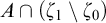 $A\cap (\zeta _1\setminus \zeta _0)$
set
$A\cap (\zeta _1\setminus \zeta _0)$
set $\alpha \sim \beta $
iff
$\alpha \sim \beta $
iff $(\forall X\in {\mathbf {B}})\, (\alpha \in X\leftrightarrow \beta \in X)$
. As there are at most
$(\forall X\in {\mathbf {B}})\, (\alpha \in X\leftrightarrow \beta \in X)$
. As there are at most $|2^{{\mathbf {B}}}|$
many equivalence classes, there have to be
$|2^{{\mathbf {B}}}|$
many equivalence classes, there have to be $\beta _0\ne \beta _1$
in
$\beta _0\ne \beta _1$
in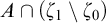 $A\cap (\zeta _1\setminus \zeta _0)$
with
$A\cap (\zeta _1\setminus \zeta _0)$
with $\beta _0\sim \beta _1$
.
$\beta _0\sim \beta _1$
.
If $\pi ^c(\beta _i)\ne f(\beta _i)$
for
$\pi ^c(\beta _i)\ne f(\beta _i)$
for $i=0$
or
$i=0$
or $i=1$
, set
$i=1$
, set $d:=c$
. Otherwise, defines d as follows:
$d:=c$
. Otherwise, defines d as follows: $\delta ^d=\delta ^c$
,
$\delta ^d=\delta ^c$
, $C^d=C^c$
, and
$C^d=C^c$
, and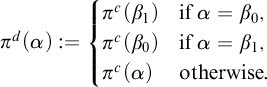 $\pi ^d(\alpha ):=\begin {cases} \pi ^c(\beta _1)&\text {if }\alpha =\beta _0,\\ \pi ^c(\beta _0)&\text {if }\alpha =\beta _1,\\ \pi ^c(\alpha ) & \text {otherwise.} \end {cases}$
Note that in any case,
$\pi ^d(\alpha ):=\begin {cases} \pi ^c(\beta _1)&\text {if }\alpha =\beta _0,\\ \pi ^c(\beta _0)&\text {if }\alpha =\beta _1,\\ \pi ^c(\alpha ) & \text {otherwise.} \end {cases}$
Note that in any case, $d>_{\bar a} b$
:
$d>_{\bar a} b$
:
Set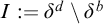 $I:=\delta ^d\setminus \delta ^b$
. As
$I:=\delta ^d\setminus \delta ^b$
. As $\beta _0\sim \beta _1$
we have
$\beta _0\sim \beta _1$
we have $\pi ^d[A\cap I]=\pi ^c[A\cap I]={\boldsymbol {\pi }}^{{\mathbf {a}}_i}[A\cap I]$
for all
$\pi ^d[A\cap I]=\pi ^c[A\cap I]={\boldsymbol {\pi }}^{{\mathbf {a}}_i}[A\cap I]$
for all $i\in J$
and
$i\in J$
and $A\in {\mathbf {B}}^{{\mathbf {a}}_i}$
(as
$A\in {\mathbf {B}}^{{\mathbf {a}}_i}$
(as $c>_{\bar {\mathbf {a}}} b$
).
$c>_{\bar {\mathbf {a}}} b$
).
And as the $\beta _0,\beta _1$
are above
$\beta _0,\beta _1$
are above $\zeta _0$
, and
$\zeta _0$
, and $I_{\delta ^b}^{{\mathbf {a}}_i}\le \zeta _0$
, we have
$I_{\delta ^b}^{{\mathbf {a}}_i}\le \zeta _0$
, we have $\pi ^d\restriction I_{\delta ^b}^{{\mathbf {a}}_i}=\pi ^c\restriction I_{\delta ^b}^{{\mathbf {a}}_i}= {\boldsymbol {\pi }}^{{\mathbf {a}}_i}\restriction I_{\delta ^b}^{{\mathbf {a}}_i}$
.
$\pi ^d\restriction I_{\delta ^b}^{{\mathbf {a}}_i}=\pi ^c\restriction I_{\delta ^b}^{{\mathbf {a}}_i}= {\boldsymbol {\pi }}^{{\mathbf {a}}_i}\restriction I_{\delta ^b}^{{\mathbf {a}}_i}$
.
5
$2^\lambda =\lambda ^+$
for
$\lambda $
inaccessible implies a nowhere trivial automorphism


Lemma 5.1. Every increasing sequence in ${\mathrm {AP}_\lambda }$
of length
${\mathrm {AP}_\lambda }$
of length ${<}\lambda ^+$
has an upper bound.
${<}\lambda ^+$
has an upper bound.
Proof. We can assume without loss of generality that the increasing sequence is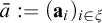 $\bar a:=({\mathbf {a}}_i)_{i\in \xi }$
with
$\bar a:=({\mathbf {a}}_i)_{i\in \xi }$
with $\xi \le \lambda $
.
$\xi \le \lambda $
.
For $i<\xi $
, enumerateFootnote
4
$i<\xi $
, enumerateFootnote
4 ${\mathbf {B}}^{{\mathbf {a}}_i}$
as
${\mathbf {B}}^{{\mathbf {a}}_i}$
as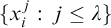 $\{x_i^j:\, j\le \lambda \}$
, and set
$\{x_i^j:\, j\le \lambda \}$
, and set $B^j_i:=\{x_i^k:\, k\le j\}$
for
$B^j_i:=\{x_i^k:\, k\le j\}$
for $j<\lambda $
. We enumerate in a way so that the
$j<\lambda $
. We enumerate in a way so that the $B^j_i$
are increasing with
$B^j_i$
are increasing with $i<\xi $
. Let
$i<\xi $
. Let ${\mathbf {a}}_i^j$
be
${\mathbf {a}}_i^j$
be ${\mathbf {a}}_i$
with
${\mathbf {a}}_i$
with ${\mathbf {B}}^{{\mathbf {a}}_i}$
replaced by
${\mathbf {B}}^{{\mathbf {a}}_i}$
replaced by $B^j_i$
, and for
$B^j_i$
, and for $\ell <\lambda $
, we set
$\ell <\lambda $
, we set $\bar {\mathbf {a}}^\ell :=({\mathbf {a}}^\ell _k)_{k<\min (\ell ,\xi )}$
.
$\bar {\mathbf {a}}^\ell :=({\mathbf {a}}^\ell _k)_{k<\min (\ell ,\xi )}$
.
Note the following:
-
• For all
$i<\ell <\lambda $
and
$\alpha \in C^{{\mathbf {a}}^\ell _j}=C^{{\mathbf {a}}^i_j}=C^{{\mathbf {a}}_j}$
we have
${\mathbf {a}}^i_j<_\alpha {\mathbf {a}}^\ell _j$
. -
•
$\bar {\mathbf {a}}^\ell $
is short. -
•
${\mathbf {c}}\in {\mathrm {AP}}$
is an upper bound of
$\bar {\mathbf {a}}$
iff it is an upper bound of all
${\mathbf {a}}^\ell _k$
for
$\ell < \lambda $
and
$k<\min (\ell ,\xi )$
.





We now construct by induction on $\ell <\lambda $
an
$\ell <\lambda $
an $<_{\mathrm {IS}}$
-increasing continuous sequence
$<_{\mathrm {IS}}$
-increasing continuous sequence $(c^\ell )_{\ell \in \lambda }$
, such that
$(c^\ell )_{\ell \in \lambda }$
, such that $\delta ^{c^\ell }$
is
$\delta ^{c^\ell }$
is $\bar {\mathbf {a}}^\ell $
-good:
$\bar {\mathbf {a}}^\ell $
-good:
-
• At limits
$\gamma $
we let
$c^\gamma $
be the limit of the
$(c^k)_{k<\gamma }$
, and note that (by induction) its height is
$\bar {\mathbf {a}}^\gamma $
-good. -
• For
$j=\ell +1$
, let E be the club set of
$\bar {\mathbf {a}}^{\ell +1}$
-good ordinals, and choose, as in Lemma 4.4(5)
$c^{\ell +1}>_{\bar {\mathbf {a}}^\ell } c^\ell $
with
$\delta ^{c^{\ell +1}}\in E$
.


Let ${\mathbf {c}}$
be the limit of the
${\mathbf {c}}$
be the limit of the $c^\ell $
with
$c^\ell $
with ${\mathbf {B}}^{{\mathbf {c}}}:=\bigcup _{i< \xi }{\mathbf {B}}^{{\mathbf {a}}_i}$
.
${\mathbf {B}}^{{\mathbf {c}}}:=\bigcup _{i< \xi }{\mathbf {B}}^{{\mathbf {a}}_i}$
.
We claim that ${\mathbf {c}}\ge _{\mathrm {AP}} {\mathbf {a}}^\ell _j$
for all
${\mathbf {c}}\ge _{\mathrm {AP}} {\mathbf {a}}^\ell _j$
for all $\ell < \lambda $
and
$\ell < \lambda $
and $j<\min (\ell ,\xi )$
:
$j<\min (\ell ,\xi )$
:
Assume that $k>\ell $
. As
$k>\ell $
. As $\delta ^{c^k}$
is
$\delta ^{c^k}$
is $\bar {\mathbf {a}}^k$
-good, we have
$\bar {\mathbf {a}}^k$
-good, we have $\delta ^{c^k}\in C^{{\mathbf {a}}_j}$
. Therefore
$\delta ^{c^k}\in C^{{\mathbf {a}}_j}$
. Therefore ${\mathbf {a}}^\ell _j<{\mathbf {a}}^k_j$
. Also,
${\mathbf {a}}^\ell _j<{\mathbf {a}}^k_j$
. Also,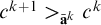 $c^{k+1}>_{\bar {\mathbf {a}}^k} c^k$
, so (by definition)
$c^{k+1}>_{\bar {\mathbf {a}}^k} c^k$
, so (by definition) $c^{k+1}>_{{\mathbf {a}}^k_j} c^k$
, and so, by Lemma 4.4(3),
$c^{k+1}>_{{\mathbf {a}}^k_j} c^k$
, and so, by Lemma 4.4(3),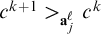 $c^{k+1}>_{{\mathbf {a}}^\ell _j} c^k$
. Then Lemma 4.4(4) gives us
$c^{k+1}>_{{\mathbf {a}}^\ell _j} c^k$
. Then Lemma 4.4(4) gives us ${\mathbf {c}}>_{\mathrm {AP}} {\mathbf {a}}^\ell _j$
, as required.
${\mathbf {c}}>_{\mathrm {AP}} {\mathbf {a}}^\ell _j$
, as required.
Lemma 5.2. Given ${\mathbf {a}}\in {\mathrm {AP}_\lambda }$
,
${\mathbf {a}}\in {\mathrm {AP}_\lambda }$
, $f\in \operatorname {\mathrm {Sym}}(\lambda ),$
and
$f\in \operatorname {\mathrm {Sym}}(\lambda ),$
and $A\in [\lambda ]^\lambda $
, there is a
$A\in [\lambda ]^\lambda $
, there is a ${\mathbf {b}}\ge _{\mathrm {AP}}{\mathbf {a}}$
which is in
${\mathbf {b}}\ge _{\mathrm {AP}}{\mathbf {a}}$
which is in ${\mathrm {AP}_\lambda }$
and spoils
${\mathrm {AP}_\lambda }$
and spoils $(f,A)$
.
$(f,A)$
.
Proof. Enumerate ${\mathbf {B}}^{\mathbf {a}}$
as
${\mathbf {B}}^{\mathbf {a}}$
as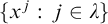 $\{x^j:\, j\in \lambda \}$
and let
$\{x^j:\, j\in \lambda \}$
and let ${\mathbf {a}}^j$
be
${\mathbf {a}}^j$
be ${\mathbf {a}}$
with
${\mathbf {a}}$
with ${\mathbf {B}}$
replaced by
${\mathbf {B}}$
replaced by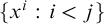 $\{x^i:\, i<j\}$
. So
$\{x^i:\, i<j\}$
. So ${\mathbf {a}}^j\in {\mathrm {AP}}_{<\lambda }$
. We construct a continuous increasing sequence
${\mathbf {a}}^j\in {\mathrm {AP}}_{<\lambda }$
. We construct a continuous increasing sequence $b^i$
(
$b^i$
( $i<\lambda $
) in
$i<\lambda $
) in ${\mathrm {IS}}$
such that
${\mathrm {IS}}$
such that $\delta ^{b^i}$
is
$\delta ^{b^i}$
is ${\mathbf {a}}^i$
-good: Given
${\mathbf {a}}^i$
-good: Given $b^{i}$
, we find
$b^{i}$
, we find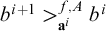 $b^{i+1}>^{f,A}_{{\mathbf {a}}^i} b^i$
as in Lemma 4.8. Let
$b^{i+1}>^{f,A}_{{\mathbf {a}}^i} b^i$
as in Lemma 4.8. Let ${\mathbf {b}}$
be the limit of the
${\mathbf {b}}$
be the limit of the $b^{i}$
with
$b^{i}$
with ${\mathbf {B}}^{\mathbf {b}}={\mathbf {B}}^{\mathbf {a}}\cup \{A'\}$
as in Lemma 4.7.
${\mathbf {B}}^{\mathbf {b}}={\mathbf {B}}^{\mathbf {a}}\cup \{A'\}$
as in Lemma 4.7.
And ${\mathbf {b}}>_{\mathrm {AP}} {\mathbf {a}}^j$
for all
${\mathbf {b}}>_{\mathrm {AP}} {\mathbf {a}}^j$
for all $j<\lambda $
and therefore
$j<\lambda $
and therefore ${\mathbf {b}}>_{\mathrm {AP}} {\mathbf {a}}$
.
${\mathbf {b}}>_{\mathrm {AP}} {\mathbf {a}}$
.
We can now easily show the following theorem.
Theorem 5.3. If $\lambda $
is (strongly) inaccessible and
$\lambda $
is (strongly) inaccessible and $2^\lambda = \lambda ^+$
, then there is a nowhere trivial automorphism of the Boolean algebra
$2^\lambda = \lambda ^+$
, then there is a nowhere trivial automorphism of the Boolean algebra $\mathcal P(\lambda )/[\lambda ]^{<\lambda }$
.
$\mathcal P(\lambda )/[\lambda ]^{<\lambda }$
.
Proof. We construct, by induction on $i\in \lambda ^+$
, an increasing chain of
$i\in \lambda ^+$
, an increasing chain of ${\mathbf {a}}_i$
in
${\mathbf {a}}_i$
in ${\mathrm {AP}_\lambda }$
as follows:
${\mathrm {AP}_\lambda }$
as follows:
-
• For limit i, we take limits according to Lemma 5.1.
-
• For odd successors
$i=j+1=\delta +2n+1$
(
$\delta $
limit or
$0$
,
$n\in \omega $
), pick by bookkeeping some
$X_j$
and let
${\mathbf {a}}_{j+1}$
be the same as
${\mathbf {a}}_j$
but with
$X_j$
and
$({\boldsymbol {\pi }}^{{\mathbf {a}}_j})^{-1}[X_j]$
added to
${\mathbf {B}}^{{\mathbf {a}}_j}$
. -
• For even successors
$i=j+1=\delta +2n+2$
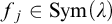
, we pick by bookkeeping an
${f_j\in \operatorname {\mathrm {Sym}}(\lambda )}$
and an
$A_j\in [\lambda ]^\lambda $
. Then we choose
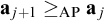
${\mathbf {a}}_{j+1}\ge _{\mathrm {AP}} {\mathbf {a}}_j$
spoiling
$(f_j,A_j)$
, using Lemma 5.2.





Then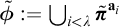 ${\boldsymbol {\tilde \phi }}:=\bigcup _{i<\lambda } {\boldsymbol {\tilde \pi }}^{{\mathbf {a}}_i}$
is a nowhere trivial automorphism according to Fact 3.7.
${\boldsymbol {\tilde \phi }}:=\bigcup _{i<\lambda } {\boldsymbol {\tilde \pi }}^{{\mathbf {a}}_i}$
is a nowhere trivial automorphism according to Fact 3.7.
6 Forcing a nowhere trivial automorphism with
$2^\lambda>\lambda ^+$
,
$\lambda $
inaccessible


Theorem 6.1. Assume $\lambda $
is inaccessible,
$\lambda $
is inaccessible, $2^\lambda =\lambda ^+$
, and
$2^\lambda =\lambda ^+$
, and $\mu>\lambda ^+$
is regular. Then there is a cofinality preserving (
$\mu>\lambda ^+$
is regular. Then there is a cofinality preserving ( ${<}\lambda $
-closed and
${<}\lambda $
-closed and $\lambda ^+$
-cc) poset which forces:
$\lambda ^+$
-cc) poset which forces: $2^\lambda =\mu $
, and there is a nowhere trivial automorphism of
$2^\lambda =\mu $
, and there is a nowhere trivial automorphism of $\mathcal P(\lambda )/[\lambda ]^{<\lambda }$
.
$\mathcal P(\lambda )/[\lambda ]^{<\lambda }$
.
For the rest of this section we fix $\lambda $
and
$\lambda $
and $\mu $
as in the lemma.
$\mu $
as in the lemma.
We will construct a ${<}\lambda $
-support iteration
${<}\lambda $
-support iteration $(P_\alpha ,Q_\alpha )_{\alpha < \mu }$
. We call the final limit P. We denote the
$(P_\alpha ,Q_\alpha )_{\alpha < \mu }$
. We call the final limit P. We denote the $P_\alpha $
-extension
$P_\alpha $
-extension $V[G_\alpha ]$
by
$V[G_\alpha ]$
by $V_\alpha $
.
$V_\alpha $
.
Each $Q_\alpha $
and therefore also each
$Q_\alpha $
and therefore also each $P_\alpha $
will be
$P_\alpha $
will be ${<}\lambda $
-closed.
${<}\lambda $
-closed.
So the followings statements are absolute between $P_\alpha $
-extensions:
$P_\alpha $
-extensions: $x\in {\mathrm {AP}}$
,
$x\in {\mathrm {AP}}$
, $x<_{\mathrm {AP}} y$
, as well as
$x<_{\mathrm {AP}} y$
, as well as ${\mathrm {IS}}$
(as set, of size
${\mathrm {IS}}$
(as set, of size $\lambda $
).
$\lambda $
).
Each $Q_\alpha $
will add an
$Q_\alpha $
will add an ${\mathbf {a}}^*_\alpha \in {\mathrm {AP}}$
, such that the
${\mathbf {a}}^*_\alpha \in {\mathrm {AP}}$
, such that the ${\mathbf {a}}^*_\alpha $
are
${\mathbf {a}}^*_\alpha $
are $<_{\mathrm {AP}}$
-increasing in
$<_{\mathrm {AP}}$
-increasing in $\alpha $
.
$\alpha $
.
By induction we assume we live in the $P_{\alpha }$
-extension
$P_{\alpha }$
-extension $V_\alpha $
where we already have the increasing sequence
$V_\alpha $
where we already have the increasing sequence $({\mathbf {a}}^*_i)_{i<\alpha }$
. (We do not claim that this sequence has an upper bound in
$({\mathbf {a}}^*_i)_{i<\alpha }$
. (We do not claim that this sequence has an upper bound in $V_\alpha $
.)
$V_\alpha $
.)
We now define $Q_\alpha $
, which we will just call Q to improve readability.
$Q_\alpha $
, which we will just call Q to improve readability.
Definition 6.2. $q\in Q$
consists of:
$q\in Q$
consists of:
-
(1) A
$b^q\in {\mathrm {IS}}$
, also called “trunk of q.”We also write
$\delta ^q$
,
$\pi ^q$
,
$C^q$
, and
$I^q_\beta $
instead of
$\delta ^{b^q}$
, etc. -
(2) A set
$X^q\in [\alpha ]^{<\lambda }$
, and for
$\beta \in X^q$
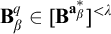
, a set
${\mathbf {B}}^q_\beta \in [{\mathbf {B}}^{{\mathbf {a}}^*_\beta }]^{<\lambda }$
, such that the
${\mathbf {B}}^q_\beta $
are increasing in
$\beta $
.




For $\beta \in X^q$
, we set
$\beta \in X^q$
, we set ${\mathbf {a}}^q_\beta $
to be
${\mathbf {a}}^q_\beta $
to be ${\mathbf {a}}^*_\beta $
with
${\mathbf {a}}^*_\beta $
with ${\mathbf {B}}$
replaced by
${\mathbf {B}}$
replaced by ${\mathbf {B}}^q_\beta $
. We set
${\mathbf {B}}^q_\beta $
. We set $\bar {\mathbf {a}}^q:=({\mathbf {a}}^q_\beta )_{\beta \in X^q}$
(which is short). To be a valid condition in Q, we require
$\bar {\mathbf {a}}^q:=({\mathbf {a}}^q_\beta )_{\beta \in X^q}$
(which is short). To be a valid condition in Q, we require $\delta ^{b^q}$
to be good for
$\delta ^{b^q}$
to be good for $\bar {\mathbf {a}}^q$
.
$\bar {\mathbf {a}}^q$
.
(“Short” and “good” are defined in Definition 3.9.) As we use Q as forcing poset, we follow the notation that $r\le _Q q$
means that r is stronger than q (whereas in
$r\le _Q q$
means that r is stronger than q (whereas in $<_{\mathrm {AP}}$
and
$<_{\mathrm {AP}}$
and $<_{\mathrm {IS}}$
the stronger object is the larger one).
$<_{\mathrm {IS}}$
the stronger object is the larger one).
Definition 6.3. $r\le _Q q$
if:
$r\le _Q q$
if:
-
(1)
$b^r\ge _{\bar {\mathbf {a}}^q} b^q$
(see Definition 4.3). -
(2)
$X^r\supseteq X^q$
, and
${\mathbf {B}}^r_\beta \supseteq {\mathbf {B}}^q_\beta $
for
$\beta \in X^q$
.


The following follows immediately from by Lemma 4.4(3).
Fact 6.4. Assume that $r\le _Q q$
,
$r\le _Q q$
, $b\in {\mathrm {IS}}$
and that
$b\in {\mathrm {IS}}$
and that $\delta ^b$
is good for
$\delta ^b$
is good for $\bar {\mathbf {a}}^r$
. Then
$\bar {\mathbf {a}}^r$
. Then $c\ge _{\bar {\mathbf {a}}^r} b$
implies
$c\ge _{\bar {\mathbf {a}}^r} b$
implies $c\ge _{\bar {\mathbf {a}}^q} b$
.
$c\ge _{\bar {\mathbf {a}}^q} b$
.
This implies that $\le _Q$
is transitive. (It even is a partial order.)
$\le _Q$
is transitive. (It even is a partial order.)
Lemma 6.5. For $q\in Q$
, the following holds (in
$q\in Q$
, the following holds (in $V_\alpha $
): Let
$V_\alpha $
): Let $E\subseteq \lambda $
be club.
$E\subseteq \lambda $
be club.
-
(1) For
$\beta <\alpha $
and
$A\in {\mathbf {B}}^{{\mathbf {a}}^*_\beta }$
there is an
$r<_Q q$
with
$\delta ^r\in E$
,
$\beta \in X^r$
, and
$A\in {\mathbf {B}}^r_\beta $
. -
(2) For any
$A\in [\lambda ]^\lambda $
and
$f\in \operatorname {\mathrm {Sym}}(\lambda )$
(both in
$V_\alpha $
), the following set is dense:
$D_{q,f,A}:=\{r\perp q\}\cup \{r\le q:\, b^r<^{f,A} b^q\}$
. -
(3) Q is
$\lambda $
-centered, witnessed by the function that maps q to its trunk,
$b^q$
.(Actually, even
${<}\lambda $
many conditions with the same trunk have a lower bound.) -
(4)
$Q_\alpha $
is
${<}\lambda $
-closed.Moreover, a descending sequence
$(q_i)_{i\in \xi }$
(
$\xi <\lambda $
) has a canonical limit r, and the trunk of r is the union of the trunks of the
$q_i$
.


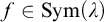




Proof. (1): Extend $\bar {\mathbf {a}}^q$
in the obvious way to
$\bar {\mathbf {a}}^q$
in the obvious way to $\bar {\mathbf {a}}^r$
: Add
$\bar {\mathbf {a}}^r$
: Add $\beta $
to the index set, set
$\beta $
to the index set, set ${\mathbf {B}}^r_\beta :=\{A\}\cup \bigcup _{\zeta \in X^q\cap (\beta +1)}{\mathbf {B}}^q_\zeta $
, and add A to all
${\mathbf {B}}^r_\beta :=\{A\}\cup \bigcup _{\zeta \in X^q\cap (\beta +1)}{\mathbf {B}}^q_\zeta $
, and add A to all ${\mathbf {B}}^q_\zeta $
for
${\mathbf {B}}^q_\zeta $
for $\zeta \in X^q\setminus \beta $
. Let
$\zeta \in X^q\setminus \beta $
. Let $E':=\{\zeta \in \lambda :\, \zeta \text { good for }\bar {\mathbf {a}}^r\}$
. Then
$E':=\{\zeta \in \lambda :\, \zeta \text { good for }\bar {\mathbf {a}}^r\}$
. Then $E'$
is club according to Fact 3.10, so we can use Lemma 4.4(5) to find
$E'$
is club according to Fact 3.10, so we can use Lemma 4.4(5) to find $b^r>_{\bar {\mathbf {a}}^q}b^q$
with
$b^r>_{\bar {\mathbf {a}}^q}b^q$
with $\delta ^r\in E\cap E'$
.
$\delta ^r\in E\cap E'$
.
(2) Assume that $s\le q$
(so
$s\le q$
(so $b^s> b^q$
). Then according to Lemma 4.8 we can find an
$b^s> b^q$
). Then according to Lemma 4.8 we can find an $r\le _Q s$
with
$r\le _Q s$
with $b^r>^{f,A} b^s$
and therefore
$b^r>^{f,A} b^s$
and therefore $b^r>^{f,A}b^{q}$
(according to Fact 4.6).
$b^r>^{f,A}b^{q}$
(according to Fact 4.6).
(3) Let $(q_i)_{i\in \mu }$
,
$(q_i)_{i\in \mu }$
, $\mu <\lambda $
all have the same trunk b. Then the following r is a condition in Q:
$\mu <\lambda $
all have the same trunk b. Then the following r is a condition in Q: $b^r=b$
,
$b^r=b$
, $X^r=\bigcup _{i<\mu }X^{q_i}$
, and
$X^r=\bigcup _{i<\mu }X^{q_i}$
, and $B^r_\zeta = \bigcup _{i<\mu \ \&\ \zeta \in X^{q_i}}B^{q_i}_\zeta $
.
$B^r_\zeta = \bigcup _{i<\mu \ \&\ \zeta \in X^{q_i}}B^{q_i}_\zeta $
.
(4) Let $(q_i)_{i<\zeta }$
with
$(q_i)_{i<\zeta }$
with $\zeta <\lambda $
be
$\zeta <\lambda $
be $<_Q$
-decreasing. Then the obvious union r is an element of Q and stronger than each
$<_Q$
-decreasing. Then the obvious union r is an element of Q and stronger than each $q_i$
:
$q_i$
: $b^r$
is the union of the
$b^r$
is the union of the $b^{q_i}$
, as in Fact 4.2, and
$b^{q_i}$
, as in Fact 4.2, and $X^r:=\bigcup _{i<\zeta } X^{q_i} $
and
$X^r:=\bigcup _{i<\zeta } X^{q_i} $
and ${\mathbf {B}}^r_\beta :=\bigcup _{i<\zeta , \beta \in X^ {q_i}} {\mathbf {B}}^{q_i}_\beta $
for each
${\mathbf {B}}^r_\beta :=\bigcup _{i<\zeta , \beta \in X^ {q_i}} {\mathbf {B}}^{q_i}_\beta $
for each $\beta \in X^r$
.
$\beta \in X^r$
.
Then $\delta ^r$
is good for
$\delta ^r$
is good for ${\mathbf {a}}^r_\beta $
for
${\mathbf {a}}^r_\beta $
for $\beta \in X^r$
: It is enough to show that
$\beta \in X^r$
: It is enough to show that $\delta ^r$
is good for all
$\delta ^r$
is good for all ${\mathbf {a}}^{q_i}_\beta $
(for sufficiently large i). Fix such an i. If
${\mathbf {a}}^{q_i}_\beta $
(for sufficiently large i). Fix such an i. If $j>i$
, then
$j>i$
, then $\delta ^{q_j}$
is good for
$\delta ^{q_j}$
is good for $\bar {\mathbf {a}}^{q_j}$
and therefore for
$\bar {\mathbf {a}}^{q_j}$
and therefore for ${\mathbf {a}}^{q_j}_\beta $
and therefore for
${\mathbf {a}}^{q_j}_\beta $
and therefore for ${\mathbf {a}}^{q_i}_\beta $
. So the limit
${\mathbf {a}}^{q_i}_\beta $
. So the limit $\delta ^r$
is good as well.
$\delta ^r$
is good as well.
Similarly one can argue that $b^r>_{\bar {\mathbf {a}}^{q_i}} b^{q_i}$
for all
$b^r>_{\bar {\mathbf {a}}^{q_i}} b^{q_i}$
for all $i<\zeta $
.
$i<\zeta $
.
Definition 6.6. Let $G(\alpha )$
be
$G(\alpha )$
be $Q_\alpha $
-generic. We define
$Q_\alpha $
-generic. We define ${\mathbf {a}}^*_\alpha $
(in
${\mathbf {a}}^*_\alpha $
(in $V_{\alpha +1}$
) as follows:
$V_{\alpha +1}$
) as follows: ${\mathbf {C}}^{{\mathbf {a}}^*_\alpha }:=\bigcup _{q\in G(\alpha )} C^q$
,
${\mathbf {C}}^{{\mathbf {a}}^*_\alpha }:=\bigcup _{q\in G(\alpha )} C^q$
, ${\boldsymbol {\pi }}^{{\mathbf {a}}^*_\alpha }:=\bigcup _{q\in G(\alpha )} \pi ^q$
, and
${\boldsymbol {\pi }}^{{\mathbf {a}}^*_\alpha }:=\bigcup _{q\in G(\alpha )} \pi ^q$
, and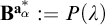 ${\mathbf {B}}^{{\mathbf {a}}^*_\alpha }:=P(\lambda )$
.
${\mathbf {B}}^{{\mathbf {a}}^*_\alpha }:=P(\lambda )$
.
Lemma 6.7. $P_{\alpha +1}$
forces:
$P_{\alpha +1}$
forces:
-
(1)
${\mathbf {a}}^*_\alpha>_{\mathrm {AP}} {\mathbf {a}}^*_\beta $
for all
$\beta <\alpha $
. -
(2)
${\mathbf {a}}^*_\alpha $
spoils
$(f,A)$
for all
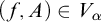
$(f,A)\in V_\alpha $
.


The proof consists of straightforward density arguments.
Proof. For (1) we know that by there is some $q\in G(\alpha )$
with
$q\in G(\alpha )$
with $\beta \in X^q$
. This implies that
$\beta \in X^q$
. This implies that ${\mathbf {C}}^{{\mathbf {a}}^*_\alpha }\subseteq {\mathbf {C}}^{{\mathbf {a}}^*_\beta }$
above
${\mathbf {C}}^{{\mathbf {a}}^*_\alpha }\subseteq {\mathbf {C}}^{{\mathbf {a}}^*_\beta }$
above $\delta ^q$
and that
$\delta ^q$
and that ${\boldsymbol {\pi }}^{{\mathbf {a}}^*_\alpha }\restriction I^{{\mathbf {a}}^*_\beta }_\zeta = {\boldsymbol {\pi }}^{{\mathbf {a}}^*_\beta }\restriction I^{{\mathbf {a}}^*_\beta }_\zeta $
for all
${\boldsymbol {\pi }}^{{\mathbf {a}}^*_\alpha }\restriction I^{{\mathbf {a}}^*_\beta }_\zeta = {\boldsymbol {\pi }}^{{\mathbf {a}}^*_\beta }\restriction I^{{\mathbf {a}}^*_\beta }_\zeta $
for all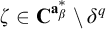 $\zeta \in {\mathbf {C}}^{{\mathbf {a}}^*_\beta }\setminus \delta ^q$
. We can also assume that a given
$\zeta \in {\mathbf {C}}^{{\mathbf {a}}^*_\beta }\setminus \delta ^q$
. We can also assume that a given $A\in {\mathbf {B}}^{{\mathbf {a}}^*_\beta }$
is in
$A\in {\mathbf {B}}^{{\mathbf {a}}^*_\beta }$
is in ${\mathbf {B}}^q_\beta $
, which implies that
${\mathbf {B}}^q_\beta $
, which implies that ${\boldsymbol {\pi }}^{{\mathbf {a}}^*_\alpha }[A]={\boldsymbol {\pi }}^{{\mathbf {a}}^*_\beta }[A]$
above
${\boldsymbol {\pi }}^{{\mathbf {a}}^*_\alpha }[A]={\boldsymbol {\pi }}^{{\mathbf {a}}^*_\beta }[A]$
above $\delta ^q$
.
$\delta ^q$
.
For (2) and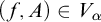 $(f,A)\in V_\alpha $
we know by Lemma 6.5(2) that for each
$(f,A)\in V_\alpha $
we know by Lemma 6.5(2) that for each $q\in G(\alpha )$
there is an
$q\in G(\alpha )$
there is an $r<q$
in
$r<q$
in $G(\alpha )$
such that
$G(\alpha )$
such that $b^{r}>^{f,A} b^q$
. I.e, in
$b^{r}>^{f,A} b^q$
. I.e, in $V_{\alpha +1}$
,
$V_{\alpha +1}$
, ${\mathbf {a}}_\alpha ^*$
is a limit of an
${\mathbf {a}}_\alpha ^*$
is a limit of an $<_{\mathrm {IS}}$
-increasing sequence as in Lemma 4.7, therefore
$<_{\mathrm {IS}}$
-increasing sequence as in Lemma 4.7, therefore ${\mathbf {a}}^*_\alpha $
spoils
${\mathbf {a}}^*_\alpha $
spoils $(f,A)$
(as
$(f,A)$
(as $A'$
certainly is in
$A'$
certainly is in ${\mathbf {B}}^{{\mathbf {a}}^*_\alpha }=P(\lambda )$
).
${\mathbf {B}}^{{\mathbf {a}}^*_\alpha }=P(\lambda )$
).
So P adds a sequence $({\mathbf {a}}^*_\alpha )_{\alpha <\mu }$
that we can use in Fact 3.7 to get a nowhere trivial automorphism. We will now show that P is
$({\mathbf {a}}^*_\alpha )_{\alpha <\mu }$
that we can use in Fact 3.7 to get a nowhere trivial automorphism. We will now show that P is $\lambda ^+$
-cc, which finishes the proof of Theorem 6.1.
$\lambda ^+$
-cc, which finishes the proof of Theorem 6.1.
Lemma 6.8. Set $t(p):=(b^{p(\alpha )})_{\alpha \in \operatorname {\mathrm {dom}}(p)}$
(i.e., the sequence of trunks). Then the following set D is dense: p in D if there is an
$t(p):=(b^{p(\alpha )})_{\alpha \in \operatorname {\mathrm {dom}}(p)}$
(i.e., the sequence of trunks). Then the following set D is dense: p in D if there is an $x\in V$
such that the empty condition forces
$x\in V$
such that the empty condition forces $t(p)=x$
.
$t(p)=x$
.
Proof. We claim that the lemma holds for $P_\alpha $
, by induction on
$P_\alpha $
, by induction on $P_\alpha $
. Successors and limits of cofinality
$P_\alpha $
. Successors and limits of cofinality ${\ge }\lambda $
are clear.
${\ge }\lambda $
are clear.
Let $\alpha $
be a limit with cofinality
$\alpha $
be a limit with cofinality $\kappa < \lambda $
, and
$\kappa < \lambda $
, and $(\alpha _i)_{i\in \kappa }$
cofinal in
$(\alpha _i)_{i\in \kappa }$
cofinal in $\alpha $
,
$\alpha $
, $\alpha _0=0$
. Set
$\alpha _0=0$
. Set $D_j:=D\cap P_{\alpha _j}$
(by induction dense in
$D_j:=D\cap P_{\alpha _j}$
(by induction dense in $P_{\alpha _j}$
). We construct by induction on
$P_{\alpha _j}$
). We construct by induction on $j\in \kappa $
a decreasing sequence
$j\in \kappa $
a decreasing sequence $p_j\in P_\alpha $
such that
$p_j\in P_\alpha $
such that $p_0=p$
and
$p_0=p$
and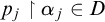 $p_j\restriction \alpha _j\in D$
:
$p_j\restriction \alpha _j\in D$
:
Successors: Given $p_j$
, we find
$p_j$
, we find $r\le p_j\restriction \alpha _{j+1}$
in
$r\le p_j\restriction \alpha _{j+1}$
in $D_{j+1}$
and set
$D_{j+1}$
and set $p_{j+1}:=r\wedge p_j$
(which is the same as
$p_{j+1}:=r\wedge p_j$
(which is the same as $r\wedge p$
).
$r\wedge p$
).
Limits: Given $(p_i)_{i<\xi }$
with
$(p_i)_{i<\xi }$
with $\xi \le \kappa $
, let
$\xi \le \kappa $
, let $p_\xi $
be the pointwise canonical limit. Note that we can calculate (in V) each
$p_\xi $
be the pointwise canonical limit. Note that we can calculate (in V) each $p_{\xi }(\beta )$
from the sequence
$p_{\xi }(\beta )$
from the sequence $(p_i(\beta ))_{i<\xi }$
(it is just the union).
$(p_i(\beta ))_{i<\xi }$
(it is just the union).
Lemma 6.9. (Assuming $2^\lambda =\lambda ^+$
in the ground model.) P is
$2^\lambda =\lambda ^+$
in the ground model.) P is $\lambda ^+$
-cc.
$\lambda ^+$
-cc.
Proof. Assume $(a_i)_{i\in \lambda ^+}$
is a sequence in P. For every
$(a_i)_{i\in \lambda ^+}$
is a sequence in P. For every $a_i$
find an
$a_i$
find an $a^{\prime }_i\le a$
in D. By Fodor (or the Delta-system lemma) there is an
$a^{\prime }_i\le a$
in D. By Fodor (or the Delta-system lemma) there is an $X\subseteq \lambda ^+$
of size
$X\subseteq \lambda ^+$
of size $\lambda ^+$
such that
$\lambda ^+$
such that $\{\operatorname {\mathrm {dom}}(a^{\prime }_i):\, i\in X\}$
form a Delta system with heart
$\{\operatorname {\mathrm {dom}}(a^{\prime }_i):\, i\in X\}$
form a Delta system with heart $\Delta $
, and furthermore we can assume that
$\Delta $
, and furthermore we can assume that $t(a^{\prime }_i)\restriction \Delta $
(the sequence of trunks restricted to
$t(a^{\prime }_i)\restriction \Delta $
(the sequence of trunks restricted to $\Delta $
) is the same for all
$\Delta $
) is the same for all $i\in X$
. (There are
$i\in X$
. (There are $\lambda ^{|\Delta |}=\lambda <\lambda ^+$
many such restrictions.) Then for
$\lambda ^{|\Delta |}=\lambda <\lambda ^+$
many such restrictions.) Then for $i,j$
in X, the conditions
$i,j$
in X, the conditions $a^{\prime }_i$
and
$a^{\prime }_i$
and $a^{\prime }_j$
(and therefore also
$a^{\prime }_j$
(and therefore also $a_i$
and
$a_i$
and $a_j$
) are compatible.
$a_j$
) are compatible.
Remark 6.10. Generally, preserving $\lambda ^+$
-cc for
$\lambda ^+$
-cc for $\lambda>\omega _1$
is much more cumbersome than for
$\lambda>\omega _1$
is much more cumbersome than for $\lambda =\omega $
, as there is no obvious universal theorem analogous to “the finite support iteration of ccc forcings is ccc.” In our case, it was very easy to show
$\lambda =\omega $
, as there is no obvious universal theorem analogous to “the finite support iteration of ccc forcings is ccc.” In our case, it was very easy to show $\lambda ^+$
-cc manually. However, we could have used existing iteration theorems. We give two examples (but there surely are many more). Note that the following theorems do not require
$\lambda ^+$
-cc manually. However, we could have used existing iteration theorems. We give two examples (but there surely are many more). Note that the following theorems do not require $\lambda $
to be inaccessible.
$\lambda $
to be inaccessible.
-
(1) From [Reference Shioya9] (generalising the
$\lambda =\aleph _1$
case from [Reference Baumgartner1, Lemma 4.1]):-
• Definition [Reference Shioya9, p. 237]: Q is
$\lambda $
-centered closed, if a centered subset D of Q of size
${<}\lambda $
has a lower bound. -
• Lemma [Reference Shioya9, p. 237]: Assume
$2^{<\lambda }=\lambda $
. Let P be a
${<}\lambda $
-support iteration such that each iterand is (forced to be)
$\lambda $
-linked and
$\lambda $
-centered closed. Then P is
$\lambda ^{+}$
-cc.
It is easy to see that our Q satisfies the requirements (Q is even
$\lambda $
-centered and “
$\lambda $
-linked closed”). -
-
(2) From [Reference Baumhauer, Goldstern and Shelah2] (generalizing the
$\lambda =\aleph _1$
case from [Reference Shelah6]):-
• [Reference Baumhauer, Goldstern and Shelah2, Definition 2.2.2]: Q is “stationary
$\lambda ^+$
-Knaster,” if for every sequence
$(p_i)_{i < \lambda ^+}$
in Q there exists a club
$E \subseteq \lambda ^+$
and a regressive function f on
$E \cap S^{\lambda ^+}_\lambda $
such that
$p_i$
and
$p_j$
are compatible whenever
$f(i) = f(j)$
. -
• [Reference Baumhauer, Goldstern and Shelah2, Theorem 2.26]: Assume that P is a
${<}\lambda $
-support iteration of iterands that all are: stationary
$\lambda ^+$
-Knaster, strategically
${<}\lambda $
-closed, and any two compatible conditions have a greatest lower bound, as do decreasing
$\omega $
-sequences. Then P is stationary
$\lambda ^+$
-Knaster.
Note that our Q satisfies the requirements, and that our proof that P is
$\lambda ^+$
-cc actually shows that P is stationary
$\lambda ^+$
-Knaster. -


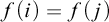


Funding
The first author was supported by the Austrian Science Fund (FWF) with DOI 10.55776/P33420, 10.55776/P33895, and 10.55776/PAT4602825. The second author was support by the Israel Science Foundation (ISF) grant no. 2320/23, and wishes to thank Craig Falls for generously funding typing services that were used during the work on the article. This is publication Sh:1251 in the second author’s list.





 Open access

