

Introduction
In Spain, 2024 marked the first year of a reconfigured left-wing coalition between the Socialist Party (Partido Socialista Obrero Español, PSOE) and the leftist platform Sum Up (Sumar). As in the previous legislature (2019–2023), the government was again a minority coalition, now supported by a legislative majority that included all parties from the prior term plus the Catalan nationalist party Together (Junts). The administration of this heterogeneous majority proved to be challenging for the coalition—but not impossible.
The first half of 2024 saw four consecutive elections that set the national agenda: Galicia in February, Basque Country in April, Catalonia in May, and the European Parliament elections in June. The results were mixed for major parties with representation in the Spanish Parliament.
With this electoral horizon at the forefront, legislative activity in Spain remained rather low. As a matter of fact, this was one more year in which the government chose not to present a new budget; the last time the Parliament passed a budget was in November 2022, for the 2023 budget. The main legislative landmark of 2024 was the Amnesty Law for people convicted during the so-called procés, the Catalan pro-independence process in play since the 2010s. This law was finally approved, but not without bitter debates both inside and outside the Spanish Parliament, including among the Judiciary.
During 2024, the PSOE was involved in diverse controversies that set the party's agenda. These included: the Koldo Case, a corruption scandal involving purchases made during the COVID-19 pandemic; accusations and investigations into influence peddling and nepotism against the family of President Sánchez; and the imputation of the Attorney General, Álvaro García Ortiz, for his alleged involvement in confidential information leaks. With these growing problems and difficulties around the left-wing coalition, a strong People's Party (Partido Popular, PP) and a resilient Vox continued their rivalry in the opposition.
At the end of October, a major meteorological event (termed DANA, Spanish acronym for Isolated Depression at High Levels) brought heavy rainfall to Castilla–La Mancha, Andalusia, and especially to the Valencian Community. In the province of Valencia, devastation was widespread, causing over 200 deaths and billions of euros in economic damage. As an example of the high polarization of Spanish politics, this catastrophe was used by parties and governments at all levels (local, regional, national) to fiercely attack their opponents, from the PP government in Valencia to the leftist national government in Madrid.
Election report
In 2024, no legislative elections took place in Spain.
European parliamentary elections
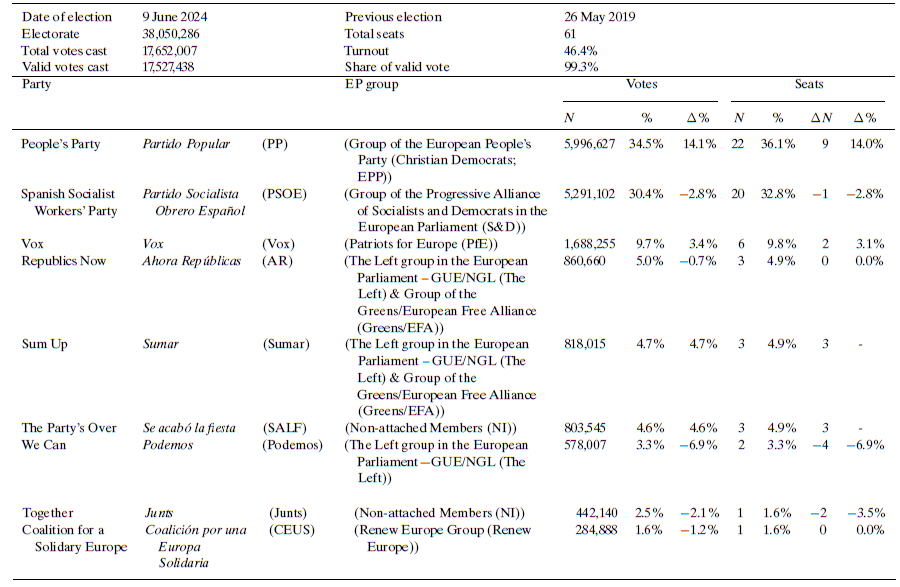
Spain was allocated 61 of the 720 seats in the European Parliament, with all representatives elected from a single national constituency. This significantly reduces the actual electoral threshold for gaining seats and allows small parties to obtain representation. The year 2024 proved to be no exception.
Turnout was below 50 per cent—a drop of nearly 14 points, compared to 2019 (at 60.7 per cent). The strong turnout of the prior election was due to its concurrence with local and regional elections in 2019 (see Delgado Sotillos et al. Reference Delgado Sotillos, López, Redondo and Fernández2020).
As in the general election that had taken place barely a year earlier, the traditional parties (PP and PSOE) obtained the most votes, together accounting for 60 per cent. The PP, led by Dolors Monserrat, emerged as the largest party, garnering roughly 6 million votes and 22 MEPs. This represented a significant increase of nine seats, compared to 2019, mainly due to the disappearance of one of its competitors, Citizens (Ciudadanos, Cs). The PSOE, led by Teresa Ribera, Minister for Ecological Transition and Demographic Challenge and third vice-president, came second with 5.3 million votes and 20 MEPs (one seat less than in 2019). Despite having significantly less support than the two major parties, the third strongest party, Vox, led by Jorge Buxadé, resisted and consolidated its position with over 1.6 million votes and six seats (+2). One of the big surprises of the election was the emergence of The Party's Over (Se Acabó La Fiesta, SALF), led by online agitator Luis “Alvise” Pérez. Despite its lack of structure and traditional media presence, this new party took advantage of the low electoral threshold and obtained a good result, especially among (male) voters below age 45, ending up with over 800,000 votes and three seats. SALF is a personalistic platform controlled by Alvise, with an anti-politics, populist, and far-right discourse. As a matter of fact, as an example of SALF's ideology, two of its MEPs joined the European Conservatives and Reformists in the European Parliament Group in December.
The break-up between Sumar and the Podemos party in Spain's Parliament at the end of 2023 (see Fernández-Pasarín & Bohigues Reference Fernández-Pasarín and Bohigues2024) continued during the 2024 European Parliament election. The Sumar list was led by Estrella Galán, a relatively unknown candidate who had served since 2011 as director of the non-profit organization, Spanish Commission for Refugees (CEAR). For its part, the Podemos list was led by former Minister of Equality Irene Montero, who had been excluded from the third Sánchez government formed in November 2023. Following poor results by Sumar in Galicia, Basque Country, and Catalonia, Sumar's performance in the European Parliament elections was similarly underwhelming, particularly in light of its participation in the national government. It obtained just over 810,000 votes and three seats, which were split among Movimiento Sumar (Sumar Movement), the Valencian party Compromís (Commitment), and Comuns (Commons), Sumar's Catalan counterpart. Podemos proved its resilience with 578,000 votes and two seats. Considering the split and the longstanding tensions between the two leftist forces in the past, Podemos perceived these results as good.
As for regional and nationalist parties, which usually unite in electoral alliances for the European elections due to the single national constituency, both Republics Now (electoral coalition formed by Republican Left of Catalonia [Esquerra Republicana de Catalunya, ERC], Basque Country United [Euskal Herria Bildu], Galician Nationalist Bloc [Bloque Nacionalista Galego, BNG], and Ara Més) and Coalition for a Solidary Europe (Coalición por una Europa Solidaria; electoral coalition formed by Basque Nationalist Party [Euzko Alderdi Jeltzalea-Partido Nacionalista Vasco, PNV], Canarian Coalition (Coalici ó n Canaria, CCa), El Pi, Atarrabia Group, Geroa Socialgreens) repeated prior results, with three seats for the former and one for the latter. Not belonging to any electoral coalition, Junts lost two seats, maintaining only one—although in fact the elected candidate did not take office as an MEP (see Table 1, Note 3).

Notes:
1. Since valid votes in Spain include blank votes, the share of votes by parties has been calculated on valid votes without blank votes.
2. Republics Now is an electoral coalition formed by ERC, EH-BILDU, BNG, and Now More (Ara Més). CEUS is an electoral coalition formed by PNV, CC, El Pi, Atarrabia Group, Geroa Socialgreens. Sumar run in a coalition formed by Sumar, Comuns, Commitment, United Left, More Madrid, Greens Equo, Aragonese Union, Andalusian People's Initiative, New Canary–Canarist Block.
3. Spanish law requires MEPs-elect to travel to the national Parliament in Madrid and declare their allegiance to the constitution in order to be certified as elected MEP. Since Toni Comín (Junts) refused to do so, EP President Roberta Metsola declined to recognize him as an MEP and did not to allow him to take office. This situation also happened after the 2019 election, with Toni Comín and Carles Puigdemont. The Court of Justice of the European Union ruled in September 2024 that the decision to not allow Comín and Puigdemmont in 2019 to take offices as MEPs was justified.
4. One MEP of Sumar and one of Now Republics joined The Left; the remaining MEPs (two from Sumar, two from Now Republics) joined Greens/EFA. Two MEPs of SALF joined European Conservatives and Reformists Group on 18 December 2024.
5. The change in the number of seats is based on the redistribution of seats in the EP after Brexit in 2020 (59 seats, instead of the 54 elected in 2019).
6. Podemos ran in 2019 in the coalition United We Can, formed by Podemos, IU, and Comuns.
Sources: European election results–Spain (2024; https://results.elections.europa.eu); InfoElectoral, Ministry of Home Affairs (Ministerio del Interior) (2024; https://infoelectoral.interior.gob.es/es/elecciones-celebradas/resultadoselectorales/).
Following prevailing trends, these elections proved to be almost purely Spanish in content—no major references to European issues were present during the campaign. The election results yielded a mixed outcome: with the exceptions of Sumar and Junts, almost all parties had reasons to be satisfied. The PSOE did not emerge as the election winner, but its results were not bad, and Teresa Ribera was eventually designated executive vice-president for the Clean, Equitable, and Competitive Transition of the European Commission later that year.
Regional elections
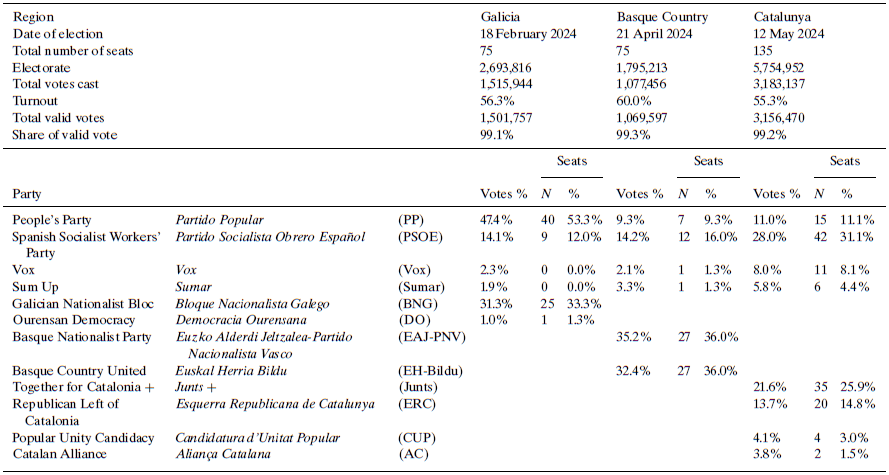
During 2024, three regional elections took place in Spain in the autonomous communities of Galicia, Basque Country, and Catalonia (Table 2). In all three cases, the campaigns, results, and formation of governments had an impact on the national agenda.

Notes:
1. Since valid votes in Spain include blank votes, the share of votes by parties has been calculated on valid votes without blank votes.
2. Sumar and Commons (Comuns) formed an electoral coalition for the 2024 Catalan elections.
Sources: Archivo de Resultados Electorales País Vasco (2024; https://www.euskadi.eus/elecciones-parlamento-vasco-2024-resultados-definitivos/web01-a3haup24/es/); ARGOS (2024; https://argos.gva.es); Eleccións 2024 Parlamento de Galicia (2024; https://resultados2024.xunta.gal); Eleccions al Parlament de Catalunya 2024 (2024; https://gencat.cat/eleccions/resultatsparlament2024/ca/inici).
In December 2023, Alfonso Rueda (PP)—President of Galicia since 2022 after Alberto Núñez Feijóo resigned to become President of the party at national level—called for snap elections for the Galician Parliament on 18 February. Although some polls predicted that the PP could lose its absolute majority, the party obtained a solid position and its fifth consecutive absolute majority since 2009. In stark contrast, the PSOE suffered its worst historical results, falling to just 12 per cent of the vote. The opposition to the PP government was successfully capitalized upon by the Galician Nationalist Bloc (Bloque Nacionalista Galego, BNG), led by Ana Pontón, which achieved its best-ever results: over 30 per cent of the vote and one-third of the seats. Ourensan Democracy (Democracia Ourensana), a right-wing personalistic local party that governs in Ourense, ran for the first time in the Galician elections and obtained one seat. Vox, Sumar, and Podemos did not win any seats.
Just four days later, on 22 February, Íñigo Urkullu (PNV), the Basque Country's lehendakari (president), called for snap elections to take place on 21 April. After internal negotiations, Urkullu did not run for re-election, and the PNV instead nominated Imanol Pradales, a relatively unknown politician with a rather technical background. The campaign was marked by the possibility (predicted by polls) that the Bildu party could become the main electoral force for the first time. Bildu did obtain a very good result—in fact its best to date—but the PNV remained the largest party. Both nationalist parties tied in seats (27), and the PSOE improved its results and obtained 12 seats (+2). These results allowed the ruling coalition, formed by the PNV and PSOE, to continue in power for the new legislature. Meanwhile, the PP (+1) and Vox (=) obtained results similar to 2020.
Finally, elections to the Catalan Parliament (135 seats) took place on 12 May. These were also snap elections, given that President Pere Aragonés (ERC) was unable to pass a budget and consequently called for elections. The PSOE-Party of Socialists of Catalonia (Partit dels Socialistes de Catalunya, PSC) continued to improve upon its 2021 results (see Delgado Sotillos et al. Reference Delgado Sotillos, Fernández-Pasarín and Bohigues2022). With 42 seats, it remained the largest party, this time with a clear advantage over the two parties that had ruled in the past decade, ERC and Junts. After the experience of governing in coalition with Junts, and later in a minority government, ERC dropped to third place with 20 seats (−13). For its part, Junts obtained 35 seats (+3). Their list was led by Carles Pugidemont, former president of Catalonia who proclaimed independence in 2017, then fled to Waterloo, Belgium, and has a warrant pending for his arrest. Since the Popular Unity Candidacy (Candidatura d'Unitat Popular) also lost votes and seats (down to just four), the total sum of leading pro-independence parties did not attain a parliamentary majority (59 out of 135) for the first time since 2010. Vox, once again, proved a resilient force, and with over 250,000 votes, it retained the same number of seats as in 2021 (11). The PP significantly improved its presence in the Catalan Parliament, from three seats to 15, mainly due to the collapse of Cs. Sumar-Comuns saw its representation reduced to six seats (−2). Last, a new party entered the Catalan Parliament with two seats: Catalan Alliance (Aliança Catalana), a far-right xenophobic Catalan nationalistic party that governs in the Catalan municipality of Ripoll with Sílvia Orriols, who obtained one of the seats.
A leftist majority became a possibility in Catalonia through the combination of the PSOE-PSC, ERC, and Sumar-Comuns (68 out of 135). ERC and Sumar-Comuns voted in favor of Salvador Illa (PSOE-PSC) as president, in an investiture marked by the fleeting public return of Puigdemont to Spain. Regardless of this comeback, Illa was successfully invested as president, and the PSOE-PSC formed a minority government. All things considered, these elections were proof that the so-called procés that began in 2012 was appeased in Catalan politics, at least for now.
Cabinet report
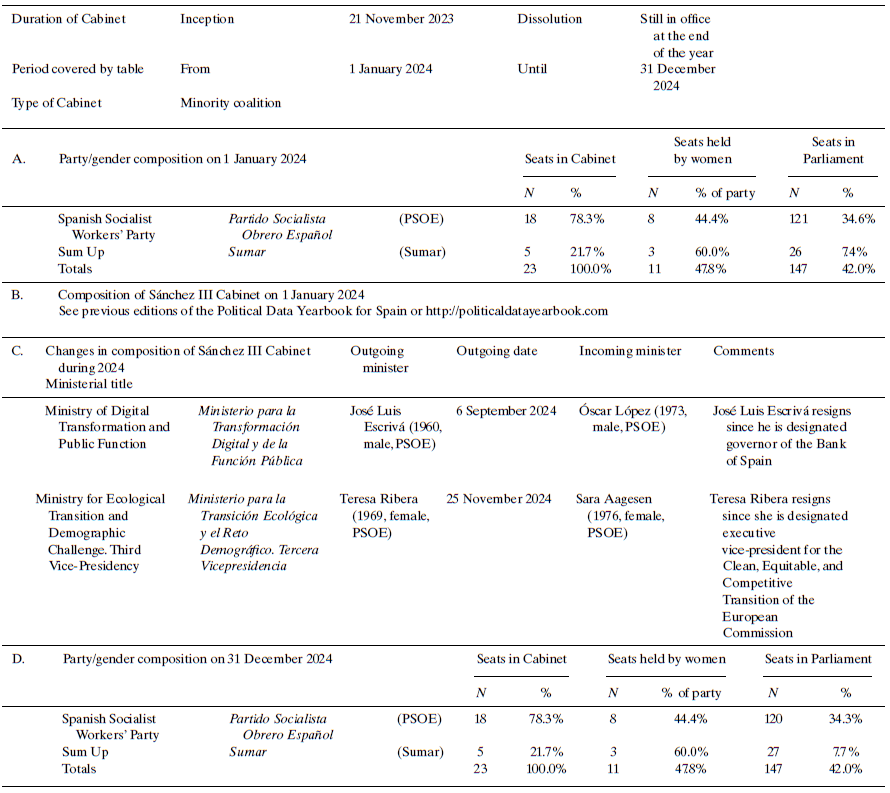
In 2024, there were just two changes in the composition of the Cabinet (Table 3), both of them affecting PSOE ministries.

Notes: See Table 4 for more information on the changes in the seats in Parliament controlled by PSOE and Sumar.

Notes:
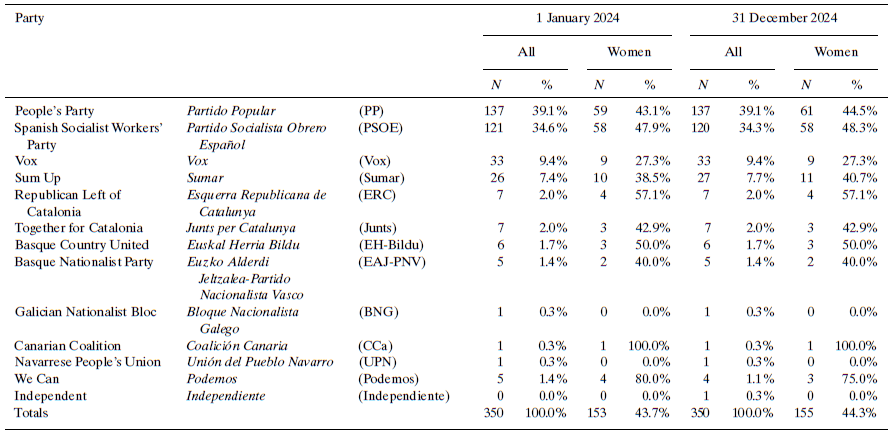
1. After the parliamentary split between Podemos and Sumar in December 2023 (see Fernández-Pasarín & Bohigues Reference Fernández-Pasarín and Bohigues2024), on January 2024 Lilith Verstrynge (Podemos) resigned and was replaced by Candela López (Sumar). This left Sumar with one additional seat, a total of 27 seats (out of the 31 won in the 2023 general election).
2. Due to a corruption scandal, MP José Luis Ábalos was expelled from the PSOE and left its parliamentary group but kept its seat as an independent on February 2024. This left the PSOE with one less seat.
Sources: Lower House (Congreso de los Diputados) (2024; www.congreso.es).
Sources: La Moncloa (2024; www.lamoncloa.gob.es) and lower house (Congreso de los Diputados) (2024; www.congreso.es).
In September, José Luis Escrivá, head of the Ministry of Digital Transformation and Public Function, was designated by President Sánchez as governor of Spain's central bank and replaced by Óscar López, theretofore Sánchez's Chief of Staff.
In December, Teresa Ribera, Minister for Ecological Transition and Demographic Challenge and third vice-president, was designated executive vice-president for the Clean, Equitable, and Competitive Transition of the European Commission. Ribera led the PSOE's list for the EU elections but did not take office as an MEP; she continued in her role as minister until her designation to the European Commission. Ribera was replaced by Sara Aagesen, previously Secretary of State for Energy in the same Ministry.
Parliament report
In 2024, the Spanish Parliament approved six Organic Laws (LO), eleven Royal Decree Laws (RD), and seven Ordinary Laws. Organic laws included: amnesty for the institutional, political, and social normalization of Catalonia (LO 1/2024 of 10 June); equal representation and balanced presence of women and men (LO 2/2024 of 1 August); an amendment to the Organic Law on Judiciary Power (6/1985) and the Organic Statute of the Public Prosecutor's Office (50/1981; LO 3/2024 of 2 August); and the improvement of the Foral Regime of Navarre on matters regarding traffic, circulation of motor vehicles, and road safety (LO 6/2024 of 5 December). In line with the European Criminal Records Information System, the Spanish Parliament also modified the Organic Law (7/2014) on the exchange of criminal record information and consideration of criminal judicial decisions in the European Union (LO 4/2024 of 18 October).
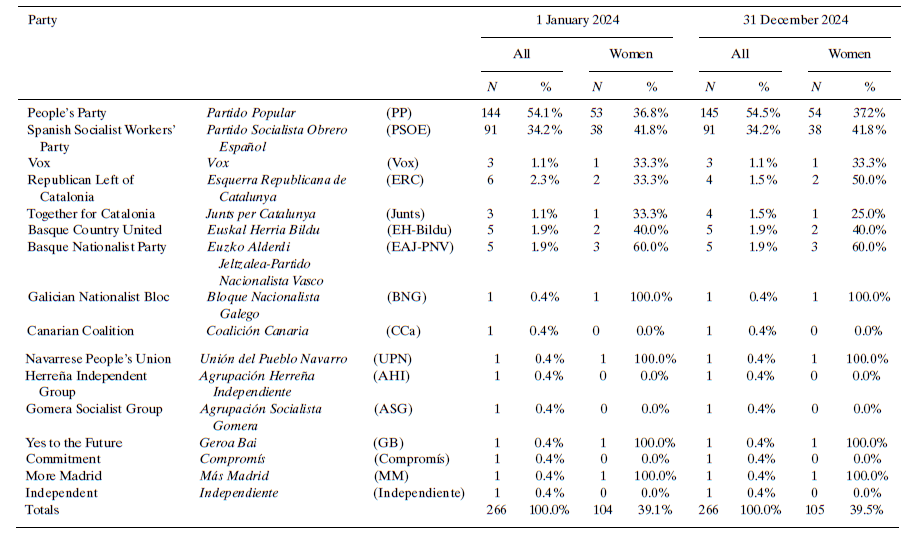
The most outstanding legislative landmark was the Amnesty Law, which came as a result of negotiations between the PSOE and the Catalan pro-independence parties (ERC and Junts) in exchange for their support in the 2023 investiture of Pedro Sánchez. This law granted total amnesty for all those involved in the so-called procés, which included the 2014 consultation on Catalan independence, the 2017 independence referendum, and the declaration of independence in 2017. This Amnesty Law was first voted on by Congress (lower house) on 30 January, but it was rejected (179 votes against, from the PP, Vox, Navarrese People's Union [Unión del Pueblo Navarro, UPN], CC, and also Junts). Despite its prominent role in the procés, Junts voted against due to the PSOE's unwillingness to extend the amnesty to include crimes of terrorism and treason. After another round of negotiations and a new debate in the Justice Commission, the law was passed by the lower house on 14 March, now with Junts voting in favor. The law was then vetoed by the Senate, where the PP held a majority (145 of 265), but the veto was finally overridden by the lower house on 31 May with 177 votes in favor (PSOE, Sumar, Podemos, ERC, Junts, EH Bildu, PNV, BNG), 172 votes against (PP, Vox, UPN, CC), one absence (one MP of Podemos), and no abstentions.
At the end of the year, the government approved an “Omnibus Decree” consisting of a battery of measures tapping into issues such as economics, taxes, energy, wages, transportation, pensions, and social security (RD 9/2024 of 23 December). Two of the most relevant measures were a revaluation of retirement pensions and a temporary energy tax for 2025. The measures on tax reform were queried by the PP in the European Commission and criticized by the Independent Authority for Fiscal Responsibility (Autoridad Independiente de Responsabilidad Fiscal española, AIReF) for non-compliance with EU legislation regarding fiscal deficit targets. This posed an obstacle to the government's plans, as the tax reform was a necessary step for the fifth disbursement of Next Generation EU funds.
Other governmental decrees addressed the social and economic catastrophe caused by the DANA in Valencia. These measures included the Plan of Immediate Response and Reconstruction for the damages in various affected areas (RD 6/2024 of 5 November and RD 7/2024 of 11 November).
Regarding the composition of the Parliament, two changes are noteworthy. First, due to a corruption scandal, in February 2024, former minister and MP, José Luis Ábalos, was expelled from the PSOE and left its parliamentary group; he maintained his seat as an independent. Second, MP Íñigo Errejón resigned as the Sumar spokesman and left his seat in the lower house after accusations of sexist violence that were acknowledged by himself in a public letter.
Continuing the trend from 2023, the government announced in March its decision not to present a new budget, citing the upcoming elections (especially the Catalan elections since the pre-election atmosphere would have complicated negotiations with Junts and ERC). Therefore, 2024 ended without a new budget.
Information on party and gender composition of the Parliament in Spain in 2024 can be found in Tables 4 and 5.

Notes:
1. Más Madrid and Commitment formed part of Sumar for the elections to the lower house, but their senators are designated by the parliaments of the Community of Madrid and the Valencian Community.
2. The independent Senator run to the 2023 Senate election with the platform Eivissa i Formentera al Senat (Ibiza and Formentera to the Senate) supported by PSOE, Sumar, EUIB, and Ara Eivissa.
Sources: Upper House (Senado) (2024; www.senado.es).
Political party report
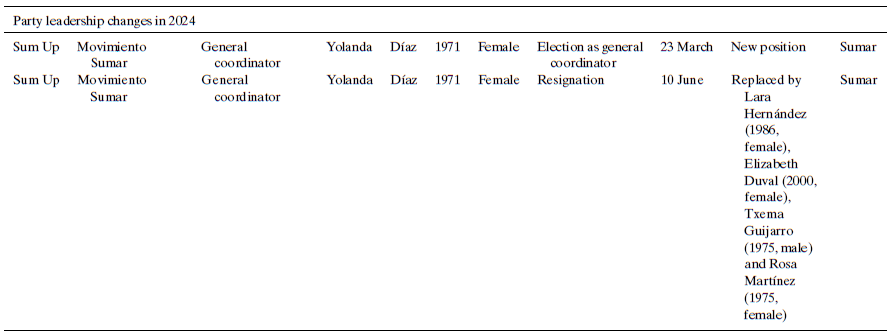
After the launch of Movimiento Sumar Footnote 1 and the local, regional, and general elections in 2023, the process of institutionalization of this new force moved ahead in 2024 with the election of Yolanda Díaz, second vice-president and Minister of Labor, as the General Coordinator of Movimiento Sumar. However, following poor results in the Galician, Basque, Catalan, and especially the European elections (see Tables 1 and 2), Díaz resigned as general coordinator of Movimiento Sumar in June, barely three months after her election.
In July, the National Executive Committee of Vox decided to put an end to all its coalitions in the regional (autonomous) governments with the PP—namely, in Castilla and Leon, Aragon, the Valencian Community, and Murcia. This left the PP with minority governments and Vox with no executive positions. The official reason for severing ties with the PP was a controversy over the distribution of unaccompanied foreign minors (“mena” an acronym for “menor extranjero no acompañado”) arriving in Spain, with PP-led regional governments agreeing to accept some, while Vox was firmly against. Coalitions with the PP at the sub-regional level were not affected by this decision.
The year 2024 also saw the end of the legislative representation of Cs. The party's last remaining seats had been in the Catalan and European Parliaments; unlike in the general elections of 2023, Cs ran in both of these elections but obtained no seats.
Information on changes in political parties in Spain in 2024 can be found in Table 6.

Source: Movimiento Sumar (2024; https://movimientosumar.es).
Institutional change report
The institutional deadlock of the General Council of the Judiciary (CGPJ in Spanish) was finally overcome after an agreement between the PP and PSOE to renew its 20 members, whose terms had expired more than five years earlier (see Fernández-Pasarín & Bohigues Reference Fernández-Pasarín and Bohigues2024: 477). Alongside an equal distribution of 10 members for each party, they agreed to task the new CGPJ with studying a reform of their own election method, taking into account the requirements of the European Commission. Another historical development related to the Judiciary was that, for the first time, a woman, Isabel Perelló, was elected by her peers as President of the Supreme Court and, therefore, head of the CGPJ.Footnote 2
Carmen Calvo, a PSOE MP and former vice-president, was appointed president of the Council of State after the Supreme Court (TS) annulled the appointment of Magdalena Valerio—former Minister of Labor (2018–2020) with the PSOE—for not being a “jurist of known prestige.”
The government issued a decree approving the renewal of the Board of Directors of the RTVE Corporation (Spanish Public Radio and Television Broadcaster) to improve its stability and professionalization. The new RTVE councillors (15) were confirmed in Congress through a political agreement between the PSOE (five councillors), Sumar (two), Junts (one), ERC (one), Podemos (one) and PNV (one); the remaining four councillors were elected by the PP in the Senate.
Finally, the appointment of Minister Jose Luis Escrivá as governor of Spain's central bank was somewhat controversial, as he was appointed by President Pedro Sánchez without reaching an agreement with the opposition (mainly the PP). Escrivá does not have a partisan but a technocratic background; before joining the Sánchez II government in 2020, he was the president of the AIReF, created by the PP in 2013.
Issues in national politics
Continuing the trend from 2023, the Spanish economy grew by 3.2 per cent in 2024, above the European average, and the minimum wage was raised by an average of 5 per cent. Household consumption recovered as the annual inflation rate slowed from 3.5 per cent in 2023 to 2.8 per cent in 2024. The unemployment rate decreased slightly, from 11.8 per cent in Q4 2023 to 10.3 per cent in Q4 2024 (Instituto Nacional de Estadística 2025).
In contrast to this favorable macroeconomic situation, various political matters slowed down the progress of the new legislature in 2024. The electoral schedule of the Galician, Basque, Catalan, and European elections, plus the Amnesty Law negotiations and protests against it, supported by rightist organizations, the PP and Vox, which began in October 2023 (see Fernández-Pasarín & Bohigues Reference Fernández-Pasarín and Bohigues2024: 479), amounted to a drain on the government's energy and its endeavors through the first half of the year.
Three salient corruption cases hit the headlines. First was the “Koldo case,” which involved alleged enrichment through public contracts during the COVID-19 pandemic and implicated José Luis Ábalos (an MP and former Minister, PSOE's Secretary of Organization and a close ally of Sánchez until 2021). Second, President Sánchez's wife, Begoña Gómez, was accused of influence-peddling by a far-right organization, and this allegation was supported and fuelled by Vox in complicity with the PP. In response, Sánchez took five days off to decide whether he would remain in office; after a week of great uncertainty during which the PSOE rallied around Sánchez, he decided not to resign. Last, there was a case of alleged tax fraud linked to the partner of Isabel Diaz Ayuso, president of the Community of Madrid and a powerful leader within the PP (see Delgado Sotillos et al. Reference Delgado Sotillos, Fernández-Pasarín and Bohigues2022, Reference Delgado Sotillos, López, Redondo and Fernández2020); this resulted in cross-accusations in which the Attorney General (perceived as close to the PSOE) ended up being investigated for the crime of unlawful disclosure of secrets due to media leaks during the case. All these scandals and accusations further tarnished the environment around the PSOE and were used by the opposition to attack the government.
On 29 October, Spain experienced one of the biggest natural catastrophes in its history: extensive flooding caused by the DANA meteorological event that mainly affected the Valencian Community (fourth largest economy of Spain) and left a total of 227 dead in addition to severe economic and infrastructure damages. Despite tensions between the PP and PSOE due to the lack of coordination between administration levels to alleviate the situation, the main attribution of responsibility fell on the Valencian regional government, led by the PP's Carlos Mazón, for its slow reaction in activating population alerts.
In the international arena, on 22 May, the Spanish government approved the recognition of the State of Palestine.

 Open access

