

I Introduction
Speaking at the 53rd Munich Security Conference, early in 2017, Bill Gates remarked that:
… the next epidemic could originate on the computer screen of a terrorist intent on using genetic engineering to create a synthetic version of the smallpox virus ... or a super contagious and deadly strain of the flu… Whether it occurs by a quirk of nature or at the hand of a terrorist, epidemiologists say a fast-moving airborne pathogen could kill more than 30 million people in less than a year.Footnote 1
The use of chemical or biological weapons by non-state actors is not a new issue, but it has become more significant for a number of European states over the course of the last year. For example, Sweden described chemical weapons use by non-state actors as a “grave risk and a major concern”;Footnote 2 Germany declared the “danger of a use of biological agents as a weapon, in particular by terrorist groups, is to be taken seriously”;Footnote 3 and, indeed, the EU has expressed “grave concern” “about the risk of non-State actors acquiring and using toxic chemicals”.Footnote 4
There are reasonable grounds for such concern, biology is getting relatively easier, more accessible and ever more powerful; whereas chemical weapons in the hands of non-state actors in Syria and Iraq is a regrettable reality. Yet gloomy predictions of apocalyptic chemical and biological weapons (CBW) in the hands of non-state actors rather ignores a complex set of factors that feed into decisions to adopt – or reject – such weapons, yet alone use them.
This article is part of a special issue that analyses the interactions between public health and security policy in Europe. The article seeks to explore what the past can tell us about the future risk of chemical and biological weapons adoption by non-state actors with a particular focus on the risks to Europe. In doing so, it challenges some of the bolder claims pertaining to an imminent darker chemical and biological weapons future. It does this by exploring different factors that are likely to feed into the calculus of whether or not such weapons will be adopted and/or used by non-state actors in the European context, including the relative advantage of CBW, the complexity of such weapons, the ideological compatibility, organisational factors, the visibility of such weapons and the wider European environmental context.
An exploration of these key factors suggests that, contrary to more alarmist claims, the seductive appeal of CBW with gigantic effect is likely to remain an unobtainable mirage for the short-term. However, as the synthesis of the factors addressed in this article shows, small groups of non-state actors with operationally relevant expertise are already able to launch crude, low-level, scruffy and opportunistic chemical weapons attacks, and this may be refined in the future. This suggests that public health preparations in Europe need to be able deal with a spectrum of CBW risks.
The paper begins with a discussion around the literature on technology adoption before laying out a framework orientated around six clusters of factors. The paper then proceeds by outlining the limits of using the past as prologue for understanding contemporary risks. The clusters of factors are then explored in turn using the available empirical data pertaining to past cases of CBW adoption and taking into account the evolving opportunities and challenges of the European context. The paper concludes with some reflections on what the past suggests about the future of CBW adoption in the European context.
II Framework for the adoption of CBW by non-state actors
The use of the term “adoption” is intended to denote the choice of a non-state actor to pursue chemical or biological weapons with a view to the assimilation of such weapons. This remains a significant part of the process of innovation,Footnote 5 as Michael Horowitz notes, a “key puzzle is how terrorist groups decide whether to adopt the innovation”.Footnote 6
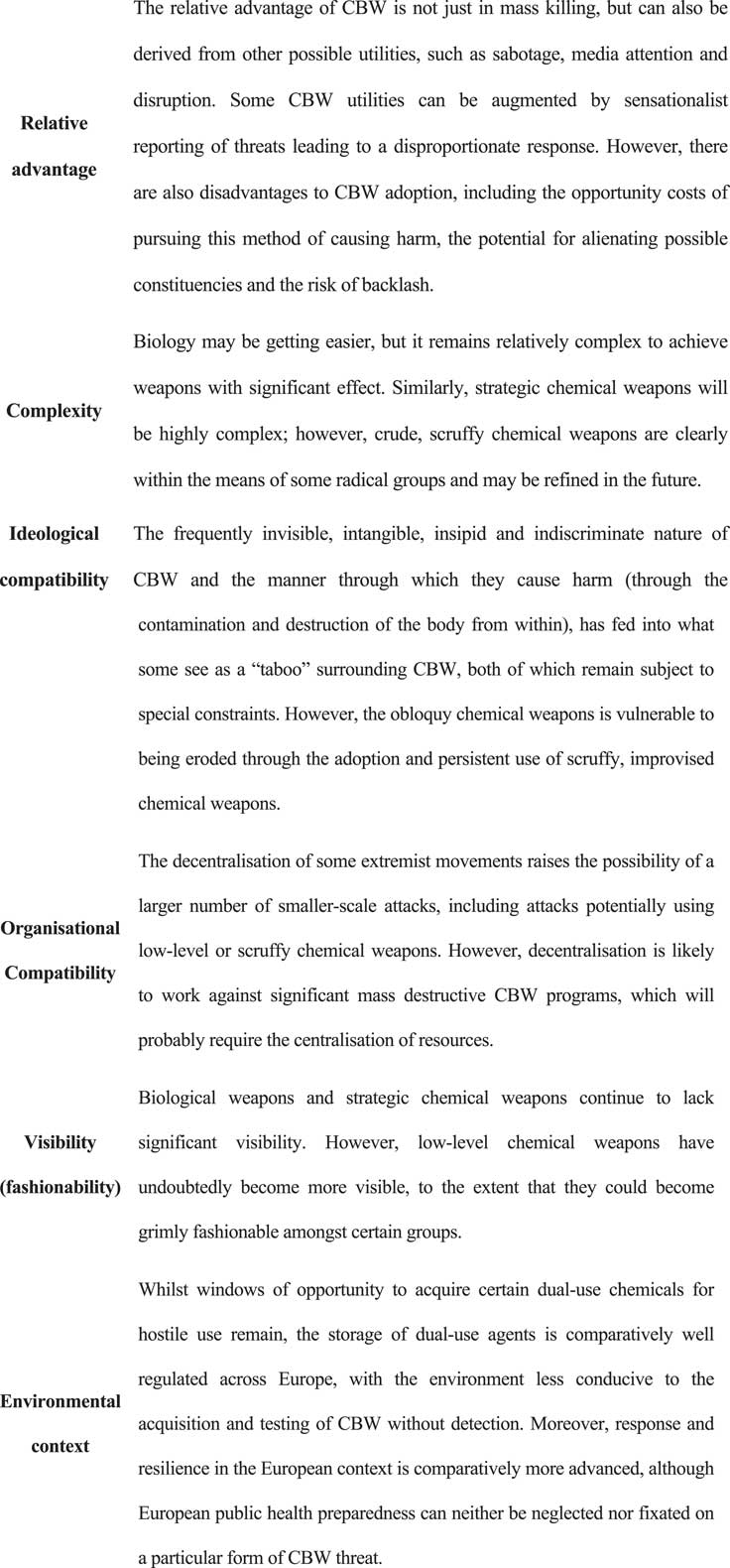
To explore this question, this article develops a framework for analysis of CBW adoption by non-state actors. The framework is not proposed as a perfect typology of factors that influence non-state adoption, nor are the clusters of factors neatly delineated, isolated groupings that can be dealt with in an equal manner. On the contrary, these factors overlap and interact with each other, with some of greater salience than others. Nonetheless, such a framework provides a means of trying to tease out different issues to consider in seeking to understand the risk of CBW adoption by non-state actors in the European context, as the summary in Figure 1 below illustrates. Moreover, it does so by building on established frameworks for thinking about adoption, specifically Roger’s five-factoral framework for the adoption of (peaceful) technologies,Footnote 7 combined with further insights from terrorism and security scholarship including the work of, inter alia, Crenshaw,Footnote 8 Ackerman,Footnote 9 JacksonFootnote 10 Rasmussen,Footnote 11 Bale and Dolnik.Footnote 12
Summary of factors identified as significant in CBW adoption
In employing this framework, this article eschews a technologically deterministic approach to looking at CBW adoption, in favour of a more constructivist approach that recognises the significance of multiple social factors in shaping technology and innovation. This is important as an antidote to more technologically deterministic approaches that erroneously assume “innovation necessarily entails the widespread diffusion of new technologies or techniques across terrorist organizations”,Footnote 13 when this is not the case.Footnote 14
It also seeks to draw from history whilst recognising that histories of CBW adoption by non-state actors have their limitations: in part, because of the assumptions, interpretations and definitions for example over what constitutes CBW; in part, because of considerable missing information on inter alia the perpetrators, the agents used, the motivations and indeed the validity of some reported cases;Footnote 15 and, in part, because there exist several cases in which non-events or naturally occurring phenomenon have been mistaken for – or deliberately misrepresented as – chemical and biological weapons use.Footnote 16 Such non-cases persist perhaps because of the power of CBW allegations in propaganda and the demonisation of adversaries; as Robinson has remarked “Accusations of association with [CBW] have for centuries … been used by well-intentioned as well as unscrupulous people to vilify enemies and to calumniate rivals”.Footnote 17
The point is that the past record of CBW needs to be treated with caution because it is potentially incomplete, inconsistent and contaminated with politics and uncertainty. Nevertheless, it cannot be ignored by those seeking to make sense of the future risk of CBW adoption by non-state groups and, whilst such factors cannot be used to predict specific changes in the adoption of CBW, there are perhaps some generalisable lessons that may be learned from the past that can inform the development of a framework for thinking about CBW adoption in the future.
1 Relative advantage and utilities
The first factor is the perceived relative advantage of chemical or biological weapons over other means of causing harm. As Rogers points out, “[d]iffusion scholars have found [the] relative advantage to be one of the best predictors of an innovation’s rate of adoption”;Footnote 18 moreover, several scholars of terrorist innovation have referred to the importance of the relative advantage factor.Footnote 19
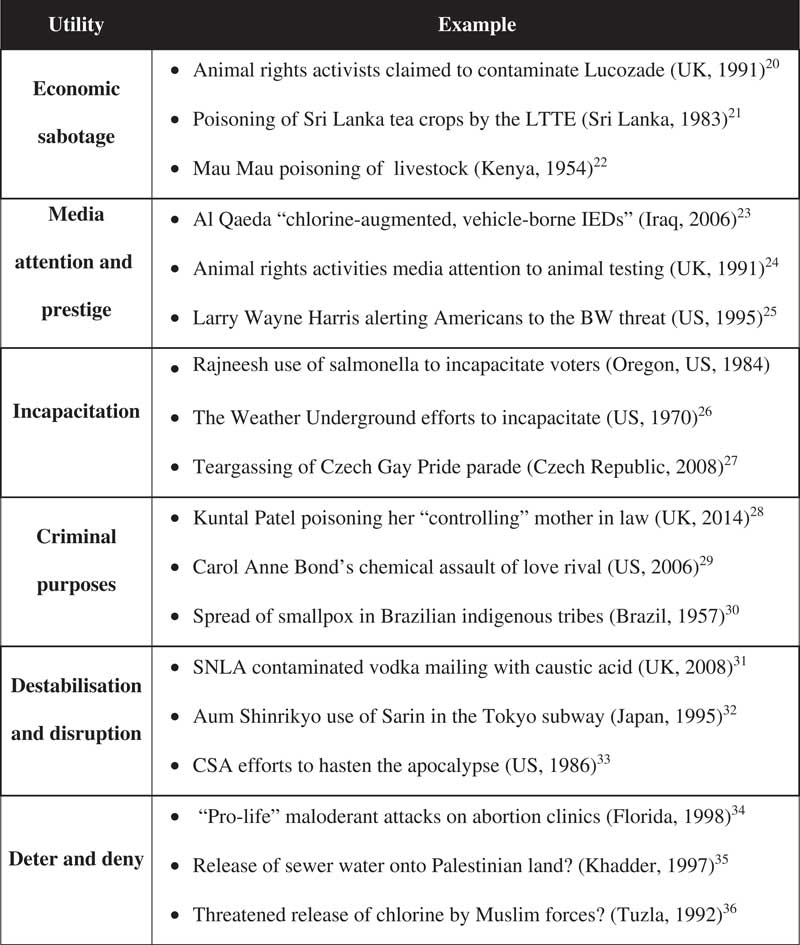
Yet in order to appreciate the relative advantage, it requires an understanding of the utilities of CBW. As noted elsewhere “[n]ot all CBW are Weapons of Mass Destruction, and to think otherwise is dangerous”,Footnote 37 nor is killing the only reason for the pursuit of such weapons. Rather CBW can serve a number of possible purposes from generating fear to stimulating media attention to economic sabotage and, indeed, there are examples where groups have eschewed highly-lethal CBW, such as in the case of the Rajneesh Cult, in part to avoid undue attention. Of course in some cases killing may be a key objective, but a focus on killing belies a number of other utilities CBW may be perceived as fulfilling, something outlined in Figure 2 above, which further illustrates both the long history and diversity of CBW adopters. The frequently sensationalised media coverage of CBW and the association of CBW with mass destruction, necessitates that in the event of an attack using these weapons, public reactions may well be disproportionate to the casualty-causing potential of such weapons.
Utilities of CBW and illustrative example cases.
Whilst CBW therefore have a number of utilities, some of which can be amplified through media hype – and public health actors need to prepare accordingly – it is also clear that there are other means of achieving the objectives of non-state groups. Gill et al have certainly argued that in the case of Hamas, “the fact that suicide bombings are cheaper, less likely to alienate their constituency and more cost-effective means that this particular manifestation of violence is far more elegant than a chemical attack…”;Footnote 38 whereas the Europol TE-SAT report for 2016 stated, “Terrorists prefer the use of conventional firearms and explosives because of their availability, simplicity and effectiveness”.Footnote 39 Indeed, IEDs have been employed for sabotage, destabilisation, demoralisation, disruption, area-denial and deterrence and have been used widely in Europe; whereas marauding Mumbai-style attacks have been used to devastating effect in Norway and, more recently, France.
Moreover, CBW have relative disadvantages over other means of causing harm. As discussed below, CBW are complex and the pursuit of such weapons generates opportunity costs; they are frequently met with opprobrium, to the extent that the adoption and use of such weapons could alienate many otherwise sympathetic constituents and potentially generate a comparatively more robust response from states; and the acquisition, development and or testing of such weapons can leave groups vulnerable to detection, a risk which is particularly pronounced in the European environmental context.
This notion of relative advantage (and disadvantage) and multiple utilities of CBW weapons suggests a note of caution in fixating European policy on preventing the proliferation of new, high-tech chemical and biological weapons of mass destruction, particularly if such a policy is pursued at a cost to efforts to prevent pernicious CBW with effects short of mass destruction. Indeed, it suggests a need for the EU and the composite member states to guard against a spectrum of possible CBW health threats, ranging from the use of more high-tech forms of chemical and biological weapons with gigantic effect on humans, to localised opportunistic attacks, including attacks on agriculture, livestock and even material.
2 Complexity
The second factor is “the perceived complexity of the innovation in terms of adoption and use”.Footnote 40 This is important in the innovation literature, as Rogers remarked, “[t]he complexity of an innovation, as perceived by members of a social system, is negatively related to its rate of adoption”.Footnote 41 Several scholars of terrorist innovation have also highlighted the issue of complexity;Footnote 42 or, as Cragin et al have stated, “[h]ow simple or complex a technology appears affects perceptions of how risky it will be to adopt.”Footnote 43
In most cases terrorist groups appear to have largely opted for the simplest pathway towards the achievement of their goals and the weapons used tend to be vernacular, functional devices drawing on local and readily-available materials, rather than sophisticated, “baroque” technologies. This is certainly the case with IEDs, the history of which is characterised largely by incremental innovations – although nevertheless frequently effective ones – with many means of delivery recycled from the past.Footnote 44 Complexity can therefore be seen as important in the adoption of technology by terrorists generally, but is perhaps particularly acute in the case of CBW technology.
Some CBW can be relatively simple: “chlorine-augmented, vehicle-borne IEDs,” as employed by Al-Qaeda in Iraq (AQI) from 2006 to 2007 are not sophisticated weapons.Footnote 45 Attacks on chemical production facilities, an apparent tactic of Serbian forces in the early to mid-1990s,Footnote 46 employed relatively simple technologies – specifically explosives – with toxicity a secondary by-product. Direct contamination of food,Footnote 47 drinkFootnote 48 or healthcare productsFootnote 49 does not require particularly sophisticated technology for the purposes of delivery – although may require some considerable skill to culture and scale-up a biological agent – and has been a common approach in European CBW incidents.Footnote 50 Similarly, the contamination of water systems, something familiar to Europe,Footnote 51 can also be relatively easily attempted. However, in most cases such methods of dissemination have generated results that are far short of the “mass destruction” that CBW are associated with, although this does not mean such a possibility can be ignored by those working on public health preparedness.
Although some relatively simple approaches could cause significant harm, mass casualty attacks still require considerable expertise, something particularly acute in the context of biological weapons.Footnote 52 The most effective route to weaponising biology is arguably through the process of aerosolising agents, something recognised mid-way through the last century as opening up the theoretical possibility of using biological weapons on a gigantic scale.Footnote 53 However, realising such theoretical potential is difficult and it took states decades to develop more predictable biological weapons,Footnote 54 and even then such weapons were acutely vulnerable to environmental factors.Footnote 55 For non-state groups such complexity has proven a significant barrier to CBW development. By means of an example, one of the best-resourced biological weapons programs, that of Aum Shinrikyo, failed variously because the group acquired the wrong strain, contaminated fermenters and were faced with insurmountable production and dissemination difficulties.Footnote 56 There are of course exceptions, such as the 2001 anthrax Letter Attacks in the US. However, if one accepts the conclusions of the FBI that this sophisticated attack with aerosolised anthrax in the US postal system was perpetrated by a US biodefence researcher, Dr Bruce Ivins,Footnote 57 it is an exception that proves the rule.
To circumvent the difficulties with aerosolisation, arguably one could use human-to-human transmissible biological agents as part of a suicide bioterror operation. There are good reasons for concern over how crude suicide bioterrorists could employ such a tactic. However, the use of highly contagious agents is also poorly predictable and would have to deal with social factors, such as the “spatial contact process among individuals”, which can spell “out the difference between large-scale epidemics and abortive ones”.Footnote 58
The counter to this argument is the growing access to data and the changing human geography of the life sciences. Some 83% of European households reportedly are online, effectively allowing access to what is a growing body of available data on CBW, including so-called bioterrorist “recipes” and “blueprints” that are available in both mainstream scientific as well as more subversive literatures online. It is also clear that there is a changing human geography in European life sciences (for peaceful purposes), with the emergence of 30 DIY-bio groups located in EuropeFootnote 59 and some 80 European teams in the international Genetically Engineered Machines (IGEM) competition in 2016.Footnote 60 This is compounded by reports that groups such as Daesh have deliberately sought to recruit foreign fighters “including some with degrees in physics, chemistry, and computer science, who experts believe have the ability to manufacture lethal weapons from raw substances”.Footnote 61
Whilst it would be unwise to ignore such developments, there is a need for caution in looking at the extent to which new technologies and geographies will facilitate the adoption of chemical and biological weapons by groups seeking to target European countries. First, data is not information, and information is not knowledge, let alone the tacit knowledge required for CBW.Footnote 62 In many cases a degree of determination and dedication will be required merely to separate online fantasy from fact and identify operationally useful information (of relevance to the European context) from nonsense (or information pertinent to contexts other than Europe). Second, with new technologies there is the potential for such tools to enable some, but certainly not all, actors, and even then new technologies bring new challenges. CRISPR, gene editing technology is currently seen as a particular source of promise and peril, which purportedly enables “even largely untrained people to manipulate the very essence of life”.Footnote 63 As much may be technically true, yet “untrained people” would nonetheless require some guidance in identifying suitable areas of genetic structures to manipulate. Moreover, CRISPR would only get aspiring weaponeers so far, with the process of culturing, scaling-up and weaponisation still requiring considerable attention and interdisciplinary skills, typically generated through “large interdisciplinary teams of scientists, engineers, and technicians”,Footnote 64 in order to be effective.
Indeed, for all the progress in science and technology, biological weapons are still not used, in part, because of the complexity of such weapons; and the chemical weapons that are used today are largely the same as the chemical weapons of 100 years ago. As Robinson noted “It remains the case today that, in the design of CBW, increasingly severe technological constraint sets in as the mass-destruction end of the spectrum is approached: the greater and more assured the area-effectiveness sought for the weapon, the greater the practical difficulties of achieving it”.Footnote 65
Thus, although complexity is an important factor, it is not an argument for complacency. Rather it highlights the significance of, first, guarding against technological surprise, including the shock of the old and the scruffy; and, second, sensitising those with the potential skill-sets to contribute to serious programs to dual-use risks and engaging scientists in academic and industry. Past research has suggested there is a low-level of awareness of dual-use risks amongst academics working in the fields of chemistry and biology across Europe,Footnote 66 and although there have since been a number of commendable initiatives to raise awareness and promote a culture of responsibility, including through the recent Hague Ethical Guidelines,Footnote 67 it is unclear how widely promulgated or sustainable such initiatives have been.
3 Ideology
A third factor is the compatibility of CBW with the ideological outlook of non-state actors. Ideology matters to the extent it may pre-determine the possibility of adoption or not.Footnote 68 As Ackerman has noted “[p]ractices that enjoy greater legitimacy, culturally or otherwise, in the wider social system are likely to diffuse more quickly than those that do not.”Footnote 69 Many means and methods of causing harm – from the crossbow to aerial bombardment to dumb-dumb bullets – have been subject to opprobrium. Yet unlike other such weapons where norms have eroded, chemical and biological weapons have largely continued to remain subject to a cross-cultural norm against their acquisition, development and use, to the extent some have described CBW as “taboo”.Footnote 70 Moreover, this is a norm which has been reinforced and codified through the development of an international governance regime comprising of treaties, such as the Chemical and Biological Weapons Conventions, and national laws that have been relatively well implemented across EU member states.
However, as history indicates, the norm against CBW is not inviolable; rather it remains a social construct and, as such, remains subject to change particularly with advances in science and technology and a rapidly changing security context.Footnote 71 This is a particular concern in light of the adoption and continued use of chemical weapons by actors involved in the Syrian conflict, a trend that has the potential to erode notions of CBW as an ideological anathema. As Guthrie has stated “There is certainly a huge risk of normalising [the use of chemical weapons] … This latest allegation of use is another contribution to the slow and steady diminishing of the taboo.”Footnote 72
Moreover, there remains a risk that CBW may be perceived as more ideologically compatible amongst contemporary violent extremist groups than in the past. As a recent European Parliamentary Research Service briefing indicated “ISIL/Da’esh is considered to be particularly dangerous because of its radical ideology and its declared intention to shock: the group has used ‘shock tactics’ effectively to attract new recruits”.Footnote 73 This inclination to shock, including through the use of novel, extreme tactics, suggests CBW could potentially be compatible with the tactics of groups, such as Daesh. Moreover, significant figures such as Bin Laden, as well as certain Islamic scholars, have explicitly encouraged the adoption and use of CBW. For example Al Qaeda’s flagship magazine Inspire cited religious scholars as encouraging Jihadists to “…throw on them fire, snakes or scorpions…”, “… Put blood, feces or poison in their water…”, and “…strike them with … scorpions snakes and all what harms them…”.
Yet whilst alarming, it is of note that Daesh have not been particularly forthcoming in claiming responsibility for the use of chemical weapons in Syria (or Iraq), although they are willing to actively promote other shocking acts. Furthermore, the justification for CBW is rather weak to any critical appraisal; “throwing scorpions” is a far cry from weapons of mass destruction and the comments of three Imams is surely outweighed by a statement attributed to the first Caliph exhorting troops to “overcome their enemies by bravery and never by poison”.Footnote 74 Nevertheless, the more frequent use of low-level chemicals remains a cause of consternation because of the challenge they pose to the norm against such weapons, the visibility these events give to chemical weapons, and the potential for chemical weapons adoption to become “darkly fashionable” among extremist groups outside of Syria and Iraq.
4 Organisational factors
Organisational factors are important, something noted by several scholars,Footnote 75 but neatly articulated by Kollars and Bristert: “decentralized organizations excel at generating new ideas, [but] they carry them out poorly. Conversely, centralized organizations can more easily coordinate attacks, but are hypothetically less innovative”.Footnote 76 This argument is certainly borne-out in the context of IED innovation in Europe;Footnote 77 however, the role of organisational factors in CBW adoption is less clear, with some well-documented case studies, such as that of Aum Shinrikyo, suggesting innovation is possible in certain highly centralised organisations, but particularly those with a leadership with a “techno-fetishist affinity”Footnote 78 towards such weapons.
Nonetheless, it remains a concern that recent exhortations from radical groups have encouraged those unable to participate in Jihad directly in countries, such as Iraq, to wage a much more disaggregated and decentralised Jihad.Footnote 79 This has been achieved either through “lone wolf” attacks undertaken without any direct supportFootnote 80 or, more significantly, “remotely guided plots”, that is “violence conceived and guided by operatives in areas controlled by the Islamic State whose only connection to the would-be attacker is the internet.”Footnote 81 Lone wolf attacks are comparatively rare in Europe and, although they can be devastating (such as in the case of the terrorist attack by Anders Breivik, which arguably falls within the “lone wolf” category), an analysis of lone wolf attacks in Europe by Ellis et al suggests that “76 per cent failed to cause any fatalities”.Footnote 82 More common of late have been plots in which individuals have been remotely encouraged and/or guided through the internet; according to Burke, such plots include a “wave of attack[s] in France” in 2015 and a number of incidents in Germany.Footnote 83
Neither “lone wolves” nor the perpetrators of “remotely guided plots” in Europe have seemingly sought to use CBW and, even taking into account that these decentralised entities have excelled at generating new ideas and demonstrated the capacity to carry them out, such attacks have so far involved relatively unsophisticated weapons. As significant CBW programs will likely require a number of social commitments and external linkages to function – from supply chains to expertise – it seems significant CBW adoption appears largely incompatible, or less compatible, with either decentralised remotely guided terrorism or smaller loosely affiliated group actors. This does not, however, rule out the possibility of groups virtually sharing operationally-relevant information pertaining to low-level, scruffy CBW or indeed facilitating the delivery of precursor chemicals and equipment intended for European targets from afar.Footnote 84
5 Visibility and “Fashionability” of CBW
A fifth factor is the visibility, and perhaps the “fashionability” of CBW. Non-state groups cannot use a weapon that they or their networks are not aware of. As the, then, Al Qaeda number two, Ayman Al Zawahiri, reportedly stated “… [Al Qaeda] only became aware of [chemical and biological weapons] when the enemy drew our attention to them by repeatedly expressing concern that they can be produced cheaply”.Footnote 85 In contrast, when there are visible examples of success, “Militant groups will seek to emulate tactics they deem as particularly novel, effective, and fear-inducing”.Footnote 86 This copy-cat-type process has been well documented with other forms of terrorist innovationFootnote 87 and suggests there is potential for CBW to become somehow darkly “fashionable”.
Fashionability certainly seems to have had a bearing on small-scale ricin plots, long a source of fascination amongst right-wing extremists in the US, the success of the TV series “Breaking Bad” increased the number of copycat efforts to use ricin in personal attacks, although not in a manner necessarily consistent with a wider understanding of CBW terrorism.Footnote 88 Similarly anthrax hoaxes and white powder letters increased significantly following the Amerithrax attack in 2001;Footnote 89 and, to provide some historical perspective, France endured a “wave of vitriolage” in the late 1880s with an estimated “83 reported cases” of chemical assault through acid throwing.Footnote 90
A more recent example of greater concern for contemporary European security, is the use of chemical weapons in Syria. A report titled A New Normal by the Syrian American Medical Society reports treating “victims from at least 161 chemical attacks”.Footnote 91 Whilst this is difficult to verify, the UN-OPCW Joint Investigative Mechanism (JIM) has indicated there is evidence of a small number of attacks having been carried out in Syria, the majority of which have been carried out by the Syrian Arab Armed Forces,Footnote 92 but at least one is believed to have been undertaken by the Islamic State in Iraq and the Levant (ISIL).Footnote 93 Similarly, French intelligence has reported five “proven” cases of sarin use “attributed to the Syrian regime”, 22 cases in which they have a “strong presumption of the use of chlorine by the Syrian regime” and three incidents of “Mustard gas attack attributed to Daesh”.Footnote 94 Such ongoing reports of chemical weapons use in Syria suggests that low-level chemical weapons are increasingly visible, raising the possibility of CW becoming more darkly fashionable as a tool of non-state actors, something potentially amplified by sensationalist media headlines.
6 Environmental context
A final cluster of factors is the wider environmental context,Footnote 95 including the space to trial weapons; the extent of countermeasures and preparedness of target populations; and the availability of “windows of opportunity”. The space to test and trial new weapons has been identified as important in Rogers’ work on “trialability”, that is “the degree to which an innovation may be experimented with on a limited basis”.Footnote 96 Several scholars of terrorist innovation have also emphasised the importance of a “hospitable environment” as a precondition for terrorist innovation,Footnote 97 with Dolnik demonstrating how safe havens provide space and time for innovation.Footnote 98 This appears the case with significant historical IED campaigns,Footnote 99 but also seemingly with major CBW events. For example, Aum benefited from considerable time and space (as well as resources) for their program and reportedly “attempted at least ten chemical agent and ten biological agent attacks”,Footnote 100 prior to “succeeding” with sarin in Tokyo;Footnote 101 whereas the Rajneeshees had several attempts at testing poisons before “successfully” contaminating salad bars with salmonella. In contrast, the crude CSA plot to contaminate water supplies was foiled, although as Carus notes, in time “CSA members might have found a more effective means of delivering cyanide if they had not been stopped by the FBI”.Footnote 102 It is notable in this regard that the European context is not a particularly “hospitable environment” for acquiring and trialling chemical or biological weapons, with a series of EU counter-terrorism projects having been undertaken to detect CBW and prevent the proliferation of dual-use materials.Footnote 103
Second, yet related to the above, government countermeasures have been highlighted by several scholars as important drivers of “innovation as terrorists seek to circumvent new security procedures”.Footnote 104 In addition to which, in the case of CBW, the preparedness of target states to react and respond to CBW use may also have a bearing on the methods and targets of non-state actors, with robust emergency response systems and resilient societal fabrics potentially undermining the appeal of CBW. In this regard, it is encouraging that at the European level, response and resilience have been given considerable attention through projects, such as the EU Framework 7, “End-user driven DEmo for cbrNE” or EDEN projectFootnote 105 as well as the establishment of the Early Warning and Response System, and Rapid Alert System for biological and chemical incidents.Footnote 106
A third element of the environmental context cluster are “windows of opportunity” to acquire and potentially use CBW with the “use of chemical weapons in conflict areas … largely conditioned by availability and means of dissemination in the region”.Footnote 107 One of the reasons for the rise and rise of IEDs in Iraq circa 2006, was, in part, the convergence and availability of IED components and skills, drawing from pilfered weapons caches and locally available materials and supported by former Baathist regime expertise; but also, in part, because of the windows of opportunity for using IEDs against coalition forces and the wide range of then-accessible targets.Footnote 108 The same opportunism can also be detected in some past cases of CBW adoption and use by non-state actors, for example, the Tamil Tiger’s seizure of chlorine cylinders in 1990 “was opportunistic in that the chlorine was readily available and satisfied an urgent military need”; whereas AQI’s chlorine augmented truck bombs also appear opportunistic.Footnote 109 As Karasik, has suggested “those who use toxic weapons are also taking whatever opportunities become available”.Footnote 110
The European context offers a number of possible sources of dual-use materials. However, key precursors are largely “under strict control of governments”,Footnote 111 and whilst low-level chemical weapons ingredients, specifically toxic industrial chemicals (TICs), may be widespread across Europe, the barriers to acquiring such materials are likely to be relatively more robust, although not infallible. Moreover, there have also been a considerable number of national initiatives (including those intended to develop penal legislation and enforcement capacity) across Europe, and the basic legal and regulatory components are in place in most cases. It will be important to ensure that such measures are both enforced and are not solely WMD-centric, but able to deal with acts of acquisition and development which whilst pernicious, fall short of efforts to acquire weapons capable of mass destruction in humans. It will also be important to ensure that states developed the necessary investigative expertise to pursue and prosecute crimes involving chemical and biological weapons. This may require specific skill sets in order to inter alia, preserve the chain of evidence and provide robust forensic analysis, as well as mechanisms for cooperation with actors in other jurisdictions and across national borders in order to be effective.Footnote 112
III Conclusions
This article has argued that the adoption of CBW by non-state actors has been influenced by a number of interlinked clusters of factors, including the relative advantage, the complexity, ideological compatibility, organisational structure, visibility and environmental context. Although there are limits to detailed data on such factors in relation to a long and diverse history of past case studies, there are nonetheless some generalisable lessons that may be learned from the past which can inform the future.
First, the relative advantages to CBW lie not necessarily in simply killing, but in other utilities such as economic sabotage, the generation of media attention and prestige; incapacitation; criminal purposes; destabilisation and disruption; deterrence and denial. Certain utilities, such as sabotage, destabilisation, disruption and denial in particular, can be amplified by sensationalist press coverage which in turn can generate a disproportionate reaction. The range of utilities and potential for amplification means that CBW may appeal to a variety of different groups in the future, including Daesh, but also, potentially, white supremacist groups, environmentalist and other violent extremist movements. However, the adoption of CBW by such groups also has disadvantages. The consequences of CBW adoption by non-state actors, if proven, would be significant with many EU countries imposing significant custodial sentences for acquisition. If this does not serve as a deterrent, the complexity of CBW, the potential opportunity costs of pursuing CBW over other means of causing harm and the risk of alienating otherwise sympathetic constituencies through association with CBW, might serve to dissuade.
Complexity is a major factor that is changing to some extent with advances in the life sciences and the development of enabling technologies. However, significant biological and chemical weapons remain complex and complicated – although the same cannot be said for scruffy chemical weapons. This suggests that there is a need to guard against technological surprise including the shock of the old (and the scruffy). Moreover, it is also apparent that any sense of ideological opprobrium towards chemical weapons may erode with the continued use of such weapons by state and non-state actors in Syria, in the process ‘chipping away’ at the norm against chemical weapons and potentially leading to such weapons becoming somehow grimly “fashionable”.
Organisationally, the apparent trend towards “remotely guided plots” works against the adoption of sophisticated CBW which will likely require a more centralised development process; but not necessarily the adoption of low-level chemical weapons. Although Europe is relatively well regulated, with dual-use precursors comparatively better controlled and response systems relatively well-developed than in other parts of the world, it cannot be overlooked that lucky amateurs might be able to successfully adopt and develop CBW with significant effect, despite the odds against them and the challenges to tradecraft in Europe.
This presents a rather fuzzy risk spectrum for those seeking to prevent, prosecute and respond to CBW adoption across Europe. Moreover it is a risk spectrum for which neither technological quick fixes nor simple, siloed solutions can be applied. There are a number of things that have been – and are being – done to prevent such weapons being adopted and used: from softer ethical guidelines to reinforce the norm, to penal legislative measures. Yet it needs to be recognised that such measures can only reduce the risk, not eliminate it and efforts towards prevention need to be complimented with an all-hazard public health preparedness capability able to tackle a number of possible CBW-related scenarios.


 Open access

