


Modern developmental research seeks to understand the intricate network of influences of the different environments children grow up in as well as children’s characteristics that shape children’s and adolescent’s development (Davidov et al., Reference Davidov, Knafo-Noam, Serbin and Moss2015; Rutter et al., Reference Rutter, Moffitt and Caspi2006). One goal of the Longitudinal Israeli Study of Twins (LIST; Avinun & Knafo, Reference Avinun and Knafo2013; Knafo, Reference Knafo2006) is to address this complexity by studying the association between genetic factors and the environments children grow up in, which is referred to as gene–environment correlations (rGE; Knafo & Jaffee, Reference Knafo and Jaffee2013; Plomin et al., Reference Plomin, DeFries and Loehlin1977). The other major goal of LIST is to study the origins of individual differences in the positive aspects of morally relevant development. There are over a hundred genetically informative studies on antisocial behavior (e.g. Burt, Reference Burt2009). In contrast, there are much fewer studies on the genetics of moral variables (Israel et al., Reference Israel, Hasenfratz and Knafo-Noam2015). Thus, the majority of LIST work has focused on the genetic, environmental and developmental background of variables such as prosocial behavior, empathy and values.
Data Collection
LIST includes 1657 families of Hebrew-speaking Israeli twins who have participated at least once in the study. Recruitment commenced in 2007 when the twins were 3 years old. Families of twins from across the country were identified with national information on multiple births provided by the Ministry of the Interior. Twins have been subsequently followed on a typically biannual rate (see Table 1). At ages 3.5, 5 and 7 years, the subsample of families living in the Jerusalem area participated in an observational session at the lab. Ages 6.5 and 8–9 years involved a larger sample of either home or lab visits that also included families from the center and north of Israel. Observational sessions focused mainly on same-sex twins. Currently, age 15 data are being collected, with plans for follow-up at age 17 and later on. Past reports on the LIST twin registry provide further details on the sample and recruitment (Avinun & Knafo, Reference Avinun and Knafo2013; Knafo, Reference Knafo2006).
LIST MZ and DZ pairs and data collected according to age and data type
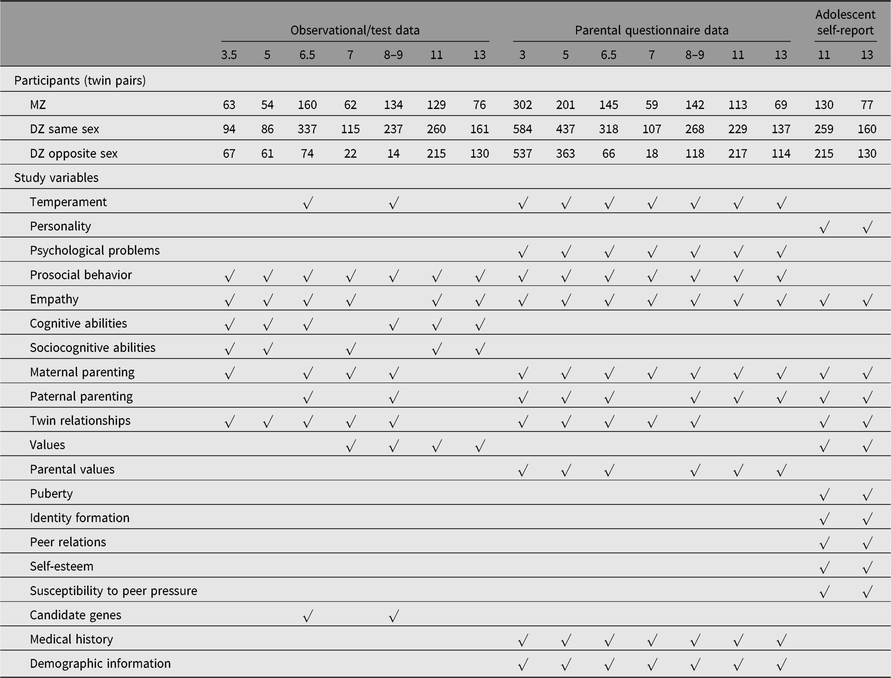
Notes: The number of twin pairs refers to the overall N in each study wave, but the specific N for each measured construct varies by tasks and questionnaires; participant numbers do not include pairs whose zygosity has not been verified or estimated; parent questionnaire participant numbers are for pairs for whom at least one parent filled up the questionnaire. N(pairs) for mothers by age in years: 3, 1421; 5, 997; 6.5, 495; 7, 184; 8–9, 498; 11, 522; 13, 291. N(pairs) for fathers: 3, 139; 5, 109; 6.5, 408; 8–9, 278; 11, 321; 13, 175. Parent questionnaire data on parenting was by each father about himself and each mother about herself, separately for each twin. Data collection is ongoing.
MZ = monozygotic; DZ = dizygotic.
At all ages, mothers were asked to describe children’s development using questionnaires, which mainly focused on twins’ relationships, behavior and temperament as well as demographic details and socioeconomic status. When available, fathers filled similar versions of the questionnaires. Starting from age 11, adolescents and their parents participate in the study through a specialized online portal. Contact with the families has been maintained through regular newsletters, a website and most recently in a special event honoring twins and their families at the Bloomfield Science Museum in Jerusalem.
Zygosity Assignment
Zygosity was assessed by DNA using 10 genetic markers for 44.6% of the same-sex twin pairs. Twins’ DNA was isolated from buccal epithelial cells using buccal swab brushes that were kept after collection in a sterile tube containing 15 ml of Aquafresh mouthwash. Parents’ DNA was extracted from 20 ml of Aquafresh mouthwash samples. DNA was extracted using the Master Pure kit (Epicentre, Madison, WI). When DNA was not available, zygosity was assigned by parental questionnaires describing twins’ physical similarity (54.7%; Goldsmith, Reference Goldsmith1991). In other cases, twins were assigned as dizygotic (DZ) when they were conceived via in-vitro fertilization (0.7%), and one family’s zygosity was assigned as DZ using estimates of physical similarity from videos.
Overall, the sample includes 10.92% monozygotic (MZ) male twins, 9.72% MZ female twins, 20.4% DZ male twins, 19.67% DZ female twins, 35.7% opposite-sex twins and 3.6% with undetermined zygosity. Avinun and Knafo (Reference Avinun and Knafo2013) suggested that the relatively high proportion of DZ twins reflects the relatively high number of Israeli families using assisted reproductive technologies. Table 1 presents sample sizes by zygosity for questionnaire and observational/test data at each age.
Measures of Children’s Development
Measures include core variables of positive aspects of social development and specifically prosocial behavior and empathy. These variables have been collected at each time point using both questionnaire and observational or test methods (e.g. Knafo et al., Reference Knafo, Israel and Ebstein2011; Knafo-Noam et al., Reference Knafo-Noam, Uzefovsky, Israel, Davidov and Zahn-Waxler2015; Schapira et al., Reference Schapira, Elfenbein, Amichay-Setter, Zahn-Waxler and Knafo-Noam2019). Starting at age 7 years, human values have been added as a core variable (Uzefovsky et al., Reference Uzefovsky, Döring and Knafo-Noam2016).
In addition to these core variables, we assessed children’s temperament (Hasenfratz et al., Reference Hasenfratz, Benish-Weisman, Steinberg and Knafo-Noam2015), their developmental delays and cognitive abilities (e.g. Kavé et al., Reference Kavé, Shalmon and Knafo2013), and psychological problems (Knafo et al., Reference Knafo, Zahn-Waxler, Davidov, Van Hulle, Robinson and Rhee2009). These variables were assessed with lab tests, observations, or established questionnaires (e.g. Buss & Plomin, Reference Buss and Plomin1984; Goodman, Reference Goodman1997; Kavé, Reference Kavé2006). Starting in early adolescence (age 11), information on relevant variables such as pubertal status (Petersen et al., Reference Petersen, Crockett, Richards and Boxer1988), personality traits (Big Five inventory; John et al., Reference John, Donahue and Kentle1991), wellbeing (Life Satisfaction scale; Huebner, Reference Huebner1991) and identity formation (DIDS; Luyckx et al., Reference Luyckx, Schwartz, Berzonsky, Soenens, Vansteenkiste, Smits and Goossens2008) have been added (Table 1).
Measures of Children’s Environment
Life events such as hospitalization and family structure changes are monitored at each assessment. Parenting, assessed by observations, parent reports and adolescent reports, has also been a focus of LIST (Knafo et al., Reference Knafo, Israel and Ebstein2011; Pener-Tessler et al., Reference Pener-Tessler, Avinun, Uzefovsky, Edelman, Ebstein and Knafo2013). From twins’ pregnancy and birth history (Fortuna et al., Reference Fortuna, van Ijzendoorn, Mankuta, Kaitz, Avinun, Ebstein and Knafo2011) to aspects of the school environment in adolescence, variables in LIST are adapted to children’s developmental period. As adolescence starts (age 11), measures of the peer group and emerging romantic relationships have been added.
Genetic Assessment
To study rGE, we focus on three neurobiological systems that were previously found to be related to social behavior: the dopaminergic, the serotonergic and the oxytonergic/vasopressinergic systems (Donaldson & Young, Reference Donaldson and Young2008; Girault & Greengard, Reference Girault and Greengard2004; Kuepper et al., Reference Kuepper, Alexander, Osinsky, Mueller, Schmitz, Netter and Hennig2010). Special interest is given to several genes commonly indicated in research for differential susceptibility to the environment, such as DRD2, DRD4, COMT, brain-derived neurotrophic factor (BDNF), 5-HTTPLR and AVPR1A (Avinun & Knafo-Noam, Reference Avinun and Knafo-Noam2017; Knafo et al., Reference Knafo, Israel and Ebstein2011).
Recent Achievements in LIST
The recent phases of LIST have focused on the longitudinal aspects of social development and have enabled us to examine stability and change throughout development in various prosocial and temperamental characteristics. Our two main goals were to further understand morally relevant development and to study rGE and gene–environment interactions. Intertwin relationships have also been of interest.
Morally Relevant Development
We focus on emotional, behavioral and cognitive aspects of morally relevant development, such as empathy, prosocial behavior and values. Although empathy, defined as the ability to recognize the emotions of others and to share those emotions (Uzefovsky & Knafo-Noam, Reference Uzefovsky, Knafo-Noam, Sommerville and Decety2017), can be seen as serving a meaningful evolutionary function (Decety et al., Reference Decety, Bartal, Uzefovsky and Knafo-Noam2016; De Waal, Reference De Waal2012), it also shows substantial individual differences (Knafo et al., Reference Knafo, Zahn-Waxler, Davidov, Van Hulle, Robinson and Rhee2009). Work from LIST has demonstrated genetic contributions to observed empathy in early childhood (Knafo et al., Reference Knafo, Zahn-Waxler, Davidov, Van Hulle, Robinson and Rhee2009), although cognitive aspects of empathy such as understanding emotions tend to show lower heritability and higher shared environmental influences in middle childhood (Knafo & Uzefovsky, Reference Knafo, Uzefovsky, Legerstee, Haley and Bornstein2013; Schapira et al., Reference Schapira, Elfenbein, Amichay-Setter, Zahn-Waxler and Knafo-Noam2019). Further work has showed gene–environment interactions, in which variation in the exon III repeat region of the DRD4 gene interacted with children’s gender and with the parenting they received in affecting different aspects of children’s observed empathy (Ben-Israel et al., Reference Ben-Israel, Uzefovsky, Ebstein and Knafo-Noam2015; Knafo & Uzefovsky, Reference Knafo, Uzefovsky, Legerstee, Haley and Bornstein2013).
Prosocial behavior, a behavior that is aimed at benefiting others (Eisenberg et al., Reference Eisenberg, Spinrad, KnafoNoam, Lamb and Lerner2015), can be manifested in different forms such as sharing, social concern, helping and comforting. These behaviors can be either self-initiated or compliant, following a request. At age 3.5 years, we found that experimentally assessed comforting behavior correlated with helping and sharing behaviors, while sharing and helping did not correlate with each other (Knafo-Noam et al., Reference Knafo-Noam, Vertsberger and Israel2018). As children grew older we could study a wider variety of prosocial behaviors. At age 7 years, using parent reports, we identified five prosociality facets (sharing, social concern, kindness, helping and empathetic concern), which were positively intercorrelated (r > .39; Knafo-Noam et al., Reference Knafo-Noam, Uzefovsky, Israel, Davidov and Zahn-Waxler2015). This finding may point to the existence of a single prosociality trait, which perhaps crystallizes with age.
Values, which are abstract goals that guide behavior and are used as compass to determine right from wrong (Schwartz, Reference Schwartz1992), may be seen as providing the motivational stratum of morality (Sverdlik et al., Reference Sverdlik, Roccas, Sagiv, Mikulincer and Shaver2012). Values were traditionally considered as emerging in late adolescence, and so the majority of studies on values focus on adults. However, we found evidence that values actually develop earlier than previously thought and can be studied in children of 7 years old (Uzefovsky et al., Reference Uzefovsky, Döring and Knafo-Noam2016) and even younger (Abramson et al., Reference Abramson, Daniel and Knafo-Noam2018). We used the Picture-Based Value Survey for children (Döring et al., Reference Döring, Blauensteiner, Aryus, Drögekamp and Bilsky2010), which is based on Schwartz’s comprehensive and widely used account of value priorities and structure (Boehnke, Reference Boehnke2001; Verplanken & Holland, Reference Verplanken and Holland2002), and found the same basic patterns of relations between value priorities and social dimensions — gender, religiosity and socioeconomic status — that have been found in adult studies (Uzefovsky et al., Reference Uzefovsky, Döring and Knafo-Noam2016). Although most of our work on the genetic and environmental contribution to values is ongoing, this initial report from LIST was the first to demonstrate genetic contributions to most values in young children (Uzefovsky et al., Reference Uzefovsky, Döring and Knafo-Noam2016). As children enter adolescence, the way they explore and commit to their future identity helps shape the development of their values (Knafo & Schwartz, Reference Knafo and Schwartz2004). Thus, our report from age 11 years showed that individual differences in identity formation patterns are partly heritable (Markovitch et al., Reference Markovitch, Luyckx, Klimstra, Abramson and Knafo-Noam2017). This suggests that value development through adolescence is likely affected by genetic factors as well.
Gene–Environment Correlations
A major goal of LIST has been to understand rGE and specifically evocative rGE, in which an individual’s genetically influenced phenotype affects the reaction of his or her social environment. One such environment, peer relationships, is crucial for social development (Blakemore & Mills, Reference Blakemore and Mills2014). Our results show that peer problems, seen as the reaction of the peer environment to the developing child, are associated with the child’s temperamental dimensions of negative emotionality and sociability at age 3 years (Benish-Weisman et al., Reference Benish-Weisman, Steinberg and Knafo2010). Using longitudinal data from ages 3, 5 and 6.5 years, our results indicate that peer problems (assessed by both mothers and fathers) are longitudinally associated with mother-rated negative emotionality and low sociability, over and above moderate stability of all variables (Hasenfratz et al., Reference Hasenfratz, Benish-Weisman, Steinberg and Knafo-Noam2015). Heritability partly explained these associations, thus indicating the existence of evocative rGE. This finding implies that children’s genetically influenced tendency to play alone and experience intensive negative emotions is putting them at a higher risk of rejection by their peers (Hasenfratz et al., Reference Hasenfratz, Benish-Weisman, Steinberg and Knafo-Noam2015).
LIST also focuses on how children’s behavior influences the parenting they receive. At age 3.5, we found evidence of an evocative rGE in which boys’ 5-HTTLPR genotype was associated with mothers’ observed positive parenting (Pener-Tessler et al., Reference Pener-Tessler, Avinun, Uzefovsky, Edelman, Ebstein and Knafo2013). In addition, the results indicated that boys’ mother-reported self-control mediated the effect of boys’ 5-HTTLPR genotype on mothers’ positivity, such that boys’ 5-HTTLPR genotype predicted their levels of self-control, which in turn predicted the levels of positive parenting they received (Pener-Tessler et al., Reference Pener-Tessler, Avinun, Uzefovsky, Edelman, Ebstein and Knafo2013).
Parenting has also been linked to parents’ own genes (Avinun et al., Reference Avinun, Ebstein and Knafo2012; Pener-Tessler et al., Reference Pener-Tessler, Avinun, Uzefovsky, Edelman, Ebstein and Knafo2013), implicating passive rGE in observed associations between parenting and child behavior (Knafo & Jaffee, Reference Knafo and Jaffee2013; Narusyte et al., Reference Narusyte, Neiderhiser, D’onofrio, Reiss, Spotts, Ganiban and Lichtenstein2008). Finally, to add to the complexity of the parenting–genes–child behavior network, two reports from LIST found that fathers’ (but not mothers’) parenting was predicted by an interaction between the val-met polymorphism in the BDNF gene and children’s prosocial or aggressive behavior. The importance of children’s behavior was exemplified by within-family twin comparisons such that Met carrier fathers differentiated more strongly between their children based on the child’s behaviors (Avinun & Knafo-Noam, Reference Avinun and Knafo-Noam2017; Avinun et al., Reference Avinun, Davidov, Mankuta and Knafo-Noam2018).
Twin Relationships
Despite the importance of twins to each other, research on twins has largely neglected this relationship. In the parent-report twin relationship questionnaire, we identified five relationship factors, namely, conflict, closeness, dependence, dominance and rivalry, which related to twins’ self-reported relationship and observed prosocial behavior toward each other (Segal & Knafo-Noam, Reference Segal and Knafo-Noam2019). The first report from LIST on this topic found that 3-year-old MZ twins were perceived as closer and more co-twin dependent than DZ twins who in turn were closer and more co-dependent than a matched sample of nontwin siblings (Fortuna et al., Reference Fortuna, Goldner and Knafo2010). However, using an experimental measure of intertwin prosocial behavior at the age of 6.5 years, we did not find a difference between MZ and DZ twins in their prosocial behavior toward each other (Yirmiya et al., Reference Yirmiya, Segal, Bloch and Knafo-Noam2018), and the two kinds of twins were similarly positively correlated with each other, suggesting that this behavior is driven by reciprocity (i.e. the likelihood of being prosocial, depending on the past and future mutual interactions), rather than relative genetic similarity between the twins. The difference between these findings may be explained by differences in the examined constructs, children’s age, or research method, and stresses the need for additional research on this important topic.
Summary and Future Directions
LIST has provided ample evidence for the involvement of genetic influences and to a lesser extent also shared environmental influences in children’s development (Fortuna et al., Reference Fortuna, Baor, Israel, Abadi and Knafo2014; Kavé et al., Reference Kavé, Shalmon and Knafo2013; Knafo et al., Reference Knafo, Israel and Ebstein2011). It has also provided evidence for the role of rGE and gene–environment interactions (e.g. Benish-Weisman et al., Reference Benish-Weisman, Kerem, Knafo-Noam and Belsky2015; Fortuna et al., Reference Fortuna, van Ijzendoorn, Mankuta, Kaitz, Avinun, Ebstein and Knafo2011).
Current research plans for LIST focus on adolescence until the age of 17 years and hopefully beyond. Adolescent research will investigate the genetic and environmental contributions to values as well as the development, crystallization and genetic origins of values–personality associations that are evident in adulthood (Fischer & Boer, Reference Fischer and Boer2015). As adolescents grow up, in addition to our continued focus on parenting, more emphasis will be given to other social environments that increase in their importance during this developmental period, such as the school and neighborhood. At the same time, LIST will seek to include polygenic information to further our understanding of the genetic factors involved in social behavior. After studying early, middle and late childhood, the transition to adolescence and then emerging adulthood will be at the heart of future research in LIST.
The email address of LIST is mehkar.teomim@gmail.com. Our website address is http://soc-lab.com.
Acknowledgements
We thank Gali Naor, Moran Shalmon, Tamar Gutbir, Naama Gilat, Roni Pener-Tessler, Hen Nave-Arbel, Chen Regev-Limoni, Noam Markovitch and Dana Katsoty for coordinating the data collection at different stages of LIST. LIST has been supported by the Israel Science Foundation (grants No. 31/06, 1670/13, 1333/18). Further support was obtained by a grant from The Science of Generosity Initiative, University of Notre Dame funded by the John Templeton Foundation and by starting grant no. 240994 from the European Research Council (ERC) both to Ariel Knafo. We also thank the Bloomfield Science Museum in Jerusalem for their support of the twin study participant meeting. Most importantly, we thank the parents and children in our study for their continued support and participation.



