


Introduction
The Mediterranean Sea harbour stable populations of marine mammals, including 10 cetacean and 1 pinniped species (Pace et al., Reference Pace, Tizzi and Mussi2015; Karamanlidis et al., Reference Karamanlidis, Lyamin, Adamantopoulou and Dendrinos2017). However, many exotic marine mammal species can enter the Mediterranean Sea through the Strait of Gibraltar or the Suez Canal (Podestà et al., Reference Podestà, Cagnolaro and Cozzi2005; Galil, Reference Galil2008; Notarbartolo di Sciara, Reference Notarbartolo di Sciara2016; Solomando et al., Reference Solomando, Colomar, Gomila and Fernández2023, and references therein). Three exotic cetacean species have been reported several times, i.e., the common minke whale, Balaenoptera acutorostrata; the humpback whale, Megaptera novaeangliae, and the false killer whale, Pseudorca crassidens, whereas other 10 species seem to be exceptional in occurrence (Frantzis et al., Reference Frantzis, Nikolaou, Bompar and Cammedda2004; Podestà et al., Reference Podestà, Cagnolaro and Cozzi2005; Notarbartolo di Sciara, Reference Notarbartolo di Sciara2016 and references therein; Calogero et al., Reference Calogero, Biasissi, Bottaro, Capone and Violi2021; MEDACES Database). Records of pinnipeds are unusual, with reports of hooded seal, Cystophora cristata (Bellido et al., Reference Bellido, Castillo, Farfan, Martín, Mons and Real2008; Bouderbala et al., Reference Bouderbala, Bouras, Bekrattou, Doukara, Abdelghani and Boutiba2007); harp seal, Pagophilus groenlandicus (Bellido et al., Reference Bellido, Cabot, Castillo, Báez, Martin, Mons, Larios, Rubia and Real2009); harbour seal, Phoca vitulina (Mas et al., Reference Mas, Jiménez and Raga1997), and, more recently, grey seal, Halichoerus grypus (Solomando et al., Reference Solomando, Colomar, Gomila and Fernández2023).
The presence of marine mammal species in localities out of their usual geographical range is usually interpreted as the result of vagrant movements of dispersing individuals, or the abnormal behaviour of impaired or disoriented animals (Halpin et al., Reference Halpin, Towers and Ford2018; Chosson et al., Reference Chosson, Randhawa, Sigurðsson, Halldórsson, Björnsson, Svansson, Granquist, Gunnarsson, Samarra and Pampoulie2023; Solomando et al., Reference Solomando, Colomar, Gomila and Fernández2023; De Weerdt et al., Reference De Weerdt, Ramos and Acosta-Pachón2024). However, the possibility that these exceptional occurrences may reflect ongoing climate-related shifts in geographical distribution cannot be ruled out (Levesque et al., Reference Levesque, Daly, Dillane, O’Donovan, Gomez-Parada and Berrow2023; Chiacchio & Aae, Reference Chiacchio and Aae2024; Pons-Bordas et al., Reference Pons-Bordas, Pool, Ten, Armenteros-Santos, Balseiro, Fayos and Aznar2024). To shed light on this issue, evidence on the geographic origin of the animals, and the time spent to reach the new localities, would be highly informative. To this end, parasites can be particularly useful tags (see, e.g., Margolis, Reference Margolis1959, Reference Margolis1963; Gomes et al., Reference Gomes, Quiazon, Kotake, Fujise, Ohizumi, Itoh and Yoshinaga2021; Ten et al., Reference Ten, Konishi, Raga, Pastene and Aznar2022; Pons-Bordas et al., Reference Pons-Bordas, Pool, Ten, Armenteros-Santos, Balseiro, Fayos and Aznar2024) for two reasons. First, parasite species that exhibit a restricted geographical distribution can mark the stay of infected hosts in these areas; second, the lifespan of these parasites, and the duration of each life stage within the host, can help gauge the period in which the hosts were out of the parasite’s distribution area (Mackenzie, Reference Mackenzie2002; Pons-Bordas et al., Reference Pons-Bordas, Pool, Ten, Armenteros-Santos, Balseiro, Fayos and Aznar2024).
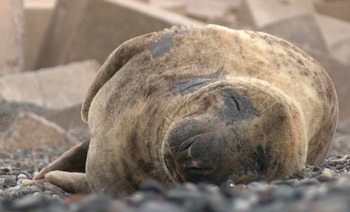
Grey seals, Halichoerus grypus, inhabit cold temperate and subarctic waters along the North Atlantic Ocean, where they are grouped into three populations in the NW Atlantic, NE Atlantic and Baltic Sea (Boskovic et al., Reference Boskovic, Kovacs, Hammill and White1996; Jefferson et al., Reference Jefferson, Webber and Pitman2011; Wood et al., Reference Wood, Frasier, McLeod, Gilbert, White, Bowen, Hammill, Waring and Brault2011; Berta, Reference Berta, Würsig, Thewissen and Kovacs2018) (Fig. 1). On 18 February 2022, an adult male of grey seal was detected on the SW Atlantic coast of Spain (Figs. 1, 2). The animal was re-sighted 9 times around the Gibraltar Strait and the SE Mediterranean coast of Spain (Fig. 1). Confirmation about the identity was possible due to the abnormal moulting pattern of the animal and a characteristic light pink depigmentation on the nostrils (Fig. 2). On 29 March 2022, the animal was found on the Beach of La Llana (Fig. 2) in very poor health, and the veterinarian staff of the Oceanogràfic Foundation of Valencia captured it for recovery. Unfortunately, the animal died on 2 April 2022 due to a convulsive crisis. In the present study, we investigate the possible geographical origin and journey of this grey seal before death based on the helminth fauna found in the gastrointestinal tract.
Primary and secondary ranges of distribution of grey seals, Halichoerus grypus, worldwide. Insert: locations visited by a vagrant male grey seal that was detected on the Spanish Atlantic coast in February 2022 and died in the Mediterranean Sea. [1] 18 February 2022 (Doñana National Park); [2] 19 February 2022 (Bahía de Cádiz Natural Park); [3] 7 March 2022 (Alhucemas); [4] 7 March 2022 (Chafarinas Islands); [5] 7 March 2022 (Melilla); [6] 15 March 2022 (Saladillo Beach); [7] 16 March 2022 (Peñoncillo Beach); [8] 17 March 2022 (El Cable Beach); [9] 21 March 2022 (El Portús Beach); [10] 29 March 2022 (La Llana Beach).

Vagrant male of grey seal, Halichoerus grypus, spotted around the Atlantic and Mediterranean waters of Spain from February to March 2022. Note a characteristic light pink depigmentation between the nostrils. Image was provided by Telemotril.

Materials and methods
Data collection
A complete necropsy of the seal was carried out at the recovery centre ‘La Granja’ in El Saler (Valencia, Spain), together with the veterinary staff of the Oceanogràfic Foundation (Oceanogràfic of Valencia). The oesophagus and the stomach were opened in situ and examined for parasites. Nematodes collected free in the lumen were sectioned into three segments, i.e., cephalic, middle body, and caudal regions, to enable both morphological and molecular identification (see below). Cephalic and caudal regions were stored in 70% ethanol for morphological examination, whereas the middle body region was preserved in 96% ethanol for molecular purposes. The nematodes that were found attached to stomach ulcers were collected together with the surrounding tissue and kept in 70% ethanol. One week later, individuals were detached and, when practicable, their relative position on the ulcer was marked on a drawing; then, each specimen was processed following the same procedures as those described above for nematodes found free within the lumen. The intestine was brought to the Marine Zoology Unit (Cavanilles Institute of Biodiversity and Evolutionary Biology, University of Valencia) and frozen at −20°C. After thawing, it was opened under a 200 mm sieve, and the content was examined under a binocular stereomicroscope at 10×. Intestinal parasites were collected and conserved in 70% ethanol, except for a subset of them that was kept in 96% ethanol for molecular analysis.
Morphological identification: life stage, sex, and species determination
A random sample of 10 specimens from each of the 2 species of digeneans found (see the Results) was stained with iron-acetocarmine, dehydrated though an ethanol series, cleared in dimethyl-phthalate and mounted in Canada balsam (1:1); specimens were then observed under a light microscope (40×) equipped with a digital camera. Scaled photographs were captured using LAS X software (Leica Microsystems, Wetzlar, Germany) and images were subsequently processed using the ImageJ software (Schneider et al., Reference Schneider, Rasband and Eliceiri2012) for morphometric analyses. It was not possible to individually count all digeneans because they were too numerous; thus we made an estimation as follows. Parasites were placed in a volume of 1,850 mL of 70% ethanol and stirred at 150 rpm for 2 minutes with a magnetic stirrer. Then, a subsample of 700 mL was poured into Petri dishes, and digeneans of each species were counted with a click counter under a stereomicroscope at 10×. Total number was estimated by extrapolating the number of digeneans from each species found in the Petri subsamples to the final volume. Since total counts were derived from extrapolation of a homogenized subsample, values must be regarded as approximations; accordingly, abundances are reported as rounded figures in the Results.
Regarding nematodes, cephalic and caudal regions of all specimens (including those attached to stomach ulcers) were temporarily mounted in lactic acid-phenol to allow genus-level identification. Life stage and sex of all specimens were also determined following the criteria and procedures described by Pons-Bordas et al. (Reference Pons-Bordas, Pool, Ten, Armenteros-Santos, Balseiro, Fayos and Aznar2024).
Acanthocephalans were also mounted in lactic acid-phenol and examined under a binocular stereomicroscope (4.0×) equipped with an integrated camera lucida to draw the outline of specific structures of diagnostic value (Nickol et al., Reference Nickol, Helle and Valtonen2002) and obtain morphometric data.
Molecular identification
Total genomic DNA of a subsample of gastrointestinal parasites was extracted from single specimens using the DNeasy Blood & Tissue Kit (Qiagen). All individuals subjected to molecular analyses were previously identified based on morphological characters (see above).
For specimens of Cryptocotyle lingua (N = 6), Ascocotyle septentrionalis (N =14), and Corynosoma spp. (N = 9) (see the Results), the mitochondrial cytochrome c oxidase subunit I (cox1) gene was partially amplified by polymerase chain reaction (PCR). Primers forward 5′-AGT TCT AAT CAT AA(R) GAT AT(Y) GG-3′ and reverse 5′-TAA ACT TCA GGG TGA CCA AAA AAT CA-3′ (Folmer et al., Reference Folmer, Black, Hoeh, Lutz and Vrijenhoek1994) were used for acanthocephalan specimens. Cycling conditions consisted of an initial denaturation at 94°C for 5 min, followed by 35 cycles of 94°C for 1 min, 40°C for 1 min, and 72°C for 1 min, with a final extension at 72°C for 5 min. For digeneans, the primers used were JB3 5′-TTT TTT GGG CAT CCT GAC GTT TAT-3′ and JB4.5 5′-TAA AGA AAG AAC ATA ATG AAA ATG-3′ (Bowles & McManus, Reference Bowles and McManus1994). Cycling conditions for this primer pair were: 94°C for 5 min for an initial denaturation, then 35 cycles of 92°C for 30 s, 45.6°C for 45 s, and 72°C for 90 s, followed by a final extension at 72°C for 10 min.
In the case of digeneans, the nuclear small subunit (ssrDNA) region was also partially amplified by PCR using forward primer Worm A 5′-GCG AAT GGC TCA TTA AATCAG-3′ and reverse primer Worm B 5′-CTT GTT ACGACT TTT ACT TCC-3′ (Littlewood & Olson, Reference Littlewood, Olson, Littlewood and Bray2001). Cycling conditions for this primer pair were: 94°C for 3 min for an initial denaturation, then 40 cycles of 94°C for 30 s, 56°C for 30 s, and 72°C for 2 min, followed by a final extension at 72°C for 7 min.
A total of 16 specimens of Anisakis simplex s.l. and 5 of Contracaecum spp. (see the Results) were subjected to PCR amplification of the mitochondrial cytochrome c oxidase II (cox2) gene using the specific primers 211F 5′-TTT TCT AGT TAT ATA GAT TGR TTY AT-3′ and 210R 5′-CAC CAA CTC TTA AAA TTA TC-3′ (Nadler & Hudspeth, Reference Nadler and Hudspeth2000). After an initial heat-activation step of 94°C for 3 min, the reaction consisted of 34 cycles of 94°C for 30 s, 46°C for 1 min, and 72°C for 1 min 30 s, followed by a final step at 72°C for 10 min.
PCR reactions were carried out in a total volume of 20 μL, including 1.6 μL of each primer (forward and reverse) at a concentration of 5 μM, 2 μL of template DNA, 10 μL of MyFi™ DNA Polymerase (BioLine, Meridian Life Science Inc., Taunton, MA, USA), and 4.8 μL of PCR-grade water. Positive and negative (no DNA) controls were included in each PCR reaction. Amplicons were purified using the Nucleospin® PCR and Gel Purification Clean-up kit (Macherey-Nagel, Duren, Germany), and sequenced by Macrogen Spain (Madrid, Spain) using Sanger sequencing with the same primers as those used for PCR. For taxonomic identification, the resulting sequences were edited using Geneious R7 (https://www.geneious.com) and compared with GenBank sequences using the National Center for Biotechnology Information Basic Local Alignment Search Tool (http://blast.ncbi.nlm.nih.gov). Only sequences associated with published studies were considered as reliable candidates.
Results
Data collection
Post-mortem examination revealed that the grey seal measured 217 cm from the tip of the snout to the tip of the hind flippers and was in very poor body condition (BCS-1, emaciated), with abdominal blubber thickness <1 mm and pale musculature consistent with poor nutritional status (HELCOM, 2018; IJsseldijk et al., Reference IJsseldijk, Hessing, Mairo, ten Doeschate, Treep, van den Broek, Keijl, Siebert, Heesterbeek, Gröne and Leopold2021). Haematological analyses indicated mild anaemia. Both eyes were affected by advanced cataracts, suggesting severely impaired vison or even blindness. The moulting pattern was abnormal, and a large abscess was present in the cervical region. Moderate amounts of free fluid were observed in the abdominal cavity, and histopathological examination revealed intestinal enteritis (Oceanogràfic Foundation pers. comm.).
Morphological identification: life stage, sex, and species determination
Two digenean species were collected from the intestine. A total of ~9,900 individuals were assigned to Cryptocotyle lingua based on the following key diagnostic characters (Creplin Reference Creplin1825): (i) linguiform, elongate body, (ii) conspicuous ventrogenital sac enclosing a markedly reduced ventral sucker, and (iii) two testes arranged diagonally/obliquely in the hindbody. A total of ~500,000 individuals were assigned to Ascocotyle septentrionalis following Van den Broek (Reference Van den Broek1967); a detailed morphological description follows. Measurements (expressed in micrometres; μm) are presented as the range, followed by the mean, the standard deviation (SD) and the number of measured specimens (N) and/or structures (n) given in parentheses. Body elongated, distinctly bipartite, consisting of a comparatively narrow forebody representing the 57.0%–69.9% (63.6% ± 4.6, N = 10) of the total body length, gradually widening into a rounded hindbody. Total body length 523.6–779.8 (643.0 ± 84.0, N = 10), maximum body width 117.0–236.3 (164.4 ± 32.0; N = 10). Oral sucker terminal, surrounded by a single row of circumoral spines; counting was only possible on the ventral surface, and 7–8 spines were observed, 9.1–13.0 (10.6 ± 1.1; N = 2, n = 13) long. Pharynx oval, strongly muscular, 36.3–42.3 (38.5 ± 2.6; N = 4) long and 16.7–24.1 (20.5 ± 4.0; N = 4) width. Ventral sucker spherical, 35.2 to 59.3 (44.9 ± 9.8; N=5) in diameter. Testes paired, oval, and symmetrically located at the posterior extremity of the body, partially or totally overlapped by uterine loops; width of testes 40.7 (n = 1). Uterus extensive, with several transverse loops extending from the ventral sucker to the posterior extremity of the body, and containing numerous eggs. Vitellaria follicular, distributed along the posterolateral margins of the hindbody, extending to the level of the testes. Eggs oval, operculate, measuring 15.1–22.0 (18.5 ± 1.7; N = 10, n = 40) in length and 6.4–12.6 (10.1 ± 1.4; N = 10, n = 40) in width.
A total of 588 nematodes were retrieved from both the oesophagus and the stomach. Specimens collected in the lumen were morphologically identified as Contracaecum spp. (N = 408) and Anisakis simplex s.l. (N = 108). Species assignation was supported by the morphological correspondence of our specimens to the descriptions provided by Fagerholm (Reference Fagerholm1989), Davey (Reference Davey1971), and Mattiucci et al. (Reference Mattiucci, Cipriani, Levsen, Paoletti and Nascetti2018). Diagnostic characters for Contracaecum spp. included well-developed interlabia, the presence of an intestinal appendix, an intestinal caecum arising from the oesophagus-intestinal junction and extending anteriorly alongside the oesophagus, and male spicules of similar length, whereas A. simplex s.l. was characterized by the absence of both interlabia and intestinal caecum, a long, sigmoid ventriculus, and male spicules unequal in length (mean ratio ca. 1:1.7). In both Contracaecum spp. and Anisakis simplex s.l. collected from the lumen, adults (77.2% vs. 93.5%, respectively), especially females (48.5% vs. 62.0%), predominated in the overall sample; subadults made up 18.1% vs. 5.6%, and larvae just 4.7% vs. 0.9% of the total sample (Table 1). Three gastric ulcers were detected, one of them harbouring 72 attached individuals of A. simplex s.l., including 66 adult females, 3 adult males, and 3 subadult males; additionally, a single adult female was observed attached to the surrounding tissue but not associated with any of the ulcerative lesions (Fig. 3).
Total abundance (N, with percent in the total sample of nematodes between parentheses) of each life stage of Contracaecum spp. and Anisakis simplex s.l. collected in a male grey seal, Halichoerus grypus, stranded on the Spanish Mediterranean coast, together with the overall abundance and relative percentage of all nematodes collected. Where available, the duration of each life stage, as determined by in vitro culture, is provided for both taxa

a Likely and Burt (Reference Likely and Burt1992)
b Fagerholm (Reference Fagerholm1988)
c Van Banning (Reference Van Banning1971)
d Grabda (Reference Grabda1976)
e Sommerville and Davey (Reference Sommerville and Davey1976)
f Iglesias et al. (Reference Iglesias, Valero and Adroher1997, Reference Iglesias, Valero, Benítez and Adroher2001)
g Quiazon et al. (Reference Quiazon, Yoshinaga, Ogawa and Yukami2008).
† Named ‘preadult’ by Van Banning (Reference Van Banning1971)
Piece of stomach of a male grey seal, Halichoerus grypus, stranded on the Spanish Mediterranean coast, showing the ulcerative lesions caused by Anisakis simplex s.l. (a) Intact piece with attached nematodes. (b) and (c) Graphic representation of the piece after removing all attached nematodes. Note three large ulcers in (c) (arrows); only the upper one had attached worms. (d) Spatial distribution of nematodes in the infected ulcer according to life stage and sex; due to spatial overlap, not all individuals are visually distinguishable. Note also a single worm attached to the wall. AF: adult female; AM: adult male; SM: subadult male. Scale bar:1 cm.

Fifty-nine acanthocephalans were found in the intestine and identified as belonging to the genus Corynosoma based on Lühe (Reference Lühe and Brauer1904), Van Cleave (Reference Van Cleave1953, Reference Van Cleave H1945), Aznar et al. (Reference Aznar, de León and Raga2006), and García-Varela et al. (Reference García-Varela, Aznar, Pérez-Ponce de León, Piñero and Laclette2005), and assigned to Corynosoma strumosum/magdaleni following Nickol et al. (Reference Nickol, Helle and Valtonen2002). The proboscis and neck were invaginated in all specimens. Trunk length (mean ± SD [range] in mm) was 8.0 ± 0.05 [6.9-9.0], and mean relative extension (%) of ventral trunk spines was 50.9 ± 4.2 (n= 30, range: 43.4-59.8). According to Nickol et al. (Reference Nickol, Helle and Valtonen2002), this extension should range from 40% to 58% in C. strumosum, and from 52% to 74% in C. magdaleni. In our sample, this extension was within 43.4%–51.9% in 19 individuals, within 52.0%–58.0% in 9 individuals, and above 58.0% in 2 individuals (i.e., 59% and 59.8%).
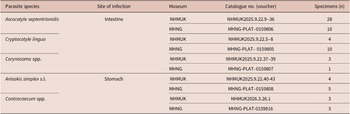
Voucher specimens of all parasite species found were deposited in both the Natural History Museum, London, and the Muséum d’Histoire Naturelle de Genève (Table 2).
Voucher specimens of helminths (Nematoda, Acanthocephala, and Digenea) found in a grey seal, Halichoerus grypus, stranded on the Spanish Mediterranean coast. Material was deposited in the Natural History Museum, London (NHMUK), and in the Muséum d’Histoire naturelle de Genève (MHNG). Catalogue numbers (cat. no.) and sample size of specimens housed (n) in each collection are provided

Molecular identification
Repeated PCR attempts targeting the cox1 and the ssrDNA genes did not yield amplification products for any of the two digenean species.
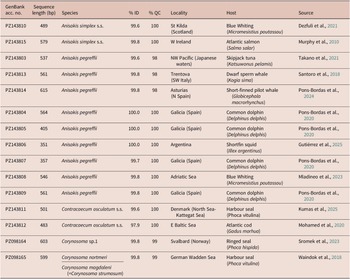
The mtDNA cox2 gene could be successfully amplified and sequenced in 11 specimens of Anisakis simplex s.l. and 2 of Contracaecum spp., generating sequences ranging from 351 to 615 bp in length (Table 3). Nine individuals were identified as Anisakis pegreffii, 2 as Anisakis simplex s.s., and 2 as Contracaecum osculatum s.s. (Table 3).
GenBank accession number (GenBank acc. no.), sequence length, and putative species inferred from mtDNA cox2 and cox1 sequences of 13 adult nematodes (cox2) and 2 adult acanthocephalans (cox1) collected in a male grey seal, Halichoerus grypus, stranded on the Spanish Mediterranean coast. Percent of identity (% ID) and query cover (% QC), showing the similarity of the query sequence with the target sequence and the coverage of the query sequence by the target sequence, respectively, are also given. Host, locality, and reference of the GenBank published sequences from which both % ID and % QC values were obtained are provided

Cox1 sequences could only be retrieved from 2 acanthocephalan specimens (603, 599 bp). One of the sequences showed 99.8% identity with two sequences of C. magdaleni and C. nortmeri, respectively, obtained from parasites infecting harbour seals, Phoca vitulina, from the German Wadden Sea (Waindok et al., Reference Waindok, Lehnert, Siebert, Pawliczka and Strube2018). The other sequence showed a 99.8% identity with two sequences of Corynosoma spp. 1 obtained from parasites infecting ringed seals, Phoca hispida, in Svalbard Islands, Norway (Table 3).
Discussion
Species identification
Unfortunately, the identification of digeneans from the grey seal could only be confirmed based on morphological characters because DNA could not be extracted from specimens. However, the morphology of Cryptocotyle specimens collected clearly fits the original description of C. lingua by Creplin (Reference Creplin1825), which typically infects and reproduces in a number of Holarctic fish-eating birds and mammals (Smirnov & Gonchar, Reference Smirnov and Gonchar2024 and references therein). Regarding Ascocotyle, there are 37 valid species currently recognized in this genus (Arruda et al., Reference Arruda, Muniz-Pereira and Pinto2002; Gustinelli et al., Reference Gustinelli, Caffara, Scaravelli, Fioravanti and Scholz2022 and references therein). Twenty-five species differ from the examined specimens by the presence of either a double complete row of circumoral spines or a single complete row of circumoral spines accompanied by additional spines (Gustinelli et al., Reference Gustinelli, Caffara, Scaravelli, Fioravanti and Scholz2022 and references therein). Among the 12 species bearing a single row of circumoral spines, A. inglei, A. italica, A. longa, and A. micracantha have a pretesticular uterus (Ransom, Reference Ransom1920; Travassos, Reference Travassos1930; Hutton & Sogandares-Bernal, Reference Hutton and Sogandares-Bernal1958; Coil & Kuntz, Reference Coil and Kuntz1960; Scholz, Reference Scholz1999), contrary to the specimens here examined; A. bulbosa is characterized by a rounded, stout, and compact body, clearly distinct from the slender, pyriform body observed in our specimens (Ukoli, Reference Ukoli1968); A. sinoecum exhibits markedly larger circumoral spines (~19 μm vs. 9.1–13.0 μm) and substantially broader testes (85–132 μm vs. 40.7 μm) (Ciurea, Reference Ciurea1933); A. trentinii possesses a longer and broader pharynx (52-85 μm long and 42-80 μm wide vs. 36.3-42.3 μm and 16.7-24.1 μm, respectively) (Gustinelli et al., Reference Gustinelli, Caffara, Scaravelli, Fioravanti and Scholz2022), and A. minuta has vitellaria limited to the uterine region rather than extending to the testicular level (Looss, Reference Looss1899; Hutton & Sogandares-Bernal, Reference Hutton and Sogandares-Bernal1958; Sogandares-Bernal & Lumsden, Reference Sogandares-Bernal and Lumsder1963). Of the four remaining candidate species whose morphology could be compatible with that observed in the specimens from the grey seal, A. ascolonga has only been reported in domestic dogs and cats from Israel and Egypt (Witenberg, Reference Witenberg1929; Kuntz & Chandler, Reference Kuntz and Chandler1956), and A. macrostoma and A. cameliae are restricted to the Americas (Robinson, Reference Robinson1956; Scholz et al., Reference Scholz, Vargas-Vázquez, Vidal-Martínez and Aguirre-Macedo1997; Hernández-Orts et al., Reference Hernández-Orts, Georgieva, Landete and Scholz2019). In contrast, A. septentrionalis is the only species of the genus reported in pinnipeds from the Palearctic region, particularly in the Northeast Atlantic (Van den Broek, Reference Van den Broek1967; Suppl. Table S1). Admittedly, we were unable to find specimens with a complete row of circumoral spines, likely due to the poor condition of specimens, but the concordance of morphological characters, host association, and geographic distribution provides strong support for assigning the present material to A. septentrionalis. This finding represents the first report of A. septentrionalis in grey seals (Suppl. Table S1).
Most of the nematodes examined in the present study displayed traits typical of Contracaecum (s.l.), including an interlabia, ventricular appendix, and intestinal caecum (Fagerholm Reference Fagerholm1989, Cipriani et al., Reference Cipriani, Giulietti, Palomba, Fernandez, Mattiucci, Bjørge, Levsen and Bao2025). Before the advent of molecular analyses, records of Contracaecum spp. in pinnipeds from the Northern Hemisphere were all referred to C. osculatum (Mattiucci et al., Reference Mattiucci, Paoletti, Webb, Sardella, Timi, Berland and Nascetti2008, Suppl. Table S1). Two specimens in our sample were identified as C. osculatum s.s., a species commonly reported in seals from the North Atlantic (Mattiucci et al., Reference Mattiucci, Paoletti, Webb, Sardella, Timi, Berland and Nascetti2008, Cipriani et al. Reference Cipriani, Giulietti, Palomba, Fernandez, Mattiucci, Bjørge, Levsen and Bao2025). However, another genetically identified species of C. osculatum, namely, sp. A, has been reported in grey seals from this region (Mattiucci et al., Reference Mattiucci, Paoletti, Webb, Sardella, Timi, Berland and Nascetti2008, Cipriani et al., Reference Cipriani, Giulietti, Palomba, Fernandez, Mattiucci, Bjørge, Levsen and Bao2025) and, therefore, we cannot be certain as to how many species of the C. osculatum complex were present in the sample.
A comparatively small, but significant fraction of the nematode assemblage was morphologically consistent with Anisakis simplex (s.l.) based on the presence of long, sigmoid ventriculus, male spicules unequal in length (mean ratio ca. 1:1.7) and the absence of both interlabia and intestinal caecum. Analogous to the case of C. osculatum (s.l.), reports of Anisakis simplex s.l. (i.e., a sibling-species complex comprising A. simplex s.s., A. pegreffii, and A. berlandi) in pinnipeds from the NE Atlantic were historically attributed to Anisakis simplex without discrimination among sibling species (see Mattiucci et al., Reference Mattiucci, Cipriani, Levsen, Paoletti and Nascetti2018, Suppl. Table S1). Genetic analyses conducted herein revealed the presence of two species, namely A. simplex s.s. and A. pegreffii, constituting the first documented occurrence of A. pegreffii in grey seals. Moreover, most of the specimens of Anisakis collected from the seal were adults (Table 1; Fig 3). Traditionally, the worldwide occurrence of reproductive stages of Anisakis in pinnipeds has been considered relatively uncommon (Brattey & Ni, Reference Brattey and Ni1992; Brattey & Stenson, Reference Brattey and Stenson1993; Campana-Rouget & Biocca, Reference Campana-Rouget and Biocca1955; Jensen, 2009; Kuzmina et al., Reference Kuzmina, Lyons and Spraker2014; Scott & Fisher, Reference Scott and Fisher1958; Van Theil, 1966; Walden et al., Reference Walden, Bryan, McIntosh, Tuomi, Hoover-Miller, Stimmelmayr and Quakenbush2020; Young, Reference Young1972). Recently, Kumas et al. (Reference Kumas, Gonzalez, Kania and Buchmann2025) and Cipriani et al. (Reference Cipriani, Giulietti, Palomba, Fernandez, Mattiucci, Bjørge, Levsen and Bao2025) reported the presence of adult specimens of A. simplex s.s. in harbour seals, Phoca vitulina, and grey seals from Danish and Norwegian waters, respectively. Cipriani et al. (Reference Cipriani, Giulietti, Palomba, Fernandez, Mattiucci, Bjørge, Levsen and Bao2025) observed a mean adult proportion of ~20% among the Anisakis specimens collected from two grey seals, a proportion marginally higher than previous reports for the same species (i.e., ~2%) (Young, Reference Young1972; 9%, Brattey & Stenson, Reference Brattey and Stenson1993). However, the prevalence of adult Anisakis appears to be highly variable across studies, ranging from 8.1% in harbour seals (Jensen, 2009), 21% in ringed seals (Pusa hispida; Walden et al., Reference Walden, Bryan, McIntosh, Tuomi, Hoover-Miller, Stimmelmayr and Quakenbush2020), 21.8% in northern fur seals (Callorhinus ursinus; Kuzmina et al., 2024), 67% in ribbon seals (Histriophoca fasciata; Walden et al., Reference Walden, Bryan, McIntosh, Tuomi, Hoover-Miller, Stimmelmayr and Quakenbush2020), 71% in spotted seals (Phoca largha; Walden et al., Reference Walden, Bryan, McIntosh, Tuomi, Hoover-Miller, Stimmelmayr and Quakenbush2020), 96% in bearded seals (Erignathus barbatus; Walden et al., Reference Walden, Bryan, McIntosh, Tuomi, Hoover-Miller, Stimmelmayr and Quakenbush2020), to 100% in harp seals (Pagophilus groenlandicus; Brattey & Ni, Reference Brattey and Ni1992). In the present study, 93.5% of the Anisakis were adults; this finding, together with previous reports of exceptionally high adult prevalence, calls into question the conventionally assumed low host specificity of Anisakis for pinnipeds (Cipriani et al., Reference Cipriani, Giulietti, Palomba, Fernandez, Mattiucci, Bjørge, Levsen and Bao2025; Kumas et al., Reference Kumas, Gonzalez, Kania and Buchmann2025). The proportion of adult Anisakis was similar (i.e., 95.8%) when considering only those nematodes attached to the gastric mucosa, all but one of which were embedded within a gastric ulcer. Mild to severe ulcerative lesions, often associated with high nematode burdens, are frequently documented in both pinnipeds and cetaceans, including individuals that appear clinically healthy (e.g., see Pons-Bordas et al., Reference Pons-Bordas, Hazenberg, Hernandez-Gonzalez, Pool, Covelo, Sánchez-Hermosin, López, Saavedra, Fraija-Fernández, Fernández and Aznar2020; Cipriani et al., Reference Cipriani, Giulietti, Palomba, Fernandez, Mattiucci, Bjørge, Levsen and Bao2025 and references therein). However, further investigations are warranted to elucidate both the occurrence and nature of gastric ulcerations in pinnipeds, with particular consideration given to the nematode species involved, their ecological dynamics in the host gastrointestinal tract, and the inter- and intraspecific interactions within the nematode assemblage.
The morphology of acanthocephalans collected in the grey seal closely resembles that of Corynosoma strumosum or C. magdaleni (Nickol et al., Reference Nickol, Helle and Valtonen2002). We could examine a putative diagnostic trait differentiating both species, i.e., the extension of ventral spines, and no clear segregation of specimens based on this trait was observed. In fact, recent morphological and molecular evidence strongly suggests that these two nominal species in NE Atlantic could be conspecific (Waindok et al., Reference Waindok, Lehnert, Siebert, Pawliczka and Strube2018; Sromek et al., Reference Sromek, Ylinen, Kunnasranta, Maduna, Sinisalo, Michell, Kovacs, Lydersen, Leshko, Andrievskaya, Alexeev, Leidenberger, Hagen and Nyman2023). Molecular data indicates a further splitting of Corynosoma cf. strumosum into a putative sibling species, C. nortmeri (Waindok et al., Reference Waindok, Lehnert, Siebert, Pawliczka and Strube2018), and two additional species well defined by molecular markers, provisionally named as Corynosoma sp. 1 and sp. 2 (Sromek et al., Reference Sromek, Ylinen, Kunnasranta, Maduna, Sinisalo, Michell, Kovacs, Lydersen, Leshko, Andrievskaya, Alexeev, Leidenberger, Hagen and Nyman2023). The geographical and host distribution of these 3 species is still fragmentary because of the very small number of specimens hitherto detected, i.e., C. nortmeri in harbour seals from the German Wadden Sea (Waindok et al., Reference Waindok, Lehnert, Siebert, Pawliczka and Strube2018); Corynosoma sp. 1 in ringed seals, Phoca hispida, from Svalbard, and Corynosoma sp. 2 in a ringed seal from Svalbard and, especially, some ringed seals and grey seals from the Baltic Sea (Sromek et al., Reference Sromek, Ylinen, Kunnasranta, Maduna, Sinisalo, Michell, Kovacs, Lydersen, Leshko, Andrievskaya, Alexeev, Leidenberger, Hagen and Nyman2023). Interestingly, molecular evidence from the present study suggests that several Corynosoma species could occur in the same grey seal individual, including at least Corynosoma sp. 1 and C. magdaleni = strumosum or C. nortmeri.
Geographical origin and length of the journey of the grey seal towards Mediterranean waters
A bibliographic comparison indicates that 3 of 7 helminth species found in the male grey seal, i.e., Cryptocotyle lingua, Contracaecum osculatum, and Anisakis simplex s.s., had previously been reported in grey seals and/or other sympatric seal species from the Northeast Atlantic, being geographically widespread (Suppl. Table S1); C. lingua are also known to infect and reproduce in a number of Holarctic fish-eating birds and mammals (Smirnov & Gonchar, Reference Smirnov and Gonchar2024 and references therein). However, a closer look at surveys reporting A. septentrionalis suggests that infections are heavy and appear to be restricted to harbour seals from waters around the Wadden Sea (Table 4; Suppl. Table S1). Of note, other two helminth species, namely Cryptocotyle lingua and Corynosoma strumosum, always co-occur there with A. septentrionalis and generally exhibit high prevalence, and high (C. lingua) but comparatively lower (C. strumosum) abundance (Table 4); the nematode C. osculatum is also frequently reported at moderate-high prevalence along with the previous species (Table 4; Suppl. Table S1). Interestingly, a single sequence obtained from the acanthocephalan specimens exhibited 99.8% nucleotide identity to reference sequences assigned to C. magdaleni and C. nortmeri, respectively, derived from parasites infecting harbour seals in the German Wadden Sea (Waindok et al., Reference Waindok, Lehnert, Siebert, Pawliczka and Strube2018; Table 3). In short, the finding of A. septentrionalis in the male grey seal, and the observation that its intestinal helminth fauna largely corresponds to that of the harbour seal from the Dutch Wadden Sea, strongly suggest that the grey seal got the primary infections in this area. Admittedly, two taxa detected in the present study have not previously been reported in the Wadden Sea. First, Corynosoma sp. 1, a species recently detected by molecular markers, has so far only been documented in Arctic ringed seals (Sromek et al., Reference Sromek, Ylinen, Kunnasranta, Maduna, Sinisalo, Michell, Kovacs, Lydersen, Leshko, Andrievskaya, Alexeev, Leidenberger, Hagen and Nyman2023); although Arctic acquisition of Corynosoma sp.1 cannot be excluded, knowledge of its geographical and host distribution remains limited due to the small number of specimens reported to date, being thus plausible that the grey seal acquired this species elsewhere in the northeast Atlantic. Second, A. pegreffii shows a latitudinal range from 5°S to 43°N (i.e., roughly the tropical Atlantic off the Gulf of Guinea up to the Bay of Biscay), with prevalence progressively declining towards higher latitudes, where the species is uncommon (Mattiucci et al., Reference Mattiucci, Paoletti, Webb, Sardella, Timi, Berland and Nascetti2008, Reference Mattiucci, Cipriani, Levsen, Paoletti and Nascetti2018; Cipriani et al., Reference Cipriani, Palomba, Giulietti, Marcer, Mazzariol, Santoro, Alburqueque, Covelo, López, Santos, Pierce, Brownlow, Davison, McGovern, Frantzis, Alexiadou, Højgaars, Mikkelsen, Paoletti, Nascetti, Levsen and Mattiucci2022; Pons-Bordas et al., Reference Pons-Bordas, Pool, Ten, Armenteros-Santos, Balseiro, Fayos and Aznar2024). The presence of this species may indicate that the seal ingested at least some infected prey in southern waters, likely during its journey towards the Mediterranean.
Infection data of intestinal helminth fauna (with host sample size in parentheses) in surveys of harbour seal, Phoca vitulina, from the Wadden Sea from which the digenean Ascocotyle septentrionalis was found.

a 1. Van den Broek and Wensvoort (Reference Van den Broek and Wensvoort1959), Van den Broek (Reference Van den Broek1963, Reference Van den Broek1967); 2. Borgsteede et al. (Reference Borgsteede, Bus, Verplanke and Van Burg1991); 3. Strauss et al. (Reference Strauss1990); 4. Saint-Pierre (Reference Saint-Pierre2009); 5. Wigman et al. (Reference Wigman2013); 6. Nijenhuis (Reference Nijenhuis2012); 7. Roozen (Reference Roozen2012)
b Weighted prevalence; N: pooled number of hosts examined across the included studies.
c The intestinal parasites were collected only from the contents of 1 meter jejunum on the second third of the total intestinal length.
P: Prevalence; N: host sample size; MA: Mean abundance; max: maximum abundance recorded.
Being specific to pinnipeds and geographically restricted, A. septentrionalis could inform on the duration of the journey of the male grey seal from the Wadden Sea to the Mediterranean. The adult life span of this parasite is not known, but other marine digeneans similar in size seem to survive for ca. 1–2 months (Stunkard, Reference Stunkard1930; Willey & Stunkard, Reference Willey and Stunkard1942; Chuang et al., Reference Chuang, Shinn and Bron2025). The heavy loads of A. septentrionalis found in the male grey seal would indicate that little loss of worms occurred since the host left the Wadden Sea, thus suggesting a maximum duration of the journey of ca. 1 month before death. Data from Corynosoma spp. C. osculatum and Anisakis spp. conform to this estimation. Experimental infections indicate that, in Corynosoma spp., sexual maturity can be reached in about a week (Castro & Martínez, Reference Castro and Martínez2004), and all individuals of Corynosoma spp. that we collected were adult. Likewise, the estimated duration of L3 and L4 larvae of both Anisakis spp. and C. osculatum is about 2–17 and 30–42 days, respectively (Table 1), and we found just 1% (i.e., A. simplex s.l.) and 4.7% (i.e., Contracaecum spp.) of L4 larvae in the male grey seal. Taken together, we can infer that the last recruitment of Corynosoma spp., Anisakis spp., and C. osculatum would have occurred at least 2 weeks before the seal died. And, since the two species that we inferred were acquired towards the Wadden Sea waters (i.e., Corynosoma spp. and C. osculatum) are largely specific to pinnipeds (Mattiucci et al., Reference Mattiucci, Paoletti, Webb, Sardella, Timi, Berland and Nascetti2008, Ionita et al., Reference Ionita, Varela, Lyons, Spraker and Tolliver2008; Haarder et al., Reference Haarder, Kania, Galatius and Buchmann2014), regular (re)infections would have not occurred below 47°N which, in the NE Atlantic, is the lowest latitude of regular occurrence of any pinniped species (Berta, Reference Berta, Würsig, Thewissen and Kovacs2018). Notably, immune suppression associated with the seal’s poor condition may have weakened density-dependent regulation of parasitic infections and thereby prolonged the survival of individual trematodes, which could have influenced our temporal inference.
Conclusions
In summary, the parasitological data indicate that the male grey seal could have left the Wadden Sea about one month before he died. Why the animal embarked on such a long journey is difficult to say. The necropsy revealed emaciation, anaemia, and signs of severe pathologies, including enteritis (a contribution of the high digenean burden cannot be ruled out) and cataracts in both eyes (Oceanogràfic Foundation pers. comm.); only three unidentifiable cephalopod beaks were found as stomach content. Thus, perhaps the animal was ill and disoriented before it reached the Mediterranean Sea. In any event, this study highlights the potential of parasites as markers of the host’s biology and, as far as we know, is the first one in using parasites as indicators of geographical origin and movements of pinnipeds.
Supplementary material
The supplementary material for this article can be found at http://doi.org/10.1017/S0022149X26101345.
Acknowledgements
We thank our veterinarian colleagues of the Oceanogràfic Foundation of Valencia (Valencia, Spain) for helping with both the necropsy and the diagnosis of pathologies presented by the grey seal. We also thank Telemotril for providing the image of the seal, and projects AICO2021/022, Generalitat Valenciana, and VARACOMVAL for their contributions. The project VARACOMVAL is supported by the Biodiversity Foundation of MITECO of the Government of Spain within the framework of the Plan de Recuperación, Transformación y Resiliencia (PRTR), funded by the European Union – NextGenerationEU.
Competing interest
None





 Open access

