1 Introduction
HERITAGE IS EVERYWHERE.
When David Lowenthal began his seminal work The Heritage Crusade and the Spoils of History some twenty years ago, he wrote this statement to critique the global heritage movement. Here, I borrow it, not only to mean that the heritage movement is more pervasive today and demands for more critical inquiries but also to summon greater diversity in heritage thinking, research, and practice. Indeed, heritage is everywhere, but people in different parts of the world may talk about, understand, and deal with it differently. This Element starts from the premise that heritage is not something out there but a meaning-making process and sociocultural practice; a key component is how discourse works to represent and construct what heritage is (not) and coerces how people perceive and act upon heritage (Smith Reference Smith2006; Waterton Reference Waterton2010a; Wu & Hou Reference Wu, Hou, Waterton and Watson2015). I aim to accentuate that heritage (as) discourse is culturally saturated and should be diverse or diversified in relation to geography and time. For critical heritage scholars, searching for and rearticulating alternative cultural discourses of heritage that have been marginalized, devalued, or forgotten in the global heritage movement is equally, if not more, important than critiquing the dominant discourses to advance this new interdisciplinary field of inquiry.
In recent years, we have seen increasingly more research endeavors to explore alternative discourses of heritage, among which most are done from ethnographic and community-archaeological perspectives (e.g., Astudillo & Salazar Reference Astudillo and Salazar2024; Byrne Reference Byrne2014; De Jong & Rowlands Reference De Jong and Rowlands2007; Evans & Rowlands Reference Evans and Rowlands2021; Onciul Reference Onciul2015; Rico Reference Rico2016; Schmidt Reference Schmidt2017; Yu & Mei Reference Yu and Mei2024). This Element intends to showcase a different approach to critical heritage studies, one that turns our attention to forgotten or transformed discourses of heritage in their cultural-historical contexts. In other words, I advocate for an approach to researching and rearticulating cultural discourses of heritage in past times. As Harvey (Reference Harvey2001) has pointed out, heritage is a human condition, rather than a modern movement starting from the nineteenth century or any other time. By analyzing how people write and make meaning of the past in the past, we can not only challenge the knowledge/power of the Western “Authorized Heritage Discourse” (AHD, Smith Reference Smith2006) but also demonstrate how heritage might be conceptualized, categorized, communicated, and construed in different ways and with alternative cultural logics over time and across geographical areas.
This historical perspective on heritage (as) discourse is largely overlooked in current critical heritage scholarship. It is not that critical heritage researchers have little interest in history or historical materials. On the contrary, most of them do. Yet, rarely do they conduct discourse analysis of historical documents to rearticulate forgotten or substituted cultural ideas of heritage, or their underlying ways of thinking and valuing the past. As I will demonstrate, unpacking heritage discourse in history is genuinely beneficial to diversify heritage thinking, research, and practice. In China, this historical approach is particularly useful, if not indispensable. For one thing, China has a long history of dealing with sites and objects that we tend to call “heritage” today, yet its contemporary heritage policies and practices have been largely shaped by modern, Western discourses, the AHD in particular. Though the cry for rethinking and reformulating heritage becomes increasingly louder, Western-originated concepts, principles, and models of heritage practice are still mainstream. For another, China is extremely rich in historical documents, which provide data for us to find alternative cultural ways of conceptualizing, categorizing, and constructing what we today term heritage. My focus in this Element is on a Chinese cultural discourse – guji (古迹, ancient traces or vestiges) in historical times. Guji is putatively the first term that would come to mind if a Chinese person were asked for a counterpart to cultural heritage in their language (Hou Reference Hou2019: 456; see also Li Reference Li2013). As will be shown, although this Chinese word is still widely in use, the meaning or idea it conveys has been subtly transformed by the Western, globalized discourse of heritage. My central task is to rearticulate how the Chinese, in times before their enthusiastic embrace of modern, Western historical consciousness and the World Heritage Movement, represented and made meaning of their guji for remembrance and responsive actions. Guji might include historic buildings, sites, and places that readily fall into the category of cultural heritage, as well as others that are hard to classify as heritage in its contemporary definition such as a tree or a stone (see section 3). I will first examine how guji is generally understood in China in the present era of “world heritage craze” (Yan Reference Yan2018) and in historical times. This can be regarded as a macroanalysis of the Chinese guji discourse. Then, I come to the core of this treatise: a focused cultural-historical discourse analysis of guji in an ordinary Chinese heritage city, namely, Quzhou in the Zhejiang province.
This grounded historical inquiry into the guji discourse will help rearticulate Chinese cultural ways of meaning-making and remembering the past, which have been discarded, forgotten, or transformed while the country has embraced the modern historical consciousness and ethos of heritage conservation originating from Europe. It is thus both a critical project to challenge the AHD and other globalized heritage ways of thinking that construe commonsense knowledge of what heritage is and how it should be handled, and a constructive enterprise to promote dialogue and diversity regarding heritage from a Chinese cultural and historical perspective. In Harvey’s (Reference Harvey2024: 4) words, this Element presents a “more-than-critical” approach to heritage studies, as I will not only critique the dominant, authoritative discourses but also take “an invitational attitude towards alternative modes of being and doing.” I can also say this approach reflects a Chinese cultural understanding of critical scholarship: being critical does not necessarily mean confronting, challenging, or deconstructing; acts of historicizing, exploring alternatives, or remaking can be critical as well (Hou & Wu Reference Hou and Wu2015; Zhu Reference Zhu2024b; see also Hou & Wu Reference Hou and Wu2017 for an alternative approach to critical discourse studies based on a case study of heritage in Quzhou).
Furthermore, this Element also contributes to advancing heritage discourse studies – a research line that integrates heritage studies and discourse studies, the history of heritage (particularly, the conceptual history, or history of ideas of heritage in China), and other pertinent interdisciplinary areas of scholarship, such as memory studies, historical geography, and Chinese studies. As Wu and Hou (Reference Wu, Hou, Waterton and Watson2015) have pointed out, heritage discourse studies focus mostly on critiquing the authoritative, dominant, and globalized, by adopting various discourse analytical methods such as critical discourse analysis (Barry & Teron Reference Barry and Teron2023; Smith Reference Smith2006: chapter 3; Waterton Reference Waterton2010a; Waterton et al. Reference Waterton, Smith and Campbell2006), Foucauldian discourse analysis (Melis & Chambers Reference Melis and Chambers2021; Wight Reference Wight2016), multimodal discourse analysis (Feng et al. Reference Feng, Li and Wu2017, Reference Feng, Dai, Jiang and Wei2018; Skrede & Andersen Reference Skrede and Andersen2023; Waterton Reference Waterton2009, Reference Waterton, Waterton and Watson2010b), and sociolinguistic discourse analysis (Coupland & Coupland Reference Coupland and Coupland2014; Coupland et al. Reference Coupland, Garrett, Bishop, Jaworski and Prichard2005), as well as a combination of discourse analysis with other methodological or epistemological perspectives (Angouri et al. Reference Angouri, Paraskevaidi and Wodak2017; Skrede Reference Skrede2020; Skrede & Hølleland Reference Skrede and Hølleland2018). However, discourse analytical perspectives and methods are much less frequently applied to explore alternative ways of talking about and thinking of what we today tend to call “heritage.” To present a discourse analysis of an alternative concept of heritage from historical China, this Element intends to bridge historical and discourse studies of heritage, and to encourage cross-fertilization of these two subfields of heritage research. As I will show, rearticulating disregarded, forgotten cultural discourses of what is now termed “heritage,” such as guji, in their pasts is a compelling approach to rethinking and reconstructing heritage.
Although historical research on heritage has been growing in recent years (e.g., Bloembergen & Eickhoff Reference Bloembergen and Eickhoff2020; D’Agostino Reference D’Agostino2021; Falser Reference Falser2020; Jokilehto Reference Jokilehto2017; Swenson Reference Swenson2013; Zhu Reference Zhu2024a), it remains a relatively underdeveloped subfield of heritage scholarship. Systematic studies in the conceptual history or history of ideas regarding heritage are even scarcer (but see Eriksen Reference Eriksen2014; Wang Reference Wang, Stolte and Kikuchi2017). It should be noted that many scholars have concerns over perceptions or understandings of heritage in historical times, yet their studies are concentrated on historical practices or ways of practicing what we now tend to call “heritage.” (Gilman Reference Gillman2010: chapter 4; Wang Reference Wang2020; Wang & Rowlands Reference Wang, Rowlands, Geismar and Anderson2017; Zhu Reference Zhu2024a) These studies are better described as cultural or social histories of heritage. The current Element is intended to contribute to the conceptual history of heritage by explicating the Chinese notion of guji. Eriksen’s (Reference Eriksen2014) historical inquiry into the evolution of such concepts as antiquity, monument, and cultural heritage in Nordic culture since the 18th century is a rare and laudable book-length contribution to this branch of heritage history. My work in this Element is more focused: It investigates one single Chinese cultural concept of heritage in an eastern Chinese city–Quzhou (衢州)–during the period from late imperial to mid Republican China, or, more precisely, from the 1500s to the 1920s. Wang Shu-li’s (Reference Wang, Stolte and Kikuchi2017) historical exposition of the Chinese term wenwu (文物) is, perhaps, the most similar to my research. However, her study is rather general, without detailed analysis of specific historical texts. Adopting a discourse analytical approach, I attempt to unravel the disregarded cultural episteme and meaning-making apparatus of guji, hoping to facilitate heritage rethinking and dialogue in a more nuanced manner.
A Cultural-Historical Discourse Approach to Heritage
Discourse, as Foucault (Reference Foucault1972: 49) states, consists of “practices which systematically form the objects of which they speak.” Heritage can be viewed as such an object formed in and through discursive practices, primarily our words that speak of it. In this Element, I further highlight, following cultural discourse scholars, the embeddedness of discourse in culture. Shi-xu (Reference Shi-xu2005, Reference Shi-xu2014), for example, theorizes discourse as cultural ways of speaking. As he writes:
different cultures have different histories, conditions, problems, issues, aspirations, and so on. Consequently, the different cultural discourses which constitute them will have not only different objects of construction or topics, but also different categorizations, understandings, perspectives, evaluations, and so on. They make up different cultural worlds, so to speak.
Donal Carbaugh, another leading advocate of cultural discourse research, defines cultural discourse as “a historically transmitted expressive system of communication practices, of acts, events, and styles, which are composed of specific symbols, symbolic forms, norms, and their meanings” (Reference Carbaugh2007: 169). Both of these scholars have pinpointed the link between cultural discourse and history. When studying cultural discourses of heritage, this link should be more accentuated. The reason for this is simple: Heritage is “historically transmitted” as well. What is more, as will be shown, careful investigations into history can lead us to see alternative ways of heritage conceptualization, categorization, communication, construction, and action, which should be transmitted yet are largely stigmatized, marginalized, or forgotten in the present climate of global heritage craze. Therefore, we need to approach history from a discourse perspective, particularly a cultural discourse perspective. That means studying history is not to trace historical facts, events, causes, or backgrounds but rather to look into the texts produced in the past and scrutinize how those texts construct what we tend to classify as “heritage” today.
That said, I am bringing to light a cultural-historical discourse approach to heritage. It grows out of my efforts in collaboration with colleagues in exploring alternative Chinese understandings of heritage (Hou Reference Hou2019; Hou & Wu Reference Hou and Wu2012, Reference Hou and Wu2015; Hou et al. Reference Hou, Liu and Gao2019). It is different from the established cultural approaches to discourse analysis, such as Shi-xu’s “cultural discourse studies” (Reference Shi-xu2005, Reference Shi-xu, Tracy, Ilie and Sandel2015) and Carbaugh’s “cultural discourse analysis” (Reference Carbaugh1996, Reference Carbaugh2007) in that it focuses on historical rather than contemporary texts as its main data. The defining attribute of this approach is that it is simultaneously cultural and historical. That is, the researcher takes on a discursive perspective on history and a historical perspective on discourse. Following Foucault (Reference Foucault and Rabinow1984) and White (Reference White1973, Reference White1987), I see history as a form of narrative or discursive construction. Historical inquiries are not much about finding a systemic process of development or the causes for a present discourse (cf. Blommaert Reference Blommaert2005: 37; Flowerdew Reference Flowerdew2012; Reisigl & Wodak Reference Reisigl, Wodak, Wodak and Meyer2015). Rather, they involve collecting and interpreting various texts produced in historical times and unpacking the meaning production, reality construction, and ways of remembering, valuing, and using what we today term “heritage” in the past. In other words, by probing into history, we come to understand the forgotten historical words and worlds, values and ways of valuing, and thoughts and modes of thinking about “heritage”; and we can attend to the divergences, ruptures, and transformations in how heritage is conceptualized, categorized, and coped with in different times. Such an approach will allow us to historicize present discourses of heritage in China and reflect upon their underlying ways of knowing and politics of the past.
Furthermore, this cultural-historical discourse approach to heritage will not rigidly follow any established discourse analytical framework to explain and interpret data, given that they are designed primarily for or based on the investigation of texts coded in modern languages, especially European languages (Shi-xu Reference Shi-xu2012). Nor will I attempt to set up a new discourse analytical framework claimed to be more applicable for examining texts in classical Chinese, which is impossible in the space this Element allows. Instead, some analytical strategies can be outlined here to serve as rough guidelines for cultural-historical discourse studies of heritage.
First, the beginning of this cultural-historical discourse approach is a set of commonly asked questions for undertaking discourse analysis:
(1) What is (not) said about “heritage” (in general terms or a specific instance) in the texts under investigation?
(2) How is the said articulated, and how is the unsaid concealed?
(3) What underlying meaning- and value-making may be sustained, and what ideology or cultural way of thinking may be significant in such forms of discursive representation of “heritage”?
(4) What social and cultural consequences and responses may such discursive representations of “heritage” bring forth?
Bearing these questions in mind, the researcher starts to read the textual data they have collected critically.
Second, the noticeable features in the textual data under inspection generally become the focal points for analysis. These features may be about content (topics, themes, categories, events) or form (linguistic-textual, intertextual, stylistic, rhetorical, generic, and so on) in representing “heritage.” Analytical vocabularies from heritage studies, discourse and communication studies, and other relevant disciplines may be useful for describing those content or formal features, such as materiality, authenticity, site, emotion, and quotation.
Third, it is also important to interpret the meaning- or value-making process, discursive-constructing work, and cultural ways of thinking, doing, and being regarding “heritage” underlying the content and form of the historical texts under study. This interpretive procedure should involve careful examination of the local, cultural, and historical contexts in which the texts are produced. Furthermore, comparative and contrastive analysis with reference to the dominant, globalized discourses may be illuminating.
I should note that, when doing cultural-historical discourse analysis of “heritage,” it is not always necessary to address every point mentioned in the commonly asked questions outlined previously, or to scrutinize every form or content feature identified in the textual data. Rather, the researcher selects the most salient features that serve their analytical purposes, as discourse analysts usually do. For example, the researcher may choose the thematic and some of the linguistic-textual features to analyze their data and then interpret how those features work to construct alternative heritage understandings and values.
This cultural-historical discourse approach is effective in rearticulating alternative understandings of heritage in cultural settings. For example, I have adopted this method to delineate the remembrance of trees as heritage in the city of Hangzhou during the Qing dynasty (1636–1911), revealing a fourfold meaning-making apparatus through which trees, physically existent or not, were rendered culturally significant for the remembrance of historical figures, place names, poetic writings, and exceptional landscapes. In this Element, my focus is Quzhou in the late imperial and mid Republican eras.
Quzhou as an Ordinary Chinese Heritage City: The Context and Texts
To study Chinese guji discourse, it would be useful to probe into a particular locality, apart from observations and analyses at macro levels. As Walsh states in his critical study of heritage representations in the United Kingdom, “What is necessary is a rearticulation of discourses based on the locality, a manageable context which permits the development of democratic discourse” (Reference Walsh1992: 3; my emphasis). I chose the city of Quzhou as the locality to serve my objective of rearticulating a marginalized, forgotten Chinese cultural discourse of heritage, hoping to facilitate the development and dialogue between different heritage discourses. Nonetheless, I do not think there is one democratic discourse that is good for all. As is known, either democracy or discourse implies choice-making, that is, to select and foreground one among possible alternatives.
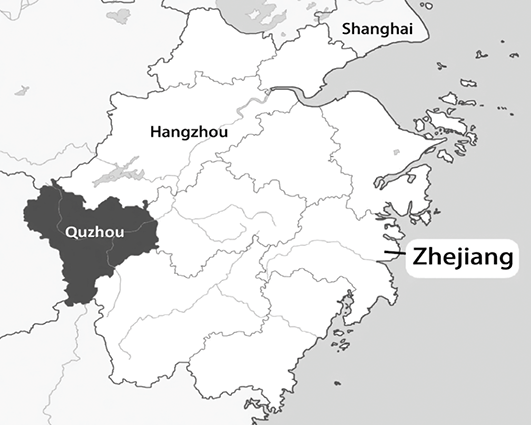
Situated in western Zhejiang (see Figure 1), Quzhou is about 230 kilometers northwest from the provincial capital Hangzhou, and about 400 kilometers southwest from the biggest Chinese city Shanghai. Like most Chinese cities, Quzhou has a long history to trace. According to local historiographies, it was first established as a county in 192 AD, called Xin’an (新安), which was renamed Xin’an (信安) in 280. In 621, the prefecture of Quzhou was founded in the early Tang dynasty, with Xin’an County (信安县) being its prefectural seat (Shen et al. Reference Shen and Wu2009: 7; Lin et al. Reference Lin and Ye2009: 380). Some 250 years later, the city name Xin’an (信安) was changed to Xi’an (西安), which lasted until the end of imperial China. With the transition to the Republic of China in 1912, its name was altered to Qu County (衢县; Zheng Reference Zheng1984: 118, 121). The county of Xin’an, Xi’an or Qu shares roughly the same territory as the present Quzhou city. It is the regional scope this Element will focus on.
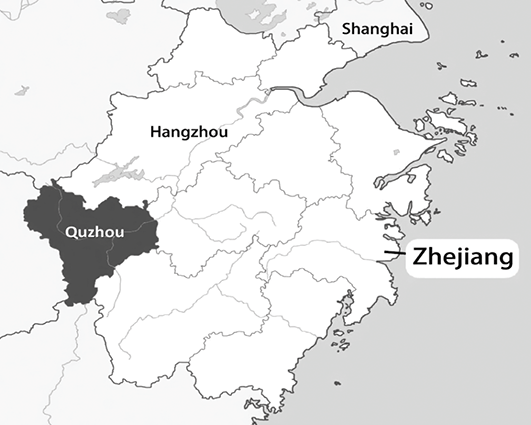
Figure 1 A map of Zhejiang province emphasizing Quzhou.
Quzhou is one among the 142 renowned cultural-historical cities sanctioned by the Chinese central government since 1994. It has several national heritage sites and dozens more provincial and prefectural ones. As a heritage city, Quzhou is not especially outstanding or unique in the vast territory of China. It is just an ordinary city of its kind and, for that matter, not much visited by cultural tourists or examined by heritage scholars apart from me and a few colleagues I have worked closely with (Hou & Wu Reference Hou and Wu2012; Hou et al. Reference Hou, Liu and Gao2019; Wu Reference Wu2012b; Wu & Hou Reference Hou and Wu2012; Zhang Reference Zhang2019). It is certainly less appealing than many other well-known Chinese heritage cities such as Beijing, Xi’an, Hangzhou, or Lijiang. However, the politics of heritage shaped by Western AHD and local AHDs as a fusion or interaction of the global, Chinese national, and local authoritative discourses, is no less observable in Quzhou than in other parts of China (e.g., Blumenfield & Silverman Reference Blumenfield and Silverman2013; Shepherd & Yu Reference Shepherd and Yu2013; Su & Teo Reference Su and Teo2009; Svensson & Maags Reference Svensson and Maags2018; Yan Reference Yan2018; Zhu & Maags Reference Zhu and Maags2020). Postulating this in contemporary Quzhou might be an interesting project to pursue, but it is not my main concern in this Element. What I want to do, as stated earlier, is to contribute to a cultural-historical discourse approach to heritage, and particularly to rearticulating the Chinese discourse of guji for cultural reflections on the globalized heritage movement and its politics. In historical China, guji was a ubiquitous discourse, and an ordinary heritage city like Quzhou can well serve as the locality for a cultural-historical project I wish to pursue.
From a cultural-historical discourse approach, historical texts that document what we call “heritage” are of key importance. However, historical texts are usually utilized as testimony in contemporary heritage projects. In that manner, the pastness of those texts is rendered subject to the present idea of what heritage is and what values heritage has. Following Fairclough (Reference Fairclough1992), I see a text as manifestation or materialization of a discourse. Thus, a historical text about guji is a materialization of this particular Chinese discourse in context.
Among the most useful sources of such historical texts for studying Chinese guji discourse are the premodern fangzhi or local gazetteers. Fangzhi is a Chinese genre for recording a locale, as fang means locale, and zhi means documentation or written records. Fangzhi has been categorized as either geographic or historical writing. Some scholars view them as both historical and geographic; they are historicized geography and geographically bounded history (Yang Reference Yang1999: 3). In other words, local gazetteers record historicized places and localized history. The compilation of such local gazetteers can be dated back to far ancient times in Chinese history. It is generally held that the genre came to its maturity in the Song dynasty (960–1279) and the peak of its compilation was seen in the Ming (1368–1644) and the Qing (1644–1911) eras. Most of the surviving premodern local gazetteers were compiled during this timeframe. They have been mainly used as references for governance, education, and culture- and memory-making (Cang Reference Cang1990: 1–2).
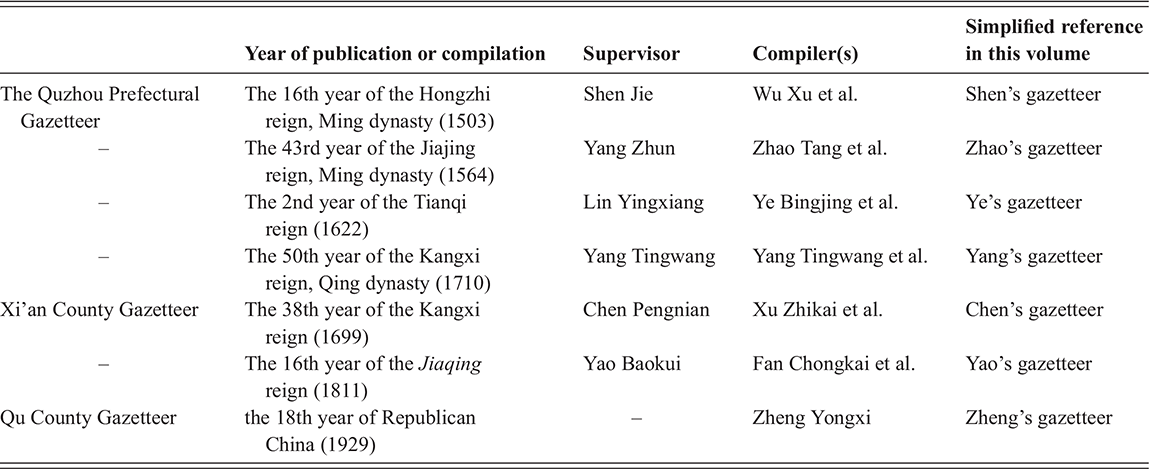
Seven premodern local gazetteers of Quzhou have been found; they will serve as the data for exploring the Chinese discourse of guji in this Element. I should note that my distinction between “modern” and “premodern” local gazetteers is based not so much on the historical phases circumscribed by historians, but rather on the linguistic features and historical consciousness an individual local gazetteer demonstrates. The premodern local gazetteers were coded in the classical Chinese language and, more importantly, the historical consciousness that underwrote them was rooted in the Confucian historiographical tradition. In other words, the modern sense of historicity from the West had not yet exercised its considerable influence on the way they were written. These seven premodern local gazetteers of Quzhou were compiled in the late imperial and the Republican China eras, including four prefectural gazetteers and three county gazetteers. The prefectural gazetteers, bearing the same title Quzhou Prefectural Gazetteer (衢州府志), encompass local-historical records of the greater Quzhou region, which includes the present Quzhou city and some neighboring cities. My analysis, however, will concentrate primarily on the records of guji in the city of Quzhou.
Three of these prefectural gazetteers were compiled in the Ming dynasty. They were completed in, respectively, the sixteenth year of the Hongzhi reign (1503) by Shen Jie (沈杰), Wu Xu (吾冔), and others, the forty-third year of the Jiajing reign (1564) by Yang Zhun (杨准), Zhao Tang (赵镗), and others, and the second year of the Tianqi reign (1622) by Lin Yinxiang (林应翔), Ye Bingjing (叶秉敬), and others. The other one was a Qing-dynasty gazetteer finished in the fiftieth year of the Kangxi reign (1710) by Yang Tingwang (杨廷望) and others.Footnote 1 The three county gazetteers are records of the Quzhou city proper, including the two Qing-dynasty Xi’an County Gazetteers (西安县志) compiled, respectively, in the thirty-eighth year of the Kangxi reign (1699) by Chen Pengnian (陈鹏年), Xu Zhikai (徐之凯), and others, and the sixteenth year of the Jiaqing reign (1811) by Yao Baokui (姚宝煃), Fan Chongkai (范崇楷), and others, and the Qu County Gazetteer (衢县志) finished in the eighteenth year of the Republican China period (1929) by Zheng Yongxi (郑永禧, 1866–1931). For an overview of these local gazetteers, see Table 1.
| Year of publication or compilation | Supervisor | Compiler(s) | Simplified reference in this volume | |
|---|---|---|---|---|
| The Quzhou Prefectural Gazetteer | The 16th year of the Hongzhi reign, Ming dynasty (1503) | Shen Jie | Wu Xu et al. | Shen’s gazetteer |
| – | The 43rd year of the Jiajing reign, Ming dynasty (1564) | Yang Zhun | Zhao Tang et al. | Zhao’s gazetteer |
| – | The 2nd year of the Tianqi reign (1622) | Lin Yingxiang | Ye Bingjing et al. | Ye’s gazetteer |
| – | The 50th year of the Kangxi reign, Qing dynasty (1710) | Yang Tingwang | Yang Tingwang et al. | Yang’s gazetteer |
| Xi’an County Gazetteer | The 38th year of the Kangxi reign (1699) | Chen Pengnian | Xu Zhikai et al. | Chen’s gazetteer |
| – | The 16th year of the Jiaqing reign (1811) | Yao Baokui | Fan Chongkai et al. | Yao’s gazetteer |
| Qu County Gazetteer | the 18th year of Republican China (1929) | – | Zheng Yongxi | Zheng’s gazetteer |
The Qu County Gazetteer was not commissioned by any officials. I should note, though, that it is an excellent one, perhaps the best in quality among the seven local gazetteers (Tang Reference Tang2015). The compiler, Zheng Yongxi, took five years to finish it. He eventually lost his eyesight working on the project day and night. His friend Yu Shaosong (余绍宋, 1883–1949) helped him proofread the draft and publish it (Tang Reference Tang2015: 96). Zheng Yongxi was born into a family of literati and was well trained in traditional Chinese scholarship. Although the Qu County Gazetteer was compiled in the late 1920s, that is, at a time when the Chinese historiographical revolution under Western influences had spread quite widely (see Huang Reference Huang1997; Wang Reference Wang2001), it is regarded as a premodern local gazetteer because it is written in classical Chinese, and, as shall be seen in later sections, reflects traditional historical consciousness and ways of writing. Considering the excellence of this local gazetteer, I will not shy away from using its entries as examples in my cultural-historical discourse analysis.
Outline of Sections
This Element will present macro- and micro-analyses of the Chinese guji discourse in its cultural-historical contexts as an alternative to the current dominant, globalized idea of heritage. It consists of six sections. Apart from this first section, which provides an overview of the Element, and a concluding section to reflect on my findings under a philosophical lens and the insights it may shed on further research, the main body is divided into four sections.
Section 2 sets out to do a macroanalysis of the Chinese discourse of guji in the present and in the past. I will first explain how guji is defined in contemporary China, revealing its convergence with the AHD. Then I will elucidate the concept of guji in historical Chinese contexts through two steps: (1) an analysis of guji via a philological reading of the two Chinese characters that make the word, gu and ji, and (2) an analysis of the prefaces to the guji chapters or volumes in Chinese local historiographies compiled in historical times. In so doing, I will be able to give a glimpse of the Chinese guji discourse compared to the mainstream notion of heritage today. It can also function as an exploration of the cultural root and context to my discourse analysis in later sections.
In the third section, I will begin a focused discourse analysis of guji in Quzhou in the late imperial and mid Republican eras of China, aiming to display its dynamic categorization and boundary negotiation of the past in the local past. First, I shall examine how guji had been categorized and recategorized in the local gazetteers of Quzhou in different ages. This reveals that there was no standardized framework to coerce the Chinese thinking of what guji could be. How it might be categorized was open to negotiation. In other words, the boundaries of guji were not fixed, but traversable. To further illustrate this understanding, I will then delineate the remembrance of natural existence, including bodies of water, trees, and stones, as guji in historical Quzhou, unpacking the meaning-making process through which they were transformed into culturally significant sites of memory about human figures and their deeds.
The fourth section will be devoted to the issue of materiality or physicality in Quzhou’s historical discourse of guji. I will show that very often materiality was not a concern. When it was, the meaning-making of materiality in the guji discourse would be at odds with today’s AHD. Most fundamentally, it was the Chinese Li (礼) thinking that shaped how the physical or material existence of a guji was meaningful. For that matter, guji might engender alternative cultural politics of the past. In addition, I will examine how sites, either with or without identifiable material remains, were remembered as guji in historical Quzhou.
Section 5 will offer a holistic view of the Chinese guji discourse through a focused case analysis of a particular guji without material remains, the House of Yin Hao. Specifically, I will conduct a cultural-historical discourse analysis of this guji in the local gazetteers of Quzhou. I shall demonstrate that most of the features or understandings of guji revealed in the previous sections, such as the neglect of materiality, meaning-making through association with historical figures and their deeds, poetry from the past as a source of meaning, and the importance of site tracing, can and usually do converge.
In the concluding section, I place my analytical findings and arguments in this Element in philosophical (and, occasionally, theological) perspectives. Reflecting on the existence of heritage in words, and the use of heritage as the use of language, I bring the cultural-historical understandings of guji in Quzhou to the global dialogue on what heritage is and does. It is hoped that readers will be stimulated to imagine how many different cultural words or concepts there have been in the world throughout human history.
2 Guji Present and Guji Past
He assumed that words had kept their meaning, that desires still pointed in a single direction, and that ideas retained their logic; and he ignored the fact that the world of speech and desires has known invasions, struggles, plundering, disguises, ploys.
At the outset of his essay “Nietzsche, Genealogy, History,” Foucault critiques the linear perspective underlying the German philosopher Paul Rée’s history of morality, pinpointing his misconception that words, desires, and ideas are consistent or unwavering. In this section, I examine the Chinese word guji as a cultural concept of heritage and the ideas it has sustained. As Foucault warns, the meaning of this Chinese word and the logic of ideas it holds might not be static or constant. Presumably, it has undergone meaning transformations throughout time, especially when China began to embrace Western modernity to reshape historical consciousness and relationship with its history around the turn of the 20th century (see Huang Reference Huang1997; Wang Reference Wang2001). For that matter, I first look into the contemporary Chinese conceptualization of guji and then investigate how guji was understood in historical eras when the modern Western historical consciousness had not yet taken control of Chinese historical and historiographical practices.
The Contemporary Idea of Guji
In the contemporary Chinese context, guji is understood as a synonym to wenhua yichan (文化遗产) – the Chinese term for cultural heritage. Although in everyday interactions, guji is more frequently heard, these two terms may be used interchangeably in most situations. In Chinese dictionaries and encyclopedias, guji is usually defined as “the remains of ancient times, referring mostly to ancient architecture.”Footnote 2 Baidu Encyclopedia, the Chinese counterpart to Wikipedia, equates guji to “wenwu baohu danwei” (文物保护单位), a term now officially translated as “unit of cultural heritage.”Footnote 3 Let us look at how guji is explained in this most popular Chinese online encyclopedia:
Guji (Wenwu baohu danwei) is historic, cultural, architectural and artistic heritages or sites left by the ancient people. It includes ancient architecture, traditional settlements, ancient cities and streets, archeological sites, and historic and cultural remains. It may be significant in terms of politics, defense, religion, sacrifice, inhabitation, daily life, entertainment, labor, society, economy, education, etc. It functions to make up for the shortage of written, historic and other documentation. (My translation and emphasis)Footnote 4
As can be seen, guji is clearly stated as “historic, cultural, architectural and artistic heritages or sites,” including “ancient architecture, traditional settlements, ancient cities and streets, archeological sites, and historic and cultural remains.” This conceptualization of guji is in line with UNESCO’s definition of (tangible) cultural heritage. As defined in the World Heritage Convention, “cultural heritage” includes:
monuments: architectural works, works of monumental sculpture and painting, elements or structures of an archaeological nature, inscriptions, cave dwellings and combinations of features, which are of outstanding universal value from the point of view of history, art or science;
groups of buildings: groups of separate or connected buildings which, because of their architecture, their homogeneity or their place in the landscape, are of outstanding universal value from the point of view of history, art or science;
sites: works of man or the combined works of nature and man, and areas including archaeological sites which are of outstanding universal value from the historical, aesthetic, ethnological or anthropological point of view.
In the Chinese legal framework for heritage protection, the term wenwu (文物) serves as the standard designation. Wenwu is classified into two categories: movable and immovable. Immovable wenwu that has been inscribed by government authorities is referred to as wenwu baohu danwei (文物保护单位), commonly translated as “unit of cultural heritage.” This category encompasses (1) ancient yizhi (遗址, sites), tombs, architectural structures, cave temples, stone carvings and murals, and (2) modern historical sites, objects, and buildings associated with significant events, movements, or figures. The concept of wenwu baohu danwei bears a strong resemblance to contemporary ideas of wenhua yichan (cultural heritage) and guji in China.Footnote 5 This is why these terms are used interchangeably in sources such as Baidu Encyclopedia and in a variety of other public contexts.
It should be pointed out that neither guji nor wenwu in traditional China can be equated to what is now termed cultural heritage. As Wang Shu-li (Reference Wang, Stolte and Kikuchi2017) has contended, it was under Western influence – largely through Japan as an intermediary in the early 20th century – that the concept of wenwu underwent a historical transformation to encompass anything of historical or aesthetic value and thus to be often used as a substitute for cultural property or cultural heritage. In far ancient China, wenwu was initially a term to denote significant objects in ritual systems, functioning as symbols of political power and hierarchical relations, and since the Song dynasty (960–1279) it was expanded to include various kinds of ancient objects for virtue and self-cultivation. Its modern transformation into an equivalent to cultural heritage was the result of a translingual practice (Liu Reference Liu1995) that regenerates new meanings of old words through translating ostensible equivalences from the West (see also Wang & Rowlands Reference Wang, Rowlands, Geismar and Anderson2017: 268–70).
This is also true to the concept of guji. The contemporary definition of guji as above outlined can be understood as a translation of or substitute by the modern discourse of cultural heritage from Europe (Li Reference Li2005). China ratified the World Heritage Convention in 1985, and the Convention for the Safeguarding of the Intangible Cultural Heritage in 2004. Now, the country ranks number one in both the World Heritage List and the Representative List of Intangible Cultural Heritage of Humanity, and there are numerous properties and elements on its domestic heritage lists sanctioned by the central, provincial, municipal, and county authorities. Nonetheless, the notion of heritage in contemporary China is an imported concept or, in an expression coined by the eminent 20th-century Chinese writer Lu Xun (1881–1936), “domestically made imported product” (自造的舶来品) (Lu Reference Lu and Xun1973: 48). Chinese heritages are “made in China,” but their “brand” and fundamental logic are global or, in most cases, Western. Professionals and researchers have translated concepts, categorizations, codes, criteria, conservation guidelines, laws, policy documents, and research publications from the developed world (Western Europe, the United States, Australia and, more recently, Japan and South Korea) and call on governmental entities and the society at large to learn from them in policy and practice (see Bi et al. Reference Bi, Vanneste and van der Borg2016: Wang Reference Wang, Stolte and Kikuchi2017; Zhu & Maags Reference Zhu and Maags2020). Adams (Reference Adams, Blumenfield and Silverman2013: 277) coins a phrase to speak of such a situation – “Chinese heritage management with Western characteristics.” The contemporary “heritage fever” in China is a process of acquiring and implementing international knowledge and discourse.
Actually, the Chinese began to develop a modern consciousness of conserving and preserving cultural relics and ancient architecture under Western influence since the late 19th and early 20th centuries. Some scholars, such as Lai (Reference Lai, Matsuda and Mengoni2016) and Zhu and Maags (Reference Zhu and Maags2020: 29–34), have traced the Chinese “journey of Westernization” in establishing their institutions, legislations and disciplinary knowledge for heritage conservation. Not only were the first Chinese public museums and legal regulations of heritage protection in the late Qing period influenced by the West, but also the academic disciplines and the professional institutions for heritage conservation in the Republican China era were established through translating or imitating Western ones, with efforts initiated by those intellectuals coming back to China with Western university degrees, notably Li Ji (李济 1896–1979) and Liang Sicheng (梁思成 1901–72) (see also Lai et al. Reference Lai, Demas and Agnew2004; Shepherd & Yu Reference Shepherd and Yu2013: 9–10). Then, “much of the twentieth century saw the formation of a heritage conservation system in contemporary China, in close association with the West” (Bi et al. Reference Bi, Vanneste and van der Borg2016: 198), along with the conceptual shifts, institutional developments, and discourse remaking (see Zhu & Maags Reference Zhu and Maags2020: chapters 2–3).
What did guji mean in premodern China before the Western idea of heritage influenced Chinese elites and the public? How is it divergent from the mainstream conception of heritage in contemporary China and the wider world? To provide general answers to these questions, I adopt two procedures of analysis. First, from the perspective of exegetics, I look into some ancient text fragments concerning gu and ji, so that the deeper Chinese understandings of guji may be unpacked. Second, I refer to the small preface (xiaoxu) to guji chapter or volume in some renowned Chinese local gazetteers. From there, expositions of what guji used to mean and how it was valuable can be found.
Guji as Gu and Ji
One of the most esteemed ways of explaining a word in traditional Chinese scholarship is exegetics. Adopting this approach, scholars often dismantle a multiple-character word by tracing the meaning of each of its constituent characters. In this subsection, I try to understand guji through explicating its two constituent characters, gu and ji.
Gu, in its literal sense, means the ancient or the past. In Shuowen Jiezi (说文解字), which is generally regarded as the first Chinese dictionary, Xu Shen (许慎, ca. 58 BCE–ca. 147 BCE) interprets this character as “gu” (故) or raison d’être (Xu & Duan Reference Xu and Duan1981: 88). Duan Yucai (段玉裁, 1735–1815) explains, “Raison d’être refers to the whys and wherefores for things, which are all based on gu (the past). That is the reason why this interpretation—‘Gu, raison d’être’ is offered” (88). To further explicate gu, Duan Yucai presents two more quotations: “the heaven is gu; the earth is jiu (long-lasting)” from a most ancient Chinese historiography Yizhoushu (Book of Zhou), and “recollecting gu is in accordance with heaven” from Zheng Xuan’s (郑玄, 127–200) commentaries on a pillar Chinese classic Shangshu (Book of Documents). From these meaning expositions, it is not hard to see that gu had been highly valued in traditional China. The understanding of gu served as an essential entrée to the raison d’être of things in the world. Gu was also regarded as being connected with Tian (天) or Heaven – the highest being that humans on Earth should follow its way to act and live in Chinese cultural thinking (see Chan Reference Chan2012; Nikkilä Reference Nikkilä1992). Recollecting gu, for that matter, was a way of acting in line with Heaven. It is safe to conclude that gu was regarded as a most crucial matter to explore for the Chinese in old times.
Another important point detected from reading the entry of gu in the Shuowen Jiezi is that gu was conceived of as entwined with language, particularly words from the past. As Xu Shen goes on with his explanation of the character, he states that “in terms of meaning, gu is composed of ‘ten’ (shi) and ‘mouth’ (kou); it means to record earlier words” (Xu & Duan Reference Xu and Duan1981: 88). Duan Yucai elucidates, “It is the mouths that record earlier words. When those [words] have passed down through ten [mouths], a convention is formulated” (88). That is to say, it is through the transmission of words from the past that gu establishes itself.
Let us now turn to the character ji. As in the word guji, ji could be written as either 跡, 蹟, or 迹. Xu Shen brings them together in his dictionary. He explains the first one as “where the steps were” (70). Duan Yucai cites Zhuangzi (369 BCE – 286 BCE), an early master of Daoism, to lead us to think further, “Ji refers to what is produced by the shoes, but is ji simply about the shoes that produce them?” (70) Ostensibly, this is a rhetorical question to say that ji is more than the shoes that produce the footsteps. As human traces, ji is of fundamental value. Duan Yucai refers to the Mao Tradition of PoetryFootnote 6 to expose its deeper meaning, which goes, “non-observation of ji means deviation from the Dao” (70). This suggests that ji was considered to be allegorical to Dao, a primordial concept in both Daoist and Confucian thinking. Dao is extremely challenging to define, yet is often postulated as the fundamental Way by which the world exists, as well as the ultimate human pursuit (Cheng Reference Cheng and Cua2003).
To conclude, both gu and ji were perceived as crucial or fundamental in the Chinese tradition, relatable to and illuminating primordial Chinese concepts such as Dao and Heaven. Gu was considered inextricably intertwined with language and ji with human traces. Such a conceptualization of guji is more explicitly pronounced in the small prefaces (xiaoxu) to guji volumes or chapters in premodern Chinese local gazetteers.
Understanding Guji in the Small Prefaces
A small preface was a common way of commencing a chapter or a volume in historiographic and other genres of writing in premodern China. As Xu Shizen (徐师曾, 1517–80) states, “A small preface is written to prelude a part or part in one’s writing. To differentiate it from the big preface (daxu), such a name is given” (Xu Reference Xu1998: 135–36). Like a big preface or, simply, preface, at the beginning of a work, a small preface is usually intended to articulate the purpose(s) of the volume, chapter, or section of one’s writing. Therefore, by examining the small preface to a guji chapter or volume in premodern Chinese local gazetteers, I will be able to tease out the meaning and value negotiations of guji in historical China.
First, I will look at the small preface to the guji volume in the Guangdong Provincial Gazetteer compiled in the Yongzheng reign (1723–35) of the Qing dynasty. It reads as follows:
Does the transmission of gu rely on ji? Or vice versa? Since the beginning of heaven and earth, [there have been] big rivers and mountains, remote rocks, and gullies. How can they not be called gu? But they are not ji. Ji are the traces and remains of the forerunners’ tracks and ruts. That is why it is called ji. If so, when is not a time ji comes into being? There were places the renowned officials and ministers had climbed up for sightseeing, places where the literati and poets left their words, and numerous daises, pavilions, stone tablets. They were shining for a while, yet nothing would remain after they were demolished. All these are ji, not gu. Only those like the Jiucheng Dais, the Post of the General Fubo, the Touyanchenxian Shore, the stream called Eyu (crocodile), the mountain peak named Baihe (white crane), Across even thousands of years, those who behold them linger around in reflection, unable to depart. As for the traces of Buddhas and deities, such as the Fuqiuzhangren, the Zhumingbaopu, and the Caoxidajian, they, though bizarre ji, share the same essence of being gu. [古以迹传乎? 抑迹以古传乎? 自开辟以来, 高山大川, 幽岩邃壑, 岂不称古? 而非迹也。迹也者, 前人所留之轨、所履之辙而迹遗焉, 故曰迹也。顾迹亦何时蔑有? 名臣巨卿之所登览, 骚人词客之所留题, 台榭碑铭非不林立, 然而当时艳之, 没即已焉, 则又迹也, 而非古也。惟夫九成之台, 伏波之柱, 投砚沉香之浦, 溪记鳄鱼, 峰名白鹤, 千百世下, 见者犹低回留之不能去。至于梵迹仙踪, 若浮丘丈人、朱明抱朴、曹溪大鉴, 其迹虽殊, 而古则一也。]Footnote 7
Here the characters gu and ji are explained to delimit the meaning of guji. For the then local gazetteer compilers, ji referred mainly to the traces of human activity, rather than the remains of a physical structure; those that were not associated with human or divine beings could not be regarded as guji. Apparently, the globalized concept of cultural heritage and the contemporary idea of guji are different, as they speak primarily of the material remains inherited from the past. In the same vein, the idea of guji as presented in this small preface distinguishes itself from the contemporary notion of “natural heritage” that underlines the ancientness of physical or biological formations (UNESCO 1972: 3). As clearly stated, natural beings without human or divine traces could not be remembered as guji, no matter how far back in time they might be dated. Nonetheless, if they were known for having association with the traces of renowned human figures or divine beings, they could well be guji.
A further point revealed in this small preface is that guji was not simply about time depth or the pastness, but also about what values it might have in the present. As is known, presentness has been a key issue in both the authoritative idea of heritage and critical heritage studies. For the former, the presentness of heritage is manifested through the so-called historic, artistic, and technological values for the human race. For the latter, heritage presentness is perceived predominantly from a political point of view, as it is a site of identity, ideological, and/or rights contestations in the present (see, e.g., De Cesari Reference De Cesari2019; Hall Reference Hall1999; Harrison Reference Harrison2010; Littler & Nadioo Reference Littler and Naidoo2005; Losson Reference Losson2022; Smith Reference Smith2004; Waterton Reference Waterton2010a). While critical heritage researchers treat heritage as “the root of problem” (Harvey Reference Harvey2024: 5) that causes contention and struggle, the Chinese hopefully saw guji as “a part of the solution” (5) for problems in their society and politics. Through guji, they should be able to excite reflections and emotions, primarily respects paid to virtuous individuals in the past. These virtuous figures would usually serve as examples or means for people to reflect on or forward critiques of pertinent problems in the present. This is more explicitly articulated in the Qing dynasty General Gazetteer of Henan, where the small preface to the volume of guji reads:
The junzi (man of great virtue) in the far ancient demonstrated their virtues to benefit people, and their reputations can travel through time. They are not only recorded in the history books. The places they had stayed and visited attract later generations to pay memorial visits and linger around there reluctant to leave. Isn’t that because of the personage of the junzi? The Book of Poetry remarks, “To the high hills I looked; the great way I pursued.” [上古之君子, 德泽加于民, 名声流于时, 匪独垂竹帛炳丹青而已也。其生平所经历与钓游处往往使人凭吊流连而不能去, 岂非以其人哉? 《诗》云: “高山仰止, 景行行止。”]Footnote 8
Here, guji is associated particularly with junzi (man of great virtue) in the far past. It is their virtuous deeds and reputations that generate an aura on a guji and evoke emotions in visitors. With these emotions, visitors would linger around the guji wanting not to depart. Perceivably, these emotions or feelings were admiration and respect. This is confirmed by the ending quotation from the Book of Poetry. The most well-known Chinese historian Sima Qian (司马迁, ca. 145 BCE – ca. 87 BCE) also cited this when he concluded his narrative of Confucius in the Shiji (Records of the Great Historian) (Sima Reference Sima1959: 1947) to show his deepest esteem to the ancient sage or junzi It can be said that the affective feelings toward ancient junzi bridges the past and the present in guji. As a phrase in the small preface to the guji chapter in the Jiangnan General Gazetteer (Jiangnan Tongzhi) goes, through guji, “feelings get across a hundred decades to be fused with those in the past.”Footnote 9 Interestingly, a turn to emotions and affects is emerging in critical heritage studies in recent years. Scholars have shown how heritage and museum visitors’ feelings and affective responses are entangled with identity politics or family attachment in heritage meaning-making (Kearney Reference Kearney2009; Marchant 2019; Smith Reference Smith2020; Smith et al. Reference Smith, Wetherell and Campbell2018; Tolia-Kelly et al. Reference Tolia-Kelly, Waterton and Watson2017; Zhang Reference Zhang2020). The affectivity of guji in premodern Chinese contexts, as epitomized in the previous quotation, was about identification with certain individuals of virtue in history, rather than with a present community one belongs to, such as race, nation, culture, ethnicity, lineage, or family. In other words, guji was linked to an alternative politics based on feelings of respect and admiration toward the past, not the present recognition or inclusion of particular communities (cf. Smith Reference Smith2020).
Related to such affective bonds across time directed to virtuous historical figures, guji was also meaningful in some other ways. For example, as the small preface to the guji chapter in the General Gazetteer of Jiangnan goes on to state, it “can also be of help to guan (观) and xing (兴).”Footnote 10 To understand this, we need to see what guan and xing mean in premodern Chinese contexts. Duan Yucai interprets guan by referring to The Guliang Commentaries on the Spring and Autumn Annals, stating, “Towards common matters, we say shi (视, see or watch); towards extraordinary matters, we say guan”(Xu & Duan Reference Xu and Duan1981: 408). If this explains guan as a particular kind of looking or observing, the Kangxi Dictionary, a celebrated Chinese dictionary compiled in 1716, directs us to the deeper connotations this Chinese character has. Under its entry of guan, one reads a quotation from the leading Song-dynasty scholar Zhu Xi’s (朱熹, 1130–1200) comments on the I Ching (Book of Change) – “Guan means having something central and correct to show to others, and thus to be looked upon by them” (Zhang Reference Zhang2002: 1112). This suggests that guan is a value-laden act of observing and that what is exposed to guan should be the right and virtuous. With this understanding, it becomes clear why guji could assist guan. As pinpointed previously, guji was considered to be meaningful for the historical figures of virtue and later generations’ affective and emotional visits aroused by their admiration and respect for those virtuous individuals in the past. In this sense, guji could certainly be places upon which guan occurs. Through the guan of guji, one would be led to the virtuous historical figures, looking upon them and learn to be a junzi.
Let us move to the word xing. In the Commentaries on Shuowen Jiezi, Duan Yucai remarks, “Among the six types of poetry in the Zhouli, there are what is called bi and what is called xing. Xing is to embed [our] thoughts about an event in the [poetic] speaking of things” (Xu & Duan Reference Xu and Duan1981: 205). For the Chinese literati in premodern times, the connection between guji and poetry is intimate. On the one hand, when visiting guji, they often wrote poems about or for it. On the other hand, in documenting guji in local gazetteers, travel writing or other forms of work, poetry has an important role to play (Hou Reference Hou2019; Wang Reference Wang, Zeitlin and Liu2003). By means of xing, the poet can lead people to more profound meanings and concerns. The Qing Chinese scholar Yao Chenxu’s (姚承绪) Wuyue Fanggu Lu (吴越访古录 Records of Visiting the Past in the Wu and Yue regions) well epitomizes this. In that work, which intends to document guji in Wu and Yue (roughly, Zhejiang, Jiangsu, and Shanghai today), he amassed 546 poems of his own for the task. Cheng Tingwu (程庭鹭), a friend of the author, exposes in the preface to the book the deep meaning underlying such poetic writing of guji:
Places are to render known human beings, and human beings are to render known places. [This volume] demonstrates the author’s capacity in reading humans and expounding the world. It brings to light what is obscure and makes manifest what is minute, not simply a work to show off poetic talent.
In this perspective, guji can be places that endorse the full play of xing. When reading a poem about a guji, one appreciates not only the poet’s literary talent but also the profound and delicate meanings beneath the poetic lines to understand the past and the present human world. Through such poetic writings or xing, both the guji it describes and the historic figures it commemorates get passed down to later generations.
To synthesize the insights gained in this macroanalysis of guji, I reiterate four main divergences between this repressed Chinese concept and the mainstream conceptualization of heritage today:
(1) Guji is predominantly about human and, sometimes, divine beings. It is their deeds and virtues that render guji meaningful and appealing to people. As such, it differentiates from the universalized notion of (tangible) cultural heritage, which rests heavily on the material remains of the past and the so-called innate values within its materiality or physicality.
(2) Guji does not include pure natural creations. What is called “natural heritage” today could not be remembered as guji in traditional Chinese contexts. However, this is not to mean that the natural beings could not be guji. A stream or a mountain peak might fall into the category of guji if they have traces of memorable human or divine beings.
(3) Guji is not simply a matter of the past; presentness is its overriding concern. Different from our concern over the presentness of heritage as a site of political control and contestation, guji is deemed to be a resource for critiquing or rethinking the present through value-laden acts of guan (looking or observing) to learn from the right and the correct, as well as the affective bondage it establishes with historical figures of virtue.
(4) Guji is also linked to language, especially poetic language that embodies xing to negotiate delicate and profound meanings concerning the present. This is still neglected in contemporary heritage practices, though critical heritage researchers have problematized the language of present experts and policy texts.
In the ensuing sections, I will present cultural-historical discourse analysis of guji recorded in Quzhou local gazetteers to demonstrate how the Chinese represented, constructed, and made meaning of the past within this forgotten cultural discourse of heritage. With different focuses, they serve as a crystallization of the fundamental logic of ideas associated with guji.
3 What Can Guji Be? The Categorization and Boundary Negotiation of Guji
[A]s I read the passage, all the familiar landmarks of my thought – our thought, the thought that bears the stamp of our age and our geography – breaking up all the ordered surfaces and all the planes with which we are accustomed to tame the wild profusion of existing things, and continuing long afterwards to disturb and threaten with collapse our age-old distinction between the Same and the Other.
As Foucault has shown in many of his works (Reference Foucault1972, Reference Foucault1977, Reference Foucault1989), debunking the categorization or order of things under a notion can be an expedient means to unravel knowledge production and modes of thinking. It is a fertile approach to studying how a concept or an object is discursively constructed to shape the ways we think and act. In this section, I explicate the categorization of guji in Quzhou from late imperial to mid Republican periods (specifically, 1500s–1920s). By examining how guji is categorized, including how natural beings, such as trees and stones, could be classified into its realm, I will show, from a particular angle, alternative ways of constructing the past in a specific local-historical context, and thereby stimulate reflections on contemporary heritage research and practice that usually presuppose a system of categorization endorsed by international authoritative organizations, such as UNESCO and International Council on Monuments and Sites (ICOMOS).
Categorizing and Recategorizing Guji
In Quzhou, before the modern Western ideas of history and historic conservation had become decisively influential, what could (not) be said in the discourse of guji? How did guji as a discourse order or classify things in Quzhou from late imperial to mid Republican eras of China? With these questions in mind, I have analyzed the seven premodern local gazetteers from a cultural-historical discourse perspective. Those questions are then transformed into some more specific ones: In the examined local gazetteers, what is included in the category of guji? What subcategories of guji can be found? What upper category could guji be assigned to? And what categories ran parallel to it? In this section, I report my findings regarding these specific questions from examining the seven local gazetteers of Quzhou one by one. Then I conclude with a discussion on what such historical modes of categorization tell us about the forgotten Chinese idea of guji, particularly in terms of boundary thinking.
In Shen’s gazetteer, guji constitutes a section or category in its seventh volume, which does not have a title (other volumes in the gazetteer are without titles too). Along with guji, the only other section in the volume is siguan (寺观, Temples and Monasteries). That is to say, the compilers of Shen’s gazetteer considered guji a parallel category to that of temples and monasteries, and a higher-level category that can accommodate these two might be difficult, if not impossible, to assign. Furthermore, it is found that guji is further classified geographically in Shen’s gazetteer. Specifically, different guji show themselves under such titles as Fu (府), Xi’an (西安), Longyou (龙游), Jiangshan (江山), Changshan (常山), and Kaihua (开化), which were then counties under the administration of the Quzhou prefecture. This is a common way through which a prefectural gazetteer organizes its records under a category undividable otherwise. Therefore, we can say that the compilers of Shen’s gazetteer did not consider guji as having subtypes, or worthwhile to be classified into subtypes.
In Zhao’s gazetteer, the category of guji is seen in the third volume, Shanchuanji Er (山川纪二, The Record of Mountains and Rivers II), with such parallel categories as Jindu (津渡, Ferries), Piyan (陂堰, Lakes and Weirs), and Tangjin (塘井, Pools and Wells). In the section on guji, one finds almost the same geographical subclassification as seen in Shen’s gazetteer. This, again, means guji was not able or worthwhile to be further divided into subtypes for the compilers of Zhao’s gazetteer.
A somewhat different picture unfolds in Ye’s gazetteer. In the volume Yudi Zhi (Geographic Records), records of guji constitute an individual chapter, along with parallel chapters such as Xingye (星野, Hoshino), Shengzhai (圣宅, The House of the Sage’s Descendants), Jiangyu (疆域, Territory), Yange (沿革, Historic Transitions), Xingsheng (形胜, Landscapes), Fangxiang (坊乡, Urban Neighborhoods and the Countryside), and Yandu (堰渡, Weirs and Ferries). Although under the chapter of guji is, again, a geographical subclassification, as seen in the two earlier Quzhou gazetteers mentioned, in the table of contents of Ye’s gazetteer, ten subtypes are named under the category of guji: Cheng (城, Cities), Zhai (宅, Houses/Mansions), Lou (楼, Towers), Ge (阁, Pavilions), Ting (亭, Kiosks), Tai (台, Daises), Tang (堂, Halls), Miao (庙, Temples), Ci (祠, Memorial Temples), and Mu (墓, Tombs) (Lin et al. Reference Lin and Ye2009: 365). This means that for the compilers of Ye’s gazetteer, guji could be further classified into these different subcategories.
Surprisingly, no specific volume, chapter, or section on guji is identified in Yang’s gazetteer. However, this does not mean that what is recorded under the category of guji in the earlier local gazetteers of Quzhou is excluded from this local gazetteer. Rather, they are scattered in several different volumes of it, such as Shanchuan (山川, Mountains and Rivers), Xieyu (廨宇, Government Buildings), Fangxiang (坊巷, Neighborhoods and Alleys), and more. Thus, it is fair to say that, in Yang’s gazetteer, guji as a category is buried or dissolved.
In Chen’s gazetteer, a chapter on guji is located in the volume of Shanchuan, along with parallel chapters Zhi Shan (志山 Recording Mountains), Zhi Dongyan (志洞岩, Recording Caves and Rocks), Zhi Chuan (志川, Recording Rivers), Wuchan (物产, Natural and Agricultural Products). In the chapter of guji, there are no further subcategories given.
Finally, in Yao’s gazetteer and Zheng’s gazetteer’ guji has the privilege of constituting an independent volume. While the former does not encompass any subcategories of guji, six of them are found in the latter gazetteer. They are, in sequence: (1) Gucheng (故城, Ancient Cities), (2) Jiushu (旧署, Old Official Seats), (3) Fangxiang (坊巷, Blocks and Alleys), (4) Ta (塔, Pagodas), (5) Zhaidi Yuanting (宅第园亭, Mansions, Gardens and Pavilions), with Loutai Chitang (楼台池塘, Towers, Daises, Ponds, and Pools) supplemented, and (6) Zhongmu (冢墓, Tombs).
From these findings, it becomes clear that the classification of guji was not static or rigid in Quzhou from the 1500s to the 1920s. To which upper category guji should belong and how it could be divided into subcategories was rather elastic. With the vicissitudes of time, local gazetteer compilers might have varying understandings or considerations about their guji documentation and thus chose to order it in quite different manners. In other words, how guji should be classified or ordered was open to negotiation for the premodern local gazetteer compilers. There was no standard for them to follow. As such, it contrasts with UNESCO’s World Heritage framework, as well as the national and local heritage frameworks in different countries forged with direct or indirect influence from the World Heritage framework. Today, in China and the wider world, heritage is commonly perceived as a system that consists of cultural heritage, natural heritage, and cultural landscape. Other categories would be extremely hard, if not impossible, to get in. Furthermore, each of these subcategories of heritage is clearly defined to exclude one another. They are further separated into definable subtypes, and those subtypes are classifiable as well. For example, we divide cultural heritage into tangible and intangible cultural heritage, and tangible heritage into monuments, sites, and groups of buildings. Such a systematic categorization of heritage has been taken for granted in practices and most of our research. It serves as basic or fundamental knowledge that coerces our thinking of and actions upon heritage. In recent critical heritage studies, the nature–culture divide in this system of heritage conceptualization continues to be criticized, even though the category of cultural landscape was added into UNESCO’s world heritage framework in 1992. The deep root of this problem, as critical researchers have pointed out, is the Western dualist thinking that separates a wholeness into two binary parts (see, e.g., Brown, Reference Brown, Brown and Goetcheus2023; Harrison Reference Harrison2015; Katelieva et al. Reference Katelieva, Muhar and Penker2020).
With this analysis of guji categorization and recategorization in historical Quzhou, what I can add is that the system of heritage is problematic in that it sets up clear-cut boundaries and discards relational, dynamic, and transformative thinking. In the Chinese cultural context, dual categorizations are common. A fundamental one is the yin–yang thinking, which orders the world and matters therein into two categories, yin and yang. However, yin and yang are not separable, definite categories that exclude one another; they are rather dynamic and relative. Yin and yang are “experienced as a matter of degrees of contrast,” and they are divided “based on our limited experience and special ends from our understanding of yin and yang as cosmic forces and states of becoming” (Cheng Reference Cheng and Mou2008: 75; see also Graham Reference Graham1986). Furthermore, “yin and yang are related in many intimate, reciprocal and interactive ways: yang can be said to bring out yin, just as yin can be said to bring out yang”; they are “mutually supporting, transforming, balancing, enhancing and furthering of the new” (Cheng Reference Cheng and Mou2008: 75; see also Fang Reference Fang2012). The boundary between yin and yang is open and changeable. In the same vein, the boundaries of guji are also dynamic and open to negotiation. It could be categorized and recategorized differently throughout time.
I should note that I am not suggesting a complete absence of convergence in the ways how guji was classified across time. As described earlier, some similar subtypes of guji are seen in Ye’s gazetteer and Zheng’s gazetteer. What I hope to contend is that the then local gazetteer compilers had the privilege to express different understandings in compartmentalizing guji, without a standardized system of classification to coerce their thinking. Through designing their categorizations of guji with a similar basic idea of what it could and could not be, the local gazetteer compilers might extend intellectual dialogue with those doing parallel projects in the past and in the future. This is clearly articulated in the section of Fanli (凡例, Principles of compilation) of Chen’s gazetteer:
The ways of naming and grouping are generally similar in different prefectural and county gazetteers. Divergences and distinctions occur mainly due to diverse understandings. They are not deliberately made to look different.Footnote 11
A more elaborate expression of this is found in the Fanli section of Zheng’s gazetteer:
Chen’s gazetteer places guji in the volume of Mountains and Rivers, which might make it oversimplistic. Yao’s gazetteer has recorded more [guji]. I have collected even more and attempted to trace the provenances and transformations they have gone through. Therefore, I give guji an individual volume, so as to satisfy the desire of later generations for studying the past.
Here, Zheng Yongxi extends dialogue with earlier local gazetteer compilers, arguing that guji should not simply be a subcategory of Shanchuan, but needs to be an ultimate rubric to include more. His treatment of guji as a category was based on what he had found in his research, as well as his understanding of later generations’ expectation of guji as a resource for studying the past or, rather, his own expectation of guji as such a resource for later generations. In this manner, his dialogue on (the writing of) guji is directed to both previous- and later-generation colleagues and those interested in studying the past.
Ultimately, it can be said that the categorization of guji was more about boundary negotiation than boundary setting for the Chinese in historical times, which was in line with their yin–yang thinking. Though working to delimit what guji could be and how they could be ordered, it was contingent, dynamic, and open to dialogue. Such a dialogical and dynamic boundary thinking was not only reflected in the making and remaking of guji categorization, but also in the transformation of non-guji into guji, such as the remembering of natural beings as guji.
Natural Beings as Guji
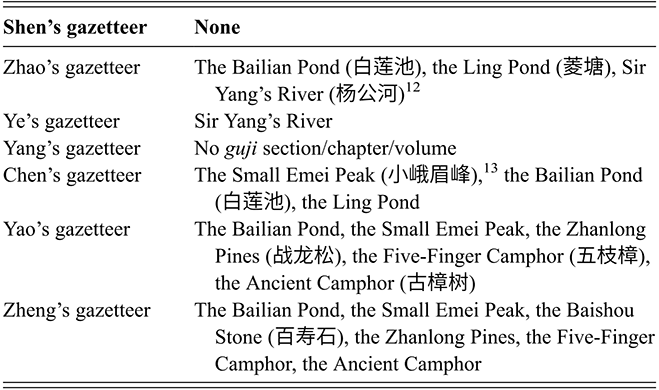
As observed in Section 2, guji does not include what is today categorized as natural heritage, but natural beings might be recognized as guji if they could be linked to human or divine figures. From the yin–yang perspective, one can say this is a manifestation of the Chinese understanding of nature and culture as relative, interactive, and transformative binaries, and of guji as having unsettled, negotiable boundaries. Through examination of the seven local gazetteers of Quzhou, I have identified several instances of natural beings recorded as guji. These include specific bodies of waters, trees, and stones. Table 2 catalogs the documented natural elements as guji in the local gazetteers under scrutiny.
| Shen’s gazetteer | None |
|---|---|
| Zhao’s gazetteer | The Bailian Pond (白莲池), the Ling Pond (菱塘), Sir Yang’s River (杨公河)Footnote 12 |
| Ye’s gazetteer | Sir Yang’s River |
| Yang’s gazetteer | No guji section/chapter/volume |
| Chen’s gazetteer | The Small Emei Peak (小峨眉峰),Footnote 13 the Bailian Pond (白莲池), the Ling Pond |
| Yao’s gazetteer | The Bailian Pond, the Small Emei Peak, the Zhanlong Pines (战龙松), the Five-Finger Camphor (五枝樟), the Ancient Camphor (古樟树) |
| Zheng’s gazetteer | The Bailian Pond, the Small Emei Peak, the Baishou Stone (百寿石), the Zhanlong Pines, the Five-Finger Camphor, the Ancient Camphor |
As displayed in Table 2, natural beings as guji were an evolving idea over time. In Shen’s gazetteer, no natural beings were recognized as guji. In Zhao’s and Ye’s gazetteers, only bodies of water could be remembered as guji. Then stones became guji in Chen’s gazetteer. In Yao’s and Zheng’s gazetteers, trees were added in the rubric. Among the three types of natural beings, bodies of water seem to be more readily recognizable as guji. This might be because they were more often associated with historical events, human figures, and their poetic writings than stones and trees were. As the boundaries of guji were not static but open to negotiation, trees and stones could be recognized by this Chinese discourse of “heritage” and recorded for remembrance. It should also be observed that, though the transmission of guji was mostly constant across time, a particular natural being recognized and recorded as guji in one local gazetteer might not always be recognized in another. One can find more or less variations in the documentation of natural beings as guji across the seven inspected local gazetteers of Quzhou. This, again, confirms that there was no standardized idea or uniform definition of guji.
To further explicate such dynamic conceptualization and boundary negotiations of guji, I now turn to examine a few records of trees and stones as found in the guji part of Quzhou’s seven local gazetteers. These two types of natural beings are chosen as they are less likely to be considered as heritage today. To delve into these records can better illustrate the boundary-crossing nature of guji-making.
Trees as Guji
As is known, cultural landscape was added to the World Heritage Convention in 1992 to recognize the combined works of nature and human beings, in response to the critiques against the “nature–culture” dichotomy in Western-originated heritage thinking. However, in this more inclusive heritage framework, can trees or stones be considered heritage? The answer may still be negative. At least, one does not find any trees or stones in the World Heritage List. In the Registration Forms for the Third National Survey of Immovable Heritage (Quzhou) in 2009, no documentation of trees or stones can be identified either. Nonetheless, for people in China and many other parts of the world, trees might be important places of historic significance or sites of memory. For instance, in Kaiija, northwestern Tanzania, there is a huge tree shrine near a village that functions as a compelling mnemonic for the ancient history of Kaiija, and the focal point of identity for social groups such as the royal clan and the Indigenous ironworking clan (Schmidt Reference Schmidt2010). And a few miles north of Cibecue in Western Apache, locals may point one to a huge cottonwood tree at Gizhyaa’itiné (Trail Goes Down between Two Hills). Amusing stories about Old Man Owl and two beautiful sisters who tried to tease the senior amorist with open legs standing in the tree have been told from generation to generation, shaping Apache people’s morality and sense of place (see Basso Reference Basso, Feld and Basso1996: 61–5). In early 20th-century Sweden, “a great and beautiful juniper,” “a giant spruce,” “a ‘troll’ pine,” and “a majestic old oak” were recorded as naturminnesmärker, a concept that means “a combination of nature, remembrance, and mark (trace)” (Sundin Reference Sundin2005: 13). Are these trees heritage? If yes, what kind of heritage are they: natural, cultural, or cultural landscape heritage? For me, they do not seem to be straightforwardly categorizable into the contemporary idea of heritage. Elsewhere, I have examined how in the discourse of guji trees were remembered in Qing-dynasty Hangzhou, the capital city of Zhejiang province. I have argued that tree guji might be more analogous to cultural or cultural landscape heritage, yet still with observable cultural distinctiveness of its own (Hou Reference Hou2019). Here, my examination of trees as guji in the historical context of Quzhou is quite similar, but more focused on individual cases. My aim here is to illustrate the dynamics of boundary negotiation, rather than the more general apparatus of meaning-making in the Chinese cultural discourse of guji.
As shown in Table 2, three tree guji were recognized in Qing and Republican Quzhou, namely, the Zhanlong Pines (战龙松), the Five-Finger Camphor (五枝樟), and the Ancient Camphor (古樟树). My case analysis will be based on the documentation of the first two, through which I hope to further challenge the globalized, standardized framework of heritage categorization and, more importantly, showcase Chinese cultural-historical understanding of boundary negotiation in ordering the past in the local past. The first one is the Zhanlong Pines, a group of pine trees on a famous mountain of Quzhou. In Yao’s gazetteer the record of it reads as follows:
Example 1–1
The Zhanlong Pines Located in the Keshan Mountain. It has been told that there used to be a stone tablet with three characters – Zhan Long Song – carved on it. The characters were Zhu Huian’s calligraphy. The broken pieces of the stone tablet were still identifiable during the Qianlong reign (1736–95). Now they are lost. (Zhou Zhao’s poem) The green characters have gone from the Zhanlong trees, the red pavilion having retreated in the Luming Mountain.
[战龙松 在柯山, 相传有朱晦庵书战龙松三字碑, 乾隆间犹存断碣, 今失去。 (周召诗) 绿字已销战龙树, 红亭空隐鹿鸣山。]
Noticeably, this documentation of the Zhanlong Pines shows little concern over the trees as natural entities. Or, in other words, these pine trees as natural beings were not considered important for their meaning-making as a local guji. The attention of the gazetteer compilers at the time was on some cultural and historical matters related to these pine trees, including (1) the stone tablet that names these pines and (2) the calligraphy of Zhu Huian, better known as Zhu Xi (朱熹, 1130—1200), that renders this stone tablet and these pine trees special and valuable. As such, these pines were called into being in the human world: They were named, remembered (as the act of erecting a stone tablet with its name beside them is a mnemonic practice), and liaised with Zhu Xi, a most influential Confucian scholar in the Chinese intellectual history, who had been worshiped as an accompanying deity in the sacrifice to Confucius in late imperial China (see, for example, Zhao et al. Reference Zhao1976: 2533). It was this distinguished and venerated historical figure and his calligraphy that rendered these pine trees significant and worthwhile to remember, even though the stone tablet that could attest to this cultural significance had already disappeared at the time it was documented. Indeed, a group of pines by themselves could not make a guji. Only through entering into the human world to break the boundary between nature and culture might they become a memorable guji. What is more, this boundary-breaking process ought to be based on the natural being’s cultural association with a memorable historic figure and words – in this case, Zhu Xi’s handwritten characters to name these pines.
In addition, one sees two lines of a poem cited to document the pine trees as guji. Reproducing these poetic lines in which the Zhanlong Pines were referred to, the local gazetteer compilers made meaning of the pines via the poetic words of Zhou Zhao. This is a further means to call the pine trees into being in the world of humans. As Tuan Yi-fu (Reference Tuan1991: 691) has pointed out:
The Chinese characteristically believe that poems and poetic prose can deepen meanings of landscape. They have not actually said that words call objects into being, wake up rocks and flowers, imbuing them with life and meaning, and yet something of that belief is there.
Thus, these pines would transcend the boundaries between nature and culture and demonstrate their quality as a guji to incite xing. Meanwhile, this renders the well-known local scholar Zhou Zhao, whose name and biography are seen in the local gazetteer’s volume dedicated to Confucian scholars (see Yao et al. Reference Yao and Fan1970: 1295–96), pertinent to these pine trees. As such, the pines are further incorporated into the realm of guji. As pointed out earlier, this Chinese idea of heritage is more about human traces than about the physical vestiges; its meanings and values are derived chiefly from the historical figures associated with it.
In Zheng’s gazetteer, the record of the Zhanlong Pines appears to be rather multifarious. Its main body reads:
Example 1–2
(The Kangxi County Gazetteer) In front of the Shiqiao Temple in the Keshan Mountain is a sequestered track. Several pines grow there. They are all over a thousand years old and are called the Zhanlong Pines. (Wuzazu by Xie Zhaozhi in the Ming dynasty) In the Lankeshan Mountain of Sanqu,Footnote 14 there are several pines huddling up together. They appear alien and enigmatic. I once passed by and signed for their being in such a bleak place, unable to attract viewers. Beside the track are a dozen stone tablets of tribute, reading “Zhan Long Song” (Zhanlong Pines). The characters were Zhu Huiweng’s calligraphy.
[(康熙县志) 柯山石桥寺寺门前山径幽寂, 有虬松数株, 皆千余年物, 名战龙松。(明谢肇淛五杂俎) 三衢烂柯山中有数松盘拏蹙缩, 形势殊诡, 余尝过之叹其生于荒僻, 无能赏者。又十数武石碣表于道周, 大书曰: “战龙松”, 朱晦翁笔之。]
Here, the location, natural setting and physical appearance of the pine trees are accounted for. This might indicate that the existence of these pine trees in the natural world is also meaningful in the guji making of them. It is important to reiterate, however, that in traditional Chinese contexts, guji does not encompass purely natural beings in isolation. The description of these pines in their natural settings, I contend, appears to be a subjective documentation of them as a jing (景, landscape), since one can easily detect a human view of them. For the Chinese, jing “is highly subjective, and [it] borrows its charm from human thoughts and sentiments” (Lin Reference Lin1937: 437). As I have illustrated elsewhere, in Qing-dynasty Hangzhou, trees could be remembered as guji if they were considered most beautiful or rare jing (Hou Reference Hou2019: 458–59). Likewise, the Zhonglong Pines were recognized as a guji as they, first of all, constituted a rare jing to be viewed. As displayed in the Ming dynasty scholar–official Xie Zhaozhi’s (谢肇淛, 1567–1624) words cited, the pines were to him a jing rare, bizarre and sentiment provoking – Xie Zhaozhi signed for their being in such a bleak place. In the eminent Chinese landscape scholar Xie Ninggao’s term, these pine trees can incite the “human-landscape effect,” that is, “the inspiration, evocation, edification, sensation, empathy, engagement or any other possible spiritual or psychological responses from humans when facing a jing” (Xie Reference Xie1991: 19). In addition, through citing Xie Zhaozhi’s work, the local gazetteer complier further rendered the pines into a human ji, not only of Zhu Xi, but also of Xie Zhaozhi himself. As a famous official, writer, and traveler, Xie was recognized and recorded in the History of Ming (see Zhang et al. Reference Zhang1974: 7357). This historical figure “once passed by and signed for” these pines also contributed to bringing them to the cultural sphere.
Finally, this documentation of the Zhanlong Pines as guji ends with more quotations in smaller-sized characters: poetic lines of Ye Nansheng (叶南生) in the Ming dynasty and Ye Rizhen (叶日蓁) in the Qing dynasty (Zheng Reference Zheng1984: 784). This way, the Zhanlong Pines were further associated with locally significant poets in history, whose virtues were recognized in Quzhou local histories (see, e.g., Zheng Reference Zheng1984: 2304, 2372). In the meantime, these poems contribute to rendering the pine trees a site of poetics (Hou Reference Hou2019: 460–61) or a landscape for poetic xing, and thereby a guji worthwhile to remember.
Stones as Guji
As listed in Table 2, two entries of stone guji are found in the local gazetteers of Quzhou under analysis: the Baishou Stone (百寿石) and the Small Emei Peak (小峨眉峰), which refers actually to two stones. Here I look at the record of the Small Emei Peak to demonstrate how stones might enter into the realm of guji.
Example 2–1
The Small Emei Peak (Records of Places of Interest) [It is] in front of the seat of the prefectural government [of Quzhou]. During the Qianfu reign (874–79) of the Tang dynasty, the prefect Ji Gou got two stones when establishing a stockade at the Dragon Mountain. They were over six chiFootnote 15 long. He had it placed at the Wenhui Pavilion. During the Chunhua reign (990–94) of the Song dynasty, the prefect Shen Zhili relocated the stones here and covered them up with earth to form a peak. Later generations had taken them as the tomb of Guo Pu (276–324). During the Shaosheng reign (1094–98), the prefect Sun Ben dug up the stones and moved them to the hall of the prefectural government. Later, in the Xuanhe reign (1119–25), the prefect Gao Zhilin placed them back. It was said that the seat of the prefectural government was at a position suppressed by Mount Emei, the stones were placed here to resist that, and they were called “Small Emei.” The prefect Li Sui (1504–66) in the Ming dynasty dug out the two stones again, and relocated them beside the Youzhu Pavilion, with an inscriptional record written for them.
[小峨眉峰 (名胜志) 在郡治前。唐乾符间刺史季彀置砦龙山, 得石长六尺许, 取置文会阁。宋淳化间郡守慎知礼移植于此, 积土为峰。后遂讹传为郭璞墓。绍圣中郡守孙贲发之, 因得此石, 移置堂中。宣和间郡守高至临复移归故处。相传为峨眉山正压郡治, 故处此以对之, 因名“小峨眉”。明郡守李遂又发去双石, 植游瞩亭之侧, 有记。]
This entry of the Small Emei Peak presents a chain of stories concerning the two stones, narrating how they were found and were dealt with in the passage of time. In this way, the stones are associated with a number of historical figures significant in the local past. These include five prefects of Quzhou: Ji Gou in the Tang dynasty, Shen Zhili, Sun Ben and Gao Zhilin in the Song dynasty, and Li Sui in the Ming dynasty. Also pertinent is a prominent scholar–official in the Jin dynasty, namely, Guo Pu. Albeit a mistaken association, it adds an enigmatic zest to the stones as a guji, making them more culturally enthralling. As stated earlier, it is these associations with historical figures that make the stones culturally meaningful and thereby acceptable as a guji.
From another point of view, this record of the stones presents a “cultural biography of objects” (Gosden & Marshall Reference Hall1999) or “material biography” (Meskell Reference Meskell2021) of them. As Gosden and Marshall (Reference Hall1999: 170) state, “Not only do objects change through their existence, but they often have the capability of accumulating histories, so that the present significance of an object derives from the persons and events to which it is connected.” As narrated, the stones had been accumulating history throughout time, from the Tang dynasty to the Ming dynasty, and making connections to the historical figures and their deeds as prefects in Quzhou. In such a biography, the stones, which were originally objects from the natural world, were imbued with cultural and historical meanings. Thus, they could serve as a guji for remembrance, or a site of memory “to block the work of forgetting” (Nora Reference Nora1989: 19).
In this entry of the Small Emei Peak as guji, there is also an annotation after its main body just analyzed. In that annotation, we read stories related to the stones with more details. For example, Sun Ben’ digging up the stones is narrated as follows.
Example 2–2
Beside Quzhou’s prefectural government hall, a hump used to be seen. It was said the hump was an ancient tomb. There, on a stone tablet, was written, “The prefects shall be my cemetery men for five hundred years.” This had been passed down from generation to generation. No one dared to slight it. In the first year of the Shaosheng reign (1094), Sun Ben from Qi’an was the prefect. He asked his men about the hump and was told the said story. He ordered it to be demolished. Local officials were terrified. Sun Ben said, “Even if there’re bones of the ancient man of virtue under that hump, we should relocate them in line with the ritual laws.” He then wrote a eulogy and offered sacrifices by himself. He demolished the hump and dug further into the earth for several meters.Footnote 16 Nothing special was found except two stones …
[衢州厅事下旧有土势隆起, 相传云古坟冢也。旧有碑云: ”五百年刺史为吾守墓。” 以此前后相承, 皆畏而不敢慢。绍圣元年, 齐安孙公贲为守, 问之左右, 以是对公。命毁之, 官吏大恐。公曰: “藉令土有贤者骨, 当以礼法迁之。” 乃为文, 自祭而除之。劚深丈□, 了无他异, 但有二石 … …]
This is a more complete narrative about how Sun Ben demolished the hump and excavated out the two stones. Reading this, one can envision this historical figure’s brave character as a local governor of virtue. Such virtuous historical figures and their deeds, as mentioned in Section 2, are of crucial significance in making the stones a unique guji to remember.
Finally, it should be noted that the contexts in which the two stones were placed are also important. As Godden and Marshall (Reference Hall1999: 174) contend, contexts can “create meanings and produce object biographies.” Easily inferable from the above narrative, the stones were assigned diverse meanings when they were arranged at different places. A particularly interesting instance is that the two stones were relocated in front of the prefectural government of Quzhou as a strategy to resist the suppression from Mount Emei and, thus, were called Small Emei. As Mount Emei, a renowned mountain in southwestern China, is over a thousand miles away from Quzhou, the suppressing effect it might have upon the prefectural government was only conceivable from the perspective of feng shui (风水), which, as Zhang Su (Reference Zhang2018) demonstrates, is still influential in Chinese heritage narratives and practices today. In other words, the two stones were attached a feng shui meaning when they were relocated beside the prefectural government.
To conclude this section, here are the beginning sentences of the small preface to guji in Chen’s gazetteer:
When a person, amidst the dust or tangled wilderness, comes across a fist-sized stone, a handful of water, a cupful of soil, or a wood of ten feet long, they cannot help but linger, sighing with emotion, their heart pounding uncontrollably. Why is this so? It is because there is someone who has tied with them! Those who are so much held in esteem must surely possess aspirations and ideals within themselves, manifested in their significance through great accomplishments in their times. How, then, could their value be confined to such trifling things as springs, stones, soil, or wood?
[凡人于埃𡏖灌莽中得一拳石, 一掬水, 一杯之土, 寻丈之木, 輙从而流连慨想怦怦焉不能自已者, 何也? 有人焉以系之也! 夫人之足以见重者, 必自有其抱负于身, 表见于当世之具, 而岂系此区区泉石土木之间哉? ]Footnote 17
Indeed, the suppressed Chinese idea of guji does not value or respect things in the natural world themselves, but the human figures of virtue and their deeds associated with those things. Historically, the Chinese have not developed a rigid categorization of guji, or a universally applicable framework to assess what can(not) be categorized into the rubric because even those plain things in the wilderness, such as a stone, a spring, some soil, or a piece of wood might be regarded as guji, not to mention those cultural places, historic buildings, or religious sites. This is rather similar to Nora’s (Reference Nora1989) idea of lieux de mémoire or site of memory. As one might have noticed, Nora and his followers often offer a set of instances to exemplify different types of them for their purposes of exposition. They do not have a rigid categorization of lieux de mémoire. For both these ideas, categorization and recategorization are only contingent ways of delimiting. They are situated in and open to dialogue with others in the past and in the future.
That said, I can ask a few challenging questions concerning today’s heritage research and practice: Should the World Heritage system and its way of heritage categorization be rigidly followed in China and other parts of the world? Or should we set up a rigid system to compartmentalize various heritages worldwide? How should we perceive and deal with Chinese guji or whatever cultural concepts that cannot be readily put into the globalized catalogue of heritage? Inspired by the dynamic and dialogical ways of categorizing guji, I argue that heritage does not need to be defined and classified so unbendingly. There is no one best categorization of heritage that all should follow. The globalized system of heritage categories sets up boundaries and distinctions between heritage and nonheritage, as well as among different subtypes of heritage, which should not simply be problematized and remedied but deconstructed as a whole. This is not to suggest that all those familiar subcategories of heritage are no longer valid. They still are. Only the system they constitute should no longer be a universal model to follow. Taking such a system as universally applicable only makes heritage standardized, static and homogenous, which is at odds with the fundamental objective of the World Heritage program, that is, to preserve and promote cultural diversity.
4 The Materiality/Physicality of Guji
[T]he paradox is that the very past which seems to penetrate everything, and to manifest itself with such surprising vigour, is also strangely evading our physical grasp. This same China, which is loaded with so much history and so many memories, is also oddly deprived of ancient monuments. In the Chinese landscape, there is a material absence of the past that can be most disconcerting for cultivated Western travellers – especially if they approach China with the criteria and standards that are naturally developed in a European environment.
In today’s mainstream conceptualization and practices of heritage, materiality or physicality is still attached crucial importance. Material remains are treated as the primary ground for testing heritage authenticity. For most critical heritage scholars, this privilege of materiality or material authenticity is a key feature of the AHD, whose origin can be traced back to European architectural conservation in the 19th century (Smith Reference Smith2006; Waterton 2010; see also D’Agostino Reference D’Agostino2021; Swenson Reference Swenson2013). In contemporary China’s system of heritage, material authenticity serves as a key criterion for the official recognition of heritage sites and a key issue in their preservation and management. Those that lack verifiable material authenticity are usually excluded from heritage recognition. Even when such sites are granted official status, they would soon become targets of criticism from both scholarly and public spheres.
Cultural reflections on the materiality-boundness of non-Western, especially Chinese and Asian, heritages have never stopped since the emergence of critical heritage studies (see, e.g., Byrne Reference Byrne1991, Reference Byrne2014; Chung Reference Chung2005; Evers & Seagle Reference Evers and Seagle2012; Hou Reference Hou2019; Lowenthal Reference Lowenthal1989; Rico Reference Rico2016; Wu Reference Wu2014b; Zhu Reference Zhu2024b). However, there are also some scholars critiquing these cultural voices as a form of binary thinking that presupposes and reinforces the West–East divide in heritage (e.g., Akagawa Reference Akagawa2016; Gao & Jones Reference Gao and Jones2021; Taylor Reference Taylor2015; Winter Reference Winter2014). It is true that:
in the West and the wider world, the idea and practice of heritage conservation has pluralised and expanded, with the boundaries between the tangible/intangible, material/social, human/non-human, art/craft becoming increasingly porous. […] Asia has been part of a wider global trend.
Nevertheless, it should be understood that this global trend of more pluralized heritage conceptualization and practice does not come from nowhere or a sudden epiphany. It is a result, at least partly, of the global development of critical heritage research and awareness that problematizes the materiality-centered discourse of heritage and its knowledge/ power, among which Asia’s “discourse of difference” (Winter Reference Winter2014) is a main contributing force. In other words, the “discourse of difference” from Asia or elsewhere has contributed to the diversification of heritage around the world, rather than harming the coexistence of Eastern and Western heritage ideas.
Should we now abandon this “discourse of difference” and other forms of it, as there is a global trend of heritage pluralization? It is not yet time for that. There is still a need for such discourses, and more nuanced and sophisticated expositions of the cultural differences in heritage to further promote this pluralizing trend. After all, in the World Heritage nomination process, the flow of expertise regarding technical or material issues is still of vital importance (James & Winter Reference James and Winter2017). Furthermore, the AHD, featured by authenticity and materiality concerns, continues to exert significant influence on heritage practices across diverse cultural contexts – even in projects that ostensibly prioritize citizen participation (Pastor Pérez & Colomer Reference Pastor Pérez and Colomer2024). In China, for example, it generates cultural effects such as spatial separation, emotional banishment, and value transformation, as well as instigating tensions between heritage agencies and local communities (Zhu Reference Zhu2015; see also Yan Reference Yan2018; Zhu & Maags Reference Zhu and Maags2020). Furthermore, even lay people in China (especially urban China) have internalized this authenticity discourse. As Gao and Jones (Reference Gao and Jones2021: 99–100) report, there are numerous Chinese cases in which local residents dissent from actions in changing the physical existence of a heritage or express satisfaction over conservation efforts to maintain material authenticity. Though the two scholars take these Chinese cases as counterevidence to the “discourse of difference” between East and West in heritage thinking, I argue that they are, rather, illustrations of how influential the global, authorized discourse of authenticity is in contemporary China. As stated in Section 2, guji, as a Chinese cultural notion of heritage, has already been transformed by the modern, Western historical consciousness and, particularly, the AHD over the last century or so. One should not take for granted that Chinese people’s understanding of heritage has not been affected by the globalized discourse.
Nonetheless, I should make it clear that I am not suggesting that the Chinese today should totally throw away their concerns over materiality or physicality when dealing with heritage. This is not only because the rapid urbanization process in contemporary China has been wiping out and endangering the physical existence of heritage at an alarming speed and scale, but also because the Chinese cultural discourse of guji would also consider physical dimensions. The role of materiality or physicality in Chinese guji discourse cannot be reduced to a yes or no assessment. One should ask: How was materiality or physicality understood and dealt with in the Chinese cultural discourse of guji before it was transformed by the globalized idea of heritage? How were the physical and material aspects of guji discursively represented or obscured, remembered or forgotten? Underlying such discursive representations, what cultural logic and meaning-making processes were at work? In this section, I attempt to offer some preliminary insights into these questions with my cultural-historical discourse analysis of the guji records in the seven local gazetteers of Quzhou.
Materiality Ignored to Foreground Cultural Associations
A notable pattern emerges from my discourse analysis of guji records across the seven local gazetteers of Quzhou is that the material or physical dimensions are very often excluded; foregrounded in those records are historical figures and their deeds associated with the guji. More specifically, almost all the succinct guji records in the seven local gazetteers of Quzhou are without any description of their physical aspects. In those lengthier records of guji, accounts of physical dimensions are not often seen, either. Here are a few examples for a more nuanced understanding of how the materiality/physicality of guji was (un)attended to or (dis)remembered.
Example 3
The Yanxu Hotel Located in the eastern part of the prefectural city. During the Xiantong reign (860–74) of the Tang dynasty, the prefect Zhao Lin gave a farewell dinner to his younger brother, the then prefect of Chuzhou – Zhao Zan – here.
[雁序馆 (在) 郡城西, 唐咸通中刺史赵璘与其弟处州刺史瓒会别之所。]
In this very brief documentation of the Yanxu Hotel as a guji, one cannot find any account of its physical existence. The most significant matter in this documentation is its once being a place where a memorable moment in the local past occurred, that is, in the late Tang dynasty, the prefect of Quzhou, Zhao Lin, gave a farewell dinner to his younger brother, Zhao Zan, who was then the prefect of Chuzhou (处州). Whatever reason(s) one may find for such nondescription of the physical being of this guji, it testifies that historical figures and their activities are far more important than the physical dimensions in the meaning-making of a guji, as it is the former respect that renders this particular hotel a memorable site and a site of memory.
Example 4
The ZhengmengFootnote 18 Pavilion According to the Xin’an Gazetteer, Doulu Shu was previously named [Doulu] Fuzheng. When he was a youth, he once traveled to Quzhou. The prefect Zheng Shizhan said to him, “Your family name has two characters. It is not good that your given name is of two characters, too.” He then wrote the character shu (署) and presented it to him. At night, the young man dreamed of an old man talking to him, “I heard that the prefect has changed your name. You’ll get your fame taking the imperial exam four times. And twenty years after that, you’ll be the prefect here. The man then pointed to a place, saying, “This place is good to build a pavilion.” Waking up, the young man changed his name to Shu. At that time, he had already failed the imperial examination twice. Taking the exam four times more, he succeeded and won his fame. Twenty years later, he was really appointed the prefect of Quzhou. Then he built this Zhengmeng Pavilion at the site the old man in his dream had pointed to him.
[征梦亭 按《信安志》: 豆卢署初名辅真, 少旅于衢, 刺史郑式瞻谓曰: “子复姓, 不宜二名。”乃书署字授之。夕梦老父曰: “闻使君与君易名, 君当四举成名, 后二十年牧兹郡。”指一地方曰: “此处可建亭台。”既悟, 因名署。时已再下第, 又四举乃成名。后二十年果刺衢, 于所指地立征梦亭。]
Notably, in this relatively lengthier record of the Zhengmeng Pavilion as a guji, its material existence is unheeded. What one reads is only an intriguing narrative of the pavilion’s being built, in which the historical interaction between two prominent prefects of Quzhou, Doulu Shu and Zheng Shizhan, is foregrounded. Both of them were significant figures in the city’s local history.
The Zhengmeng Pavilion is also found in other local gazetteers of Quzhou. Though even lengthier than the above documentation, one cannot find any account of its material or physical existence, either. In Shen’s and Zhao’s gazetteers, for example, this interesting narrative also constitutes the record of the Zhengmeng Pavilion as a guji, only that it has a few more details (Shen et al. Reference Shen and Wu2009: 40; Yang et al. Reference Yang and Zhao2009: 161). In Yao’s and Zheng’s gazetteers, the documentation of the Zhengmeng Pavilion consists of the same story about how it had come to be built, and a couple of poems related to the pavilion (Yao et al. Reference Yao and Fan1970: 544–45; Zheng Reference Zheng1984: 762). That is to say, the Quzhou local gazetteer compilers in different historical times did not consider its physical existence necessary to make meaning of the pavilion as a guji.
With this analysis, I want to further stress that the Chinese used not to care so much about materiality or physicality in remembering guji. The absence of physical or material considerations from guji records was commonplace. The examples analyzed earlier further provide support from a cultural-historical perspective for scholars who maintain that the Chinese idea of heritage is not materiality-bounded (e.g., Hou & Wu Reference Hou and Wu2012; Lowenthal Reference Lowenthal1989; Ruan & Lin Reference Ruan and Lin2003; Wu Reference Wu2012b; Yu Reference Yu2008, Reference Yu2012). It is important to note, however, that this observation should not be interpreted as a support for the claim that Chinese – or, more broadly, Asian – cultures place greater value on intangible heritage than on tangible heritage. I remain unconvinced by such a view. As I have contended in the previous section, this dichotomous grouping of heritage is misaligned with the cultural-historical conception of guji, and the Chinese yin–yang philosophy. What I am showing here is that the material or physical facts were not often an issue in the recognition and meaning-making of guji that we today tend to classify as tangible heritage. In other words, even in dealing with what is today called tangible heritage, the Chinese used not to care too much about its material or physical aspects. It seems that the Chinese well understood that “all heritage is intangible” long before Smith (Reference Smith2006: 3; Reference Smith and Tebbaa2011: 11) made this claim. For them, a guji was meaningful and memorable because it sustained “a performance or cultural process” (Smith Reference Smith and Tebbaa2011: 11) through which the past was translated to be a valuable resource in the present. Even though its material existence was lost, a guji could continue to fulfill its function, so long as this cultural process remained active. In such cases, tracing the site where the guji once physically stood became especially significant.
Tracing the Site
Intimately pertinent to the issue of materiality or physicality, site stands out to be an overarching concern in the guji discourse, as revealed in the Quzhou local gazetteers under inspection. It should be explained at once that the idea of site in the Chinese guji discourse is different from how we perceive it in the contemporary system of heritage. Today, sites constitute a particular type of tangible heritage, defined as “works of man or the combined works of nature and man, and areas including archaeological sites which are of outstanding universal value from the historical, aesthetic, ethnological or anthropological point of view” (UNESCO 1972: 2). Unlike monuments or built heritages, sites do not have those structures standing as they were in material integrity; there are only material remains on and/or under the ground to authenticate their status as heritage. The enlisted world heritages of this type in China include the Peking Man Site at Zhoukoudian, the Yin Xu and the Site of Xanadu. Arguably, these sites have been recognized because they best exemplify the universal values in the AHD framework, based on archeological research of the material remains excavated. In the Third National Survey of Immovable Heritage (Quzhou), no registration of a site as such is identified. This indicates that in Quzhou there are no sites that demonstrate universal heritage values, or, rather, no material remnants for the state-sanctioned heritage surveyors to authenticate a site of universal heritage values. However, when a historically significant space or structure collapsed, how might its site be treated in the cultural discourse of guji? Through examining the guji records in Quzhou’s seven local gazetteers, I explicate alternative ways of conceptualizing and remembering sites, so as to illuminate distinct understandings of materiality or physicality within the marginalized Chinese guji discourse.
First, a structure or place of historic significance could be recognized and remembered as guji after its physical destruction or desolation, whether its site could be determined or not. For example,
Example 5
The Yuefeng Pavilion Located behind the seat of the prefectural government. It was built in the seventh year of the Jiajing (1528) by the prefect Sir Wang. Today, it is desolated.
[乐丰亭 在府治后, 嘉靖七年郡守王公建, 今废。]Footnote 19
Despite its state of desolation at the time of its documentation, the pavilion retained its status as guji. In this record, what comes first is the original location or the site where the pavilion used to stand. Actually, as may be noticed in the examples presented earlier, most guji records begin with a description of where it is or was standing. This indicates the crucial significance of the location or site of guji in the Chinese cultural thinking.
Example 6
The Demolished Yingchuan County (Taiping Huanyu Ji) 95 liFootnote 20 south from the prefectural city. (Fanyu Jiyao) 90 li south from the prefectural city […]. (The previous gazetteer) The site of the city seems to be still there … .
[盈川废县 (太平寰宇记) 在州南九十五里 (方舆纪要) 州南九十里 [… …] (旧志) 城址仿佛犹存。 … …]
In this record of the Demolished Yingchuan County as a guji, the exact location of the site is left uncertain. It seems that the local gazetteer compilers at the time had no sufficient physical evidence to determine where it used to stand. They offered two versions for this, by quoting historical documentation from a book completed in the late 10th century, Taiping huanyu ji (Universal Geography of the Taiping Era) and one published in 1692, Fanyu jiyao (Essence of Historical Geography). These two versions of site location have a discrepancy of five li or 2.5 kilometers between them. It should be observed that the second version is in smaller-sized characters, suggesting that the local gazetteer compilers consider it less accurate than the first one.
What runs after these two versions of site location in the guji record is another quotation from the previous county gazetteer, that is, Chen’s gazetteer compiled in 1699, stating that “the site of the city seems to be still there.” This indicates that the compilers of Chen’s gazetteer had traced a site for the Demolished Yingchuan County, yet were uncertain or unable to authenticate that it was. They added the hedge word “仿佛” (fangfu, seems to) to confess their uncertainty. This indeterminacy was then carried over by the compilers of Yao’s gazetteer, who simply retained Chen’s equivocal conclusion without resolving the ambiguity surrounding the guji’s precise whereabouts. From Sima Qian’s perspective, this is to pass down the uncertainty as uncertainty (Sima Reference Sima1959: 487), without affecting the recognition and remembrance of it as a guji.
Second, a collapsed structure could be a guji even though its site was already untraceable. For the then Chinese, it was not necessarily a guji lost that allowed disremembering, nor was it problematic to announce that its site could not be verified. Arguably, the traceability of a site in the physical world was not a critical factor in determining whether a guji could be recognized or not. Here are a couple of examples for illustration.
Example 7
The Hefeng Post Built in the Shaoxing reign (1131–62) of the Song dynasty by the prefect Sir Zhang, who was born in Xiangyang. It had long been abandoned. Its base and site cannot be found.
[和风驿 宋绍兴中郡守襄阳张公建, 废久, 基址无可考。]Footnote 21
As underlined, this entry of the Hefeng Post as a guji explicitly states that it had been abandoned, and its site was no longer verifiable at the time when it was documented in the local gazetteer. Nonetheless, this did not affect its value or meaningfulness to be recorded as a guji. In so doing, the local gazetteer compilers at least granted people in their time and the coming ages a chance to transmit the name of this post. More importantly, this recognition and documentation of it as a guji could work to transmit the name and memory of Sir Zhang, a prefect of Quzhou in the 12th century, encouraging contemporary and future officials in Quzhou to build such useful infrastructures so as to make their names remembered by later generations.
Example 8
The Chuangshan Pavilion, the Yuepo Pavilion, the Fengyue Pavilion
Their bases, sites and histories of establishment and desolation are all untraceable.
[闯山亭 月坡亭 风月亭 基址兴废俱不可考。]Footnote 22
Captivatingly, the three pavilions recorded in this guji entry seem to have nothing traceable, their sites included. Though so, they could still be guji, worthwhile to be documented and made known to the present and later generations. The only thing transmitted is their names. Indeed, names can serve as a memorial form to be called and recalled. This aligns with Azaryahu’s (Reference Azaryahu2021: 1) conceptualization of “onymic commemoration,” that is, a complex process that operates via the remembrance of, by, and through, names, as “a time-honored and prestigious technology of immortality.”
What cultural imperative drove the Chinese practice of recognizing and remembering guji without physical remains or traceable sites? Did they really attempt to remember every desolated, disappeared guji, or every empty or even untraceable site? In the Fanli of Zhao’s gazetteer, whose chapter of guji includes similar records of the Hefeng Post and the three pavilions named earlier, a clear clue to answer those questions is found. It reads:
Those that have been demolished today and without verifiable sites will be omitted. Though demolished, some guji, such as the Hefeng Post, the Chuangshan Pavilion and so on, will still be recorded, rather than deleted. This is to pass down the words or writings of renowned figures. [今废, 址俱不可考, 故削之。虽废, 如和风驿、闯山亭之类犹存而弗削者, 存名人之辞翰也。]
Clearly, this statement shows that the Chinese did permit forgetting guji when their sites were no longer traceable. However, the overriding principle governing whether a guji could be disremembered was not the traceability of its site, but whether it could still serve to transmit the words or writings of memorable human figures. The deep cultural thinking behind this is, as discussed in Section 2, that the idea of guji used to privilege the transmission of words, especially poetic words, and the memory of human figures. For the Chinese, “[t]he past was a past of words, not of stones” (Mote Reference Mote1973: 51). Wu (2012) advocates the idea of “language authenticity” for Chinese heritage. That is, language should be taken as a key aspect in maintaining the authenticity of heritage in China. It is more important to preserve and transmit authentic language than material or other matters in Chinese heritage practices (see also Hou et al. Reference Hou, Liu and Gao2019).
Third, the process of tracing where the site of a guji is itself important or meaningful to be documented. In the seven local gazetteers of Quzhou under inspection, multiple guji entries specify the compilers’ efforts to identify and demarcate sites. This practice is particularly well illustrated in Yao’s gazetteer’s account of the Fushi (Floating Stone) Pavilion:
Example 9
The Fushi Pavilion Located at the Fushi Ferry outside the Gongcheng Gate. In studying earlier gazetteers, I encountered Meng Jiao’s poem about the Lanke Stone at Zhengrong Ridge. Later, upon reading the collected works of Meng Jiao, I found a poem of the Fushi Pavilion, which raised doubts about whether its site was at the previously stated location. However, upon examining the collected works of Zhao Qianxian, I discovered references that “the Fushi Immortal’s trace is at the finishing stone along the river beside my house,” and that “the Fushi Immortal’s trace still remains.” When considering these together with the final lines of Meng’s poem, I could confirm its site is indeed there. Yet surprisingly, earlier gazetteers omit any mention of the Fushi Immortal; the story appears only in these two respected figures’ poems. People have all been speaking of the legend of the Lanke Mountain, yet few know about this tale. Are deities also destined to be or not to be transmitted? …
[浮石亭 在拱辰门外浮石渡。尝考旧志, 有孟郊峥嵘岭烂柯石诗, 后读郊集又得浮石亭诗, 或恐非此地。因读赵清献集, 有浮石仙人遗迹在吾庐江畔钓鱼矶, 又浮石仙人迹尚存, 合之郊诗结语, 知其为此地也。独怪浮石仙人事前志不载, 仅见于二公诗。世竞传柯山事而知此者寥寥, 岂仙人传不传亦有数耶? … …]
This record of the Fushi Pavilion as a guji is primarily a narrative of how the site of it was traced textually. The compiler’s examination of a poem about this guji written by the esteemed Tang-dynasty poet Meng Jiao (孟郊, 751–814) raised doubts about the recorded site of this guji. Further inspection into the collected works of Zhao Qingxian or better known as Zhao Bian (赵抃, 1008-84) – a celebrated Song-dynasty scholar–official who was born, grew up and lived his retired life in Quzhou, coupled with a close analysis of the concluding lines of Meng Jiao’s poem, confirmed that the site documentation was right. Rather than simply the finding, this site-tracing journey was also presented to the readers, so as to unfold a process of recollecting gu (稽古, jigu). As I have previously expounded on, in traditional Chinese cultural thinking, “recollecting gu is [a means to be] in accordance with heaven.” That might be the reason why this journey of site tracing was deemed worthy of documentation.
Furthermore, it can be inferred that the site of the Fushi Pavilion was no longer physically identifiable at the time, as the process of locating and documenting the site relied entirely on textual sources. This lack of physical evidence, however, did not affect its status as a guji, for its significance was tied to the words of renowned historical figures and traces of deities. The gazetteer compiler also expressed surprise – or, rather, discontent – at the omission of the Fushi Immortal’s tale in earlier Quzhou gazetteers. As discussed in Section 2, this tale can be a crucial source of meaning-making for the Fushi Pavilion as a guji.
Another example of illustrative power is the entry of the Zhuangyuan ToriiFootnote 23 in Zheng’s gazetteer. As the documentation goes:
Example 10
The Zhuangyuan Torii (Jiaqing County Gazetteer). It was built for Liu Mengyan, Chen Su, Mao Zizhi, etc.
Note: This torii collapsed a long time ago. Only this name has survived. It was at the end of Mazhan, south from the Wu Bridge. Zhan (栈) is vernacularly written as zhan (站). According to local seniors, this site is actually the house where the zhuangyuan Liu Mengyan had lived, and Mazhan was the stable where Liu Mengyan fed horses. …
[状元坊 (嘉庆县志) 为留梦炎、程宿、毛自知等立。按: 此坊久圮, 仅存其名, 在乌桥南马栈底, 栈俗作站, 然据故老相传其地实留状元故居, 马栈亦留状元当年厮养所也。 … …]
While the torii had long since collapsed, the site might be lost to time. The local gazetteer compiler Zheng Yongxi then sought to rediscover it by interviewing local seniors. This process of site tracing is discernible from Zheng’s note in the entry, particularly his representation of the voice of local seniors. With help from them, Zheng traced more than the site of the Zhuangyuan Torii. He further found that Liu Mengyan’s house and stable used to be at this site as well.
To conclude this analysis, I would like to reiterate that site held critical importance in the Chinese cultural discourse of guji. However, unlike today’s mainstream heritage conceptualization, the concern over sites in premodern Chinese thinking was not so much about conserving material remains in the designated space as about transmitting memories—those about particular historical figures and their words, even those deity tales or simply names that had been left. Often, the site of a guji was empty, lacking any physical traces that could be subjected to what is today called authenticity tests. Later generations would employ various methods to locate such sites, including textual research, fieldwork interviews, and others. These efforts might yield inconclusive results, and, in some cases, nothing at all. Even in such instances, however, documenting the lost guji remained evocative, and the process of tracing its site was itself meaningful. Such documentation can illuminate a process of recollecting gu, or efforts to reconnect with and meaningfully reinterpret the past in the present.
The Meaning-Making of Physicality
A close examination of the seven local gazetteers of Quzhou also reveals that the physical aspects of guji were occasionally incorporated into the records, though they were more often than not neglected. How did local historians of Quzhou frame or portray the material or physical aspects of a guji? In what ways did their documentation of material facets converge with or diverge from our modern heritage discourse? What cultural processes of meaning-making shaped these material accounts? These questions remain largely unexplored, as scholarly discourse has typically focused on either defending or challenging the idea that Chinese heritage approaches transcend the concern over materiality or material authenticity. In this subsection, I address these questions through examining two guji cases, the Official Seat of the Magistrate Assistant, and the Office of the Judicial Assistant, as recorded in Zheng’s gazetteer.
The records of the two guji read as follows.
Example 11
The Official Seat of the Magistrate Assistant (Jiaqing County Gazetteer) Located initially at the eastern side of the retreat hall in the county’s official seat. In the 41st year of the Qianlong reign (1752), it was detached and relocated at the Zhangshutan in the eastern city. The magistrate assistant Yang Xiang built this official seat, whose hall had three principal columns. At the right and the left sides of it, there were porches. Behind the hall was the interior house of three rooms. In front of the hall were the main gate and the screen wall. During the Xianfeng reign (1851–61), this official seat was destroyed during a war. …
[县丞署 (嘉庆县志) 原在县署退堂东。乾隆四十一年分防城东樟树潭, 县丞杨翔建署, 为堂三楹, 左右有廊, 后有内宅三楹, 堂前为大门、为屏墙。咸丰兵毁。 … …]
Example 12
The Office of the Judicial Assistant (Kangxi County Gazetteer). The Judicial Assistant’s Office is located east of the Zhong’ai Hall in the county seat, south of the Assistant Magistrate’s residence. The Assistant Magistrate’s office is known as the Grain Yamen, while the Judicial Assistant’s office is also called the Constabulary Yamen. (Jiaqing County Gazetteer) The Judicial Assistant’s residence is situated at the northwestern edge of the county seat. In the middle is a hall, with a two-bay corridor to its east. Behind this were two halls, and further back is the inner residence of five bays. West of the main hall stands a three-bay study, while a ceremonial gate is positioned to the hall’s south.
[典史厅 (康熙县志) 县治忠爱堂之东为典史厅, 在县丞之宅南, 丞称粮衙, 典史亦称捕衙。(嘉庆县志) 县治西进迤北为典史宅, 中为堂, 堂东有廊二楹, 后为二堂, 更后为内宅五楹, 堂西有书室三楹, 堂南为仪门。]
As underlined, these two guji records do have accounts of their physical erection. Observably, these physical accounts focus on the architectural structure of the two official buildings, with little attention given to specific details or micro-level architectural characteristics. This form of physical documentation stands in stark contrast to the expectations of modern heritage specialists, who would seek more information on, for example, the precise dimensions of the structures and their components, the materials used, the architectural styles and aesthetic principles embodied, as well as the construction techniques and levels of technical sophistication involved.
To better illustrate this, one efficacious strategy is to compare these guji records with contemporary heritage documentation. Here is how a “Zhejiang Provincial Key Unit of Cultural Heritage” in Quzhou, the Tianfei Gong (literally Heavenly Queen Palace), is recorded in the Third National Survey of Immovable Heritage in 2009. In the registration form of this heritage, an introduction to it goes as follows:
The Heavenly Queen Palace is located at No.18, Tianhuang Alley. It was built to commemorate the Heavenly Queen – Mazu, and thus also called Heavenly Queen Palace. This architecture occupies the east and faces the west. At first, it was 2,052.9 square meters in size. Today, only 650.89 square meters remain. In horizontal layout, it appears like a vertical rectangle. It has two side doors in the northern and southern parts of its front wall. Over the main gate, there is a stone plaque that reads “Tian Hou Gong.” The main gate faces 20 degrees north of due west. 16.75 meters westward from the main gate is a screen wall. Going through the main gate, one enters its front hall. Moving inward further is a yard, with two wings (xianglou) at its south and north. The ground of the yard is covered with flagstones. Right in the middle of it, a corridor cuts through and connects to the main hall. Another section (jin) behind the main hall was pulled down. The front hall is built upon a stone base of two layers. Above the main gate are brick carvings. They are mainly in the shape of 卐, scattered around which are images of human beings, birds and beasts, of trees and stones, and of landscapes. During the Cultural Revolution (1967–77), these brick carvings were covered by yellow mud. The front hall is of five jian and two floors. The second floor is the stage for Chinese opera performace. [… ] The architecture is basically well preserved. The brick carvings over the main gate are delicately beautiful. The dougong, queti, tuojiao, etc., in the architecture are mostly engraved; the engravings are fine, delicate, and dense, with golden light and varied colors shining, but the overall images of them look dull, being clearly of the late Qing style.Footnote 24
As clearly seen, this documentation of the Heavenly Queen Palace as a heritage is predominantly about its physical existence. The state-sanctioned heritage surveyors have offered thorough and detailed accounts of how the Heavenly Queen Palace looks like in physical and material terms and how it was constructed, including information about its size, layout, structure, fabric, its construction materials, techniques, decoration style and aesthetics. Perceptibly, these descriptions are to demonstrate the so-called universal values (scientific, historic, and aesthetic) of this built heritage. Scientifically, the Heavenly Queen Palace is depicted as an architectural building with fine design and careful structural and constructional contemplations, so that it can be regarded as a human creation with scientific and technological complexity. Historically, the Heavenly Queen Palace is represented as a piece of architecture of the late Qing era, surviving the drastic transformations in late imperial and modern Chinese history. Aesthetically, the architectural style and decoration details are underscored to portray the Heavenly Queen Palace as a work of architectural art. Though the images of the engravings look dull (from an architectural art point of view), they reflect the aesthetic style and taste in late Qing China.
With this analytical observation in mind, I turn back to the two records of Quzhou official buildings as guji. Though the physical description constitutes a notable part in each of the records, it is much less prominent than that in the contemporary heritage documentation as exemplified earlier. To understand such less detailed accounts of guji physicality, we should not follow contemporary heritage or architectural perspectives. As many scholars have pointed out, architecture in imperial China, especially royal palaces and official seats, had been shaped by family-state politics and, more fundamentally, Chinese Li (礼) thinking (Li Reference Li2020; Zhang Reference Zhang2011). Li, as “the determinate fabric of Chinese culture” (Hall & Ames Reference Hall and Ames1998: 269), does not have a single equivalent term in the English language. As Chard (Reference Chard2011: 29) summarizes, it has been translated into words such as “ritual, rites, ceremonial, etiquette, manners, rules of behavior, ritual propriety,” or, more generally, “prescriptive rules or norms which govern society.” As colleagues and I have contended elsewhere, Li is a guiding discourse that shapes the meaning-making of Chinese heritage or guji in premodern times (Hou & Wu Reference Hou and Wu2017: 83–4; Wu & Yao Reference Wu and Yao2014). Furthermore, Peng Zhaorong (Reference Peng2018) has highlighted the primordial role of Li to understand Chinese intangible heritage.
In the description of the two official seats as guji, this Chinese cultural understanding was perceptibly embedded. First, the principle “qian tang hou shi” (the audience hall is in the front and the rooms are in the back) or “qian ya hou qin” (the office is in the front and the living space is in the back) had been observed when building the two official seats. This was the basic scheme of architectural construction in traditional China, guided by the Li discourse. It can be traced back to the ancient Chinese classics of Li. For example, while commenting on the Yili (Book of Etiquette and Rites), the Qing official–scholar Sheng Shizuo (盛世佐, 1719–55) affirmed that “the scheme for architecture is qian tang hou shi.”Footnote 25
Furthermore, the physical descriptions of the two official architecture as guji show a concern over scale, another important dimension of the Chinese Li discourse that shapes the meaning-making of architecture, because it is through the distinction in scale that Li forges itself. As stated in the Li Ki (Book of Rites),
In some ceremonial usages, the multitude of things formed the mark of distinction. The son of Heaven had 7 shrines in his ancestral temple; the prince of a state, 5; Great officers, 3; and other officers, 1. (Li Ki, 10: 7; Legge’s translation Reference Legge1885: 397)
In others, greatness of size formed the mark. The dimensions of palaces and apartments; the measurements of dishes and (other) articles …
The official seats should meet the requirements of Li at the time it was constructed. In late imperial China, according to Tian Kai (Reference Tian2012: 108), the main hall of the official seat for officials ranked from the ninth to the sixth levels ought to have three rooms. The magistrate assistant of a county outside of the provincial capital was in the eighth rank, and the judicial assistant of a county was rankless. When the Chinese read such physical descriptions in premodern days, they would judge whether these buildings were appropriate in terms of Li: The Office of the Magistrate Assistant was an appropriate one, while the Office of the Judicial Assistance was not, as its scale was even larger than the Office of the Magistrate Assistant. This can be understood as a different politics of the past in the present. It functioned as a mirror for the local officials at that time to reflect on their own behaviors in using building (and more) and thereby guide their future deeds.
In light of this discourse analysis of guji, some of the assumptions and limitations that underlie contemporary heritage identification and management practices need to be reflected on. Typically, when the material remains of a historically significant site are no longer extant, one tends to deny its status of heritage. The response is often limited to expressions of regret and blame: They lament that the site was not properly preserved and reproach institutions or individuals for their failure to protect it. Ironically, this is usually followed by collective forgetting. Behind such a tendency is a deep entrenchment in the Western-originated conception of heritage authenticity. It should be stressed, however, that loss is not equivalent to nonexistence. A site may no longer possess physical remains or traces, but this does not necessarily preclude its value as heritage. Having no material remnants or even lost traces of the site, a heritage may still be valuable and memorable, if it has a poetic writing, a tale, or simply a name left.
The debate on heritage materiality/physicality also needs further reflections, as our contemporary perspectives, including those who critique the East–West binary or the “discourse of difference” in heritage thinking, remain constrained by Western-originated dichotomies and disciplinary frameworks. Basically, the current debate operates largely within a yes–no dichotomy in thinking and rethinking heritage materiality or physicality. However, the issue can be much more complicated. For example, can one interpret the Chinese concern over the site of guji as a concern over its materiality? One cannot simply say yes or no. As I have shown, the Chinese had enthusiastically researched and recorded where the physical site of a guji was, but if they could not physically verify the site, it would not matter so much. Furthermore, we need to ask: When people show concerns over heritage materiality or physically, what are they really concerned about? In today’s mainstream heritage discourse and practice, such concerns are usually directed to the so-called “innate values” in science, technology, art, and history. Nevertheless, these values are not really innate but are assigned by heritage experts from their disciplinary (archeological, architectural, artistic, or historical) perspectives. In contrast, the premodern Chinese engagement with the physicality of a guji was usually from the perspective of Li, a different politics of the past in the present. This alerts us that the concern over heritage materiality or physicality might have divergent meanings and implications across cultures and time. Heritage researchers and practitioners should carefully examine this, rather than instinctively bring in their own disciplinary knowledge to understand materiality or physicality in heritage work.
5 Guji in a Holistic View
Stepping into a new territory for travel or sightseeing, one first asks about the sages and wise figures of bygone eras, seeks for the great events occurred in history, and talks to locals to trace the sites associated with them. A hall or a pavilion may conjure the elegance of a hundred years past; a derelict temple or an ancient tomb may recall heroes ten centuries ago. Even though those ruined sites, by the emptiness they left we may still commemorate the past. Never fade are their names and auras, which will inspire us in days to come. [入境游观, 先询往哲, 追前胜事, 聊访遗踪。月榭风亭, 犹想百年光霁; 荒祠古墓, 回思千载英灵。虽废址, 堪悲空吊往古, 而流芳未泯, 可激来今。]
In the preceding sections, I have selectively foregrounded particular aspects of the Chinese guji discourse to facilitate a clear exposition of its main ways of meaning-making and remembering the past. Nevertheless, as readers may have noticed, these aspects do not exist in isolation; rather, they frequently intersect and coalesce within individual instances of guji documentation. In this final analytical section, I hope to provide a more holistic understanding of the Chinese guji discourse. What I choose to do is a focused analysis of a single, emblematic case – the House of Yin Hao (殷浩宅). This case analysis will enable revisiting the earlier themes addressed while bringing their interrelations into sharper relief, thus offering a more cohesive elucidation of how this forgotten Chinese discourse of heritage operated in ways different from the AHD.
Yin Hao (殷浩, 303–56) was a renowned military general in the Eastern Jin dynasty (317–420), whose deeds were well documented in the Book of Jin (see Fang et al. Reference Fang1974: 2043–49). He spent his later years in Quzhou and was buried there after his death. Yin Hao has been regarded as an important figure in the local history, with stories and traces of his life in Quzhou meticulously recorded in the local gazetteers. My analysis of the House of Yin Hao as a guji will draw on the records from Yao’s and Zheng’s gazetteers. These two are chosen for the reason that, as shall soon be evident, they reproduce the documentation of this guji in other local gazetteers of Quzhou. To examine them will not blind us from seeing how it was recorded and understood across time.
Now let us look at the record of the House of Yin Hao in Yao’s gazetteer, which goes as follows:
Example 13–1
The House of Yin Hao (Yuanfeng Gazetteer of the Nine Regions of China) Located in the Xi’an County. The base of the house is still there. Locals call it Yinqiang (the wall of the Yin family). (Tianqi Prefecture Gazetteer of Quzhou) Located in the Xin’an Old City, 6 li south to the Xi’an County. Hao was the Mid General in the Jin dynasty. During the Jianyuan reign (343–44), he was defeated in the northern expedition by Yao Xiang. For that reason, he was removed from office and relegated to layperson. He was sent to live here. Its site still exists, and by the roadside there is a small stone chamber, housing a statue of a deity whose image is a warrior in helmet and armor … . [殷浩宅 (元丰九域志) 在西安县, 基地犹存。土人号曰殷墙。(天启府志) 在西安县南六里信安故城, 浩在晋为中将军, 建元间北伐为姚襄所败, 废为庶人, 贬居于此。其址犹存, 道旁有小石室, 其神为介冑之像。 … …]
First, this record of the House of Yin Hao as a guji exhibits little concern over its material existence, as there are no descriptions of its physical appearance, structure, or remnants. One can argue that this absence of physical description might be due to the long-ago demolition of the house, which prevented the local gazetteer compilers from providing any details about its material form. While this could be true, it is noteworthy that the compilers did not cite physical descriptions of the house from the Yuanfeng Gazetteer of the Nine Regions of China or the Tianqi Prefectural Gazetteer of Quzhou. They either could not locate any in these early historical writings or deemed it meaningless to include such information. Whatever the reason was, it is safe to say that the material characteristics of the house were not deemed of much significance in the guji discourse then. Thus, even though the House of Yin Hao had long been demolished or materially gone, it was still recorded and remembered as a guji in Quzhou.
Second, the issue of site was a serious concern in this entry of the House of Yin Hao as a guji. The local gazetteer compilers brought together two historical records to speak of this guji, both of which mentioned the site of the fallen house. According to the Yuanfeng Gazetteer of the Nine Areas of China, which was compiled during the Yuanfeng reign (1078–85) of the Song dynasty, the base of the house was visible in the 11th century, referred to by locals as Yinqiang (Walls of the Yin). This might suggest that the collapsed walls of the house were also discernible then. By the early Ming dynasty, as noted in Shen’s gazetteer compiled in the 1500s, only the site itself was traceable. Through these quoted historical records, the local gazetteer compilers not only provided the essential information about the fallen house and its historical changes, but also suggested that tracing the site was a long-lasting tradition in the recording and remembering of guji. Such an act, as indicated in this entry, happened in different times of history in dealing with the House of Yin Hao as a guji.
Third, the life story of Yin Hao constitutes a very, if not the most important, part in the documentation and meaning-making of this collapsed house as a guji. Essentially, it is because of him that this fallen house or empty site of it has been deemed valuable and memorable. Despite his defeat as a general, Yin Hao was a person of virtue and reputation (see, e.g., Fang et al. Reference Fang1974: 2043–49; Yao et al. Reference Yao and Fan1970: 1424–25). The mere fact that such a historical figure had once resided therein transformed this house into a memorable guji, even after the physical structure had vanished. In other words, the significance of this site derives not from its material remnants but from its association with the life trajectory of a noteworthy historical figure.
Fourth, the local belief is rendered pertinent to this site to commemorate Yin Hao, as in the Chinese discourse of guji, the liaisons with human and/or divine figures were its primary sources of meaning. In this entry of guji, one encounters an account of the local worship of a warrior deity. While definitive evidence connecting this deity to Yin Hao is not provided, the inclusion of this description under the entry of the House of Yin Hao opens up ample possibilities toward this interpretation. This account of local belief, it can be argued, enriches the guji with an added layer of meaning, and creates space for further negotiation and imagination of its significance.
In the entry of the House of Yin Hao in Zheng’s gazetteer, what is recorded in Yao’s gazetteer is fully reiterated, with some additional details and stories supplemented. By examining this fuller guji record, I can further illustrate the Chinese idea of what is now called “heritage.”
Example 13–2
The House of Yin Hao (The General Gazetteer of the Great Ming) Located south to the prefectural city. Hao was an officer in the Eastern Jin dynasty. During the Jianyuan reign (343–44), he was defeated in the northern expedition by Yao Xiang and was thus dismissed from office and relegated to layperson. He was further punished to move to Xin’an and live in this house. Its site still remains, which is called Yinqiang (the walls of the Yin). The General Gazetteer of Qing: 6 li south from the Xi’an County. Hao was dismissed from office and sent here after his defeat at Mount Sang. (Guangyuji) Hao was removed from his position and moved to Xin’an. Every day, he wrote in the air four characters – duo duo guai shi (truly very unreasonable matter). His nephew Han Bo accompanied him to this place. A year later, Bo chose to go back to the capital. Hao saw him off to the river, reciting Cao Yanhuan’s poetic lines, “When one enjoys position and wealth, others come to send warmth; when one drops into poverty and doggery, relatives leave to augment misery.” With this, he wept (Kangxi County Gazetteer). Hao was the Middle General in the Jin dynasty. Defeated in a battle, he was dismissed from office and moved to Xin’an. He had not a word of complaint. The house he had lived in was desolated later. The locals call the site Yinqiang. To eschew the taboo of referring to an emperor, it was changed to be Qingqiang. This should be in the Song dynasty. A long time later, it was transformed into the Longshou Temple. Beside the road, there is a stone case, inside which a statue of a deity wearing a helmet and armour is seen. Zhao’s gazetteer says that there remains the base of the Temple of the General. This is because Yin’s old official residence bore the title of General. Today, 6 li south of the county is a Temple of the General, which might be the site of Yin Hao’s house, but the locals reckon it was [a temple built] for another general.
In the Tang-dynasty scholar-official Xue Feng’s poem “Seeing off Mr. Cui from Quzhou,” a line reads “the red tree covers silently the House of Yin Hao.” The Qing scholar Mao Qiling’s poem To nephew Tian When Passing by the House of Yin Hao in Xin’an: the day when Yin Hao moved to the south, not a company among relatives or friends. Today, I passed by the house of Yin Hao, tears shed while thinking of his nephew Han.
[殷浩宅 (明一统志) 在府城南。浩仕东晋, 建元间北伐为姚襄所败, 废为庶人, 贬信安居此。其址犹存, 号曰殷墙。清统志: 在西安县南六里信安故城, 浩以山桑之败贬此。 (广舆记) 浩废信安, 终日书空作“咄咄怪事”四字。甥韩伯随至徙所, 经岁还都, 浩送之江上, 咏曹颜还诗云: “富贵他人合, 贫贱亲戚离。” 因而泣下。 (康熙县志) 浩仕晋, 为中将军, 败废徙居信安, 口无怨言。后宅废, 土人名其处曰殷墙。因避讳改曰庆墙 当在宋代。久之为龙寿寺, 道旁有小石室, 其神为介冑之像 赵志云有将军庙基, 盖殷官有将军号故也。今城南六里有将军殿, 或即其址, 但土人以为别一将军。
唐薛逢送衢州崔员外诗有“红树暗藏殷浩宅”句。清毛奇龄《过新安殷浩宅示田甥》诗: 当年殷浩南迁日, 无复亲知相伴行, 今日一过殷浩宅, 叫人流涕对韩甥。]
As seen here, there are three main embellishments in the latter record of the House of Yin Hao. First, it includes an extra quotation from Guangyuji (The Records of Vast Territories), a historic-geographical work compiled by the late Ming scholar Lu Yingyang (陆应阳, 1542–1624). This quotation tells Yin Hao’s story in a fuller fashion, from which one is not only informed of Yin Hao’s miserable relocation to Quzhou but also episodes of his dejected life in this house. This nuanced depiction enriches the cultural meaning associated with the site, inviting resonances with and reflections on the present society or one’s personal experiences. Furthermore, the story has the potential to evoke sympathy for Yin Hao among present and future generations, whether through reading this guji documentation or visiting the site with this story in mind. This emotional bond across time finds further expression in other parts of the guji record.
Second, this entry of the House of Yin Hao includes some lines from two poems that are absent in Yao’s gazetteer. The first poem, specifically a line from it, was written by the Tang dynasty literati-official Xue Feng (薛逢, ca. 806–74). The inclusion of this verse referencing the House of Yin Hao indicates at least that this guji was both recognizable and significant in the 9th century. The other poem, written by the Qing-dynasty scholar Mao Qiling (毛奇龄, 1623–1716), is reproduced in its full length in the documentation, from which one can see how this guji could provoke emotions and sentiments. In reading the poetic lines Mao Qiling wrote to his nephew surnamed Tian, one would sense the poignant feelings that the poet had when he passed by this guji, a site of memory that accommodates stories of Yin Hao and especially the story that his nephew Han Bo accompanied him here yet chose to leave him after staying for a year. He could empathize with what Yin Hao had felt when seeing off his nephew. As discussed in the second section, such empathy across time is of key importance in the meaning-making of guji.
Furthermore, these two poems contribute to rendering the House of Yin Hao a site of xing – or a site of poetics (Hou Reference Hou2019). This transformation occurs as the house is imbued with meaning in past poetic compositions while summoning new poetic responses. Mao Qiling’s verses, written to his nephew as he passed by the site, convey a strong emotional resonance that ties the present moment he was in to the memory of the past. Once incorporated into the textual history of the guji, Mao’s poem becomes part of an evolving process of meaning-making, open to new interpretations, and invites readers to engage with the guji meaning-making through their own poetic responses. This way, its cultural significance and memory-making can continue across time.
Third, this guji entry presents a more careful investigation into its historical connection with the nearby temple, so as to further trace the exact location of the site of this house as a guji. This confirms that tracing the site of a guji and presenting the process of site tracing were deemed important. The result of the site-tracing efforts, however, would not much affect its status as a guji. As one can see, the local gazetteer compiler Zheng Yongxi had tried to search for the site, which, however, yielded a result denied by the locals. He chose to report this contradiction to “pass on doubts as doubts” and his engagement in recollecting gu (the past).
Through this analysis of the House of Yin Hao, I have illustrated how guji as a Chinese discourse of heritage was operated to make meaning of the past in an integrated fashion. Although the physical structure and material remains of the house had long been lost, it continued to be a memorable guji for over a thousand years through an intricate interweaving of site tracing, biographical narratives of the historical figure associated, poetic responses to past poem writings, and connection to a local belief. Even in the Republican China era, the local historian still tried to trace its site in the spirit of recollecting gu. Regrettably, this site is no longer included in contemporary heritage work, for example, the Third National Survey of Immovable Heritage (Quzhou) in 2009. Why not? The answer is simple: because it has no materiality to authenticate its existence. Perceptibly, for heritage researchers and practitioners today, it is nonsensical that a historic house that had lost its material remains for so long should still be remembered as heritage. However, for the premodern Chinese, this would not be surprising at all because guji was not considered to have innate values residing in its materiality. A guji was but a dynamic site of past–present interactions, where memory and meaning-making continue to evolve across time. The meaning-making of a guji would not stop if there were cultural associations with and remembrance of virtuous historical or divine figures, their deeds and words, as well as different later generations’ poetic responses and affective empathies to bridge the past and the present.
As stated in the epigraph, though standing amid the ruins or empty sites, the premodern Chinese could still trace the aura of the past as a source of inspiration for the present and the future. Long before critical heritage researchers, they understood that guji, or what we today tend to call heritage, is a process of meaning-making and emotional resonance, rather than an object to be preserved as it was (Macdonald Reference Macdonald2013; Onciul Reference Onciul2015; Rico Reference Rico2021; Smith Reference Smith2006, Reference Smith2020). Indeed, as Harvey (Reference Harvey2024: 5) states, “Seeing something called ‘heritage’ as a process […] is not actually very innovative; people have been doing it for thousands of years.” This cultural discourse or alternative idea of heritage in historical China well teaches us that historic preservation is not as much about preserving the old as old, as it is to preserve the cultural modes of rendering the old as meaningful as before. If those cultural modes of meaning-making discontinue, the past or tradition will die.
6 Concluding Remarks
The Duke of [Ye] informed Confucius, saying, “Among us here, there are those who may be styled upright in their conduct. If their father has stolen a sheep, they will bear witness to the fact.” Confucius said, “Among us, in our part of the country, those who are upright are different from this. The father conceals the misconduct of the son, and the son conceals the misconduct of the father. Uprightness is to be found in this.”
Despite the numerous critiques of contemporary heritage practices, it is undeniable that we do need heritage, just as we need language and discourse. In this concluding section, I review the major issues addressed in this Element through a philosophical (and sometimes theological) lens, particularly the philosophies of language and history. What I hope is to stimulate further rethinking, inquiries, and debates on heritage while providing summaries of my research findings and viewpoints from a broader perspective.
What is in a Word?
“There is no such thing as heritage” (Smith Reference Smith2006: 13; Waterton & Smith Reference Waterton, Smith, Waterton and Smith2009). This provocative statement might make many upset, if not irritated. Actually, what Smith and Waterton want to argue is that nothing is heritage by nature; things are heritage only when they are so called or recognized by human beings. In other words, heritage gains its existence in and through our speaking of things as heritage. The studies of heritage, therefore, need to pay adequate attention to the language employed to represent and construct, categorize and communicate it.
However, when scholars critique heritage as a form of discursive practice in and through language, many feel upset, at a loss, or even angry. Heritage seems to be driven to nihilism. More than a decade ago, some critical heritage scholars began to indicate that we should not dwell too much on what the discursive turn brings to us but should pay more attention to other important facets of heritage, especially “the ways in which heritage is caught up in the quotidian bodily practices of dwelling, travelling, working and ‘being’ in the world” (Harrison Reference Harrison2013: 113). The most influential scholar in promoting heritage as discourse, Laurajane Smith, appears to be more interested in emotion than in discourse in recent years. Do we really have enough attention to and work on heritage discourses? No, we do not. For one thing, heritage in our quotidian, bodily practices of dwelling, traveling, working, and being is intertwined with and shaped by language and discourse. Foucault (Reference Foucault1978), for instance, has well shown that sexuality – the most intimate bodily practice – is also influenced by discourse. For Heidegger (Reference Heidegger and Hofstadter2001), it is in poetry – a particular genre or mode of language use characterized by its diverse possibilities of interpretation – that we humans can truly dwell and find true being in the world. Therefore, I argue that our studies of heritage (as) discourse are still insufficient. At least, we need more efforts to explore alternative words and discourses to construct and make meaning of “heritage” in various cultural and historical contexts.
In this Element, I have examined a key word analogous to heritage, that is, guji, in cultural-historical China. Indeed, if the existence of heritage is only found in words, critical heritage studies should aim not only at deconstructing the universalized terms and ways of speaking, but also, and more importantly, at rearticulating alternative discourses and their underlying ways of meaning-making of the past. As a modern term or concept, guji is not distinctive, as it has been transformed by the globalized idea of heritage, particularly tangible heritage, when China began to embrace Western historical consciousness and the ethos of historic conservation over the last hundred years or so. I have traced what this word used to mean and what was articulated about it in a premodern Chinese context, particularly in Quzhou from the 1500s to the 1920s, attempting to disclose it as a forgotten cultural discourse of what we today call “heritage.” In doing so, I have demonstrated that heritage could exist differently from how UNESCO, ICOMOS, and national and local heritage institutions define it, and from how archeologists, architects, art historians, and even some critical heritage researchers conceptualize it. Guji, as my analysis has unpacked, used to operate under alternative logics of categorizing, meaning-making, and remembering. It was not clearly defined through a standardized system of categorization, opening up its boundaries for negotiation and change. In terms of meaning-making, what was important then was not the physical remains, but those historical (divine) figures, their deeds and words, as well as the emotional bond a site fostered across time. Though materially disappeared, it was still deemed meaningful to trace the site where a guji had physically existed and to make the tracing process known to the present and later generations. This well reflects the idea of ji in the word guji: traces of human steps, but more than the physical vestiges left. What is more, it should be heeded that the concern over materiality or physicality is not simply a yes or no question in the discourse of guji. Though it was more often insignificant or out of the process of guji meaning-making, one should not simply claim that the Chinese cultural thinking of heritage always excludes any physical or material concerns. As I have shown, when the physical facets, usually the structure and scale, of a guji were given attention, another Chinese word, Li – “the determinate fabric of Chinese culture” (Hall & Ames Reference Hall and Ames1998: 269) – should be crucial. It was through this guiding discourse in traditional China that the meaning of a guji’s physical being and the underlying alternative politics of the past were expressed.
Indeed, as heritage is in words and discourses, different words and ways of speaking of heritage can ascribe to it divergent modes of existence. Such divergences should be especially valued and endorsed in the contemporary world. Heritage should be diverse across the world, just like language and discourse should not be homogeneous. In the Christian Bible, God punished human beings when they arrogantly built the Tower of Babel to reach the sky by making them speak different languages (Genesis 11: 1–9). Today, are humans again attempting to achieve excellence of humanity through uniting their language of science, technology, economy, politics, education, culture, and, indeed, heritage?
In this globalized world, cultural diversity is under serious threat. That is a fundamental reason why heritage is needed. Ironically, the idea of heritage itself becomes globalized and homogeneous. In this Element, I have showcased a constructive or “more than critical” (Harvey Reference Harvey2024) approach to deconstruct heritage universalism and homogeneity. It is not about doing critical analysis of the globalized, but about revisiting a forgotten or transformed cultural-historical Other for dialogue. Through this, I hope my readers will not only know better about a forgotten Chinese alternative to heritage, but also be led to imagine how many different alternatives we might have in this vast world in the long passage of time we human beings have gone through. As indicated in the dialogue between Confucius and the Duke of Ye in the epigraph, two different cultural communities might have very different or even contradicting ideas of uprightness. Of crucial importance is that these two senses of uprightness are in dialogue, without a presumption that one is right, and the other is wrong. They coexist to stimulate reflexivity and mutual learning, as I have contended elsewhere (Hou Reference Hou2020). Readers of this dialogue should ask themselves: Is my (cultural) understanding of uprightness applicable to others (other cultures)? How many different (cultural) understandings of uprightness are there in this world? How might these (cultural) understandings magnify my (culture’s) understanding of uprightness? In such reflexive thinking, the cultural diversity of uprightness could be anticipated (144). In the same vein, through revisiting local, cultural discourses of heritage, one expects cross-cultural dialogue, reflexivity, and mutual learning to attain diversity. The Chinese have learned from the West so much and for such a long period of time that they have almost forgotten their cultural discourse of guji. They now need to relearn this cultural idea for the diversity of heritage research and practice in China. For other cultures, guji, as a Chinese idea of heritage, can be a resource for intercultural learning and an inspiration for them to relearn their own heritage pasts and reshape their own heritage futures.
Uses of Heritage, or Uses of Language
Discussing the use and abuse of history in Europe, Friedrich Nietzsche remarks:
We need history, certainly, but we need it for reasons different from those for which the idler in the garden of knowledge needs it, even though he may look nobly down on our rough and charmless needs and requirements. We need it, that is to say, for the sake of life and action, not so as to turn comfortably away from life and action, let alone for the purpose of extenuating the self-seeking life and the base and cowardly action. We want to serve history only to the extent that history serves life …
In today’s China and the wider world, we are not only in need of history, but also heritage – an extension of history – and perhaps more urgently than ever before. But how do we need heritage? Do we need it for clearer pictures or more complete knowledge of the past? As critical heritage scholars have pointed out, the construction of heritage as testimony of the past, or as evidence from which the past is known, objectifies it and distances it even further away from us (see, e.g., Lowenthal 1985, Reference Lowenthal1998). In this way, heritage is dead, like our treatment of history as an object or subject of knowledge. As Nietzsche (Reference Nietzsche, Breazeale and Hollingdale1997: 67) observes, “A historical phenomenon, known clearly and completely and resolved into a phenomenon of knowledge, is, for him who has perceived it, dead.” How can we, as Nietzsche expects, use history and heritage “only insofar as it serves living?”
Undeniably, heritage is utilized in various locales of China and the wider world to serve certain people’s living in economic terms. But for Nietzsche, living as life and action does not mean this. Being “a pupil of earlier times,” or a classicist, he wants history to serve our life and action as something untimely, something that disturbs the present. That is, history should be “acting counter to our time and thereby acting on our time and, let us hope, for the benefit of a time to come” (60).
China has a long tradition of classical or historical studies like this. Confucius was a great classicist in this sense. His writing of the Chunqiu (Spring and Autumn Annals) was intended to act counter to his time and thereby to act on it and expect a time to come. Sima Qian well explicates this by quoting Dong Zhongshu (董仲舒, 179 BCE – 104 BCE), one of the most prominent Confucian scholars in the Han dynasty:
Sir Hu Sui asked, “For what purposes did Confucius compose the Chunqiu in his time?” The grand historian said, “Dong Zhongshu remarks, as I heard him, ‘[At his time] the Dao of the Zhou dynasty had fallen into decline. […] Confucius knew that words would not be used and the Dao would not be practiced. He then righted and wronged what had happened during the 242 years. In doing so, he set the example for the world to follow, critiqued the Son of Heaven, denounced the dukes, and condemned the high officials in order to achieve the career of the sage-kings.’” [上大夫壶遂曰: “昔孔子何为而作春秋哉? ” 太史公曰: “余闻董生曰: ‘周道衰废, [… …]。孔子知言之不用, 道之不行也, 是非二百四十二年之中, 以为天下仪表, 贬天子, 退诸侯, 讨大夫, 以达王事而已矣。’”]
Confucius had made himself a pupil of the past about two thousand years earlier than Nietzsche. His renarration of the 242-year history was to counter and critique the ruling elites who did not act in line with the Dao of Zhou, including the Tianzi (Son of Heaven) or the king, the dukes and the high officials. As such, he was a genuine classicist acting on his time and hoping for a time to come (back). A key strategy in this Confucian tradition of history-making, I would like to stress, is the reuse of authentic language from the past, as gu was considered integral to the language passed down from earlier generations. Confucius, a transmitter of gu (Analects 7: 1; Legge Reference Legge1991: 195), as he claimed, worked hard to pass down the Dao and the language in which it is embedded. For him, the Dao is with the language from the past, and the problems in the present are usually attributed to the discontinued correct reuse of ancient words, particularly those of the sage-kings (see Wu Reference Wu2014b).
This Chinese tradition in transmitting words of the past, especially words of respectful and virtuous historical figures, has been fundamentally important for the Chinese in their guji making. As my discourse analysis in this volume has displayed, the language from the past, especially that by respectful local and national historical figures of poetic quality, and the stories about them are greatly valued in the meaning-making of a guji. Such meaning-making of the past in words and narratives transmitted from the past was not for the sake of knowledge but in hoping to use the past language to address the present, often in order to counteract the present in moral and political terms. Guji was considered a resource for guan and xing to call for respectful emotions, ethical actions, and the observance of Li. It was expected to make people venerate the past, especially the virtuous historical figures from whom they could learn how to live like a junzi (君子), and to warn people not to act in ways that violate the rules of Li.
As such, guji can also add some insights to the debates around heritage ethics (Colwell & Joy Reference Colwell, Joy and Meskell2015; Ireland & Schofield Reference Ireland and Schofield2015; Meskell Reference Meskell2010; Rico Reference Rico2017), urging us to consider the ethical use of heritage or the use of heritage for ethical purposes. This is a pressing issue in China and the wider world, as people from different walks of life are worrying about the moral deterioration in our societies. Can our heritage be utilized for the humility of ourselves? Can we allow heritage to turn us into pupils of the past? Can heritage help us live as ethically pleasing beings? I hope this volume on guji as a Chinese discourse of heritage can also stimulate more intercultural debates on the ethics of heritage from diverse approaches, rather than being confined to ownership, rights and identity. After all, is it ethically unpleasant if heritage ethics focuses merely on claiming and reclaiming properties, rights, and identities? If heritage exists in language and discourse, who really owns it? Who can claim rights for it? And who cannot find identification with the associated historical figures if they are able to understand the language?
Acknowledgments
Some six years ago, a much fuller version of this Element was submitted to a prestigious European publisher. The anonymous reviewer faulted it for not addressing the important issue of heritage politics in China and suggested a rejection of my manuscript. I understand that most critical heritage scholars, at least at that time, did not care much about alternative heritage discourses in historical times but were obsessed with contemporary politics of heritage. They want to explicate how governments and institutions in different parts of the world use heritage for ideological and economic purposes, and how experts and their expertise work in this process as knowledge/power. That is not a problem, but virtually a fashion in critical heritage studies. However, is it not the case that scholarship should strive to counter rather than follow fashions? Should not a reviewer assess a scholarly work based on the importance of the issue addressed and how well it is addressed, rather than the importance, if not popularity, of the issue not explicitly addressed? Actually, my work does take Chinese heritage politics into consideration, though in rather implicit ways. My inquiry into a forgotten alternative for what we now call “heritage” points to the politics of the heritage movement in contemporary China (and the wider world) with a critical edge. As many researchers have pointed out and showcased in this Element, there are divergent ways of doing critical scholarship, and people need “more-than-critical” (Harvey 2024) scholarship. This premise is valid not only in heritage studies but also in other fields of the humanities and social sciences.
Fortunately, as critical heritage studies grow increasingly diverse in recent years, I could more easily find open minds to welcome a critical or, rather, more-than-critical contribution like this one. I would like to record my deepest gratitude to the series editor I had been working with, Professor Michael Rowlands, who, very sadly, passed away from cancer before the publication of this Element. This is a profound loss for us all in the field of heritage studies. He was such an astute intellectual and compassionate person. I was truly thankful for his patience and encouragement in the process, though the deadline of submission was postponed twice for my reasons. I was particularly moved by his commitment to this project even in the last months of his life. In April 2025, he urged me in one of our email exchanges to expedite revisions and language editing in response to reviewer comments, to ensure a timely publication. When I submitted the revised manuscript in June, his silence was uncharacteristic. Two months later, I learned the devastating news of his death from Professor Kristian Kristiansen, to whom I am immensely grateful for her generosity in carrying this project forward.
My obligations to Professor Xiaoye You at Pennsylvania State University and to the two anonymous reviewers are equally weighty. Their careful readings and constructive comments on earlier drafts proved invaluable in enhancing both the clarity and the rigor of this work. Their insights have also helped me situate this study more effectively within broader scholarly conversations.
During the long process of research, writing, and rewriting, I have been indebted to many scholars I have worked with and talked to. My sincere thanks go to Professor Zongjie Wu, whose unique way of thinking and insightful supervision in the early stage of my research work have fundamentally shaped how I understand heritage, discourse, and critical scholarship. Professor Peter Schmidt’s teaching and supervision were also profoundly significant in the emerging stage of this work. To him, my obligations always endure. I am also enormously obliged to Professor Zhaohui Liu, Professor Huimei Liu, Professor Meixin Hu, Dr. Hua Yu, Dr. Chunyan Han, Dr. Yingchun Zhang, Dr. Cuijun Xia, Dr. Yuanyuan Yao, Dr. Yujie Zhu, Professor Guolong Lai, and many others whose names I cannot exhaust here. Their help, advice, and encouragement at various stages were instrumental in bringing my research to fruition.
Section 2 of this Element was revised and developed from the third section of a paper I coauthored in Chinese, namely, Hou, S., & Wu, Z. (2012). Guji and cross-cultural interpretations of heritage politics [“古迹”与遗产政治的跨文化解读], Studies in Culture and Arts [文化艺术研究] (1), 1–8. I am truly grateful to Professor Wu for consenting to my rewriting it for this Element, and to the journal for permitting its reuse.
Above all, I owe an immeasurable debt to my wife, Dr. Binfang Wu, whose unwavering love and support not only render this book possible, but also make my career and life a lot more meaningful.
Kristian Kristiansen
University of Gothenburg
Michael Rowlands
UCL
About the Series
This series focuses on the recently established field of Critical Heritage Studies. Interdisciplinary in character, it brings together contributions from experts working in a range of fields, including cultural management, anthropology, archaeology, politics, and law. The series will include volumes that demonstrate the impact of contemporary theoretical discourses on heritage found throughout the world, raising awareness of the acute relevance of critically analysing and understanding the way heritage is used today to form new futures.