


Introduction
For more effective global biodiversity conservation, priority areas with high levels of habitat loss and endemism have been designated biodiversity hotspots (Myers et al. Reference Myers, Mittermeier, Mittermeier, da Fonseca and Kent2000). In total, these biodiversity hotspots contain more than 44% of the world’s plant species and 35% of its vertebrate species on only 2.3% of the earth’s surface (Critical Ecosystem Partnership Fund 2017). Despite their high conservation priority, only parts of these areas are legally protected, and implementation can be ineffective. Consequently, flora, fauna and ecosystem functions in biodiversity hotspots continue to suffer from habitat fragmentation and degradation through land-use change, which is still the main cause of biodiversity decline globally, leading to half of all hotspots comprising 10% or less of their original natural habitat (Soulé Reference Soulé1991, Sala et al. Reference Sala, Chapin, Armesto, Berlow, Bloomfield, Dirzo and Huber-Sanwald2000, Foley et al. Reference Foley, DeFries, Asner, Barford, Bonan, Carpenter and Chapin2005, Sloan et al. Reference Sloan, Jenkins, Joppa, Gaveau and Laurance2014). Effective conservation is underpinned by improved understanding of ecological patterns and processes at a landscape scale, including landscape composition and configuration (Fischer & Lindenmayer Reference Fischer and Lindenmayer2007, Fahrig et al. Reference Fahrig, Baudry, Brotons, Burel, Crist, Fuller and Sirami2011, Tscharntke et al. Reference Tscharntke, Tylianakis, Rand, Didham, Fahrig, Batary and Bengtsson2012). For biodiversity hotspots, it is thus vital to understand the state of knowledge at a landscape scale and to identify possible barriers to furthering and applying this knowledge.
The Cape Floristic Region (CFR) in South Africa is recognized as a global biodiversity hotspot and contains some of the most transformed habitat in South Africa due to agriculture, urbanization and the spread of invasive alien plants (Rouget et al. Reference Rouget, Richardson, Cowling, Lloyd and Lombard2003b, Newton & Knight Reference Newton and Knight2005a). Despite covering a relatively small geographic area (78 555 km2), the CFR contains more than 9000 vascular plant species (Goldblatt & Manning Reference Goldblatt and Manning2002), of which 70% are endemic (Linder Reference Linder2005, Giliomee Reference Giliomee2006), many of which are geophytes. Globally, the region represents c. 2% of all known plant species (Myers et al. Reference Myers, Mittermeier, Mittermeier, da Fonseca and Kent2000) and has high levels of faunal endemism, particularly reptiles, birds, amphibians and invertebrates, such as dragonflies and butterflies (Grant & Samways Reference Grant and Samways2007, Critical Ecosystem Partnership Fund 2017). For these reasons, the region is recognized as a Centre of Plant Diversity, an Endemic Bird Area and a Global 200 Ecoregion (Olson & Dinerstein Reference Olson and Dinerstein2002). The exceptional biodiversity of the CFR is globally acknowledged, as is the serious need for conserving its threatened habitats and species.
Renosterveld is one of the most critically endangered habitat types within the CFR (Cowling & Heijnis Reference Cowling and Heijnis2001, Rouget et al. Reference Rouget, Richardson, Cowling, Lloyd and Lombard2003b, Newton & Knight Reference Newton and Knight2005b). While considered part of the fynbos biome, renosterveld differs from fynbos vegetation in that it occurs mostly on moderately fertile clay-rich soils, has a significant grass understorey and shares few species with fynbos, although they often grow adjacent to one another (Goldblatt & Manning Reference Goldblatt and Manning2002, Musil et al. Reference Musil, Milton and Davis2005, Mucina & Rutherford Reference Mucina and Rutherford2006), leading some authors to call for renosterveld to be recognized as a unique vegetation type rather than a subset of fynbos (Bergh et al. Reference Bergh, Verboom, Rouget and Cowling2014). The richer substrate on which renosterveld occurs and its largely accessible topography makes it more prone to clearance for agriculture than fynbos (Cowling et al. Reference Cowling, Pierce and Moll1986, Rouget et al. Reference Rouget, Barnett, Cowling, Cumming, Daniels, Timm Hoffman and Manuel2014), increasing the threat of transformation to this vegetation type over other habitat types in the CFR, with related consequences for fauna and flora (Fig. S1, available online). Renosterveld contains the highest concentration of threatened plant species in South Africa, of which 25 are endemic to the Swartland shale renosterveld vegetation type (SANBI Red List, http://redlist.sanbi.org). Renosterveld ecology is subject to diverse ecological drivers – not only land-use change, but also fire, drought, grazing regimes and invasive species. These drivers may have individual as well as interacting effects on specific taxa, with related implications for conservation planning.
Given both the high endemism rate and the acute landscape changes in renosterveld (e.g., Halpern & Meadows Reference Halpern and Meadows2013), a synthesis of the scientific understanding of its ecology and conservation to date is needed in order to inform targeted conservation measures. Here, we present the first systematic literature map and synthesis of renosterveld ecology and conservation. Systematic mapping allows for the identification and collation of existing research, but does not include an analysis of collected data as in meta-analyses (Randall & James Reference Randall and James2012, McKinnon et al. Reference McKinnon, Cheng, Dupre, Edmond, Garside, Glew and Holland2016). We conducted our synthesis on two levels to cover both a broad overview and identifying research gaps in this particular ecosystem through systematic mapping and, more specifically, to generate a synthesis of the available scientific knowledge. Our first-level question asked: What are the dominant themes, taxa and locations of renosterveld research? Our second-level questions asked: What is known about the state of fragmentation in renosterveld? What are the principal imminent and general threats to it? What are the main recommendations for its conservation? What are the barriers to conservation? We thus synthesized the existing knowledge and identified gaps and potential wider implications for evidence-based conservation.
Material and Methods
We focused this synthesis on literature specifically relating to renosterveld. We define renosterveld as dense, fire-prone shrubland, delineated in the following broad habitat units outlined by Cowling and Heijnis (Reference Cowling and Heijnis2001): coastal renosterveld, inland renosterveld and fynbos/renosterveld mosaic. While renosterveld relates to an ecological habitat type, we did not exclude any search results from outside ecological and environmental sciences. We did not impose any constraints regarding year or language of publication on the database searches. We searched two peer-reviewed publication databases: Elsevier’s Scopus and Thompson Reuters’ Web of Science, both of which cover natural and social sciences. The search term ‘renosterveld’ was applied in both databases on 23 May 2017. We also searched both databases for the term ‘renosterbos’, which refers specifically to the species Elytropappus rhinocerotis, a shrub typically associated with renosterveld. Additionally, we included the first 50 hits from Google Scholar, excluding theses and citations. We added relevant additional articles that were cited in identified articles. Our search, while comprehensive, was not exhaustive.
All search results were exported into the bibliography software Mendeley and, after exclusion of duplicates, they were subsequently exported to Microsoft Excel. We documented our procedure as recommended by Moher et al. (Reference Moher, Liberati, Tetzlaff and Altman2015) (Fig. 1). To address our first-level research questions, we examined the title and abstract of each search result in order to determine the research theme, study location and studied taxa. All articles were assigned to one of 12 broad research themes (Table S1). If this information was not available in the title and abstract, we searched the full text. To address our second-level research questions, we read the title and abstract of each article to determine its relevance to the following themes of interest: fragmentation and landscape ecology; threats; and conservation. We rejected articles of these themes that were not specifically about renosterveld but dealt with one or more of these themes at a national scale, or were about characteristics or traits of a single species unless directly related to conservation. The resulting articles formed the basis for an in-depth qualitative analysis.
PRISMA literature search flow diagram. Adapted from PRISMA flow diagram (Moher & Liberati, Reference Moher, Liberati, Tetzlaff and Altman2009).
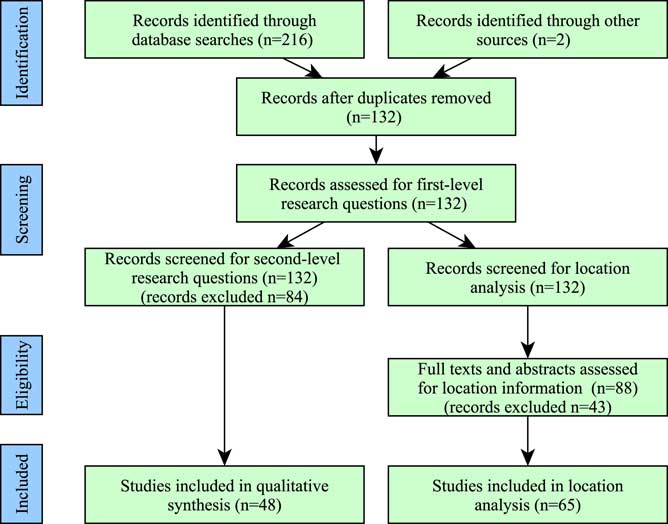
To map renosterveld study locations, we screened the titles and abstracts of all records and rejected those that were not within the CFR and without geographical field sites. To further determine eligibility, we searched the full texts of the resulting records for location data, excluding studies using bird atlas data, historical or archaeological study sites and experimental studies. For every article with geographic information available, we collected study locations and mapped them as accurately as possible to give a broad indication of the spatial distribution of renosterveld studies. Information on fragment size was collected for those studies that intersected with existing fine-grain spatial data of fragments (Von Hase et al. Reference Von Hase, Rouget, Maze and Helme2003).
First-Level Analysis
What Are the Dominant Themes, Locations and Taxa of Renosterveld Research?
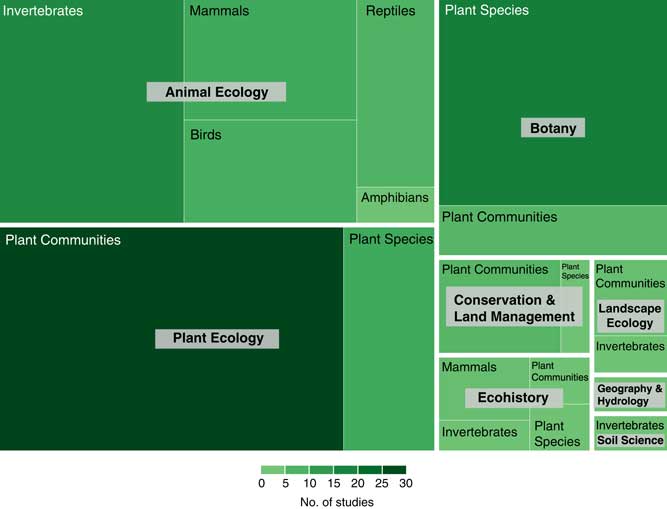
In the 132 articles that were relevant to the synthesis, the most popular research theme was plant ecology (n=35), followed by animal ecology (n=33) and botany (n=20). The majority of articles appeared in the journals South African Journal of Botany (n=20), Biological Conservation (n=7) and Bothalia (n=7); articles were published between 1981 and 2017. The number of publications increased after 2003, peaking in 2011 (n=16).
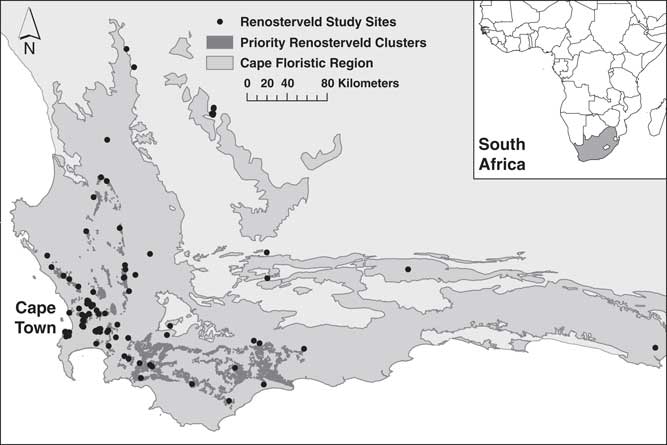
Renosterveld study sites showed a high concentration in the Cape Wineland and Boland municipal districts to the northeast of Cape Town (Fig. 2). Of 136 total mapped locations, 70 were located within 60 km of Cape Town (51%). Coastal renosterveld appears to have been studied more than inland renosterveld and, in west coast renosterveld, clustered in larger fragments on the edges of the Swartland region. There have been fewer studies of the south coast renosterveld, where renosterveld conservation priority clusters are larger and more numerous. Of 65 mapped studies, 44 contained locations in protected areas (67%). Studied fragments ranged from less than 1 ha to 4233 ha in size (mean 393 ha).
Regional distribution of renosterveld studies (n=65) within the Cape Floristic Region that investigated ecological phenomena with field study sites. Priority renosterveld clusters as mapped in the Cape Lowlands Renosterveld Project (Von Hase et al. Reference Von Hase, Rouget, Maze and Helme2003) are shown in dark grey.
The most studied were plant communities (n=38), followed by individual plant species (n=25), together accounting for 48% of all study taxa (Fig. 3). The least studied taxa were reptiles, amphibians and birds (n≤6). Invertebrates were the most highly studied animal taxa from all articles (n=16), although this included three articles from the same study identifying a new type of leafhopper (Theron Reference Theron1984a, Reference Theron1984b, Reference Theron1986). Other invertebrates studied included species of the gall midge, termite, longhorn beetle, springtail, oil-collecting bee, earthworm and pollen wasp. Seven articles studied invertebrates as part of ecological processes (Donaldson et al. Reference Donaldson, Nanni, Zachariades, Kemper and Thompson2002, Pauw Reference Pauw2006, Picker et al. Reference Picker, Hoffman and Leverton2007, O’Farrell et al. Reference O’Farrell, Donaldson and Hoffman2010, Pauw & Hawkins Reference Pauw and Hawkins2011, Leinaas et al. Reference Leinaas, Bengtsson, Janion-Scheepers and Chown2015, Garnas et al. Reference Garnas, Hurley, Slippers, Wingfield and Roux2016). Trophic interactions were studied for plant–pollinator relationships, such as between oil-collecting bees and geophytes (Coryciinae) (Pauw Reference Pauw2006), revealing that fragmentation does not necessarily limit pollinator diversity (Donaldson et al. Reference Donaldson, Nanni, Zachariades, Kemper and Thompson2002). Mammals were studied in relation to fire regime and seed dispersal in dung (Shiponeni & Milton Reference Shiponeni and Milton2006, Kraaij & Novellie Reference Kraaij and Novellie2010), but otherwise not at a community or trophic level. Nine studies considered direct effects of fire on renosterveld ecology and nine focused on the impact of invasive species.
Renosterveld studies grouped by study taxa (labels in top left of boxes) and different research themes (in bold text within central boxes) as a proportion of all studies of taxa (n=101). Thick white dividing lines distinguish between thematic groups. Size of box represents number of studies relative to total. Created using Treemap package, R Software (Tennekes & Ellis Reference Tennekes and Ellis2017).
Second-Level Analysis
Of the 132 articles from our first-level analysis, we found 48 articles to be relevant for our second-level analysis. More of these articles appeared in the journals Biological Conservation (n=7) and the South African Journal of Botany (n=7) than any other journals. These 48 articles were able to provide answers to our second-level research questions.
What Is the State of Fragmentation in Renosterveld?
Renosterveld is a highly fragmented landscape, with only 15% of coastal renosterveld and 3% of West Coast renosterveld remaining (McDowell & Moll Reference McDowell and Moll1992). In the Cape Lowlands region, less than 10% of original lowland renosterveld remains (Von Hase et al. Reference Von Hase, Rouget, Maze and Helme2003). In the Swartland, renosterveld cover changed from 11.23% in 1960 to 2.50% in 2010 (Halpern & Meadows Reference Halpern and Meadows2013). Of four regions of West Coast renosterveld studied by Newton and Knight (Reference Newton and Knight2005a), the Kapokberg region in the Swartland (33’24’54”S; 18’23’53”E) underwent the greatest transformation from 1938 to 2000, losing 47.6% of renosterveld vegetation. The lesser fragmentation observed in the South Coast renosterveld compared to West Coast renosterveld is likely due to its retention for grazing, owing to higher grass cover as a result of greater summer precipitation (Cowling Reference Cowling1984, cited in Kemper et al. Reference Kemper, Cowling, Richardson, Forsyth and McKelly2000). The West Coast renosterveld is not as palatable for grazing and thus has less direct value for agriculture than artificial grasslands. As a consequence, the majority has been transformed to arable land rather than pasture (McDowell & Moll Reference McDowell and Moll1992). Topography is the strongest predictor of patterns of renosterveld loss (Kemper et al. Reference Kemper, Cowling, Richardson, Forsyth and McKelly2000). Remaining fragments exist in areas less suited to agriculture due to steep slopes and rocky soils. Most fragments in the Cape Lowlands region are less than 0.5 ha (Von Hase et al. Reference Von Hase, Rouget, Maze and Helme2003). Nonetheless, renosterveld fragments contain highly localized species and, between fragments, there is very high species turnover (Kemper et al. Reference Kemper, Cowling and Richardson1999, Newton & Knight Reference Newton and Knight2010). Such high heterogeneity of floristic composition among fragments suggests that loss of fragments in plains may lead to higher extinction rates than previously assumed, when larger hillside fragments are those most likely to be conserved (Newton & Knight Reference Newton and Knight2010).
Fragmentation in renosterveld produced more losers than winners. Fragmentation and agricultural intensification have been beneficial for some species such as the blue crane (Anthropoides paradiseus), which favours artificial grassland habitat (McCann et al. Reference McCann, Theron and Morrison2007). However, pollinators have been shown to be negatively impacted (Donaldson et al. Reference Donaldson, Nanni, Zachariades, Kemper and Thompson2002, Pauw Reference Pauw2006), and abundance and species richness of petaloid monocotyledonous plants and ferns show edge effects (Horn et al. Reference Horn, Krug, Newton and Esler2011). Even small renosterveld fragments (<1 ha) may support vegetation that is similar to large fragments (>30 ha) (Kemper et al. Reference Kemper, Cowling and Richardson1999) and do not always experience pollinator deficits (Donaldson et al. Reference Donaldson, Nanni, Zachariades, Kemper and Thompson2002). Other indigenous renosterveld plants, such as Nemesia barbata, did not show any correlation with fragment size or distance (Heelemann et al. Reference Heelemann, Krug, Esler, Poschlod and Reisch2014, Reference Heelemann, Baeuerlein, Krug, Esler, Poschlod and Reisch2015). Black harriers (Circus maurus) were found to be displaced from lowland renosterveld following transformation to cereal agriculture (Curtis et al. Reference Curtis, Simmons and Jenkins2004). In general, severe implications stem from the loss of species diversity from such a unique global biodiversity hotspot due to land transformation drivers (Meadows Reference Meadows1998).
What Are the Principal Imminent and General Threats to Renosterveld?
We identified threats and their frequency from the literature and grouped them according to four major types: socioeconomic (n=29), biological (n=9), climatic (n=3) and attitudinal (n=6). Socioeconomic threats included agricultural expansion for pasture and crops, which was the most commonly identified imminent threat to renosterveld overall (n=18). Other commonly identified socioeconomic threats were urbanization and industrial expansion (n=8), with tungsten mining specifically identified as a more localized threat (Steiner Reference Steiner2011). Invasive plant species such as Port Jackson willow (Acacia saligna) are the principal biological threat to South Africa, occurring particularly where land is already modified, such as road verges and agricultural lands, and their presence could impact rich renosterveld flora that attract visitors to the region (Musil et al. Reference Musil, Milton and Davis2005). The biological threat of alien species converges with poor land management. For example, overgrazing changes the shrub species composition and deteriorates renosterveld (Kemper et al. Reference Kemper, Cowling and Richardson1999), allowing for the spread of invasive species and of hardy pioneer shrubs such as the kraalbos (Galenia africana) (Bengtsson et al. Reference Bengtsson, Janion, Chown and Leinaas2011).
Climate change is associated with serious risk to the entire CFR; for example, certain Proteaceae may lose all bioclimatically suitable range by 2050 (Midgley et al. Reference Midgley, Hannah, Millar, Rutherford and Powrie2002, Reference Midgley, Hannah, Millar, Thuiller and Booth2003), predominantly through the lack of precipitation (Yates et al. Reference Yates, Elith, Latimer, Le Maitre, Midgley, Schurr and West2010). Specific potential impacts of climate change on renosterveld were identified in the literature (n=4), particularly for invertebrates and associated ecosystem functions. For example, termite mounds play an important role in generating renosterveld species diversity and as a food source, and they could be impacted by changing rainfall and vegetation patterns (Picker et al. Reference Picker, Hoffman and Leverton2007). Additionally, the great number of ant-dispersed plant species in the CFR are unlikely to be capable of migrating sufficiently quickly (Cowling et al. Reference Cowling, Pressey, Rouget and Lombard2003, Newton & Knight Reference Newton and Knight2010). Climate change is also linked to fire and drought cycles, key natural drivers of environmental change in renosterveld. We found one study of renosterveld–fynbos diversity baseline data for monitoring climate change impacts conducted on protected land (Agenbag et al. Reference Agenbag, Esler, Midgley and Boucher2008). Although we did not find many very recent papers overall, Curtis et al. (Reference Curtis, Stirton and Muasya2013) state that the most prevalent ongoing threat to renosterveld remains illegal land conversion and poor land management. Despite legislation prohibiting ploughing of virgin soils (Conservation of Agricultural Resources Act 1983, Act 43 and the National Environmental Management Biodiversity Act of 2004), conversion continues to take place in areas outside of formal protection.
What Are the Main Recommendations for Conservation in Renosterveld?
Recommendations for conservation of renosterveld can be grouped into four types: governance and formal protection; farming practices and incentives; renosterveld patch management; and managing perceptions. Formal protection includes the recommendation to increase purchase of renosterveld by government, adding 52% of additional extant habitat to existing reserves and reclassifying quartz shale renosterveld as critically endangered (Curtis et al. Reference Curtis, Stirton and Muasya2013) in order to meet conservation targets established by Cowling et al. (Reference Cowling, Pressey, Rouget and Lombard2003) (Pressey et al. Reference Pressey, Cowling and Rouget2003, Rouget et al. Reference Rouget, Cowling, Lombard, Knight and Kerley2006). Our synthesis showed that large renosterveld fragments are more likely to be conserved legally, whereas in West Coast renosterveld, where fragments are generally smaller than South Coast renosterveld, fragments are largely in private ownership and unprotected (McDowell et al. Reference McDowell, Sparks, Grindley and Moll1989, McDowell & Moll Reference McDowell and Moll1992, Von Hase et al. Reference Von Hase, Rouget, Maze and Helme2003, Reference Von Hase, Rouget and Cowling2010).
Recommendations for improvement of farming practices address both local threats such as overgrazing (e.g., through well-managed grazing regimes) and also include large-scale strategies such as the development of management plans to allow for the coexistence of species in agricultural landscapes (Cowling et al. Reference Cowling, Pierce and Moll1986, McCann et al. Reference McCann, Theron and Morrison2007). Agricultural expansion should take place in areas of former agriculture as opposed to areas of high biodiversity (Fairbanks et al. Reference Fairbanks, Hughes and Turpie2004) in order to achieve the vision of a biodiversity-friendly landscape posited by Giliomee (Reference Giliomee2006). Within renosterveld patches themselves, recommendations include managing for heterogeneity to increase pollinator richness (Donaldson et al. Reference Donaldson, Nanni, Zachariades, Kemper and Thompson2002) and enlarging Swartland shale renosterveld patches to more than 600 m in width to avoid edge effects (Horn et al. Reference Horn, Krug, Newton and Esler2011). Mills et al. (Reference Mills, Birch, Stanway, Huyser, Chisholm, Sirami and Spear2013) advocate for carbon credits as a means of incentivizing farmers to protect marginal agricultural land in renosterveld. In order to manage perceptions and address misconceptions, several authors recommend increased, careful engagement with landowners to enhance understanding of the value of renosterveld (McDowell et al. Reference McDowell, Sparks, Grindley and Moll1989, Giliomee Reference Giliomee2006, Winter et al. Reference Winter, Prozesky and Esler2007).
The Cape Lowlands Renosterveld Conservation Project published a technical report on its conservation planning for renosterveld (Von Hase et al. Reference Von Hase, Rouget, Maze and Helme2003). Principal recommendations included avoiding transformation of all fragments in priority clusters and river corridors. Ecological processes and functions are incorporated into planning through mapping of edaphic interfaces, riverine corridors, upland–lowland interfaces and habitat connectivity. This plan, along with the conservation plan for the CFR (Cowling et al. Reference Cowling, Pressey, Rouget and Lombard2003), represents the most comprehensive conservation assessment of renosterveld ecology to date, with a goal of effective protection by 2020, in line with global Aichi Biodiversity Targets (www.cbd.int/sp/targets), although this is likely to take much longer to implement than originally planned (Von Hase et al. Reference Von Hase, Rouget and Cowling2010).
What Are the Barriers to Conservation of Renosterveld?
The main barrier to conservation has been farmer attitudes to retaining renosterveld, which is not perceived as economically advantageous (McDowell et al. Reference McDowell, Sparks, Grindley and Moll1989, Winter et al. Reference Winter, Esler and Kidd2005, Reference Winter, Prozesky and Esler2007, O’Farrell et al. Reference O’Farrell, Donaldson and Hoffman2009, Von Hase et al. Reference Von Hase, Rouget and Cowling2010). The fact that most vulnerable fragments are in private ownership, albeit protected under national law, limits conservation activity. External ‘structural’ factors, such as financial pressures and government policies, are arguably the most influential factors deciding farmers’ conservation behaviour (Winter et al. Reference Winter, Esler and Kidd2005). A prevailing notion is that financial responsibility for conservation should come from government, and while farmers have welcomed potential incentives, such as assistance with fencing and direct financial assistance, many are sceptical of these incentives being implemented (Winter et al. Reference Winter, Prozesky and Esler2007). Lack of institutional capacity and collaboration between conservation agencies is another barrier to conservation (Cowling et al. Reference Cowling, Pressey, Rouget and Lombard2003). Other barriers include high costs of conservation measures, such as removal of invasive species (Musil et al. Reference Musil, Milton and Davis2005), and the costs and administrative burdens of fire management. Nonetheless, some landowners conduct controlled burns in collaboration with local authorities to reduce fuel load and promote regeneration of renosterveld (S Cousins, Department of Conservation Ecology and Entomology, University of Stellenbosch, pers. comm. 2017).
Other barriers to conservation action include the lack of awareness of the importance of biodiversity (Cowling et al. Reference Cowling, Pressey, Rouget and Lombard2003, Giliomee Reference Giliomee2006). Certain benefits of biodiversity on farmland, such as wild plant potential and biological pest control, are not experienced to a significant degree by farmers (Giliomee Reference Giliomee2006), although the benefit of maintaining ecological processes such as soil formation is acknowledged. Our mapping showed potential for restoration in targeted areas such as the Peninsula Shale renosterveld in Cape Town (Cowan & Anderson Reference Cowan and Anderson2014, Waller et al. Reference Waller, Anderson, Holmes and Newton2015, Reference Waller, Anderson, Holmes and Allsopp2016), but there is a lack of suitable measures for the restoration of degraded renosterveld or the integration of renosterveld with farming practices in the wider landscape (Shiponeni & Milton Reference Shiponeni and Milton2006, Heelemann et al. Reference Heelemann, Krug, Esler, Reisch and Poschlod2012, Reference Heelemann, Krug, Esler, Reisch and Poschlod2013, Fourie Reference Fourie2014). For example, native renosterveld species have been unsuitable as winter cover crops (Fourie Reference Fourie2014), and artificial bird perches have been ineffective at enhancing seed dispersal and establishment in degraded renosterveld (Heelemann et al. Reference Heelemann, Krug, Esler, Reisch and Poschlod2012), thereby limiting the opportunities for farmers to perceive material benefits from retaining renosterveld.
Discussion
Renosterveld research is thematically and geographically biased, with notably less focus than other fragmented ecosystems worldwide, despite higher levels of habitat loss than other biodiversity hotspots (Geri et al. Reference Geri, Amici and Rocchini2010, Sloan et al. Reference Sloan, Jenkins, Joppa, Gaveau and Laurance2014). For example, a rapid search for Mediterranean grasslands in scientific literature databases returned many more studies than we retrieved for renosterveld. Compared to other ecosystems in the CFR, such as mountain fynbos, renosterveld is more likely to be transformed and less likely to be protected, due to its occurrence on lowland fertile soils (Rouget et al. Reference Rouget, Barnett, Cowling, Cumming, Daniels, Timm Hoffman and Manuel2014). We find fragmented knowledge in both an overview of renosterveld studies to date and among the intricacies of renosterveld conservation. We discuss our findings according to our two-level analysis.
Themes, Location and Taxa
Plant ecology and botany are perhaps unsurprisingly the most studied research themes in renosterveld. The geographic clustering of studies in coastal renosterveld, close to Cape Town, and in larger fragments of greater connectivity indicates that ecological knowledge on more isolated, smaller fragments is lacking. At the same time, proximity to urban areas makes these fragments more prone to resource extraction at unsustainable rates (Van Wilgen & McGeoch Reference Van Wilgen and McGeoch2015). Fewer ecological studies have taken place in South Coast renosterveld, despite there being significantly more and larger remaining fragments, suggesting that this region requires additional focus. Renosterveld has the smallest proportion of overall area covered by protected areas of any broad habitat unit in the CFR (Rouget et al. Reference Rouget, Richardson and Cowling2003a). We found that over half of ecological studies have taken place in protected areas, despite the majority of renosterveld falling outside of protected areas. This discrepancy creates gaps in knowledge; for example, all mammal studies in renosterveld took place inside protected areas, indicating that the role of privately owned renosterveld remnants for sustaining mammal populations is unknown.
It appears that research on renosterveld fauna is generally lacking, as no single taxon was studied exhaustively (Von Hase et al. Reference Von Hase, Rouget, Maze and Helme2003, Giliomee Reference Giliomee2006). While invertebrates were the most highly studied fauna in our synthesis, the link between invertebrates and fragmentation in renosterveld is still unclear. Detailed information on the species richness, the distribution, the community composition, the habitat requirements and the patterns of faunal endemism of invertebrates in the CFR are still deficient (Colville et al. Reference Colville, Potts, Bradshaw, Measey, Snijman, Picker and Manning2014).
Given these knowledge gaps, improved understanding of renosterveld-dependent fauna would be a key addition to a revised conservation assessment. To overcome resource limitations in terms of staff, time and money, citizen science can function as a key societal initiative that targets neglected organisms for research (Troudet et al. Reference Troudet, Grandcolas, Blin, Vignes-Lebbe and Legendre2017) and can also target understudied locations, particularly unprotected areas. There are strong citizen science initiatives in the CFR for a wide variety of understudied taxa, such as Lepidoptera, mammals, fungi, Odonata and arachnids (e.g., the Animal Demography Unit Virtual Museum, University of Cape Town, https://vmus.adu.org.za). These initiatives offer a potential ‘way out’ of the problems of a lack of long-term monitoring on multiple small and large fragments, and they address the lack of awareness of biodiversity by engaging communities and landowners. The resulting datasets from such initiatives offer opportunities for future scientific research, conservation and science outreach (Silvertown Reference Silvertown2009, Braschler et al. Reference Braschler, Mahood, Karenyi, Gaston and Chown2010).
Fragmentation, Threats and Recommendations
Renosterveld plant diversity is relatively well understood, and plant diversity can act as a proxy for other taxonomic diversity within the CFR (Kemp & Ellis Reference Kemp and Ellis2017). However, fragmentation studies demonstrate that renosterveld plant species can be highly localized, and therefore one renosterveld fragment cannot act as an ecological proxy for all others (Kemper et al. Reference Kemper, Cowling and Richardson1999). For such a fragmented landscape, renosterveld studies focused on fragmentation are surprisingly few (12% of all articles), and those that quantify and consider the qualities of surrounding land are limited. Both single large and many small fragments have been shown to promote landscape-wide biodiversity across taxa (Rösch et al. Reference Rösch, Tscharntke, Scherber and Batáry2015), which increases the importance of studying individual fragments at a landscape scale. Fire and grazing regimes add complexity to fragmented renosterveld ecology, and threats such as climate change and invasive species are also likely to be interlinked. Given the likelihood of increasing drought and fire occurrence in the face of climatic and human population changes in the CFR, a lack of knowledge regarding functional ecology could impede effective conservation. Thus, ecological studies on the responses of species to these drivers are needed.
Threats to renosterveld are both varied and persistent. Habitat loss is stark, and the current level of loss is uncertain (Rouget et al. Reference Rouget, Barnett, Cowling, Cumming, Daniels, Timm Hoffman and Manuel2014). While agricultural intensification is the most imminent threat, studies documenting the incentives and attitudes behind intensification are dated, and there is little information on policy, governance structures or other socioeconomic factors potentially acting as drivers. South African agricultural policy is set in a complex, shifting, postcolonial context within which biodiversity conservation must be navigated (Crane Reference Crane2006). For renosterveld, arguably the most critically endangered habitat in South Africa (Newton & Knight Reference Newton and Knight2005b), identification of policy tools and appropriately adaptive management strategies are crucial, particularly given diverse ecological drivers and threats. Adaptive management integrated with regional biogeographical knowledge is important for conserving large-scale production landscapes (Kay et al. Reference Kay, Barton, Driscoll, Cunningham, Blanchard, McIntyre and Lindenmayer2016), such as the CFR, wherein the agricultural mosaic must be considered as a significant contributor to the compositional biodiversity of the region (Vrdoljak & Samways Reference Vrdoljak and Samways2014), and management plans must be developed alongside landowners to allow for the coexistence of species in these landscapes (McCann et al. Reference McCann, Theron and Morrison2007).
Landowner perception of lack of utility is one of the most important historical and current factors determining renosterveld conservation failure. We found only one article that explicitly investigated potential ecosystem services of renosterveld (O’Farrell et al. Reference O’Farrell, Donaldson and Hoffman2009), an approach that could address this lack of valuation. Erosion control is a particularly important ecosystem service, given the history in the Western Cape of severe erosion on agricultural lands (Giliomee Reference Giliomee2006). Control measures, such as contours, have been implemented on farmland following the Agricultural Resources Act of 1983. Winter et al. (Reference Winter, Prozesky and Esler2007) found that erosion control was the fourth most important use of renosterveld to farmers in South Coast renosterveld. Our review showed that pollinator networks have been studied to some extent in renosterveld and surrounding agricultural landscapes, although the use of pollination as an ecosystem service is limited, as the monoculture crops grown in the CFR, primarily cereals (73% of land cover) and wine grapes (7% of land cover), do not require pollination by wild pollinators (Crop Estimates Consortium 2017). Fragmentation does not necessarily limit pollinator diversity (Donaldson et al. Reference Donaldson, Nanni, Zachariades, Kemper and Thompson2002), and therefore, as farmers in the CFR potentially diversify in response to market demands and environmental changes, a wider variety of crops in the CFR may allow for a higher perceived value of renosterveld fragments as important pollinator sources. More studies involving direct landowner engagement and addressing farmer valuation of nature could provide collaboratively derived ideas for conservation that, matched with ecological knowledge, could help to meet detailed conservation targets, such as those laid out by Cowling et al. (Reference Cowling, Pressey, Rouget and Lombard2003), particularly as so many remaining fragments are privately owned. The unique and highly complex biological, evolutionary and sociopolitical histories of renosterveld and the CFR contrast with conservation elsewhere, such as in Europe, where political structures differ and tools such as agri-environment schemes are more widespread (Crane Reference Crane2006, Vrdoljak & Samways Reference Vrdoljak and Samways2014). One key limitation is the capacity to attract external conservation investment. However, renosterveld managers may learn from other Mediterranean-type ecosystem hotspots, such as the Californias, where conservation easements target native species and habitats on private, working landscapes (Cox & Underwood Reference Cox and Underwood2011), an approach that is implemented by the Overberg Renosterveld Conservation Trust (ORCT) in South Coast renosterveld, with notable successes (www.overbergrenosterveld.org.za).
Articles focused on renosterveld conservation have not substantially increased since publication of the Cape Lowlands Renosterveld Conservation Plan in 2003, and many articles containing recommendations are already relatively dated (Von Hase et al. Reference Von Hase, Rouget and Cowling2010). We recognize that only mapping scientific literature does not capture all conservation progress, particularly when many land stewardship agreements are informal (Von Hase et al. Reference Von Hase, Rouget and Cowling2010). The loss of some nuance and detail is inevitable in a synthesis; however, we have tried to capture the meaning or principal recommendations of all studies included. Despite comprehensive landscape-scale conservation assessments, conservation approaches are piecemeal, consisting of differently managed protected areas, farmer initiatives and non-governmental organization partnerships, such as the former Biodiversity and Wine initiative (www.sanbi.org/documents/biodiversity-and-wine-initiative-bwi), which are constrained by external funding cycles. While the majority of the CFR falls under the Western Cape administration, policy and planning implementation is complex (Rouget et al. Reference Rouget, Barnett, Cowling, Cumming, Daniels, Timm Hoffman and Manuel2014). Current understanding of landowner attitudes, additional options for conservation and restoration of renosterveld within an adaptive, evidence-based approach remain priorities for future research.
Conclusion
We demonstrated that, to date, renosterveld articles contain thematic, spatial and taxonomic biases. Ecological understanding of the effect of fragmentation on renosterveld is limited and lacks insights from long-term observations. Renosterveld remnants continue to be at risk and conservation targets are not being met (Von Hase et al. Reference Von Hase, Rouget and Cowling2010). The impact of threats on much existing renosterveld is unknown; therefore, continued research efforts are necessary, particularly on smaller, understudied fragments, as is continued, creative engagement with landowners to reshape attitudes towards renosterveld.
The gaps identified in our understanding of renosterveld have implications for the wider comprehension of biodiversity hotspots. Renosterveld exists in a relatively densely populated and highly transformed area of global biological significance, with active citizen science initiatives in place. In contrast, limited ecological understanding of other highly biologically diverse, more sparsely populated regions could impact our capacity to effectively conserve these ecosystems and potential associated ecosystem services. Due to converging land transformation drivers, Mediterranean and grassland ecosystems are considered the most threatened ecoregions in the world (Sala et al. Reference Sala, Chapin, Armesto, Berlow, Bloomfield, Dirzo and Huber-Sanwald2000). Systematic mapping of ecology and conservation knowledge, including threats and barriers to conservation, for these regions and other biodiversity hotspots could similarly identify preferences, gaps and research priorities of value to researchers and conservation practitioners.
Supplementary Material
For supplementary material accompanying this paper, visit www.cambridge.org/core/journals/environmental-conservation
Acknowledgements
We dedicate this work to Stephen Cousins of the Conservation Ecology and Entomology Department, University of Stellenbosch. Stephen shared invaluable insights and his passion for renosterveld with us. We thank Professor Les Underhill of the Animal Demography Unit, University of Cape Town, and Dr David A Edge of the Brenton Blue Trust for their support in this project. We also thank three anonymous reviewers for their constructive comments on earlier drafts of this manuscript.
Financial Support
The study was supported by the German Research Foundation (DFG, LO 2323/1-1).
Conflict of Interest
None.
Ethical Standards
None.




 Open access

