


Introduction
Enterococci are commonly implicated in healthcare-associated infections (HAIs) and approximately 30% of these isolates are vancomycin-resistant enterococci (VRE). Reference Kent, Spicer and Campbell1 Vancomycin resistance is typically mediated by the vanA gene cluster which alters the glycopeptide binding site and is often carried by MGEs that enable inter-strain and inter-species transmission. Reference Hawkins, Medvedeva, Wang, Banaei and Holubar2 Following the emergence of vancomycin resistance in the late 1980s, clonality studies supported the idea that VRE spreads primarily through person-to-person transmission in health-care settings. 3–Reference Fiore, Van Tyne and Gilmore5 For this reason, and to limit the spread of vancomycin resistance, the Hospital Infection Control Practices Advisory Committee recommended contact precautions (single room, gowns, and gloves) for patients with VRE infections in 1995. 3
The effectiveness of contact precautions in preventing vancomycin resistance spread remains debated, with limited high-quality evidence. A robust randomized controlled trial would require 50 clusters or 25 centers per group, making it impractical. Reference Li and Paras6 Consequently, most evidence comes from before-and-after studies, where hospitals discontinuing contact precautions reported no significant increases in VRE infections. Reference Martin, Colaianne and Bridge7 Whole-genome sequencing (WGS) offers a cost-effective adjunct, providing detailed transmission insights without large trials and enabling precise tracking of bacterial spread. Previous studies used short-read WGS to evaluate VRE transmission before and after discontinuing contact precautions. Reference Biehl, Higgins and Stemler8,Reference Eichel, Boutin and Frank9 However, short-read methods may underestimate MGE-mediated resistance spread due to difficulty resolving repetitive regions and linking resistance genes to their carriers. Long-read WGS enables more complete assembly of bacterial and plasmid genomes, allowing precise tracking of MGE-borne resistance and its genomic context. Reference Kamathewatta, Bushell and Young10 We used long-read WGS for a more detailed analysis of the transmission dynamics of the vanA plasmid following discontinuation of contact precautions for VRE bloodstream infections.
Methods
Study population, epidemiologic design, and data collection
This study was conducted at Stanford University Medical Centre, a quaternary referral and transplant center with 800 combined licensed beds. On October 1, 2021, Stanford Health Care discontinued the routine use of contact precautions for patients with VRE infections. Specifically, single-room placement, gowns, and gloves were no longer required for patients with active VRE-positive clinical cultures across the hospital. Colonization was not systematically tracked. We conducted a retrospective, quasi-experimental study integrating classical epidemiologic methods and WGS to assess the impact of contact precaution discontinuation on VRE strain and plasmid transmission. No other hospitalwide infection prevention interventions were introduced or discontinued during the study periods. No VRE outbreaks were identified during either study period.
We included all blood culture isolates yielding E. faecalis or E. faecium from hospitalized adults (≥18 yr) collected during two periods: prediscontinuation (January 1–September 30, 2021) and postdiscontinuation (October 1–December 31, 2021, and January 1–October 31, 2023). We included vancomycin-resistant and-susceptible isolates to capture extensive genomic diversity of circulating Enterococcus faecalis and E. faecium in our hospital. Isolates from 2022 were unavailable, as the clinical microbiology laboratory retains bloodstream infection isolates for one year. We retrospectively collected patient metadata, including demographics, clinical characteristics, and immunocompromised status—defined as active chemotherapy, hematologic malignancy, solid organ transplant, or prednisone ≥20 mg/day (or equivalent). Additional data included vancomycin exposure within the prior three months, culture results, susceptibility profiles, and location tracking across all units available through the electronic medical record, including wards, ICUs, emergency department, operative suites, catheterization and interventional radiology laboratories, and procedural areas. Only radiology units were excluded, as specific imaging locations cannot be automatically extracted from the medical record. Potential transmissions were identified epidemiologically among patients with VRE bacteremia, based on shared-location exposure within seven days before or after the index positive blood culture collection date, consistent with an estimated VRE colonization incubation period of approximately 5–9 days. Reference Bonten, Hayden and Nathan11–Reference Wammes, Voor In ‘T Holt, Klaassen, Vos, Verkaik and Severin13 The study was approved by the Stanford University Institutional Review Board.
Isolate collection, whole-genome sequencing, and genomic analysis
Bloodstream E. faecalis and E. faecium isolates were identified by MALDI-TOF (Bruker Biotyper). Frozen stocks were cultured aerobically for 16 hours in 3 mL brain heart infusion (BHI) broth at 37°C with shaking. A 1:100 subculture was then incubated until reaching OD600 ∼ 1.0. Cell pellets were resuspended in PBS, centrifuged, and stabilized in Zymo DNA/RNA Shield™ before shipment to Plasmidsaurus (Oregon, USA) for long-read sequencing using Oxford Nanopore Technology (ONT) with DNA extraction. For genome assembly and bioinformatics analysis, DNA libraries were sequenced with ONT using the “Standard Bacterial Genome with DNA extraction” protocol. Assemblies were generated by the sequencing provider and assessed for taxonomic accuracy and contiguity (Supplementary Data). Assemblies with more than 20 contigs were excluded. Additional details on isolate collection, library preparation, and sequencing have been published elsewhere. Reference Grieshop, Behr, Bowden, Lin, Molari, Reynolds, Brooks, Doyle, Moore, Rodriguez-Nava, Salinas, Banaei and Bhatt14
Chromosomal and plasmid contigs were classified using geNomad (v1.8.0), a bioinformatics tool combines machine learning with reference-based methods for element identification. Reference Camargo, Roux and Schulz15 Contigs with scores >0.6 (chromosome) or >0.7 (plasmid) were retained; others were excluded due to low classification confidence, often reflecting ambiguous elements such as potential phage or unresolved plasmid sequences. Pairwise chromosomal and plasmid distances were estimated using Mash (v2.3), a tool that rapidly approximates genome-wide similarity. Mash uses MinHash, a probabilistic algorithm that compresses large sequences into representative sketches, enabling fast comparison and clustering of closely related genomes. Reference Ondov, Treangen and Melsted16 To assess genomic relatedness and identify potential strain transmission events, split k-mer analysis (SKA v1.0) was applied pairwise to all chromosomal contigs. Split k-mer analysis identifies shared k-mers across samples separated by a single base and is ideally suited for clinical outbreak tracking. Reference Harris17 A conservative threshold of 20 single-nucleotide polymorphisms (SNPs) was used to define clonal transmission, based on comparisons of isolates from the same patients.
Statistical analysis
Group comparisons were performed using the Mann–Whitney U test for continuous variables. For proportions, the Z-test or Fisher’s exact test was used, as appropriate. A P value of <.05 was considered statistically significant.
Results
Baseline characteristics of the study cohort
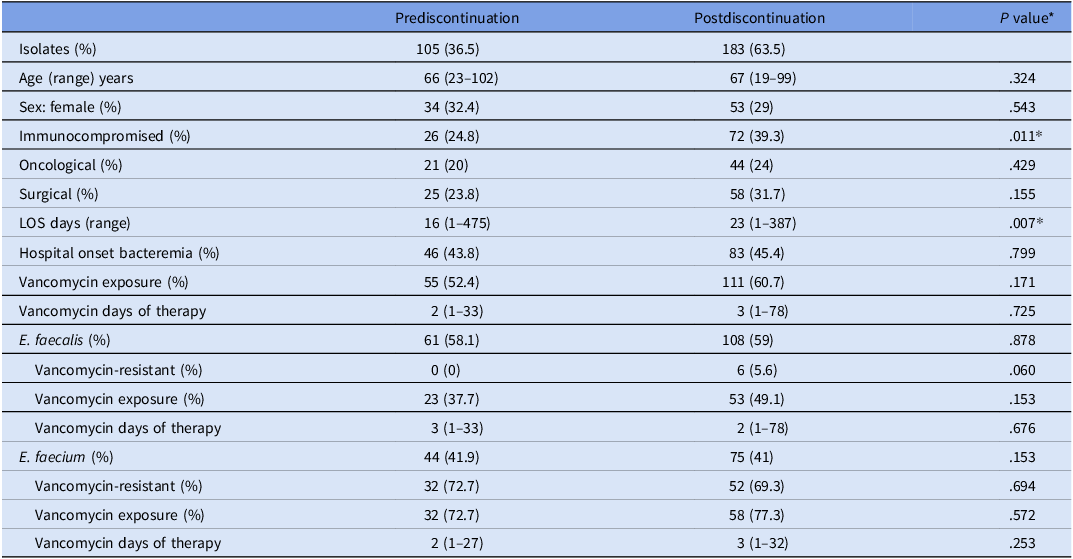
We collected 288 blood culture isolates in total. Of these, 105 (36.2%) were from the prediscontinuation period and 183 (63.8%) from the postdiscontinuation period, representing 202 unique patients. Compared to the prediscontinuation group, the postdiscontinuation group had a higher proportion of immunocompromised patients (24.1% vs 39.1%, P = .007) and a longer length of stay (17 vs 23 d, P = .004). There were no significant differences in age, sex, surgical or oncological status, or hospital-onset bacteremias, defined as onset on day 4 or later of admission. Vancomycin-resistant E. faecalis was more common in the postdiscontinuation group (0% vs 6.4%, P = .044), while vancomycin-resistant E. faecium was not significantly different between pre-and postdiscontinuation groups (72.7% versus 69.3%, P = .392) (Table 1).
Patient characteristics and microbiologic data of patients with Enterococcus bloodstream infection during pre- and post-discontinuation of contact precautions periods—Northern California, 2021–2023

Comparisons between groups were performed using the Mann–Whitney U test for continuous variables and the Z-test for proportions. *p < .05.
LOS, length of stay.
Strain transmission dynamics postdiscontinuation of contact precautions
During the study period, 850 potential encounters were identified where patients specifically with VRE bloodstream infection shared the same unit within the defined ±7 day window period. The most common shared locations were the operating room (324 pairs), transplant step-down unit (192), emergency department (132), general medical ward (64), and surgical ICU (58). After excluding duplicate encounters beyond the initial shared-location event, 25 unique encounter pairs remained. The proportion of potential transmissions based on classical epidemiology was similar before (9.52%, 95% CI: 3.91%–15.14%) and after (8.2%, 95% CI: 4.22%–12.17%) the discontinuation of contact precautions (difference 1.33%, 95% CI: –8.21% to 5.55%; P = .700). In sensitivity analyses extending the shared-location window from ±7 days to ±14 and ±21 days around the index blood culture, the proportion of potential epidemiologic transmissions remained similar or lower postdiscontinuation (±14-day window: 24.8% vs 15.3%, P = .048; ±21-day window: 41.9% vs 22.4%, P < .001), with higher proportions observed in the prediscontinuation period in both analyses.
A total of 266 highly contiguous genome assemblies were generated using long-read WGS, including 168 E. faecalis and 104 E. faecium genomes. Isolates initially identified as Enterococcus but reclassified as non-Enterococcus by sequencing and those failing assembly quality thresholds were excluded. Chromosomal and plasmid contigs were identified using geNomad, and genomic distances were estimated with Mash. These data were paired with metadata on phenotypic vancomycin resistance and vanA plasmid presence. The resulting dendrograms for E. faecium and E. faecalis are shown in Figure 1A,B.
Chromosomal Mash distance clustering of Enterococcus isolates from Stanford Health Care, 2021–2023. All panels display hierarchical clustering of pairwise Mash distances calculated from whole-genome sketches (k-mer 21); branch lengths reflect genetic divergence. In A, E. faecium (n = 104); in B, E. faecalis (n = 168). Beneath each tree, three annotation tracks denote, from top to bottom, timing of obtention relative to discontinuation of contact precautions (Red Oxide = prediscontinuation; Golden Ocher = postdiscontinuation), vancomycin susceptibility phenotype (Ash Gray = susceptible; Dark Khaki = resistant), and vanA plasmid presence (Coral Red = absent; Citrine Yellow = present).

To explore whether putative transmission events of VRE strains increased postdiscontinuation of contact precautions, split k-mer analysis was applied pairwise to all chromosomal contigs to identify SNP sites. The threshold for putative transmission events was derived from within-patient isolate pairs, assuming they represented the same strain, and was set at 20 or fewer SNPs based on split k-mer analysis (Figure 2). Four cross-patient isolate pairs met the genomic threshold suggesting potential strain sharing, fewer than those identified by classical epidemiology: three involved E. faecium and one involved E. faecalis (Figure 2). Among the E. faecium pairs, two were identified postdiscontinuation of contact precautions and both involved VRE isolates. One of these pairs shared a medical ward within the defined window (7 d before or after the index blood culture), while the other had no documented overlap in location. The third E. faecium pair, identified prediscontinuation, included one VRE (with vanA detected but not plasmid-associated) and one non-VRE isolate, and involved shared time in the operating suite. The E. faecalis pair, consisting of two non-VRE isolates, spanned both study periods and had no documented shared location.
Comparison of pairwise chromosomal SNP distances between Enterococcus isolates, Stanford Health Care, 2021–2023. All panels display boxplots of log10(pairwise SNP counts): left, within patient isolate pairs; right, within the same sequence type (ST) across different patients. Boxes show median and interquartile range; whiskers extend to 1.5×IQR and points beyond are outliers. Colors denote species (Golden Brown = E. faecalis; Seafoam Green = E. faecium). The red dashed line indicates 20 SNPs, the cutoff for inferring clonal relatedness (values at or below represent putative transmission events); selected pairings near or below that threshold are annotated.

Plasmid transmission dynamics postdiscontinuation of contact precautions
To assess whether plasmid-borne vancomycin resistance exhibited different transmission patterns than strain-level spread postdiscontinuation of contact precautions, we compared Mash distances among 67 vanA-containing plasmids from 53 patients. Of these, 66 were from E. faecium isolates. Several clusters of related vanA plasmids were identified (Figure 3A), including a dominant cluster of 38 highly related plasmids with Mash distance <0.001 (“low-diversity cluster”). There was no significant difference in the proportion of low-diversity cluster” plasmids identified pre-(14/29, 48.3%) and postdiscontinuation (24/38, 63.2%) of contact precautions (P = .223). We observed a case illustrating potential decoupling of the vanA plasmid and chromosomal evolution (Figure 3B). “Patient A” had five E. faecium isolates collected over 201 days. The last isolate was chromosomally most like isolates from “Patient B” and likely represented colonization by the dominant hospital ST117 E. faecium strain. However, the plasmid remained more closely related to earlier isolates from Patient A,” suggesting plasmid persistence despite chromosomal divergence or possible acquisition of a different strain.
Dynamics of vanA plasmid among VRE blood culture isolates after discontinuation of contact precautions, Stanford Health Care, 2021–2023. Panel A displays hierarchical clustering of pairwise Mash distances calculated from whole-contig sketches for 67 vanA-containing contigs identified as plasmids by geNomad; beneath the dendrogram, two annotation tracks denote, from top to bottom, timing of obtention relative to discontinuation of contact precautions (Red Oxide = prediscontinuation; Golden Ocher = postdiscontinuation) and sequence type (ST) as defined by multilocus sequence typing (MLST, Moss Green = ST117, Pale Aqua = ST80, Teal Blue = other). Panel B illustrates a representative case of chromosomal–plasmid decoupling: Patient A (Turquoise Green) contributed five E. faecium isolates over 201 days (first four ST80; last isolate FM048 was ST117 and chromosomally grouped with Patient B [Chestnut Brown]), while its vanA plasmid remained closely related to Patient A’s earlier samples.

Molecular epidemiology of enterococci postdiscontinuation of contact precautions
Despite no clear evidence of increased patient-to-patient VRE strain or vanA plasmid transmission, we observed more E. faecium isolates of a vancomycin-resistant, vanA-positive sequence type postdiscontinuation of contact precautions (Figure 1A). The E. faecium population was dominated by ST117 (67 of 119 assemblies; Figure 4), which was frequently associated with vanA plasmid carriage and vancomycin resistance. A higher number of ST117 isolates were identified postdiscontinuation of contact precautions, but this was not statistically significant (pre-21/38 vs post-46/66, P = .138). By contrast, E. faecalis displayed more sequence type diversity, with ST179 accounting for 43 of 169 isolates and many falling outside the dominant lineage (Figure 4). Vancomycin resistance in E. faecalis was rare, with four isolates identified postdiscontinuation, only one of which carried a vanA-positive plasmid (Figure 1B).
Distribution of sequence types among E. faecium and E. faecalis blood culture isolates, Stanford Health Care, 2021–2023. Bars show counts by sequence type; Seafoam Green represents E. faecium, Golden Brown represents E. faecalis. “Other” aggregates minor types; “NA” indicates undetermined sequence type.

Among the 68 ST117 isolates, nearly half (n = 28) were collected from two high-risk units: the surgical ICU (n = 14) and a transplant step-down unit (n = 14). Postdiscontinuation isolates (n = 49) were similarly concentrated in these units (surgical ICU, n = 13; transplant step-down unit, n = 11), with additional isolates from a medical ward (n = 4), the oncology-hematology ICU (n = 4), and the cardiothoracic ICU (n = 3). The remaining isolates postdiscontinuation were evenly distributed across units with a high volume of immunocompromised patients.
Discussion
Stopping contact precautions for VRE infections was associated with no significant difference in potential transmission events among patients with bloodstream infections by classical epidemiology. Similarly, there was no increase in clonal transmission events based on bloodstream infection isolates. The proportion of highly related plasmids did not differ before or after discontinuation of contact precautions. However, the postdiscontinuation period was marked by a higher prevalence of the dominant E. faecium ST117 lineage, often carrying highly related vanA-positive plasmids.
Our observations are consistent with prior epidemiologic and genomic studies using short-read WGS that evaluated the impact of contact precautions on clonal VRE transmission. The STAR*ICU randomized controlled trial found no significant decrease in healthcare-associated VRE acquisition after the implementation of weekly screening and expanded use of contact precautions. Reference Huskins, Murray, Walker, Jernigan and Goldmann18 A large quasi-experimental before-and-after study involving over 400 hospitals similarly reported no increase in VRE incidence following discontinuation of contact precautions. Reference Martin, Colaianne and Bridge7 Biehl et al. conducted a multicenter cohort study across hematology-oncology wards in Germany and found confirmed patient-to-patient transmission rates of 9.4% and 5.6% at sites without and with contact precautions, respectively; antimicrobial exposure and host factors had a greater impact on VRE acquisition than contact precautions. Reference Biehl, Higgins and Stemler8 Eichel et al. analyzed vancomycin-resistant E. faecium acquisition in ICUs before and after discontinuation of contact precautions and observed nosocomial transmission in 25% and 3.4% of bacteremia patients before and after discontinuation, respectively. Reference Eichel, Boutin and Frank9 Together, these studies and our own epidemiologic and genomic data suggest that contact precautions may have limited impact in controlling clonal patient-to-patient VRE transmission in acute-care hospitals.
Efforts focused solely on clonal spread may overlook the parallel role of MGEs in sustaining vancomycin resistance. MGEs play a key role in the dissemination and persistence of vancomycin resistance in Enterococcus species. Reference Hegstad, Mikalsen, Coque, Werner and Sundsfjord19 The vanA gene is the dominant determinant in vancomycin-resistant E. faecium and E. faecalis globally. Reference Kent, Spicer and Campbell1,Reference Faron, Ledeboer and Buchan20 This gene is highly mobile, carried on the transposon Tn1546, which is frequently located on plasmids. This enables both transposition between genomic locations and horizontal transmission through plasmid dissemination. Reference Hegstad, Mikalsen, Coque, Werner and Sundsfjord19,Reference Arredondo-Alonso, Top, Corander, Willems and Schürch21 Previous efforts to characterize clonal transmission of vanA-carrying MGEs have relied on short-read WGS. Reference Arredondo-Alonso, Top, Corander, Willems and Schürch21 However, such analyses are limited in reconstructing the nested architecture of resistance dissemination, particularly plasmids circulating across distinct bacterial lineages.
Long-read WGS increasingly enables reconstruction of complete plasmids involved in antimicrobial resistance transmission, including linear plasmids not easily resolved by short-read data alone. Recent reports from Japan have highlighted the role of such plasmids in the dissemination of vanA-mediated vancomycin resistance across multiple Enterococcus spp. Hashimoto et al. described a local outbreak involving E. faecium, E. raffinosus, and E. casseliflavus driven by interspecies transmission of a conjugative linear plasmid (pELF2) carrying vanA. Reference Hashimoto, Kita, Suzuki, Hirakawa, Ohtaki and Tomita22 Similarly, Fujiya et al. reported a prolonged multiclonal outbreak linked to a linear plasmid (pIHVA) that was horizontally transmitted among diverse E. faecium lineages and other Enterococcus spp. Reference Fujiya, Harada and Sugawara23 Both studies used hybrid sequencing approaches, combining short-and long-read data, along with conventional reference-based analyses and pulsed-field gel electrophoresis to characterize resistance spread. While these methods provided valuable insights, they also illustrate the limitations of earlier genomic tools in fully resolving plasmid diversity and transmission dynamics. We used long-read WGS and geNomad, a tool that classifies MGEs using genome architecture and machine learning. Reference Camargo, Roux and Schulz15 This allowed us to reconstruct highly-contiguous plasmid structures and better assess their movement independent of bacterial strains. We found no significant difference in the proportions of highly similar vanA-positive plasmids before and after the discontinuation of contact precautions. Furthermore, as shown in a case from our cohort, we observed the presumed independent horizontal transmission of a vanA plasmid between unrelated E. faecium strains.
Although proportions were not significantly different, we observed a numerically higher number of highly related vanA-positive plasmids following the discontinuation of contact precautions. Direct contact is widely regarded as the main route of transmission of resistant pathogens in acute-care hospitals. Reference Wolfensberger, Clack and Kuster24 While direct contact remains the predominant assumed route of transmission for resistant pathogens in acute-care hospitals, this view may overstate the role of contact precautions in limiting resistance spread, particularly via MGEs. The perceived protection of contact precautions may lead to underestimating alternative transmission routes, including shared equipment, outpatient exposures, or even aerosols. First, portable medical equipment, such as computers on wheels, are frequently touched before patient contact but are not consistently included in standard disinfection practices. Reference Jinadatha, Villamaria and Coppin25 This equipment can serve as a reservoir for resistant bacterial strains and MGEs maintained by pathogenic or non-pathogenic bacteria and potentially transferred to patient microbiota Reference Von Wintersdorff, Penders and Van Niekerk26 Second, ambulatory and outpatient settings remain underrecognized in infection prevention efforts; shared spaces and rapid room turnover increase the likelihood of surface contamination. Reference Siegel, Rhinehart, Jackson and Chiarello27 Pathogens have been isolated from high-touch surfaces in these settings, suggesting that MGEs may also persist in these environments. Reference Cadnum, Pearlmutter and Jencson28 A third possibility involves the role of aerosols in MGE dissemination. Resistant bacterial strains can become aerosolized from sink drains and hospital plumbing systems, Reference Goforth, Boone and Clark29 and MGEs may follow similar routes. Mobile genetic elements can account for up to 65% of extracellular, free-floating DNA in wastewater and have the potential to be transported by aerosols. Reference Calderón-Franco, Van Loosdrecht, Abeel and Weissbrodt30 Their detection in inhalable hospital particulate matter, along with evidence of conjugative transfer, suggests that MGEs may remain viable during aerosol transport and retain the ability to mediate horizontal gene transfer. Reference Zhou, Shuai, Lin, Liu, Zhu and Chen31
Enterococci are widely distributed in nature, capable of behaving as commensals or as opportunistic pathogens, especially in immunocompromised patients. Reference Guzman Prieto, Van Schaik and Rogers32 Both E. faecium and E. faecalis have become globally disseminated nosocomial pathogens. However, E. faecium includes a distinct hospital-adapted subpopulation rarely found outside healthcare settings. This distinction is less clear for E. faecalis, as strains causing infections in hospitals are also common in healthy individuals and animals. Reference Hollenbeck and Rice4,Reference Guzman Prieto, Van Schaik and Rogers32 The majority of hospital-adapted E. faecium clones belong to clonal complex 17. Reference Guzman Prieto, Van Schaik and Rogers32,Reference Mills, Hewlett and Smith33 They are characterized by the acquisition of adaptive genetic elements, including genes for metabolism, biofilm formation, and antibiotic resistance via the vanA gene. Reference Guzman Prieto, Van Schaik and Rogers32,Reference Palmer, Kos and Gilmore34 By contrast, E. faecalis generally lacks these adaptations; its virulence genes largely function as host-adaptive traits suited to a broad range of intestinal niches. Reference Guzman Prieto, Van Schaik and Rogers32 Postdiscontinuation, E. faecium ST117 showed higher prevalence at Stanford Hospital overall, frequently carrying highly related vanA-positive plasmids and vancomycin resistance. By contrast, E. faecalis isolates displayed broader lineage diversity during the study period. E. faecium ST117 belongs to the healthcare-adapted clonal complex 17. Reference Mills, Hewlett and Smith33 This vancomycin-resistant lineage has been emerging globally, displacing earlier healthcare-associated strains due to its competitive advantages. Reference Mills, Hewlett and Smith33,Reference Tedim, Lanza and Manrique35–Reference Hammerum, Karstensen and Roer42 This transition occurred largely after 2020, Reference Mills, Hewlett and Smith33 aligning with its emergence at Stanford University Hospital, although it was also detected in stool samples from bone marrow transplant patients at Stanford as early as 2015. Reference Grieshop, Behr, Bowden, Lin, Molari, Reynolds, Brooks, Doyle, Moore, Rodriguez-Nava, Salinas, Banaei and Bhatt14 This likely reflects both this broader global shift and the higher proportion of immunocompromised patients in the postdiscontinuation period, though a contribution from the discontinuation of contact precautions cannot be entirely excluded.
This study has several limitations. First, we included only bloodstream infection isolates, which underestimates the full burden of VRE colonization and transmission within the hospital but allowed us to explore the impact of discontinuing contact precautions on the most clinically significant transmission events. The absence of systematic colonization screening, such as rectal swabs, limited our ability to detect silent transmission events and may have reduced the sensitivity of our genomic surveillance. However, prior studies using short-read sequencing and evaluating acquisitions through colonization screening and bloodstream infections have not shown a major impact of contact precautions. Reference Biehl, Higgins and Stemler8,Reference Eichel, Boutin and Frank9 Their effect on the silent transmission of MGEs remains to be studied. Second, while we used a conservative 20-SNP threshold informed by within-host comparisons, fixed cutoffs may not fully account for the varying evolutionary rates across Enterococcus lineages. However, this threshold has been used in prior genomic epidemiology studies Reference Sundermann, Rangachar Srinivasa and Mills43 and was additionally supported by empirical distributions observed in our dataset. Third, we lacked data on direct contact, shared healthcare providers, and environmental sources, which limited our ability to attribute transmission pathways with greater precision. Our findings of independent plasmid movement suggest that alternative transmission routes beyond direct patient contact should be further explored. Finally, generalizability may be limited, as our findings reflect the epidemiology of a single institution with a dominant, genomically stable ST117 clade, which may differ from settings with greater strain diversity or differing infection control practices. However, as a quaternary care transplant center, we provide data from a population with a high prevalence of immunocompromised patients, who have an increased burden of Enterococcus infection and are likely underrepresented in prior studies.
In conclusion, discontinuing contact precautions for VRE was not associated with increased enterococci transmission or vanA plasmid spread among bloodstream infection isolates. The postdiscontinuation period was marked by a higher prevalence of an already dominant E. faecium ST117 lineage among bloodstream infection isolates at Stanford Hospital. While vancomycin resistance spread remained limited regardless of contact precautions, the persistence of highly related vanA-positive plasmids, often carried by the hospital-adapted E. faecium ST117 lineage, suggests ongoing dissemination through alternative mechanisms. These findings call for a broader understanding of mobile genetic element transmission, as their mobility enables resistance persistence beyond direct patient contact and traditional inpatient settings.
Supplementary material
The supplementary material for this article can be found at https://doi.org/10.1017/ash.2026.10392.
Data availability statement
Long-read Enterococci genome assemblies generated in this study are available under NCBI BioProject ID PRJNA1236482.
Acknowledgements
None.
Author contributions
GRN: Funding acquisition, Conceptualization, Methodology, Data curation, Formal analysis, Visualization, Writing—Original draft. MPG: Conceptualization, Software, Investigation, Data curation, Resources, Formal analysis, Visualization, Writing—Original draft. AZ: Conceptualization, Writing—Original draft. AB: Software, Investigation, Data Curation, Writing—Review and editing. EM: Data curation, Writing—Review and editing. WT: Data curation, Writing—Review and editing. EPVC: Data curation, Writing—Review and editing. NP: Conceptualization, Writing—Review and editing. NB: Resources, Writing—Review and editing. MS: Supervision, Writing—Review and editing. ASB: Funding acquisition, Conceptualization, Supervision, Resources, Writing—Review and editing. JLS: Funding acquisition, Conceptualization, Methodology, Supervision, Project administration, Visualization, Writing—Original draft.
Financial support
This work was supported by the 2023 Stanford Team Science Seed Grant and by the National Center For Advancing Translational Sciences of the National Institutes of Health under Award Number UM1TR004921.
Competing interests
The authors have no conflicts of interest to declare.


 Open access

