

CLINICAL SCENARIO
A 19-year-old female, university student with a long-standing history of migraine headaches presented to the emergency department (ED) with a 36-hour history of gradual onset of left-sided headache, preceded by visual aura. She stated that her headache was worse than usual and now associated with nausea, vomiting, and photophobia, despite use of oral ibuprofen. On examination, she was afebrile, her SaO2 = 98% on room air, her pulse was 110 beats/minute, and she was breathing 20 breaths/minute. She received a Canadian Triage and Acuity Scale score of 2 due to her pain score of 8/10 on a Visual Analogue Scale (VAS). Her neurological examination was normal and her neck was supple with full range of motion. She was a non-smoker, infrequent cannabis user, and her last menstrual period was normal.
KEY CLINICAL QUESTIONS
- 1.
How do you know a patient has a benign headache? Answer: Benign headaches generally refer to recurrent migraine, cluster, and tension headaches in patients without history or signs of serious headaches
A combination of history and physical examination will confirm the diagnosis of benign headache and eliminate other possible serious conditions. It is important to obtain a full social history because occupation, lifestyle factors (e.g., sleep, diet, substance use [drugs and alcohol]), work and life stress, and mental health issuesReference Fuller-Thomson, Jayanthikumar and Agbeyaka1 can contribute to headache exacerbations. The exposure to air contaminants (e.g., carbon monoxide) should be explored.
- 2.
Which alternative diagnoses should be excluded prior to managing a benign headache? Answer: In adults without a history of headaches, other more serious causes of headache should be considered
Serious headaches are caused by infections (e.g., meningitis, encephalitis), inflammation (e.g., temporal arteritis, vasculitis), cerebrovascular events (e.g., sub-arachnoid [SAH], intracerebral and/or subdural hemorrhages (strokes), and other rare conditions. Older patients with visual changes and eye pain should be assessed for acute angle closure glaucoma. A pattern of headaches worse in the morning and improving throughout the day should trigger investigations for an intracranial tumour while a remote history of trauma should raise the suspicion of a hemorrhage. Overall, the pattern, severity, duration, and relieving factors of headaches can assist clinicians in narrowing the diagnostic possibilities; valid decision support tools (e.g., SAH rules) are available to assist clinicians’ assessment.Reference Perry, Sivilotti and Sutherland2
- 3.
Which patients need further investigations? Answer: Very few; most patients with benign headaches have single-system presentations and laboratory tests, or advanced imaging have limited utility
While other medical conditions (e.g., diabetes mellitus, thyroid disease, hypertension) can co-exist in patients with headaches, exacerbations are usually unrelated to these other chronic conditions. In addition, few people have abnormal examinations or suspicious features (e.g., fever, severe hypertension, visual changes), so advanced brain imaging should not be routinely ordered. Despite this, ED-based studies have demonstrated frequent and increasing head computed tomography (CT) ordering for patients with acute headaches, which delays treatment and dispositions, exposes patients to needless radiation, has the potential to incur additional treatments due to incidental findings, and adds costs to the healthcare system.Reference Berdahl, Vermuen, Larson and Schull3 Advanced imaging modalities should be considered when patients exhibit signs of infection (e.g., fever, stiff neck, no history of recurrent headaches), stroke (e.g., abnormal neurological examination, sudden onset of severe headache), remote history of head injury, or do not respond to usual care. Most international and Choosing Wisely recommendations discourage unnecessary investigations in patients with acute benign headaches.
- 4.
What treatments should emergency physicians consider and avoid? Answer: The treatment of all benign headaches has coalesced in recent years
National and international guidelines on acute headache management exist. With the exception of patients with mild headaches that may resolve with oral non-steroidal anti-inflammatories or over-the-counter analgesics, most patients should receive intravenous (IV) access. Fluid rehydration (10–20 cc/kg), IV metoclopramide, and/or ketorolac are the most common approaches used in Canada.Reference Sumamo Schellenberg, Dryden and Pasichnyk4 Because limited evidence exists to support routine fluid administration in patients with headache, a fluid challenge should be restricted to those who are clinically volume depleted. Combining agents has been shown to be more effective than sequential administration. While effective, the extrapyramidal and akathisia side effects of phenothazines (e.g., prochlorperazine) limit their use. Finally, patients with incomplete resolution of headache may benefit from dihydroergotamine (DHE) and several other “orphan” agents (see Table 1).
Common treatment options for patients with acute benign headaches
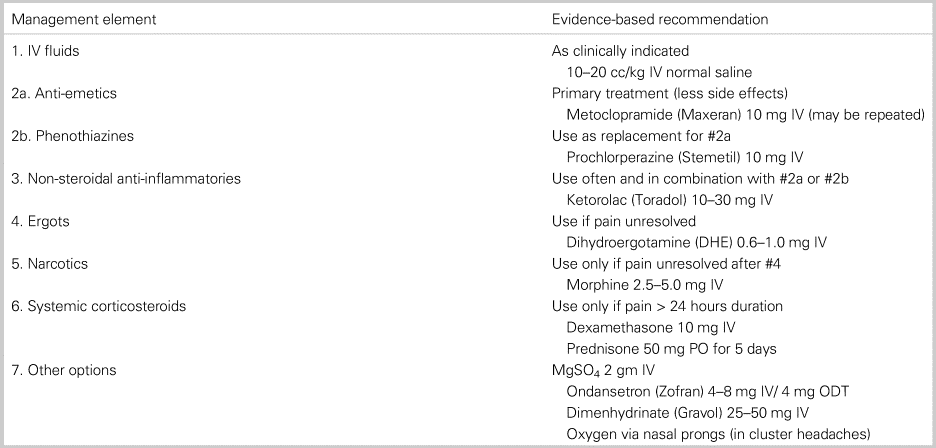
Notes: gm = grams; IV = intravenous; mg = milligram; MgSO4 = magnesium sulphate; ODT = oral dissolving tablet; PO = per os (by mouth).
Narcotics (e.g., meperidine, morphine) have historically been used frequently in Canadian and U.S. EDs. In general, they are less effective than headache-specific treatments, associated with more adverse effects, and contribute to opioid addiction. Opioids should be restricted if used at all.
- 5.
What role do systemic corticosteroids play in treating acute headache and preventing relapse? Answer: Systemic corticosteroids have not shown to improve headache in the ED
Several systematic reviews, however, have demonstrated a reduction in severe headache symptoms and ED revisits when dexamethasone is administered as a single IV dose prior to discharge. The treatment results in an approximately 25% reduction in headache recurrence within 72 hours of ED discharge. Although a wide range of doses has been studied, there is insufficient evidence to recommend more than 10 mg.Reference Sumamo Schellenberg, Dryden and Pasichnyk4,Reference Colman, Friedman and Brown5
- 6.
If corticosteroids are so effective, why not give them to everyone? Answer: Corticosteroids are effective, yet not without side effects
Systemic corticosteroids have serious short-term (i.e., insomnia, hyperglycemia, abdominal pain) and long-term (i.e., osteoporosis, fluid retention, skin changes), adverse events. In order to reduce these, emergency physicians should target this treatment to those patients with the greatest potential benefits. Subgroup exploration in patients with acute migraine headaches suggests that IV dexamethasone should be restricted to those patients with prolonged (> 24 hours) headache, headache scores that do not reach 0–1/10 prior to discharge, and where narcotics are required.Reference Rowe, Colman and Edmonds6
CASE RESOLUTION
This patient received 1 litre of saline, 10 mg of metoclopramide, and 30 mg ketorolac via IV over 1 hour in the ED. Her VAS decreased to 0–1 during that period, and she tolerated oral fluids prior to discharge. No laboratory tests or advanced images were ordered. She was discharged following 10 mg of IV dexamethasone and advised to follow-up with her primary care provider within 7 days, as well as to explore additional strategies for headache trigger management.
KEY POINTS
• Benign headaches are recurrent, common neurological conditions in the ED.
• Most patients with acute benign headaches can be treated symptomatically and discharged from the ED after appropriate care without advanced investigations.
• Attention to evidence-based recommendations for ED care can resolve symptoms and improve short-term outcomes for most patients with a benign headache.
• Pharmacological (e.g., abortive treatments with triptans and other agents) and non-pharmacological (e.g., avoidance of alcohol and other triggers, proper diet and sleep) management is important in preventing return ED visits.
Funding source
Dr. Rowe is supported by the Canadian Institutes of Health Research (CIHR) through the Government of Canada as the Scientific Director of the Institute of Circulatory and Respiratory Health. Dr. Rowe is also the Co-Chair of the Canadian Association of Emergency Physicians (CAEP) Choosing Wisely Working Group. Dr. Villa-Roel is an Adjunct Assistant Professor in the Department of Emergency Medicine, at the University of Alberta. Ms. Krebs is supported by the Partnership for Research and Innovation in the Health System (PRIHS-2) Choosing Wisely Project.
Competing interests
None declared.



