





1. Introduction
Populism is now central to contemporary political discourse, yet the factors associated with its rise and the ways in which it connects to public health problems remain far less understood (Guriev and Papaioannou, Reference Guriev and Papaioannou2022).Footnote 1 Populism is often labelled as a political strategy that contrasts ‘the virtuous people’ against a ‘corrupt elite’, often combined with anti-expert and exclusionary narratives. Yet populism is not bound by one consistent ideology. While left-wing populism typically advocates for expanded social protections, right-wing populism undermines public health through welfare chauvinism and anti-scientific rhetoric. The latter is also often nativist as it combines preferences for ‘natives’, or citizens of the same skin colour (Eichengreen, Reference Eichengreen2018; McKee et al., Reference McKee, Figueras, Kalediene, Joshi, El-Mohandes, Otok, Magaña, Marchandise and Barros2025). For instance, when the COVID-19 outbreak began, Trump labelled it the ‘Chinese virus’ or ‘Kung flu’, stigmatising Asian communities.
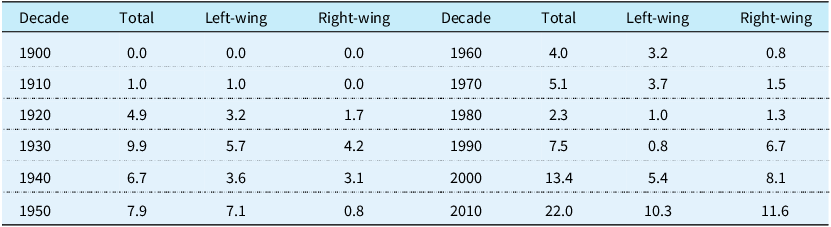
Drawing on data from Funke et al. (Reference Funke, Schularick and Trebesch2023), it is possible to trace the origins of populism (see Table 1). Populism is not a new phenomenon, and it first peaked in the wake of the Great Depression (with populists holding power in some 5–10 per cent of countries) and again after 1990, following the fall of the Berlin Wall. During these swings, one can spot that left-wing populism has generally outperformed right-wing populism. Nonetheless, the recent surge since the 1990s is striking, as not only has the overall prevalence of populism reached unseen levels, with one-fifth of countries ruled by populists, but right-wing populism, once nearly extinguished after World War II, has expanded with force.
Populists in power (in percentages)

The column total displays the percentage of countries (among a 60-country sample) governed by populist leaders in each decade. The other columns distinguish between right-wing versus left-wing populist regimes. Data are from Funke et al. (Reference Funke, Schularick and Trebesch2023).
Against the backdrop of recurring populist cycles throughout history, this article offers a narrative synthesis of historical evidence on the interplay between health crises and populism, offering insights that link past patterns to contemporary risks.Footnote 2 The synthesis focuses on the first wave of populism (from the 1920s to the end of World War II) when right-wing populism gained momentum in contexts of distress following economic downturns, especially when policy responses failed to protect ordinary people. Most of the evidence discussed here comes from Germany and Italy, where mass discontent and worsening health after the Great Depression were frequently associated with increased support for extremist and fascist movements (Eichengreen, Reference Eichengreen2015; Reference Eichengreen2018). But history also shows that this does not have to be the case, and countries that adopted fiscal expansion, such as the U.S. in the 1930s, experienced patterns consistent with greater resilience against populism, faster recovery, and better health outcomes.
As a result, the article reflects a transatlantic focus, emphasising right-wing populism (Table 2 offers an overview of the contributions discussed throughout the article.)Footnote 3 Unfortunately, evidence on how left-wing populist movements respond to health crises remains scarce. This omission is particularly important in the context of Latin American politics starting with the victory of Hipólito Yrigoyen in Argentina in 1916 and continuing with subsequent populists such as Juan Perón in Argentina, Getúlio Vargas in Brazil, and Lázaro Cárdenas in Mexico.Footnote 4 Likewise, the Spanish historiography has not yet addressed how rural poverty intersected with the rise of the Second Republic in the early 1930s (Robledo, Reference Robledo2022). Despite these limitations, below, I provide a historical review of the growing literature explaining how health crises intersected with the rise of right-wing populism. I conclude the article by discussing the parallels between now and then (Section 3).
Overview of the studies

2. The interwar experience
The Great Depression, triggered by the 1929 Wall Street crash, produced an unprecedented collapse in output, trade, and employment (Eichengreen Reference Eichengreen1992; Temin Reference Temin1991). By 1932–1933, unemployment had reached one in four Americans and nearly one in three Germans. In Germany, Heinrich Brüning of the Center Party (Germany’s chancellor between March 1930 and May 1932) responded to the debts stemming from World War I and the economic downturn with severe austerity. His policies combined spending cuts, higher taxes, and reductions in civil service pay. Brüning (commonly known as the ‘Hunger Chancellor’) hoped that visible hardship would generate international sympathy and help end reparations under Versailles, creating room to navigate the Depression. Instead, as simulation models from Ettmeier et al. (Reference Ettmeier, Kriwoluzky, Schularick and Steege2024) show, austerity reduced GDP by more than 4 per cent and raised unemployment by almost 2 million.
Explanations for the Nazi rise are many, but Galofré-Vilà et al. (Reference Galofré-Vilà, Meissner, McKee and Stuckler2021c) show a close connection between these austerity shocks and electoral outcomes (see also Galofré-Vilà, Reference Galofré-Vilà2023a). Controlling for unemployment and output, spending cuts and tax hikes are closely associated with increases in Nazi electoral support, suggesting that, in a counterfactual scenario, these shocks may have provided the margin of support necessary for the Nazi majority in the 1933 election.Footnote 5 About the mechanisms at play, austerity was linked to reductions in health spending and higher mortality, patterns that coincided with stronger Nazi support in the most affected areas. Indeed, after 1931 mortality in Germany surged, something unique among the industrialised nations at that time, yet the effect was not uniform within Germany, and the association between health deterioration and political extremism was weaker in areas that maintained measures of welfare protections (Galofré-Vilà, Reference Galofré-Vilà, McKee, Bor, Meissner and Stuckler2021a).
Anecdotal evidence also suggests that Hitler saw the German suffering as a springboard to power. In their 1932 programme, the Nazis promised ‘fundamental improvements in agriculture in general, multiple years of tax exemption for the settlers, cheap loans and the creation of markets by improving transportation routes and making them less expensive.’ They also pledged to preserve a welfare system weakened by austerity, contrasting their platform with the failures of the existing regime: ‘National Socialism will do all it can to maintain the social insurance system, which has been driven to collapse by the present System’.Footnote 6
Research has further linked the impoverishment of the German society to the Nazi rise (King et al., Reference King, Rosen, Tanner and Wagner2008). For instance, Doerr et al. (Reference Doerr, Gissler, Peydró and Voth2022) show how the collapse of German banks intensified the downturn, reducing incomes and coinciding with increases in radical voting, while Nazi propaganda drew upon and amplified existing anti-Semitic attitudes by blaming Jewish bankers. Brey and Facchini (Reference Brey and Facchini2023) and Albers et al. (Reference Albers, Kersting and Reiske2024) also highlight trade collapse and the late-1920s agricultural crisis, when indebted farmers faced insolvency, turning in large numbers to the Nazis. Finally, Voigtländer and Voth (Reference Voigtländer and Voth2025) also discuss how Hitler’s ‘Autobahn’ programme, launched after Hitler came to power, boosted support and popularity. In part, because this ambitious project signalled the end of austerity and restored national pride.
Paradoxically, the early years of Nazi rule brought a health crisis rather than improvement. Baten and Wagner (Reference Baten and Wagner2003) show that after 1933 autarky policies and rearmament were associated with strained food supplies and reported shortages and rationing even before the war. Consequently, mortality soared, and children displayed stunted growth profiles due to poorer nutrition and the rapid spread of communicable diseases. After 1939, it also ushered in war, opening one of the darkest and most tragic chapters in Europe’s history. This highlights a common pattern in populist governance where promises to help ordinary people were quickly replaced by other goals. In addition to this, Ferguson and Voth (Reference Ferguson and Voth2008) also show that firms that supported the Nazi movement in the early 1930s experienced unusually high returns, outperforming unconnected ones. That is, firms that had ‘bet on Hitler’ benefited substantially later on.
The experience of Weimar Germany contrasts with what happened on the other side of the Atlantic, where policy took a different course. In 1932, Franklin D. Roosevelt campaigned on the promise of a New Deal to Americans. Certainly, Roosevelt cannot be labelled as a populist (he was an elite) but he borrowed elements of populist rhetoric and responded to pressure from figures like Huey Long. His promises to restore the economy and protect health tipped the balance in his favour, and he won the election in 1932 against Herbert Hoover. Once in office, the New Deal was characterised by an ambitious expansion of welfare programmes and public works. Initiatives like the FERA, WPA, or HOLCFootnote 7 provided jobs, prevented foreclosures, and stabilised households. Other measures like the PWA built hospitals and provided immunisations for Americans who could not afford them.Footnote 8
Evidence suggests that the New Deal was associated with substantial improvements in public health and meant the difference between having shelter and falling into homelessness. Stuckler et al. (Reference Stuckler, Meissner, Fishback, Basu and McKee2012) show that changes in mortality during the Depression cannot be explained by economic shocks alone; instead, the New Deal interventions coincided with and were associated with significant reductions in mortality. The authors argue that crises do not automatically translate into mortality spikes, and what matters is the government’s response and the presence of protective policies.Footnote 9 This work was later expanded in Stuckler and Basu (Reference Stuckler and Basu2013), Galofré-Vilà (Reference Galofré-Vilà2023b), and Price Fishback and co-authors (for a review of this literature, see Fishback Reference Fishback2017), showing that expansionary policies were associated with faster recovery and appear to have helped mitigate mortality (see also Fishback et al., Reference Fishback, Haines and Kantor2007; Fishback and Kachanovskaya, Reference Fishback and Kachanovskaya2015).
Indeed, the New Deal did more than provide short-term relief; it reshaped America’s welfare state. The lion’s share of the SSA, that came later, in 1935, was the Old-Age Assistance as basis for a national pension system. At its signing, Roosevelt explained that ‘Old age is at once the most certain, and for many people the most tragic of all hazards. There is no tragedy in growing old, but there is tragedy in growing old without means of support.’ It transformed a patchwork of private and local schemes into a universal framework. Research shows that these social reforms reduced mortality at old age (Balan-Cohen, Reference Balan-Cohen2008; Galofré-Vilà et al., Reference Galofré-Vilà, McKee and Stuckler2021b; Stoian and Fishback, Reference Stoian and Fishback2010) and that other provisions of the SSA, such as Aid to Dependent Children, also coincided with lowered infant mortality and improved maternal health (Galofré-Vilà, Reference Galofré-Vilà2020).Footnote 10
Summing up, Germany and the U.S. in the 1930s pursued markedly different strategies in confronting the worst effects of the Depression, and the German case suggests that imposing too much austerity during a downturn can be associated with a series of unintended political consequences, with truly unpredictable and potentially tragic results. Nonetheless, the contrast should not be taken as deterministic and to imply that American welfare has always been more generous or protective. Germany, after all, had pioneered social protection earlier on with means of support that were both extensive and innovative. In this regard, Kersting (Reference Kersting2025) shows how the implementation of Bismarck’s health insurance in the 1880s boosted electoral support for the socialists while also encouraging a shift toward more reformist labour movements and less radical strikes. Bauernschuster et al. (Reference Bauernschuster, Driva and Hornung2019) also find that the compulsory health insurance introduced in 1884 led to large reductions in mortality.
Indeed, the history of the U.S. also offers episodes where policies were nativist. Most notably, while the New Deal was expansionary and articulated with non-discrimination goals in mind (speaking at Howard University on October 26, 1936, Roosevelt explicitly maintained that ‘Among American citizens, there should be no forgotten men and no forgotten races’), it was administered locally in ways that allowed racial discrimination (especially in the South) leading to unequal access to jobs and wages (see Fishback, Reference Fishback2017). For instance, original eligibility on social benefits excluded many agricultural and domestic workers (jobs disproportionately held by black Americans in the South) and the Federal Housing Administration also avoided insuring mortgages in predominantly black neighbourhoods, institutionalising redlining.
In the Jim Crow South, demagogic leaders and racial populists also kept hospitals segregated and chronically underfunded for Black Americans, leaving large parts of Americans with no healthcare. It is also well-known that between the 1830s and 1850s, under Jacksonian populism, many states repealed licensing laws in the medical profession, dismissing them as elitist monopolies. This opened the door to homeopaths, herbalists, and ‘irregular’ practitioners, creating a free-for-all in medicine. This reform coincided with the proliferation of unproven remedies and evidence suggesting declining quality of care until the germ theory gave new legitimacy to medicine and regulation returned under the Progressive Era. These are less researched topics in economic history but equally important.
History also offers further examples where pro-social policies succeeded in Germany or Italy. After World War II, the Marshall Plan launched Europe’s Golden Age of Capitalism. Using Italian data (Italy ranked as the third-largest beneficiary of the Marshall aid) Galofré-Vilà (Reference Galofre-Vilà2024) shows that beyond economic growth, aid through food and drug relief is estimated to have contributed to reductions in mortality rates. So even if we are to ascribe the most cynical and instrumental motivations to the Marshall Plan (namely, the need for the U.S. to find new markets for trade and promote the Bretton Woods institutions while countering communism), it is evident that the aid was explicitly designed to restore peace and stop the suffering caused by the war. Table 1 also provides a neat picture of over 40 years of almost no right-wing populism during this Golden Age of economic growth.
The corollary seems clear. In difficult times, the interwar evidence suggests that governments that buffer hardship through expansionary social policies tend to experience patterns consistent with faster recovery, fewer avoidable deaths, and greater political stability. By contrast, those tightening fiscal policy during severe downturns have often been associated with worsening public health outcomes and rising political discontent. Nonetheless, the works reviewed here also show that countries, at different times, might take different paths, depending on institutional legacies, external pressures, and political choices. The broader lesson being that crises do not mechanically produce either recovery or collapse; a key factor in determining the outcome is the nature of the government’s response.
The interwar period also encompasses a pandemic (the 1918 Spanish flu), known to have killed 50 million people. Uneven responses from governments are also illustrative of how mass infection can reshape politics. In Italy, Acemoglu et al. (Reference Acemoglu, De Feo, De Luca and Russo2022) and Galofré-Vilà et al. (Reference Galofré-Vilà, McKee, Gómez-León and Stuckler2022) find that cities with higher influenza deaths were more likely to support Mussolini in the early 1920s. Mussolini tended to blame ‘others’ and portrayed himself as the voice of the common people against an out-of-touch ‘elite’. In his speeches, he commented, for example, that ‘Many people have suffered from the grippe, the Spanish grippe, the flu. Many did not succumb to this epidemic evil, but there are many who, although relatively favoured, resent the terror of the evil and it is unknown if they will ever manage to get rid of it properly’.Footnote 11 Germany also offers a close parallel. Blickle (Reference Blickle2020) shows that influenza mortality accounts for a significant share of Nazi votes in 1932 (both elections) and 1933. Propaganda appears to have linked disease narratives with anti-Semitic messaging.
The U.S. experience with the 1918 pandemic contrasts with that of Italy or Germany. Correia et al. (Reference Correia, Luck and Verner2022) show that stringent public health interventions, including closing schools, banning gatherings, and isolating the sick, cut peak mortality by up to half without slowing recovery. In fact, places that acted more aggressively sometimes recovered faster. That is, while the pandemic depressed economic activity across the board, places that proactively fought the virus did not pay an extra-economic price. So, politically speaking, the direct impacts of the pandemic left little trace. Here Abad and Maurer (Reference Abad and Maurer2020) and Achen and Bartels (Reference Achen and Bartels2004) find that influenza deaths in 1918 had no sizeable effect on the 1920 election.
Nonetheless, there is also evidence that the pandemic might have intersected with finance and then politics in complex and indirect ways. Hilt and Rahn (Reference Hilt and Rahn2020) also argue that because in 1918 places highly affected by the pandemic sold fewer Liberty BondsFootnote 12 and since these depreciated under Wilson and gained value under the Republicans, places with high Liberty Bond ownership rates turned against the Democratic Party in the elections of 1920 and 1924, although with small effects at most. Whether or not the 1918 pandemic did affect U.S. politics at the polls, Li and Meissner (Reference Lin and Meissner2021) have documented that its legacy persisted. They find a close correlation between places with high deaths in 1918 and during COVID-19. Rather than weak leadership and health inaction, they list deeper socio-political factors, such as distrust of expertise, lack of cooperation, and limited health capacity.
3. Discussion
As noted in the introduction, the narrative offered here is inevitably incomplete. It reflects where the research is strongest, and it leaves out cases like Britain or France simply because the evidence is thinner. The emphasis on right-wing mobilisation (overlooking left-wing populism in Latin America) further biases the picture of this article. While these biases are real, the narrative synthesis of historical evidence on the interplay between health crises and populism in the inter-war years still yields useful insights, and one lesson stands out.
While past parallels need to be taken as illustrative, not deterministic, the interwar record suggests that perceived mismanagement of health crises is often associated with declining trust in established elites. In interwar Germany and Italy, or more recently in the UK and the US, governments often appeared more concerned with rescuing banks than protecting households. This context may create conditions in which populist movements gain traction by offering genuine ‘change’. For instance, Bor (Reference Bor2017) shows that U.S. counties with stagnant or declining life expectancy were more likely to support Trump in the 2016 election. Fetzer (Reference Fetzer2019) finds a similar dynamic in the UK, where austerity-hit areas swung towards Brexit.Footnote 13
A second pattern is the exploitation of fragile institutions. The Weimar Republic, with proportional representation combined with presidential emergency powers, was shaky from the outset. Its fragility appears to have facilitated the opening the Nazis needed. First a platform, then legitimacy, and finally, unchecked power. On January 6, 2021, the storming of the U.S. Capitol by Trump’s supporters left the world in astonishment, raising questions about the strength of American democracy. Then and now, populist leaders also blame ‘others’ for the local problems. Interwar fascists turned on Jews, portraying them as the source of disease, poverty, and social decay. Today, they follow a similar playbook where immigrants, supranational institutions, and distant bureaucrats are cast as villains. In the 2017 and 2025 elections, Trump railed against Mexican migrants for crime and China for job losses.
Another parallel is the assault on knowledge and anti-scientific bent of right-wing populism. In the 1930s, Nazi ideology dismissed entire branches of science that clashed with its racial obsessions. Nowadays, negationists move from climate change denial to anti-vaccination movements. Recent U.S. policy changes have reduced funding for major health agencies like the WHO and the CDC,Footnote 14 once considered the bedrock of American science and public health. While left-wing populist movements are often associated with modernisation and scientific progress, the historical record also shows some departures. Most salient, the Soviet embrace of Lysenkoism marked by the dismissal of Mendelian genetics led to the persecution of dissenting scientists.
The narrative presented here suggests that health outcomes often function as an early warning system for broader social and political unrest (Ponticelli and Voth, Reference Ponticelli and Voth2020). Periods of declining health or widening health inequalities frequently occurred prior to episodes of political upheaval, suggesting a potential predictive relationship (Stuckler and Basu, Reference Stuckler and Basu2013). This is not accidental, and deteriorating health both reflects underlying social stress and appears to be associated with greater public discontent with established institutions. The data suggest that adverse health trends may reflect underlying societal and institutional fragility. Conversely, improvements in health and the narrowing of disparities can reinforce stability and trust.
Summing up, the past and present reveal a feedback loop between public health and populism. Crises in health, broadly defined to include economic determinants, have often coincided with and may have contributed to right-wing populist mobilisation, while these movements have, in some contexts, been associated with policies that weakened public health systems, compounding future risks. The historical record indicates that addressing the systemic vulnerabilities in health and economic systems may be a factor in mitigating the conditions conducive to populist mobilisation. It is also important to carefully identify the underlying causes, as, for example, the Great Depression was largely characterised by deflation, whereas the recent surge in populism appears to be boosted by inflationary pressures.
Acknowledgements
I would like to thank the editor, Martin McKee, and two anonymous referees for helpful comments.
Financial Support
I acknowledge financial support from the Agencia Estatal de Investigación (AEI) through the PID2024-161780OA-I00 project.
Competing interests
None to declare.


 Open access

