


Introduction
The transformation of the British political economy over the past half century has changed society's cleavage structure (Ford & Jennings, Reference Ford and Jennings2020). The 2016 referendum on the United Kingdom's membership of the European Union (the Brexit vote) exposed a new cleavage through a binary division of ‘Leavers’ and ‘Remainers’ (Evans & Tilley, Reference Evans and Tilley2017). It created new political identities that have entrenched the new cleavage in British politics and remain salient beyond individuals’ positions on Brexit (Hobolt et al., Reference Hobolt, Leeper and Tilley2020). The political science literature has consistently shown that ‘winning’ or ‘losing’ in the context of structural change are strong predictors of one's position on Brexit (Adler & Ansell, Reference Adler and Ansell2020; Colantone & Stanig, Reference Colantone and Stanig2018; Fetzer, Reference Fetzer2019; Hopkin, Reference Hopkin2017; Iversen & Soskice, Reference Iversen and Soskice2019; W. Jennings & Lodge, Reference Jennings and Lodge2019; Lee et al., Reference Lee, Morris and Kemeny2018). However, it is unclear how absolute intergenerational mobility contributes to the structure of this cleavage. In the context of educational expansion and occupational upgrading, a large part of the population moved away from their parents’ positions in society (Bukodi et al., Reference Bukodi, Goldthorpe, Waller and Kuha2015; Buscha & Sturgis, Reference Buscha and Sturgis2018). In most cases, individuals have been upwardly mobile, but a significant minority have experienced downward mobility. Our paper's contribution is to identify how the positions of intergenerationally mobile voters in the Brexit referendum differ from those of their non‐mobile counterparts.
We draw on theoretical and methodological contributions from political sociology that have studied the effect of intergenerational social mobility on political behaviour and voter preferences. A socially mobile individual may (1) relate to their destination position (assimilation); (2) relate to their origin position (socialisation) or (3) the experience of mobility itself could have an effect (mobility effect). This distinction is rarely made in political science where the literature tends to either focus on one's intragenerational experience of gain or loss (Ares, Reference Ares2019; Burgoon et al., Reference Burgoon, Noort, Rooduijn and Underhill2019; Margalit, Reference Margalit2013), or instead highlight the importance of socialisation (Neundorf & Soroka, Reference Neundorf and Soroka2018; O'Grady, Reference O'Grady2019). We thus have two research questions. First, does social origin affect the likelihood of one voting ‘Remain’ in the UK Brexit referendum? Second, does upward (downward) social mobility, over and above origin and destination effects, increase or decrease one's likelihood of voting ‘Remain’ in the UK referendum?
Our empirics confirm the need to differentiate between origins, mobility and destination effects to make sense of how socio‐economic change has transformed the cleavage structure in Britain. It is based on a diagonal reference model (DRM), a model grounded in sociological theory, comparing mobile individuals to the immobile (Sobel, Reference Sobel1981, Reference Sobel1985). The DRM allows us to separate out the effects of one's origins and destination to mobility effects, which is not possible in conventional ordinary least‐squares (OLS) models. We use data from Understanding Society, a large annual panel survey in the United Kingdom, with more than 40,000 households (University of Essex, 2020). We find that the predicted probability of a mobile individual voting ‘Remain’ in the Brexit referendum is substantially different compared to that of non‐mobile individuals. This finding is consistent for both of our measures of absolute intergenerational social mobility: education and occupation. Reaching a high occupational status or high education position via upward mobility, if compared to inheriting this position from one's parents, decreases the likelihood of voting ‘Remain’. Falling to a lower position via downward mobility, compared to having stood still in this destination position, increases the likelihood of voting ‘Remain’. These results are driven by one relating to their origin position, rather than any independent mobility effect. We find that an upwardly mobile university graduate would be 10 percentage points less likely to vote ‘Remain’ than a graduate whose parents also went to university.Footnote 1
The paper is structured as follows. The next section presents the theoretical foundations of our analysis. Next, we describe the data used from the Understanding Society dataset (Data section) and set out the methodological approach (Methodology: Diagonal reference model), followed by outlining the main findings from our analysis (Findings section). In our concluding section, we discuss the implications of these findings for the polarisation in Britain today.
Socioeconomic change and the Brexit cleavage
In the past decades, new cleavages have emerged across Europe. These reflect changes in the composition of the electorate following developments such as the expansion of higher education, mass immigration, increasing size of older cohorts and increasing inequalities of geographical opportunities (Ford & Jennings, Reference Ford and Jennings2020). In the case of Britain, the Brexit vote exposed this new dimension of political conflict, which had been suppressed by the limited choice between partisan policy platforms in prior general elections (Evans & Tilley, Reference Evans and Tilley2017). Crucially, beyond exposing such divisions, Brexit also further entrenched them and thus transformed the political landscape. It created new political identities of ‘Leavers’ and ‘Remainers’, which transcend partisan lines (Hobolt et al., Reference Hobolt, Leeper and Tilley2020).
Socio‐economic changes, which have ‘left‐behind’ an increasing share of citizens, play a central role for explanations of the success of anti‐system movements across advanced capitalist democracies, such as Brexit. Those individuals who have lost out in an era of political economic change are overwhelmingly more likely to vote ‘Leave’. Some studies conceptualise ‘left‐behind’ voters in Britain on the individual level. Individual‐level measures include age, education (Alabrese et al., Reference Alabrese, Becker, Fetzer and Novy2019; Hobolt, Reference Hobolt2016), occupation (Evans & Tilley, Reference Evans and Tilley2017), income (Goodwin & Heath, Reference Goodwin and Heath2016), residential mobility (Lee et al., Reference Lee, Morris and Kemeny2018) and subjective social status (Gidron & Hall, Reference Gidron and Hall2020). Others, instead, see such voters as nested in regions which have been ‘left‐behind’ by processes such as exposure to austerity (Fetzer, Reference Fetzer2019), globalisation (Carreras et al., Reference Carreras, Irepoglu Carreras and Bowler2019; Colantone & Stanig, Reference Colantone and Stanig2018) or housing prices (Adler & Ansell, Reference Adler and Ansell2020). Campaigners for leaving the European Union successfully tapped into the sense of ‘losing out’ (W. Jennings & Lodge, Reference Jennings and Lodge2019). Often disappointment materialised through voters’ authoritarian values (Ballard‐Rosa et al., Reference Ballard‐Rosa, Jensen and Scheve2021), which were particularly prone to the right‐wing populist discourse that underpinned the Brexit project and its campaign.
Occupational and educational positions are important determinants of individuals’ position on Brexit (Evans & Tilley, Reference Evans and Tilley2017; Hobolt, Reference Hobolt2016). However, the literature is less clear in its conceptualisation of the ‘winners’ and the ‘left‐behind’ of occupational upgrading and educational expansion. The role of education has become more prevalent in recent scholarship on preference formation (Abou‐Chadi & Hix, Reference Abou‐Chadi and Hix2021; Gethin et al., Reference Gethin, Martínez‐Toledano and Piketty2021), with skill‐biased technological change altering the returns to education investment, leading to a reconfiguration of welfare support coalitions (Ansell & Gingrich, Reference Ansell, Gingrich, Manow, Palier and Schwander2018; Cavaille & Marshall, Reference Cavaille and Marshall2019; Gelepithis & Giani, Reference Gelepithis and Giani2020; Gingrich & Häusermann, Reference Gingrich and Häusermann2015; Häusermann et al., Reference Häusermann, Kurer and Schwander2015; Marshall, Reference Marshall2016). That said, many individuals have reached their destination position through intergenerational social mobility. As a consequence of socio‐economic change, more than two‐thirds of the population have been occupationally mobile, of which the majority are upwardly mobile (Bukodi et al., Reference Bukodi, Goldthorpe, Waller and Kuha2015; Buscha & Sturgis, Reference Buscha and Sturgis2018).Footnote 2 Over 70 per cent of graduates have been upwardly educationally mobile, that is their parents did not attend university (authors’ calculations, Understanding Society, Wave 8 2016/2017). Whilst both these processes are linked, educational mobility is not perfectly correlated with occupational mobility (see Data section and supplementary material for more details).
Beyond individuals’ socio‐economic destination position, we therefore propose to add a second dimension of variation, which distinguishes between intergenerationally mobile and immobile individuals. Table 1 represents variation on these two dimensions in simple binary terms (high vs low destination status; mobile vs immobile). Amongst the highly educated, some ‘gained’ by reaching the new position via mobility (Group 3 in Table 1), whilst others achieved the same position as their parents (Group 4). In parallel, there are two different groups of ‘left‐behind’ voters, who may have experienced loss in different ways: some have stood still in a low position whilst their peers moved upwards (Group 2), others have moved down the social ladder (Group 1).
Varieties of social mobility in the context of occupational upgrading and educational expansion

Theoretical expectations
Scholarship on the effects of intergenerational mobility on political behaviour provides the basis for our expectations on whether and how intergenerational gains and losses of positions affect the new cleavage in British society. This literature has brought important contributions to political science literature on class voting (Clifford & Heath, Reference Clifford and Heath1993; De Graaf et al., Reference De Graaf, Nieuwbeerta and Heath1995; Nieuwbeerta, Reference Nieuwbeerta2000).Footnote 3 Following Jaime‐Castillo and Marqués‐Perales (Reference Jaime‐Castillo and Marqués‐Perales2019, p. 139), the main message of that scholarship is that ‘mobile individuals are attached to two different social milieus: their origins and destination classes. As a result, they forge their personal views in a different way than those who are born and die in the same social class’. Accordingly, the literature has proposed two main hypotheses: the assimilation hypothesis, where social origin does not, or mostly does not, matter; and the socialisation hypothesis, where social origins may be as important as an individual's destination position.
Political socialisation literature highlights how and why social origins may have long‐term effects on political behaviour, that is, the ‘possible persistence of orientations derived from the impressionable years’ (M. K. Jennings, Reference Jennings2007). Individuals with different social origins vary in their long‐standing attitudes and ideologies that were shaped in their childhood and early years (for an overview see O'Grady, Reference O'Grady2019). Early years’ political socialisation is shaped by education and schooling (Gingrich, Reference Gingrich2019; Holbein, Reference Holbein2017; Holbein et al., Reference Holbein, Hillygus, Lenard, Gibson‐Davis and Hill2020) and childhood social networks including family (M. K. Jennings et al., Reference Jennings, Stoker and Bowers2009; Rico & Jennings, Reference Rico and Jennings2012).
As well as an individual's preferences being conditioned by their origin and destination, the experience of social mobility itself may be important. There are two theoretical approaches to the intergenerational mobility effect. One approach in the literature sees a positive effect of upward mobility on individuals’ well‐being and preference for the status quo, and a corresponding negative effect of downward mobility (Gugushvili, Reference Gugushvili2020; Gugushvili et al., Reference Gugushvili, Zhao and Bukodi2019). Indeed, the upwardly mobile may view their success as an indicator of the meritocratic nature of society, which may underpin their preference for the maintenance of the status quo. The downwardly mobile, in turn, are expected to blame this ‘failure’ on the lack of opportunities in society.
A second approach, the dissociative hypothesis (Sorokin, Reference Sorokin1959), instead leads to expectations of negative effects of either upward or downward mobility. Here, both upward and downward social mobility cause a ‘mental strain’, as individuals are not fully integrated into either their origin or destination class. Upwardly mobile individuals may struggle with the ‘complexities’ of integrating into a new class (Friedman, Reference Friedman2016; Friedman et al., Reference Friedman, O'Brien and McDonald2021). Downwardly mobile individuals, in turn, may struggle to handle their ‘fall from grace’ (Newman, Reference Newman1999). Hence, the literature does not draw a unanimous picture on the social mobility effect.
Two recent strands within political science grapple with related questions. First, the recent ‘loss’ literature closely relates to both the dissociative theory and the role of ‘blame’ effects of downward mobility. Whilst this literature conceptualises changes in individuals’ position over time, it does not explicitly discuss intergenerational mobility. Individuals whose own position or whose group's position in society has declined over time are more likely to support the anti‐system right. ‘Loss’ has been hypothesised to exist in several guises, including declining relative social status (Gidron & Hall, Reference Gidron and Hall2017), perceptions of increased deprivation (Gest et al., Reference Gest, Reny and Mayer2018) and positional deprivation (Burgoon et al., Reference Burgoon, Noort, Rooduijn and Underhill2019). Second, the field of intragenerational mobility analyses how people's preferences change as they move between classes within their working lifetime. Intragenerationally mobile individuals tend to have economic preferences in‐between immobile individuals in their class of origin and immobile individuals in their class of destination (Ares, Reference Ares2019). For example, upwardly mobile individuals become more economically ‘conservative’ (Langsæther et al., Reference Langsæther, Evans and O'Grady2021). The findings of such intragenerational mobility studies are mostly consistent with those of the intergenerational mobility literature. By contrast, the ‘loss’ literature focuses on the impact of decline and its positive association with anti‐system voting (or Brexit ‘Leave’ voting). From that perspective, the extent to which individuals retain the preferences of their (higher) social origins is of secondary importance.
In sum, this discussion allows us to clarify our expectations of how intergenerational social mobility affects individuals’ attitudes towards Brexit. First, we can expect to observe variation in Brexit voting between individuals who have experienced a change in status when compared to their peers who have not moved away from their social origin position. Second, the literature invites us to decompose intergenerational mobility into the origins effect on the one hand, and the mobility effect on the other hand.
If we take Group 3 from Table 1, upwardly mobile individuals with a high‐status destination position, we expect these individuals to strongly identify as ‘winners’ because of their high‐status position. In turn, this group would have a higher tendency to vote ‘Remain’. However, if their social origins matter, they might also identify with the ‘left‐behind’, which can push them towards ‘Leave’. For example, an upwardly mobile individual's social network likely will compose of friends and family from their origin, who have remained in the ‘stand‐still’ group, which could lead to sociotropic preference formation. A second mechanism relates to individuals’ perceptions of their place in society, which is crucial in a political context that frames ‘the establishment’ versus ‘the people’, and can be linked to early years’ political socialisation. Irrespective of political socialisation, those with lower socio‐economic origins may be in a materially different situation than others in their same destination position. They may have fewer family resources to draw upon than their peers, and thus be economically less secure (Friedman & Laurison, Reference Friedman and Laurison2020). Similar mechanisms could apply to downwardly mobile individuals in Group 1 (Table1). They may be more likely to vote ‘Remain’ due to their high origins position, if compared to their immobile peers in a similarly low destination position (Group 2).
Hypothesis 1: An individual's position on Brexit is affected by social origins. Socially mobile individuals from a lower educational (occupational) parental origin are more likely to vote ‘Leave’ than their immobile peers. Socially mobile individuals from higher educational (occupational) parental origins are less likely to vote ‘Leave’ than their immobile peers.
There are no clear expectations on a potential effect of upward mobility. if there is one, it could go in two directions: the upwardly mobile (Group 3) could have enhanced their positive beliefs in a meritocratic society, fostering their acceptance of the status quo. An individual's experience of directly benefiting from positive status change may push them towards ‘Remain’. Alternatively, following the dissociative theory, upward mobility could have a negative effect on their propensity to vote ‘Remain’. They may question whether their investments to move up the rungs of the ladder have paid off, and not see themselves as ‘winners’ of educational expansion or occupational upgrading. Examining the effect of mobility is particularly important for the downwardly mobile (Group 1), as this is the group we could most clearly identify as experiencing negative change, which could lead to the sense of loss that the literature on the ‘left‐behind’ has highlighted. The social mobility literature leads us to a clear expectation that downward mobility increases the propensity to vote ‘Leave’. Downward mobility (Group 1) might enhance negative beliefs in a meritocratic society. The dissociative theory points in the same direction, with the lack of full integration into origin or destination class providing a further sense of loss.
Hypothesis 2: Over and above origin and destination effects, downward mobility will increase the tendency for an individual to vote ‘Leave’ in the EU Referendum.
Hypothesis 3a: Over and above origin and destination effects, upward mobility will increase the tendency for an individual to vote ‘Leave’ in the EU Referendum.
Hypothesis 3b: Over and above origin and destination effects, upward mobility will decrease the tendency for an individual to vote ‘Leave’ in the EU Referendum.
Data
Data are drawn from Understanding Society, a large‐scale household panel survey in the United Kingdom covering members of approximately 40,000 households (University of Essex, 2020). Understanding Society has run since 2009 and is a nationally representative sample survey with all adults (individuals aged 16 and over) interviewed annually. Around 8,000 households were also members of the predecessor study, the British Household Panel Survey (University of Essex, 2020). We utilise information from Wave 8, where data were collected in 2016 and 2017. As described below, we control for the fact that some individuals were surveyed prior to the European Union referendum on 23rd June 2016, and others afterwards. We have included only those aged 28 and over, as young adults below this age may not have reached their highest educational or occupational status. Our results are substantively similar for other choices of age cut‐off.
We capture absolute intergenerational mobility with two measures: educational mobility and occupational class mobility. The need for these two routes of mobility is described in more detail below. The respondent's highest qualification is recorded according to 16 available categories ranging from “Higher Degree” through to GCSEs (a school level qualification typically taken at age 16). The respondent also provides their mother's and father's educational attainment, this time on a 5‐point scale, ranging from not attending school to ‘university degree or higher degree’. We amalgamate the parental qualifications to use the highest of either parent – only including in the sample observations where both the mother's and father's educational attainment is available. Re‐running the models based purely on father's educational attainment or occupational status, where there are fewer missing datapoints, produces substantively similar results. To operationalise occupational class, we use the National Statistics Socio‐economic classification (NS‐SEC) 5‐point scale: 1: Managerial and professional, 2: Intermediate, 3: Small employers and own account, 4: Lower supervisory and technical, 5: Semi‐routine and routine. Again, we take the highest social status parental occupation, which is derived from the respondent's own recollection of their mother's and father's jobs when the respondent was 14 years old.
The stylised social mobility groupings we developed in Table 1 are refined by further dividing the educational and occupation groupings into ‘low’, ‘middle’ and ‘high’ (for both parents and respondents). This grouping keeps our model as simple as possible whilst also allowing a logical categorical breakdown of education and occupation. We categorise highly educated individuals as those with a degree or above (also includes diploma in HE), middle education as any respondent with a school level qualification, and finally, low education as ‘no qualifications’. Similarly, occupational class is ranked from low through high for both respondents and their parents. We categorise high class as NS‐SEC 1, middle class as NS‐SEC 2‐4 and low class as NS‐SEC 5.
To analyse our dependent variable, the Brexit vote in 2016, we use the variable in Understanding Society where respondents answered, ‘Should the United Kingdom remain a member of the European Union or leave the European Union?’ As illustrated in previous work using Understanding Society (Lee et al., Reference Lee, Morris and Kemeny2018), there is an overstatement of ‘Remain’ voting in the sample (59.5 per cent in the educational mobility Models; 57.7 per cent in the occupation mobility Models), compared to the actual result in the EU Referendum (48.1 per cent). Our results use sample weights provided by Understanding Society to make the results representative of the UK population.Footnote 4
Education and occupation as the mobility variable
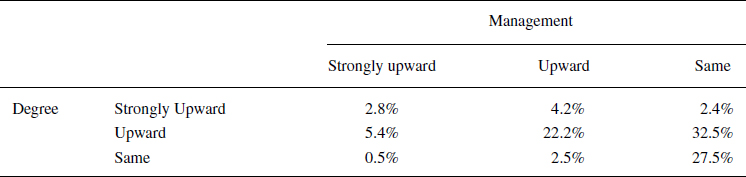
We test our hypotheses in relation to two separate routes of social mobility: occupation and education (see distribution of individuals’ destination positions in Table 2). These two measures are needed because individuals in Britain have experienced intergenerational social mobility in different ways. Educational and occupational mobility often go hand in hand, but there is a significant proportion of the population that has been mobile on one dimension without being mobile on the other dimension. This is the case both for upward and downward mobility. Table 3 illustrates this for individuals in the highest of our socio‐economic position classifications: with a degree and a managerial or professional destination position. 27.5 per cent have inherited their high educational and occupational status from their parents. A small minority, 3.0 per cent, have inherited their high education position but have been upwardly occupationally mobile compared to their parents. 34.9 per cent are first‐generation graduates but are from high status occupational parental backgrounds. 34.6 per cent of individuals have been upwardly mobile on both dimensions.
Percentage of respondents by level of occupation and educational qualification

Note: The sample is all individuals in our educational mobility model.
Social mobility of those with a degree and in a managerial or professional occupation

Note: The sample is all individuals in our model with data available for both occupational and educational mobility. ‘Strongly’ upwardly mobile individuals have a ‘low’ origin position, upwardly mobile individuals have a ‘middling’ origin position.
Similar patterns can be observed in the remaining categories of individuals’ destination positions, that is, in lower levels of education and/or occupational destinations. An extended version of Table 3 is available in the supplementary material. There are some other notable patterns. First, of the educationally upwardly mobile, several individuals have been occupationally immobile or downwardly mobile. Second, there is a significant share of those with a low to intermediate occupation and low to intermediate education who have been educationally immobile but occupationally downwardly mobile. Third, a small but significant minority have been occupationally upwardly mobile whilst their low to intermediate educational status is the same as their parents’.
In summary, educational mobility is not perfectly correlated with occupational mobility and thus the requirement for two separate analyses by education and occupation. This is perhaps not surprising given the mass university expansion in the United Kingdom of the early 1990s. Before this time, it was much more likely to have a managerial or professional occupation without being a graduate. The variation in mobility trajectories will have impacted different age cohorts to various degrees. We address this in our robustness tests at the end of the findings section. Whilst we think separating out mobility by education and occupation is important, it may be that there is a further nuance whereby there is a difference between those who are mobile on both measures compared to just one. We cannot incorporate this into the model below and it represents a potential limitation.
Methodology: Diagonal reference model
To test the effect of social mobility on individuals’ preferences or behaviour, much of the existing literature uses conventional OLS regression. Specifically, there would be three ways in which to account for intergenerational mobility (Schuck & Steiber, Reference Schuck and Steiber2018). First, one could estimate mobility effects while controlling for origin (but not destination). Second, one could control for destination and mobility, excluding origin. Finally, one could include mobility, origin and destination all in one model. The first of these options is possible but conflates the effect of mobility with destination (i.e., own occupation or education levels). Similarly, the second option would not be able to separate out the effects of mobility from origin. Thus, this conventional analysis does not correctly disaggregate destination, origin and mobility effects (Sobel, Reference Sobel1981, Reference Sobel1985). It is not clear whether the effect is from one's origins or the mobility effect of making a transition between education (occupation) levels. These two models are in effect under‐identified. The final option described above is most problematic, based on an overidentified model. Mobility effects are linearly dependent on both origin and destination; they should, therefore, not all be included within one model (Blalock, Reference Blalock1967).
Given the imprecision associated with a conventional model, we use a DRM. We use the DRM to separate out mobility effects from origin and destination without overidentifying the model. This model uses the key reference point as individuals who have been immobile. Those individuals are on the diagonal of a mobility table, with the same educational (occupational) status as their parents. It is a model that compares mobile individuals to only the non‐mobile (Billingsley et al., Reference Billingsley, Drefahl and Ghilagaber2018; van der Waal et al., Reference Waal, Daenekindt and Koster2017). DRMs have been used relatively extensively within social mobility research to overcome the issue of separating out mobility effects from origin and destination (Clifford & Heath, Reference Clifford and Heath1993; Nieuwbeerta, Reference Nieuwbeerta2000). For a thorough overview of the methodological difficulties of approaches other than the DRM see Hendrickx et al. (Reference Hendrickx, De Graaf, Lammers and Ultee1993). The DRM can be specified as follows: $\begin{equation}{Y_{\textit {ijk}}} = {w^ * }{{{\mu}}_{ii}} + {\left( {1 - w} \right)^ * }{{{\mu}}_{\textit {jj}}} + \sum \,{\rm{{\ss}}}\,{x_{\textit {ijk}}} + {e_{\textit {ijk}}}\end{equation}$
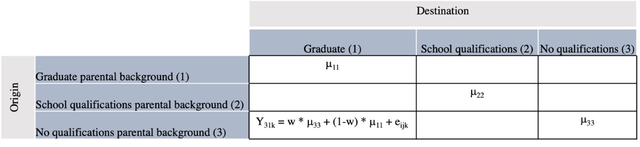
where Yijk is the dependent variable in cell ij of the mobility table of respondent k. Subscripts i and j refer to the position of origin and destination respectively, that is parental education (occupation) and respondent education (occupation). The group of individuals with the same status as their parents, that is, those that are nonmobile, are in the diagonal cells of the mobility table. The DRM compares mobile individuals to the immobile group with the same origin, μii, and the immobile group with the same destination, μjj. It calculates the weighting of origin (w) and destination (1 − w): w and (1 − w) must sum to one. The ∑ ß xijk term allows for the covariates with the model, which are detailed in the following section. The DRM setup is best demonstrated by Figure 1, adapted from van der Waal et al. (Reference Waal, Daenekindt and Koster2017).
Illustration of the origin and destination effects, and weighting parameter within a DRM. [Colour figure can be viewed at wileyonlinelibrary.com]

In our analysis, we run a binary logistic DRM including dummies for upward mobility (up) and downward mobility (down). We calculate a mobility variable separately for occupation and education. The DRM restricts us to study one mobility variable at a time, hence the need to separate out models in terms of educational and occupational mobility. The mobility variable is simply a comparison of the respondent's education (occupation) to their parent's education (occupation). This then can take the form upwardly mobile (i.e., parental education is lower than the respondent's education), inherited (same education) or downwardly mobile (i.e., parent education is higher than the respondent's education). πijk is the probability of voting ‘Remain’ for the kth individual, with educational (occupational) destination j and social origin i. Thus: $\begin{equation}{Y_{\textit {ijk}}} = {\rm{log}}\,({{{\pi}}_{{{\textit {ijk}}}}}/[1 - {{{\pi}}_{\textit {ijk}}}]) = {w^*}{{{\mu}}_{\textit {ii}}} + {\left( {1 - w} \right)^* }{{{\mu}}_{\textit {jj}}} + {{\rm{{\ss}}}_1}{\rm{up}} + {{\rm{{\ss}}}_2}{\rm{down}} + \sum \,{\rm{{\ss}}}\,{x_\textit {{ijk}}} + {e_{\textit {ijk}}}.\end{equation}$
We now wish to explore if there are different effects of origin and destination depending on the level of education (occupation) of the respondent. We can incorporate this by allowing the weight, w, to vary by the destination position. Essentially, this allows the relative salience of origin versus destination to vary between levels of destination status (Zhao & Li Reference Zhao and Li2019). $\begin{eqnarray} {Y_{\textit {ijk}}} &=& {\rm{log}}\,({{{\pi}}_{\textit {ijk}}}/[1 - {{{\pi}}_{\textit {ijk}}}]) = {w_{{\rm{des}}.j}}^*{{{\mu}}_{\textit {ii}}} + {\left( {1 - {w_{{\rm{des}}.j}}} \right)^*}{{{\mu}}_{\textit {jj}}} + {{\rm{{\ss}}}_1}{\rm{up}} + {{\rm{{\ss}}}_2}{\rm{down}}\nonumber\\ && + \sum \,{\rm{{\ss}}}\,{x_{\textit {ijk}}} + {e_{\textit {ijk}}} \end{eqnarray}$
The models are run in STATA using the drm package (Kaiser Reference Kaiser2018).
Control variables
The control variables are included in the ∑ ßxijk term in the formulae above. We control for demographic characteristics, and broadly follow the strategy of similar work on Brexit (for example Lee et al., Reference Lee, Morris and Kemeny2018). Controls include gender, age, age squared and an ethnicity variable. The Understanding Society fieldwork for Wave 8, in which the question on EU membership was asked, was undertaken over a 2‐year period spanning the Brexit vote. To mitigate any influence of the result on one's response to the survey question, we include a dummy to indicate whether the respondent was interviewed prior to, or after 23rd June 2016.Footnote 5
We control for the individual's current occupational class when we are studying educational mobility. Similarly, we control for the respondent's education level in the occupational mobility models. We also provide a version of the models in the supplementary material without occupational (educational) controls when we study educational (occupational) mobility. This is to alleviate any concerns that occupation may be mediating the effect of education. The results in both cases are substantively in line with our main analysis, and we comment further in the robustness test section below. We also have a categorical variable for labour market status, which separates out those who are inactive, unemployed, active, on maternity leave, a student and retired. This is largely redundant given that we have used the NS‐SEC occupational definitions, so the individual should be working. However, it may be that the individual is, for example, also a student. Finally, we include the area of the United Kingdom in which the individual resides given that there are clear differences between regional votes for Brexit. This is at NUTS 1 regional level, that is, Scotland, Northern Ireland, Wales and nine regions of England. A full summary of the descriptive statistics is shown in the supplementary material.Footnote 6
Findings
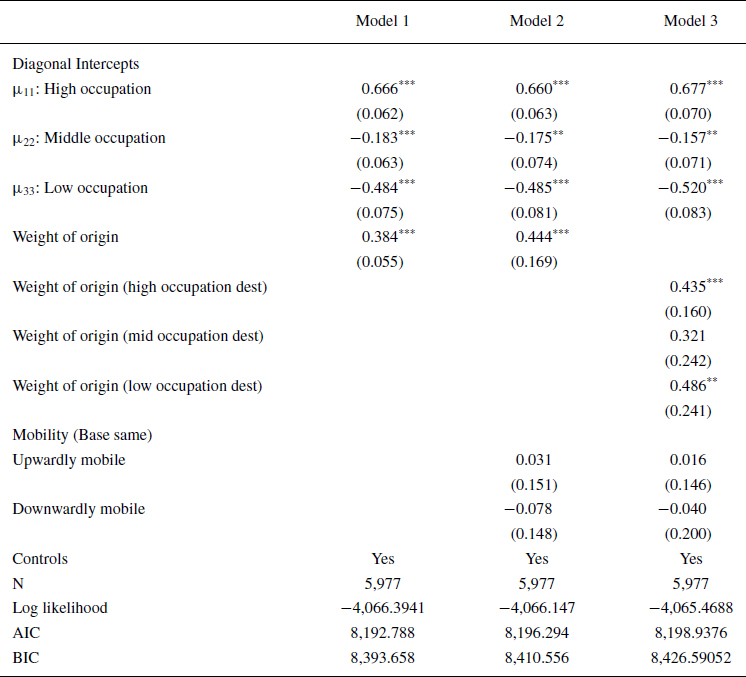
We now produce our DRMs for each dependent variable, separately for educational and occupational mobility. There are three models within each analysis, as explained in detail above. Model 1 is the standard DRM (as outlined in DRM Equation 1 above), including the controls. Model 2 adds upwards and downwards mobility dummies (DRM Equation 2); and Model 3 allows the origin weight to differ by destination position (DRM Equation 3).
Education as the mobility variable
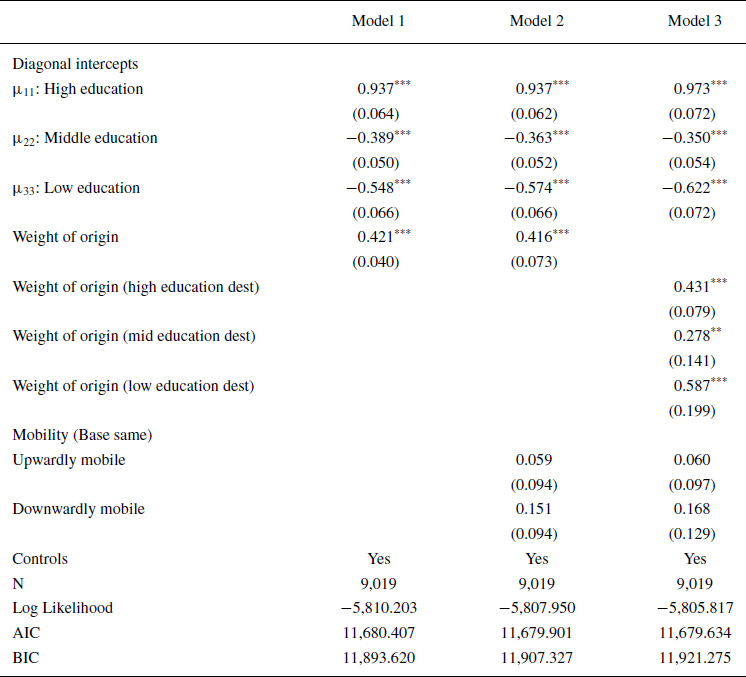
We find that a higher level of education for non‐mobile respondents is associated with an increased probability of voting ‘Remain’ (Table 4). The diagonal intercepts, that is estimated log odds for immobile individuals at each level of educational attainment, decrease as the level of education decreases. In particular, the highly educated immobile group are much more likely to vote ‘Remain’ compared to the middle and low immobile education groups. These diagonal intercepts are the basis for estimating origin and destination effects for those individuals that are mobile.
DRM Binary logistic regression based on educational mobility – ‘Should the United Kingdom remain a member of the European Union or leave the European Union?’ 0. ‘Leave’ EU, 1. ‘Remain’ (coefficients are log odds)

Notes: Unreported controls: age, age2, UK region, sex, ethnicity, occupation, job status, surveyed prior or after referendum. Weighted data. Coefficients are log odds. *p < 0.1;
**p < 0.05;
***p < 0.01.
Across all three models, there is a statistically significant and substantial weighting to one's origins – in fact, the weighting to one's origin is nearly as important as destination. In Model 1 the origin weighting is 0.421 [95 per cent CI: 0.342, 0.500] and in Model 2 it is 0.416 [95 per cent CI: 0.274, 0.558]. When including mobility effects in Model 2, we find no evidence of a statistically significant effect of upward or downward mobility over and above the impact of origin and destination. Model 3 would suggest that the effect of origins is most important for those ending up with a high or low level of educational attainment. For an individual who ends up with a middle education, origin is least important (w = 0.278). However, for all educational destinations, the weight of origin is statistically significant. Thus, the main finding from all three models is that parental origins, measured in terms of education, have a significant and substantial effect on the position individuals took on the Brexit vote. However, there is no statistically significant association of upwards or downwards mobility, over and above origin and destination, with the likelihood of voting ‘Remain’.
In the supplementary material, we also test whether there is a difference of origin weight for individuals who are upwardly mobile compared to those who are downwardly mobile. The weight for the upwardly mobile is marginally higher, albeit this difference is not statistically significant. This also applies when we use occupation as the mobility variable.
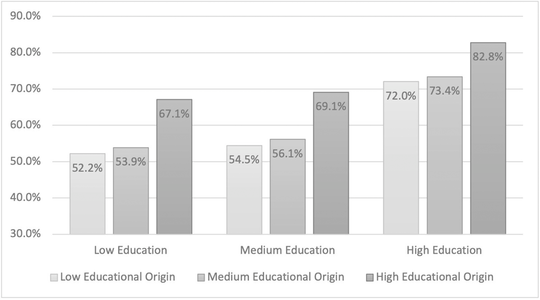
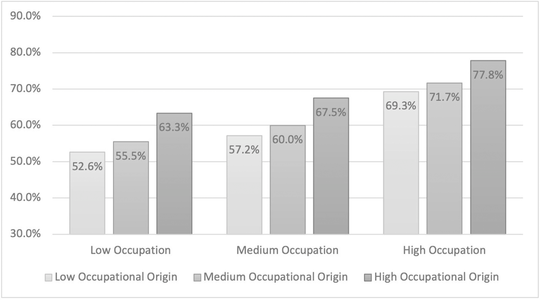
The effects from our models are most clearly illustrated using predicted probabilities. We use Model 1 given that it was the ‘best goodness of fit’ and mobility effects were not significantFootnote 7. Predicted probabilities for all the models are available in the supplementary material, but they are substantively similar. We show predicted probabilities using a hypothetical individual based around choosing a characteristic for each variable in our model. Our example is a 40‐year‐old white English female from the North‐East of England who is active in the labour market with a high‐level occupation. The predicted probabilities for this individual are reproduced in Figure 2. We now discuss how the probability of supporting ‘Remain’ varies by social origin for this hypothetical individual.
Predicted probability of voting ‘Remain’ for our ‘hypothetical individual’ based on educational mobility.

In the case in which our individual is also a graduate and inherited their position (Group 4 in Table1), there is a very high predicted probability that they voted ‘Remain’ in the EU referendum (82.8 per cent). If this individual had instead reached her high education destination via upward social mobility (Group 3), she would be around 10 percentage points less likely to vote ‘Remain’. In the case in which our hypothetical individual has not participated in education beyond her school level qualification, origins are also crucial. There is very little difference as to whether one has the same educational status as their parents (i.e., ‘middle’ – school level qualifications) or has been upwardly mobile from a low educational origin (56.1 per cent vs 54.5 per cent). However, should this hypothetical individual have at least one graduate parent and thus experienced downward mobility (‘fallen down the ladder’ – Group 1), they would be a full thirteen percentage points more likely to vote ‘Remain’. Finally, our hypothetical individual would be the least likely to vote ‘Remain’ should this person have stood still (Group 2) without educational qualifications or educational social mobility.
Occupation as the mobility variable
We now run the same models based on occupation (Table 5). There is a similar dynamic. A higher level of occupational status is associated with an increased probability of voting ‘Remain’. Occupational origin is an important factor, it is of a similar magnitude to our education model. However, compared to the education model, there is less of a difference between immobile individuals from a high occupational category versus a low occupational category (note we control for one's own educational status in this model). When we move to Model 3, allowing weights to vary by destination, we find a similar pattern as in the education model. Origin is least important for those that end up in the middle. We do not find statistically significant mobility effects over and above those effects of origin and destination.
DRM binary logistic regression based on occupational mobility – ‘Should the United Kingdom remain a member of the European Union or leave the European Union?’ 0. ‘Leave’, EU 1. ‘Remain’ (coefficients are log odds)

Notes: Unreported controls: age, age2, UK region, sex, ethnicity, education, job status, surveyed prior or after referendum. Weighted data. Coefficients are log odds. *p < 0.1;
**p < 0.05;
***p < 0.01.
According to all the measures of ‘goodness of fit’, Model 1 is the best. This again reiterates our lack of confidence in additional mobility effects. We thus use predicted probabilities based on Model 1. In substance, the predicted probabilities are very similar across models (see supplementary material).
We provide predicted probabilities for our hypothetical individual, a 40‐year‐old white English female from the North‐East of England who is active in the labour market (Figure 3). We now keep a high level of education constant and examine variation in occupational origin and destination. One's occupation is important but so are one's origins. ‘Inherited high position’ (Group 4) individuals, those with high occupations and parents within the same class, are more likely to vote ‘Remain’ than those who have achieved their position through upward social mobility – ‘climbed up the ladder’ (Group 3). Should this hypothetical individual have been downwardly mobile into the middle or low occupations, there is an origin effect, and they are more likely to vote ‘Remain’ than an immobile individual. However, there is a limited differential if one maintains their occupational class in the middle compared to those who have made the jump from a low to middle occupation.
Predicted probability of voting ‘Remain’ for our ‘hypothetical individual’ based on occupational mobility.

Model extensions
Age effects
The literature posits that the effects of origin may become less important with age (De Graaf et al., Reference De Graaf, Nieuwbeerta and Heath1995; Jaime‐Castillo & Marqués‐Perales, Reference Jaime‐Castillo and Marqués‐Perales2019). Intuitively, as one spends more time in their destination class, one may increasingly share preferences with that class. Additionally, as we discussed in the data section, age might also matter for the effects of social mobility via the cohort effect. On that basis, it may be too much of a simplification to consider the immobile young as the same as the immobile old. Similarly, mobility experience may be important with reference to one's cohort's achievement.
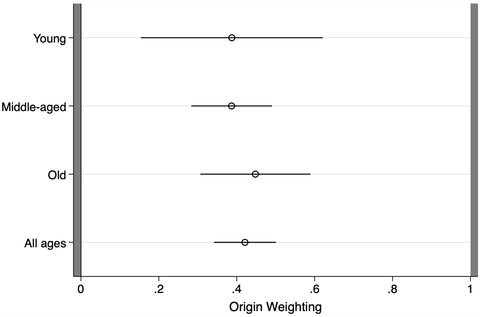
To understand how age might affect our models, we conduct the following robustness test. We produce three DRMs based on educational mobility, for the young (35 years‐old or younger), the middle‐aged (36 to 55 years‐old) and the old (over 55‐years‐old). Other age categorisations for the ‘young’, ‘middle’ and ‘old’ do not impact the results meaningfully. Moreover, these age bands approximate to the times of significant educational and occupational expansion to which we have previously referred. For example, the ‘young’ group would have participated in the mass university expansion of the 1990s and 2000s. The full results are reported in the supplementary material. We do not find statistically significant mobility effects, over and above the effects of origin and destination, in any of the three models. The immobile groups are similar for the ‘young’, ‘middle’ and ‘old’. If anything, there is more of a disparity between the three groups of immobile individuals for the ‘old’ compared to the other two groups. This is not surprising given that the university educated are a smaller group for the oldest age group, forming more of an elite. The coefficients of the origin weights are plotted below, along with the estimate of origin from the main analysis above (Figure 4). There is no statistically significant difference between the three age groups. The point estimates would suggest that origins are most important for the old. Whilst the nuances from this analysis may be interesting, we believe the similarities justify the pooled analysis in the main section of this paper.
Origin effects based on educational mobility by age group.
Note: Unlike the main analysis, the young also includes those aged between 23 and 27.

The supplementary material also provides an alternative version of this age analysis. We interact the ‘young’, ‘middle’ and ‘old’ age categories with the origin weight. In this case, the diagonal intercepts, that is, the means of the immobile groups, remain the same for all ages. Once again, the interaction term is not statistically significant for any of the age groups, thus, justifying the pooled analysis by age groups. Both of the above analyses are replicated for occupational mobility within the supplementary material.
Education/occupation as potentially mediating variables
The supplementary material presents models without occupational controls in the educational mobility analysis and, correspondingly, without educational controls in the occupational mobility analysis. This robustness test is added because it may be argued that occupation (education) mediates the effects of education (occupation) on Brexit voting and thus it should not be included in the model (Angrist & Pischke, Reference Angrist and Pischke2009). Second, this increases the number of observations as, for example, some individuals may be missing data on their occupational status and thus omitted from the educational mobility model. The results are substantively similar across both educational and occupational mobility models. However, upward mobility is now associated with a higher tendency to vote ‘Remain’ in the education model, but it is only weakly significant (p = 0.063). Whilst we do not think this is enough evidence to definitively claim there are upward mobility effects, we call for additional research into this potential mobility effect with different datasets.
Discussion
Our findings confirm that intergenerational educational and occupational mobility have strong political consequences, affecting individuals’ Brexit voting. Those individuals that are in the top socio‐economic position, defined either by education or occupation, need to be more finely categorised by whether they have been socially mobile. Individuals who ‘reached’ their new position ‘thanks to’ upward mobility (Group 3 from Table 1, theory section) are still different from those who already had ‘inherited’ such a position (Group 4). They are more likely to vote ‘Leave’. Our work further entrenches the idea that those ‘standing still’ have been ‘left‐behind’ (Group 2), considering that even those who incurred a clear loss over time (the downwardly mobile—Group 1) in the same position are more likely to vote ‘Remain’.
These results are driven by a substantial effect of individuals’ socio‐economic origins (hypothesis 1), rather than any direct mobility effect (hypotheses 2 and 3). The weighting for origin in the educational model is 0.421 [95 per cent CI: 0.342, 0.500]. This shows a substantial origin effect and in fact we cannot be confident that destination is more influential than educational origins. Our findings are in line with the expectations we derived from intergenerational social mobility (Clifford & Heath, Reference Clifford and Heath1993; De Graaf et al., Reference De Graaf, Nieuwbeerta and Heath1995; Piketty, Reference Piketty1995), intragenerational mobility (Ares, Reference Ares2019; Langsæther et al., Reference Langsæther, Evans and O'Grady2021) and political socialisation research (Neundorf et al., Reference Neundorf, Smets and García‐Albacete2013; O'Grady, Reference O'Grady2019). Individuals’ attachment to the social milieu in which they grew up plays a role on where they position themselves on the Brexit divide. This finding showcases the need to disentangle origins and mobility effects to analyse whether the gains and losses, connected with intergenerational mobility in the context of educational expansion and occupational upgrading, have impacted the Brexit vote.
Whilst our findings resonate with the existing intergenerational and intra‐generational mobility literature, there is a contrast to work highlighting declining, or ‘loss’ of, position (Burgoon et al., Reference Burgoon, Noort, Rooduijn and Underhill2019; Gest et al., Reference Gest, Reny and Mayer2018; Gidron & Hall, Reference Gidron and Hall2017). Our findings confirm the expectation that those with lower status will have a higher tendency to vote for Brexit. However, in our findings, those downwardly mobile individuals retain part of their preferences in line with their social origins. This contrasts to the hypothesis that a decline in subjective social status, or socio‐economic position more generally, results in a higher tendency to vote ‘Leave’. That said, mobile individuals may well see their subjective social status, their place in society, as more than just a function of education and occupation. In line with our empirics, one's perception of class is a fuzzy concept going well beyond current status (Friedman et al., Reference Friedman, O'Brien and McDonald2021).
Our work highlights the need to challenge previous assumptions about the ‘winners’ as one homogenous group. The findings confirm the role of education for individuals’ position on social cleavages and add a piece to this puzzle: the education effect persists over generations, as the group of graduates with highly educated origins differ in their attitudes towards Brexit from their first‐generation graduate peers. Thus, our findings feed into the research on the preferences and partisan identities of university graduates (Ansell & Gingrich, Reference Ansell, Gingrich, Manow, Palier and Schwander2018; Gelepithis & Giani, Reference Gelepithis and Giani2020; Gingrich & Häusermann, Reference Gingrich and Häusermann2015; Häusermann et al., Reference Häusermann, Kurer and Schwander2015). In particular, our findings lend support to Ansell and Gingrich's (Reference Ansell, Gingrich, Manow, Palier and Schwander2018) expectation that heterogeneity between graduates may make it difficult to bind cross‐class coalitions.
In summary, individuals’ social mobility is an underappreciated variable for understanding the new cleavage structure of British politics. At the level of the individual, it is too simplistic to define graduates as ‘winners’ and theorise their preferences on this basis. Moreover, the immobile ‘left‐behind’ are the group that behaves most strongly in line with the existing literature on the ‘left‐behind’. Analysis needs to be more nuanced and consider preferences based on socio‐economic status, origins and mobility in attaining that position.
The extent to which our findings on social origins can be generalised to other anti‐system movements requires further empirical work. The importance of occupational and educational mobility may be specific to British voters given the centrality of the ‘aspirational society’ in forging a cross‐class coalition in British politics (Andersson, Reference Andersson2010). Moreover, our work has identified an important association between origin position and likelihood of Brexit voting, but is limited to identifying this association and leaves the question of mechanisms open theoretically and empirically. Specifically, our theory section suggested three possible mechanisms for this effect: one's social networks, early years’ political socialisation of ‘the establishment’ against ‘the people’, and variation in resources from the parent generation. With this finding, we thus call for a research agenda to develop and empirically test explanations of the role of social origins in the current electorate's cleavage structure.
Acknowledgement
Previous versions of this paper were presented at the UCL's Institute of Education and the LSE. We would like to thank Dan Berliner, Jane Gingrich, Joe Greenwood‐Hau, Bob Hancké, Jonathan Hopkin, Neil Lee, Mariely Lopez‐Santana, David Soskice, and two anonymous reviewers for helpful feedback and comments. All errors remain our own.




 Open access

