Book contents
- Frontmatter
- Introduction
- FROM EUROPEAN IMAGININGS OF AUSTRALIA TO THE END OF THE COLONIAL PERIOD
- FROM THE LATE NINETEENTH CENTURY TO 1950
- TRAVERSES
- FROM 1950 TO NEARLY NOW
- 17 Publishing, patronage and cultural politics: Institutional changes in the field of Australian literature from 1950
- 18 Theatre from 1950
- 19 The short story since 1950
- 20 Scribbling on the fringes: Post-1950 Australian poetry
- 21 Groups and mavericks
- 22 The challenge of the novel: Australian fiction since 1950
- 23 The novel, the implicated reader and Australian literary cultures, 1950–2008
- 24 Nation, literature, location
- Select bibliography
- Index
- References
18 - Theatre from 1950
from FROM 1950 TO NEARLY NOW
Published online by Cambridge University Press: 28 May 2011
Edited by

Book contents
- Frontmatter
- Introduction
- FROM EUROPEAN IMAGININGS OF AUSTRALIA TO THE END OF THE COLONIAL PERIOD
- FROM THE LATE NINETEENTH CENTURY TO 1950
- TRAVERSES
- FROM 1950 TO NEARLY NOW
- 17 Publishing, patronage and cultural politics: Institutional changes in the field of Australian literature from 1950
- 18 Theatre from 1950
- 19 The short story since 1950
- 20 Scribbling on the fringes: Post-1950 Australian poetry
- 21 Groups and mavericks
- 22 The challenge of the novel: Australian fiction since 1950
- 23 The novel, the implicated reader and Australian literary cultures, 1950–2008
- 24 Nation, literature, location
- Select bibliography
- Index
- References
Summary
At the half-way point of the century, theatre in Australia had seen the reversal of patterns of theatre-making and theatregoing brought about by two world wars and was caught up in the post-war idealism that art, culture and self-expression could be ministers in the evangelical movement for world peace.
At that time there were two dominating forces. The commercial theatre of J. C. Williamson Ltd, established in 1876 by an American actor–manager, was owner of enough theatrical real estate to make it the largest touring circuit in the world. The Williamson empire was based on the canny acquisition of rights to the Gilbert and Sullivan operas, and from the 1920s had been run by the five enterprising Tait brothers who presented American musicals, Viennese operetta, pantomime and English comedy. The work was uniformly a reproduction of the overseas original; the stars were almost always imported. Other entrepreneurs did regular business with JCW (or the Firm, as it was known) and Australia was well served by a round of entertainment of a high, if not particularly creative, standard.
Meanwhile, the more serious sector of Australian society, inspired by the Irish and English repertoire movements, had since 1907 sought social and intellectual improvement by establishing an amateur theatre, peopled mostly by the professional and business classes, the Catholic Church and the universities. During the Great Depression many actors, thrown out of work by the mass closure of live theatres in favour of the cinema, established drama, dance and elocution studios, which by degrees converted into small theatres.
Information
- Type
- Chapter
- Information
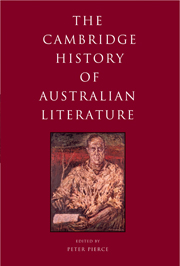
- The Cambridge History of Australian Literature , pp. 391 - 418Publisher: Cambridge University PressPrint publication year: 2009
References
(ed.), The Cambridge Companion to Australian Literature, Cambridge University Press, 2000.CrossRefGoogle Scholar
, ‘For Some Serious R&R’ (Philip Parsons Memorial Lecture), 2 Dec. 1996.
Accessibility standard: Unknown
Why this information is here
This section outlines the accessibility features of this content - including support for screen readers, full keyboard navigation and high-contrast display options. This may not be relevant for you.Accessibility Information
Accessibility compliance for the PDF of this chapter is currently unknown
and may be updated in the future.