


A Timeline of Nineteenth-Century Asylum Periodicals Identified to Date1
- 1835–1836
- 1836–1837?
- 1837
- 1842
- 1843
‘The Illuminator’, Pennsylvania Hospital for the Insane, Philadelphia, PA
- 1842–1846
Asylum Journal, Vermont State Asylum for the Insane, Brattleboro, VT
- 1844–1937
- 1845
- 1845–1974
- 1846
- 1851–1860
- 1851
The Entertainer, Pennsylvania Hospital for the Insane, Philadelphia, PA
- 1853
‘The Gartnavel Gazette’, Glasgow Royal Asylum, Scotland
- 1853–1854
- 1854
- 1855
The Gartnavel Gazette (new series), Glasgow Royal Asylum, Scotland
- 1857–1878
- 1861–1877
- 1865
La Razón de la sin Razón, San Baudilio del Llobregat Hospital, Catalonia, Spain
- 1860s
Le Glaneur de Madopolis, Charenton, Saint-Maurice, Val-de-Marne, France
- 1871
- 1872–1907
Diario dell’ ospizio di San Benedetto in Pesaro (renamed Diario del San Benedetto in Pesaro in 1880), San Benedetto Hospital, Pesaro, Italy
- 1872–1883?
- 1872
- 1872–1874
The Friend, Pennsylvania State Lunatic Hospital, Harrisburg, PA
- 1875–1880
- 1879–1881
La Razón de la sin Razón (new series), San Baudilio del Llobregat Hospital, Catalonia, Spain
- 1882
The Moon, New York City Asylum for the Insane, Wards Island, New York City, NY
- 1882
The Gartnavel Gazette (Christmas edition), Glasgow Royal Asylum, Scotland
- 1887–1904
Sunnyside Chronicle, Royal Lunatic Asylum, Infirmary, and Dispensary of Montrose, Scotland
- 1888–1889?
St Andrew’s Review, St Andrew’s Hospital, Northampshire, England
- 1889–1890?
‘Under the Dome’, Bethlem Royal Hospital, England
- 1889?
‘Above the Dome’, Bethlem Royal Hospital, England
- 1890–1896?
The Conglomerate, Middletown State Homeopathic Hospital, Middletown, NY
- 1891–1897?
Lancaster Argus, Provincial Lunatic Asylum of St John, New Brunswick, Canada
- 1891–1899?
The Fort England Mirror, Grahamstown Lunatic Asylum, South Africa
- 1891–1918
Excelsior (new series), James Murray Royal Asylum, Perth, Scotland
- 1892–1930
- 1893
- 1894–1897
St Ann’s Magazine, Holloway Sanatorium, Virginia Water, England
- 1890s
- 1890s
Monthly Leaflet of Colney Hatch, Second Middlesex County Asylum, Colney Hatch, England
Asylums’ adoption of printing and periodical publishing from the late 1830s was related to two major developments on both sides of the Atlantic: the growing accessibility of print and printing presses and the spread of the moral treatment of insanity. As the periodical press permeated daily life, and printing equipment became cheaper and easier to use, the introduction of presses into asylums was a practical move. The presses served multiple purposes: recreational, therapeutic, as well as administrative. This chapter identifies various factors that contributed to the introduction of printing in asylums and addresses concerns about the exploitation of patients’ labour hidden behind the theory of moral therapeutics. It also reflects on the symbolic meaning of the press, its association with civilisational progress, and the influence of such ideas on the early adoption of periodical publishing in America and Scotland. While presses were almost never bought solely for patients’ benefits, they offered novel opportunities for inmates to exercise initiative and agency as partners in the development of early psychiatry, as well as civilisation.
Buying printing equipment was a financial commitment that publicly funded mental institutions could not always afford or justify. Requiring nothing more than paper and writing tools, manuscript periodicals were much easier and cheaper to produce, and several nineteenth-century asylums had handwritten periodicals before or instead of printed ones. Apart from the ‘Bethlem Star’ of Bethlem Royal Hospital, which ran for as long as five years (1875–1880), manuscript periodicals were more modest and short-lived projects than their printed counterparts. Their readerships were significantly smaller, restricted to fractions of the institutional populations. The ‘Glasgow North Briton’ (1835–1836) of the Glasgow Royal Asylum was ‘generally circulated among [the institution’s] reading Patients’.1 The ‘Illuminator’ of the Pennsylvania Hospital for the Insane, was equally exclusive: ‘It was issued on a very large sheet, in beautiful manuscript, but as it was a part of the editorial duties to transcribe the whole, only three copies were prepared, and they [were] intended for the inmates of the house, and its officers.’2 The ‘Illuminator’ is the only English-language manuscript title that seems to have survived, though access to its copies in the Pennsylvania Hospital Historic Collections is currently closed.3 It was launched on 1 April 1843 and was issued every Saturday. Around 15 July, a second ‘volume’ was started. While still consisting of a single folio, its pages expanded from 12 × 8 to 15.5 × 10 inches. It continued until at least 12 August of that year.4 The fragility and limited circulation of manuscript periodicals restricted their use, but their successful execution and popularity among the asylum populations often inspired more ambitious projects, motivating physicians to invest in printing presses or come up with alternative arrangements for publishing periodicals. Such were the cases of the ‘Asylumian’, which preceded the Opal in the New York State Asylum, and the handwritten predecessors of Under the Dome of Bethlem Hospital.5 The Gartnavel Gazette, discussed in Chapter 4, also had its beginning as a handwritten circular.
It is hardly a coincidence that the first asylum periodicals were conceived precisely when printing of various scales became more accessible. The proliferation of periodicals in the nineteenth century corresponded with the diversification of both readers and print producers. As printing presses became cheaper, portable, and easier to use, the mass publishing industry was complemented by a rapidly developing small-scale and amateur press that catered to communities of various natures and sizes. Politically and socially marginalised groups (such as racial and ethnic minorities), local literary societies of labourers and artisans in Britain, American pioneers, businessmen and young literary aficionados, and ship crews scattered in distant corners of the world all employed the press for various purposes, such as self-representation, self-improvement, education, and entertainment.6 Though asylum periodicals were often portrayed as ‘literary curiosities’ in the press, in this context, mental institutions appear as hardly exceptional sites of publishing.
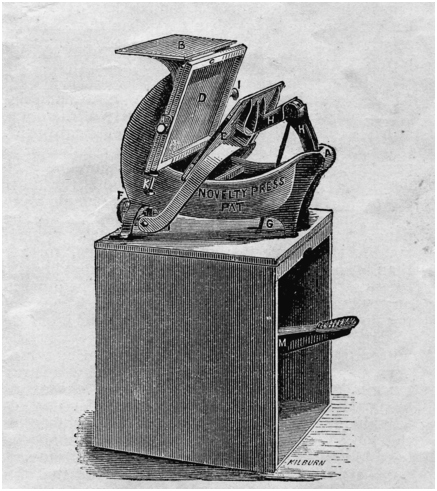
There is little evidence of the types of presses that mental institutions employed for producing periodicals. The needs of asylum publishing hardly required the speed and efficiency of steam presses, so hand presses were the preferred choice. Size and type, however, varied in response to an ever-growing choice and depended on the needs and resources of the institution. The Meteor of the Alabama Insane Hospital is the only periodical that discloses details of its technical production. It was printed on a Quarto Novelty Press, like the one shown in Figure 1.1.7 It was known as a cheap, compact, and easy-to-use piece of machinery, or, in the words of its distributors, the ‘best amateur printing press yet invented’.8 Dr William Hutcheson, the superintendent of the Glasgow Royal Asylum, vaguely described the press that produced the Chronicles of the Monastery as ‘a small press’, not suitable for printing the annual reports in-house, and he explained that the institution could not afford a bigger machine.9 In comparison to these machines, the one housed in the New York State Asylum printing office must have been significantly bigger and sturdier. At the end of 1851, it was able to print 1,230 copies of the monthly Opal, in addition to the American Journal of Insanity, which had international distribution.10 The choice of type and size of the press thus depended on the financial situation of the institution as well as the intended purposes and publishing scale.
Quarto Novelty Press, like the one used for printing the Meteor of the Alabama Insane Hospital. Its various parts are labelled with letters from A to M.
Institutional and Therapeutic Uses of Printing Presses and Periodical Publishing
Compared to their handwritten counterparts, printed periodicals were more ambitious attempts to engage diverse readerships. The complexity of their production posed challenges, but they presented more opportunities too, both for individual patients and institutions. Produced in large numbers (up to a few thousand copies), they were often distributed outside institutions, generating profit or inciting exchanges with the outside world. The introduction of presses into asylums served various recreational, therapeutic, and administrative purposes. Asylums that featured printing or periodical publishing tended to be run by physicians who advocated the moral treatment and the healing power of work and amusement. Though farming and gardening were the most common forms of occupation, the therapeutic activities had to ideally be selected with care. In his report for 1843, Dr William Rockwell of the Vermont State Asylum for the Insane (also known as the Brattleboro Retreat) observed that:
We find that patients recover sooner by employing them in their former occupations, than in those to which they were never accustomed. It seems to awaken their former associations, and the mind is more readily drawn into its natural current of thoughts and ideas – leaving its late wild and extravagant notions.11
As print trade professionals and amateur enthusiasts were admitted into asylums, superintendents had to consider acquiring presses or coming up with other arrangements for offering suitable employment.12
Though publications’ purposes varied, therapeutics is frequently mentioned among them. Periodical publishing was a particularly valuable activity, providing work as well as recreation. Both writing and printing could promote healing through distraction, as Dr Rockwell’s reflection on the Asylum Journal suggests:
The publishing of the Journal has greatly contributed to the employment, comfort and restoration of our patients. It has furnished agreeable employment to many. Several have recovered while engaged in printing. Many have been diverted from their delusions, while writing or selecting for the paper. Few can write, but many can select for the same. And I know of nothing better calculated to arouse the insane from their listless inactivity, or fix the attention from wandering to different subjects, than writing or selecting for a weekly periodical.13
Patients themselves perceived publishing as restorative. After his discharge from the Royal Edinburgh Asylum, printer-poet Alexander Smart (1798–1866) described the work for the Morningside Mirror as ‘an excellent and beneficial hobby for such of the patients as were smit with a love for scribbling, or whom the gods had made poetical’.14 As I have argued elsewhere, he also expressed a firm belief in the benefits of the physical exertion required by activities such as printing:
From my observation of the dreamy life of inaction in the eastern house, resulting from the higher class of patients in that department not being inured to, or capable of, manual labour, I think the chances of recovery there are much less than in the western house [where the poorer patients resided].15
Keeping the body and the mind busy was therefore at the core of therapy, as the healing potential of occupation was attributed to the distraction from the suffering it provided.16
A complex process, involving multiple steps and requiring focus, skill, and physical effort, printing could be an especially absorbing type of employment. Like writing and editing, it demanded concentration and good knowledge of spelling and grammar. However, setting the type on a composing stick was a skill that took time to master, especially if one wanted to do it with speed and accuracy. Fitting the type and the furniture, locking the chase, and then operating the press at the right pressure required further training and physical strength. Knowledge about the maintenance of the press, the type, and the other utensils was also necessary to ensure the good quality of the final result. In the fast-paced commercial printing office, this work was often stressful and detrimental to printers’ physical and mental health: by the mid nineteenth century, printing was already associated with respiratory disease, lead poisoning, exhaustion, and alcoholism.17 But in the asylum, publishing could transform into a therapeutic activity in which patients engaged willingly, even if they had no previous experience.18 Judging from the Gartnavel Gazette, discussed in detail later in this book, enthusiastic patients could develop their printing skills quite quickly. The first issue of the Gazette appeared a little over a month after the untrained gentlemen behind it requested to use the press.19
The consumption of periodicals was also considered to have healing potential. In the same report that mentions the Glasgow Royal Asylum’s acquisition of a printing press, Dr William Hutcheson depicts reading as an activity ‘calling forth and exercising the moral and intellectual powers and preventing the Patient from brooding over his own morbid thoughts’.20 As Laura Blair has recently shown, medical professionals and inspectors saw reading provision as fundamental to the good management of asylums. Suitable reading material in asylums became part of the curative institutional environment: ‘“Good” books took on a similar function to paintings, statues, plants and other decoration as objects which encouraged self-control and rational behaviour, promoting patient recovery.’21 As Blair suggests, not all reading was beneficial: physicians selected carefully the reading material with which patients engaged.22 Sensationalist accounts of crime, war, and death in the press, for instance, could be detrimental to patients’ well-being.23 As a result, in the early years of the moral treatment period, staff in several asylums took measures to limit patients’ exposure to distressing or otherwise ‘unhealthy’ reading.24 These practices affected asylum periodicals too: a patient’s account of a murder was excluded from the copies of the Morningside Mirror that were circulated internally.25
Regardless of these caveats, newspapers and periodicals were widely distributed in nineteenth-century mental institutions. According to Dr William Rockwell of the Vermont Asylum, periodical publications were unique in their provision of healthy and engaging reading matter for a wide audience: ‘Our newspapers furnish a kind of reading which is not found in books. Many will look on a newspaper, and read here and there an article, who would not open a regular treatise.’26 Newspapers and periodicals were perceived as better suited to the distractable minds of patients, as their contents were served in shorter portions, did not require linear perusal, and discussed various topics. Asylum periodicals thus provided additional reading, while also having the added value of being produced by fellow patients. As sources of entertaining reading and healthy occupation, the publications were well-suited to serve the purposes of the moral treatment.
The uses of printing equipment in asylums were not limited to therapy, as an article in Excelsior of the Murray Royal Asylum suggests:
in many Asylums there are Printing Presses [italics in original]; sometimes intended only for the use of the Establishment, as in the larger English Pauper Asylums; in other cases, established for the benefits of the Patients, as in Edinburgh and Dumfries; and in a third class, used for both purposes, as at Hanwell.27
The beneficial purposes of the presses referred to here are related to the publishing of patients’ writing: the author hints at the Morningside Mirror at the Royal Edinburgh and the New Moon at the Crichton Royal Asylum, as well as the ‘printing press at Hanwell Lunatic Asylum, at which the printer lunatics print the blank forms used in the house, and also the effusions of the mad poets’.28 While this statement suggests that the acquisition of presses was often motivated by interests in patient’s welfare, it also highlights the fact that presses were acquired for institutional uses – for printing admission forms, certificates, annual reports, and other documents and publications.
In fact, printing machines were rarely employed solely for patients’ benefits. The second-hand press at Hanwell was purchased at the suggestion of a house surgeon, Dr Begley, who ‘pointed out the practicability of usefully employing several Printers who are at present Patients in the Asylum’.29 The press was originally used to print out the blank forms for the asylum, before issuing the creative work of patients. The presses at the Royal Asylums that Excelsior describes as solely ‘recreational’ were used for administrative printing too. When launched in 1844, the New Moon of the Crichton was printed externally. The purchase of a press in 1847 and a generous donation of type by J. and W. McDiarmid of the Dumfries Courier in 1852 enabled the Crichton Institution to publish both the New Moon and its annual reports in-house.30 Between 1847 and 1852, however, patients operated the press to produce a library catalogue and programmes for concerts, plays, and other cultural events in the asylum.31 After acquiring a press in 1845, the Royal Edinburgh Asylum used it both for launching the Morningside Mirror and for producing ‘schedules, diet lists, &c.’, as well as the annual reports.32 Asylums that acquired presses thus rarely used them solely for patients’ publications. Administrative printing and smaller jobs were often the primary, or at least an equally important, function.
In-house presses allowed establishments to cut some of the operational costs. Studying the Opal of the New York State Asylum, Maryrose Eannace has observed that ‘the coincident residency of a patient who was also a professional printer would have helped improve the economic feasibility of publishing a patient-written periodical’.33 As the acquisition of a press was frequently motivated by the presence of people who could or were willing to learn how to operate it, there was hardly a coincidence. Rather than paying external printers, asylums could invest in printing equipment and get patients to produce all their documentation and publications, as well as patients’ periodicals, at significantly reduced costs. Patients were not oblivious to this aspect of their ‘treatment’. An 1883 press account of the work conducted in the printing office of the New York City Asylum on Wards Island reveals that: ‘one poor fellow, who used to be on the Sun, looked up from his case and announced that the Herald would pay at least forty-six cents per “em” for such extra type-setting. In a moment the whole room had stopped work, and long explanations were necessary to avert the strike.’34 Relying on ‘the steam-power used in the laundry’, the asylum’s printing office was at the time catering to the needs of the Department of Public Charities and Correction of New York City.35 In practice, this meant supporting the operations of eight hospitals, five asylums, an alms house, an orphan asylum for Black children, two workhouses, a penitentiary, the city prisons, and a few more agencies and establishments.36 The discontent of patients, who had previous experience of publishing and an awareness of the rates of pay for that kind of labour, is hardly surprising.
Evidence about patients’ monetary reward for their printing and publishing work is not readily available, but there are indications that some of that labour was paid. The publication of the Retreat Gazette in the Hartford Retreat in Connecticut and the Gartnavel Gazette in the Glasgow Royal Asylum was motivated by the printers’ desire to support their families, but the achievement of these goals is uncertain. Dr Mackinnon’s 1844 report on the governance of the Royal Edinburgh Asylum mentions a ‘small remuneration which can be afforded for work done in the asylum—an increase of which is to be included in our desiderata’, but it also states that the compensation ‘only meets certain cases, and those not adequately’.37 The success of the Conglomerate of the Middletown Homeopathic Hospital in New York State resulted in patients’ remuneration, though the superintendent’s report for 1891 reveals that patients’ choice how to spend their earnings might have been limited: ‘Financially, it [the Conglomerate] is not only self-supporting, but it is helpful to its workers in that it gives to those who do the manual labor such compensation that with their earnings they have been enabled to clothe themselves, thus saving expense to the State or to their friends.’38 Not all patient-printers necessarily needed or wanted to be remunerated for their work. Operating the press was taken up by some, usually higher-class, paying patients as a hobby. Such an example is James Buchanan and his gentlemanly circle who launched the Gartnavel Gazette (see Chapter 4). Alexander Smart, a working-class poet and printer, also saw his work for the Morningside Mirror as ‘a pleasant source of recreation’.39 Whatever provision there was for patients working in the printing office, it was less costly than relying on the regular services of external printers.
With that in mind, the motivations behind institutions’ acquisitions of presses appear suspicious. Doubts about the exploitation of patients’ labour and wrongful confinement have been expressed since the nineteenth century, and printing, as a form of work, should be interrogated as well. According to Erving Goffman, the promise of therapy and improvement masks the reality that work in mental institutions ‘derives from the working needs of the establishment’.40 Patients’ work was often resorted to as a means for sustaining asylums and, in certain cases, generating profit. This applies especially to the second half of the century, when increasing demand resulted in massive, overcrowded, and underfunded institutions, many of which shed their therapeutic purposes altogether and transformed into what Waltraud Ernst describes as ‘self-supporting if not lucrative manufactories or agricultural enterprises’.41
The history of asylum periodicals occasionally raises similar concerns. As patient-printers provided useful and low-cost services, letting them leave, especially when there were no competent substitutes, ran against institutional interests. Patients such as the editors of the Meteor and the Gartnavel Gazette openly declared that their printing skills were the sole reason for their prolonged confinement. Revealing their stories later in the book, I will show that these concerns were not unfounded, but there were other aspects of their situations that affected their stay. A particularly alarming case is the home of the Opal, the New York State Asylum, which acquired a printing press in 1847 and by the end of the century functioned as a major printing office with five machines and a bookbindery, relying on patient labour.42 It served the needs not only of the host institution but of a dozen other state establishments, as well as the State Commission of Lunacy, several private hospitals for the insane, and medical publications such as the American Journal of Insanity and the State Hospital Bulletin.43
Indeed, patients occasionally printed physicians’ publications. In the 1850s, a copy of William Tuke, the Founder of the York Retreat by his great-grandson and physician at the Retreat at the time, Daniel Hack Tuke, was sent to Edinburgh phrenologist George Combe, bearing an inscription disclosing that the volume was printed at the Retreat ‘by a deaf, dumb, & insane patient’.44 Asylum periodicals themselves advertised their institutions to the public and presented their superintendents as knowledgeable experts in the treatment of madness, hence attracting funding, donations, and new patients. The Asylum Journal (1881–1886) of the Public Lunatic Asylum for British Guiana is worth mentioning as an example of a periodical that was invested exclusively in the promotion of the institution and its superintendent. Printed by inmates, it was written entirely by Dr Robert Grieve and contained his accounts of the operations of the asylum and his reflections on the treatment of insanity.45 These examples reveal potential for exploitation of patients’ free or low-cost labour for the benefit of asylums and medical professionals – an issue that will be repeatedly addressed throughout this book.
Interpretations of patients’ work solely as abuse, however, obscure contemporary attempts to counteract exploitative or repressive practices, as well as positive experiences of working in the printing offices of institutions. Dr William Lauder Lindsay (1829–1880), physician superintendent of the Murray Royal Asylum in Scotland and editor of its periodical, Excelsior, was a vocal opponent of any attempts to take advantage of patients’ labour and rely on it for financial benefits:
Some authorities go the length of asserting that a pauper Asylum, with a sufficiency of farm land, should be self-supporting. But this is probably an extreme view, one based on the idea of economy or the interests of the ratepayer, rather than on that of cure or the interests of the patient. It should never be forgotten that the chief object of an Asylum is the cure and comfort of the insane, and all questions of economy and profit should be subsidiary or subservient to this grand aim and object.46
This recognition of malpractice and advice against it shows that the failings of the asylum system were not necessarily rooted in neglect or ill-meaning intentions.
Furthermore, the use of patients’ labour in asylum printing offices in the pursuit of institutional or physicians’ interests does not mean that patients did not benefit from their work, either directly or indirectly. During Dr Amariah Brigham’s governance of the New York State Lunatic Asylum in Utica between 1842 and 1849, patients evidently participated in the running of the institution and in the broader mission of promoting better understanding and treatment of insanity. In his report for 1844, Dr Brigham expresses ‘great obligation’ to patients for their writing work, revealing that ‘in drawing up this report four different patients have been employed as amanuenses’.47 In 1847, eight out of the eighty-six employees of the asylum were former patients, suggesting their willingness to remain and support the institution past their discharge.48 Printing equipment was purchased in the spring of the same year and was set up by patients themselves. The first productions of the press were institutional documents and publications: ‘numerous blanks and small bills for the Asylum, … an edition of the “Act to organize the State Lunatic Asylum,” also an edition of the “Rules and Regulations and By-Laws adopted by the Managers,” and the October [1847] and January [1848] numbers of the “American Journal of Insanity.”’49 There are indications, however, that this work was not necessarily forced upon the patients, nor driven solely by institutional interests. While some of the inmates involved were printers by trade, Brigham mentions two who at the time were learning how to use the new equipment – a process requiring some degree of autonomy and self-motivation.
The involvement of patients in the publishing of the quarterly American Journal of Insanity is also worth discussing. Though considered the first psychiatric medical journal, its early statements of purpose had an egalitarian ring to them. The aim stated in the first issue was ‘to popularize the study of insanity, – to acquaint the general reader with the nature and varieties of this disease, methods of prevention and cure’.50 It also suggested its usefulness to ‘members of the medical and legal profession, and to all those engaged in the study of the phenomena of mind’.51 Its openness to diverse audiences, including the general public, is understandable, considering that at the time psychiatry was yet to establish itself as a specialist subject. By the fourth volume (1847–1848), however, the Journal’s objective was redefined: It claimed to have been ‘established to benefit the Insane by extending a knowledge of their wants and claims’.52 Patients’ involvement in the printing of the Journal at the same time is hardly coincidental, especially since the first patient-made issues also contained patient’s contributions, such as a poem by ‘J. M. B.’ titled ‘The Maniac’.53 In her detailed exploration of the New York State Asylum’s magazine, the Opal, Maryrose Eannace observes that patients’ writing, such as letters and personal accounts, featured frequently in the Journal under Brigham’s editorship, suggesting that he valued their contributions. She also shows that the launching of the Opal was likely his idea, though his death interrupted his plans.54 The publishing of a separate patients’ publication appears to have been the next step in a partnership between the physician and his patients, which, though unequal, could be mutually beneficial and founded on respect.
Contrary to Goffman’s argument that work in the institutions does not bring the same rewards as regular employment, such as just remuneration or respectability, printing and publishing periodicals in the asylum could have indisputable benefits for patients.55 As Vesna Curlic points out, ‘in the case of pauper patients, especially, their labour was a tool of agency, which allowed them to bargain for more luxuries which were beyond their means, otherwise’.56 Patients’ literary efforts usually resulted in higher status within the institution and sometimes created opportunities for recognition and personal and professional development beyond the asylum. Alexander Smart’s work for the Morningside Mirror secured him greater freedom of movement in the institution and access to the wards of the higher-paying patients.57 A contributor to the Meteor of the Alabama Insane Hospital, likely the editor, stated that he too had gained greater mobility: ‘He has now a key of his own and usually walks alone or attended with one or more dogs. He is free to confess that he enjoys his walks more since he could select their time and place.’58 Even if work in the asylum did not benefit patients in the same way as external employment, neither did it expose them to the same challenges and distress. In the asylum, Smart ‘was given a chance to retreat from the taxing life of a professional printer and rediscover the pleasure of practising his art in a relaxed setting, without the pressures of the marketplace’.59 His and several of the other case studies in this book suggest that work in the asylum could be a source of pleasure, healing, and a sense of fulfilment.
The privileges that working as a printer or an editor of a periodical secured within the institution, however, were conditional and could be lost. The freedom of movement that periodical editors enjoyed, for instance, was likely tied to the successful performance of their literary work. If they were to write about institutional life, they needed greater access to the grounds and to all the events that took place in the asylum. Eannace has suggested that the special status was contingent on patients’ productivity. In her discussion of one of the printers of the Opal, she notes that, while industrious in the printing office, the patient was kept in the ‘posher’ first hall of the New York State Asylum, but he was ‘demoted … to a lower hall when he ceased being competent in his printing work at the asylum’.60 She argues that this movement replicated social realities outside the institution: the inability to prove professional competence or compete in the market cost one their social standing.61 Such institutional ‘demotions’ could however be driven by factors unrelated to patients’ productivity too, such as their behaviour towards staff and fellow patients. The implementation of work in different institutions varied, but in my view of the early applications of the moral treatment, I side with Jennifer Laws’s statement that ‘the broader ethic of work apparent in the retreats owed little to the developing consciousness of the capitalists’.62 In Alexander Smart’s case, the Royal Edinburgh Asylum allowed him to demonstrate his professional expertise and receive meaningful rewards that promoted the restoration of his confidence in his own abilities.63 In the liminal space of the asylum, the very meaning of work could change, making it hardly distinguishable from a pleasurable and aspirational recreation. It is therefore important to recognise patients’ compromised position in institutions, while leaving room for positive or more nuanced experiences.
Symbolic Uses of the Press
‘The newspaper,’ one author in the Asylum Journal of the Vermont Asylum wrote, ‘is the chronicle of civilization, the common resorvoir [sic] into which every stream pours its living waters, at which every man can come and drink; it is the newspaper which gives to liberty its practical life – its constant observation – its perpetual vigilance – its unrelenting activity’.64 Launching periodicals was not only a practical decision but also a symbolic act for patients and physicians alike. In The Politics of Language, Olivia Smith argues that in the late eighteenth century, ‘civilisation was largely a linguistic concept, establishing a terrain in which vocabulary and syntax distinguished the refined and the civilized from the vulgar and savage’.65 As a key medium of language in the nineteenth century, print assumed a central position in the cultural imagination, representing civilisational progress, enlightenment, and liberation. These associations were consolidated by growing literacy rates, access to education and proliferation of printed materials, leading Alexander Smart to call the press ‘a giant of power’ in one of his poems.66 Cheap, widely circulated, and sustaining consistent readerships through its regular appearance, the periodicals became a powerful manifestation of print. Its role in national identity formation imbued it with additional cultural significance, as the following quote from the 1860 United States census suggests: ‘Among the elements which determine the characteristics of a people, no branch of social statistics occupies a more important place than that which exhibits the number, variety, and diffusion of newspapers and other periodicals.’67 The idea that the press was at the heart of every civilised nation impacted the emergence and spread of publishing in asylums and can also suggest explanations for the phenomenon’s popularity and early spread in Scotland and the United States.
In 1853, Dr Isaac Ray, one of the founding members of the Association of Medical Superintendents of American Institutions for the Insane, attributed the spread of insanity among Americans to the advanced state of civilisation they had achieved:
The press and the rostrum, the railway and the spinning-jenny, the steam-engine and the telegraph, republican institutions and social organizations, are agencies more potent in preparing the mind for insanity, than any or all those vices and casualties which exert a more immediate and striking effect …. The present is an age of great mental activity, all over Christendom, and especially with us …. Here is no standstill.68
Ray’s commentary is part of a broader discourse on progress that was widespread in Britain, Europe, and America. As Bonea et al. have argued, nineteenth-century journalistic, literary, and medical writings repeatedly conveyed ‘perceptions of increased “velocity” in thought and action, of wear and tear on the brain, [as] part of an emerging diagnosis of the problems of modernity’.69 British and American physicians enthusiastically championed the thesis that insanity was a side effect of rapid civilisational progress. Medical writers often named technological development, wider access to education, increased social mobility, and ceaseless competition as risk factors for intellectual and emotional overexertion. The unmanageable dispersion of print was also a major risk factor, as Ray explains:
No single incident of civilization has contributed so much to maintain the mental activity of modern times, as the art of printing, and at no period since its invention have its benefits and its evils been more widely diffused …. The multiplicity of books and of readers, not only evinces a degree of mental activity which, a century ago, would have been thought to be scarcely within the bounds of possibility, but much of the literature of the day is more or less directly addressed to the lower sentiments of our nature, thereby impairing that supremacy of the higher which is indispensable in a healthy, well ordered mind.70
Here, Ray expresses concern about both the quantity and the quality of reading material, while reinforcing the symbolism of the press as a vehicle of civilisation. His commentary also suggests that psychiatrists were keen contributors to broader discussions of reading in relation to health.71 By displaying expertise in distinguishing ‘healthy’ from ‘unhealthy’ reading, he underscores the profession’s importance in civilisational development: as Reiss has argued, they aspired to ‘doctor’ not only individual minds but also culture.72 Though official sources such as the 1871 census of England and Wales suggest that the ‘theory that insanity is a product of civilisation … is entirely unsupported by evidence’, insistence on the correlation between progress and insanity was key to proving the importance of the emerging specialism of psychiatry.73 That rhetoric positioned asylums as strongholds of civilisation and superintendents as their privileged guardians, prescribing sanity-preserving measures and guiding the insane back to reason.
Under the moral treatment, healthy, well-regulated mental occupation through cultural activity became a central point of physicians’ therapeutic programmes within and beyond asylums. Reiss interprets the phenomenon as ‘a sort of neocolonial cultural warfare’.74 According to him and other scholars, asylum periodicals contributed to a grand project of ‘civilising’ the insane, as they promoted ideals of refinement and civility. In his study of the Opal, Reiss argues that the very existence of the periodical of the New York State Asylum shows the intertwining of sanity and literary ability: ‘The history of the Opal (and related journals at other institutions) makes clear that the asylum authorities had an essentially literary model in mind when they imagined outcomes for their patients. To acquire the polite arts and to learn eloquence, disciplined reading, and correct composition were essential, not only for developing literary sensibility, but also for healthy character formation.’75 Turner makes a similar point about the New Moon, arguing that an institutional ideology of ‘refinement as wellbeing’ permeates the magazine – a ‘curative emphasis [that] equates intellectual pursuit with psychological improvement, [correlating] a heightened civility with developed sanity’.76 These models suggest a strictly top-down movement of initiative, however, neglecting patients’ own understanding and uses of print. A closer look at individual patients’ stories reveals a more complex reality.
In his classification of inmate adaptations to institutional reality, Erving Goffman lists behaviours such as withdrawal from interaction, refusal to cooperate, ‘conversion’ to the prescribed, and ‘colonization’ – the resourceful use of the limited resources available to construct a ‘stable, relatively contented existence’.77 Drawing on this categorisation of behaviours, Jessica Campbell shows how long-term patient contributors to the Morningside Mirror ‘colonised’ the institutional environment by creating ‘literary personae as a means of reconstituting their identities and [carving] out their own space within the asylum’.78 The cases discussed throughout this book show that patients used publishing for their own agendas and relied on the symbolism of the press to preserve their identity and self-worth. Furthermore, though publishing in asylums was indeed a ‘civilising’ project, the target was not only the insane. As I show in Chapter 7, patients could also employ the press to enlighten their sane readers – by interrogating the fundamental ideals of humanity, liberty, reason, and progress on which civilisation was allegedly built.
Discourses on insanity as the price of progress inspired intercultural comparisons. For instance, the authors of the British Manual of Psychological Medicine, one of the first psychiatric textbooks, argued that ‘the liability to mental disease is greater (other things being equal) in a civilized and thinking people, than in nomadic tribes, or in any race whose intellectual faculties are but little called into action. Knowledge brings with it its miseries as well as its blessing’.79 The civilisational classification shown here encouraged not only racial but also national comparisons, according to which insanity became a mark of high achievement. Thus, Isaac Ray argued that, unlike ‘the people of the old world’, Americans were more likely to go insane due to the mental strain of the ‘abundant opportunities that are offered for the pursuit of wealth, and the consequent variety and novelty of the enterprises undertaken for this purpose’.80 Here, Ray refers to the white population only: Black people’s mental illness was mostly invisible during the Antebellum period and was afterwards repeatedly misattributed to their inability to handle their emancipation.81 Later in the century, the belief expressed by Ray forged a new diagnosis – neurasthenia – perceived as a uniquely American phenomenon resulting from over-ambition and excessive stimulation of the nervous system.82 As Eannace points out, the understanding of insanity as a mark of distinction was not limited to white Americans: ‘the English had already staked out madness – most specifically, melancholia – as “the English Malady.”’83 American reframing of white insanity as a sign of cultural advancement should thus be understood as part of constructing a national identity distinct from England.
Similar nationalistic sentiments are found in Scottish psychiatric writings, which also reveal asylum periodicals’ role in the competition of civilisation. In the January 1878 issue of Excelsior of the Murray Royal Asylum in Perth, the superintendent Dr William Lauder Lindsay summarised the state of periodical publishing thus:
We point with some pride to the fact that these serials [the New Moon and the Morningside Mirror], which are 34 and 33 years old respectively, and are therefore, counted by man’s years, only in their prime – are both Scotch. It is singular that our sister country, which makes such a parade of the doings of its Asylums in the Times, Daily Telegraph, or other influential newspapers – metropolitan or provincial – cannot, or at least does not, produce a single Asylum serial! That such an anomaly should long remain a reproach against England [emphasis in original], which perpetually boasts that its Asylums are the first in the world, we can scarcely believe. For the richer, larger, wealthier, more powerful Asylums of England have for the last half century been following the lead of ‘puir Auld Scotland’ in all that constitute the essential features of what is now known popularly as the ‘Modern’ or ‘Humane’ system of Treatment of the Insane.84
Throughout its run, Excelsior made other comparisons between Scottish and English practice. In 1866, it observed that: ‘On the whole they [asylum libraries] seem far less common in England than in Scotland – a fact significant of the superior literary tastes of the Scotch people’.85 Taking stock of asylum periodicals in circulation in 1873, another article concluded that at the time:
three [titles] are edited in Scotland by Scotchmen: one by a Scotchman in England: and one by an Englishman in England. Ireland possesses none. We can account for the number of these literary journals issued in Scotland only by supposing that the ‘ingenium prefervidum Scotorum’ [italics in original] of the age expresses itself in literary effort, whether the mind of the community is in health or disease: that the Scotch, even when they have a ‘bee in their bonnets,’ exhibit in this way their superior education and their higher general culture.86
Excelsior represented periodical publishing as a civilisational achievement in which Scotland excelled. It suggests Scottish physicians’ drive to prove their superior professional ability through facilitating cultural and literary activity in their institutions. It also encouraged pride among the patients and staff of the Murray Royal and other Scottish institutions, by highlighting the importance of their publishing efforts.
In their construction of national identities, both Scotland and America pursued distinction from England through an ideal of universal education and social mobility. Nineteenth-century Scotland boasted a remarkable working-class literary scene and a widespread and active network of subscription and circulating libraries and Mechanics’ Institutes.87 Similarly, in America by the 1820s, ‘the republican standard of a politically informed electorate within a generally educated, moral citizenry had become a national mandate’.88 Publishing became an aspirational activity, a potent tool of self-improvement and social mobility. In her discussion of post–Civil War amateur newspapers, Jessica Isaac proposes that, while affluent youths treated newspaper publishing as a hobby and an opportunity to socialise, less privileged amateurs
were more likely to use amateur journalism to learn about writing, editing, and printing. Furthermore, they pursued amateur journalism to create meaningful social and professional relationships. They produced an amateur newspaper to groom themselves for middle class adulthood, to shape identities that would enable participation in spheres more privileged than those in which they had grown up.89
Resonating with the ‘lad o’ pairts’ myth in Scotland according to which any young man, however disadvantaged, could rely on accessible education to improve his station in life, the phenomenon demonstrates the importance attributed to periodical publishing and editing in America.90 Maureen Park and Robert Hamilton have suggested that the Scottish tradition of accessible education informed occupational therapy and cultural engagement in the Crichton Royal Asylum: it had a library, a museum, a theatre club, a rich programme of concerts, lectures, and entertainments, as well as a magazine.91 Similarly, Jill McMillan has suggested that the longevity of Crichton’s New Moon and the Royal Edinburgh’s Morningside Mirror was due to the ‘long standing tradition of literacy in Scotland or … the continued influence of useful knowledge movements in the country’.92 The ideal of universal education and the promise of social mobility through cultural activity did not necessarily match reality.93 The reiteration of these national narratives, however, was itself a source of motivation. As Weiss observes, ‘it’s not the point whether or not Scotland had superior literacy rates and education levels, or whether this national self-image was “true”, it’s what they believed to be true, which is more potent’.94 These aspirations to self-improvement through literary activity could be powerful stimuli for pursuing or encouraging innovative and experimental literary projects such as publishing in mental institutions.
Infused with nationalist sentiments, ideas of progress could have thus influenced periodical publishing in asylums. They might explain why the practice was picked up with particular enthusiasm in Lowland Scotland and the American Northeast: by 1860 there were six American, five Scottish, and only one English publication of High Beech Asylum in Essex, which has not survived.95 As I show in the following chapters, the launch of new titles often depended on patients’ initiative and the movement of staff and information between institutions. However, here I would like to suggest that Scottish and American physicians, as well as patients recognised the press as a symbol of progress and a potential source of prestige. The asylum periodical thus bore a particular cultural value. The fact that the titles known to date have been kept in institutional archives or have gained publicity through mentions in physicians’ reports, medical journals, and the press is significant. It shows that in these locations, asylum periodicals were considered especially important – enough to keep them running, talk about them, and preserve them throughout the years. Though other titles might be found in the future, it is unlikely that more printed asylum periodicals existed continuously without drawing attention. The launch of these publications tended to be celebrated with pride and enthusiasm by physicians and publicised in the press. The asylum periodicals that might resurface in the future will likely be publications that were distributed only internally, had small circulations, or were short-lived projects that lacked institutional support. Evident patterns in the distribution of asylum periodicals reflect processes of cultural self-representation and attribution of value, as much as potential local and national cultural differences and peculiarities. They reveal a comparatively greater enthusiasm among Scottish and American early psychiatrists to enable, promote, and participate in experimental publishing ventures in their institutions.
There are a few other country-specific factors that might have contributed to the early popularity of asylum periodicals in Scotland and America. Both countries had comparatively high portions of the population involved in publishing and the related trades in these areas. The proportion of the Scottish population involved in the book trade seems to have been especially high. Bill Bell estimates that ‘between 1841 and 1901, an average of 26 per cent more of the nation’s workforce was employed in the print and allied trades than in England and Wales, with Edinburgh showing a rate, on average, 68 per cent higher than London’.96 The print trade also grew rapidly in the big American port cities in the Northeast, where printing had to meet the pace of bustling commerce and demographic expansion. According to Allan Pred, ‘printing and publishing, with over 2,000 workers, was New York City’s single most important industry in 1840’.97 Growing numbers of people involved in publishing increased the likelihood of asylums receiving people with professional experience in the trade. That in turn promoted the launching of periodicals.98 Whether superintendents tried to cut institutional expenses or match patients’ professional occupation following the moral treatment’s principles, the presence of qualified printers was often used to justify the acquisition of printing presses.
In addition, the asylums that first adopted periodical publishing tended to reward patients with greater freedom of movement and to offer voluntary boarding, which was especially popular in Scotland.99 Several of the early publications (Retreat Gazette, Asylum Journal, New Moon) involved collaboration with local printers and patients’ use of their offices. In other cases, patients launched or supported the publications after their official discharge. Such was the case of Chronicles of the Monastery, which was started by a patient who had decided to stay in the Glasgow Royal Asylum as a voluntary boarder (see Chapter 3). William Shields remained in the Crichton Royal Asylum after his recovery and was hired as the official printer of the New Moon.100 William Selden George (1825–1881), discussed in greater detail in Chapter 2, launched the Asylum Journal at the Vermont Asylum while a patient but continued to print it after his release. A few years later, having left Vermont, he revised and published a selection of articles in a separate volume, titled Bedlamiana: or Selections from the ‘Asylum Journal’ (1846).101 The reproduction of the Journal’s contents at a time when George was no longer connected with the asylum indicates his appreciation for his literary work in the asylum and his ability to use both his experience in the institution and public interest in insanity to his advantage. These examples show patients’ initiative and autonomy, suggesting that they could also use the asylum and contribute willingly to the expansion of the press.
Naturally, patients’ participation in civilisation and its promises of liberty was limited. The American ideals of personal freedom and opportunity were in particularly stark conflict with the treatment of insane citizens who were stripped of their civil rights to vote, own property, and sign contracts. As Eannace observes in her discussion of the Opal:
the removal of at least some who are institutionalized from active participation in the American project abrogates the ideals of the project. In this vein, there continues to be much mention [in The Opal] of the loss of liberty and of citizens’ rights.102
Nevertheless, the fact that patients were offered platforms of expression, such as the Opal, shows that the ideals were not entirely divorced from reality. Though the asylum printing press often served institutional rather than therapeutic purposes, patients also recognised it as a powerful tool of influence and liberation. Reflecting medical, social, and literary ambitions, the publication and preservation of asylum periodicals are profound testimonies to the cultural value of these publications and the progressive aspirations of the institutions and patients that produced them.
Dotted here and there over the earth are little colonies whose inhabitants are cut off from all intercourse with the everyday world by their own idiosyncrasies. Each individual lives in a world of his or her own creation, which, in the majority of cases, only two outside interests ever succeed in reaching – namely, the asylum doctor and the asylum magazine.1
Written at the close of the nineteenth century, this article in the Daily Mail mentions four Scottish, one South African, one English, and one American title in circulation in the 1890s. Though incomplete, this list shows recognition that by the end of the century, periodical publishing in asylums was a global phenomenon. Furthermore, while placing a disputable emphasis on patients’ status as social outsiders, the article positions physicians as facilitators, guiding patients out of their isolation. Asylum periodicals served as threads connecting the insides of asylums to the rest of the world. The history of asylum periodicals indeed recasts the asylum as an open system, embedded in ongoing exchanges of people and publications.
The permeability of institutional boundaries is already evident from various documented interactions. Barfoot and Beveridge have discovered that the writings of John Willis Mason, a patient and regular contributor to the Morningside Mirror, were published in the Meteor of the Alabama Insane Hospital. In fact, the Mirror travelled regularly to other institutions and was exchanged for similar publications.2 In her study of the New Moon of the Crichton Royal Asylum, Jill McMillan has identified a broader system of connections between asylums and their publications and inmates:
In its [the New Moon’s] pages, patients could engage in dialogue with other patients, staff, or outside subscribers. This privilege was not restricted to Crichton residents either; indeed, persons from the greater asylum community also contributed to the New Moon …. The circulation of such magazines likely strengthened connections among patient-readers and the wider asylum community, reminding that their experience was not particularly isolated or unusual.3
The ‘greater asylum community’ McMillan mentions remains ill-defined, and my aim here is to flesh it out. Asylum periodicals arose from and sustained international networks of medical professionals and publications. Their launch and development also depended on interactions with wider periodical culture and relationships with the print trade. Embedded in social and print networks, asylum periodicals require a re-evaluation of the isolation of the asylum and its inhabitants. The history of these publications was a history of transgression, of resistance to marginalisation, and of continuous participation in social life.
Physicians as Facilitators: Medical Networks and the International Spread of Asylum Periodicals
Nineteenth-century medicine was shaped by growing internationalism, and, as pioneers of a new medical branch, early psychiatrists formed networks crossing geographical and national boundaries. Developments in the treatment of insanity in Britain, America, and the rest of the world informed each other, as physicians travelled abroad, visited each other’s institutions, and read each other’s publications.4 National differences naturally emerged. However, this happened in the context of multidirectional communication and increased mobility.
The periodical press was a major channel through which medical exchanges occurred. The publications of local and national medical societies had an international reach and included writing from foreign correspondents. The first psychiatric periodical was no exception. Launched in 1844, the American Journal of Insanity (known today as the American Journal of Psychiatry) aimed to inform readers of new developments in the field around the world. In Britain, the Journal of Psychological Medicine and Mental Pathology and the Asylum Journal of Mental Science (later published as the British Journal of Psychiatry) followed suit in 1848 and 1853, respectively. Asylum annual reports were widely circulated and reprinted not only in medical journals but also in the general press. Print thus facilitated and reflected the formation and expansion of a well-connected professional community of physicians interested in the treatment of insanity.
Asylum periodicals themselves were part of these networks, as they carried medical news across and beyond institutions. The New Moon promised to ‘offer occasional observations on the management and success of other Houses of the same kind, both at home and abroad’.5 Other asylum periodicals often referenced the writings of medical professionals about their own practices or those of their colleagues abroad. The Meteor, for example, enclosed an excerpt from a letter from Dr Thomas Kirkbride of the Pennsylvania Hospital for the Insane to the superintendent of the state asylum of Alabama.6 Notes about other institutions’ annual reports in asylum periodicals hint at their far-reaching circulation. The Asylum Gazette of the New Hampshire Asylum mentions the receipt of the Seventh Annual Report of Ohio Lunatic Asylum, while the annual reports of two asylums in Virginia reached the office of the Asylum Journal in Vermont.7 Asylum periodicals also reprinted cross-national and cross-institutional comparative studies by physicians. Between April and November 1846, the Asylum Journal serialised Dr Isaac Ray’s ‘Observations on the Principal Hospitals for the Insane, in Great Britain, France & Germany’, originally published in the American Journal of Insanity.8 Similarly, the Meteor included a report by the Commissioner of Lunacy for California, containing his observations of 149 asylums, of which 45 were in the United States and the rest in Canada, Britain, Ireland, and Europe.9 Finally, asylum periodicals reported events of importance for the medical profession, such as the second meeting of the Association of Medical Superintendents of American Institutions for the Insane.10 It is unlikely that the patient-editors had access to these publications and news without the assistance of asylum staff. Asylum periodicals thus embody the transatlantic networks of alienists who were interested in each other’s work and had various ways of acquiring and sharing knowledge nationally and internationally.
Asylum periodicals themselves contributed to the discussion of the treatment of insanity, by offering original essays on the topic and embodying a new therapeutic practice. Their distribution beyond their host institutions sparked medical interest and strengthened professional connections. Physicians were among the first subscribers of asylum periodicals, as they learnt about the publications either from the press or their colleagues. Such was the case of Dr Samuel Bayard Woodward of the Worcester Lunatic Asylum in Massachusetts, who subscribed to the Retreat Gazette of the Hartford Retreat in Connecticut right after its launch in August 1837.11 Woodward had been involved in the establishment of the Hartford Retreat, so he and Silas Fuller, who was the superintendent at the time, were acquainted before the launch of the Gazette.12 The periodical became another form of communication that nourished their professional bond.
This exchange suggests that, though largely produced by patients, asylum periodicals resisted the growing distinction between lay and specialist publications. The intertwining of medical publications and asylum periodicals is uniquely embodied by the printing press of the New York State Asylum, which produced not only the American Journal of Insanity but the patients’ publication, the Opal, launched in 1851. Even before the birth of the patients’ magazine, the American Journal of Insanity featured current and former patients’ writings.13 However, as Reiss observes in relation to the Opal, asylum periodicals ‘received relatively little attention in the writings of the medical authorities’.14 Although direct expressions of medical interest in patients’ contributions and publications were not consistent, asylum periodicals continued to be shared between physicians and were exchanged for medical journals, such as the Lancet, the Medical Times and Gazette, and the Asylum Journal of Mental Science – the organ of the Association of Medical Officers of Asylums and Hospitals for the Insane, later known as Royal College of Psychiatrists.
These interactions enabled both the spread of periodical publishing in mental institutions and communication between periodical producers across institutions. As physicians moved between different establishments and corresponded with each other, they carried the practice across institutional and country borders. In 1854, Dr William Lauder Lindsay became Physician Superintendent of the James Murray Royal Asylum in Perth, after working as an assistant physician to the famous William Alexander Francis Browne at the Crichton Royal Asylum in Dumfries, where the New Moon had continuously been published for ten years. In his first superintendent’s report published in 1855, Dr Lindsay complained that his institution was not prepared to support a periodical, but disclosed that this did not prevent his patients from publishing their works.15 Indeed, two contributions from the Murray Royal had recently appeared in the New Moon.16 Their publication in the periodical of the Crichton Royal Asylum was likely driven by Lindsay’s enduring connection with his former employers. His professional experience in the other institution had also equipped him with the know-how for running his own literary project. He launched Excelsior two years later.
In turn, Excelsior participated in the spread of periodical publishing in asylums south of the Scottish border. In the late 1860s, William Hyslop left his position as head attendant at the Murray Royal Asylum and became the proprietor of the private institution at Church Stretton in England. Under his governance, the establishment launched Loose Leaves in 1872.17 In the introductory article of the publication, he openly discussed the influence of existing periodicals on his project and expressed hopes that his venture will itself serve to promote the practice:
It is because I have seen so much good produced in this way by The New Moon, … the Excelsior, … and other little literary waifs of a similar character, that I have encouraged the production of this publication, in the hope that it will do good in itself, and be an inducement for others to follow the example.18
This was the second English asylum periodical to appear in nearly forty years. After the High Beech publication of the 1830s, it was not until 1861 that the practice was renewed in England, again under Scottish influence. The York Star of York Lunatic Asylum in Bootham was launched in that year and edited by the physician superintendent, Dr Frederick Needham. The Latin motto of the Morningside Mirror, translating as ‘Spare these pages that are destined to perish’, is directly quoted in the first issue of the York Star, and its single-column octavo format visually resembles the Mirror. These peculiarities suggest that the English physician at the very least had seen the Edinburgh periodical.
The Mirror itself was inspired by Crichton Royal’s New Moon, which was launched a year earlier. Reviewing the second issue of the Edinburgh publication, the Athenaeum appended the following correspondence with the superintendent William Mackinnon: ‘Dr Mackinnon has … the candour to inform us that he cannot claim the credit of having been the first to establish a newspaper within the precincts of an asylum. “To my friend, Dr. Brown[e],” he says, “of the Crichton Institution, Dumfries … this merit is due.”’19 Both the Morningside Mirror and the New Moon continued their lives well into the twentieth century. The wide circulation, longevity, and publicity of these two titles increased the chances that physicians in Britain and beyond would hear about the practice and attempt to replicate it. Indeed, references to them appear in other titles, such as the Sunnyside Chronicle, published in the Montrose Asylum in the 1880s. The Chronicle started its run with the following hopeful statement: ‘The Morningside Mirror and The New Moon … have now each reached the mature age of forty-two years. They will, we feel sure, welcome the appearance of the oldest Asylum in Scotland in a sphere where they have shone so long.’20
Similar exchanges happened in America. Dr William Rockwell, under whose supervision the Asylum Journal of the Vermont Asylum appeared in 1842, had worked for nine years as the assistant physician at the Hartford Retreat, which issued the Retreat Gazette in 1837.21 He had left the institution a year before the launch of the Gazette, but he likely stayed informed of the developments in his former workplace. In turn, his Asylum Journal inspired the New Hampshire Asylum Gazette, launched in 1846. The blatant similarity of the title was criticised by the American Journal of Insanity, which expressed ‘regret that some other name [emphasis in original] was not selected as there is danger of confounding it with [the Asylum Journal]’.22 The launch of the manuscript ‘Illuminator’ at the Pennsylvania Hospital in 1843 indicates Dr Kirkbride’s attempt to keep up with the latest innovations.23 The idea for the Opal of the New York State Asylum potentially came from Dr Amariah Brigham, who was also connected to the Hartford Retreat.24 The Opal was likely influenced by the Asylum Journal, the Asylum Gazette, and even the Scottish New Moon, as references to all of them appear in the American Journal of Insanity during Brigham’s editorship.25 The emergence of asylum periodicals in Britain and America in the 1830s–1850s was therefore likely interlinked, promoting cross-institutional and transatlantic exchanges of medical practices and ideas between medical professionals.
As the century progressed, the practice of printing and periodical publishing in asylums spread further. In 1881, Dr Robert Grieve of the Public Lunatic Asylum for British Guiana employed his patients in printing another Asylum Journal, which, however, did not feature patients’ writing. The 1890s saw the birth of the Fort England Mirror (1891–1899?), a quarterly launched by another Scottish physician, Thomas Duncan Greenlees, at the mental institution in Grahamstown, South Africa, and the Lancaster Argus (1891–1897?) of the Provincial Lunatic Asylum at St John in New Brunswick, Canada.26
The expansion of periodical publishing in asylums continued beyond the English-speaking world. At least two titles were launched in France: Le Glaneur de Madopolis of the Charenton Hospital and ‘L’Anti-Aliéniste’, a manuscript periodical run by a patient in the Bicêtre Hospital in Paris.27 In 1865, the asylum of San Baudilio del Llobregat in Catalonia launched La Razón de la sin Razón (‘The Reason of Unreason’). It was printed and partly written by the patients, and according to Robert H. Le Bow, it preceded the first Spanish official medical journal by sixteen years.28 Prior to its launch, the superintendent, Dr Antonio Pujadas, had travelled across Europe and England, visiting mental institutions and observing their practices. It is possible that he had also heard of the existence of asylum periodicals in Scotland during this period. A more palpable connection is evident in the spread of periodical publishing to Argentina. In 1899, the director of the Hospicio de las Mercedes in Buenos Aires, Dr Domingo Cabred, purchased a press. According to Fabio Ares, Cabred first used the machine for a Spanish translation of an English psychiatric nursing manual.29 As the original use of the press suggests, Cabred kept track of English medical publications. Mentions of existing asylum periodicals in the press were therefore a possible source of inspiration for the Ecos de las Mercedes, issued between 1905 and 1907. Two published letters written by Cabred, however, suggest a more direct influence. In them, he reflects on the management of Scottish asylums, many of which he personally visited in 1896. He pays special attention to the Royal Edinburgh and the Crichton Royal Asylums, which at the time were still publishing the Morningside Mirror and the New Moon.30 The Argentinian Ecos openly echoed other asylum periodicals’ promises to offer healthy recreation to patients, claiming that: ‘The essentially therapeutic aims pursued by this and other publications found in some major European asylums signifies a new means of treating madness.’31
The links between physicians also enabled much wider circulation of asylum periodicals: through the superintendents, the publications reached the libraries and inmates of other institutions. The 1846 annual report of the Ohio Lunatic Asylum mentions the Asylum Journal and Asylum Gazette among the periodicals that it received.32 Exchanges were recorded in asylum periodicals themselves: The Meteor in Alabama declared that the Morningside Mirror ‘comes to us regularly from the Royal Edinburgh Asylum’.33 The Alabama newspaper was also exchanged for Excelsior of the Murray Royal Asylum. Further evidence of asylum periodicals’ external circulation are the pieces celebrating the launch of new asylum publications. When the Asylum Gazette began publication in 1846, the Asylum Journal commented: ‘We have received the first number of this interesting little sheet, published monthly, by the inmates of the N. H. Asylum. We wish it all manner of success.’34 These exchanges were likely driven by physicians’ keenness to share their professional achievements, which were both described and embodied by asylum periodicals. In doing so, physicians promoted the formation of an asylum periodical network, uniting readers and contributors from institutions across vast distances.
The cross-institutional circulation of asylum periodicals enabled patients to communicate with each other, not only with the permission but the encouragement of physicians. In contrast with the widespread institutional policies that restricted patients’ correspondence with the outside world, the pages of asylum periodicals allowed interaction. For instance, the Asylum Journal published letters from patients in New York City Lunatic Asylum on Blackwell’s Island.35 The Meteor in Alabama announced that it had
received from a patient of the Iowa State hospital for the insane [sic] a letter of inquiry as to the expense and difficulties attending the establishment of a hospital paper. Having replied by letter, we notice the matter in this place only to say that while the cost of a small printing establishment is trifling, the advantages are important, and we unhesitatingly recommend the procurement to all institutions for the insane.36
Even if the answer was intercepted, the essence of the response was carried by the Meteor itself. Though there is no evidence that a paper was published in Iowa State Hospital, this exchange embodied the new opportunities for patients’ communication that asylum periodicals created.
Physicians supported such interactions and even welcomed the writing of patients from different institutions. Dr Mackinnon of the Royal Edinburgh Asylum discussed external communications in the Morningside Mirror with palpable contentment: ‘It is interesting to note’, he wrote, ‘that in its pages have appeared contributions from the inmates in two other Asylums’.37 In the first two years of its publication, the Mirror featured pieces from at least three correspondents from the Aberdeen Royal Asylum, as well as submissions from Hanwell Asylum and the York Retreat in England, and Richmond Asylum and St Patrick’s Hospital in Dublin.38 Jill McMillan observes a similar trend in the New Moon, which published pieces by residents in the Aberdeen Royal Asylum and the McLean Asylum in Somerville, Massachusetts.39 Patients from the New York State Asylum and the Pennsylvania Hospital for the Insane also contributed to this title.40
Physicians had a key role in these cross-institutional exchanges. Patients in the Aberdeen Asylum were encouraged to contribute to other asylums’ periodicals.41 In the case of the Mirror, professional connections could further explain the presence of ‘foreign’ correspondents. Dr Mackinnon had previously worked at Aberdeen Royal, the matron had been employed at St Patrick’s, and one of the assistant physicians had studied under John Conolly of Hanwell.42 Professional links with the other institutions are also possible. Proof of direct influence or intervention of the physicians in these exchanges can be hard to find. However, Mackinnon’s satisfaction with patients’ interaction through the Mirror and the practice of monitoring patients’ correspondence suggest that physicians were instrumental in the initiation of this printed correspondence, as well as the overall spread of asylum periodicals.
Asylum Periodicals and Their ‘Brethren’: Periodicals as Bridges with the Outside World
The engagement with the world that asylum periodicals offered patients was not strictly bound to the contemporary medical circles and their institutions and publications. Interaction with the general press was another important aspect of asylum publishing. As many of the contributors and producers of asylum periodicals came from a publishing background, these publications can be perceived as branches in contemporary print trade and literary networks rather than novel publications existing outside regular literary production. Asylum periodicals were also part of a diverse stream of periodicals circulating in mental institutions, all of which contributed to fostering a sense of inclusion and connection with the local community. These networks offered patients opportunities not only to observe but to participate in social life. Therefore, in addition to informing the public and patrons about the workings of mental institutions, asylum periodicals enabled inmates’ continuous involvement in public discussions and life beyond the walls of the institution. By allowing looking not only from the outside into institutions, but from the inside out, asylum periodicals challenged the boundaries between the sane and the insane.
The local press was usually keen to note the launching of asylum periodicals, and the news spread quickly. The Factory Girls Gazette in Exeter, NH, ‘exploded a compliment’ to the first number of the Asylum Gazette of the New Hampshire Asylum, which answered the greeting with a poem.43 Within two weeks of its birth, the Retreat Gazette was reviewed by the New Heaven Courant, the Liberator in Boston, and Nile’s Weekly Register in Baltimore.44 In its fourth issue, the Vermont Asylum Journal reprinted the salutes of one Boston and two New York newspapers.45 Patients’ writings were occasionally quoted and reprinted in other periodicals. A poem published in the first issue of the Morningside Mirror appeared in Chambers’s Journal and other British periodicals. An ode to Robert Burns, recited at the 1859 celebration of the poet in the Royal Murray Asylum, ‘attracted considerable notice in the outside newspaper press’.46 External periodicals published several pieces written by Joseph Alexander Goree (1825–1896), the editor, while he was an inmate at the Alabama Insane Hospital.47 The press was clearly interested in what asylum inmates had to say, and, quite often, this publicity arose from their peculiar situation.
Other factors could be at play too. Many of those involved in the production of asylum periodicals were enmeshed in the professional print trade networks prior to their institutionalisation. Barber Badger, who produced the Retreat Gazette in the Hartford Retreat, was a prominent editor of religious newspapers in New York. Alexander Smart, who printed and edited the Morningside Mirror in the early 1850s, was a working-class printer-poet. Prior to his admission to the Royal Edinburgh Asylum, he had published two editions of his poetry collection and received the praise of Francis Jeffrey, Charles Dickens, and Charles MacKay.48 William Selden George was a seventeen-year-old apprentice printer who was given permission to use the equipment in the office of the Vermont Phoenix newspaper to produce the Asylum Journal while an inmate at the Brattleboro Retreat in Vermont. After his discharge, he continued his career in publishing. He joined the Vermont Phoenix officially as their political editor and then headed about a dozen newspapers.49 At the time of his death in 1881, he was a major figure in the Michigan publishing scene. He was the senior proprietor and editor of the Michigan State newspaper, the Lansing Republican, and headed the State Printing Firm, the largest publishing company in the state.50 The Boston Sun reveals that some of the producers of the Asylum Gazette had close links with the newspaper trade too:
It is known also that Gov. Hill has a brother there [in the New Hampshire Asylum], who was once associated with him as publisher of the New-Hampshire Patriot. Our friend Warland, now there, would add much weight to the newspaporial and literature of the Asylum.51
The article refers to politician and publisher Isaac Hill, whose firm, Isaac Hill and Sons, in fact printed the Asylum Gazette, and likely to William Warland Clapp Sr or Jr, both of whom were prominent newspapermen in Boston.52 All of these examples show that the press had reasons to be interested in asylum periodicals other than their novelty. Newspaper editors, publishers, and printers had friends, family, and colleagues staying in asylums. Periodicals were a means through which the print trade community kept in touch and expressed support and solidarity with its members in distress.
Asylum periodicals were often offshoots of a well-connected network of book trade professionals and literary men. They emerged in perpetual exchange with other serials and sought to establish a relationship on equal grounds with their peers, or ‘brethren’, as the Asylum Gazette emphatically referred to them.53 These aspirations are observable in asylum periodicals’ emphasis on their literary quality and their attempts to mimic established publications in tone, contents, and appearance.54 The involvement of professional print producers in these projects, however, urges us to see at least some of the titles in a different light. Rather than outsiders’ projects trying to live up to externally imposed standards, they were extensions of the regular press, little different from other small periodicals fighting for survival.
The relationship with their ‘brethren’ remained unbalanced, as producers of asylum periodicals naturally had restricted resources. However, the imbalance could occasionally be inversed. Such was the case when the Tuscaloosa Weekly Times found themselves in a difficult situation:
In consequence of the sale of the Times …, we were, for a short time, thrown out of employment and deprived of the use of the material in the Times office. Just this time, we had several important orders for Job-Work …. We are … under many obligatians [sic] to the Rev. Geo. H. Hunt, Geo[rge]. A. Searcy & Co., Prof. Lanneau, and to Dr. Goree [the editor], of The Meteor, at the Insane Hospital, for the use of their amateur presses and type.55
This instance of charity and fellowship presents patients as equal members of their local communities, willing and capable of offering help in times of need. It also shows that asylum periodicals could provide access to the print trade to individuals who would not be necessarily admitted otherwise: though an avid reader and newspaper contributor, Goree was not a printer by trade. He learnt to print using the amateur press in the asylum (see Chapter 5).
The circulation of lay periodicals in asylums allowed inmates not only to find a healthy occupation in reading but also to keep in touch with their communities and local and global events. These functions of the press were often highlighted in superintendents’ reports and asylum periodicals. Dr David Skae observed that the Reading Room at the Royal Edinburgh Asylum ‘brings its occupants into close intermediate contact with the world of every-day life, with sane thoughts and projects, and real events’.56 Likewise, Dr Rockwell of the Vermont Asylum assured readers that patients were enabled to stay in touch with their communities through print: ‘We have been able to furnish every patient with a newspaper from his own immediate vicinity, every politician with a newspaper of his own political views, and every sectarian with a religious periodical of his own peculiar sentiments.’57 The Meteor expressed similar views, stating that ‘newspapers most agreeably entertain the mind, and are therefore remedial’.58 It described the periodical press as ‘a privileged hole in the canvass of a circus which enables one to enjoy the show almost as much as those regularly admitted’ and observed that ‘the friends of many patients so seldom write them, that their only means of learning of their acquaintances, and of events transpiring at home, is through their county newspapers’.59 The editor of the Morningside Mirror offers another portrayal of periodicals as a bridge to the rest of society, helping patients to overcome isolation. He states that ‘newspapers, and other weekly and monthly publications, … have tended to keep up our interest in that world outside of us that we are debarred from mixing with and participating in’.60 Continuous access to news and literary culture through newspapers and other periodicals was an important aspect of healing by physicians and patients alike. It provided patients with a distraction from unhealthy thoughts, dispelled boredom, and kept them connected with their past lives and the rest of the world.61
Access to print was frequently facilitated by asylum periodicals themselves, in a variety of ways. Several asylums raised funds and donations through their publications to provide inmates with reading materials. The profits from the sales of the Morningside Mirror, for instance, were used to establish a reading room and pay for periodical subscriptions.62 The proceeds from the Opal allowed the New York State Asylum to purchase 650 volumes for its library.63 Mentions of book and periodical donations from well-wishing benefactors, inspired and encouraged by asylum periodicals, appear frequently in their pages.64 Furthermore, American titles were also exchanged for other periodicals. Within the first years of launching their publications, the Brattleboro Retreat received over 200 titles in exchange for the Asylum Journal.65 The New York State Asylum got ‘two hundred and twenty weeklies, 4 semi-weeklies, 8 dailies and 33 monthlies’ for its Opal.66 The latest surviving issue of the Meteor of the Alabama Insane Hospital lists twenty-one exchange papers from Alabama and five foreign ones, including the Morningside Mirror.67 Until 1876, the institution also regularly received Excelsior of the Murray Royal Asylum in Scotland.68 At least two American publications, the Opal and the Conglomerate, supplanted the profits of their sales through advertisements.69
Throughout the Meteor’s run, increasingly urgent calls for newspaper donations appeared in its pages. In 1874, the newspaper declared that Dr Bryce, the superintendent, was considering installing a donation box for old periodicals:
The people of the state are very poor, but we believe that in such way very many interesting papers, which are now read and thrown away, might be secured for those unfortunates deprived of liberty and destitute of other means for obtaining that stimulus of intellection … – the weekly newspaper.70
The plan was not carried out until 1879, by which point the tone of the Meteor on the matter had become significantly more hostile.71 In his Christmas greeting, the editor wished ‘all those Alabama editors and publishers who ha[d] failed to send us their papers have a bad time of it in this world, lest they miss the bliss of the hereafter’.72 As institutions’ restrained budgets did not allow regular purchases of serials and books, asylum periodicals were crucial to attracting donations of reading material.
Sometimes the very publication of asylum periodicals was driven by these exchanges. When William Selden George, the founder, printer, and editor of the Asylum Journal, was discharged from the Vermont Asylum, the population of the institution found themselves lacking reading material:
We were not fully aware of the loss of the Journal until we began to be deprived of the exchanges …. To supply this want, and to ensure the constant printing of our Journal, several of our little community are now learning to print, and we trust that this little periodical will be permanent. We would most respectfully solicit the publishers of our former exchanges to send them again.73
Driven by the prospects of attracting fresh reading material, patients (and potentially staff) tried to master printing to ensure the survival of the Asylum Journal. While, in the months that followed, George was employed as a printer, he eventually left the institution for good in 1844.74 The printing got picked up by another patient who was a printer by trade, and the periodical lived on for two more years.75 It is unclear how long the second printer performed his duties. It is however possible to imagine that members of the asylum community were incentivised to teach themselves how to print, to ensure the provision of exchange periodicals.
Access to the latest print was not only necessary for patients’ recreation. It was also important for the operation of asylum periodicals, as it provided new content. As the number of contributors was limited, filling the pages of asylum periodicals was not easy. While some publications (the majority of the British ones, but also the Opal) prioritised the cultivation of authenticity through their contents by insisting on being ‘bona fide the production of the patients’, others made use of the common practice of reprinting.76 Towards the end of its run, the Gartnavel Gazette of the Glasgow Royal Asylum included less original verses and essays and more reviews of publications and reprinted poetry.77 The first American asylum periodicals published reprints from their launches. The Retreat Gazette, the Asylum Journal, and the Asylum Gazette dedicated a substantial portion of their pages to borrowings from various newspapers.78 The Asylum Journal was especially dependent on cut-and-paste journalism, as the superintendent’s account of its operation suggests:
A small portion only are capable of writing for [the Journal], but many are employed in making selections, and this employment diverts the mind from its own delusions, and aids, with other means, in restoring its just balance …. Some who do not compose assist by making selections, and by copying extracts from books or papers.79
While original writings did appear in it, copying was at least as frequently resorted to (but likely even more often). The periodicals that reached asylums therefore provided a constant stream of material for potential reusing.
The recycling of other publications in asylum periodicals was not merely passive reproduction of informative or amusing filler. Occasionally, they are framed by original commentary that discloses the editorial intentions and shows active engagement with the press in pursuit of patients’ own and/or their institution’s interests. For instance, the Asylum Journal inserted a notice by Governor Charles Paine about new legislation pertaining to institutionalisation. The announcement stated that the Brattleboro Retreat in Vermont was to receive new cases of insanity, and it was accompanied by the following manicule note: ‘The several newspaper publishers in the State are respectfully requested to give the above an insertion in their respective papers, or at least, notice it editorially.’80 This was a clear attempt to draw the attention of readers of the Journal and other newspapers that might have followed suit in republishing the notice to matters relevant to the institution and its inmates. In addition to accompanying commentary, information obtained from external publications inspired patients’ own contributions.81 The result was a sense of participation and, potentially, an ability to contribute to public debates, as was the case of the Asylum Journal whose humorous piece about the presidential elections in 1844 was reprinted in the Michigan-based Signal of Liberty.82 While external serials supplied patients with material for their publications, asylum periodicals in turn carried inmates’ opinions to the world beyond.
The early beginnings of asylum periodicals were therefore driven by both individual interests and complex interactions between people, institutions, and objects. Several systems of relationships converged in these publications: networks of medical professionals, patient contributors, internal and external readers, members of the book trade and literary circles, and medical and lay texts and publications. Heike Schaefer has posited that networks make it possible ‘to conceive of complex sociocultural negotiations – particularly of processes of connection and disconnection, of inclusion and exclusion, of emergence and change – in a way that renders problematic such dichotomies as part and whole, internal and external, original and variation’.83 The divisions between madness and sanity, inside and outside, centre and margins have become obstacles to evaluation rather than helpful analytical terms. Recognising asylum periodicals as results of existing networks and the potential sources of new ones (e.g. between patients in different institutions) destabilises these divisions. As periodicals punctured physical, social, and cultural boundaries, it becomes hard to continue seeing asylum inhabitants as isolated outsiders.
To better understand the beginnings of asylum periodicals, it is useful to look at their endings. Most asylum periodicals had only brief runs. Contemporary commentators such as Dr Judson Andrews suggested that this was due to ‘the changeable character of the population of institutions, and the loss of novelty to both patients and the public’.1 At the end of its own rather lengthy run of twenty-one years in 1878, Excelsior reflected on the reasons for asylum periodicals’ short lives. It concluded that publications ceased because the editors, be they patients or physicians, left the institutions, faced lack of interest and support, or became incapable or unwilling to run the publications.2 In the nineteenth century, prominent, long-lasting periodicals were the exception, rather than the norm, so asylum periodicals’ ephemerality is not unusual. These observations, however, draw attention to the editor as a key figure in asylum publishing. The beginnings of the practice in Britain and the United States reveal its dependence on individual agency and entrepreneurship. Focusing on the brief histories of two of the first asylum periodicals in Britain and America – the Retreat Gazette of the Hartford Retreat in Connecticut (1837) and Chronicles of the Monastery at the Glasgow Royal Asylum in Scotland (1842) – I will show that these early endeavours were highly personal projects. Through them, patients navigated and sought to control, as much as they could, their institutional reality.
I should note that the two titles I have selected are not the earliest known to have existed. They were preceded by at least two other publications: the manuscript weekly ‘Glasgow North Briton’ of the Glasgow Royal Asylum (1835–1836) and the weekly newspaper of High Beech Asylum in Essex (c. 1836–1837).3 Information about them is however limited to brief mentions in institutional and medical publications. The annual report for the Glasgow Royal Asylum published in January 1836 states that:
In addition to our usual means of diverting the mind from its morbid impressions, one of our patients has lately assumed the office of editor of a weekly manuscript newspaper, which he has chosen to denominate the Glasgow North Briton. This literary production, to which several patients contribute amusing and abundantly characteristic articles, is at present very popular, and having been hitherto free from any objectionable matter, is generally circulated among our reading patients.4
These words were echoed in the local and national press: between February and March that year, reprints of that statement can be found in nearly a dozen newspapers across the country.5 Copies of the publication cannot be found in the preserved institutional records held at the NHS Greater Glasgow and Clyde Archives, and no further information about its patient-editor has been gathered. The description of the project nevertheless provides a general idea of its set-up: the periodical was initiated and led by a single individual, who attracted the contributions of several other fellow patients.
The High Beech publication is even more obscure. In his Essay on the Classification of the Insane (1837), Dr Matthew Allen reflected on the entertainments offered in his institution, remarking that: ‘For some months we published a weekly newspaper of considerable interest.’6 It is unclear whether the periodical was printed or manuscript, but since no reports in the press have been found, it is likely that it was either handwritten, or printed only for internal circulation. It is unclear if the publication was in any way associated with two recognisable literary names connected with that asylum. Poet John Clare was admitted as a patient on 16 July 1837, and Alfred Tennyson had moved to the area in the spring of the same year and often visited his brother, who was a voluntary patient.7 Dating the periodical precisely is difficult, but Óscar Martínez Azumendi has persuasively argued that it was likely launched before 1837 and discontinued in that year or earlier.8 Though no further details about the publication are known, the widespread resonance of the news about the ‘Glasgow North Briton’ creates the possibility that the Scottish manuscript weekly inspired the High Beech publication. As shown in Chapter 2, this was a common mechanism through which periodical publishing in asylums spread across the institutions.
The End of Barber Badger’s Career and the Beginning of Asylum Publishing in the United States: The Retreat Gazette (1837)
Compared to the obscure publications of High Beech and the Glasgow Royal Asylum, the Retreat Gazette (1837) of the Hartford Retreat in Connecticut offers a better glimpse at the origins of periodical publishing in asylums. The Gazette’s founder and main contributor, Barber Badger (1792–1854), was a well-known printer and newspaper editor prior to entering the institution. A native of Coventry, Connecticut, Badger began his career in 1816, when he published the Naval Temple: Containing a Complete History of the Battles Fought by the Navy of the United States. He launched the Rhode Island Religious Intelligencer in 1821, and two years later he was appointed as editor of the Zion’s Herald in Boston. In 1826, he moved to New York to become the first editor of the Christian Advocate, and from 1828 he assisted Rev Nathan Bangs in that task.9 In July 1831, Badger launched his own Badger’s Weekly Messenger. Its advertisement to subscribers, found in the American Antiquarian Society’s collections, suggests that by that time Badger was a well-known name in the American publishing scene: it features over seventy recommendations from colleagues based as far as South Carolina and Ohio.10 The publication was renamed the New York Weekly Messenger in the following year and continued under Badger’s editorship until the summer of 1836.11 In July 1837, he was already in the Hartford Retreat: the Retreat Gazette appeared under his name in August that year (see Figure 3.1). The asylum periodical thus belonged to a series of titles that Badger launched and ran.
Front page of the first issue of the Retreat Gazette, dated August 1837.
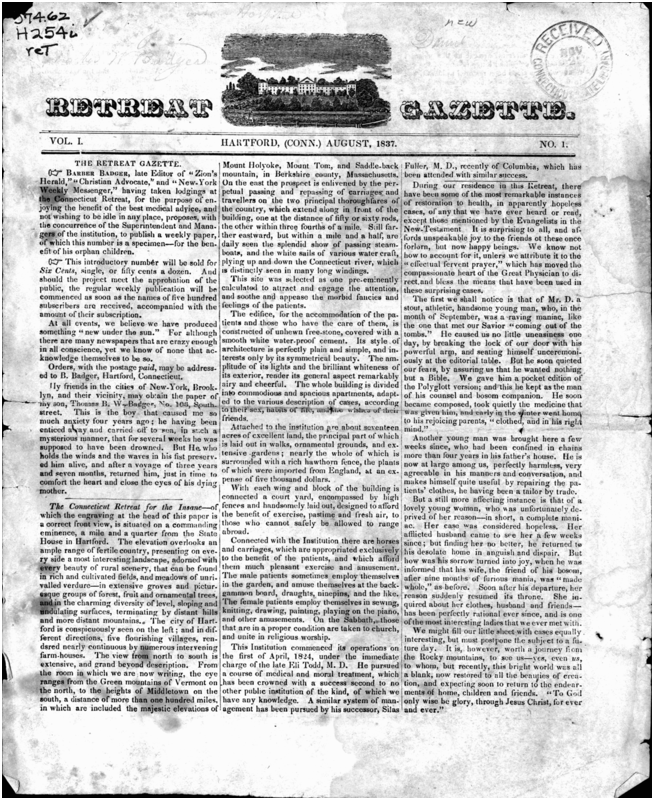
Established in 1824, the Hartford Retreat was the idea of Dr Eli Todd (1769–1833) and his colleagues at the Hartford County Medical Society, who were determined to create an institution modelled after the York Retreat in England. The original building admitted 44 patients who were offered boarding at rates varying between $3.50 and $12 per week. Connecticut residents benefited from lower fees.12 Male and female patients were segregated, with each sex inhabiting a different wing, though social mingling was allowed at dinners and events. The building was surrounded by seventeen acres of land, suitable for exercise and walks. Following the tenets of the moral treatment, the Retreat operated under what the committee of visiting physicians in 1830 described as the ‘law of kindness’.13 At least in theory, violence was forbidden and restraints were minimised, implemented only when ‘necessary for the welfare of the patients’.14 In practice, this meant that the more restless and troublesome patients, as well as those considered to be ‘idiotic’ or ‘demented’ were kept in the basement rooms of the wings. Prior to 1840, the physician superintendent was not required to live on-site. He resided in town and continued to supplant his income from managing the institution by maintaining his private practice.15
Eli Todd became the first superintendent of the Retreat and a pioneer of the moral treatment of insanity in America. Under his governance, the Hartford Retreat became a stepstone in other prominent physicians’ careers. Among Todd’s pupils were Samuel B. Woodward, who headed the Worcester Lunatic Asylum, and William Rockwell, who became the first superintendent of the Vermont Asylum for the Insane.16 In 1840, Amariah Brigham, an influential psychiatrist who later founded the American Journal of Insanity, took over the Hartford Retreat. The Connecticut institution was therefore an important medical centre that attracted physicians interested in insanity and set an example for other mental institutions in America.
At the time of Badger’s admission to the Retreat in the summer of 1837, however, the institution was experiencing difficulties. Under the pressures of overcrowding, it had expanded in 1832 and then had a housing capacity for ninety patients. Like other establishments of its kind, its management was plagued by financial difficulties, aggravated by the Panic of May 1837, which triggered a seven-year-long period of recession and uncertainty.17 The Retreat was also going through a crisis of leadership. As the blank space across the title ‘Physician’ in the May 1834 report’s list of officers suggests, finding a replacement for Eli Todd after his death in late 1833 had proven to be a challenge.18 Despite practically running the asylum during the last months of Todd’s life, which were marked by illness and frailty, Todd’s assistant and Retreat apothecary, William Rockwell, was not perceived as a suitable candidate for the position. After an unsuccessful attempt to attract Samuel B. Woodward, the hiring committee chose Silas Fuller, a physician who had made a name for himself as an able surgeon. Prior to his new appointment, Fuller had managed a private asylum within his own home, and he continued practising privately even after heading the Retreat in June 1834, making it impossible to get fully invested in his new job.19 His distraction from his duties is reflected by the halt in the publishing of annual reports during his superintendency. The tensions surrounding his frequent absences erupted in an argument with the steward, resulting in Fuller’s resignation in January 1840.20
It is amidst this turbulent time that Badger entered the Retreat and launched the Retreat Gazette. His professional skills and experience as a printer and editor enabled the inception of the publication. Describing himself as ‘not wishing to be idle in any place’, Badger commenced the periodical as an extension of his usual occupation.21 His reputation in the local publishing circles likely helped him access the equipment necessary for his project. The editor portrays the production of the first issue as the result of the solidarity and charity of some of the leading printers and publishers in the area:
We tender our acknowledgments to our brother artists of the city of Hartford, whose generosity has enabled us to print this paper. Mr. Canfield kindly loaned us the press and type – Mr. Hurlbut the brass rules – Messrs. Case & Tiffany the ornamental letters which, with the beautiful engraving, compose the title. The engraving does much credit to the head, as well as to the heart of Mr. Clark, the young gentleman who executed it.22
Philemon Canfield owned the biggest printing office in Hartford, with ten presses including the first steam presses in Connecticut. Case, Tiffany, & Co. was founded in 1836, and in 1838 it purchased Canfield’s.23 The young ‘Mr Clark’ was likely Seth Howard Clark (1814–1888), an engraver in Hartford. In this expression of gratitude, the Gazette appears to be a highly collaborative project between several publishing firms and professionals. In that respect, it is not unlike Badger’s earlier projects, especially his Weekly Messenger, which also outlined the provenance of all equipment and materials employed in its production:
The paper on which this specimen number is printed was manufactured at the extensive establishment of Messrs. D. & J. Ames, in Springfield, Mass. The type is from the foundry of James Conner, Esq. of this city [New York]. And the press work is executed on a Napier press, at the office of the New York Observer. The Supplement is printed on a similar press, at the office of the Journal of Commerce. The composition was done in the office of S. Hoyt & Co. To the latter gentlemen, to the Editors of the New York Observer, and of the Journal of Commerce, to Mr. Conner, and to all others who have generously forwarded this enterprise, the Editor of the Weekly Messenger tenders the homage of a grateful heart [emphases in original].24
The difference between the Retreat Gazette and Badger’s Weekly Messenger was that the editor required the support of a few more stakeholders. Prior to the start of the publication, Badger also secured the ‘concurrence of the Superintendent [Dr Silas Fuller] and the Managers of the institution’.25 The launch of the Gazette was therefore facilitated by the relationships between several actors and communities – book trade professionals, physicians, and patients. Furthermore, the connection with Case, Tiffany, & Co. that Badger potentially established continued to serve the Retreat until at least the early 1880s, as the printing company took on the publication of the annual reports once it resumed in 1840.
Badger was the link that brought all actors together, and his past and present life fuelled the publication. Only two issues of the Retreat Gazette appeared, and its brief existence is closely tied to Badger’s fate. Originally, the publication was intended as a weekly and was to be sold for six cents each, fifty cents for a dozen, or $2 annually. In the first issue of August 1837, the editor promised that ‘should the project meet the approbation of the public, the regular weekly publication will be commenced as soon as the names of five hundred subscribers are received’.26 Within a few days, the publication was warmly welcomed by the local and the national press. The Hartford Courant claimed that: ‘It is well filled with sprightly and amusing matter, calculated to entertain miscellaneous readers. At the same time, it contains sound moral and religious sentiments.’27 A review in the New York Journal of Commerce, widely reprinted by other newspapers, praised it too: ‘We see no evidence of a deranged mind, but much of a fertile and imaginative one.’28 As the favourable review suggests, the Retreat Gazette was a success. The first issue had an impressive circulation of 4,000 and attracted major public figures as subscribers, such as the Governor of Connecticut and Dr Woodward, the superintendent of the Worcester Lunatic Asylum.29 In comparison, it had taken Badger three years to bring the circulation of the Zion’s Herald to 5,000.30 Having ‘received the decided approbation of the inhabitants of this free and enlightened Republic’, Badger continued his work.31
The second issue, however, was delayed. It appeared in September, and it was the last number to be published. As the positive reviews indicate, the bumpy, irregular publication and the Retreat Gazette’s untimely termination cannot be explained by a lack of interest in the project. A closer look at its contents suggests that the fate of the periodical was decided by events in its editor’s life. From the first issue, the Gazette presented itself as a highly personal project. Though employing the conventional editorial ‘we’ most of the time, the introductory article to the first number uses first- and third-person singular. It immediately introduces the editor as ‘Barber Badger, late Editor of “Zion’s Herald,” “Christian Advocate,” and “New-York Weekly Messenger”’. It also states that, in addition to providing occupation to Badger while in the Retreat, the newspaper was initiated ‘for the benefit of his orphan children’.32 Badger named his son, Thomas B. W. Badger, as the New York–based distributor of the paper, finding an opportunity to mention the family’s recent history:
This is the boy that caused me so much anxiety four years ago; he having been enticed away and carried off to sea, in such a mysterious manner, that for several weeks he was supposed to have been drowned. But He who holds the wind and the waves in his fist preserved him alive, and a voyage of three years and seven months, returned him, just in time to comfort the heart and close the eyes of his dying mother.33
A brief notice confirms that Badger’s wife had passed away earlier that year:
DIED. At the residence of her husband, No. 15, King-street, New York, on the 15th of March last, Mrs. Sarah B. Badger – the wife of the editor of this paper …. Her aged parents mourn for a dutiful daughter, her afflicted husband for a lovely wife, and her four orphan children for the best of mothers.34
The notice is unusual, for the inclusion of such an announcement five months after the event makes it sound less like news than an intimate expression of inconsolable grief. The notice once again draws attention to the editor’s family and their tragedy, the alleviation of which emerges as the central purpose of the Gazette.
The first issue’s closing paragraphs support this proposition. The producers of most American asylum periodicals that appeared later were happy to receive other reading materials in exchange for their own publications. Badger, however, unambiguously focused on recruiting paying subscribers. Addressing fellow periodical editors and proprietors, he wrote:
Our brethren of the type and quill, who may be disposed to exchange with us, must be aware that their papers will be of very little service to crazy people. We, however, will readily exchange with those who will so far interest themselves in our favor as to procure a list of subscribers who will pay [emphasis in original]. If they do that for us, it will be more than many of them have been able to do for themselves.35
Badger’s exclusive interest in monetary remuneration suggests that the alleviation of his family’s financial issues resulting from his wife’s death and his institutionalisation was his periodical’s primary objective. The Retreat Gazette was Badger’s personal project through which he intended to continue earning a living and provide for his children.
The close connection between editor and newspaper was a double-edged sword. The newspaper’s reliance on a single individual inevitably tied its fate to that person’s resource. On the one hand, Badger’s extensive connections with the printing trade and openness about his struggles in the newspaper might have factored in the publication’s success by inspiring sympathy among his colleagues, friends, and the local community. On the other hand, Badger’s mental state determined the existence of the publication and its regular publication. In the introduction to the second number, the editor reveals that the delay of the publication was in fact directly caused by concerns over his well-being: ‘Some … have expressed their fears that our health may not permit us to issue the paper in regular weekly numbers.’ The issue also features the following reflection on the effects of modernity: ‘Civilization has changed our character of mind as well as body. We live in a state of unnatural excitement-unnatural because it is partial, irregular and excessive. Our muscles waste for want of action; our nervous system is worn out by excess of action.’36 Though unattributed, the quote originally appeared in The Effects of the Principal Arts, Trades, and Professions, and of Civic States and Habits of Living, on Health and Longevity (1831) by British physician Charles Turner Thackrah and was picked up and reprinted in the American press in 1837. The insertion of the passage situates Badger’s anxieties about the effects of his work in the broader discussions about the harmful effects of industrialisation typical of his time.37 Considering the dangers of overexertion, Badger reduced the frequency of his newspaper to semi-monthly, adjusting the price to $1 per year. ‘This,’ he added ‘will meet the approbation of our friends – afford us more time to mature each number, and probably contribute to the restoration of our health.’38 This is the first open expression of faith that producing the newspaper could promote healing.39 Balance was key, however: if unregulated, the intensity of the labour could be detrimental to one’s health.
In James Mudge’s History of the New England Conference of the Methodist Episcopal Church (1910), Badger appears as an important figure in the Church’s publishing activities. He ran his publications with ease, increased their circulation and improved the reputation of each, before moving on to the next project.40 A closer look at the periodicals Badger edited, however, reveals that his career as a religious newspaper editor was defined by the search for a healthy work equilibrium. In the years leading to his admission to the Hartford Retreat, Badger suffered recurrent episodes of mental distress that were caused, in his own view, by the mental overwork that editing involved. The earliest known major breakdown occurred in the mid-1820s and was likely the reason he suddenly quit his job as an editor of the Zion’s Herald. His unexpected resignation left the paper’s proprietors baffled: ‘His departure was so sudden as to prevent a formal leave of his patrons at that time.’41 In a letter to the newspaper he had now abandoned, Badger explained his move as motivated by an opportunity ‘to pursue the same arduous but delightful employment in another part of the same vineyard’, namely, as an editor of the Christian Advocate. However, he later reflected on this episode, revealing that the reason for his departure was the mental strain of his employment:
My occupation was that of a printer, and while I labored at the business, my health was good …. [B]ut after I became the editor of ‘Zion’s Herald’, … my health began to decline, gradually, and almost imperceptibly, until the disease finally terminated in a confirmed nervous head-ache … I relinquished my editorial duties altogether, with a view of trying the effect of manual labor. Accordingly, in the month of August last, I selected a small sized printing press, and commenced operation as a pressman. The result has been entirely successful.42
At the time of writing this account, likely in late 1832, Badger had already suffered a few more spells of ill health. In the winter of 1830–1831, while he was an assistant editor of the Christian Advocate and Journal and Zion’s Herald, an ‘almost entire prostration of [his] health’ urged him to consider changing ‘as soon as circumstances might permit, a scene of duty so arduous and absorbing, for one allowing time for travel and scope for muscular exertion’.43 This change did not take place until 6 June 1831, when he announced his relinquishment of his editorial duties and reflected on his experience of the past seven years and a half:
Through health and sickness, through seasons of hope and many dark hours of despondency, God will be the subscriber’s witness how much his heart has been engaged in his work – how great has been his solicitude to discharge, in some measure corresponding to its importance, a duty so weighty and momentous; and how great his anxiety, when his declining health has, for days, weeks, and months, unfitted him to sustain labour of an occupation which presses heavily on the mind, and, from its sedentary nature, severely tasks even the robust frame and firm constitution.44
Badger’s withdrawal from his trade did not last long, though. A few days later, he circulated the prospectus of his new project, Badger’s Weekly Messenger. Forty thousand copies of the first number were to be issued on 4 July and distributed across the whole country.45 In the advertisements in the press, Badger assured his new readers that his retreat to recover his health would ‘not interfere with the success of his publication, – competent editorial assistance having been engaged to conduct the paper during his occasional recesses’.46 As he progressed in his career, Badger was thus forced to accommodate for the detrimental impact of his work on his mental health.
A whole month elapsed before the second issue appeared, suggesting that Badger’s absence slowed down the work on the newspaper after all. Afterwards, the publication ran smoothly, bar some typographical mistakes that were noted by his colleagues and a scrambled pagination after the forty-seventh issue.47 The contents of the newspaper indicate, however, that by June the next summer Badger was suffering again. The issue for 4 July 1832 indicates that he had left New York on 27 June for Middletown, Connecticut, hoping that the change of scenery would restore his ‘impaired health’.48 His recovery was cut short, however, by his decision to join his family in New York on 18 July to be with them amidst the epidemic of cholera raging in the city.49
In late June 1836, Badger’s health deteriorated again, and he went away on another healing trip, this time to Hartford, Connecticut.50 This was meant to be a short absence, but an article he wrote for the literary journal Poughkeepsie Casket suggests that he was still there in late September. According to his account, Badger, in a ‘debilitated state of health’, and his physician paid a visit to poet Lydia Huntley Sigourney.51 From 1831 onwards, Sigourney’s works, original and reprinted, had appeared regularly in Badger’s newspaper, then called the New York Weekly Messenger and Young Men’s Advocate. Upon his visit, the editor thanked the poet ‘for having sustained my feeble steps in my early walks in the paths of literature’ and requested ‘an article or two wherewith to sustain the character of my paper’.52 Sigourney kindly obliged him, agreeing to lend her local fame once again to support his newspaper. It is uncertain whether the poem ‘On Sickness’, which she wrote and sent to him only a few hours later, was included in Badger’s publication. Within a month, Badger’s name was removed from the front page of the New York Weekly Messenger and Young Men’s Advocate.
Beyond the death of his wife in March 1837, there is little information about Badger’s life and movements during the year preceding his admission into the Hartford Retreat. What is known about him clarifies the role of the Retreat Gazette in the editor’s life. Beyond supporting his family, the asylum periodical reflected his struggles with work-related stress. Whether his own or the physicians’, the concerns about his health, which necessitated the reduction of the periodical’s frequency, were founded on a decade of recurrent suffering and distress that rendered him incapable of working consistently as an editor. In the asylum, Badger once again had to find the right balance to turn his work into a restorative occupation rather than a source of debilitating pressure. The purpose of the periodical hence underwent a shift in focus between the two issues. The second number contains no more mentions of his family matters. From a project explicitly intended to support his struggling family financially, the Retreat Gazette was recognised as a potential cure, which might speed up his reintroduction into society as a provider for his children. Both of these purposes are, however, closely intertwined with Badger’s personal and professional life, and so is the end of the periodical, resulting from his discharge from the Retreat unrecovered.53 Badger died in 1854, without producing any other known publications.54 The Retreat Gazette was therefore his last notable work, marking the potential closure of his career as a newspaper editor. His invisibility from the records, however, leaves the chance that in the last years of his life, he returned to the kind of work that he found remedial: printing.
Learning to Print: John Reid Adam’s Chronicles of the Monastery (1842)
The first asylum periodical printed in Scotland was also a patient-driven initiative. The Glasgow Royal Asylum (also known later as the Gartnavel Royal Hospital) acquired a press in 1842 and started issuing the weekly Chronicles of the Monastery in the same year. It is hard to tell whether the physicians or patients of the Gartnavel were aware of the American predecessor of their publication, as no British libraries seem to hold copies of the Retreat Gazette, and there is little evidence that contemporary British and Scottish periodicals reviewed it.55 It is also unclear whether its producers were aware of its direct predecessor, the manuscript ‘Glasgow North Briton’. The launch of the Chronicles was the responsibility of two enthusiastic individuals with no previous professional experience in the book trade. One of them remains unidentified, but the other was John Reid Adam (1806–1866), a Scottish merchant with poetic aspirations who taught himself how to print in the asylum.56 The Chronicles was free and circulated only within the institution. Like the Retreat Gazette, it had a short run, but no copies of it seem to have survived. It is still possible to learn more about the periodical and the role it had in the institution by piecing together Adam’s life. His biography also reveals his direct and indirect involvement in at least two other asylum periodicals.
Most of what is known about John Reid Adam comes from John Reid Adam himself. Throughout his life, he produced a substantial body of autobiographical poetry and prose, published independently or in asylum periodicals. Using Adam’s own narratives alongside asylum documentation, newspaper articles about his adventures, and other sources, I have managed to identify him as the individual behind the pseudonym ‘IRAM’ (or ‘Iram’). This is a close abbreviation of the name he believed he deserved, John Reid Adam Maxwell, of the rich Maxwell family of the Pollok estate in Renfrewshire.57 Catherine Reilly has claimed that Adam did indeed inherit the estate, but I have not been able to find any connection between John Reid Adam of Colinslee and the Maxwells other than geographical proximity.58 Nevertheless, Adam used that pseudonym for the rest of his life and was financially capable of spending the last seventeen years of his life as a private patient in the Royal Edinburgh Asylum. Even if not a Maxwell, he had the means to support his maintenance at the institution.
The Glasgow Royal Asylum was founded in 1814 in Dobbie’s Loan to accommodate the insane patients of the Town’s Hospital. It received a Royal charter in 1824. In 1840, a large plot of land in Gartnavel was purchased, and by mid-1843 the new building was ready to accommodate the patients. Like other early asylums in Britain, the Glasgow Royal was originally run by laymen, but as the century progressed, its administration was overtaken by medical professionals. In 1840, William Hutcheson became its first resident physician, but he fulfilled the duties of superintendent and wrote the annual reports for most of the decade. While practices in the Gartnavel did not always fit with the postulates of the moral treatment, there were marked attempts under the first superintendents to adopt the new principles.59 For instance, both Hutcheson and his successor, Dr Alexander Mackintosh, were proud advocates of non-restraint, although they did not adhere to it consistently.60
The Glasgow Royal Asylum received John Reid Adam as a private patient on 22 October 1839. At the time of admission, Adam was in a state of delirium tremens due to alcohol abuse, following several difficult years of financial troubles related to his family’s bleaching business and to the death of his infant son.61 Despite discomforts such as ‘rare belly-fulls’ and the unpleasant business of digging up a well, he claims to have received ‘kind and humane treatment … under the care of Dr. Hutcheson’.62 He seems to have enjoyed his stay enough to refuse to leave. Though deemed to be cured on 27 July 1841, he arranged to remain in the asylum as a voluntary boarder.63 In his own words, this decision was driven by concerns for his unstable financial situation. He remained in the asylum,
to see if any compromise could be effected with my grandfather’s trustees, when I might have been enabled to enter into some respectable line of business. But having been on a visit to my parents and sisters, some months ago, I learned that there was just as little prospect of a satisfactory adjustment as ever.64
It is unclear how long he stayed there voluntarily, but in November the following year he was officially admitted as a patient once again.65
Launched seven years after the manuscript ‘Glasgow North Briton’, Chronicles of the Monastery was the Glasgow Asylum’s first printed publication. It was published for ten weeks in 1842, during Adam’s voluntary stay at the Gartnavel. We learn about it from the Gartnavel Minstrel, Adam’s poetry collection which he produced himself, after leaving the institution and finding employment as a printer in Glasgow 1845:66
The Doctor ever willing to encourage all rational amusement, readily furnished another boarder and myself with a small press and a font of types, with which we commenced a Weekly Periodical as Co-Editors. My department lay chiefly in providing for the ‘Poets Corner’.67
It is likely that some of the poetry appearing in Adam’s Minstrel was reprinted from the pages of the asylum periodical. This is certainly true of the ‘Introductory Address’ to the Chronicles, a poetic piece of thirty-nine, four-line stanzas that welcomed readers to the new publication, promised original writing and news about asylum life, and invited contributions. The poem claims that the purpose of the periodical was to ‘cause on beauty’s rosy cheek / Perhaps a pretty dimple’.68 However, another intention surfaces throughout the poem, evident even in the reference to ‘beauty’s rosy cheek’. The ‘Address’ is particularly insistent on encouraging writings from the ladies in the asylum: ‘But most of all, we fondly hope, / The sisterhood so fair, / Will send some cutting articles.’69 Seven stanzas are dedicated to persuading the female patients to share their writings, and, towards the end of the poem, the speaker adds: ‘The sisterhood we seldom see, / They’re rather out of view.’70 These lines reflect one of the realities in the Gartnavel that Adam clearly struggled to accept: patients were separated by gender. Clearly, one of the purposes of the Chronicles was to bridge this divide and enable interaction that was otherwise denied or limited.
The introductory poem also shows that the periodical offered its editors a chance for voicing complaints. In comparison to the Retreat Gazette and most asylum periodicals that appeared later in the century, the Chronicles seems quite bold in that respect. Throughout the poem, the speaker adopts a playful tone. Using light-hearted jokes and puns, he outlines the different aspects of asylum life that the Chronicles will report on, including negative experiences such as ‘the cold water cure’ and the ‘game of hush or whist’ played by the clinical assistants.71 He also mentions the threat of punishment that the more vocal patients faced:
Perhaps emboldened by his status as a voluntary boarder, Adam employed a highly subversive tone that pushed the limits of his privilege and freedom. Though the ‘Address’ clearly seeks to soften its own criticism by flattering those in power and appealing to their generosity, it presents the Chronicles as a platform where institutional tensions could be discussed and ironised.
The boldness in the poem is also palpable in the title of the periodical. An explanatory note in the Gartnavel Minstrel discloses its origins: ‘The Asylum had been by some of the inmates, facetiously termed the Monastery of La Trappe: hence the origin of the title given to our periodical.’73 By the time of publication, the Monastery of La Trappe had become a well-known curiosity. Numerous pieces of travel writing in the periodical press told of this convent, taking especial interest in two of the characteristics of the order, namely, their oath of silence and their intense preoccupation with death. La Belle Assemblée compared life at La Trappe to ‘a living grave’, while the Weekly Entertainer states that:
The living may be said to reside with the dead; and that they may be continually reminded of their mortal state, a grave is always left open for the reception of the next that dies; and we are told, that each individual of the fraternity prayed sincerely that he himself might soon become the occupier.74
In Scotland, Tait’s Edinburgh Magazine observed in 1841 that ‘those who become its [La Trappe’s] members, cease altogether to meddle with the world’.75 The image of the silent, isolated monks awaiting their mortal end must have inspired the Gartnavel patients’ inside joke. It is unclear whether the association was inspired by the clinical assistants’ ‘game of hush and whist’ that silenced patients like the monks, or the parallel was gloomier, referring to the potentially oppressive, isolated life in the institution. Either way, the new publication promised to disrupt the deathly silence and brighten the days of the inhabitants of the Gartnavel ‘monastery’.
Beyond Adam’s Minstrel, the Chronicles is discussed in the physician’s annual report for 1842. There, Dr Hutcheson presents the acquisition of the printing press and its operation as an expansion of the array of activities offered to patients:
To the occupations mentioned in my last Report, we have added printing. Having procured a small press and a supply of types, and given one or two of the most intelligent Patients a few hints, they very soon overcame the mechanical difficulties, and acquired so much expertness, that at one time I entertained a sanguine hope that this Report would have been printed within the Asylum, by my friends. … No sooner had the printers acquired a certain degree of expertness, than a periodical commenced; and the contributions of the inmates, exclusive of those too absurd to be printed, were far more than sufficient to fill its pages. It went on vigorously for ten weeks, when, owing to the discharge of some of its contributors, the paper was abandoned.76
Dr Hutcheson’s statement highlights the importance of the press and the Chronicles to Adam, as well as the institution. The provision of occupation to the boarders was motivated by the physician’s hopes of producing the annual reports in-house. For Adam, however, publishing the periodical was much more than a pastime. It was a chance to acquire and practice a new skill, which changed the course of his life. In the Gartnavel Minstrel he wrote that:
It is therefore to the indulgence granted me by the Physician, sanctioned by the board of directors, added to the kind encouragement I have received from Dr. [Thomas] Prichard [the Physician’s Assistant] and others in the house, that I am chiefly indebted for the practical knowledge of letterpress printing, and consequently in the power of publishing my own productions, chiefly by individual exertions.77
After his discharge, Adam pursued printing professionally and published his own writing. He wrote that his works ‘would never have been brought before the public in this, or any other form’, had it not been for his admission into the Gartnavel.78 The Chronicles thus mark the starting point of Adam’s career as a printer and poet. Despite its limited readership, it was the first platform where he could express his creative urges.
Even as a voluntary boarder in the institution, Adam’s access to resources depended on the good will of the superintendent. Hutcheson was also able to decide what material was ‘too absurd to be printed’, as he himself put it.79 Furthermore, according to the records of the Gartnavel, Adam was readmitted officially as a patient on 8 November 1842 and stayed until he was deemed ‘cured’ on 22 September 1844. The annual reports for 1843 and 1844 do not indicate that the Chronicles was reinstated after Adam’s return. However, there is evidence that the printing office of the institution continued to be in operation after his discharge and potentially even during his stay. The annual report for 1845, for instance, was printed at Gartnavel. Though the printing of later reports was outsourced once more, the printing office was regularly improved, suggesting that the press was employed for other jobs. An account of the work tasks completed by patients during 1845 reports the ‘fitting up [of the] Printing Office with Tables, Boards, Shelves, &c.’, while in the following year, male inmates ‘alter[ed] a Frame for holding TypeCases,&c. [sic] for Printing Office’.80 By the early 1850s, the press had seemingly fallen into disuse. It remained inactive until 1853, when a few enthusiastic patients asked to produce a periodical once again – an event that is discussed in Chapter 4.
Tracing Adam’s life beyond his discharge from the Glasgow Royal Asylum and the publication of the Gartnavel Minstrel shows that he continued his literary career in London. By the autumn of 1845, he was in the city, trying to make a career out of his interests in poetry and theatre. A notice of Adam’s upcoming performance appeared in Bell’s Life for 19 October: ‘Mr J. R. Adam … has engaged the [Western] Literary and Scientific Institution, Leicester-square, for the 28th.’81 In the following report, Bell’s Life states that the event was attended by ‘a numerous audience’ and consisted of ‘original compositions of great merit, readings from the finest parts of “Hamlet” and “Macbeth,” and other interesting selections from the older dramatic writers’.82 It congratulates Adam for one piece in particular – ‘the “Ode to Wellington,” a rhetorical effusion, which charmed us with the power and truth of its style, and the brilliancy of its delivery’.83 By early 1846, Adam’s talent for reciting poetry had earned him a name as the ‘Scottish Improvisatore’, and he was employing his printing skills to circulate his poetry more widely.84 Following the favourable review of the ‘Ode to Wellington’, Adam published it alongside other pieces, using his own ‘Lilliputian Press’ on 20 Sermon Lane, St Paul’s, in January 1846.85 In the summer, Adam had another volume of his published, this time by H. Peet on Earle Street. The Iron Dukes’ Veterans: A Poetical Memoir of the Waterloo Heroes Assembled in the Ante-Room for the Apsley House Banquet was intended to be distributed among the guests of the annual event that took place on 18 June 1846. For the purpose, it was ‘originally printed in large type, so as to be legible to the aged veterans themselves’.86 The special printing requirements can potentially explain why Adam did not print the collection himself. Brief reviews of the book appeared in both Bell’s Life and the Times: the former called the author ‘a man of strong mind and natural genius’, while the Times congratulated him for the ‘humble, but earnest rhymes’.87 Beyond publishing his poetry, Adam made several unsuccessful attempts to contact theatre directors to launch his career as an actor.88 His passion for composing and reciting poetry eventually secured him a job: in the summer of 1846, he became the Invisible Poet of Cremorne Gardens.89 In that position, Adam, hidden out of view, would ask visitors of the gardens to write their names on slips of paper and drop them through a letterbox. At the price of two pence, he would produce four-line verses, offering a rhyme for each visitor’s name.90
The employment in Cremorne Gardens must have been a very important achievement for Adam. After more than a year of trying to capture the attention of the London public and theatre world, he was finally allowed to make a living out of his passion for poetry. The poems he wrote during that year and published later in his collection All Sorts (1856, 1859) demonstrate that he took great pride in his work there. Several of the poems he included were produced during his employment there and are dedicated to the place and the people who managed or visited it. In each of them, he dedicates a few lines to the ‘Bard unseen’ and his cot.91 In the 1859 edition of the collection, he also added sixty-nine of the poems he produced for the visitors of the Poet’s Cottage at Cremorne, most of which were written for women.92 Their inclusion in the collection over ten years after their original production shows that Adam preserved them, as he saw them as precious fruits of his poetic inspiration he was proud to share.
In the spring of 1848, however, Adam’s life took a turn for the worse. The Times reports that, after producing ‘poetic effusions … of so degenerate a character as to have given offence to the visitors’, he lost his job in Cremorne Gardens.93 Driven to desperation by the loss of the job that he had worked so hard to secure, he went to the Gardens once more and delivered ‘an open air lecture upon “The transition of the soul from the body after death”’.94 What followed was a squabble with the managers of the gardens, leading to an assault on a policeman and the beginning of a series of detainments. Adam was first sent to Westminster Bridewell prison, then to Hanwell Lunatic Asylum. Eventually, he was transferred back to Scotland: from 15 September 1849 until his death in 1866 he resided in the Royal Edinburgh Asylum. The case notes from the date of his admission state that: ‘His friends attribute his insanity to the death of one of his children, to whom he was passionately attached, to the conduct of his wife and partly to dissipation.’95 Further entries show that, while initially peaceful and content, by the summer of 1850, he was growing restless and increasingly anxious about his confinement.96
Though not always pleased with his detainment, in Edinburgh Adam had opportunities to display his talents. He was a regular participant in theatre performances at Morningside and by April 1853, he was referred to as ‘the sprightly and indefatigable’ stage manager of the institution.97 He also engaged in scene painting for the regular asylum balls.98 Within a year, he got himself involved in the printing office of the institution.99 In addition to the two editions of his All Sorts, he published a volume of verse about his travels to Malta as a young man and became a key contributor to the periodical of the asylum, the Morningside Mirror. The Mirror was launched in 1845, the same year in which the institution acquired a press. It was a single-column eight-page monthly in a compact octavo format that was allegedly produced entirely in-house by patients.100 A survey of the periodical reveals that, under the pseudonym ‘Iram’, Adam was one of the main contributors to the magazine between 1850 and 1860. During his most active year (1854), nearly half of the pages of the periodical were filled with his works.101 At the peak of his literary activity, he composed original poems that served as the mottos for volumes nine to twelve.102 He also ran the rubric ‘Monthly Retrospect’, where he recounted the major occurrences in the asylum. In an 1858 note from the Mirror’s editor, he is referred to as ‘Our Own Reporter’.103 For a few years of his stay, Adam established himself as a dominant presence on the pages of the Mirror, shaping and defining the periodical.
Both in the Glasgow and the Edinburgh asylums, Adam’s literary function was reflected by a prominent and privileged position in the institutions. At Morningside, this allowed him to be present at all the important events he reported on. While his status as a private patient already secured him access to luxuries such as better accommodation and board, his creativity and his involvement with the Mirror reinforced his privileged position. On one particular occasion, he mentions that he was one of ‘among a selection of the ladies and gentlemen of the first-class inmates’ who were taken out of the asylum for a trip.104 He was allowed to leave the asylum to go to the theatre and other amusements in town.105 His poetic and dramatic talents were also employed during special events, and he gave recitals praising the staff and the institution.106 Adam was therefore not merely present and informed about all the affairs in Morningside but was a central participant in events involving both patients and staff. His involvement with the Mirror and the recreational programme of the institution thus both reflected and reinforced his position in the asylum. In 1860, the signature of ‘Iram’ stopped appearing in the periodical. He passed away six years later in the same institution, leaving a deep mark in the history of asylum periodicals in Britain.
The stories of the founders of the first asylum periodicals show that these publications were driven primarily by single individuals’ ambitions and needs. The overtly stated aims of these projects were the provision of occupation and amusement for the patients, but understanding their functions fully requires them to be situated in the contexts of their founders’ lives. The Retreat Gazette marked the ending of Barber Badger’s fifteen-year-long career as a prominent newspaper editor – a career repeatedly interrupted by breakdowns resulting from work-related stress and personal loss. The Chronicles of the Monastery, on the other hand, was John Reid Adam’s first publishing project. It equipped him with the skills to pursue his passion for writing and theatre professionally, publicise his story and poetry, and gain privileges in the Royal Edinburgh Asylum later. Early asylum periodicals thus embodied their founders’ struggles and allowed them to navigate the complexities of life within and beyond institutions. This is characteristic of later publications too. Even though physician-superintendents got more involved as editors, contributors, or agents soliciting contributions from patients, asylum periodicals fulfilled important functions in patients’ lives that were determined by their personal circumstances and aims. For the most part, these were patient-driven initiatives that allowed inmates of institutions to make sense of and shape their experience.
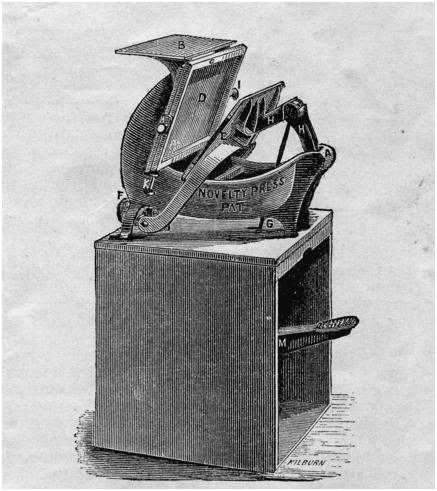
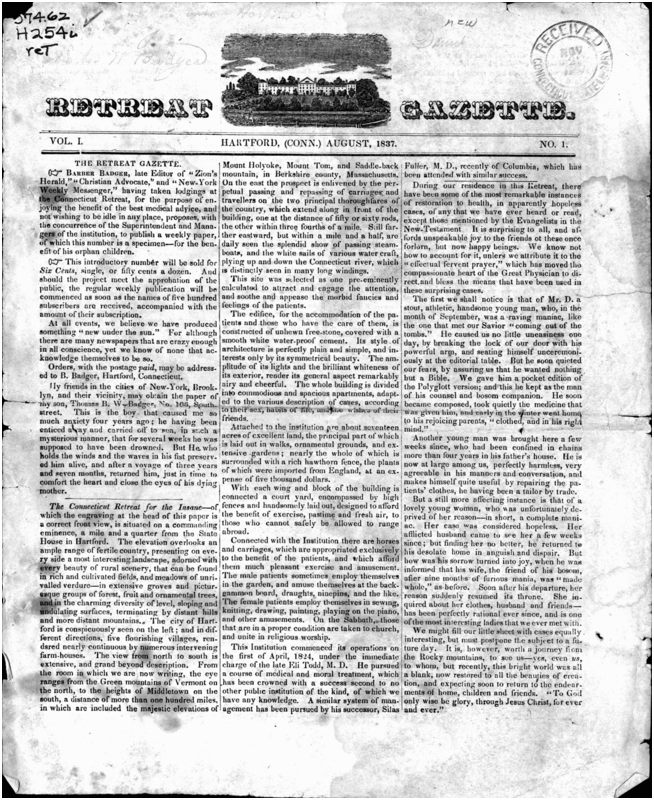

 Open access