


1. Introduction
Aesthetic taste, as defined by Fenner (Reference Fenner2020, p.116) is “the ability of the attender to experience in aesthetic objects the presence of aesthetic properties or, in short, to experience (certain) objects as aesthetic objects.” Taste in this sense is twofold, first as a quality of a consumer, and secondly, as a quasi-objective judgement of an object. Throughout this paper, taste is used in the first sense. Taste is a form of expertise acquired experientially; in other words, by consuming the product. Alba & Hutchinson Reference Alba and Hutchinson(1987) proposed that expertise in a product category grows with product familiarity and consumption of products in that category. As this type of expertise is not expressly acquired through instruction or professional experience, it has been difficult to study for a few reasons. First, without a suitable metric for defining aesthetic taste, there is a difficulty with selecting suitable experts. Second, even when experts can be identified subjectively, there is still a difficulty in adjudicating their level of expertise. Yet society’s judgement of aesthetic taste drives the world – from market predictions to automobile manufacturing specifications to funding arts programs. In these contexts, primacy is given to persons adjudged to have high aesthetic taste.
In addition, there is a lack of understanding of the cognitive processes associated with aesthetic taste in decision making and how these cognitive processes differ between persons with high aesthetic taste and persons with low aesthetic taste. Camerer & Johnson Reference Camerer and Johnson(1991) provide the rationale for exploring cognitive differences, they explained that the cognition of experts is more sophisticated than that of novices, and a model of the cognition of experts would help even non-experts produce better judgements. While some methods exist to qualify people into different levels of aesthetic appreciation, such as the Centrality of Visual Product Aesthetics (CVPA) scale, which measures the personal importance of aesthetics (Bloch et al., Reference Bloch, Brunel and Arnold2003a), these methods only provide a means to categorize people as having high or low aesthetic taste. To understand aesthetic decision making, we need to learn more about how people of high aesthetic taste deploy their cognition in decision making. One way to do this is by studying their product evaluation strategies.
In Hsee’s Reference Hsee, Kahneman and Tversky(2000) paper on the evaluability hypothesis, the joint evaluation-separate evaluation reversal (subsequently called the JE-SE reversal in this paper) is described as a phenomenon whereby a sample of consumers, when presented with two options, value those options differently when comparing the options simultaneously versus when they analyse them individually. In the paper, Hsee presents a possible real-life scenario of the JE-SE reversal: where a consumer purchases the best-sounding speaker in a store out of competing options (using the joint evaluation mode), but dislikes how it fits with the rest of the interior decoration once the speaker is set up at home (using the separate evaluation mode).
Adopting Hsee’s paradigm in this paper, we explore the relationship between evaluation modes and aesthetic taste. In addition, we compare two dimensions of aesthetic taste: expertise, as acquired through professional experience; and acumen, as acquired through lived experience. We also contribute to the literature by utilizing a redefined idea of separate evaluation. Our work contributes to the literature in two ways: first, we conceptualize a method to study the JE-SE reversal using a product choice context. Second, we compare aesthetic taste using two dimensions.
This paper proceeds are follows. First, we review the literature and describe our approach for studying the JE-SE reversal in a product design context. Second, we describe an experiment to deduce the evaluation mode of consumers during aesthetic decision making; in the study we compare aesthetic taste across the dimensions previously outlined. Finally, we present the results of the experiment and discuss future extensions of this line of research.
2. Background
Hoyer & Stokburger-Sauer Reference Hoyer and Stokburger-Sauer(2012) were among the first to consider the role of aesthetic taste in consumer judgements. Based on an analysis of psychology, sociology, and philosophy literature, they defined consumer aesthetic taste as “an individual’s consistent and appropriate response to aesthetic consumption objects through any of the five senses that is highly correlated with some external standard” (p. 169).
Their work divided aesthetic taste in two metrics based on the value of the product: when the product is valued as a hedonic object, the expertise generated by consumption is consumer taste; when the product is valued as a utility (i.e., by its function), the expertise generated by consumption is consumer knowledge. While the former is driven by affect, the latter is driven by cognition. They also developed a framework of three categories, where the consumer judgements made are some combination of cognition and affect, ranging from mostly cognition in Category I, to an even split of both in Category II, to mostly affective judgements in Category III.
Product design objects have functional elements which require understanding, but their selection by consumers requires some aspects of taste; therefore, aesthetic judgements of product design, such as selecting a new speaker, are in Category II of Hoyer and Stokburger-Sauer’s framework. While listening to music has mostly hedonic value, selecting a speaker requires an understanding of the product’s attributes. Thus, product design judgements present a credible opportunity to understand the cognition of “taste experts,” i.e., people with high aesthetic taste.
Researchers have largely studied aesthetic taste with respect to affect (Category I of Hoyer and Stokburger-Sauer’s framework). Particularly, Holbrook Reference Holbrook(2005) explored taste in movies by comparing the ratings of experts, ordinary evaluators, and popular appeal. Fingerhut et al. Reference Fingerhut, Gomez-Lavin, Winklmayr and Prinz(2021) evaluated taste by investigating consumer preferences in music and art. Another area of enquiry has been whether high aesthetic taste is a natural phenomenon, due to more advanced visual and spatial awareness possessed by persons with high taste compared with the general population (Reference McManus and KitsonMcManus & Kitson, 1995) or how it can be acquired (Reference FennerFenner, 2020). There is a common thread across these and other studies of aesthetic taste: that consumers demonstrate their taste through their choice of products to consume. This implies that studying the decision-making processes of consumers with high aesthetic taste could yield definitive reasons for how they differ from consumers with low aesthetic taste. We contend that the evaluation mode they use in making their decisions should be paid closer attention.
As defined earlier, the JE-SE reversal is a phenomenon where consumers value options differently when presented together compared to when presented separately. Consumer behaviour researchers have criticized the discussion of this phenomenon as comparing a choice decision (joint evaluation) to a judgement decision (separate evaluation) (Reference Schmeltzer, Caverni and WarglienSchmeltzer et al., 2004). However, the JE-SE reversal phenomenon has been robustly confirmed and remains useful in understanding consumer evaluation, as we show in this paper.
In their review of JE-SE reversals, (Reference Hsee, Blount, Loewenstein and BazermanHsee et al., 1999) explain that separate evaluation refers to two kinds of situations: those where two or more options are evaluated by different individuals where each person only sees one option, and those where two or more options are evaluated by the same consumer but at different times such that only one option is ever considered at a time. We posit that both instances of separate evaluation are merely instances of judgement decisions. To truly analyse JE-SE reversals, the same decision (a choice or a judgement) should be presented in the joint evaluation scenario and well as in the separate evaluation scenario.
Given a product design choice decision with a context of use, for example, a choice between two speakers for a home office, there are two evaluation modes that a consumer needs to consider: (1) an evaluation of options based on the product attributes (i.e., joint evaluation or JE) or (2) an evaluation of options based on the product’s fit with the context (i.e., separate evaluation or SE). In this paper, we devised a study that presents a product choice scenario and analyze the decision-making strategies of high and low taste participants. We describe the study and rationale in the next two sections.
3. Research questions
We propose that separate evaluation is associated with high aesthetic taste. As consumers with high aesthetic taste are known to have well-curated homes or products (Reference Sivanathan and PettitSivanathan & Pettit, 2010), when making product choices they must consider the product’s fit with the context of use as much as they consider the choice alternatives. We contend that this dual cognition (comparing each product’s fit with the context and choosing the better fit) is indicative of high aesthetic taste, as the simpler cognitive process (joint evaluation) will only compare the two product choices. In Figure 1 below, we illustrate this proposal.
Joint and separate evaluation modes in product choice

This paper seeks to answer two research questions:
RQ1: Are consumers with high aesthetic taste more likely to deploy separate evaluation when making product design choices compared to consumers with low aesthetic taste?
RQ2: Do consumers differ in product choice decision making depending on their dimension of aesthetic taste?
In the following section, we describe an experiment conceived to investigate the research questions.
4. Methodology
To study this phenomenon, we needed a product choice scenario where we could study the decision-making process that informed the choice selected as well as group the participants into high and low taste categories. Thus, an interactive preference elicitation study was designed. Participants were invited to join the study in person or online via web conference where they were guided by a moderator. The moderator provided a computer (for those in person) or shared their screen (for those online) to allow the participants provide their responses to the interview questions.
For this experiment, we were interested in showing that aesthetic taste can be acquired outside of formal design instruction by comparing two dimensions of aesthetic taste: expertise and acumen. Ethics approval was received from our institutional Research Ethics Board.
4.1. Participants
Two groups of participants were recruited for this study: 25 interior design professionals were recruited from across Canada, and 77 general population participants were recruited from the Toronto area. General population participants were asked about their design experience during recruitment and only persons without formal design instruction were selected.
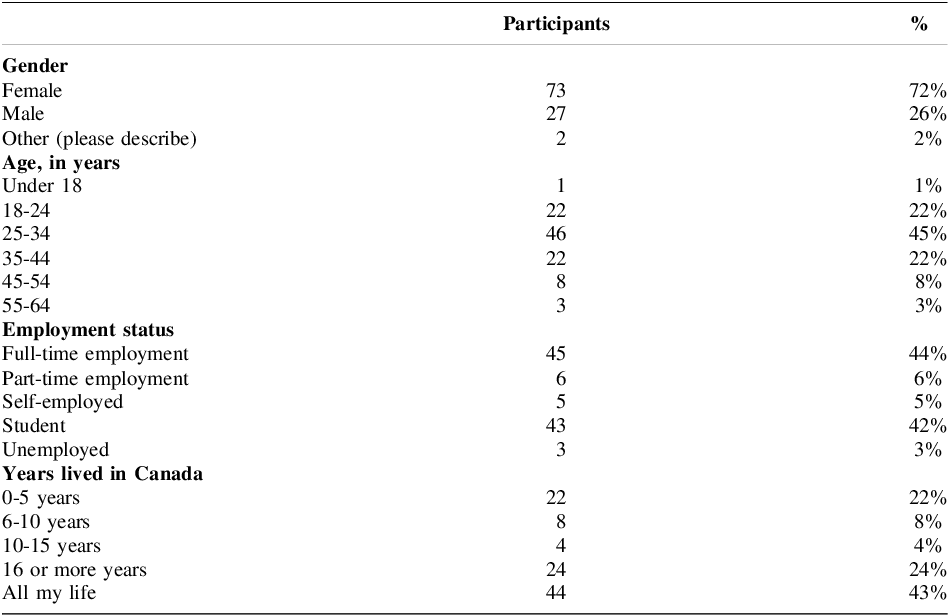
Table 1 below shows the demographic breakdown of the recruited participants. While there are significantly more participants of the female gender compared to the male gender, this is due to the interior designers’ group, where women represent more than 80% of the global population of interior designers.
Demographic table of study participants

4.2. Stimuli
Reading chairs were selected for this study because, while it is a hedonic product, it also has a functional use. Thus, it is a good fit for Category II of Hoyer and Stokburger-Sauer’s (2011) framework.
4.3. Procedure
At the start of the experiment, participants completed a demographic survey and were informed that they will be given a prompt and shown images of two product options. They were asked to select whether they prefer to view the options simultaneously or individually. Next, all participants were read the following prompt while viewing the image beside it:
Image of the apartment shown in the experiment. Image rendered using Midjourney, a generative artificial intelligence tool

Please consider the following scenario: A friend of yours has just moved to a new city and sent you a photo of their new apartment. The picture shown on the screen is a representation of your friend’s apartment.
You have decided to get them a gift to mark the occasion. Since they enjoy reading books, you have decided to purchase a reading chair for their apartment.
Accordingly, you visit a home goods online store where you are presented with the following two options.
Of the two chairs, which do you select?
The experiment prompt was designed to provide participants with a scenario independent of their own experience, to reduce the influence of their personal preferences on their product choice. Prior to the experiment, the study prompt was validated in a pilot experiment.
While the prompt was read to them, participants were shown two images (depending on the viewing option selected) of a website showing two chairs as well as other product attributes such as the material, customer rating, and product description. Figure 3 below shows the two chairs in the simultaneous viewing option. To maximize realism, we presented the two reading chair options using the user interface of Etsy, a home goods online marketplace.
The two reading chair options presented to the participants. To confirm the study’s manipulation, one of the chair options (left) had the same brown hue as the apartment

Participants were then asked to select their preferred choice and to provide a rationale for this choice. They were also asked if any information not provided could have affected their choice.
Finally, participants from the general population were asked to complete the Centrality of Visual Product Aesthetics (CVPA) scale, a validated, self-reported measure used to score the importance of visual aesthetics to the rater. Participants were allowed to revisit the image of the apartment, as well as switch between chair options (for those viewing the chairs individually), to simulate real-life purchase experiences. Their choice and rationale were recorded by the moderator.
4.4. Data compilation
Using the method validated by Bloch et al. (Reference Bloch, Brunel and Arnold2003b), the CVPA score for the general population participants was collated and used to assign the participants into categories. Participants in the upper tercile of CVPA score were assigned to the “high aesthetic taste” category while participants in the lower tercile of the CVPA score were assigned to the “low aesthetic taste” category. Participants in the middle tercile were excluded from our acumen group analysis.
Our data includes two categorical variables (expertise and acumen), each with high and low levels. Thus, we have four participant groups: the low expertise group, randomly selected from the general population; the high expertise group, comprised of the interior designers; the high acumen group, made of the general population participants with top tercile CVPA scores; and the low acumen group, comprised of the general population participants with the low tercile CVPA scores. Each of the four participant group was of the same size (25 participants).
5. Results
This section presents the results of the study described in the previous section. Each sub-section presents the results of the two research questions.
5.1. Aesthetic taste and evaluation mode
After the experiment, the first sentence of the participants’ rationale was coded independently by two raters as either joint evaluation (where their selection and rationale are based primarily on a comparison between the chairs) or separate evaluation (where their rationale is based primarily on a comparison between the chairs and the apartment). After the first round of coding, interrater agreement was 68%, which led to collaborative arbitration. Post-arbitration, the Cohen’s kappa was 0.88 reflecting very strong agreement between both raters.
To confirm that our experimental manipulation worked, we performed a manipulation check comparing the reading chair option selection and the evaluation mode for all participants. A chi-square test of independence showed that there is a significant association between selecting the first option (shown on the left in Figure 3) and using the separate evaluation mode (X2 = 7.7447, p = 0.02). Given that Option 1 had a similar hue as the apartment, this validates our methodology and qualitative coding as it shows that participants deploying separate evaluation were more likely to consider the apartment in their decision-making process.
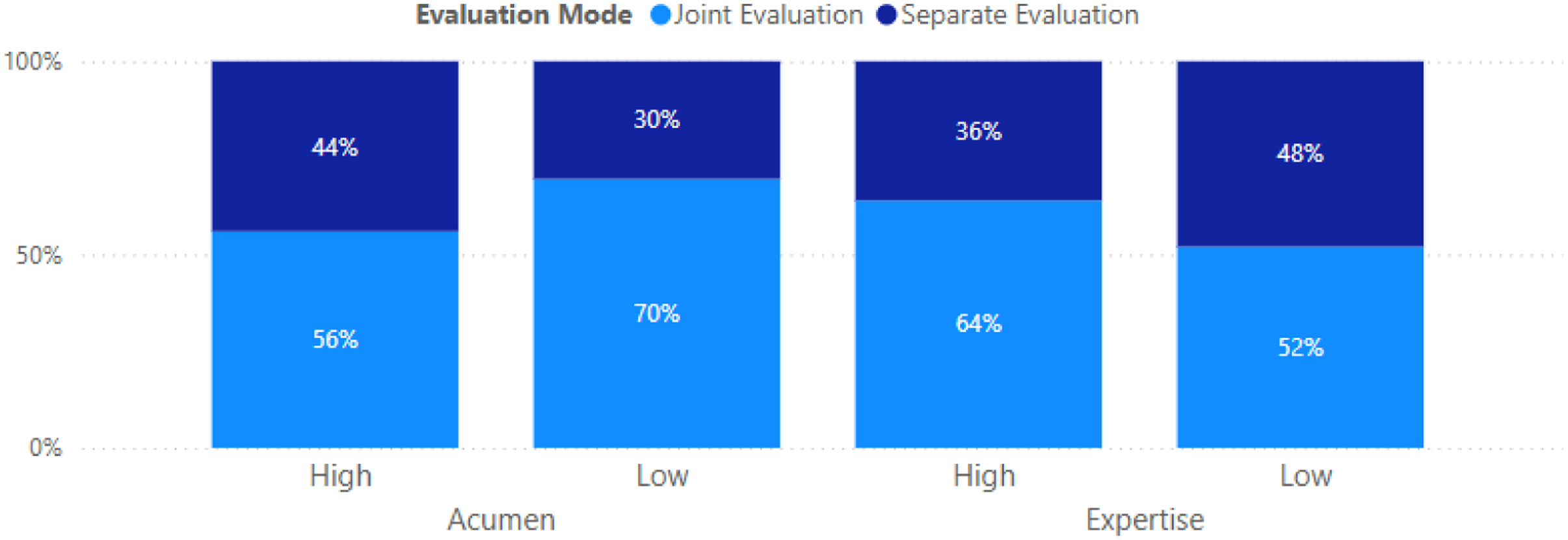
Using Fisher’s Exact Test, due to the small sample size for each group, we found that while participants with high expertise are almost twice as likely to make product choices using joint evaluation than participants with low expertise, the different is not significant (Odds Ratio = 1.64, p = 0.57). In addition, we do not find support that participants with high taste evaluate choices using different evaluation modes from participants with low aesthetic taste (Odds Ratio: 0.56, p = 0.38). Figure 4 below shows the count of two-way codes across the two aesthetic taste dimensions.
Graph showing breakdown of joint evaluation-separate evaluation two-way coding for each participant group of 25 participants

Finally, we ran a logistic regression on the data from the general population to analyze the relationship between evaluation mode (separate or joint evaluation) and the overall score from the CVPA scale. We found that even though there is a positive relationship between evaluation mode and an increase in the CVPA score, the relationship is not significant (β = 0.038, p = 0.34).
5.2. Differences in product choice decision making by aesthetic taste dimension
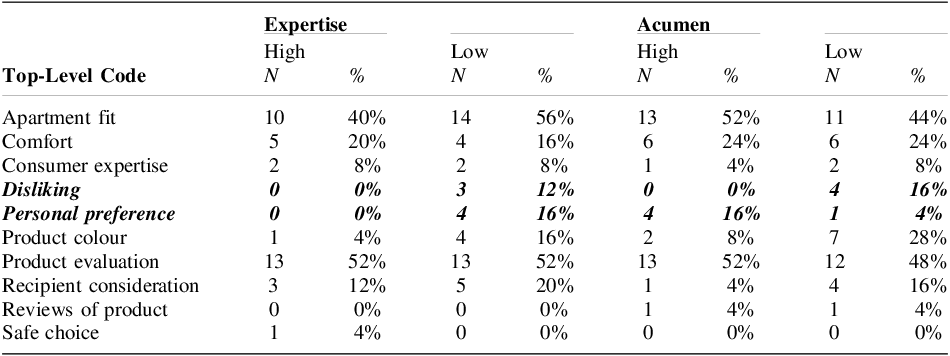
To understand the decision making of the participants, we utilized the textual data collected during the study. After the initial two-way coding, we performed open-ended qualitative analysis using thematic analysis (Reference Clarke and BraunClarke & Braun, 2017) to code the themes explored in the rationale provided by participants. After the qualitative coding, the results yielded 10 top-level codes and 21 low-level codes. Table 2 below shows the distribution of top-level codes for both expertise and acumen dimensions.
Qualitative open-coding results, showing number of participants and percent composition

We observed similar themes form for the high taste categories as well as the low taste categories, except for the personal preferences code. While participants in the low expertise group express their product choice decision making using words that express a personal preference, those in the high expertise group do not express any personal preferences. The case in reversed in the acumen groups, where the high acumen group utilize their personal preferences in their decision-making while the low acumen group are less likely to.
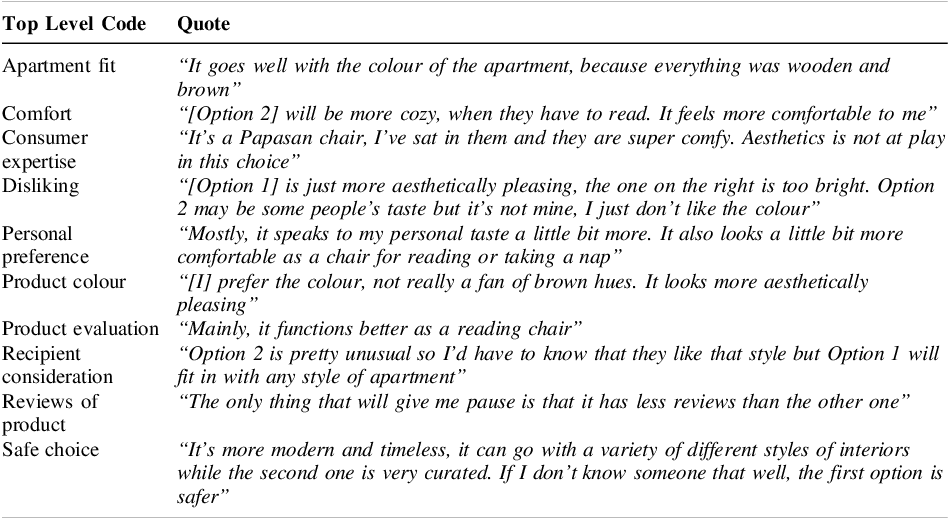
Another finding is that participants in the low expertise group described their product choice decision making using words that expressed dislike, usually of the unselected reading chair. This was the opposite for the high expertise group. The same pattern is repeated for the low and high acumen groups respectively. As an illustration, we present quotes of each top-level code in Table 3 below. When participant responses had different elements - having text that represented multiple top-level codes - we recorded them for each of the codes.
Representative quotes from each top-level code

6. Discussion and conclusion
6.1. Aesthetic taste and evaluation mode
Our study did not find a statistically significant relationship between the aesthetic taste of participants and the evaluation mode they employ in product choice decision making. In our estimation, this may be due to the inter-related nature of the evaluation modes, where persons simultaneously oscillate between joint and separate evaluation during decision-making. In addition, our qualitative coding only accounted for the first statement that the participants made; follow-up statements could reveal whether they switched evaluation modes or not. Reflecting on our hypothesis, high taste consumers may not use separate evaluation only, but some combination of evaluation strategies.
However, we notice that across the two dimensions of aesthetic taste, there is a change in the evaluation mode used between the low group and the high group (see Figure 4). For the acumen dimension, the use of separate evaluation decreases from the high acumen group to the low acumen group. The opposite is true for the expertise group, where separate evaluation increases from the high expertise group to the low expertise group. We believe this finding is driven by different reasons: for the acumen group, their evaluation mode is driven by their personal preferences while for the expertise group, their evaluation mode is driven by their product knowledge (as interior designers).
6.2. Differences in product choice decision making
Our qualitative analysis using open-ended coding found one similarity across the taste dimensions as well as one difference. For the similar finding, our results show that participants with high expertise and participants with high taste describe their aesthetic evaluations by using product attributes that they dislike. This expression of disliking may be about attributes in the product they have selected, or about attributes in the product not selected. This looks to be an expression of regulatory focus theory (Reference Crowe and HigginsCrowe & Higgins, 1997), where participants with high taste make decisions in a ‘prevention’ focus to avoid unsatisfactory outcomes, in this case, a product they do not like.
On the other hand, participants with low expertise are more likely to describe their aesthetic evaluations using their personal preferences compared to participants with high expertise. This finding is particularly interesting as our methodology utilized a product choice decision for a friend to reduce the impact of personal preferences in the decision-making process. This phenomenon may be due to experts – in this case, interior designers – having more experience working with clients who require more objective reasons for product choices. This behaviour is however reversed in the taste dimension. Participants with high taste are more likely to describe their aesthetic evaluations using their personal preferences compared to participants with low taste. In our analysis, this may be due to a cultivation of luxury goods where people with high taste are expected to show off their possessions and display their personal style.
6.3. Limitations and Future Research Directions
Our study has some limitations. First, the sample size could be expanded for wider relevance. However, recruiting experts always poses a challenge. In our case, we closed recruitment of interior designers after 6 months having only recruited 26 participants. Second, the interview experiment could be influenced by the rapport between the moderator and the participants as well as the limitations of two-way communication. For example, while we offered participants the choice to view the options simultaneously or independently, only 6% of participants selected to view the options independently. We believe this was due to the online meeting environment which could influence participants to view all choices at the same time. Third, the coding strategy used for RQ1 was highly selective as we only used the first sentence uttered by the participants. Meanwhile, several participants expressed their product choice decision making using both joint and separate evaluation modes in the full study transcript.
Future research could attempt to address these limitations. A study conducted in a point-of-sale context, such as a physical store or e-commerce site could vary the viewing of options between simultaneous viewing and independent viewing. In addition, to improve the data collection and analysis processes, we believe it would be useful to utilize additional methods such as eye tracking to study this construct in future work.
6.4. Conclusion
In conclusion, we devised a study to understand the impact of aesthetic taste on the evaluation mode used in product choice decision making. To do this, we reformulated joint and separation evaluation modes for product choice decision making based on the existing literature. While we do not find statistically significant findings for the evaluation modes used by high and low taste groups, through qualitative analysis we find that participants with low taste describe their decision making using their personal preferences and product attributes they dislike. Our findings contribute to the product design and aesthetic evaluation literature, specifically that taste acquired though professional experience as well as through everyday experiences produce similar strategies in product choice decision making.




 Open access

