

1 Motivation
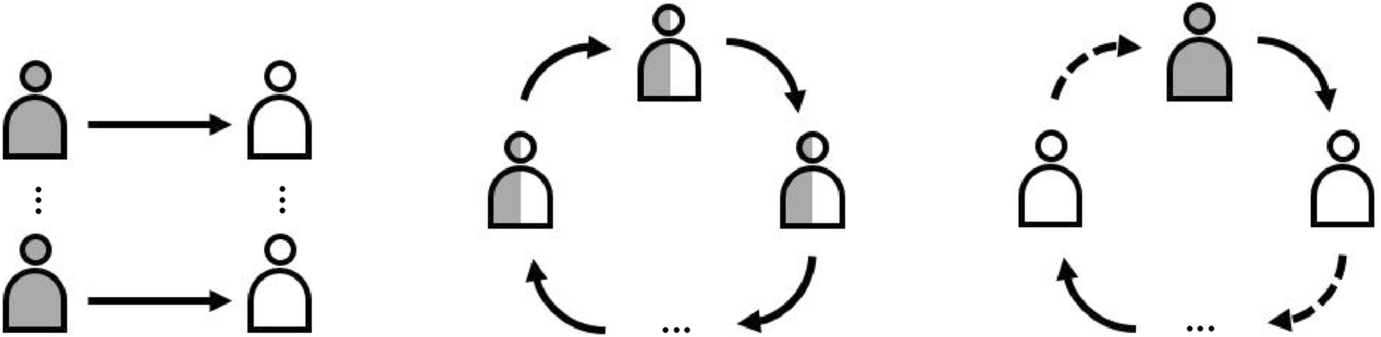
The economic study on altruistic giving has relied heavily on lab experiments labelled as ‘dictator games’, where one subject is given an endowment (money, tokens, etc.) to be shared with someone else. What has received little attention so far, however, is that different experimental protocols are being used to implement this game (see Fig. 1), namely
- ‘standard’
-
protocols (introduced by Kahneman et al. (Reference Kahneman, Knetsch and Thaler1986) and Forsythe et al. (Reference Forsythe, Horowitz, Savin and Sefton1994)) where only half of the subjects acting as the givers make decisions and the other half is entirely passive,
- ‘interactive’
-
protocols (introduced by Andreoni and Miller (Reference Andreoni and Miller2002)) where every subject acts both in the role of dictator and recipient, and thus eventually earns two payments from keeping and receiving at the same time, and
- ‘role uncertainty’
-
protocols, a hybrid of the standard and interactive protocols, whereby all subjects submit dictator decisions ex ante but only half of them are randomly picked eventually and paid out with a randomly paired subject whose decisions do not matter for final payments.Footnote 1
Three flavors of experimental dictator game implementations. Left: standard—half of the subjects are dictators (shaded). Middle: interactive—all subjects give and receive at the same time. Right: role uncertainty—while all subjects make dictator decisions, only for half of those, these decisions are carried out in terms of actual cash payments
Until recently, differences between these protocols have tended to remain unacknowledged by experimentalists. Corroborating this point is the fact that in the meta-study on dictator games by Engel (Reference Engel2011), which remains one of the standard references on the subject, there are no variables to control for such protocol differences. To gain a better understanding of whether and how protocol differences matter, we take a fresh look at Engel’s meta-regression by adding additional controls for the three different protocols that have been used under the same ‘dictator games’ umbrella term. We identify for each treatment included in Engel’s meta-study which of the three protocols was used. Our meta-regressions suggest that giving decisions depend on the exact protocol that is being used in a way that has likely confounded earlier studies in the literature that do not account for protocol differences.
Our effort to add protocol information to Engel’s meta-study is motivated by our own prior investigations in Grech and Nax (Reference Grech and Nax2020) regarding the different strategic incentives that different protocols create, in particular by the discovery that standard versus interactive protocols induce starkly different rational-choice benchmarks (game-theoretic predictions). Furthermore, we have evidence that these protocol effects matter behaviorally from several dedicated experiments that we conducted. In Grech and Nax (Reference Grech and Nax2020), for an online convenience sample recruited in that study, the interactive protocol resulted in different distributions of giving decisions and higher giving overall. In that experiment, giving multipliers (that determine how much every unit of giving is worth in the hands of the recipient) of the dictator games that were run ranged from 0.1 to 2, which allows some investigation of subjects’ efficiency preferences. We found that giving under the interactive protocol was more sensitive to the giving multiplier in a way that made giving more efficient (i.e. giving more when it is cheap and giving less when it is expensive). Subsequently, in Nax et al. (Reference Nax, Depoorter, Grech, Halten, Hoeppner, Newton, Pradelski, Soos, Wehrli, Ikica and Jantschgi2020) and Grech et al. (Reference Grech, Halten, Hoeppner and Nax2020) we ran additional experiments with different populations and with a wider range of giving multipliers. In Nax et al. (Reference Nax, Depoorter, Grech, Halten, Hoeppner, Newton, Pradelski, Soos, Wehrli, Ikica and Jantschgi2020), we find that subjects of a social elite in the United States give less than subjects in a non-elite sample in the interactive protocol when the giving multiplier is less than 2, but not when the giving multiplier is higher and also not in the standard protocol. In Grech et al. (Reference Grech, Halten, Hoeppner and Nax2020), for a representative population sample for the United States, we find that the protocol effect interacts with gender, with women being more generous in the interactive dictator game, and men being more generous in the standard dictator game. Our own findings add to a growing experimental literature that has investigated through dedicated experiments the effects of protocol differences on giving in dictator games and related contexts; see Iriberri and Rey-Biel (Reference Iriberri and Rey-Biel2011), Rigdon and Levine (Reference Rigdon and Levine2018), Greiff et al. (Reference Greiff, Ackermann and Murphy2018); Eckel et al. (Reference Eckel, Grossman and Zhan2020) and Andreozzi et al. (Reference Andreozzi, Faillo and Saral2021). In sum, all prior studies reject the hypothesis of protocol equivalence. The image that emerges instead is that dictator games run outside the standard protocol render giving behavior more efficiency-oriented (i.e. more positively correlated with the multiplier) and more sensitive to beliefs about others’ giving decisions. In terms of overall levels of giving, effect size and direction depend both on protocol and on the underlying population sample (e.g. Grech and Nax (Reference Grech and Nax2020) and Nax et al. (Reference Nax, Depoorter, Grech, Halten, Hoeppner, Newton, Pradelski, Soos, Wehrli, Ikica and Jantschgi2020) point in different directions for elite and non-elite samples).
In the present paper, we complement the single-study perspective from the aforementioned recent experiments with a meta-regression on past experiments. We therefore set out to check the instructions for each of the 131 papers included in Engel (Reference Engel2011)’s 2011 meta-study and code which protocol was used in each treatment in each of those papers.Footnote 2 The meta perspective supports the overall image that protocol effects matter and helps organize the findings emerging from recent experimental investigations further: meta-regressions suggest that, on aggregate, departures from the standard protocol have rendered subjects less generous for low giving multipliers, more generous for higher giving multipliers, and generally more sensitive to the giving multiplier (via a significant positive correlation). Note that these effects are potentially different for different subject pools, as, for example differentiated by gender, age, etc. In this light, the results of several influential papers with ‘big’ messages concluding that systematic differences among humans as distinguished by gender, age, culture, class, etc. exist deserve some further investigation, because several of them have used non-standard protocols [e.g. interactive in the gender comparison of Andreoni and Vesterlund (Reference Andreoni and Vesterlund2001)] or compared populations across protocols [e.g. elite under interactive compared with non-elite under standard in Fisman et al. (Reference Fisman, Jakiela, Kariv and Markovits2015)]. Understanding whether and how exactly protocol differences matter is helpful to organize these prior findings, and indicates avenues for targeted replications and reproductions aimed at testing certain conclusions.
2 Data and models
2.1 Meta-analysis in perspective
Our focus here is on protocol differences from a meta-analytical perspective. Choosing such an approach may be considered a timely enterprise as the typical ‘single-study’ experimental paper is being increasingly criticized for failing to deliver broader messages that are robust to idiosyncrasies of individual experimental implementations. However, we encourage the reader to keep the following caveats pertaining to meta-analyses in mind when we subsequently describe the data set that we shall investigate and the analyses that we shall run.
Perhaps trivially, meta-analyses inherit all systematic shortcomings of the underlying studies on which they are based. Examples include potential omitted variable bias, lack of external validity, etc. Beyond this, meta-studies critically rest on additional assumptions which may be difficult to satisfy. For one, the different underlying experimental implementations need to be largely homogeneous in all relevant aspects not controlled for in the meta-analysis. The dictator game, at first sight, appears to be the ideal candidate for such an endeavor, because the game can be parametrized by very few variables and is very simple—in its basic implementation it is not even a game, strictly speaking—and therefore seems to leave little leeway for researcher degrees of freedom. Upon closer inspection, however, even for dictator games, it is hard to judge whether comparable laboratory procedures were really being respected. Potentially confounding factors range from general lab features (temperature, seating, color of the wall, etc.) to specific implementation details that are hard to measure (e.g. subtleties in framing). What is more, for the controls that do enter the meta-analysis, one must often make simplifying assumptions (e.g. by rendering certain variable categories coarser than in individual studiesFootnote 3) in order to compile a data set with manageable complexity. Such information loss, albeit unavoidable for practical reasons, can be difficult to track and may bias results. Further limitations for meta-regressions include issues related to non-uniform reporting of controlsFootnote 4 and implicit values.Footnote 5
2.2 Engel (Reference Engel2011)’s data set
We build our analysis on Engel’s data from his 2011 paper. In addition to coding for every treatment in every study in that paper which protocol was used and integrating this information with Engel’s original data (see all analyses and data at our repository on the Open Science Framework)Footnote 6, we identify and correct a number of mistakes in Engel’s data.Footnote 7 Engel’s dataset contains 620 treatments, found in 131 dictator game studies published up until 2010. The dependent variable of his meta-regression is the mean fraction of giving, which is reported in 498 of these treatments. Among those, the standard error of the mean is either directly reported in the original study (191), can be reconstructed from it (254), or is missing. This results in
 non-missing data points for meta-regression used by Engel. For those, we corrected 286 false standard errors and 10 incorrect means (including 5 with a suspect value of 0).Footnote 8 Appendix A of our Online Supplementary Materials gives an overview of which studies are affected.Footnote 9 With these corrections, we recover a pattern according to which studies with a larger sample size have on average smaller standard errors, which was absent in the original data set (see Figure A1, Appendix A, Online SI).
In his regressions, Engel considers 24 control variables which fall broadly into three qualitatively distinct categories; population characteristics (such as age), framing (such as ‘give’ versus ‘take’ frame), and incentives (such as the specific strategic setting of the experiment but also whether it was financially incentivized or not).Footnote 10 A glossary for all individual variables is given in Appendix B of our Online Supplementary Materials. To Engel’s original variables, we add controls for the three different dictator game protocols (interactive, non-interactive and role uncertainty) which fall into the category of incentive variables. One of Engel’s incentive controls is ‘recipient efficiency,’ which is the aforementioned giving multiplier
 with which the given amount is multiplied determining what actually gets paid to the recipient. Recipient efficiency is of particular interest for our paper, because our prior theoretical and empirical work (Grech & Nax, Reference Grech and Nax2020) predicted and identified a positive correlation with it for the interactive protocol but not for the non-interactive and role uncertainty protocols.
3 Results
Engel’s main analysis is a multivariate random-effects meta-regression, which weights each study according to measurement accuracy (square of inverse standard error), and uses a restricted maximum likelihood procedure to estimate the between-study variance [ReML; (Patterson & Thompson, Reference Patterson and Thompson1971)], as well as the Knapp–Hartung modification to estimate confidence intervals (Hartung, Reference Hartung1999; Hartung & Knapp, Reference Hartung and Knapp2001a, Reference Hartung and Knappb).Footnote 11 To ensure comparability, we have followed the same procedure using the statistical software environment R (v3.6.1).
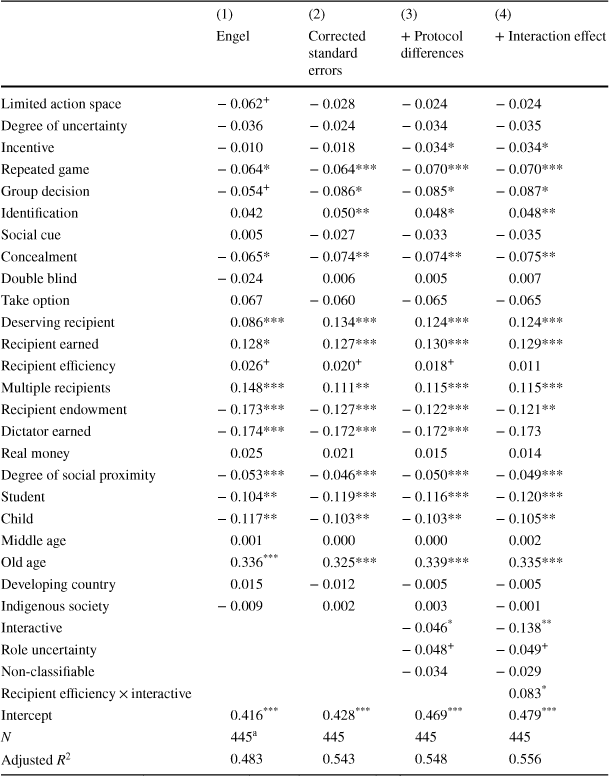
Table 1 displays Engel’s original results and three new meta-regressions that we ran. Regression (1) is the meta-regression as in Engel’s paper using Engel’s means and standard errors without corrections. Regression (2) is that same meta-regression run on the corrected data set. Regressions (3) and (4) are our meta-regressions (also run on the corrected data set) that include the protocol effects, with and without an interaction effect between recipient efficiency and interactive. Note that in each of the four meta-regressions, we adhered to the same use of categorical vs. continuous variables as Engel (cf. above). For full regressions where all variables are treated as categorical, we refer the reader to Appendix C of our Online Supplementary Materials (qualitative conclusions remain unchanged).
A comparison of regressions (1) and (2) reveals that the above-mentioned data misspecifications do have an impact and change both effect sizes and p values of individual variables. By and large, however, Engel’s results remain surprisingly robust except for the effect of identification.
Regression (3) is our baseline specification to analyze protocol effects. In line with theoretical predictions from Grech and Nax (Reference Grech and Nax2020), we find that interactive protocols lead to significantly lower mean giving. This confirms the direction of the effect that we found for the social elite and representative samples from the United States in Grech et al. (Reference Grech, Halten, Hoeppner and Nax2020) and Nax et al. (Reference Nax, Depoorter, Grech, Halten, Hoeppner, Newton, Pradelski, Soos, Wehrli, Ikica and Jantschgi2020), but is opposite to the effect in the experiment in Grech and Nax (Reference Grech and Nax2020) where we recruited an online convenience sample via MTurk. We also find a marginally significant effect of lower mean giving for role uncertainty. This is notable since the rational choice benchmark under role uncertainty is the same as that for the ordinary, non-interactive dictator game: players maximizing their expected utility under role uncertainty can only influence their final outcome by their own action in the case where they act as dictators. In this case, however, their decision problem is identical to a non-interactive dictator game. We point out that we find effects from protocol differences despite the relatively low number of studies following interactive or role uncertainty designs, which provides further support to our central claim that different protocols should not be used interchangeably, i.e. without acknowledging their differences.
In regression (4), which is our preferred specification, we further include an interaction effect between recipient efficiency and interactivity, motivated by our theoretical predictions in Grech and Nax (Reference Grech and Nax2020) according to which Nash equilibrium play is such that giving depends positively on recipient efficiency (jumping from null to full) for any subject who is at least moderately altruistic. This prediction applies to all such individuals, both efficiency-oriented and equality-oriented ones. By contrast, under the standard protocol and under role uncertainty, a negative relationship is rational for equality-oriented individuals, and a positive relationship is rational for efficiency-oriented individuals. The interaction term has a significant positive effect which suggests that it was really the interactive implementations that were driving the previously marginally significant effects of recipient efficiency. Finally, by comparing Regression (4) [or (3), for that matter] to Engel’s original Regression (1) (or its corrected version, Regression (2)) we find that the previously insignificant effect of incentivization becomes significant and substantive when controls related to protocol are added.
Meta-regression
|
(1) |
(2) |
(3) |
(4) |
|
|---|---|---|---|---|
|
Engel |
Corrected standard errors |
+ Protocol differences |
+ Interaction effect |
|
|
Limited action space |
− 0.062+ |
− 0.028 |
− 0.024 |
− 0.024 |
|
Degree of uncertainty |
− 0.036 |
− 0.024 |
− 0.034 |
− 0.035 |
|
Incentive |
− 0.010 |
− 0.018 |
− 0.034* |
− 0.034* |
|
Repeated game |
− 0.064* |
− 0.064*** |
− 0.070*** |
− 0.070*** |
|
Group decision |
− 0.054+ |
− 0.086* |
− 0.085* |
− 0.087* |
|
Identification |
0.042 |
0.050** |
0.048* |
0.048** |
|
Social cue |
0.005 |
− 0.027 |
− 0.033 |
− 0.035 |
|
Concealment |
− 0.065* |
− 0.074** |
− 0.074** |
− 0.075** |
|
Double blind |
− 0.024 |
0.006 |
0.005 |
0.007 |
|
Take option |
0.067 |
− 0.060 |
− 0.065 |
− 0.065 |
|
Deserving recipient |
0.086*** |
0.134*** |
0.124*** |
0.124*** |
|
Recipient earned |
0.128* |
0.127*** |
0.130*** |
0.129*** |
|
Recipient efficiency |
0.026+ |
0.020+ |
0.018+ |
0.011 |
|
Multiple recipients |
0.148*** |
0.111** |
0.115*** |
0.115*** |
|
Recipient endowment |
− 0.173*** |
− 0.127*** |
− 0.122*** |
− 0.121** |
|
Dictator earned |
− 0.174*** |
− 0.172*** |
− 0.172*** |
− 0.173 |
|
Real money |
0.025 |
0.021 |
0.015 |
0.014 |
|
Degree of social proximity |
− 0.053*** |
− 0.046*** |
− 0.050*** |
− 0.049*** |
|
Student |
− 0.104** |
− 0.119*** |
− 0.116*** |
− 0.120*** |
|
Child |
− 0.117** |
− 0.103** |
− 0.103** |
− 0.105** |
|
Middle age |
0.001 |
0.000 |
0.000 |
0.002 |
|
Old age |
0.336*** |
0.325*** |
0.339*** |
0.335*** |
|
Developing country |
0.015 |
− 0.012 |
− 0.005 |
− 0.005 |
|
Indigenous society |
− 0.009 |
0.002 |
0.003 |
− 0.001 |
|
Interactive |
− 0.046* |
− 0.138** |
||
|
Role uncertainty |
− 0.048+ |
− 0.049+ |
||
|
Non-classifiable |
− 0.034 |
− 0.029 |
||
|
Recipient efficiency
|
0.083* |
|||
|
Intercept |
0.416*** |
0.428*** |
0.469*** |
0.479*** |
|
N |
445a |
445 |
445 |
445 |
|
Adjusted
|
0.483 |
0.543 |
0.548 |
0.556 |


Significance levels:
 is coded as

 as
as

 as
as
 and
and
 as
as
 . In the text, we refer to coefficients significant at
 as ‘marginally significant,’ and to effects with higher levels of significance as ‘significant’
 Engel (Reference Engel2011) indicates
 in his regression table, but reports the correct value in his article
4 Conclusion
Our meta-regressions produce results that help organize what several recent single-study papers have found: compared with standard protocols, non-standard protocols render subjects’ giving on average less generous and make their giving decisions more efficiency-oriented. Protocols with role uncertainty seem to go in a similar direction as the interactive protocol despite not sharing the same game-theoretic predictions. Notwithstanding the various limitations of meta-analyses—as discussed in Sect. 2.1—these findings corroborate the view that protocol variations may lead to qualitatively different results and therefore deserve more attention. Strictly speaking, the three protocol categories that we separated dictator games into are still simplifications of the actual decision-making contexts in the lab. For instance, the size of the loop in an interactive implementation varies and is often unknown to participants, and it remains to be understood how beliefs and loop sizes affect giving decisions. In some standard implementations, the recipient is the same external entity (e.g. a charity) to which donations can be made by multiple dictators which plausibly leads to a crowding out of donations (as opposed to the case of multiple recipients which the meta-regression suggested has a significant positive effect). Another issue is that participants in a dictating role often take more than one giving decision throughout an experiment, but only one such decision is typically randomly chosen for payment. Therefore, the trichotomy we present and study here ought to be further refined and tested in the future.
One important distinction between the effect types that we made in the present paper, which we would like to stress again here, concerns the three broadly different categories of variables: population effects, effects due to framing, and effects due to different incentives. We believe this distinction is useful to think about other experimental games beyond dictator games too. Organized per these three categories, our results summarize as follows. Some population effects (such as age) were found to have unambiguous and sizeable effects, others not. This implies that it is important to qualify certain findings in light of the constitution of the underlying population which may create some biases, as also our differences in results regarding social elite, representative and online convenience sample indicated. The direction of the expected bias may depend on the protocol that is being used. Similarly, framing effects may have unambiguous and sizeable effects, but not necessarily so. It is important to control for framing effects inherent to an experimental design, as some of these may vary strongly between studies. Finally, variables related to incentive effects are mostly significant and matter. These effects include protocol variations—which were the focus of our efforts here—that need to be carefully controlled for as interactions with framing effects and population effects are likely. Further dedicated single-study experiments are therefore needed to organize some of these effects, particularly as they concern protocol differences and interactions with population differences.
In general, conclusions regarding differences between people need to be drawn carefully, as one should aim not to confound poorly understood protocol effects with such conclusions, and this meta-analysis provides further evidence that there are such effects. At present, interpreting meta-analytical results based on previously conducted studies remains difficult as only very few studies have carefully and transparently made their implementation details and data available. What is more, with the exception of our own ongoing work and Grech and Nax (Reference Grech and Nax2020) there has been little to no effort to pre-register dictator game experiments in the past. The trouble with meta-analyses mirrors some issues that are present in experimental economics more broadly, where more transparency is needed to tackle the ongoing credibility and replication crises.Footnote 12 With improved frameworks for making data available, the hope is that promising methodologies such as meta-analyses could thrive productively in economics.Footnote 13
Supplementary Information
The online version contains supplementary material available at https://doi.org/10.1007/s40881-022-00120-4.
Acknowledgements
Funding was provided by Schweizerischer Nationalfonds zur Förderung der Wissenschaftlichen Forschung (Eccellenza).
Funding
Open access funding provided by University of Zurich.


 Open access

