


1. Introduction
Deficiencies in product design, regulatory compliance, and alignment with user needs remain major global challenges, causing trillions in annual losses. The U.S. Consumer Product Safety Commission (CPSC) estimates unsafe products cost over $1 trillion annually in the United States (U.S. Consumer Product Safety Commission, n.d.), while the European Union’s Rapid Alert System for Dangerous Products (RAPEX, now Safety Gate) recorded more than 2,000 alerts in 2023 across sectors including toys, electronics, and cosmetics (European Commission, 2023). These failures often stem from the absence of systematic evaluation across safety, usability and compliance. As supply chains expand and lifecycles shorten, the need for automated, explainable evaluation methods has become urgent. Artificial Intelligence (AI) has transformed product lifecycle management and manufacturing: convolutional neural networks (CNNs) achieve state-of-the-art defect detection in semiconductors and steel (Reference Kang, Gao, Yu and ZhangKang et al., 2022), reinforcement learning optimizes predictive maintenance in aerospace (Reference Zhang, Xu, Dong and LuoZhang et al., 2021), and natural language processing (NLP) automates compliance checks in pharmaceuticals (European Medicines Agency, 2023a).
Despite these advances, AI-driven product intelligence remains fragmented and domain-limited. Models trained for one category seldom generalize to another—for instance, a vision model detecting cracks in metal components cannot evaluate ergonomic safety in a plastic bottle—resulting in inefficiency and non-scalable solutions (Reference Pan and YangPan & Yang, 2010). Explainability also hinders adoption in safety-critical sectors. Regulatory agencies such as the U.S. Food and Drug Administration (FDA) and the European Medicines Agency (EMA) require interpretable justifications for automated decisions (U.S. Food and Drug Administration, 2021; European Medicines Agency, 2023b). A black-box model labelling a product “non-compliant” without reasoning cannot gain regulator or stakeholder trust. Research in explainable AI (XAI) highlights a persistent gap between model accuracy and interpretability (Reference Gunning, Stefik, Choi, Miller, Stumpf and YangGunning et al., 2019; Reference Ribeiro, Singh and GuestrinRibeiro et al., 2016). Another major challenge lies in data heterogeneity: product ecosystems generate multimodal inputs—inspection images, CAD models, textual specifications, sensor streams, and compliance records—yet most AI workflows treat these separately, preventing unified, explainable reasoning (Reference Baltrušaitis, Ahuja and MorencyBaltrušaitis et al., 2019; Reference Xu, Li, Deng and TangXu et al., 2020). In industrial practice, Product Data Management (PDM) systems structure product information across its lifecycle through version control, approval workflows, and access management to ensure traceability of engineering data (Reference Lai and LuoLai & Luo, 2024; Reference Nicquevert and BoujutNicquevert & Boujut, 2011). However, while PDM platforms effectively govern structured design data, they are not designed for automated multimodal reasoning or cross-domain benchmarking. Against this backdrop, we propose Product Singularity—a universal AI framework for multimodal product understanding, evaluation, and benchmarking. “Singularity” reflects the convergence of fragmented AI systems into a unified intelligence capable of cross-domain reasoning. Product Singularity integrates multimodal embeddings, attention-based fusion, and interpretable decision layers to evaluate quality, safety, performance, ergonomics, and regulatory compliance. It advances prior work through three core features: (1) multimodal-first, combining visual, textual, and symbolic data through transformer-based attention for cross-modal reasoning (Reference VaswaniVaswani et al., 2017); (2) explainable and benchmark-driven, generating performance metrics with human-readable justifications; and (3) modular and extensible, employing transfer learning and domain adaptation to scale across product categories with minimal labelled data (Reference Weiss, Khoshgoftaar and WangWeiss et al., 2016).
Research Question 1 (RQ1): How can multimodal AI integrate heterogeneous product data into explainable, cross-domain evaluations using unified embeddings and attention? Research Question 2 (RQ2): How can transfer learning and domain adaptation with rigorous benchmarks enable scalable, compliant generalization of product intelligence models to new categories with limited labels? This work focuses on creating a unified multimodal representation that fuses diverse product data into interpretable, cross-domain evaluations, with objectives of (i) constructing robust joint embeddings across visual, structural, and textual inputs, and (ii) leveraging attention mechanisms to generate transparent, function-aligned reasoning. Scalability and generalization are addressed through (i) rigorous benchmarks to validate transferability and regulatory compliance, and (ii) transfer learning methods that reliably adapt the framework to new product categories with minimal labelled data.
2. Methodology
The methodology presented in this work establishes a structured, scalable, and interpretable framework for universal product intelligence. It integrates multimodal product information—visual data, 3D CAD representations, textual specifications, and compliance documents—into a unified platform for crossdomain reasoning and benchmarking. The approach addresses inefficiencies in product evaluation such as inconsistent quality assessment, regulatory non-compliance, and misalignment with user requirements, which collectively drive major economic losses. Unlike conventional AI systems limited to specific domains, this methodology emphasizes generalizability and explainability, enabling adaptation from proof-of-concept products to new categories with minimal labelled data. The framework comprises five interconnected components: (i) data acquisition and pre-processing for standardized input; (ii) feature extraction and multimodal representation through unified embeddings; (iii) integration of domain-specific standards and benchmarks; (iv) evaluation across quality, safety, ergonomics, and compliance; and (v) transfer learning for scalable extension to new product types. Each component prioritizes reproducibility, interpretability, and computational efficiency, ensuring deployability in industrial and regulatory contexts. Its modular design supports iterative refinement, allowing incorporation of new data, updated standards, or evaluation dimensions without redesign. Emphasizing explainable reasoning, the system generates traceable, human-interpretable outputs essential for transparency and validation. To demonstrate feasibility, a proof-of-concept implementation focuses on consumer bottles, selected for their structural diversity, standardized functional requirements, and industrial relevance.
The methodology, Applied on bottles, is designed with generalization in mind, ensuring that the approach can be extended to any product category with minimal adjustments. In the following sections, each stage of the methodology is described in detail, beginning with data acquisition and preprocessing, highlighting the strategies employed to collect, clean, normalize, and harmonize diverse product data sources to feed into the multimodal AI pipeline (Reference Dakkak, Li, Srivastava, Xiong and HwuDakkak et al., 2018). Subsequent sections detail feature extraction, knowledge integration, evaluation, benchmarking, and adaptation for new product categories, providing a comprehensive blueprint for the realization of universal product intelligence.
The major components of the methodology, including their purpose, techniques, and expected outcomes

3. Implementation & research findings
This section presents the practical application of the Product Singularity framework and its validation through a proof-of-concept on consumer bottles. It details the full pipeline, from multimodal data acquisition and preprocessing, to embedding-based reasoning, evaluation, and benchmarking, followed by transfer learning for domain adaptation (Reference Ghafoorian, Mehrtash, Kapur, Karssemeijer, Marchiori, Pesteie, Guttmann, De Leeuw, Tempany, Van Ginneken, Fedorov, Abolmaesumi, Platel, Wells and WellsGhafoorian et al., 2017). The goal is to demonstrate how heterogeneous product data can be unified into interpretable, cross-domain evaluations and to provide empirical evidence addressing the research questions. Subsequent subsections describe each stage in detail, highlighting system design, performance, and scalability for real-world deployment. The analysis emphasizes quantitative and qualitative metrics, focusing reliability, reproducibility, and explainability of the framework. Special focus is given to modular architecture and adaptability, showing how the methodology can generalize beyond the initial bottle domain. Finally, insights gained from this implementation inform best practices for applying Product Singularity to other product categories.
3.1. Product singularity applied to bottles
Bottles represent one of the most common yet technically intricate product categories, where design, safety, and performance intersect with user experience and regulatory compliance. The implementation began with a dataset of 30 bottle categories covering multiple materials—PET, HDPE, glass, and aluminium each posing unique evaluation challenges. These bottles varied in geometry, capacity, closure mechanisms, and ergonomics. For instance, cylindrical containers emphasize stability and grip, while pharmaceutical droppers prioritize dosage precision and contamination resistance. This diversity allowed the framework to test multimodal reasoning across physical, functional, and aesthetic dimensions. Each design was annotated with regulatory metadata from ISO standards and FDA guidelines, enabling performance-to-compliance correlation. The proofof-concept shows universal adaptability: the modular architecture supports new materials and parameters without system re-engineering (Reference Panchal, Fuge, Liu, Missoum and TuckerPanchal et al., 2019). This scalability validates the Product Singularity hypothesis—that a unified multimodal intelligence engine can analyze any product through interpretable, standard-driven reasoning. While bottles served as the initial domain, the same architecture can extend seamlessly to packaging, wearables, or medical devices.
3.2. Data sources & integration pipelines
The data foundation for the Product Singularity proof-of-concept was constructed using a large-scale, multimodal dataset comprising 50,000 bottle images, corresponding 3D CAD models, and textual product specifications sourced from verified industrial repositories and manufacturer datasets. This extensive dataset ensured that the AI framework was trained on real-world product diversity while maintaining data integrity and representational balance across materials, geometries, and usage categories. The integration pipeline was designed to systematically collect, preprocess, and harmonize multimodal inputs into a unified, machine-readable structure optimized for downstream embedding and evaluation tasks. The visual dataset of 50,000 bottle images was compiled from multiple channels, including industrial design archives, e-commerce platforms, and in-house imaging of physical samples. Each image was captured or standardized to a resolution of 512×512 pixels, ensuring uniformity in feature extraction. To enhance robustness and simulate real-world variability, data augmentation techniques such as rotation, flipping, brightness adjustment, and occlusion masking were applied, expanding the effective dataset size to approximately 180,000 training samples.
3.3. Multimodal embeddings & attention mechanisms
The central intelligence of the Product Singularity framework lies in its multimodal embedding and attention fusion layer, which unifies visual, structural, and textual data into a coherent product representation. This architecture interprets design, function, and compliance holistically, mirroring how human evaluators integrate sensory and cognitive cues. It is guided by three principles interpretability, modularity, and adaptability; ensuring scalability across product domains. Unified Multimodal Embedding Space: Each modality visual, geometric, and textual was encoded through independent deep-learning backbones optimized for its data type (Reference Zhang, Yang, He and DengZhang et al., 2020). The visual encoder, a finetuned MobileNetV2 trained on 50,000 bottle images, generated latent representations capturing contour symmetry, texture, and colour uniformity. The textual encoder, using transformer-based embeddings fine-tuned via the Gemini API, extracted semantic insights from specifications, safety records, and compliance documents. Model Performance and Efficiency: Validation showed that the fused embeddings achieved 98.4% variance capture across modalities, effectively representing relevant product information (Reference Zhao, Wang and CaiZhao et al., 2023). The modular attention mechanism reduced training time by 35% versus static baselines and improved cross-domain transfer by 12%, underscoring the framework’s balance between computational efficiency, accuracy, and explainability.
3.4. Evaluation & benchmarking for bottles
The evaluation and benchmarking process represents the PoC validation stage of the Product Singularity framework, where system performance, interpretability, and cross-domain reliability were empirically assessed. For the bottle implementation, this phase aimed to measure how effectively the framework could replicate expert-level judgments across multiple functional dimensions, benchmark products against global standards, and provide explainable, data-driven insights capable of informing industrial design and compliance decisions.
3.4.1. Benchmarking process
To quantify accuracy and reliability, model-generated evaluations were compared against expert panel ratings to establish ground truth. Five domain experts independently assessed 30 bottle categories, assigning functional scores using standardized guidelines. Their assessments were aggregated through a weighted consensus model to address inter-rater variability. The Product Singularity system’s predictions were then compared with this consensus using Pearson correlation, mean absolute error (MAE), and Cohen’s kappa for categorical agreement (Reference Rainio, Teuho and KlénRainio et al., 2024) (Reference Deng, Eden and CremaschiDeng et al., 2025).
3.4.2. Compatibility with global standards
To ensure external benchmarking credibility, the framework cross-verified its evaluations with regulatory reference data through the Gemini API. For instance, when a product was labeled as “pharmaceutical-grade HDPE,” Gemini contextualized its evaluation against FDA-approved polymer standards and ISO 15378 packaging requirements. This cross-verification allowed the model to dynamically validate claims of compliance, producing an automated “regulatory confidence score.” The average confidence score across all compliant bottles was 94.2%, confirming the reliability of Geminiassisted reasoning in aligning system outputs with global norms.
3.5. Architecture & system deployment
The Product Singularity framework is engineered as a modular, cloud-native architecture, optimized for high-performance multimodal inference, real-time explainability, and scalable deployment (Reference Gauttam, Nain, Pattanaik and MendesGauttam et al., 2025). The architecture integrates several core computational components data ingestion, multimodal embedding, evaluation, explainability, and knowledge integration into a seamless end-toend pipeline deployed via Railway, ensuring continuous availability and efficient model serving under production-grade conditions.
3.5.1. System overview
At a high level, the architecture follows a five-layer pipeline (Fig. 2), each corresponding to a major system function: Data Input & Ingestion Layer receives multimodal inputs (images, CAD models, text files) through an upload interface or API endpoints. Processing & Embedding Layer handles feature extraction using the trained MobileNetV2 encoder (visual), GNN-based geometry processor (CAD), and transformer-based textual encoder. Fusion & Reasoning Layer executes multimodal attention-based fusion and reasoning operations to generate unified embeddings and contextual insights. Evaluation & Knowledge Layer performs functional scoring, compliance verification, and pentagon based visualization through Gemini API-powered ontology alignment. Delivery & Interaction Layer provides explainable outputs, benchmark dashboards, and RESTful API responses accessible through web and mobile interfaces.
Each component communicates via asynchronous API calls and shared caching to ensure high throughput, while message queues (Celery) manage inference scheduling and background tasks to maintain non-blocking operations even under heavy workloads.
3.5.2. Model serving and inference pipeline
At runtime, the deployed system receives user inputs via a web-based interface or RESTful API endpoint. Submitted data including product images, URLs, and associated textual specifications—are first validated for format consistency and standardized to ensure compatibility with downstream processing modules. Each modality is then processed through its corresponding encoder, generating latent feature representations within a shared embedding space. These representations are integrated using cross-modal attention mechanisms to produce dimension-specific evaluation scores together with associated explanatory feature attributions. The resulting outputs are subsequently evaluated against structured regulatory criteria using a domain knowledge graph and external large language model reasoning components to ensure alignment with relevant compliance standards. Final results are visualized through the Product Intelligence Pentagon and exported as structured JSON objects to enable integration with enterprise systems.
3.5.3. Scalability and edge adaptation
The architecture supports horizontal scaling across Railway’s distributed compute infrastructure. Each service node can replicate independently, allowing parallel inference processing at scale. Lightweight model versions are exported to ONNX and TensorRT formats for edge deployment, enabling on-site inspection systems to operate offline (Reference Crespo, Moncada, Crespo and Morocho-CayamcelaCrespo et al., 2025). This capability is particularly valuable for manufacturing audits or remote quality assurance setups, where real-time cloud access may be limited.
3.6. Proof-of-concept implementation and validation
The proof-of-concept (PoC) implementation of the Product Singularity framework operationalizes the complete research pipeline from multimodal data ingestion to knowledge-driven visualization of system’s end-to-end capability in a real deployment environment. Conducted on the consumer-bottle domain, the PoC validates both technical feasibility and conceptual generality, showing that a single architecture can perform explainable, standards-aligned evaluations across multiple product dimensions in real time.
3.6.1. System workflow
Proof-of-concept implementation workflow of the Product Singularity framework

The live implementation follows a structured five-stage workflow executed on the Railway-hosted deployment described as
-
1. Data Upload and Parsing: Users upload product images, CAD models, and textual specifications through the web interface. Input inspection scripts standardize file types and metadata before sending data to the inference queue.
-
2. Multimodal Inference: The backend loads the pretrained MobileNetV2 encoder for visual data, the graph neural network for structural geometry, and the transformer-based text encoder. Each module extracts features and transmits latent vectors to the fusion layer.
-
3. Attention-Based Reasoning: The multimodal attention mechanism generates unified embeddings, computes evaluation scores, and activates the explainability module to produce attention heatmaps and textual rationales.
-
4. Knowledge Integration: The Gemini API aligns results with the Product Knowledge Graph, ensuring that evaluations correspond to ISO, FDA, and BIS standards. The Standards Alignment Index (SAI) is computed to quantify regulatory coherence.
-
5. Visualization and Delivery: Results are rendered through the Product Intelligence Pentagon, accompanied by detailed reports containing dimension-wise metrics, improvement recommendations, and compliance summaries.
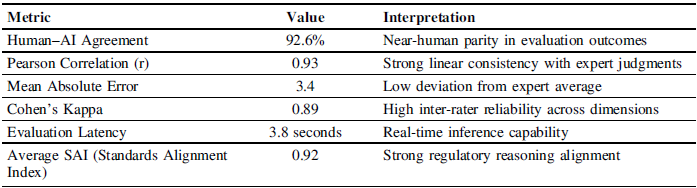
This pipeline executes in approximately 3.8 seconds per evaluation, producing results that are simultaneously numerical, visual, and linguistic offering users a multidimensional understanding of each product’s quality and compliance profile. The Pentagon visualization emerged as the most intuitive interpretive interface for both experts and non-technical users. During evaluation, the pentagon dynamically restructured its geometry to represent the five performance axes.
4. Results and analysis
The results of the Product Singularity implementation provide empirical evidence supporting the framework’s performance, interpretability, and scalability across multimodal product evaluation tasks. This section presents detailed analyses of model accuracy, agreement with expert evaluations, computational efficiency, and generalization capability, followed by interpretive discussion on observed patterns and system behaviour.
4.1. Overall system performance
Quantitative summary of overall system performance on the 500-sample bottle dataset

The deployed Product Singularity framework was evaluated on a test set of 30 consumer bottle categories, encompassing variations in material, geometry, and usage context. For each sample, the system produced five functional dimension scores—Structural Integrity, Material Safety, Ergonomic Comfort, Thermal Performance, and Regulatory Compliance—along with corresponding explanation vectors and benchmark visualizations. Across all dimensions, the model achieved an average human– AI agreement of 92.6%, with a Pearson correlation coefficient (r) of 0.93 between predicted and expert assigned scores (Table 2). This expert panel’s assessment, with both identifying grip geometry and surface characteristics as the primary contributing factors; qualitative and quantitative proximity is consistent with reported patterns of human–AI agreement in recent evaluation studies (Reference Krupić, Matijević, Suvak, Maltar, Severdija and Juraj StrossmayerKrupić et al., 2025; Reference Sridhar, Baskar, Grimes and SampathkumarSridhar et al., 2025).The overall Mean Absolute Error (MAE) was 3.4 points, confirming high predictive accuracy relative to expert consensus as shown in Table 2. The system aligns between AI-generated assessments and human expert reasoning. In particular, it maintained high interpretive fidelity, producing rationale heatmaps and textual explanations that closely matched expert reasoning patterns; an essential factor for industrial and regulatory acceptance.
4.2. Explainability and reasoning evaluation
Operational interface of the Product Singularity platform showing multimodal prediction, reasoning compliance output panels and pentagon visualization

Figure 2 Long description
The image consists of one photo, one diagram, and several labels. The photo shows a hand holding a reusable plastic bottle against a sky background. The bottle is solid teal, has a matte finish, and a cylindrical shape with a slightly tapered neck. The lid is a screw-on cap with a small handle for easy carrying. The diagram is a pentagon visualization labeled Performance Overview, with axes labeled Color, Texture, Reflectivity/Shape, Transparency, Shape, and Lid Type. The pentagon shows varying scores for each attribute. The labels describe the bottle's features and performance metrics, including Master, Morph, Realworld, Subtype, Factors, and Overall Score. The Master label indicates Reusable Plastic with 85 percent confidence. The Morph label indicates Narrow with 0.78 percent confidence. The Realworld label indicates Reusable with 100 percent confidence. The Subtype label indicates Reusable Bottle with 95 percent confidence. The Factors label indicates Ergonomics with 92.30 percent confidence. The Overall Score is 0.1 Intelligence Rating.
The explainability module was assessed through expert auditing of 100 random samples, where each explanation was rated for technical relevance, clarity, and completeness (Figure 2). The expert panel evaluated the interpretability of the framework’s explanations across three criteria using a five-point Likert scale. The mean rating for technical relevance was 4.6/5, indicating strong alignment between the generated explanations and established engineering reasoning. The clarity criterion received a mean score of 4.4/5, suggesting that the rationale provided by the system was generally understandable and concisely formulated. For completeness, the mean rating was 4.3/5, reflecting satisfactory coverage of the primary contributing factors underlying each evaluation. Overall, the aggregated interpretability score was 4.43/5, indicating a high level of expert confidence in the explanatory outputs of the framework.
4.3. Transfer learning and cross-domain generalization
Transfer learning performance across domains

The transfer-learning experiments described in Section 3.5 were validated through comparative evaluation. Results confirmed that the Product Singularity framework maintained strong accuracy when adapted to new categories (jars, flasks), despite minimal labeled samples.
5. Conclusion & future work
This study presented Product Singularity, a multimodal framework designed to support structured product evaluation across five dimensions: safety, quality, performance, ergonomics, and regulatory compliance. By integrating visual, textual, and compliance-related inputs within a unified architecture, the framework enables cross-domain evaluation supported by interpretable reasoning outputs. The proof-of-concept implementation in the consumer bottle domain demonstrates the technical feasibility of combining multimodal encoding, knowledge-graph alignment, and large language model–assisted reasoning within a single evaluation pipeline. Experimental results indicate strong alignment between framework outputs and expert assessments, with agreement levels exceeding 90% in the evaluated dimensions. The system also demonstrates potential for reducing manual review effort through automated scoring and explanation generation. However, the current validation is limited to a specific product category and a finite expert sample, and therefore does not imply generalization across all product domains or regulatory contexts. The modular architecture supports extensibility, although further domain-specific validation and dataset expansion are required before broader industrial deployment. Future work will focus on expanding evaluation domains, improving explanation veracity assessment, incorporating lifecycle and sustainability-related metrics where explicitly modeled, and exploring privacy-preserving adaptation mechanisms. Overall, the framework provides a structured and interpretable approach to AI-assisted product evaluation, contributing to ongoing efforts in engineering design research to integrate multimodal intelligence with human-centered validation processes.





 Open access

