IntroductionWar, Politics, and the Study of Memory
Published online by Cambridge University Press: 07 October 2011

Summary
War was the central theme of Germany’s twentieth century. The first half of the century saw unprecedented violence and destruction caused successively by the Kaiserreich and the Third Reich. The second half was shaped by the consequences of these wars and the realities of a resulting cold war: total defeat, utter devastation, a divided nation under Allied occupation, and a second dictatorship on German soil. Studying modern German history thus entails dealing with war and its social, political, and cultural consequences along with the narratives and memories it inspired in its aftermath. The two most terrible, closely intertwined crimes committed by Germans during World War II – the Holocaust and the war against the Soviet Union – gave rise to two diametrically opposed official memories of the Nazi past in the two postwar Germanys. Although the mass murder of about 6 million Jews would gain the most prominent position in West German public memory of the war, official memory in East Germany centered around the Nazi attack on the Soviet Union. This fundamental difference derived to a great extent, but not exclusively, from the political realities and ideological antagonism of the Cold War – the West German alliance with the West and the integration of East Germany into the Soviet sphere of influence. A multitude of personal, political, and ideological motives of those postwar politicians who came to dominate the political landscape in divided Germany also gave shape to this fundamental difference.
The emergence of the differing – what I call – political memories of the Nazi war against the Soviet Union – henceforth also referred to as the war on the Eastern Front or, simply, the Eastern Front – in divided and reunited Germany is the subject of this book. I present a comparative study that examines when and how the war was discussed in public, with a particular focus on the two social groups that often dominated the collective memory landscape: the political elite and war veterans. I investigate the relationship between public memory and politics by asking how memory formed and informed political culture, and vice versa. I am thus concerned with the “public use of history,” with the recollection, appropriation, and narration of the war against the Soviet Union by politicians, state officials, and war veterans in the context of the most important domestic and foreign policy debates in postwar German history.
Information
- Type
- Chapter
- Information
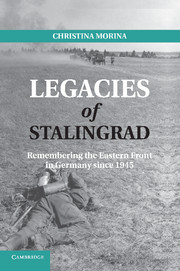
- Legacies of StalingradRemembering the Eastern Front in Germany since 1945, pp. 1 - 17Publisher: Cambridge University PressPrint publication year: 2011
References
Kollektives Gedächtnis und Erinnerungskulturen: Eine EinführungStuttgartMetzler 2005CrossRefGoogle Scholar
Genealogy of a Categorical Mistake: A Critical Intellectual History of the Cultural Trauma MetaphorRethinking History 8 2004CrossRefGoogle Scholar
The Unmasterable Past: History, Holocaust and German National IdentityCambridge, Mass.Harvard University Press 1988Google Scholar
Remembering War: The Great War Between Memory and History in the Twentieth CenturyNew Haven, Conn.Yale University Press 2006Google Scholar
What Has ‘Coming to Terms with the Past’ Meant in Post-World War II Germany?: From History to Memory to the ‘History of Memory,’Central European History 35 2002CrossRefGoogle Scholar
After the Expulsion: West Germany and Eastern Europe, 1945–1990OxfordOxford University Press 2003CrossRefGoogle Scholar
Geschichtsvergessenheit – Geschichtsversessenheit: Vom Umgang mit deutschen Vergangenheiten nach 1945StuttgartDVA 1999Google Scholar
Der Holocaust und die westdeutschen Historiker: Erforschung und ErinnerungGöttingenWallstein 2003Google Scholar
Coping with the Nazi Past: West German Debates on Nazism and Generational Conflict, 1955–1975New YorkBerghahn 2006Google Scholar
Legacies of Dachau: The Uses and Abuses of a Concentration Camp, 1933–2001CambridgeCambridge University Press 2001Google Scholar
In jenen Tagen: Wie der deutsche Nachkriegsfilm die Vergangenheit bewältigteOpladenLeske & Budrich 1995Google Scholar
Soldat und Kriegsliteratur: Deutsche militärische Erinnerungsliteratur (1945–1961) zum Zweiten WeltkriegTübingenNiemeyer 2000Google Scholar
Verletztes Gedächtnis: Erinnerungskultur und Zeitgeschichte im KonfliktFrankfurt am MainCampus 2002Google Scholar
Der Angriffskrieg als Lesestoff: Der Krieg an der Ostfront in der deutsch-deutschen Nachkriegsliteratur, 1945–1960Zeitgeschichte Online/Contemporary History Online 2005 1Google Scholar
Stranded Objects: Mourning, Memory and Film in Postwar GermanyIthaca, N.Y.Cornell University Press 1990Google Scholar
Using the Past in the Nazi Successor States from 1945 to the PresentANNALS AAPSS 617 2008CrossRefGoogle Scholar
Geschichtsbewußtsein und sozialistische Gesellschaft: Beiträge zur Rolle der Geschichtswissenschaft, des Geschichtsunterrichts und der Geschichtspropaganda bei der Entwicklung des sozialistischen BewußtseinsBerlinDietz 1970Google Scholar
Murder in Our Midst: The Holocaust, Industrial Killing, and RepresentationNew YorkOxford University Press 1996Google Scholar
Accessibility standard: Unknown
Why this information is here
This section outlines the accessibility features of this content - including support for screen readers, full keyboard navigation and high-contrast display options. This may not be relevant for you.Accessibility Information
Accessibility compliance for the PDF of this chapter is currently unknown
and may be updated in the future.