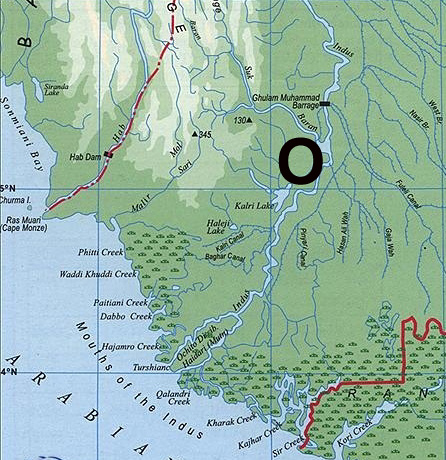


Location map, with O marking Ongar.

Introduction
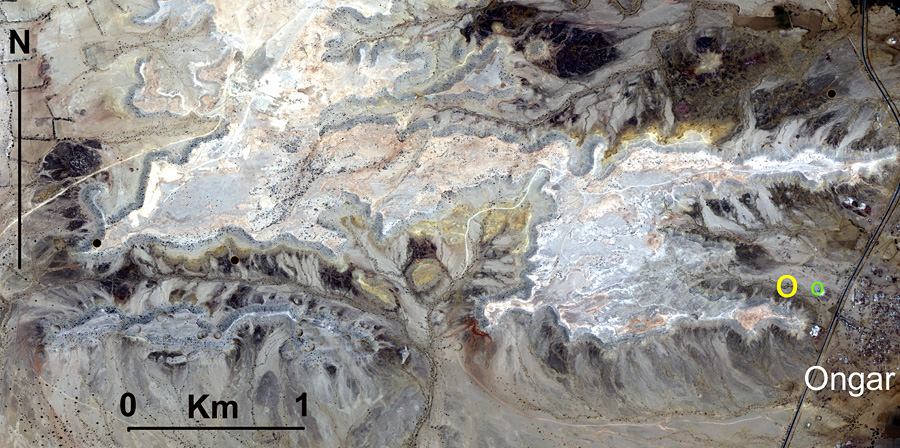
For the Lower and Middle Palaeolithic of the Indian subcontinent the site of Ongar is better known as Milestone 101 (Allchin et al. 1978). It was discovered by W.A. Fairservis (1975: 77) and later surveyed by B. Reference AllchinAllchin (1976), who recorded Palaeolithic flint workshops on the top of the limestone terraces of Ongar's easternmost 'horseshoe-shaped' hill (Reference BlandfordBlandford 1880) (Figures 1 & 2). The site was revisited in the 1970s by Professor A.R. Reference Khan and KhanKhan (1979), who collected an impressive amount of Palaeolithic tools, now in the collections of the Museum of Prehistory and Palaeogeography of Karachi University. The Ongar Hills were systematically surveyed again between 2004 and 2008 as part of a joint research programme carried out by Ca' Foscari University, Venice, and the Institute of Sindhology, Jamshoro (Reference BiagiBiagi 2005, 2006a; Biagi & Franco 2008). This showed that the archaeological area is much larger than had previously been suggested: Palaeolithic implements, and also quarries and lithic workshops of the Bronze Age Indus civilisation, were recorded even on the top of the terraces of Daphro and Bekhain (Reference BiagiBiagi 2007a). It became clear that most of the archaeological sites had been destroyed by limestone quarrying, which was still underway and greatly endangering all the remaining sites (Reference BiagiBiagi 2008: figs 7 & 22).
The limestone terraces of Ongar, almost completely destroyed by quarrying, with the location of the Levalloisian site (yellow circle) and the new flint heaps (green circle).

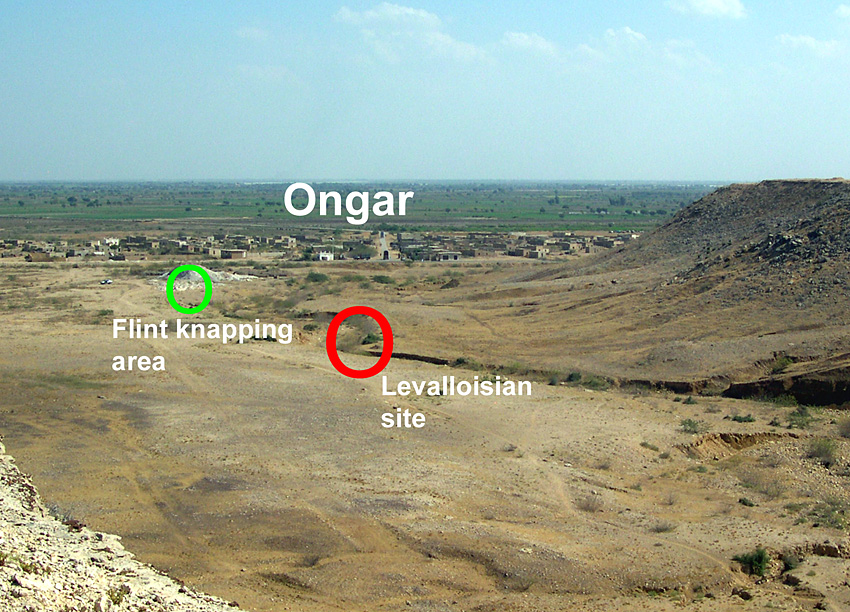
Ongar: location of the Levalloisian site (red circle), and the new flint heaps (green circle) (photograph: P. Biagi).

Ongar in 2010
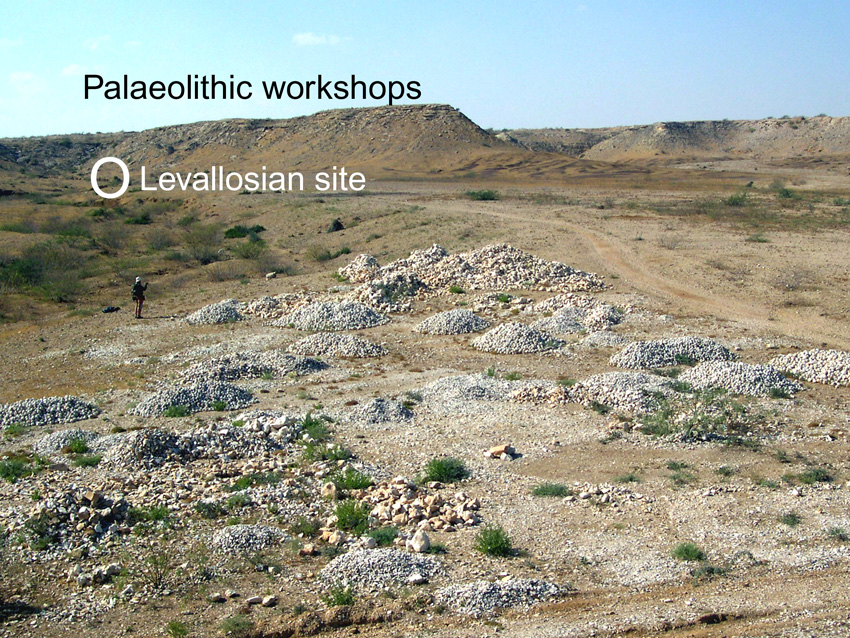
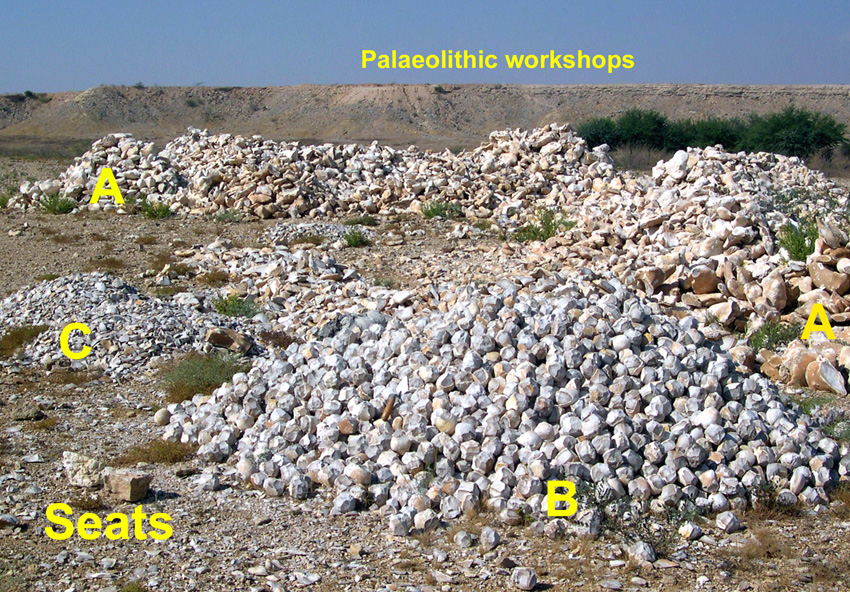
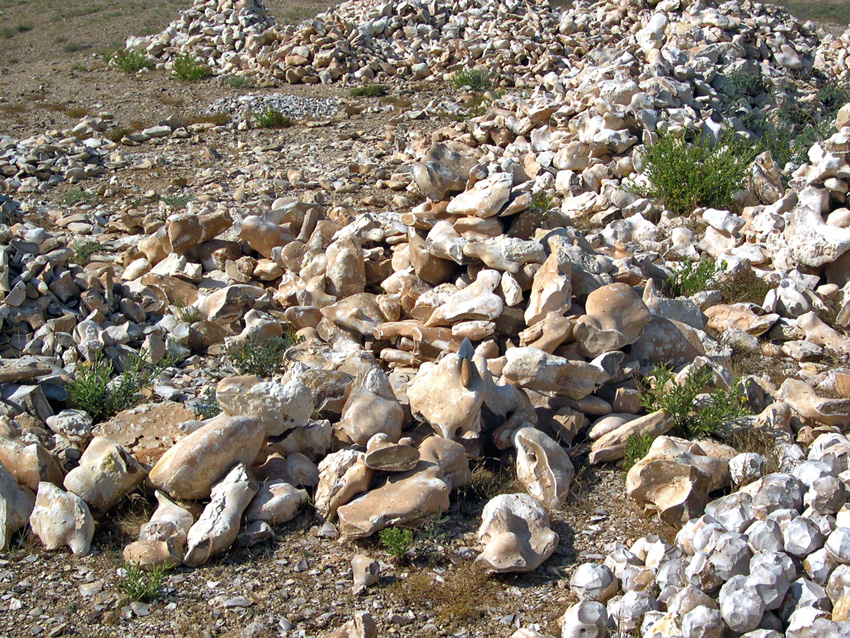
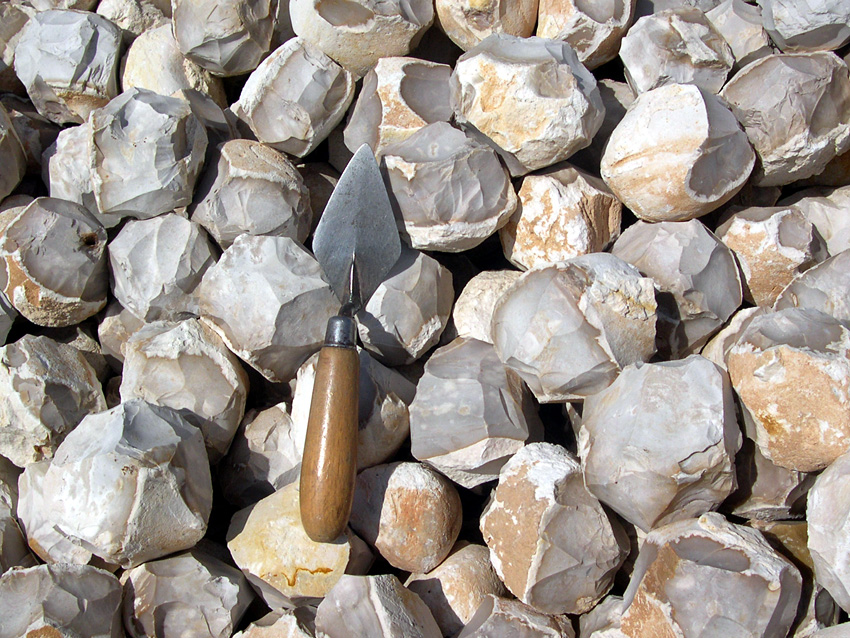
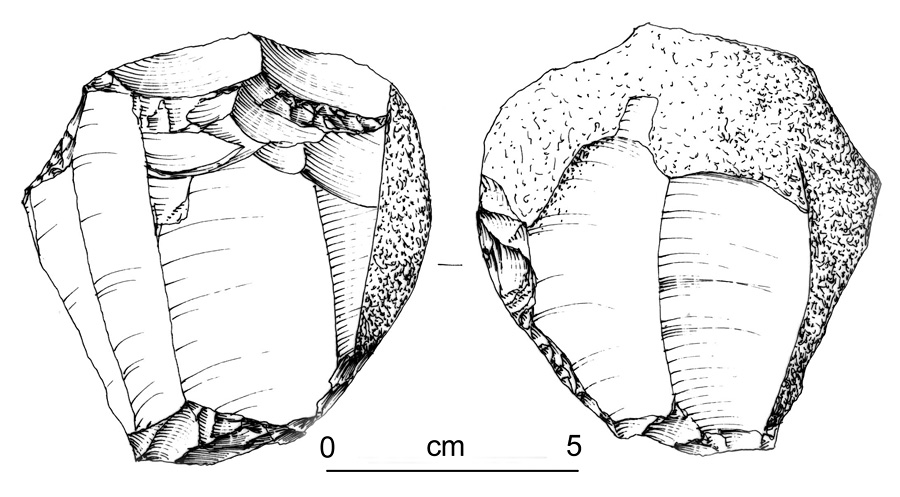
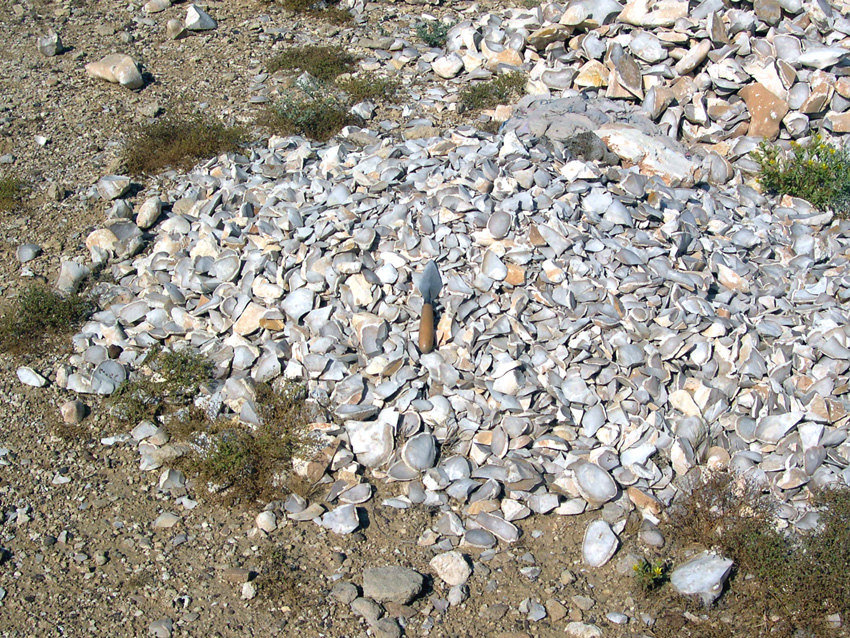
A brief visit to Ongar was made in January 2010 to monitor the state of preservation of the archaeological sites and to re-establish the location of a Levalloisian assemblage discovered a few years previously along the terrace of a small seasonal watercourse (Reference BiagiBiagi 2007b; Biagi & Starnini 2011). To our great surprise we noticed that numerous heaps of flint had been assembled at the mouth of the narrow valley that opens some 200m east of the Levalloisian site (Figures 2 & 3). The heaps (Figures 4 & 5) are made of nodules (Figure 6) mined from the top of the surrounding 'mesas', as well as cores (Figures 7 & 8) and debitage flakes (Figure 9). It was immediately clear that flint had been quarried during the previous months for industrial purposes, as was also observed a few days before — and later confirmed by local dwellers — at Jhimpir (Reference BiagiBiagi 2011), another prehistoric site located a few dozen kilometres to the south-west.
Ongar: the present-day flint working area at the mouth of the valley in respect of the Levalloisian site, and the Palaeolithic workshops already destroyed at the top of the mesas (photograph: P. Biagi).

Ongar: a present-day flint working area: A) nodules; B) spherical cores; C) debitage flakes. Note the squared stones used as seats by the artisans (photograph: P. Biagi).

Ongar: heap of local flint nodules (photograph: P. Biagi).

Ongar: spherical flint cores (photograph: P. Biagi).

Ongar: a typical, spherical flint core with blade and blade-like flake detachments (drawing: P. Biagi, inking: G. Almerigogna).

Ongar: heap of debitage flakes (photograph: P. Biagi).

Discussion
It is hard to believe that Ongar, which has been devastated for at least 50 years by illegal limestone quarrying, is still currently exploited to produce flint cores and blades, seemingly to decorate private residence walls. The flint heaps recorded along the foothills testify to the systematic manufacture of well-defined products, detached from spherical blade-like flake cores by (local?) artisans using metal hammers. Despite many appeals for the preservation of the archaeological sites of Sindh (see, for instance, Reference DarDar 1991; Reference BiagiBiagi 2008: 21), and the establishment of a new chair of Anthropology and Archaeology at Sindh University, Jamshoro, it seems that the archaeological remains of the region of Ongar, Daphro and Bekhain will disappear in the very near future, due to a complete lack of support, or lack of understanding of the importance of the sites for early prehistory, by local and national authorities. We would like to draw to the attention of the local, national and international community the extremely valuable Palaeolithic material known to exist in the Ongar Hills, in the hope that the sites located there will not suffer the same fate as the archaeological sites of the Rohri Hills (Reference BiagiBiagi 2006b).