








1. Introduction
1·1. Lonely runners
The Lonely Runner Problem of Wills [Reference Wills32] and Cusick [Reference Cusick10] is based on the following setup. Suppose $n+1$
runners start at the same position on a unit-length circular track and then begin running around the track at pairwise distinct constant speeds. We say that a runner is lonely at a particular time if their distance from every other runner is at least
$n+1$
runners start at the same position on a unit-length circular track and then begin running around the track at pairwise distinct constant speeds. We say that a runner is lonely at a particular time if their distance from every other runner is at least $1/(n+1)$
. The Lonely Runner Conjecture predicts that each runner will be lonely at some time (allowing different times for different runners).
$1/(n+1)$
. The Lonely Runner Conjecture predicts that each runner will be lonely at some time (allowing different times for different runners).
Consider the frame of reference of a single runner, and suppose that the n other runners have speeds $v_1, \ldots, v_n$
relative to our fixed runner. Define the maximum loneliness for this set of speeds to be
$v_1, \ldots, v_n$
relative to our fixed runner. Define the maximum loneliness for this set of speeds to be
 \begin{equation*}{\mathrm{ML}}(v_1, \ldots, v_n)\,:\!=\,\sup_{t \in \mathbb{R}} \min_{1 \leq i \leq n} \|tv_i\|_{\mathbb{R}/\mathbb{Z}},\end{equation*}
where $\|x\|_{\mathbb{R}/\mathbb{Z}}$
denotes the distance from x to the nearest integer. Reformulated in this language, the Lonely Runner Conjecture asserts that
$\|x\|_{\mathbb{R}/\mathbb{Z}}$
denotes the distance from x to the nearest integer. Reformulated in this language, the Lonely Runner Conjecture asserts that
 \begin{equation*}{\mathrm{ML}}(v_1, \ldots, v_n) \geq 1/(n+1)\end{equation*}
for all nonzero real numbers $v_1, \ldots, v_n$
. Using Kronecker’s Equidistribution Theorem, Bohman, Holzman and Kleitman [
Reference Bohman, Holzman and Kleitman8
] showed that it suffices to prove the Lonely Runner Conjecture for integer speeds; we will revisit this perspective below the fold.
$v_1, \ldots, v_n$
. Using Kronecker’s Equidistribution Theorem, Bohman, Holzman and Kleitman [
Reference Bohman, Holzman and Kleitman8
] showed that it suffices to prove the Lonely Runner Conjecture for integer speeds; we will revisit this perspective below the fold.
The Lonely Runner Problem has attracted substantial attention since Wills first posed it in 1967. Due to the work of many authors [
Reference Barajas and Serra2
,
Reference Betke and Wills5
,
Reference Bienia, Goddyn, Gvozdjak, Sebö and Tarsi7
,
Reference Bohman, Holzman and Kleitman8
,
Reference Cusick and Pomerance12
,
Reference Renault25
], the Lonely Runner Conjecture is known to hold for $n \leq 6$
; unfortunately, none of the approaches to these small-n cases seem to generalise to an arbitrary number of runners. The trivial bound
$n \leq 6$
; unfortunately, none of the approaches to these small-n cases seem to generalise to an arbitrary number of runners. The trivial bound ${\mathrm{ML}}(v_1, \ldots, v_n) \geq 1/(2n)$
has also been improved slightly (see [
Reference Tao31
] and the references therein), and the conjecture has been proven in the case where all of the runners have slow speeds (e.g., [
Reference Bohman and Peng9
,
Reference Pomerance24
,
Reference Sah and Sawhney26
,
Reference Tao31
]). For other work on and around the Lonely Runner Problem, see the references in [
Reference Kravitz21
].
${\mathrm{ML}}(v_1, \ldots, v_n) \geq 1/(2n)$
has also been improved slightly (see [
Reference Tao31
] and the references therein), and the conjecture has been proven in the case where all of the runners have slow speeds (e.g., [
Reference Bohman and Peng9
,
Reference Pomerance24
,
Reference Sah and Sawhney26
,
Reference Tao31
]). For other work on and around the Lonely Runner Problem, see the references in [
Reference Kravitz21
].
1·2. Maximum loneliness spectra
In this paper, we will be concerned with the perspective introduced in the second author’s thesis [
Reference Kravitz21
]. The new motivating question was: what can we say about the set $\widetilde{\mathcal{S}}(n)$
of all of the possible values of
$\widetilde{\mathcal{S}}(n)$
of all of the possible values of ${\mathrm{ML}}(v_1, \ldots, v_n)$
? For example, what is the second-smallest element after (conjecturally)
${\mathrm{ML}}(v_1, \ldots, v_n)$
? For example, what is the second-smallest element after (conjecturally) $1/(n+1)$
? Can we describe all of
$1/(n+1)$
? Can we describe all of $\widetilde{\mathcal{S}}(n)$
explicitly? More qualitatively, what do the accumulation points of
$\widetilde{\mathcal{S}}(n)$
explicitly? More qualitatively, what do the accumulation points of $\widetilde{\mathcal{S}}(n)$
look like? Notice that each
$\widetilde{\mathcal{S}}(n)$
look like? Notice that each $\widetilde{\mathcal{S}}(n)$
is a subset of the interval
$\widetilde{\mathcal{S}}(n)$
is a subset of the interval $(0,1/2]$
. We will see later that
$(0,1/2]$
. We will see later that $\widetilde{\mathcal{S}}(n)$
is a closed subset of the rationals.
$\widetilde{\mathcal{S}}(n)$
is a closed subset of the rationals.
The focus of the work [
Reference Kravitz21
] was the following conjecture about the “bottom” part of the set $\widetilde{\mathcal{S}}(n)$
.
$\widetilde{\mathcal{S}}(n)$
.
Conjecture 1·1 (Loneliness Spectrum Conjecture ([
Reference Kravitz21
, conjecture 1·2])). For every natural number $n \geq 2$
, we have
$n \geq 2$
, we have
 \begin{equation*}\widetilde{\mathcal{S}}(n) \cap (0,1/n)=\{s/(ns+1)\,:\, s \in \mathbb{N}\}.\end{equation*}
One should think of the quantity $s/(ns+1)$
as the result of “rounding down”
$s/(ns+1)$
as the result of “rounding down” $1/n$
to the nearest multiple of
$1/n$
to the nearest multiple of $1/(ns+1)$
. An explicit construction from [
Reference Kravitz21
] shows that all of the values
$1/(ns+1)$
. An explicit construction from [
Reference Kravitz21
] shows that all of the values $s/(ns+1)$
are contained in
$s/(ns+1)$
are contained in $\widetilde{\mathcal{S}}(n)$
. The conjecture has no content for
$\widetilde{\mathcal{S}}(n)$
. The conjecture has no content for $n=1$
and is easily verified for
$n=1$
and is easily verified for $n=2$
. One of the main results of [
Reference Kravitz21
] is a proof of the conjecture for
$n=2$
. One of the main results of [
Reference Kravitz21
] is a proof of the conjecture for $n=3$
.
$n=3$
.
Using computer experiments, Fan and Sun [
Reference Fan and Sun16
] discovered a family of examples that disproves Conjecture 1·1 for $n=4$
. In particular, they showed that
$n=4$
. In particular, they showed that
 \begin{equation*}{\mathrm{ML}}(8, 4r+3, 4r+11, 4r+19)=\frac{2r+7}{4(2r+7)+2}\end{equation*}
for every integer $r \geq 0$
. This provides a second infinite family of maximum loneliness values limiting to
$r \geq 0$
. This provides a second infinite family of maximum loneliness values limiting to $1/n$
(at least for
$1/n$
(at least for $n=4$
) in a structured way. Following the “
$n=4$
) in a structured way. Following the “ $1/n$
rounded down” philosophy, Fan and Sun proposed the following natural weakening of Conjecture 1·1.
$1/n$
rounded down” philosophy, Fan and Sun proposed the following natural weakening of Conjecture 1·1.
Conjecture 1·2 (Amended Loneliness Spectrum Conjecture ([
Reference Fan and Sun16
, conjecture 1·3]). For every natural number $n \geq 2$
, we have
$n \geq 2$
, we have
 \begin{equation*}\widetilde{\mathcal{S}}(n) \cap (0,1/n) \subseteq \{s/(ns+k)\,:\, s \in \mathbb{N}, 1 \leq k \leq n\}.\end{equation*}
1·3. Accumulation points
On a qualitative level, both Conjecture 1·1 and its weakening Conjecture 1·2 predict that $1/n$
is the smallest accumulation point of
$1/n$
is the smallest accumulation point of $\widetilde{\mathcal{S}}(n)$
. It is no coincidence that this number
$\widetilde{\mathcal{S}}(n)$
. It is no coincidence that this number $1/n$
coincides with the conjectural smallest value of
$1/n$
coincides with the conjectural smallest value of $\widetilde{\mathcal{S}}(n-1)$
. Recall that, for a subset
$\widetilde{\mathcal{S}}(n-1)$
. Recall that, for a subset $\mathcal{S}$
of
$\mathcal{S}$
of $\mathbb{R}$
, the number
$\mathbb{R}$
, the number $x \in \mathbb{R}$
is an upper accumulation point if
$x \in \mathbb{R}$
is an upper accumulation point if $\mathcal{S} \cap (x, x+\varepsilon) \neq \emptyset$
for all
$\mathcal{S} \cap (x, x+\varepsilon) \neq \emptyset$
for all $\varepsilon\gt 0$
; we define lower accumulation points analogously. We write
$\varepsilon\gt 0$
; we define lower accumulation points analogously. We write ${\mathrm{acc}}(\mathcal{S})$
for the set of (all) accumulation points of
${\mathrm{acc}}(\mathcal{S})$
for the set of (all) accumulation points of $\mathcal{S}$
. The following theorem forms the starting point for our investigations.
$\mathcal{S}$
. The following theorem forms the starting point for our investigations.
Theorem 1·3 ([
Reference Kravitz21
, theorem 6·5]). Let $n \geq 2$
be a natural number. Then the set of lower accumulation points of
$n \geq 2$
be a natural number. Then the set of lower accumulation points of $\widetilde{\mathcal{S}}(n)$
contains
$\widetilde{\mathcal{S}}(n)$
contains $\widetilde{\mathcal{S}}(n-1)$
.
$\widetilde{\mathcal{S}}(n-1)$
.
Also in [
Reference Kravitz21
], the second author raised the questions of whether upper accumulation points are impossible, and whether the set containment in Theorem 1·3 is actually an equality. The aim of the present paper is to give an affirmative answer to the first part of this question and make partial progress towards the second part. Along the way, our arguments will show that the sets $\widetilde{S}(n)$
and some closely related sets have a “hierarchical” structure; this information is potentially useful for inductive approaches to the Lonely Runner Conjecture, which so far have seemed inaccessible because of a failure to relate the instances of the conjecture for different numbers of runners. Before stating our results precisely, we need to introduce a few geometric notions.
$\widetilde{S}(n)$
and some closely related sets have a “hierarchical” structure; this information is potentially useful for inductive approaches to the Lonely Runner Conjecture, which so far have seemed inaccessible because of a failure to relate the instances of the conjecture for different numbers of runners. Before stating our results precisely, we need to introduce a few geometric notions.
1·4. View-obstruction, subtori and subgroups
It will be convenient for us to work with the “view-obstruction” formulation of the Lonely Runner Problem, as popularised by Cusick [
Reference Cusick10
]. Associate each tuple $(v_1, \ldots, v_n)$
of nonzero integers with the 1-dimensional subtorus
$(v_1, \ldots, v_n)$
of nonzero integers with the 1-dimensional subtorus
 \begin{equation*}T\,:\!=\,\pi(\langle (v_1, \ldots, v_n) \rangle_{\mathbb{R}})=\{t(v_1, \ldots, v_n)\,:\, t \in \mathbb{R}\}/\mathbb{Z}^n\end{equation*}
of the torus $(\mathbb{R}/\mathbb{Z})^n$
, where
$(\mathbb{R}/\mathbb{Z})^n$
, where $\pi\,:\, \mathbb{R}^n \to (\mathbb{R}/\mathbb{Z})^n$
is the standard quotient map. Notice that T is not contained in any of the coordinate hyperplanes of
$\pi\,:\, \mathbb{R}^n \to (\mathbb{R}/\mathbb{Z})^n$
is the standard quotient map. Notice that T is not contained in any of the coordinate hyperplanes of $(\mathbb{R}/\mathbb{Z})^n$
; in general, we say that a subtorus is proper if it is not contained in the union of the coordinate hyperplanes. Let D(T) denote the
$(\mathbb{R}/\mathbb{Z})^n$
; in general, we say that a subtorus is proper if it is not contained in the union of the coordinate hyperplanes. Let D(T) denote the $L^\infty$
-distance from T to the point
$L^\infty$
-distance from T to the point $(1/2, \ldots, 1/2)$
in the “center” of
$(1/2, \ldots, 1/2)$
in the “center” of $(\mathbb{R}/\mathbb{Z})^n$
, so that
$(\mathbb{R}/\mathbb{Z})^n$
, so that
 \begin{equation*}D(T)=1/2-{\mathrm{ML}}(v_1, \ldots, v_n).\end{equation*}
Now define the nth Lonely Runner spectrum to be the set $\mathcal{S}(n)$
of all values achieved by D(T) as T ranges over the 1-dimensional proper subtori of
$\mathcal{S}(n)$
of all values achieved by D(T) as T ranges over the 1-dimensional proper subtori of $(\mathbb{R}/\mathbb{Z})^n$
; we have
$(\mathbb{R}/\mathbb{Z})^n$
; we have
 \begin{equation*}\mathcal{S}(n)=1/2-\widetilde{\mathcal{S}}(n).\end{equation*}
In this new language, yet another reformulation of the Lonely Runner Conjecture is the assertion that $\mathcal{S}(n) \subseteq [0,1/2-1/(n+1)]$
. Notice that lower accumulation points for
$\mathcal{S}(n) \subseteq [0,1/2-1/(n+1)]$
. Notice that lower accumulation points for $\widetilde{\mathcal{S}}(n)$
correspond to upper accumulation points for
$\widetilde{\mathcal{S}}(n)$
correspond to upper accumulation points for $\mathcal{S}(n)$
, and vice versa.
$\mathcal{S}(n)$
, and vice versa.
The more geometric line of inquiry arising from view-obstruction has been fruitfully related to the study of polytopes, and the “zonotope” version of the Lonely Runner Conjecture has received significant attention (see, e.g., [ Reference Beck, Hoşten and Schymura3 , Reference Beck and Schymura4 , Reference Bhardwaj, Narayanan and Venkataraman6 , Reference Henze and Malikiosis18 ] and the references therein).
The function D and the notion of properness also make sense for arbitrary closed subsets $X \subseteq (\mathbb{R}/\mathbb{Z})^n$
. In particular, define D(X) to be the
$X \subseteq (\mathbb{R}/\mathbb{Z})^n$
. In particular, define D(X) to be the $L^\infty$
-distance from X to the point
$L^\infty$
-distance from X to the point $(1/2, \ldots, 1/2)$
, and say that X is proper if is is not contained in the union of the coordinate hyperplanes.Footnote
1
We will have occasion to study the values assumed by D(X) not only when X is a 1-dimensional proper subtorus but also when X is a higher-dimensional subtorus or a closed subgroup.
$(1/2, \ldots, 1/2)$
, and say that X is proper if is is not contained in the union of the coordinate hyperplanes.Footnote
1
We will have occasion to study the values assumed by D(X) not only when X is a 1-dimensional proper subtorus but also when X is a higher-dimensional subtorus or a closed subgroup.
For $1 \leq k \leq n$
, a k-dimensional subtorus of
$1 \leq k \leq n$
, a k-dimensional subtorus of $(\mathbb{R}/\mathbb{Z})^n$
is a subgroup of the form
$(\mathbb{R}/\mathbb{Z})^n$
is a subgroup of the form $T=\pi(W)$
for some k-dimensional subspace W of
$T=\pi(W)$
for some k-dimensional subspace W of $\mathbb{R}^n$
that is “rational” in the sense that
$\mathbb{R}^n$
that is “rational” in the sense that $\mathbb{Z}^n \cap W$
is a lattice of rank k. Now, let
$\mathbb{Z}^n \cap W$
is a lattice of rank k. Now, let $\mathcal{S}_k(n)$
be the set of all values achieved by D(T) as T ranges over the k-dimensional proper subtori of
$\mathcal{S}_k(n)$
be the set of all values achieved by D(T) as T ranges over the k-dimensional proper subtori of $(\mathbb{R}/\mathbb{Z})^n$
. Notice that
$(\mathbb{R}/\mathbb{Z})^n$
. Notice that $\mathcal{S}(n)=\mathcal{S}_1(n)$
in this notation. We will also need to work with closed subgroups of
$\mathcal{S}(n)=\mathcal{S}_1(n)$
in this notation. We will also need to work with closed subgroups of $(\mathbb{R}/\mathbb{Z})^n$
; in this paper, “subgroup” always means “closed subgroup”. Every subgroup
$(\mathbb{R}/\mathbb{Z})^n$
; in this paper, “subgroup” always means “closed subgroup”. Every subgroup $\Delta \subseteq (\mathbb{R}/\mathbb{Z})^n$
is the direct product of a k-dimensional subtorus of
$\Delta \subseteq (\mathbb{R}/\mathbb{Z})^n$
is the direct product of a k-dimensional subtorus of $(\mathbb{R}/\mathbb{Z})^n$
and a finite subgroup of
$(\mathbb{R}/\mathbb{Z})^n$
and a finite subgroup of $(\mathbb{R}/\mathbb{Z})^n$
, and we say that the dimension of
$(\mathbb{R}/\mathbb{Z})^n$
, and we say that the dimension of $\Delta$
is k. Now, for
$\Delta$
is k. Now, for $0 \leq k \leq n$
, let
$0 \leq k \leq n$
, let $\mathcal{S}^*_k(n)$
denote the set of all values achieved by
$\mathcal{S}^*_k(n)$
denote the set of all values achieved by $D(\Delta)$
as
$D(\Delta)$
as $\Delta$
ranges over the k-dimensional proper subgroups of
$\Delta$
ranges over the k-dimensional proper subgroups of $(\mathbb{R}/\mathbb{Z})^n$
. We make the convention
$(\mathbb{R}/\mathbb{Z})^n$
. We make the convention $\mathcal{S}^*_0(0)\,:\!=\,\{0\}$
, and we write
$\mathcal{S}^*_0(0)\,:\!=\,\{0\}$
, and we write $\mathcal{S}^*(n)$
for
$\mathcal{S}^*(n)$
for $\mathcal{S}^*_1(n)$
. Since every (proper) k-dimensional subtorus is also a (proper) k-dimensional subgroup, we have the inclusion
$\mathcal{S}^*_1(n)$
. Since every (proper) k-dimensional subtorus is also a (proper) k-dimensional subgroup, we have the inclusion $\mathcal{S}_k(n) \subseteq \mathcal{S}^*_k(n)$
, which in general is strict (see below).
$\mathcal{S}_k(n) \subseteq \mathcal{S}^*_k(n)$
, which in general is strict (see below).
Finally, we remark that one can think of $\mathcal{S}_k(n)$
as a multiset by keeping track of the values of D(T) for all k-dimensional proper subtori
$\mathcal{S}_k(n)$
as a multiset by keeping track of the values of D(T) for all k-dimensional proper subtori $T \subseteq (\mathbb{R}/\mathbb{Z})^n$
; we will denote this multiset by
$T \subseteq (\mathbb{R}/\mathbb{Z})^n$
; we will denote this multiset by $\mathcal{S}_{k,{\mathrm{mult}}}(n)$
. The multiset
$\mathcal{S}_{k,{\mathrm{mult}}}(n)$
. The multiset $\mathcal{S}^*_{k,{\mathrm{mult}}}(n)$
is obtained from
$\mathcal{S}^*_{k,{\mathrm{mult}}}(n)$
is obtained from $\mathcal{S}^*_{k}(n)$
analogously. The density points of a multiset
$\mathcal{S}^*_{k}(n)$
analogously. The density points of a multiset $\mathcal{S}$
are defined to be the accumulation points of
$\mathcal{S}$
are defined to be the accumulation points of $\mathcal{S}$
together with the infinite-multiplicity elements of
$\mathcal{S}$
together with the infinite-multiplicity elements of $\mathcal{S}$
. We write
$\mathcal{S}$
. We write ${\mathrm{den}}(\mathcal{S})$
for the set of density points of
${\mathrm{den}}(\mathcal{S})$
for the set of density points of $\mathcal{S}$
.
$\mathcal{S}$
.
1·5. Main result
We are finally ready to state our main result, which is summarised by the following relationships among the sets $\mathcal{S}_k(n), \mathcal{S}^*_k(n)$
.
$\mathcal{S}_k(n), \mathcal{S}^*_k(n)$
.
Theorem 1·4. Let $n \geq 2$
be a natural number, and let
$n \geq 2$
be a natural number, and let $1 \leq k \lt n$
and
$1 \leq k \lt n$
and $0 \leq k' \lt n$
. Then the sets
$0 \leq k' \lt n$
. Then the sets $\mathcal{S}_k(n),\mathcal{S}_{k'}^*(n)$
have only upper accumulation points. On the level of sets we have the inclusions
$\mathcal{S}_k(n),\mathcal{S}_{k'}^*(n)$
have only upper accumulation points. On the level of sets we have the inclusions
 \begin{align*}{\mathrm{acc}}(\mathcal{S}_k(n)) \subseteq \mathcal{S}_{k+1}(n) \subseteq \mathcal{S}_{k+1}^*(n)=\mathcal{S}_0^*(n-k-1),\end{align*}
and on the level of multisets we have the equalities
 \begin{equation*}{\mathrm{den}}(\mathcal{S}_{k,{\mathrm{mult}}}(n))=\mathcal{S}_{k+1}(n) \quad \mathrm{and} \quad {\mathrm{den}}(\mathcal{S}_{k',{\mathrm{mult}}}^*(n))=\mathcal{S}_{k'+1}^*(n)=\mathcal{S}_{k'}^*(n-1).\end{equation*}
Moreover, when $k=1$
, we also have the inclusion
$k=1$
, we also have the inclusion $\mathcal{S}(n-1) \subseteq {\mathrm{acc}}(\mathcal{S}(n))$
, which implies that
$\mathcal{S}(n-1) \subseteq {\mathrm{acc}}(\mathcal{S}(n))$
, which implies that
 \begin{align}\mathcal{S}(n-1) \subseteq {\mathrm{acc}}(\mathcal{S}(n)) \subseteq \mathcal{S}_{2}(n) \subseteq \mathcal{S}_{2}^*(n)=\mathcal{S}^*(n-1).\end{align}
The natural question, of course, is which of the inclusions (1) are actually equalities. Equality holds in (1) for $n=2$
trivially; it also holds for
$n=2$
trivially; it also holds for $n=3$
because (see Section 8 below) we can explicitly compute
$n=3$
because (see Section 8 below) we can explicitly compute
 \begin{equation*}\mathcal{S}(2)=\mathcal{S}^*(2)=\{0\} \cup \left\{1/(4s+2)\,:\, s \in \mathbb{N}\right\}.\end{equation*}
Equality cannot hold in general, however; we will show in Proposition 8·1 that $7/50 \in \mathcal{S}^*(3){\setminus}\mathcal{S}(3)$
. Nonetheless, we conjecture that equality holds in Theorem 1·3.
$7/50 \in \mathcal{S}^*(3){\setminus}\mathcal{S}(3)$
. Nonetheless, we conjecture that equality holds in Theorem 1·3.
Conjecture 1·5. For any natural number $n \geq 2$
, we have
$n \geq 2$
, we have ${\mathrm{acc}}(\mathcal{S}(n))=\mathcal{S}(n-1)$
.
${\mathrm{acc}}(\mathcal{S}(n))=\mathcal{S}(n-1)$
.
To prove this conjecture, it would suffice to show that $\mathcal{S}_2(n)=\mathcal{S}(n-1)$
, i.e, that the first two inclusions in (1) are equalities. More generally, we pose the following problem, which we suspect has an affirmative answer.
$\mathcal{S}_2(n)=\mathcal{S}(n-1)$
, i.e, that the first two inclusions in (1) are equalities. More generally, we pose the following problem, which we suspect has an affirmative answer.
Problem 1·6. Is it the case that $\mathcal{S}_k(n)=\mathcal{S}_{k-\ell}(n-\ell)$
for all natural numbers
$\mathcal{S}_k(n)=\mathcal{S}_{k-\ell}(n-\ell)$
for all natural numbers $1\leq \ell \lt k \leq n$
?
$1\leq \ell \lt k \leq n$
?
Theorem 1·4 has a couple of nice consequences. One is that, due to the trivial containments $\mathcal{S}_k(n) \subseteq \mathcal{S}_{k-1}(n)$
and
$\mathcal{S}_k(n) \subseteq \mathcal{S}_{k-1}(n)$
and $\mathcal{S}^*_{k'}(n) \subseteq \mathcal{S}^*_{k'-1}(n)$
, the sets
$\mathcal{S}^*_{k'}(n) \subseteq \mathcal{S}^*_{k'-1}(n)$
, the sets $\mathcal{S}(n), \mathcal{S}^*(n)$
are closed for all n. Another consequence is that each of
$\mathcal{S}(n), \mathcal{S}^*(n)$
are closed for all n. Another consequence is that each of $\mathcal{S}(n), \mathcal{S}^*(n)$
is a well-ordered set with order type
$\mathcal{S}(n), \mathcal{S}^*(n)$
is a well-ordered set with order type $\omega^{n-1}+1$
.
$\omega^{n-1}+1$
.
1·6. Checking small speeds suffices
The maximum loneliness function is easy to compute, and it is natural to ask whether the Lonely Runner Conjecture can be verified by checking that there are no counterexamples with all speeds below some explicit threshold. Tao [
Reference Tao31
] showed that this question can be answered in the affirmative, and that it suffices to check all speeds up to $n^{Cn^2}$
for some explicitly computable constant C. Recently, Malikiosis, Santos and Schymura [
Reference Malikiosis, Santos and Schymura23
] used the zonotope formulation of the Lonely Runner Conjecture to improve this threshold to
$n^{Cn^2}$
for some explicitly computable constant C. Recently, Malikiosis, Santos and Schymura [
Reference Malikiosis, Santos and Schymura23
] used the zonotope formulation of the Lonely Runner Conjecture to improve this threshold to $(n(n+1)/2)^{n-1}\approx n^{2n}$
. The new perspective afforded by Theorem 1·4 leads to a simple and transparent proof of the same result with the slightly weaker bound
$(n(n+1)/2)^{n-1}\approx n^{2n}$
. The new perspective afforded by Theorem 1·4 leads to a simple and transparent proof of the same result with the slightly weaker bound $n^{(5/2)n}$
(see below for our precise bound). It is interesting to note that Minkowski’s Theorem on successive minima plays a role both for us and for Malikiosis, Santos, and Schymura.
$n^{(5/2)n}$
(see below for our precise bound). It is interesting to note that Minkowski’s Theorem on successive minima plays a role both for us and for Malikiosis, Santos, and Schymura.
1·7. Organisation of the paper
In Section 2, we put the Lonely Runner spectra in their proper context alongside other “bass note spectra” such as the Markoff spectrum, and we sketch an interpretation in terms of abelian Bloch wave theory; this perspective was suggested to us by Peter Sarnak. We prove our main result Theorem 1·4 over the course of the following four sections: Section 3 includes some geometric lemmas about cubes; Section 4 establishes a quantitative Kronecker-type result about high-volume subtori; Section 5 shows how to produce accumulation points in Lonely Runner spectra; and Section 6 assembles the pieces. In Section 7 we explain the computability result mentioned in Section 1·6, and in Section 8 we provide several examples and characterisations in low-dimensional cases. Finally, we raise some prospects for future work in Section 9.
2. Relation to similar problems
2·1. Abelian covers
There is a natural generalisation of the setup described in Section 1·4. For any continuous function $f\,:\, (\mathbb{R}/\mathbb{Z})^n \to \mathbb{R}$
, we can define
$f\,:\, (\mathbb{R}/\mathbb{Z})^n \to \mathbb{R}$
, we can define $D_f(T)$
to be the minimum value of f assumed on the subtorus
$D_f(T)$
to be the minimum value of f assumed on the subtorus $T \subseteq (\mathbb{R}/\mathbb{Z})^n$
. Our D(T) from above corresponds to the function
$T \subseteq (\mathbb{R}/\mathbb{Z})^n$
. Our D(T) from above corresponds to the function $f(x)=\Vert x-(1/2, \ldots, 1/2) \Vert_{\infty}$
. One can further define
$f(x)=\Vert x-(1/2, \ldots, 1/2) \Vert_{\infty}$
. One can further define $\mathcal{S}_{f,k}(n)$
to be the set of all values assumed by
$\mathcal{S}_{f,k}(n)$
to be the set of all values assumed by $D_f(T)$
where T is a k-dimensional proper subtorus of
$D_f(T)$
where T is a k-dimensional proper subtorus of $(\mathbb{R}/\mathbb{Z})^n$
, and it is interesting to study the qualitative structure of such sets. (For some choices of f, it may make more sense to drop the “properness” condition.)
$(\mathbb{R}/\mathbb{Z})^n$
, and it is interesting to study the qualitative structure of such sets. (For some choices of f, it may make more sense to drop the “properness” condition.)
Abelian Bloch wave theory provides a fertile source of functions f. Let M be a geometric object such as a manifold or a graph, and let $\widetilde{M}$
be its universal abelian cover. Denote by
$\widetilde{M}$
be its universal abelian cover. Denote by $\pi_1(M)$
the fundamental group of M. The character torus of M is
$\pi_1(M)$
the fundamental group of M. The character torus of M is
 \begin{equation*}T_M\,:\!=\,\{\mathrm{characters}\ \chi\,:\, \pi_1 \mathrm{(M)} \to \mathbb{C}\ \mathrm{such\ that}\ \chi(\gamma)=1\ \mathrm{for\ all}\ \gamma \in \pi_1(\widetilde{M})\}\end{equation*}
(which really is a torus in the usual sense of the term). Finite abelian covers of M correspond to finite subgroups of $T_M$
, and infinite abelian covers correspond to closed subgroups of
$T_M$
, and infinite abelian covers correspond to closed subgroups of $T_M$
of dimension at least 1. The universal abelian cover of M corresponds to the entire character torus. The overarching principle of Bloch wave theory (or Floquet theory) is that spectral properties of an operator on an abelian cover M
′ of M can be understood in terms of “twisted” versions of the operator on the base space M; the subgroup of
$T_M$
of dimension at least 1. The universal abelian cover of M corresponds to the entire character torus. The overarching principle of Bloch wave theory (or Floquet theory) is that spectral properties of an operator on an abelian cover M
′ of M can be understood in terms of “twisted” versions of the operator on the base space M; the subgroup of $T_M$
corresponding to M
′ dictates which character twists to consider. In many cases of interest (such as when the operator is the Laplacian), these twisted operators are perturbations of the original operator, and Kato’s perturbation theory (see [
Reference Kato22
]) tells us that quantities of interest vary continuously as we move along the character torus. We can then define the function
$T_M$
corresponding to M
′ dictates which character twists to consider. In many cases of interest (such as when the operator is the Laplacian), these twisted operators are perturbations of the original operator, and Kato’s perturbation theory (see [
Reference Kato22
]) tells us that quantities of interest vary continuously as we move along the character torus. We can then define the function $f(\chi)$
to be the value of such a quantity for the twisted operator corresponding to the point
$f(\chi)$
to be the value of such a quantity for the twisted operator corresponding to the point $\chi$
. For example, taking
$\chi$
. For example, taking $f(\chi)$
to be the spectral gap of the
$f(\chi)$
to be the spectral gap of the $\chi$
-twisted Laplacian on M results in the “bass-note spectrum” of M. See [
Reference Kollár and Sarnak20
, section 3] for an overview of how Bloch wave theory applies to the study of graph spectra; see also [
Reference Sarnak27
] and the work [
Reference Adve and Giri1
] of Adve and the first author for applications to spinor spectra of closed Riemann surfaces; and see [
Reference Girvin and Yang17
] for a standard treatment of Bloch wave theory from a physics perspective.
$\chi$
-twisted Laplacian on M results in the “bass-note spectrum” of M. See [
Reference Kollár and Sarnak20
, section 3] for an overview of how Bloch wave theory applies to the study of graph spectra; see also [
Reference Sarnak27
] and the work [
Reference Adve and Giri1
] of Adve and the first author for applications to spinor spectra of closed Riemann surfaces; and see [
Reference Girvin and Yang17
] for a standard treatment of Bloch wave theory from a physics perspective.
Our results and techniques in the context of the Lonely Runner Problem may also provide a path to understanding similar qualitative phenomena in spectra of differential operators on abelian covers. Even if there turns out not to be a formal connection, it is helpful to situate the Lonely Runner Problem in this broader context.
2·2. The Markoff spectrum
In Section 2·1 we described a question about (simple) geodesics in the flat torus $(\mathbb{R}/\mathbb{Z})^n$
. One can generalise this setup to geodesics in other locally symmetric spaces.
$(\mathbb{R}/\mathbb{Z})^n$
. One can generalise this setup to geodesics in other locally symmetric spaces.
One particularly nice example comes from the locally symmetric space $X=\mathbb{H}^2/\Gamma$
, where
$X=\mathbb{H}^2/\Gamma$
, where $\mathbb{H}^2\,:\!=\,\{x+iy\,:\, y\gt 0\}$
is the complex upper half-plane with the hyperbolic metric and
$\mathbb{H}^2\,:\!=\,\{x+iy\,:\, y\gt 0\}$
is the complex upper half-plane with the hyperbolic metric and $\Gamma$
is a finite-index subgroup of the modular group
$\Gamma$
is a finite-index subgroup of the modular group ${\mathrm{PSL}}_2(\mathbb{Z})$
(which acts on
${\mathrm{PSL}}_2(\mathbb{Z})$
(which acts on $\mathbb{H}^2$
by Möbius transformations). Given a continuous function f on X, we can define the function
$\mathbb{H}^2$
by Möbius transformations). Given a continuous function f on X, we can define the function $D_{X,f}(\gamma)$
to be the minimum value of f achieved on the closed (simple) geodesic
$D_{X,f}(\gamma)$
to be the minimum value of f achieved on the closed (simple) geodesic $\gamma$
, and one can ask about the set
$\gamma$
, and one can ask about the set $\mathcal{S}_{X,f}$
of values of
$\mathcal{S}_{X,f}$
of values of $D_{X,f}(\gamma)$
.
$D_{X,f}(\gamma)$
.
The top part of the famous Markoff spectrum (which is related to the Lagrange spectrum from Diophantine approximation) can be described in this language: It equals $\mathcal{S}_{X,f}$
for a certain choice of a congruence subgroup
$\mathcal{S}_{X,f}$
for a certain choice of a congruence subgroup $\Gamma$
and a function f for which
$\Gamma$
and a function f for which $D_{X,f}(\gamma)$
measures how far
$D_{X,f}(\gamma)$
measures how far $\gamma$
travels into the “cusp” of X (i.e., the “distance from
$\gamma$
travels into the “cusp” of X (i.e., the “distance from $\gamma$
to the point at infinity”). The structure of the Markoff spectrum is quite complicated (see Figure 1) and remains far from understood. The top part of the spectrum is discrete and the bottom consists of a continuous interval (the so-called Hall–Freiman ray); there is a “fractal” region in the middle. See [
Reference Series29
] and [
Reference Cusick and Flahive11
, chapter 7] for overviews.
$\gamma$
to the point at infinity”). The structure of the Markoff spectrum is quite complicated (see Figure 1) and remains far from understood. The top part of the spectrum is discrete and the bottom consists of a continuous interval (the so-called Hall–Freiman ray); there is a “fractal” region in the middle. See [
Reference Series29
] and [
Reference Cusick and Flahive11
, chapter 7] for overviews.
These three sketches illustrate the behaviour of various bass-note spectra. Top: The Lonely Runner spectrum $\mathcal{S}(2)$
is a “rigid” spectrum which is infinite and discrete with the unique accumulation point 0. Middle: The Markoff spectrum has a continuous (“flexible”) bottom part, a discrete (“rigid”) top part, and a fractal transition part. Bottom: The Lonely Runner spectrum
$\mathcal{S}(2)$
is a “rigid” spectrum which is infinite and discrete with the unique accumulation point 0. Middle: The Markoff spectrum has a continuous (“flexible”) bottom part, a discrete (“rigid”) top part, and a fractal transition part. Bottom: The Lonely Runner spectrum $\mathcal{S}(3)$
looks complicated, but it exhibits the “hierarchical” structure that its set of accumulation points is
$\mathcal{S}(3)$
looks complicated, but it exhibits the “hierarchical” structure that its set of accumulation points is $\mathcal{S}(2)$
.
$\mathcal{S}(2)$
.

One can also consider the locally symmetric spaces ${\mathrm{PGL}}_n(\mathbb{R})/{\mathrm{PGL}}_n(\mathbb{Z})$
for
${\mathrm{PGL}}_n(\mathbb{R})/{\mathrm{PGL}}_n(\mathbb{Z})$
for $n\geq 3$
. In many number-theoretic applications of this setup, it is natural to consider collections of geodesics (so-called “packets”) or certain families of closed torus orbits rather than individual geodesics. The measure rigidity conjectures would imply that any infinite sequence of distinct such packets must eventually go arbitrarily deep into the cusp, and this would imply the rigidity of the corresponding spectra. See [
Reference Einsiedler13
–
Reference Einsiedler, Lindenstrauss, Michel and Venkatesh15
] for more in this direction.
$n\geq 3$
. In many number-theoretic applications of this setup, it is natural to consider collections of geodesics (so-called “packets”) or certain families of closed torus orbits rather than individual geodesics. The measure rigidity conjectures would imply that any infinite sequence of distinct such packets must eventually go arbitrarily deep into the cusp, and this would imply the rigidity of the corresponding spectra. See [
Reference Einsiedler13
–
Reference Einsiedler, Lindenstrauss, Michel and Venkatesh15
] for more in this direction.
3. Geometry of cubes
We begin with some short “combinatorial” lemmas about how subtori and subgroups of $(\mathbb{R}/\mathbb{Z})^n$
can intersect cubes centered at
$(\mathbb{R}/\mathbb{Z})^n$
can intersect cubes centered at $(1/2, \ldots, 1/2)$
.
$(1/2, \ldots, 1/2)$
.
Lemma 3·1. Let $n \geq 2$
and
$n \geq 2$
and $0 \leq k \leq n$
be natural numbers. Then all elements of
$0 \leq k \leq n$
be natural numbers. Then all elements of $\mathcal{S}^*_k(n)$
(and a fortiori of
$\mathcal{S}^*_k(n)$
(and a fortiori of $\mathcal{S}_k(n)$
for
$\mathcal{S}_k(n)$
for $k \geq 1$
) are rational numbers. Moreover, for each k-dimensional proper subgroup
$k \geq 1$
) are rational numbers. Moreover, for each k-dimensional proper subgroup $\Delta$
of
$\Delta$
of $(\mathbb{R}/\mathbb{Z})^n$
, there is a point
$(\mathbb{R}/\mathbb{Z})^n$
, there is a point $q \in \Delta$
with all rational coordinates such that
$q \in \Delta$
with all rational coordinates such that $D(\Delta)=\Vert q-(1/2, \ldots, 1/2)\Vert_{\infty}$
.
$D(\Delta)=\Vert q-(1/2, \ldots, 1/2)\Vert_{\infty}$
.
Proof. Let $\Delta$
be a k-dimensional proper subgroup of
$\Delta$
be a k-dimensional proper subgroup of $(\mathbb{R}/\mathbb{Z})^n$
. Then there exist vectors
$(\mathbb{R}/\mathbb{Z})^n$
. Then there exist vectors $u_1, \ldots, u_k \in \mathbb{Z}^n$
and
$u_1, \ldots, u_k \in \mathbb{Z}^n$
and $v_1, \ldots, v_\ell \in \mathbb{Q}^n$
such that
$v_1, \ldots, v_\ell \in \mathbb{Q}^n$
such that
 \begin{equation*}\Delta=\bigcup_{1\leq\, j \leq \ell} \pi(\mathbb{R}u_1+\cdots+\mathbb{R}u_k + v_j)\,.\end{equation*}
The point $p =\alpha_1 u_1+\cdots+\alpha_k u_k+v_j$
has image
$p =\alpha_1 u_1+\cdots+\alpha_k u_k+v_j$
has image $\pi(p)=p-\lfloor p \rfloor$
(with
$\pi(p)=p-\lfloor p \rfloor$
(with $\lfloor p \rfloor$
taken coordinate-wise) in the fundamental domain
$\lfloor p \rfloor$
taken coordinate-wise) in the fundamental domain $[0,1)^n$
of
$[0,1)^n$
of $(\mathbb{R}/\mathbb{Z})^n$
, and hence the
$(\mathbb{R}/\mathbb{Z})^n$
, and hence the $L^\infty$
-distance from p to
$L^\infty$
-distance from p to $(1/2, \ldots, 1/2)$
in
$(1/2, \ldots, 1/2)$
in $(\mathbb{R}/\mathbb{Z})^n$
is
$(\mathbb{R}/\mathbb{Z})^n$
is
 \begin{equation*}\Vert p-\lfloor p \rfloor-(1/2, \ldots, 1/2) \Vert_{L^\infty(\mathbb{R}^n)}.\end{equation*}
Since the expression inside the $L^\infty$
-norm is unchanged if the
$L^\infty$
-norm is unchanged if the $\alpha_i$
’s are shifted by integers (recall that the
$\alpha_i$
’s are shifted by integers (recall that the $u_i$
’s have all integer coordinates), we have
$u_i$
’s have all integer coordinates), we have
 \begin{equation*}D(\Delta)=\min_{1 \leq\, j \leq \ell}\min_{\alpha_1, \ldots, \alpha_k \in [0,1]} \left\Vert \sum_i \alpha_i u_i + v_j -\left\lfloor \sum_i \alpha_i u_i + v_j \right\rfloor-(1/2, \ldots, 1/2) \right\Vert_{L^{\infty} (\mathbb{R})^n}.\end{equation*}
As j and $\alpha_1, \ldots, \alpha_k$
range, the quantity
$\alpha_1, \ldots, \alpha_k$
range, the quantity $\lfloor \sum_i \alpha_i u_i + v_j \rfloor$
ranges over finitely many vectors in
$\lfloor \sum_i \alpha_i u_i + v_j \rfloor$
ranges over finitely many vectors in $\mathbb{Z}^n$
, say,
$\mathbb{Z}^n$
, say, $m_1, \ldots, m_R \in \mathbb{Z}^n$
. Then we can write
$m_1, \ldots, m_R \in \mathbb{Z}^n$
. Then we can write
 \begin{equation*}D(\Delta)=\min_{1 \leq r \leq R}\min_{1\leq\, j \leq \ell} \min_{\alpha_1, \ldots, \alpha_k \in [0,1]} \left\Vert \sum_i \alpha_i u_i+v_j -m_r-(1/2, \ldots, 1/2) \right\Vert_{L^{\infty} (\mathbb{R})^n}.\end{equation*}
The expression inside the $L^\infty$
-norm is a rational affine-linear function of the
$L^\infty$
-norm is a rational affine-linear function of the $\alpha_i$
’s for each choice of r, j, so we conclude that the set of
$\alpha_i$
’s for each choice of r, j, so we conclude that the set of $\alpha_i$
’s attaining the minimum is a finite union of rational polytopes (i.e., polytopes defined by linear equalities and inequalities with rational coefficients). Hence some minimizer has all rational coordinates, and it follows that
$\alpha_i$
’s attaining the minimum is a finite union of rational polytopes (i.e., polytopes defined by linear equalities and inequalities with rational coefficients). Hence some minimizer has all rational coordinates, and it follows that $D(\Delta)$
is also rational.
$D(\Delta)$
is also rational.
It is clear that $\mathcal{S}_{k-\ell}^*(n-\ell) \subseteq \mathcal{S}^*_{k}(n)$
for all
$\mathcal{S}_{k-\ell}^*(n-\ell) \subseteq \mathcal{S}^*_{k}(n)$
for all $1 \leq \ell \leq k \leq n$
: If
$1 \leq \ell \leq k \leq n$
: If $\Delta$
is a
$\Delta$
is a $(k-\ell)$
-dimensional proper subgroup of
$(k-\ell)$
-dimensional proper subgroup of $(\mathbb{R}/\mathbb{Z})^{n-\ell}$
with
$(\mathbb{R}/\mathbb{Z})^{n-\ell}$
with $D(\Delta)=d$
, then
$D(\Delta)=d$
, then $\Delta'\,:\!=\,\Delta \times (\mathbb{R}/\mathbb{Z})^\ell$
is a k-dimensional proper subgroup of
$\Delta'\,:\!=\,\Delta \times (\mathbb{R}/\mathbb{Z})^\ell$
is a k-dimensional proper subgroup of $(\mathbb{R}/\mathbb{Z})^n$
with
$(\mathbb{R}/\mathbb{Z})^n$
with $D(\Delta')=d$
. Somewhat surprisingly, this inclusion is an equality. It is this “hierarchical” structure that makes the function D particularly nice (among all of the possible functions
$D(\Delta')=d$
. Somewhat surprisingly, this inclusion is an equality. It is this “hierarchical” structure that makes the function D particularly nice (among all of the possible functions $D_f$
described in Section 2·1). One should think of the equality
$D_f$
described in Section 2·1). One should think of the equality $\mathcal{S}^*_{k}(n)=\mathcal{S}_{k-\ell}^*(n-\ell)$
as saying that the set of attainable values of
$\mathcal{S}^*_{k}(n)=\mathcal{S}_{k-\ell}^*(n-\ell)$
as saying that the set of attainable values of $D(\Delta)$
depends on only the codimension of the subgroups
$D(\Delta)$
depends on only the codimension of the subgroups $\Delta$
under consideration.
$\Delta$
under consideration.
Lemma 3·2. For natural numbers $1 \leq \ell\leq k\leq n$
, we have
$1 \leq \ell\leq k\leq n$
, we have $\mathcal{S}^*_{k}(n)=\mathcal{S}_{k-\ell}^*(n-\ell)$
.
$\mathcal{S}^*_{k}(n)=\mathcal{S}_{k-\ell}^*(n-\ell)$
.
Proof. The result is trivial for $k=n$
, so suppose that
$k=n$
, so suppose that $k \lt n$
. By the previous remark, it suffices to show that
$k \lt n$
. By the previous remark, it suffices to show that $\mathcal{S}^*_{k}(n)\subseteq \mathcal{S}_{k-\ell}^*(n-\ell)$
. It is clear that
$\mathcal{S}^*_{k}(n)\subseteq \mathcal{S}_{k-\ell}^*(n-\ell)$
. It is clear that $0 \in \mathcal{S}_{k-\ell}^*(n-\ell)$
, as witnessed by, for instance, the subgroup
$0 \in \mathcal{S}_{k-\ell}^*(n-\ell)$
, as witnessed by, for instance, the subgroup
 \begin{equation*}\{(\underbrace{0, \ldots, 0}_{n-k}), (\underbrace{1/2, \ldots, 1/2}_{n-k})\} \times (\mathbb{R}/\mathbb{Z})^{k-\ell} \subseteq (\mathbb{R}/\mathbb{Z})^{n-\ell}.\end{equation*}
Now let $d \in \mathcal{S}_{k}^*(n)$
with
$d \in \mathcal{S}_{k}^*(n)$
with $d\gt 0$
, and let
$d\gt 0$
, and let $\Delta$
be a k-dimensional proper subgroup of
$\Delta$
be a k-dimensional proper subgroup of $(\mathbb{R}/\mathbb{Z})^n$
such that
$(\mathbb{R}/\mathbb{Z})^n$
such that $D(\Delta)=d$
. Let B denote the box in
$D(\Delta)=d$
. Let B denote the box in $(\mathbb{R}/\mathbb{Z})^n$
consisting of the points whose
$(\mathbb{R}/\mathbb{Z})^n$
consisting of the points whose $L^\infty$
-distance from
$L^\infty$
-distance from $(1/2, \ldots, 1/2)$
is d. The properness of
$(1/2, \ldots, 1/2)$
is d. The properness of $\Delta$
ensures that
$\Delta$
ensures that $d \lt 1/2$
, so B really is a “box”. We claim that
$d \lt 1/2$
, so B really is a “box”. We claim that $\Delta$
intersects a face of B of dimension at most
$\Delta$
intersects a face of B of dimension at most $n-k-1$
. Indeed, let F be a lowest-dimensional face of B that intersects
$n-k-1$
. Indeed, let F be a lowest-dimensional face of B that intersects $\Delta$
. If
$\Delta$
. If $\dim(F)\gt n-k$
, then the intersection of F and
$\dim(F)\gt n-k$
, then the intersection of F and $\Delta$
contains a line segment by naive dimension-counting, and we can follow this line segment to find an intersection of
$\Delta$
contains a line segment by naive dimension-counting, and we can follow this line segment to find an intersection of $\Delta$
with a lower-dimensional face of B. If
$\Delta$
with a lower-dimensional face of B. If $\dim(F)=n-k$
, then again the intersection of F and
$\dim(F)=n-k$
, then again the intersection of F and $\Delta$
contains a line segment, since otherwise
$\Delta$
contains a line segment, since otherwise $\Delta$
would intersect F transversely and pass into the interior of B, which is impossible. So we conclude that
$\Delta$
would intersect F transversely and pass into the interior of B, which is impossible. So we conclude that $\dim(F) \leq n-k-1$
.
$\dim(F) \leq n-k-1$
.
Let p be an intersection point of $\Delta$
with a face of B of dimension at most
$\Delta$
with a face of B of dimension at most $n-k-1$
. Then p has at least
$n-k-1$
. Then p has at least $k+1$
coordinates with values in
$k+1$
coordinates with values in $\{1/2+d,1/2-d\}$
; without loss of generality, we may assume that the first
$\{1/2+d,1/2-d\}$
; without loss of generality, we may assume that the first $k+1 \geq \ell+1$
coordinates of p equal
$k+1 \geq \ell+1$
coordinates of p equal $1/2+d$
. Recall from Lemma 3·2 that d is rational and that the set of points
$1/2+d$
. Recall from Lemma 3·2 that d is rational and that the set of points $x \in \Delta$
with
$x \in \Delta$
with $\Vert x-(1/2, \ldots, 1/2) \Vert_\infty=d$
is a finite union of rational polytopes. If we impose the additional constraint that the first
$\Vert x-(1/2, \ldots, 1/2) \Vert_\infty=d$
is a finite union of rational polytopes. If we impose the additional constraint that the first $\ell+1$
coordinates all equal
$\ell+1$
coordinates all equal $1/2+d$
, then we again obtain a finite union of rational polytopes, and we know that it is nonempty since it contains p. Hence it also contains some point q with all rational coordinates. Let
$1/2+d$
, then we again obtain a finite union of rational polytopes, and we know that it is nonempty since it contains p. Hence it also contains some point q with all rational coordinates. Let $\Delta'$
be the subgroup of
$\Delta'$
be the subgroup of $\Delta$
obtained by intersecting
$\Delta$
obtained by intersecting $\Delta$
with the subspace
$\Delta$
with the subspace
 \begin{equation*}\{(x_1,\ldots,x_n)\,:\, x_1=\cdots=x_{\ell+1}\}.\end{equation*}
Notice that $\Delta'$
is a subgroup of dimension at least
$\Delta'$
is a subgroup of dimension at least $k-\ell$
, and it is proper because it contains the point q. Now, take any
$k-\ell$
, and it is proper because it contains the point q. Now, take any $(k-\ell)$
-dimensional subgroup of
$(k-\ell)$
-dimensional subgroup of $\Delta'$
containing q, and let
$\Delta'$
containing q, and let $\Delta'' \subseteq (\mathbb{R}/\mathbb{Z})^{n-\ell}$
denote its the projection onto the last
$\Delta'' \subseteq (\mathbb{R}/\mathbb{Z})^{n-\ell}$
denote its the projection onto the last $n-\ell$
coordinates of
$n-\ell$
coordinates of $(\mathbb{R}/\mathbb{Z})^n$
. Then
$(\mathbb{R}/\mathbb{Z})^n$
. Then $\Delta'' \subseteq (\mathbb{R}/\mathbb{Z})^{n-\ell}$
is a
$\Delta'' \subseteq (\mathbb{R}/\mathbb{Z})^{n-\ell}$
is a $(k-\ell)$
-dimensional proper subgroup with
$(k-\ell)$
-dimensional proper subgroup with $D(\Delta'')=D(\Delta')=D(\Delta)=d$
, so
$D(\Delta'')=D(\Delta')=D(\Delta)=d$
, so $d \in \mathcal{S}_{k-\ell}^*(n-\ell)$
, as desired.
$d \in \mathcal{S}_{k-\ell}^*(n-\ell)$
, as desired.
Let us now describe what happens when one works with subtori instead of subgroups. We still have the trivial inclusion $\mathcal{S}_{k-\ell}(n-\ell) \subseteq \mathcal{S}_k(n)$
for
$\mathcal{S}_{k-\ell}(n-\ell) \subseteq \mathcal{S}_k(n)$
for $1\leq \ell \lt k \leq n$
, although one cannot hope for any relationship when
$1\leq \ell \lt k \leq n$
, although one cannot hope for any relationship when $\ell=k$
since
$\ell=k$
since $\mathcal{S}_0(n-\ell)=\emptyset$
, as there are no 0-dimensional proper subtori.
$\mathcal{S}_0(n-\ell)=\emptyset$
, as there are no 0-dimensional proper subtori.
Matters around the reverse inclusion are more complicated. For $\ell \lt k$
, one can run the first paragraph of the argument from the proof of Lemma 3·2 on a k-dimensional proper subtorus U. The trouble comes in the second paragraph, where the intersection of U with the subspace
$\ell \lt k$
, one can run the first paragraph of the argument from the proof of Lemma 3·2 on a k-dimensional proper subtorus U. The trouble comes in the second paragraph, where the intersection of U with the subspace $\{(x_1,\ldots,x_n)\,:\, x_1=\cdots=x_{\ell+1}\}$
may be a disconnected subgroup rather than a connected subtorus.Footnote
2
Since
$\{(x_1,\ldots,x_n)\,:\, x_1=\cdots=x_{\ell+1}\}$
may be a disconnected subgroup rather than a connected subtorus.Footnote
2
Since $\ell \lt k$
, one could also consider the intersections of U with other subspaces of the form
$\ell \lt k$
, one could also consider the intersections of U with other subspaces of the form
 \begin{equation*}\{(x_1, \ldots, x_n)\,:\, x_{i_1}=\cdots=x_{i_{\ell+1}}\}\end{equation*}
for $1 \leq i_1 \lt \cdots \lt i_{\ell+1} \leq k+1$
. Unfortunately, even this additional flexibility is insufficient to guarantee that the intersection is connected; a concrete counterexample with
$1 \leq i_1 \lt \cdots \lt i_{\ell+1} \leq k+1$
. Unfortunately, even this additional flexibility is insufficient to guarantee that the intersection is connected; a concrete counterexample with $\ell=1, k=2, n=3$
is given by the subtorus
$\ell=1, k=2, n=3$
is given by the subtorus $\pi(\langle (0,7,-5), (5,-93,0) \rangle_\mathbb{R}) \subseteq (\mathbb{R}/\mathbb{Z})^3$
.
$\pi(\langle (0,7,-5), (5,-93,0) \rangle_\mathbb{R}) \subseteq (\mathbb{R}/\mathbb{Z})^3$
.
It is still possible to say a little bit. A special case of the following lemma appeared, in somewhat different language, as Lemma 8 of the paper of Bohman, Holzman, and Kleitman [
Reference Bohman, Holzman and Kleitman8
]. One should think of the lemma as as a characterisation of $\max \mathcal{S}_k(n)$
by the “codimension”
$\max \mathcal{S}_k(n)$
by the “codimension” $n-k$
.
$n-k$
.
Lemma 3·3. For natural numbers $1 \leq \ell \lt k \leq n$
, we have
$1 \leq \ell \lt k \leq n$
, we have $\max \mathcal{S}_k(n) =\max \mathcal{S}_{k-\ell}(n-\ell)$
.
$\max \mathcal{S}_k(n) =\max \mathcal{S}_{k-\ell}(n-\ell)$
.
Proof. By induction, it suffices to establish the $\ell=1$
case of the lemma. The trivial inclusion
$\ell=1$
case of the lemma. The trivial inclusion $\mathcal{S}_{k-1}(n-1) \subseteq \mathcal{S}_k(n)$
gives
$\mathcal{S}_{k-1}(n-1) \subseteq \mathcal{S}_k(n)$
gives $\max \mathcal{S}_k(n) \geq \max \mathcal{S}_{k-1}(n-1)$
. It remains to show the reverse inequality.
$\max \mathcal{S}_k(n) \geq \max \mathcal{S}_{k-1}(n-1)$
. It remains to show the reverse inequality.
Let $d \in \mathcal{S}_k(n)$
, and let
$d \in \mathcal{S}_k(n)$
, and let $U \subseteq (\mathbb{R}/\mathbb{Z})^n$
be a k-dimensional proper subtorus with
$U \subseteq (\mathbb{R}/\mathbb{Z})^n$
be a k-dimensional proper subtorus with $D(U)=d$
. Write
$D(U)=d$
. Write $U=\pi(\langle w_1,\ldots, w_{k-2},u,v \rangle_{\mathbb{R}})$
for nonzero vectors
$U=\pi(\langle w_1,\ldots, w_{k-2},u,v \rangle_{\mathbb{R}})$
for nonzero vectors $w_1,\ldots, w_{k-2},u=(u_1, \ldots, u_n), v=(v_1, \ldots, v_n) \in \mathbb{Z}^n$
. The properness of U guarantees that for each
$w_1,\ldots, w_{k-2},u=(u_1, \ldots, u_n), v=(v_1, \ldots, v_n) \in \mathbb{Z}^n$
. The properness of U guarantees that for each $1 \leq i \leq n$
, at least one of the k generators of U has its i-th coordinate nonzero. Thus, by replacing u with u plus suitable integer multiples of the other generators, we may assume that u has all nonzero coordinates. Moreover, by changing coordinates
$1 \leq i \leq n$
, at least one of the k generators of U has its i-th coordinate nonzero. Thus, by replacing u with u plus suitable integer multiples of the other generators, we may assume that u has all nonzero coordinates. Moreover, by changing coordinates $x_i \mapsto -x_i$
for the i’s with
$x_i \mapsto -x_i$
for the i’s with $u_i \lt 0$
, we may assume that u has all coordinates strictly positive. Finally, by permuting the coordinates
$u_i \lt 0$
, we may assume that u has all coordinates strictly positive. Finally, by permuting the coordinates $x_i$
, we may assume that the quantities
$x_i$
, we may assume that the quantities
 \begin{equation*}v_1/u_1, v_2/u_2, \ldots, v_n/u_n\end{equation*}
are non-decreasing. Since u, v are non-parallel, there is some index $1 \leq i \leq n-1$
such that
$1 \leq i \leq n-1$
such that $v_i/u_i \lt v_{i+1}/u_{i+1}$
.
$v_i/u_i \lt v_{i+1}/u_{i+1}$
.
Now, let T denote the identity component of the intersection $U \cap \{x_i =-x_{i+1}\}$
. Note that T is a subtorus of dimension either
$U \cap \{x_i =-x_{i+1}\}$
. Note that T is a subtorus of dimension either $k-1$
or k. We claim that T is proper. To this end, the key observation is that T contains the 1-dimensional proper subtorus
$k-1$
or k. We claim that T is proper. To this end, the key observation is that T contains the 1-dimensional proper subtorus
 \begin{equation*}\pi(\langle (v_i+v_{i+1})u-(u_i+u_{i+1})v \rangle_{\mathbb{R}}).\end{equation*}
Indeed, the i-th and $(i+1)$
-th coordinates of
$(i+1)$
-th coordinates of $(v_i+v_{i+1})u-(u_i+u_{i+1})v$
sum to zero by direct calculation, so this is indeed a subtorus of T. For properness, it suffices to show that
$(v_i+v_{i+1})u-(u_i+u_{i+1})v$
sum to zero by direct calculation, so this is indeed a subtorus of T. For properness, it suffices to show that $(v_i+v_{i+1})u-(u_i+u_{i+1})v$
has all coordinates nonzero. To see this, notice that the j-th coordinate is equal to
$(v_i+v_{i+1})u-(u_i+u_{i+1})v$
has all coordinates nonzero. To see this, notice that the j-th coordinate is equal to
 \begin{equation*}(v_i+v_{i+1})u_j-(u_i+u_{i+1})v_j,\end{equation*}
which vanishes if and only if
 \begin{equation*}\frac{v_j}{u_j}=\frac{v_i+v_{i+1}}{u_i+u_{i+1}}.\end{equation*}
Since $u_i,u_{i+1}\gt 0$
and
$u_i,u_{i+1}\gt 0$
and $v_i/u_i \lt v_{i+1}/u_{i+1}$
, the quantity
$v_i/u_i \lt v_{i+1}/u_{i+1}$
, the quantity $(v_i+v_{i+1})/(u_i+u_{i+1})$
lies strictly between
$(v_i+v_{i+1})/(u_i+u_{i+1})$
lies strictly between $v_i/u_i$
and
$v_i/u_i$
and $v_{i+1}/u_{i+1}$
, and in particular it is not equal to
$v_{i+1}/u_{i+1}$
, and in particular it is not equal to $v_j/u_j$
for any
$v_j/u_j$
for any $1 \leq j \leq n$
.
$1 \leq j \leq n$
.
Take T
′ to be a $(k-1)$
-dimensional proper subtorus of T, and let T
′′ denote the projection of T
′ onto all but the i-th coordinate. Then T
′′ is a
$(k-1)$
-dimensional proper subtorus of T, and let T
′′ denote the projection of T
′ onto all but the i-th coordinate. Then T
′′ is a $(k-1)$
-dimensional proper subtorus of
$(k-1)$
-dimensional proper subtorus of $(\mathbb{R}/\mathbb{Z})^{n-1}$
, and
$(\mathbb{R}/\mathbb{Z})^{n-1}$
, and $D(U) \leq D(T)\leq D(T')=D(T'') \leq \max \mathcal{S}_{k-1}(n-1)$
, as desired.
$D(U) \leq D(T)\leq D(T')=D(T'') \leq \max \mathcal{S}_{k-1}(n-1)$
, as desired.
We remark that we could have intersected U with the subspace where $x_1=x_n$
instead of the subspace where
$x_1=x_n$
instead of the subspace where $x_i=-x_{i+1}$
; there is some (limited) flexibility in this choice.
$x_i=-x_{i+1}$
; there is some (limited) flexibility in this choice.
It is instructive to compare what the proofs of Lemmas 3·2 and 3·3 tell us about the intersections $U'\,:\!=\,U \cap \{x_i=x_j\}$
where
$U'\,:\!=\,U \cap \{x_i=x_j\}$
where $U \subseteq (\mathbb{R}/\mathbb{Z})^n$
is a fixed 2-dimensional proper subtorus and
$U \subseteq (\mathbb{R}/\mathbb{Z})^n$
is a fixed 2-dimensional proper subtorus and $1 \leq i \lt j \leq n$
range. The proof of Lemma 3·2 provides indices
$1 \leq i \lt j \leq n$
range. The proof of Lemma 3·2 provides indices $i \lt j$
such that U
′ satisfies
$i \lt j$
such that U
′ satisfies $D(U')=D(U)$
but may be disconnected. The proof of Lemma 3·3 provides indices
$D(U')=D(U)$
but may be disconnected. The proof of Lemma 3·3 provides indices $i \lt j$
such that U is connected but may satisfy
$i \lt j$
such that U is connected but may satisfy $D(U')\gt D(U)$
. The example described between the two lemmas shows that for some choices of U it is impossible to find indices
$D(U')\gt D(U)$
. The example described between the two lemmas shows that for some choices of U it is impossible to find indices $i \lt j$
such that U
′ both is connected and satisfies
$i \lt j$
such that U
′ both is connected and satisfies $D(U')=D(U)$
.
$D(U')=D(U)$
.
4. Quantitative Kronecker Theorem
We will require some technical results on the distribution of subtori of $(\mathbb{R}/\mathbb{Z})^n$
. Recall that every k-dimensional subtorus (
$(\mathbb{R}/\mathbb{Z})^n$
. Recall that every k-dimensional subtorus ( $1 \leq k \leq n$
) is of the form
$1 \leq k \leq n$
) is of the form $T=\pi(W)$
for some k-dimensional subspace W of
$T=\pi(W)$
for some k-dimensional subspace W of $\mathbb{R}^n$
such that
$\mathbb{R}^n$
such that $\Lambda\,:\!=\,\mathbb{Z}^n \cap W$
is a lattice of rank k. We write
$\Lambda\,:\!=\,\mathbb{Z}^n \cap W$
is a lattice of rank k. We write ${\mathrm{vol}}_k(T)$
for the k-dimensional volume of a k-dimensional subtorus T. Note that the volume of the torus
${\mathrm{vol}}_k(T)$
for the k-dimensional volume of a k-dimensional subtorus T. Note that the volume of the torus $T=\pi(W)$
is simply the covolume of its associated lattice
$T=\pi(W)$
is simply the covolume of its associated lattice $\Lambda$
.
$\Lambda$
.
We will require a simple lemma showing that there are only finitely many subtori with volume smaller than any constant. Schmidt obtained this result with a sharp bound in [ Reference Schmidt28 ], but we will also include a short proof here (with a worse bound) to keep the paper self-contained. We first recall a standard fact from reduction theory.
Theorem 4·1 ([
Reference Siegel and Chandrasekharan30
, sections X.5–6]) Let $\Lambda \subset \mathbb{R}^k$
be a lattice of full rank. Then there is a basis
$\Lambda \subset \mathbb{R}^k$
be a lattice of full rank. Then there is a basis $b_1, \ldots, b_k$
of
$b_1, \ldots, b_k$
of $\Lambda$
such that
$\Lambda$
such that
 \begin{equation*}\Vert b_1\Vert_2 \cdots \Vert b_k \Vert_2 \leq 2^k (3/2)^{k(k-1)/2} {\mathrm{covol}}_k(\Lambda)/\omega_k,\end{equation*}
where $\omega_k\,:\!=\,\pi^{k/2}/\Gamma(k/2+1)$
is the volume of the
$\omega_k\,:\!=\,\pi^{k/2}/\Gamma(k/2+1)$
is the volume of the $L^2$
-unit ball in
$L^2$
-unit ball in $\mathbb{R}^k$
.
$\mathbb{R}^k$
.
This theorem is a variation of Minkowski’s Second Theorem from the geometry of numbers. We cannot apply Minkowski’s Second Theorem directly because the elements of $\Lambda$
achieving the successive minima need not form a
$\Lambda$
achieving the successive minima need not form a $\mathbb{Z}$
-basis (as discussed in [
Reference Siegel and Chandrasekharan30
, section X.5]).
$\mathbb{Z}$
-basis (as discussed in [
Reference Siegel and Chandrasekharan30
, section X.5]).
Lemma 4·2. Let $0 \leq k \leq n$
be nonnegative integers, and let
$0 \leq k \leq n$
be nonnegative integers, and let $V\gt 0$
be a positive real number. Then there are only finitely many k-dimensional subtori of
$V\gt 0$
be a positive real number. Then there are only finitely many k-dimensional subtori of $(\mathbb{R}/\mathbb{Z})^n$
with volume at most V.
$(\mathbb{R}/\mathbb{Z})^n$
with volume at most V.
Proof. Every k-dimensional subtorus T of $(\mathbb{R}/\mathbb{Z})^n$
with volume at most V is of the form
$(\mathbb{R}/\mathbb{Z})^n$
with volume at most V is of the form $\pi(W)$
for some k-dimensional subspace W of
$\pi(W)$
for some k-dimensional subspace W of $\mathbb{R}^n$
that is “rational” in the sense that
$\mathbb{R}^n$
that is “rational” in the sense that $\Lambda\,:\!=\,\mathbb{Z}^n\cap W$
is a rank-k lattice in W; identifying W with
$\Lambda\,:\!=\,\mathbb{Z}^n\cap W$
is a rank-k lattice in W; identifying W with $\mathbb{R}^k$
, we see that T is isomorphic to
$\mathbb{R}^k$
, we see that T is isomorphic to $\mathbb{R}^k/\Lambda$
. Theorem 4·1 provides a basis
$\mathbb{R}^k/\Lambda$
. Theorem 4·1 provides a basis $b_1, \ldots, b_k$
of
$b_1, \ldots, b_k$
of $\Lambda$
such that
$\Lambda$
such that
 \begin{equation*}\Vert b_1\Vert_2 \cdots \Vert b_k \Vert_2 \leq 2^k (3/2)^{k(k-1)/2} {\mathrm{vol}}_k(T)/\omega_k.\end{equation*}
Since every nonzero element of $\mathbb{Z}^n$
has length at least 1, we see that each
$\mathbb{Z}^n$
has length at least 1, we see that each
 \begin{equation*}\Vert b_i \Vert_2 \leq 2^k (3/2)^{k(k-1)/2}V/\omega_k\,:\!=\,\ell(k,V).\end{equation*}
Since $\mathbb{Z}^n$
has only finitely many elements of length at most
$\mathbb{Z}^n$
has only finitely many elements of length at most $\ell(k,V)$
, we conclude that there are only finitely many choices for the
$\ell(k,V)$
, we conclude that there are only finitely many choices for the $b_i$
’s and hence (since T is determined by W, which is determined by
$b_i$
’s and hence (since T is determined by W, which is determined by $\Lambda$
) only finitely many choices for T.
$\Lambda$
) only finitely many choices for T.
We also need the analogous result for subgroups.
Lemma 4·3. Let $0 \leq k \leq n$
be nonnegative integers, and let
$0 \leq k \leq n$
be nonnegative integers, and let $V\gt 0$
be a positive real number. Then there are only finitely many k-dimensional subgroups of
$V\gt 0$
be a positive real number. Then there are only finitely many k-dimensional subgroups of $(\mathbb{R}/\mathbb{Z})^n$
of volume at most V.
$(\mathbb{R}/\mathbb{Z})^n$
of volume at most V.
Proof. Every subgroup $\Delta$
of
$\Delta$
of $(\mathbb{R}/\mathbb{Z})^n$
with volume at most V can be written as a direct sum
$(\mathbb{R}/\mathbb{Z})^n$
with volume at most V can be written as a direct sum $\Delta= T \oplus H$
, where T is the identity component of
$\Delta= T \oplus H$
, where T is the identity component of $\Delta$
and H is a finite subgroup of
$\Delta$
and H is a finite subgroup of $(\mathbb{R}/\mathbb{Z})^n$
; note that T is a k-dimensional subtorus and
$(\mathbb{R}/\mathbb{Z})^n$
; note that T is a k-dimensional subtorus and $H \subseteq (\mathbb{Q}/\mathbb{Z})^n$
. From
$H \subseteq (\mathbb{Q}/\mathbb{Z})^n$
. From ${\mathrm{vol}}_k(T) \geq 1$
and
${\mathrm{vol}}_k(T) \geq 1$
and
 \begin{equation*}{\mathrm{vol}}_k(T) \cdot |H|={\mathrm{vol}}_k(\Delta)\leq V,\end{equation*}
we see that ${\mathrm{vol}}_k(T), |H| \leq V$
. Lemma 4·3 tells us that there are only finitely many choices for T. To see that there are only finitely many choice for H, note that H is contained in the set of elements of
${\mathrm{vol}}_k(T), |H| \leq V$
. Lemma 4·3 tells us that there are only finitely many choices for T. To see that there are only finitely many choice for H, note that H is contained in the set of elements of $(\mathbb{R}/\mathbb{Z})^n$
of order at most V and this set is finite. Since
$(\mathbb{R}/\mathbb{Z})^n$
of order at most V and this set is finite. Since $\Delta$
is determined by T, H, we conclude that there are only finitely many choices for
$\Delta$
is determined by T, H, we conclude that there are only finitely many choices for $\Delta$
.
$\Delta$
.
We can now prove our Kronecker-type result. The classical version of Kronecker’s Equidistribution Theorem says that every irrational orbit in $(\mathbb{R}/\mathbb{Z})^n$
equidistributes in some subtorus of dimension at least 2. Our version can be understood as a quantitative, finitary analogue for closed subtori and subgroups. Recall that a subset X of
$(\mathbb{R}/\mathbb{Z})^n$
equidistributes in some subtorus of dimension at least 2. Our version can be understood as a quantitative, finitary analogue for closed subtori and subgroups. Recall that a subset X of $Y \subseteq (\mathbb{R}/\mathbb{Z})^n$
is said to be
$Y \subseteq (\mathbb{R}/\mathbb{Z})^n$
is said to be $\varepsilon$
-dense with respect to the
$\varepsilon$
-dense with respect to the $L^2$
-norm if for each element
$L^2$
-norm if for each element $y \in Y$
, there is some
$y \in Y$
, there is some $x \in X$
such that
$x \in X$
such that $\|x-y\|_{L^2((\mathbb{R}/\mathbb{Z})^n)} \leq \varepsilon$
.
$\|x-y\|_{L^2((\mathbb{R}/\mathbb{Z})^n)} \leq \varepsilon$
.
Lemma 4·4. Let $0 \leq k \leq n$
be nonnegative integers, and let
$0 \leq k \leq n$
be nonnegative integers, and let $\varepsilon\gt 0$
be a positive real number. Then there exist a constant
$\varepsilon\gt 0$
be a positive real number. Then there exist a constant $C^* = C^*(n,k,\varepsilon) \gt 0$
and a finite list
$C^* = C^*(n,k,\varepsilon) \gt 0$
and a finite list $L^*= L^*(n,k,\varepsilon)$
of subgroups of
$L^*= L^*(n,k,\varepsilon)$
of subgroups of $(\mathbb{R}/\mathbb{Z})^n$
such that for each k-dimensional subgroup
$(\mathbb{R}/\mathbb{Z})^n$
such that for each k-dimensional subgroup $\Delta$
of
$\Delta$
of $(\mathbb{R}/\mathbb{Z})^n$
, one of the following holds:
$(\mathbb{R}/\mathbb{Z})^n$
, one of the following holds:
-
(i) $\Delta$
has volume at most C;
$\Delta$
has volume at most C; -
(ii)
$\Delta$
is contained in one of the subgroups
$\Gamma \in L^*$
and is
$\varepsilon$
-dense (with respect to the
$L^2$
-norm) in
$\Gamma$
. If
$\Delta$
is a subtorus, then
$\Gamma$
can also be taken to be subtorus.


Moreover, each subgroup in $L^*$
has dimension at least
$L^*$
has dimension at least $k+1$
if
$k+1$
if $k \lt n$
.
$k \lt n$
.
Notice that $(\mathbb{R}/\mathbb{Z})^n$
will always be one of the elements of our list
$(\mathbb{R}/\mathbb{Z})^n$
will always be one of the elements of our list $L^*$
; this corresponds to the situation where
$L^*$
; this corresponds to the situation where $\Delta$
is dense in
$\Delta$
is dense in $(\mathbb{R}/\mathbb{Z})^n$
.
$(\mathbb{R}/\mathbb{Z})^n$
.
Proof. We fix n and proceed by downward induction on k. For the base case $k=n$
, the only subgroup
$k=n$
, the only subgroup $\Delta$
is
$\Delta$
is $\Delta=(\mathbb{R}/\mathbb{Z})^n$
; take
$\Delta=(\mathbb{R}/\mathbb{Z})^n$
; take $L^*(n,n,\varepsilon)=\{(\mathbb{R}/\mathbb{Z})^n\}$
and
$L^*(n,n,\varepsilon)=\{(\mathbb{R}/\mathbb{Z})^n\}$
and $C^*(n,n,\varepsilon)=1$
(say), and there is nothing to prove.
$C^*(n,n,\varepsilon)=1$
(say), and there is nothing to prove.
We proceed to the induction step. For visualising the argument, the reader may find it helpful to keep the $k=n-1$
case in mind. Let
$k=n-1$
case in mind. Let $\Delta$
be a k-dimensional subgroup of volume V, and let T be the identity component of
$\Delta$
be a k-dimensional subgroup of volume V, and let T be the identity component of $\Delta$
. Note that T is itself a k-dimensional subtorus, and write
$\Delta$
. Note that T is itself a k-dimensional subtorus, and write $T=\pi(W)$
with W a k-dimensional rational subspace of
$T=\pi(W)$
with W a k-dimensional rational subspace of $\mathbb{R}^n$
. Moreover, we can write
$\mathbb{R}^n$
. Moreover, we can write $\Delta= T \oplus H$
for some finite group
$\Delta= T \oplus H$
for some finite group $H \subseteq (\mathbb{R}/\mathbb{Z})^n$
, and there is a unique finite set
$H \subseteq (\mathbb{R}/\mathbb{Z})^n$
, and there is a unique finite set $R \subseteq [0,1)^n$
such that
$R \subseteq [0,1)^n$
such that $\pi(R)=H$
bijectively; note that in fact
$\pi(R)=H$
bijectively; note that in fact $R \subseteq \mathbb{Q}^n$
. Let X denote the tubular neighbour of
$R \subseteq \mathbb{Q}^n$
. Let X denote the tubular neighbour of $\Delta$
of radius
$\Delta$
of radius $\varepsilon/2$
. If
$\varepsilon/2$
. If
 \begin{equation*}V\omega_{n-k} (\varepsilon/2)^{n-k}\gt 1,\end{equation*}
then the $(n-k)$
-dimensional “orthogonal slices” of X around the points of
$(n-k)$
-dimensional “orthogonal slices” of X around the points of $\Delta$
cannot all be disjoint. Lifting this picture to
$\Delta$
cannot all be disjoint. Lifting this picture to $\mathbb{R}^n$
gives us some
$\mathbb{R}^n$
gives us some $x \in (\mathbb{Z}^n+R) \setminus W$
such that the
$x \in (\mathbb{Z}^n+R) \setminus W$
such that the $\varepsilon/2$
-tubular neighbours around W and
$\varepsilon/2$
-tubular neighbours around W and $W+x$
intersect. In particular, the orthogonal complement of W intersects
$W+x$
intersect. In particular, the orthogonal complement of W intersects $W+x$
at some (necessarily nonzero) point p of length at most
$W+x$
at some (necessarily nonzero) point p of length at most $\varepsilon$
. The point p has all rational coordinates since it is determined by a rational system of linear equations (involving W and x). Let W
′ be the
$\varepsilon$
. The point p has all rational coordinates since it is determined by a rational system of linear equations (involving W and x). Let W
′ be the $\mathbb{R}$
-subspace of
$\mathbb{R}$
-subspace of $\mathbb{R}^n$
spanned by W and p, and let
$\mathbb{R}^n$
spanned by W and p, and let $T'\,:\!=\,\pi(W')$
. Notice that T
′ is a
$T'\,:\!=\,\pi(W')$
. Notice that T
′ is a $(k+1)$
-dimensional subtorus (because of the rationality of p) and that the
$(k+1)$
-dimensional subtorus (because of the rationality of p) and that the $\varepsilon/2$
-neighbour of
$\varepsilon/2$
-neighbour of $\Delta$
contains T
′. It follows that
$\Delta$
contains T
′. It follows that $\Delta$
is
$\Delta$
is $\varepsilon/2$
-dense in the subgroup
$\varepsilon/2$
-dense in the subgroup $\Delta'\,:\!=\,T'+H$
.
$\Delta'\,:\!=\,T'+H$
.
We now have a dichotomy depending on whether the volume of $\Delta'$
is small or large. Set
$\Delta'$
is small or large. Set
 \begin{align*}L^*(n,k,\varepsilon) & \,:\!=\,L^*(n,k+1, \varepsilon/2) \cup \{(k+1)-\mathrm{dim}\text{'}\mathrm{l}\ \mathrm{subgroups\ of\ volume\ at\ most}\\& C^*(n,k+1,\varepsilon/2)\}.\end{align*}
If the volume of $\Delta'$
is at most
$\Delta'$
is at most $C^*(n,k+1,\varepsilon/2)$
, then
$C^*(n,k+1,\varepsilon/2)$
, then $\Delta' \in L^*(n,k,\varepsilon)$
and we are done since
$\Delta' \in L^*(n,k,\varepsilon)$
and we are done since $\Delta$
is
$\Delta$
is $\varepsilon$
-dense in
$\varepsilon$
-dense in $\Delta'$
. If instead the volume of
$\Delta'$
. If instead the volume of $\Delta'$
is larger than
$\Delta'$
is larger than $C^*(n,k+1,\varepsilon/2)$
, then there is some
$C^*(n,k+1,\varepsilon/2)$
, then there is some $\Delta'' \in L^*(n,k+1, \varepsilon/2) \subseteq L^*(n,k,\varepsilon)$
such that
$\Delta'' \in L^*(n,k+1, \varepsilon/2) \subseteq L^*(n,k,\varepsilon)$
such that $\Delta'$
is
$\Delta'$
is $\varepsilon/2$
-dense in
$\varepsilon/2$
-dense in $\Delta''$
, and again we are done since
$\Delta''$
, and again we are done since $\Delta$
is
$\Delta$
is $\varepsilon$
-dense in
$\varepsilon$
-dense in $\Delta''$
by the Triangle Inequality. This proves the lemma with the choice
$\Delta''$
by the Triangle Inequality. This proves the lemma with the choice
 \begin{equation*}C^*(n,k,\varepsilon)\,:\!=\,\frac{1}{\omega_{n-k} (\varepsilon/2)^{n-k}}.\end{equation*}
Lemma 4·3 implies that $L^*(n,k,\varepsilon)$
is a finite set. The second part of (ii) is clear from tracing through the proof with only subtori under consideration.
$L^*(n,k,\varepsilon)$
is a finite set. The second part of (ii) is clear from tracing through the proof with only subtori under consideration.
5. Producing accumulation points
Our next task is showing how elements of certain spectra lead to accumulation points in other spectra. We begin by producing density points in multiset spectra.
Proposition 5·1. For natural numbers $1 \leq k \lt n$
, we have
$1 \leq k \lt n$
, we have $\mathcal{S}_{k+1}(n) \subseteq {\mathrm{den}}(\mathcal{S}_{k,{\mathrm{mult}}}(n))$
. For nonnegative integers
$\mathcal{S}_{k+1}(n) \subseteq {\mathrm{den}}(\mathcal{S}_{k,{\mathrm{mult}}}(n))$
. For nonnegative integers $0 \leq k \lt n$
, we have
$0 \leq k \lt n$
, we have $\mathcal{S}^*_{k+1}(n) \subseteq {\mathrm{den}}(\mathcal{S}^*_{k,{\mathrm{mult}}}(n))$
.
$\mathcal{S}^*_{k+1}(n) \subseteq {\mathrm{den}}(\mathcal{S}^*_{k,{\mathrm{mult}}}(n))$
.
Proof. For the first statement, we must show that for every $(k+1)$
-dimensional proper subtorus
$(k+1)$
-dimensional proper subtorus $U \subseteq (\mathbb{R}/\mathbb{Z})^n$
, the value D(U) is a density point of the multiset
$U \subseteq (\mathbb{R}/\mathbb{Z})^n$
, the value D(U) is a density point of the multiset $\mathcal{S}_{k,{\mathrm{mult}}}(n)$
. Fix such a U. Notice that every k-dimensional subtorus
$\mathcal{S}_{k,{\mathrm{mult}}}(n)$
. Fix such a U. Notice that every k-dimensional subtorus $T \subseteq U$
has
$T \subseteq U$
has $D(T) \geq D(U)$
by the definition of D. If moreover T is
$D(T) \geq D(U)$
by the definition of D. If moreover T is $\varepsilon$
-dense in U with respect to the
$\varepsilon$
-dense in U with respect to the $L^\infty$
-norm, then the Triangle Inequality also gives
$L^\infty$
-norm, then the Triangle Inequality also gives $D(T) \leq D(U)+\varepsilon$
. Hence, it suffices to exhibit an infinite sequence of k-dimensional proper subtori
$D(T) \leq D(U)+\varepsilon$
. Hence, it suffices to exhibit an infinite sequence of k-dimensional proper subtori $T_1, T_2, \ldots$
that are contained in U and become o(1)-dense in U. Notice that the properness condition comes for free if
$T_1, T_2, \ldots$
that are contained in U and become o(1)-dense in U. Notice that the properness condition comes for free if $T_1, T_2, \ldots$
become o(1)-dense in U, since non-proper subtori all have D-value
$T_1, T_2, \ldots$
become o(1)-dense in U, since non-proper subtori all have D-value $1/2$
.
$1/2$
.
Now, in fact, any infinite sequence of k-dimensional subtori of U becomes o(1)-dense in U (by the codimension-1 cases of lemmas 4·2 and 4·4). We can also produce such a sequence explicitly by writing $U=\pi(\langle u_1, \ldots, u_{k+1} \rangle_{\mathbb{R}})$
for some nonzero vectors
$U=\pi(\langle u_1, \ldots, u_{k+1} \rangle_{\mathbb{R}})$
for some nonzero vectors $u_1, \ldots, u_{k+1} \in \mathbb{Z}^n$
and setting
$u_1, \ldots, u_{k+1} \in \mathbb{Z}^n$
and setting
 \begin{equation*}T_j\,:\!=\,\pi(\langle u_1, u_2, \ldots, u_{k-1}, u_k+ju_{k+1} \rangle_{\mathbb{R}}) \subseteq U\end{equation*}
for each $j \in \mathbb{N}$
. The o(1)-denseness of the
$j \in \mathbb{N}$
. The o(1)-denseness of the $T_j$
’s in U follows from the o(1)-denseness of the subtori
$T_j$
’s in U follows from the o(1)-denseness of the subtori $\pi(\langle (1,j) \rangle_{\mathbb{R}})$
in
$\pi(\langle (1,j) \rangle_{\mathbb{R}})$
in $(\mathbb{R}/\mathbb{Z})^2$
, which is geometrically obvious.
$(\mathbb{R}/\mathbb{Z})^2$
, which is geometrically obvious.
The second statement goes in the same way. Let $\Delta \subseteq (\mathbb{R}/\mathbb{Z})^n$
be a
$\Delta \subseteq (\mathbb{R}/\mathbb{Z})^n$
be a $(k+1)$
-dimensional proper subgroup. As in the previous paragraph, it suffices to find an infinite sequence
$(k+1)$
-dimensional proper subgroup. As in the previous paragraph, it suffices to find an infinite sequence $\Gamma_1, \Gamma_2, \ldots$
of k-dimensional subgroups of
$\Gamma_1, \Gamma_2, \ldots$
of k-dimensional subgroups of $\Delta$
that become o(1)-dense in
$\Delta$
that become o(1)-dense in $\Gamma$
. We can write
$\Gamma$
. We can write $\Delta$
as a direct sum
$\Delta$
as a direct sum $\Delta=U \oplus G$
, where U is a
$\Delta=U \oplus G$
, where U is a $(k+1)$
-dimensional subtorus (not necessarily proper) and G is a finite subgroup (also not necessarily proper). It suffices to produce a sequence of k-dimensional subgroups
$(k+1)$
-dimensional subtorus (not necessarily proper) and G is a finite subgroup (also not necessarily proper). It suffices to produce a sequence of k-dimensional subgroups $H_1, H_2, \ldots$
of U that become o(1)-dense in U, since then
$H_1, H_2, \ldots$
of U that become o(1)-dense in U, since then $\Gamma_1\,:\!=\,H_1 \oplus G, \Gamma_2\,:\!=\,H_2 \oplus G, \ldots$
will be o(1)-dense in
$\Gamma_1\,:\!=\,H_1 \oplus G, \Gamma_2\,:\!=\,H_2 \oplus G, \ldots$
will be o(1)-dense in $\Delta$
. If
$\Delta$
. If $k=0$
, then U is a 1-dimensional subtorus and we can take
$k=0$
, then U is a 1-dimensional subtorus and we can take $H_j$
to be the unique subgroup of U of order j. If
$H_j$
to be the unique subgroup of U of order j. If $k \geq 1$
, then we can take
$k \geq 1$
, then we can take $H_j$
to be the subtorus
$H_j$
to be the subtorus $T_j$
constructed in the previous paragraph.
$T_j$
constructed in the previous paragraph.
The situation becomes more subtle when we work with set spectra instead of multiset spectra. The proof strategy for Proposition 5·1 completely breaks down. In the context of the first statement (about subtori), it is possible that $D(T)=D(U)$
for all but finitely many k-dimensional proper subtori T of U; in this case, the D-values of the k-dimensional proper subtori of U witness D(U) as a density point of
$D(T)=D(U)$
for all but finitely many k-dimensional proper subtori T of U; in this case, the D-values of the k-dimensional proper subtori of U witness D(U) as a density point of $\mathcal{S}_{k,{\mathrm{mult}}}(n)$
but do not witness D(U) as a genuine accumulation point of
$\mathcal{S}_{k,{\mathrm{mult}}}(n)$
but do not witness D(U) as a genuine accumulation point of $\mathcal{S}_k(n)$
. Jain and the second author [
Reference Jain and Kravitz19
] have given a simple geometric criterion for when a 2-dimensional proper subtorus
$\mathcal{S}_k(n)$
. Jain and the second author [
Reference Jain and Kravitz19
] have given a simple geometric criterion for when a 2-dimensional proper subtorus $U \subseteq (\mathbb{R}/\mathbb{Z})^n$
has infinitely many 1-dimensional proper subtori T with
$U \subseteq (\mathbb{R}/\mathbb{Z})^n$
has infinitely many 1-dimensional proper subtori T with $D(T)\gt D(U)$
: This occurs if and only if the locus where U attains its D-value is contained in a finite union of parallel line segments.Footnote
3
Using this criterion, they showed that, for example, the 2-dimensional proper subtorus
$D(T)\gt D(U)$
: This occurs if and only if the locus where U attains its D-value is contained in a finite union of parallel line segments.Footnote
3
Using this criterion, they showed that, for example, the 2-dimensional proper subtorus
 \begin{equation*}U=\pi(\langle (1, 2, 3, 2, 0, 0, 0),(0, 0, 0, 2, 1, 2, 3) \rangle_{\mathbb{R}}) \subseteq (\mathbb{R}/\mathbb{Z})^7\end{equation*}
has only finitely many 1-dimensional proper subtori T with $D(T)\gt D(U)$
. It is even easier to construct such examples in the context of the second statement of Proposition 5·1 (about subgroups). For instance, the 1-dimensional proper subgroup
$D(T)\gt D(U)$
. It is even easier to construct such examples in the context of the second statement of Proposition 5·1 (about subgroups). For instance, the 1-dimensional proper subgroup
 \begin{equation*}\Delta=\mathbb{R}/\mathbb{Z} \times \{0,1/3,2/3\} \subseteq (\mathbb{R}/\mathbb{Z})^2\end{equation*}
has only finitely many discrete subgroups $\Gamma$
with
$\Gamma$
with $D(\Gamma)\gt D(\Delta)$
.
$D(\Gamma)\gt D(\Delta)$
.
An important special case occurs when U is of the form $U=U' \times \mathbb{R}/\mathbb{Z}$
for U
′ a 1-dimensional proper subtorus. Since U
′ achieves its D-value at only finitely many points, we see that U achieves its D-value on only finitely many “vertical” line segements. The criterion of Jain and second author guarantees that U contains infinitely many 1-dimensional proper subtori T with
$U=U' \times \mathbb{R}/\mathbb{Z}$
for U
′ a 1-dimensional proper subtorus. Since U
′ achieves its D-value at only finitely many points, we see that U achieves its D-value on only finitely many “vertical” line segements. The criterion of Jain and second author guarantees that U contains infinitely many 1-dimensional proper subtori T with $D(T)\gt D(U)=D(U')$
. In particular, there exist such T’s with volume tending to infinity, in which case D(T) approaches D(U) from above due to the codimension-1 cases of Lemmas 4·2 and 4·4. We conclude that, as observed more directly in [
Reference Kravitz21
], we have the inclusion
$D(T)\gt D(U)=D(U')$
. In particular, there exist such T’s with volume tending to infinity, in which case D(T) approaches D(U) from above due to the codimension-1 cases of Lemmas 4·2 and 4·4. We conclude that, as observed more directly in [
Reference Kravitz21
], we have the inclusion
 \begin{equation*}\mathcal{S}(n-1) \subseteq {\mathrm{acc}} (\mathcal{S}(n))\end{equation*}
for every natural number $n \geq 2$
. It is an interesting open problem to determine whether or not
$n \geq 2$
. It is an interesting open problem to determine whether or not
 \begin{equation*}\mathcal{S}_k(n-1) \subseteq {\mathrm{acc}} (\mathcal{S}_k(n))\end{equation*}
for all $1 \leq k \lt n$
; we suspect that this is likely the case, and that in fact equality holds.
$1 \leq k \lt n$
; we suspect that this is likely the case, and that in fact equality holds.
6. Putting everything together
We have nearly all of the pieces that comprise Theorem 1·4. Before we can complete the proof, we need to use our Kronecker-type result to relate ${\mathrm{acc}} (\mathcal{S}_k(n))$
to
${\mathrm{acc}} (\mathcal{S}_k(n))$
to $\mathcal{S}_{k+1}(n)$
.
$\mathcal{S}_{k+1}(n)$
.
Lemma 6·1. Let $1 \leq k \lt n$
be natural numbers. Then the accumulation points of
$1 \leq k \lt n$
be natural numbers. Then the accumulation points of $\mathcal{S}_k(n)$
are all accumulation points only from above, and
$\mathcal{S}_k(n)$
are all accumulation points only from above, and ${\mathrm{den}}(\mathcal{S}_{k,{\mathrm{mult}}}(n)) \subseteq \mathcal{S}_{k+1}(n)$
.
${\mathrm{den}}(\mathcal{S}_{k,{\mathrm{mult}}}(n)) \subseteq \mathcal{S}_{k+1}(n)$
.
Proof. We first claim that if $1 \leq \ell \leq n-1$
and
$1 \leq \ell \leq n-1$
and $T_1, T_2, \ldots$
is a sequence of distinct
$T_1, T_2, \ldots$
is a sequence of distinct $\ell$
-dimensional proper subtori of
$\ell$
-dimensional proper subtori of $(\mathbb{R}/\mathbb{Z})^n$
, then there exist a subtorus T of dimension at least
$(\mathbb{R}/\mathbb{Z})^n$
, then there exist a subtorus T of dimension at least $\ell+1$
and a subsequence
$\ell+1$
and a subsequence $T_{i_1}, T_{i_2}, \ldots$
such that each
$T_{i_1}, T_{i_2}, \ldots$
such that each $T_{i_j}$
is contained in T and the
$T_{i_j}$
is contained in T and the $T_{i_j}$
’s become o(1)-dense in T as
$T_{i_j}$
’s become o(1)-dense in T as $j \to \infty$
. We proceed by downward induction on
$j \to \infty$
. We proceed by downward induction on $\ell$
. Notice that the volume of the
$\ell$
. Notice that the volume of the $T_i$
’s tends to infinity as i grows. The base case
$T_i$
’s tends to infinity as i grows. The base case $\ell=n-1$
now follows immediately from Lemma 4·4, which tells us that the
$\ell=n-1$
now follows immediately from Lemma 4·4, which tells us that the $T_i$
’s are o(1)-dense in
$T_i$
’s are o(1)-dense in $(\mathbb{R}/\mathbb{Z})^n$
. For the induction step, suppose that the
$(\mathbb{R}/\mathbb{Z})^n$
. For the induction step, suppose that the $T_i$
’s are
$T_i$
’s are $\ell$
-dimensional with
$\ell$
-dimensional with $\ell \lt n-1$
. Lemma 4·4 tells us that there are subtori
$\ell \lt n-1$
. Lemma 4·4 tells us that there are subtori $T'_i$
, each of dimension at least
$T'_i$
, each of dimension at least $\ell+1$
, such that each
$\ell+1$
, such that each $T_i$
is contained in
$T_i$
is contained in $T'_i$
and the
$T'_i$
and the $T_i$
’s are o(1)-dense in their respective
$T_i$
’s are o(1)-dense in their respective $T'_i$
’s as
$T'_i$
’s as $i \to \infty$
. By passing to a subsequence, we may assume that all of the
$i \to \infty$
. By passing to a subsequence, we may assume that all of the $T'_i$
’s have the same dimension, say,
$T'_i$
’s have the same dimension, say, $\ell'\geq \ell+1$
. If there are only finitely many distinct
$\ell'\geq \ell+1$
. If there are only finitely many distinct $T'_i$
’s, then one of them appears infinitely often and we can conclude by letting T be such a
$T'_i$
’s, then one of them appears infinitely often and we can conclude by letting T be such a $T'_i$
. If instead there are infinitely many distinct
$T'_i$
. If instead there are infinitely many distinct $T'_i$
’s, then (by the induction hypothesis) there exist a subtorus T of dimension at least
$T'_i$
’s, then (by the induction hypothesis) there exist a subtorus T of dimension at least $\ell'+1$
and a subsequence
$\ell'+1$
and a subsequence $T'_{i_1}, T'_{i_2}, \ldots$
such that each
$T'_{i_1}, T'_{i_2}, \ldots$
such that each $T'_{i_j}$
is contained in T and the
$T'_{i_j}$
is contained in T and the $T'_{i_j}$
’s are o(1)-dense in T. Then we also see that each
$T'_{i_j}$
’s are o(1)-dense in T. Then we also see that each $T_{i_j}$
is contained in T and the
$T_{i_j}$
is contained in T and the $T_{i_j}$
’s are o(1)-dense in T (by the Triangle Inequality), as desired.
$T_{i_j}$
’s are o(1)-dense in T (by the Triangle Inequality), as desired.
We now prove the lemma by (upward) induction on k. Let $T_1, T_2, \ldots$
be a sequence of k-dimensional proper subtori with
$T_1, T_2, \ldots$
be a sequence of k-dimensional proper subtori with $\lim_{i \to \infty}D(T_i)=d$
. The claim from the previous paragraph tells us that, after passing to a subsequence, we may assume that all of the
$\lim_{i \to \infty}D(T_i)=d$
. The claim from the previous paragraph tells us that, after passing to a subsequence, we may assume that all of the $T_i$
’s are contained in a single subtorus T of dimension at least
$T_i$
’s are contained in a single subtorus T of dimension at least $k+1$
and that the
$k+1$
and that the $T_i$
’s are o(1)-dense in T. It follows that every
$T_i$
’s are o(1)-dense in T. It follows that every $D(T_i)\geq D(T)$
and that
$D(T_i)\geq D(T)$
and that $\lim_{i \to \infty} D(T_i)=D(T)$
, so
$\lim_{i \to \infty} D(T_i)=D(T)$
, so $D(T)=d$
. In particular,
$D(T)=d$
. In particular, $D(T_i)$
cannot limit to d from below. This establishes the first statement of the lemma, namely, that
$D(T_i)$
cannot limit to d from below. This establishes the first statement of the lemma, namely, that $\mathcal{S}_k(n)$
has only upper accumulation points.
$\mathcal{S}_k(n)$
has only upper accumulation points.
We know that T has dimension at least $k+1$
. We can find a
$k+1$
. We can find a $(k+1)$
-dimensional subtorus T
′ such that
$(k+1)$
-dimensional subtorus T
′ such that $d=D(T)=D(T') \in \mathcal{S}_{k+1}(n)$
: Just take any
$d=D(T)=D(T') \in \mathcal{S}_{k+1}(n)$
: Just take any $(k+1)$
-dimensional subtorus T
′ of T that passes through a rational point of T with
$(k+1)$
-dimensional subtorus T
′ of T that passes through a rational point of T with $L^\infty$
-distance d from the point
$L^\infty$
-distance d from the point $(1/2, \ldots, 1/2)$
(using lemma 3·1). This establishes the second statement of the lemma, namely, that
$(1/2, \ldots, 1/2)$
(using lemma 3·1). This establishes the second statement of the lemma, namely, that ${\mathrm{acc}}(\mathcal{S}_k(n)) \subseteq \mathcal{S}_{k+1}(n)$
.
${\mathrm{acc}}(\mathcal{S}_k(n)) \subseteq \mathcal{S}_{k+1}(n)$
.
The following subgroup-version of this lemma can be proven by an identical argument.
Lemma 6·2. Let $0 \leq k \lt n$
be nonnegative integers. Then the accumulation points of
$0 \leq k \lt n$
be nonnegative integers. Then the accumulation points of $\mathcal{S}_k^*(n)$
are all accumulation points only from above, and
$\mathcal{S}_k^*(n)$
are all accumulation points only from above, and ${\mathrm{den}}(\mathcal{S}_{k,{\mathrm{mult}}}^*(n)) \subseteq \mathcal{S}_{k+1}^*(n)$
.
${\mathrm{den}}(\mathcal{S}_{k,{\mathrm{mult}}}^*(n)) \subseteq \mathcal{S}_{k+1}^*(n)$
.
We remark that Lemmas 6·1 and 6·2 do not use anything special about the fact that D(T) measures the $L^\infty$
distance from T to
$L^\infty$
distance from T to $(1/2, \ldots, 1/2)$
: We would get the same “qualitative” result for any
$(1/2, \ldots, 1/2)$
: We would get the same “qualitative” result for any $D_f(T)$
.
$D_f(T)$
.
Combining all of our results so far yields Theorem 1·4, as follows.
-
(i) Lemmas 6·1 and 6·2 tell us that
$\mathcal{S}_k(n), \mathcal{S}^*_{k'}(n)$
have only upper accumulation points. -
(ii) For the long string of set inclusions in Theorem 1·4: We obtain
${\mathrm{acc}} (\mathcal{S}_k(n)) \subseteq \mathcal{S}_{k+1}(n)$
from Lemma 6·1. The inclusion
$\mathcal{S}_{k+1}(n) \subseteq \mathcal{S}^*_{k+1}(n)$
is trivial. And we obtain
$\mathcal{S}^*_{k+1}(n)=\mathcal{S}_0^*(n-k-1)$
from Lemma 3·2. -
(iii) For the multiset equalities: we can obtain
$\mathcal{S}_{k+1}(n) \subseteq {\mathrm{den}}(\mathcal{S}_{k,{\mathrm{mult}}}(n))$
and
$\mathcal{S}^*_{k'+1}(n) \subseteq {\mathrm{den}}(\mathcal{S}^*_{k',{\mathrm{mult}}}(n))$
from Proposition 5·1. And we obtain
${\mathrm{den}}(\mathcal{S}_{k,{\mathrm{mult}}}(n)) \subseteq \mathcal{S}_{k+1}(n)$
and
${\mathrm{den}}(\mathcal{S}^*_{k',{\mathrm{mult}}}(n)) \subseteq \mathcal{S}^*_{k'+1}(n)$
from Lemmas 6·1 and 6·2. The final equality
$\mathcal{S}_{k'+1}^*(n)=\mathcal{S}_{k'}^*(n-1)$
follows from Lemma 3·2. -
(iv) For the final assertion, we obtain
$\mathcal{S}(n-1) \subseteq {\mathrm{acc}} (\mathcal{S}(n))$
from Theorem 1·3, and Lemma 3·2 gives us
$\mathcal{S}^*_2(n)=\mathcal{S}^*(n-1)$
.


7. Checking small speeds suffices
In this short section, we explain how to deduce the computability result described in Section 1·6. The argument is a straightforward modification of the approach taken in the proof of Lemma 4·4. Suppose we already know that the Lonely Runner Conjecture holds for $n-1$
runners and we want to determine whether or not it holds for n runners, simply by checking the maximum loneliness for all n-tuples of small natural-number speeds. It would suffice to show that if there exists a counterexample to the Lonely Runner Conjecture with n runners, then there exists such a counterexample with all slow runners. We will show a stronger statement, namely, that every n-tuple with large sum of squares of speeds must satisfy the Lonely Runner Conjecture. Recall that the tuple of speeds
$n-1$
runners and we want to determine whether or not it holds for n runners, simply by checking the maximum loneliness for all n-tuples of small natural-number speeds. It would suffice to show that if there exists a counterexample to the Lonely Runner Conjecture with n runners, then there exists such a counterexample with all slow runners. We will show a stronger statement, namely, that every n-tuple with large sum of squares of speeds must satisfy the Lonely Runner Conjecture. Recall that the tuple of speeds $(v_1, \ldots, v_n)$
corresponds to the 1-dimensional proper subtorus
$(v_1, \ldots, v_n)$
corresponds to the 1-dimensional proper subtorus $T\,:\!=\,\pi(\langle(v_1, \ldots, v_n)\rangle_{\mathbb{R}}) \subseteq (\mathbb{R}/\mathbb{Z})^n$
, which has length
$T\,:\!=\,\pi(\langle(v_1, \ldots, v_n)\rangle_{\mathbb{R}}) \subseteq (\mathbb{R}/\mathbb{Z})^n$
, which has length ${\mathrm{vol}}_1(T)=\sqrt{v_1^2+\cdots+v_n^2}$
if
${\mathrm{vol}}_1(T)=\sqrt{v_1^2+\cdots+v_n^2}$
if $\gcd(v_1, \ldots, v_n)=1$
(which of course we may assume).
$\gcd(v_1, \ldots, v_n)=1$
(which of course we may assume).
Let $\varepsilon\,:\!=\,1/n-1/(n+1)=1/(n(n+1))$
, and let T be a 1-dimensional proper subtorus of
$\varepsilon\,:\!=\,1/n-1/(n+1)=1/(n(n+1))$
, and let T be a 1-dimensional proper subtorus of $(\mathbb{R}/\mathbb{Z})^n$
with volume V. The argument from the proof of Lemma 4·4 shows that if
$(\mathbb{R}/\mathbb{Z})^n$
with volume V. The argument from the proof of Lemma 4·4 shows that if
 \begin{equation*}V \omega_{n-1}\varepsilon^{n-1}\gt 1,\end{equation*}
then there is some 2-dimensional proper subtorus T
′ such that T is $\varepsilon$
-dense in T
′. In particular,
$\varepsilon$
-dense in T
′. In particular, $D(T) \leq D(T')+\varepsilon$
, and Lemma 3·3 (together with our “induction” hypothesis) ensures that the latter quantity is at most
$D(T) \leq D(T')+\varepsilon$
, and Lemma 3·3 (together with our “induction” hypothesis) ensures that the latter quantity is at most $1/2-1/(n+1)$
. Hence T satisfies the Lonely Runner Conjecture once
$1/2-1/(n+1)$
. Hence T satisfies the Lonely Runner Conjecture once
 \begin{equation*}V\gt \frac{1}{\omega_{n-1} \varepsilon^{n-1}}=\frac{\Gamma((n+1)/2)(n(n+1))^{n-1}}{\pi^{(n-1)/2}},\end{equation*}
and Stirling’s Approximation shows that this threshold is smaller than $n^{(5/2)n}$
.
$n^{(5/2)n}$
.
We remark that we can run the same argument if the Lonely Runner Conjecture for $n-1$
runners fails but we still have
$n-1$
runners fails but we still have $\max \mathcal{S}(n-1)=\max \mathcal{S}_2(n) \leq 1/2-1/(n+1)-\delta$
for some
$\max \mathcal{S}(n-1)=\max \mathcal{S}_2(n) \leq 1/2-1/(n+1)-\delta$
for some $\delta\gt 0$
; the threshold for V will just be corresponding larger.
$\delta\gt 0$
; the threshold for V will just be corresponding larger.
The ideas in this section also bear on the problem of characterising tight instances of the Lonely Runner Problem, i.e., 1-dimensional proper subtori $T \subseteq (\mathbb{R}/\mathbb{Z})^n$
with the (conjecturally) largest possible value
$T \subseteq (\mathbb{R}/\mathbb{Z})^n$
with the (conjecturally) largest possible value $D(T)=1/2-1/(n+1)$
. The above proof shows that if the Lonely Runner Conjecture holds for
$D(T)=1/2-1/(n+1)$
. The above proof shows that if the Lonely Runner Conjecture holds for $n-1$
runners, then there are only finitely many tight instances for n runners, and one could easily extract an explicit upper bound on their volume (and, by extension, their number).
$n-1$
runners, then there are only finitely many tight instances for n runners, and one could easily extract an explicit upper bound on their volume (and, by extension, their number).
8. Calculations for small (co)dimension
When the number of runners is small, we can provide some more precise information about the relation between Lonely Runner spectra and subgroup Lonely Runner spectra; this leads to more general observations about (subgroup) Lonely Runner spectra of small codimension.
We start with $\mathcal{S}_1(1)=\{0\}$
. It is also easy to compute (see, e.g., [
Reference Kravitz21
, theorem 4·1] or [
Reference Bienia, Goddyn, Gvozdjak, Sebö and Tarsi7
, remark on p.5]) that
$\mathcal{S}_1(1)=\{0\}$
. It is also easy to compute (see, e.g., [
Reference Kravitz21
, theorem 4·1] or [
Reference Bienia, Goddyn, Gvozdjak, Sebö and Tarsi7
, remark on p.5]) that
 \begin{equation*}\mathcal{S}_1(2)=\{0\} \cup \{1/(4s+2)\,:\, s \in \mathbb{N}\}.\end{equation*}
In particular,
 \begin{equation*}{\mathrm{acc}} (\mathcal{S}_1(2))=\{0\}=\mathcal{S}_1(1),\end{equation*}
which provides an affirmative answer to the $k=n$
(“codimension-0”) case of Problem 1·6.
$k=n$
(“codimension-0”) case of Problem 1·6.
Next, we calculate that
 \begin{equation*}\mathcal{S}_0^*(1)=\{0\} \cup \{1/(4s+2)\,:\, s \in \mathbb{N}\}=\mathcal{S}_1(2).\end{equation*}
Indeed, each proper discrete subgroup of $\mathbb{R}/\mathbb{Z}$
is equal to
$\mathbb{R}/\mathbb{Z}$
is equal to $\pi(\langle 1/q \rangle_\mathbb{Z})$
for some natural number
$\pi(\langle 1/q \rangle_\mathbb{Z})$
for some natural number $q \geq 2$
. If q is even, then
$q \geq 2$
. If q is even, then $1/2 \in \pi(\langle 1/q \rangle_\mathbb{Z})$
and
$1/2 \in \pi(\langle 1/q \rangle_\mathbb{Z})$
and $D(\pi(\langle 1/q \rangle_\mathbb{Z}))=0$
. If instead
$D(\pi(\langle 1/q \rangle_\mathbb{Z}))=0$
. If instead $q=2s+1$
is odd, then the closest points in
$q=2s+1$
is odd, then the closest points in $\pi(\langle 1/q \rangle_\mathbb{Z})$
to
$\pi(\langle 1/q \rangle_\mathbb{Z})$
to $1/2$
are
$1/2$
are $\pm s/q$
, so
$\pm s/q$
, so
 \begin{equation*}D(\pi(\langle 1/q \rangle_\mathbb{Z}))=1/2-s/q=1/(4s+2).\end{equation*}
Notice that the degenerate Lonely Runner spectrum $\mathcal{S}_0(1)=\emptyset$
is emphatically not equal to
$\mathcal{S}_0(1)=\emptyset$
is emphatically not equal to $\mathcal{S}_0^*(1)$
.
$\mathcal{S}_0^*(1)$
.
For each $n \geq 2$
we have the chain of inclusions
$n \geq 2$
we have the chain of inclusions
 \begin{equation*}\mathcal{S}_1(2) \subseteq \mathcal{S}_{n-1}(n) \subseteq \mathcal{S}_{n-1}^*(n)=\mathcal{S}_0^*(1)=\mathcal{S}_1(2),\end{equation*}
so equality must hold. This proves the $k=n-1$
(“codimension-1”) case of Problem 1·6 and implies that
$k=n-1$
(“codimension-1”) case of Problem 1·6 and implies that ${\mathrm{acc}} (\mathcal{S}_1(3))=\mathcal{S}_1(2)$
, as expected.
${\mathrm{acc}} (\mathcal{S}_1(3))=\mathcal{S}_1(2)$
, as expected.
The subgroup Lonely Runner spectrum $\mathcal{S}_0^*(2)$
is more complicated since there are many discrete subgroups of
$\mathcal{S}_0^*(2)$
is more complicated since there are many discrete subgroups of $(\mathbb{R}/\mathbb{Z})^2$
. Of course, we have the inclusion
$(\mathbb{R}/\mathbb{Z})^2$
. Of course, we have the inclusion
 \begin{equation*}\mathcal{S}_1(3) \subseteq \mathcal{S}_1^*(3)=\mathcal{S}_0^*(2).\end{equation*}
This inclusion, however, is strict.
Proposition 8·1. We have $7/50 \in \mathcal{S}_0^*(2) \setminus \mathcal{S}_1(3)$
.
$7/50 \in \mathcal{S}_0^*(2) \setminus \mathcal{S}_1(3)$
.
Proof. A direct calculation shows that $D(\pi(\langle(12/25,9/25) \rangle_\mathbb{Z}))=7/50 \in \mathcal{S}_0^*(2)$
; see Figure 2. It remains to show that
$D(\pi(\langle(12/25,9/25) \rangle_\mathbb{Z}))=7/50 \in \mathcal{S}_0^*(2)$
; see Figure 2. It remains to show that $7/50 \notin \mathcal{S}_1(3)$
. Let
$7/50 \notin \mathcal{S}_1(3)$
. Let $T \subseteq (\mathbb{R}/\mathbb{Z})^3$
be a 1-dimensional proper subtorus. We will show that
$T \subseteq (\mathbb{R}/\mathbb{Z})^3$
be a 1-dimensional proper subtorus. We will show that $D(T) \neq 7/50$
. First, suppose that
$D(T) \neq 7/50$
. First, suppose that ${\mathrm{vol}}(T)\gt 199$
; note that
${\mathrm{vol}}(T)\gt 199$
; note that $199\cdot ((1/25-\varepsilon)^{2}\pi)\gt 1$
for some
$199\cdot ((1/25-\varepsilon)^{2}\pi)\gt 1$
for some $\varepsilon\gt 0$
. Then the tubular neighbour argument from the proof of Lemma 4·4, with a tube of radius
$\varepsilon\gt 0$
. Then the tubular neighbour argument from the proof of Lemma 4·4, with a tube of radius $1/25-\varepsilon$
, shows that T is
$1/25-\varepsilon$
, shows that T is $(1/25-\varepsilon)$
-dense in some proper subtorus
$(1/25-\varepsilon)$
-dense in some proper subtorus $U \subseteq (\mathbb{R}/\mathbb{Z})^3$
of dimension at least 2. Thus
$U \subseteq (\mathbb{R}/\mathbb{Z})^3$
of dimension at least 2. Thus
 \begin{equation*}D(U) \leq D(T) \leq D(U)+1/25-\varepsilon.\end{equation*}
We know from the characterisation of $\mathcal{S}_2(3)$
that either
$\mathcal{S}_2(3)$
that either $D(U)=1/6$
or
$D(U)=1/6$
or $D(U) \leq 1/10$
. In the former case, the inequality
$D(U) \leq 1/10$
. In the former case, the inequality $D(T) \geq D(U)=1/6$
implies that
$D(T) \geq D(U)=1/6$
implies that $D(T) \neq 7/50$
. In the latter case, the inequality
$D(T) \neq 7/50$
. In the latter case, the inequality
 \begin{equation*}D(T) \leq D(U)+1/25-\varepsilon \leq 1/10+1/25-\varepsilon=7/50-\varepsilon\end{equation*}
implies that $D(T) \neq 7/50$
. Finally, an exhaustive computer search (taking about an hour on a standard laptop) shows that
$D(T) \neq 7/50$
. Finally, an exhaustive computer search (taking about an hour on a standard laptop) shows that $D(T) \neq 7/50$
when
$D(T) \neq 7/50$
when ${\mathrm{vol}}(T) \leq 199$
.
${\mathrm{vol}}(T) \leq 199$
.
The black dots show elements of the discrete subgroup $\pi(\langle (12/25,9/25) \rangle_\mathbb{Z}) \subseteq (\mathbb{R}/\mathbb{Z})^2$
, which witnesses the value
$\pi(\langle (12/25,9/25) \rangle_\mathbb{Z}) \subseteq (\mathbb{R}/\mathbb{Z})^2$
, which witnesses the value $7/50 \in \mathcal{S}_0^*(2)$
, and the blue square shows the
$7/50 \in \mathcal{S}_0^*(2)$
, and the blue square shows the $L^\infty$
-ball of radius
$L^\infty$
-ball of radius $7/50$
centered at the point
$7/50$
centered at the point $(1/2,1/2)$
. Notice that there are black dots on all four edges of the shaded square; this is a necessary feature of any such example.
$(1/2,1/2)$
. Notice that there are black dots on all four edges of the shaded square; this is a necessary feature of any such example.

We believe that $7/50 \notin \mathcal{S}_2(4)$
, but we do not have the computing power to carry out an exhaustive computer search analogous to what we did in Proposition 8·1. In any case, the example in Proposition 8·1 shows that proving
$7/50 \notin \mathcal{S}_2(4)$
, but we do not have the computing power to carry out an exhaustive computer search analogous to what we did in Proposition 8·1. In any case, the example in Proposition 8·1 shows that proving $\mathcal{S}_2(4)=\mathcal{S}_1(3)$
will necessarily be more difficult than proving
$\mathcal{S}_2(4)=\mathcal{S}_1(3)$
will necessarily be more difficult than proving $\mathcal{S}_2(3)=\mathcal{S}_1(2)$
. In particular, one would have to show that not all 1-dimensional proper subgroups of
$\mathcal{S}_2(3)=\mathcal{S}_1(2)$
. In particular, one would have to show that not all 1-dimensional proper subgroups of $(\mathbb{R}/\mathbb{Z})^3$
can arise when one applies the slicing argument of Lemma 3·2 to 2-dimensional proper subtori in
$(\mathbb{R}/\mathbb{Z})^3$
can arise when one applies the slicing argument of Lemma 3·2 to 2-dimensional proper subtori in $(\mathbb{R}/\mathbb{Z})^4$
.
$(\mathbb{R}/\mathbb{Z})^4$
.
9. Remarks and open problems
We conclude with a few comments and questions.
-
(1) The main open problem, of course, is determining whether or not
${\mathrm{acc}}(\mathcal{S}(n))=\mathcal{S}(n-1)$
for all
$n \geq 2$
. Two other appealing problems are showing that
$\mathcal{S}_k(n-1) \subseteq {\mathrm{acc}}(\mathcal{S}_k(n))$
and showing that
$\mathcal{S}_{k+1}(n)=\mathcal{S}_k(n-1)$
for all
$1 \leq k \lt n$
. -
(2) Our proof of Theorem 1·4 shows that each element of
$\mathcal{S}_1(n) \setminus \mathcal{S}_2(n)$
appears with finite multiplicity (but not uniformly bounded multiplicity, even for
$n=2$
) in
$\mathcal{S}_{1,{\mathrm{mult}}}(n)$
. In particular, as we mentioned in Section 7, if the Lonely Runner Conjecture is true for n and
$n-1$
runners, then there are only finitely many tight instances of the Lonely Runner Conjecture for n runners, and all such instances are low-volume. It would feasible (and very useful) to carry out numerical calculations in this direction. -
(3) For a proper subtorus
$U \subseteq (\mathbb{R}/\mathbb{Z})^n$
of dimension at least 2, one can define the Lonely Runner spectrum relative to U to be the set
$\mathcal{S}(U)$
of all values of D(T) as T ranges over 1-dimensional proper subtori contained in U. Our proof of Theorem 1·4 shows that all accumulation points of
$\mathcal{S}(n)$
are “due” to relative Lonely Runner spectra, in the sense that for each
$d \in {\mathrm{acc}}(\mathcal{S}(n))$
there are some small
$\varepsilon\gt 0$
and a finite list
$U_1, \ldots, U_t$
with
$D(U_1)=\cdots=D(U_t)=d$
such thatJain and the second author [ Reference Jain and Kravitz19 ] have studied such relative Lonely Runner spectra for 2-dimensional subtori U and have shown that the sets
\begin{equation*}\mathcal{S}(n) \cap (d,d+\varepsilon)=\left(\bigcup_{j=1}^t \mathcal{S}(U_j) \right) \cap (d,d+\varepsilon).\end{equation*}
$\mathcal{S}(U)$
have surprisingly rigid arithmetical properties.
-
(4) Our results show that
The main result of [ Reference Kravitz21 ] explicitly determines
\begin{equation*}{\mathrm{acc}} (\mathcal{S}(3))=\mathcal{S}(2)=\{1/(4s+2)\,:\, s \in \mathbb{N}\} \cup \{0\}.\end{equation*}
$\mathcal{S}(3) \cap [1/6, 1/2]$
, i.e., the set
$\mathcal{S}(3)$
“up to the first accumulation point
$1/6$
” (see Conjecture 1·1). The follow-up work of Jain and the second author [
Reference Jain and Kravitz19
] has yielded a description of
$\mathcal{S}(3)$
up to the second accumulation point
$1/10$
as well as chunks of some other Lonely Runner spectra. It would be interesting to obtain more such characterisations.
-
(5) Is the set
$\cup_{n \geq 1}\mathcal{S}(n)$
dense in the interval
$[0,1/2]$
? If not, does
$\overline{\cup_{n \geq 1}\mathcal{S}(n)}$
have any “nice” self-similarity properties?


Acknowledgments
We are grateful to Peter Sarnak for suggesting the use of a Kronecker-type lemma and for explaining the perspective that led to Section 2 of this paper. We thank Alex Fan and Alec Sun, and Romanos Diogenes Malikiosis for sharing preprints with us. We thank Terry Tao for drawing our attention to the work leading to [ Reference Malikiosis, Santos and Schymura23 ], and we thank Giorgos Kotsovolis for explaining to us the measure rigidity conjectures. We thank Milan Haiman for pointing out a gap in an earlier version of the proof of Lemma 6·1, and we thank Vanshika Jain for helpful conversations. The first author was supported by the National Science Foundation under grant DMS-FRG-1854344. The second author was supported in part by an NSF Graduate Research Fellowship (grant DGE–2039656).


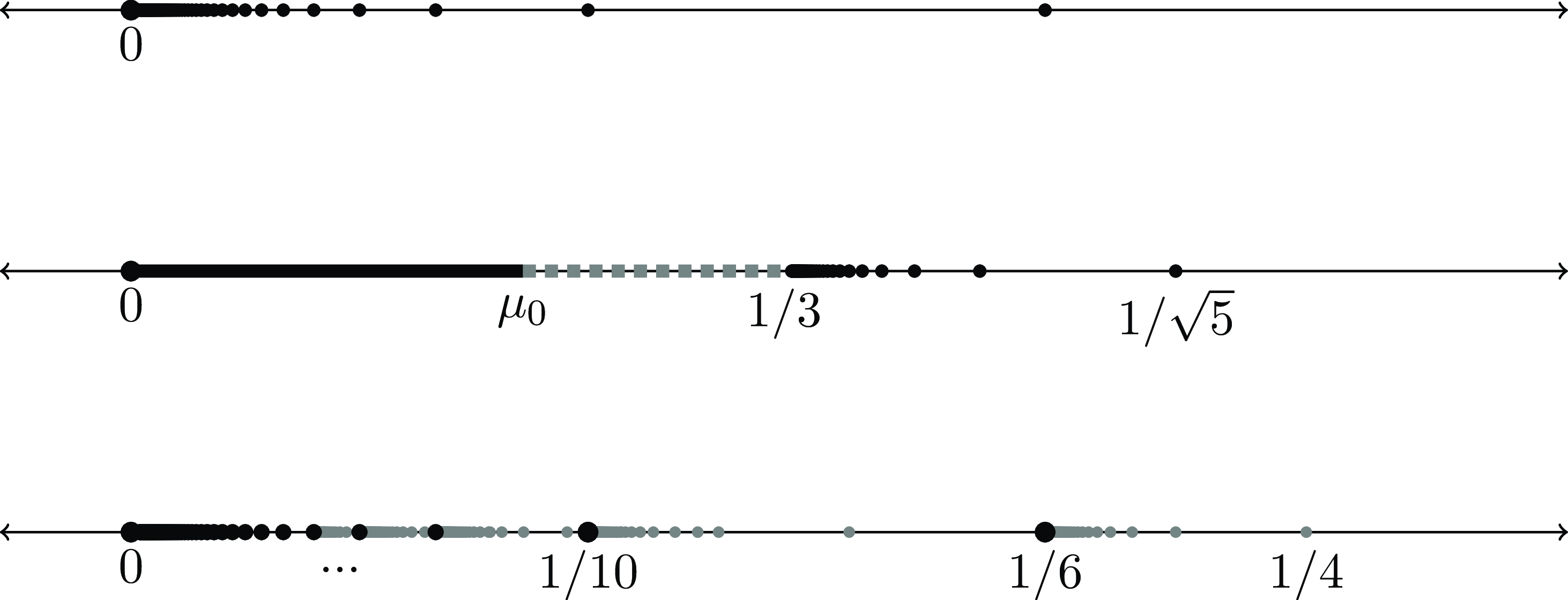


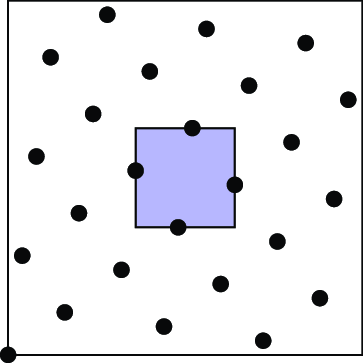


 Open access

