


1. Introduction
In this article we study semi-homogeneous vector bundles on abelian varieties (in the sense of Mukai [Reference MukaiMuk78]) and their moduli spaces through the lens of tropical geometry (expanding on [Reference Gross, Ulirsch and ZakharovGUZ22]) and the non-Archimedean approach to the Strominger–Yau–Zaslow (SYZ) fibration via essential skeletons of Berkovich analytic spaces (introduced in [Reference Kontsevich and SoibelmanKS06]).
Throughout we work over an algebraically closed field $K$
of characteristic zero. From Section 3 onwards we also assume that
$K$
of characteristic zero. From Section 3 onwards we also assume that $K$
is complete with respect to a non-trivial non-Archimedean absolute value.
$K$
is complete with respect to a non-trivial non-Archimedean absolute value.
1.1 Semi-homogeneous vector bundles and their moduli spaces
Let $A$
be an abelian variety over an algebraically closed field
$A$
be an abelian variety over an algebraically closed field $K$
of characteristic zero. The engine that drives this whole article is the theory of (semi-)homogeneous vector bundles on
$K$
of characteristic zero. The engine that drives this whole article is the theory of (semi-)homogeneous vector bundles on $A$
that has been developed in [Reference MiyanishiMiy73] and [Reference MukaiMuk78] (also see [Reference MorimotoMor59] and [Reference MatsushimaMat59] for a complex analytic predecessor of this notion). Write
$A$
that has been developed in [Reference MiyanishiMiy73] and [Reference MukaiMuk78] (also see [Reference MorimotoMor59] and [Reference MatsushimaMat59] for a complex analytic predecessor of this notion). Write $T_x\colon A\rightarrow A$
for the translation by a closed point
$T_x\colon A\rightarrow A$
for the translation by a closed point $x$
of
$x$
of $A$
. A vector bundle
$A$
. A vector bundle $E$
on
$E$
on $A$
is said to be semi-homogeneous if we have
$A$
is said to be semi-homogeneous if we have $T_x^\ast E\simeq L\otimes E$
, for a suitable line bundle
$T_x^\ast E\simeq L\otimes E$
, for a suitable line bundle $L$
on
$L$
on $A$
(possibly depending on
$A$
(possibly depending on $x$
) and homogeneous if
$x$
) and homogeneous if $L$
may be chosen to be trivial. By [Reference MukaiMuk78, Theorem 5.8] a simple vector bundle
$L$
may be chosen to be trivial. By [Reference MukaiMuk78, Theorem 5.8] a simple vector bundle $E$
on an abelian variety
$E$
on an abelian variety $A$
is semi-homogeneous if and only if there exists an isogeny
$A$
is semi-homogeneous if and only if there exists an isogeny $f\colon B\to A$
and a line bundle
$f\colon B\to A$
and a line bundle $L$
on
$L$
on $B$
such that
$B$
such that $E\cong f_*(L)$
.
$E\cong f_*(L)$
.
For a vector bundle $E$
on
$E$
on $A$
, its slope
$A$
, its slope $\delta (E)$
is the class
$\delta (E)$
is the class $\det (E)/r(E)$
of its determinant divided by its rank in the Néron–Severi group
$\det (E)/r(E)$
of its determinant divided by its rank in the Néron–Severi group $\textrm {NS}(A)_{\mathbb{Q}}$
with coefficients in
$\textrm {NS}(A)_{\mathbb{Q}}$
with coefficients in $\mathbb{Q}$
. By [Reference MukaiMuk78], given a class
$\mathbb{Q}$
. By [Reference MukaiMuk78], given a class $H\in \textrm {NS}(A)_{\mathbb{Q}}$
, there exists a simple semi-homogeneous vector bundle
$H\in \textrm {NS}(A)_{\mathbb{Q}}$
, there exists a simple semi-homogeneous vector bundle $E$
on
$E$
on $H$
with
$H$
with $\delta (E)=H$
, and any two such bundles coincide up to tensoring with a line bundle in
$\delta (E)=H$
, and any two such bundles coincide up to tensoring with a line bundle in $\textrm {Pic}^0(A)$
(for details see Theorem2.6). We denote by
$\textrm {Pic}^0(A)$
(for details see Theorem2.6). We denote by $n(H)$
the rank of any such simple semi-homogeneous vector bundle. Let
$n(H)$
the rank of any such simple semi-homogeneous vector bundle. Let $k\in \mathbb{Z}_{\gt 0}$
and set
$k\in \mathbb{Z}_{\gt 0}$
and set $r=k\cdot n(H)$
. Denote by
$r=k\cdot n(H)$
. Denote by $M_{H,k}(A)$
the normalization of the locus of semi-homogeneous vector bundles
$M_{H,k}(A)$
the normalization of the locus of semi-homogeneous vector bundles $E$
of slope
$E$
of slope $H$
and rank
$H$
and rank $r=k\cdot n(H)$
in the moduli space semi-stable torsion free sheaves on
$r=k\cdot n(H)$
in the moduli space semi-stable torsion free sheaves on $A$
. We show in Theorem2.16 that its image in the moduli space defines a connected component of the moduli space.
$A$
. We show in Theorem2.16 that its image in the moduli space defines a connected component of the moduli space.
We write
 \begin{align*} \Sigma (H)= \{x\in A^\vee \mid P_x\otimes E \cong E\}, \end{align*}
where $P_x$
is the line bundle on
$P_x$
is the line bundle on $A$
corresponding to
$A$
corresponding to $x$
in the the dual abelian variety
$x$
in the the dual abelian variety $A^\vee$
and
$A^\vee$
and $E$
is any semi-homogeneous vector bundle with
$E$
is any semi-homogeneous vector bundle with $\delta (E)=H$
. Let
$\delta (E)=H$
. Let $\pi ^\ast : A^\vee \rightarrow A^\vee / \Sigma (H)$
be the isogeny with kernel
$\pi ^\ast : A^\vee \rightarrow A^\vee / \Sigma (H)$
be the isogeny with kernel $\Sigma (H)$
, and let
$\Sigma (H)$
, and let $\pi : A_H \rightarrow A$
be the dual isogeny, where
$\pi : A_H \rightarrow A$
be the dual isogeny, where $A_H$
denotes the dual of
$A_H$
denotes the dual of $A^\vee / \Sigma (H)$
.
$A^\vee / \Sigma (H)$
.
Theorem A (see Theorem2.16). Let $A$
be an abelian variety over an algebraically closed field
$A$
be an abelian variety over an algebraically closed field $K$
of characteristic zero and fix a class
$K$
of characteristic zero and fix a class $H\in \textrm {NS}(A)_{\mathbb{Q}}$
.
$H\in \textrm {NS}(A)_{\mathbb{Q}}$
.
-
(i) When $k=1$
, then
\begin{align*} M_{H,1}(A) \cong \textrm {Pic}^{\pi ^*H}(A_H) .\end{align*}
$k=1$
, then
\begin{align*} M_{H,1}(A) \cong \textrm {Pic}^{\pi ^*H}(A_H) .\end{align*}
-
(ii) When
$k \geqslant 1$
, then there is a canonical isomorphism
\begin{align*} \textrm {Sym}^k M_{H,1}(A)\xrightarrow {\,\sim \,} M_{H,k}(A). \end{align*}


By [Reference Mehta and NoriMN84, Theorem 2 and the discussion on p. 2] a vector bundle $E$
on
$E$
on $A$
is semi-homogeneous if and only it is semi-stable with projective Chern class zero, meaning that the total Chern class is given by
$A$
is semi-homogeneous if and only it is semi-stable with projective Chern class zero, meaning that the total Chern class is given by $\left (1+ {c_1(E)}/{r}\right )^r$
where
$\left (1+ {c_1(E)}/{r}\right )^r$
where $r=k\cdot n(H)$
is the rank of
$r=k\cdot n(H)$
is the rank of $E$
and
$E$
and $E$
is semi-stable with respect to some polarization on
$E$
is semi-stable with respect to some polarization on $A$
. Thus, the component
$A$
. Thus, the component $M_{H,k}(A)$
may also be reinterpreted as a moduli space of semi-stable bundles with projective Chern class zero (and fixed slope
$M_{H,k}(A)$
may also be reinterpreted as a moduli space of semi-stable bundles with projective Chern class zero (and fixed slope $H$
).
$H$
).
If $H=0$
,
$H=0$
, $M_{H,k}(A)$
is the moduli space of semi-stable vector bundles of rank
$M_{H,k}(A)$
is the moduli space of semi-stable vector bundles of rank $r=k$
, all of whose Chern classes are trivial (which is why we often switch the index from
$r=k$
, all of whose Chern classes are trivial (which is why we often switch the index from $k$
to
$k$
to $r$
). This space appears, for example, in [Reference SimpsonSim94] as the locus in the Dolbeault moduli space of topologically trivial semi-stable Higgs bundles where the Higgs field is zero. In this case, it appears to be well-known in the community that the morphism in Theorem A(ii) induces an isomorphism onto its image in the moduli space of semi-stable vector bundles. This fact can, for example, also be deduced from the description of the moduli space of
$r$
). This space appears, for example, in [Reference SimpsonSim94] as the locus in the Dolbeault moduli space of topologically trivial semi-stable Higgs bundles where the Higgs field is zero. In this case, it appears to be well-known in the community that the morphism in Theorem A(ii) induces an isomorphism onto its image in the moduli space of semi-stable vector bundles. This fact can, for example, also be deduced from the description of the moduli space of $\Lambda$
-modules on
$\Lambda$
-modules on $A$
as a symmetric power in [Reference Franco and TortellaFT17, Theorem 3.14 and Proposition 3.16] (also see [Reference Bolognese, Küronya and UlirschBKU23, Proposition 1.6]).
$A$
as a symmetric power in [Reference Franco and TortellaFT17, Theorem 3.14 and Proposition 3.16] (also see [Reference Bolognese, Küronya and UlirschBKU23, Proposition 1.6]).
Theorem A is a moduli-theoretic reinterpretation of the structure results on semi-homogeneous vector bundles in [Reference MukaiMuk78]. The technique used in [Reference Franco and TortellaFT17], as well as the technique used in the proof of Theorem A, is based on Mukai’s work on Fourier–Mukai transforms [Reference MukaiMuk81], where he already observed the equivalence of the category of homogeneous vector bundles on an abelian variety and that of finite-length sheaves on its dual.
Part (i) of Theorem A is a slightly more explicit version of [Reference GulbrandsenGul08, Proposition 3.1]. In dimension one, Theorem A specializes to Atiyah’s classification of vector bundles on elliptic curves in [Reference AtiyahAti57], which has found a moduli-theoretic interpretation in [Reference TuTu93] and later in [Reference Hein and PloogHP05] from a Fourier–Mukai perspective. Moduli spaces of simple semi-homogeneous sheaves also play a crucial role in Lane’s study of Fourier–Mukai equivalences between twisted derived categories in [Reference LaneLan24].
1.2 Essential skeletons and tropicalization
From now on we assume that $K$
(in addition to being algebraically closed and of characteristic zero) is also complete with respect to a non-trivial non-Archimedean absolute value. Let
$K$
(in addition to being algebraically closed and of characteristic zero) is also complete with respect to a non-trivial non-Archimedean absolute value. Let $A$
be an abelian variety over
$A$
be an abelian variety over $K$
with totally degenerate reduction. By non-Archimedean uniformization, the Berkovich analytic space
$K$
with totally degenerate reduction. By non-Archimedean uniformization, the Berkovich analytic space $A^{{{\rm an}}}$
is a quotient
$A^{{{\rm an}}}$
is a quotient $T^{{{\rm an}}}/\Lambda$
of an algebraic torus
$T^{{{\rm an}}}/\Lambda$
of an algebraic torus $T\simeq {\mathbb{G}}_m^g$
by a lattice
$T\simeq {\mathbb{G}}_m^g$
by a lattice $\Lambda \simeq \mathbb{Z}^g$
. The non-Archimedean skeleton of
$\Lambda \simeq \mathbb{Z}^g$
. The non-Archimedean skeleton of $A^{{{\rm an}}}$
in the sense of Berkovich [Reference BerkovichBer90] is naturally identified with a real torus
$A^{{{\rm an}}}$
in the sense of Berkovich [Reference BerkovichBer90] is naturally identified with a real torus $A^{{{\rm trop}}}=N_{\mathbb{R}}/\Lambda$
, where
$A^{{{\rm trop}}}=N_{\mathbb{R}}/\Lambda$
, where $N_{\mathbb{R}}$
is the
$N_{\mathbb{R}}$
is the $\mathbb{R}$
-linear space spanned by the cocharacter lattice
$\mathbb{R}$
-linear space spanned by the cocharacter lattice $N$
of
$N$
of $T$
; we refer to
$T$
; we refer to $A^{{{\rm trop}}}$
as the tropicalization of
$A^{{{\rm trop}}}$
as the tropicalization of $A$
.
$A$
.
Berkovich skeletons are usually not unique. In [Reference Kontsevich and SoibelmanKS06], in an effort to construct a non-Archimedean analogue of mirror symmetry and, in particular, the SYZ fibration, Kontsevich and Soibelman suggest the construction of an essential skeleton of the Berkovich analytic space associated to a Calabi–Yau variety (also see [Reference Mustaţă and NicaiseMN15, Reference Nicaise and XuNX16, Reference Nicaise, Xu and YuNXY19] for further developments). Since the moduli spaces $M_{H,k}$
are all Calabi–Yau varieties, they do admit a canonical strong deformation retraction
$M_{H,k}$
are all Calabi–Yau varieties, they do admit a canonical strong deformation retraction $\tau$
onto their essential skeleton
$\tau$
onto their essential skeleton $\Sigma (M_{H,k})$
.
$\Sigma (M_{H,k})$
.
In Section 4, we develop a tropical analogue of the geometry of semi-homogeneous vector bundles on $A^{{{\rm trop}}}$
, expanding on the results in [Reference Gross, Ulirsch and ZakharovGUZ22] on metric graphs (and inspired by the case of line bundles developed in [Reference Mikhalkin and ZharkovMZ08]). In particular, we prove a tropical analogue of Mukai’s classification of semi-homogeneous bundles [Reference MukaiMuk78]. Mukai’s classification does not immediately allow us to construct a well-defined tropicalization map, whose target is the naïve tropical analogue of the moduli space
$A^{{{\rm trop}}}$
, expanding on the results in [Reference Gross, Ulirsch and ZakharovGUZ22] on metric graphs (and inspired by the case of line bundles developed in [Reference Mikhalkin and ZharkovMZ08]). In particular, we prove a tropical analogue of Mukai’s classification of semi-homogeneous bundles [Reference MukaiMuk78]. Mukai’s classification does not immediately allow us to construct a well-defined tropicalization map, whose target is the naïve tropical analogue of the moduli space $M_{H,k}(A)$
. Given a fixed class
$M_{H,k}(A)$
. Given a fixed class $H\in \textrm {NS}(A)_{\mathbb{Q}}$
, we identify a natural smallest sublattice
$H\in \textrm {NS}(A)_{\mathbb{Q}}$
, we identify a natural smallest sublattice $\Lambda _{H}^{c}$
, that allows to construct a refined moduli space
$\Lambda _{H}^{c}$
, that allows to construct a refined moduli space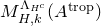 $M_{H,k}^{\Lambda _{H^{c}}}(A^{{{\rm trop}}})$
of equivalence classes of semi-homogeneous tropical vector bundles, that is the target of a natural tropicalization map
$M_{H,k}^{\Lambda _{H^{c}}}(A^{{{\rm trop}}})$
of equivalence classes of semi-homogeneous tropical vector bundles, that is the target of a natural tropicalization map ${{\rm trop}}\colon M_{H,k}(A)^{{{\rm an}}}\rightarrow M_{H,k}^{\Lambda _{H^{c}}}(A^{{{\rm trop}}})$
(see Definition3.5 for the precise definition of
${{\rm trop}}\colon M_{H,k}(A)^{{{\rm an}}}\rightarrow M_{H,k}^{\Lambda _{H^{c}}}(A^{{{\rm trop}}})$
(see Definition3.5 for the precise definition of $\Lambda _{H}^{c}$
and Definition 4.21 for the definition of
$\Lambda _{H}^{c}$
and Definition 4.21 for the definition of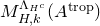 $M_{H,k}^{\Lambda _{H^{c}}}(A^{{{\rm trop}}})$
).
$M_{H,k}^{\Lambda _{H^{c}}}(A^{{{\rm trop}}})$
).
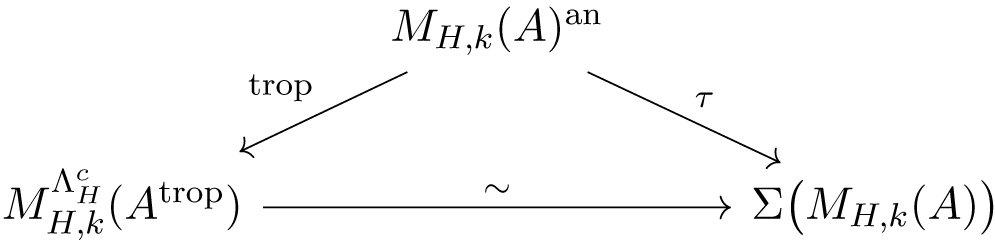
The following theorem tells us that this construction is precisely the retraction to the essential skeleton of $M_{H,k}(A)^{{{\rm an}}}$
.
$M_{H,k}(A)^{{{\rm an}}}$
.
Theorem B (see Theorem6.6). Let $A$
be an abelian variety over an algebraically closed complete non-Archimedean field
$A$
be an abelian variety over an algebraically closed complete non-Archimedean field $K$
with totally degenerate reduction, and fix
$K$
with totally degenerate reduction, and fix $H\in \textrm {NS}(A)_{\mathbb{Q}}$
. Then there is a natural isomorphism
$H\in \textrm {NS}(A)_{\mathbb{Q}}$
. Then there is a natural isomorphism
 \begin{align*} M_{H,k}^{\Lambda _{H}^{c}}(A^{{{\rm trop}}})\xrightarrow {\,\sim \,} \Sigma \big (M_{H,k}(A)\big ) \end{align*}
that makes the following diagram commute.
In the case $H=0$
(and, thus,
$H=0$
(and, thus, $r=k$
) the moduli space
$r=k$
) the moduli space $M_{0,r}(A)$
is isomorphic to the moduli space of semi-stable vector bundles of rank
$M_{0,r}(A)$
is isomorphic to the moduli space of semi-stable vector bundles of rank $r$
on
$r$
on $A$
with vanishing Chern classes. In this case, the moduli space
$A$
with vanishing Chern classes. In this case, the moduli space $M_{0,r}^{^{\Lambda _{H^{c}}}}(A^{{{\rm trop}}})$
may be identified with the main component
$M_{0,r}^{^{\Lambda _{H^{c}}}}(A^{{{\rm trop}}})$
may be identified with the main component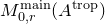 $M_{0,r}^{{{\rm main}}}(A^{{{\rm trop}}})$
of a (naïvely defined) moduli space
$M_{0,r}^{{{\rm main}}}(A^{{{\rm trop}}})$
of a (naïvely defined) moduli space $M_{0,r}(A^{{{\rm trop}}})$
of homogeneous tropical vector bundles of rank
$M_{0,r}(A^{{{\rm trop}}})$
of homogeneous tropical vector bundles of rank $r$
and with trivial Neron–Severi class (see Section 7.1 for details). Thus, Theorem B, in particular, describes the essential skeleton of the moduli space of semi-stable vector bundles with vanishing Chern classes.
$r$
and with trivial Neron–Severi class (see Section 7.1 for details). Thus, Theorem B, in particular, describes the essential skeleton of the moduli space of semi-stable vector bundles with vanishing Chern classes.
Theorem B is a generalization of [Reference Gross, Ulirsch and ZakharovGUZ22, Theorem D], which proves an analogous result on Tate curves (the case $g=1$
). It forms another addition to the dictionary between non-Archimedean skeletons of algebraic moduli spaces and their tropical analogues. The pioneering works in this direction are [Reference Baker and RabinoffBR15], which deals with the Jacobian, and [Reference Abramovich, Caporaso and PayneACP15], which deals with the moduli space of curves.
$g=1$
). It forms another addition to the dictionary between non-Archimedean skeletons of algebraic moduli spaces and their tropical analogues. The pioneering works in this direction are [Reference Baker and RabinoffBR15], which deals with the Jacobian, and [Reference Abramovich, Caporaso and PayneACP15], which deals with the moduli space of curves.
1.3 Representations, homogeneous bundles, and tropicalization
Homogeneous bundles play an important role in the representation theory of the fundamental group of an abelian variety. For an abelian variety $A$
with totally degenerate reduction, we write
$A$
with totally degenerate reduction, we write $A^{{{\rm an}}}=T^{{{\rm an}}}/\Lambda$
for an algebraic torus
$A^{{{\rm an}}}=T^{{{\rm an}}}/\Lambda$
for an algebraic torus $T={\mathbb{G}}_m^g$
, with
$T={\mathbb{G}}_m^g$
, with $\Lambda$
the analytic fundamental group of
$\Lambda$
the analytic fundamental group of $T^{an}$
.
$T^{an}$
.
We show in Section 7.3 that for semi-simple representations the characterization of line bundles on $A$
due to Gerritzen [Reference GerritzenGer72], gives rise to a natural surjective analytic morphism
$A$
due to Gerritzen [Reference GerritzenGer72], gives rise to a natural surjective analytic morphism
 \begin{align*} \eta _A^{{{\rm an}}}\colon X_r(\Lambda )^{{{\rm an}}}\longrightarrow M_{0,r}(A)^{{{\rm an}}} \end{align*}
from the (analytification of the) character variety
 \begin{align*} X_r(\Lambda )={\textrm {Hom}}(\Lambda ,\textrm {GL}_r)/\!\!/{\textrm {GL}_r} \end{align*}
of $\Lambda$
to the (analytification of the) moduli space
$\Lambda$
to the (analytification of the) moduli space $M_{0,r}(A)$
of homogeneous bundles of rank
$M_{0,r}(A)$
of homogeneous bundles of rank $r$
on
$r$
on $A$
(or equivalently the moduli space of semi-stable bundles with vanishing Chern classes).
$A$
(or equivalently the moduli space of semi-stable bundles with vanishing Chern classes).
In Sections 7.2 and 7.4 we construct a tropical analogue $X^{{{\rm trop}}}_r(\Lambda )$
of the character variety
$X^{{{\rm trop}}}_r(\Lambda )$
of the character variety $X_r(\Lambda )$
as well as a natural tropicalization map
$X_r(\Lambda )$
as well as a natural tropicalization map ${{\rm trop}}\colon X_r(\Lambda )^{{{\rm an}}}\rightarrow X^{{{\rm trop}}}_r(\Lambda )$
that exhibits the main component
${{\rm trop}}\colon X_r(\Lambda )^{{{\rm an}}}\rightarrow X^{{{\rm trop}}}_r(\Lambda )$
that exhibits the main component $X^{{{\rm trop}}}_r(\Lambda )^{{{\rm diag}}}$
of
$X^{{{\rm trop}}}_r(\Lambda )^{{{\rm diag}}}$
of $X^{{{\rm trop}}}_r(\Lambda )$
(parametrizing diagonalizable representations) as the essential skeleton
$X^{{{\rm trop}}}_r(\Lambda )$
(parametrizing diagonalizable representations) as the essential skeleton $\Sigma \big (X_r(\Lambda )\big )$
of the open Calabi–Yau variety
$\Sigma \big (X_r(\Lambda )\big )$
of the open Calabi–Yau variety $X_r(\Lambda )$
. In other words, we find an isomorphism
$X_r(\Lambda )$
. In other words, we find an isomorphism $X^{{{\rm trop}}}_r(\Lambda )^{{{\rm diag}}}\xrightarrow {\sim }\Sigma \big (X_r(\Lambda )\big )$
that identifies the tropicalization map
$X^{{{\rm trop}}}_r(\Lambda )^{{{\rm diag}}}\xrightarrow {\sim }\Sigma \big (X_r(\Lambda )\big )$
that identifies the tropicalization map ${\rm trop}$
with the retraction
${\rm trop}$
with the retraction $\tau$
to
$\tau$
to $\Sigma \big (X_r(\Lambda )\big )$
.
$\Sigma \big (X_r(\Lambda )\big )$
.
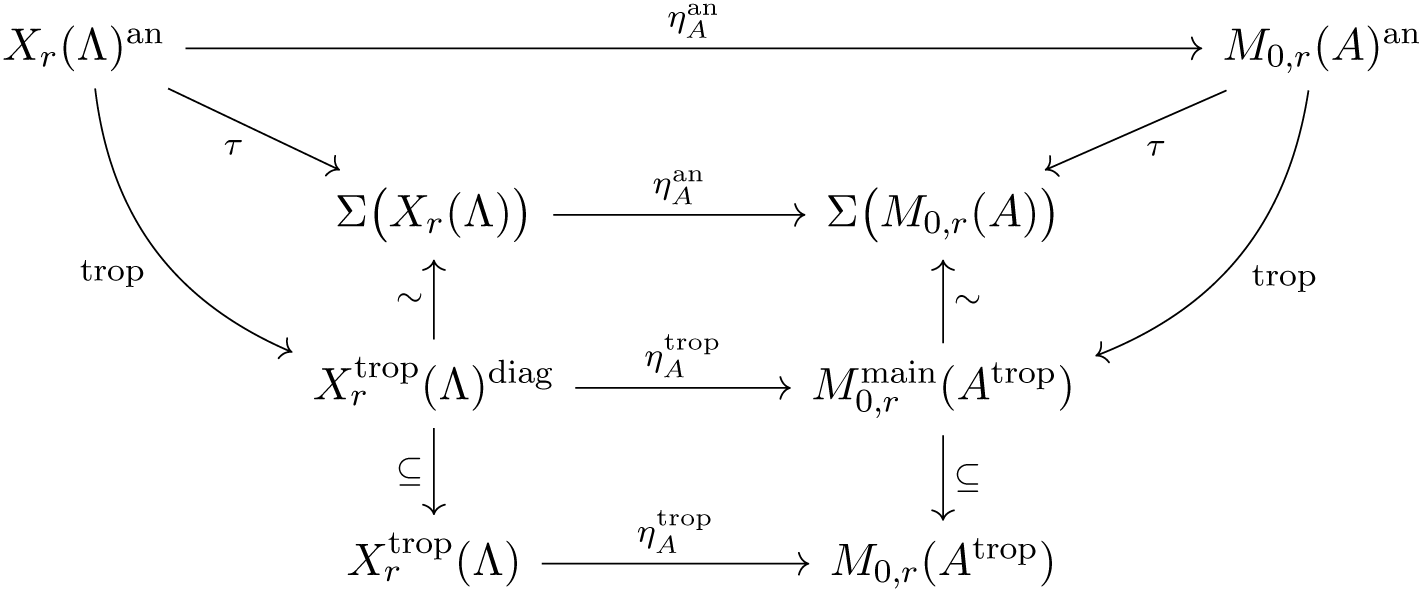
The following theorem provides us with a tropical analogue of $\eta _A^{{{\rm an}}}$
that is compatible with the process of tropicalization.
$\eta _A^{{{\rm an}}}$
that is compatible with the process of tropicalization.
Theorem C (see Corollary 7.5 and Proposition 7.11). There is a natural surjective morphism
 \begin{align*}\eta _{A}^{{{\rm trop}}}\colon X^{{{\rm trop}}}_r(\Lambda )\longrightarrow M_{0,r}(A^{{{\rm trop}}}) \end{align*}
(of integral affine orbifolds) that is given by associating to every tropical representation $\rho \colon \Lambda \rightarrow \textrm {GL}_n({\mathbb{T}})$
a tropical homogeneous vector bundle
$\rho \colon \Lambda \rightarrow \textrm {GL}_n({\mathbb{T}})$
a tropical homogeneous vector bundle $E(\rho )$
and which naturally agrees with
$E(\rho )$
and which naturally agrees with $\eta _A^{{{\rm an}}}$
on the main components.
$\eta _A^{{{\rm an}}}$
on the main components.
In other words, we may summarize our results by saying that the following natural diagram commutes.
A $p$
-adic analogue of the Corlette–Simpson correspondence on abeloid varieties was proven in [Reference Heuer, Mann and WernerHMW23]. In this
$p$
-adic analogue of the Corlette–Simpson correspondence on abeloid varieties was proven in [Reference Heuer, Mann and WernerHMW23]. In this $p$
-adic setting, on the representation side continuous representations of the (pro-finite) étale fundamental group are considered. Nevertheless, working with only “half” of the fundamental group in this article provides us with a connection to tropical geometry.
$p$
-adic setting, on the representation side continuous representations of the (pro-finite) étale fundamental group are considered. Nevertheless, working with only “half” of the fundamental group in this article provides us with a connection to tropical geometry.
2. Semi-homogeneous bundles and their moduli spaces
In this section we let $K$
be an algebraically closed field of characteristic zero. We recall the basic definitions and results related to semi-homogeneous vector bundles on abelian varieties. Throughout this section, (semi-)stability refers to Gieseker (semi-)stability.
$K$
be an algebraically closed field of characteristic zero. We recall the basic definitions and results related to semi-homogeneous vector bundles on abelian varieties. Throughout this section, (semi-)stability refers to Gieseker (semi-)stability.
2.1 Semi-homogeneous vector bundles on abelian varieties
Let $A$
be an abelian variety of dimension
$A$
be an abelian variety of dimension $g$
over
$g$
over $K$
and write
$K$
and write $T_x\colon A\rightarrow A$
for the translation
$T_x\colon A\rightarrow A$
for the translation $a\mapsto x+a$
by an element
$a\mapsto x+a$
by an element $x\in A(K)$
.
$x\in A(K)$
.
Definition 2.1. A vector bundle $E$
on
$E$
on $A$
is called homogeneous, if
$A$
is called homogeneous, if $T_x^\ast E\simeq E$
for every
$T_x^\ast E\simeq E$
for every $x\in A(K)$
. Line bundles are homogeneous if and only if they are algebraically equivalent to zero or, equivalently, if their class in the Néron–Severi group
$x\in A(K)$
. Line bundles are homogeneous if and only if they are algebraically equivalent to zero or, equivalently, if their class in the Néron–Severi group $\textrm {NS}(A)= \textrm {Pic}(A)/\textrm {Pic}^0(A)$
is trivial.
$\textrm {NS}(A)= \textrm {Pic}(A)/\textrm {Pic}^0(A)$
is trivial.
A vector bundle $E$
is called semi-homogeneous if for every
$E$
is called semi-homogeneous if for every $x \in A(K)$
, there exists a line bundle
$x \in A(K)$
, there exists a line bundle $L$
(possibly depending on
$L$
(possibly depending on $x$
) on
$x$
) on $A$
such that
$A$
such that $T_x^{*}E = E \otimes L$
.
$T_x^{*}E = E \otimes L$
.
Definition 2.2. Let $\textrm {NS}(A)_{\mathbb{Q}}$
denote the Néron–Severi group with rational coefficients. For a vector bundle
$\textrm {NS}(A)_{\mathbb{Q}}$
denote the Néron–Severi group with rational coefficients. For a vector bundle $E$
on
$E$
on $A$
we denote its slope by
$A$
we denote its slope by
 \begin{align*} \delta (E)=\frac {[\det (E)]}{r(E)} \end{align*}
in $\textrm {NS}(A)_{\mathbb{Q}}$
. By
$\textrm {NS}(A)_{\mathbb{Q}}$
. By $[\det ]$
, we mean the class of the determinant in the Néron–Severi group. Therefore fixing the slope for us implies that we are not fixing the determinant but its class.
$[\det ]$
, we mean the class of the determinant in the Néron–Severi group. Therefore fixing the slope for us implies that we are not fixing the determinant but its class.
Remark 2.3. Recall that a vector bundle $E$
is simple if the only endomorphisms of
$E$
is simple if the only endomorphisms of $E$
are the scalars, i.e.
$E$
are the scalars, i.e. ${\textrm {End}}(E) = K$
. By [Reference MukaiMuk78, Proposition 6.16] every simple semi-homogeneous bundle is stable.
${\textrm {End}}(E) = K$
. By [Reference MukaiMuk78, Proposition 6.16] every simple semi-homogeneous bundle is stable.
The following theorem provides a classification of semi-homogeneous vector bundles on abelian varieties and generalizes the classification of vector bundles on elliptic curves given by Atiyah in [Reference AtiyahAti57].
Theorem 2.4 (see [Reference MukaiMuk78, Propositions 6.2 and 6.18]). Let $E$
be a semi-homogeneous vector bundle. Then there exist simple semi-homogeneous vector bundles
$E$
be a semi-homogeneous vector bundle. Then there exist simple semi-homogeneous vector bundles $E_1,\ldots , E_k$
with
$E_1,\ldots , E_k$
with $\delta (E_i)=\delta (E)$
and for every
$\delta (E_i)=\delta (E)$
and for every $1\leqslant i\leqslant k$
a unipotent vector bundle
$1\leqslant i\leqslant k$
a unipotent vector bundle $U_i$
such that
$U_i$
such that
 \begin{align*} E\cong \bigoplus _{i=1}^k U_i\otimes E_i. \end{align*}
Definition 2.5. Let $H\in \textrm {NS}(A)_{\mathbb{Q}}$
. We define
$H\in \textrm {NS}(A)_{\mathbb{Q}}$
. We define $\mathcal{S}_{H}$
to be the set of all isomorphism classes of simple semi-homogeneous vector bundles
$\mathcal{S}_{H}$
to be the set of all isomorphism classes of simple semi-homogeneous vector bundles $E$
on
$E$
on $A$
with
$A$
with $\delta (E)=H$
.
$\delta (E)=H$
.
The following result gives the non-emptiness of $\mathcal{S}_H$
.
$\mathcal{S}_H$
.
Theorem 2.6 (see [Reference MukaiMuk78, Proposition 6.17, Corollary 6.23, and Theorem 5.8]). Let $H\in \textrm {NS}(A)_{\mathbb{Q}}$
. Then there exists at least one simple semi-homogeneous bundle
$H\in \textrm {NS}(A)_{\mathbb{Q}}$
. Then there exists at least one simple semi-homogeneous bundle $E$
on
$E$
on $A$
with
$A$
with $\delta (E)=H$
; in other words,
$\delta (E)=H$
; in other words, $ \mathcal{S}_H\neq \emptyset$
. If
$ \mathcal{S}_H\neq \emptyset$
. If $E,E'\in \mathcal{S}_H$
, then there exists a line bundle
$E,E'\in \mathcal{S}_H$
, then there exists a line bundle $M\in \textrm {Pic}^0(A)$
with
$M\in \textrm {Pic}^0(A)$
with $E\otimes M\cong E'$
. Moreover, for every
$E\otimes M\cong E'$
. Moreover, for every $E\in {\mathcal{S}}_H$
, there exists an isogeny
$E\in {\mathcal{S}}_H$
, there exists an isogeny $f\colon A'\to A$
and a line bundle
$f\colon A'\to A$
and a line bundle $L$
on
$L$
on $A'$
with
$A'$
with $f_*L\cong E$
.
$f_*L\cong E$
.
Notation 2.7.
For a semi-homogeneous vector bundle $E$
on
$E$
on $A$
we denote
$A$
we denote
 \begin{align*}K(E)= \{x \in A\mid T_x^*E\cong E\} \end{align*}
and
 \begin{align*} \Sigma (E)= \{x\in A^\vee \mid P_x\otimes E \cong E\}, \end{align*}
where $P_x$
is the line bundle on
$P_x$
is the line bundle on $A$
corresponding to
$A$
corresponding to $x$
in the the dual abelian variety
$x$
in the the dual abelian variety $A^\vee$
.
$A^\vee$
.
Given $H\in \textrm {NS}(A)_{\mathbb{Q}}$
, we denote
$H\in \textrm {NS}(A)_{\mathbb{Q}}$
, we denote $n(H)=r(E)$
and
$n(H)=r(E)$
and $\Sigma (H)=\Sigma (E)$
for some simple semi-homogeneous vector bundle
$\Sigma (H)=\Sigma (E)$
for some simple semi-homogeneous vector bundle $E$
with
$E$
with $\delta (E)=H$
. By Theorem
2.6
, both
$\delta (E)=H$
. By Theorem
2.6
, both $n(H)$
and
$n(H)$
and $\Sigma (H)$
are well-defined, since any two choices of
$\Sigma (H)$
are well-defined, since any two choices of $E$
coincide up to tensoring with a line bundle in
$E$
coincide up to tensoring with a line bundle in $\textrm {Pic}^0(A)$
.
$\textrm {Pic}^0(A)$
.
By [Reference MukaiMuk78, Proposition 3.2], $K(E)$
is a closed subgroup scheme of
$K(E)$
is a closed subgroup scheme of $A$
, and
$A$
, and $\Sigma (E)$
is a closed subgroup scheme of
$\Sigma (E)$
is a closed subgroup scheme of $A^\vee$
. In particular both are reduced.
$A^\vee$
. In particular both are reduced.
Theorem 2.8 (see [Reference OdaOda71, Theorem 1.2], [Reference MukaiMuk78, Lemma 3.13]). Let $f\colon B\to A$
be an isogeny of abelian varieties and let
$f\colon B\to A$
be an isogeny of abelian varieties and let $L$
be a line bundle on
$L$
be a line bundle on $B$
. Then
$B$
. Then $f_*(L)$
is simple if and only if
$f_*(L)$
is simple if and only if $K(L)\cap \ker (f)=0$
.
$K(L)\cap \ker (f)=0$
.
Lemma 2.9.
Let $f\colon B\to A$
be an isogeny of abelian varieties and let
$f\colon B\to A$
be an isogeny of abelian varieties and let $L$
be a line bundle on
$L$
be a line bundle on $B$
. Then we have
$B$
. Then we have $f^*\delta (f_*L)=L$
in
$f^*\delta (f_*L)=L$
in $\textrm {NS}(B)_{\mathbb{Q}}$
.
$\textrm {NS}(B)_{\mathbb{Q}}$
.
Proof. Since pullbacks commute with determinants we have
 \begin{align*} f^*\delta (f_*L)=\delta (f^*f_*L). \end{align*}
The isogeny $f$
is a
$f$
is a $\ker (f)$
-torsor. Therefore,
$\ker (f)$
-torsor. Therefore,
 \begin{align*} f^*f_*L\cong \bigoplus _{\lambda \in \ker (f)} T_\lambda ^*L. \end{align*}
As translates of $L$
are algebraically equivalent, the assertion follows.
$L$
are algebraically equivalent, the assertion follows.
Fix a class $H\in \textrm {NS}(A)_{\mathbb{Q}}$
. By Theorem2.6 there exists a simple semi-homogeneous bundle
$H\in \textrm {NS}(A)_{\mathbb{Q}}$
. By Theorem2.6 there exists a simple semi-homogeneous bundle $E$
of slope
$E$
of slope $H$
, which is of the form
$H$
, which is of the form $E\cong f_*L$
for an isogeny
$E\cong f_*L$
for an isogeny $f\colon A'\to A$
and a line bundle
$f\colon A'\to A$
and a line bundle $L$
on
$L$
on $A'$
. The simple semi-homogeneous bundles of slope
$A'$
. The simple semi-homogeneous bundles of slope $H$
are then precisely the bundles of the form
$H$
are then precisely the bundles of the form $E\otimes M \cong f_*(L\otimes f^*M)$
for
$E\otimes M \cong f_*(L\otimes f^*M)$
for $M\in \textrm {Pic}^0(A)$
. By [Reference MumfordMum70, Section 15, Theorem 1], the pullback
$M\in \textrm {Pic}^0(A)$
. By [Reference MumfordMum70, Section 15, Theorem 1], the pullback $f^\ast : \textrm {Pic}^0(A) \to \textrm {Pic}^0(A')$
has finite kernel. The image of
$f^\ast : \textrm {Pic}^0(A) \to \textrm {Pic}^0(A')$
has finite kernel. The image of $f^\ast$
is therefore a closed subvariety of
$f^\ast$
is therefore a closed subvariety of $\textrm {Pic}^0(A')$
of the same dimension, which implies that
$\textrm {Pic}^0(A')$
of the same dimension, which implies that $f^\ast$
is surjective. Hence, every simple semi-homogeneous bundle on
$f^\ast$
is surjective. Hence, every simple semi-homogeneous bundle on $A$
of slope
$A$
of slope $H$
is of the form
$H$
is of the form $f_*(L')$
, for a line bundle
$f_*(L')$
, for a line bundle $L'$
on
$L'$
on $A'$
algebraically equivalent to
$A'$
algebraically equivalent to $L$
, and, conversely,
$L$
, and, conversely, $f_*(L')$
is simple semi-homogeneous of slope
$f_*(L')$
is simple semi-homogeneous of slope $H$
for all
$H$
for all $L'$
algebraically equivalent to
$L'$
algebraically equivalent to $L$
. Moreover, Lemma 2.9 implies that
$L$
. Moreover, Lemma 2.9 implies that $L$
has class
$L$
has class $f^*H$
in
$f^*H$
in $\textrm {NS}(A')_{\mathbb{Q}}$
. Because
$\textrm {NS}(A')_{\mathbb{Q}}$
. Because $\textrm {NS}(A')$
is torsion free by [Reference MumfordMum70, Section 19, Corollary 2], the pullback
$\textrm {NS}(A')$
is torsion free by [Reference MumfordMum70, Section 19, Corollary 2], the pullback $f^*H$
in fact determines the class of
$f^*H$
in fact determines the class of $L$
in
$L$
in $\textrm {NS}(A')$
.
$\textrm {NS}(A')$
.
2.2 Moduli spaces of semi-homogeneous bundles
As before, let $A$
be an abelian variety over an algebraically closed field
$A$
be an abelian variety over an algebraically closed field $K$
of characteristic zero and let
$K$
of characteristic zero and let $H\in \textrm {NS}(A)_{\mathbb{Q}}$
. Let
$H\in \textrm {NS}(A)_{\mathbb{Q}}$
. Let $k\in \mathbb{Z}_{\gt 0}$
and set
$k\in \mathbb{Z}_{\gt 0}$
and set $r=k\cdot n(H)$
. In what follows, we show that there exists a connected component
$r=k\cdot n(H)$
. In what follows, we show that there exists a connected component $S_{H,k}(A)$
in the moduli space of semi-stable sheaves on
$S_{H,k}(A)$
in the moduli space of semi-stable sheaves on $A$
whose points correspond to
$A$
whose points correspond to $S$
-equivalence classes of semi-homogeneous bundles of slope
$S$
-equivalence classes of semi-homogeneous bundles of slope $H$
and rank
$H$
and rank $r$
. Denote by
$r$
. Denote by $M_{H,k}(A)$
its normalization. In the case
$M_{H,k}(A)$
its normalization. In the case $k=1$
, we explicitly construct
$k=1$
, we explicitly construct $M_{H,1}(A)\simeq S_{H,k}(A)$
as a torsor over an abelian variety. For
$M_{H,1}(A)\simeq S_{H,k}(A)$
as a torsor over an abelian variety. For $k\gt 1$
, we construct an isomorphism between the symmetric power
$k\gt 1$
, we construct an isomorphism between the symmetric power $\textrm {Sym}^k(M_{H,1}(A))$
and
$\textrm {Sym}^k(M_{H,1}(A))$
and $M_{H,k}(A)$
. We begin with some notation.
$M_{H,k}(A)$
. We begin with some notation.
Notation 2.10.
For $H\in \textrm {NS}(A)$
we denote by
$H\in \textrm {NS}(A)$
we denote by $\textrm {Pic}^H(A)$
the fiber over
$\textrm {Pic}^H(A)$
the fiber over $H$
along the quotient map
$H$
along the quotient map $\textrm {Pic}(A)\to \textrm {NS}(A)$
. Let
$\textrm {Pic}(A)\to \textrm {NS}(A)$
. Let $\pi ^\ast : A^\vee \rightarrow A^\vee / \Sigma (H)$
be the isogeny with kernel
$\pi ^\ast : A^\vee \rightarrow A^\vee / \Sigma (H)$
be the isogeny with kernel $\Sigma (H)$
, and let
$\Sigma (H)$
, and let $\pi : A_H \rightarrow A$
be the dual isogeny, where
$\pi : A_H \rightarrow A$
be the dual isogeny, where $A_H$
denotes the dual of
$A_H$
denotes the dual of $A^\vee / \Sigma (H)$
.
$A^\vee / \Sigma (H)$
.
Proposition 2.11.
Let $\mathcal{F}$
be an
$\mathcal{F}$
be an $S$
-flat coherent sheaf on
$S$
-flat coherent sheaf on $A\times _K S$
for some finite-type
$A\times _K S$
for some finite-type $K$
-scheme
$K$
-scheme $S$
. Then the set of closed points
$S$
. Then the set of closed points $s\in S$
such that
$s\in S$
such that ${\mathcal{F}}_s$
is semi-homogeneous of slope
${\mathcal{F}}_s$
is semi-homogeneous of slope $H$
and rank
$H$
and rank $k\cdot n(H)$
is the set of closed points of an open subset of
$k\cdot n(H)$
is the set of closed points of an open subset of $S$
.
$S$
.
Proof.
Being a locally free sheaf is an open condition by [Reference Huybrechts and LehnHL10, Lemma 2.1.8], as is the condition of having slope $H$
and rank
$H$
and rank $k\cdot n(H)$
. We may thus assume that
$k\cdot n(H)$
. We may thus assume that $\mathcal{F}$
is a family of vector bundles of slope
$\mathcal{F}$
is a family of vector bundles of slope $H$
and rank
$H$
and rank $k\cdot n(H)$
.
$k\cdot n(H)$
.
By [Reference MukaiMuk78, Proposition 5.4], a vector bundle $E$
on
$E$
on $A$
is semi-homogeneous if and only if
$A$
is semi-homogeneous if and only if $\pi ^*E$
is a semi-homogeneous vector bundle on
$\pi ^*E$
is a semi-homogeneous vector bundle on $A_H$
. If
$A_H$
. If $E$
is of slope
$E$
is of slope $H$
, then
$H$
, then $\pi ^*E$
is of slope
$\pi ^*E$
is of slope $\pi ^*H$
and by [Reference MukaiMuk78, Proposition 7.6] we have
$\pi ^*H$
and by [Reference MukaiMuk78, Proposition 7.6] we have $\pi ^*H\in \textrm {NS}(A)$
. Replacing
$\pi ^*H\in \textrm {NS}(A)$
. Replacing $A$
by
$A$
by $A_H$
we may thus assume, from the onset, that
$A_H$
we may thus assume, from the onset, that $H\in \textrm {NS}(A)$
.
$H\in \textrm {NS}(A)$
.
Let ${\mathcal{P}}_H$
denote the universal line bundle on
${\mathcal{P}}_H$
denote the universal line bundle on $A\times \textrm {Pic}^H(A)$
and let
$A\times \textrm {Pic}^H(A)$
and let
 \begin{align*} \begin{split} \Phi \colon D^b\big ({\textrm {Pic}}^H(A)\big )&\longrightarrow D^b(A) \\[5pt] {\mathcal{K}}^\bullet &\longmapsto \mathbf R p_{1*} (p_{2}^*{\mathcal{K}}^\bullet \otimes ^{\mathbf L} {\mathcal{P}}_H) \end{split} \end{align*}
denote the associated Fourier–Mukai transform. By Theorem2.4, semi-homogeneous bundles on $A$
of slope
$A$
of slope $H$
are precisely the successive extensions of elements of
$H$
are precisely the successive extensions of elements of $\textrm {Pic}^H(A)$
. These correspond under
$\textrm {Pic}^H(A)$
. These correspond under $\Phi$
to the successive extension of skyscraper sheaves on
$\Phi$
to the successive extension of skyscraper sheaves on $A$
, that is to zero-dimensional coherent sheaves on
$A$
, that is to zero-dimensional coherent sheaves on $A$
. Applying the inverse
$A$
. Applying the inverse $\Phi ^{-1}$
to
$\Phi ^{-1}$
to $\mathcal{F}$
(this can be done in families, see [Reference Bartocci, Bruzzo and RuipérezBBHR09, Section 1.2.1]), it suffices to prove the following: given an element
$\mathcal{F}$
(this can be done in families, see [Reference Bartocci, Bruzzo and RuipérezBBHR09, Section 1.2.1]), it suffices to prove the following: given an element ${\mathcal{K}}^\bullet \in D^b(\textrm {Pic}^H(A)\times _K S)$
, the set
${\mathcal{K}}^\bullet \in D^b(\textrm {Pic}^H(A)\times _K S)$
, the set $U$
of
$U$
of $s\in S$
such that
$s\in S$
such that $\mathbf L i_s^*{\mathcal{K}}^\bullet$
is finite of length
$\mathbf L i_s^*{\mathcal{K}}^\bullet$
is finite of length $k$
is open. Here, we denote by
$k$
is open. Here, we denote by $i_s\colon \textrm {Pic}^H(A)\times _K \kappa (s) \to \textrm {Pic}^H(A)\times _K S$
the inclusion. To prove openness, it suffices to show that
$i_s\colon \textrm {Pic}^H(A)\times _K \kappa (s) \to \textrm {Pic}^H(A)\times _K S$
the inclusion. To prove openness, it suffices to show that $U$
is both constructible and stable under generalization.
$U$
is both constructible and stable under generalization.
We first prove that $U$
is stable under generalization. Suppose that
$U$
is stable under generalization. Suppose that $s\in S$
specializes to
$s\in S$
specializes to $t\in U$
, let
$t\in U$
, let $R$
be the local ring of
$R$
be the local ring of $t$
in
$t$
in $\overline {\{s\}}$
, and let
$\overline {\{s\}}$
, and let $\iota \colon \textrm {Spec} R\to S$
denote the inclusion. Then after replacing
$\iota \colon \textrm {Spec} R\to S$
denote the inclusion. Then after replacing $S$
by
$S$
by $\textrm {Spec} R$
and
$\textrm {Spec} R$
and ${\mathcal{K}}^\bullet$
by
${\mathcal{K}}^\bullet$
by $\mathbf L \iota ^*{\mathcal{K}}^\bullet$
, we may assume that
$\mathbf L \iota ^*{\mathcal{K}}^\bullet$
, we may assume that $t$
is the unique closed point of
$t$
is the unique closed point of $S$
and that
$S$
and that $\mathbf L i_t^*{\mathcal{K}}^\bullet$
is of finite length
$\mathbf L i_t^*{\mathcal{K}}^\bullet$
is of finite length $k$
. By [Reference HuybrechtsHuy06, Lemma 3.31], it follows that
$k$
. By [Reference HuybrechtsHuy06, Lemma 3.31], it follows that ${\mathcal{K}}^\bullet$
is isomorphic to a sheaf
${\mathcal{K}}^\bullet$
is isomorphic to a sheaf $\mathcal{L}$
that is flat over
$\mathcal{L}$
that is flat over $S$
. Since Hilbert polynomials are locally constant in flat families, it follows that
$S$
. Since Hilbert polynomials are locally constant in flat families, it follows that $i_s^*{\mathcal{L}}\cong \mathbf Li_s^*{\mathcal{K}}^\bullet$
is also of finite length
$i_s^*{\mathcal{L}}\cong \mathbf Li_s^*{\mathcal{K}}^\bullet$
is also of finite length $k$
.
$k$
.
To prove constructibility, by Noetherian induction it suffices to prove that $U\cap V$
is open for some non-empty open subset
$U\cap V$
is open for some non-empty open subset $V\subset S$
. By generic flatness, we may choose
$V\subset S$
. By generic flatness, we may choose $V$
to be a non-empty open subset such that
$V$
to be a non-empty open subset such that ${\mathcal{H}}^i({\mathcal{K}}^\bullet )\vert _V$
is flat over
${\mathcal{H}}^i({\mathcal{K}}^\bullet )\vert _V$
is flat over $V$
for all
$V$
for all $i\in \mathbb{Z}$
. Then for all
$i\in \mathbb{Z}$
. Then for all $s\in S$
we have
$s\in S$
we have ${\mathcal{H}}^i(\mathbf Li_s^*{\mathcal{K}}^\bullet )= i_s^*{\mathcal{H}}^i({\mathcal{K}}^\bullet )$
, and therefore the set
${\mathcal{H}}^i(\mathbf Li_s^*{\mathcal{K}}^\bullet )= i_s^*{\mathcal{H}}^i({\mathcal{K}}^\bullet )$
, and therefore the set $W$
consisting of all
$W$
consisting of all $s\in V$
such that
$s\in V$
such that $\mathbf Li_s^*{\mathcal{K}}^\bullet$
is a sheaf, is open. As
$\mathbf Li_s^*{\mathcal{K}}^\bullet$
is a sheaf, is open. As ${\mathcal{K}}^\bullet$
is a flat sheaf over
${\mathcal{K}}^\bullet$
is a flat sheaf over $W$
by construction, the set of all
$W$
by construction, the set of all $s\in W$
such that
$s\in W$
such that $\mathbf L i_s^*{\mathcal{K}}^\bullet$
is a finite sheaf of length
$\mathbf L i_s^*{\mathcal{K}}^\bullet$
is a finite sheaf of length $k$
is open.
$k$
is open.
Definition 2.12. We denote by $S_{H,k}(A)$
the open subset of the moduli space of semi-stable sheaves whose closed points correspond to semi-homogeneous vector bundles of slope
$S_{H,k}(A)$
the open subset of the moduli space of semi-stable sheaves whose closed points correspond to semi-homogeneous vector bundles of slope $H$
and rank
$H$
and rank $k\cdot n(H)$
and by
$k\cdot n(H)$
and by $M_{H,k}(A)$
its normalization.
$M_{H,k}(A)$
its normalization.
By [Reference MukaiMuk78, Proposition 6.13], semi-homogeneous vector bundles are semi-stable, and by Theorem2.16 below the points $M_{H,k}(A)$
are, in fact, in bijection with all
$M_{H,k}(A)$
are, in fact, in bijection with all $S$
-equivalence classes of semi-homogeneous vector bundles of slope
$S$
-equivalence classes of semi-homogeneous vector bundles of slope $H$
and rank
$H$
and rank $k\cdot n(H)$
.
$k\cdot n(H)$
.
We now give an explicit description of $M_{H,1}(A)$
and, subsequently, of
$M_{H,1}(A)$
and, subsequently, of $M_{H,k}(A)$
. Let
$M_{H,k}(A)$
. Let $f\colon A'\to A$
be an isogeny such that there exists a line bundle
$f\colon A'\to A$
be an isogeny such that there exists a line bundle $L$
on
$L$
on $A'$
for which
$A'$
for which $E=f_*L$
is simple of slope
$E=f_*L$
is simple of slope $H$
. Following Notation 2.10, let
$H$
. Following Notation 2.10, let $\pi ^\ast : A^\vee \rightarrow A^\vee / \Sigma (H)$
be the isogeny with kernel
$\pi ^\ast : A^\vee \rightarrow A^\vee / \Sigma (H)$
be the isogeny with kernel $\Sigma (H)$
, and let
$\Sigma (H)$
, and let $\pi : A_H \rightarrow A$
be the dual isogeny, where
$\pi : A_H \rightarrow A$
be the dual isogeny, where $A_H$
denotes the dual of
$A_H$
denotes the dual of $A^\vee / \Sigma (H)$
. If
$A^\vee / \Sigma (H)$
. If $M\in \ker (f^*)\subseteq \textrm {Pic}^0(A)= (A)^\vee (K)$
, then
$M\in \ker (f^*)\subseteq \textrm {Pic}^0(A)= (A)^\vee (K)$
, then $E\otimes M\cong E$
and, hence,
$E\otimes M\cong E$
and, hence, $M\in \Sigma (H) = \ker (\pi ^\ast )$
. This implies that
$M\in \Sigma (H) = \ker (\pi ^\ast )$
. This implies that $\pi ^*$
factors uniquely through
$\pi ^*$
factors uniquely through $f^*$
. Dually,
$f^*$
. Dually, $\pi$
factors uniquely through
$\pi$
factors uniquely through $f$
, say
$f$
, say $\pi =f\circ g$
.
$\pi =f\circ g$
.
Lemma 2.13.
Recall that $\mathcal{S}_{H}$
denotes the set of all isomorphism classes of simple semi-homogeneous vector bundles
$\mathcal{S}_{H}$
denotes the set of all isomorphism classes of simple semi-homogeneous vector bundles $E$
on
$E$
on $A$
with
$A$
with $\delta (E)=H$
. The map
$\delta (E)=H$
. The map
 \begin{align*} \textrm {Pic}^{f^*H}(A')(K)\longrightarrow \mathcal{S}_H \end{align*}
given by $L\mapsto f_*(L)$
induces a bijection
$L\mapsto f_*(L)$
induces a bijection
 \begin{align*} \textrm {Pic}^{f^*H}(A')(K)\big /{\textrm {Aut}}(A'/A)\xrightarrow {\,\sim \,} \mathcal{S}_H. \end{align*}
Proof.
We have already seen that every bundle in $\mathcal{S}_H$
is isomorphic to
$\mathcal{S}_H$
is isomorphic to $f_*(L)$
for some
$f_*(L)$
for some $L\in \textrm {Pic}^{f^*H}(A')(K)$
. If
$L\in \textrm {Pic}^{f^*H}(A')(K)$
. If $f_*(L)\cong f_*(L')$
for two line bundles
$f_*(L)\cong f_*(L')$
for two line bundles $L$
and
$L$
and $L'$
in
$L'$
in $\textrm {Pic}^{f^*H}(A')(K)$
, then
$\textrm {Pic}^{f^*H}(A')(K)$
, then
 \begin{align*} \bigoplus _{g\in {\textrm {Aut}}(A'/A)} g^*L\cong f^*f_*L \cong f^*f_* L'\cong \bigoplus _{g\in {\textrm {Aut}}(A'/A)}g^*L', \end{align*}
where the first and last isomorphisms exist because $f$
is an
$f$
is an ${\textrm {Aut}}(A'/A)$
-torsor. It follows that
${\textrm {Aut}}(A'/A)$
-torsor. It follows that $L\cong g^*L'$
for some
$L\cong g^*L'$
for some $g\in {\textrm {Aut}}(A'/A)$
.
$g\in {\textrm {Aut}}(A'/A)$
.
Lemma 2.14.
The pullback $g^*$
induces an isomorphism
$g^*$
induces an isomorphism
 \begin{align*} \textrm {Pic}^{f^*H}(A')\big /{\textrm {Aut}}(A'/A)\cong \textrm {Pic}^{\pi ^*H}(A_H). \end{align*}
Proof.
First note that since $\textrm {Pic}^{f^*H}(A')$
is projective and
$\textrm {Pic}^{f^*H}(A')$
is projective and ${\textrm {Aut}}(A'/A)$
is finite, the geometric quotient
${\textrm {Aut}}(A'/A)$
is finite, the geometric quotient $\textrm {Pic}^{f^*H}(A')\big /{\textrm {Aut}}(A'/A)$
exists by [SGA03, Exposé V, Section 1] or [Sta24, Tag 07S7]. Let
$\textrm {Pic}^{f^*H}(A')\big /{\textrm {Aut}}(A'/A)$
exists by [SGA03, Exposé V, Section 1] or [Sta24, Tag 07S7]. Let $L\in \textrm {Pic}^{f^*H}(A')(K)$
. Then every other
$L\in \textrm {Pic}^{f^*H}(A')(K)$
. Then every other $K$
-point of
$K$
-point of $\textrm {Pic}^{f^*H}(A')$
is represented by
$\textrm {Pic}^{f^*H}(A')$
is represented by $L\otimes f^*M$
for some
$L\otimes f^*M$
for some $M\in \textrm {Pic}^0(A)$
. Suppose
$M\in \textrm {Pic}^0(A)$
. Suppose $g^*(L)\cong g^*(L\otimes f^*M)$
. Then
$g^*(L)\cong g^*(L\otimes f^*M)$
. Then $\pi ^*M\cong {\mathcal{O}}_{A_H}$
and, hence,
$\pi ^*M\cong {\mathcal{O}}_{A_H}$
and, hence, $M\in \Sigma (H)$
. It follows that
$M\in \Sigma (H)$
. It follows that $f_*(L)\cong f_*(L\otimes f^*M)$
. Using Lemma 2.13, we conclude that
$f_*(L)\cong f_*(L\otimes f^*M)$
. Using Lemma 2.13, we conclude that $g^*$
induces a morphism
$g^*$
induces a morphism $\textrm {Pic}^{f^*H}(A')/{\textrm {Aut}}(A'/A)\to \textrm {Pic}^{\pi ^*H}(A_H)$
that is bijective on
$\textrm {Pic}^{f^*H}(A')/{\textrm {Aut}}(A'/A)\to \textrm {Pic}^{\pi ^*H}(A_H)$
that is bijective on $K$
-points. Since
$K$
-points. Since $\textrm {Pic}^{\pi ^*H}(A_H)$
is normal, this concludes the proof.
$\textrm {Pic}^{\pi ^*H}(A_H)$
is normal, this concludes the proof.
Remark 2.15. By Lemma 2.13 and by Lemma 2.14 we have a bijection
 \begin{align*} \psi _H\colon \mathcal{S}_{H}\xrightarrow {\,\cong \,} \textrm {Pic}^{\pi ^*H}(A_H)(K). \end{align*}
We note that a priori, the bijection $\psi _H$
depends on
$\psi _H$
depends on $f$
: one first represents
$f$
: one first represents $E\in \mathcal{S}_{H}$
as
$E\in \mathcal{S}_{H}$
as $f_*(L)$
for some
$f_*(L)$
for some $L\in \textrm {Pic}^{f^*H}(A')$
, and then defines
$L\in \textrm {Pic}^{f^*H}(A')$
, and then defines $\psi _H(E)=g^*L$
. But then
$\psi _H(E)=g^*L$
. But then $f^*E\cong \bigoplus _{g\in {\textrm {Aut}}(A'/A)} g^* L$
because
$f^*E\cong \bigoplus _{g\in {\textrm {Aut}}(A'/A)} g^* L$
because $f$
is an
$f$
is an ${\textrm {Aut}}(A'/A)$
-torsor and, therefore,
${\textrm {Aut}}(A'/A)$
-torsor and, therefore, $\pi ^*E\cong \psi _H(E)^{{\textrm {rk}}(E)}$
by the argument above. This condition uniquely determines
$\pi ^*E\cong \psi _H(E)^{{\textrm {rk}}(E)}$
by the argument above. This condition uniquely determines $\psi _H$
.
$\psi _H$
.
Theorem 2.16.
Keep notation as above. The space $S_{H,k}(A)$
is a connected component in the moduli space of semi-stable torsion-free sheaves.
$S_{H,k}(A)$
is a connected component in the moduli space of semi-stable torsion-free sheaves.
-
(i) When
$k=1$
, then we have natural isomorphisms
\begin{align*} M_{H,1}(A) \cong S_{H,1}(A)\cong \textrm {Pic}^{\pi ^*H}(A_H). \end{align*}
-
(ii) When
$k\geqslant 1$
, then there is a natural bijective morphism
that induces an isomorphism
\begin{align*} \phi _k\colon \textrm {Sym}^k M_{H,1}(A)\longrightarrow S_{H,k}(A) \end{align*}
\begin{align*} {\textrm {Sym}}^k M_{H,1}(A)\xrightarrow {\,\sim \,} M_{H,k}(A). \end{align*}


Proof.
Let ${\mathcal{P}}_H$
denote the universal line bundle on
${\mathcal{P}}_H$
denote the universal line bundle on $A'\times _K\textrm {Pic}^{f^*H}(A')$
(whose fiber over a point
$A'\times _K\textrm {Pic}^{f^*H}(A')$
(whose fiber over a point $[L]\in \textrm {Pic}^{f^*H}(A')(K)$
is
$[L]\in \textrm {Pic}^{f^*H}(A')(K)$
is $L$
). Define
$L$
). Define
 \begin{align*} {\mathcal{E}}_1= (f\times {\textrm {id}})_*{\mathcal{P}}_H. \end{align*}
This is a vector bundle on $ A\times _K\textrm {Pic}^{f^*H}(A')$
whose fiber over a point
$ A\times _K\textrm {Pic}^{f^*H}(A')$
whose fiber over a point $[L]\in \textrm {Pic}^{f^*H}(A')(K)$
is the simple semi-homogeneous vector bundle
$[L]\in \textrm {Pic}^{f^*H}(A')(K)$
is the simple semi-homogeneous vector bundle $f_*L$
. Let
$f_*L$
. Let
 \begin{align*} \phi _1'\colon \textrm {Pic}^{f^*H}(A')\longrightarrow S_{H,1}(A) \end{align*}
be the associated morphism. For $\lambda \in {\textrm {Aut}}(A'/A)$
, the fiber of
$\lambda \in {\textrm {Aut}}(A'/A)$
, the fiber of ${\mathcal{E}}_1$
over
${\mathcal{E}}_1$
over $T_\lambda ^*[L]=[T_\lambda ^*L]$
is isomorphic to the fiber over
$T_\lambda ^*[L]=[T_\lambda ^*L]$
is isomorphic to the fiber over $[L]$
, because we have
$[L]$
, because we have
 \begin{align*} f_*(T_\lambda ^*L)\cong f_*(T_{-\lambda })_*L=f_*L. \end{align*}
It follows that $({\textrm {id}}\times T_{\lambda }^*)^* {\mathcal{E}}_1$
and
$({\textrm {id}}\times T_{\lambda }^*)^* {\mathcal{E}}_1$
and ${\mathcal{E}}_1$
have isomorphic fibers over all points of
${\mathcal{E}}_1$
have isomorphic fibers over all points of $\textrm {Pic}^{f^*H}(A')$
. As
$\textrm {Pic}^{f^*H}(A')$
. As $\textrm {Pic}^{f^*H}(A')$
is reduced, we can conclude from [Reference MukaiMuk78, Theorem 1.8] (see also [Reference Huybrechts and LehnHL10, Lemma 4.6.3] for the assumption on simplicity over the base) that there exists a line bundle
$\textrm {Pic}^{f^*H}(A')$
is reduced, we can conclude from [Reference MukaiMuk78, Theorem 1.8] (see also [Reference Huybrechts and LehnHL10, Lemma 4.6.3] for the assumption on simplicity over the base) that there exists a line bundle ${\mathcal{L}}_\lambda$
on
${\mathcal{L}}_\lambda$
on $\textrm {Pic}^{f^*H}(A')$
such that
$\textrm {Pic}^{f^*H}(A')$
such that
 \begin{align*} ({\textrm {id}}\times T_{\lambda }^*)^* {\mathcal{E}}_1\cong {\mathcal{E}}_1\otimes p_2^*{\mathcal{L}}_\lambda, \end{align*}
where $p_2$
denotes the projection to
$p_2$
denotes the projection to $\textrm {Pic}^{f^*H}(A')$
. This shows that
$\textrm {Pic}^{f^*H}(A')$
. This shows that $\phi _1'$
is
$\phi _1'$
is ${\textrm {Aut}}(A'/A)$
-equivariant and thus descends, by Lemma 2.14, to a morphism
${\textrm {Aut}}(A'/A)$
-equivariant and thus descends, by Lemma 2.14, to a morphism
 \begin{align*} \phi _1\colon \textrm {Pic}^{\pi ^*H}(A_H) \to S_{H,1}(A). \end{align*}
For $F\in {\mathcal{S}}_H$
, the morphism
$F\in {\mathcal{S}}_H$
, the morphism $\phi _1$
maps the point
$\phi _1$
maps the point $\psi _H(F)\in \textrm {Pic}^{\pi ^*H}(A_H)(K)$
to the point of
$\psi _H(F)\in \textrm {Pic}^{\pi ^*H}(A_H)(K)$
to the point of $\textrm {Pic}^{\pi ^*H}(A_H)$
corresponding to
$\textrm {Pic}^{\pi ^*H}(A_H)$
corresponding to $F$
. We conclude that
$F$
. We conclude that $\phi _1$
is bijective on
$\phi _1$
is bijective on $K$
-points. Moreover, the space
$K$
-points. Moreover, the space $S_{H,1}(A)$
is the image of the proper space
$S_{H,1}(A)$
is the image of the proper space $\textrm {Pic}^{\pi ^*H}(A_H)$
and is therefore closed in the moduli space of semi-stable sheaves, as well as connected. By definition, it is also open, showing that it is a component. By [Reference GulbrandsenGul08, Proposition 3.1], the component
$\textrm {Pic}^{\pi ^*H}(A_H)$
and is therefore closed in the moduli space of semi-stable sheaves, as well as connected. By definition, it is also open, showing that it is a component. By [Reference GulbrandsenGul08, Proposition 3.1], the component $S_{H,1}(A)$
is smooth and, thus, automatically isomorphic to
$S_{H,1}(A)$
is smooth and, thus, automatically isomorphic to $M_{H,1}(A)$
. The bijectivity of
$M_{H,1}(A)$
. The bijectivity of $\phi _1$
on
$\phi _1$
on $K$
-points implies that
$K$
-points implies that $\phi _1$
is an isomorphism by Zariski’s main theorem.
$\phi _1$
is an isomorphism by Zariski’s main theorem.
For the case $k\gt 1$
, consider the vector bundle
$k\gt 1$
, consider the vector bundle
 \begin{align*} {\mathcal{E}}_k:= \bigoplus _{1=1}^k p_i^*{\mathcal{E}}_1 \end{align*}
on $(\textrm {Pic}^{f^*H}(A))^k\times _K A$
. The
$(\textrm {Pic}^{f^*H}(A))^k\times _K A$
. The ${\textrm {Aut}}(A'/A)$
-action on
${\textrm {Aut}}(A'/A)$
-action on $\textrm {Pic}^{f^*H}(A)$
and the
$\textrm {Pic}^{f^*H}(A)$
and the $S_k$
-action on
$S_k$
-action on $(\textrm {Pic}^{f^*H}(A))^k$
combine to an
$(\textrm {Pic}^{f^*H}(A))^k$
combine to an $(S_k\ltimes {\textrm {Aut}}(A'/A)^k)$
-action and it follows from the
$(S_k\ltimes {\textrm {Aut}}(A'/A)^k)$
-action and it follows from the $k=1$
case that the morphism
$k=1$
case that the morphism
 \begin{align*} \phi _k'\colon (\textrm {Pic}^{f^*H}(A))^k\longrightarrow S_{H,k}(A) \end{align*}
induced by ${\mathcal{E}}_k$
descends to a morphism
${\mathcal{E}}_k$
descends to a morphism
 \begin{align*} \phi _k \colon \textrm {Sym}^k(M_{H,1}(A))=(\textrm {Pic}^{f^*H}(A))^k /(S_k\ltimes {\textrm {Aut}}(A'/A)^k) \longrightarrow S_{H,k}(A). \end{align*}
By Theorem2.4 and the $k=1$
case, the morphism
$k=1$
case, the morphism $\phi _k$
is bijective on
$\phi _k$
is bijective on $K$
-points. The statement about being a component follows as in the
$K$
-points. The statement about being a component follows as in the $k=1$
case. That
$k=1$
case. That $\phi _k$
induces an isomorphism between
$\phi _k$
induces an isomorphism between $\textrm {Sym}^k(M_{H,1}(A))$
and the normalization
$\textrm {Sym}^k(M_{H,1}(A))$
and the normalization $M_{H,k}(A)$
follows from Zariski’s main theorem.
$M_{H,k}(A)$
follows from Zariski’s main theorem.
Remark 2.17. Suppose that $K$
is complete with respect to a non-Archimedean absolute value. Because
$K$
is complete with respect to a non-Archimedean absolute value. Because $\phi _k$
is bijective, the same is true for the induced morphism
$\phi _k$
is bijective, the same is true for the induced morphism $\phi _k^{{\rm an}}\colon \textrm {Sym}^k M_{H,1}(A)^{{{\rm an}}}\rightarrow S_{H,k}(A)^{{{\rm an}}}$
of Berkovich analytic spaces by [Reference BerkovichBer90, Proposition 3.4.6]. Since
$\phi _k^{{\rm an}}\colon \textrm {Sym}^k M_{H,1}(A)^{{{\rm an}}}\rightarrow S_{H,k}(A)^{{{\rm an}}}$
of Berkovich analytic spaces by [Reference BerkovichBer90, Proposition 3.4.6]. Since $\textrm {Sym}^k(M_{H,1}(A))^{{\rm an}}$
is compact by [Reference BerkovichBer90, Theorem 3.4.8] and
$\textrm {Sym}^k(M_{H,1}(A))^{{\rm an}}$
is compact by [Reference BerkovichBer90, Theorem 3.4.8] and $M_{H,k}(A)^{{\rm an}}$
is separated by [Reference BerkovichBer90, Proposition 3.1.5], it follows that
$M_{H,k}(A)^{{\rm an}}$
is separated by [Reference BerkovichBer90, Proposition 3.1.5], it follows that $\phi _k^{{\rm an}}$
is a homeomorphism. Hence, our result about the skeleton of
$\phi _k^{{\rm an}}$
is a homeomorphism. Hence, our result about the skeleton of $M_{H,k}(A)^{{{\rm an}}}$
in Theorem B is, in fact, also a statement about
$M_{H,k}(A)^{{{\rm an}}}$
in Theorem B is, in fact, also a statement about $S_{H,k}(A)^{{{\rm an}}}$
.
$S_{H,k}(A)^{{{\rm an}}}$
.
3. Tropical and non-Archimedean Appell–Humbert
In this section, let $K$
be an algebraically closed field of characteristic zero, complete with respect to a non-trivial valuation
$K$
be an algebraically closed field of characteristic zero, complete with respect to a non-trivial valuation $\nu \colon K\rightarrow {\mathbb{R}}\cup \{\infty \}$
and let
$\nu \colon K\rightarrow {\mathbb{R}}\cup \{\infty \}$
and let $A$
be an abelian variety over
$A$
be an abelian variety over $K$
. For a scheme
$K$
. For a scheme $Y$
locally of finite type over
$Y$
locally of finite type over $K$
we denote by
$K$
we denote by $Y^{{{\rm an}}}$
the associated Berkovich analytic space. We assume that
$Y^{{{\rm an}}}$
the associated Berkovich analytic space. We assume that $A$
has totally degenerate reduction, that is, that there exists a uniformization
$A$
has totally degenerate reduction, that is, that there exists a uniformization $A^{{\rm an}} \cong T^{{\rm an}}/\Lambda$
for some torus
$A^{{\rm an}} \cong T^{{\rm an}}/\Lambda$
for some torus $T$
over
$T$
over $K$
and some (algebraic) lattice
$K$
and some (algebraic) lattice $\Lambda$
in
$\Lambda$
in $T(K)$
. Let
$T(K)$
. Let $M$
denote the character lattice of
$M$
denote the character lattice of $T$
and let
$T$
and let $N={\textrm {Hom}}(M,\mathbb{Z})$
. We have a tropicalization map
$N={\textrm {Hom}}(M,\mathbb{Z})$
. We have a tropicalization map $T^{{\rm an}}\to N_{\mathbb{R}}$
given by mapping
$T^{{\rm an}}\to N_{\mathbb{R}}$
given by mapping $x\in T^{{{\rm an}}}$
to the homomorphism
$x\in T^{{{\rm an}}}$
to the homomorphism $m\mapsto -\log \vert \chi ^m\vert _x$
in
$m\mapsto -\log \vert \chi ^m\vert _x$
in $N_{\mathbb{R}}={\textrm {Hom}}_{\mathbb{Z}}(M,{\mathbb{R}})$
. The lattice
$N_{\mathbb{R}}={\textrm {Hom}}_{\mathbb{Z}}(M,{\mathbb{R}})$
. The lattice $\Lambda \subseteq T(K)$
maps isomorphically to a lattice in
$\Lambda \subseteq T(K)$
maps isomorphically to a lattice in $N_{\mathbb{R}}$
, which by abuse of notation we also denote by
$N_{\mathbb{R}}$
, which by abuse of notation we also denote by $\Lambda$
. The tropicalization of
$\Lambda$
. The tropicalization of $A$
is the tropical abelian variety
$A$
is the tropical abelian variety $A^{{\rm trop}}= N_{\mathbb{R}}/\Lambda$
. The tropicalization map on
$A^{{\rm trop}}= N_{\mathbb{R}}/\Lambda$
. The tropicalization map on $T$
induces a natural continuous tropicalization map
$T$
induces a natural continuous tropicalization map $A^{{{\rm an}}}=T^{{{\rm an}}}/\Lambda \rightarrow A^{{{\rm trop}}}=N_{\mathbb{R}}/\Lambda$
(see [Reference GublerGub07a] for details).
$A^{{{\rm an}}}=T^{{{\rm an}}}/\Lambda \rightarrow A^{{{\rm trop}}}=N_{\mathbb{R}}/\Lambda$
(see [Reference GublerGub07a] for details).
By [Reference BerkovichBer90, Proposition 3.4.11], we have $\textrm {Pic}(A)=\textrm {Pic}(A^{{\rm an}})$
, which allows us to express
$\textrm {Pic}(A)=\textrm {Pic}(A^{{\rm an}})$
, which allows us to express $\textrm {Pic}(A)$
explicitly in terms of the uniformization of
$\textrm {Pic}(A)$
explicitly in terms of the uniformization of $A^{{\rm an}}$
via the non-Archimedean Appell–Humbert theorem [Reference GerritzenGer72]. Similarly, tropical line bundles on
$A^{{\rm an}}$
via the non-Archimedean Appell–Humbert theorem [Reference GerritzenGer72]. Similarly, tropical line bundles on $A^{{\rm trop}}$
can be described explicitly via the tropical Appell–Hubert theorem [Reference Gross and ShokriehGS19, Theorem C]. We recall these principles in detail in the following, starting with the tropical side.
$A^{{\rm trop}}$
can be described explicitly via the tropical Appell–Hubert theorem [Reference Gross and ShokriehGS19, Theorem C]. We recall these principles in detail in the following, starting with the tropical side.
Let us recall the notion of tropical line bundles on the integral affine manifold $A^{{\rm trop}}$
.
$A^{{\rm trop}}$
.
3.1 Integral affine manifolds
An integral affine structure on a topological manifold $X$
is a sheaf
$X$
is a sheaf ${\rm Aff}_X$
of continuous functions on
${\rm Aff}_X$
of continuous functions on $X$
such that each
$X$
such that each $x\in X$
has an open neighborhood
$x\in X$
has an open neighborhood $U$
that can be embedded openly into
$U$
that can be embedded openly into ${\mathbb{R}}^n$
for some
${\mathbb{R}}^n$
for some $n\in \mathbb{Z}_{\geqslant 0}$
in a way that identifies the sections of
$n\in \mathbb{Z}_{\geqslant 0}$
in a way that identifies the sections of ${\rm Aff}_X$
with functions on (open subsets of)
${\rm Aff}_X$
with functions on (open subsets of) $U$
that are locally of the form
$U$
that are locally of the form $x\mapsto \langle m,x\rangle + s$
for some
$x\mapsto \langle m,x\rangle + s$
for some $m\in (\mathbb{Z}^n)^\vee$
and
$m\in (\mathbb{Z}^n)^\vee$
and $s\in {\mathbb{R}}$
. Here
$s\in {\mathbb{R}}$
. Here $\langle -,-\rangle \colon (\mathbb{Z}^n)^\vee \times \mathbb{Z}^n\to \mathbb{Z}$
denotes the duality pairing that we extend
$\langle -,-\rangle \colon (\mathbb{Z}^n)^\vee \times \mathbb{Z}^n\to \mathbb{Z}$
denotes the duality pairing that we extend $\mathbb{R}$
-linearly to a pairing
$\mathbb{R}$
-linearly to a pairing $({\mathbb{R}}^n)^\vee \times {\mathbb{R}}^n\to {\mathbb{R}}$
. A topological manifold together with an integral affine structure is called an integral affine manifold. A morphism between two integral affine manifolds
$({\mathbb{R}}^n)^\vee \times {\mathbb{R}}^n\to {\mathbb{R}}$
. A topological manifold together with an integral affine structure is called an integral affine manifold. A morphism between two integral affine manifolds $X$
and
$X$
and $Y$
is a continuous map
$Y$
is a continuous map $f\colon X\to Y$
that induces, via pullback, a morphism
$f\colon X\to Y$
that induces, via pullback, a morphism $f^{-1}{\rm Aff}_Y\to {\rm Aff}_X$
.
$f^{-1}{\rm Aff}_Y\to {\rm Aff}_X$
.
If $Y$
is a topological manifold and
$Y$
is a topological manifold and $f\colon X\to Y$
is a covering space, then an integral affine structure
$f\colon X\to Y$
is a covering space, then an integral affine structure ${\rm Aff}_Y$
on
${\rm Aff}_Y$
on $Y$
induces an integral affine structure on
$Y$
induces an integral affine structure on $X$
by defining
$X$
by defining ${\rm Aff}_X$
as the sheaf of continuous functions generated by all functions of the form
${\rm Aff}_X$
as the sheaf of continuous functions generated by all functions of the form $\phi \circ f\vert _{f^{-1}U}$
, where
$\phi \circ f\vert _{f^{-1}U}$
, where $\phi \in \Gamma (U,{\rm Aff}_Y)$
for some open subset
$\phi \in \Gamma (U,{\rm Aff}_Y)$
for some open subset $U\subseteq Y$
. Conversely, if
$U\subseteq Y$
. Conversely, if $(X,{\rm Aff}_X)$
is an integral affine manifold such that the deck transformations are morphisms of integral affine manifolds, then there is an induced integral affine structure on
$(X,{\rm Aff}_X)$
is an integral affine manifold such that the deck transformations are morphisms of integral affine manifolds, then there is an induced integral affine structure on $Y$
obtained by defining
$Y$
obtained by defining $\Gamma (U,{\rm Aff}_Y)$
for
$\Gamma (U,{\rm Aff}_Y)$
for $U\subseteq Y$
open as the set of precisely those continuous functions
$U\subseteq Y$
open as the set of precisely those continuous functions $\phi \colon U\to {\mathbb{R}}$
for which
$\phi \colon U\to {\mathbb{R}}$
for which $\phi \circ f\vert _{f^{-1}U}\in \Gamma (f^{-1}U,{\rm Aff}_X)$
.
$\phi \circ f\vert _{f^{-1}U}\in \Gamma (f^{-1}U,{\rm Aff}_X)$
.
3.2 Tropical line bundles
A tropical line bundle on an integral affine manifold $X$
is an
$X$
is an ${\rm Aff}_{X}$
-torsor. We can identify the set of isomorphism classes of
${\rm Aff}_{X}$
-torsor. We can identify the set of isomorphism classes of ${\rm Aff}_{X}$
-torsors with
${\rm Aff}_{X}$
-torsors with $H^1(X, {\rm Aff}_X)$
in the usual way, allowing us to define the Picard group
$H^1(X, {\rm Aff}_X)$
in the usual way, allowing us to define the Picard group $\textrm {Pic}(X)$
of
$\textrm {Pic}(X)$
of $X$
as
$X$
as
 \begin{align*} \textrm {Pic}(X) := H^1(X, {\rm Aff}_{X}). \end{align*}
Let ${\mathbb{R}}_{X}$
denote the sheaf of locally constant real valued functions on
${\mathbb{R}}_{X}$
denote the sheaf of locally constant real valued functions on $X$
. These functions are affine and we define the tropical cotangent bundle on
$X$
. These functions are affine and we define the tropical cotangent bundle on $X$
via the short exact sequence
$X$
via the short exact sequence
 \begin{align*} 0\longrightarrow {\mathbb{R}}_{X}\longrightarrow {\rm Aff}_{X}\longrightarrow \Omega^1_{X}\longrightarrow 0, \end{align*}
called the tropical exponential sequence. The first Chern class $c_1(L)$
of an element
$c_1(L)$
of an element $L\in \textrm {Pic}(X)$
on
$L\in \textrm {Pic}(X)$
on $X$
, as introduced in [Reference Mikhalkin and ZharkovMZ08, Reference Jell, Rau and ShawJRS18], is the image of
$X$
, as introduced in [Reference Mikhalkin and ZharkovMZ08, Reference Jell, Rau and ShawJRS18], is the image of $L$
under the morphism
$L$
under the morphism
 \begin{align*} c_1\colon H^1(X, {\rm Aff}_{X})\longrightarrow H^1(X,\Omega^1_{X}) \end{align*}
that is induced by the quotient map. We denote the kernel of this morphism by $\textrm {Pic}^0{X}$
.
$\textrm {Pic}^0{X}$
.
3.3 Factors of automorphy on real tori
Now let $X=A^{{\rm trop}}$
. Any isomorphism
$X=A^{{\rm trop}}$
. Any isomorphism $N\xrightarrow {\cong }\mathbb{Z}^n$
makes
$N\xrightarrow {\cong }\mathbb{Z}^n$
makes $N_{\mathbb{R}}$
an integral affine manifold. This integral affine structure does not depend on the chosen isomorphism. The deck transformations of the covering
$N_{\mathbb{R}}$
an integral affine manifold. This integral affine structure does not depend on the chosen isomorphism. The deck transformations of the covering $N_{\mathbb{R}}\to A^{{\rm trop}}= N_{\mathbb{R}}/\Lambda$
are the translations by elements in
$N_{\mathbb{R}}\to A^{{\rm trop}}= N_{\mathbb{R}}/\Lambda$
are the translations by elements in $\Lambda$
, which are automorphisms of the integral affine manifold
$\Lambda$
, which are automorphisms of the integral affine manifold $N_{\mathbb{R}}$
. Therefore, there is an induced integral affine structure
$N_{\mathbb{R}}$
. Therefore, there is an induced integral affine structure ${\rm Aff}_{A^{{\rm trop}}}$
on
${\rm Aff}_{A^{{\rm trop}}}$
on $A^{{\rm trop}}$
. For
$A^{{\rm trop}}$
. For $X=A^{{\rm trop}}$
, the sheaf
$X=A^{{\rm trop}}$
, the sheaf $\Omega^1_{A^{{\rm trop}}}$
is isomorphic to the constant sheaf with values in the character lattice
$\Omega^1_{A^{{\rm trop}}}$
is isomorphic to the constant sheaf with values in the character lattice $M$
, so we can identify
$M$
, so we can identify
 \begin{align*} H^1(A^{{\rm trop}},\Omega^1_{A^{{\rm trop}}})\cong H^1(N_{\mathbb{R}}/\Lambda ,M) \cong \Lambda ^\vee \otimes _{\mathbb{Z}} M, \end{align*}
which can, in turn, be identified with the group of homomorphisms $H\colon \Lambda \to M$
. For
$H\colon \Lambda \to M$
. For $\lambda ,\lambda '\in \Lambda$
we denote by
$\lambda ,\lambda '\in \Lambda$
we denote by $[\lambda ,\lambda ']_H^{\mathbb{R}}$
the real number
$[\lambda ,\lambda ']_H^{\mathbb{R}}$
the real number $\big \langle \lambda , H(\lambda ')\big \rangle$
, where
$\big \langle \lambda , H(\lambda ')\big \rangle$
, where $\langle -, -\rangle$
denotes the evaluation pairing
$\langle -, -\rangle$
denotes the evaluation pairing $N_{\mathbb{R}}\times M_{\mathbb{R}}\to {\mathbb{R}}$
. The image of
$N_{\mathbb{R}}\times M_{\mathbb{R}}\to {\mathbb{R}}$
. The image of $c_1$
consists precisely of those
$c_1$
consists precisely of those $H$
whose associated bilinear form
$H$
whose associated bilinear form $[-,-]^{\mathbb{R}}_H$
on
$[-,-]^{\mathbb{R}}_H$
on $\Lambda$
is symmetric (see [Reference Mikhalkin and ZharkovMZ08, p. 15] or [Reference Gross and ShokriehGS19, Theorem C and Proposition 7.1]). In this case, we say that
$\Lambda$
is symmetric (see [Reference Mikhalkin and ZharkovMZ08, p. 15] or [Reference Gross and ShokriehGS19, Theorem C and Proposition 7.1]). In this case, we say that $H$
is
$H$
is $\mathbb{R}$
-symmetric.
$\mathbb{R}$
-symmetric.
Definition 3.1. Let $A^{{{\rm trop}}}$
be a real torus with integral structure.
$A^{{{\rm trop}}}$
be a real torus with integral structure.
-
(i) The tropical Néron–Severi group, denoted
$\textrm {NS}(A^{{\rm trop}})$
is the group of
$\mathbb{R}$
-symmetric homomorphisms
$\Lambda \to M$
. For every
$H\in \textrm {NS}(A^{{\rm trop}})$
we denote
$\textrm {Pic}^H(A^{{\rm trop}})=c_1^{-1}\{H\}$
. -
(ii) A factor of automorphy on
$A^{{\rm trop}}$
is a pair
$(H,l)$
consisting of an
$\mathbb{R}$
-symmetric bilinear homomorphism
$H\colon \Lambda \to M$
and a morphism
$l\in {\textrm {Hom}}(\Lambda ,{\mathbb{R}})$
.







By [Reference Gross and ShokriehGS19, Theorem C], every factor of automorphy $(H,l)$
determines a line bundle on
$(H,l)$
determines a line bundle on $A^{{\rm trop}}$
which we denote by
$A^{{\rm trop}}$
which we denote by $L(H,l)$
, and every line bundle on
$L(H,l)$
, and every line bundle on $A^{{\rm trop}}$
is of this form. We can recover
$A^{{\rm trop}}$
is of this form. We can recover $H$
from
$H$
from $L(H,l)$
via the identity
$L(H,l)$
via the identity $c_1\big (L(H,l)\big )= H$
. In particular, the class
$c_1\big (L(H,l)\big )= H$
. In particular, the class $H$
is uniquely determined by the line bundle
$H$
is uniquely determined by the line bundle $L(H,l)$
. The element
$L(H,l)$
. The element $l$
, on the other hand, is not uniquely determined. But we have
$l$
, on the other hand, is not uniquely determined. But we have $L(H,l)\cong L(H,l')$
if and only if
$L(H,l)\cong L(H,l')$
if and only if $l_{\mathbb{R}}-l_{\mathbb{R}}'$
has integer values on
$l_{\mathbb{R}}-l_{\mathbb{R}}'$
has integer values on $N$
, that is
$N$
, that is $l_{\mathbb{R}}-l_{\mathbb{R}}'\in M$
, where the subscript
$l_{\mathbb{R}}-l_{\mathbb{R}}'\in M$
, where the subscript $\mathbb{R}$
indicates that we extend
$\mathbb{R}$
indicates that we extend $l$
and
$l$
and $l'$
linearly over
$l'$
linearly over $\mathbb{R}$
to
$\mathbb{R}$
to $N_{\mathbb{R}}$
. We thus obtain a natural identification
$N_{\mathbb{R}}$
. We thus obtain a natural identification
 \begin{align*} \textrm {Pic}^0(A^{{\rm trop}})= {\textrm {Hom}}(N_{\mathbb{R}},{\mathbb{R}})/M = \Lambda ^\vee _{\mathbb{R}}/N^\vee , \end{align*}
with the dual torus $\Lambda ^\vee _{\mathbb{R}}/N^\vee$
. Here, we identify
$\Lambda ^\vee _{\mathbb{R}}/N^\vee$
. Here, we identify $\Lambda ^\vee _{\mathbb{R}}$
first with
$\Lambda ^\vee _{\mathbb{R}}$
first with ${\textrm {Hom}}(\Lambda ,{\mathbb{R}})$
and then with
${\textrm {Hom}}(\Lambda ,{\mathbb{R}})$
and then with ${\textrm {Hom}}_{\mathbb{R}}(N_{\mathbb{R}},{\mathbb{R}})$
.
${\textrm {Hom}}_{\mathbb{R}}(N_{\mathbb{R}},{\mathbb{R}})$
.
For each $x\in A^{{\rm trop}}$
denote the translation by
$x\in A^{{\rm trop}}$
denote the translation by $x$
as
$x$
as $T_x\colon A^{{\rm trop}}\to A^{{\rm trop}},\;\; y\mapsto x+y$
. Translations of line bundles can be described explicitly in terms of factors of automorphy. Namely, if
$T_x\colon A^{{\rm trop}}\to A^{{\rm trop}},\;\; y\mapsto x+y$
. Translations of line bundles can be described explicitly in terms of factors of automorphy. Namely, if $x \in N_{\mathbb{R}}$
represents
$x \in N_{\mathbb{R}}$
represents $\overline x\in A^{{\rm trop}}$
, then
$\overline x\in A^{{\rm trop}}$
, then $T_{\overline x}^{-1}L(H,l) =L\big (H, l-H(x)\big )$
by [Reference Gross and ShokriehGS19, Proposition 7.5].
$T_{\overline x}^{-1}L(H,l) =L\big (H, l-H(x)\big )$
by [Reference Gross and ShokriehGS19, Proposition 7.5].
3.4 Line bundles on
$A^{{\rm an}}$

As in the tropical case, every line bundle on the abelian variety $A^{{\rm an}} \simeq T^{{\rm an}} / \Lambda$
is uniquely determined by a factor of automorphy, i.e. a pair
$A^{{\rm an}} \simeq T^{{\rm an}} / \Lambda$
is uniquely determined by a factor of automorphy, i.e. a pair $(H, r)$
consisting of a homomorphism
$(H, r)$
consisting of a homomorphism
 \begin{align*} H\colon \Lambda \longrightarrow M \end{align*}
and a map $r\colon \Lambda \to {\mathbb{G}}_{m,K}$
such that
$r\colon \Lambda \to {\mathbb{G}}_{m,K}$
such that
 \begin{equation} \big \langle \lambda , H(\lambda ')\big \rangle =\frac {r(\lambda +\lambda ')}{r(\lambda )\cdot r(\lambda ')}, \end{equation}
where $\langle -,-\rangle$
denotes the evaluation pairing of a character in
$\langle -,-\rangle$
denotes the evaluation pairing of a character in $M$
on an element of
$M$
on an element of $T$
. We denote
$T$
. We denote $\big \langle \lambda , H(\lambda ')\big \rangle$
by
$\big \langle \lambda , H(\lambda ')\big \rangle$
by $[\lambda ,\lambda ']_H$
. We say that a morphism
$[\lambda ,\lambda ']_H$
. We say that a morphism $H\colon \Lambda \to M$
is
$H\colon \Lambda \to M$
is ${\mathbb{G}}_m$
-symmetric if
${\mathbb{G}}_m$
-symmetric if
 \begin{align*} [\lambda ,\lambda ']_H=[\lambda ',\lambda ]_H \end{align*}
for all $\lambda ,\lambda '\in \Lambda$
. Note that if
$\lambda ,\lambda '\in \Lambda$
. Note that if $H$
is part of a factor of automorphy, then it is
$H$
is part of a factor of automorphy, then it is ${\mathbb{G}}_m$
-symmetric because it satisfies (1). Conversely, every
${\mathbb{G}}_m$
-symmetric because it satisfies (1). Conversely, every ${\mathbb{G}}_m$
-symmetric bilinear map
${\mathbb{G}}_m$
-symmetric bilinear map $H\colon \Lambda \to M$
appears as a factor of automorphy by [Reference Bosch and LütkebohmertBL91, Lemma 2.3]. Because
$H\colon \Lambda \to M$
appears as a factor of automorphy by [Reference Bosch and LütkebohmertBL91, Lemma 2.3]. Because $\nu [\lambda ,\lambda ']_H = [\lambda ,\lambda ']_H^{\mathbb{R}}$
, every
$\nu [\lambda ,\lambda ']_H = [\lambda ,\lambda ']_H^{\mathbb{R}}$
, every ${\mathbb{G}}_m$
-symmetric morphism
${\mathbb{G}}_m$
-symmetric morphism $H\colon \Lambda \to M$
is automatically
$H\colon \Lambda \to M$
is automatically $\mathbb{R}$
-symmetric.
$\mathbb{R}$
-symmetric.
Let $L_{(H,r)}$
denote the line bundle on
$L_{(H,r)}$
denote the line bundle on $A^{{\rm an}}$
corresponding to the factor of automorphy
$A^{{\rm an}}$
corresponding to the factor of automorphy $(H,r)$
. We have
$(H,r)$
. We have
 \begin{align*} L_{(H,r)} \cong L_{(H',r')} \end{align*}
if and only if $H=H'$
and there exists
$H=H'$
and there exists $m\in M$
such that
$m\in M$
such that
 \begin{align*} \frac {r'(\lambda )}{r(\lambda )} = \langle \lambda , m \rangle \end{align*}
for all $\lambda \in \Lambda$
. Moreover, if
$\lambda \in \Lambda$
. Moreover, if $x\in T(K)$
and
$x\in T(K)$
and $\overline x$
is its image in
$\overline x$
is its image in $A(K)$
, then
$A(K)$
, then
 \begin{align*} T_{\overline x}^* L_{(H, r)} \cong L_{(H, r')} ,\end{align*}
where
 \begin{align*} \frac {r'(\lambda )}{r(\lambda )} =\big \langle x,H(\lambda )\big \rangle. \end{align*}
The elements of $\textrm {Pic}^0(A)=\textrm {Pic}^0(A^{{\rm an}})$
are precisely the translation invariant line bundles, which are precisely those that can be written as
$\textrm {Pic}^0(A)=\textrm {Pic}^0(A^{{\rm an}})$
are precisely the translation invariant line bundles, which are precisely those that can be written as $L_{(0,r)}$
for some group homomorphism
$L_{(0,r)}$
for some group homomorphism $r\colon \Lambda \to {\mathbb{G}}_m(K)$
. It follows that the Néron–Severi group
$r\colon \Lambda \to {\mathbb{G}}_m(K)$
. It follows that the Néron–Severi group $\textrm {NS}(A)$
is isomorphic to the group of
$\textrm {NS}(A)$
is isomorphic to the group of ${\mathbb{G}}_m$
-symmetric morphisms
${\mathbb{G}}_m$
-symmetric morphisms $\Lambda \to M$
.
$\Lambda \to M$
.
As noted previously, ${\mathbb{G}}_m$
-symmetric morphisms
${\mathbb{G}}_m$
-symmetric morphisms $\Lambda \to M$
are
$\Lambda \to M$
are $\mathbb{R}$
-symmetric, so there is an inclusion
$\mathbb{R}$
-symmetric, so there is an inclusion $\textrm {NS}(A)\to \textrm {NS}(A^{{\rm trop}})$
. However, as the next example shows that
$\textrm {NS}(A)\to \textrm {NS}(A^{{\rm trop}})$
. However, as the next example shows that $\textrm {NS}(A)$
is not saturated in
$\textrm {NS}(A)$
is not saturated in $\textrm {NS}(A^{{\rm trop}})$
.
$\textrm {NS}(A^{{\rm trop}})$
.
Example 3.2. Let $\Lambda _a$
be the lattice spanned by
$\Lambda _a$
be the lattice spanned by
 \begin{align*} \lambda _1=\left (\begin{matrix} t\\[5pt] 1 \end{matrix} \right ), \quad \lambda _2=\left (\begin{matrix} -1 \\[5pt] t \end{matrix}\right ) \end{align*}
in ${\mathbb{G}}_{m}^2(K)$
, where
${\mathbb{G}}_{m}^2(K)$
, where $K$
is a complete algebraically closed extension field of
$K$
is a complete algebraically closed extension field of ${\mathbb{C}}((t))$
, and consider the analytic torus
${\mathbb{C}}((t))$
, and consider the analytic torus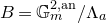 $B={\mathbb{G}}_m^{2,{{\rm an}}}/\Lambda _a$
. Let
$B={\mathbb{G}}_m^{2,{{\rm an}}}/\Lambda _a$
. Let $e_1, e_2$
be the standard basis of
$e_1, e_2$
be the standard basis of $N=\mathbb{Z}^2$
with dual basis
$N=\mathbb{Z}^2$
with dual basis $e_1^*,e_2^*$
, and let
$e_1^*,e_2^*$
, and let $H\colon \Lambda \to M$
be given by
$H\colon \Lambda \to M$
be given by $H(\lambda _i)=e_i^*$
. Clearly,
$H(\lambda _i)=e_i^*$
. Clearly, $H\in \textrm {NS}(B^{{\rm trop}})$
, but we have
$H\in \textrm {NS}(B^{{\rm trop}})$
, but we have

Thus, $H$
is not
$H$
is not ${\mathbb{G}}_m$
-symmetric. But
${\mathbb{G}}_m$
-symmetric. But $2H$
is
$2H$
is ${\mathbb{G}}_m$
-symmetric as
${\mathbb{G}}_m$
-symmetric as $[\lambda _2,\lambda _1]_{2H}=(-1)^2=1$
. We conclude that
$[\lambda _2,\lambda _1]_{2H}=(-1)^2=1$
. We conclude that $H\in \textrm {NS}(B^{{\rm trop}})\setminus \textrm {NS}(B)$
with
$H\in \textrm {NS}(B^{{\rm trop}})\setminus \textrm {NS}(B)$
with $2H\in \textrm {NS}(B)$
. Note that since
$2H\in \textrm {NS}(B)$
. Note that since $[-,-]_{2H}^{\mathbb{R}}$
is positive definite, the analytic torus
$[-,-]_{2H}^{\mathbb{R}}$
is positive definite, the analytic torus $B$
is in fact algebraic, that is there exists an abelian variety
$B$
is in fact algebraic, that is there exists an abelian variety $A$
over
$A$
over $K$
with
$K$
with $A^{{\rm an}}=B$
(see [Reference LütkebohmertLüt16, Theorem 6.4.4]).
$A^{{\rm an}}=B$
(see [Reference LütkebohmertLüt16, Theorem 6.4.4]).
In what follows, we identify the elements of $\textrm {NS}(A)_{\mathbb{Q}}$
with morphisms
$\textrm {NS}(A)_{\mathbb{Q}}$
with morphisms $\Lambda \to M_{\mathbb{Q}}$
.
$\Lambda \to M_{\mathbb{Q}}$
.
Definition 3.3. Let $H\in \textrm {NS}(A)_{\mathbb{Q}}$
. We define the subgroup
$H\in \textrm {NS}(A)_{\mathbb{Q}}$
. We define the subgroup $\Lambda _{H}^{\mathbb{Z}}$
of
$\Lambda _{H}^{\mathbb{Z}}$
of $\Lambda$
by
$\Lambda$
by
 \begin{align*} \Lambda _{H}^{\mathbb{Z}}=\big \{ \lambda \in \Lambda \ \big \vert \ H(\lambda )\in M \big \}. \end{align*}
Lemma 3.4.
Let $H\in \textrm {NS}(A)_{\mathbb{Q}}$
. Then
$H\in \textrm {NS}(A)_{\mathbb{Q}}$
. Then $\Lambda _{H}^{\mathbb{Z}}$
has finite index in
$\Lambda _{H}^{\mathbb{Z}}$
has finite index in $\Lambda$
.
$\Lambda$
.
Proof.
The subgroup $\Lambda _{H}^{\mathbb{Z}}$
of
$\Lambda _{H}^{\mathbb{Z}}$
of $\Lambda$
is precisely the kernel of the composite
$\Lambda$
is precisely the kernel of the composite
 \begin{align*} \Lambda \xrightarrow {\,\,\,H\,\,} M_{\mathbb{Q}}\longrightarrow M_{\mathbb{Q}}/M \end{align*}
Since every element in $M_{\mathbb{Q}}/M$
has finite order, the quotient
$M_{\mathbb{Q}}/M$
has finite order, the quotient $\Lambda /\Lambda _{H}^{\mathbb{Z}}$
is a finitely generated abelian group, all of whose elements have finite order. Therefore, the quotient
$\Lambda /\Lambda _{H}^{\mathbb{Z}}$
is a finitely generated abelian group, all of whose elements have finite order. Therefore, the quotient $\Lambda /\Lambda _{H}^{\mathbb{Z}}$
is finite.
$\Lambda /\Lambda _{H}^{\mathbb{Z}}$
is finite.
While $H\in \textrm {NS}(A)_{\mathbb{Q}}$
does not, in general, induce a pairing
$H\in \textrm {NS}(A)_{\mathbb{Q}}$
does not, in general, induce a pairing $\Lambda \times \Lambda \to {\mathbb{G}}_m$
(unless
$\Lambda \times \Lambda \to {\mathbb{G}}_m$
(unless $H\in \textrm {NS}(A)$
), it does make sense to define a bilinear pairing
$H\in \textrm {NS}(A)$
), it does make sense to define a bilinear pairing
 \begin{align*} \begin{split} [-,-]_H\colon \Lambda \times \Lambda _{H}^{\mathbb{Z}}&\longrightarrow {\mathbb{G}}_m \\[5pt] (\lambda ,\lambda ')&\longmapsto \big \langle \lambda , H(\lambda ')\big \rangle \end{split} \end{align*}
that agrees with the pairing defined above if $H\in \textrm {NS}(A)$
.
$H\in \textrm {NS}(A)$
.
This leads us to defining the following subgroup of $\Lambda _{H}^{\mathbb{Z}}$
, which will play a key role in Section 5.
$\Lambda _{H}^{\mathbb{Z}}$
, which will play a key role in Section 5.
Definition 3.5. We define the subgroup $\Lambda _{H}^{c}$
of
$\Lambda _{H}^{c}$
of $\Lambda _{H}^{\mathbb{Z}}$
by
$\Lambda _{H}^{\mathbb{Z}}$
by
 \begin{align*} \Lambda _{H}^{c}=\big \{\gamma \in \Lambda _{H}^{\mathbb{Z}}\ \big \vert \ [\gamma ,\lambda ]_H=[\lambda ,\gamma ]_H {\rm \ for\ all\ }\lambda \in \Lambda _{H}^{\mathbb{Z}}\big \}. \end{align*}
Lemma 3.6.
Let $l$
be a positive integer such that
$l$
be a positive integer such that $lH\in \textrm {NS}(A)$
. Then
$lH\in \textrm {NS}(A)$
. Then $l\Lambda \subseteq \Lambda _{H}^{c}$
. In particular, the sublattice
$l\Lambda \subseteq \Lambda _{H}^{c}$
. In particular, the sublattice $\Lambda _{H}^{c}$
has finite index in
$\Lambda _{H}^{c}$
has finite index in $\Lambda$
.
$\Lambda$
.
Proof.
Let $\gamma =l\theta \in l\Lambda$
and let
$\gamma =l\theta \in l\Lambda$
and let $\lambda \in \Lambda _{H}^{\mathbb{Z}}$
. Then we have
$\lambda \in \Lambda _{H}^{\mathbb{Z}}$
. Then we have
 \begin{align*} [\gamma ,\lambda ]_H= [\theta ,\lambda ]_{lH}=[\lambda ,\theta ]_{lH}=[\lambda ,\gamma ]_H. \end{align*}
It immediately follows that $l\Lambda \subseteq \Lambda _{H}^{c}$
.
$l\Lambda \subseteq \Lambda _{H}^{c}$
.
4. Semi-homogeneous tropical bundles on real tori
Let $\Sigma =N_{\mathbb{R}}/\Lambda$
be a real torus with integral structure and write
$\Sigma =N_{\mathbb{R}}/\Lambda$
be a real torus with integral structure and write $M={\textrm {Hom}}(N,\mathbb{Z})$
. In the previous section, we have studied line bundles on
$M={\textrm {Hom}}(N,\mathbb{Z})$
. In the previous section, we have studied line bundles on $\Sigma$
. In this section, we introduce and study vector bundles of higher rank on
$\Sigma$
. In this section, we introduce and study vector bundles of higher rank on $\Sigma$
.
$\Sigma$
.
4.1 Tropical vector bundles on integral affine manifolds
Let $X$
be an integral affine manifold, whose sheaf of affine functions is denoted by
$X$
be an integral affine manifold, whose sheaf of affine functions is denoted by ${\rm Aff}_X$
. Denote by
${\rm Aff}_X$
. Denote by ${\mathbb{T}}={\mathbb{R}}\cup \{\infty \}$
the semi-field of tropical numbers (with
${\mathbb{T}}={\mathbb{R}}\cup \{\infty \}$
the semi-field of tropical numbers (with $\min$
and
$\min$
and $+$
as operations). It is well-known that the group of invertible tropical
$+$
as operations). It is well-known that the group of invertible tropical $r\times r$
-matrices precisely consists of all
$r\times r$
-matrices precisely consists of all $r\times r$
-matrices with exactly one entry in all rows and columns not equal to
$r\times r$
-matrices with exactly one entry in all rows and columns not equal to $\infty$
(see [Reference AllermannAll12, Lemma 1.4]). In other words, we have
$\infty$
(see [Reference AllermannAll12, Lemma 1.4]). In other words, we have $\textrm {GL}_r({\mathbb{T}})=S_r\ltimes {\mathbb{R}}^r$
. Our approach, here and in [Reference Gross, Ulirsch and ZakharovGUZ22], is to think of a vector bundle on
$\textrm {GL}_r({\mathbb{T}})=S_r\ltimes {\mathbb{R}}^r$
. Our approach, here and in [Reference Gross, Ulirsch and ZakharovGUZ22], is to think of a vector bundle on $X$
as a principal
$X$
as a principal $\textrm {GL}_r({\mathbb{T}})$
bundle in terms of its affine transition maps with integral slopes taking values in
$\textrm {GL}_r({\mathbb{T}})$
bundle in terms of its affine transition maps with integral slopes taking values in $\textrm {GL}_r({\mathbb{T}})=S_r\ltimes {\mathbb{R}}^r$
.
$\textrm {GL}_r({\mathbb{T}})=S_r\ltimes {\mathbb{R}}^r$
.
Definition 4.1. Let $(X,{\rm Aff}_X)$
be an integral affine manifold. A tropical vector bundle of rank
$(X,{\rm Aff}_X)$
be an integral affine manifold. A tropical vector bundle of rank $r$
on
$r$
on $X$
is an
$X$
is an $S_r\ltimes {\rm Aff}_X^r$
-torsor on
$S_r\ltimes {\rm Aff}_X^r$
-torsor on $X$
.
$X$
.
A morphism of tropical vector bundles is a morphism of $S_r\ltimes {\rm Aff}_X^r$
-torsors. In particular, all morphisms of tropical vector bundles are isomorphisms.
$S_r\ltimes {\rm Aff}_X^r$
-torsors. In particular, all morphisms of tropical vector bundles are isomorphisms.
Definition 4.2. A free cover of an integral affine manifold $X$
is a morphism
$X$
is a morphism $\pi \colon Y\to X$
of integral affine manifolds which is a covering space for the underlying topological spaces and induces an isomorphism
$\pi \colon Y\to X$
of integral affine manifolds which is a covering space for the underlying topological spaces and induces an isomorphism
 \begin{align*} \pi ^{-1}{\rm Aff}_X\longrightarrow {\rm Aff}_Y. \end{align*}
Example 4.3. The morphism $\pi \colon {\mathbb{R}}/\mathbb{Z}\rightarrow {\mathbb{R}}/\mathbb{Z}$
of real tori with integral structure given by
$\pi \colon {\mathbb{R}}/\mathbb{Z}\rightarrow {\mathbb{R}}/\mathbb{Z}$
of real tori with integral structure given by
 \begin{align*} x+\mathbb{Z}\longmapsto 2x+\mathbb{Z} \end{align*}
is a covering space on the underlying topological spaces but not a free cover: the pullbacks of affine functions via $\pi$
do not generate
$\pi$
do not generate ${\rm Aff}_{{\mathbb{R}}/\mathbb{Z}}$
because their slopes are always even.
${\rm Aff}_{{\mathbb{R}}/\mathbb{Z}}$
because their slopes are always even.
Proposition 4.4.
The category of tropical vector bundles of rank $r\in \mathbb{Z}_{\geqslant 1}$
on an integral affine manifold
$r\in \mathbb{Z}_{\geqslant 1}$
on an integral affine manifold $X$
is equivalent to the category of pairs
$X$
is equivalent to the category of pairs $(Y\xrightarrow {\pi } X,L)$
consisting of a free cover
$(Y\xrightarrow {\pi } X,L)$
consisting of a free cover $\pi$
of degree
$\pi$
of degree $r$
and a tropical line bundle
$r$
and a tropical line bundle $L$
on
$L$
on $Y$
.
$Y$
.
Proof.
Let $\mathcal{G}$
denote the category fibered in groupoids over the small site
$\mathcal{G}$
denote the category fibered in groupoids over the small site $O(X)$
of open subsets of
$O(X)$
of open subsets of $X$
consisting of pairs
$X$
consisting of pairs $(Y\xrightarrow {\pi }U ,L)$
, where
$(Y\xrightarrow {\pi }U ,L)$
, where $\pi$
is a free cover of degree
$\pi$
is a free cover of degree $r$
of an open subset
$r$
of an open subset $U$
of
$U$
of $X$
and
$X$
and $L$
be a tropical line bundle on
$L$
be a tropical line bundle on $Y$
. Note that this is equivalent to the category consisting of pairs
$Y$
. Note that this is equivalent to the category consisting of pairs $(Y\xrightarrow {\pi }U,L)$
, where
$(Y\xrightarrow {\pi }U,L)$
, where $\pi$
is a cover of the underlying topological space
$\pi$
is a cover of the underlying topological space $U$
and
$U$
and $L$
is a
$L$
is a $\pi ^{-1}{\rm Aff}_U$
-torsor. Since covering spaces and torsors glue, the fibered category
$\pi ^{-1}{\rm Aff}_U$
-torsor. Since covering spaces and torsors glue, the fibered category $\mathcal{G}$
is a stack over
$\mathcal{G}$
is a stack over $O(X)$
. Let
$O(X)$
. Let $I\in {\mathcal{G}}(X)$
denote the trivial degree-
$I\in {\mathcal{G}}(X)$
denote the trivial degree- $r$
cover of
$r$
cover of $X$
equipped with the trivial torsor. Then every element of
$X$
equipped with the trivial torsor. Then every element of $\mathcal{G}$
is locally isomorphic to
$\mathcal{G}$
is locally isomorphic to $I$
. In other words, the stack
$I$
. In other words, the stack $\mathcal{G}$
is a neutral gerbe on
$\mathcal{G}$
is a neutral gerbe on $O(X)$
. It follows that there is an equivalence of gerbes
$O(X)$
. It follows that there is an equivalence of gerbes
 \begin{align*} {\mathcal{G}} \xrightarrow {\,\sim \,} {\rm Tors}\big (\underline{{\rm Isom}}(I,I)\big )\quad \textrm {given by}\ J\longmapsto \underline{{\rm Isom}}(I,J), \end{align*}
where ${\rm Tors}\big (\underline{{\rm Isom}}(I,I)\big )$
denotes the gerbe of
${\rm Tors}\big (\underline{{\rm Isom}}(I,I)\big )$
denotes the gerbe of $\underline{{\rm Isom}}(I,I)$
torsors. In particular, we obtain an equivalence of categories between
$\underline{{\rm Isom}}(I,I)$
torsors. In particular, we obtain an equivalence of categories between ${\mathcal{G}}(X)$
and the category of torsors over
${\mathcal{G}}(X)$
and the category of torsors over $\underline{{\rm Isom}}(I,I)= S_r\ltimes {\rm Aff}_X^r$
, which are precisely the tropical vector bundles of rank
$\underline{{\rm Isom}}(I,I)= S_r\ltimes {\rm Aff}_X^r$
, which are precisely the tropical vector bundles of rank $r$
on
$r$
on $X$
.
$X$
.
Remark 4.5. Isomorphism classes of tropical vector bundles can be described via transition maps that satisfy the cocycle condition. Given transition maps for a tropical vector bundle $E$
, one can explicitly construct a cover
$E$
, one can explicitly construct a cover $Y\xrightarrow {\pi } X$
and a tropical line bundle
$Y\xrightarrow {\pi } X$
and a tropical line bundle $L$
on
$L$
on $Y$
such that
$Y$
such that $f_*L$
is isomorphic to
$f_*L$
is isomorphic to $X$
. This has been carried out on tropical curves in the proof of [Reference Gross, Ulirsch and ZakharovGUZ22, Proposition 3.2].
$X$
. This has been carried out on tropical curves in the proof of [Reference Gross, Ulirsch and ZakharovGUZ22, Proposition 3.2].
Definition 4.6. Let $X$
be an integral affine manifold. If
$X$
be an integral affine manifold. If $f\colon Y\to X$
is a free cover and
$f\colon Y\to X$
is a free cover and $L$
is a tropical line bundle on
$L$
is a tropical line bundle on $Y$
, we denote by
$Y$
, we denote by $E(f,L)$
the tropical vector bundle corresponding to
$E(f,L)$
the tropical vector bundle corresponding to $f$
and
$f$
and $L$
(as in Proposition 4.4). We define direct sums, tensor products, pullbacks, and pushforwards of tropical vector bundles as follows.
$L$
(as in Proposition 4.4). We define direct sums, tensor products, pullbacks, and pushforwards of tropical vector bundles as follows.
-
• The direct sum of
$E_i=E(Y_i\xrightarrow {f_i} X, L_i)$
for
$i\in \{1,2\}$
is given by
\begin{align*} E_1\oplus E_2 = E\big (Y_1\sqcup Y_2 \xrightarrow {f_1\sqcup f_2}X, L_1\sqcup L_2\big ). \end{align*}
-
• The tensor product of
$E_i=E(Y_i\xrightarrow {f_i} X, L_i)$
,
$i\in \{1,2\}$
is given by
Here
\begin{align*} E_1\otimes E_2 = E\big (f_1\times _X f_2, g_1^{-1}L_1\otimes g_2^{-1}L_2\big ). \end{align*}
$f_1\times _X f_2$
denotes the cover
$Y_1\times _X Y_2\rightarrow X$
induced from both
$f_1$
and
$f_2$
and
$g_i$
is the projection from
$Y_1\times _X Y_2$
onto
$Y_i$
.
-
• The pullback of
$E=E(Y\xrightarrow {f} X,L)$
along a morphism
$g\colon Z\to X$
is given by
where
\begin{align*} g^*E=E\big (Y\times _X Z\xrightarrow {f'} Z, (g')^*L\big ), \end{align*}
$f'$
and
$g'$
are the projections from
$Y\times _X Z$
to
$Z$
and
$Y$
, respectively.
-
• The pushforward of
$E=E(Y\xrightarrow {f}X,L)$
along a free cover
$g\colon X\to Z$
of integral affine manifolds is given by
Note that this makes sense of the equality
\begin{align*} f_*E=E(g\circ f, L). \end{align*}
$E=f_*L$
.















Definition 4.7. Let $X$
be an integral affine manifold. We say that a tropical vector bundle
$X$
be an integral affine manifold. We say that a tropical vector bundle $E$
is indecomposable if there do not exist tropical vector bundles
$E$
is indecomposable if there do not exist tropical vector bundles $F_1$
and
$F_1$
and $F_2$
of positive rank with
$F_2$
of positive rank with $E\cong F_1\oplus F_2$
.
$E\cong F_1\oplus F_2$
.
Lemma 4.8.
A tropical vector bundle $E(Y\to X, L)$
on an integral affine manifold
$E(Y\to X, L)$
on an integral affine manifold $X$
is indecomposable if and only if
$X$
is indecomposable if and only if $Y$
is connected. Moreover, every tropical vector bundle
$Y$
is connected. Moreover, every tropical vector bundle $E$
on
$E$
on $X$
can be uniquely expressed (up to permutation) as a sum
$X$
can be uniquely expressed (up to permutation) as a sum $\bigoplus _{i=1}^k E_i$
for some indecomposable vector bundles
$\bigoplus _{i=1}^k E_i$
for some indecomposable vector bundles $E_i$
.
$E_i$
.
Proof.
By definition of sums, the cover associated to a sum $E_1\oplus E_2$
of tropical vector bundles is never connected. Therefore, if
$E_1\oplus E_2$
of tropical vector bundles is never connected. Therefore, if $Y$
is connected, then
$Y$
is connected, then $E(Y\to X,L)$
is indecomposable. To complete the proof, it suffices to show that every tropical vector bundle can be expressed uniquely as a sum of tropical vector bundles corresponding to connected covers. But this is clear because the connected components of a cover are uniquely determined by the cover.
$E(Y\to X,L)$
is indecomposable. To complete the proof, it suffices to show that every tropical vector bundle can be expressed uniquely as a sum of tropical vector bundles corresponding to connected covers. But this is clear because the connected components of a cover are uniquely determined by the cover.
4.2 Semi-homogeneous tropical vector bundles
We now focus on tropical vector bundles on a real torus $\Sigma =N_{\mathbb{R}}/\Lambda$
with integral structure. Note that the results of this section apply to all real tori with integral structure. We do not need to assume that
$\Sigma =N_{\mathbb{R}}/\Lambda$
with integral structure. Note that the results of this section apply to all real tori with integral structure. We do not need to assume that $N$
and
$N$
and $\Lambda \subseteq N_{\mathbb{R}}$
are induced from an uniformization of an abelian variety.
$\Lambda \subseteq N_{\mathbb{R}}$
are induced from an uniformization of an abelian variety.
Lemma 4.9.
Let $f\colon \Sigma '\to \Sigma$
be a connected free cover of finite degree. Then there exists a lattice
$f\colon \Sigma '\to \Sigma$
be a connected free cover of finite degree. Then there exists a lattice $\Lambda '\subseteq \Lambda$
of finite index such that
$\Lambda '\subseteq \Lambda$
of finite index such that $f$
is isomorphic to the cover
$f$
is isomorphic to the cover $N_{\mathbb{R}}/\Lambda '\to N_{\mathbb{R}}/\Lambda =\Sigma$
.
$N_{\mathbb{R}}/\Lambda '\to N_{\mathbb{R}}/\Lambda =\Sigma$
.
Proof.
The projection $N_{\mathbb{R}}\to \Sigma$
exhibits
$N_{\mathbb{R}}\to \Sigma$
exhibits $N_{\mathbb{R}}$
as the universal covering space of
$N_{\mathbb{R}}$
as the universal covering space of $\Sigma$
and induces an isomorphism between
$\Sigma$
and induces an isomorphism between $\Lambda$
and the fundamental group
$\Lambda$
and the fundamental group $\pi _1(\Sigma ,0)$
of
$\pi _1(\Sigma ,0)$
of $\Sigma$
. By the classification of covering spaces, the connected finite cover
$\Sigma$
. By the classification of covering spaces, the connected finite cover $f$
defines a subgroup
$f$
defines a subgroup $\Lambda '$
of
$\Lambda '$
of $\pi _1(\Sigma ,0)=\Lambda$
of finite index and
$\pi _1(\Sigma ,0)=\Lambda$
of finite index and $\Sigma '$
can be recovered from
$\Sigma '$
can be recovered from $\Lambda '$
as the quotient
$\Lambda '$
as the quotient $N_{\mathbb{R}}/\Lambda '$
.
$N_{\mathbb{R}}/\Lambda '$
.
Note that as $\Lambda$
is abelian, the cover of
$\Lambda$
is abelian, the cover of $\Sigma$
determined by a sublattice
$\Sigma$
determined by a sublattice $\Lambda '$
is automatically a
$\Lambda '$
is automatically a $\Lambda /\Lambda '$
-torsor.
$\Lambda /\Lambda '$
-torsor.
Remark 4.10. A finite cover $f\colon \Sigma '=N_{\mathbb{R}}/\Lambda '\to N_{\mathbb{R}}/\Lambda =\Sigma$
given by a sublattice
$f\colon \Sigma '=N_{\mathbb{R}}/\Lambda '\to N_{\mathbb{R}}/\Lambda =\Sigma$
given by a sublattice $\Lambda '\subseteq \Lambda$
induces a pullback
$\Lambda '\subseteq \Lambda$
induces a pullback $f^*\colon \textrm {NS}(\Sigma )\to \textrm {NS}(\Sigma ')$
. The elements of
$f^*\colon \textrm {NS}(\Sigma )\to \textrm {NS}(\Sigma ')$
. The elements of $\textrm {NS}(\Sigma )$
are
$\textrm {NS}(\Sigma )$
are $\mathbb{R}$
-symmetric homomorphisms
$\mathbb{R}$
-symmetric homomorphisms $H\colon \Lambda \to M$
and the pullback of such an
$H\colon \Lambda \to M$
and the pullback of such an $H$
is simply the restriction
$H$
is simply the restriction $H\vert _{\Lambda '}$
. Since
$H\vert _{\Lambda '}$
. Since $\mathbb{R}$
has no torsion, a homomorphism
$\mathbb{R}$
has no torsion, a homomorphism $H\colon \Lambda \to M$
is
$H\colon \Lambda \to M$
is $\mathbb{R}$
-symmetric if and only if its restriction
$\mathbb{R}$
-symmetric if and only if its restriction $H\vert _{\Lambda '}$
is. Now combining this with the fact that
$H\vert _{\Lambda '}$
is. Now combining this with the fact that $\Lambda '$
has finite index in
$\Lambda '$
has finite index in $\Lambda$
and
$\Lambda$
and $\mathbb{Q}$
is divisible, we can conclude that the pullback induces an isomorphism
$\mathbb{Q}$
is divisible, we can conclude that the pullback induces an isomorphism $\textrm {NS}(\Sigma )_{\mathbb{Q}}\xrightarrow {\cong } \textrm {NS}(\Sigma ')_{\mathbb{Q}}$
.
$\textrm {NS}(\Sigma )_{\mathbb{Q}}\xrightarrow {\cong } \textrm {NS}(\Sigma ')_{\mathbb{Q}}$
.
Definition 4.11. Let $E$
be an indecomposable tropical vector bundle on
$E$
be an indecomposable tropical vector bundle on $\Sigma$
. Then
$\Sigma$
. Then $E=E(\Sigma '\xrightarrow {f} \Sigma ,L)$
for some free cover
$E=E(\Sigma '\xrightarrow {f} \Sigma ,L)$
for some free cover $f$
with connected domain
$f$
with connected domain $\Sigma '$
and some line bundle
$\Sigma '$
and some line bundle $L$
on
$L$
on $\Sigma '$
. By Lemma 4.9, we have
$\Sigma '$
. By Lemma 4.9, we have $\Sigma '=N_{\mathbb{R}}/\Lambda '$
for some finite-index sublattice
$\Sigma '=N_{\mathbb{R}}/\Lambda '$
for some finite-index sublattice $\Lambda '$
of
$\Lambda '$
of $\Lambda$
. As we observed previously, the cover
$\Lambda$
. As we observed previously, the cover $f$
induces an isomorphism
$f$
induces an isomorphism
 \begin{align*} \textrm {NS}(\Sigma )_{\mathbb{Q}}\xrightarrow {\cong } \textrm {NS}(\Sigma ')_{\mathbb{Q}}. \end{align*}
We define the slope $\delta (E)$
of
$\delta (E)$
of $E$
as the unique class in
$E$
as the unique class in $\textrm {NS}(\Sigma )_{\mathbb{Q}}$
pulling back to the class
$\textrm {NS}(\Sigma )_{\mathbb{Q}}$
pulling back to the class $[L]$
of
$[L]$
of $L$
in
$L$
in $\textrm {NS}(\Sigma ')_{\mathbb{Q}}$
. For a general vector bundle
$\textrm {NS}(\Sigma ')_{\mathbb{Q}}$
. For a general vector bundle $E$
on
$E$
on $\Sigma$
with indecomposable summands
$\Sigma$
with indecomposable summands $E_1,\ldots , E_k$
, we define the slope of
$E_1,\ldots , E_k$
, we define the slope of $E$
as
$E$
as
 \begin{align*} \delta (E)=\frac {\sum _{i=1}^k r(E_i)\delta (E_i)}{r(E)}. \end{align*}
Remark 4.12. It is possible to define determinants of tropical vector bundles; the definition given in [Reference Gross, Ulirsch and ZakharovGUZ22, Section 2.4] easily generalizes the case of integral affine manifolds. One can then show that for a tropical vector bundle $E$
on
$E$
on $\Sigma$
one has
$\Sigma$
one has
 \begin{align*} \delta (E)=\frac {\big [\det (E)\big ]}{r(E)}. \end{align*}
Definition 4.13. For a point $x\in \Sigma$
, we denote by
$x\in \Sigma$
, we denote by $T_x\colon \Sigma \to \Sigma ,\; y\mapsto y+x$
the translation by
$T_x\colon \Sigma \to \Sigma ,\; y\mapsto y+x$
the translation by $x$
. A tropical vector bundle
$x$
. A tropical vector bundle $E$
on
$E$
on $\Sigma$
is called homogeneous if
$\Sigma$
is called homogeneous if $T_x^{-1} E \cong E$
for all
$T_x^{-1} E \cong E$
for all $x\in \Sigma$
. It is called semi-homogeneous if for each
$x\in \Sigma$
. It is called semi-homogeneous if for each $x\in \Sigma$
there exists
$x\in \Sigma$
there exists $L\in \textrm {Pic}^0(\Sigma )$
(possibly depending on
$L\in \textrm {Pic}^0(\Sigma )$
(possibly depending on $x$
) with
$x$
) with $T_x^{-1}E \cong E\otimes L$
.
$T_x^{-1}E \cong E\otimes L$
.
Lemma 4.14.
Let $f\colon \Sigma '\to \Sigma$
be a free cover, let
$f\colon \Sigma '\to \Sigma$
be a free cover, let $L$
be a line bundle on
$L$
be a line bundle on $\Sigma '$
, let
$\Sigma '$
, let $x\in \Sigma$
, and let
$x\in \Sigma$
, and let $y\in f^{-1}\{x\}$
. Then we have
$y\in f^{-1}\{x\}$
. Then we have
 \begin{align*} T_x^{-1} (f_*L)= f_*(T_y^{-1}L) .\end{align*}
Proof. The equality
 \begin{align*} T_x^{-1}(f_*L) =(T_{-x})_*(f_*L) =f_*\big ((T_{-y})_*L\big )= f_*(T_y^{-1} L), \end{align*}
is a consequence of $T_{-x}\circ f=f\circ T_{-y}$
.
$T_{-x}\circ f=f\circ T_{-y}$
.
Lemma 4.15.
Let $f\colon \Sigma '=N_{\mathbb{R}}/\Lambda '\to N_{\mathbb{R}}/\Lambda =\Sigma$
be the cover associated to a finite-index sublattice
$f\colon \Sigma '=N_{\mathbb{R}}/\Lambda '\to N_{\mathbb{R}}/\Lambda =\Sigma$
be the cover associated to a finite-index sublattice $\Lambda '\subseteq \Lambda$
, and let
$\Lambda '\subseteq \Lambda$
, and let $(H,l)$
and
$(H,l)$
and $(H',l')$
be two factors of automorphy for line bundles
$(H',l')$
be two factors of automorphy for line bundles $\Sigma '$
. Then we have
$\Sigma '$
. Then we have $f_*L(H,l)\cong f_*L(H',l')$
if and only if
$f_*L(H,l)\cong f_*L(H',l')$
if and only if $H=H'$
and
$H=H'$
and $l-l'-H(\lambda )\in M$
for some
$l-l'-H(\lambda )\in M$
for some $\lambda \in \Lambda$
.
$\lambda \in \Lambda$
.
Proof.
Tropical vector bundles are equivalent to isomorphism classes of tropical line bundles on finite free covers. Therefore, the pushforward $f_*L(H,l)$
is isomorphic to
$f_*L(H,l)$
is isomorphic to $f_*L(H',l')$
if and only if there exists an automorphism of
$f_*L(H',l')$
if and only if there exists an automorphism of $f$
along which
$f$
along which $L(H,l)$
pulls back to
$L(H,l)$
pulls back to $L(H',l')$
. The automorphisms of
$L(H',l')$
. The automorphisms of $f$
are precisely the translations by the classes of elements
$f$
are precisely the translations by the classes of elements $\lambda \in \Lambda$
and the pullback of
$\lambda \in \Lambda$
and the pullback of $L(H,l)$
via a translation by
$L(H,l)$
via a translation by $\lambda$
is given by
$\lambda$
is given by $L\big (H, l- H(\lambda )\big )$
. This is isomorphic to
$L\big (H, l- H(\lambda )\big )$
. This is isomorphic to $L(H',l')$
if and only if
$L(H',l')$
if and only if $H=H'$
and
$H=H'$
and $l-l'-H(\lambda )\in M$
.
$l-l'-H(\lambda )\in M$
.
Proposition 4.16.
Let $E_1,\ldots , E_k$
be indecomposable tropical vector bundles on
$E_1,\ldots , E_k$
be indecomposable tropical vector bundles on $\Sigma$
. Then
$\Sigma$
. Then $E=\oplus _{i=1}^k E_i$
is homogeneous if and only if
$E=\oplus _{i=1}^k E_i$
is homogeneous if and only if $\delta (E_i)=0$
for all
$\delta (E_i)=0$
for all $1\leqslant i \leqslant k$
. The vector bundle
$1\leqslant i \leqslant k$
. The vector bundle $E$
is semi-homogeneous if and only if
$E$
is semi-homogeneous if and only if $\delta (E_i)=\delta (E_j)$
for all
$\delta (E_i)=\delta (E_j)$
for all $1\leqslant i,j\leqslant k$
.
$1\leqslant i,j\leqslant k$
.
Proof.
For every $i\in \{1,\ldots , k\}$
there exists a finite-index sublattice
$i\in \{1,\ldots , k\}$
there exists a finite-index sublattice $\Lambda _i$
of
$\Lambda _i$
of $\Lambda$
, a symmetric morphism
$\Lambda$
, a symmetric morphism $H_i\colon \Lambda _i\to M$
, and a linear map
$H_i\colon \Lambda _i\to M$
, and a linear map $l_i\colon \Lambda _i\to {\mathbb{R}}$
such that
$l_i\colon \Lambda _i\to {\mathbb{R}}$
such that $E_i =(\pi _i)_*L(H_i, l_i)$
, where
$E_i =(\pi _i)_*L(H_i, l_i)$
, where $\pi _i\colon N_{\mathbb{R}}/\Lambda _i\to N_{\mathbb{R}}/\Lambda$
is the quotient map. For
$\pi _i\colon N_{\mathbb{R}}/\Lambda _i\to N_{\mathbb{R}}/\Lambda$
is the quotient map. For $x\in N_{\mathbb{R}}$
, we have
$x\in N_{\mathbb{R}}$
, we have
 \begin{align*} T_{\overline x}^*E \cong \bigoplus _{i=1}^k L\big (H_i, l_i-H_i(x)\big ) \end{align*}
by Lemma 4.14. By Lemma 4.15, this is isomorphic to $E\otimes L(0, l)$
for some
$E\otimes L(0, l)$
for some $l\colon \Lambda \to {\mathbb{R}}$
if and only if there exists a permutation
$l\colon \Lambda \to {\mathbb{R}}$
if and only if there exists a permutation $\sigma$
on
$\sigma$
on $\{1,\ldots , k\}$
with
$\{1,\ldots , k\}$
with $\Lambda _i=\Lambda _{\sigma (i)}$
and
$\Lambda _i=\Lambda _{\sigma (i)}$
and $H_i=H_{\sigma (i)}$
as well as for each
$H_i=H_{\sigma (i)}$
as well as for each $1\leqslant i\leqslant k$
elements
$1\leqslant i\leqslant k$
elements $\lambda _i\in \Lambda$
and
$\lambda _i\in \Lambda$
and $m_i\in M$
with
$m_i\in M$
with
 \begin{equation} l_i-H_i(x)= l_{\sigma (i)}+H_i(\lambda _i)+m_i+l. \end{equation}
If $E$
is homogeneous, we can take
$E$
is homogeneous, we can take $l=0$
and see that there are only countably many choices for
$l=0$
and see that there are only countably many choices for $l_i-H_i(x)$
as
$l_i-H_i(x)$
as $i$
varies over
$i$
varies over $\{1,\ldots , k\}$
and
$\{1,\ldots , k\}$
and $x$
over
$x$
over $N_{\mathbb{R}}$
. As every one-dimensional subspace of
$N_{\mathbb{R}}$
. As every one-dimensional subspace of $N_{\mathbb{R}}$
is uncountable, this implies that
$N_{\mathbb{R}}$
is uncountable, this implies that $H_i(x)=0$
for all
$H_i(x)=0$
for all $x\in N_{\mathbb{R}}$
and
$x\in N_{\mathbb{R}}$
and $i\in \{1,\ldots , k\}$
, and, hence,
$i\in \{1,\ldots , k\}$
, and, hence, $\delta (E_i)= H_i=0$
for all
$\delta (E_i)= H_i=0$
for all $i\in \{1,\ldots , k\}$
. Conversely, if
$i\in \{1,\ldots , k\}$
. Conversely, if $H_i=0$
for all
$H_i=0$
for all $1\leqslant i\leqslant k$
, then we can take
$1\leqslant i\leqslant k$
, then we can take $\sigma ={\textrm {id}}$
as well as
$\sigma ={\textrm {id}}$
as well as $l$
and all
$l$
and all $\lambda _i$
and
$\lambda _i$
and $m_i$
to be zero in (3), showing that
$m_i$
to be zero in (3), showing that $E$
is homogeneous.
$E$
is homogeneous.
If $E$
is semi-homogeneous, we take differences of the Equations (3) for given
$E$
is semi-homogeneous, we take differences of the Equations (3) for given $1\leqslant i,j\leqslant n$
. For every
$1\leqslant i,j\leqslant n$
. For every $x \in N_{\mathbb{R}}$
there exists a permutation
$x \in N_{\mathbb{R}}$
there exists a permutation $\sigma$
of
$\sigma$
of $\{1,\ldots , k\}$
and elements
$\{1,\ldots , k\}$
and elements $\lambda \in \Lambda$
and
$\lambda \in \Lambda$
and $m\in M$
with
$m\in M$
with
 \begin{align*} l_i-l_j +\big (H_j(x)-H_i(x)\big )= l_{\sigma (i)}-l_{\sigma (j)}+ H(\lambda )+m. \end{align*}
As there is only a countable set of choices for the triple $(\sigma , \lambda , m)$
, there exists a set
$(\sigma , \lambda , m)$
, there exists a set $S\subseteq N_{\mathbb{R}}$
whose affine span is
$S\subseteq N_{\mathbb{R}}$
whose affine span is $N_{\mathbb{R}}$
such that
$N_{\mathbb{R}}$
such that $H_j(s)-H_i(s)$
is independent of the choice of
$H_j(s)-H_i(s)$
is independent of the choice of $s\in S$
. But this implies that
$s\in S$
. But this implies that
 \begin{align*} \delta (E_i)=H_i=H_j=\delta (E_j). \end{align*}
Conversely, if all $H_i$
coincide, then we can take
$H_i$
coincide, then we can take $\sigma ={\textrm {id}}$
as well as
$\sigma ={\textrm {id}}$
as well as $l=-H_1(x)$
, and all
$l=-H_1(x)$
, and all $\lambda _i$
and
$\lambda _i$
and $m_i$
equal to zero in (3) and conclude that
$m_i$
equal to zero in (3) and conclude that $E$
is semi-homogeneous.
$E$
is semi-homogeneous.
4.3 A parameter space for semi-homogeneous tropical bundles
Lemma 4.17.
Let $f\colon \Sigma '=N_{\mathbb{R}}/\Lambda _1\to N_{\mathbb{R}}/\Lambda _2=\Sigma$
, where
$f\colon \Sigma '=N_{\mathbb{R}}/\Lambda _1\to N_{\mathbb{R}}/\Lambda _2=\Sigma$
, where $\Lambda _1$
is a finite-index sublattice of
$\Lambda _1$
is a finite-index sublattice of $\Lambda _2$
. Then the pullback morphism
$\Lambda _2$
. Then the pullback morphism
 \begin{align*} f^*\colon \textrm {Pic}^0(N_{\mathbb{R}}/\Lambda _2)\longrightarrow \textrm {Pic}^0(N_{\mathbb{R}}/\Lambda _1) \end{align*}
is a bijection.
We reiterate that $f^\ast$
is only a bijective homomorphism; it does not induce an isomorphism of the integral affine structures on the dual tori.
$f^\ast$
is only a bijective homomorphism; it does not induce an isomorphism of the integral affine structures on the dual tori.
Proof. We have $\textrm {Pic}^0(N_{\mathbb{R}}/\Lambda _i)= {\textrm {Hom}}(\Lambda _i,{\mathbb{R}})/M$
and the pullback is induced by the inclusion
$\textrm {Pic}^0(N_{\mathbb{R}}/\Lambda _i)= {\textrm {Hom}}(\Lambda _i,{\mathbb{R}})/M$
and the pullback is induced by the inclusion $\Lambda _1\to \Lambda _2$
. Since its dual
$\Lambda _1\to \Lambda _2$
. Since its dual ${\textrm {Hom}}(\Lambda _2,{\mathbb{R}})\to {\textrm {Hom}}(\Lambda _1,{\mathbb{R}})$
is a bijection that is the identity on
${\textrm {Hom}}(\Lambda _2,{\mathbb{R}})\to {\textrm {Hom}}(\Lambda _1,{\mathbb{R}})$
is a bijection that is the identity on $M$
, the assertion follows.
$M$
, the assertion follows.
Lemma 4.18.
Let $f\colon \Sigma '\to \Sigma$
and
$f\colon \Sigma '\to \Sigma$
and $g\colon \Sigma ''\to \Sigma '$
be connected finite covers of tropical abelian varieties and let
$g\colon \Sigma ''\to \Sigma '$
be connected finite covers of tropical abelian varieties and let $L$
and
$L$
and $M$
be two tropical line bundles on
$M$
be two tropical line bundles on $\Sigma '$
. Then
$\Sigma '$
. Then $f_*L\cong f_*M$
if and only if
$f_*L\cong f_*M$
if and only if $(f\circ g)_* g^*L \cong (f\circ g)_* g^*M$
.
$(f\circ g)_* g^*L \cong (f\circ g)_* g^*M$
.
Proof.
We have $(f\circ g)_*g^*L\cong (f\circ g)_*g^*M$
if and only if there exists an automorphism
$(f\circ g)_*g^*L\cong (f\circ g)_*g^*M$
if and only if there exists an automorphism $\phi$
of
$\phi$
of $f\circ g$
such that
$f\circ g$
such that $\phi ^*g^* L\cong g^* M$
. Similarly, we have
$\phi ^*g^* L\cong g^* M$
. Similarly, we have $f_*L\cong f_*M$
if and only if there exists an automorphism
$f_*L\cong f_*M$
if and only if there exists an automorphism $\psi$
of
$\psi$
of $f$
such that
$f$
such that $\psi ^*L\cong M$
. Any automorphism on a connected cover
$\psi ^*L\cong M$
. Any automorphism on a connected cover $h$
of
$h$
of $\Sigma$
is induced by an element
$\Sigma$
is induced by an element $\lambda \in \pi _1(\Sigma ,0)$
; we denote the automorphism induced by
$\lambda \in \pi _1(\Sigma ,0)$
; we denote the automorphism induced by $\lambda$
by
$\lambda$
by $\phi _{h,\lambda }$
. Thus, we have
$\phi _{h,\lambda }$
. Thus, we have $(f\circ g)_*g^*L\cong (f\circ g)_*g^*M$
if and only if there exists
$(f\circ g)_*g^*L\cong (f\circ g)_*g^*M$
if and only if there exists $\lambda \in \pi _1(A,0)$
with
$\lambda \in \pi _1(A,0)$
with $\phi _{f\circ g,\lambda }^*g^L\cong g^*M$
. Since
$\phi _{f\circ g,\lambda }^*g^L\cong g^*M$
. Since $g\circ \phi _{f\circ g,\lambda }= \phi _{f,\lambda }\circ g$
, this is equivalent to the existence of
$g\circ \phi _{f\circ g,\lambda }= \phi _{f,\lambda }\circ g$
, this is equivalent to the existence of $\lambda$
with
$\lambda$
with $\phi _{f,\lambda }^*L\cong M$
by Lemma 4.17. This, in turn, is equivalent to
$\phi _{f,\lambda }^*L\cong M$
by Lemma 4.17. This, in turn, is equivalent to $f_*L\cong f_*M$
.
$f_*L\cong f_*M$
.
Definition 4.19. Let $\Sigma =N_{\mathbb{R}}/\Lambda$
and
$\Sigma =N_{\mathbb{R}}/\Lambda$
and $\Gamma$
be a finite-index sublattice of
$\Gamma$
be a finite-index sublattice of $\Lambda$
.
$\Lambda$
.
-
(i) An indecomposable tropical vector bundle
$E= E(f\colon \Sigma '\to \Sigma ,L)$
is called
$\Gamma$
-compatible if the cover
$N_{\mathbb{R}} / \Gamma \to \Sigma$
factors as
$f \circ g$
for some
$g: N_{\mathbb{R}} / \Gamma \to \Sigma '$
. -
(ii) We say that two indecomposable tropical vector bundles
$E_1= E(f_1\colon \Sigma '_1\to \Sigma ,L_1)$
and
$E_2=E(f_2\colon \Sigma '_2\to \Sigma ,L_2)$
on the tropical abelian variety
$\Sigma =N_{\mathbb{R}}/\Lambda$
are equivalent, written
$E_1\sim E_2$
, if there exist a connected free cover
$h\colon \Sigma ''\to \Sigma$
and factorizations
$h=f_1\circ g_1= f_2\circ g_2$
such that
$h_*g_1^*L_1\cong h_*g_2^*L_2$
. -
(iii) We denote by
$M^{\Gamma }_{H,1}(\Sigma )$
the set of equivalence classes of indecomposable
$\Gamma$
-compatible tropical vector bundles of slope
$H$
.











Remark 4.20. In Definition 4.19(ii), there exists a connected finite cover $h\colon \Sigma ''\to \Sigma$
with the desired properties if and only if all connected finite covers that dominate both
$h\colon \Sigma ''\to \Sigma$
with the desired properties if and only if all connected finite covers that dominate both $f_1$
and
$f_1$
and $f_2$
have the desired property. This follows directly from Lemma 4.18 and the fact that connected finite covers form a directed set.
$f_2$
have the desired property. This follows directly from Lemma 4.18 and the fact that connected finite covers form a directed set.
Since by Lemma 4.8, any tropical vector bundle on an integral affine manifold can be uniquely expressed as a sum of indecomposable ones, we can extend the Definition 4.19 to all tropical vector bundles.
Definition 4.21. Let $\Sigma =N_{\mathbb{R}}/\Lambda$
and
$\Sigma =N_{\mathbb{R}}/\Lambda$
and $\Gamma$
be a finite-index sublattice of
$\Gamma$
be a finite-index sublattice of $\Lambda$
.
$\Lambda$
.
-
(i) We say that a tropical vector bundle
$E$
on
$\Sigma$
is
$\Gamma$
-compatible if each of its indecomposable summands is
$\Gamma$
-compatible. -
(ii) We write
$M^{\Gamma }_{H,k}(\Sigma )$
for the set theoretic symmetric power
$\textrm {Sym}^k\big (M_{H,1}^\Gamma (\Sigma )\big )=(M_{H,1}^\Gamma (\Sigma ))^k/S_k$
. We may interpret an element in
$M^{\Gamma }_{H,k}(\Sigma )$
as an equivalence class of vector bundles arising as a direct sum
$E=E_1\oplus \cdots \oplus E_k$
of indecomposable
$\Gamma$
-compatible semi-homogeneous vector bundles of slope
$H$
, where two bundles
$E=E_1\oplus \cdots \oplus E_k$
and
$E'=E_1'\oplus \cdots \oplus E_k'$
are equivalent if and only if (possibly after a suitable permutation) the
$E_i$
and
$E_i'$
are equivalent.









Remark 4.22. Note that in Definition 4.21, it is possible that two tropical vector bundles of different rank are equivalent.
Proposition 4.23.
The subgroup $M'=M+H(\Lambda )$
of
$M'=M+H(\Lambda )$
of ${\textrm {Hom}}(\Gamma ,{\mathbb{R}})$
, where we consider
${\textrm {Hom}}(\Gamma ,{\mathbb{R}})$
, where we consider $H$
as a map from
$H$
as a map from $\Lambda$
to
$\Lambda$
to ${\textrm {Hom}}_{\mathbb{R}}(N_{\mathbb{R}},{\mathbb{R}})\cong {\textrm {Hom}}(\Gamma ,{\mathbb{R}})$
, contains
${\textrm {Hom}}_{\mathbb{R}}(N_{\mathbb{R}},{\mathbb{R}})\cong {\textrm {Hom}}(\Gamma ,{\mathbb{R}})$
, contains $M$
as a finite-index lattice. The set
$M$
as a finite-index lattice. The set ${\textrm {Hom}}(\Gamma , {\mathbb{R}})/M'$
can be naturally identified with the set
${\textrm {Hom}}(\Gamma , {\mathbb{R}})/M'$
can be naturally identified with the set $M^{\Gamma }_{H,1}(\Sigma )$
.
$M^{\Gamma }_{H,1}(\Sigma )$
.
In particular, the moduli space $M_{H,1}^{\Gamma }(\Sigma )$
carries the structure of a real torus with integral structure. Thus, the moduli space
$M_{H,1}^{\Gamma }(\Sigma )$
carries the structure of a real torus with integral structure. Thus, the moduli space $M_{H,k}^{\Gamma }(\Sigma )=\textrm {Sym}^k\big (M_{H,1}^{\Gamma }(\Sigma )\big )$
is a finite quotient of an integral affine manifold.
$M_{H,k}^{\Gamma }(\Sigma )=\textrm {Sym}^k\big (M_{H,1}^{\Gamma }(\Sigma )\big )$
is a finite quotient of an integral affine manifold.
Proof. All underlying covers of indecomposable $\Gamma$
-compatible tropical vector bundles can be dominated by the cover
$\Gamma$
-compatible tropical vector bundles can be dominated by the cover $\pi \colon N_{\mathbb{R}}/\Gamma \to N_{\mathbb{R}}/\Lambda$
, so by Lemma 4.18 (see also Remark 4.20) the set of equivalence classes of
$\pi \colon N_{\mathbb{R}}/\Gamma \to N_{\mathbb{R}}/\Lambda$
, so by Lemma 4.18 (see also Remark 4.20) the set of equivalence classes of $\Gamma$
-compatible indecomposable tropical vector bundles on
$\Gamma$
-compatible indecomposable tropical vector bundles on $N_{\mathbb{R}}/\Lambda$
of slope
$N_{\mathbb{R}}/\Lambda$
of slope $H$
is in natural bijection with the set of isomorphism classes of tropical vector bundles that appear as pushforwards of tropical line bundles of Néron–Severi class
$H$
is in natural bijection with the set of isomorphism classes of tropical vector bundles that appear as pushforwards of tropical line bundles of Néron–Severi class $H$
on
$H$
on $N_{\mathbb{R}}/\Gamma$
along
$N_{\mathbb{R}}/\Gamma$
along $\pi$
. This, in turn, is in bijection with the dual abelian variety of
$\pi$
. This, in turn, is in bijection with the dual abelian variety of $N_{\mathbb{R}}/\Gamma$
modulo the automorphism group
$N_{\mathbb{R}}/\Gamma$
modulo the automorphism group $\Lambda /\Gamma$
of the cover, that is with
$\Lambda /\Gamma$
of the cover, that is with
 \begin{align*} \big ({\textrm {Hom}}(\Gamma ,{\mathbb{R}})/M\big )\big /(\Lambda /\Gamma ). \end{align*}
A class $\overline \lambda \in \Lambda /\Gamma$
acts on
$\overline \lambda \in \Lambda /\Gamma$
acts on $N_{\mathbb{R}}/\Gamma$
as translation by
$N_{\mathbb{R}}/\Gamma$
as translation by $\lambda$
. On the level of factors of automorphy we have described the action of
$\lambda$
. On the level of factors of automorphy we have described the action of $\lambda$
on tropical line bundles of Néron–Severi class
$\lambda$
on tropical line bundles of Néron–Severi class $H$
by
$H$
by
 \begin{align*} (H,l)\longmapsto \big (H, l-H(\lambda )\big ). \end{align*}
This allows us to identify the quotient $\big ({\textrm {Hom}}(\Gamma ,{\mathbb{R}})/M\big )\big /(\Lambda /\Gamma )$
with
$\big ({\textrm {Hom}}(\Gamma ,{\mathbb{R}})/M\big )\big /(\Lambda /\Gamma )$
with ${\textrm {Hom}}(\Gamma , {\mathbb{R}})/M'$
.
${\textrm {Hom}}(\Gamma , {\mathbb{R}})/M'$
.
5. Uniformization and semi-homogeneous bundles
Let $A^{{{\rm an}}}=T^{{{\rm an}}}/\Lambda$
be the analytification of an abelian variety
$A^{{{\rm an}}}=T^{{{\rm an}}}/\Lambda$
be the analytification of an abelian variety $A$
with totally degenerate reduction over an algebraically closed complete non-Archimedean field
$A$
with totally degenerate reduction over an algebraically closed complete non-Archimedean field $K$
. Let
$K$
. Let $M$
and
$M$
and $N$
denote the character and cocharacter lattice of
$N$
denote the character and cocharacter lattice of $T$
, so that
$T$
, so that $T=N\otimes _{\mathbb{Z}}{\mathbb{G}}_m$
. As recalled in Section 2, in [Reference MukaiMuk78], Mukai showed that for every
$T=N\otimes _{\mathbb{Z}}{\mathbb{G}}_m$
. As recalled in Section 2, in [Reference MukaiMuk78], Mukai showed that for every $H\in \textrm {NS}(A)_{\mathbb{Q}}$
there exists a simple semi-homogeneous vector bundle
$H\in \textrm {NS}(A)_{\mathbb{Q}}$
there exists a simple semi-homogeneous vector bundle $E$
with
$E$
with $\delta (E)=H$
, and
$\delta (E)=H$
, and $E'$
is another such vector bundle if and only if
$E'$
is another such vector bundle if and only if $E'\cong E\otimes L$
for some
$E'\cong E\otimes L$
for some $L\in \textrm {Pic}^0(A)$
. He also proved that there exists an isogeny
$L\in \textrm {Pic}^0(A)$
. He also proved that there exists an isogeny $f\colon B\to A$
and a line bundle
$f\colon B\to A$
and a line bundle $L$
on
$L$
on $B$
such that
$B$
such that $f_*L\cong E$
. However, neither the isogeny nor the line bundle are unique in general. Moreover, to be able to tropicalize
$f_*L\cong E$
. However, neither the isogeny nor the line bundle are unique in general. Moreover, to be able to tropicalize $E$
we need
$E$
we need $f$
to be a free cover, by which we mean that the associated tropical cover
$f$
to be a free cover, by which we mean that the associated tropical cover $f^{{\rm trop}}\colon B^{{\rm trop}}\to A^{{\rm trop}}$
is free. In what follows we show that every simple semi-homogeneous bundle can indeed be written as the pushforward of a line bundle along a free cover.
$f^{{\rm trop}}\colon B^{{\rm trop}}\to A^{{\rm trop}}$
is free. In what follows we show that every simple semi-homogeneous bundle can indeed be written as the pushforward of a line bundle along a free cover.
5.1 Semi-homogeneous vector bundles and free covers
Using the given uniformization of $A$
, we observe that the free covers of
$A$
, we observe that the free covers of $A$
are precisely those given by a quotient map
$A$
are precisely those given by a quotient map $N\otimes _{\mathbb{Z}}{\mathbb{G}}_m^{{\rm an}}/\Lambda '\to N\otimes _{\mathbb{Z}}{\mathbb{G}}_m^{{\rm an}}/\Lambda =A$
for some finite-index sublattice
$N\otimes _{\mathbb{Z}}{\mathbb{G}}_m^{{\rm an}}/\Lambda '\to N\otimes _{\mathbb{Z}}{\mathbb{G}}_m^{{\rm an}}/\Lambda =A$
for some finite-index sublattice $\Lambda '$
of
$\Lambda '$
of $\Lambda$
. To this end, we make the following definition.
$\Lambda$
. To this end, we make the following definition.
Definition 5.1. Let $H\in \textrm {NS}(A)_{\mathbb{Q}}$
. A finite-index sublattice
$H\in \textrm {NS}(A)_{\mathbb{Q}}$
. A finite-index sublattice $\Lambda '$
of
$\Lambda '$
of $\Lambda$
is
$\Lambda$
is $H$
-admissible if there exists a line bundle
$H$
-admissible if there exists a line bundle $L$
on
$L$
on $T^{{\rm an}}/\Lambda '$
whose pushforward to
$T^{{\rm an}}/\Lambda '$
whose pushforward to $A$
under the quotient map is simple of slope
$A$
under the quotient map is simple of slope $H$
. We say that
$H$
. We say that $L$
represents
$L$
represents $H$
.
$H$
.
The following proposition shows that if a line bundle $L$
on
$L$
on $T^{{\rm an}}/\Lambda '$
represents
$T^{{\rm an}}/\Lambda '$
represents $H$
, then its Néron–Severi class
$H$
, then its Néron–Severi class $[L]$
is given by
$[L]$
is given by $H$
again.
$H$
again.
Proposition 5.2.
Let $A^{{{\rm an}}}=T^{{{\rm an}}}/\Lambda$
and
$A^{{{\rm an}}}=T^{{{\rm an}}}/\Lambda$
and $H\in \textrm {NS}(A)_{\mathbb{Q}}$
. Let
$H\in \textrm {NS}(A)_{\mathbb{Q}}$
. Let $f\colon T^{{\rm an}}/\Lambda '\to A^{{\rm an}}$
be an isogeny, where
$f\colon T^{{\rm an}}/\Lambda '\to A^{{\rm an}}$
be an isogeny, where $\Lambda '$
is a finite-index sublattice of
$\Lambda '$
is a finite-index sublattice of $\Lambda$
, and let
$\Lambda$
, and let $L$
be a line bundle on
$L$
be a line bundle on $T^{{\rm an}}/\Lambda '$
such that
$T^{{\rm an}}/\Lambda '$
such that $\delta (f_*L)=H$
. Then
$\delta (f_*L)=H$
. Then $\Lambda '$
is contained in the subgroup
$\Lambda '$
is contained in the subgroup $\Lambda _{H}^{\mathbb{Z}}$
defined in Definition
3.3
. Moreover, we have
$\Lambda _{H}^{\mathbb{Z}}$
defined in Definition
3.3
. Moreover, we have
 \begin{align*} \ker (f)\cap K(L)= \big \{\lambda \in \Lambda _{H}^{\mathbb{Z}} \ \big \vert \ [\lambda , \lambda ']_H =[\lambda ', \lambda ]_H {\rm \ for\ all\ }\lambda '\in \Lambda '\big \}/\Lambda '. \end{align*}
In particular, the sublattice $\Lambda '$
is
$\Lambda '$
is $H$
-admissible if and only if it is maximal among the sublattices of
$H$
-admissible if and only if it is maximal among the sublattices of $\Lambda _{H}^{\mathbb{Z}}$
on which
$\Lambda _{H}^{\mathbb{Z}}$
on which $H$
is symmetric.
$H$
is symmetric.
Proof.
 \begin{equation} \langle \lambda ' , m\rangle =\big \langle x, H(\lambda ')\big \rangle \end{equation}
for all $\lambda '\in \Lambda '$
. The kernel of
$\lambda '\in \Lambda '$
. The kernel of $f$
is given by
$f$
is given by $\Lambda /\Lambda '$
. So if
$\Lambda /\Lambda '$
. So if $\lambda \in \Lambda _{H}^{\mathbb{Z}}$
with
$\lambda \in \Lambda _{H}^{\mathbb{Z}}$
with $[\lambda ,\lambda ']_H=[\lambda ',\lambda ]_H$
for all
$[\lambda ,\lambda ']_H=[\lambda ',\lambda ]_H$
for all $\lambda '\in \Lambda$
, then we can take
$\lambda '\in \Lambda$
, then we can take $x=\lambda$
and
$x=\lambda$
and $m=H(\lambda )$
in (4) and see that the class
$m=H(\lambda )$
in (4) and see that the class $\overline \lambda$
in
$\overline \lambda$
in $T^{{\rm an}}/\Lambda '$
satisfies
$T^{{\rm an}}/\Lambda '$
satisfies $\overline \lambda \in \ker (f)\cap K(L)$
.
$\overline \lambda \in \ker (f)\cap K(L)$
.
Conversely, let $\lambda \in \Lambda$
with
$\lambda \in \Lambda$
with $\overline \lambda \in \ker (f)\cap K(L)$
. Then by virtue of (4) there exists
$\overline \lambda \in \ker (f)\cap K(L)$
. Then by virtue of (4) there exists $m\in M$
such that
$m\in M$
such that
 \begin{align*} \langle \lambda ' , m\rangle =\big \langle \lambda , H(\lambda ')\big \rangle \end{align*}
for all $\lambda '\in \Lambda '$
. Because
$\lambda '\in \Lambda '$
. Because $H\in \textrm {NS}(A)_{\mathbb{Q}}$
, for a sufficiently large integer
$H\in \textrm {NS}(A)_{\mathbb{Q}}$
, for a sufficiently large integer $k$
we have
$k$
we have
 \begin{align*} \langle \lambda ', km\rangle = \big \langle \lambda , kH(\lambda ')\big \rangle =\big \langle \lambda ', kH(\lambda )\big \rangle \end{align*}
for all $\lambda '\in \Lambda '$
. Applying the valuation on both sides and using that
$\lambda '\in \Lambda '$
. Applying the valuation on both sides and using that $\mathbb{R}$
is torsion-free allows us to conclude that
$\mathbb{R}$
is torsion-free allows us to conclude that $H(\lambda )= m\in M$
, from which we conclude that
$H(\lambda )= m\in M$
, from which we conclude that $\lambda \in \Lambda _{H}^{\mathbb{Z}}$
. Plugging in
$\lambda \in \Lambda _{H}^{\mathbb{Z}}$
. Plugging in $H(\lambda )$
for
$H(\lambda )$
for $m$
above, we see that
$m$
above, we see that
 \begin{align*} [\lambda ',\lambda ]_H=\big \langle \lambda ', H(\lambda )\big \rangle =\big \langle \lambda , H(\lambda ')\big \rangle =[\lambda ,\lambda ']_H \end{align*}
for all $\lambda '\in \Lambda '$
.
$\lambda '\in \Lambda '$
.
By our description of $\ker (f)\cap K(L)$
, we have
$\ker (f)\cap K(L)$
, we have $\ker (f)\cap K(L)=0$
if and only if there exists no sublattice of
$\ker (f)\cap K(L)=0$
if and only if there exists no sublattice of $\Lambda _{H}^{\mathbb{Z}}$
that is strictly larger than
$\Lambda _{H}^{\mathbb{Z}}$
that is strictly larger than $\Lambda '$
and on which
$\Lambda '$
and on which $H$
defines a symmetric bilinear form. On the other hand, by [Reference MukaiMuk78, Proposition 5.6], the vector bundle
$H$
defines a symmetric bilinear form. On the other hand, by [Reference MukaiMuk78, Proposition 5.6], the vector bundle $f_*L$
is simple if and only if
$f_*L$
is simple if and only if $\ker (f)\cap K(L)=0$
, completing the proof.
$\ker (f)\cap K(L)=0$
, completing the proof.
Recall the definition of the subgroup $\Lambda _{H}^{c}$
given in Definition3.5.
$\Lambda _{H}^{c}$
given in Definition3.5.
Proposition 5.3.
Let $H\in \textrm {NS}(A)_{\mathbb{Q}}$
. Then there exists an
$H\in \textrm {NS}(A)_{\mathbb{Q}}$
. Then there exists an $H$
-admissible sublattice
$H$
-admissible sublattice $\Lambda '$
of
$\Lambda '$
of $\Lambda$
. Moreover, given
$\Lambda$
. Moreover, given $\theta \in \Lambda _{H}^{\mathbb{Z}}\setminus \Lambda _{H}^{c}$
, we may choose
$\theta \in \Lambda _{H}^{\mathbb{Z}}\setminus \Lambda _{H}^{c}$
, we may choose $\Lambda '$
such that
$\Lambda '$
such that $\theta \notin \Lambda '$
.
$\theta \notin \Lambda '$
.
Proof.
If $\Lambda _{H}^{c} = \Lambda _{H}^{\mathbb{Z}}$
, we can take
$\Lambda _{H}^{c} = \Lambda _{H}^{\mathbb{Z}}$
, we can take $\Lambda '= \Lambda _{H}^{\mathbb{Z}}$
. Otherwise, by definition of
$\Lambda '= \Lambda _{H}^{\mathbb{Z}}$
. Otherwise, by definition of $\Lambda _{H}^{c}$
, there exists
$\Lambda _{H}^{c}$
, there exists $\delta \in \Lambda _{H}^{\mathbb{Z}}$
such that
$\delta \in \Lambda _{H}^{\mathbb{Z}}$
such that $[\delta ,\theta ]_H\neq [\theta ,\delta ]_H$
. Moreover, the restriction of
$[\delta ,\theta ]_H\neq [\theta ,\delta ]_H$
. Moreover, the restriction of $H$
to
$H$
to $\Lambda _{H}^{c}+\mathbb{Z}\delta$
is symmetric and by Lemma 3.6,
$\Lambda _{H}^{c}+\mathbb{Z}\delta$
is symmetric and by Lemma 3.6, $\Lambda _{H}^{c}+\mathbb{Z}\delta$
has finite index in
$\Lambda _{H}^{c}+\mathbb{Z}\delta$
has finite index in $\Lambda$
. Let
$\Lambda$
. Let $\Lambda '$
be maximal among the sublattices of
$\Lambda '$
be maximal among the sublattices of $\Lambda$
that contain
$\Lambda$
that contain $\Lambda _{H}^{c}+\mathbb{Z}\delta$
and on which
$\Lambda _{H}^{c}+\mathbb{Z}\delta$
and on which $H$
is symmetric. Let
$H$
is symmetric. Let $L$
be a line bundle on
$L$
be a line bundle on $B:= N\otimes _{\mathbb{Z}}{\mathbb{G}}_m^{{\rm an}}/\Lambda '$
of Néron–Severi class
$B:= N\otimes _{\mathbb{Z}}{\mathbb{G}}_m^{{\rm an}}/\Lambda '$
of Néron–Severi class $H$
, and let
$H$
, and let $f\colon B\to A$
denote the quotient map. By construction, we have
$f\colon B\to A$
denote the quotient map. By construction, we have $\delta (f_*L)=H$
, and by Proposition 5.2 it follows that
$\delta (f_*L)=H$
, and by Proposition 5.2 it follows that $\Lambda '$
is
$\Lambda '$
is $H$
-admissible. Since
$H$
-admissible. Since $H$
is symmetric on
$H$
is symmetric on $\Lambda '$
and
$\Lambda '$
and $\delta \in \Lambda '$
, we must have
$\delta \in \Lambda '$
, we must have $\theta \notin \Lambda '$
.
$\theta \notin \Lambda '$
.
Example 5.4. In Example 3.2, the class $H\in \textrm {NS}(A^{{\rm trop}})$
(notation as in the example), is not contained in
$H\in \textrm {NS}(A^{{\rm trop}})$
(notation as in the example), is not contained in $\textrm {NS}(A)$
. Recall that
$\textrm {NS}(A)$
. Recall that
 \begin{equation} [\lambda _1, \lambda _2]_H=1 \quad {\rm as\ well\ as} \ [\lambda _2,\lambda _1]_H=-1. \end{equation}
Thus, $H$
is not
$H$
is not ${\mathbb{G}}_m$
-symmetric. But
${\mathbb{G}}_m$
-symmetric. But $2H$
is
$2H$
is ${\mathbb{G}}_m$
-symmetric as
${\mathbb{G}}_m$
-symmetric as $[\lambda _2,\lambda _1]_{2H}=(-1)^2=1$
. Therefore
$[\lambda _2,\lambda _1]_{2H}=(-1)^2=1$
. Therefore $H$
defines an element in
$H$
defines an element in $\textrm {NS}(A)_{\mathbb{Q}}$
. Moreover, if
$\textrm {NS}(A)_{\mathbb{Q}}$
. Moreover, if $\Lambda '$
is any index-
$\Lambda '$
is any index- $2$
sublattice of
$2$
sublattice of $\Lambda$
(notation as in the example), then the induced morphism
$\Lambda$
(notation as in the example), then the induced morphism $\Lambda '\to M$
is
$\Lambda '\to M$
is ${\mathbb{G}}_m$
-symmetric (e.g. if
${\mathbb{G}}_m$
-symmetric (e.g. if $\Lambda '=2\mathbb{Z}\lambda _1+\mathbb{Z}\lambda _2$
, then both lines of (5) are squared, making the form symmetric). In particular, there exists no maximal sublattice of
$\Lambda '=2\mathbb{Z}\lambda _1+\mathbb{Z}\lambda _2$
, then both lines of (5) are squared, making the form symmetric). In particular, there exists no maximal sublattice of $\Lambda$
on which
$\Lambda$
on which $H$
becomes
$H$
becomes ${\mathbb{G}}_m$
-symmetric.
${\mathbb{G}}_m$
-symmetric.
Corollary 5.5.
Let $H\in \textrm {NS}(A)_{\mathbb{Q}}$
. Then we have
$H\in \textrm {NS}(A)_{\mathbb{Q}}$
. Then we have
 \begin{align*} \Lambda _{H}^{c}= \bigcap _{\substack {\Lambda ' {\rm \ is\ }\\ H\textrm {-admissible}} }\Lambda '. \end{align*}
Moreover, for any $H$
-admissible
$H$
-admissible $\Lambda '\subseteq \Lambda$
,
$\Lambda '\subseteq \Lambda$
,
 \begin{align*} \Lambda _{H}^{c}\subseteq \Lambda '\subseteq \Lambda _{H}^{\mathbb{Z}}.\end{align*}

5.2 Uniformization of
$M_{H,1}(A)$

We have seen so far that simple semi-homogeneous bundles can be written as pushforwards of line bundles along free covers, but (in general) not uniquely. The following proposition controls the non-uniqueness.
Proposition 5.6.
Let $H\in \textrm {NS}(A)_{\mathbb{Q}}$
. For
$H\in \textrm {NS}(A)_{\mathbb{Q}}$
. For $i\in \{1,2\}$
, let
$i\in \{1,2\}$
, let $\Lambda _i$
be an
$\Lambda _i$
be an $H$
-admissible sublattice of
$H$
-admissible sublattice of $\Lambda$
and let
$\Lambda$
and let $L_i$
be a line bundle on
$L_i$
be a line bundle on $T^{{\rm an}}/\Lambda _i$
representing
$T^{{\rm an}}/\Lambda _i$
representing $H$
with
$H$
with $f_{1*}L_1\cong f_{2*}L_2$
, where
$f_{1*}L_1\cong f_{2*}L_2$
, where $f_i\colon T^{{\rm an}}/\Lambda _i\to A$
denotes the projection. Let
$f_i\colon T^{{\rm an}}/\Lambda _i\to A$
denotes the projection. Let $g_i\colon T^{{\rm an}}/\Lambda _{H}^{c}\to T^{{\rm an}}/\Lambda _i$
denote the projection. Then there exists
$g_i\colon T^{{\rm an}}/\Lambda _{H}^{c}\to T^{{\rm an}}/\Lambda _i$
denote the projection. Then there exists $\lambda \in \Lambda$
such that
$\lambda \in \Lambda$
such that
 \begin{align*} g_1^*L_1\cong T_{\overline \lambda }^*g_2^*L_2. \end{align*}
Proof.
Since $f_i$
is a
$f_i$
is a $\Lambda /\Lambda _i$
-torsor, we have
$\Lambda /\Lambda _i$
-torsor, we have
 \begin{align*} f_i^*f_{i*}L_i\cong \bigoplus _{\overline \lambda \in \Lambda /\Lambda _i} T_{\overline \lambda }^*L_i. \end{align*}
Let $\lambda _1,\ldots ,\lambda _k\in \Lambda$
be a set of representatives for
$\lambda _1,\ldots ,\lambda _k\in \Lambda$
be a set of representatives for $\Lambda /\Lambda _2$
, and let
$\Lambda /\Lambda _2$
, and let $h\colon T^{{\rm an}}/\Lambda _{H}^{c} \to A$
denote the projection. Then we have
$h\colon T^{{\rm an}}/\Lambda _{H}^{c} \to A$
denote the projection. Then we have
 \begin{align*} \bigoplus _{\overline \lambda \in \Lambda /\Lambda _1} g_1^*T_{\overline \lambda }^*L_1 \cong h^*f_{1*}L_1 \cong h^*f_{2*}L_2 \cong \bigoplus _{\overline \lambda \in \Lambda /\Lambda _2} g_2^*T_{\overline \lambda }^*L_2. \cong \bigoplus _{i=1}^k T_{\overline \lambda _i}^*g_2^*L_2. \end{align*}
Therefore, we have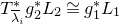 $T_{\overline \lambda _i}^*g_2^*L_2 \cong g_1^*L_1$
for some
$T_{\overline \lambda _i}^*g_2^*L_2 \cong g_1^*L_1$
for some $1\leqslant i\leqslant k$
by the Krull–Schmidt theorem.
$1\leqslant i\leqslant k$
by the Krull–Schmidt theorem.
Notation 5.7.
As above, let ${\mathcal{S}}_H$
denote the set of isomorphism classes of simple vector bundles on
${\mathcal{S}}_H$
denote the set of isomorphism classes of simple vector bundles on $A$
of slope
$A$
of slope $H$
. By Proposition 5.6 we obtain a well-defined map
$H$
. By Proposition 5.6 we obtain a well-defined map
 \begin{align*} \chi _H\colon {\mathcal{S}}_H \longrightarrow \textrm {Pic}^H\big (T^{{\rm an}}\big /\Lambda _{H}^{c}\big )/\Lambda , \end{align*}
where $\Lambda$
acts by pullbacks via translations. By Lemma 2.13 we have
$\Lambda$
acts by pullbacks via translations. By Lemma 2.13 we have
 \begin{align*} \psi _H\colon {\mathcal{S}}_H\xrightarrow {\,\sim \,} \textrm {Pic}^H(A_H), \end{align*}
where $A_H=\big (A^\vee /\Sigma (H)\big )^\vee$
. In what follows, we identify
$A_H=\big (A^\vee /\Sigma (H)\big )^\vee$
. In what follows, we identify $\textrm {Pic}^H\big (T^{{\rm an}}/\Lambda _{H}^{c}\big )\big /\Lambda$
with
$\textrm {Pic}^H\big (T^{{\rm an}}/\Lambda _{H}^{c}\big )\big /\Lambda$
with $\textrm {Pic}^H(A_H)$
.
$\textrm {Pic}^H(A_H)$
.
Lemma 5.8.
Let $\Lambda '$
be a lattice between
$\Lambda '$
be a lattice between $\Lambda _{H}^{c}$
and
$\Lambda _{H}^{c}$
and $\Lambda _{H}^{\mathbb{Z}}$
. Then pullback induces an isomorphism
$\Lambda _{H}^{\mathbb{Z}}$
. Then pullback induces an isomorphism
 \begin{align*} \textrm {Pic}^H(T^{{\rm an}}/\Lambda ')\big /\Lambda _{H}^{\mathbb{Z}}\cong \textrm {Pic}^H(T^{{\rm an}}/\Lambda _{H}^{c}). \end{align*}
Proof.
For $\lambda \in \Lambda _{H}^{\mathbb{Z}}$
and
$\lambda \in \Lambda _{H}^{\mathbb{Z}}$
and $L(H,r)\in \textrm {Pic}^H(N\otimes _{\mathbb{Z}}{\mathbb{G}}_m^{{\rm an}})(K)/\Lambda '$
, the translate
$L(H,r)\in \textrm {Pic}^H(N\otimes _{\mathbb{Z}}{\mathbb{G}}_m^{{\rm an}})(K)/\Lambda '$
, the translate $T_{\overline \lambda }^*L(H,r)$
is given by
$T_{\overline \lambda }^*L(H,r)$
is given by $L(H,r')$
, where
$L(H,r')$
, where
 \begin{align*} \frac {r'}{r}(\lambda ')=[\lambda ,\lambda ']_H= \frac {[\lambda ,\lambda ']_H}{[\lambda ',\lambda ]_H}[\lambda ',\lambda ]_H. \end{align*}
Since $[\lambda ',\lambda ]_H= \big \langle \lambda ', H(\lambda )\big \rangle$
and
$[\lambda ',\lambda ]_H= \big \langle \lambda ', H(\lambda )\big \rangle$
and $H(\lambda )\in M$
, we have
$H(\lambda )\in M$
, we have
 \begin{align*} T_{\overline \lambda }^*L(H,r)= L\big (H,B(\lambda ,-)r\big ), \end{align*}
where we denote
 \begin{align*} B\colon \Lambda _{H}^{\mathbb{Z}}\times \Lambda _{H}^{\mathbb{Z}}\longrightarrow {\mathbb{G}}_m(K),\; \; (\lambda _1,\lambda _2)\longmapsto \frac {[\lambda _1,\lambda _2]_H}{[\lambda _2,\lambda _1]_H}. \end{align*}
Note that $B(\lambda _1,\lambda _2)=B(\lambda _2,\lambda _1)^{-1}$
and that
$B(\lambda _1,\lambda _2)=B(\lambda _2,\lambda _1)^{-1}$
and that $B(\lambda _1,\lambda _2)=1$
for all
$B(\lambda _1,\lambda _2)=1$
for all $\lambda _2\in \Lambda _{H}^{\mathbb{Z}}$
if and only if
$\lambda _2\in \Lambda _{H}^{\mathbb{Z}}$
if and only if $\lambda _2\in \Lambda _{H}^{c}$
. In particular, the bilinear pairing
$\lambda _2\in \Lambda _{H}^{c}$
. In particular, the bilinear pairing $B$
induces an injection
$B$
induces an injection
 \begin{align*} \Lambda _{H}^{\mathbb{Z}}/\Lambda _{H}^{c}\longrightarrow {\textrm {Hom}}\big (\Lambda _{H}^{\mathbb{Z}}/\Lambda _{H}^{c},{\mathbb{G}}_m(K)\big ), \end{align*}
which is, in fact, a bijection because both domain and target have the same cardinality. Since ${\mathbb{G}}_m(K)$
is divisible, we conclude that the linear maps
${\mathbb{G}}_m(K)$
is divisible, we conclude that the linear maps $\Lambda '\to {\mathbb{G}}_m(K)$
arising as
$\Lambda '\to {\mathbb{G}}_m(K)$
arising as $B(\lambda ,-)$
for some
$B(\lambda ,-)$
for some $\lambda \in \Lambda _{H}^{\mathbb{Z}}$
are precisely those that are identically
$\lambda \in \Lambda _{H}^{\mathbb{Z}}$
are precisely those that are identically $1$
on
$1$
on $\Lambda _{H}^{c}$
. These, in turn, are exactly those that are in the kernel of the isogeny
$\Lambda _{H}^{c}$
. These, in turn, are exactly those that are in the kernel of the isogeny
 \begin{align*} {\textrm {Hom}}(\Lambda ',{\mathbb{G}}_m^{{\rm an}})\longrightarrow {\textrm {Hom}}(\Lambda _{H}^{c},{\mathbb{G}}_m^{{\rm an}}) \end{align*}
of tori that induces the pullback of line bundles.
It remains to understand how the action of $\Lambda /\Lambda _{H}^{\mathbb{Z}}$
changes
$\Lambda /\Lambda _{H}^{\mathbb{Z}}$
changes $\textrm {Pic}^H(T^{{\rm an}}/\Lambda _{H}^{c})$
. It turns out that this quotient does not further affect the lattice
$\textrm {Pic}^H(T^{{\rm an}}/\Lambda _{H}^{c})$
. It turns out that this quotient does not further affect the lattice $\Lambda _{H}^{c}$
that we divide by, but instead changes the cocharacter lattice
$\Lambda _{H}^{c}$
that we divide by, but instead changes the cocharacter lattice $N$
.
$N$
.
Notation 5.9.
In what follows, we denote by $H^\vee \colon N_{\mathbb{Q}}\to \Lambda ^\vee _{\mathbb{Q}}$
, the dual of
$H^\vee \colon N_{\mathbb{Q}}\to \Lambda ^\vee _{\mathbb{Q}}$
, the dual of $H$
.
$H$
.
Definition 5.10. We define
 \begin{align*} N_{H}^{\mathbb{Z}}=\big \{ n\in N \ \big \vert \ H^\vee (n)\in \Lambda ^\vee \big \} \end{align*}
and $M_{H}^{\mathbb{Z}}={\textrm {Hom}}(N_{H}^{\mathbb{Z}},\mathbb{Z})$
.
$M_{H}^{\mathbb{Z}}={\textrm {Hom}}(N_{H}^{\mathbb{Z}},\mathbb{Z})$
.
Lemma 5.11. We have
 \begin{align*} M_{H}^{\mathbb{Z}}=M+H(\Lambda ). \end{align*}
More precisely, there is a short exact sequence
 \begin{align*} 0 \longrightarrow \Lambda _{H}^{\mathbb{Z}} \longrightarrow M\oplus \Lambda \longrightarrow M_{H}^{\mathbb{Z}} \longrightarrow 0, \end{align*}
where the first map sends $\lambda$
to
$\lambda$
to $\big (-H(\lambda ), \lambda \big )$
, and the second sends
$\big (-H(\lambda ), \lambda \big )$
, and the second sends $(m,\lambda )$
to
$(m,\lambda )$
to $\big (m+H(\lambda )\big )\big \vert _{N_{H}^{\mathbb{Z}}}$
.
$\big (m+H(\lambda )\big )\big \vert _{N_{H}^{\mathbb{Z}}}$
.
Proof.
By definition of $\Lambda _{H}^{\mathbb{Z}}$
, there is an injection
$\Lambda _{H}^{\mathbb{Z}}$
, there is an injection
 \begin{align*} \Lambda /\Lambda _{H}^{\mathbb{Z}}\longrightarrow M_{H}^{\mathbb{Z}}/M ,\;\; \overline \lambda \longmapsto \overline {H(\lambda )}. \end{align*}
On the other hand, by definition of $N_{H}^{\mathbb{Z}}$
, we also have an injection
$N_{H}^{\mathbb{Z}}$
, we also have an injection
 \begin{align*} N/N_{H}^{\mathbb{Z}}\longrightarrow {\textrm {Hom}}(\Lambda _{H}^{\mathbb{Z}},\mathbb{Z})\big /\Lambda ^\vee ,\;\; \overline n\longmapsto \overline {H^\vee (n)}. \end{align*}
Since
 \begin{align*} [M_{H}^{\mathbb{Z}}:M]=[N:N_{H}^{\mathbb{Z}}] \quad {\rm and}\quad [\Lambda :\Lambda _{H}^{\mathbb{Z}}]=\big [{\textrm {Hom}}(\Lambda _{H}^{\mathbb{Z}},\mathbb{Z}):\Lambda ^\vee \big ] , \end{align*}
it follows that both of these injections are in fact bijections, proving the first part of the assertion and the exactness of the sequence to the right. The exactness on the left is clear and exactness in the middle follows from the definition of $\Lambda _{H}^{\mathbb{Z}}$
.
$\Lambda _{H}^{\mathbb{Z}}$
.
Lemma 5.12. There exists a unique pairing
 \begin{align*} B\colon \Lambda _{H}^{c}\times M_{H}^{\mathbb{Z}}\longrightarrow {\mathbb{G}}_m(K) \end{align*}
such that $B(\lambda ,m)= \langle \lambda , m\rangle$
and
$B(\lambda ,m)= \langle \lambda , m\rangle$
and $B\big (\lambda ,H(\lambda ')\big )= [\lambda ',\lambda ]_H$
for all
$B\big (\lambda ,H(\lambda ')\big )= [\lambda ',\lambda ]_H$
for all $\lambda \in \Lambda _{H}^{c}$
,
$\lambda \in \Lambda _{H}^{c}$
, $m\in M$
, and
$m\in M$
, and $\lambda '\in \Lambda$
.
$\lambda '\in \Lambda$
.
Proof.
By the exactness of the short exact sequence in Lemma 5.11, the assertion follows from the fact that for $\lambda \in \Lambda _{H}^{c}$
and
$\lambda \in \Lambda _{H}^{c}$
and $\lambda '\in \Lambda _{H}^{\mathbb{Z}}$
we have
$\lambda '\in \Lambda _{H}^{\mathbb{Z}}$
we have

By definition, the unique pairing from Lemma 5.12 extends the pairing $\Lambda _{H}^{c}\times M\to {\mathbb{G}}_m(K)$
coming from the embedding of
$\Lambda _{H}^{c}\times M\to {\mathbb{G}}_m(K)$
coming from the embedding of $\Lambda _{H}^{c}$
into
$\Lambda _{H}^{c}$
into $T=N\otimes _{\mathbb{Z}}{\mathbb{G}}_m^{{\rm an}}(K)$
. Therefore, no confusion will arise if we denote it by
$T=N\otimes _{\mathbb{Z}}{\mathbb{G}}_m^{{\rm an}}(K)$
. Therefore, no confusion will arise if we denote it by $\langle -,-\rangle$
as well. Defining this extension of the pairing is equivalent to lifting the embedding of
$\langle -,-\rangle$
as well. Defining this extension of the pairing is equivalent to lifting the embedding of $\Lambda _{H}^{c}$
into
$\Lambda _{H}^{c}$
into $N\otimes _{\mathbb{Z}}{\mathbb{G}}_m^{{\rm an}}(K)$
to an embedding into
$N\otimes _{\mathbb{Z}}{\mathbb{G}}_m^{{\rm an}}(K)$
to an embedding into $N_{H}^{\mathbb{Z}}\otimes _{\mathbb{Z}}{\mathbb{G}}_m^{{\rm an}}(K)$
.
$N_{H}^{\mathbb{Z}}\otimes _{\mathbb{Z}}{\mathbb{G}}_m^{{\rm an}}(K)$
.
Notation 5.13.
In what follows, we write $N_{H}^{\mathbb{Z}}\otimes _{\mathbb{Z}}{\mathbb{G}}_m^{{\rm an}}/\Lambda _{H}^{c}$
for the quotient by this particular lift of
$N_{H}^{\mathbb{Z}}\otimes _{\mathbb{Z}}{\mathbb{G}}_m^{{\rm an}}/\Lambda _{H}^{c}$
for the quotient by this particular lift of $\Lambda _{H}^{c}$
.
$\Lambda _{H}^{c}$
.
Lemma 5.14.
Let $\Lambda '$
denote a lattice between
$\Lambda '$
denote a lattice between $\Lambda _{H}^{c}$
and
$\Lambda _{H}^{c}$
and $\Lambda _{H}^{\mathbb{Z}}$
. Then the pullback induces an isomorphism
$\Lambda _{H}^{\mathbb{Z}}$
. Then the pullback induces an isomorphism
 \begin{align*} \textrm {Pic}^H\big (T^{{\rm an}}/\Lambda ' \big )\big /\Lambda \cong \textrm {Pic}^H\big (N_{H}^{\mathbb{Z}}\otimes _{\mathbb{Z}}{\mathbb{G}}_m^{{\rm an}}/\Lambda _{H}^{c}\big ). \end{align*}
Proof.
By Lemma 5.8, we already know that pulling-back to $T^{{\rm an}}=N\otimes _{\mathbb{Z}} {\mathbb{G}}_m^{{\rm an}}/\Lambda _{H}^{c}$
is equivalent to dividing by the action of
$T^{{\rm an}}=N\otimes _{\mathbb{Z}} {\mathbb{G}}_m^{{\rm an}}/\Lambda _{H}^{c}$
is equivalent to dividing by the action of $\Lambda _{H}^{\mathbb{Z}}$
. We may therefore assume that
$\Lambda _{H}^{\mathbb{Z}}$
. We may therefore assume that $\Lambda '=\Lambda _{H}^{c}$
and that the restriction of the
$\Lambda '=\Lambda _{H}^{c}$
and that the restriction of the $\Lambda$
-action to
$\Lambda$
-action to $\Lambda _{H}^{\mathbb{Z}}$
is trivial.
$\Lambda _{H}^{\mathbb{Z}}$
is trivial.
Given $\lambda \in \Lambda$
and
$\lambda \in \Lambda$
and $L(H,r)\in \textrm {Pic}^H(N\otimes _{\mathbb{Z}}{\mathbb{G}}_m^{{\rm an}}/\Lambda _{H}^{c})$
, the translate
$L(H,r)\in \textrm {Pic}^H(N\otimes _{\mathbb{Z}}{\mathbb{G}}_m^{{\rm an}}/\Lambda _{H}^{c})$
, the translate $T^*_{\overline \lambda }L(H,r)$
is given by
$T^*_{\overline \lambda }L(H,r)$
is given by $L(H,r')$
, where we have
$L(H,r')$
, where we have
 \begin{align*} \frac {r'}{r}(\lambda ')= [\lambda ,\lambda ']_H= \big \langle \lambda ',H(\lambda )\big \rangle \end{align*}
for all $\lambda '\in \Lambda _{H}^{c}$
. Here, the second equality uses the definition of the embedding of
$\lambda '\in \Lambda _{H}^{c}$
. Here, the second equality uses the definition of the embedding of $\Lambda _{H}^{c}$
in
$\Lambda _{H}^{c}$
in $N_{H}^{\mathbb{Z}}$
, or dually the embedding of
$N_{H}^{\mathbb{Z}}$
, or dually the embedding of $M_{H}^{\mathbb{Z}}$
in
$M_{H}^{\mathbb{Z}}$
in ${\textrm {Hom}}(\Lambda _{H}^{c},{\mathbb{G}}_m^{{\rm an}})$
. By Lemma 5.11, the given action of
${\textrm {Hom}}(\Lambda _{H}^{c},{\mathbb{G}}_m^{{\rm an}})$
. By Lemma 5.11, the given action of $\Lambda$
yields the same quotient as the action by
$\Lambda$
yields the same quotient as the action by $M_{H}^{\mathbb{Z}}$
, that is
$M_{H}^{\mathbb{Z}}$
, that is
 \begin{align*} \textrm {Pic}^H\big (T^{{\rm an}}/\Lambda _{H}^{c}\big )\big /\Lambda \cong \big ({\textrm {Hom}}(\Lambda _{H}^{c},{\mathbb{G}}_m^{{\rm an}})\big /M\big )/\Lambda \cong {\textrm {Hom}}\big (\Lambda _{H}^{c},{\mathbb{G}}_m^{{\rm an}}\big )\big /M_{H}^{\mathbb{Z}}\cong \textrm {Pic}^H\big (N_{H}^{\mathbb{Z}}\otimes _{\mathbb{Z}}{\mathbb{G}}_m^{{\rm an}}\big /\Lambda _{H}^{c}\big ), \end{align*}
and it is immediate that the quotient map is precisely the pullback map.
By Lemma 5.14, we may view $\chi _H$
as a map from
$\chi _H$
as a map from ${\mathcal{S}}_H$
to
${\mathcal{S}}_H$
to $\textrm {Pic}^H(N_{H}^{\mathbb{Z}}\otimes _{\mathbb{Z}}{\mathbb{G}}_m^{{\rm an}}/\Lambda _{H}^{c})$
.
$\textrm {Pic}^H(N_{H}^{\mathbb{Z}}\otimes _{\mathbb{Z}}{\mathbb{G}}_m^{{\rm an}}/\Lambda _{H}^{c})$
.
Proposition 5.15. The map
 \begin{align*} \chi _H\colon {\mathcal{S}}_H\longrightarrow \textrm {Pic}^H(N_{H}^{\mathbb{Z}}\otimes _{\mathbb{Z}}{\mathbb{G}}_m^{{\rm an}}/\Lambda _{H}^{c})(K) \end{align*}
is a bijection. In particular, we have
 \begin{align*} A_H\cong \big (N_{H}^{\mathbb{Z}}\otimes _{\mathbb{Z}}{\mathbb{G}}_m^{{\rm an}}\big )\big /\Lambda _{H}^{c}, \end{align*}
or dually
 \begin{align*} A^\vee /\Sigma (H) \cong (\Lambda _{H}^{c})^\vee \otimes _{\mathbb{Z}}{\mathbb{G}}_m^{{\rm an}}\big /M_{H}^{\mathbb{Z}}. \end{align*}
Proof.
By Proposition 5.3, there exists an $H$
-admissible sublattice
$H$
-admissible sublattice $\Lambda '$
of
$\Lambda '$
of $\Lambda$
and a line bundle
$\Lambda$
and a line bundle $L$
on
$L$
on $A'=T^{{\rm an}}/\Lambda '$
such that, if
$A'=T^{{\rm an}}/\Lambda '$
such that, if $f\colon A'\to A$
denotes the quotient map, the vector bundle
$f\colon A'\to A$
denotes the quotient map, the vector bundle $f_*L$
is simple and
$f_*L$
is simple and $\delta (f_*L)=H$
. Given any simple vector bundle
$\delta (f_*L)=H$
. Given any simple vector bundle $E$
on
$E$
on $A$
with
$A$
with $\delta (E)=H$
, there exists a line bundle
$\delta (E)=H$
, there exists a line bundle $M\in \textrm {Pic}^0(A)$
such that
$M\in \textrm {Pic}^0(A)$
such that $E=f_*L\otimes M=f_*(L\otimes f^* M)$
by [Reference MukaiMuk78, Proposition 6.17]. Therefore, the simple vector bundle on
$E=f_*L\otimes M=f_*(L\otimes f^* M)$
by [Reference MukaiMuk78, Proposition 6.17]. Therefore, the simple vector bundle on $A$
of slope
$A$
of slope $H$
are precisely the pushforwards along
$H$
are precisely the pushforwards along $f$
of line bundles in
$f$
of line bundles in $\textrm {Pic}^{f^*H}(A')$
. If
$\textrm {Pic}^{f^*H}(A')$
. If $M_1, M_2\in \textrm {Pic}^{f^*H}(A')$
with
$M_1, M_2\in \textrm {Pic}^{f^*H}(A')$
with $f_*M_1=f_*M_2$
, then
$f_*M_1=f_*M_2$
, then $f^*f_*M_1=f^*f_*M_2$
. As
$f^*f_*M_1=f^*f_*M_2$
. As $f$
is a
$f$
is a $\Lambda /\Lambda '$
-torsor, we have
$\Lambda /\Lambda '$
-torsor, we have
 \begin{align*} f^*f_*M_i= \bigoplus _{\lambda \in \Lambda /\Lambda '} T^*_\lambda M_i \end{align*}
and it follows that $M_2\cong T^*_\lambda M_1$
for some
$M_2\cong T^*_\lambda M_1$
for some $\lambda \in \Lambda /\Lambda '$
. Conversely, if
$\lambda \in \Lambda /\Lambda '$
. Conversely, if $M_2\cong T^*_\lambda M_1$
for some
$M_2\cong T^*_\lambda M_1$
for some $\lambda \in \Lambda /\Lambda '$
, it is clear that
$\lambda \in \Lambda /\Lambda '$
, it is clear that $f_*M_1\cong f_*M_2$
. We conclude that we can identify
$f_*M_1\cong f_*M_2$
. We conclude that we can identify ${\mathcal{S}}_H$
with
${\mathcal{S}}_H$
with $\textrm {Pic}^H\big (T^{{\rm an}}/\Lambda '\big )\big /\Lambda$
. By Lemma 5.14, the pullback of line bundles in
$\textrm {Pic}^H\big (T^{{\rm an}}/\Lambda '\big )\big /\Lambda$
. By Lemma 5.14, the pullback of line bundles in $\textrm {Pic}^{f^*H}(A')$
to
$\textrm {Pic}^{f^*H}(A')$
to $N_{H}^{\mathbb{Z}}\otimes _{\mathbb{Z}}{\mathbb{G}}_m^{{\rm an}}/\Lambda _{H}^{c}$
induces an isomorphism of
$N_{H}^{\mathbb{Z}}\otimes _{\mathbb{Z}}{\mathbb{G}}_m^{{\rm an}}/\Lambda _{H}^{c}$
induces an isomorphism of $\textrm {Pic}^{f^*H}(A')/\Lambda$
with
$\textrm {Pic}^{f^*H}(A')/\Lambda$
with $\textrm {Pic}^H\big (N_{H}^{\mathbb{Z}}\otimes _{\mathbb{Z}}{\mathbb{G}}_m^{{\rm an}}/\Lambda _{H}^{c}\big )$
. This pullback factors through the pullback to
$\textrm {Pic}^H\big (N_{H}^{\mathbb{Z}}\otimes _{\mathbb{Z}}{\mathbb{G}}_m^{{\rm an}}/\Lambda _{H}^{c}\big )$
. This pullback factors through the pullback to $\textrm {Pic}^H\big (T^{{\rm an}}/\Lambda _{H}^{c}\big )/\Lambda$
and, hence, through
$\textrm {Pic}^H\big (T^{{\rm an}}/\Lambda _{H}^{c}\big )/\Lambda$
and, hence, through $\chi _H$
.
$\chi _H$
.
Let $g\colon N_{H}^{\mathbb{Z}}\otimes _{\mathbb{Z}}{\mathbb{G}}_m^{{\rm an}}/\Lambda _{H}^{c}\to A$
be the quotient map and let
$g\colon N_{H}^{\mathbb{Z}}\otimes _{\mathbb{Z}}{\mathbb{G}}_m^{{\rm an}}/\Lambda _{H}^{c}\to A$
be the quotient map and let $E\in {\mathcal{S}}_H$
. for a line bundle
$E\in {\mathcal{S}}_H$
. for a line bundle $M\in \textrm {Pic}^0(A)$
we have
$M\in \textrm {Pic}^0(A)$
we have $\chi _H(E\otimes M)= \psi _H(E)\otimes g^*M$
and since
$\chi _H(E\otimes M)= \psi _H(E)\otimes g^*M$
and since $E\otimes M_1\cong E\otimes M_2$
for
$E\otimes M_1\cong E\otimes M_2$
for $M_1, M_2\in \textrm {Pic}^0(A)$
, the kernel of
$M_1, M_2\in \textrm {Pic}^0(A)$
, the kernel of $g^*$
is precisely
$g^*$
is precisely $\Sigma (E)$
.
$\Sigma (E)$
.
6. Tropicalizing semi-homogeneous vector bundles
We denote by $A^{{{\rm an}}}:=T^{{{\rm an}}}/\Lambda$
the non-Archimedean uniformization and by
$A^{{{\rm an}}}:=T^{{{\rm an}}}/\Lambda$
the non-Archimedean uniformization and by $A^{{{\rm trop}}}:=T^{{{\rm trop}}}/\Lambda$
the tropicalization of
$A^{{{\rm trop}}}:=T^{{{\rm trop}}}/\Lambda$
the tropicalization of $A$
. In this section, we study the process of tropicalization for semi-homogeneous vector bundles on an abelian variety
$A$
. In this section, we study the process of tropicalization for semi-homogeneous vector bundles on an abelian variety $A$
over
$A$
over $K$
that admits a totally degenerate reduction over its valuation ring
$K$
that admits a totally degenerate reduction over its valuation ring $R$
. We proceed in three steps: first the case of line bundles, then the case of simple semi-homogeneous vector bundles, and then the general case of semi-homogeneous vector bundles.
$R$
. We proceed in three steps: first the case of line bundles, then the case of simple semi-homogeneous vector bundles, and then the general case of semi-homogeneous vector bundles.
6.1 The case of line bundles
Given a line bundle $L$
on
$L$
on $A^{{{\rm an}}}=N\otimes _{\mathbb{Z}}{\mathbb{G}}_m^{{\rm an}}/\Lambda$
, we can tropicalize it by tropicalizing factors of automorphy. Namely, if we write
$A^{{{\rm an}}}=N\otimes _{\mathbb{Z}}{\mathbb{G}}_m^{{\rm an}}/\Lambda$
, we can tropicalize it by tropicalizing factors of automorphy. Namely, if we write $L=L(H,r)$
, then
$L=L(H,r)$
, then $H$
defines a symmetric form on
$H$
defines a symmetric form on $N_{\mathbb{R}}$
. We can also postcompose
$N_{\mathbb{R}}$
. We can also postcompose $r$
with the valuation and obtain a map
$r$
with the valuation and obtain a map $\nu \circ r\colon \Lambda \to {\mathbb{R}}$
. However,
$\nu \circ r\colon \Lambda \to {\mathbb{R}}$
. However, $\nu \circ r$
is not linear unless
$\nu \circ r$
is not linear unless $H=0$
. To remedy this, we define
$H=0$
. To remedy this, we define $r^{{\rm trop}}$
by
$r^{{\rm trop}}$
by
 \begin{align*} r^{{\rm trop}}(\lambda )= \nu \big (r(\lambda )\big )-\frac 12 [\lambda ,\lambda ]_H^{\mathbb{R}}, \end{align*}
which is indeed linear: for $\lambda ,\lambda ' \in \Lambda$
we have
$\lambda ,\lambda ' \in \Lambda$
we have
 \begin{align*} r^{{\rm trop}}(\lambda +\lambda ')&= \nu \big (r(\lambda +\lambda ')\big )-\frac 12 [\lambda +\lambda ',\lambda +\lambda ']_H^{\mathbb{R}} \\[5pt] &=\nu \big (r(\lambda )\big )+ \nu \big (r(\lambda ')\big )+[\lambda ,\lambda ']_H^{\mathbb{R}} -\frac 12 [\lambda ,\lambda ]_H^{\mathbb{R}}-[\lambda ,\lambda ']_H^{\mathbb{R}}- \frac 12 [\lambda ',\lambda ']_H^{\mathbb{R}}\\& = r^{{\rm trop}}(\lambda )+r^{{\rm trop}}(\lambda ') , \end{align*}
where the second equality comes from applying the valuation to (1).
Definition 6.1. We define the tropicalization $L^{{\rm trop}}$
of
$L^{{\rm trop}}$
of $L$
to be the tropical line bundle
$L$
to be the tropical line bundle $L^{{\rm trop}}=L(H, r^{{\rm trop}})$
. This is independent of the choice of the factors of automorphy.
$L^{{\rm trop}}=L(H, r^{{\rm trop}})$
. This is independent of the choice of the factors of automorphy.
Suppose $K'$
is an algebraically closed non-Archimedean extension of
$K'$
is an algebraically closed non-Archimedean extension of $K$
. Then, for
$K$
. Then, for $L\in \textrm {Pic}^H(A)$
, the base change
$L\in \textrm {Pic}^H(A)$
, the base change $L_{K'}\in \textrm {Pic}^H(A_{K'})$
is a line bundle on
$L_{K'}\in \textrm {Pic}^H(A_{K'})$
is a line bundle on $A_{K'}$
with
$A_{K'}$
with $A_{K'}^{{{\rm an}}}=T_{K'}^{{{\rm an}}}/\Lambda$
. The factors of automorphy are compatible with base change. Hence, the tropicalization is invariant under this operation. Therefore we have a well-defined tropicalization map
$A_{K'}^{{{\rm an}}}=T_{K'}^{{{\rm an}}}/\Lambda$
. The factors of automorphy are compatible with base change. Hence, the tropicalization is invariant under this operation. Therefore we have a well-defined tropicalization map
 \begin{align*} {{\rm trop}}\colon \textrm {Pic}^H(A)^{{{\rm an}}}\longrightarrow \textrm {Pic}^H(A^{{{\rm trop}}}\big ) ,\end{align*}
which will turn out to be uniquely determined by its restriction to the dense subset $\textrm {Pic}^H(A)\subseteq \textrm {Pic}^H(A)^{{{\rm an}}}$
, once we know it is continuous (a consequence of Theorem6.2).
$\textrm {Pic}^H(A)\subseteq \textrm {Pic}^H(A)^{{{\rm an}}}$
, once we know it is continuous (a consequence of Theorem6.2).
The dual abelian variety $\textrm {Pic}^0(A)$
is an abelian variety with maximally degenerate reduction and admits a strong deformation retraction
$\textrm {Pic}^0(A)$
is an abelian variety with maximally degenerate reduction and admits a strong deformation retraction $\tau \colon \textrm {Pic}^0(A)^{{{\rm an}}}\rightarrow \Sigma \big (\textrm {Pic}^0(A)\big )$
onto a closed subset
$\tau \colon \textrm {Pic}^0(A)^{{{\rm an}}}\rightarrow \Sigma \big (\textrm {Pic}^0(A)\big )$
onto a closed subset $\Sigma \big (\textrm {Pic}^0(A)\big )\subseteq \textrm {Pic}^0(A)^{{{\rm an}}}$
that has the structure of a real torus, its non-Archimedean skeleton (see [Reference BerkovichBer90, Section 6.5] but also [Reference GublerGub07] for details). The variety
$\Sigma \big (\textrm {Pic}^0(A)\big )\subseteq \textrm {Pic}^0(A)^{{{\rm an}}}$
that has the structure of a real torus, its non-Archimedean skeleton (see [Reference BerkovichBer90, Section 6.5] but also [Reference GublerGub07] for details). The variety $\textrm {Pic}^H(A)$
is a torsor over
$\textrm {Pic}^H(A)$
is a torsor over $\textrm {Pic}^0(A)$
. Hence, its Berkovich analytification also admits a natural strong deformation retraction
$\textrm {Pic}^0(A)$
. Hence, its Berkovich analytification also admits a natural strong deformation retraction $\tau \colon \textrm {Pic}^H(A)^{{{\rm an}}}\rightarrow \Sigma \big (\textrm {Pic}^H(A)\big )$
onto a non-Archimedean skeleton
$\tau \colon \textrm {Pic}^H(A)^{{{\rm an}}}\rightarrow \Sigma \big (\textrm {Pic}^H(A)\big )$
onto a non-Archimedean skeleton $\Sigma \big (\textrm {Pic}^H(A)\big )\subseteq \textrm {Pic}^H(A)^{{{\rm an}}}$
, which now canonically carries the structure of a torsor over a real torus. We note that the skeleton
$\Sigma \big (\textrm {Pic}^H(A)\big )\subseteq \textrm {Pic}^H(A)^{{{\rm an}}}$
, which now canonically carries the structure of a torsor over a real torus. We note that the skeleton $\Sigma \big (\textrm {Pic}^H(A)\big )$
coincides with the essential skeleton of
$\Sigma \big (\textrm {Pic}^H(A)\big )$
coincides with the essential skeleton of $\textrm {Pic}^H(A)$
in the sense of [Reference Kontsevich and SoibelmanKS06, Reference Mustaţă and NicaiseMN15, Reference Nicaise and XuNX16, Reference Nicaise, Xu and YuNXY19] by [Reference Halle and NicaiseHN18, Proposition 4.3.2].
$\textrm {Pic}^H(A)$
in the sense of [Reference Kontsevich and SoibelmanKS06, Reference Mustaţă and NicaiseMN15, Reference Nicaise and XuNX16, Reference Nicaise, Xu and YuNXY19] by [Reference Halle and NicaiseHN18, Proposition 4.3.2].
Theorem 6.2.
Let $H\in \textrm {NS}(A)$
. Then there exists a unique isomorphism
$H\in \textrm {NS}(A)$
. Then there exists a unique isomorphism $\phi \colon \Sigma (\textrm {Pic}^H(A))\xrightarrow {\cong } \textrm {Pic}^H(A^{{\rm trop}})$
such that the following diagram, where
$\phi \colon \Sigma (\textrm {Pic}^H(A))\xrightarrow {\cong } \textrm {Pic}^H(A^{{\rm trop}})$
such that the following diagram, where $\tau$
denotes the retraction map, commutes.
$\tau$
denotes the retraction map, commutes.
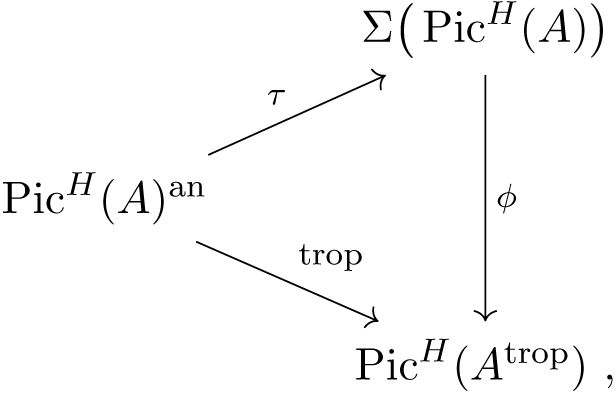
Proof.
First consider the case $H=0$
. Then we have a uniformization
$H=0$
. Then we have a uniformization $\Lambda ^\vee \otimes _{\mathbb{Z}}{\mathbb{G}}_m^{{\rm an}}\to \textrm {Pic}^0(A)$
in which a point
$\Lambda ^\vee \otimes _{\mathbb{Z}}{\mathbb{G}}_m^{{\rm an}}\to \textrm {Pic}^0(A)$
in which a point
 \begin{align*} r\in (\Lambda ^\vee \otimes _{\mathbb{Z}}{\mathbb{G}}_m^{{\rm an}})(L)= {\textrm {Hom}}\big (\Lambda , {\mathbb{G}}_m(L)\big ) \end{align*}
over some valued field extension $L/K$
maps to the line bundle
$L/K$
maps to the line bundle $L(0,r)$
by [Reference LütkebohmertLüt16, Theorem 2.7.7]. Let
$L(0,r)$
by [Reference LütkebohmertLüt16, Theorem 2.7.7]. Let $r^{{\rm trop}}(\lambda ):=\nu (r(\lambda ))$
and denote by
$r^{{\rm trop}}(\lambda ):=\nu (r(\lambda ))$
and denote by $L(0,r^{{\rm trop}})$
the class corresponding to
$L(0,r^{{\rm trop}})$
the class corresponding to $r^{{\rm trop}}$
in
$r^{{\rm trop}}$
in $\textrm {Pic}^0(A^{{\rm trop}})=\Lambda ^\vee \otimes _{\mathbb{Z}}{\mathbb{R}} /M$
.
$\textrm {Pic}^0(A^{{\rm trop}})=\Lambda ^\vee \otimes _{\mathbb{Z}}{\mathbb{R}} /M$
.
The tropicalization maps the line bundle associated to $r$
to the tropical line bundle
$r$
to the tropical line bundle $L(0, r^{{\rm trop}})$
. However, the map
$L(0, r^{{\rm trop}})$
. However, the map
 \begin{align*} \begin{split} \Lambda ^\vee \otimes _{\mathbb{Z}}{\mathbb{G}}_m^{{\rm an}} /M &\longrightarrow \Lambda ^\vee \otimes _{\mathbb{Z}}{\mathbb{R}} /M\\[5pt] r&\longmapsto \nu \circ r \end{split} \end{align*}
has a natural section that identifies $\textrm {Pic}^0(A^{{\rm trop}})= \Lambda ^\vee \otimes _{\mathbb{Z}}{\mathbb{R}} /M$
with the skeleton of
$\textrm {Pic}^0(A^{{\rm trop}})= \Lambda ^\vee \otimes _{\mathbb{Z}}{\mathbb{R}} /M$
with the skeleton of $\textrm {Pic}^0(A)=\Lambda ^\vee \otimes _{\mathbb{Z}}{\mathbb{G}}_m^{{\rm an}}/M$
and the tropicalization map with the retraction map.
$\textrm {Pic}^0(A)=\Lambda ^\vee \otimes _{\mathbb{Z}}{\mathbb{G}}_m^{{\rm an}}/M$
and the tropicalization map with the retraction map.
For general $H$
, pick a factor of automorphy
$H$
, pick a factor of automorphy $(H,r)$
for a line bundle in
$(H,r)$
for a line bundle in $\textrm {Pic}^H(A)$
, and let
$\textrm {Pic}^H(A)$
, and let $(H,r^{{\rm trop}})$
be its tropicalization. Then tensoring with
$(H,r^{{\rm trop}})$
be its tropicalization. Then tensoring with $L(H,r)$
defines an isomorphism
$L(H,r)$
defines an isomorphism $\textrm {Pic}^0(A)\to \textrm {Pic}^H(A)$
, and tensoring with
$\textrm {Pic}^0(A)\to \textrm {Pic}^H(A)$
, and tensoring with $L(H,r^{{\rm trop}})$
defines an isomorphism
$L(H,r^{{\rm trop}})$
defines an isomorphism $\textrm {Pic}^0(A^{{\rm trop}})\to \textrm {Pic}^H(A^{{\rm trop}})$
. On the level of skeleta, we obtain a chain of isomorphisms
$\textrm {Pic}^0(A^{{\rm trop}})\to \textrm {Pic}^H(A^{{\rm trop}})$
. On the level of skeleta, we obtain a chain of isomorphisms
 \begin{align*} \Sigma \big (\textrm {Pic}^H(A)\big )\xrightarrow {\otimes L(H,r)^{-1}} \Sigma \big (\textrm {Pic}^0(A)\big )\xrightarrow {{{\rm trop}}} \textrm {Pic}^0(A^{{\rm trop}}) \xrightarrow {\otimes L(H,r^{{\rm trop}})} \textrm {Pic}^H(A^{{\rm trop}}), \end{align*}
the composite of which we denote by $\phi$
. If, for
$\phi$
. If, for $G\in \textrm {NS}(A)$
, we denote by
$G\in \textrm {NS}(A)$
, we denote by $\tau _G\colon \textrm {Pic}^G(A)^{{\rm an}}\to \Sigma (\textrm {Pic}^G(A))$
the retraction to the skeleton. Then for
$\tau _G\colon \textrm {Pic}^G(A)^{{\rm an}}\to \Sigma (\textrm {Pic}^G(A))$
the retraction to the skeleton. Then for $L(H,r')\in \textrm {Pic}^H(A)(L)$
over some valued field extension
$L(H,r')\in \textrm {Pic}^H(A)(L)$
over some valued field extension $L/K$
we have
$L/K$
we have
 \begin{align*} \begin{split} (\phi \circ \tau _H)\big (L(H,r)\big )&= {{\rm trop}}\left (L\left (0,\frac {r'}r\right )\right )\otimes L\big (H,r^{{\rm trop}}\big ) = L(H, r'\circ \nu - r\circ \nu +r^{{\rm trop}})\\[5pt] &= L(H,(r')^{{\rm trop}})=L(H,r')^{{\rm trop}}. \end{split} \end{align*}
Therefore, $\phi \circ \tau _H = {{\rm trop}}$
. Since
$\phi \circ \tau _H = {{\rm trop}}$
. Since $\tau _H$
is surjective,
$\tau _H$
is surjective, $\phi$
unique with that property.
$\phi$
unique with that property.
Remark 6.3. Note that if a line bundle $L$
on
$L$
on $A$
is ample, there is an alternative way to tropicalize
$A$
is ample, there is an alternative way to tropicalize $L$
. First, one takes the effective divisor
$L$
. First, one takes the effective divisor $D$
on
$D$
on $A$
corresponding to a section of
$A$
corresponding to a section of $L$
. The image of
$L$
. The image of $D^{{\rm an}}$
under the retraction to
$D^{{\rm an}}$
under the retraction to $\Sigma (A)$
has the structure of a tropical hypersurface
$\Sigma (A)$
has the structure of a tropical hypersurface $D^{{\rm trop}}$
in
$D^{{\rm trop}}$
in $A^{{\rm trop}}$
[Reference GublerGub07], which, in turn, corresponds to a tropical line bundle on
$A^{{\rm trop}}$
[Reference GublerGub07], which, in turn, corresponds to a tropical line bundle on $A^{{\rm trop}}$
. To see that this line bundle coincides with
$A^{{\rm trop}}$
. To see that this line bundle coincides with $L^{{\rm trop}}$
, first rigidify
$L^{{\rm trop}}$
, first rigidify $L$
so that
$L$
so that $D$
corresponds to a theta function
$D$
corresponds to a theta function $f$
. Then
$f$
. Then $D^{{\rm trop}}$
is defined by the tropicalization of the theta function
$D^{{\rm trop}}$
is defined by the tropicalization of the theta function $f^{{\rm trop}}$
(in the sense of [Reference Foster, Rabinoff, Shokrieh and SotoFRS+18]) and
$f^{{\rm trop}}$
(in the sense of [Reference Foster, Rabinoff, Shokrieh and SotoFRS+18]) and $f^{{\rm trop}}$
is a theta function with respect to the induced rigidification of
$f^{{\rm trop}}$
is a theta function with respect to the induced rigidification of $L^{{\rm trop}}$
[Reference Foster, Rabinoff, Shokrieh and SotoFRS+18, Theorem 4.10].
$L^{{\rm trop}}$
[Reference Foster, Rabinoff, Shokrieh and SotoFRS+18, Theorem 4.10].
We need the following result.
Lemma 6.4.
Let $\phi \colon N\otimes _{\mathbb{Z}}{\mathbb{G}}_m^{{\rm an}}/\Lambda \to N'\otimes _{\mathbb{Z}}{\mathbb{G}}_m^{{\rm an}}/\Lambda '$
be a homomorphism of analytic tori induced by a homomorphism
$\phi \colon N\otimes _{\mathbb{Z}}{\mathbb{G}}_m^{{\rm an}}/\Lambda \to N'\otimes _{\mathbb{Z}}{\mathbb{G}}_m^{{\rm an}}/\Lambda '$
be a homomorphism of analytic tori induced by a homomorphism $\phi _N\colon N\to N'$
of free abelian groups. Then for every line bundle
$\phi _N\colon N\to N'$
of free abelian groups. Then for every line bundle $L$
on
$L$
on $N'\otimes _{\mathbb{Z}}{\mathbb{G}}_m^{{\rm an}}$
we have
$N'\otimes _{\mathbb{Z}}{\mathbb{G}}_m^{{\rm an}}$
we have
 \begin{align*} (\phi ^*L)^{{\rm trop}}=\phi _{{\rm trop}}^*L^{{\rm trop}}. \end{align*}
Proof.
Let $L(H,r)$
be a line bundle on
$L(H,r)$
be a line bundle on $N\otimes _{\mathbb{Z}}{\mathbb{G}}_m^{{\rm an}}$
. If we denote by
$N\otimes _{\mathbb{Z}}{\mathbb{G}}_m^{{\rm an}}$
. If we denote by $\phi _\Lambda \colon \Lambda \to \Lambda '$
the morphism induced by
$\phi _\Lambda \colon \Lambda \to \Lambda '$
the morphism induced by $\phi _N$
, then by [Reference LütkebohmertLüt16, Corollary 6.4.3] we have
$\phi _N$
, then by [Reference LütkebohmertLüt16, Corollary 6.4.3] we have
 \begin{align*} \phi ^*L(H,r)= L\big (H\circ (\phi _\Lambda \times \phi _N), r\circ \phi _\Lambda \big ). \end{align*}
By a short calculation we deduce the desired equality.
6.2 The case of simple bundles
Let $A$
be an abelian variety with totally degenerate reduction with
$A$
be an abelian variety with totally degenerate reduction with $A^{{\rm an}}\cong T^{{\rm an}}/\Lambda$
for some algebraic torus
$A^{{\rm an}}\cong T^{{\rm an}}/\Lambda$
for some algebraic torus $T$
, and let
$T$
, and let $H\in \textrm {NS}(A)_{\mathbb{Q}}$
. We now construct a natural tropicalization map for simple semi-homogeneous vector bundles:
$H\in \textrm {NS}(A)_{\mathbb{Q}}$
. We now construct a natural tropicalization map for simple semi-homogeneous vector bundles:
 \begin{align*} {{\rm trop}}\colon M_{H,1}(A)^{{{\rm an}}}\longrightarrow M_{H,1}^{\Lambda _{H}^{c}}(A^{{{\rm trop}}}). \end{align*}
Let $E$
be a simple semi-homogeneous vector bundle on
$E$
be a simple semi-homogeneous vector bundle on $A$
of slope
$A$
of slope $\delta (E)=H$
. To tropicalize
$\delta (E)=H$
. To tropicalize $E$
, we use Proposition 5.3 and write
$E$
, we use Proposition 5.3 and write $E=f_*L$
for some line bundle
$E=f_*L$
for some line bundle $L$
on the source
$L$
on the source $B$
of an isogeny
$B$
of an isogeny $f\colon T^{{\rm an}}/\Lambda '\to T^{{\rm an}}\Lambda$
associated to a finite-index sublattice
$f\colon T^{{\rm an}}/\Lambda '\to T^{{\rm an}}\Lambda$
associated to a finite-index sublattice $\Lambda '$
of
$\Lambda '$
of $\Lambda$
. We then tropicalize
$\Lambda$
. We then tropicalize $L$
and obtain a line bundle
$L$
and obtain a line bundle $L^{{\rm trop}}$
on
$L^{{\rm trop}}$
on $N_{\mathbb{R}}/\Lambda '$
, which we can push forward to a vector bundle
$N_{\mathbb{R}}/\Lambda '$
, which we can push forward to a vector bundle $f^{{\rm trop}}_*L^{{\rm trop}}$
on
$f^{{\rm trop}}_*L^{{\rm trop}}$
on $N_{\mathbb{R}}/\Lambda$
. This is not well-defined, as
$N_{\mathbb{R}}/\Lambda$
. This is not well-defined, as $\Lambda '$
and
$\Lambda '$
and $L$
are not well-defined.
$L$
are not well-defined.
To fix this, we can use $\psi _H$
(see Remark 2.15) to tropicalize vector bundles in
$\psi _H$
(see Remark 2.15) to tropicalize vector bundles in ${\mathcal{S}}_H$
. Given
${\mathcal{S}}_H$
. Given $E\in {\mathcal{S}}_H$
, we apply
$E\in {\mathcal{S}}_H$
, we apply $\psi _H$
and obtain a line bundle
$\psi _H$
and obtain a line bundle $L$
on
$L$
on $N\otimes _{\mathbb{Z}}{\mathbb{G}}_m^{{\rm an}}/\Lambda _{H}^{c}$
, that is well-defined up the action of the automorphism group
$N\otimes _{\mathbb{Z}}{\mathbb{G}}_m^{{\rm an}}/\Lambda _{H}^{c}$
, that is well-defined up the action of the automorphism group $\big [\Lambda /\Lambda _{H}^{c}\big ]$
of the cover
$\big [\Lambda /\Lambda _{H}^{c}\big ]$
of the cover $T^{{\rm an}}/\Lambda _{H}^{c}\to A$
. Therefore, its tropicalization
$T^{{\rm an}}/\Lambda _{H}^{c}\to A$
. Therefore, its tropicalization $L^{{\rm trop}}$
is a tropical line bundle on
$L^{{\rm trop}}$
is a tropical line bundle on $N_{\mathbb{R}}/\Lambda _{H}^{c}$
that is well-defined up to the action of the automorphism group of the cover
$N_{\mathbb{R}}/\Lambda _{H}^{c}$
that is well-defined up to the action of the automorphism group of the cover $N_{\mathbb{R}}/\Lambda _{H}^{c}\to N_{\mathbb{R}}/\Lambda$
. By Proposition 4.23, the tropical line bundle
$N_{\mathbb{R}}/\Lambda _{H}^{c}\to N_{\mathbb{R}}/\Lambda$
. By Proposition 4.23, the tropical line bundle $L^{{\rm trop}}$
defines an equivalence class of
$L^{{\rm trop}}$
defines an equivalence class of $\Lambda _{H}^{c}$
-compatible tropical vector bundles of slope
$\Lambda _{H}^{c}$
-compatible tropical vector bundles of slope $H$
that is independent of all choices. In other words, we obtain a natural map
$H$
that is independent of all choices. In other words, we obtain a natural map
 \begin{align*} {{\rm trop}}\colon M_{H,1}(A)(K)\longrightarrow {\mathcal{M}}_{H,1}^{\Lambda _{H}^{c}}(A^{{{\rm trop}}}) .\end{align*}
By construction, if a line bundle $L$
on
$L$
on $T_{K'}^{{\rm an}}/\Lambda '$
represents
$T_{K'}^{{\rm an}}/\Lambda '$
represents $H$
and
$H$
and $f\colon T_{K'}^{{\rm an}}/\Lambda '\to A$
denotes the projection, then
$f\colon T_{K'}^{{\rm an}}/\Lambda '\to A$
denotes the projection, then ${{\rm trop}}(f_*L)$
is the equivalence class of
${{\rm trop}}(f_*L)$
is the equivalence class of $f^{{\rm trop}}_*L^{{\rm trop}}$
.
$f^{{\rm trop}}_*L^{{\rm trop}}$
.
This construction is naturally compatible with non-Archimedean extensions $K'$
of
$K'$
of $K$
and so we obtain the desired tropicalization map for simple semi-homogeneous vector bundles:
$K$
and so we obtain the desired tropicalization map for simple semi-homogeneous vector bundles:
 \begin{align*} {{\rm trop}}\colon M_{H,1}(A)^{{{\rm an}}}\longrightarrow M_{H,1}^{\Lambda _{H}^{c}}(A^{{{\rm trop}}}). \end{align*}
We now show that ${\rm trop}$
agrees with the retraction
${\rm trop}$
agrees with the retraction $\tau \colon M_{H,1}(A)^{{{\rm an}}}\rightarrow \Sigma (M_{H,1}(A))$
to the skeleton
$\tau \colon M_{H,1}(A)^{{{\rm an}}}\rightarrow \Sigma (M_{H,1}(A))$
to the skeleton $\Sigma (M_{H,1}(A))$
of
$\Sigma (M_{H,1}(A))$
of $M_{H,1}(A)\cong A^\vee /\Sigma (H)$
. To this end, we first represent the quotient
$M_{H,1}(A)\cong A^\vee /\Sigma (H)$
. To this end, we first represent the quotient $A^\vee /\Sigma (H)$
explicitly as
$A^\vee /\Sigma (H)$
explicitly as $(\Lambda ')^\vee \otimes {\mathbb{G}}_m^{{\rm an}}/M'$
, for some finite-index sublattice
$(\Lambda ')^\vee \otimes {\mathbb{G}}_m^{{\rm an}}/M'$
, for some finite-index sublattice $\Lambda '$
of
$\Lambda '$
of $\Lambda$
and some lattice
$\Lambda$
and some lattice $M'$
containing
$M'$
containing $M$
as a finite-index sublattice.
$M$
as a finite-index sublattice.
Theorem 6.5.
Let $H\in \textrm {NS}(A)_{\mathbb{Q}}$
. There exists an isomorphism
$H\in \textrm {NS}(A)_{\mathbb{Q}}$
. There exists an isomorphism $\phi \colon \Sigma (S_H)\to {\mathcal{M}}_{H,1}^{\Lambda _{H^{c}}}(A^{{{\rm trop}}})$
such the following diagram, where
$\phi \colon \Sigma (S_H)\to {\mathcal{M}}_{H,1}^{\Lambda _{H^{c}}}(A^{{{\rm trop}}})$
such the following diagram, where $\tau$
denotes the retraction to
$\tau$
denotes the retraction to $\Sigma \big (M_{H,1}(A)\big )$
, commutes.
$\Sigma \big (M_{H,1}(A)\big )$
, commutes.

Proof.
By Proposition 5.15, we can identify $M_{H,1}(A)^{{\rm an}}$
with
$M_{H,1}(A)^{{\rm an}}$
with $\textrm {Pic}^H(N_{H}^{\mathbb{Z}}\otimes _{\mathbb{Z}}{\mathbb{G}}_m^{{\rm an}}/\Lambda _{H}^{c})$
. As in the line bundle case treated in Theorem6.2, we have
$\textrm {Pic}^H(N_{H}^{\mathbb{Z}}\otimes _{\mathbb{Z}}{\mathbb{G}}_m^{{\rm an}}/\Lambda _{H}^{c})$
. As in the line bundle case treated in Theorem6.2, we have
 \begin{align*} \Sigma (M_{H,1}(A))=\textrm {Pic}^H(N_{H}^{\mathbb{Z}}\otimes _{\mathbb{Z}}{\mathbb{R}}/\Lambda _{H}^{c}) ={\textrm {Hom}}(\Lambda _{H}^{c},{\mathbb{R}})/M_{H}^{\mathbb{Z}}, \end{align*}
and $\tau$
is the tropicalization map of line bundles on
$\tau$
is the tropicalization map of line bundles on $N_{H}^{\mathbb{Z}}\otimes _{\mathbb{Z}}{\mathbb{G}}_m^{{\rm an}}/\Lambda _{H}^{c}$
of class
$N_{H}^{\mathbb{Z}}\otimes _{\mathbb{Z}}{\mathbb{G}}_m^{{\rm an}}/\Lambda _{H}^{c}$
of class $H$
. On the other hand, we have
$H$
. On the other hand, we have
 \begin{align*} M_{H,1}^{\Lambda _{H}^{c}}(A^{{{\rm trop}}})={\textrm {Hom}}(\Lambda _{H}^{c},{\mathbb{R}})/M+H(\Lambda ) \end{align*}
by Proposition 4.23 and
 \begin{align*} M+H(\Lambda )=M_{H}^{\mathbb{Z}} \end{align*}
by Lemma 5.11. Therefore, in the representation of the two spaces, we can take $\phi$
to be the identity. It remains to show that the diagram commutes. Since
$\phi$
to be the identity. It remains to show that the diagram commutes. Since $M_{H,1}(A)(K)$
is dense in
$M_{H,1}(A)(K)$
is dense in $M_{H,1}(A)^{{{\rm an}}}$
, it is enough to consider an
$M_{H,1}(A)^{{{\rm an}}}$
, it is enough to consider an $E\in {\mathcal{S}}_H$
. Let
$E\in {\mathcal{S}}_H$
. Let $\Lambda '$
be
$\Lambda '$
be $H$
-admissible, denote
$H$
-admissible, denote $A'=N\otimes _{\mathbb{Z}}{\mathbb{G}}_m^{{\rm an}}/\Lambda '$
and
$A'=N\otimes _{\mathbb{Z}}{\mathbb{G}}_m^{{\rm an}}/\Lambda '$
and $f\colon A'\to A$
the quotient map, and let
$f\colon A'\to A$
the quotient map, and let $L\in \textrm {Pic}^{f^*H}(A')$
be a line bundle with
$L\in \textrm {Pic}^{f^*H}(A')$
be a line bundle with $f_*L\cong E$
. Then
$f_*L\cong E$
. Then ${{\rm trop}}(E)= \big [f^{{\rm trop}}_*{{\rm trop}}(L)\big ]$
. If
${{\rm trop}}(E)= \big [f^{{\rm trop}}_*{{\rm trop}}(L)\big ]$
. If $g\colon N_{H}^{\mathbb{Z}}\otimes _{\mathbb{Z}}{\mathbb{G}}_m^{{\rm an}}/\Lambda _{H}^{c}\to A'$
denote the quotient map, then the identification of Proposition 4.23 identifies
$g\colon N_{H}^{\mathbb{Z}}\otimes _{\mathbb{Z}}{\mathbb{G}}_m^{{\rm an}}/\Lambda _{H}^{c}\to A'$
denote the quotient map, then the identification of Proposition 4.23 identifies ${{\rm trop}}(E)$
with
${{\rm trop}}(E)$
with $(g^{{\rm trop}})^*{{\rm trop}}(L)$
. Since tropicalization of line bundles commutes with pullbacks by Lemma 6.4,
$(g^{{\rm trop}})^*{{\rm trop}}(L)$
. Since tropicalization of line bundles commutes with pullbacks by Lemma 6.4, ${{\rm trop}}(E)$
is given by
${{\rm trop}}(E)$
is given by ${{\rm trop}}(g^*L)$
, which we have already noted is equal to
${{\rm trop}}(g^*L)$
, which we have already noted is equal to $\tau (g^*L)$
. As we also have
$\tau (g^*L)$
. As we also have $\psi _H(E)=g^*L$
, that is
$\psi _H(E)=g^*L$
, that is $E$
and
$E$
and $g^*L$
are identified in Proposition 5.15, this completes the proof.
$g^*L$
are identified in Proposition 5.15, this completes the proof.
6.3 The general case
Fix $H\in \textrm {NS}(A)_{\mathbb{Q}}$
. Recall from Theorem2.4 that every semi-homogeneous vector bundle
$H\in \textrm {NS}(A)_{\mathbb{Q}}$
. Recall from Theorem2.4 that every semi-homogeneous vector bundle $E$
of rank
$E$
of rank $r$
on
$r$
on $A$
with slope
$A$
with slope $\delta (H)$
is
$\delta (H)$
is $S$
-equivalent to a direct sum
$S$
-equivalent to a direct sum $\bigoplus\nolimits _{i=1}^k E_i$
of
$\bigoplus\nolimits _{i=1}^k E_i$
of $k$
simple semi-homogeneous vector bundles
$k$
simple semi-homogeneous vector bundles $E_i$
with
$E_i$
with $\delta (E_i)=H$
, where
$\delta (E_i)=H$
, where $k= {r}/{n(H)}$
and the
$k= {r}/{n(H)}$
and the $E_i$
, the Jordan–Hölder factors of
$E_i$
, the Jordan–Hölder factors of $E$
, are uniquely determined up to permuting the indices. In particular, by Theorem2.16 above, we have
$E$
, are uniquely determined up to permuting the indices. In particular, by Theorem2.16 above, we have $M_{H,k}(A)^{{\rm an}}\cong \textrm {Sym}^k\big (M_{H,1}(A)\big )^{{\rm an}}$
. On the other hand, we have defined
$M_{H,k}(A)^{{\rm an}}\cong \textrm {Sym}^k\big (M_{H,1}(A)\big )^{{\rm an}}$
. On the other hand, we have defined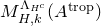 $M_{H,k}^{\Lambda _{H^{c}}}(A^{{{\rm trop}}})$
to be symmetric power
$M_{H,k}^{\Lambda _{H^{c}}}(A^{{{\rm trop}}})$
to be symmetric power $\textrm {Sym}^k(M_{H,1}^{\Lambda _{H^{c}}}(A^{{{\rm trop}}})$
in Definition 4.21 above. We therefore have a natural tropicalization map
$\textrm {Sym}^k(M_{H,1}^{\Lambda _{H^{c}}}(A^{{{\rm trop}}})$
in Definition 4.21 above. We therefore have a natural tropicalization map
 \begin{align*} {{\rm trop}}\colon M_{H,k}(A)^{{{\rm an}}}\longrightarrow M_{H,k}^{\Lambda _{H}^{c}}(A^{{{\rm trop}}}) \end{align*}
given by taking the $k$
-symmetric powers of the tropicalization map
$k$
-symmetric powers of the tropicalization map ${{\rm trop}}\colon M_{H,1}(A)^{{{\rm an}}}\longrightarrow M_{H,1}^{\Lambda _{H^{c}}}(A^{{{\rm trop}}})$
. In other words, to tropicalize a given
${{\rm trop}}\colon M_{H,1}(A)^{{{\rm an}}}\longrightarrow M_{H,1}^{\Lambda _{H^{c}}}(A^{{{\rm trop}}})$
. In other words, to tropicalize a given $E\in M_{H,k}(A)^{{{\rm an}}}$
we can apply our construction for simple semi-homogeneous bundles to the Jordan–Hölder factors of
$E\in M_{H,k}(A)^{{{\rm an}}}$
we can apply our construction for simple semi-homogeneous bundles to the Jordan–Hölder factors of $E$
and obtain a well-defined element in
$E$
and obtain a well-defined element in $M_{H,k}^{\Lambda _{H^{c}}}(A^{{{\rm trop}}})=\textrm {Sym}^k(M^{\Lambda _{H^{c}}}_{H,1}(A^{{\rm trop}}))$
.
$M_{H,k}^{\Lambda _{H^{c}}}(A^{{{\rm trop}}})=\textrm {Sym}^k(M^{\Lambda _{H^{c}}}_{H,1}(A^{{\rm trop}}))$
.
The moduli space $M_{H,k}(A)$
is Calabi–Yau. Hence, it admits a natural strong deformations retraction
$M_{H,k}(A)$
is Calabi–Yau. Hence, it admits a natural strong deformations retraction $\tau$
to the essential skeleton
$\tau$
to the essential skeleton $\Sigma (M_{H,k}(A))$
(see [Reference Kontsevich and SoibelmanKS06] as well as [Reference Mustaţă and NicaiseMN15, Reference Nicaise and XuNX16, Reference Nicaise, Xu and YuNXY19] for details on this construction). Since essential skeletons behave well with respect to symmetric products by [Reference Brown and MazzonBM19], we obtain the following theorem.
$\Sigma (M_{H,k}(A))$
(see [Reference Kontsevich and SoibelmanKS06] as well as [Reference Mustaţă and NicaiseMN15, Reference Nicaise and XuNX16, Reference Nicaise, Xu and YuNXY19] for details on this construction). Since essential skeletons behave well with respect to symmetric products by [Reference Brown and MazzonBM19], we obtain the following theorem.
Theorem 6.6.
Let $H\in \textrm {NS}(A)_{\mathbb{Q}}$
and
$H\in \textrm {NS}(A)_{\mathbb{Q}}$
and $k\geqslant 1$
. For the moduli space
$k\geqslant 1$
. For the moduli space $M_{H,k}(A)$
there exists an isomorphism
$M_{H,k}(A)$
there exists an isomorphism
 \begin{align*} \phi \colon \Sigma \big (M_{H,k}(A)\big )\xrightarrow {\,\sim \,} M_{H,k}^{\Lambda _{H}^{c}}(A^{{{\rm trop}}}), \end{align*}
such that the following diagram commutes.
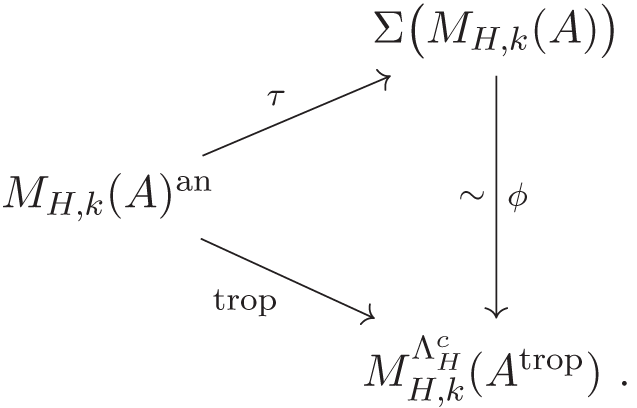
Proof. By [Reference Brown and MazzonBM19, Proposition 6.1.11] the formation of the essential skeleton is compatible with symmetric products. The statement of our theorem is, therefore, a direct consequence of Theorem6.5.
7. Homogeneous bundles and representations
Let $A$
be an abelian variety over
$A$
be an abelian variety over $K$
admitting a totally degenerate reduction over
$K$
admitting a totally degenerate reduction over $R$
; we write
$R$
; we write $A^{{{\rm an}}}=T^{{{\rm an}}}/\Lambda$
for its non-Archimedean uniformization and
$A^{{{\rm an}}}=T^{{{\rm an}}}/\Lambda$
for its non-Archimedean uniformization and $A^{{{\rm trop}}}=T^{{{\rm trop}}}/\Lambda$
for its tropicalization. In this section, we study a natural analytic epimorphism from the analytification of the character variety
$A^{{{\rm trop}}}=T^{{{\rm trop}}}/\Lambda$
for its tropicalization. In this section, we study a natural analytic epimorphism from the analytification of the character variety $X_r(\Lambda )$
of
$X_r(\Lambda )$
of $\Lambda$
to the analytification of the moduli space
$\Lambda$
to the analytification of the moduli space $M_{0,r}(A)$
building on the non-Archimedean uniformization of the dual abelian variety. We introduce a tropical analogue of this construction and show that both of these construction are compatible under tropicalization.
$M_{0,r}(A)$
building on the non-Archimedean uniformization of the dual abelian variety. We introduce a tropical analogue of this construction and show that both of these construction are compatible under tropicalization.
7.1 The moduli space
$M_{0,r}(A^{{{\rm trop}}})$
made explicit

Let $M_{0,r}(A^{{\rm trop}})$
be the set of isomorphism classes of homogeneous vector bundles on
$M_{0,r}(A^{{\rm trop}})$
be the set of isomorphism classes of homogeneous vector bundles on $A^{{{\rm trop}}}$
of rank
$A^{{{\rm trop}}}$
of rank $r$
.
$r$
.
Every vector bundle $E\in M_{0,r}(A^{{{\rm trop}}})$
may be written as a direct sum
$E\in M_{0,r}(A^{{{\rm trop}}})$
may be written as a direct sum $E_1\oplus \cdots \oplus E_s$
of indecomposable vector bundles. Recall that by Proposition 4.16 the bundle
$E_1\oplus \cdots \oplus E_s$
of indecomposable vector bundles. Recall that by Proposition 4.16 the bundle $E$
is homogeneous if
$E$
is homogeneous if $\delta (E_i)=0$
for all
$\delta (E_i)=0$
for all $i=1,\ldots , s$
. For every
$i=1,\ldots , s$
. For every $E_i$
there is a sublattice
$E_i$
there is a sublattice $\Lambda _i\subseteq \Lambda$
of index
$\Lambda _i\subseteq \Lambda$
of index $k_i\gt 0$
with
$k_i\gt 0$
with $k_1+\cdots + k_s=r$
such that there is a line bundle
$k_1+\cdots + k_s=r$
such that there is a line bundle $L_i\in \textrm {Pic}(N_{\mathbb{R}}/\Lambda _i)$
whose pushforward along
$L_i\in \textrm {Pic}(N_{\mathbb{R}}/\Lambda _i)$
whose pushforward along $N_{\mathbb{R}}/\Lambda _i\rightarrow N_{\mathbb{R}}/\Lambda$
is equal to
$N_{\mathbb{R}}/\Lambda _i\rightarrow N_{\mathbb{R}}/\Lambda$
is equal to $E_i$
. So we may write
$E_i$
. So we may write $M_{0,r}(A^{{{\rm trop}}})$
naturally as a disjoint union
$M_{0,r}(A^{{{\rm trop}}})$
naturally as a disjoint union
 \begin{align*} M_{0,r}(A^{{{\rm trop}}})=\bigsqcup _{\substack {\Lambda _1\oplus \cdots \oplus \Lambda _s\subseteq \Lambda ^s\\ [\Lambda :\Lambda _i]=k_i\gt 0\\ k_1+\cdots +k_s=r}} M_{\Lambda _1\oplus \cdots \oplus \Lambda _{s}}(A^{{{\rm trop}}}) , \end{align*}
where $M_{\Lambda _1\oplus \cdots \oplus \Lambda _s }(A^{{{\rm trop}}})$
denotes the set of isomorphism classes of vector bundles
$M_{\Lambda _1\oplus \cdots \oplus \Lambda _s }(A^{{{\rm trop}}})$
denotes the set of isomorphism classes of vector bundles $E$
that decompose as direct sums
$E$
that decompose as direct sums $E=E_1\oplus \cdots \oplus E_s$
of indecomposable vector bundles
$E=E_1\oplus \cdots \oplus E_s$
of indecomposable vector bundles $E_i$
that arise as pushforwards of line bundles along the connected cover
$E_i$
that arise as pushforwards of line bundles along the connected cover $N_{\mathbb{R}}/\Lambda _i\rightarrow N_{\mathbb{R}}/\Lambda$
for sublattices
$N_{\mathbb{R}}/\Lambda _i\rightarrow N_{\mathbb{R}}/\Lambda$
for sublattices $\Lambda _i\subseteq \Lambda$
of index
$\Lambda _i\subseteq \Lambda$
of index $k_i\gt 0$
. When
$k_i\gt 0$
. When $s=1$
, we may identify
$s=1$
, we may identify $M_{\Lambda _1}^{{{\rm trop}}}(\Lambda )$
as
$M_{\Lambda _1}^{{{\rm trop}}}(\Lambda )$
as
 \begin{align*} M_{\Lambda _1}(A^{{{\rm trop}}})=\textrm {Pic}^0(N_{\mathbb{R}}/\Lambda _i)={\textrm {Hom}}(\Lambda _1,{\mathbb{R}})/N\simeq {\textrm {Hom}}(\Lambda ,{\mathbb{R}})/N= \Lambda ^\vee _{\mathbb{R}}/N=A^{\vee ,{{\rm trop}}}. \end{align*}
In general, for arbitrary $s\geqslant 1$
, let
$s\geqslant 1$
, let $l_j=\#\{k_i=j\}$
for
$l_j=\#\{k_i=j\}$
for $j=1,\ldots , r$
. Then the group
$j=1,\ldots , r$
. Then the group $S_{l_1}\times \cdots \times S_{l_r}$
permutes summands of equal length in
$S_{l_1}\times \cdots \times S_{l_r}$
permutes summands of equal length in $E=E_1\oplus \cdots \oplus E_s$
and we have an identification
$E=E_1\oplus \cdots \oplus E_s$
and we have an identification
 \begin{align*} M_{\Lambda _1\oplus \cdots \oplus \Lambda _s }(A^{{{\rm trop}}})=(A^{\vee ,{{\rm trop}}})^s/S_{l_1}\times \cdots \times S_{l_r} . \end{align*}
We use this identification to endow $M_{0,r}(A^{{{\rm trop}}})$
with the structure of an integral affine orbifold.
$M_{0,r}(A^{{{\rm trop}}})$
with the structure of an integral affine orbifold.
The main component of $M_{0,r}(A^{{{\rm trop}}})$
is given by
$M_{0,r}(A^{{{\rm trop}}})$
is given by
 \begin{align*} M_{\underbrace {\Lambda \oplus \cdots \oplus \Lambda }_{r \textrm { times}}}(A^{{{\rm trop}}})=(\Lambda ^\vee _{\mathbb{R}}/N)^r/S_r=\textrm {Sym}^r(\widehat {A}^{{{\rm trop}}}). \end{align*}
It is naturally isomorphic to the moduli space $M_{0,r}^{\Lambda }(A^{{{\rm trop}}})$
.
$M_{0,r}^{\Lambda }(A^{{{\rm trop}}})$
.
7.2 Tropical representations and tropical character variety
Let $\rho \colon \Lambda \rightarrow \textrm {GL}_r({\mathbb{T}})$
be a representation. We point out that in
$\rho \colon \Lambda \rightarrow \textrm {GL}_r({\mathbb{T}})$
be a representation. We point out that in $\textrm {GL}_r({\mathbb{T}})$
(the group of generalized tropical permutation matrices) all block triangular matrices are already block diagonal matrices. Thus, one should not distinguish between indecomposable and irreducible
$\textrm {GL}_r({\mathbb{T}})$
(the group of generalized tropical permutation matrices) all block triangular matrices are already block diagonal matrices. Thus, one should not distinguish between indecomposable and irreducible $\textrm {GL}_r({\mathbb{T}})$
representations. In particular, every representation with values in
$\textrm {GL}_r({\mathbb{T}})$
representations. In particular, every representation with values in $\textrm {GL}_r({\mathbb{T}})$
can be viewed as semi-simple, since it is a direct sum of indecomposable representations.
$\textrm {GL}_r({\mathbb{T}})$
can be viewed as semi-simple, since it is a direct sum of indecomposable representations.
We associate to $\rho$
a vector bundle
$\rho$
a vector bundle $E(\rho )$
of rank
$E(\rho )$
of rank $r$
on
$r$
on $A^{{{\rm trop}}}=N_{\mathbb{R}}/\Lambda$
, whose sections (as an
$A^{{{\rm trop}}}=N_{\mathbb{R}}/\Lambda$
, whose sections (as an $S_r\ltimes {\rm Aff}^r$
-torsor) over
$S_r\ltimes {\rm Aff}^r$
-torsor) over $U\subseteq A^{{{\rm trop}}}$
may be identified with affine functions
$U\subseteq A^{{{\rm trop}}}$
may be identified with affine functions $f\colon \widetilde {U}\rightarrow {\mathbb{R}}^r$
on the preimage
$f\colon \widetilde {U}\rightarrow {\mathbb{R}}^r$
on the preimage $\widetilde {U}$
of
$\widetilde {U}$
of $U$
in
$U$
in $N_{\mathbb{R}}$
such that
$N_{\mathbb{R}}$
such that $f(\lambda + \widetilde {u})=\rho (\lambda ) f(\widetilde {u})$
for all
$f(\lambda + \widetilde {u})=\rho (\lambda ) f(\widetilde {u})$
for all $\widetilde {u}\in \widetilde {U}$
and
$\widetilde {u}\in \widetilde {U}$
and $\lambda \in \Lambda$
.
$\lambda \in \Lambda$
.
Proposition 7.1.
For a representation $\rho \colon \Lambda \rightarrow \textrm {GL}_r({\mathbb{T}})$
the vector bundle
$\rho \colon \Lambda \rightarrow \textrm {GL}_r({\mathbb{T}})$
the vector bundle $E(\rho )$
is homogeneous and every homogeneous vector bundle arises this way.
$E(\rho )$
is homogeneous and every homogeneous vector bundle arises this way.
Proof.
We first consider the case $r=1$
. For a representation
$r=1$
. For a representation $\rho \colon \Lambda \rightarrow \textrm {GL}_1({\mathbb{T}})={\mathbb{R}}$
the associated line bundle
$\rho \colon \Lambda \rightarrow \textrm {GL}_1({\mathbb{T}})={\mathbb{R}}$
the associated line bundle $L(\rho )=L(H,l)$
is defined by the factor of automorphy
$L(\rho )=L(H,l)$
is defined by the factor of automorphy $H=0$
and
$H=0$
and $l=\phi \in {\textrm {Hom}}(\Lambda ,{\mathbb{R}})$
, equivalently, by the surjective homomorphism
$l=\phi \in {\textrm {Hom}}(\Lambda ,{\mathbb{R}})$
, equivalently, by the surjective homomorphism $\Lambda ^\vee _{\mathbb{R}}\rightarrow \Lambda ^\vee _{\mathbb{R}}/M=\textrm {Pic}^0(A^{{{\rm trop}}})$
. This proves our claim for
$\Lambda ^\vee _{\mathbb{R}}\rightarrow \Lambda ^\vee _{\mathbb{R}}/M=\textrm {Pic}^0(A^{{{\rm trop}}})$
. This proves our claim for $r=1$
.
$r=1$
.
Now suppose that $\rho$
is an indecomposable representation. Note that analogous to Proposition 4.4,
$\rho$
is an indecomposable representation. Note that analogous to Proposition 4.4, $\textrm {GL}_r({\mathbb{T}})$
-torsors (that is, tropical vector bundles with constant transition functions) on any integral affine manifold
$\textrm {GL}_r({\mathbb{T}})$
-torsors (that is, tropical vector bundles with constant transition functions) on any integral affine manifold $X$
are in natural one-to-one correspondence with pairs consisting of a degree-
$X$
are in natural one-to-one correspondence with pairs consisting of a degree- $r$
free cover
$r$
free cover $Y\to X$
and a torsor over
$Y\to X$
and a torsor over $\textrm {GL}_1({\mathbb{T}})={\mathbb{R}}$
on
$\textrm {GL}_1({\mathbb{T}})={\mathbb{R}}$
on $Y$
. Since all covers and
$Y$
. Since all covers and $\mathbb{R}$
-torsors over the universal covering space
$\mathbb{R}$
-torsors over the universal covering space $N_{\mathbb{R}}$
of
$N_{\mathbb{R}}$
of $A^{{\rm trop}}$
are trivial, it follows that conjugacy classes of indecomposable
$A^{{\rm trop}}$
are trivial, it follows that conjugacy classes of indecomposable $\textrm {GL}_r({\mathbb{T}})$
representations are in one-to-one correspondence with
$\textrm {GL}_r({\mathbb{T}})$
representations are in one-to-one correspondence with $\textrm {GL}_r({\mathbb{T}})$
-torsors on
$\textrm {GL}_r({\mathbb{T}})$
-torsors on $A^{{\rm trop}}$
, whose associated cover is connected. By Lemma 4.9, the associated cover is of the form
$A^{{\rm trop}}$
, whose associated cover is connected. By Lemma 4.9, the associated cover is of the form $N_{\mathbb{R}}/\Lambda '\to N_{\mathbb{R}}/\Lambda$
for some index-
$N_{\mathbb{R}}/\Lambda '\to N_{\mathbb{R}}/\Lambda$
for some index- $r$
sublattice
$r$
sublattice $\Lambda '$
of
$\Lambda '$
of $\Lambda$
. Since
$\Lambda$
. Since $\mathbb{R}$
-torsors on
$\mathbb{R}$
-torsors on $N_{\mathbb{R}}/\Lambda '$
correspond to representations
$N_{\mathbb{R}}/\Lambda '$
correspond to representations $\rho '\colon \Lambda '\to {\mathbb{R}}$
, this establishes a natural one-to-one correspondence between indecomposable representations
$\rho '\colon \Lambda '\to {\mathbb{R}}$
, this establishes a natural one-to-one correspondence between indecomposable representations $\rho \colon \Lambda \rightarrow \textrm {GL}_r({\mathbb{T}})$
up to conjugation and pairs consisting of a sublattice
$\rho \colon \Lambda \rightarrow \textrm {GL}_r({\mathbb{T}})$
up to conjugation and pairs consisting of a sublattice $\Lambda '\subseteq \Lambda$
of index
$\Lambda '\subseteq \Lambda$
of index $r$
and a representation
$r$
and a representation $\rho '\colon \Lambda '\rightarrow {\mathbb{R}}$
. By construction of the correspondence, the vector bundle
$\rho '\colon \Lambda '\rightarrow {\mathbb{R}}$
. By construction of the correspondence, the vector bundle $E(\rho )$
is the pushforward along
$E(\rho )$
is the pushforward along $N_{\mathbb{R}}/\Lambda '\rightarrow N_{\mathbb{R}}/\Lambda$
of the line bundle
$N_{\mathbb{R}}/\Lambda '\rightarrow N_{\mathbb{R}}/\Lambda$
of the line bundle $E(\rho ')=L(0,\rho ')$
on
$E(\rho ')=L(0,\rho ')$
on $N_{\mathbb{R}}/\Lambda '$
. This vector bundle is indecomposable, since the cover
$N_{\mathbb{R}}/\Lambda '$
. This vector bundle is indecomposable, since the cover $N_{\mathbb{R}}/\Lambda '\rightarrow N_{\mathbb{R}}/\Lambda$
is connected. It is of slope zero since
$N_{\mathbb{R}}/\Lambda '\rightarrow N_{\mathbb{R}}/\Lambda$
is connected. It is of slope zero since $E(\rho ')$
has slope zero. Moreover, every vector bundle of rank
$E(\rho ')$
has slope zero. Moreover, every vector bundle of rank $r$
and slope zero arises as the pushforward of a line bundle of slope zero on a connected cover of degree
$r$
and slope zero arises as the pushforward of a line bundle of slope zero on a connected cover of degree $r$
of
$r$
of $A^{{{\rm trop}}}$
, which one may describe by choosing a sublattice
$A^{{{\rm trop}}}$
, which one may describe by choosing a sublattice $\Lambda '$
of index
$\Lambda '$
of index $r$
. Thus, every indecomposable vector bundle of slope zero arises as
$r$
. Thus, every indecomposable vector bundle of slope zero arises as $E(\rho )$
for an irreducible representation
$E(\rho )$
for an irreducible representation $\rho \colon \Lambda \rightarrow \textrm {GL}_r({\mathbb{T}})$
.
$\rho \colon \Lambda \rightarrow \textrm {GL}_r({\mathbb{T}})$
.
Finally, for the general case, we recall from Proposition 4.16 that every representation $\rho \colon \Lambda \rightarrow \textrm {GL}_r({\mathbb{T}})$
is naturally a direct sum of irreducible representations and every homogeneous vector bundle is a direct sum of indecomposable vector bundles of slope zero. Since the association
$\rho \colon \Lambda \rightarrow \textrm {GL}_r({\mathbb{T}})$
is naturally a direct sum of irreducible representations and every homogeneous vector bundle is a direct sum of indecomposable vector bundles of slope zero. Since the association $\rho \mapsto E(\rho )$
is compatible with direct sums, the irreducible case of our claim implies the general one.
$\rho \mapsto E(\rho )$
is compatible with direct sums, the irreducible case of our claim implies the general one.
We now give a moduli-theoretic reinterpretation of Proposition 7.1.
Definition 7.2. We define the tropical character variety denoted $X_r^{{{\rm trop}}}(\Lambda )$
, as the set of conjugacy classes of representations
$X_r^{{{\rm trop}}}(\Lambda )$
, as the set of conjugacy classes of representations $\rho \colon \Lambda \rightarrow \textrm {GL}_r({\mathbb{T}})$
.
$\rho \colon \Lambda \rightarrow \textrm {GL}_r({\mathbb{T}})$
.
Remark 7.3. Note that every representation $\rho \colon \Lambda \rightarrow \textrm {GL}_r({\mathbb{T}})$
may be written as a direct sum
$\rho \colon \Lambda \rightarrow \textrm {GL}_r({\mathbb{T}})$
may be written as a direct sum $\rho^1\oplus \cdots \oplus \rho ^s$
of indecomposable representations and the underlying permutation representation of
$\rho^1\oplus \cdots \oplus \rho ^s$
of indecomposable representations and the underlying permutation representation of $\rho ^i$
gives rise to a sublattice
$\rho ^i$
gives rise to a sublattice $\Lambda _i\subseteq \Lambda$
of index
$\Lambda _i\subseteq \Lambda$
of index $k_i\gt 0$
such that
$k_i\gt 0$
such that $k_1+\cdots + k_s=r$
. Moreover, any such permutation representation gives rise to a connected cover
$k_1+\cdots + k_s=r$
. Moreover, any such permutation representation gives rise to a connected cover $N_{\mathbb{R}}/\Lambda _i\rightarrow N_{\mathbb{R}}/\Lambda$
.
$N_{\mathbb{R}}/\Lambda _i\rightarrow N_{\mathbb{R}}/\Lambda$
.
Thus, we can write $X_r^{{{\rm trop}}}(\Lambda )$
naturally as a disjoint union
$X_r^{{{\rm trop}}}(\Lambda )$
naturally as a disjoint union
 \begin{align*} X_r^{{{\rm trop}}}(\Lambda )=\bigsqcup _{\substack {\Lambda _1\oplus \cdots \oplus \Lambda _s\subseteq \Lambda ^s\\ [\Lambda :\Lambda _i]=k_i\gt 0\\ k_1+\cdots +k_s=r}} X_{\Lambda _1\oplus \cdots \oplus \Lambda _{s}}^{{{\rm trop}}}(\Lambda ), \end{align*}
When $s=1$
, we have
$s=1$
, we have
 \begin{align*} X_{\Lambda _1}^{{{\rm trop}}}(\Lambda )={\textrm {Hom}}(\Lambda _1,{\mathbb{R}})\simeq {\textrm {Hom}}(\Lambda ,{\mathbb{R}})= \Lambda ^\vee _{\mathbb{R}}. \end{align*}
In general, for arbitrary $s\geqslant 1$
, let
$s\geqslant 1$
, let $l_j=\#\{k_i=j\}$
for
$l_j=\#\{k_i=j\}$
for $j=1,\ldots , r$
. Then the group
$j=1,\ldots , r$
. Then the group $S_{l_1}\times \cdots \times S_{l_r}$
permutes summands of equal length in
$S_{l_1}\times \cdots \times S_{l_r}$
permutes summands of equal length in $\rho =\rho^1\oplus \cdots \oplus \rho ^s$
and we have an identification
$\rho =\rho^1\oplus \cdots \oplus \rho ^s$
and we have an identification
 \begin{align*} X_{\Lambda _1\oplus \cdots \oplus \Lambda _s }^{{{\rm trop}}}(\Lambda )=(\Lambda ^\vee _{\mathbb{R}})^s/S_{l_1}\times \cdots \times S_{l_r}. \end{align*}
We use this identification to endow $X_r^{{{\rm trop}}}(\Lambda )$
with the structure of an integral affine orbifold.
$X_r^{{{\rm trop}}}(\Lambda )$
with the structure of an integral affine orbifold.
Definition 7.4. The component
 \begin{align*} X_{\underbrace {\Lambda \oplus \cdots \oplus \Lambda }_{r \textrm { times}}}=(\Lambda _{\mathbb{R}})^r/S_r \end{align*}
of the tropical character variety $X_r^{{{\rm trop}}}(\Lambda )$
parametrizes diagonalizable representations and will be denoted by
$X_r^{{{\rm trop}}}(\Lambda )$
parametrizes diagonalizable representations and will be denoted by $X^{{{\rm trop}}}_r(\Lambda )^{{{\rm diag}}}$
.
$X^{{{\rm trop}}}_r(\Lambda )^{{{\rm diag}}}$
.
Corollary 7.5.
There is a natural surjective morphism $\eta _{A^{{{\rm trop}}}}^r\colon X_r^{{{\rm trop}}}(\Lambda )\rightarrow M_{0,r}(A^{{{\rm trop}}})$
(of integral affine orbifolds) that associates to a representation
$\eta _{A^{{{\rm trop}}}}^r\colon X_r^{{{\rm trop}}}(\Lambda )\rightarrow M_{0,r}(A^{{{\rm trop}}})$
(of integral affine orbifolds) that associates to a representation $\rho \colon \Lambda \rightarrow \textrm {GL}_r({\mathbb{T}})$
the homogeneous vector bundle
$\rho \colon \Lambda \rightarrow \textrm {GL}_r({\mathbb{T}})$
the homogeneous vector bundle $E(\rho )$
.
$E(\rho )$
.
We point out that $\eta _{A^{{{\rm trop}}}}^r$
sends
$\eta _{A^{{{\rm trop}}}}^r$
sends $X^{{{\rm trop}}}_r(\Lambda )^{{{\rm diag}}}$
into
$X^{{{\rm trop}}}_r(\Lambda )^{{{\rm diag}}}$
into $M^\Lambda _{0,r}(A^{{\rm trop}})$
.
$M^\Lambda _{0,r}(A^{{\rm trop}})$
.


7.3 Line bundles and representations via non-Archimedean uniformization
As above, let $A$
be an abelian variety over
$A$
be an abelian variety over $K$
such that
$K$
such that $A^{{{\rm an}}}\simeq T^{{{\rm an}}} / \Lambda$
, where
$A^{{{\rm an}}}\simeq T^{{{\rm an}}} / \Lambda$
, where $T$
is a split algebraic torus with character lattice
$T$
is a split algebraic torus with character lattice $M$
and cocharacter lattice
$M$
and cocharacter lattice $N$
, and
$N$
, and $\Lambda$
is a lattice.
$\Lambda$
is a lattice.
Definition 7.6. Let $X_r(\Lambda )$
denote the geometric invariant theory quotient
$X_r(\Lambda )$
denote the geometric invariant theory quotient
 \begin{align*} X_r(\Lambda )={\textrm {Hom}}(\Lambda ,{\textrm {GL}}_r)/\!\!/ {{\textrm {GL}}_r}, \end{align*}
where $\textrm {GL}_r$
acts by conjugation. We refer to
$\textrm {GL}_r$
acts by conjugation. We refer to $X_r(\Lambda )$
as the character variety of
$X_r(\Lambda )$
as the character variety of $\Lambda$
.
$\Lambda$
.
The character variety $X_r(\Lambda )$
is a moduli space for semi-simple representations
$X_r(\Lambda )$
is a moduli space for semi-simple representations $\rho \colon \Lambda \rightarrow {\textrm {GL}_r}$
up to conjugation. We refer the reader to [Reference SikoraSik12] for a careful and detailed exposition of this construction in general. Since
$\rho \colon \Lambda \rightarrow {\textrm {GL}_r}$
up to conjugation. We refer the reader to [Reference SikoraSik12] for a careful and detailed exposition of this construction in general. Since $\Lambda$
is abelian, every irreducible representation of
$\Lambda$
is abelian, every irreducible representation of $\Lambda$
is one-dimensional. Again, we may write a semi-simple representation
$\Lambda$
is one-dimensional. Again, we may write a semi-simple representation $\rho \colon \Lambda \rightarrow {\textrm {GL}_r}$
as a direct sum
$\rho \colon \Lambda \rightarrow {\textrm {GL}_r}$
as a direct sum $\rho^1\oplus \cdots \oplus \rho ^r$
of one-dimensional representation
$\rho^1\oplus \cdots \oplus \rho ^r$
of one-dimensional representation $\rho ^i\colon \Lambda \rightarrow {\mathbb{G}}_m$
. This shows that we have a natural isomorphism
$\rho ^i\colon \Lambda \rightarrow {\mathbb{G}}_m$
. This shows that we have a natural isomorphism
 \begin{align*} X_r(\Lambda )\simeq \textrm {Sym}^r \big (X_1(\Lambda )\big )=\textrm {Sym}^r \big (\Lambda ^\vee \otimes {\mathbb{G}}_m\big ). \end{align*}
We may naturally associate to a semi-simple representation a homogeneous vector bundle. This may be phrased from a moduli-theoretic point of view as follows.
Notation 7.7.
In what follows, we denote by $X_r^{{{\rm an}}}(\Lambda )$
the analytification of the character variety
$X_r^{{{\rm an}}}(\Lambda )$
the analytification of the character variety $X_r(\Lambda )$
.
$X_r(\Lambda )$
.
Proposition 7.8.
There is a natural surjective analytic morphism $\eta _A^r\colon X_r^{{{\rm an}}}(\Lambda )\rightarrow M_{0,r}(A)^{{{\rm an}}}$
given by associating to a semi-simple representation
$\eta _A^r\colon X_r^{{{\rm an}}}(\Lambda )\rightarrow M_{0,r}(A)^{{{\rm an}}}$
given by associating to a semi-simple representation $\rho \colon \Lambda \rightarrow \textrm {GL}_r(L)$
for a non-Archimedean extension
$\rho \colon \Lambda \rightarrow \textrm {GL}_r(L)$
for a non-Archimedean extension $L$
of
$L$
of $K$
, the vector bundle
$K$
, the vector bundle $E(\rho )=L(\rho^1)\oplus \cdots \oplus L(\rho ^r)$
on
$E(\rho )=L(\rho^1)\oplus \cdots \oplus L(\rho ^r)$
on $A_L$
.
$A_L$
.
Proof.
For $r=1$
this is the surjective analytic morphism
$r=1$
this is the surjective analytic morphism
 \begin{align*}\eta _A^1\colon \Lambda ^\vee \otimes {\mathbb{G}}_m^{{{\rm an}}}\longrightarrow \Lambda ^\vee \otimes {\mathbb{G}}_m^{{{\rm an}}}/N=\textrm {Pic}^0(A)^{{{\rm an}}}\end{align*}
defining the non-Archimedean uniformization of $A^\vee =\textrm {Pic}_0(A)$
. The general morphism
$A^\vee =\textrm {Pic}_0(A)$
. The general morphism $\eta _A^r$
is given by setting
$\eta _A^r$
is given by setting
 \begin{align*} \eta _A^r=\textrm {Sym}^r(\eta _A^1)\colon X_r^{{{\rm an}}}(\Lambda )=\textrm {Sym}^r\big (\Lambda ^\vee \otimes {\mathbb{G}}_m^{{{\rm an}}}\big )\longrightarrow \textrm {Sym}^r(A^\vee )=M_{0,r}(A)^{{{\rm an}}} \end{align*}
and this clearly defines a surjective analytic morphism.
Remark 7.9. If we restrict the surjective morphism of the previous theorem to a fundamental domain for the action of $H$
, we can derive a bijection. To be precise, let us fix any
$H$
, we can derive a bijection. To be precise, let us fix any $\mathbb{Z}$
-basis
$\mathbb{Z}$
-basis $\lambda _1, \ldots , \lambda _g$
of
$\lambda _1, \ldots , \lambda _g$
of $\Lambda$
and a
$\Lambda$
and a $\mathbb{Z}$
-basis
$\mathbb{Z}$
-basis $x_1, \ldots , x_g$
of
$x_1, \ldots , x_g$
of $M$
. Since the matrix
$M$
. Since the matrix
 \begin{align*}[-\log |x_i(\lambda _j)|]_{i,j=1,\ldots , g}\end{align*}
has full rank over $\mathbb{R}$
we can exchange the order of the
$\mathbb{R}$
we can exchange the order of the $\lambda _i$
and the
$\lambda _i$
and the $x_j$
so that the entries on the diagonal are all non-zero. Now we replace
$x_j$
so that the entries on the diagonal are all non-zero. Now we replace $\lambda _j$
by
$\lambda _j$
by $\lambda _j^{-1}$
, whenever
$\lambda _j^{-1}$
, whenever $-\log \big |x_j(\lambda _j)\big | \gt 0$
, so that the new bases satisfy
$-\log \big |x_j(\lambda _j)\big | \gt 0$
, so that the new bases satisfy $\big |x_i(\lambda _i)\big | \lt 1$
for all
$\big |x_i(\lambda _i)\big | \lt 1$
for all $i$
. Then every class in
$i$
. Then every class in ${\textrm {Hom}}(\Lambda , K^\ast )$
modulo
${\textrm {Hom}}(\Lambda , K^\ast )$
modulo $M$
has a unique representative
$M$
has a unique representative $\rho : \Lambda \rightarrow K^\ast$
satisfying
$\rho : \Lambda \rightarrow K^\ast$
satisfying
 \begin{align*} \big |x_i(\lambda _i)\big | \leqslant \big |\rho (\lambda _i)\big | \lt 1 \quad \mbox{for all } i=1, \ldots , g. \end{align*}
In this way, homogeneous line bundles on $A$
correspond bijectively to representations
$A$
correspond bijectively to representations $\rho : \Lambda \rightarrow K^\ast$
satisfying the previous condition. Note that this condition coincides with
$\rho : \Lambda \rightarrow K^\ast$
satisfying the previous condition. Note that this condition coincides with $\Phi$
-boundedness of one-dimensional representation in [Reference van der Put and ReversatvdPR88]. In [Reference van der Put and ReversatvdPR88, Theorem (1.3.5) and Section 2], an equivalence of categories relating homogeneous vector bundles of rank
$\Phi$
-boundedness of one-dimensional representation in [Reference van der Put and ReversatvdPR88]. In [Reference van der Put and ReversatvdPR88, Theorem (1.3.5) and Section 2], an equivalence of categories relating homogeneous vector bundles of rank $r$
on
$r$
on $A$
and
$A$
and $r$
-dimensional
$r$
-dimensional $\Phi$
-bounded representations of the lattice
$\Phi$
-bounded representations of the lattice $\Lambda$
is established.
$\Lambda$
is established.
7.4 Tropicalization of character varieties
There is a natural tropicalization map
 \begin{align*} {{\rm trop}}\colon X_r^{{{\rm an}}}(\Lambda )\longrightarrow X_r^{{{\rm trop}}}(\Lambda ) \end{align*}
that is given as follows. A point $x$
in
$x$
in $X^{{{\rm an}}}_r(\Lambda )$
may be represented by an
$X^{{{\rm an}}}_r(\Lambda )$
may be represented by an $L$
-valued point of
$L$
-valued point of $X_r(\Lambda )$
for a non-Archimedean extension
$X_r(\Lambda )$
for a non-Archimedean extension $L$
of
$L$
of $K$
. This, in turn, corresponds to a semi-simple representation
$K$
. This, in turn, corresponds to a semi-simple representation $\rho _x\colon \Lambda \rightarrow \textrm {GL}_r(L)$
. Write
$\rho _x\colon \Lambda \rightarrow \textrm {GL}_r(L)$
. Write $\rho _x$
as a direct sum of irreducible representations
$\rho _x$
as a direct sum of irreducible representations $\rho _x^i\colon \Lambda \rightarrow {\mathbb{G}}_m$
for
$\rho _x^i\colon \Lambda \rightarrow {\mathbb{G}}_m$
for $i=1,\ldots , r$
(noting that irreducible representations of an abelian group are automatically one-dimensional). Then
$i=1,\ldots , r$
(noting that irreducible representations of an abelian group are automatically one-dimensional). Then ${{\rm trop}}(x)$
is defined to be the tropical representation
${{\rm trop}}(x)$
is defined to be the tropical representation $\rho _x^{{{\rm trop}}}=(\rho _x^1)^{{{\rm trop}}}\oplus \cdots \oplus (\rho _x^r)^{{{\rm trop}}}$
, where
$\rho _x^{{{\rm trop}}}=(\rho _x^1)^{{{\rm trop}}}\oplus \cdots \oplus (\rho _x^r)^{{{\rm trop}}}$
, where $(\rho _x^i)^{{{\rm trop}}}$
is given by the composition
$(\rho _x^i)^{{{\rm trop}}}$
is given by the composition $\Lambda \xrightarrow {\rho ^i_x}L^\ast \xrightarrow {-\log \vert .\vert }{\mathbb{R}}=\textrm {GL}_1({\mathbb{T}})$
. Note that image of the map
$\Lambda \xrightarrow {\rho ^i_x}L^\ast \xrightarrow {-\log \vert .\vert }{\mathbb{R}}=\textrm {GL}_1({\mathbb{T}})$
. Note that image of the map ${\rm trop}$
is contained in the component
${\rm trop}$
is contained in the component
 \begin{align*} X^{{{\rm trop}}}_r(\Lambda )^{{{\rm diag}}}=\textrm {Sym}^r\big (\Lambda _{\mathbb{R}}^{\vee }\big ) \end{align*}
parametrizing diagonal tropical representations of $\Lambda$
.
$\Lambda$
.
Proposition 7.10.
Let $\Lambda$
be a finitely generated free abelian group and
$\Lambda$
be a finitely generated free abelian group and $\Sigma \big (X_r(\Lambda )\big )$
be the essential skeleton of the character variety
$\Sigma \big (X_r(\Lambda )\big )$
be the essential skeleton of the character variety $X_r(\Lambda )$
. Then there is a natural isomorphism
$X_r(\Lambda )$
. Then there is a natural isomorphism
 \begin{align*} J\colon X^{{{\rm trop}}}_r(\Lambda )^{{{\rm diag}}} \xrightarrow {\,\sim \,} \Sigma \big (X_r(\Lambda )\big ) \end{align*}
which makes the following diagram commute.
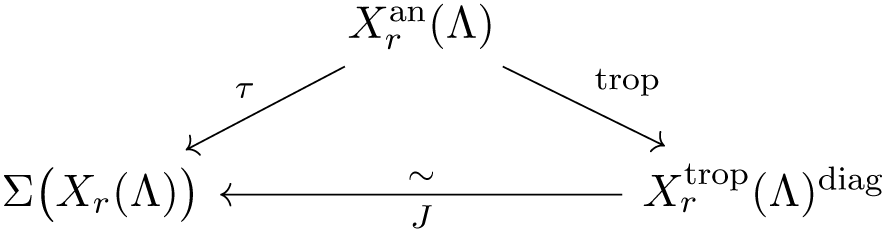
Proof.
Let us first consider the case $r=1$
. Then we have
$r=1$
. Then we have $X_1(\Lambda )=\Lambda ^\vee \otimes {\mathbb{G}}_m$
and
$X_1(\Lambda )=\Lambda ^\vee \otimes {\mathbb{G}}_m$
and $X_\Lambda ^{{{\rm trop}}}(\Lambda )=\Lambda ^\vee \otimes {\mathbb{R}}$
. Therefore, we have a natural isomorphism
$X_\Lambda ^{{{\rm trop}}}(\Lambda )=\Lambda ^\vee \otimes {\mathbb{R}}$
. Therefore, we have a natural isomorphism $J\colon \Lambda ^\vee \otimes {\mathbb{R}} \xrightarrow {\sim } \Sigma \big (\Lambda ^\vee \otimes {\mathbb{G}}_m^{{{\rm an}}}\big )$
which makes the following diagram commute.
$J\colon \Lambda ^\vee \otimes {\mathbb{R}} \xrightarrow {\sim } \Sigma \big (\Lambda ^\vee \otimes {\mathbb{G}}_m^{{{\rm an}}}\big )$
which makes the following diagram commute.
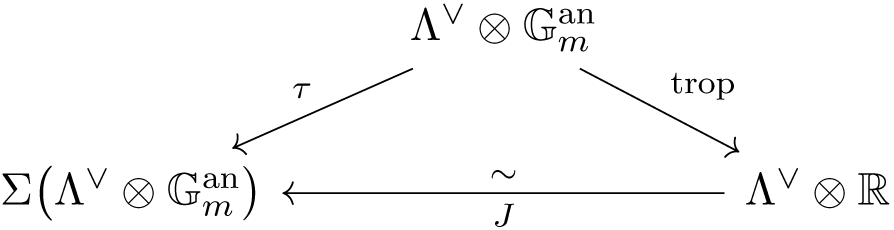
The general case follows from the compatibility of essential skeletons of open Calabi–Yau varieties with symmetric powers (see [Reference Brown and MazzonBM19, Proposition 6.1.11] and [Reference Mauri, Mazzon and StevensonMMS22, Theorem F]).
Proposition 7.11.
For a non-Archimedean extension $L\vert K$
and a semi-simple representation
$L\vert K$
and a semi-simple representation $\rho \colon \Lambda \rightarrow \textrm {GL}_r(L)$
we have
$\rho \colon \Lambda \rightarrow \textrm {GL}_r(L)$
we have
 \begin{align*} E(\rho )^{{{\rm trop}}}\simeq E(\rho ^{{\rm trop}}). \end{align*}
In other words, the following diagram commutes.

commutes.
Proof.
For $r=1$
, diagram (6) becomes
$r=1$
, diagram (6) becomes
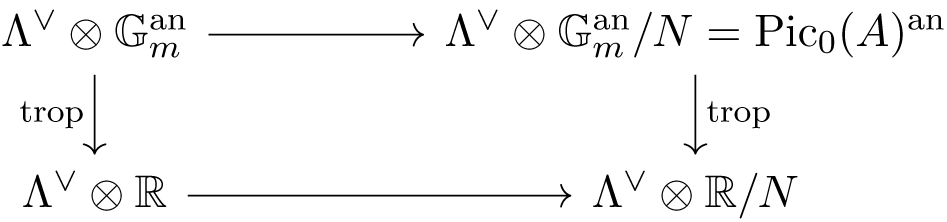
and this is commutative by the construction of the tropicalization map for line bundles in Section 6.1. The general case $r\geqslant 1$
follows, since both
$r\geqslant 1$
follows, since both $E(.)$
in the algebraic and the tropical realm and both tropicalization maps naturally respect symmetric powers.
$E(.)$
in the algebraic and the tropical realm and both tropicalization maps naturally respect symmetric powers.
Acknowledgements
The authors would like to thank Luca Battistella, Barbara Bolognese, Michel Brion, Francesca Carocci, Camilla Felisetti, Emilio Franco, Johannes Horn, Katharina Hübner, Arne Kuhrs, Alex Küronya, Chunyi Li, Mirko Mauri, Dhruv Ranganathan and Dmitry Zakharov for helpful conversations and discussion en route to this article. We also thank the referee of this article for many useful comments. Particular thanks are due to Jakob Stix, who helped us clarify the role of the moduli space in Section 2 and Tyler Lane, who spotted an inaccuracy in an earlier version of Theorem A and explained his insights in several subsequent discussions.
Financial support
This project has received funding from the Deutsche Forschungsgemeinschaft (DFG, German Research Foundation) TRR 326 Geometry and Arithmetic of Uniformized Structures, project number 444845124, and TRR 358 Integral Structures in Geometry and Representation Theory, project number 491392403, as well as from the Deutsche Forschungsgemeinschaft (DFG, German Research Foundation) Sachbeihilfe From Riemann surfaces to tropical curves (and back again), project number 456557832, and the DFG Sachbeihilfe Rethinking tropical linearalgebra: Buildings, bimatroids, and applications, project number 539867663, within the SPP 2458 Combinatorial Synergies, as well as from the LOEWE grant Uniformized Structures in Algebra and Geometry and from the Marie-Skłodowska-Curie-Stipendium Hessen (as part of the HESSEN HORIZON initiative).
Conflicts of interest
None.
Journal information
Moduli is published as a joint venture of the Foundation Compositio Mathematica and the London Mathematical Society. As not-for-profit organisations, the Foundation and Society reinvest $100\%$
of any surplus generated from their publications back into mathematics through their charitable activities.
$100\%$
of any surplus generated from their publications back into mathematics through their charitable activities.


 Open access

