


1. Introduction
India is a promising market for the expanding exports of major fresh fruit producing countries, including the United States. The Indian economy has grown since the economic reform process began in the early 1990s (Ahluwalia, Reference Ahluwalia2002), from a per capita gross national income of $380 (in current U.S. dollars) in 1990 to $2,020 in 2018 (The World Bank, 2019). One consequence of this economic growth is the expansion of fresh fruit imports, particularly apples, from around the world. In 1990, India imported no fresh apples, but in 2017 fresh apple imports reached 204,000 tons (United Nations, 2018). This general increase has been mirrored in Indian imports from the United States, from 440 tons of fresh apples, valued at $303,000 in 2000 to 164,000 tons in 2018, valued at $164.5 million (United Nations, 2018). This increase was despite the existing 50% tariff imposed by India on U.S. fresh apples. Moreover, effective June 2019, India imposed an additional 20% tariff on the same goods (Northwest Horticultural Council, 2019). Mishra (Reference Mishra2013) argues that U.S. imported apples enjoy a differentiated market position because of their perceived higher quality compared with domestically produced apples or imported apples from other countries, such as China.
Despite the increase in imports, Indian consumption of fresh apples is still far below the world average: In 2013, annual per capita consumption of all apple products was 1.52 kg, compared with a world average of 10 kg (Food and Agriculture Organization of the United Nations, 2018), but it is increasing at the rate of 4.2% annually (Index Mundi, 2018; The World Bank, 2018). Clearly, there is potential for increasing demand for apples in India.
The Indian government has entered into several relevant free trade agreements (FTAs) over the years (India Department of Commerce, Ministry of Commerce and Industry, 2018). Within Asia, India has signed bilateral FTAs with nine countries, including Sri Lanka (1998), Afghanistan (2003), Thailand (2004), Singapore (2005), Bhutan (2006), Nepal (2009), South Korea (2009), Malaysia (2011), and Japan (2011) (India Department of Commerce, Ministry of Commerce and Industry, 2018). In addition, India is part of several regional trade agreements, including the South Asian Free Trade Agreement (SAFTA in 2004); the Association of Southeast Asian Nations Agreement (ASEAN in 2010); the Asia-Pacific Trade Agreement (APTA in 1975) to which China acceded in 2001; and the India–Africa Trade Agreement among India and 19 African countries including South Africa (India Department of Commerce, Ministry of Commerce and Industry, 2018). Moreover, India has preferential trade agreements with Chile (2006) and Mercosur, a South American trade bloc (2004). In 2016, the governments of India and New Zealand launched a commitment to continue working toward a comprehensive bilateral trade agreement (New Zealand, Foreign Affairs and Trade, 2018). Despite, India’s increased interested in FTAs, there has been no agreement with the United States.
This article measures the impact of the 50% tariff imposed by India on the quantities demanded of imported fresh apples and quantifies the resulting welfare changes among Indian consumers. We use a restricted source-differentiated almost ideal demand system (RSDAIDS) model to measure the effect of the tariff levy on U.S. exports of fresh apples to India and include major U.S. competitors—such as China and Chile—in the Indian market. To illustrate substitution effects among fresh fruit imports, we include imports of fresh pears, grapes, and other fresh fruits in the model but retain our focus on Indian fresh apple imports. In addition, we use the compensating variation technique to estimate the effect of tariffs on Indian consumer welfare.
Fresh apples are one of the most valuable fruits in the United States, with a direct sale value equivalent to $3.013 billion in 2018 (U.S. Department of Agriculture, Economic Research Service, 2019). The U.S. apple industry has consolidated in the last 20 years. Low apple prices in the late 1990s and early 2000s forced a considerable number of fresh apple operations out of business. High-density production systems and other technologies are now the norm for apple plantings. These systems require considerable initial investment and have higher maintenance costs, contributing to industry consolidation (U.S. International Trade Commission, 2010). U.S. demand for domestic fresh apples has stagnated in the last decade: Per capita consumption was at 7.43 kg in 2007/2008 and increased by 8% to 8.02 kg in 2017/2018 (U.S. Department of Agriculture, Economic Research Service, 2019). Given the increase in domestic production volume and the challenge of stagnant consumption, maintaining and expanding market share in export markets, including India, is considered critical for the survival of the U.S. apple industry (Ferreira and Perez, Reference Ferreira and Perez2016; Luckstead, Devadoss, and Mittelhammer, Reference Luckstead, Devadoss and Mittelhammer2014). This study includes an assessment of the impacts of a potential increase in the demand for imported U.S. fresh apples in India because of tariff elimination.
2. Literature review
Abundant literature suggests that tariff reduction increases both international trade volume and countries’ welfare. Using partial equilibrium models to assess international trade of agricultural goods, Ananthramiah (Reference Ananthramiah1996) estimated the effects of the North American Free Trade Agreement (NAFTA) on beef trade among the United States, Canada, and Mexico and found that the agreement effects would be realized in the long run and that Mexican beef exporters would benefit most from the agreement. Durand-Morat and Wailes (Reference Durand-Morat and Wailes2005) studied the potential effects of CAFTA (Central America Free Trade Agreement) on the rice industry in signatory countries using both general and partial equilibrium models. They found that the largest welfare benefits would be accrued by the United States compared with Central American rice producers. Naanwaab and Yeboah (Reference Naanwaab and Yeboah2012) studied the effect of NAFTA on a number of commodities, including corn, soybeans, cotton, wheat, fresh vegetables, poultry, dairy, and red meats. They used a partial equilibrium framework and found mixed evidence. Trade volume increased for some commodities, such as Mexican exports of tomatoes to the United States. However, trade volume decreased for some other commodities, such as U.S. exports of corn and poultry to Canada. Considering the net effects, trade volume increased among the three countries.
A number of studies have focused on the impact of tariffs on the fresh apple trade. Devadoss and Ridley (Reference Devadoss and Ridley2014) studied the impacts of Mexican tariffs imposed on U.S. apples and found that the overall welfare impact is negative because consumer losses outweigh producer gains and tariff revenues. Zahniser, Hertz, and Argoti (Reference Zahniser, Hertz and Argoti2016) found that retaliatory import tariffs imposed by Mexico on selected U.S. agricultural products reduced U.S. sales to Mexico by $923 million during the period in which the retaliatory tariffs were in effect; fresh apples lost $119 million, one of the four agricultural goods with the largest loss in sales to Mexico because of the tariffs.
In relation to the Indian fresh apple import market, Devadoss and Wahl (Reference Devadoss and Wahl2004) studied the impacts of Indian trade policies on apple imports and found that, under free trade, India’s fresh apple consumption would increase by 12%. They also estimated that a 30% increase in fresh apple imports would be expected under free trade and that eliminating tariffs would increase total consumer and producer welfare in India. In a similar study, Devadoss, Sridharan, and Wahl (Reference Devadoss, Sridharan and Wahl2009) found that the volume of apples traded between the United States and the rest of the world could increase significantly with the removal of tariffs and showed that India and Southeast Asia could be potential markets for U.S. apple exports. Because those countries have high tariffs—ranging from 45% to 61%—decreasing consumer prices by tariff removal would lead to an increase in demand for fresh apples.
Because China is a major U.S. competitor in the fresh apple export market, Luckstead, Devadoss, and Mittelhammer (Reference Luckstead, Devadoss and Mittelhammer2014) analyzed the apple export competition between the United States and China in the ASEAN countries. They developed a trade model under imperfect competition and found that eliminating Chinese tariffs would contract U.S. exports to ASEAN countries, but complete free trade would favor U.S. apple producers, as U.S. apple exports would displace Chinese apple exports.
The overall findings in the literature reveal that eliminating tariffs in the Indian fresh apple market would increase trade volume and consumer welfare in the importing country. Our study has a similar aim and scope as that of Devadoss and Wahl (Reference Devadoss and Wahl2004). However, our study considers substitutability among major (by volume) fruits in the Indian import market. Estimating demand for fruits individually, without considering the prices of other fruits, may lead to incorrect results. We use the RSDAIDS model to observe quality differentiation among apples imported from different countries. In addition, we use a compensating variation technique to estimate the impact of India’s tariff on demand for imported fresh apples and consumer welfare in India.
3. Empirical framework
This study constructs an import demand model following Deaton and Muellbauer’s (Reference Deaton and Muellbauer1980) almost ideal demand system (AIDS). We depart from AIDS to use the source-differentiated AIDS model suggested by Yang and Koo (Reference Yang and Koo1994), which aims to model importer behavior that differentiates goods based on their origins. We consider this model to more closely approximate to our research problem because fresh apples could be differentiated according to the country from which they are imported. However, the source-differentiated AIDS model may suffer from a degrees-of-freedom problem in empirical applications, as mentioned in Yang and Koo (Reference Yang and Koo1994). Fresh fruits usually have several substitutes from different import origins, causing the model to have too many parameters in each equation. To reduce the number of parameters, we use the RSDAIDS (restricted source-differentiated almost ideal demand system) model derived by Yang and Koo (Reference Yang and Koo1994). The RSDAIDS model introduces a block substitutability assumption to fix the degrees-of-freedom problem. For example, fresh apples imported from the United States could be substituted by pears imported from any other country. With this assumption, the expenditure share equation is as follows:
 $$\matrix{{{w_{{i_{h}}}} = {\alpha _{{i_h}}} + \mathop {\sum }\limits_k {{{\gamma }}_{{i_{hk}}}}\,{\rm{ln}}\left( {{p_{{i_k}}}} \right) + \mathop {\sum }\limits_{j \ne k} {{{\gamma }}_{{i_h}j}}\,{\rm{ln}}\left( {{p_j}} \right) + {\beta _{{i_h}}}\ln \left( {{E \over P}} \right)}\cr } ,$$
(1)
$$\matrix{{{w_{{i_{h}}}} = {\alpha _{{i_h}}} + \mathop {\sum }\limits_k {{{\gamma }}_{{i_{hk}}}}\,{\rm{ln}}\left( {{p_{{i_k}}}} \right) + \mathop {\sum }\limits_{j \ne k} {{{\gamma }}_{{i_h}j}}\,{\rm{ln}}\left( {{p_j}} \right) + {\beta _{{i_h}}}\ln \left( {{E \over P}} \right)}\cr } ,$$
(1)
where ${w_{{i_h}}}$
is the expenditure share of fruit i from country h among all imported fruits;
${w_{{i_h}}}$
is the expenditure share of fruit i from country h among all imported fruits; ${\alpha _{{i_h}}}$
represents the estimated budget share of fruit i from country h when all logarithmic prices and real expenditures are 0;
${\alpha _{{i_h}}}$
represents the estimated budget share of fruit i from country h when all logarithmic prices and real expenditures are 0; ${\beta _{{i_h}}}$
is the expenditure coefficient and represents the change in the expenditure share of fruit i from country h with respect to change in real income; and
${\beta _{{i_h}}}$
is the expenditure coefficient and represents the change in the expenditure share of fruit i from country h with respect to change in real income; and ${\gamma _{{i_h}j}}$
represents the change in the budget share of commodity i from country h with respect to a percentage change in the price of fruit j, with real expenditures held constant. Subscripts i and j denote fruits (i,j = 1, …, N), and i and j are substitutable; h and k denote country of origin. Each fruit can have a different number of countries of origin. For example, fruit i may be imported from m different countries, whereas fruit j may be imported from n countries.
${\gamma _{{i_h}j}}$
represents the change in the budget share of commodity i from country h with respect to a percentage change in the price of fruit j, with real expenditures held constant. Subscripts i and j denote fruits (i,j = 1, …, N), and i and j are substitutable; h and k denote country of origin. Each fruit can have a different number of countries of origin. For example, fruit i may be imported from m different countries, whereas fruit j may be imported from n countries. ${p_{{i_k}}}$
denotes the price of fruit i imported from country k; p
j
denotes the price of fruit j. E denotes total expenditures in all goods in this demand system, and P is the Stone’s price index
${p_{{i_k}}}$
denotes the price of fruit i imported from country k; p
j
denotes the price of fruit j. E denotes total expenditures in all goods in this demand system, and P is the Stone’s price index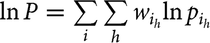 ${\rm{ln}}\,P = \mathop {\sum}\limits_i \mathop {\sum}\limits_h {w_{{i_h}}}{\rm{ln}}\,{p_{{i_h}}}$
to come up with a linear approximation (Deaton and Muellbauer, Reference Deaton and Muellbauer1980). To avoid singularity effects, the share equation for other imported fruits is dropped from the system of equations. Further, we tested the adding-up condition following Barten (Reference Barten1969) who stated that the estimation results should not be affected if one of the equations in the system of equations is dropped.
${\rm{ln}}\,P = \mathop {\sum}\limits_i \mathop {\sum}\limits_h {w_{{i_h}}}{\rm{ln}}\,{p_{{i_h}}}$
to come up with a linear approximation (Deaton and Muellbauer, Reference Deaton and Muellbauer1980). To avoid singularity effects, the share equation for other imported fruits is dropped from the system of equations. Further, we tested the adding-up condition following Barten (Reference Barten1969) who stated that the estimation results should not be affected if one of the equations in the system of equations is dropped.
The Marshallian price elasticities of the RSDAIDS model are the following:
 $$\matrix{{{\varepsilon_{{i_h}{i_h}}} = - 1 + {{{\gamma _{{i_{hh}}}}} \over {{w_{{i_h}}}}} - {\beta _{{i_h}}}} \cr} ,$$
(2)
$$\matrix{{{\varepsilon_{{i_h}{i_h}}} = - 1 + {{{\gamma _{{i_{hh}}}}} \over {{w_{{i_h}}}}} - {\beta _{{i_h}}}} \cr} ,$$
(2)
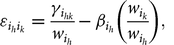 $${\varepsilon _{{i_h}{i_k}}} = {{{\gamma _{{i_{hk}}}}} \over {{w_{{i_h}}}}} - {\beta _{{i_h}}}\left( {{{{w_{{i_k}}}} \over {{w_{{i_h}}}}}} \right),$$
(3)
$${\varepsilon _{{i_h}{i_k}}} = {{{\gamma _{{i_{hk}}}}} \over {{w_{{i_h}}}}} - {\beta _{{i_h}}}\left( {{{{w_{{i_k}}}} \over {{w_{{i_h}}}}}} \right),$$
(3)
 $${\varepsilon _{{i_h}j}} = {{{\gamma _{{i_h}j}}} \over {{w_{{i_h}}}}} - {\beta _{{i_h}}}\left( {{{{w_j}} \over {{w_{{i_h}}}}}} \right),$$
(4)
$${\varepsilon _{{i_h}j}} = {{{\gamma _{{i_h}j}}} \over {{w_{{i_h}}}}} - {\beta _{{i_h}}}\left( {{{{w_j}} \over {{w_{{i_h}}}}}} \right),$$
(4)
 $${\varepsilon_{{i_h}}} = 1 + {{{\beta _{{i_h}}}} \over {{w_{{i_h}}}}}.$$
(5)
$${\varepsilon_{{i_h}}} = 1 + {{{\beta _{{i_h}}}} \over {{w_{{i_h}}}}}.$$
(5)
Equation (2) represents own-price elasticities, equation (3) represents cross-price elasticities between the same goods from different sources, and equation (4) represents cross-price elasticities between different goods (i.e., the cross-price elasticity between fruit i imported from country h and fruit j imported from the rest of the world). w j is the expenditure share of fruit j. Equation (5) represents expenditure elasticities of fruit i from country h. The general demand conditions are imposed, which are adding-up, homogeneity, and symmetry conditions as following Yang and Koo (Reference Yang and Koo1994). Appendix C includes further details of the derivations of equations (2)–(5).
This study assumes separability between domestic and imported fruits, an assumption that is usually imposed on import demand estimations (see studies by Alston et al., Reference Alston, Carter, Green and Pick1990; Seale, Sparks, and Buxton, Reference Seale, Sparks and Buxton1992; Weatherspoon and Seale, Reference Weatherspoon and Seale1995). Our separability assumption is further justified by the fact that the Indian domestic and imported fresh fruit markets can be considered separate markets given the tariffs imposed by India on imported fresh fruits, making imported fruit more expensive than domestic fruit; India imposes a 50% tariff on all imported fresh apples and a 30% tariff on all pears and grapes.
3.1. Test for block separability
Block separability allows each type of fruit to be estimated individually without having to consider the prices of other fruits. Hayes, Wahl, and Williams (Reference Hayes, Wahl and Williams1990) derive the restriction that is implied by the quasi-separability of the cost function. We chose this approach because the AIDS model is based on a flexible functional form of the cost function. The null hypothesis for the block separability test is that each fruit variety is separable from all other fruits: ${\gamma _{{i_h}j}} = {w_{{i_h}}}{\gamma _{ij}}\forall j \ne h$
, where
${\gamma _{{i_h}j}} = {w_{{i_h}}}{\gamma _{ij}}\forall j \ne h$
, where ${\gamma_{{i_h}j}}$
is the cross-price parameter between fruit i imported from country h and fruit j, estimated from RSDAIDS;
${\gamma_{{i_h}j}}$
is the cross-price parameter between fruit i imported from country h and fruit j, estimated from RSDAIDS; ${w_{{i_h}}}$
is the expenditure share on fruit i imported from country h; and γ
ij
is the cross-price parameter between fruit i and fruit j estimated from an aggregated AIDS model that is not differentiated by sources. The log-likelihood ratio test results for block separability reject the hypothesis that apple, pear, grape, and other fruits are separable from one another at the 1% significance level (see Table 1). Therefore, studying each fruit separately is not an appropriate assumption for the Indian imported apple market, supporting the use of a source-differentiated model.
${w_{{i_h}}}$
is the expenditure share on fruit i imported from country h; and γ
ij
is the cross-price parameter between fruit i and fruit j estimated from an aggregated AIDS model that is not differentiated by sources. The log-likelihood ratio test results for block separability reject the hypothesis that apple, pear, grape, and other fruits are separable from one another at the 1% significance level (see Table 1). Therefore, studying each fruit separately is not an appropriate assumption for the Indian imported apple market, supporting the use of a source-differentiated model.
Test results of block separability and product aggregation: RSDAIDS (restricted source-differentiated almost ideal demand system) model of Indian fresh apple imports

Notes: LR is the statistic of log-likelihood ratio test, and χ
2 is the statistic for the Wald test. Single and double asterisks (*,**) indicate significance at the 5% and 1% level, respectively. Block separability test restrictions are ${\gamma _{{i_k}j}} = {w_{{i_h}}}{\gamma _{ij}}\forall j{\rm{ }} \ne {\rm{ }}i$
, and product aggregation test restrictions are
${\gamma _{{i_k}j}} = {w_{{i_h}}}{\gamma _{ij}}\forall j{\rm{ }} \ne {\rm{ }}i$
, and product aggregation test restrictions are ${\alpha _{{i_h}}} = {\alpha _i};{\gamma _{{i_h}j}} = {\gamma _{ij}};{\beta _{{i_h}}} = {\beta _i}.$
3.2. Test of product aggregation
We use the product aggregation test to prove that consumers place different values on the same fruit from different countries. In other words, fruit imports have been disaggregated by origin because fruit prices are not homogeneous and quality attributes of fruits related to origin may influence consumer choices. To test product aggregation, we compare three parameters estimated from the AIDS model (α
i
, γ
ij
, β
i
) and from the RSDAIDS model ( ${\alpha _{{i_h}}}, {\gamma _{{i_h}j}}, and {\beta _{{i_h}}}$
). The null hypothesis is that each fruit can be aggregated across sources (
${\alpha _{{i_h}}}, {\gamma _{{i_h}j}}, and {\beta _{{i_h}}}$
). The null hypothesis is that each fruit can be aggregated across sources ( ${\alpha _{{i_h}}} = {\alpha _i};{\gamma _{{i_h}j}} = {\gamma _{ij}};{\beta _{{i_h}}} = {\beta _i}$
), where
${\alpha _{{i_h}}} = {\alpha _i};{\gamma _{{i_h}j}} = {\gamma _{ij}};{\beta _{{i_h}}} = {\beta _i}$
), where ${\alpha _{{i_h}}}$
is the intercept estimated by RSDAIDS and α
i
is estimated by AIDS,
${\alpha _{{i_h}}}$
is the intercept estimated by RSDAIDS and α
i
is estimated by AIDS, ${\gamma _{{i_h}j}}$
is the cross-price estimate between fruit i from country h and fruit j estimated from RSDAIDS, γ
ij
is the estimate between fruits i and j estimated from AIDS,
${\gamma _{{i_h}j}}$
is the cross-price estimate between fruit i from country h and fruit j estimated from RSDAIDS, γ
ij
is the estimate between fruits i and j estimated from AIDS, ${\beta_{{i_h}}}$
is the expenditure coefficient and represents the change in the expenditure share of fruit i from h with respect to change in real income from RSDAIDS, and β
i
is the expenditure coefficient of fruit i from AIDS. Wald test results reject the null hypothesis that each fruit can be aggregated at the 1% statistically significant level (see Table 1). In addition, we conducted tests for heteroscedasticity (Breusch-Pagan test) and autocorrelation (Breusch-Godfrey Lagrange Multiplier test) and found no evidence of heteroscedasticity or autocorrelation in the model.
${\beta_{{i_h}}}$
is the expenditure coefficient and represents the change in the expenditure share of fruit i from h with respect to change in real income from RSDAIDS, and β
i
is the expenditure coefficient of fruit i from AIDS. Wald test results reject the null hypothesis that each fruit can be aggregated at the 1% statistically significant level (see Table 1). In addition, we conducted tests for heteroscedasticity (Breusch-Pagan test) and autocorrelation (Breusch-Godfrey Lagrange Multiplier test) and found no evidence of heteroscedasticity or autocorrelation in the model.
3.3. Test of price and expenditure endogeneity
Demand estimation models do not control for possible price and expenditure endogeneity, which might lead to biased parameter estimates (Dhar, Chavas, and Gould, Reference Dhar, Chavas and Gould2003). We use a Durbin-Wu-Hausman (DWH) test. Following Henneberry and Hwang (Reference Henneberry and Hwang2007) and Andayani and Tilley (Reference Andayani and Tilley1997), we use the consumer price index of the exporting country and lagged real expenditure as instrumental variables to test price and expenditure endogeneity. The null hypothesis is that θ SUR is consistent. We perform the DWH test, in which the θ SUR is from the RSDAIDS model and θ 3SLS is from the same RSDAIDS model, treating prices and expenditures as endogenous. We use the consumer price index (CPI) to test price endogeneity and lagged real expenditure to test expenditure endogeneity. Because the CPI and lagged real expenditure have been used in the literature, we select these two instrumental variables to perform the DWH test from among other possible instrument variables that we collected, such as overall fruit exports, precipitation amounts, temperatures, apple growing acreage, number of agricultural workers, input price index, and overall apple production.
The result of the DWH test for expenditure endogeneity is that the null hypothesis cannot be rejected in the case of controlling expenditure as exogenous (χ2 = −71.03), which indicates that the estimates without controlling for expenditure endogeneity are consistent. We also test price endogeneity, and the χ2 statistics are negative except for price of Chinese pears, which might be interpreted as strong evidence that we cannot reject the null hypothesis. Such a negative result is not an unusual outcome for the DWH test, particularly when the sample is relatively small; our study includes only 16 years of data. In other words, the estimates without controlling for price endogeneity are consistent, excluding the price of Chinese pear.
3.4. India fresh apple welfare and demand change estimation
We apply the compensating variation (CV) technique developed by Friedman and Levinsohn (Reference Friedman and Levinsohn2002). First, they use the minimum expenditure function, which determines the minimum cost needed to attain a certain utility level at given prices. Then we calculate the first-order Taylor expansion of the minimum expenditure function with respect to price, which will yield an approximation of the income required to compensate the household after a price change and to restore that household to the prechange utility level. This first-order Taylor expansion approximates the compensating variation:
 $$\Delta \ln c \approx \mathop {\mathop \sum }\limits_h {w_{{i_h}}}\Delta \ln {p_{{i_h}}},$$
(6)
$$\Delta \ln c \approx \mathop {\mathop \sum }\limits_h {w_{{i_h}}}\Delta \ln {p_{{i_h}}},$$
(6)
where c is consumption, ${w_{{i_h}}}$
is the budget share on fruit i from country h in the initial period, and
${w_{{i_h}}}$
is the budget share on fruit i from country h in the initial period, and ${p_{{i_h}}}$
is the price of the product. Equation (6) captures the direct effect of price change on consumption. However, consumers can substitute one good for another when price changes. Thus, we apply the second-order Taylor expansion to account for the substitution effect in the CV computation:
${p_{{i_h}}}$
is the price of the product. Equation (6) captures the direct effect of price change on consumption. However, consumers can substitute one good for another when price changes. Thus, we apply the second-order Taylor expansion to account for the substitution effect in the CV computation:
 $$\Delta \ln c \approx \mathop {\mathop \sum }\limits_h {w_{{i_h}}}\Delta \ln {p_{{i_h}}} + {1 \over 2}\mathop {\mathop \sum }\limits_h \sum\nolimits_k {{w_{{i_h}}}{\varepsilon _{{i_h}{i_k}}}\Delta \ln {p_{{i_h}}}\Delta \ln {p_{{i_k}}},}$$
(7)
$$\Delta \ln c \approx \mathop {\mathop \sum }\limits_h {w_{{i_h}}}\Delta \ln {p_{{i_h}}} + {1 \over 2}\mathop {\mathop \sum }\limits_h \sum\nolimits_k {{w_{{i_h}}}{\varepsilon _{{i_h}{i_k}}}\Delta \ln {p_{{i_h}}}\Delta \ln {p_{{i_k}}},}$$
(7)
where $\Delta \ln {p_{{i_h}}}$
is the proportionate change in the price of fruit i from country h, and
$\Delta \ln {p_{{i_h}}}$
is the proportionate change in the price of fruit i from country h, and ${\varepsilon _{{i_h}{i_k}}}$
is the compensated price elasticity of fruit i from country h with respect to a price change of fruit i from country k. Appendix C explains the derivation of the CV in detail.
${\varepsilon _{{i_h}{i_k}}}$
is the compensated price elasticity of fruit i from country h with respect to a price change of fruit i from country k. Appendix C explains the derivation of the CV in detail.
4. Data
Data on Indian imported fresh fruits were collected from UN Comtrade (United Nations, 2018). Indian fresh fruit imports were divided into four major categories: apple, pear, grape, and other fresh fruits. Because of limitations accessing Indian import data, we included only the three major (by volume) imported fresh fruits. On average for the years 2000–2015, 79.2% of all Indian fresh fruit imports were apples, 6.3% were pears, and 4.5% were grapes (United Nations, 2018). Other fresh fruit imports were contained in the “other fruits” variable, and the equation for other fruits was dropped to avoid singularity because of the adding-up condition (Table 2).
Summary statistics for expenditure share and price of Indian fresh fruit imports, 2000–2015

Each fresh fruit type is imported from different countries. We identify a country as a fresh fruit exporting country if it exports at least 10% of the total fruit imported by India.
Major import sources for apples include the United States, China, and Chile. On average for the years 2000–2015, the United States was the largest (by volume) fresh fruit exporting country to India, accounting for 35% of all Indian fresh apple imports (25% came from China). For fresh pears, 50% of all Indian imports come from China, 22% from the United States, 19% from South Africa, and 10% from other countries. Major import sources for grapes are the United States (56% of imports) and Australia (18% of imports) (United Nations, 2018).
5. Results
5.1. India fresh apple conditional demand elasticities
Table 3 presents the full matrix of Marshallian conditional demand elasticities from the RSDAIDS model. Expenditures on Chinese and U.S. apples are conditionally elastic (1.28 and 1.19, respectively) and more than double those for Chilean apples (0.55). This finding implies that India imports 1.28% more from China, 1.19% more from the United States, and 0.55% more from Chile for each additional 1% increase in total apple imports. U.S. exports to India consist mostly of ‘Red Delicious’ apples, while Chilean exports are mostly ‘Gala’ and ‘Red Delicious’; both countries export apples mostly from April to July (Giacinti, Reference Giacinti2016). Thus, this finding implies that Indian consumers prefer U.S. ‘Red Delicious’ apples over Chilean ‘Gala’ and ‘Red Delicious’ apples.
Marshallian elasticities: RSDAIDS (restricted source-differentiated almost ideal demand system) model of Indian fresh apple imports

Notes: Single and double asterisks (*,**) denote significance at the 5% and 1% levels, respectively. See Appendix A for more details. Standard errors are in parentheses. ROW, rest of the world.
Each additional 1% increase in total imported fresh pears leads to India importing 1.54% more fresh pears from South Africa, 1.48% more from the United States, and 0.87% more from China. For Indian grape imports, each additional 1% increase in total grape imports leads to India importing 0.86% more from the United States and 0.02% more from Australia. This inelasticity indicates that fresh grapes are less affected by changes in import market size (Table 3).
Most own-price elasticities for the set of fruits and countries included in this study are negative. Own-price elasticities for apples are conditionally price elastic compared with those for other fruits: −3.96 for imported Chinese apples and −3.38 for imported U.S. apples. The own-price elasticity for pears imported from China (−1.87) is more elastic than that for S. African imported pears (−1.45) and U.S. imported pears (−0.92). Grapes imported from the United States are conditionally price elastic (1.26), grapes imported from Australia are also elastic (−1.59), and for the rest of the world is price inelastic (−0.65) (Table 3).
Table 3 also shows conditional cross-price elasticities. Conditional cross-price elasticities between the United States and Chilean apples are not statistically significant; this may reflect the fact that apples from these two countries are not substitutes. Conditional cross-price elasticities between China and Chile also are not statistically significant, possibly because China mainly exports ‘Fuji’ apples to India, whereas Chile exports ‘Gala’ and ‘Red Delicious’ (Giacinti, Reference Giacinti2016). However, the United States competes with China in the fresh apple market; conditional cross-price elasticities between the United States and China are statistically significant. The reason could be those two countries export fresh apples through the entire year, focusing on the first two quarters, whereas Chile exports only in the second and third quarters (Giacinti, Reference Giacinti2016). This finding concurs with Luckstead, Devadoss, and Mittelhammer (Reference Luckstead, Devadoss and Mittelhammer2014) who found that the United States and China are competitors in ASEAN countries.
Conditional cross-price elasticities between China and South Africa in the fresh pear market are statistically significant and positive, which means that the two countries compete in this market. The reason may be the similar season in which they export to India: Both countries export mostly in March through May (Giacinti, Reference Giacinti2016). Conditional cross-price elasticities between the United States and China and between the United States and South Africa are not significant, which indicates that they do not compete in the market; the United States exports pears to India mostly in December through February, whereas China and South Africa export in March through May (Giacinti, Reference Giacinti2016). In the fresh grape market, the United States and Australia do not compete with each other.
5.2. India fresh apple welfare and demand change estimation
Table 4 presents the tariff effects on Indian consumer welfare. If the 50% tariff on apples imported from the United States were eliminated, this would lead to a 40% increase in Indian consumer welfare in the imported fresh apple market, with a value equivalent to $84 million in 2015. That is, Indian consumers can save $84 million, to meet the same utility after the tariff cut in the imported apple market. To provide context, considering the 2015 total value of fresh apple Indian imports at $210 million, $84 million represented about 40%. Considering the population of India in 2015 (1.309 billion), this value represented $0.6 per capita. A progressive reduction in the import tariff (of 40%, 30%, 20%, and 10%) would lead to subsequent increases in Indian consumer welfare in the imported fresh apple market of 26%, 16%, 9%, and 4%, respectively. Furthermore, we estimate the effect of a tariff cut on all Indian fresh apple imports. Results are similar. Completely eliminating the 50% tariff on all apple imports would lead to an increase of consumer welfare of 57%, which is valued at about $120 million, or $0.9 per capita (Table 4). Similarly, progressive reductions (of 40%, 30%, 20%, and 10%) in the import tariff would lead to subsequent increases in Indian consumer welfare in the imported fresh apple market of 41%, 29%, 18%, and 8%, respectively (Table 4). These results differ in magnitude from those reported in Devadoss and Wahl (Reference Devadoss and Wahl2004) who estimated that a complete tariff elimination in India would increase apple consumption by 12%. Note that in this study we estimate consumer welfare considering the imported fresh apple consumption market, not the general apple consumption volume as Devadoss and Wahl (Reference Devadoss and Wahl2004) did. Nonetheless, our findings coincide with Devadoss and Wahl (Reference Devadoss and Wahl2004) and Devadoss and Ridley (Reference Devadoss and Ridley2014) in that tariffs exert a negative impact on consumers in the country imposing the tariff.
Second-order estimation of compensating variation after scenarios of tariff reduction/elimination on Indian fresh apple imports from the United States and all other countries

Note: The estimated demands are calculated using compensated own-price elasticities and compensated cross-price elasticities, which we calculate in the current article.
Because real income increases, Indian consumers will consume more imported fresh apples, which are more price elastic compared with other imported fruits. Hence, we analyze demand in the Indian imported apple market without the current 50% tariff on U.S. imported apples. Table 5 shows the calculated demand for U.S. fresh apples and overall demand for imported fresh apples in India when the 50% tariff on U.S. apples is eliminated. To calculate changes in demand, we use the Marshallian own- and cross-price elasticities so that income effects are considered. As shown in Table 5, when considering the maximum impact of tariff cuts, Indian consumers demand 33.4% more U.S. apples and consume 16% fewer apples from China (the main U.S. competitor). Overall, demand for imported fresh apples would increase by 24%. This coincides with findings by Luckstead, Devadoss, and Mittelhammer (Reference Luckstead, Devadoss and Mittelhammer2014) in that tariff elimination would favor U.S. apple producers, and U.S. apple exports would displace Chinese apple exports to India.
Effects of tariff reduction/elimination on Indian demand for all imported fresh apples, imported U.S. fresh apples, and imported Chinese fresh apples

Notes: The estimated demands are calculated using Marshallian own-price elasticities and Marshallian cross-price elasticities which we calculate in the current article. See Appendix B for details.
5.3. U.S. fresh apple producers’ welfare change estimation
We include in our analyses the effects of the India tariff elimination on U.S. apple producers. Eliminating import tariffs for fresh apples would lead to a 33.4% or 77.72 million lb. increase in demand for U.S. apples in India. This increase in demand is about 0.7% of U.S. total apple production in 2015, which was 11,027.52 million lb. To interpret the impact of the demand increases for U.S. apples in India on U.S. producers’ welfare, we borrow methods and results from Cassey et al. (Reference Cassey, Lee, Sage and Tozer2018). In their study, Cassey et al. (Reference Cassey, Lee, Sage and Tozer2018) estimated a two-stage Muth equilibrium displacement model of the pome (apple) and prunus (peach) markets. A two-stage Muth model is a system of reduced-form equations of the competitive equilibrium of a single-good competitive industry and its associated competitive input markets. We used parameters from Cassey et al. (Reference Cassey, Lee, Sage and Tozer2018) for the U.S. apple market—the preharvest labor input supply elasticity (3.37), the postharvest labor input supply elasticity (0.73), the elasticity of substitution between inputs (1.1), the preharvest labor input share (0.695), and the postharvest labor input share (0.305)—to come up with an equilibrium price of $1.24/lb. and quantity demanded of 6,126.5 million lb. In this study, we estimate the new output quantity for the U.S. apple market, after the 0.7% demand increase, which caused a new equilibrium point leading to a 0.32% increase in quantity and 0.16% increase in price. U.S. apple producers are better off after this demand shock. They enjoy $1,911.4 million after the demand shock, which is $12.2 million higher than before the shock, which was at $1,899.2 million. These results agree with findings by Devadoss, Sridharan, and Wahl (Reference Devadoss, Sridharan and Wahl2009) and Zahniser, Hertz, and Argoti (Reference Zahniser, Hertz and Argoti2016) in that eliminating tariffs would have a positive effect on the industry sector affected by the tariff in the exporting country.
6. Summary and conclusions
Using data on Indian fresh fruits imports between 2000 and 2015, we show the impact of the 50% tariff imposed by India on U.S. fresh apples imports by applying an RSDAIDS model approach. We use a restricted version of the SDAIDS (source-differentiated almost ideal demand system) because SDAIDS may suffer from a degrees-of-freedom problem in empirical applications. We also tested for price and expenditure endogeneity and tested product aggregation and block separability. All tests support the application of the RSDAIDS model. To estimate welfare effects on Indian consumers, we apply the compensating variation technique. We estimated the restricted SDAIDS model for three major fruits: apples, pears, and grapes. A country is identified as a fresh fruit exporting country if its exports account for at least 10% of India’s total fruit imports.
Using the above-estimated price elasticities for Indian fresh apple imports, we found that India is responsive to U.S. fresh apple imports, suggesting that a 1% decrease in the price of U.S. apples would increase the quantities demanded by 3.83%. Also, we found that the United States competes with China in the Indian fresh apple market. Indian imports from China are less sensitive to the U.S. price (1.66) than imports from the United States are sensitive to the Chinese price (2.36).
We found that if India eliminates the tariff on imported fresh apples from the United States, Indian consumer welfare would increase by 40% or $84 million ($0.6 per capita) in terms of the 2015 imported fresh apple consumption market. If tariffs to all imported apples were eliminated, Indian consumer welfare in terms of the 2015 imported fresh apple consumption market would increase by 57% or $120 million ($0.9 per capita). Demand for U.S. apples would be expected to increase by 33.4% if the tariff were eliminated, whereas demand for apples from China—U.S. apple producers’ main competitor—would decrease by 16.2%. U.S. apple producers would also be positively affected with gains in welfare equivalent to $12.2 million.
Findings in this study add to the evidence that imposing tariffs would have a negative impact on consumers in the country imposing the tariff, evidence that could be used by policy makers when deciding on the imposition or negotiation of tariffs. Our approach based on an RSDAIDS model only considers the effects on consumer demand. Hence, it does not integrate the domestic India fresh apple sector, which is a caveat. It is likely that the effects reported in this study would be different in magnitude if the Indian fresh apple sector were considered. Previous studies (Devadoss and Ridley, Reference Devadoss and Ridley2014) found that the overall impact of imposing tariffs is negative, as the negative effects to consumers outweigh producers’ gains and tariff revenues. Additional implications are for fruit exporting companies in the United States, China, and Chile. Tariff elimination would imply a volume increase in Indian apple imports, which would benefit domestic producers in the exporting country.
This study did not consider the possible long-run impacts of tariff elimination. After the consumer price change caused by tariff elimination, the assumption of separability between imported and domestic fruits should be reconsidered because the lower prices of imported fruits might affect consumption of domestic fruits. Also, the price change might affect a range of imported fruit varieties—for example, Indian consumers might want higher-quality apple varieties such as ‘Honeycrisp’ apples, expanding the market even further.
Financial support
This research received no specific grant from any funding agency or commercial or not-for-profit sectors.
Conflicts of interest
None.
Appendix A: Tables of elasticities
Compensated own-price elasticities

Note: ROW, rest of the world.
Compensated cross-price elasticities between countries of origin

Note: ROW, rest of the world.
Appendix B: Indian fresh apple welfare change and demand estimation
In this section, we describe the model used to obtain the demand estimation of Indian fresh apple imports as price changes. To consider the impacts of the price increases on household welfare, we follow Friedman and Levinsohn (Reference Friedman and Levinsohn2002). We start with a minimum expenditure function, E(u,p), given price p and utility level u. Because the partial derivative of the minimum expenditure function with respect to price is quantity consumed, we get
 $$\vskip-2{\Delta E = q\Delta p.$$
(B-1)
$$\vskip-2{\Delta E = q\Delta p.$$
(B-1)
Then we obtain the following expression with a second Taylor expansion of ΔE = qΔp:
 $$\Delta E \approx q\Delta p + {1 \over 2}\Delta ps{\mkern 1mu} \Delta p,$$
(B-2)
$$\Delta E \approx q\Delta p + {1 \over 2}\Delta ps{\mkern 1mu} \Delta p,$$
(B-2)
where q is quantity; Δp is price change; and $s = {{\partial {q^c}} \over {\partial p}}$
, which is the compensated derivatives of demand, where q
c
is the compensated demand function. In terms of budget shares, we get
$s = {{\partial {q^c}} \over {\partial p}}$
, which is the compensated derivatives of demand, where q
c
is the compensated demand function. In terms of budget shares, we get
 $$\Delta {\rm{ln}}\,E \approx \sum\nolimits_h {{w_{{i_h}}}\Delta {\rm{ln}}{p_{{i_h}}}} + {1 \over 2}\sum\nolimits_h {\sum\nolimits_k {{E_{{i_h}{i_k}}}\Delta \ln {p_{{i_h}}}\Delta {\rm{ln}}{p_{{i_k}}}}, }$$
(B-3)
$$\Delta {\rm{ln}}\,E \approx \sum\nolimits_h {{w_{{i_h}}}\Delta {\rm{ln}}{p_{{i_h}}}} + {1 \over 2}\sum\nolimits_h {\sum\nolimits_k {{E_{{i_h}{i_k}}}\Delta \ln {p_{{i_h}}}\Delta {\rm{ln}}{p_{{i_k}}}}, }$$
(B-3)
where ${E_{{i_h}{i_k}}} = {p_{{i_h}}}{s_{{i_h}{i_k}}}{p_i}_k/E; {s_{{i_h}{i_k}}}$
is the Slutsky derivatives. Then we obtain the following equation:
${E_{{i_h}{i_k}}} = {p_{{i_h}}}{s_{{i_h}{i_k}}}{p_i}_k/E; {s_{{i_h}{i_k}}}$
is the Slutsky derivatives. Then we obtain the following equation:
 $$\Delta {\rm{ln}}{\mkern 1mu} E \approx \sum\nolimits_h {{w_{{i_h}}}\Delta {\rm{ln}}{p_{{i_h}}}} + {1 \over 2}\sum\nolimits_h {\sum\nolimits_k {{w_{{i_h}}}{\varepsilon _{{i_h}{i_k}}}\Delta \ln {p_{{i_h}}}} \Delta \ln {p_{{i_k}}},} $$
(B-4)
$$\Delta {\rm{ln}}{\mkern 1mu} E \approx \sum\nolimits_h {{w_{{i_h}}}\Delta {\rm{ln}}{p_{{i_h}}}} + {1 \over 2}\sum\nolimits_h {\sum\nolimits_k {{w_{{i_h}}}{\varepsilon _{{i_h}{i_k}}}\Delta \ln {p_{{i_h}}}} \Delta \ln {p_{{i_k}}},} $$
(B-4)
where the compensated price elasticity ${\varepsilon _{{i_h}{i_k}}} = - 1 + {{{\gamma _{{i_{hk}}}}} \over {{w_{{i_h}}}}} + {w_{{i_k}}}$
when h = k;
${\varepsilon _{{i_h}{i_k}}} = - 1 + {{{\gamma _{{i_{hk}}}}} \over {{w_{{i_h}}}}} + {w_{{i_k}}}$
when h = k;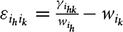 ${\varepsilon _{{i_h}{i_k}}} = {{{\gamma _{{i_{hk}}}}} \over {{w_{{i_h}}}}} - {w_{{i_k}}}$
when h ≠ k.
${\varepsilon _{{i_h}{i_k}}} = {{{\gamma _{{i_{hk}}}}} \over {{w_{{i_h}}}}} - {w_{{i_k}}}$
when h ≠ k.
Now we derive how we compute demand changes in the imported fresh apple market in India:
 $$E = {\sum _i}{X_i}{P_i},$$
(B-5)
$$E = {\sum _i}{X_i}{P_i},$$
(B-5)
where E is Indian expenditures on imported fresh apples, X is imports, and i is import sources.
Taking the derivatives of E with respect to P 1 , we have
 $${{\partial E} \over {\partial {P_1}}} = {X_1} + {{\partial {X_1}} \over {\partial {P_1}}}{P_1} + {{\partial {X_2}} \over {\partial {P_1}}}{P_2} + \ldots + {{\partial {X_n}} \over {\partial {P_1}}}{P_n}.$$
(B-6)
$${{\partial E} \over {\partial {P_1}}} = {X_1} + {{\partial {X_1}} \over {\partial {P_1}}}{P_1} + {{\partial {X_2}} \over {\partial {P_1}}}{P_2} + \ldots + {{\partial {X_n}} \over {\partial {P_1}}}{P_n}.$$
(B-6)
Utilizing ${{{P_n}} \over {{P_n}}} and {{{X_n}} \over {{X_n}}}$
to manipulate equation (B-6), then multiplying by
${{{P_n}} \over {{P_n}}} and {{{X_n}} \over {{X_n}}}$
to manipulate equation (B-6), then multiplying by ${{{P_1}} \over Y}$
, we get
${{{P_1}} \over Y}$
, we get
 $${{\partial E/E} \over {\partial {P_1}/{P_1}}} = {w_1}\left( {{\varepsilon _{11}} + 1} \right) + {w_2}{\varepsilon _{21}} + \ldots + {w_n}{\varepsilon _{n1}},$$
(B-7)
$${{\partial E/E} \over {\partial {P_1}/{P_1}}} = {w_1}\left( {{\varepsilon _{11}} + 1} \right) + {w_2}{\varepsilon _{21}} + \ldots + {w_n}{\varepsilon _{n1}},$$
(B-7)
where ${{\partial E/E} \over {\partial {P_1}/{P_1}}}$
represents percentage change in expenditure in terms of a price change of good 1; w(ε
11 + 1) is a portion of a demand change for good 1; W
n
ε
n1 is a portion of a demand change for good n; w
n
is the consumption share of n’s fresh apples; ε
n1 is the Marshallian own-price elasticity when n = 1 or cross-price elasticity when n ≠ 1. For calculating percentage change in expenditure in terms of a price change of U.S. apples,
${{\partial E/E} \over {\partial {P_1}/{P_1}}}$
represents percentage change in expenditure in terms of a price change of good 1; w(ε
11 + 1) is a portion of a demand change for good 1; W
n
ε
n1 is a portion of a demand change for good n; w
n
is the consumption share of n’s fresh apples; ε
n1 is the Marshallian own-price elasticity when n = 1 or cross-price elasticity when n ≠ 1. For calculating percentage change in expenditure in terms of a price change of U.S. apples,
 $${{\partial E/E} \over {\partial {P_{U.S.apple}}/{P_{U.S.apple}}}} = {w_{U.S.apple}}\left( {{\varepsilon _{{\rm{U}}.{\rm{S}}.{\rm{apple}}}} + 1} \right) + {w_{Chinese\ apple}}{\varepsilon _{Chineses\ apple,\,U.S.apple}} + {w_{Chilian\ apple}}{\varepsilon _{Chilian\ apple,\,{\rm{}}U.S.apple}} \\ + {w_{Other\ apple}}{\varepsilon _{Other\ apple,{\rm{}}U.S.apple}.}$$
Appendix C: Derivations of elasticities
In this section, we derive price and expenditure elasticities. A definition of the uncompensated price elasticities of demand is
 $${\varepsilon_{ij}} = {{d{\rm{ln}}{q_i}} \over {d{\rm{ln}}{p_j}}},$$
(C-1)
$${\varepsilon_{ij}} = {{d{\rm{ln}}{q_i}} \over {d{\rm{ln}}{p_j}}},$$
(C-1)
where q
i
represents the quantities demanded of fruit i, and p denotes the price for fruit j. In terms of RSDAIDS, we use Stone’s price index ${\rm{ln}}P = \mathop \sum \limits_i \mathop \sum \limits_h {w_{{i_h}}}{\rm{ln}}{p_{{i_h}}}$
and equation (6) in the main text. Then we derive
${\rm{ln}}P = \mathop \sum \limits_i \mathop \sum \limits_h {w_{{i_h}}}{\rm{ln}}{p_{{i_h}}}$
and equation (6) in the main text. Then we derive
 $${{d{\rm{ln}}{q_i}} \over {d{\rm{ln}}{p_j}}} = - {\delta _{ij}} + {{d{\rm{ln}}{w_i}} \over {d{\rm{ln}}{p_j}}} = - {\delta _{ij}} + {{{\gamma _{ij}}} \over {{w_i}}} - {{{\beta _i}} \over {{w_i}}}{{d{\rm{ln}}P} \over {d{\rm{ln}}{p_j}}},$$
(C-2)
$${{d{\rm{ln}}{q_i}} \over {d{\rm{ln}}{p_j}}} = - {\delta _{ij}} + {{d{\rm{ln}}{w_i}} \over {d{\rm{ln}}{p_j}}} = - {\delta _{ij}} + {{{\gamma _{ij}}} \over {{w_i}}} - {{{\beta _i}} \over {{w_i}}}{{d{\rm{ln}}P} \over {d{\rm{ln}}{p_j}}},$$
(C-2)
where δ ij is the Kronecker delta (δ ij = 0 for i = j; δ ij = 1 for i ≠ j), and P is Stone’s price index. Then own-price elasticity is
 $${\varepsilon_{{i_h}{i_h}}} = - {\delta _{{i_h}{i_h}}} + {{{\gamma _{{i_{hh}}}}} \over {{w_{{i_h}}}}} - {{{\beta _{{i_h}}}} \over {{w_{{i_h}}}}}{{d{\rm{ln}}P} \over {d{\rm{ln}}{p_{{i_h}}}}} = - 1 + {{{\gamma _{{i_{hh}}}}} \over {{w_{{i_h}}}}} - {\beta _{{i_h}}}.$$
(C-3)
$${\varepsilon_{{i_h}{i_h}}} = - {\delta _{{i_h}{i_h}}} + {{{\gamma _{{i_{hh}}}}} \over {{w_{{i_h}}}}} - {{{\beta _{{i_h}}}} \over {{w_{{i_h}}}}}{{d{\rm{ln}}P} \over {d{\rm{ln}}{p_{{i_h}}}}} = - 1 + {{{\gamma _{{i_{hh}}}}} \over {{w_{{i_h}}}}} - {\beta _{{i_h}}}.$$
(C-3)
Cross-price elasticities between the same goods from different sources are
 $${\varepsilon_{{i_h}{i_k}}} = - {\delta _{{i_h}{i_k}}} + {{{\gamma _{{i_{hk}}}}} \over {{w_{{i_h}}}}} - {{{\beta _{{i_h}}}} \over {{w_{{i_h}}}}}{{d{\rm{ln}}P} \over {d{\rm{ln}}{p_{{i_k}}}}} = {{{\gamma _{{i_{hk}}}}} \over {{w_{{i_h}}}}} - {\beta _{{i_h}}}{{{w_{{i_k}}}} \over {{w_{{i_h}}}}}.$$
(C-4)
$${\varepsilon_{{i_h}{i_k}}} = - {\delta _{{i_h}{i_k}}} + {{{\gamma _{{i_{hk}}}}} \over {{w_{{i_h}}}}} - {{{\beta _{{i_h}}}} \over {{w_{{i_h}}}}}{{d{\rm{ln}}P} \over {d{\rm{ln}}{p_{{i_k}}}}} = {{{\gamma _{{i_{hk}}}}} \over {{w_{{i_h}}}}} - {\beta _{{i_h}}}{{{w_{{i_k}}}} \over {{w_{{i_h}}}}}.$$
(C-4)
Cross-price elasticities between different goods (i.e., the cross-price elasticity between fruit i imported from country h and fruit j imported from the rest of the world) are
 $${\varepsilon_{{i_h}j}} = - {\delta _{{i_h}j}} + {{{\gamma _{{i_h}j}}} \over {{w_{{i_h}}}}} - {{{\beta _{{i_h}}}} \over {{w_{{i_h}}}}}{{d{\rm{ln}}P} \over {d{\rm{ln}}{p_j}}} = {{{\gamma _{{i_h}j}}} \over {{w_{{i_h}}}}} - {\beta _{{i_h}}}{{{w_j}} \over {{w_{{i_h}}}}}.$$
(C-5)
$${\varepsilon_{{i_h}j}} = - {\delta _{{i_h}j}} + {{{\gamma _{{i_h}j}}} \over {{w_{{i_h}}}}} - {{{\beta _{{i_h}}}} \over {{w_{{i_h}}}}}{{d{\rm{ln}}P} \over {d{\rm{ln}}{p_j}}} = {{{\gamma _{{i_h}j}}} \over {{w_{{i_h}}}}} - {\beta _{{i_h}}}{{{w_j}} \over {{w_{{i_h}}}}}.$$
(C-5)
Expenditure elasticities are
 $${\varepsilon_{{i_h}}} = {{d{\rm{ln}}{q_{{i_h}}}} \over {d{\rm{ln}}E}} = 1 + {{{\beta _{{i_h}}}} \over {{w_{{i_h}}}}}.$$
(C-6)
$${\varepsilon_{{i_h}}} = {{d{\rm{ln}}{q_{{i_h}}}} \over {d{\rm{ln}}E}} = 1 + {{{\beta _{{i_h}}}} \over {{w_{{i_h}}}}}.$$
(C-6)


 Open access

