




1 Introduction
Robert Meyer and John Slaney, at a meeting of the Australasian Association for Logic of 1979,Footnote
1
presented a new logic system, Abelian logic, as a particular relevant logic in a language consisting of binary connectives $\rightarrow $
,
$\rightarrow $
, ${\&}$
,
${\&}$
,  , and
, and  and the truth constant $\texttt {t}$
.Footnote
2
Special features of Abelian logic are (1) the axiom of relativity
$\texttt {t}$
.Footnote
2
Special features of Abelian logic are (1) the axiom of relativity $((\varphi \to \psi ) \to \psi )\to \varphi $
, a generalization of the double negation elimination law in which any formula
$((\varphi \to \psi ) \to \psi )\to \varphi $
, a generalization of the double negation elimination law in which any formula $\psi $
can take the place of falsity and (2) its equivalent algebraic semantics, the variety of Abelian lattice-ordered groups (Abelian
$\psi $
can take the place of falsity and (2) its equivalent algebraic semantics, the variety of Abelian lattice-ordered groups (Abelian $\ell $
-groups for short; see the next section for details).
$\ell $
-groups for short; see the next section for details).
While one needs to work with all Abelian $\ell $
-groups to get a sound and complete semantics for the full consequence relation of Abelian logic, if we only want to speak about its tautologies (or even the consequence relation restricted to finite sets of premises), it suffices to restrict to any given non-trivial Abelian
$\ell $
-groups to get a sound and complete semantics for the full consequence relation of Abelian logic, if we only want to speak about its tautologies (or even the consequence relation restricted to finite sets of premises), it suffices to restrict to any given non-trivial Abelian $\ell $
-group, in particular the usual additive group of the real numbers.
$\ell $
-group, in particular the usual additive group of the real numbers.
The tradition of endowing logical systems with an algebraic semantics based on algebras over real numbers is much older. Indeed, Łukasiewicz logic (which can be defined in the language of Abelian logic expanded by a truth constant $\texttt {f}$
for falsum) in its infinitely-valued version was introduced in 1930 by Łukasiewicz and Tarski [Reference Łukasiewicz and Tarski24] and since then it has proved to be one of the most prominent members of the family of many-valued logics often used to model some aspects of vagueness. Also, it has deep connections with other areas of mathematics such as continuous model theory, error-correcting codes, geometry, algebraic probability theory, etc. [Reference Cignoli, D’Ottaviano and Mundici6, Reference Gabbay and Metcalfe14, Reference Mundici, Bicchieri and Chiara28, Reference Di Nola, Leuştean, Cintula, Hájek and Noguera29].
$\texttt {f}$
for falsum) in its infinitely-valued version was introduced in 1930 by Łukasiewicz and Tarski [Reference Łukasiewicz and Tarski24] and since then it has proved to be one of the most prominent members of the family of many-valued logics often used to model some aspects of vagueness. Also, it has deep connections with other areas of mathematics such as continuous model theory, error-correcting codes, geometry, algebraic probability theory, etc. [Reference Cignoli, D’Ottaviano and Mundici6, Reference Gabbay and Metcalfe14, Reference Mundici, Bicchieri and Chiara28, Reference Di Nola, Leuştean, Cintula, Hájek and Noguera29].
Let us now introduce the real-valued semantics of these two logics side-by-side, to see their close relationship.

Long description
The table has three columns. The leftmost column lists logical constructs: truth-values, truth-definition, e open parenthesis phi right arrow psi close parenthesis, e open parenthesis phi and psi close parenthesis, e open parenthesis phi or psi close parenthesis, e open parenthesis t close parenthesis, e open parenthesis f close parenthesis. The middle column, labeled Abelian logic, specifies: R, e open parenthesis phi close parenthesis greater than or equal to 0, e open parenthesis psi close parenthesis minus e open parenthesis phi close parenthesis, e open parenthesis phi close parenthesis plus e open parenthesis psi close parenthesis, minimum of e open parenthesis phi close parenthesis and e open parenthesis psi close parenthesis, maximum of e open parenthesis phi close parenthesis and e open parenthesis psi close parenthesis, 0, dash. The rightmost column, labeled Łukasiewicz logic, specifies: open bracket 0 comma 1 close bracket, e open parenthesis phi close parenthesis equals 1, minimum of 1 and 1 plus e open parenthesis psi close parenthesis minus e open parenthesis phi close parenthesis, maximum of 0 and e open parenthesis phi close parenthesis plus e open parenthesis psi close parenthesis minus 1, minimum of e open parenthesis phi close parenthesis and e open parenthesis psi close parenthesis, maximum of e open parenthesis phi close parenthesis and e open parenthesis psi close parenthesis, 1, 0.
We say that a formula $\varphi $
is a tautology of any of these two logics, if the truth definition holds for all evaluations (we get to consequence relations later). The tautologies of Łukasiewicz logic form a proper subset of the classical tautologies (e.g., the evaluation
$\varphi $
is a tautology of any of these two logics, if the truth definition holds for all evaluations (we get to consequence relations later). The tautologies of Łukasiewicz logic form a proper subset of the classical tautologies (e.g., the evaluation $e(p) = 0.5$
shows that the classical tautology
$e(p) = 0.5$
shows that the classical tautology 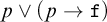 is not a tautology of Łukasiewicz logic). In contrast, Abelian logic is contraclassical because, for instance, the formula $((p\to q) \to q)\to p$
is a tautology (while in classical logic we can take the evaluation e such that
$((p\to q) \to q)\to p$
is a tautology (while in classical logic we can take the evaluation e such that $e(p)=0$
and
$e(p)=0$
and $e(q)=1$
, which makes it false). Observe also that Abelian logic is consistent: for instance, the evaluation
$e(q)=1$
, which makes it false). Observe also that Abelian logic is consistent: for instance, the evaluation $e(p) = e(q) = 1$
shows that
$e(p) = e(q) = 1$
shows that $q\to (p \to q)$
is not a tautology.
$q\to (p \to q)$
is not a tautology.
Recently, a variation of Łukasiewicz logic, that we will call here Łukasiewicz unbound logic, has been introduced in [Reference Cintula, Grimau, Noguera and Smith8], with philosophical and linguistic motivations related to a finer analysis of reasoning with vagueness and graded predicates. This logic shares the language with Łukasiewicz logic and so we can again present their semantics side-by-side for comparison (note that the semantics of the unbound logic uses all real numbers as truth degrees and hence it allows us to avoid “truncations” in the definition of evaluations):

Long description
The table has three columns. The first column lists properties: truth-values, truth-definition, e open parenthesis phi right arrow psi close parenthesis, e open parenthesis phi and psi close parenthesis, e open parenthesis phi or psi close parenthesis, e open parenthesis phi wedge psi close parenthesis, e open parenthesis phi vee psi close parenthesis, e open parenthesis t close parenthesis, e open parenthesis f close parenthesis. The second column, labeled Łukasiewicz unbound logic, gives: R, e open parenthesis phi close parenthesis greater than or equal to 1, 1 plus e open parenthesis psi close parenthesis minus e open parenthesis phi close parenthesis, e open parenthesis phi close parenthesis plus e open parenthesis psi close parenthesis minus 1, min open curly bracket e open parenthesis phi close parenthesis, e open parenthesis psi close parenthesis close curly bracket, max open curly bracket e open parenthesis phi close parenthesis, e open parenthesis psi close parenthesis close curly bracket, 1, 0. The third column, labeled Łukasiewicz logic, gives: open bracket 0, 1 close bracket, e open parenthesis phi close parenthesis equals 1, min open curly bracket 1, 1 plus e open parenthesis psi close parenthesis minus e open parenthesis phi close parenthesis close curly bracket, max open curly bracket 0, e open parenthesis phi close parenthesis plus e open parenthesis psi close parenthesis minus 1 close curly bracket, min open curly bracket e open parenthesis phi close parenthesis, e open parenthesis psi close parenthesis close curly bracket, max open curly bracket e open parenthesis phi close parenthesis, e open parenthesis psi close parenthesis close curly bracket, 1, 0.
The first starting point of this paper is the observation that Łukasiewicz unbound logic can be seen as an expansion of Abelian logic (in the language expanded with $\texttt {f}$
): indeed we only need to use the isomorphism
$\texttt {f}$
): indeed we only need to use the isomorphism $f(x) = x - 1$
to obtain a “shifted” version of the semantics of Łukasiewicz unbound logic:
$f(x) = x - 1$
to obtain a “shifted” version of the semantics of Łukasiewicz unbound logic:

Long description
The table has three columns. The first column lists logical concepts: truth-values, truth-definition, e open parenthesis phi right arrow psi close parenthesis, e open parenthesis phi and psi close parenthesis, e open parenthesis phi or psi close parenthesis, e open parenthesis phi wedge psi close parenthesis, e open parenthesis phi vee psi close parenthesis, e open parenthesis t close parenthesis, e open parenthesis f close parenthesis. The second column, labeled Abelian logic, has the following entries: R, e open parenthesis phi close parenthesis is greater than or equal to 0, e open parenthesis psi close parenthesis minus e open parenthesis phi close parenthesis, e open parenthesis phi close parenthesis plus e open parenthesis psi close parenthesis, minimum of e open parenthesis phi close parenthesis and e open parenthesis psi close parenthesis, maximum of e open parenthesis phi close parenthesis and e open parenthesis psi close parenthesis, 0, dash. The third column, labeled Łukasiewicz unbound logic, shifted, has: R, e open parenthesis phi close parenthesis is greater than or equal to 0, e open parenthesis psi close parenthesis minus e open parenthesis phi close parenthesis, e open parenthesis phi close parenthesis plus e open parenthesis psi close parenthesis, minimum of e open parenthesis phi close parenthesis and e open parenthesis psi close parenthesis, maximum of e open parenthesis phi close parenthesis and e open parenthesis psi close parenthesis, 0, minus 1. The structure highlights that both logics use the same definitions except for the value of e open parenthesis f close parenthesis, which is dash for Abelian logic and minus 1 for Łukasiewicz unbound logic, shifted.
It is trivial to see that tautologies given by the original and the “shifted” semantics coincide and thus any tautology of Abelian logic is also a tautology of Łukasiewicz unbound logic (its relation to Łukasiewicz logic is more complex and is explored in Theorem 5.11).Footnote 3 This observation induces a rich family of logics expanding Abelian logic in the language with just one additional truth constant.
The second starting point of the paper is the observation that, despite the fact that Abelian logic has no finitary consistent extensions in the original language, it has a vast family of infinitary extensions.
Thus, the main goal of this article is twofold: (1) clarify the exact relations between Abelian, Łukasiewicz and Łukasiewicz unbound logics and (2) study two prominent families of expansions of Abelian logic: infinitary extensions in the original language and expansions in the language with $\texttt {f}$
.
$\texttt {f}$
.
The paper is organized as follows. After this introduction, in §2 we formally introduce Abelian logic Ab and the theoretical framework to study its expansions. We choose the framework of (abstract) algebraic logic (see, e.g., [Reference Font11, Reference Font, Jansana and Pigozzi12]) to develop our study. More precisely, since Ab is a weakly implicative logic in the sense of [Reference Cintula7], we capitalize mostly on the kind of abstract algebraic logic presented in the monograph [Reference Cintula and Noguera9], narrowing down its results and reformulating them in a convenient way for our purposes. We also need to employ some tools of universal algebra which can be found, e.g., in the monographs [Reference Birkhoff2, Reference Burris and Sankappanavar4, Reference Galatos, Jipsen, Kowalski and Ono15, Reference Gorbunov16, Reference Mal’cev25]. In particular, in this approach, we have that axiomatic extensions correspond to subvarieties of algebras, finitary extensions correspond to subquasivarieties, and infinitary extensions to generalized subquasivarieties. Since, as mentioned above, every non-trivial Abelian $\ell $
-group generates the whole class as a quasivariety, it turns out that there are no non-trivial subquasivarieties, and hence the only finitary extension of Ab is the inconsistent logic (i.e., the logic in which all formulas are tautologies). While this section is thus mostly preliminary, it also presents a new, purely syntactic proof of the semilinearity of Abelian logic in Theorem 2.12, which, to the best of our knowledge, has not appeared in this form before.
$\ell $
-group generates the whole class as a quasivariety, it turns out that there are no non-trivial subquasivarieties, and hence the only finitary extension of Ab is the inconsistent logic (i.e., the logic in which all formulas are tautologies). While this section is thus mostly preliminary, it also presents a new, purely syntactic proof of the semilinearity of Abelian logic in Theorem 2.12, which, to the best of our knowledge, has not appeared in this form before.
In contrast, the study of its infinitary extensions is much richer, for which in §3 we just scratch the surface. In particular, we give an infinitary rule that axiomatizes the extension of Ab corresponding to the generalized quasivariety generated by ${\boldsymbol {R}}$
. Moreover, we provide
${\boldsymbol {R}}$
. Moreover, we provide $2^{\omega }$
semilinear infinitary extensions of Ab, with corresponding completeness theorems, showing
$2^{\omega }$
semilinear infinitary extensions of Ab, with corresponding completeness theorems, showing ${\vDash _{{\boldsymbol {R}}}} \subsetneq {\vDash _{\boldsymbol {Q}}}$
and that there are
${\vDash _{{\boldsymbol {R}}}} \subsetneq {\vDash _{\boldsymbol {Q}}}$
and that there are $2^{2^\omega }$
infinitary extensions of Ab. At the end of the section, we discuss a possible axiomatization of the logic generated by
$2^{2^\omega }$
infinitary extensions of Ab. At the end of the section, we discuss a possible axiomatization of the logic generated by ${\boldsymbol {{Z}}}$
.
${\boldsymbol {{Z}}}$
.
After that, in §4, we introduce the pointed Abelian logic ${\text {pAb}}$
, which gives rise to a dramatically different landscape, since here sub(quasi)varieties of algebras are plentiful. In particular, we prove that
${\text {pAb}}$
, which gives rise to a dramatically different landscape, since here sub(quasi)varieties of algebras are plentiful. In particular, we prove that ${\text {pAb}}$
is finitely strongly complete with respect to
${\text {pAb}}$
is finitely strongly complete with respect to $\{{\boldsymbol {R}}_{-1},{\boldsymbol {R}}_0,{\boldsymbol {R}}_1\}$
.
$\{{\boldsymbol {R}}_{-1},{\boldsymbol {R}}_0,{\boldsymbol {R}}_1\}$
.
In §5 we study the Łukasiewicz unbound logics $\text {Lu}$
and
$\text {Lu}$
and $\text {Lu}_\infty $
, we axiomatize them as extensions of
$\text {Lu}_\infty $
, we axiomatize them as extensions of ${\text {pAb}}$
, and we show that there is a translation of Łukasiewicz logic into these logics. Following this, we generalize the methods to axiomatize and provide completeness results for a family of other prominent extensions of
${\text {pAb}}$
, and we show that there is a translation of Łukasiewicz logic into these logics. Following this, we generalize the methods to axiomatize and provide completeness results for a family of other prominent extensions of ${\text {pAb}}$
, which are similar to
${\text {pAb}}$
, which are similar to $\text {Lu}$
. We conclude the paper with §6 discussing possible avenues of further research.
$\text {Lu}$
. We conclude the paper with §6 discussing possible avenues of further research.
2 Abelian logic and its expansions
Let ${Fm}_{\!\mathcal L}$
be the set of all formulas built from a propositional language
${Fm}_{\!\mathcal L}$
be the set of all formulas built from a propositional language $\mathcal L$
and a countable set of variables, and let
$\mathcal L$
and a countable set of variables, and let ${\boldsymbol {\boldsymbol {{Fm}_{\!\mathcal L}}}}$
be the absolutely free algebra of type
${\boldsymbol {\boldsymbol {{Fm}_{\!\mathcal L}}}}$
be the absolutely free algebra of type $\mathcal L$
defined on
$\mathcal L$
defined on ${Fm}_{\!\mathcal L}$
.
${Fm}_{\!\mathcal L}$
.
Definition 2.1. We say that a relation $\text L$
between sets of formulas and formulas in a language
$\text L$
between sets of formulas and formulas in a language $\mathcal L$
is a logic in
$\mathcal L$
is a logic in ${\mathcal L}$
when it satisfies the following conditions for each
${\mathcal L}$
when it satisfies the following conditions for each ${\Gamma \cup \Delta \cup \{\varphi \}\subseteq {Fm}_{\!\mathcal L}}$
:
${\Gamma \cup \Delta \cup \{\varphi \}\subseteq {Fm}_{\!\mathcal L}}$
:
-
• $\{\varphi \}\vdash _{\mathrm{L}}\varphi $
. (Reflexivity)
$\{\varphi \}\vdash _{\mathrm{L}}\varphi $
. (Reflexivity) -
• If
$\Gamma \vdash _{\mathrm{L}}\varphi $
and
$\Gamma \subseteq \Delta $
, then
$\Delta \vdash _{\mathrm{L}}\varphi $
. (Monotonicity) -
• If
$\Delta \vdash _{\mathrm{L}}\psi $
for each
$\psi \in \Gamma $
and
$\Gamma \vdash _{\mathrm{L}}\varphi $
, then
$\Delta \vdash _{\mathrm{L}}\varphi $
. (Cut) -
• If
$\Gamma \vdash _{\mathrm{L}}\varphi $
, then
$\sigma [\Gamma ]\vdash _{\mathrm{L}}\sigma (\varphi )$
for each substitution
$\sigma $
, i.e., endomorphisms on
${\boldsymbol {\boldsymbol {{Fm}_{\!\mathcal L}}}}$
. (Structurality)





A logic ${\mathrm{L}}$
is said to be finitary if furthermore
${\mathrm{L}}$
is said to be finitary if furthermore
-
• If
$\Gamma \vdash _{\mathrm{L}}\varphi $
, then there is a finite
$\Gamma '\subseteq \Gamma $
such that
$\Gamma '\vdash _{\mathrm{L}}\varphi $
. (Finitarity)


As a matter of convention we say that ${\mathrm{L}}$
is infinitary if it is not finitary.
${\mathrm{L}}$
is infinitary if it is not finitary.
A consecution in a language $\mathcal L$
is a tuple written as
$\mathcal L$
is a tuple written as $\Gamma \mathrel {\blacktriangleright } \varphi $
, where
$\Gamma \mathrel {\blacktriangleright } \varphi $
, where $\Gamma \cup \{\varphi \} \subseteq {Fm}_{\!\mathcal L}$
; it is said to be finitary if
$\Gamma \cup \{\varphi \} \subseteq {Fm}_{\!\mathcal L}$
; it is said to be finitary if $\Gamma $
is finite and infinitary otherwise, we also identify consecutions
$\Gamma $
is finite and infinitary otherwise, we also identify consecutions $\emptyset \mathrel {\blacktriangleright } \varphi $
with just the formula
$\emptyset \mathrel {\blacktriangleright } \varphi $
with just the formula $\varphi $
. Note that any logic can be seen as a set of consecutions and thus whenever
$\varphi $
. Note that any logic can be seen as a set of consecutions and thus whenever $\Gamma \vdash _{\mathrm{L}} \varphi $
, we say that the consecution
$\Gamma \vdash _{\mathrm{L}} \varphi $
, we say that the consecution $\Gamma \mathrel {\blacktriangleright }\varphi $
is valid in
$\Gamma \mathrel {\blacktriangleright }\varphi $
is valid in ${\mathrm{L}}$
or that
${\mathrm{L}}$
or that ${\mathrm{L}}$
satisfies
${\mathrm{L}}$
satisfies $\Gamma \mathrel {\blacktriangleright }\varphi $
.
$\Gamma \mathrel {\blacktriangleright }\varphi $
.
A set of consecutions closed under arbitrary substitutions (i.e., endomorphisms on ${\boldsymbol {{Fm}_{\mathcal L}}}$
, which are extended to consecutions in an obvious way) is called an axiomatic system. An element
${\boldsymbol {{Fm}_{\mathcal L}}}$
, which are extended to consecutions in an obvious way) is called an axiomatic system. An element $\Gamma \mathrel {\blacktriangleright } \varphi $
of the set is called an axiom, a finitary rule or an infinitary rule depending on the cardinality of
$\Gamma \mathrel {\blacktriangleright } \varphi $
of the set is called an axiom, a finitary rule or an infinitary rule depending on the cardinality of $\Gamma $
. An axiomatic system is called infinitary if it contains at least one infinitary rule, otherwise it is called finitary.
$\Gamma $
. An axiomatic system is called infinitary if it contains at least one infinitary rule, otherwise it is called finitary.
Given an axiomatic system ${\mathcal {AS}}$
we write
${\mathcal {AS}}$
we write $\Gamma \vdash _{\mathcal {AS}} \varphi $
if there is a proof of
$\Gamma \vdash _{\mathcal {AS}} \varphi $
if there is a proof of $\varphi $
from
$\varphi $
from $\Gamma $
in
$\Gamma $
in ${\mathcal {AS}}$
. Note that, as we allow infinitary rules, our notion of proof cannot be the usual finite sequence of formulas, but it has to be a tree with no infinite branches (for details, see [Reference Cintula and Noguera9]). We say that
${\mathcal {AS}}$
. Note that, as we allow infinitary rules, our notion of proof cannot be the usual finite sequence of formulas, but it has to be a tree with no infinite branches (for details, see [Reference Cintula and Noguera9]). We say that ${\mathcal {AS}}$
is a presentation (an axiomatic system) of logic
${\mathcal {AS}}$
is a presentation (an axiomatic system) of logic ${\mathrm{L}}$
if
${\mathrm{L}}$
if ${\mathrm{L}} = {\vdash _{\mathcal {AS}}}$
. Consequently, we can trivially observe that every (finitary) logic possesses a (finitary) presentation.
${\mathrm{L}} = {\vdash _{\mathcal {AS}}}$
. Consequently, we can trivially observe that every (finitary) logic possesses a (finitary) presentation.
The axiomatic system of Abelian logic

Table 1 Long description
Starting from the top row, each entry contains three columns. The first column shows the symbolic label, such as s f, e, id, rel, u b sub 1, u b sub 2, l b sub 1, l b sub 2, sup, inf, push, pop, res sub 1, res sub 2, M P, and Adj. The second column displays the formal logical expression for each axiom, including phi forward arrow psi forward arrow open parenthesis psi forward arrow xi close parenthesis forward arrow open parenthesis phi forward arrow xi close parenthesis for suffixing; phi forward arrow open parenthesis psi forward arrow xi close parenthesis forward arrow psi forward arrow open parenthesis phi forward arrow xi close parenthesis for exchange; phi forward arrow phi for identity; open parenthesis phi forward arrow psi close parenthesis forward arrow psi forward arrow phi for relativity axiom; and phi forward arrow open parenthesis t forward arrow phi close parenthesis for push. Other expressions include open parenthesis t forward arrow phi close parenthesis forward arrow phi for pop; phi forward arrow open parenthesis psi forward arrow xi close parenthesis forward arrow open parenthesis phi and psi forward arrow xi close parenthesis for residuation; open parenthesis phi and psi forward arrow xi close parenthesis forward arrow phi forward arrow open parenthesis psi forward arrow xi close parenthesis for residuation; phi comma phi forward arrow psi black triangle right psi for modus ponens. The third column provides the descriptive name for each axiom, such as suffixing, exchange, identity, relativity axiom, upper bound, lower bound, supremality, infimality, push, pop, residuation, modus ponens, and adjunction. The table includes all axioms relevant to Abelian logic, with each row mapping the symbolic label to its formal expression and descriptive name.
In this paper we deal with several logics in different languages with rather intricate interrelations. Therefore, we need to introduce the formal notions of extension and expansion.
Definition 2.2. Let $\mathcal L_1 \subseteq \mathcal L_2$
be two languages and
$\mathcal L_1 \subseteq \mathcal L_2$
be two languages and ${\mathrm{L}}_i$
a logic in
${\mathrm{L}}_i$
a logic in $\mathcal L_i$
for
$\mathcal L_i$
for $i \in \{1,2\}$
. We say that
$i \in \{1,2\}$
. We say that ${\mathrm{L}}_2$
is
${\mathrm{L}}_2$
is
-
• the expansion of
${\mathrm{L}}_1$
by a set of consecutions
${\mathcal {S}}$
in
$\mathcal L_2$
if it is the least logic in
$\mathcal L_2$
containing
${\mathrm{L}}_1$
and
${\mathcal {S}}$
(i.e.,
${\mathrm{L}}_2$
is axiomatized by all substitutional instances in
$\mathcal L_2$
of consecutions from
${\mathcal {S}}\cup {\mathcal {AS}}$
, for any presentation
${\mathcal {AS}}$
of
${\mathrm{L}}_1$
). We denote
${\mathrm{L}}_2$
by
${\mathrm{L}}_1 + {\mathcal {S}}$
; -
• an (axiomatic) expansion of
${\mathrm{L}}_1$
if it is the expansion of
${\mathrm{L}}_1$
by some set of consecutions (resp. axioms); -
• an extension of
${\mathrm{L}}_1$
if
${\mathrm{L}}_2$
is an expansion of
${\mathrm{L}}_1$
and
$\mathcal L_1=\mathcal L_2$
.


Now we can formally define the Abelian logic Ab as the logic in the languageFootnote
4
 given by the axiomatic system presented in Table 1.
The following consecutions are known to be valid in Ab and thus they are valid in all its expansions:

Long description
From top to bottom, each row contains three columns. The first column has a label in parentheses: t, T, C sub vee, A sub vee, I sub vee, p sub vee, M P sub vee. The second column contains the corresponding logical or algebraic expression: t; phi yields psi, psi yields xi, phi yields xi; phi yields xi; phi or psi yields psi or phi; open parenthesis phi or psi close parenthesis or xi yields phi or open parenthesis psi or xi close parenthesis; phi or phi yields phi; open parenthesis phi yields psi close parenthesis or open parenthesis psi yields phi close parenthesis; phi or psi, phi yields psi. The third column lists the property name: Transitivity, vee-commutativity, Associativity, vee-idempotency, Prelinearity. Each property name is right-aligned with its corresponding expression.
Moreover, one can easily see that Ab is a weakly implicative logic in the sense of [Reference Cintula and Noguera9], i.e., it satisfies $\mathrm {(id)}, {\mathrm {(MP)}}, {\mathrm {(T)}}$
and, for each n-ary c in
$\mathrm {(id)}, {\mathrm {(MP)}}, {\mathrm {(T)}}$
and, for each n-ary c in $\mathcal L_{\mathrm {Ab}}$
, also
$\mathcal L_{\mathrm {Ab}}$
, also

Expansions of Ab need not in general satisfy $\mathrm {(sCNG_{\textit c})}$
for connectives added to the language
$\mathrm {(sCNG_{\textit c})}$
for connectives added to the language $\mathcal L_{\mathrm {Ab}}$
. Since we want to focus on weakly implicative logics, we provide the following definition.
$\mathcal L_{\mathrm {Ab}}$
. Since we want to focus on weakly implicative logics, we provide the following definition.
Definition 2.3. A logic ${\mathrm{L}}$
in a language
${\mathrm{L}}$
in a language $\mathcal L \supseteq \mathcal L_{\mathrm {Ab}}$
is superabelian if
$\mathcal L \supseteq \mathcal L_{\mathrm {Ab}}$
is superabelian if ${\mathrm{L}}$
is an expansion of Ab satisfying
${\mathrm{L}}$
is an expansion of Ab satisfying $\mathrm {(sCNG_{\textit c})}$
for each
$\mathrm {(sCNG_{\textit c})}$
for each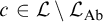 $c \in \mathcal L \setminus \mathcal L_{\mathrm {Ab}}$
.
$c \in \mathcal L \setminus \mathcal L_{\mathrm {Ab}}$
.
Notice the difference between the notion of superabelian logic and the well-known terminology of superintuitionistic logics, which are axiomatic extensions (instead of expansions) of intuitionistic logic. Actually, as we shall soon see, Ab has no non-trivial axiomatic (or even finitary) extension.
There are many natural examples of superabelian logics. In §3 we will focus on infinitary extensions of Ab and in §4 and §5 we focus on some extensions of pointed Abelian logic (the least expansion of Abelian logic in the language with the additional constant $\texttt {f}$
). Other natural examples of superabelian logics are the expansions of Ab with connectives corresponding to additional arithmetical operations on real numbers, such as multiplication or division. Other examples would be various types of congruential modal Abelian logics, i.e., logics where:
$\texttt {f}$
). Other natural examples of superabelian logics are the expansions of Ab with connectives corresponding to additional arithmetical operations on real numbers, such as multiplication or division. Other examples would be various types of congruential modal Abelian logics, i.e., logics where:
 $$ \begin{align*}\varphi \rightarrow \psi, \psi \rightarrow \varphi \mathrel{\blacktriangleright} \Box\varphi \rightarrow \Box \psi. \end{align*} $$
We introduce now the algebraic semantics of Abelian logic and all superabelian logics.
Definition 2.4. An Abelian lattice-ordered group (Abelian $\ell $
-group, see, e.g., [Reference Fuchs13]) is a structure of the form
$\ell $
-group, see, e.g., [Reference Fuchs13]) is a structure of the form  such that:
-
•
is an Abelian group, i.e.,
$+$
is a commutative and associative binary operation with unit
$0$
and
$-$
is the inverse operation (i.e., for each
$a\in A$
, we have
$a + (-a) = 0$
); -
•
is a lattice, i.e., the binary relation defined as iff iff turns out to be an order in which, for each
$x,y \in A$
, and are, respectively, the supremum and the infimum of
$\{x,y\}$
; -
• it satisfies the monotonicity condition, that is, for each
$a,b,c\in A$
: implies .
 is an Abelian group, i.e.,



 is a lattice, i.e., the binary relation
  defined as
  iff
iff  iff
iff  turns out to be an order in which, for each
 and
and  are, respectively, the supremum and the infimum of

 implies
  .
. It is well known that the defining conditions of Abelian $\ell $
-groups can be expressed by means of equations, so they form a variety which we denote by
$\ell $
-groups can be expressed by means of equations, so they form a variety which we denote by $\mathbb {AL}$
. Moreover, the lattice reduct of any Abelian
$\mathbb {AL}$
. Moreover, the lattice reduct of any Abelian $\ell $
-group is distributive.
$\ell $
-group is distributive.
In order to match the language that we have chosen to introduce the logic Ab, Abelian $\ell $
-groups can be equivalently seen as structures
$\ell $
-groups can be equivalently seen as structures  based on the interdefinability: $-a:=a \rightarrow 0$
and
$-a:=a \rightarrow 0$
and $a \rightarrow b:=b-a$
. To avoid excessive parentheses, we stipulate that the unary operation
$a \rightarrow b:=b-a$
. To avoid excessive parentheses, we stipulate that the unary operation $-$
has precedence over all binary operations. Natural examples of (linearly ordered) Abelian
$-$
has precedence over all binary operations. Natural examples of (linearly ordered) Abelian $\ell $
-groups are those of the integers
$\ell $
-groups are those of the integers ${\boldsymbol {{Z}}}$
, the rational numbers
${\boldsymbol {{Z}}}$
, the rational numbers ${\boldsymbol {Q}}$
, and the real numbers
${\boldsymbol {Q}}$
, and the real numbers ${\boldsymbol {R}}$
. Note that
${\boldsymbol {R}}$
. Note that $a\to b \geq 0$
iff
$a\to b \geq 0$
iff  .
.
Let $\mathcal L$
be any propositional language containing
$\mathcal L$
be any propositional language containing $\mathcal L_{\mathrm {Ab}}$
and let
$\mathcal L_{\mathrm {Ab}}$
and let ${\boldsymbol {A}}$
be an
${\boldsymbol {A}}$
be an $\mathcal L$
-algebra with an Abelian
$\mathcal L$
-algebra with an Abelian $\ell $
-group reduct. An
$\ell $
-group reduct. An ${\boldsymbol {A}}$
-evaluation is a homomorphism from
${\boldsymbol {A}}$
-evaluation is a homomorphism from ${\boldsymbol {{Fm}_{\mathcal {L}}}}$
to
${\boldsymbol {{Fm}_{\mathcal {L}}}}$
to ${\boldsymbol {A}}$
. A consecution
${\boldsymbol {A}}$
. A consecution $\Gamma \mathrel {\blacktriangleright } \varphi $
is valid in
$\Gamma \mathrel {\blacktriangleright } \varphi $
is valid in ${\boldsymbol {A}}$
,
${\boldsymbol {A}}$
, $\Gamma \vDash _{\boldsymbol {A}} \varphi $
in symbols, if for every
$\Gamma \vDash _{\boldsymbol {A}} \varphi $
in symbols, if for every ${\boldsymbol {A}}$
-evaluation e it holds that, whenever
${\boldsymbol {A}}$
-evaluation e it holds that, whenever $e(\psi ) \geq 0$
for every
$e(\psi ) \geq 0$
for every $\psi \in \Gamma $
, then also
$\psi \in \Gamma $
, then also $e(\varphi ) \geq 0$
. Given a class
$e(\varphi ) \geq 0$
. Given a class ${{\mathbb K}}$
of
${{\mathbb K}}$
of $\mathcal L$
-algebras with an Abelian
$\mathcal L$
-algebras with an Abelian $\ell $
-group reduct, we write
$\ell $
-group reduct, we write $\Gamma \vDash _{{\mathbb K}} \varphi $
if
$\Gamma \vDash _{{\mathbb K}} \varphi $
if $\Gamma \vDash _{\boldsymbol {{B}}} \varphi $
for each
$\Gamma \vDash _{\boldsymbol {{B}}} \varphi $
for each ${\boldsymbol {{B}}} \in {{\mathbb K}}$
. It is well known that
${\boldsymbol {{B}}} \in {{\mathbb K}}$
. It is well known that $\vDash _{{\mathbb K}}$
is a superabelian logic.
$\vDash _{{\mathbb K}}$
is a superabelian logic.
Let ${\mathrm{L}}$
be a superabelian logic in the language
${\mathrm{L}}$
be a superabelian logic in the language $\mathcal L$
. By
$\mathcal L$
. By ${\mathbf {Alg}^{*}({\mathrm{L}})}$
we denote the class of
${\mathbf {Alg}^{*}({\mathrm{L}})}$
we denote the class of ${\mathrm{L}}$
-algebras, i.e.,
${\mathrm{L}}$
-algebras, i.e., $\mathcal L$
-algebras
$\mathcal L$
-algebras ${\boldsymbol {A}}$
which have an Abelian
${\boldsymbol {A}}$
which have an Abelian $\ell $
-group reduct and
$\ell $
-group reduct and ${\mathrm{L}} \subseteq {\vDash _{\boldsymbol {A}}}$
. For the purposes of this paper, we sometimes write that
${\mathrm{L}} \subseteq {\vDash _{\boldsymbol {A}}}$
. For the purposes of this paper, we sometimes write that ${\boldsymbol {A}}$
is a model of
${\boldsymbol {A}}$
is a model of ${\mathrm{L}}$
instead of saying that
${\mathrm{L}}$
instead of saying that ${\boldsymbol {A}}$
is an
${\boldsymbol {A}}$
is an ${\mathrm{L}}$
-algebra.
${\mathrm{L}}$
-algebra.
The usual techniques of algebraic logic allow us to prove that ${\mathbf {Alg}^{*}(\mathrm {\mathrm {Ab}})}=\mathbb {AL}$
and, for any superabelian logic
${\mathbf {Alg}^{*}(\mathrm {\mathrm {Ab}})}=\mathbb {AL}$
and, for any superabelian logic ${\mathrm{L}}$
, we have the following completeness theorem: for each
${\mathrm{L}}$
, we have the following completeness theorem: for each $\Gamma \cup \{\varphi \}$
, we have
$\Gamma \cup \{\varphi \}$
, we have
 $$ \begin{align*}\Gamma \vdash_{\mathrm{L}} \varphi\qquad \text{iff}\qquad \Gamma \vDash_{\mathbf{Alg}^{*}({\mathrm{L}})} \varphi. \end{align*} $$
Furthermore, one can easily check that the following consecutions are valid in Ab:
-
,
-
,
-
 ,
, ,
,
Taken together, these consecutions give the condition $\mathrm {(Alg)}$
from [Reference Cintula and Noguera9, theorem 2.9.5], which guarantees that Ab (resp. any superabelian logic
$\mathrm {(Alg)}$
from [Reference Cintula and Noguera9, theorem 2.9.5], which guarantees that Ab (resp. any superabelian logic ${\mathrm{L}}$
) is algebraically implicative (i.e., weakly implicative and algebraizable in the sense of Blok and Pigozzi [Reference Blok and Pigozzi3]) and the class
${\mathrm{L}}$
) is algebraically implicative (i.e., weakly implicative and algebraizable in the sense of Blok and Pigozzi [Reference Blok and Pigozzi3]) and the class $\mathbb {AL}$
(resp.
$\mathbb {AL}$
(resp. ${\mathbf {Alg}^{*}({\mathrm{L}})}$
) is its equivalent algebraic semantics. Therefore, there is a dual order isomorphism between the lattices of finitary extensions of Ab and subquasivarieties of
${\mathbf {Alg}^{*}({\mathrm{L}})}$
) is its equivalent algebraic semantics. Therefore, there is a dual order isomorphism between the lattices of finitary extensions of Ab and subquasivarieties of $\mathbb {AL}$
.
$\mathbb {AL}$
.
We are interested, for a given superabelian logic ${\mathrm{L}}$
, in completeness theorems with respect to various (classes of)
${\mathrm{L}}$
, in completeness theorems with respect to various (classes of) ${\mathrm{L}}$
-algebras, instead of the whole equivalent algebraic semantics. For reasons apparent later, we distinguish two kinds of completeness theorems.
${\mathrm{L}}$
-algebras, instead of the whole equivalent algebraic semantics. For reasons apparent later, we distinguish two kinds of completeness theorems.
Definition 2.5. A superabelian logic ${\mathrm{L}}$
enjoys the (Finite) Strong
${\mathrm{L}}$
enjoys the (Finite) Strong ${{\mathbb K}}$
-Completeness with respect to a class
${{\mathbb K}}$
-Completeness with respect to a class ${{\mathbb K}}$
of
${{\mathbb K}}$
of ${\mathrm{L}}$
-algebras,
${\mathrm{L}}$
-algebras, $\mathrm {(F)}{\mathrm {S}{{\mathbb K}}\mathrm {C}}$
for short, if for every (finite) set
$\mathrm {(F)}{\mathrm {S}{{\mathbb K}}\mathrm {C}}$
for short, if for every (finite) set $\Gamma \cup \{\varphi \}$
of formulas,
$\Gamma \cup \{\varphi \}$
of formulas,
 $$ \begin{align*}\Gamma \vdash_{\mathrm{L}} \varphi\qquad \text{iff}\qquad \Gamma \vDash_{{\mathbb K}} \varphi. \end{align*} $$
A particularly interesting class of ${\mathrm{L}}$
-algebras is that of those whose underlying lattice is linearly ordered; following the common notation in the literature (see [Reference Cintula and Noguera9]), we denote this class as
${\mathrm{L}}$
-algebras is that of those whose underlying lattice is linearly ordered; following the common notation in the literature (see [Reference Cintula and Noguera9]), we denote this class as $\mathbf {Alg}^{\ell }({\mathrm{L}})$
and introduce the following central notion.
$\mathbf {Alg}^{\ell }({\mathrm{L}})$
and introduce the following central notion.
Definition 2.6. A superabelian logic ${\mathrm{L}}$
is semilinear if it has the Strong
${\mathrm{L}}$
is semilinear if it has the Strong $\mathbf {Alg}^{\ell }({\mathrm{L}})$
-Completeness.
$\mathbf {Alg}^{\ell }({\mathrm{L}})$
-Completeness.
As we will see later in Example 5.4, not all superabelian logics have to be semilinear. There is a very useful characterization of semilinearity among superabelian logics with a countable presentation (which is, of course, the case for Ab, all finitary superabelian logics and, as we will see later, even some prominent infinitary ones) using the notion of a strong disjunction (see [Reference Cintula and Noguera9, definition 5.1.2] and note that the definition also requires the validity of $\varphi \mathrel {\blacktriangleright } \varphi \vee \psi $
and
$\varphi \mathrel {\blacktriangleright } \varphi \vee \psi $
and $\psi \mathrel {\blacktriangleright } \varphi \vee \psi $
, which is clearly the case in any superabelian logic).
$\psi \mathrel {\blacktriangleright } \varphi \vee \psi $
, which is clearly the case in any superabelian logic).
Definition 2.7. The lattice connective  is a strong disjunction in a superabelian logic ${\mathrm{L}}$
if for each set
${\mathrm{L}}$
if for each set $\Gamma \cup \Phi \cup \Psi \cup \{\xi \}$
of formulas,
$\Gamma \cup \Phi \cup \Psi \cup \{\xi \}$
of formulas,

where  is short for
The next theorem follows directly from [Reference Cintula and Noguera9, Theorems 6.2.2 and 5.5.14].
Theorem 2.8. Let ${\mathrm{L}}$
be a superabelian logic with a countable presentation. Then,
${\mathrm{L}}$
be a superabelian logic with a countable presentation. Then, ${\mathrm{L}}$
is semilinear iff
${\mathrm{L}}$
is semilinear iff  is a strong disjunction.
The power of the theorem above is that there is an easy syntactical way (see Corollary 2.13) to check whether $\vee $
is a strong disjunction using a simple syntactical construction.
$\vee $
is a strong disjunction using a simple syntactical construction.
Definition 2.9. Let $\Gamma \cup \{\varphi \} \subseteq {Fm}_{\!\mathcal L}$
. The
$\Gamma \cup \{\varphi \} \subseteq {Fm}_{\!\mathcal L}$
. The  -form of a consecution $\Gamma \mathrel {\blacktriangleright } \varphi $
is the set of consecutions
$\Gamma \mathrel {\blacktriangleright } \varphi $
is the set of consecutions

Lemma 2.10. Let ${\mathrm{L}}$
be a superabelian logic,
${\mathrm{L}}$
be a superabelian logic, ${\boldsymbol {A}}$
an
${\boldsymbol {A}}$
an ${\mathrm{L}}$
-algebra, and
${\mathrm{L}}$
-algebra, and $\Gamma \cup \{\varphi \}$
a set of formulas. If we have
$\Gamma \cup \{\varphi \}$
a set of formulas. If we have  for each $\psi $
, then we also have
$\psi $
, then we also have $\Gamma \vDash _{\boldsymbol {A}} \varphi $
. Moreover, if
$\Gamma \vDash _{\boldsymbol {A}} \varphi $
. Moreover, if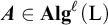 ${\boldsymbol {A}} \in \mathbf {Alg}^{\ell }({\mathrm{L}})$
, the converse implication also holds.
${\boldsymbol {A}} \in \mathbf {Alg}^{\ell }({\mathrm{L}})$
, the converse implication also holds.
Proof. Take an evaluation e such that, for each $\xi \in \Gamma $
, we have
$\xi \in \Gamma $
, we have $e(\xi ) \geq 0$
. Then clearly
$e(\xi ) \geq 0$
. Then clearly  (
( ${\boldsymbol {A}}$
has a lattice reduct). Thus by our assumption for
${\boldsymbol {A}}$
has a lattice reduct). Thus by our assumption for $\psi =\varphi $
, we know that
$\psi =\varphi $
, we know that  .
.
For the converse implication, take an evaluation e such that  for each $\xi \in \Gamma $
. Since we assume that
$\xi \in \Gamma $
. Since we assume that ${\boldsymbol {A}}$
is linearly ordered, we can derive that either
${\boldsymbol {A}}$
is linearly ordered, we can derive that either $e(\psi ) \geq 0$
or, for all
$e(\psi ) \geq 0$
or, for all $\xi \in \Gamma $
, we have
$\xi \in \Gamma $
, we have $e(\xi ) \geq 0$
. In the latter case, the assumption
$e(\xi ) \geq 0$
. In the latter case, the assumption $\Gamma \vDash _{\boldsymbol {A}} \varphi $
gives us
$\Gamma \vDash _{\boldsymbol {A}} \varphi $
gives us $e(\varphi ) \geq 0$
and so in both cases we have
$e(\varphi ) \geq 0$
and so in both cases we have  .
.
The following theorem is a particular version of [Reference Cintula and Noguera9, Theorem 5.2.6] (clearly, the consecutions  and
and  mentioned in that theorem are valid in each superabelian logic).
Theorem 2.11. Let ${\mathrm{L}}$
be a superabelian logic with a presentation
${\mathrm{L}}$
be a superabelian logic with a presentation ${\mathcal {AS}}$
. Then, the following are equivalent:
${\mathcal {AS}}$
. Then, the following are equivalent:
-
1.
is a strong disjunction. -
2.
for each consecution
$R\in {\mathcal {AS}}$
. -
3.
for each consecution
$R\in {\mathrm{L}}$
.
 is a strong disjunction.
 for each consecution
 for each consecution
Now we are ready to give the promised direct alternative proof of semilinearity of Ab, which originally was established using a completeness theorem (see, e.g., [Reference Cintula and Noguera9, Example 6.2.3]).
Theorem 2.12. Ab is a semilinear logic with strong disjunction $\vee $
.
$\vee $
.
Proof. As Ab has a countable presentation, it suffices to prove that $\vee $
is a strong disjunction which, thanks to Theorem 2.11, follows if we prove that
$\vee $
is a strong disjunction which, thanks to Theorem 2.11, follows if we prove that  and
and  are valid in Ab.
For the first one, let ${\boldsymbol {A}}$
be an Abelian
${\boldsymbol {A}}$
be an Abelian $\ell $
-group and e an
$\ell $
-group and e an ${\boldsymbol {A}}$
-evaluation such that
${\boldsymbol {A}}$
-evaluation such that  and
and  . Then, by the assumptions and distributivity of the lattice operations, we have

To prove the validity of  , consider an evaluation e such that
  and
and  . This gives us
  . Using the distributivity of the lattice operations, we obtain

For simplicity, let us set  ,
, $e(\psi ) = b$
,
$e(\psi ) = b$
, 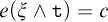 and
and  . As
. As  holds in $\ell $
-groups, we obtain
$\ell $
-groups, we obtain

Note that, due to monotonicity of addition, we have

Therefore, we obtain  as required.
The following corollary is a direct consequence of Theorems 2.8, 2.11, and 2.12.
Corollary 2.13. Let ${\mathrm{L}}$
be a superabelian logic expanding Ab by a set
${\mathrm{L}}$
be a superabelian logic expanding Ab by a set $\mathcal {S}$
of consecutions such that
$\mathcal {S}$
of consecutions such that  is valid in ${\mathrm{L}}$
for each
${\mathrm{L}}$
for each $R \in \mathcal {S}$
. Then,
$R \in \mathcal {S}$
. Then, $\vee $
is a strong disjunction in
$\vee $
is a strong disjunction in ${\mathrm{L}}$
. If, furthermore,
${\mathrm{L}}$
. If, furthermore, ${\mathrm{L}}$
has a countable presentation, then
${\mathrm{L}}$
has a countable presentation, then ${\mathrm{L}}$
is semilinear.
${\mathrm{L}}$
is semilinear.
In order to obtain completeness results for the logics studied in this paper, we will make use of the following two theorems and corollary which offer algebraic characterizations adapted from the general framework of the monograph [Reference Cintula and Noguera9] to the setting of superabelian logics. For clarity, we first recall the definitions of the standard class operators from universal algebra.
Definition 2.14. Let ${{\mathbb K}}$
be a class of
${{\mathbb K}}$
be a class of $\mathcal L$
-algebras. We define the following:
$\mathcal L$
-algebras. We define the following:
-
•
$\mathbf {I}({{\mathbb K}})$
,
$\mathbf {S}({{\mathbb K}})$
,
$\mathbf {H}({{\mathbb K}})$
,
$\mathbf {P}({{\mathbb K}})$
,
$\mathbf {P}_{\mathrm {U}}({{\mathbb K}})$
, and
$\mathbf {P}_\omega ({{\mathbb K}})$
are the classes of all isomorphic images, subalgebras, homomorphic images, direct products, ultraproducts, and countably-filtered products of algebras in
${{\mathbb K}}$
, respectively. -
•
${{\mathbb K}}_{\mathrm {RFSI}}$
is the class of relatively finitely subdirectly irreducible members of
${{\mathbb K}}$
. -
• We use
${\boldsymbol {1}}$
to denote an arbitrary fixed trivial one-element algebra.


Since superabelian logics are algebraically implicative, we can recall the following two useful characterizations of (finite) strong completeness proved as [Reference Cintula and Noguera9, corollaries 3.8.3 and 3.8.7] (in the latter case we also use the fact that for semilinear logics $\mathbf {Alg}^*({\mathrm{L}})_{\mathrm {RFSI}}=\mathbf {Alg}^{\ell }({\mathrm{L}})$
, see [Reference Cintula and Noguera9, Theorem 6.1.7]).
$\mathbf {Alg}^*({\mathrm{L}})_{\mathrm {RFSI}}=\mathbf {Alg}^{\ell }({\mathrm{L}})$
, see [Reference Cintula and Noguera9, Theorem 6.1.7]).
Theorem 2.15. Let ${\mathrm{L}}$
be a superabelian logic and
${\mathrm{L}}$
be a superabelian logic and ${{\mathbb K}} \subseteq {\mathbf {Alg}^{*}({\mathrm{L}})}$
. Then, the following are equivalent:
${{\mathbb K}} \subseteq {\mathbf {Alg}^{*}({\mathrm{L}})}$
. Then, the following are equivalent:
-
1.
${\mathrm{L}}$
is strongly complete w.r.t.
${{\mathbb K}}$
. -
2.
${\mathbf {Alg}^{*}({\mathrm{L}})}$
is generated by
${{\mathbb K}}$
as a generalized quasivariety, i.e.,
${\mathbf {Alg}^{*}({\mathrm{L}})} = \mathbf {ISP}_\omega ({{\mathbb K}})$
.



Theorem 2.16. Let ${\mathrm{L}}$
be a superabelian logic and
${\mathrm{L}}$
be a superabelian logic and ${{\mathbb K}} \subseteq {\mathbf {Alg}^{*}({\mathrm{L}})}$
. Then, the following are equivalent:
${{\mathbb K}} \subseteq {\mathbf {Alg}^{*}({\mathrm{L}})}$
. Then, the following are equivalent:
-
1.
${\mathrm{L}}$
is finitely strongly complete w.r.t.
${{\mathbb K}}$
. -
2.
${\mathbf {Alg}^{*}({\mathrm{L}})}$
is generated by
${{\mathbb K}}$
as a quasivariety, i.e.,
${\mathbf {Alg}^{*}({\mathrm{L}})} = \mathbf {ISP}\mathbf {P}_{\mathrm {U}}({{\mathbb K}})$
.


If furthermore ${\mathrm{L}}$
is finitary and semilinear, then we can add
${\mathrm{L}}$
is finitary and semilinear, then we can add
-
3.
$\mathbf {Alg}^{\ell }({\mathrm{L}}) \subseteq \mathbf {ISP}_{\mathrm {U}}({{\mathbb K}},{\boldsymbol {{1}}})$
.

Finally, we add a simple yet important corollary of the previous which follows from the fact that  [Reference Bergman1, Theorem 5.6].
Corollary 2.17. Let ${\mathrm{L}}$
be a finitary semilinear superabelian logic. Consider finitely many classes of
${\mathrm{L}}$
be a finitary semilinear superabelian logic. Consider finitely many classes of ${\mathrm{L}}$
-algebras
${\mathrm{L}}$
-algebras ${{\mathbb K}}_1,{{\mathbb K}}_2,\dots , {{\mathbb K}}_n \subseteq {\mathbf {Alg}^{*}({\mathrm{L}})}$
. Then, the following are equivalent:
${{\mathbb K}}_1,{{\mathbb K}}_2,\dots , {{\mathbb K}}_n \subseteq {\mathbf {Alg}^{*}({\mathrm{L}})}$
. Then, the following are equivalent:
-
1.
${\mathrm{L}}$
is finitely strongly complete w.r.t.
$\bigcup _{i=1}^n {{\mathbb K}}_i$
. -
2.
.


 .
. Thanks to [Reference Khisamiev22], we know the quasivariety of Abelian $\ell $
-groups is generated (as a quasivariety) by
$\ell $
-groups is generated (as a quasivariety) by ${\boldsymbol {{Z}}}$
and, since
${\boldsymbol {{Z}}}$
and, since ${\boldsymbol {{Z}}}$
can be embedded into any non-trivial Abelian
${\boldsymbol {{Z}}}$
can be embedded into any non-trivial Abelian $\ell $
-group, we obtain the following corollary.
$\ell $
-group, we obtain the following corollary.
Corollary 2.18. The variety $\mathbb {AL}$
of Abelian
$\mathbb {AL}$
of Abelian $\ell $
-groups is generated (as a quasivariety) by any of its non-trivial members, that is,
$\ell $
-groups is generated (as a quasivariety) by any of its non-trivial members, that is, $\mathbf {ISPP}_{\mathrm {U}}({\boldsymbol {A}})=\mathbb {AL}$
for any non-trivial
$\mathbf {ISPP}_{\mathrm {U}}({\boldsymbol {A}})=\mathbb {AL}$
for any non-trivial ${\boldsymbol {A}} \in \mathbb {AL}$
. Therefore,
${\boldsymbol {A}} \in \mathbb {AL}$
. Therefore, $\mathbb {AL}$
has no non-trivial subquasivarieties.
$\mathbb {AL}$
has no non-trivial subquasivarieties.
As we will see in the next section, $\mathbb {AL}$
is not generated as a generalized quasivariety by any of
$\mathbb {AL}$
is not generated as a generalized quasivariety by any of ${\boldsymbol {R}}$
,
${\boldsymbol {R}}$
, ${\boldsymbol {Q}}$
, or
${\boldsymbol {Q}}$
, or ${\boldsymbol {{Z}}}$
, and it admits numerous non-trivial generalized subquasivarieties.
${\boldsymbol {{Z}}}$
, and it admits numerous non-trivial generalized subquasivarieties.
In logical terminology, we know that Ab is finitely strongly complete w.r.t. any non-trivial Abelian $\ell $
-group and has no consistent finitary extension, though it has numerous proper consistent infinitary extensions. Moreover, it is not strongly complete w.r.t. any of
$\ell $
-group and has no consistent finitary extension, though it has numerous proper consistent infinitary extensions. Moreover, it is not strongly complete w.r.t. any of ${\boldsymbol {R}}$
,
${\boldsymbol {R}}$
, ${\boldsymbol {Q}}$
or
${\boldsymbol {Q}}$
or ${\boldsymbol {{Z}}}$
. In the next section, we will axiomatize its proper extension strongly complete w.r.t.
${\boldsymbol {{Z}}}$
. In the next section, we will axiomatize its proper extension strongly complete w.r.t. ${\boldsymbol {R}}$
.
${\boldsymbol {R}}$
.
3 Infinitary extensions of Abelian logic
Having established that Abelian logic (Ab) lacks non-trivial finitary extensions, a well-known result that motivates our next step, we now turn our attention to the much richer landscape of its infinitary extensions. This section explores this domain by introducing infinitary rules designed to capture specific semantic properties.
Clearly, the most prominent candidates for such infinitary logics are ${\vDash _{\boldsymbol {R}}}$
,
${\vDash _{\boldsymbol {R}}}$
, ${\vDash _{\boldsymbol {Q}}}$
, and
${\vDash _{\boldsymbol {Q}}}$
, and ${\vDash _{\boldsymbol {{Z}}}}$
. We know that:
${\vDash _{\boldsymbol {{Z}}}}$
. We know that:
 $$ \begin{align*}{\mathrm {Ab}} \subseteq {\vDash_{\boldsymbol{R}}} \subseteq {\vDash_{\boldsymbol{Q}}} \subseteq {\vDash_{\boldsymbol {{Z}}}} \end{align*} $$
and that above ${\vDash _{\boldsymbol {{Z}}}}$
there is only the inconsistent logic (because
${\vDash _{\boldsymbol {{Z}}}}$
there is only the inconsistent logic (because ${\boldsymbol {{Z}}}$
obviously generates the smallest non-trivial generalized subquasivariety of Abelian
${\boldsymbol {{Z}}}$
obviously generates the smallest non-trivial generalized subquasivariety of Abelian $\ell $
-groups).
$\ell $
-groups).
In this section, we obtain the following new results:
-
• strictness of all three inclusions, and thus these three logics are indeed not finitary (Example 3.3, Corollary 3.6 and Theorem 3.7);
-
• there are
$2^{2^\omega }$
distinct infinitary logics between
${\vDash _{\boldsymbol {R}}}$
and
${\vDash _{\boldsymbol {Q}}}$
(Corollary 3.6); -
• an axiomatization of the logic
$\vDash _{\boldsymbol {R}}$
(Theorem 3.4).


Moreover, we give a conjecture for an axiomatization of the logic $\vDash _{\boldsymbol {{Z}}}$
, give strong arguments to support it, and point to the impossibility of proving it by usual methods (Conjecture 3.8).
$\vDash _{\boldsymbol {{Z}}}$
, give strong arguments to support it, and point to the impossibility of proving it by usual methods (Conjecture 3.8).
From now on, we will use the following notation: for $n \in \mathbb {N}$
and a formula
$n \in \mathbb {N}$
and a formula $\varphi $
, we write
$\varphi $
, we write $n \cdot \varphi $
instead of
$n \cdot \varphi $
instead of $\underbrace {\varphi\ {\&} \dots {\&}\ \varphi }_{n \text { times}}$
(we also set
$\underbrace {\varphi\ {\&} \dots {\&}\ \varphi }_{n \text { times}}$
(we also set $0 \cdot \varphi = \texttt {t}$
). We use the analogous notation for
$0 \cdot \varphi = \texttt {t}$
). We use the analogous notation for $+$
in the algebraic setting.
$+$
in the algebraic setting.
Let us first recall the infinitary rule used to axiomatize the infinitary Łukasiewicz logic (see [Reference Hay19]):
 $$ \begin{align} \{\neg \varphi \rightarrow n \cdot \varphi \mid n \in \mathbb{N} \} \mathrel{\blacktriangleright} \varphi. \end{align} $$
Since the language of Ab does not include a negation with similar properties to that of Łukasiewicz logic, we have to replace $\neg \varphi $
by
$\neg \varphi $
by $\psi $
and define
$\psi $
and define
 $$ \begin{align} \{\psi \rightarrow n \cdot \varphi \mid n \in \mathbb{N} \} \mathrel{\blacktriangleright} \varphi. \end{align} $$
As its name suggests, the rule (Arch) is intended as a syntactic counterpart to the well-known algebraic property of being Archimedean. We introduce the standard definition of this property for Abelian $\ell $
-groups.
$\ell $
-groups.
Definition 3.1. Let ${\boldsymbol {A}}$
be an Abelian
${\boldsymbol {A}}$
be an Abelian $\ell $
-group. We say that
$\ell $
-group. We say that ${\boldsymbol {A}}$
is Archimedean if and only if for each
${\boldsymbol {A}}$
is Archimedean if and only if for each $a,b \in A$
it holds
$a,b \in A$
it holds

The following lemma makes the connection between the rule and the property precise, showing that the (Arch) rule is valid in an Abelian $\ell $
-group if and only if that group is Archimedean.
$\ell $
-group if and only if that group is Archimedean.
Lemma 3.2. Let ${\boldsymbol {A}}$
be an Abelian
${\boldsymbol {A}}$
be an Abelian $\ell $
-group. Then, the following conditions are equivalent:
$\ell $
-group. Then, the following conditions are equivalent:
-
1.
${\boldsymbol {A}}$
is Archimedean. -
2. (Arch) is valid in
${\boldsymbol {A}}$
.


Furthermore, if ${\boldsymbol {A}}$
is linearly ordered, we can add the following condition:
${\boldsymbol {A}}$
is linearly ordered, we can add the following condition:
-
3. (Arch)
is valid in
${\boldsymbol {A}}$
.
 is valid in
Proof. We first show the implication from 1 to 2. Let e be an evaluation such that we have $e(\varphi ) \ngeq 0$
. We set
$e(\varphi ) \ngeq 0$
. We set $a=\ -e(\varphi )$
and
$a=\ -e(\varphi )$
and $b=\ -e(\psi )$
. Since
$b=\ -e(\psi )$
. Since ${\boldsymbol {A}}$
is Archimedean and
${\boldsymbol {A}}$
is Archimedean and $a\nleq 0$
, there is an
$a\nleq 0$
, there is an $n \in \mathbb {N}$
such that
$n \in \mathbb {N}$
such that $n \cdot a \nleq b$
. Consequently, there is an
$n \cdot a \nleq b$
. Consequently, there is an $n \in \mathbb {N}$
such that
$n \in \mathbb {N}$
such that $n \cdot e(\varphi ) \ngeq e(\psi ) $
; thus
$n \cdot e(\varphi ) \ngeq e(\psi ) $
; thus $e(\psi \rightarrow n \cdot \varphi ) \ngeq 0$
. This shows that (Arch) holds.
$e(\psi \rightarrow n \cdot \varphi ) \ngeq 0$
. This shows that (Arch) holds.
To show the implication from 2 to 1, we assume that ${\boldsymbol {A}}$
is not Archimedean. Therefore, there exist
${\boldsymbol {A}}$
is not Archimedean. Therefore, there exist $a,b \in A$
such that
$a,b \in A$
such that $a \nleq 0$
and
$a \nleq 0$
and  for each $n \in \mathbb {N}$
. Consider an evaluation e such that
$n \in \mathbb {N}$
. Consider an evaluation e such that $e(\varphi )=\ -a$
and
$e(\varphi )=\ -a$
and $e(\psi )=\ -b$
. Then, for each
$e(\psi )=\ -b$
. Then, for each $n \in \mathbb {N}$
, we have
$n \in \mathbb {N}$
, we have $n \cdot e(\varphi ) \geq e(\psi )$
and thus
$n \cdot e(\varphi ) \geq e(\psi )$
and thus $e(\psi \rightarrow n \cdot \varphi ) \geq 0$
for each
$e(\psi \rightarrow n \cdot \varphi ) \geq 0$
for each $n \in \mathbb {N}$
. However, by assumption,
$n \in \mathbb {N}$
. However, by assumption, $e(\varphi )=\ -a \ngeq 0$
and thus (Arch) fails in
$e(\varphi )=\ -a \ngeq 0$
and thus (Arch) fails in ${\boldsymbol {A}}$
.
${\boldsymbol {A}}$
.
The rest of the statement follows from Lemma 2.10.
By the next example, we know that (Arch) is not valid in Ab and so Ab is strictly contained in $\vDash _{\boldsymbol {R}}$
and thus
$\vDash _{\boldsymbol {R}}$
and thus $\vDash _{\boldsymbol {R}}$
cannot be finitary.
$\vDash _{\boldsymbol {R}}$
cannot be finitary.
Example 3.3. Clearly the algebras ${\boldsymbol {R}}$
,
${\boldsymbol {R}}$
, ${\boldsymbol {Q}}$
, and
${\boldsymbol {Q}}$
, and ${\boldsymbol {{Z}}}$
are Archimedean. As an example of a non-Archimedean linearly ordered
${\boldsymbol {{Z}}}$
are Archimedean. As an example of a non-Archimedean linearly ordered $\ell $
-group, consider the lexicographic product of two copies of the integers
$\ell $
-group, consider the lexicographic product of two copies of the integers ${\boldsymbol {{Z}}} \times _{\text {lex}} {\boldsymbol {{Z}}}$
, where
${\boldsymbol {{Z}}} \times _{\text {lex}} {\boldsymbol {{Z}}}$
, where ${\boldsymbol {{Z}}} \times _{\text {lex}} {\boldsymbol {{Z}}}$
has the same group structure as
${\boldsymbol {{Z}}} \times _{\text {lex}} {\boldsymbol {{Z}}}$
has the same group structure as ${\boldsymbol {{Z}}} \times {\boldsymbol {{Z}}}$
, with the ordering
${\boldsymbol {{Z}}} \times {\boldsymbol {{Z}}}$
, with the ordering  iff
iff $a>c$
or
$a>c$
or $a=c$
and
$a=c$
and $b>d$
. This
$b>d$
. This $\ell $
-group is clearly not Archimedean, since by definition
$\ell $
-group is clearly not Archimedean, since by definition  for each $n \in \mathbb {N}$
.
$n \in \mathbb {N}$
.
Let us call the logic $\vDash _{\boldsymbol {R}}$
the real Abelian logic and denote it
$\vDash _{\boldsymbol {R}}$
the real Abelian logic and denote it ${\mathrm {rAb}}$
. The next theorem shows how to axiomatize it.
${\mathrm {rAb}}$
. The next theorem shows how to axiomatize it.
Theorem 3.4. ${\mathrm {rAb}}$
is the extension of Ab by the rule (Arch)
${\mathrm {rAb}}$
is the extension of Ab by the rule (Arch)
 .
.
Proof. Let us denote the logic 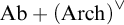 by
by ${\mathrm{L}}$
. First note that, by Corollary 2.13, we know that
${\mathrm{L}}$
. First note that, by Corollary 2.13, we know that ${\mathrm{L}}$
is a semilinear logic and so it is strongly complete with respect to the class
${\mathrm{L}}$
is a semilinear logic and so it is strongly complete with respect to the class $\mathbf {Alg}^{\ell }({\mathrm{L}})$
, which, due to the previous lemma, consists of linearly ordered Archimedean
$\mathbf {Alg}^{\ell }({\mathrm{L}})$
, which, due to the previous lemma, consists of linearly ordered Archimedean $\ell $
-groups. By Hölder’s Theorem [Reference Hölder20], each such
$\ell $
-groups. By Hölder’s Theorem [Reference Hölder20], each such $\ell $
-group is embeddable into
$\ell $
-group is embeddable into ${\boldsymbol {R}}$
and so the proof follows.
${\boldsymbol {R}}$
and so the proof follows.
Note that this proof relies on the  -form of the rule (Arch) which is necessary to ensure that the resulting logic is semilinear. Therefore, it remains an open question whether the rule (Arch) itself would suffice on its own to axiomatize ${\mathrm {rAb}}$
, which is equivalent to the question whether (Arch)
${\mathrm {rAb}}$
, which is equivalent to the question whether (Arch) is valid in ${\mathrm {Ab}} + \mathrm {(Arch)}$
.
${\mathrm {Ab}} + \mathrm {(Arch)}$
.
Next, we show that $\vDash _{\boldsymbol {Q}}$
is strictly stronger than
$\vDash _{\boldsymbol {Q}}$
is strictly stronger than $\vDash _{\boldsymbol {R}}$
(in other words,
$\vDash _{\boldsymbol {R}}$
(in other words, ${\mathrm {rAb}}$
is not strongly complete w.r.t.
${\mathrm {rAb}}$
is not strongly complete w.r.t. ${\boldsymbol {Q}}$
).
${\boldsymbol {Q}}$
).
We use the following convention. For an $\ell $
-group
$\ell $
-group ${\boldsymbol {A}}$
, elements
${\boldsymbol {A}}$
, elements $a,b \in A$
and
$a,b \in A$
and ${\frac {k}{l} \in \mathbb Q \setminus \{0\}}$
we write
${\frac {k}{l} \in \mathbb Q \setminus \{0\}}$
we write  or
or  when
when  . Similarly, we write $\frac {k}{l} \cdot \varphi \rightarrow \psi $
or
$\frac {k}{l} \cdot \varphi \rightarrow \psi $
or $\varphi \rightarrow \frac {l}{k} \cdot \psi $
instead of
$\varphi \rightarrow \frac {l}{k} \cdot \psi $
instead of $k \cdot \varphi \rightarrow l \cdot \psi $
.
$k \cdot \varphi \rightarrow l \cdot \psi $
.
For each $0<\gamma \in \mathbb R \setminus \mathbb Q$
, we introduce the following rule, in which
$0<\gamma \in \mathbb R \setminus \mathbb Q$
, we introduce the following rule, in which  is a strictly increasing sequence of rationals converging to $\gamma $
and
$\gamma $
and  is a strictly decreasing sequence of rationals converging to $\gamma $
:
$\gamma $
:
 $$\begin{align} & \{q_j \cdot \varphi \rightarrow \psi, \psi \rightarrow r_j \cdot \varphi \mid j \in \mathbb{N}\} \mathrel{\blacktriangleright} \varphi \rightarrow \texttt{t}. \end{align} $$
The next proposition shows that in our context $\mathrm {(str_\gamma )}$
does not depend on the choice of the sequences.
$\mathrm {(str_\gamma )}$
does not depend on the choice of the sequences.
Proposition 3.5. Given $0<\gamma \in {\boldsymbol {R}} \setminus {\boldsymbol {Q}}$
, a sequence of rationals
$0<\gamma \in {\boldsymbol {R}} \setminus {\boldsymbol {Q}}$
, a sequence of rationals  strictly increasing and converging to $\gamma $
, and a sequence of rationals
$\gamma $
, and a sequence of rationals  strictly decreasing and converging to $\gamma $
, the logic
$\gamma $
, the logic 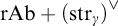 is strongly complete w.r.t.
 $$ \begin{align*}{{\mathbb K}}=\{{\boldsymbol{A}} \subseteq {\boldsymbol{R}} \mid (\forall a,b \in A) \; (b= \gamma \cdot a \implies a=0) \}.\end{align*} $$
Moreover, for any ${\boldsymbol {A}} \in \mathbf {IS}({\boldsymbol {R}})$
we have
${\boldsymbol {A}} \in \mathbf {IS}({\boldsymbol {R}})$
we have  if and only if ${\boldsymbol {A}} \in {{\mathbb K}}$
.
${\boldsymbol {A}} \in {{\mathbb K}}$
.
Proof. Since the logic 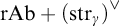 satisfies the conditions from Corollary 2.13, it is semilinear. Since
 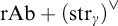 is an extension of ${\mathrm {rAb}}$
, we obtain that
${\mathrm {rAb}}$
, we obtain that 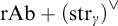 is strongly complete w.r.t. some subclass of $\mathbf {S}({\boldsymbol {R}})$
.
$\mathbf {S}({\boldsymbol {R}})$
.
We need the following technical observation.
Observation. Let ${\boldsymbol {A}} \subseteq {\boldsymbol {R}}$
and
${\boldsymbol {A}} \subseteq {\boldsymbol {R}}$
and $a,b \in A$
. Then we have
$a,b \in A$
. Then we have

Proof. First, since  and
and $q_0 < r_0$
, we can conclude that
$q_0 < r_0$
, we can conclude that  . We have
  and
and  . Consequently,
  . Therefore, we obtain $\gamma \cdot a=b$
. The other direction follows as well: if
$\gamma \cdot a=b$
. The other direction follows as well: if $\gamma \cdot a=b$
and
$\gamma \cdot a=b$
and $a \geq 0$
, then
$a \geq 0$
, then  for each $j \in \mathbb {N}$
(since
$j \in \mathbb {N}$
(since $a \geq 0$
and
$a \geq 0$
and $q_j$
is strictly increasing) and
$q_j$
is strictly increasing) and  for each $j \in \mathbb {N}$
(since
$j \in \mathbb {N}$
(since $a \geq 0$
and
$a \geq 0$
and $r_j$
is strictly decreasing).
$r_j$
is strictly decreasing).
First, let us take an arbitrary ${\boldsymbol {A}} \in \mathbb K$
. We show that
${\boldsymbol {A}} \in \mathbb K$
. We show that ${\boldsymbol {A}}$
satisfies
${\boldsymbol {A}}$
satisfies  . By the observation and the definition of ${{\mathbb K}}$
, if, for
${{\mathbb K}}$
, if, for $a,b \in A$
, we have
$a,b \in A$
, we have  and
and  for each $j \in \mathbb {N}$
, then it must be that
$j \in \mathbb {N}$
, then it must be that $a=0$
. Thus, any evaluation in
$a=0$
. Thus, any evaluation in ${\boldsymbol {A}}$
that satisfies the premise of
${\boldsymbol {A}}$
that satisfies the premise of $\mathrm {(str_\gamma )}$
must map
$\mathrm {(str_\gamma )}$
must map $\varphi $
to
$\varphi $
to $0$
, thereby satisfying the conclusion
$0$
, thereby satisfying the conclusion $\varphi \rightarrow \texttt {t}$
. Therefore,
$\varphi \rightarrow \texttt {t}$
. Therefore, $\mathrm {(str_\gamma )}$
is valid in
$\mathrm {(str_\gamma )}$
is valid in ${\boldsymbol {A}}$
. Since
${\boldsymbol {A}}$
. Since ${\boldsymbol {A}}$
is a chain, by Lemma 2.10
${\boldsymbol {A}}$
is a chain, by Lemma 2.10  is also valid in ${\boldsymbol {A}}$
, and thus
${\boldsymbol {A}}$
, and thus ${\boldsymbol {A}}$
is a model of
${\boldsymbol {A}}$
is a model of 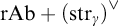 .
.
To prove the other direction, assume for an algebra ${\boldsymbol {{1}}} \neq {\boldsymbol {A}} \subseteq {\boldsymbol {R}}$
that there exist
${\boldsymbol {{1}}} \neq {\boldsymbol {A}} \subseteq {\boldsymbol {R}}$
that there exist $a,b \in A$
such that
$a,b \in A$
such that $b=\gamma \cdot a$
and
$b=\gamma \cdot a$
and $a \neq 0$
. Clearly,
$a \neq 0$
. Clearly, $\gamma \cdot (-a)=\ -b$
holds as well. Since
$\gamma \cdot (-a)=\ -b$
holds as well. Since ${\boldsymbol {A}}$
is totally ordered, we can assume without loss of generality that
${\boldsymbol {A}}$
is totally ordered, we can assume without loss of generality that $a> 0$
. By the observation, this implies that for each
$a> 0$
. By the observation, this implies that for each $j \in \mathbb {N}$
,
$j \in \mathbb {N}$
,  and
and  . But since $a,b \in A$
and
$a,b \in A$
and $a> 0$
, this is a counterexample to the validity of rule
$a> 0$
, this is a counterexample to the validity of rule $\mathrm {(str_\gamma )}$
in
$\mathrm {(str_\gamma )}$
in ${\boldsymbol {A}}$
. By Lemma 2.10,
${\boldsymbol {A}}$
. By Lemma 2.10,  fails in ${\boldsymbol {A}}$
as well. This shows that
${\boldsymbol {A}}$
as well. This shows that ${\boldsymbol {A}}$
is not a model of
${\boldsymbol {A}}$
is not a model of 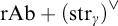 .
.
Clearly, for $\gamma _1,\gamma _2 \in {\boldsymbol {R}} \setminus {\boldsymbol {Q}}$
, the rules
$\gamma _1,\gamma _2 \in {\boldsymbol {R}} \setminus {\boldsymbol {Q}}$
, the rules  and
and  do not necessarily define different classes of models. For example, one can easily show that
  is valid in an algebra ${\boldsymbol {A}}$
if and only if
${\boldsymbol {A}}$
if and only if  is valid in ${\boldsymbol {A}}$
. Nevertheless, one can show the following.
${\boldsymbol {A}}$
. Nevertheless, one can show the following.
Corollary 3.6. There are $2^{2^\omega }$
infinitary extensions of Abelian logic between
$2^{2^\omega }$
infinitary extensions of Abelian logic between $\vDash _{\boldsymbol {R}}$
and
$\vDash _{\boldsymbol {R}}$
and $\vDash _{\boldsymbol {Q}}$
.
$\vDash _{\boldsymbol {Q}}$
.
Proof. It is a well-known result that the transcendence degree of ${\boldsymbol {R}}$
over
${\boldsymbol {R}}$
over ${\boldsymbol {Q}}$
is
${\boldsymbol {Q}}$
is $2^\omega $
. From this, it follows that there are
$2^\omega $
. From this, it follows that there are $2^{2^\omega }$
distinct subfields of
$2^{2^\omega }$
distinct subfields of ${\boldsymbol {R}}$
that are field extensions of
${\boldsymbol {R}}$
that are field extensions of ${\boldsymbol {Q}}$
. We argue that the
${\boldsymbol {Q}}$
. We argue that the $\ell $
-group reduct of each such field is a model of a different infinitary extension of Ab. Let
$\ell $
-group reduct of each such field is a model of a different infinitary extension of Ab. Let ${\boldsymbol {A}}$
and
${\boldsymbol {A}}$
and ${\boldsymbol {{B}}}$
be the
${\boldsymbol {{B}}}$
be the $\ell $
-group reducts of two distinct subfields of
$\ell $
-group reducts of two distinct subfields of ${\boldsymbol {R}}$
that are field extensions of
${\boldsymbol {R}}$
that are field extensions of ${\boldsymbol {Q}}$
. Without loss of generality, assume that there is a
${\boldsymbol {Q}}$
. Without loss of generality, assume that there is a $\gamma \in A \setminus B$
such that
$\gamma \in A \setminus B$
such that $0 < \gamma $
. By Proposition 3.5, an
$0 < \gamma $
. By Proposition 3.5, an $\ell $
-subgroup of
$\ell $
-subgroup of ${\boldsymbol {R}}$
validates the rule
${\boldsymbol {R}}$
validates the rule  if and only if $b=\gamma \cdot a \implies a=0$
for all
$b=\gamma \cdot a \implies a=0$
for all $a,b$
in the corresponding
$a,b$
in the corresponding $\ell $
-subgroup. Since
$\ell $
-subgroup. Since ${\boldsymbol {A}}$
and
${\boldsymbol {A}}$
and ${\boldsymbol {{B}}}$
are the
${\boldsymbol {{B}}}$
are the $\ell $
-group reducts of subfields of
$\ell $
-group reducts of subfields of ${\boldsymbol {R}}$
, this condition holds if and only if
${\boldsymbol {R}}$
, this condition holds if and only if $\gamma $
is not an element of their respective universes. Hence we obtain that the rule
$\gamma $
is not an element of their respective universes. Hence we obtain that the rule  is valid in ${\boldsymbol {{B}}}$
but is not valid in
${\boldsymbol {{B}}}$
but is not valid in ${\boldsymbol {A}}$
. This shows that
${\boldsymbol {A}}$
. This shows that $\vDash _{\boldsymbol {A}}$
and
$\vDash _{\boldsymbol {A}}$
and $\vDash _{\boldsymbol {{B}}}$
are different logics.
$\vDash _{\boldsymbol {{B}}}$
are different logics.
Note that Proposition 3.5 also hints at a possible axiomatization of the logic $\vDash _{\boldsymbol {Q}}$
. Indeed we can easily observe that
$\vDash _{\boldsymbol {Q}}$
. Indeed we can easily observe that $\vDash _{\boldsymbol {Q}}$
is axiomatized as
$\vDash _{\boldsymbol {Q}}$
is axiomatized as  iff this logic is semilinear (which we unfortunately do not know, as Corollary 2.13 works for countably axiomatized logics only). Therefore, the axiomatization of $\vDash _{\boldsymbol {Q}}$
remains as an open problem.
$\vDash _{\boldsymbol {Q}}$
remains as an open problem.
Finally, we show that $\vDash _{\boldsymbol {{Z}}}$
is strictly stronger than
$\vDash _{\boldsymbol {{Z}}}$
is strictly stronger than $\vDash _{\boldsymbol {Q}}$
. To this end, we propose the following infinitary rule IDC (standing for “infinite decreasing chain”):
$\vDash _{\boldsymbol {Q}}$
. To this end, we propose the following infinitary rule IDC (standing for “infinite decreasing chain”):
 $$ \begin{align} \{ 2\cdot \varphi_{n+1} \rightarrow \varphi_{n}, \varphi_n \rightarrow 4 \cdot \varphi_{n+1} \mid n \in \mathbb{N}\} \mathrel{\blacktriangleright} \varphi_0 \rightarrow \texttt{t} \end{align} $$
and prove the following theorem.
Theorem 3.7. Let ${\boldsymbol {A}}$
be a non-trivial linearly ordered Archimedean Abelian
${\boldsymbol {A}}$
be a non-trivial linearly ordered Archimedean Abelian $\ell $
-group. Then (IDC) is valid in
$\ell $
-group. Then (IDC) is valid in ${\boldsymbol {A}}$
iff
${\boldsymbol {A}}$
iff ${\boldsymbol {A}}$
is isomorphic to
${\boldsymbol {A}}$
is isomorphic to ${\boldsymbol {{Z}}}$
.
${\boldsymbol {{Z}}}$
.
Before we prove this theorem, let us state a conjecture based on this result.Footnote 5
Conjecture 3.8. The logic $\vDash _{\boldsymbol {{Z}}}$
is the extension of Ab by the rules (Arch)
$\vDash _{\boldsymbol {{Z}}}$
is the extension of Ab by the rules (Arch)
 and (IDC) $^\vee $
.
$^\vee $
.
Observe that the conjecture holds if and only if ${\mathrm {Ab}}+\mathrm {(IDC)}^\vee +\mathrm {(Arch)}^\vee $
is a semilinear logic. Unfortunately, the rule (IDC) uses infinitely many variables and thus, while we know that
${\mathrm {Ab}}+\mathrm {(IDC)}^\vee +\mathrm {(Arch)}^\vee $
is a semilinear logic. Unfortunately, the rule (IDC) uses infinitely many variables and thus, while we know that $\vee $
is a strong disjunction in
$\vee $
is a strong disjunction in ${\mathrm {Ab}}+\mathrm {(IDC)}^\vee +\mathrm {(Arch)}^\vee $
by Corollary 2.13, we do not know whether this logic is actually a semilinear logic.
${\mathrm {Ab}}+\mathrm {(IDC)}^\vee +\mathrm {(Arch)}^\vee $
by Corollary 2.13, we do not know whether this logic is actually a semilinear logic.
This is, however, a systematic problem as any rule valid in $\vDash _{\boldsymbol {{Z}}}$
but not in
$\vDash _{\boldsymbol {{Z}}}$
but not in $\vDash _{\boldsymbol {Q}}$
has to use infinitely many variables. Indeed, since any finitely generated subalgebra of
$\vDash _{\boldsymbol {Q}}$
has to use infinitely many variables. Indeed, since any finitely generated subalgebra of ${\boldsymbol {Q}}$
is isomorphic to
${\boldsymbol {Q}}$
is isomorphic to ${\boldsymbol {{Z}}}$
, any rule with finitely many variables valid in
${\boldsymbol {{Z}}}$
, any rule with finitely many variables valid in $\vDash _{\boldsymbol {{Z}}}$
must also be valid in
$\vDash _{\boldsymbol {{Z}}}$
must also be valid in $\vDash _{\boldsymbol {Q}}$
.
$\vDash _{\boldsymbol {Q}}$
.
Let us now proceed towards the proof of Theorem 3.7. First, we need to introduce a machinery of decreasing sequences (which justifies the name of the rule).
Definition 3.9. Let ${\boldsymbol {A}}$
be an Abelian
${\boldsymbol {A}}$
be an Abelian $\ell $
-group. A sequence
$\ell $
-group. A sequence  of elements of A is strongly decreasing if, for each $i \in \mathbb {N}$
, there is an
$i \in \mathbb {N}$
, there is an $n_{i} \geq 4$
such that:
$n_{i} \geq 4$
such that:
 $$ \begin{align*}n_{i} \cdot a_{i+1} \geq a_i \geq 2 \cdot a_{i+1}. \end{align*} $$
We call the sequence trivial if $a_i = 0$
for each i.
$a_i = 0$
for each i.
Let us note that any non-trivial strongly decreasing sequence in ${\boldsymbol {A}}$
is indeed decreasing and
${\boldsymbol {A}}$
is indeed decreasing and $a_i \geq 0$
for each
$a_i \geq 0$
for each $i \geq 1$
. The latter claim follows from the fact that for each i there is an
$i \geq 1$
. The latter claim follows from the fact that for each i there is an $n_i\geq 4$
such that
$n_i\geq 4$
such that $n_i \cdot a_i \geq 2n_i \cdot a_{i+1} \geq 2 \cdot a_i$
, thus
$n_i \cdot a_i \geq 2n_i \cdot a_{i+1} \geq 2 \cdot a_i$
, thus $(n_i-2) \cdot a_i \geq 0$
, from which one can derive
$(n_i-2) \cdot a_i \geq 0$
, from which one can derive $a_i \geq 0$
(since in
$a_i \geq 0$
(since in ${\boldsymbol {{Z}}}$
for any
${\boldsymbol {{Z}}}$
for any $n \geq 1$
the quasiequation
$n \geq 1$
the quasiequation $n \cdot x\geq 0 \implies x\geq 0$
is valid, it holds in
$n \cdot x\geq 0 \implies x\geq 0$
is valid, it holds in ${\boldsymbol {A}}$
). The former claim then follows from the validity of
${\boldsymbol {A}}$
). The former claim then follows from the validity of $x \geq 0 \implies 2 \cdot x \geq x$
in
$x \geq 0 \implies 2 \cdot x \geq x$
in ${\boldsymbol {{Z}}}$
.
${\boldsymbol {{Z}}}$
.
Lemma 3.10. Let  be a non-trivial sequence of elements of an Abelian $\ell $
-group
$\ell $
-group ${\boldsymbol {A}}$
. If
${\boldsymbol {A}}$
. If  is strongly decreasing, then it is strictly decreasing. If ${\boldsymbol {A}}$
is an Archimedean chain and it has a strictly decreasing sequence of positive elements, then it also has a non-trivial strongly decreasing sequence.
${\boldsymbol {A}}$
is an Archimedean chain and it has a strictly decreasing sequence of positive elements, then it also has a non-trivial strongly decreasing sequence.
Proof. To prove the first claim, it suffices to show the strictness. Assume that ${a_i=a_{i+1}}$
for some
${a_i=a_{i+1}}$
for some $i \in \mathbb {N}$
. Then the inequality
$i \in \mathbb {N}$
. Then the inequality $a_i \geq 2 \cdot a_{i+1}$
becomes
$a_i \geq 2 \cdot a_{i+1}$
becomes $a_i \geq 2 \cdot a_i$
and thus
$a_i \geq 2 \cdot a_i$
and thus $0 \geq a_i.$
Since also
$0 \geq a_i.$
Since also $a_i \geq 0$
, we obtain
$a_i \geq 0$
, we obtain $a_i=0$
. For each
$a_i=0$
. For each $j> i$
we have
$j> i$
we have $a_i \geq a_j \geq 0$
, thus we get
$a_i \geq a_j \geq 0$
, thus we get $a_j=0$
as well. Similarly, for
$a_j=0$
as well. Similarly, for $j < i$
, there is an
$j < i$
, there is an $n \in \mathbb {N}$
such that
$n \in \mathbb {N}$
such that $n \cdot a_i \geq a_j \geq 0$
and thus again
$n \cdot a_i \geq a_j \geq 0$
and thus again $a_j=0$
. Therefore, the sequence
$a_j=0$
. Therefore, the sequence  has to be trivial, a contradiction.
We will prove the second claim. Let us assume that ${\boldsymbol {A}}$
is an Archimedean chain and
${\boldsymbol {A}}$
is an Archimedean chain and  is a strictly decreasing sequence of positive elements. Without loss of generality, as ${\boldsymbol {A}}$
is Archimedean, we can assume that
${\boldsymbol {A}}$
is Archimedean, we can assume that ${\boldsymbol {A}} \subseteq {\boldsymbol {R}}$
, by Hölder’s Theorem. We construct a non-trivial strongly decreasing sequence
${\boldsymbol {A}} \subseteq {\boldsymbol {R}}$
, by Hölder’s Theorem. We construct a non-trivial strongly decreasing sequence  . Set
. Set $b_0> 0$
arbitrarily. We will define the rest of the sequence recursively. Assume that we have already constructed
$b_0> 0$
arbitrarily. We will define the rest of the sequence recursively. Assume that we have already constructed  satisfying the conditions from the definition of a strongly decreasing sequence. Now we want a $b_{n+1}$
such that
$b_{n+1}$
such that  .
.
Since  is a strictly decreasing sequence, it follows that there exists a $j \in \mathbb {N}$
such that
$j \in \mathbb {N}$
such that $\frac {a_j}{b_n} \notin \mathbb Z$
(otherwise
$\frac {a_j}{b_n} \notin \mathbb Z$
(otherwise  would be a strictly decreasing sequence of positive elements in ${\boldsymbol {{Z}}}$
, which is not possible).
${\boldsymbol {{Z}}}$
, which is not possible).
Since ${\boldsymbol {A}}$
is Archimedean, there is a
${\boldsymbol {A}}$
is Archimedean, there is a $k \in \mathbb {N}$
such that
$k \in \mathbb {N}$
such that  . Since $\frac {a_j}{b_n} \notin \mathbb Z$
, we have
$\frac {a_j}{b_n} \notin \mathbb Z$
, we have $0 \neq a_j -k \cdot b_n$
and thus
$0 \neq a_j -k \cdot b_n$
and thus $0 < a_j -k \cdot b_n < b_n$
. Hence,
$0 < a_j -k \cdot b_n < b_n$
. Hence,

Therefore, we set
 $$ \begin{align*}b_{n+1}=\min\{a_j -k \cdot b_n, b_n-(a_j -k \cdot b_n)\}.\end{align*} $$
Clearly, $b_{n+1}>0$
and
$b_{n+1}>0$
and  . The second condition for strong decreasing sequences easily follows from the fact that ${\boldsymbol {A}}$
is Archimedean. Thus,
${\boldsymbol {A}}$
is Archimedean. Thus,  is a non-trivial strongly decreasing sequence.
Example 3.11. We will show that there are non-Archimedean chains with strictly decreasing sequences of positive elements and with no non-trivial strongly decreasing sequence. Consider the $\ell $
-group
$\ell $
-group ${\boldsymbol {{Z}}} \times _{\text {lex}} {\boldsymbol {{Z}}}$
from Example 3.3. First, let us consider the sequence
${\boldsymbol {{Z}}} \times _{\text {lex}} {\boldsymbol {{Z}}}$
from Example 3.3. First, let us consider the sequence 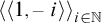 . Clearly, this sequence is strictly decreasing and
  for each $i \in \mathbb {N}$
. We show that there is no non-trivial strongly decreasing sequence in
$i \in \mathbb {N}$
. We show that there is no non-trivial strongly decreasing sequence in ${\boldsymbol {{Z}}} \times _{\text {lex}} {\boldsymbol {{Z}}}$
.
${\boldsymbol {{Z}}} \times _{\text {lex}} {\boldsymbol {{Z}}}$
.
Let us assume that 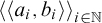 is a strongly decreasing sequence. Clearly $a_i \geq 0$
for all
$a_i \geq 0$
for all $i \in \mathbb {N}$
since
$i \in \mathbb {N}$
since  . Thus, there has to be a $c \geq 0$
such that
$c \geq 0$
such that $a_i=c$
for infinitely many
$a_i=c$
for infinitely many $i \in \mathbb {N}$
. Therefore, there has to be a strongly decreasing subsequence
$i \in \mathbb {N}$
. Therefore, there has to be a strongly decreasing subsequence  , where $d_i \in \mathbb Z$
and
$d_i \in \mathbb Z$
and $c \geq 0$
. Fix an arbitrary
$c \geq 0$
. Fix an arbitrary $i \in \mathbb {N}$
. We know that
$i \in \mathbb {N}$
. We know that  , thus
  . This implies $c=0$
.
$c=0$
.
Since  is a strongly decreasing sequence in ${\boldsymbol {{Z}}} \times _{\text {lex}} {\boldsymbol {{Z}}}$
, the sequence
${\boldsymbol {{Z}}} \times _{\text {lex}} {\boldsymbol {{Z}}}$
, the sequence  is strongly decreasing in ${\boldsymbol {{Z}}}$
. Therefore,
${\boldsymbol {{Z}}}$
. Therefore, $d_i=0$
for all
$d_i=0$
for all $i \in \mathbb {N}$
. This shows that
$i \in \mathbb {N}$
. This shows that  has to be the trivial sequence and so is
 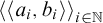 as well.
Proposition 3.12. Let ${\boldsymbol {A}}$
be an Abelian
${\boldsymbol {A}}$
be an Abelian $\ell $
-group. Then (IDC) is valid in
$\ell $
-group. Then (IDC) is valid in ${\boldsymbol {A}}$
iff only the trivial sequence is strongly decreasing in
${\boldsymbol {A}}$
iff only the trivial sequence is strongly decreasing in ${\boldsymbol {A}}$
.
${\boldsymbol {A}}$
.
Proof. First, assume that ${\boldsymbol {A}}$
has a non-trivial strongly decreasing sequence
${\boldsymbol {A}}$
has a non-trivial strongly decreasing sequence  and note that w.l.o.g. we can assume that $n_i = 4$
for each i (if for some i we have
$n_i = 4$
for each i (if for some i we have $a_i> 4\cdot a_{i+1}$
, expand the sequence by putting
$a_i> 4\cdot a_{i+1}$
, expand the sequence by putting $2\cdot a_{i+1}$
in a proper place, and repeat …). Let us consider the
$2\cdot a_{i+1}$
in a proper place, and repeat …). Let us consider the ${\boldsymbol {A}}$
-evaluation e induced by setting
${\boldsymbol {A}}$
-evaluation e induced by setting $e(x_i) = a_i$
. Clearly, all the premises of (IDC) are valid but we have
$e(x_i) = a_i$
. Clearly, all the premises of (IDC) are valid but we have $e(x_0 \rightarrow \texttt {t}) = - a_0 < 0$
and thus the rule (IDC) is not valid in
$e(x_0 \rightarrow \texttt {t}) = - a_0 < 0$
and thus the rule (IDC) is not valid in ${\boldsymbol {A}}$
.
${\boldsymbol {A}}$
.
Conversely, assume that the rule (IDC) is not valid in ${\boldsymbol {A}}$
, i.e., we have an evaluation e such that if we set
${\boldsymbol {A}}$
, i.e., we have an evaluation e such that if we set $e(\varphi _i) = a_i$
the validity of premises of (IDC) tells us that
$e(\varphi _i) = a_i$
the validity of premises of (IDC) tells us that $4 \cdot a_{i+1} \geq a_{i} \geq 2 \cdot a_{i+1}$
, i.e.,
$4 \cdot a_{i+1} \geq a_{i} \geq 2 \cdot a_{i+1}$
, i.e.,  is a strongly decreasing sequence and, by the failure of the conclusion of the rule, we have $a_0> 0$
, i.e., the sequence is non-trivial.
$a_0> 0$
, i.e., the sequence is non-trivial.
The previous proposition gives us a description of Abelian $\ell $
-groups satisfying (IDC) in terms of the existence of strongly decreasing sequences. Lemma 3.10 shows that there is a connection between strictly decreasing sequences of positive elements and strongly decreasing sequences. Therefore, it is natural to ask whether the previous proposition could be stated in terms of the existence of strictly decreasing sequences of positive elements. The following example shows that this is not the case.
$\ell $
-groups satisfying (IDC) in terms of the existence of strongly decreasing sequences. Lemma 3.10 shows that there is a connection between strictly decreasing sequences of positive elements and strongly decreasing sequences. Therefore, it is natural to ask whether the previous proposition could be stated in terms of the existence of strictly decreasing sequences of positive elements. The following example shows that this is not the case.
Example 3.13. There exist $\ell $
-groups in
$\ell $
-groups in $\mathbf {P}({\boldsymbol {{Z}}})$
which have strictly decreasing sequences of positive elements but lack a non-trivial strongly decreasing sequence.
$\mathbf {P}({\boldsymbol {{Z}}})$
which have strictly decreasing sequences of positive elements but lack a non-trivial strongly decreasing sequence.
Consider the Abelian $\ell $
-group
$\ell $
-group ${\boldsymbol {{Z}}}^\omega $
and note that the sequence of positive elements
${\boldsymbol {{Z}}}^\omega $
and note that the sequence of positive elements

is strictly decreasing. However, the previous proposition clearly states that only the trivial sequence is strongly decreasing in ${\boldsymbol {{Z}}}^{\omega }$
, since
${\boldsymbol {{Z}}}^{\omega }$
, since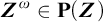 ${\boldsymbol {{Z}}}^{\omega } \in \mathbf {P}({\boldsymbol {{Z}}})$
,
${\boldsymbol {{Z}}}^{\omega } \in \mathbf {P}({\boldsymbol {{Z}}})$
, $\mathbf {P}({\boldsymbol {{Z}}}) \subseteq \mathbf {ISP}_\omega ({\boldsymbol {{Z}}})$
, and (IDC) holds in
$\mathbf {P}({\boldsymbol {{Z}}}) \subseteq \mathbf {ISP}_\omega ({\boldsymbol {{Z}}})$
, and (IDC) holds in $\mathbf {ISP}_\omega ({\boldsymbol {{Z}}})$
.
$\mathbf {ISP}_\omega ({\boldsymbol {{Z}}})$
.
Now we are finally ready to give the promised proof of Theorem 3.7.
Proof of Theorem 3.7
Let ${\boldsymbol {A}}$
be a non-trivial linearly ordered Archimedean Abelian
${\boldsymbol {A}}$
be a non-trivial linearly ordered Archimedean Abelian $\ell $
-group. We want to show that (IDC) is valid in
$\ell $
-group. We want to show that (IDC) is valid in ${\boldsymbol {A}}$
if and only if
${\boldsymbol {A}}$
if and only if ${\boldsymbol {A}}$
is isomorphic to
${\boldsymbol {A}}$
is isomorphic to ${\boldsymbol {{Z}}}$
. By the previous proposition, (IDC) is valid in
${\boldsymbol {{Z}}}$
. By the previous proposition, (IDC) is valid in ${\boldsymbol {A}}$
if and only if
${\boldsymbol {A}}$
if and only if ${\boldsymbol {A}}$
has only the trivial strongly decreasing sequence.
${\boldsymbol {A}}$
has only the trivial strongly decreasing sequence.
Since ${\boldsymbol {A}}$
is an Archimedean chain, by Lemma 3.10, having only the trivial strongly decreasing sequence is equivalent to having no strictly decreasing sequence of positive elements.
${\boldsymbol {A}}$
is an Archimedean chain, by Lemma 3.10, having only the trivial strongly decreasing sequence is equivalent to having no strictly decreasing sequence of positive elements.
Thus, it suffices to show that a non-trivial linearly ordered Archimedean $\ell $
-group
$\ell $
-group ${\boldsymbol {A}}$
has no strictly decreasing sequence of positive elements if and only if
${\boldsymbol {A}}$
has no strictly decreasing sequence of positive elements if and only if ${\boldsymbol {A}} \cong {\boldsymbol {{Z}}}$
.
${\boldsymbol {A}} \cong {\boldsymbol {{Z}}}$
.
Clearly, ${\boldsymbol {{Z}}}$
has no decreasing sequences of positive elements. To show the other implication, one has to argue that
${\boldsymbol {{Z}}}$
has no decreasing sequences of positive elements. To show the other implication, one has to argue that ${\boldsymbol {{Z}}}$
is the only non-trivial linearly ordered Archimedean
${\boldsymbol {{Z}}}$
is the only non-trivial linearly ordered Archimedean $\ell $
-group with no strictly decreasing sequences of positive elements. We can assume, by Hölder’s Theorem, that without loss of generality,
$\ell $
-group with no strictly decreasing sequences of positive elements. We can assume, by Hölder’s Theorem, that without loss of generality, ${\boldsymbol {{Z}}} \subseteq {\boldsymbol {A}} \subseteq {\boldsymbol {R}}$
and
${\boldsymbol {{Z}}} \subseteq {\boldsymbol {A}} \subseteq {\boldsymbol {R}}$
and ${\boldsymbol {A}}$
is not isomorphic to
${\boldsymbol {A}}$
is not isomorphic to ${\boldsymbol {{Z}}}$
. We have to distinguish two cases.
${\boldsymbol {{Z}}}$
. We have to distinguish two cases.
-
1. Let
$\zeta \in \mathbb R\setminus \mathbb Q$
be an element of A. Without loss of generality we can assume
$\zeta>1$
. Since
$1 \in A$
, we can generate recursively the following sequence. We start with
$r_0=\zeta $
and
$r_1=1$
. For
$n> 0$
, we define and let
$r_{n+1}=r_{n-1}-k_n \cdot r_n$
. By the properties of division, for all
$n \geq 1$
. This means that the sequence is strictly decreasing. Furthermore, because
$\zeta $
is irrational, the ratio
$\frac {r_n}{r_{n+1}}$
is irrational for each
$n \in \mathbb {N}$
. This shows that this algorithm never terminates with a zero remainder; thus,
$r_n>0$
for all n. -
2.
${\boldsymbol {A}} \subseteq \mathbb {\boldsymbol {Q}}$
. Since
${\boldsymbol {A}}$
is not isomorphic to
${\boldsymbol {{Z}}}$
,
${\boldsymbol {A}}$
is not generated by any single element. Thus, for each
$0<a_n \in A$
, there is a
$0<b_n \in A$
such that
$a_n$
does not generate
$b_n$
. If
$b_n<a_n$
we set
$a_{n+1}=b_n$
; otherwise, we set and
$a_{n+1}=b_n- k_n \cdot a_n$
. Thus, we have constructed
$0<a_{n+1}<a_n$
. This allows us to build the desired sequence, and therefore we finish the proof.


 and let
 for all
 is strictly decreasing. Furthermore, because


 and
and 

4 Pointed Abelian logic
In the previous sections, we have explored the landscape of Abelian logic and its infinitary extensions. We now turn our attention to expansions, that is, we allow not only new rules, but also enriched logical languages. This section introduces pointed Abelian logic $({\mathrm {pAb}})$
, which extends Abelian logic with a new constant symbol
$({\mathrm {pAb}})$
, which extends Abelian logic with a new constant symbol $\texttt {f}$
. This seemingly simple addition of an additional “point” to the algebraic semantics dramatically alters the character of the logic. Whereas Abelian logic has no non-trivial finitary extensions, we will show that this pointed version gives rise to a plentiful landscape of logical extensions.Footnote
6
The central result of this section is a completeness theorem demonstrating that this new logic is finitely strongly complete with respect to just three canonical pointed structures over the real numbers:
$\texttt {f}$
. This seemingly simple addition of an additional “point” to the algebraic semantics dramatically alters the character of the logic. Whereas Abelian logic has no non-trivial finitary extensions, we will show that this pointed version gives rise to a plentiful landscape of logical extensions.Footnote
6
The central result of this section is a completeness theorem demonstrating that this new logic is finitely strongly complete with respect to just three canonical pointed structures over the real numbers: ${\boldsymbol {R}}_{-1}, {\boldsymbol {R}}_0$
, and
${\boldsymbol {R}}_{-1}, {\boldsymbol {R}}_0$
, and ${\boldsymbol {R}}_1$
.
${\boldsymbol {R}}_1$
.
Let us consider the expansion of the language $\mathcal L_{\mathrm {Ab}}$
of Abelian logic by a new constant symbol
$\mathcal L_{\mathrm {Ab}}$
of Abelian logic by a new constant symbol $\texttt {f}$
. We denote this language by
$\texttt {f}$
. We denote this language by $\mathcal L_{\mathrm {pAb}}$
. In this section, we study the minimal expansion of Ab in this language.
$\mathcal L_{\mathrm {pAb}}$
. In this section, we study the minimal expansion of Ab in this language.
Definition 4.1. The pointed Abelian logic is the least expansion of Ab in the language $\mathcal L_{\mathrm {pAb}}$
, i.e., it is axiomatized by the same axiomatic system as Ab only closed under substitution of the expanded language.
$\mathcal L_{\mathrm {pAb}}$
, i.e., it is axiomatized by the same axiomatic system as Ab only closed under substitution of the expanded language.
Recall that Full Lambek logic with exchange, ${\mathrm {FL}}_{\mathrm {e}}$
, is a prominent substructural logic in the language of
${\mathrm {FL}}_{\mathrm {e}}$
, is a prominent substructural logic in the language of $\mathcal L_{\mathrm {pAb}}$
which is axiomatized by omitting the axiom
$\mathcal L_{\mathrm {pAb}}$
which is axiomatized by omitting the axiom $\mathrm {(rel)}$
from the axiomatic system given in Table 1. Thus, pointed Abelian logic is the extension of
$\mathrm {(rel)}$
from the axiomatic system given in Table 1. Thus, pointed Abelian logic is the extension of ${\mathrm {FL}}_{\mathrm {e}}$
by axiom
${\mathrm {FL}}_{\mathrm {e}}$
by axiom $\mathrm {(rel)}$
.
$\mathrm {(rel)}$
.
Interestingly, we can see Ab as an extension of ${\mathrm {pAb}}$
by the axiom which collapses both constants:
${\mathrm {pAb}}$
by the axiom which collapses both constants:
 $$ \begin{align*}(\texttt{f}\to\texttt{t})\wedge(\texttt{t}\to\texttt{f}). \end{align*} $$
Therefore, sometimes in the literature Ab is presented as the expansion of ${\mathrm {FL}}_{\mathrm {e}}$
by axioms
${\mathrm {FL}}_{\mathrm {e}}$
by axioms $\mathrm {(rel)}$
and
$\mathrm {(rel)}$
and $(\texttt {f}\to \texttt {t})\wedge (\texttt {t}\to \texttt {f})$
. But, as we have commented in footnote 3, we prefer to see
$(\texttt {f}\to \texttt {t})\wedge (\texttt {t}\to \texttt {f})$
. But, as we have commented in footnote 3, we prefer to see ${\mathrm {pAb}}$
as an expansion of Ab.
${\mathrm {pAb}}$
as an expansion of Ab.
Clearly, ${\mathrm {pAb}}$
and all its extensions have
${\mathrm {pAb}}$
and all its extensions have ${\mathrm {(sCng)}}$
and hence they are superabelian logics. Therefore, it is easy to see that
${\mathrm {(sCng)}}$
and hence they are superabelian logics. Therefore, it is easy to see that $\mathbf {Alg}^*({\mathrm {pAb}})$
, i.e., the equivalent algebraic semantic of
$\mathbf {Alg}^*({\mathrm {pAb}})$
, i.e., the equivalent algebraic semantic of ${\mathrm {pAb}}$
, is the class of pointed Abelian
${\mathrm {pAb}}$
, is the class of pointed Abelian $\ell $
-groups, i.e., Abelian
$\ell $
-groups, i.e., Abelian $\ell $
-groups expanded to the language
$\ell $
-groups expanded to the language $\mathcal L_{\mathrm {pAb}}$
with a new constant symbol interpreted in an arbitrary way.
$\mathcal L_{\mathrm {pAb}}$
with a new constant symbol interpreted in an arbitrary way.
To be able to easily talk about particular ${\mathrm {pAb}}$
-algebras, we present the following definition.
${\mathrm {pAb}}$
-algebras, we present the following definition.
Definition 4.2. Let us have an algebra ${\boldsymbol {A}}$
in a language
${\boldsymbol {A}}$
in a language $\mathcal L$
such that
$\mathcal L$
such that $\texttt {f} \notin \mathcal L$
and take an element
$\texttt {f} \notin \mathcal L$
and take an element $a \in A$
. By
$a \in A$
. By ${\boldsymbol {A}}_a$
we denote the algebra in the language
${\boldsymbol {A}}_a$
we denote the algebra in the language $\mathcal L \cup \{\texttt {f}\}$
, which is the expansion of
$\mathcal L \cup \{\texttt {f}\}$
, which is the expansion of ${\boldsymbol {A}}$
and where the constant symbol
${\boldsymbol {A}}$
and where the constant symbol $\texttt {f}$
is interpreted as a.
$\texttt {f}$
is interpreted as a.
If ${{\mathbb K}}$
is a class of algebras, by
${{\mathbb K}}$
is a class of algebras, by $\mathbf {p}{{\mathbb K}}$
we denote
$\mathbf {p}{{\mathbb K}}$
we denote $\{{\boldsymbol {A}}_a \mid {\boldsymbol {A}} \in {{\mathbb K}}, a \in A\}$
. For a singleton
$\{{\boldsymbol {A}}_a \mid {\boldsymbol {A}} \in {{\mathbb K}}, a \in A\}$
. For a singleton $\{{\boldsymbol {A}}\}$
, we may write
$\{{\boldsymbol {A}}\}$
, we may write $\mathbf {p} {\boldsymbol {A}}$
instead of
$\mathbf {p} {\boldsymbol {A}}$
instead of $\mathbf {p} \{{\boldsymbol {A}}\}$
.
$\mathbf {p} \{{\boldsymbol {A}}\}$
. ${\boldsymbol {R}}_{-1}$
,
${\boldsymbol {R}}_{-1}$
, ${\boldsymbol {R}}_0$
, and
${\boldsymbol {R}}_0$
, and ${\boldsymbol {R}}_1$
are natural examples of pointed Abelian
${\boldsymbol {R}}_1$
are natural examples of pointed Abelian $\ell $
-groups. Note that obviously,
$\ell $
-groups. Note that obviously, $\mathbf {Alg}^*({\mathrm {pAb}}) = \mathbf {p} \mathbb {AL}$
. It is also a straightforward, albeit rather technical, matter to show that this pointing operator
$\mathbf {Alg}^*({\mathrm {pAb}}) = \mathbf {p} \mathbb {AL}$
. It is also a straightforward, albeit rather technical, matter to show that this pointing operator $\mathbf {p}$
commutes with the standard algebraic class operators for taking isomorphisms, subalgebras, products, and ultraproducts.
$\mathbf {p}$
commutes with the standard algebraic class operators for taking isomorphisms, subalgebras, products, and ultraproducts.
Theorem 4.3. Let ${\boldsymbol {A}}$
be a non-trivial Abelian
${\boldsymbol {A}}$
be a non-trivial Abelian $\ell $
-group.
$\ell $
-group. ${\mathrm {pAb}}$
is finitely strongly complete w.r.t.
${\mathrm {pAb}}$
is finitely strongly complete w.r.t. $\mathbf {p} {\boldsymbol {A}}=\{{\boldsymbol {A}}_a\mid a \in {\boldsymbol {A}}\}$
.
$\mathbf {p} {\boldsymbol {A}}=\{{\boldsymbol {A}}_a\mid a \in {\boldsymbol {A}}\}$
.
Proof. Assume that $\Gamma \not \vdash _{\mathrm {pAb}}\varphi $
. Given an
$\Gamma \not \vdash _{\mathrm {pAb}}\varphi $
. Given an $\mathcal L_{\mathrm {pAb}}$
-formula
$\mathcal L_{\mathrm {pAb}}$
-formula $\psi $
, we define an
$\psi $
, we define an $\mathcal L_{\mathrm {Ab}}$
-formula
$\mathcal L_{\mathrm {Ab}}$
-formula $\psi '$
by replacing all occurrences of
$\psi '$
by replacing all occurrences of $\texttt {f}$
by an arbitrary fixed variable p not occurring in
$\texttt {f}$
by an arbitrary fixed variable p not occurring in $\Gamma \cup \{\varphi \}$
. Let us denote
$\Gamma \cup \{\varphi \}$
. Let us denote $\Gamma '=\{\psi ' \mid \psi \in \Gamma \}$
. Then, clearly,
$\Gamma '=\{\psi ' \mid \psi \in \Gamma \}$
. Then, clearly, $\Gamma '\not \vdash _{\mathrm {Ab}}\varphi '$
and so
$\Gamma '\not \vdash _{\mathrm {Ab}}\varphi '$
and so $\Gamma '\not \vDash _{\boldsymbol {A}}\varphi '$
as witnessed by an evaluation e which entails
$\Gamma '\not \vDash _{\boldsymbol {A}}\varphi '$
as witnessed by an evaluation e which entails $\Gamma \not \vDash _{{\boldsymbol {A}}_{e(p)}}\varphi $
.
$\Gamma \not \vDash _{{\boldsymbol {A}}_{e(p)}}\varphi $
.
Let us formulate a trivial lemma which allows us to improve the previous result for ${\boldsymbol {A}}$
being either
${\boldsymbol {A}}$
being either ${\boldsymbol {R}}$
or
${\boldsymbol {R}}$
or ${\boldsymbol {Q}}$
and will also be of use later.
${\boldsymbol {Q}}$
and will also be of use later.
Lemma 4.4. Let ${\boldsymbol {A}}$
be either
${\boldsymbol {A}}$
be either ${\boldsymbol {R}}$
or
${\boldsymbol {R}}$
or ${\boldsymbol {Q}}$
and
${\boldsymbol {Q}}$
and $a,b \in A\setminus \{0\}$
. Then,
$a,b \in A\setminus \{0\}$
. Then, ${\boldsymbol {A}}_a$
and
${\boldsymbol {A}}_a$
and ${\boldsymbol {A}}_b$
are isomorphic iff
${\boldsymbol {A}}_b$
are isomorphic iff $a \cdot b> 0$
.
$a \cdot b> 0$
.
Proof. If $\mathbf {A}_a$
and
$\mathbf {A}_a$
and $\mathbf {A}_b$
are isomorphic, the isomorphism must preserve the underlying natural order, which trivially forces the designated units a and b to have the same sign; hence
$\mathbf {A}_b$
are isomorphic, the isomorphism must preserve the underlying natural order, which trivially forces the designated units a and b to have the same sign; hence $a \cdot b> 0$
. For the other direction, assume
$a \cdot b> 0$
. For the other direction, assume $a \cdot b> 0$
. Then
$a \cdot b> 0$
. Then $\frac {b}{a}> 0$
, and the mapping
$\frac {b}{a}> 0$
, and the mapping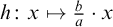 $h\colon x \mapsto \frac {b}{a} \cdot x$
is an order-preserving group automorphism mapping a to b, providing the needed isomorphism.
$h\colon x \mapsto \frac {b}{a} \cdot x$
is an order-preserving group automorphism mapping a to b, providing the needed isomorphism.
Theorem 4.5. The logic ${\mathrm {pAb}}$
is finitely strongly complete w.r.t.
${\mathrm {pAb}}$
is finitely strongly complete w.r.t. $\{{\boldsymbol {R}}_{-1},{\boldsymbol {R}}_0,{\boldsymbol {R}}_1\}$
and w.r.t.
$\{{\boldsymbol {R}}_{-1},{\boldsymbol {R}}_0,{\boldsymbol {R}}_1\}$
and w.r.t. $\{{\boldsymbol {Q}}_{-1},{\boldsymbol {Q}}_0,{\boldsymbol {Q}}_1\}$
.
$\{{\boldsymbol {Q}}_{-1},{\boldsymbol {Q}}_0,{\boldsymbol {Q}}_1\}$
.
Observe that the same would not work, e.g., for the Abelian $\ell $
-group of the integers, since
$\ell $
-group of the integers, since ${\boldsymbol {{Z}}}_a$
and
${\boldsymbol {{Z}}}_a$
and ${\boldsymbol {{Z}}}_b$
are not isomorphic unless
${\boldsymbol {{Z}}}_b$
are not isomorphic unless $a=b$
. In fact, one can show that
$a=b$
. In fact, one can show that ${\boldsymbol {{Z}}}_a$
generates a different variety for each
${\boldsymbol {{Z}}}_a$
generates a different variety for each $a \in \mathbb Z$
.
$a \in \mathbb Z$
.
Proposition 4.6. For any $a,b \in \mathbb {Z}$
, we have
$a,b \in \mathbb {Z}$
, we have $\mathbf {HSP}({\boldsymbol {{Z}}}_a)=\mathbf {HSP}({\boldsymbol {{Z}}}_b)$
if and only if
$\mathbf {HSP}({\boldsymbol {{Z}}}_a)=\mathbf {HSP}({\boldsymbol {{Z}}}_b)$
if and only if $a=b$
.
$a=b$
.
Proof. One direction is obvious. To prove the converse one, let us assume $a \neq b$
. To show that
$a \neq b$
. To show that $\mathbf {HSP}({\boldsymbol {{Z}}}_a) \neq \mathbf {HSP}({\boldsymbol {{Z}}}_b)$
, it is sufficient to find an equation which is valid in one of the generating algebras,
$\mathbf {HSP}({\boldsymbol {{Z}}}_a) \neq \mathbf {HSP}({\boldsymbol {{Z}}}_b)$
, it is sufficient to find an equation which is valid in one of the generating algebras, ${\boldsymbol {{Z}}}_a$
or
${\boldsymbol {{Z}}}_a$
or ${\boldsymbol {{Z}}}_b$
, but not in the other. If
${\boldsymbol {{Z}}}_b$
, but not in the other. If $a<0$
and
$a<0$
and $b \geq 0$
take the equation
$b \geq 0$
take the equation $\texttt {f} \geq 0$
. This equation clearly holds in
$\texttt {f} \geq 0$
. This equation clearly holds in ${\boldsymbol {{Z}}}_b$
but it does not hold in
${\boldsymbol {{Z}}}_b$
but it does not hold in ${\boldsymbol {{Z}}}_a$
. The case
${\boldsymbol {{Z}}}_a$
. The case  and
and $b>0$
is similar. Therefore, it remains to check the cases where
$b>0$
is similar. Therefore, it remains to check the cases where $a,b>0$
or
$a,b>0$
or $a,b<0$
. We will check only the first case (the second one is analogous). Moreover, let us assume without loss of generality that
$a,b<0$
. We will check only the first case (the second one is analogous). Moreover, let us assume without loss of generality that $0 <a<b$
.
$0 <a<b$
.
Consider the following equation:

This equation is not valid in ${\boldsymbol {{Z}}}_b$
, since if we take an evaluation e such that
${\boldsymbol {{Z}}}_b$
, since if we take an evaluation e such that $e(x)=1$
we get
$e(x)=1$
we get  . Thus the equation (*) does not hold in ${\boldsymbol {{Z}}}_b$
.
${\boldsymbol {{Z}}}_b$
.
We show the same equation holds in ${\boldsymbol {{Z}}}_a$
. First let us consider an evaluation e such that
${\boldsymbol {{Z}}}_a$
. First let us consider an evaluation e such that  . Clearly, we get $-e(x) \geq 0$
and thus
$-e(x) \geq 0$
and thus  It remains to consider an evaluation e such that $e(x)>0$
(and thus
$e(x)>0$
(and thus $e(x) \geq 1$
). Then
$e(x) \geq 1$
). Then $a \cdot e(x) -a \geq a \cdot 1-a=0$
. Thus the equation (*) is valid in
$a \cdot e(x) -a \geq a \cdot 1-a=0$
. Thus the equation (*) is valid in ${\boldsymbol {{Z}}}_a$
.
${\boldsymbol {{Z}}}_a$
.
5 Łukasiewicz unbound logic (and other logics of reals)
In this section, we formally introduce Łukasiewicz unbound logic within our framework, motivated by the observation that its original algebraic semantics is isomorphic to the pointed Abelian $\ell $
-group
$\ell $
-group ${\boldsymbol {R}}_{-1}$
. Our primary goal is to axiomatize this logic as an extension of pointed Abelian logic. We first define the finitary version,
${\boldsymbol {R}}_{-1}$
. Our primary goal is to axiomatize this logic as an extension of pointed Abelian logic. We first define the finitary version, $\mathrm {Lu}$
, and establish its finite strong completeness with respect to
$\mathrm {Lu}$
, and establish its finite strong completeness with respect to ${\boldsymbol {R}}_{-1}$
. Then, we introduce its infinitary version,
${\boldsymbol {R}}_{-1}$
. Then, we introduce its infinitary version, $\mathrm {Lu}_{\infty }$
, by adding the Archimedean rule to achieve strong completeness, and make the connection to standard Łukasiewicz logic precise by providing a formal translation. Generalizing the methods developed for this specific case, we broaden our scope to systematically axiomatize the logics of other prominent pointed groups, such as
$\mathrm {Lu}_{\infty }$
, by adding the Archimedean rule to achieve strong completeness, and make the connection to standard Łukasiewicz logic precise by providing a formal translation. Generalizing the methods developed for this specific case, we broaden our scope to systematically axiomatize the logics of other prominent pointed groups, such as ${\boldsymbol {R}}_0$
and
${\boldsymbol {R}}_0$
and ${\boldsymbol {R}}_1$
. We establish a correspondence between algebraic properties of the point element
${\boldsymbol {R}}_1$
. We establish a correspondence between algebraic properties of the point element $\texttt {f}$
and simple syntactic rules, allowing us to provide a comprehensive overview of completeness results for this family of logics.
$\texttt {f}$
and simple syntactic rules, allowing us to provide a comprehensive overview of completeness results for this family of logics.
Let us start this section by observing that the algebra ${\boldsymbol {R}}_{-1}$
is isomorphic to the algebra
${\boldsymbol {R}}_{-1}$
is isomorphic to the algebra ${\boldsymbol {{LU}}}$
that was used in [Reference Cintula, Grimau, Noguera and Smith8] to introduce Łukasiewicz unbound logic.
${\boldsymbol {{LU}}}$
that was used in [Reference Cintula, Grimau, Noguera and Smith8] to introduce Łukasiewicz unbound logic. ${\boldsymbol {{{LU}}}}$
is a member of
${\boldsymbol {{{LU}}}}$
is a member of $\mathbf {p}\mathbb {AL}$
defined over the reals with lattice operations defined in the usual way and other operations/constants defined as
$\mathbf {p}\mathbb {AL}$
defined over the reals with lattice operations defined in the usual way and other operations/constants defined as
 $$ \begin{align*}x \to^{\boldsymbol {{LU}}} y = 1 - x +y \qquad x\ {\&}^{\boldsymbol {{LU}}} y = x + y - 1 \qquad \texttt{t}^{\boldsymbol {{LU}}} = 1 \qquad \texttt{f}^{\boldsymbol {{LU}}} = 0. \end{align*} $$
Clearly,  defined as $f(x) = x +1$
is the desired isomorphism. As already mentioned in the introduction, the operations on
$f(x) = x +1$
is the desired isomorphism. As already mentioned in the introduction, the operations on ${\boldsymbol {{LU}}}$
closely resemble those of the well-known standard MV-algebra
${\boldsymbol {{LU}}}$
closely resemble those of the well-known standard MV-algebra  which provides semantics for the Łukasiewicz logic (see more details at the end of this section). In the context of this paper we will see it as an algebra in the language of ${\mathrm {pAb}}$
(though it clearly is not a member of
${\mathrm {pAb}}$
(though it clearly is not a member of ${\mathbf {Alg}^{*}(\mathrm {\mathrm {pAb}})}$
)Footnote
7
defined on the real unit interval
${\mathbf {Alg}^{*}(\mathrm {\mathrm {pAb}})}$
)Footnote
7
defined on the real unit interval $[0,1]$
with lattice operations defined in the usual way and other operations/constants defined as
$[0,1]$
with lattice operations defined in the usual way and other operations/constants defined as

Recall that we know that ${\mathrm {pAb}}$
is finitely strongly complete with respect to
${\mathrm {pAb}}$
is finitely strongly complete with respect to $\{{\boldsymbol {R}}_{-1}, {\boldsymbol {R}}_{1}, {\boldsymbol {R}}_{0}\}$
, thus our goal is to find a finitary rule which allows us to extend
$\{{\boldsymbol {R}}_{-1}, {\boldsymbol {R}}_{1}, {\boldsymbol {R}}_{0}\}$
, thus our goal is to find a finitary rule which allows us to extend ${\mathrm {pAb}}$
in a way that preserves semilinearity and also ensures that the rule is not valid in
${\mathrm {pAb}}$
in a way that preserves semilinearity and also ensures that the rule is not valid in ${\boldsymbol {R}}_0$
and
${\boldsymbol {R}}_0$
and ${\boldsymbol {R}}_1$
.
${\boldsymbol {R}}_1$
.
Definition 5.1. Łukasiewicz unbound logic $\mathrm {Lu}$
is the extension of the logic
$\mathrm {Lu}$
is the extension of the logic ${\mathrm {pAb}}$
by the rule:
${\mathrm {pAb}}$
by the rule:

Lemma 5.2. $\mathrm {Lu}$
is a semilinear logic.
$\mathrm {Lu}$
is a semilinear logic.
Proof. By Corollary 2.13, it is enough to check that  is valid in $\mathrm {Lu}$
. This clearly follows from the use of rules
$\mathrm {Lu}$
. This clearly follows from the use of rules  and
and  .
.
To obtain the desired completeness, let us characterize linearly ordered Abelian $\ell $
-groups satisfying the rule
$\ell $
-groups satisfying the rule $\mathrm {(Lu)}$
. We give a slightly more general result, which will allow us to show that we cannot replace
$\mathrm {(Lu)}$
. We give a slightly more general result, which will allow us to show that we cannot replace $\mathrm {(Lu)}$
by a simpler, weaker rule that might initially seem sufficient.
$\mathrm {(Lu)}$
by a simpler, weaker rule that might initially seem sufficient.
Lemma 5.3. Let ${\boldsymbol {A}} \in {\mathbf {Alg}^{*}(\mathrm {\mathrm {pAb}})}$
and
${\boldsymbol {A}} \in {\mathbf {Alg}^{*}(\mathrm {\mathrm {pAb}})}$
and ${\boldsymbol {A}} \neq {\boldsymbol {{1}}}$
. Then, the following conditions are equivalent:
${\boldsymbol {A}} \neq {\boldsymbol {{1}}}$
. Then, the following conditions are equivalent:
-
1.
$\mathtt {f}^{\boldsymbol {A}} \not \geq 0$
. -
2. The rule
$\mathtt {f} \mathrel {\blacktriangleright } \varphi $
is valid in
${\boldsymbol {A}}$
.


Furthermore, if ${\boldsymbol {A}}$
is linearly ordered, we can add the following condition:
${\boldsymbol {A}}$
is linearly ordered, we can add the following condition:
-
3. The rule
is valid in
${\boldsymbol {A}}$
.
 is valid in
Proof. The implications from 1 to 2 and from 1 to 3 are clear (note that in the second case we need to use linearity of ${\boldsymbol {A}}$
to obtain that if
${\boldsymbol {A}}$
to obtain that if $\texttt {f}^{\boldsymbol {A}} \not \geq 0$
and
$\texttt {f}^{\boldsymbol {A}} \not \geq 0$
and $\texttt {f} \vee \varphi \geq 0$
, then
$\texttt {f} \vee \varphi \geq 0$
, then $\varphi \geq 0$
). We prove the converse ones at once by contradiction: assume that
$\varphi \geq 0$
). We prove the converse ones at once by contradiction: assume that $\texttt {f} \vDash _{\boldsymbol {A}} \varphi $
(resp. that
$\texttt {f} \vDash _{\boldsymbol {A}} \varphi $
(resp. that $\texttt {f}\vee \varphi \vDash _{\boldsymbol {A}} \varphi $
) and
$\texttt {f}\vee \varphi \vDash _{\boldsymbol {A}} \varphi $
) and $\texttt {f}^{\boldsymbol {A}} \geq 0$
. For an arbitrary element a and any evaluation
$\texttt {f}^{\boldsymbol {A}} \geq 0$
. For an arbitrary element a and any evaluation $e(\varphi ) = a$
, the premises of both rules are trivially valid and so we obtain
$e(\varphi ) = a$
, the premises of both rules are trivially valid and so we obtain $a \geq 0$
, a contradiction with the assumption that
$a \geq 0$
, a contradiction with the assumption that ${\boldsymbol {A}} \neq {\boldsymbol {{1}}}$
.
${\boldsymbol {A}} \neq {\boldsymbol {{1}}}$
.
Thus, we know that in particular ${\boldsymbol {R}}_{-1} \in \mathbf {Alg}^{\ell }(\mathrm {Lu})$
but
${\boldsymbol {R}}_{-1} \in \mathbf {Alg}^{\ell }(\mathrm {Lu})$
but ${\boldsymbol {R}}_0, {\boldsymbol {R}}_1 \not \in \mathbf {Alg}^{\ell }(\mathrm {Lu})$
. The next example shows that the rules
${\boldsymbol {R}}_0, {\boldsymbol {R}}_1 \not \in \mathbf {Alg}^{\ell }(\mathrm {Lu})$
. The next example shows that the rules  and
and $\texttt {f} \mathrel {\blacktriangleright } \varphi $
are not interderivable and thus the extension of
$\texttt {f} \mathrel {\blacktriangleright } \varphi $
are not interderivable and thus the extension of ${\mathrm {pAb}}$
by the rule
${\mathrm {pAb}}$
by the rule $\texttt {f} \mathrel {\blacktriangleright } \varphi $
is strictly weaker than
$\texttt {f} \mathrel {\blacktriangleright } \varphi $
is strictly weaker than $\mathrm {Lu}$
.
$\mathrm {Lu}$
.
Example 5.4. Let us consider the Abelian $\ell $
-group
$\ell $
-group ${\boldsymbol {R}}_{-1} \times {\boldsymbol {R}}_0$
. Clearly, this Abelian
${\boldsymbol {R}}_{-1} \times {\boldsymbol {R}}_0$
. Clearly, this Abelian $\ell $
-group satisfies the rule
$\ell $
-group satisfies the rule $\mathtt {f} \mathrel {\blacktriangleright } \varphi $
, but it does not satisfy
$\mathtt {f} \mathrel {\blacktriangleright } \varphi $
, but it does not satisfy  .
.
Theorem 5.5. $\mathrm {Lu}$
is finitely strongly complete with respect to any of the following sets of algebras:
$\mathrm {Lu}$
is finitely strongly complete with respect to any of the following sets of algebras: $\{{\boldsymbol {R}}_{-1}\}$
,
$\{{\boldsymbol {R}}_{-1}\}$
, $\{{\boldsymbol {Q}}_{-1}\}$
, and
$\{{\boldsymbol {Q}}_{-1}\}$
, and $\{{\boldsymbol {A}}_{a} \mid a < 0\}$
for any non-trivial Abelian
$\{{\boldsymbol {A}}_{a} \mid a < 0\}$
for any non-trivial Abelian $\ell $
-group
$\ell $
-group ${\boldsymbol {A}}$
.
${\boldsymbol {A}}$
.
Proof. We prove the final part of the claim, the rest then follows from Lemma 4.4. Using Theorem 4.3 and Corollary 2.17, we know that
 $$ \begin{align*}\mathbf{Alg}^{\ell}(\mathrm {Lu}) \subseteq \mathbf{Alg}^{\ell}(\mathrm {\mathrm {pAb}}) \subseteq \mathbf{I}({\boldsymbol {{1}}}) \cup \mathbf{ISP}_{\mathrm{U}}(\{{\boldsymbol{A}}_{a} \mid a < 0\}) \cup \mathbf{ISP}_{\mathrm{U}}(\{{\boldsymbol{A}}_{a} \mid a \geq 0\}). \end{align*} $$
Clearly, for any non-trivial element of $\mathbf {ISP}_{\mathrm {U}}(\{{\boldsymbol {A}}_{a} \mid a \geq 0\})$
, we have
$\mathbf {ISP}_{\mathrm {U}}(\{{\boldsymbol {A}}_{a} \mid a \geq 0\})$
, we have $\texttt {f}^{{\boldsymbol {A}}_{a}}\geq 0$
(an equation preserved by ultrapowers) and thus it is not a member of
$\texttt {f}^{{\boldsymbol {A}}_{a}}\geq 0$
(an equation preserved by ultrapowers) and thus it is not a member of $\mathbf {Alg}^{\ell }(\mathrm {Lu})$
due to the previous lemma. Thus,
$\mathbf {Alg}^{\ell }(\mathrm {Lu})$
due to the previous lemma. Thus,
 $$ \begin{align*}\mathbf{Alg}^{\ell}(\mathrm {Lu}) \subseteq \mathbf{I}({\boldsymbol {{1}}}) \cup \mathbf{ISP}_{\mathrm{U}}(\{{\boldsymbol{A}}_{a} \mid a < 0\}) \end{align*} $$
and so the proof is done by Corollary 2.17.
It is easy to see that the logic $\mathrm {Lu}$
is not strongly complete with respect to
$\mathrm {Lu}$
is not strongly complete with respect to ${\boldsymbol {R}}_{-1}$
. For instance, the rule (Arch)
${\boldsymbol {R}}_{-1}$
. For instance, the rule (Arch) , introduced in the previous section, is valid in ${\boldsymbol {R}}_{-1}$
but is not derivable in
${\boldsymbol {R}}_{-1}$
but is not derivable in $\mathrm {Lu}$
(by Example 3.3). This shows that the full set of validities in
$\mathrm {Lu}$
(by Example 3.3). This shows that the full set of validities in ${\boldsymbol {R}}_{-1}$
cannot be captured by a finitary system extending
${\boldsymbol {R}}_{-1}$
cannot be captured by a finitary system extending $\mathrm {Lu}$
and will therefore require an infinitary axiomatization. To this end, we define now the following extension of
$\mathrm {Lu}$
and will therefore require an infinitary axiomatization. To this end, we define now the following extension of $\mathrm {Lu}$
.
$\mathrm {Lu}$
.
Definition 5.6. By infinitary Łukasiewicz unbound logic $\mathrm {Lu}_{\infty }$
we understand the extension of the logic
$\mathrm {Lu}_{\infty }$
we understand the extension of the logic $\mathrm {Lu}$
by the rule (Arch)
$\mathrm {Lu}$
by the rule (Arch)
 .
.
Equivalently, $\mathrm {Lu}_{\infty }$
can be seen as the expansion of
$\mathrm {Lu}_{\infty }$
can be seen as the expansion of ${\mathrm {rAb}}$
to the language of
${\mathrm {rAb}}$
to the language of ${\mathrm {pAb}}$
by the rule
${\mathrm {pAb}}$
by the rule $\mathrm {(Lu)}$
.
$\mathrm {(Lu)}$
.
Theorem 5.7. The logic $\mathrm {Lu}_{\infty }$
is strongly complete with respect to
$\mathrm {Lu}_{\infty }$
is strongly complete with respect to ${\boldsymbol {R}}_{-1}$
.
${\boldsymbol {R}}_{-1}$
.
Proof. By Corollary 2.13, the logic $\mathrm {Lu}_{\infty }$
is semilinear. Since
$\mathrm {Lu}_{\infty }$
is semilinear. Since $\mathrm {Lu}_{\infty }$
is an expansion of
$\mathrm {Lu}_{\infty }$
is an expansion of ${\mathrm {rAb}}$
, every linearly ordered
${\mathrm {rAb}}$
, every linearly ordered $\mathrm {Lu}_{\infty }$
-algebra is a pointed Archimedean
$\mathrm {Lu}_{\infty }$
-algebra is a pointed Archimedean $\ell $
-group. Since
$\ell $
-group. Since $\mathrm {Lu}_{\infty }$
is an extension of
$\mathrm {Lu}_{\infty }$
is an extension of $\mathrm {Lu}$
, by Lemma 5.3, we know that in any non-trivial
$\mathrm {Lu}$
, by Lemma 5.3, we know that in any non-trivial ${\boldsymbol {A}}$
linearly ordered
${\boldsymbol {A}}$
linearly ordered $\mathrm {Lu}_{\infty }$
-algebra we have
$\mathrm {Lu}_{\infty }$
-algebra we have $\texttt {f}^{\boldsymbol {A}} < 0$
. Thus,
$\texttt {f}^{\boldsymbol {A}} < 0$
. Thus, ${\boldsymbol {A}}$
has to be a pointed Archimedean
${\boldsymbol {A}}$
has to be a pointed Archimedean $\ell $
-group with a negative point a. Thus, by Hölder’s Theorem [Reference Hölder20], there is an embedding h of the
$\ell $
-group with a negative point a. Thus, by Hölder’s Theorem [Reference Hölder20], there is an embedding h of the $\texttt {f}$
-free reduct of
$\texttt {f}$
-free reduct of ${\boldsymbol {A}}$
into
${\boldsymbol {A}}$
into ${\boldsymbol {R}}$
. Clearly h can be seen as an embedding of
${\boldsymbol {R}}$
. Clearly h can be seen as an embedding of ${\boldsymbol {A}}$
into
${\boldsymbol {A}}$
into ${\boldsymbol {R}}_{h(a)}$
. As
${\boldsymbol {R}}_{h(a)}$
. As $h(a) < 0$
, we know that
$h(a) < 0$
, we know that ${\boldsymbol {R}}_{h(a)}$
is isomorphic to
${\boldsymbol {R}}_{h(a)}$
is isomorphic to ${\boldsymbol {R}}_{-1}$
(Lemma 4.4). Therefore,
${\boldsymbol {R}}_{-1}$
(Lemma 4.4). Therefore, $\mathbf {Alg}^{\ell }(\mathrm {Lu}_{\infty }) \subseteq \mathbf {IS}({\boldsymbol {R}}_{-1})$
. Since
$\mathbf {Alg}^{\ell }(\mathrm {Lu}_{\infty }) \subseteq \mathbf {IS}({\boldsymbol {R}}_{-1})$
. Since $\mathrm {Lu}_{\infty }$
is semilinear and
$\mathrm {Lu}_{\infty }$
is semilinear and ${\boldsymbol {R}}_{-1}$
is an
${\boldsymbol {R}}_{-1}$
is an $\mathrm {Lu}_{\infty }$
-algebra it follows that
$\mathrm {Lu}_{\infty }$
-algebra it follows that $\mathrm {Lu}_{\infty }$
is strongly complete with respect to
$\mathrm {Lu}_{\infty }$
is strongly complete with respect to ${\boldsymbol {R}}_{-1}$
.
${\boldsymbol {R}}_{-1}$
.
To conclude our analysis of these systems, we discuss the connection between (infinitary) Łukasiewicz unbound logic and (infinitary) Łukasiewicz logic. The Łukasiewicz logic  is a finitary logic axiomatized by four axioms and modus ponens and is finitely strongly complete w.r.t. the standard ${\mathrm {MV}}$
-algebra
${\mathrm {MV}}$
-algebra  introduced at the beginning of this section. The infinitary Łukasiewicz logic
  is its extension by the rule (Hay) introduced in §3, this logic indeed is not finitary but is strongly complete w.r.t. the standard ${\mathrm {MV}}$
-algebra
${\mathrm {MV}}$
-algebra  .
.
As we have seen in the beginning of the section, the algebra  is a restriction of the algebra ${\boldsymbol {{LU}}}$
which in turn is an isomorphic copy of
${\boldsymbol {{LU}}}$
which in turn is an isomorphic copy of ${\boldsymbol {R}}_{-1}$
. We use this fact (together with the completeness results for the involved logics) to prove the following results linking (infinitary) Łukasiewicz logic and (infinitary) Łukasiewicz unbound logics via the mapping
${\boldsymbol {R}}_{-1}$
. We use this fact (together with the completeness results for the involved logics) to prove the following results linking (infinitary) Łukasiewicz logic and (infinitary) Łukasiewicz unbound logics via the mapping $\tau $
Footnote
8
defined recursively on the set of formulas:
$\tau $
Footnote
8
defined recursively on the set of formulas:
-
•
for all variables p. -
•
. -
•
. -
•
$\tau (c) = c$
for
$c \in \{\texttt {f},\texttt {t}\}$
. -
•
$\tau (\psi \circ \chi ) = \tau (\psi ) \circ \tau (\chi )$
for
 for all variables p.
 .
. .
.


Theorem 5.8. Let $\Gamma \cup \{\varphi \}$
be a set of formulas. Then, we have
$\Gamma \cup \{\varphi \}$
be a set of formulas. Then, we have

Moreover, if $\Gamma $
is finite we have
$\Gamma $
is finite we have

Proof. Recall that, thanks to the known completeness properties, we can replace the syntactical consequence relations by semantical ones w.r.t. algebras  and
and ${\boldsymbol {{\mathrm {Lu}}}}$
(because it is an isomorphic copy of
${\boldsymbol {{\mathrm {Lu}}}}$
(because it is an isomorphic copy of ${\boldsymbol {R}}_{-1}$
).
${\boldsymbol {R}}_{-1}$
).
Let us consider any mapping e of propositional variables into reals and define the mapping $\bar e$
as its restriction to
$\bar e$
as its restriction to $[0,1]$
, i.e.,
$[0,1]$
, i.e.,

We denote by  and
and $e^{\boldsymbol {{Lu}}}$
the corresponding evaluations. By a simple proof by induction over the complexity of formula
$e^{\boldsymbol {{Lu}}}$
the corresponding evaluations. By a simple proof by induction over the complexity of formula $\chi $
, we obtain
$\chi $
, we obtain

Clearly, it holds for variables and constants by definition of $\bar e$
and
$\bar e$
and $\tau $
. Now assume
$\tau $
. Now assume  and
and  for formulas $\alpha ,\beta $
. We want to show that
$\alpha ,\beta $
. We want to show that  for
for  . We show this step only for $\circ ={\&}$
. We write
$\circ ={\&}$
. We write

Now we can prove the left-to-right direction of the first equivalence. Assume that  and that e is a mapping such that for each $\gamma \in \Gamma $
we have (recall that
$\gamma \in \Gamma $
we have (recall that $\texttt {t}^{\boldsymbol {{LU}}} = 1$
)
$\texttt {t}^{\boldsymbol {{LU}}} = 1$
)
 $$ \begin{align*}e^{\boldsymbol {{Lu}}}(\tau(\gamma)) \geq 1. \end{align*} $$
As  we have
  for
for $\gamma \in \Gamma $
and so, by the assumption, also
$\gamma \in \Gamma $
and so, by the assumption, also  , which entails $e^{\boldsymbol {{\mathrm {Lu}}}}(\tau (\varphi )) = 1$
.
$e^{\boldsymbol {{\mathrm {Lu}}}}(\tau (\varphi )) = 1$
.
To prove the converse direction, it suffices to note that if the co-domain of e is a subset of $[0,1]$
, then
$[0,1]$
, then $e = \bar e$
.
$e = \bar e$
.
The second equivalence can either be proved in exactly the same way or actually follows from the first one and the fact that on finite sets of premises the Łukasiewicz (unbound) logic coincides with its infinitary variant.
The translation provides some information regarding computational complexity. In Łukasiewicz logic, the problem of deciding the validity of finitary consecutions is known to be coNP-complete [Reference Haniková, Cintula, Hájek and Noguera17]. As Theorem 5.8 provides a polynomial-time reduction of finitary consecutions from  to
to $\mathrm {Lu}$
, it immediately follows that the corresponding problem for
$\mathrm {Lu}$
, it immediately follows that the corresponding problem for $\mathrm {Lu}$
is coNP-hard. The more involved question of whether the set of valid finitary consecutions of
$\mathrm {Lu}$
is coNP-hard. The more involved question of whether the set of valid finitary consecutions of $\mathrm {Lu}$
is also in coNP, and thus coNP-complete, has been answered affirmatively in the paper [Reference Haniková, Jankovec, Guerrini and König18].
$\mathrm {Lu}$
is also in coNP, and thus coNP-complete, has been answered affirmatively in the paper [Reference Haniková, Jankovec, Guerrini and König18].
Having established the axiomatization for the logic of ${\boldsymbol {R}}_{-1}$
, we now turn to the complementary task of characterizing the logics of the other prominent pointed algebras,
${\boldsymbol {R}}_{-1}$
, we now turn to the complementary task of characterizing the logics of the other prominent pointed algebras, ${\boldsymbol {R}}_0$
and
${\boldsymbol {R}}_0$
and ${\boldsymbol {R}}_1$
. As we will show, a similar approach allows us to axiomatize these systems in a straightforward manner. Let us define a new connective
${\boldsymbol {R}}_1$
. As we will show, a similar approach allows us to axiomatize these systems in a straightforward manner. Let us define a new connective $-\varphi $
as
$-\varphi $
as $\varphi \rightarrow \texttt {t}$
. By simple checking we prove the following lemma (note that we could prove a more complex variant akin to Lemma 5.3 to demonstrate that seemingly simpler rules would not do).
$\varphi \rightarrow \texttt {t}$
. By simple checking we prove the following lemma (note that we could prove a more complex variant akin to Lemma 5.3 to demonstrate that seemingly simpler rules would not do).
Lemma 5.9. Let ${\boldsymbol {A}} \in \mathbf {Alg}^{\ell }(\mathrm {\mathrm {pAb}})$
and
${\boldsymbol {A}} \in \mathbf {Alg}^{\ell }(\mathrm {\mathrm {pAb}})$
and ${\boldsymbol {A}} \neq {\boldsymbol {{1}}}$
. Then:
${\boldsymbol {A}} \neq {\boldsymbol {{1}}}$
. Then:
-
•
$\mathtt {f}^{\boldsymbol {A}} < 0$
iff the rule is valid in
${\boldsymbol {A}}$
. -
•
iff the axiom
$\mathrel {\blacktriangleright }\ {-}\mathtt {f}$
is valid in
${\boldsymbol {A}}$
. -
•
$\mathtt {f}^{\boldsymbol {A}} = 0$
iff the axiom
$\mathrel {\blacktriangleright } \mathtt {f}\wedge\ {-}\mathtt {f}$
is valid in
${\boldsymbol {A}}$
. -
•
$\mathtt {f}^{\boldsymbol {A}} \neq 0$
iff the rule is valid in
${\boldsymbol {A}}$
. -
•
$\mathtt {f}^{\boldsymbol {A}} \geq 0$
iff the axiom
$\mathrel {\blacktriangleright } \mathtt {f}$
is valid in
${\boldsymbol {A}}$
. -
•
$\mathtt {f}^{\boldsymbol {A}}> 0$
iff the rule is valid in
${\boldsymbol {A}}$
.

 is valid in
 iff the axiom


 is valid in


 is valid in
Theorem 5.10. Let ${\boldsymbol {A}}$
be any non-trivial
${\boldsymbol {A}}$
be any non-trivial ${\mathrm {rAb}}$
-algebra. Then the extension of
${\mathrm {rAb}}$
-algebra. Then the extension of ${\mathrm {pAb}}$
by the rule/axiom mentioned in a given row of Table 2 is finitely strongly complete w.r.t. the sets of algebras mentioned in the corresponding columns Set 1–3. Its extension by the rule (Arch)
${\mathrm {pAb}}$
by the rule/axiom mentioned in a given row of Table 2 is finitely strongly complete w.r.t. the sets of algebras mentioned in the corresponding columns Set 1–3. Its extension by the rule (Arch) $^\vee $
is strongly complete w.r.t. the set of algebras mentioned in the corresponding column Set 3.
$^\vee $
is strongly complete w.r.t. the set of algebras mentioned in the corresponding column Set 3.
Completeness properties of prominent extensions of ${\mathrm {pAb}}$

Table 2 Long description
The table has four columns. The first column lists extensions of p A b, including the empty set, black triangle right f, black triangle right negative f, black triangle right f wedge negative f, and others. The next three columns are labeled Set 1, Set 2, and Set 3. For the empty set, Set 1 contains bold A sub a for all a in A, Set 2 contains bold Q sub negative 1, bold Q sub 0, bold Q sub 1, and Set 3 contains bold R sub negative 1, bold R sub 0, bold R sub 1. For black triangle right f, Set 1 contains bold A sub a for a greater than or equal to 0, Set 2 contains bold Q sub 0 and bold Q sub 1, Set 3 contains bold R sub 0 and bold R sub 1. For black triangle right negative f, Set 1 contains bold A sub a for a not equal to 0, Set 2 contains bold Q sub negative 1 and bold Q sub 1, Set 3 contains bold R sub negative 1 and bold R sub 1. For black triangle right f wedge negative f, Set 1 contains bold A sub 0, Set 2 contains bold Q sub 0, Set 3 contains bold R sub 0. Additional rows include Set 1 as bold A sub a for a less than 0, Set 2 as bold Q sub negative 1, Set 3 as bold R sub negative 1, and Set 1 as bold A sub a for a greater than 0, Set 2 as bold Q sub 1, Set 3 as bold R sub 1. Each cell precisely lists the set elements associated with each extension type.
As mentioned before, the expansion of ${\mathrm {pAb}}$
by
${\mathrm {pAb}}$
by $\mathrel {\blacktriangleright } \texttt {f}\wedge\ {-}\texttt {f}$
can be seen as the Abelian logic itself (formally speaking, these two logics are termwise equivalent by setting
$\mathrel {\blacktriangleright } \texttt {f}\wedge\ {-}\texttt {f}$
can be seen as the Abelian logic itself (formally speaking, these two logics are termwise equivalent by setting $\texttt {f} = \texttt {t}$
).
$\texttt {f} = \texttt {t}$
).
Let us conclude this section by showing a natural and simple translation between $\mathrm {Lu}$
and the expansion of
$\mathrm {Lu}$
and the expansion of ${\mathrm {pAb}}$
by
${\mathrm {pAb}}$
by  , denoted here by $\mathrm {Lu}^*$
.
$\mathrm {Lu}^*$
.
Theorem 5.11. Let us consider the mapping  defined recursively as follows:
-
•
$\tau \colon \mathtt {f} \mapsto\ {-}\mathtt {f}$
. -
•
$\tau \colon \mathtt {t} \mapsto \mathtt {t}$
. -
•
$\tau \colon p \mapsto p $
for each variable p. -
•
$\tau \colon (\psi \circ \xi ) \mapsto (\tau (\psi ) \circ \tau (\xi ))$
for all binary connectives
$\circ \in \mathcal L_{\mathrm {pAb}}$
.


For any consecution $\Gamma \mathrel {\blacktriangleright } \varphi $
and for each Abelian
$\Gamma \mathrel {\blacktriangleright } \varphi $
and for each Abelian $\ell $
-group
$\ell $
-group ${\boldsymbol {A}}$
, and
${\boldsymbol {A}}$
, and $a \in A$
we have
$a \in A$
we have
 $$ \begin{align*}\Gamma\vDash_{{\boldsymbol{A}}_a} \varphi \qquad \text{iff} \qquad \tau[\Gamma]\vDash_{{\boldsymbol{A}}_{-a}} \tau(\varphi).\end{align*} $$
In particular, for any consecution $\Gamma \mathrel {\blacktriangleright } \varphi $
we have:
$\Gamma \mathrel {\blacktriangleright } \varphi $
we have:
-
1.
$\Gamma \vdash _{\mathrm {Lu}} \varphi $
iff
$\tau [\Gamma ]\vdash _{\mathrm {Lu}^*} \tau (\varphi ) $
. -
2.
$\Gamma \vdash _{\mathrm {Lu}^*} \varphi $
iff
$\tau [\Gamma ]\vdash _{\mathrm {Lu}} \tau (\varphi ) $
.


Proof. Consider an arbitrary ${\boldsymbol {A}}_a$
-evaluation
${\boldsymbol {A}}_a$
-evaluation  . Clearly, $e_1$
extends the evaluation
$e_1$
extends the evaluation  . Clearly there is a unique evaluation
  extending $e_0$
such that
$e_0$
such that $e_1(\texttt {f})=-e_2(\texttt {f})=e_2({-}\texttt {f})$
and
$e_1(\texttt {f})=-e_2(\texttt {f})=e_2({-}\texttt {f})$
and $e_1(p)=e_2(p)$
for all variables p. By induction one can show that
$e_1(p)=e_2(p)$
for all variables p. By induction one can show that $e_1(\psi ) =e_2(\tau (\psi ) )$
for each formula
$e_1(\psi ) =e_2(\tau (\psi ) )$
for each formula $\psi \in {Fm}_{\!\mathcal L_{{\mathrm {pAb}}}}$
. Therefore,
$\psi \in {Fm}_{\!\mathcal L_{{\mathrm {pAb}}}}$
. Therefore, $e_1(\psi ) \geq 0$
iff
$e_1(\psi ) \geq 0$
iff $e_2(\tau (\psi ) ) \geq 0$
. From this, one can easily derive the statement of this theorem.
$e_2(\tau (\psi ) ) \geq 0$
. From this, one can easily derive the statement of this theorem.
Clearly, the same translation would link the infinitary versions of these two logics (i.e., their extensions of (Arch) $^\vee $
); the expansions of
$^\vee $
); the expansions of ${\mathrm {pAb}}$
by (1) by axiom
${\mathrm {pAb}}$
by (1) by axiom $\texttt {f}$
and (2) axiom
$\texttt {f}$
and (2) axiom ${-}\texttt {f}$
; and their extensions of (Arch)
${-}\texttt {f}$
; and their extensions of (Arch) $^\vee $
.
$^\vee $
.
6 Future work
In this section, we outline possible directions for future research on the topics covered in this paper.
-
• Study of the lattice of infinitary extensions of Abelian logic: While the present paper provides an infinitary rule for the extension corresponding to the generalized quasivariety generated by
${\boldsymbol {R}}$
and establishes the existence of
$2^{2^\omega }$
distinct infinitary extensions, it is clear that we have only started the topic and the structure of the full lattice of infinitary extensions of Ab remains largely unexplored. One of the goals for future research is a systematic classification of this lattice. In particular, a major open challenge is explicitly axiomatizing other fundamental logics, namely, the logics of
${\boldsymbol {{Z}}}$
and
${\boldsymbol {Q}}$
. -
• Infinitary logics of distinct total orders on
${\boldsymbol {{Z}}}^n$
: It is a well-established result [Reference Clay and Rolfsen10] that the space of total orders on
${\boldsymbol {{Z}}}^n$
is homeomorphic to a Cantor space for
$n>1$
. A natural open problem is to determine whether each distinct ordering within this space generates a unique infinitary logic. -
• Study of finitary extensions of pointed Abelian logic: In the case of
${\mathrm {pAb}}$
, one should first focus on finitary extensions, as they are plentiful. In this paper we have axiomatized several prominent logics of pointed Abelian
$\ell $
-groups, but a systematic study remains an interesting topic for the future. On this matter, it is relevant to mention that the relation between Łukasiewicz logic and the Łukasiewicz unbound logic proved in Theorem 5.8 also holds between the n-valued Łukasiewicz logic and the logic of
${\boldsymbol {{Z}}}_{n-1}$
(and analogously between other axiomatic extensions of Łukasiewicz logic and properly chosen extensions of
$\mathrm {Lu}$
). Algebraically speaking, the lattice of subvarieties of Łukasiewicz logic (described by Komori in [Reference Komori23]) can be embedded into the lattice of subvarieties of
$\mathrm {Lu}$
(first shown in [Reference Young30]). The submitted paper [Reference Jankovec21] describes all quasivarieties generated by linearly ordered pointed Abelian
$\ell $
-groups. Nevertheless, the case of non-semilinear finitary extensions of pointed Abelian logic remains unexplored. -
• Semilinearity and completeness: Another area for further investigation is to determine whether certain extensions of Abelian logic, specifically the logic
${\mathrm {Ab}}+\mathrm {(IDC)}^\vee +\mathrm {(Arch)}^\vee $
, are semilinear, which would imply strong completeness with respect to
${\boldsymbol {{Z}}}$
. We have conjectured that this logic may be strongly complete with respect to
${\boldsymbol {{Z}}}$
, but this remains to be proven. -
• Study of other superabelian logics: In this paper we have focused on Łukasiewicz unbound logic and infinitary extensions of Abelian logic, but the framework from §2 applies to any superabelian logic, e.g., certain modal logics or the expansions of Ab with connectives corresponding to additional arithmetical operations on real numbers, such as multiplication or division.


Acknowledgments
The authors thank the editor and the referees for their careful reading and comments that contributed substantially to the improvement of the article.
Funding
All authors were partly supported by European Union’s Marie Sklodowska–Curie Grant No. 101007627 (MOSAIC project). The first two authors (P.C. and F.J.) were also supported by a grant from the Programme Johannes Amos Comenius under the Ministry of Education, Youth and Sports of the Czech Republic, CZ.02.01.01/00/23_025/0008711. Finally, the second author (F.J.) was also supported by the project SVV-2025-260837.


 and
and 
 is the


 .
.
 -continuous uninorms

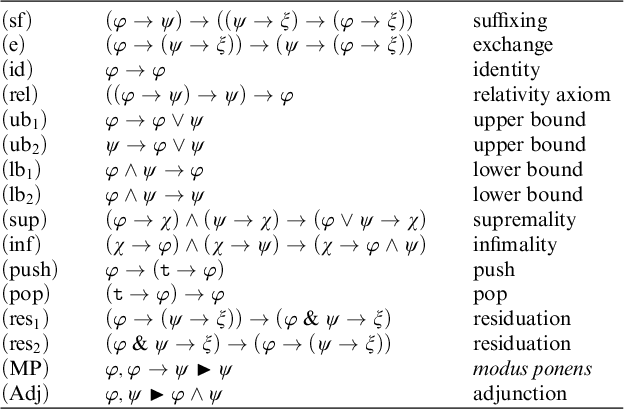
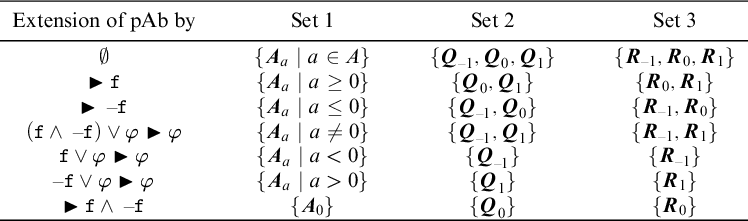


 Open access

