


NGOs and Tragic Choices in Humanitarian Aid
In their attempts to save lives and reduce suffering (cf. Barnett and Weiss Reference Barnett and Weiss2008, p. 11), humanitarian non-governmental organizations (NGOs) need to make difficult decisions about life and death on a daily basis. Owing to the many conflicts and natural disasters in the world that concern people in need, there are many options for interventions available, whereas at the same time, there are limited resources to address all such needs. It could thus be argued that humanitarian NGOs often face “tragic choices” (Calabresi and Bobbitt Reference Calabresi and Bobbitt1978) about whom to help and whom not.
In this article, the aim is to provide more insight into these choices by asking the question how humanitarian NGOs decide on the start and termination of humanitarian projects and why in a particular way. Although there is a substantial number of studies that discuss the operations and management of NGOs (see, e.g., Hilhorst Reference Hilhorst2003, Ebrahim Reference Ebrahim2003, and Lewis Reference Lewis2007), only few studies provide detailed insight into the internal decision-making processes of NGOs (for exceptions, see Cadena-Roa et al. Reference Cadena-Roa, Luna and Puga2011 and Markham et al. Reference Markham, Johnson and Bonjean1999). This article aims to provide such detailed insight by using March’s study on consequential and appropriate decision-making processes—which represents a substantial part of the organizational decision-making literature—to analyze the nature and course of NGO decision making. Since March’s two models are often explicitly or implicitly linked to certain types of organizational settings—as reflected in an organization’s formal structure, the type of coordination and compliance mechanisms, etc.—this article particularly zooms in on the relationship between NGO decision-making processes and these settings.
In the remainder of this article, a theoretical framework is presented that facilitates the analysis of NGO’s decision-making processes in relation to their organizational setting. We will describe the two types of decision-making processes that will be used to analyze NGO’s decision making, as well as the two types of organizational settings in which these decision-making mechanisms are assumed to be prominent. We will then introduce the research design and methods before we continue to illustrate this framework with help of an exploratory comparative case study into two international humanitarian NGOs: Médecins Sans Frontières Holland (MSF Holland) and Acting with Churches Netherlands (ACT Netherlands). We conclude with a discussion of the empirical results and the value of the framework.
This article contributes to the debate about NGO’s decision-making processes and its determinants in two ways. First, it offers a theoretical framework and operationalization to study the course and nature of NGO’s decision-making processes and the role of organizational settings therein, which can be used beyond the purposes of this particular study. Second, it provides an illustration of this framework and of its potential value for acquiring in-depth understanding of NGO’s decision-making processes about humanitarian aid.
A Framework of Organizational Determinants of NGO Decision-Making Processes
The organizational decision-making literature offers tools to analyze the nature and course of decision-making processes. One such “tool” is provided by James March, who distinguishes two fundamentally different types of decision-making processes: consequential (rational) and appropriate (March Reference March1988, Reference March1994, Reference March and Shapira1997). March’s categorization represents a substantial part of the academic literature on organizational decision making and will therefore be used to construct a framework to study NGO’s decision-making processes.Footnote 1
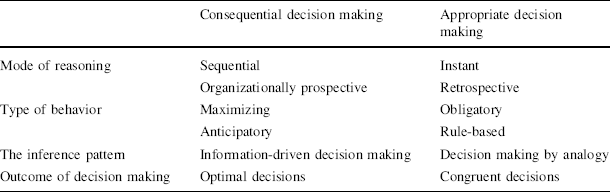
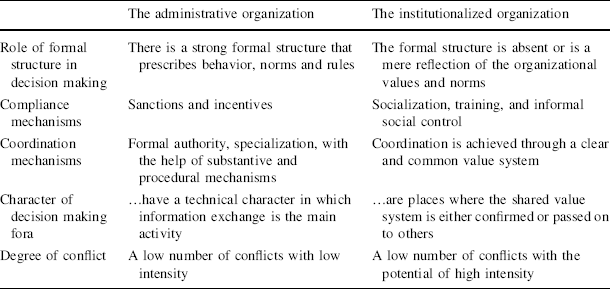
March’s decision-making models are often implicitly or explicitly linked to specific organizational settings (see, e.g., Scott Reference Scott1992; Denhardt Reference Denhardt1993; Peters Reference Peters1999). These organizational settings refer to the composite of specific organizational dimensions, such as the role of an organization’s formal structure, the type of compliance and coordination mechanisms, as well as the nature of decision-making fora in organizations (see also the first column of Table 2). Consequential decision making is often argued to be related to features of what we will call the “administrative organization”, whereas appropriate decision making is often related to notions of the “institutionalized organization.” Below, March’s two types of decision-making processes as well as the two associated ideal typical organizational settings will be further elaborated so that they can be used to analyze NGO’s decision-making processes about humanitarian aid (see Tables 1, 2 for an overview).
Characteristics of March’s two decision-making models

|
Consequential decision making |
Appropriate decision making |
|
|---|---|---|
|
Mode of reasoning |
Sequential |
Instant |
|
Organizationally prospective |
Retrospective |
|
|
Type of behavior |
Maximizing |
Obligatory |
|
Anticipatory |
Rule-based |
|
|
The inference pattern |
Information-driven decision making |
Decision making by analogy |
|
Outcome of decision making |
Optimal decisions |
Congruent decisions |
Characteristics of the two ideal–typical organizational settings

|
The administrative organization |
The institutionalized organization |
|
|---|---|---|
|
Role of formal structure in decision making |
There is a strong formal structure that prescribes behavior, norms and rules |
The formal structure is absent or is a mere reflection of the organizational values and norms |
|
Compliance mechanisms |
Sanctions and incentives |
Socialization, training, and informal social control |
|
Coordination mechanisms |
Formal authority, specialization, with the help of substantive and procedural mechanisms |
Coordination is achieved through a clear and common value system |
|
Character of decision making fora |
…have a technical character in which information exchange is the main activity |
…are places where the shared value system is either confirmed or passed on to others |
|
Degree of conflict |
A low number of conflicts with low intensity |
A low number of conflicts with the potential of high intensity |
Consequential Decision Making in the Administrative Organization
Consequential decision making refers to a rational consideration process which is based on instrumental rationality, meaning that organizations have preferences and goals which they will try to maximize (March Reference March1994; Allison and Zelikow Reference Allison and Zelikow1999). Although human beings are cognitively incapable of seeing all the alternatives for action or their future consequences (Kahneman et al. Reference Kahneman, Slovic and Tversky1982, Simon Reference Simon1945, p. 93, 94) and can at most intend to act rationally, a process of consequential decision making follows a sequential order. First, a problem is formulated, then alternatives are explored, before a decision is finally made. After a problem is formulated, the organization generates various alternatives for action that are evaluated in terms of the organizational goals and the costs associated with each alternative. The alternative with the least costs and the most benefits is chosen. This decision-making process can hence be characterized by instrumentality, sequentiality, and prospective and anticipatory reasoning (Perrow Reference Perrow1986, p. 121; March and Olsen Reference March and Olsen1989, p. 23; Scott Reference Scott1995, p. 50).Footnote 2 In other words, consequential decision making is structured by the following key questions (cf. March Reference March1994, p. 2, 3):
• What alternatives of action are available?
• What consequences (in terms of costs and benefits) will each alternative have?
• How likely is it that these consequences become real?
• How are these potential consequences valued and prioritized by the decision makers?
Consequential decision making is closely related to Simon’s theory of the “administrative organization” because of its shared assumptions about instrumental rationality, maximizing behavior and consequentionality (Scott Reference Scott1992, p. 45 Denhardt Reference Denhardt1993, p. 89; Simon Reference Simon1945, p. 72, 77).Footnote 3 In the administrative organization, the criterion of efficiency is the driving force behind the organization of work. The focus of the higher-level administrators in the organization is on making sure that its lower-level members choose that alternative for action with the least costs and the most benefits for the organization. This requires a clear statement of the organizational goals as well as specialization of the organization’s operations.
Specialization facilitates high-quality decisions (Simon Reference Simon1945, p. 188): The organizational tasks are subdivided in such a way that processes requiring a specific skill are handled by the person most specialized in that skill (Simon Reference Simon1945, p. 189). The function of the individual is specified in terms of the scope and nature of his job, and the duties connected to it (Simon Reference Simon1945, p. 7).
It is also important to guarantee that the organizational members all make the same decisions. This is done with the help of procedural coordination, such as standard operation procedures, and with the aid of substantive coordination, such as manuals (Simon Reference Simon1945, p. 190, 191). In addition, some persons have the power to impose sanctions or to create incentives. In this way, the premises of decision making for the individual are created and organizational rationality can operate without discussion or conflict. An overview of the characteristics of the administrative organization is given in Table 2.
Appropriate Decision Making in the Institutionalized Organization
Appropriate decision making refers to a consideration process in which organizational members make decisions by behaving as expected in a given situation (Scott Reference Scott1995, p. 39; March Reference March1994, p. 57). Hence “action is often based more on identifying the normatively appropriate behavior than on calculating the return expected from alternative choices” (March and Olsen Reference March and Olsen1989, p. 22).
In order to decide appropriately, the individual matches situations to rules that provide guidelines for decision making. The individual will collect information to recognize and define a situation. Then an appropriate rule regime—which defines the type and amount of information needed to decide, and the actions to be taken—will be chosen and applied, and a decision is made (Burns and Flam Reference Burns and Flam1987, p. 41, 42). In order to do so, individuals use reasoning mechanisms such as thinking by means of analogy and metaphors (March and Olsen Reference March and Olsen1989, p. 25; Neustadt and May Reference Neustadt and May1986), indicating retrospective reasoning.
The rule regimes create patterned behavior among individuals: They reflect duties and obligations that have developed through a historical process of organizational learning and adjustment (March and Olsen Reference March and Olsen1989, p. 38; Biddle Reference Biddle1986, p. 67, 69). These rules constrain the individual in the decision-making process (Searing Reference Searing1991, p. 1241; March Reference March1994). Consequently, the matching of situations to rules should ideally result in one option for action, and hence in instant decision making.
In short, the model of appropriate decision-making can be defined as a process of instant, retrospective reasoning in combination with obligatory, rule-based and value-driven action (March & Olson 1989, p. 23), in which the following questions are of importance (March Reference March, Van de Ven and Joyce1981, p. 228; March Reference March1994, p. 58; Burns and Flam Reference Burns and Flam1987, p. 36):
• In what kind of situation am I?
• What kind of person am I?
• What should a person such as I, in an organization such as this, do in a situation such as this?
Appropriate decision making is a feature of the “institutionalized organization’ (Selznick Reference Selznick1957; Peters Reference Peters1999, p. 29), which is “a natural product of social needs and pressures—a responsive, adaptive organism” (Selznick Reference Selznick1957, p. 5). It is a valued product of interaction and adaptation that provides a source of personal satisfaction to its members (Selznick Reference Selznick1957, p. 17; Scott Reference Scott1987).
In the institutionalized organization, there is a consistent set of beliefs and assumptions that reflect internal and external pressures and expectations (Scott Reference Scott1992, p. 66; Boin and Christensen Reference Boin and Christensen2008). This common value system, also referred to as an organizational ideology (Brunsson Reference Brunsson1985, p. 28; Reference Brunsson1989, p. 16), leads to a clear understanding of the standard rules for behavior (Peters Reference Peters1999, p. 40). They provide short-cuts for decision making by specifying which alternative for action is the most appropriate so that a decision can be made without any discussion or conflict (Brunsson Reference Brunsson1985, p. 29; Reference Brunsson1989, p. 17).
A common value system can develop through a more or less spontaneous process, but it can also be created quite consciously (Brunsson Reference Brunsson1985, Reference Brunsson1989). First, institutional entrepreneurs (both formal and more informal actors) can play a defining role in the institutionalization process of organizations (Czarniawksa Reference Czarniawksa2009). Second, recruitment and socialization processes are of importance (Selznick Reference Selznick1957, p. 57; March Reference March1994, p. 60). People are recruited for their shared outlook on the job and the world, and new employees receive training and other socialization processes so that they internalize the values of the organization and learn to act accordingly (Selznick Reference Selznick1957, p. 58; Peters Reference Peters1999, p. 35). An overview of the characteristics of the institutionalized organization is given in Table 2.
Research-Design and Data-Collection Methods
In order to explore the value of the above-developed theoretical framework, an in-depth exploratory comparative case study was conducted (George and McKeown Reference George and McKeown1985), of which the details are discussed below.
The Case-Selection Process
Two cases (i.e., organizations) were selected that to a large extent resembled the two ideal-types of organizational settings, i.e., the administrative and the institutionalized organization. If the theoretical framework would hold any value, then one would expect different decision-making patterns in these two NGOs.
A stepwise process led to the selection of the two cases. First, a quick scan of the organizational characteristics of the humanitarian sector in the Netherlands was made by means of publicly available information (websites, annual plans, etc.) and informative interviews with representatives of nine out of ten Dutch NGOs with a humanitarian mandate.Footnote 4 One NGO did not grant the researcher an interview or any other access. Another NGO was in the middle of an intensive merger process and therefore did not allow the researcher further access. Five of the NGOs were, at the time, quite small in size; only one or two employees were in charge of project decisions. These employees operated quite autonomously and were hardly embedded in an organizational setting, as conceptualized in the theoretical section. Since we are interested in organizational decision making, it was decided to exclude them from the study. In the conclusion section, we will discuss the ramifications of this decision for the wider applicability of this framework.
In a second step, pilot studies were conducted in the three remaining Dutch humanitarian NGOs to explore opportunities for further data collection in these organizations. These three NGOs at the time of data collection were the three biggest humanitarian NGOs in the Netherlands in terms of number of employees and budget. The pilot study consisted of a 1 week stay within the organizations in which additional documents were studied, and additional exploratory interviews with NGO staff were held. This resulted in more information about the NGOs' organizational settings in terms of potential resemblance to the ideal–typical settings of the administrative and the institutionalized organization. The pilot resulted in the preliminary conclusion that the organizational settings in these three NGOs showed resemblance to either the administrative or the institutionalized organization.
In a third step, the number of cases was limited to two organizations (ACT Netherlands and MSF Holland), because two of the three pilot NGOs were very similar in organizational setting (i.e., they resembled the institutionalized organization), and one of these organizations was preparing for a merger process in which the research project was considered to be an obstacle. After selecting these two NGOs, data collection about the organizational setting was continued to check whether the preliminary conclusions were valid. As will be elaborated later in this article, MSF indeed approximated the “administrative organization” most, while ACT resembled the “institutionalized organization” to a large extent.
The Data-Collection Process
Three data-collection methods were used in this study: qualitative interviews, document study of policy documents of both NGOs plus nine MSF project files, and observation. The observation period consisted of a 2 months' period in the headquarters of each organization and a month’s field work in an African country. Within ACT, the researcher had a desk in the same office as the project officers for 2 months and sat in at all informal and formal meetings of the organization. This enabled her to follow ACT decision-making processes on the spot. Within MSF, the researcher had a desk in the library of the organization and was allowed access to all country files with project information. The researcher was also allowed to sit in at the so-called “operational support team meetings” in which operational managers discussed project proposals with medical, logistical and humanitarian law experts of the organization. The data-collection process took place from 1999 to 2001.
The 1 month visit to Africa consisted of participant observation in an ACT field office, formal and informal interviews with field office employees, document study and various visits to ACT project sites. The researcher was also allowed access to an MSF field office, where she interviewed the employees and analyzed email communication files, so that better insight was gained in the more informal communication processes about humanitarian projects. A visit to MSF project sites was not possible because of the fact that MSF was about to close the last project in the country.
In total, six interviews with ACT project officers in their Dutch headquarters were conducted along with one formal interview with the office manager in the field, whereas at MSF eight interviews with headquarters staff and ten with field staff were conducted. The MSF headquarters staff respondent group contained four operational directors, two health advisors, a humanitarian affairs advisor and an emergency desk member. The field staff respondent group consisted of seven country managers and three medical coordinators. The respondents were asked to discuss decision-making examples concerning the start, ending and extending of projects, as well as the rejection of project proposals, as detailed as possible (cf. Weiss Reference Weiss1994). This resulted in the collection of 94 MSF decision examples and 39 ACT decision examples.
It has to be mentioned that ACT did not have many extensive files that could be studied and there were less people to interview than in MSF. However, more decision examples could be observed “real-life” than in MSF.
The Data Analysis Process
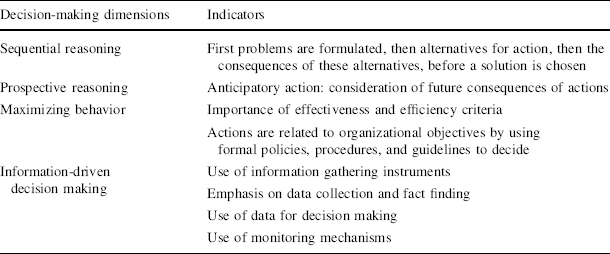
Per interview decision making example, the researcher coded to what extent the example represented any of the dimensions presented in Table 1. Consequential decision making was operationalized as follows (see Table 3):
Identifying consequential decision making

|
Decision-making dimensions |
Indicators |
|---|---|
|
Sequential reasoning |
First problems are formulated, then alternatives for action, then the consequences of these alternatives, before a solution is chosen |
|
Prospective reasoning |
Anticipatory action: consideration of future consequences of actions |
|
Maximizing behavior |
Importance of effectiveness and efficiency criteria |
|
Actions are related to organizational objectives by using formal policies, procedures, and guidelines to decide |
|
|
Information-driven decision making |
Use of information gathering instruments |
|
Emphasis on data collection and fact finding |
|
|
Use of data for decision making |
|
|
Use of monitoring mechanisms |
The above indicators were further specified for those cases that concerned the start and extension of project activities, and the rejection and termination of project activities, as reflected in Table 6.
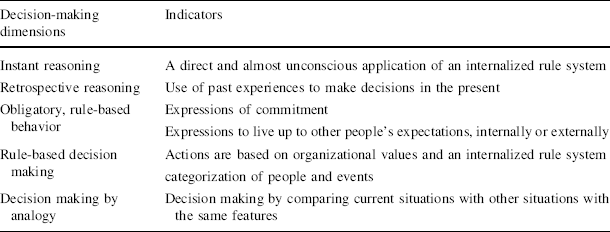
Appropriate decision making was operationalized as follows (see Table 4):
Identifying appropriate decision making

|
Decision-making dimensions |
Indicators |
|---|---|
|
Instant reasoning |
A direct and almost unconscious application of an internalized rule system |
|
Retrospective reasoning |
Use of past experiences to make decisions in the present |
|
Obligatory, rule-based behavior |
Expressions of commitment |
|
Expressions to live up to other people’s expectations, internally or externally |
|
|
Rule-based decision making |
Actions are based on organizational values and an internalized rule system |
|
categorization of people and events |
|
|
Decision making by analogy |
Decision making by comparing current situations with other situations with the same features |
The project examples mentioned in the MSF interviews were also studied with the help of nine country project files which contained information about 38 decision examples. These documents were analyzed in the same manner as the interviews. For ACT, this was hardly possible because of the lack of files.
A decision-making example was labeled to belong to one type of decision-making pattern (either consequential or appropriate) if one or more dimensions of this type of decision making were identified, and if no dimensions of another decision-making pattern had been identified. The more dimensions of one particular decision-making pattern were identified, the more appropriate or consequential the decision-making process was. Based on this exercise, it was possible to identify a primary pattern in these NGOs' decision-making processes. In Tables 6 and 7, one can find the precise elaborations and results of the coding exercise for the interview cases.
Not all decision-making examples showed elements of consequential or appropriate decision making. These cases were kept separate for additional analysis to prevent the research from becoming a theoretical confirmation effort (cf. Weiss Reference Weiss1994). In the empirical part of this article, we will also report on these decision-making examples.
The Two Cases: Organizational Characteristics of MSF Holland and ACT Netherlands
Médecins Sans Frontières Holland (MSF Holland) and Acting with Churches Netherlands (ACT Netherlands) represented characteristics of the “administrative organization” and the “institutionalized organization” respectively. Below, the characteristics of both organizations that led to this conclusion are presented.
MSF Holland: Traces of the Administrative Organization
Médècins sans Frontières (MSF) Holland specializes in medical emergency assistance to populations in humanitarian crises by sending out teams with expatriate personnel in the medical, para-medical, logistic, and management domain. The Dutch part of MSF was found in 1984 by Dutch medical doctors and is part of the world-wide MSF network that consists of 19 branches in countries, such as France, Spain, and Canada. The organization’s budget increased from the equivalent of 2.3 million euros in 1985 to almost 53 million euros in 2000.
The organization’s mandate emphasizes the organization’s aim to help those who need it the most:Footnote 5
MSF provides independent, impartial assistance to those most in need. MSF reserves the right to speak out to bring attention to neglected crises, to challenge inadequacies or abuse of the aid system, and to advocate for improved medical treatments and protocols…. MSF’s work is based on the humanitarian principles of medical ethics and impartiality. The organization is committed to bringing quality medical care to people caught in crisis regardless of race, religion, or political affiliation.
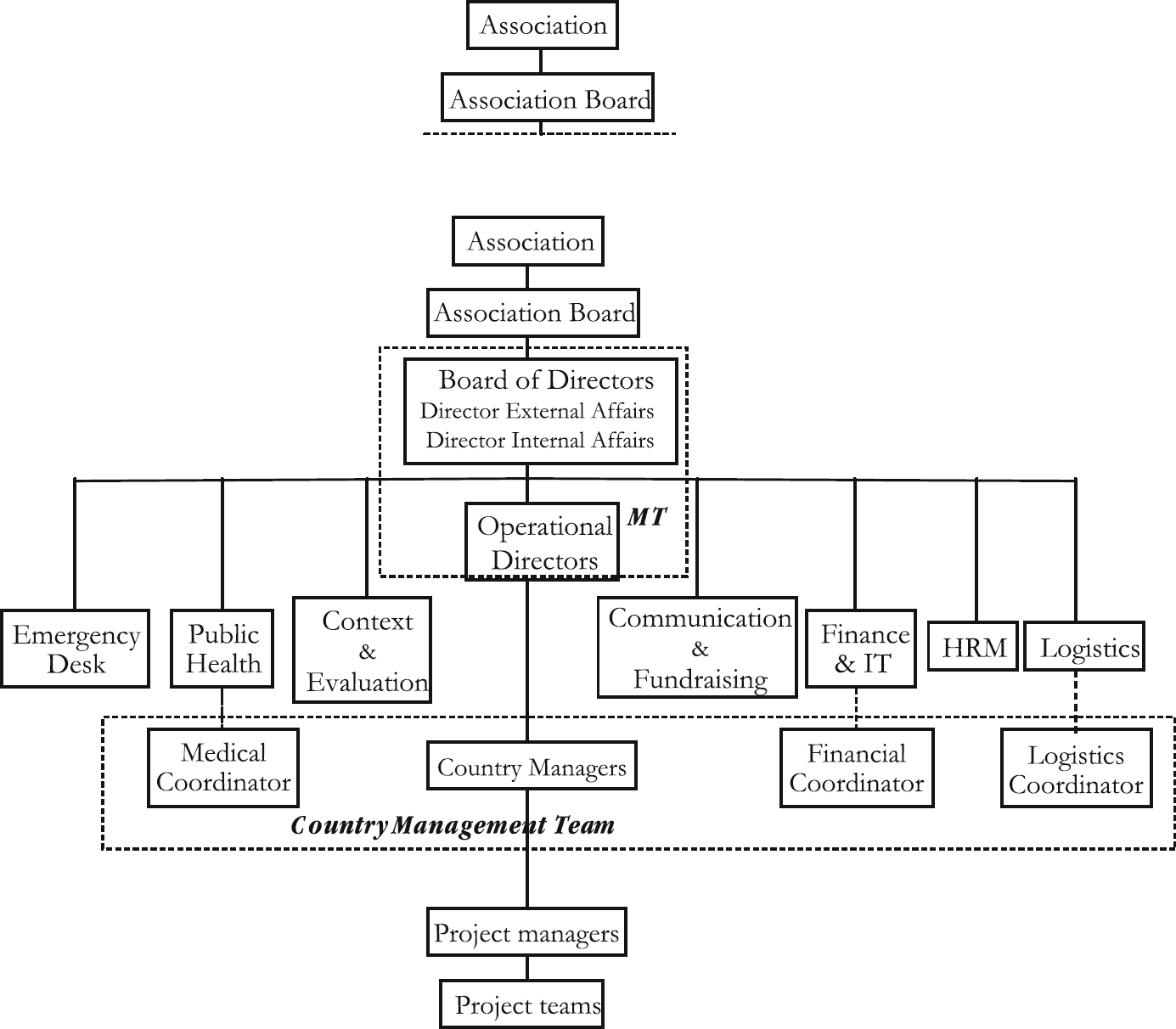
At the time of the study, MSF’s mandate was made operational through a so-called “demand-driven” system in which country management teams and associated project teams in the field defined the need for and implemented emergency interventions (see Fig. 1 for an organogram). The Management Team and the support departments at headquarters facilitated these interventions.Footnote 6 The Management Team also had the final and formal authority to approve or reject project proposals.
MSF Holland’s organizational structure in 2000–2001

MSF Holland had a large number of procedural and substantive coordination mechanisms in place. The former consisted of a general policy plan (the Mid-term Policy), an annual planning process, and country policies. The latter entailed a total of 20 policy papers, and 88 guidelines and manuals.
The Mid-term Policy reflected the organization’s long-term plans which stated that MSF would intervene in crises where there was social injustice or a violation of human rights, in combination with a significant medical and humanitarian crisis (MTP 1999, p. 17). Each year, the operational directors formulated an annual plan based on this Mid-term Policy. For this plan, the country managers made estimates of the expected project expenditures. In order to decide on the allocation of resources in the annual plan, the operational directors and country managers had to use country policies, which summarize the project activities, plans, and budget per country. For each project that MSF teams in the field wanted to start, a project proposal needed to be written. In such a proposal, a problem analysis was required, in addition to a description of the target population, project objectives, and monitoring indicators. Project proposals were often discussed with health, logistics, and humanitarian rights experts of the advisory departments in so-called operational support team meetings.
In short, MSF’s organizational characteristics to a large extent resembled the ideal type of the administrative organization because of the presence of a clear formal hierarchical structure, specialization, and a substantial number of coordination mechanisms.
ACT Netherlands: Traces of the Institutionalized Organization
ACT Netherlands was founded in 1953 under the name “Dutch Interchurch Aid” by the Dutch Protestant and Catholic churches. ACT provides both emergency and development aid by means of supporting local partner organizations to develop capacities to prevent and manage humanitarian crises. In addition, the organization transfers money to these partners in case of a humanitarian crisis. The organization participates in a world wide network of Christian humanitarian organizations, called ACT (Acting with Churches Together), which is part of the World Council of Churches. In times of humanitarian crises, this network facilitates ACT Netherlands to transfer money to local organizations for humanitarian assistance. In 2000, the organization had a budget of approximately 12 million euros.
At the time of the study, ACT Netherlands had just become a sub-department of the National Service Center of the Dutch Protestant churches. In this sub-department, there was a unit head and eight project officers who each managed regionally divided project portfolios. The organization’s mandate was described as follows Footnote 7:
We offer resources to save human lives in crisis situations, to secure the livelihoods of vulnerable groups in times of need, and to help them rebuild their societies after a civil war or flood.
This mandate was reflected in one substantive and one procedural coordination mechanism. The former was a policy paper that described ACT’s work as “crisis management in conflict areas based on a developmental approach” (Policy paper 1998, p. 5, my translation). The paper emphasized ACT’s focus on working through local partner organizations, but for the most part did not give much guidance, since a broad range of organizational activities was deemed appropriate such as human rights activities and the support of organizational development. During the observation period, this policy paper was hardly ever referred to or explicitly used by the employees. The only procedural coordination mechanism was the rule that project proposals of more than 25,000 euros needed approval by the head of the Foreign Department, of which ACT was a sub-department.
All project officers and the unit head met once a week. These meetings consisted of discussions of larger developments concerning ACT and of specific project proposals submitted by partner organizations. All project officers and the unit head received the project proposal prior to the meeting and could provide input about the proposal on a form. This implies a low level of specialization and hierarchy. The observation period led to the conclusion that these proposals often were not very detailed and that the comments section on the form was hardly ever used.
From this we concluded that ACT Netherlands resembled anything but the administrative organization: There were hardly any formal hierarchy, specialization or coordination mechanisms. In addition, hardly any conflict or disagreement about work methods or other issues was observed in the work place. On the contrary, the interviews with the project officers showed evidence of a shared organizational ideology which reflected the organization’s mandate, which was formulated as follows by one project officer (Heyse Reference Heyse2007, p. 144):
I think it is important to give people the opportunity to organize themselves. And we want to support such a process by sharing the risks associated with the process. We let them make their mistakes and won’t walk away immediately [int1 1999].
Based on this information, we concluded that ACT Netherlands showed a resemblance to the institutionalized organization.
MSF’s Decision-Making Patterns
In MSF, 90 out of 94 interview decision-making examples resembled elements of the expected decision-making process (consequential decision making), whereas a much smaller portion of the interview decision-making examples showed elements of other types of decision-making processes (4 out of 94 interview decision-making examples). See also Table 5.
No of decision occasions and no of consequential decision dimensions in MSFH

|
No of consequential features observed |
0 |
1 |
2 |
3 |
4 |
5 |
6 |
7 |
8 |
9 |
Total |
|---|---|---|---|---|---|---|---|---|---|---|---|
|
No of MSF decision occasions |
4 |
17 |
20 |
18 |
15 |
7 |
9 |
3 |
1 |
0 |
94 |
However, in six out of these 90 interview decision examples we identified a somewhat peculiar use of the consequential decision-making mode. In addition, we established that neither consequential nor appropriate decision-making elements were present in four out of nine project files as well as in an email file studied during field work in Africa. Below we discuss both the primary pattern and these exceptions to this pattern.
MSF’s Primary Decision-Making Pattern: Consequential Decision Making
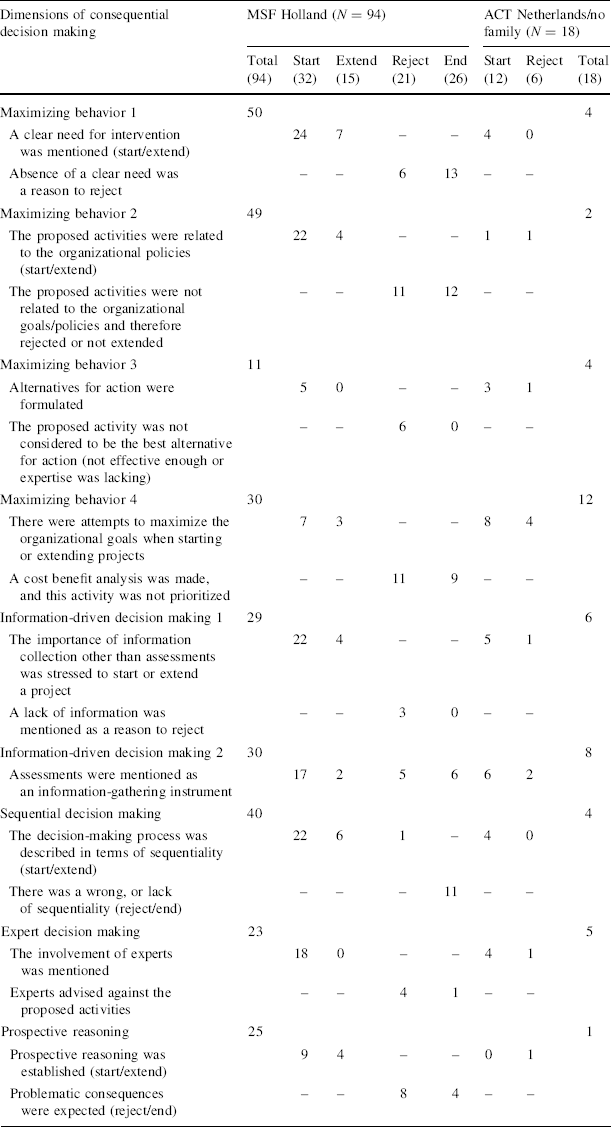
MSF’s primary decision-making pattern was consequential in nature, especially in cases where the decision to start a project was being made (see Table 6 for a summary of the analysis of interview data). The following example—in which an operational director described the decision to go to an Asian country—illustrates this way of working (Heyse Reference Heyse2007, p. 79):
The number of consequential decision-making dimensions for starting, extending, rejecting, and ending projects within MSF and ACT

|
Dimensions of consequential decision making |
MSF Holland (N = 94) |
ACT Netherlands/no family (N = 18) |
||||||
|---|---|---|---|---|---|---|---|---|
|
Total (94) |
Start (32) |
Extend (15) |
Reject (21) |
End (26) |
Start (12) |
Reject (6) |
Total (18) |
|
|
Maximizing behavior 1 |
50 |
4 |
||||||
|
A clear need for intervention was mentioned (start/extend) |
24 |
7 |
– |
– |
4 |
0 |
||
|
Absence of a clear need was a reason to reject |
– |
– |
6 |
13 |
– |
– |
||
|
Maximizing behavior 2 |
49 |
2 |
||||||
|
The proposed activities were related to the organizational policies (start/extend) |
22 |
4 |
– |
– |
1 |
1 |
||
|
The proposed activities were not related to the organizational goals/policies and therefore rejected or not extended |
– |
– |
11 |
12 |
– |
– |
||
|
Maximizing behavior 3 |
11 |
4 |
||||||
|
Alternatives for action were formulated |
5 |
0 |
– |
– |
3 |
1 |
||
|
The proposed activity was not considered to be the best alternative for action (not effective enough or expertise was lacking) |
– |
– |
6 |
0 |
– |
– |
||
|
Maximizing behavior 4 |
30 |
12 |
||||||
|
There were attempts to maximize the organizational goals when starting or extending projects |
7 |
3 |
– |
– |
8 |
4 |
||
|
A cost benefit analysis was made, and this activity was not prioritized |
– |
– |
11 |
9 |
– |
– |
||
|
Information-driven decision making 1 |
29 |
6 |
||||||
|
The importance of information collection other than assessments was stressed to start or extend a project |
22 |
4 |
– |
– |
5 |
1 |
||
|
A lack of information was mentioned as a reason to reject |
– |
– |
3 |
0 |
– |
– |
||
|
Information-driven decision making 2 |
30 |
8 |
||||||
|
Assessments were mentioned as an information-gathering instrument |
17 |
2 |
5 |
6 |
6 |
2 |
||
|
Sequential decision making |
40 |
4 |
||||||
|
The decision-making process was described in terms of sequentiality (start/extend) |
22 |
6 |
1 |
– |
4 |
0 |
||
|
There was a wrong, or lack of sequentiality (reject/end) |
– |
– |
– |
11 |
– |
– |
||
|
Expert decision making |
23 |
5 |
||||||
|
The involvement of experts was mentioned |
18 |
0 |
– |
– |
4 |
1 |
||
|
Experts advised against the proposed activities |
– |
– |
4 |
1 |
– |
– |
||
|
Prospective reasoning |
25 |
1 |
||||||
|
Prospective reasoning was established (start/extend) |
9 |
4 |
– |
– |
0 |
1 |
||
|
Problematic consequences were expected (reject/end) |
– |
– |
8 |
4 |
– |
– |
||
The team went in….. They did an assessment in the camps and based on these findings they identified water and sanitation needs as priority needs, as well as a few medical needs. There were no other organizations. So I had a discussion with the Head of Mission and we decided to go ahead [int OD3, 2001].
When MSF Holland learned of a possible humanitarian need, the situation was often studied by means of assessment missions (in 17 out of 32 project initiation cases), which contained information about morbidity and mortality, the food and nutritional situation, and the presence of other aid agencies. Other information collection activities, such as surveys or focus group discussions, were also used regularly (in 22 out of 32 project initiation cases).
The recommendation to intervene was made if the data showed evidence of a clear need to intervene (in 24 out of 32 project initiation cases). After experts had shed their light on the data (in 18 out of 32 project initiation cases), a sequential process of decision making unfolded (in 22 out of 32 project initiation cases). If there was a clear connection to the Mid-term Country Policy and other policies, then the proposal was duly approved (in 22 out of 32 project initiation cases). If the proposed activities did not fall within MSF policies or objectives, then the chance of rejection of the proposal increased (in 11 out of 21 proposal-rejection cases).
The sequential reasoning mode sometimes had a prospective character, because future consequences of projects were taken into account (in 25 out of 94 decision-making cases). Complementary evidence for prospective reasoning was found in the project proposals and assessment reports. A document analysis of sixteen project proposals showed that there were eleven proposals that described project objectives and assumptions for success. In addition, a study of thirteen assessment reports showed that all reports either made recommendations for specific interventions or formulated various alternatives for action.
In almost half of the project-extension and termination interview cases, a sequential mode of reasoning was established as well (in 17 out of 41 extension and ending cases). MSF Holland often closed a mission or a project down if the need for intervention had disappeared, for example, because the context of aid provision had changed for the better (in 13 out of 26 project termination cases). And the other way around: project activities had more chance of being extended if there was a clear need to stay in a country (in 7 out of 15 extension cases).
Another important reason to end projects was when the project activities no longer matched the organization’s policies (in 12 out 26 project termination cases) or a cost benefit analysis showed that a project was ineffective or too expensive (in 9 out 26 project termination cases). Such a cost benefit analysis was also often the reason for rejecting project proposals (in 11 out of 21 rejection cases), for example, if doubts existed about the effectiveness of the proposed intervention or if the situation was considered to be less catastrophic than initially thought.Footnote 8 This is illustrated in the following example, as told by an MSF medical advisor (Heyse Reference Heyse2007, p. 80):
A team wanted to do a meningitis intervention….I asked them if they had enough information that proved that the number of cases was increasing. There are always more cases in that season and we only want to intervene at the beginning of an epidemic because if it is already decreasing we are wasting our money, so to speak. The team collected the information…I analyzed it and concluded that there was no epidemic. At the same time the number of cases decreased, so we did not continue our plans [int HA2 2001].
To summarize, we observed that most MSF decision occasions were characterized by at least one feature of consequential decision making (see Table 5). Only in four cases did we not establish any consequential decision-making feature, whereas in 53 cases more than three dimensions of consequential decision-making were counted. Hence, decisions about MSF projects were often made in a sequentially structured process in which one anticipated the future effectiveness of the project, thus indicating prospective and maximizing behavior. This resembles the consequential decision-making mechanism to a great extent.
Secondary Patterns
There were also some exceptions to the primary decision-making pattern. These are presented below.
A “Creative Use” of Consequential Decision Making
As mentioned above, of the 90 cases in which elements of consequential decision making could be established, in six cases we identified a somewhat peculiar “use” of the consequential decision-making mode. In two of these cases, there were elements of consequential decision making, but the formal structure was bypassed. For example, the management team agreed with a project before a project proposal was written and discussed. In another four cases, the consequential decision-making mode was used as a persuasion strategy to make sure projects were approved or to legitimize decisions already taken. Hence, consequential language was used to influence decision making and could therefore be said to not represent a “sincere use” of the consequential decision making mode. As one respondent said (Heyse Reference Heyse2007, p. 97):
It also has to do with salesmanship [….]. [….] it is good to know the jargon, if you know how to stress the humanitarian aspect and the crisis aspect [int CM3 2001].
Hence, these six cases cannot be considered as representative examples of “pure” consequential decision making.
Examples of Appropriate Decision Making
In another four interview cases, elements of appropriate decision making were identified. These decision-making dynamics emerged because of feelings of commitment and obligations. Three of these cases were located in Asia, in which MSF had a presence on the ground for a long term already. Owing to a more focused Mid Term Policy, these Asian countries were no longer considered of relevance for MSF intervention. Hence, the Management Team decided to phase out these projects. This was not easy, since the teams on the ground felt a commitment toward the organizations they had worked with all these years. In one case, this even led to the approval of a new project, before one started to prepare to phase out the project, whereas in another project MSF decided to stay longer to arrange a proper handover of the project by another NGO. In a third project in Asia, it was media pressure that led to feelings of obligation to act, even though no need for intervention was established. In the fourth project, which was located in Africa, a country management team doubted whether to intervene after a severe flood in a conflict-ridden area. A cost benefit analysis of a proposal to intervene led to the conclusion that the chance of an effective and efficient operation would be quite low due to the ongoing fights in the area. However, the team decided to intervene anyhow because, as the country manager said (Heyse Reference Heyse2007, p. 101): “we felt a responsibility, the situation was so serious that we could not stay away.” These feelings of commitment thus overruled the usual (consequential) way of deciding.
Neither Consequential nor Appropriate Decision Making
In four decision-making examples in the project files and the one email communication file studied during the fieldwork period, decision-making processes showed elements of neither consequential nor appropriate decision making. Nevertheless, a pattern in these four cases could be detected. In these cases, MSF started out with the intention to follow a consequential decision-making mode, but this did not result in any alternatives for action. This could be explained by the fact that in these examples the organization was confronted with a declining operational space because of contextual constraints, such as security reasons, the presence of other aid agencies, lack of access to the areas that needed aid most, or the absence of needs that fitted MSF’s mandate.
However, the headquarters of MSF deemed it necessary—for reasons that remained unknown to the researcher—to continue their presence in the area and communicated this to the field. In these cases, MSF started a search for potential project activities that to a certain extent would still meet the organization’s mandate. In this search process “solutions started looking for a problem,” instead of the other way around, as is the case in consequential decision-making processes. Policies, procedures, and rules no longer offered sufficient guidance to the decision makers. Instead, persuasion, individual entrepreneurship, and group dynamics became more influential in the decision-making process. It was not so much the need to intervene as defined in the organization’s policies, but the craftsmanship to formulate justifiable reasons for action. These dynamics were established for a health care intervention in Africa, a water and sanitation intervention after a tropical storm in Latin America, an initiative to respond to violence in a Latin American country, and the development of the project portfolio in the African country where the researcher did her fieldwork.
ACT Netherland’s Decision-Making Patterns
In ACT the appropriate decision-making mode was the point of departure for decision making regarding “members of the family,” i.e., the local partner organizations it was used to work with, as was expected. However, in those cases in which no known local partners were available, and ACT still deemed it necessary to intervene, was consequential decision making identified as a secondary pattern. Only in one case the nature of the decision-making process was neither consequential nor appropriate.
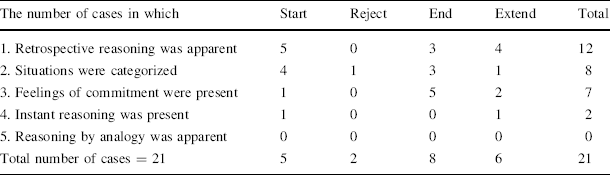
The dominant rule within ACT was to work with partners from the ACT network, which I will refer to as “the family” (which was spoken about in 21 out of 39 interview cases). The decision-making examples regarding these family members regularly resembled one or more dimensions of appropriate decision making. However, the organization also regularly opted to work with new partners (18 out of 39 interview cases). In such circumstances, another decision-making pattern resembling the consequential decision-making model could be observed (see Table 7 for the consequential decision-making dimensions and Table 6 for the appropriate decision-making dimensions).
Appropriate decision-making dimensions regarding family members of ACT

|
The number of cases in which |
Start |
Reject |
End |
Extend |
Total |
|---|---|---|---|---|---|
|
1. Retrospective reasoning was apparent |
5 |
0 |
3 |
4 |
12 |
|
2. Situations were categorized |
4 |
1 |
3 |
1 |
8 |
|
3. Feelings of commitment were present |
1 |
0 |
5 |
2 |
7 |
|
4. Instant reasoning was present |
1 |
0 |
0 |
1 |
2 |
|
5. Reasoning by analogy was apparent |
0 |
0 |
0 |
0 |
0 |
|
Total number of cases = 21 |
5 |
2 |
8 |
6 |
21 |
Pattern #1: Appropriate Decision Making When Working with the “Family”
Decisions to approve and extend project proposals were often made retrospectively if a known partner organization—that is, a “family member”—had previously been funded by ACT Netherlands (in 12 out 21 interview cases). The project officers clearly distinguished between known and trusted versus unknown and thereby distrusted partner organizations. In 4 out of 5 project initiation cases, for example, such a categorization was clearly stated (see Table 4). Or, as an employee of ACT Netherlands, said (Heyse Reference Heyse2007, p. 142):
We work with partners…… when you make a choice to work with a partner, you are not tied to it forever…However, you only have a limited amount of time and money, so you have to make it a bit continuous. So, if I have been working with organization A……then I won’t work with organization F anymore and not because organization F is not as good as organization A, but it simply stops somewhere [int3, 1999].
Once a partner organization was categorized as “trusted,” the decision-making process then unfolded almost automatically: The project officer would hardly ask any questions about the project proposal and go on to present it at the weekly meeting. If an applicant belonged to the category of “unknown” organizations, an almost automatic rejection of the project proposal followed. A study of rejection letters sent to organizations that requested support from ACT in 1998 provided further evidence for this categorization process (Heyse Reference Heyse2007, p. 143): Project proposals submitted by unknown organizations were rejected.
In staff meetings, project proposals were often approved without discussion. This was because the project officers had made a pre-selection of the proposals they deemed appropriate. The mere fact that a project proposal had made it to the intake meeting indicated that the project officers knew and trusted the applicant, and thus approval followed almost automatically. Rejecting a project proposal was a very unusual thing to do: A study of meeting notes from 1999 and part of 2000 showed that only three project proposals were rejected in the staff meeting (Heyse Reference Heyse2007, p. 141).
ACT’s work method also resulted in obligatory behavior and feelings of commitment toward partner organizations. Project officers would never decide to suddenly stop working with a family member, nor would they easily reject proposals from a known and trusted partner, even when there were (potential) effectiveness and efficiency problems. This was due to ACT’s shared organizational ideology to make a sincere effort to empower these organizations: It was deemed inappropriate to reject their project proposals or to end the relationship. Such feelings of commitment especially played out when project officers talked about ending partner organization relationships (in 5 out of 8 project termination cases, see Table 4).
An example of this was the relationship of ACT Netherlands with a local partner organization in Central Asia. The work of this partner did not result in positive effects. The staff and the director had difficulties with each other and an attempt for organizational change failed, despite various efforts of ACT Netherlands to support the organization in doing this. In the end, ACT Netherlands decided that the relationship with this partner had to be ended. This caused distress in the organization, as one employee explained, since ACT deviated from moral obligations previously committed to and this was absolutely “not done” in these circles (Heyse Reference Heyse2007, p. 146).
In other words, ACT’s organizational ideology defined commitment to be an important element in the organization’s work method. This resulted in informal rules as to how behave appropriately as well as in feelings of obligations toward partner organizations. Based on the above, we can conclude that ACT’s dominant decision-making pattern with concern to family members was—as expected—predominantly appropriate in character because of the presence of categorization processes, and retrospective and obligatory behavior.
Pattern #2: Consequential Decision Making When Working Outside the “Family”
Although the dominant rule within ACT was to work through “the family,” the organization also considered proposals from new potential partner organizations. This happened when the project officers believed that ACT’s presence in a specific area was needed, but no (trustworthy) partner organization was available. For these cases, project officers were not able to apply the appropriate decision-making mode, since these organizations had no reputation ACT could rely on.
The project officers were asked to discuss examples of this, which resulted in 18 out of a total of 39 interview cases. The analysis of these examples led to the identification of a secondary decision-making pattern in ACT which was characterized by information-driven decision making and attempts to maximize the organization’s goals, both elements of consequential decision making (see also Table 6).
When project officers received a project proposal from an unknown organization, they collected information about the organization’s reputation and performance by means of assessment missions and other information-gathering instruments (in 8 and 6 of 18 interview cases, see Table 6, information-driven decision makings 1 and 2). If the project officers thought a project proposal from a new organization would not contribute to ACT’s goals, then a rejection followed (in 4 out of 6 project proposal rejection cases). If the data collection confirmed that the proposal of the applicant organization would contribute to ACT’s goals, then the project officers funded this organization with a small amount of money, as a test case (in 8 out of 12 project initiation cases). Hence, these decision-making examples showed elements of maximizing behavior.
One Case of Neither…nor
An exception to both patterns #1 and #2 was identified in one specific case in Africa in which ACT had a field office. The ACT field officer tried to work with the few members of the family available in the country. In these cases, elements of appropriate decision-making were identified. He also tried to work according to the consequential “test funding” method by financing small projects from new, unknown local organizations. However, this was not enough to spend the budget available for the country. This put pressure on the ACT officer to find more projects that could be funded. A lack of alternatives for action made the ACT field officer look for problems that sufficiently fitted ACT’s solutions. One alternative for action presented itself to him when he received a letter in his mailbox from a one-man NGO that assisted a group of nomads in the country’s border area. The field officer started to explore the options to assist this one-man NGO through some “test funding” as described in the previous section (Pattern #2). During this phase, however, mixed signals were received about the need for assistance to this group as well as about misuse of the aid provided. Given the lack of alternative projects, the officer nevertheless continued ACT’s support. The pattern in this case showed resemblance with the four MSF project file cases discussed previously, since in this case there was again a situation in which the organization was confronted with a limited operational space and therefore opted for a project that did not really match the organization’s usual way of working.
Conclusion and Discussion
NGO decision-making processes concerning humanitarian aid involve “tragic choices” about life and death. In this article, the aim was to provide more insight into how these decisions come about. Based on organizational decision-making theory, two types of decision-making processes were elaborated to analyze NGO’s decision-making processes: consequential and appropriate decision makings. In addition, two types of organizational settings were described that are assumed to “produce” these decision-making processes: the administrative and the institutionalized organization. The assumed relationship between organizational settings and decision-making processes was investigated by means of an exploratory, comparative case study of two international humanitarian NGOs (MSF Holland and ACT Netherlands).
Summary of Results
MSF Holland approximated the “administrative organization,” whereas ACT Netherlands resembled the “institutionalized” organization. Based on the collected data, a primary pattern in decision making was established for both NGOs. In MSF Holland, a majority of the decision-making examples resembled the expected decision-making process (consequential decision making), of which six cases had to be treated with caution because of the peculiar use of the consequential decision-making mode. Only in a fairly small portion of the MSF Holland decision-making examples were other types of decision-making processes detected. In total, eight of such cases were detected, of which four reflected appropriate decision-making dynamics, and another four reflected non-consequential and non-appropriate decision-making dynamics. In the latter four cases, there was a pattern in the decisions taken in that they all occurred in restricted environments, in which the organization could not follow the primary decision-making pattern, and the staff started to search for activities that fitted the organization’s mandate and work method, instead of the other way around.
In ACT Netherlands, the appropriate decision-making mode was the point of departure for decision making regarding “members of the family,” as was expected. In those cases in which no known partners were available, and ACT still deemed it necessary to intervene was consequential decision making identified as a secondary pattern. Only in one decision-making case the decision-making process did not show elements of either consequential or appropriate decision-making. In this case, the decision-making dynamics were also related to a restricted environment and followed the same pattern as identified in MSF.
Discussion of Results
From this analysis, various conclusions can be drawn. First, the theoretical framework developed in this article has proven to be of value for the study of decision-making processes in these humanitarian NGOs. With help of the operationalization of the two types of decision-making process and the associated organizational settings, the nature and course of NGO decision-making processes and the characteristics of NGO organizational structures could be analyzed in detail. It would be valuable to explore the value of this framework beyond the purposes of this specific study by applying it to studies into decision-making processes of NGOs with different mandates, such as development aid, human rights advocacy or environmental lobbying. However, it has to be recalled that in this study the focus was on two fairly large humanitarian NGOs and that the conscious decision was taken not to include very small NGOs in this analysis. In addition, we could not include NGOs that were in a merger process. It is therefore a question for future research to what extent the framework will be valuable to study decision making in small NGOs or NGOs that are in the middle of organizational change processes.
Second, the empirical evidence showed that both NGOs followed different decision-making patterns and that these were related to their organizational settings. This is initial evidence that the core assumption of the theoretical framework is valid. However, more research is required for various reasons. First, it was striking that in the interview data, there were few examples that did not reflect characteristics of consequential or appropriate decision making, whereas in the project files and through the field work in Africa, more exceptions to this could be detected. This shows on the one hand that the use of three data-collection methods enhanced the validity of the analysis. On the other hand, it could be that there is a slight overrepresentation of consequential and appropriate decision-making examples, since the interview data have a prominent place in the analysis. Furthermore, the conclusion that decision-making processes are related to organizational settings does not exclude that NGO’s decision-making processes are not influenced by other factors, or that these influences should not be studied. For example, MSF Holland is a medical organization that is operational in the field, whereas ACT Netherlands is a religious organization that works with partners. A question for further study—for example by an extended multiple comparative case study—is to what extent these and other NGO’s specific characteristics are related to particular decision-making modes and organizational settings. Also, the few cases in this article that outlined the organizations’ responses to restricted environments hint at the possibility that the decision-making processes of humanitarian NGOs can also be related to external factors. For example, resource dependence theory (Pfeffer and Salancik Reference Pfeffer and Salancik1978) would hypothesize that those NGOs with low dependence on resources of others, or NGOs that have been able to diversify their resource dependence over various equally powerful actors, have more opportunities to follow their own strategies and structures. More research is thus required to identify the conditions in which NGO’s decision-making processes are more likely to be related to their organizational settings or to other, more external factors.
A final remark is that our findings do not automatically imply that decisions taken in correspondence with an NGO’s organizational settings will have positive or negative outcomes. We would hypothesize that decisions based on these settings would not necessarily result in good decisions and positive outcomes, since they can also generate problems. For example, the consequential decision-making mode can only thrive by means of the presence of sufficient and reliable information. Once this information is missing—which is often the case in humanitarian crises—decision making on the basis of consequential reasoning becomes very difficult. If an NGO would insist on following this decision-making mode, then it might take quite some time to find and analyze the required information, and one might thus be too late with a response. If NGOs decide appropriately, then another problem could potentially arise, namely that the feelings of obligation and commitment are so strong that NGOs find it difficult to stop working in areas or with partners if evidence of ineffectiveness, fraud or corruption is found. A strong shared organization ideology could then get in the way of effective aid provision.
All in all, future research into NGO’s decision-making processes should focus on the identification of a wider spectrum of determinants of the tragic choices humanitarian NGOs face on a daily basis. If such research would also investigate the conditions in which particular determinants influence the way in which decisions are made, and in which circumstances they generate positive or negative outcomes, then it will be possible to get a better systematic understanding of the origins of both positive and negative effects of NGO’s decisions about humanitarian aid. With this article, we hope to have taken some first steps into that direction.


 Open access

