

Why Conduct Geoforensic Studies of Unauthorized Cultural Resource Alteration?
Across the Americas and elsewhere unauthorized, human-caused cultural resource alterations range from simple blunders and contract violations to felonious commercial grave robbing and heritage terrorism. Regardless of their types and motivations, such alterations generally degrade cultural resources’ spiritual, communal, ecological, economic, and scientific values. Alterations complicate jurisdiction-specific management, inhibit research, and compromise individual and collective senses of place, security, and belonging. Professional standards and ethical codes oblige archaeologists and geoarchaeologists to help thwart, detect, investigate, and remediate damage to cultural resources, especially archaeological resource crime (Brodie and Renfrew Reference Brodie and Renfrew2005; Welch et al. Reference Welch, Cowell, Ryan, Whiting and Cantley2023). Scientific subject matter experts (SMEs) play integral roles in developing, reporting, and evaluating evidence presented by legal teams.
Except where cultural resources are under active surveillance by law enforcement officers (LEOs), the variant of crime scene investigation known as damage assessment is the essential response to unauthorized cultural resource alteration (Welch et al. Reference Welch, Cowell, Ryan, Whiting and Cantley2023). Prompt and professional damage assessment optimizes opportunities to collect all pertinent evidence, to remediate harms, and to hold perpetrators accountable. Because they provide high-resolution “snapshots” of resource conditions, damage assessments demonstrate diligence in resource stewardship and prepare landowners to detect and investigate future alterations. Figure 1 depicts the process of cultural resource damage assessment. Defense attorneys and their SMEs are not typically involved in initial crime scene investigations but may conduct independent site evaluations and resurveys. Defense teams are likely to critique damage assessment reports, and the methods and inferences used to develop evidence presented by the prosecution in criminal cases and by plaintiffs in civil cases. For these reasons, and in keeping with most courts’ procedural rules, SMEs are amici (“friends of the court”) and are obliged, de jure if not de facto, to “work for” judges and juries, rather than for any party to litigation (Albright Reference Albright2023).
The cultural resource damage assessment process prior to report preparation (Welch et al. Reference Welch, Cowell, Ryan, Whiting and Cantley2023:Figure 2, used with permission).

Figure 1 Long description
A horizontal bar graph titled Approximate Progress to Completion. The horizontal axis shows percent from 10 percent to 100 percent in 10 percent steps. The vertical axis is labeled Steps in the Investigation and lists eight numbered items. 1. Verify Unauthorized Alteration: one horizontal bar starting at 10 percent and ending at 20 percent. 2. Outfit Assessment Team and Coordinate with Local Officials: one horizontal bar starting at 10 percent and ending at 30 percent. 3. Survey Scene to Protect and Map Physical Evidence: one horizontal bar starting at 20 percent and ending at 40 percent. 4. Document Physical Evidence: one horizontal bar starting at 30 percent and ending at 70 percent. 5. Gather Physical Evidence and Establish Chain of Custody: one horizontal bar starting at 50 percent and ending at 100 percent. 6. Gather Information to Assess Archaeological Value, Cost of Restoration and Repair: one horizontal bar starting at 60 percent and ending at 90 percent. 7. Plan and Implement Urgent Stabilization and Repair: one horizontal bar starting at 80 percent and ending at 100 percent. 8. Confirm Documentation and Verify Evidence Custody: one horizontal bar starting at 90 percent and ending at 100 percent.
Geoforensic investigation is the application of geological knowledge and methods to develop evidence for use in criminal or civil determinations of where, when, how, or by whom an offense was committed (Murray and Tedrow Reference Murray and Tedrow1992; Pirrie et al. Reference Duncan, Ruffell and Dawson2013). Geoforensic methods can demonstrate connections between affected localities and polluters, looters, vandals, and collectors in diverse investigative contexts and have been used to find altered cultural resource sites on the basis of geological formations shown in defendants’ photographs (e.g., Germick Reference Germick2007; Pirrie and Ruffell Reference Pirrie, Ruffell, Roberts and Márquez-Grant2012). Geoforensic studies complement cultural resource damage assessments, most commonly through provenance analyses that provide objective assessments of similarities between sediment specimens and, where similarities are apparent, through high-confidence attributions of disturbed or relocated sediments to specific sources. Such attributions allow damage assessment and legal teams to better understand the timing, sequence, and process of unauthorized excavations and other sediment alterations. Where sediment sampling of background variation is sufficient, geoforensic analyses can attribute “dirt” recovered from persons, equipment, and objects of interest to altered archaeological resources, resource vicinities, or both (Welch et al. Reference Welch, Altaha, Cantley, Doelle, Herr, Kersel and MacDonald2019).
Geoarchaeologist Enlistment in Archaeological Crime Investigation and Adjudication
SME involvement in the investigation of an unauthorized cultural resource alteration typically begins when an LEO, prosecutor, plaintiff’s attorney, or defense attorney determines the need for specialized assistance in collecting or evaluating evidence at or associated with the alteration. Landowners—including governments, private parties, and Tribes—generally have various criminal and civil options for seeking redress. These include general statutes for punishing trespass, theft, and vandalism, as well as laws crafted for specific purposes and jurisdictions (e.g., the US Archaeological Resources Protection Act [ARPA]; the US Native American Graves Protection and Repatriation Act; “Cal ARPA” [California Public Resources Code 5097.5]; and the National Park Service’s System Unit Recovery and Protection Act [Cullinane Thomas et al. Reference Thomas, Catherine and VanMouwerik2019]). ARPA is a global standard for statutory protections for archaeological sites and effectively obligates investigative collaborations among LEOs, archaeologists, and US attorneys (for criminal cases) or US solicitors (for civil remedies) (McManamon Reference McManamon and Ellis2000).
Most ARPA investigations enlist a seasoned archaeologist early on as the SME to lead the archaeological resource damage assessment. The LEO or attorney may use professional networks to identify additional SMEs—for example, specialists in pictographs, ceramics, lithics, geology, et cetera—to complement the lead archaeologist’s expertise in identifying, developing, and presenting evidence. LEOs often prefer personal contact with those being considered for participation in their investigative teams (three uniformed officers once appeared in the audience of a workshop Welch was leading before ushering him onto a helicopter flight to an archaeological resource crime scene). LEOs may also seek contact by telephone, and SME candidates should expect to be questioned about their credentials, their knowledge and experience, and their availability for near-term fieldwork and medium-term participation in case development and presentation to a court. The investigation schedule, the specialist’s reputation as a colleague, and the specialist’s qualifications in relation to jurisdiction-specific rules of evidence may override any preference for an SME having prior knowledge of regional geology and cultural resources (Behrens Reference Behrens2024). In particular, Rule 702 of the Federal Rules of Evidence requires, among other things, that “the expert’s scientific, technical, or other specialized knowledge will help the trier of fact to understand the evidence or to determine a fact in issue.”
Few geoarchaeologists are familiar with “rules” governing SME participation in legal proceedings or with proven strategies for applying them. For federal cases, Rule 702, mentioned above, is paramount. It guides who can qualify as an expert and how an expert’s work and opinion must be presented to be admissible as legal evidence. Depending on whether a case goes civil or criminal (or both), two additional rules, Rule 26, Federal Rules of Civil Procedure, and Rule 16, Federal Rules of Criminal Procedure, apply and govern the production of written reports. Rule 26 mandates that experts in civil cases produce a report. Rule 16 mandates the same if the defendant requests a written report or if the judge orders it. Both rules govern what opinions may be included in the expert report and how such opinions are to be presented and supported. Likewise, both rules require, inter alia, disclosures of SME qualifications and compensation. Expert reports must adhere to these rules, and geoarchaeologist SMEs who accept such assignments should expect to work closely with the other members of their team to reduce the risks of having themselves or their testimony disqualified.
After being contacted, and before being contracted or otherwise retained, SMEs may be asked to assist the LEO, landowner, or defense team in matching investigation-specific attributes and goals to researcher qualifications. SMEs may be questioned about their level of familiarity with methods to gather and develop known or suspected evidence types, all without disclosing scene location or other case-specific information. SMEs should not expect LEOs and attorneys—professionals trained to share information on a need-to-know basis and to withhold unearned trust—to volunteer information beyond the approximate case location, the probable duration of the assignment, and other basics. This means that SMEs should ask as many questions as needed to help them decide whether and for how long they might contribute to the investigation and whether logistical, arrangements, background information, and financial support are sufficient to complete fieldwork and laboratory analyses. SMEs should bear in mind that any agreement they make to assist one team is likely to create a conflict of interest and prevent their participation on an opposing team.
For most cases addressing unauthorized archaeological resource alterations, a single geoarchaeologist with access to other experts—for example, a geochemist, geomorphologist, palynologist, petrographer, archaeobotanist, zooarchaeologist—is sufficient. It may be useful for SMEs recruited by attorneys to ascertain whether they will be asked to reassess evidence developed by SMEs on opposing teams (who may be colleagues), whether they will be able to enlist other expertise, and whether a particular case is likely to go to court. Any case involving a judge is likely to last a year, and more complex or contentious cases may entail longer commitments.
Challenges aside, many specialists welcome invitations to apply their expertise in new ways, and to gather and present evidence to assist courts with critical assessments of the quality and relevance of scientific information. Most criminal and civil courts give favorable weight to scientific evidence and SMEs. Experienced litigators will ably advise geoarchaeologists or other SMEs on the best ways to meet the rules of evidence applicable to the case, including strategies for developing and presenting facts, knowledge, opinions, and reports in ways optimally relevant to judges, juries, and other adjudicators (Behrens Reference Behrens2024). Even as many attorneys and judges work with legal rules and diverse types of evidence on a daily basis, few geoarchaeologist SMEs are prepared—logistically, technically, or experientially—to deploy swiftly to a region that may be unfamiliar to them or to work with an LEO trained to prioritize case development, evidence integrity, team safety, and other investigative protocols distinct from the freewheeling knowledge creation and sharing that characterize most scientific fieldwork. Even fewer SMEs are prepared, at least when first contacted, for the rigors of engagements with attorneys who are duty-bound to scrutinize all scientific methods, procedures, and reports, occasionally questioning not only the conclusions drawn but the investigator’s credibility. By agreeing to SME service, the specialist is typically committing not merely to the application of their knowledge in a novel context but, when called upon, to the presentation to a court of their field- and lab work, their data, and their reports. In a small percentage of cases, the SME must submit to rigorous cross-examination not only of their methods, findings, and reports, but also of their professional and scientific qualifications and stature. Experienced testifying experts advise that the best way to survive such scrutiny is through careful and consistent attention to scientific standards and evidentiary rules.
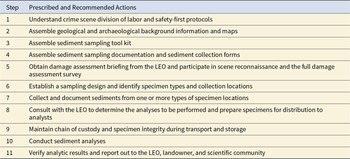
No synopsis of “how-to” recommendations can anticipate all context- and case-specific contingencies, but this article addresses some common gaps in specialist knowledge through stepwise descriptions of how to prepare for geoforensic fieldwork. We first provide general guidance for SME conduct as a member of a team involved in actual or potential litigation. We then specify recommended practices and offer investigative assets for use by geoarchaeologists and related SMEs in archaeological crime scene investigation and other types of cultural resource damage assessment. The five steps we describe precede and facilitate geoforensic specimen collection fieldwork and laboratory analyses. The five steps “nest” within the technical prescriptions detailed in the Guide to Field Investigation and Documentation of Archaeological Resources Protection Act (ARPA) Violations (United States Bureau of Indian Affairs 2020). The five steps are the first of the 11 generally sequential recommended steps for geoforensic sediment sampling and specimen collection, preparation, and analyses (Table 1). Each step builds on and presupposes that geoforensic evidence and specimen collection is proceeding in accord with case- and context-specific directives provided by LEOs, landowners, and attorneys. Nials and others (Reference Nials, Welch, MacDonald, Oga and Britton2025) describe the design and implementation of a specific program for geoforensic specimen sampling fieldwork (steps 6–7 in Table 1). MacDonald and others (Reference MacDonald, Nials, Oga, Britton and Welch2025) describe the final steps (steps 8–11), including analytic program methodology, procedures, and results. Case- or context-specific circumstances often lead to overlaps among the 11 steps or require repetition, customization, or omission. Specialists are advised to document when, where, and how each step is taken through dated notes, photographs where relevant, and completion of applicable forms. Investigation integrity and operational security require SMEs and other members of investigation teams to retain all versions and drafts of all notes, photographs, and forms.
Eleven Steps in Geoforensic Investigation of Archaeological Resource Crime.

Table 1 Long description
The table lists an eleven-step process for conducting a geoforensic investigation related to archaeological resource crime. It begins with understanding roles at the crime scene and following safety-first protocols, then gathering geological and archaeological background information and maps. Next, it calls for assembling sediment sampling tools and the documentation and collection forms needed to record samples. Midway steps emphasize coordination with law enforcement, including receiving a damage assessment briefing, participating in reconnaissance and a full damage assessment survey, and then creating a sampling design that specifies specimen types and collection locations. The workflow then covers collecting and documenting sediments, consulting with law enforcement to choose analyses, and preparing specimens for distribution to analysts. It highlights maintaining chain of custody and specimen integrity during transport and storage before conducting sediment analyses. The final step is verifying analytic results and reporting findings to law enforcement, the landowner, and the scientific community.
Step 1: Understand Crime Scene Division of Labor and Safety-First Protocols
Attorneys, LEOs, lead archaeologists, and other members of litigation teams generally expect professionalism, self-sufficiency, and precise communications from scientific SMEs. As newly enlisted members of such teams, SMEs may not instantly grasp the importance of operational security, chain-of-command, and other investigative protocols. In addition to scientific and evidentiary rule mandates to create and retain complete procedural documentation, to use reliable analytic techniques and measures, to quantify error rates, and to demonstrate construct validity (i.e., clear correspondence between observation and inference), SMEs involved in archaeological resource crime litigation are subject to protocols for case and crime scene management and for evidence collection and presentation (Albright Reference Albright2023). Honed through many generations of trials, errors, and jurisprudence, these rules distill to four principles for personal and professional conduct on the part of SMEs and all members of all damage assessment, crime scene investigation, and litigation teams.
One: Take responsibility for your personal safety and help others do the same through sustained situational awareness, including the identification, communication, and mitigation of apparent and foreseeable risks. Cultural resource damage scenes can be remote and rugged. Logistical and medical assistance is often many hours away. Other scenes may involve risks from looter holes, prolonged vehicle travel, and unfamiliar plants and animals. SMEs may be tasked to collect specimens in diverse settings, including at high-profile crime scenes, in anticipation of further alteration or removal, or in areas beyond the boundaries of defined crime scenes. Regardless of specific circumstances, risks are typically mitigated through continuous within-team sharing of observations relating to threats, challenges, goals, operational plans, alternative solutions, et cetera. (Figure 2).
Damage assessment team safety briefing, southern Arizona (left–right: Jonathan Knighton-Wisor, Shannon Cowell, Cassidy Hancock, Aimee Taufa, Wesley Miles, and Frances Landreth). Photograph courtesy of P. K. Weis.

Two: Operate within the limits of your professional training and expertise. In particular, SMEs should avoid both “playing lawyer” and all law enforcement duties, especially contacts with suspected criminals and other persons of interest in investigations. Damage assessments for large and complex cases are almost invariably dynamic and can be fraught with urgencies and contingencies. SMEs are advised to avoid temptations to vocalize unsolicited legal advice. SMEs should decline duties they have not been trained to perform expertly or are not comfortable learning to perform under expert supervision.
Three: Treat all damage areas as felony crime scenes until the LEO or landowner directs otherwise. It is seldom possible in the early stages of an investigation to ascertain with confidence whether the jurisdictional response to unauthorized resource alteration will be administrative, civil, criminal, or communal. Crime scene investigation and cultural resource damage assessment protocols converge on mandates to gather most or all evidence prior to determining the types and levels of infractions or indictments. To optimize the fair and impartial assignment of accountability for and appropriate remediation of unauthorized resource alterations, and in keeping with the “don’t play lawyer” advice offered above, specialists should defer inferences regarding case disposition and outcome pending the completion of investigations. Magistrates, judges, and juries—the arbiters of truth and justice in criminal and civil proceedings—have the final word in arguments concerning the relevance and veracity of cultural resource damage assessments and the evidence presented therein.
Four: Maintain the integrity and confidentiality of all case- and evidence-related information. SME actions and findings may have momentous consequences—either beneficial or otherwise—on legal, ecological, financial, and personal levels. Unlike academic, laboratory, and fieldwork settings, in which uninhibited sharing of knowledge and ideas is the norm, geoforensic SMEs work within parameters set by LEOs and attorneys, and exigencies dictated by crime scenes and case investigations. Some attorneys and LEOs may appreciate creative, critical, and “outside-the-box” thinking by SMEs and debates within teams; all will prioritize the timely and discrete completion of essential evidence collection, analyses, and reports. Investigative parameters almost always prohibit any disclosure of case-related information. A single unauthorized social media post, comment to a colleague outside the litigation team, or lapse in the chain of custody record for evidence can violate operational security and derail even high-profile or otherwise consequential criminal or civil adjudications.
Step 2: Assemble Geological and Archaeological Background Information and Maps
Step 2 typically begins after a geoarchaeologist accepts an SME assignment working for an LEO, landowner, or attorney. Step 2 may require timely coordination, planning, networking, and research to respond to requests for investigative assistance. The employer is likely to provide the SME with essential information on the attributes of the case and context that they think are most relevant to geoforensic inquiry, including the types and extents of resource alterations and the employer’s interests and preferences regarding the processes, staffing, timing, and reporting of geoforensic analyses. Except where other specialists have been involved, SMEs will typically need to identify and fill gaps in information concerning region-specific geological and archaeological research results.
Scientific and compliance projects affecting archaeological resources often require the completion of regulatory processes and the possession of permits to conduct investigations in specific jurisdictions. Geoforensic fieldwork to investigate archaeological crime typically also requires explicit government authorizations, including consultations with Tribal governments. However, federal officials, including LEOs, do not need permits to work within the scope of their authority on federal or Tribal land. Geoforensic specialists working under and on behalf of LEOs seldom require formal permits from landowners and land managers. That said, LEOs and attorneys directing the investigation should share information with their teams about the levels and types of permission being solicited and provided by the local hosts for each case. Such transparency allows SMEs and other team members to manage their reputations with landowners and otherwise limit risks to the investigation’s operational integrity.
Because few attorneys and LEOs will have prior experience with the processes, timeframes, limitations, and expected results of geoforensic investigations, SMEs must also be transparent. Geoarchaeologists should be clear and candid about what they need to succeed—for example, additional background information, technical and logistical assistance, guidance on scheduling, and prioritizing specimen collections and analyses—and about the likelihood of foreseeable challenges and limitations. Once an employer agrees to proceed with a specified program of evidence gathering, SMEs should typically compile archaeological, geological, and geomorphological information pertaining to the context of the investigation, including soils, geochemical, geophysical, hydrological, vegetation, and topographic maps. Aerial or remotely sensed imagery can be useful, especially if it has been acquired recently or in time series. SMEs should also obtain from the employer the case number(s), billing code(s), preferred schedule for specimen collections and analyses, and other logistical information and guidance, including permitting requirements for accessing areas and collecting specimens, and protocols for managing physical and digital evidence.
Step 3: Assemble Sediment Sampling Tool Kit
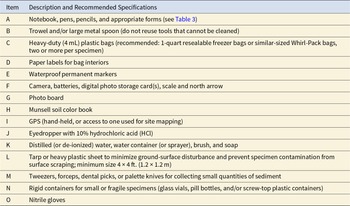
Step 3 is to assure the availability and sufficiency of equipment and supplies needed for the collection of geoforensic data and sediment specimens. The list in Table 2 provides a starting point for tool kit customization, as needed to meet SME preferences and case- and context-specific needs (Figure 3 depicts many of these items). The last three items (M–O) listed in Table 2 are commonly used in the collection of forensic sediment specimens from damage areas within cultural resource sites; these items may not be required to collect specimens from background geological contexts. SMEs should bear in mind that more specialized items are unlikely to be available in rural areas. It may be useful to create contingency plans for expedited delivery of additional materials to within reach of the fieldwork location, as required to complete evidence collection.
Geoforensic tool kit contents, including equipment and supplies for sediment specimen collection and recordation. Photograph courtesy of Shannon Cowell.

Equipment and Supplies Needed for Geoforensic Specimen Collection.
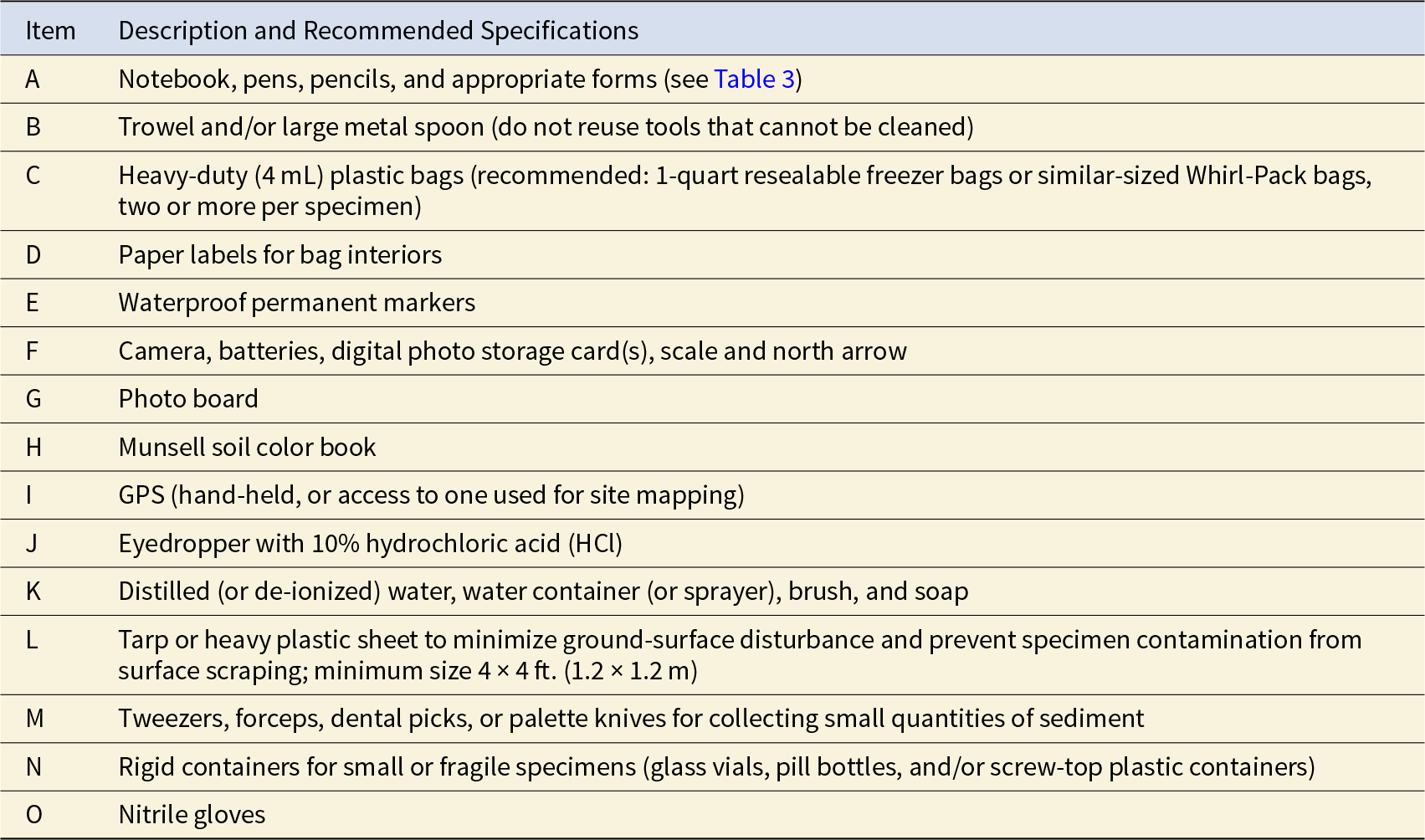
Table 2 Long description
The table lists equipment and supply items needed for collecting geoforensic specimens, pairing each item with recommended specifications or handling notes. Documentation materials include a notebook, writing tools, and appropriate forms. Sampling and handling tools include a trowel or large metal spoon that must be cleanable, plus tweezers, forceps, dental picks, or palette knives for small sediment amounts. Packaging and labeling supplies include heavy-duty plastic bags with two or more per specimen, paper labels placed inside bags, waterproof permanent markers, and rigid containers such as glass vials, pill bottles, or screw-top plastic containers for small or fragile specimens. Imaging and recording items include a camera with batteries and storage cards, a scale and north arrow, and a photo board. Site characterization and location tools include a Munsell soil color book and a hand-held GPS or access to one used for site mapping. Materials for testing and cleaning include an eyedropper with ten percent hydrochloric acid, distilled or de-ionized water with a container or sprayer, plus brush and soap. Contamination and disturbance controls include a tarp or heavy plastic sheet at least four by four feet, and nitrile gloves.
Step 4: Assemble Sediment Sampling Documentation and Sediment Collection Forms
The forms listed in Table 3 are recommended starting points for the documentation of geoforensic investigations. These forms may be supplanted by forms preferred by the employer and may be modified or supplemented by LEOs, attorneys, or SMEs to accommodate case- and context-specific circumstances and priorities. Blank copies of the forms are archived at https://core.tdar.org/document/503372/how-to-prepare-for-geoforensic-fieldwork-to-investigate-archaeological-resource-crime-supplemental-materials (Archaeology Southwest 2025) and are available for revision and/or reproduction, distribution, and field and laboratory use (Table 3; Figure 4). No form or other mechanism for recording complex suites of observations is universally self-explanatory or otherwise perfect. In the completion of forms, notes, and other documentation it is advisable to consistently use terms and phrases that are rigorously defined and free of jargon to the extent practical. In particular, the terms used to describe archaeological items and features should be descriptive (e.g., “about 50 subangular basalt boulders [all less than 50 cm in diameter] encircling a deposit of wood ash and charcoal at least 5 cm in depth”) rather than functional (e.g., “a hearth”). The same mandate holds for describing sediments. For example, “excavation exposed a 25 cm wide lens of dark brown (10YR 3/2, dry) clay loam” rather than “we found a thick cienega soil.” The geoforensic SME, often in consultation with the employer, should audit forms and records for accuracy and adequacy at appropriate intervals. Such an audit is to be completed at least once in the early stages of the fieldwork to assure errors do not proliferate, then at the close of field investigations and as part of the protocol for completing each phase of lab analysis.
Example of completed photo log. Image courtesy of Shannon Cowell.

Figure 4 Long description
The table contains the following columns: Exposure No., Camera File No., Damage Area, Direction, View, Document-ary Aids and Description/Subject. Row 1: Exposure No. 1, Camera File No. 418, Damage Area N/A, Direction N, View O, Document-ary Aids Y, Description Beginning Photo - photoboard. Row 2: Exposure No. 2, Camera File No. 419, Damage Area 3, 4, Direction N, View O, Document-ary Aids Y, Description Damage areas and associated backdirt, as found. Row 3: Exposure No. 3, Camera File No. 420, Damage Area 3, Direction N, View O, Document-ary Aids Y, Description Damage Area 3 before processing. Note pile of ceramics. Row 4: Exposure No. 4, Camera File No. 421, Damage Area 3, Direction N, View O, Document-ary Aids Y, Description Pile of ceramics on backdirt. Row 5: Exposure No. 5, Camera File No. 422, Damage Area 3, Direction N, View O, Document-ary Aids Y, Description Contents of screen, bucket #1. Row 6: Exposure No. 6, Camera File No. 423, Damage Area blank, Direction N, View O, Document-ary Aids Y, Description -VOID-. Row 7: Exposure No. 7, Camera File No. 424, Damage Area 3, Direction N, View O, Document-ary Aids Y, Description Flaked stone artifact recovered in screen, bucket #2. Row 8: Exposure No. 8, Camera File No. 425, Damage Area 3, Direction N, View O, Document-ary Aids Y, Description Cigarette butt exposed in west backdirt. Row 9: Exposure No. 9, Camera File No. 426, Damage Area 3, Direction N, View O, Document-ary Aids Y, Description Tool scar on wall of excavation - south edge. Row 10: Exposure No. 10, Camera File No. 427, Damage Area 3, Direction N, View O, Document-ary Aids Y, Description Post-processing. Note pine cones on original ground surface.
Forms Used in Geoforensic Investigation of Archaeological Resource Alteration.

Table 3 Long description
The table lists form codes and their descriptive titles used in a geoforensic investigation workflow. There are six forms, labeled A through F. Form A documents the geologic and topographic setting of specimen locations. Form B tracks sediment collection and the specimen’s history after collection. Form C is a photograph log, and Form D records evidence chain of custody. Form E is a microscopy analysis worksheet, and Form F captures petrographic thin section descriptions. The entries are a categorical index rather than measurements, so no quantities or trends are presented beyond the sequence of form types.
Step 5: Obtain Damage Assessment Briefing from the LEO and Participate in Scene Reconnaissance and the Full Damage Assessment Survey
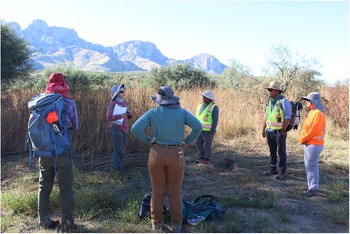
Step 5 is the threshold between preparation and fieldwork. It is the first opportunity for geoforensic SMEs to examine damage areas and other potential evidence localities. It is the last opportunity prior to specimen collection to assemble the information, documentation, and materials needed to gather evidence on geological, behavioral, and other processes affecting sediments implicated in crime scenes or other investigative contexts (Figure 5). SME participation in an on-site briefing, initial reconnaissance, or full survey or resurvey of the scene is the best foundation for assembling impeccable geoforensic knowledge and for building collaborative team relations. SME participation in discussions and reviews of the case and context are bases for designing geoforensic evidence collection, including sediment sampling and specimen collection objectives and plans that are explicitly aligned to the scale and complexity of the cultural resource alterations and that are aligned with the employer’s investigative priorities and parameters.
Investigation team reconnaissance (left–right: Brendan Fennerty, Duston Whiting, Fred Nials, Lee Wayne Lomayestewa, and Brandi MacDonald). Photograph courtesy of John R. Welch.

It bears repeating that completed forms and other elements of scientific rigor are fundamental to the effectiveness of geoforensic investigations. SME notes and forms are to use employer-assigned or -approved identifiers for damage areas and for all evidence types. Step 5 includes opportunities for geoforensic SMEs to become familiar with and adopt jurisdiction- or case-specific terms of reference, tracking numbers, and so forth. The Geological Setting Form guides the collection of information relating to particular damage areas and to the general setting of the alteration scene. Step 5 goals include the establishment of a relative chronology of alterations of earth surfaces. Because sediment crusts tend to harden and become smoother with age, variations in crusts on backdirt piles or other sediment contexts (e.g., footware or tire impressions; see Figures 6 and 7) are to be documented in written notes and photographs, sometimes in conjunction with impression casts made or commissioned by the LEO. Geoforensic SMEs may observe and compare sediment weathering and crust development, lateral stratigraphies and superpositions, and the angularity and coherence of surface clods in backdirt piles, excavated areas, and other disturbance loci. These factors—considered in relation to sediment types and textures, local slope, infilling, degree of burial, recent weather, et cetera—may provide empirical bases for SME inferences concerning the chronology of alterations to cultural resources and their vicinities. Perhaps needless to say, adjudication outcomes may hinge on such inferences.
Tire-track impression. Photograph courtesy of Duston Whiting.

Shoe impression. Photograph courtesy of Duston Whiting.

Step 5 is complete when the geoforensic SME determines that all pertinent background geological units and all foreground damage areas, especially excavated and altered earth surfaces, have been identified and either included or excluded from plans for sediment sampling plans and related evidence collection. The sampling plan should specify procedures for specimen collections in background and damage area contexts identified as relevant to the unfolding investigation. For example, if the evidence indicates that at least one vehicle was involved in the alleged alteration and that suspects excavated in ancestral homes or resting places, the SME should sample vehicle access routes, likely parking areas, and apparent damage areas (Nials et al. Reference Nials, Welch, MacDonald, Oga and Britton2025).
Discussion and Conclusions
Geoforensic investigations entail complex blends of legal, logistical, and scientific thinking and acting that may significantly affect individuals, cultural resources, and communities. One of movie director Mike Nichols’s “Five Rules for Filmmaking” seems noteworthy: “There’s absolutely no substitute for genuine lack of preparation” (Trott Reference Trott2014). The recommended practices outlined here are intended to prepare geoarchaeologists and other SMEs for geoforensic fieldwork, and to thereby boost the rigor, consistency, validity, replicability, and applicability of geoforensic evidence collections and analyses. While it has not escaped our attention that most of the recommendations and assets offered here may be useful to geoforensic SMEs preparing to investigate unauthorized dumping, wildlife poaching, or crimes not affecting cultural resources, our experience and interests center on the interplays of legal, geological, archaeological, and investigative factors entailed in cultural resource damage assessment, especially archaeological resource crime.
These five steps, taken deliberately and in accord with SME commitments to teamwork, operational security, and professionalism, will optimize prospects for geoforensic contributions to excellence in crime scene investigation and timely justice in case resolution. Damage assessment practitioners, land managers, and scientific SMEs should refine these steps and protocols in collaboration with LEOs and attorneys, then adapt them to specified jurisdiction, case, and environmental contexts. Attendance to these protocols will help to deter anthropogenic alterations, ensure just accountability for such alterations, and enable remediation of altered cultural resources and their unique values to Indigenous, local, and scientific communities.
Acknowledgments
This article is dedicated to the memories of Leigh Kuwanwisiwma (1950–2025) and Sir Colin Renfrew (1937–2024), inveterate advocates for the use of all available tools in pursuit of cultural resource protection. Much of the guidance offered here is grounded in research and case preparation and delivery completed as part of a cooperative ecosystem study unit funded primarily by the US Bureau of Indian Affairs and led by Tamara Begay, Frank Chavez, Shannon Cowell, Bill Doelle, Rechanda Lee, Steve Nash, Stacy Ryan, and Dusty Whiting. We are especially grateful for the generous support and guidance provided by the Hopi and White Mountain Apache Tribes and the leaders of their respective historic preservation and cultural resource protection staffs, including Mark Altaha, Gregg Henry, Nick Laluk, Stewart Koyiyumptewa, Lee Wayne Lomayestewa, Joel Nicholas, and Ramon Riley. Gary Huckleberry and two anonymous reviewers provided exceptionally astute and useful guidance for refining the review draft. Skylar Benedict expertly prepared the Spanish-language abstract. Garry Cantley wrote our theme music.
Funding Statement
The recommendations presented here are partially grounded in work supported by the BIA-Archaeology Southwest ARPA Assistance Initiative (CESU A23AC00099).
Data Availability Statement
No original data are included in this article.
Competing Interests
The authors declare none.




 Open access

