





1 Introduction
In the model theory of valued fields, one of the most striking results is a theorem by Ax, Kochen, and, independently, Ershov, which states that the first-order theory of an equicharacteristic zero henselian valued field is completely determined by the first-order theories of its residue field
$\mathrm {k}$
 and of its value group
$\Gamma $
and of its value group
$\Gamma $
 . A natural philosophy follows from this theorem: the model theory of a henselian valued field is controlled by its residue field and its value group.
In the early 2000s, Hrushovski asked if this philosophy also applies to the elimination of imaginaries: the classification of interpretable sets (quotients of definable sets by definable equivalence relations), or equivalently, the description of (rough) moduli spaces for families of definable sets. He proposed a classification of imaginaries reminiscent of the Ax-Kochen-Ershov principle. The goal of the present paper is to establish this classification for a broad class of henselian valued fields of equicharacteristic zero, including all those with bounded Galois group, that is, having finitely many extensions of any given degree. In fact, it suffices that the maximal unramified algebraic extension has bounded Galois group, in other words, when the inertia group is bounded.
The study of imaginaries in various henselian valued fields has been ongoing for the past 20 years, starting with the case of algebraically closed valued fields (
$\mathrm {ACVF}$
 ) in the foundational work by Haskell, Hrushovski, and Macpherson [Reference Haskell, Hrushovski and Macpherson1]. They proved that in
$\mathrm {ACVF}$
) in the foundational work by Haskell, Hrushovski, and Macpherson [Reference Haskell, Hrushovski and Macpherson1]. They proved that in
$\mathrm {ACVF}$
 , every quotient can be described as a subset of products of certain specific quotients, known as the geometric sorts : the main field K, and, for all
$n \in \mathbb {Z}_{>0}$
, every quotient can be described as a subset of products of certain specific quotients, known as the geometric sorts : the main field K, and, for all
$n \in \mathbb {Z}_{>0}$
 , the space
$\mathrm {Gr}_{n}:= \mathrm {GL}_{n}(K)/\mathrm {GL}_{n}(\mathcal {O})$
, the space
$\mathrm {Gr}_{n}:= \mathrm {GL}_{n}(K)/\mathrm {GL}_{n}(\mathcal {O})$
 of free rank
$n\, \mathcal {O}$
of free rank
$n\, \mathcal {O}$
 -submodules of
$K^{n}$
-submodules of
$K^{n}$
 (also known as the affine grassmanian of
$\mathrm {GL}_{n}$
(also known as the affine grassmanian of
$\mathrm {GL}_{n}$
 ) and the space
$\mathrm {Lin}_{n}= \coprod _{R \in \mathrm {Gr}_{n}} R/\mathfrak {m} R$
) and the space
$\mathrm {Lin}_{n}= \coprod _{R \in \mathrm {Gr}_{n}} R/\mathfrak {m} R$
 , where
$\mathcal {O}$
, where
$\mathcal {O}$
 denotes the valuation ring and
$\mathfrak {m}\subseteq \mathcal {O}$
denotes the valuation ring and
$\mathfrak {m}\subseteq \mathcal {O}$
 is the unique maximal ideal. We say that
$\mathrm {ACVF}$
is the unique maximal ideal. We say that
$\mathrm {ACVF}$
 eliminates imaginaries down to the geometric sorts. These results were later extended to other specific henselian fields, potentially with additional structure [Reference Mellor2, Reference Hrushovski, Martin and Rideau3, Reference Hils, Kamensky and Rideau4, Reference Rideau5].
As can be expected, the residue field and the value group create natural obstructions to the elimination of imaginaries in valued fields. In earlier work, the authors studied the residual obstructions [Reference Hils and Rideau-Kikuchi6] and the value group obstructions [Reference Vicaría7] independently. The main focus of the present work, and where its novelty and complexity lie, is to understand how they interact. This leads us to a classification under no assumptions on the residue field and very mild assumptions on the value group.
The classification of imaginaries in
$\mathrm {ACVF}$
 laid the groundwork for a rich “geometric model theory” of valued fields. However, the dependence on algebraically closed fields hides most of the more arithmetic phenomena. It is the authors’ belief that the present classification of imaginaries and its methods will lead to a geometric model theory of valued fields that accounts for their arithmetic. This can be seen, for example, in their work [Reference Cubides Kovacsics, Rideau-Kikuchi and Vicaría8] with Cubides Kovacsics on residue domination.
1.1 Obstructions arising from the value group
Let K be an equicharacteristic zero henselian valued field. When describing imaginaries in K, the imaginaries of the value group itself have to be accounted for. Moreover, the complexity of the value group also directly impacts the complexity of definable
$\mathcal {O}$
 -modules and this also needs to be taken into account.
This can be done by introducing the stabilizer sorts which provide codes for all the definable
$\mathcal {O}$
 -submodules of
$K^n$
-submodules of
$K^n$
 , for any n. More precisely, let
$\mathcal {C} = (\mathcal {C}_c)_{c\in \mathrm {Cut}^\star }$
, for any n. More precisely, let
$\mathcal {C} = (\mathcal {C}_c)_{c\in \mathrm {Cut}^\star }$
 be the (ind-)interpretable family of definable proper cuts in
$\Gamma $
be the (ind-)interpretable family of definable proper cuts in
$\Gamma $
 – here a cut is said to be proper if it is neither of the cuts at infinity. For every
$c\in \mathrm {Cut}^\star $
– here a cut is said to be proper if it is neither of the cuts at infinity. For every
$c\in \mathrm {Cut}^\star $
 , let
$\mathrm {I}_c$
, let
$\mathrm {I}_c$
 denote the
$\mathcal {O}$
denote the
$\mathcal {O}$
 -submodule
$\{x\in K: v(x) \in \mathcal {C}_c\}$
-submodule
$\{x\in K: v(x) \in \mathcal {C}_c\}$
 . For every tuple c in
$\mathrm {Cut}^\star $
. For every tuple c in
$\mathrm {Cut}^\star $
 , let
$\Lambda _c$
, let
$\Lambda _c$
 be the module
$\sum _i I_{c_i}e_i$
be the module
$\sum _i I_{c_i}e_i$
 , where
$(e_i)_{i<|c|}$
, where
$(e_i)_{i<|c|}$
 is the canonical basis of
$K^{|c|}$
is the canonical basis of
$K^{|c|}$
 .
.
The group
$\mathrm {B}_n$
 of upper triangular matrices acts on the set of all definable
$\mathcal {O}$
of upper triangular matrices acts on the set of all definable
$\mathcal {O}$
 -submodules of
$K^n$
-submodules of
$K^n$
 . We define

and we identify an element of
$\mathrm {Mod}_c$
 with the corresponding
$\mathcal {O}$
with the corresponding
$\mathcal {O}$
 -submodule (see Notation 3.4.2).
We also consider the (ind-)interpretable set

where c varies over the (ind-)interpretable set of finite tuples in
$\mathrm {Cut}^\star $
 . Any definable
$\mathcal {O}$
. Any definable
$\mathcal {O}$
 -submodules of
$K^n$
-submodules of
$K^n$
 is coded in
$\mathrm {Mod}\cup K$
is coded in
$\mathrm {Mod}\cup K$
 (see Corollary 3.7).
When the value group has bounded regular rank (i.e., there are at most countably many definable convex subgroups in any elementary extensionFootnote 1) and the residue field is algebraically closed, the second author [Reference Vicaría7, Theorem 5.12] showed that, together with the imaginaries of the value group, these are essentially the only new imaginaries.
1.2 Obstructions arising from the residue field
When the residue field is not algebraically closed, new obstructions arise. The residue field itself can have nontrivial imaginaries, but it might also induce linearly twisted imaginaries on interpretable
$\mathrm {k}$
 -vector spaces.
Let
$R\subseteq K^n$
 be a definable
$\mathcal {O}$
be a definable
$\mathcal {O}$
 -submodule. Then the quotient
$R/\mathfrak {m} R$
-submodule. Then the quotient
$R/\mathfrak {m} R$
 is a
$\mathrm {k}$
is a
$\mathrm {k}$
 -vector space of dimension
$d\leq n$
-vector space of dimension
$d\leq n$
 , on which
$\mathrm {k}$
, on which
$\mathrm {k}$
 induces a nontrivial structure. Once we name a basis,
$R/\mathfrak {m} R$
induces a nontrivial structure. Once we name a basis,
$R/\mathfrak {m} R$
 is definably isomorphic to some
$\mathrm {k}^{d}$
is definably isomorphic to some
$\mathrm {k}^{d}$
 , and hence imaginaries of
$R/\mathfrak {m} R$
, and hence imaginaries of
$R/\mathfrak {m} R$
 can be identified with imaginaries of
$\mathrm {k}$
can be identified with imaginaries of
$\mathrm {k}$
 ; but this identification is not canonical and depends on a choice of basis.
The structure
$(\mathrm {k}, R/\mathfrak {m} R)$
 can be seen as a structure in the language
$\mathfrak {L}_{\mathrm {vect}}$
can be seen as a structure in the language
$\mathfrak {L}_{\mathrm {vect}}$
 with two sorts:
-
○ a sort for $\mathrm {k}$
 with the structure induced by K;
 -
○ a vector space sort $\mathrm {V}$
with the (additive) group language; -
○ A function $\lambda : \mathrm {k} \times \mathrm {V} \rightarrow \mathrm {V}$
interpreted as scalar multiplication.



Given a set X interpretable without parameters in the
$\mathfrak {L}_{\mathrm {vect}}$
 -theory of dimension d vector spaces, the interpretable sets
$X^{(\mathrm {k},R/\mathfrak {m} R)}$
-theory of dimension d vector spaces, the interpretable sets
$X^{(\mathrm {k},R/\mathfrak {m} R)}$
 have to be accounted for.Footnote 2
Let
$\mathrm {Cut}^{\star \star }=\mathrm {Cut}^\star \setminus \{\Gamma _{>\gamma }: \gamma \in \Gamma \}$
 – unless the value group is discrete, in which case we set
$\mathrm {Cut}^{\star \star } = \mathrm {Cut}^\star $
– unless the value group is discrete, in which case we set
$\mathrm {Cut}^{\star \star } = \mathrm {Cut}^\star $
 . A module
$R\subseteq K^n$
. A module
$R\subseteq K^n$
 is said to be
$\mathfrak {m}$
is said to be
$\mathfrak {m}$
 -avoiding if it is in
$\mathrm {Mod}_c$
-avoiding if it is in
$\mathrm {Mod}_c$
 , for some tuple c in
$\mathrm {Cut}^{\star \star }$
, for some tuple c in
$\mathrm {Cut}^{\star \star }$
 . The dimension of
$R/\mathfrak {m} R$
. The dimension of
$R/\mathfrak {m} R$
 only depends on c – it is equal to
$d = |\{i : \mathcal {C}_{c_i} = \Gamma _{\leq \gamma }$
only depends on c – it is equal to
$d = |\{i : \mathcal {C}_{c_i} = \Gamma _{\leq \gamma }$
 , for some
$\gamma \in \Gamma \}|$
, for some
$\gamma \in \Gamma \}|$
 . For every quotient X as above, we define

and the (generalized)
$\mathrm {k}$
 -linear imaginaries:

where c ranges over all finite tuples in
$\mathrm {Cut}^{\star \star }$
 . Among those, we denote
$\mathrm {Gr} = \coprod _{c} \mathrm {Mod}_c$
. Among those, we denote
$\mathrm {Gr} = \coprod _{c} \mathrm {Mod}_c$
 and
$\mathrm {Lin} = \coprod _{c} \mathrm {Lin}_{c,\mathrm {V}}$
and
$\mathrm {Lin} = \coprod _{c} \mathrm {Lin}_{c,\mathrm {V}}$
 . Along with K, these form the (generalized) geometric sorts, and they encode all definable
$\mathcal {O}$
. Along with K, these form the (generalized) geometric sorts, and they encode all definable
$\mathcal {O}$
 -submodules of
$K^n$
-submodules of
$K^n$
 , for any n (see Corollary 3.21).
Assuming that the value group is elementarily equivalent to
$\mathbb {Q}$
 or
$\mathbb {Z}$
or
$\mathbb {Z}$
 , Hils and the first author [Reference Hils and Rideau-Kikuchi6, Theorem 6.1.1] show that, under the technical assumption that the residue field eliminates
$\exists ^\infty $
, Hils and the first author [Reference Hils and Rideau-Kikuchi6, Theorem 6.1.1] show that, under the technical assumption that the residue field eliminates
$\exists ^\infty $
 , all new imaginaries essentially arise in this manner.
1.3 An imaginary Ax-Kochen-Ershov principle
In this paper, we provide a common generalization of [Reference Hils and Rideau-Kikuchi6, Reference Vicaría7] by obtaining a general Ax-Kochen-Ershov principle for the classification of imaginaries, under a mild technical assumption on the value group (we refer the reader to Section 2.1 for notation and definitions related to imaginaries). However, note that dealing with both an arbitrary residue field and a very general value group introduces new issues that were not present in either earlier works. We give details on some of the new tools required to deal with these issues after stating the main theorems.
Definition 1.1. Given a structure M, tuples of variables x and y and a set of formulas
$\Delta (x,y)$
 , a
$\Delta $
, a
$\Delta $
 -type
$p(x)$
-type
$p(x)$
 over M is a maximal finitely consistent set of formulas of the form
$\phi (x,a)$
over M is a maximal finitely consistent set of formulas of the form
$\phi (x,a)$
 and
$\neg \phi (x,a)$
and
$\neg \phi (x,a)$
 , where
$\phi \in \Delta $
, where
$\phi \in \Delta $
 and a is a y-tuple in M. If
$A\subseteq M$
and a is a y-tuple in M. If
$A\subseteq M$
 , we say that such a type is A-definable if for every
$\phi \in \Delta $
, we say that such a type is A-definable if for every
$\phi \in \Delta $
 , the set
$ \{a\in M^y : \phi (x,a)\in p\} $
, the set
$ \{a\in M^y : \phi (x,a)\in p\} $
 is A-definable.
Definition 1.2. We say that an ordered group G (potentially with additional structure) satisfies Property D if for every
$A = \mathrm {acl}(A)\subseteq G^{\mathrm {eq}}$
 and every finite set of A-formulas
$\Delta (x,y)$
and every finite set of A-formulas
$\Delta (x,y)$
 containing the formula
$x< y_{0}$
containing the formula
$x< y_{0}$
 , any A-definable
$\Delta $
, any A-definable
$\Delta $
 -type
$p(x)$
-type
$p(x)$
 over G is contained in an A-definable complete type
$q(x)$
over G is contained in an A-definable complete type
$q(x)$
 over G.
This is a stronger property than the density of definable types. It holds in ordered abelian groups of bounded regular rank with no addition structure (see the second half of the proof of [Reference Vicaría7, Theorem 5.3]).
Our main results are the following. Let K be an equicharacteristic zero henselian valued field such that the value group is either:
-
○ dense with property D ;
-
○ or, a discrete ordered abelian group of bounded regular rank – in which case, we add a constant for a uniformizer.
Theorem (Theorem 6.6)
Let
$K_{\mathrm {ac}}$
 be an expansion of K by angular components. Then
$K_{\mathrm {ac}}$
be an expansion of K by angular components. Then
$K_{\mathrm {ac}}$
 weakly eliminates imaginaries down to
$K \cup \mathrm {k}^{\mathrm {leq}} \cup \Gamma ^{\mathrm {eq}}$
weakly eliminates imaginaries down to
$K \cup \mathrm {k}^{\mathrm {leq}} \cup \Gamma ^{\mathrm {eq}}$
 – in other words, any interpretable set admits an interpretable finite cover by a subset of some cartesian power of
$K \cup \mathrm {k}^{\mathrm {leq}} \cup \Gamma ^{\mathrm {eq}}$
– in other words, any interpretable set admits an interpretable finite cover by a subset of some cartesian power of
$K \cup \mathrm {k}^{\mathrm {leq}} \cup \Gamma ^{\mathrm {eq}}$
 (see Section 2.1 for precise definitions).
Without an angular component the short exact sequence

might not eliminate imaginaries down to
$\mathrm {k}^{\mathrm {leq}}$
 and
$\Gamma ^{\mathrm {eq}}$
and
$\Gamma ^{\mathrm {eq}}$
 , creating further obstructions (see Remark 6.5). They can be avoided by further assumption on
$\Gamma $
, creating further obstructions (see Remark 6.5). They can be avoided by further assumption on
$\Gamma $
 :
:
Theorem (Theorem 6.4)
Assume that for every
$n \in \mathbb {Z}_{\geq 1}$
 we have
$[\Gamma : n\Gamma ]< \infty $
we have
$[\Gamma : n\Gamma ]< \infty $
 , and we add constants in
$\mathrm {RV}$
, and we add constants in
$\mathrm {RV}$
 so that
$\Gamma /n\Gamma = \Gamma /n v(\mathrm {RV}(\mathrm {acl}(\emptyset )))$
so that
$\Gamma /n\Gamma = \Gamma /n v(\mathrm {RV}(\mathrm {acl}(\emptyset )))$
 . Then K weakly eliminates imaginaries down to
$K \cup \mathrm {k}^{\mathrm {leq}}\cup \Gamma ^{\mathrm {eq}}$
. Then K weakly eliminates imaginaries down to
$K \cup \mathrm {k}^{\mathrm {leq}}\cup \Gamma ^{\mathrm {eq}}$
 .
.
Remark 1.3. These theorems remain true when K comes with additional structure on
$\mathrm {k}$
 and, independently
$\Gamma $
and, independently
$\Gamma $
 – the main exception is that when the valuation is discrete, we require the valuation group to have no additional structure. Also, in the second theorem, the assumption on the finiteness of
$\Gamma /n\Gamma $
– the main exception is that when the valuation is discrete, we require the valuation group to have no additional structure. Also, in the second theorem, the assumption on the finiteness of
$\Gamma /n\Gamma $
 can be replaced by asking that
$\mathrm {k}$
can be replaced by asking that
$\mathrm {k}$
 is an algebraically closed field with no additional structure (see Corollary 4.11, this is essentially [Reference Vicaría7, Theorem 5.12]).
These results generalize all previously known weak elimination results in equicharacteristic zero (in particular, those of [Reference Hils and Rideau-Kikuchi6, Reference Vicaría7]) and provides a definitive answer for, among others, all equicharacteristic zero henselian valued fields with bounded inertia group – meaning that the maximal unramified extension has bounded Galois group.
As a corollary (and an illustration) of these two results, when
$\Gamma $
 is dense, we give a complete classification of (almost)
$\mathrm {k}$
is dense, we give a complete classification of (almost)
$\mathrm {k}$
 -internal sets – see Corollary 6.7. In the case of
$\mathrm {ACVF}$
-internal sets – see Corollary 6.7. In the case of
$\mathrm {ACVF}$
 this classification is a cornerstone of the study of stable domination and the subsequent work of Hrushovski and Loeser [Reference Hrushovski and Loeser10] on Berkovich spaces. These new results are used in [Reference Cubides Kovacsics, Rideau-Kikuchi and Vicaría11] to study residual domination in equicharacteristic zero henselian fields.
1.4 Sketch of the proof
The proof of the main theorems proceeds in two main steps. The first one is a density result for definable types in the structure induced by the maximal unramified algebraic extension (Theorem 4.1). Density of definable (complete) types is at the core of many recent results on elimination of imaginaries. However, it cannot hold in an arbitrary equicharacteristic zero henselian field K because it might not hold in the residue field or the value group.
In [Reference Hils and Rideau-Kikuchi6, Theorem 3.1.3] Hils and the first author showed that definable types of the algebraic closure
$K^{\mathrm {a}}$
 are dense among definable sets in K, under the assumption that the residue field eliminates
$\exists ^{\infty }$
are dense among definable sets in K, under the assumption that the residue field eliminates
$\exists ^{\infty }$
 . The second author ([Reference Vicaría7, Theorem 5.9]) proved density of definable types in the maximal unramified algebraic extension
$K^{\mathrm {ur}}$
. The second author ([Reference Vicaría7, Theorem 5.9]) proved density of definable types in the maximal unramified algebraic extension
$K^{\mathrm {ur}}$
 , assuming the value group has bounded regular rank. Theorem 4.1 generalizes both results and unifies them by proving that the definable types of
$K^{\mathrm {ur}}$
, assuming the value group has bounded regular rank. Theorem 4.1 generalizes both results and unifies them by proving that the definable types of
$K^{\mathrm {ur}}$
 are dense among the sets definable in K (assuming Property D). Note also that no hypothesis on the residue field is required anymore. A significant new challenge in this construction is to relate the germs of functions definable in K to those of functions definable in
$K^{\mathrm {ur}}$
are dense among the sets definable in K (assuming Property D). Note also that no hypothesis on the residue field is required anymore. A significant new challenge in this construction is to relate the germs of functions definable in K to those of functions definable in
$K^{\mathrm {ur}}$
 – see Section 4.3.
The second step of proof consists in studying the completions of the partial definable types constructed in the first step. We show that they are invariant over
$\mathrm {RV}$
 and
$\mathrm {k}$
and
$\mathrm {k}$
 -vector spaces of the form
$R/ \mathfrak {m} R$
-vector spaces of the form
$R/ \mathfrak {m} R$
 , where R is a definable
$\mathcal {O}$
, where R is a definable
$\mathcal {O}$
 -submodules of
$K^n$
-submodules of
$K^n$
 (Theorem 5.3). The bulk of the work (Proposition 5.16) revolves around showing that (generalized) geometric points can be lifted to the valued field by a sufficiently invariant type. This, in turn, relies heavily on the technical computation of germs of function taking values in sets of the form
$R/ \mathfrak {m} R$
(Theorem 5.3). The bulk of the work (Proposition 5.16) revolves around showing that (generalized) geometric points can be lifted to the valued field by a sufficiently invariant type. This, in turn, relies heavily on the technical computation of germs of function taking values in sets of the form
$R/ \mathfrak {m} R$
 .
.
We describe such germs in three steps. First we first consider the case of valued fields with algebraically closed residue field (cf. Proposition 5.7). We then consider valued fields with dense value group and arbitrary residue field (Section 5.1.1). This relies on the characterization of the
$\mathrm {k}$
 -internal sets (Corollary 3.23). Lastly, we consider valued fields with discrete value group and arbitrary residue field (Section 5.1.2). In that case, we circumvent the characterization of the
$\mathrm {k}$
-internal sets (Corollary 3.23). Lastly, we consider valued fields with discrete value group and arbitrary residue field (Section 5.1.2). In that case, we circumvent the characterization of the
$\mathrm {k}$
 -internal sets by considering a ramified extension with dense value group.
Together these two results imply a first elimination result relative to the imaginaries of
$\mathrm {RV}$
 and the
$\mathrm {k}$
and the
$\mathrm {k}$
 -vector spaces of the form
$R/ \mathfrak {m} R$
-vector spaces of the form
$R/ \mathfrak {m} R$
 (Proposition 6.1). The main theorems follow by describing the imaginaries in
$\mathrm {RV}$
(Proposition 6.1). The main theorems follow by describing the imaginaries in
$\mathrm {RV}$
 with and without angular component.
1.5 Overview of the paper
Section 2 provides some preliminary reminders on imaginaries and the model theory of equicharacteristic zero henselian fields.
In Section 3, we introduce the stabilizer sorts and the generalized geometric sorts. Both provide codes for the definable
$\mathcal {O}$
 -modules. We prove a unary decomposition for the stabilizer sorts (Proposition 3.10). The generalized geometric sorts – and the related notion of
$\mathfrak {m}$
-modules. We prove a unary decomposition for the stabilizer sorts (Proposition 3.10). The generalized geometric sorts – and the related notion of
$\mathfrak {m}$
 -avoiding module – play a crucial role in classifying
$\mathrm {k}$
-avoiding module – play a crucial role in classifying
$\mathrm {k}$
 -internal sets among the stabilizer sorts (Corollary 3.23), provided that the value group is dense.
In Section 4, we prove the density of definable types of the maximal unramified algebraic extension
$K^{\mathrm {ur}}$
 among definable sets of K (Theorem 4.1). In Section 5, we show that those definable types have invariant completions (Theorem 5.3). Finally, in Section 6, we wrap everything together and show the two main theorems.
2 Preliminaries
2.1 Model theoretic preliminaries
Throughout this text, if M is an
$\mathfrak {L}$
 -structure, a set X is said to be “definable” if it is definable with parameters. If we specify that it is “
$\mathfrak {L}$
-structure, a set X is said to be “definable” if it is definable with parameters. If we specify that it is “
$\mathfrak {L}$
 -definable” we mean that it is definable without parameters. Also, we extend definable sets canonically to elementary extensions of M and we distinguish the definable set X from the set
$X(M)$
-definable” we mean that it is definable without parameters. Also, we extend definable sets canonically to elementary extensions of M and we distinguish the definable set X from the set
$X(M)$
 of its realizations in M.
If
$A \subseteq M$
 , we write
$X(A)$
, we write
$X(A)$
 for the points of X whose coordinates are in A, rather than
$X\cap \mathrm {dcl}(A)$
for the points of X whose coordinates are in A, rather than
$X\cap \mathrm {dcl}(A)$
 . We change language too often to not be explicit with the definable closures at play.
We refer the reader to [Reference Tent and Ziegler12, Section 8.4] for a detailed exposition of the elimination of imaginaries. Let T be an
$\mathfrak {L}$
 -theory. Consider the language
$\mathfrak {L}^{\mathrm {eq}}$
-theory. Consider the language
$\mathfrak {L}^{\mathrm {eq}}$
 obtained by adding to
$\mathfrak {L}$
obtained by adding to
$\mathfrak {L}$
 a new sort
$S_X$
a new sort
$S_X$
 for every
$\mathfrak {L}$
for every
$\mathfrak {L}$
 -definable set
$X \subseteq Y\times Z$
-definable set
$X \subseteq Y\times Z$
 , where Y and Z are product of sorts, and a new symbol
$f_X : Z \to S_X$
, where Y and Z are product of sorts, and a new symbol
$f_X : Z \to S_X$
 . The
$\mathfrak {L}^{\mathrm {eq}}$
. The
$\mathfrak {L}^{\mathrm {eq}}$
 -theory
$T^{\mathrm {eq}}$
-theory
$T^{\mathrm {eq}}$
 is then obtained as the union of T, the fact that the
$f_X$
is then obtained as the union of T, the fact that the
$f_X$
 are surjective and that their fibers are the classes of the equivalence relation defined by
$X_{z_1} = \{y\in Y: (y,z_1)\in X\} = X_{z_2}$
are surjective and that their fibers are the classes of the equivalence relation defined by
$X_{z_1} = \{y\in Y: (y,z_1)\in X\} = X_{z_2}$
 .
.
Any
$M\models T$
 has a unique expansion to a model of
$T^{\mathrm {eq}}$
has a unique expansion to a model of
$T^{\mathrm {eq}}$
 denoted
$M^{\mathrm {eq}}$
denoted
$M^{\mathrm {eq}}$
 – whose points are called the imaginaries. A set is interpretable if it is definable in
$M^{\mathrm {eq}}$
– whose points are called the imaginaries. A set is interpretable if it is definable in
$M^{\mathrm {eq}}$
 . Throughout this paper, when considering types, definable closures or algebraic closures, we will work in the
$\mathfrak {L}^{\mathrm {eq}}$
. Throughout this paper, when considering types, definable closures or algebraic closures, we will work in the
$\mathfrak {L}^{\mathrm {eq}}$
 -structure, unless otherwise specified.
Given
$M\models T$
 and an
$\mathfrak {L}(M)$
and an
$\mathfrak {L}(M)$
 -definable set X, we denote by
$\ulcorner X\urcorner \subseteq M^{\mathrm {eq}}$
-definable set X, we denote by
$\ulcorner X\urcorner \subseteq M^{\mathrm {eq}}$
 the intersection of all
$A = \mathrm {dcl}(A)\subseteq M^{\mathrm {eq}}$
the intersection of all
$A = \mathrm {dcl}(A)\subseteq M^{\mathrm {eq}}$
 such that X is
$\mathfrak {L}^{\mathrm {eq}}(A)$
such that X is
$\mathfrak {L}^{\mathrm {eq}}(A)$
 -definable. It is the smallest
$\mathrm {dcl}$
-definable. It is the smallest
$\mathrm {dcl}$
 -closed set of definition for X. Any
$\mathrm {dcl}$
-closed set of definition for X. Any
$\mathrm {dcl}$
 -generating subset of
$\ulcorner X\urcorner $
-generating subset of
$\ulcorner X\urcorner $
 is called a code of X. More generally, if
$A\subseteq M^{\mathrm {eq}}$
is called a code of X. More generally, if
$A\subseteq M^{\mathrm {eq}}$
 is a set of parameters, any tuple e such that
$\mathrm {dcl}(Ae) = \mathrm {dcl}(A\ulcorner X\urcorner )$
is a set of parameters, any tuple e such that
$\mathrm {dcl}(Ae) = \mathrm {dcl}(A\ulcorner X\urcorner )$
 is called a code of X over A.
If
$\mathcal {D}$
 is a collection of sorts of
$\mathfrak {L}^{\mathrm {eq}}$
is a collection of sorts of
$\mathfrak {L}^{\mathrm {eq}}$
 (equivalently, a collection of
$\mathfrak {L}$
(equivalently, a collection of
$\mathfrak {L}$
 -interpretable sets) and
$A\subseteq M^{\mathrm {eq}}$
-interpretable sets) and
$A\subseteq M^{\mathrm {eq}}$
 is a set of parameters, we say that X is coded in
$\mathcal {D}$
is a set of parameters, we say that X is coded in
$\mathcal {D}$
 over A if it is
$\mathfrak {L}^{\mathrm {eq}}(A\cup \mathcal {D}(\ulcorner X\urcorner ))$
over A if it is
$\mathfrak {L}^{\mathrm {eq}}(A\cup \mathcal {D}(\ulcorner X\urcorner ))$
 -definable – that is, it admits a code in
$\mathcal {D}$
-definable – that is, it admits a code in
$\mathcal {D}$
 over A.
The theory T is said to eliminate imaginaries down to
$\mathcal {D}$
 if, for every
$M\models T$
if, for every
$M\models T$
 , every
$\mathfrak {L}(M)$
, every
$\mathfrak {L}(M)$
 -definable set X is coded in
$\mathcal {D}$
-definable set X is coded in
$\mathcal {D}$
 – equivalently, for every
$e\in M^{\mathrm {eq}}$
– equivalently, for every
$e\in M^{\mathrm {eq}}$
 , there is some
$d\in \mathcal {D}(\mathrm {dcl}(e))$
, there is some
$d\in \mathcal {D}(\mathrm {dcl}(e))$
 such that
$e\in \mathrm {dcl}(d)$
such that
$e\in \mathrm {dcl}(d)$
 . Finally, we say that the theory T weakly eliminates imaginaries down to
$\mathcal {D}$
. Finally, we say that the theory T weakly eliminates imaginaries down to
$\mathcal {D}$
 if for every
$e\in M^{\mathrm {eq}}$
if for every
$e\in M^{\mathrm {eq}}$
 , there is some
$d\in \mathcal {D}(\mathrm {acl}(e))$
, there is some
$d\in \mathcal {D}(\mathrm {acl}(e))$
 such that
$e\in \mathrm {dcl}(d)$
such that
$e\in \mathrm {dcl}(d)$
 .
.
If
$p(x)$
 is a (definable) partial type over some structure M and f and g are definable functions in M which are defined at realizations of p, we say that they have the same p-germ, and we write
$[f]_{p} = [g]_{p}$
is a (definable) partial type over some structure M and f and g are definable functions in M which are defined at realizations of p, we say that they have the same p-germ, and we write
$[f]_{p} = [g]_{p}$
 if
$p(x)\vdash f(x) = g(x)$
if
$p(x)\vdash f(x) = g(x)$
 . When p is definable we write
$[f]_{p}$
. When p is definable we write
$[f]_{p}$
 for class of p-germs as f varies in an
$\mathfrak {L}$
for class of p-germs as f varies in an
$\mathfrak {L}$
 -definable family.
Lastly, we refer the reader to [Reference Rideau13, Appendix A (Definition
$A.2$
 and
$A.5$
and
$A.5$
 )] for a detailed presentation of expansions (called enrichments, there) and relative quantifier elimination. Note that in the present text, expansions do not allow adding new sorts.
2.2 Equicharacteristic zero henselian fields
Let
$\mathrm {Hen}_{0,0}$
 be the theory of equicharacteristic zero henselian valued fields
$(\mathrm {K},\mathrm {v})$
be the theory of equicharacteristic zero henselian valued fields
$(\mathrm {K},\mathrm {v})$
 with no additional structure, in some language
$\mathfrak {L}$
with no additional structure, in some language
$\mathfrak {L}$
 . The exact language we use does not matter much since we will be working
$\mathfrak {L}^{\mathrm {eq}}$
. The exact language we use does not matter much since we will be working
$\mathfrak {L}^{\mathrm {eq}}$
 . In this section, we recall some useful results about these structures. We denote by
$\mathrm {RV}^\star $
. In this section, we recall some useful results about these structures. We denote by
$\mathrm {RV}^\star $
 the group
$\mathrm {K}^\star /(1+\mathfrak {m})$
the group
$\mathrm {K}^\star /(1+\mathfrak {m})$
 , where
$\mathfrak {m}$
, where
$\mathfrak {m}$
 is the maximal ideal of the valuation ring
$\mathcal {O}\subseteq \mathrm {K}$
is the maximal ideal of the valuation ring
$\mathcal {O}\subseteq \mathrm {K}$
 and
$\mathrm {rv} : \mathrm {K}\to \mathrm {RV} = \mathrm {RV}^\star \cup \{0\}$
and
$\mathrm {rv} : \mathrm {K}\to \mathrm {RV} = \mathrm {RV}^\star \cup \{0\}$
 the canonical projection (extended by
$\mathrm {rv}(0) = 0$
the canonical projection (extended by
$\mathrm {rv}(0) = 0$
 ).
).
Theorem 2.1 [Reference Basarab14, Theorem B]
Let
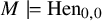
$M\models \mathrm {Hen}_{0,0}$
 and
$A\leq \mathrm {K}(M)$
and
$A\leq \mathrm {K}(M)$
 be a subring. Every A-definable subset of
$\mathrm {K}^x\times \mathrm {RV}^y$
be a subring. Every A-definable subset of
$\mathrm {K}^x\times \mathrm {RV}^y$
 is of the form
$\{(x,y) : (\mathrm {rv}(P(x)),y)\in X\}$
is of the form
$\{(x,y) : (\mathrm {rv}(P(x)),y)\in X\}$
 , for some tuple P in
$A[x]$
, for some tuple P in
$A[x]$
 and some
$X\subseteq \mathrm {RV}^n$
and some
$X\subseteq \mathrm {RV}^n$
 which is
$\mathrm {rv}(A)$
which is
$\mathrm {rv}(A)$
 -definable in the short exact sequence

where
$\mathrm {k} = \mathcal {O}/\mathfrak {m}$
 is the residue field and
$\Gamma =\mathrm {v}(\mathrm {K})$
is the residue field and
$\Gamma =\mathrm {v}(\mathrm {K})$
 is the value group.
This remains true in
$\mathrm {RV}$
 -expansions – that is, when
$\mathrm {RV}$
-expansions – that is, when
$\mathrm {RV}$
 comes with additional structure.
From the result above, either by adding a section or proving a quantifier elimination result for short exact sequences, we can deduce the following:
Proposition 2.2. Let
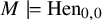
$M\models \mathrm {Hen}_{0,0}$
 and
$A\leq \mathrm {K}(M)$
and
$A\leq \mathrm {K}(M)$
 be a subring. The sets
$\mathrm {k}$
be a subring. The sets
$\mathrm {k}$
 and
$\Gamma $
and
$\Gamma $
 are stably embedded (with respectively the structure of a field and an ordered group) and they are orthogonal. In other words, any M-definable subset of
$\mathrm {k}^x\times \Gamma ^y$
are stably embedded (with respectively the structure of a field and an ordered group) and they are orthogonal. In other words, any M-definable subset of
$\mathrm {k}^x\times \Gamma ^y$
 is a finite union of products
$X\times Y$
is a finite union of products
$X\times Y$
 where X is definable in the field
$\mathrm {k}$
where X is definable in the field
$\mathrm {k}$
 and Y is definable in the ordered group
$\Gamma $
and Y is definable in the ordered group
$\Gamma $
 .
.
Moreover, any A-definable
$X\subseteq \Gamma ^n$
 is
$\mathrm {v}(A)$
is
$\mathrm {v}(A)$
 -definable – we say that
$\Gamma $
-definable – we say that
$\Gamma $
 is strongly stably embedded.
The first part is [Reference van den Dries15, corollary 2.25]. The second part follows [Reference van den Dries15, corollary 2.24], noting that adding a angular component does not grow the generated structure in
$\Gamma $
 .
.
These results remain true in
$\mathrm {k}$
 -
$\Gamma $
-
$\Gamma $
 -expansions – that is, when
$\mathrm {k}$
-expansions – that is, when
$\mathrm {k}$
 comes with additional structure, and, independently so does
$\Gamma $
comes with additional structure, and, independently so does
$\Gamma $
 . They also hold if an angular component is added to the language.
Lemma 2.3. Let M be an expansion of a model of
$\mathrm {Hen}_{0,0}$
 with strongly stably embedded value group
$\Gamma $
with strongly stably embedded value group
$\Gamma $
 . For any subring
$A\leq \mathrm {K}(M)$
. For any subring
$A\leq \mathrm {K}(M)$
 , we have

Proof. Let
$X\subseteq \Gamma ^n$
 be
$\mathrm {acl}(A)$
be
$\mathrm {acl}(A)$
 -definable. Let
$X_1 = X,\ldots ,X_n$
-definable. Let
$X_1 = X,\ldots ,X_n$
 be the
$\mathrm {Aut}(M/A)$
be the
$\mathrm {Aut}(M/A)$
 -conjugates of X over A. For every
$x,y\in \Gamma ^n$
-conjugates of X over A. For every
$x,y\in \Gamma ^n$
 , we define
$x E y$
, we define
$x E y$
 to hold if, for every i,
$x\in X_i$
to hold if, for every i,
$x\in X_i$
 if and only if
$y\in X_i$
if and only if
$y\in X_i$
 . This is an A-definable equivalence relation. By strong stable embeddedness, it is
$\mathrm {v}(A)$
. This is an A-definable equivalence relation. By strong stable embeddedness, it is
$\mathrm {v}(A)$
 -definable. Note also that E has finitely many equivalence classes and X is a union of classes. It follows that X is
$\mathrm {acl}(\mathrm {v}(A))$
-definable. Note also that E has finitely many equivalence classes and X is a union of classes. It follows that X is
$\mathrm {acl}(\mathrm {v}(A))$
 -definable.
Definition 2.4. Let
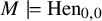
$M\models \mathrm {Hen}_{0,0}$
 . Let
$a\in \mathrm {K}(M)$
. Let
$a\in \mathrm {K}(M)$
 and let C be a cut in
$\Gamma (M)$
and let C be a cut in
$\Gamma (M)$
 – that is, an upwards closed subset. We define the generalized ball
$b_C(a)$
– that is, an upwards closed subset. We define the generalized ball
$b_C(a)$
 of cut C around a to be
$\{x\in \mathrm {K}: \mathrm {v}(x-a) \in C\}$
of cut C around a to be
$\{x\in \mathrm {K}: \mathrm {v}(x-a) \in C\}$
 . A generalized ball is said to be open if its cut is not of the form
$\Gamma _{\geq \gamma }$
. A generalized ball is said to be open if its cut is not of the form
$\Gamma _{\geq \gamma }$
 , for each
$\gamma \in \Gamma (M)$
, for each
$\gamma \in \Gamma (M)$
 .
.
Let
$\mathrm {B_g}$
 denote the (ind-)interpretable set of (codes for) definable generalized balls.
Note that, for every
$\gamma \in \Gamma (M)$
 ,
$b_{\Gamma _{>\gamma }}(a)$
,
$b_{\Gamma _{>\gamma }}(a)$
 is the open ball of radius
$\gamma $
is the open ball of radius
$\gamma $
 around a,
$b_{\Gamma _{\geq \gamma }}(a)$
around a,
$b_{\Gamma _{\geq \gamma }}(a)$
 is the closed ball of radius
$\gamma $
is the closed ball of radius
$\gamma $
 around a – and
$b_{\Gamma }(a) = \mathrm {K}$
around a – and
$b_{\Gamma }(a) = \mathrm {K}$
 is also considered an open ball.
If
$\Gamma (M)$
 is discrete,
$b_{\Gamma _{>\gamma }}(a) = b_{\Gamma _{\geq \gamma }}(a)$
is discrete,
$b_{\Gamma _{>\gamma }}(a) = b_{\Gamma _{\geq \gamma }}(a)$
 is not considered to be an open generalized ball. Let M be an
$\mathrm {RV}$
is not considered to be an open generalized ball. Let M be an
$\mathrm {RV}$
 -expansion of a model of
$\mathrm {Hen}_{0,0}$
-expansion of a model of
$\mathrm {Hen}_{0,0}$
 and let
$A\leq \mathrm {K}(M)$
and let
$A\leq \mathrm {K}(M)$
 be a subring. Let
$M^{\mathrm {a}}$
be a subring. Let
$M^{\mathrm {a}}$
 denote the algebraic closure as a pure valued field.
Theorem 2.1 can also be refined for unary sets:
Proposition 2.5 [Reference Flenner16, Proposition 3.6]
Let
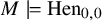
$M\models \mathrm {Hen}_{0,0}$
 , let
$A\leq \mathrm {K}(M)$
, let
$A\leq \mathrm {K}(M)$
 be a subring and let
$X\subseteq \mathrm {K} \times \mathrm {RV}^n$
be a subring and let
$X\subseteq \mathrm {K} \times \mathrm {RV}^n$
 be A-definable. There exists a finite set
$C\subseteq A^{\mathrm {a}} \cap \mathrm {K}(M)$
be A-definable. There exists a finite set
$C\subseteq A^{\mathrm {a}} \cap \mathrm {K}(M)$
 such that for every
$\xi \in \mathrm {RV}^n$
such that for every
$\xi \in \mathrm {RV}^n$
 ,
$X_\xi = \{x\in \mathrm {K}: (x,\xi )\in X\} = \mathrm {rv}_C^{-1}(\mathrm {rv}_C(X_\xi ))$
,
$X_\xi = \{x\in \mathrm {K}: (x,\xi )\in X\} = \mathrm {rv}_C^{-1}(\mathrm {rv}_C(X_\xi ))$
 where
$\mathrm {rv}_C(x) = (\mathrm {rv}(x-c))_{c\in C}$
where
$\mathrm {rv}_C(x) = (\mathrm {rv}(x-c))_{c\in C}$
 .
.
It follows that for any generalized ball b that does not intersect C, either
$b\cap X_\xi = b$
 or
$b\cap X_\xi = \emptyset $
or
$b\cap X_\xi = \emptyset $
 . We say that C prepares X.
This proposition remains true in
$\mathrm {RV}$
 -expansions. Also, it follows that
$\mathrm {K}(\mathrm {acl}(A)) \subseteq A^{\mathrm {a}}$
-expansions. Also, it follows that
$\mathrm {K}(\mathrm {acl}(A)) \subseteq A^{\mathrm {a}}$
 .
.
Lemma 2.6. Let M be (an
$\mathrm {RV}$
 -expansion of) a model of
$\mathrm {Hen}_{0,0}$
-expansion of) a model of
$\mathrm {Hen}_{0,0}$
 , let
$A\leq \mathrm {K}(M)$
, let
$A\leq \mathrm {K}(M)$
 and let b be an
$\mathrm {acl}(A)$
and let b be an
$\mathrm {acl}(A)$
 -definable generalized ball which is not an open ball. Then there exists
$c\in A^{\mathrm {a}}\cap b(M)$
-definable generalized ball which is not an open ball. Then there exists
$c\in A^{\mathrm {a}}\cap b(M)$
 whose other
$\mathrm {Aut}(M/A)$
whose other
$\mathrm {Aut}(M/A)$
 -conjugates are all outside of b.
Moreover, if b is a ball, we may assume that no other
$\mathrm {Aut}(M^{\mathrm {a}}/A)$
 -conjugate is in
$b(M^{\mathrm {a}})$
-conjugate is in
$b(M^{\mathrm {a}})$
 .
.
Proof. Note that any other
$\mathrm {Aut}(M/A)$
 -conjugate of b is disjoint from b. Let B be the union of
$\mathrm {Aut}(M/A)$
-conjugate of b is disjoint from b. Let B be the union of
$\mathrm {Aut}(M/A)$
 -conjugates of b. It is an A-definable set. By Proposition 2.5, there exists
$C\subseteq A^{\mathrm {a}}\cap \mathrm {K}(M)$
-conjugates of b. It is an A-definable set. By Proposition 2.5, there exists
$C\subseteq A^{\mathrm {a}}\cap \mathrm {K}(M)$
 such that for any ball d disjoint from C, either
$d\subseteq B$
such that for any ball d disjoint from C, either
$d\subseteq B$
 or
$d\cap B = \emptyset $
or
$d\cap B = \emptyset $
 . If
$b\cap C = \emptyset $
. If
$b\cap C = \emptyset $
 , let d be the largest ball containing b which is disjoint from C – that is, the open ball around b with radius
$\min _{c\in C}\mathrm {v}(x-c)$
, let d be the largest ball containing b which is disjoint from C – that is, the open ball around b with radius
$\min _{c\in C}\mathrm {v}(x-c)$
 , for any
$x\in b$
, for any
$x\in b$
 . Since d contains b and is disjoint from C, it is contained in B. So d is covered by finitely many disjoint subballs. As the residue field is infinite, this is impossible unless
$d = b$
. Since d contains b and is disjoint from C, it is contained in B. So d is covered by finitely many disjoint subballs. As the residue field is infinite, this is impossible unless
$d = b$
 , in which case b would be open, contradicting our assumption.
So
$b\cap C \neq \emptyset $
 . Let
$C_b = (\mathrm {Aut}(M/A)\cdot C)\cap b$
. Let
$C_b = (\mathrm {Aut}(M/A)\cdot C)\cap b$
 . Since we are in equicharacteristic zero, the average c of
$C_b$
. Since we are in equicharacteristic zero, the average c of
$C_b$
 is in
$b(M)$
is in
$b(M)$
 . By construction, no other
$\mathrm {Aut}(M/A)$
. By construction, no other
$\mathrm {Aut}(M/A)$
 -conjugate of c is in b.
If b is a ball, then it is definable in
$M^{\mathrm {a}}$
 and its
$\mathrm {Aut}(M^{\mathrm {a}}/A)$
and its
$\mathrm {Aut}(M^{\mathrm {a}}/A)$
 -orbit is also a finite set of disjoint balls. Let
$C^{\prime }_b = \mathrm {Aut}(M^{\mathrm {a}}/A)\cdot c$
-orbit is also a finite set of disjoint balls. Let
$C^{\prime }_b = \mathrm {Aut}(M^{\mathrm {a}}/A)\cdot c$
 . Since M is henselian, the average
$c'$
. Since M is henselian, the average
$c'$
 of
$C^{\prime }_b$
of
$C^{\prime }_b$
 is in M. By construction again, the only
$\mathrm {Aut}(M^{\mathrm {a}}/A)$
is in M. By construction again, the only
$\mathrm {Aut}(M^{\mathrm {a}}/A)$
 -conjugate of
$c'$
-conjugate of
$c'$
 in b is
$c'$
in b is
$c'$
 .
.
Finally, when the residue field is algebraically closed, Theorem 2.1 can be further simplified:
Theorem 2.7 [Reference Vicaría7, Corollary 2.33]
Assume the residue field
$\mathrm {k}(M)$
 is algebraically closed. Every A-definable subset of
$\mathrm {K}^x$
is algebraically closed. Every A-definable subset of
$\mathrm {K}^x$
 is of the form
$\mathrm {v}(P(x))\in X$
is of the form
$\mathrm {v}(P(x))\in X$
 where P is a tuple in
$A[x]$
where P is a tuple in
$A[x]$
 and
$X\subseteq \Gamma ^n$
and
$X\subseteq \Gamma ^n$
 is
$\mathrm {v}(A)$
is
$\mathrm {v}(A)$
 -definable in the ordered group structure. Moreover, this remains true in
$\Gamma $
-definable in the ordered group structure. Moreover, this remains true in
$\Gamma $
 -expansions – that is, when
$\Gamma $
-expansions – that is, when
$\Gamma $
 comes with additional structure.
3 Codes of
$\mathcal {O}$
-modules

3.1 The stabilizer sorts
Let M be an (expansion of a) valued field in some language
$\mathfrak {L}$
 .
.
Notation 3.1. We fix an (ind-)
$\mathfrak {L}$
 -interpretable family
$\mathcal {C} = (\mathcal {C}_c)_{c\in \mathrm {Cut}}$
-interpretable family
$\mathcal {C} = (\mathcal {C}_c)_{c\in \mathrm {Cut}}$
 of cuts in
$\Gamma $
of cuts in
$\Gamma $
 such that any M-definable cut is of the of form
$\mathcal {C}_c$
such that any M-definable cut is of the of form
$\mathcal {C}_c$
 for some unique
$c \in \mathrm {Cut}(M)$
for some unique
$c \in \mathrm {Cut}(M)$
 . We will further assume that c is a canonical parameter for
$\mathcal {C}_c$
. We will further assume that c is a canonical parameter for
$\mathcal {C}_c$
 .
.
For every
$c\in \mathrm {Cut}$
 , let
$\mathrm {I}_c$
, let
$\mathrm {I}_c$
 denote the
$\mathcal {O}$
denote the
$\mathcal {O}$
 -submodule
$\{x\in \mathrm {K}: \mathrm {v}(x) \in \mathcal {C}_c\}$
-submodule
$\{x\in \mathrm {K}: \mathrm {v}(x) \in \mathcal {C}_c\}$
 . Note that, by definition of
$\mathcal {C}$
. Note that, by definition of
$\mathcal {C}$
 , any
$\mathfrak {L}(M)$
, any
$\mathfrak {L}(M)$
 -definable
$\mathcal {O}$
-definable
$\mathcal {O}$
 -submodule of
$\mathrm {K}$
-submodule of
$\mathrm {K}$
 is of the form
$\mathrm {I}_c$
is of the form
$\mathrm {I}_c$
 for some unique
$c\in \mathrm {Cut}(M)$
for some unique
$c\in \mathrm {Cut}(M)$
 . We also denote
$\Delta _c = \{\gamma \in \Gamma : \gamma + \mathcal {C}_{c} = \mathcal {C}_{c}\}$
. We also denote
$\Delta _c = \{\gamma \in \Gamma : \gamma + \mathcal {C}_{c} = \mathcal {C}_{c}\}$
 – it is a convex subgroup of
$\Gamma $
– it is a convex subgroup of
$\Gamma $
 .
.
The following results are well-established and go back to Bauer’s work on separated extensions.
Definition 3.2. A definable valuation v on an interpretable
$\mathrm {K}$
 -vector space V is a map to some interpretable set X with an order preserving action of
$\Gamma $
-vector space V is a map to some interpretable set X with an order preserving action of
$\Gamma $
 such that
-
○ for every $\lambda \in \mathrm {K}$
and
$x\in V$
,
$v(\lambda x) = \mathrm {v}(\lambda ) + v(x)$
; -
○ for every $x,y\in V$
,
$v(x+y) \geq \min \{v(x),v(y)\}$
.





Note that we do not assume that
$v(x) = v(0)$
 implies
$x = 0$
implies
$x = 0$
 , nor do we assume that the action of
$\Gamma $
, nor do we assume that the action of
$\Gamma $
 on X is free.
Proposition 3.3. Assume that M is definably spherically complete – that is, the intersection of any M-definable chain of balls is non empty.
-
1. For every M-definable valuation v on $\mathrm {K}^n$
, there exists a triangular basis
$(a_i)_{i<n}$
of
$\mathrm {K}^n$
such that, for all i,
$v(a_i)\in \mathrm {dcl}(\ulcorner v\urcorner )$
and for every
$\lambda _i\in \mathrm {K}$
, $$\begin{align*}v(\sum_i \lambda_i a_i) = \min_i \mathrm{v}(\lambda_i)\cdot v(a_i).\end{align*}$$
-
2. Any M-definable $\mathcal {O}$
-submodule R of
$\mathrm {K}^n$
is of the form
$\sum _{i< n} \mathrm {I}_{c_i} a_i$
, where
$a_i$
is a triangular basis of
$\mathrm {K}^n(M)$
and
$c_i\in \mathrm {Cut}(\ulcorner R\urcorner )$
.





A basis as in the fist assertion is said to be separated. A module as in the second assertion is said to be of type
$c = (c_i)_{i<n}$
 .
.
Proof. If M is (elementarily equivalent to a) maximally complete field, the first assertion is [Reference Vicaría7, Lemma 5.7]. If M is only definably spherically complete, the same proof works using [Reference Hils and Rideau-Kikuchi6, Claim 3.3.9] instead of [Reference Vicaría7, Fact 2.55].
Let us now prove the second assertion. For every
$x\in \mathrm {K}^n$
 , we define
$v_R(x) = \{\mathrm {v}(\lambda ) : \lambda x \in R\}$
, we define
$v_R(x) = \{\mathrm {v}(\lambda ) : \lambda x \in R\}$
 a (nonempty) cut of
$\Gamma $
a (nonempty) cut of
$\Gamma $
 . We order them by inclusion (so
$\Gamma = v_R(0)$
. We order them by inclusion (so
$\Gamma = v_R(0)$
 is the maximal element and
$\{\infty \}$
is the maximal element and
$\{\infty \}$
 is the minimal element). Note that, for every
$x\in \mathrm {K}$
is the minimal element). Note that, for every
$x\in \mathrm {K}$
 ,
$v_R(\lambda x) = -\mathrm {v}(\lambda ) + v_R(x)$
,
$v_R(\lambda x) = -\mathrm {v}(\lambda ) + v_R(x)$
 and for this action of
$\Gamma $
and for this action of
$\Gamma $
 on the set of cuts,
$v_R$
on the set of cuts,
$v_R$
 is an M-definable valuation.
By the first assertion, we can find a separated triangular basis
$(a_i)_{i}$
 of
$\mathrm {K}^n(M)$
of
$\mathrm {K}^n(M)$
 , such that
$v_{R}(a_{i}) \in \mathrm {dcl}(\ulcorner R\urcorner )$
, such that
$v_{R}(a_{i}) \in \mathrm {dcl}(\ulcorner R\urcorner )$
 . Then
$\sum _i \lambda _i a_i \in R$
. Then
$\sum _i \lambda _i a_i \in R$
 if and only if
$0 = \mathrm {v}(1) \in v_R(\sum _i \lambda _i a_i) = \min _i - \mathrm {v}(x_i) + v_R(a_i)$
if and only if
$0 = \mathrm {v}(1) \in v_R(\sum _i \lambda _i a_i) = \min _i - \mathrm {v}(x_i) + v_R(a_i)$
 , that is,
$\mathrm {v}(\lambda _i) \in v_R(a_i)$
, that is,
$\mathrm {v}(\lambda _i) \in v_R(a_i)$
 for all i. Let
$c_i\in \mathrm {Cut}(\mathrm {dcl}({\ulcorner R\urcorner }))$
for all i. Let
$c_i\in \mathrm {Cut}(\mathrm {dcl}({\ulcorner R\urcorner }))$
 be such that
$v_R(a_i) = \mathcal {C}_{c_i}$
be such that
$v_R(a_i) = \mathcal {C}_{c_i}$
 . We then have
$R = \sum _i \mathrm {I}_{c_i} a_i$
. We then have
$R = \sum _i \mathrm {I}_{c_i} a_i$
 , as required.
Notation 3.4.
-
1. We write $B_{n}$
to denote the set of
$n \times n$
upper triangular and invertible matrices. We write
$\mathrm {D}_{n}\leq \mathrm {B}_n$
for the subgroup of diagonal matrices and
$\mathrm {U}_n\leq \mathrm {B}_n$
for the subgroup of unipotent matrices, that is upper triangular matrices with ones on the diagonal. -
2. For every n-tuple c in $\mathrm {Cut}$
, we define
$\mathrm {Mod}_c$
to be the interpretable set of modules of type c. Let
$\Lambda _c = \sum \mathrm {I}_{c_i} e_i$
be the canonical module of type c, where
$e_i$
is the canonical basis of
$K^n$
. Then
$\sum _{i< n} \mathrm {I}_{c_i} a_i = A \cdot \Lambda _c$
where
$A \in \mathrm {B}_n$
is the upper triangular matrix of the
$a_i$
. In other words,
$\mathrm {B}_n$
acts transitively on
$\mathrm {Mod}_c$
and $$\begin{align*}\mathrm{Mod}_c \simeq \mathrm{B}_n / \operatorname{Stab}(\Lambda_c).\end{align*}$$We will now identify $\mathrm {Mod}_c$
with this quotient of
$\mathrm {B}_n$
and for every
$s\in \mathrm {Mod}_c$
, we write
$R_s$
for the
$\mathcal {O}$
-module of type c coded by s. Let
$\mu _c : \mathrm {B}_n\to \mathrm {Mod}_c$
denote the natural quotient map.









If
$\Delta \leq \Gamma $
 is a (definable) convex subgroup, we write
$\mathcal {O}_{\Delta } = \{x\in \mathrm {K}: \exists \delta \in \Delta \mathrm {v}(x)\geq \delta \}$
is a (definable) convex subgroup, we write
$\mathcal {O}_{\Delta } = \{x\in \mathrm {K}: \exists \delta \in \Delta \mathrm {v}(x)\geq \delta \}$
 for the associated (definable) valuation ring. If
$I,J \leq \mathrm {K}$
for the associated (definable) valuation ring. If
$I,J \leq \mathrm {K}$
 are two (definable)
$\mathcal {O}$
are two (definable)
$\mathcal {O}$
 -submodules, let
$(I:J)$
-submodules, let
$(I:J)$
 denote the (definable)
$\mathcal {O}$
denote the (definable)
$\mathcal {O}$
 -submodule
$\{x\in \mathrm {K} : xJ \subseteq I\}$
-submodule
$\{x\in \mathrm {K} : xJ \subseteq I\}$
 .
.
Proposition 3.5. Let c be a tuple in
$\mathrm {Cut}$
 . For every
$a\in \mathrm {B}_n$
. For every
$a\in \mathrm {B}_n$
 , we have

Proof. We proceed by induction on n. Write a as
$\left (\begin {smallmatrix}a_{0,0}&b\\ 0& e\end {smallmatrix}\right )$
 , with
$e\in \mathrm {B}_{n-1}$
, with
$e\in \mathrm {B}_{n-1}$
 , and c as
$(c_0,d)$
, and c as
$(c_0,d)$
 , with
$d\in \mathrm {Cut}^{n-1}$
, with
$d\in \mathrm {Cut}^{n-1}$
 . If
$a \Lambda _c \subseteq \Lambda _c$
. If
$a \Lambda _c \subseteq \Lambda _c$
 , then, considering the action on
$\mathrm {I}_{c_{0}}$
, then, considering the action on
$\mathrm {I}_{c_{0}}$
 and
$\Lambda _{d}$
and
$\Lambda _{d}$
 , we see that
$a_{0,0} \mathrm {I}_{c_0} \subseteq \mathrm {I}_{c_0}$
, we see that
$a_{0,0} \mathrm {I}_{c_0} \subseteq \mathrm {I}_{c_0}$
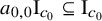 ,
$b \Lambda _{d}\subseteq \mathrm {I}_{c_0}$
,
$b \Lambda _{d}\subseteq \mathrm {I}_{c_0}$
 – so, considering the action on each
$\mathrm {I}_{c_{j}}$
– so, considering the action on each
$\mathrm {I}_{c_{j}}$
 , for every
$j> 0$
, for every
$j> 0$
 ,
$a_{0,j} \mathrm {I}_{c_j} \subseteq \mathrm {I}_{c_0}$
,
$a_{0,j} \mathrm {I}_{c_j} \subseteq \mathrm {I}_{c_0}$
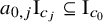 – and
$e \Lambda _{d}\subseteq \Lambda _{d}$
– and
$e \Lambda _{d}\subseteq \Lambda _{d}$
 ; and the converse also holds.
Since
$a \Lambda _c = \Lambda _c$
 if, moreover,
$a^{-1} \Lambda _c = \left (\begin {smallmatrix}a_{0,0}^{-1}&-a_{0,0}^{-1} be^{-1}\\ 0& e^{-1}\end {smallmatrix}\right )\Lambda _c \subseteq \Lambda _c$
if, moreover,
$a^{-1} \Lambda _c = \left (\begin {smallmatrix}a_{0,0}^{-1}&-a_{0,0}^{-1} be^{-1}\\ 0& e^{-1}\end {smallmatrix}\right )\Lambda _c \subseteq \Lambda _c$
 , it follows that we must further have
$a_{0,0} \mathrm {I}_{c_0} = \mathrm {I}_{c_0}$
, it follows that we must further have
$a_{0,0} \mathrm {I}_{c_0} = \mathrm {I}_{c_0}$
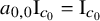 , that is,
$\mathrm {v}(a_{0,0}) \in \Delta _{c_0}$
, that is,
$\mathrm {v}(a_{0,0}) \in \Delta _{c_0}$
 and
$e \Lambda _{d} = \Lambda _{d}$
and
$e \Lambda _{d} = \Lambda _{d}$
 . These conditions are sufficient since, in that case,
$a_{0,0}^{-1}be^{-1}\Lambda _{d} = a_{0,0}^{-1}b\Lambda _d \subseteq a_{0,0}^{-1} \mathrm {I}_{c_0} = \mathrm {I}_{c_0}$
. These conditions are sufficient since, in that case,
$a_{0,0}^{-1}be^{-1}\Lambda _{d} = a_{0,0}^{-1}b\Lambda _d \subseteq a_{0,0}^{-1} \mathrm {I}_{c_0} = \mathrm {I}_{c_0}$
 . The claim now follows by induction.
Definition 3.6. Let
$\mathrm {Cut}^\star = \mathrm {Cut}\setminus \{\emptyset ,\Gamma \}$
 and
$\mathrm {Mod}$
and
$\mathrm {Mod}$
 be the disjoint union of all the
$\mathrm {Mod}_c$
be the disjoint union of all the
$\mathrm {Mod}_c$
 where c is a tuple in
$\mathrm {Cut}^\star $
where c is a tuple in
$\mathrm {Cut}^\star $
 .
.
Note that any
$s\in \mathrm {Mod}$
 determines the unique c such that
$s\in \mathrm {Mod}_c$
determines the unique c such that
$s\in \mathrm {Mod}_c$
 .
.
Corollary 3.7. Any M-definable
$\mathcal {O}$
 -submodule R of
$\mathrm {K}^n$
-submodule R of
$\mathrm {K}^n$
 is coded in
$\mathrm {K}\cup \mathrm {Mod}$
is coded in
$\mathrm {K}\cup \mathrm {Mod}$
 .
.
Proof. Let
$V\subseteq \mathrm {K}^n$
 be the
$\mathrm {K}$
be the
$\mathrm {K}$
 -span of R and
$W = \{x\in \mathrm {K}^n: \mathrm {K} x \subseteq R\}$
-span of R and
$W = \{x\in \mathrm {K}^n: \mathrm {K} x \subseteq R\}$
 . Then, by [Reference Johnson17, Lemma 4.3],
$V/W$
. Then, by [Reference Johnson17, Lemma 4.3],
$V/W$
 is
$\mathrm {K}(\ulcorner R\urcorner )$
is
$\mathrm {K}(\ulcorner R\urcorner )$
 -definably isomorphic to some
$\mathrm {K}^r$
-definably isomorphic to some
$\mathrm {K}^r$
 and R is entirely determined by its image in
$V/W$
and R is entirely determined by its image in
$V/W$
 . So we may assume
$V = \mathrm {K}^r$
. So we may assume
$V = \mathrm {K}^r$
 and
$W = 0$
and
$W = 0$
 and hence that R is of type c with
$c\in \mathrm {Cut}^\star $
and hence that R is of type c with
$c\in \mathrm {Cut}^\star $
 . By definition, it is coded in
$\mathrm {Mod}_c$
. By definition, it is coded in
$\mathrm {Mod}_c$
 .
.
Remark 3.8. There is a lot of redundancy in
$\mathrm {Mod}$
 . If c and
$c'$
. If c and
$c'$
 are tuples in
$\mathrm {Cut}$
are tuples in
$\mathrm {Cut}$
 of the same length such that for every
$i < n$
of the same length such that for every
$i < n$
 ,
$c_i'$
,
$c_i'$
 is a translate of
$c_i$
is a translate of
$c_i$
 , then there is a natural bijection between
$\mathrm {Mod}_c$
, then there is a natural bijection between
$\mathrm {Mod}_c$
 and
$\mathrm {Mod}_{c'}$
and
$\mathrm {Mod}_{c'}$
 given by the action of a diagonal matrix.
If there exists an (ind-)interpretable subset
$\mathrm {Cut}'\subseteq \mathrm {Cut}$
 such that any definable cut is of the form
$a + \mathcal {C}_c$
such that any definable cut is of the form
$a + \mathcal {C}_c$
 for a unique
$c\in \mathrm {Cut}'$
for a unique
$c\in \mathrm {Cut}'$
 , it follows that every M-definable
$\mathcal {O}$
, it follows that every M-definable
$\mathcal {O}$
 -submodule of
$\mathrm {K}^n$
-submodule of
$\mathrm {K}^n$
 is coded in
$\mathrm {K}\cup \bigcup _{c\in \mathrm {Cut}'\setminus \{\emptyset ,\Gamma \}} \mathrm {Mod}_c$
is coded in
$\mathrm {K}\cup \bigcup _{c\in \mathrm {Cut}'\setminus \{\emptyset ,\Gamma \}} \mathrm {Mod}_c$
 . Similarly, we can replace
$\mathrm {Cut}$
. Similarly, we can replace
$\mathrm {Cut}$
 by
$\mathrm {Cut}'$
by
$\mathrm {Cut}'$
 in the definition of the geometric sorts (Definition 3.13).
This is the case, for example, in ordered abelian groups of bounded regular rank (cf. [Reference Vicaría7, Corollary 2.24]).
Remark 3.9. Any M-definable generalized ball is inter-definable with the sub-
$\mathcal {O}$
 -module R of
$\mathrm {K}^2$
-module R of
$\mathrm {K}^2$
 generated by
$b\times \{1\}$
generated by
$b\times \{1\}$
 ; indeed
$b = \{x\in \mathrm {K}: (x,1)\in R\}$
; indeed
$b = \{x\in \mathrm {K}: (x,1)\in R\}$
 . So generalized balls are coded in
$\mathrm {Mod}$
. So generalized balls are coded in
$\mathrm {Mod}$
 .
.
Let us now describe the structure of
$\mathrm {Mod}$
 . The solvability of the upper triangular invertible matrices will play a central role in this description.
We go through the elements of an upper triangular matrix diagonal by diagonal starting with the middle diagonal, and in each diagonal, we proceed from top to bottom. In other words, we order pairs
$(i,j)$
 such that
$i\leq j < n$
such that
$i\leq j < n$
 first by
$j - i$
first by
$j - i$
 and then by i. We will identify the set of such pairs with the set of non-negative integers
$< n(n+1)/2$
and then by i. We will identify the set of such pairs with the set of non-negative integers
$< n(n+1)/2$
 , according to that order.
For every pair
$(i,j)$
 , let
$p_{i,j} : \mathrm {B}_n \to \mathrm {K}$
, let
$p_{i,j} : \mathrm {B}_n \to \mathrm {K}$
 be the projection on coordinate
$(i,j)$
be the projection on coordinate
$(i,j)$
 . Let also
$\varepsilon _{i,j} = 1$
. Let also
$\varepsilon _{i,j} = 1$
 if
$i = j$
if
$i = j$
 and
$0$
and
$0$
 otherwise. For every pair
$\ell $
otherwise. For every pair
$\ell $
 , let
$G_{\ell } = \{a \in \mathrm {B}_n : p_{k}(a) = \varepsilon _k,\ \forall k < \ell \}$
, let
$G_{\ell } = \{a \in \mathrm {B}_n : p_{k}(a) = \varepsilon _k,\ \forall k < \ell \}$
 . Then
$G_0 = \mathrm {B}_n$
. Then
$G_0 = \mathrm {B}_n$
 and
$G_{n(n+1)/2} = \{\mathrm {id}\}$
and
$G_{n(n+1)/2} = \{\mathrm {id}\}$
 . By choice of the order, for every
$\ell $
. By choice of the order, for every
$\ell $
 ,
$G_{\ell +1} \triangleleft G_{\ell }$
,
$G_{\ell +1} \triangleleft G_{\ell }$
 and
$p_\ell $
and
$p_\ell $
 induces an isomorphism from
$G_{\ell } / G_{\ell +1}$
induces an isomorphism from
$G_{\ell } / G_{\ell +1}$
 to
$\mathbb {G}_{\mathrm {m}}$
to
$\mathbb {G}_{\mathrm {m}}$
 , if
$\ell < n$
, if
$\ell < n$
 , and to
$\mathbb {G}_{\mathrm {a}}$
, and to
$\mathbb {G}_{\mathrm {a}}$
 otherwise. Note also that
$H_\ell =\{a\in G_\ell : p_k(a) = \varepsilon _k,\ \forall k> \ell \}$
otherwise. Note also that
$H_\ell =\{a\in G_\ell : p_k(a) = \varepsilon _k,\ \forall k> \ell \}$
 , is a section of
$p_\ell $
, is a section of
$p_\ell $
 restricted to
$G_\ell $
restricted to
$G_\ell $
 and hence
$G_\ell = G_{\ell +1}\rtimes H_\ell $
and hence
$G_\ell = G_{\ell +1}\rtimes H_\ell $
 .
.
Furthermore, we have
$G_n = \mathrm {U}_n$
 ,
$\mathrm {B}_n = \mathrm {U}_n\rtimes \mathrm {D}_n$
,
$\mathrm {B}_n = \mathrm {U}_n\rtimes \mathrm {D}_n$
 and, for every
$\ell \geq n$
and, for every
$\ell \geq n$
 ,
$G_\ell $
,
$G_\ell $
 is central in
$G_n$
is central in
$G_n$
 module
$G_{\ell +1}$
module
$G_{\ell +1}$
 – actually modulo the next upper triangular group
$G_{0,j}$
– actually modulo the next upper triangular group
$G_{0,j}$
 – if
$\ell $
– if
$\ell $
 is a pair
$(i,i+j-1)$
is a pair
$(i,i+j-1)$
 . In particular
$G_\ell \trianglelefteq \mathrm {U}_n$
. In particular
$G_\ell \trianglelefteq \mathrm {U}_n$
 .
.
We can now prove the following unary decomposition.
Proposition 3.10. Let
$s \in \mathrm {Mod}_c$
 . There exists a finite tuple
$b = (b_\ell )_{\ell < n(n+1)/2}$
. There exists a finite tuple
$b = (b_\ell )_{\ell < n(n+1)/2}$
 in
$M^{\mathrm {eq}}$
in
$M^{\mathrm {eq}}$
 – we identify each
$b_\ell $
– we identify each
$b_\ell $
 with a subset of some
$\mathrm {K}^{r_\ell }$
with a subset of some
$\mathrm {K}^{r_\ell }$
 – and
$c b_{<\ell }$
– and
$c b_{<\ell }$
 -interpretable sets
$X_\ell $
-interpretable sets
$X_\ell $
 such that:
-
○ for every $\ell $
,
$b_\ell \in X_\ell $
; -
○ $\mathrm {dcl}(s) = \mathrm {dcl}(cb)$
; -
○ if $\ell < n$
, then
$X_\ell = \Gamma /\Delta _{c_i}$
, where
$\ell = (i,i)$
; -
○ if $\ell \geq n$
, then
$X_\ell $
has a
$cb_{<\ell }$
-definable
$\mathrm {K}/\mathrm {I}_\ell $
-torsor structure where
$\mathrm {I}_\ell $
is a
$cb_{<n}$
-definable multiple of
$(\mathrm {I}_{c_i}:\mathrm {I}_{c_j})$
and
$\ell = (i,j)$
.


Moreover, for any
$n\leq \ell < n(n+1)/2$
 and any choice of
$a_{k} \in b_{k}$
and any choice of
$a_{k} \in b_{k}$
 , for
$k < \ell $
, for
$k < \ell $
 , there is a (uniformly)
$c a_{<\ell }$
, there is a (uniformly)
$c a_{<\ell }$
 -definable isomorphism of torsors
$f_\ell : X_\ell \to \mathrm {K}/\mathrm {I}_\ell $
-definable isomorphism of torsors
$f_\ell : X_\ell \to \mathrm {K}/\mathrm {I}_\ell $
 and a
$c a_{<\ell }$
and a
$c a_{<\ell }$
 -definable function
$g_\ell : f_\ell (b_\ell ) \to b_\ell $
-definable function
$g_\ell : f_\ell (b_\ell ) \to b_\ell $
 .
.
Proof. Let
$F = \operatorname {Stab}(\Lambda _{c})$
 , we identify s with a coset
$gF$
, we identify s with a coset
$gF$
 for some
$g\in \mathrm {B}_n$
for some
$g\in \mathrm {B}_n$
 . Let
$d\in \mathrm {D}_n$
. Let
$d\in \mathrm {D}_n$
 and
$u\in \mathrm {U}_n$
and
$u\in \mathrm {U}_n$
 be such that
$g = ud$
be such that
$g = ud$
 . Note that the map
$B_n \to B_n/U_n \simeq D_n$
. Note that the map
$B_n \to B_n/U_n \simeq D_n$
 is the projection on the diagonal coordinates. Therefore, by Proposition 3.5, the image of F in
$B_n/U_n$
is the projection on the diagonal coordinates. Therefore, by Proposition 3.5, the image of F in
$B_n/U_n$
 is identified with
$F_{\mathrm {D}} = F\cap \mathrm {D}_n$
is identified with
$F_{\mathrm {D}} = F\cap \mathrm {D}_n$
 . Writing
$F_{\mathrm {U}} = F\cap \mathrm {U}_n$
. Writing
$F_{\mathrm {U}} = F\cap \mathrm {U}_n$
 , we thus have
$F = F_{\mathrm {U}} \rtimes F_{\mathrm {D}}$
, we thus have
$F = F_{\mathrm {U}} \rtimes F_{\mathrm {D}}$
 . By (the proof of) [Reference Haskell, Hrushovski and Dugald Macpherson18, Lemma 11.10],
$\mathrm {dcl}(s) = \mathrm {dcl}(c,\ulcorner d F_{\mathrm {D}}\urcorner ,\ulcorner uF_{\mathrm {U}}^d\urcorner )$
. By (the proof of) [Reference Haskell, Hrushovski and Dugald Macpherson18, Lemma 11.10],
$\mathrm {dcl}(s) = \mathrm {dcl}(c,\ulcorner d F_{\mathrm {D}}\urcorner ,\ulcorner uF_{\mathrm {U}}^d\urcorner )$
 , where
$F_{\mathrm {U}}^d = dF_U d^{-1} = dFd^{-1}\cap \mathrm {U}_n$
, where
$F_{\mathrm {U}}^d = dF_U d^{-1} = dFd^{-1}\cap \mathrm {U}_n$
 does not depend on the choice of d in
$d F_D$
does not depend on the choice of d in
$d F_D$
 . Then, by Proposition 3.5,
$\mathrm {D}_n/F_{\mathrm {D}} \simeq \prod _{\ell <n} \mathrm {K}^\star /\mathcal {O}^\star _{\Delta _\ell } \simeq \prod _{\ell <n} \Gamma /\Delta _i$
. Then, by Proposition 3.5,
$\mathrm {D}_n/F_{\mathrm {D}} \simeq \prod _{\ell <n} \mathrm {K}^\star /\mathcal {O}^\star _{\Delta _\ell } \simeq \prod _{\ell <n} \Gamma /\Delta _i$
 and, for every
$\ell < n$
and, for every
$\ell < n$
 , we chose
$b_\ell = \mathrm {v}_{\Delta _\ell }(d_\ell )$
, we chose
$b_\ell = \mathrm {v}_{\Delta _\ell }(d_\ell )$
 to be the
$\ell $
to be the
$\ell $
 -th coordinate in this product. Note that
$\mathrm {dcl}(c\ulcorner d F_D\urcorner ) = \mathrm {dcl}(c b_{<n})$
-th coordinate in this product. Note that
$\mathrm {dcl}(c\ulcorner d F_D\urcorner ) = \mathrm {dcl}(c b_{<n})$
 .
.
Now, for every
$\ell \geq n$
 , note that
$F_{\mathrm {U}}^d G_\ell = G_\ell F_{\mathrm {U}}^d$
, note that
$F_{\mathrm {U}}^d G_\ell = G_\ell F_{\mathrm {U}}^d$
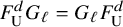 is a subgroup, since
$G_\ell $
is a subgroup, since
$G_\ell $
 is normal in
$\mathrm {U}_n$
is normal in
$\mathrm {U}_n$
 and moreover,
$F_{\mathrm {U}}^d G_{\ell +1} \trianglelefteq F_{\mathrm {U}}^d G_\ell $
and moreover,
$F_{\mathrm {U}}^d G_{\ell +1} \trianglelefteq F_{\mathrm {U}}^d G_\ell $
 since for every
$g\in G_{\ell }$
since for every
$g\in G_{\ell }$
 ,
$(F_{\mathrm {U}}^d)^g \subseteq F_{\mathrm {U}}^d G_{\ell +1}$
,
$(F_{\mathrm {U}}^d)^g \subseteq F_{\mathrm {U}}^d G_{\ell +1}$
 by centrality of the sequence. For every
$\ell \geq n$
by centrality of the sequence. For every
$\ell \geq n$
 , let
$X_\ell = u F_{\mathrm {U}}^d G_\ell / F_{\mathrm {U}}^d G_{\ell +1}$
, let
$X_\ell = u F_{\mathrm {U}}^d G_\ell / F_{\mathrm {U}}^d G_{\ell +1}$
 for the right regular action and
$b_\ell = u F_{\mathrm {U}}^d G_{\ell +1} \in X_\ell $
for the right regular action and
$b_\ell = u F_{\mathrm {U}}^d G_{\ell +1} \in X_\ell $
 . Then
$b_\ell $
. Then
$b_\ell $
 is s-definable,
$X_n = \mathrm {U}_n/F_{\mathrm {U}}^d G_{n+1}$
is s-definable,
$X_n = \mathrm {U}_n/F_{\mathrm {U}}^d G_{n+1}$
 is
$cb_{<n}$
is
$cb_{<n}$
 -definable and, if
$\ell> n$
-definable and, if
$\ell> n$
 , the set
$X_\ell = b_{\ell }/F_{\mathrm {U}}^d G_{n+1}$
, the set
$X_\ell = b_{\ell }/F_{\mathrm {U}}^d G_{n+1}$
 is
$cb_{<n}b_{\ell -1}$
is
$cb_{<n}b_{\ell -1}$
 -definable. Also,
$X_\ell $
-definable. Also,
$X_\ell $
 is
$cb_{<\ell }$
is
$cb_{<\ell }$
 -definably a (right) torsor for the group

where
$\ell = (i,j)$
 and the last isomorphism follows from Proposition 3.5 – these isomorphisms are
$cb_{<n}$
and the last isomorphism follows from Proposition 3.5 – these isomorphisms are
$cb_{<n}$
 -definable. Let
$\mathrm {I}_\ell = d_id_j^{-1}(\mathrm {I}_{c_i}:\mathrm {I}_{c_j})$
-definable. Let
$\mathrm {I}_\ell = d_id_j^{-1}(\mathrm {I}_{c_i}:\mathrm {I}_{c_j})$
 , then
$\mathrm {I}_\ell $
, then
$\mathrm {I}_\ell $
 only depends on
$b_i = v_{\Delta _i}(d_i)$
only depends on
$b_i = v_{\Delta _i}(d_i)$
 and
$b_j = \mathrm {v}_{\Delta _j}(d_j)$
and
$b_j = \mathrm {v}_{\Delta _j}(d_j)$
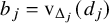 and thus is
$b_{<n}$
and thus is
$b_{<n}$
 -definable. Since
$b_{n(n+1)/2 - 1} = uF^d_U$
-definable. Since
$b_{n(n+1)/2 - 1} = uF^d_U$
 , we have
$s\in \mathrm {dcl}(c,b_{<n},b_{n(n+1)/2-1})$
, we have
$s\in \mathrm {dcl}(c,b_{<n},b_{n(n+1)/2-1})$
 . This concludes the first part of the proposition.
Let us now fix
$a_{\ell } \in b_{\ell }$
 , for all
$\ell < n(n+1)/2$
, for all
$\ell < n(n+1)/2$
 . Note that if
$\ell < n$
. Note that if
$\ell < n$
 ,
$v(a_\ell ) = \mathrm {v}_{\Delta _\ell }(d_\ell )$
,
$v(a_\ell ) = \mathrm {v}_{\Delta _\ell }(d_\ell )$
 and we may assume that
$d = a_{<n}$
and we may assume that
$d = a_{<n}$
 . If
$\ell = n$
. If
$\ell = n$
 , as we saw above
$X_n = \mathrm {U}_n/F_{\mathrm {U}}^d G_{n+1}$
, as we saw above
$X_n = \mathrm {U}_n/F_{\mathrm {U}}^d G_{n+1}$
 is
$c a_{<n}$
is
$c a_{<n}$
 -definably isomorphic to
$K/\mathrm {I}_{n}$
-definably isomorphic to
$K/\mathrm {I}_{n}$
 . If
$\ell> n$
. If
$\ell> n$
 , since
$a_{\ell -1} \in b_{\ell -1} = u F_{\mathrm {U}}^d G_{\ell }$
, since
$a_{\ell -1} \in b_{\ell -1} = u F_{\mathrm {U}}^d G_{\ell }$
 , we have
$a_{\ell -1} F_{\mathrm {U}}^d G_{\ell +1} \in X_\ell $
, we have
$a_{\ell -1} F_{\mathrm {U}}^d G_{\ell +1} \in X_\ell $
 . This gives rise to a
$c a_{<n} a_{\ell -1}$
. This gives rise to a
$c a_{<n} a_{\ell -1}$
 -definable isomorphism

where the first isomorphism is induced by left multiplication by
$a_{\ell -1}^{-1}$
 and the third by the coordinate projection
$p_\ell $
and the third by the coordinate projection
$p_\ell $
 . Let
$h_\ell : \mathrm {K} \to H_\ell $
. Let
$h_\ell : \mathrm {K} \to H_\ell $
 be the section of
$p_\ell $
be the section of
$p_\ell $
 . Then for every
$x\in f_\ell (b_\ell )$
. Then for every
$x\in f_\ell (b_\ell )$
 , since
$p_\ell (h_\ell (x)) I_\ell = f_\ell (b_\ell )$
, since
$p_\ell (h_\ell (x)) I_\ell = f_\ell (b_\ell )$
 , we have
$h_\ell (x) \in a_{\ell -1}^{-1}u F_{\mathrm {U}}^d G_{\ell +1}$
, we have
$h_\ell (x) \in a_{\ell -1}^{-1}u F_{\mathrm {U}}^d G_{\ell +1}$
 and hence
$g(x) = a_{\ell -1} s(x) \in b_\ell $
and hence
$g(x) = a_{\ell -1} s(x) \in b_\ell $
 .
.
Recall that
$\mu _c : B_n \to \mathrm {Mod}_c$
 is the canonical projection.
Remark 3.11. Looking at the proof, all the operation applied to any upper triangular matrix representation of s are actually field operations. It follows that Proposition 3.10 can be refined as follows. If
$A\leq \mathrm {K}(M)$
 is a subfield, then:
-
○ if $s \in \mu _c(\mathrm {B}_n(A))$
, then for every
$\ell $
,
$b_\ell (A)\neq \emptyset $
; -
○ if, for all $k < \ell $
, the set
$b_k(A)$
is nonempty, then
$I_\ell $
is a translate of a c-definable cut by an element of
$\mathrm {v}(A)$
, we have
$f_\ell (b_\ell )(A) \neq \emptyset $
and
$g_\ell $
sends
$f_\ell (b_\ell )(A)$
to
$b_\ell (A)$
; -
○ if, for all $\ell $
, the set
$f_\ell (b_\ell )(A)$
is nonempty, then, by induction
$b_\ell (A)\neq \emptyset $
and we can choose all
$a_\ell \in b_\ell (A)$
– in particular, we can choose
$d = a_{<n} \in D_n(A)$
and
$u \in b_{n(n+1)/2 -1}(A)$
, so
$s\in \mu _c(\mathrm {B}_n(A))$
.









We conclude this section with one of our main uses for Proposition 3.10: characterizing parameter sets over which every definable module has a (triangular) basis. Recall that
$\mathrm {B_g}$
 is the (ind-)interpretable set of definable generalized balls.
Corollary 3.12. Let
$A\subseteq M^{\mathrm {eq}}$
 and
$C\subseteq \mathrm {K}(M)$
and
$C\subseteq \mathrm {K}(M)$
 be a subfield. Assume that:
-
1. For every A-definable convex subgroup $\Delta \leq \Gamma $
, we have
$(\Gamma /\Delta )(\mathrm {dcl}(A)) \subseteq \mathrm {v}_\Delta (C)$
. -
2. For every $b\in \mathrm {B_g}(\mathrm {dcl}(AC))$
whose cut is a
$\mathrm {v}(C)$
-translate of an A-definable cut, we have
$b(C) \neq \emptyset $
.





Then, for every tuple c in
$\mathrm {Cut}$
 ,
$\mathrm {Mod}_c(\mathrm {dcl}(A)) \subseteq \mu _c(\mathrm {B}_{|c|}(C))$
,
$\mathrm {Mod}_c(\mathrm {dcl}(A)) \subseteq \mu _c(\mathrm {B}_{|c|}(C))$
 .
.
Proof. Let
$s\in \mathrm {Mod}_c(\mathrm {dcl}(A))$
 – in particular
$c\in \mathrm {Cut}(\mathrm {dcl}(A))$
– in particular
$c\in \mathrm {Cut}(\mathrm {dcl}(A))$
 – and
$b = (b_\ell )_\ell $
– and
$b = (b_\ell )_\ell $
 be as in Proposition 3.10. By Remark 3.11, it suffices to show that,
$f_\ell (b_\ell )(C) \neq \emptyset $
be as in Proposition 3.10. By Remark 3.11, it suffices to show that,
$f_\ell (b_\ell )(C) \neq \emptyset $
 . For
$\ell < n$
. For
$\ell < n$
 , since
$b_\ell \in \Gamma /\Delta _\ell (\mathrm {dcl}(A))$
, since
$b_\ell \in \Gamma /\Delta _\ell (\mathrm {dcl}(A))$
 , this follows from the first assumption. If
$\ell \geq n$
, this follows from the first assumption. If
$\ell \geq n$
 , by induction,
$f_\ell (b_\ell )\in \mathrm {K}/\mathrm {I}_\ell $
, by induction,
$f_\ell (b_\ell )\in \mathrm {K}/\mathrm {I}_\ell $
 is an
$AC$
is an
$AC$
 -definable generalized ball whose cut is a
$\mathrm {v}(C)$
-definable generalized ball whose cut is a
$\mathrm {v}(C)$
 -translate of an A-definable cut; and we conclude by the second assumption.
3.2 The geometric sorts
The goal of this section is to further simplify the codes of modules to something more akin to the geometric sorts of [Reference Haskell, Hrushovski and Macpherson1]. This will be crucial to classify
$\mathrm {k}$
 -internal sets, when the value group is non discrete, in Corollary 6.7.
Let M be an (expansion of a) valued field in some language
$\mathfrak {L}$
 with stably embedded residue field.
Definition 3.13.
-
1. Let $\mathrm {Cut}^{\star \star }$
denote
$\mathrm {Cut}^\star \setminus \{\Gamma _{>\gamma } : \gamma \in \Gamma \}$
– unless
$\Gamma $
is discrete, in which case,
$\mathrm {Cut}^{\star \star } = \mathrm {Cut}^\star $
. Any module of type a tuple c in
$\mathrm {Cut}^{\star \star }$
is said to be
$\mathfrak {m}$
-avoiding. Let
$\mathrm {Gr}$
be the collection of codes for all
$\mathfrak {m}$
-avoiding modules; that is
$\mathrm {Gr} = \coprod _{c\in \mathrm {Cut}^{\star \star }} \mathrm {Mod}_c$
. -
2. For every $\mathcal {O}$
-module R, let
$\operatorname {red}(R)$
denote the
$\mathrm {k}$
-vector space
$R/\mathfrak {m} R$
and let
$\operatorname {red}_R : R \to \operatorname {red}(R)$
denote the canonical projection. We also define
$\mathrm {Lin} = \coprod _{R\in \mathrm {Gr}} \operatorname {red}(R)$
. -
3. Let $\mathcal {G} = \mathrm {K}\cup \mathrm {Gr}\cup \mathrm {Lin}$
be the (generalized) geometric sorts.










Remark 3.14. For every
$c\in \mathrm {Cut}^\star $
 , we have
$\mathfrak {m} \mathrm {I}_c = \mathrm {I}_c$
, we have
$\mathfrak {m} \mathrm {I}_c = \mathrm {I}_c$
 if and only if
$\mathcal {C}_c \neq \Gamma _{\geq \gamma }$
if and only if
$\mathcal {C}_c \neq \Gamma _{\geq \gamma }$
 for each
$\gamma \in \Gamma $
for each
$\gamma \in \Gamma $
 . Indeed, if
$\mathcal {C}_c$
. Indeed, if
$\mathcal {C}_c$
 does not have a minimal element, then, for every
$x\in \mathrm {I}_c$
does not have a minimal element, then, for every
$x\in \mathrm {I}_c$
 , there exists
$a \in \mathrm {I}_{c}$
, there exists
$a \in \mathrm {I}_{c}$
 such that
$\mathrm {v}(a) < \mathrm {v}(x)$
such that
$\mathrm {v}(a) < \mathrm {v}(x)$
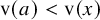 . Then
$x a^{-1} \in \mathfrak {m}$
. Then
$x a^{-1} \in \mathfrak {m}$
 and hence
$x = x a^{-1} a \in \mathfrak {m} \mathrm {I}_{c}$
and hence
$x = x a^{-1} a \in \mathfrak {m} \mathrm {I}_{c}$
 .
.
It follows that if c is some tuple in
$\mathrm {Cut}^\star $
 and R is an
$\mathcal {O}$
and R is an
$\mathcal {O}$
 -module of type c. Then
$\operatorname {red}(R)$
-module of type c. Then
$\operatorname {red}(R)$
 has dimension
$|\{i : \exists \gamma \in \Gamma ,\, \mathcal {C}_{c_i} = \Gamma _{\geq \gamma }\}|$
has dimension
$|\{i : \exists \gamma \in \Gamma ,\, \mathcal {C}_{c_i} = \Gamma _{\geq \gamma }\}|$
 over
$\mathrm {k}$
over
$\mathrm {k}$
 .
.
Lemma 3.15. Let
$R \subseteq \mathrm {K}^n$
 be an
$\mathcal {O}$
be an
$\mathcal {O}$
 -module of type c for some tuple c in
$\mathrm {Cut}^\star $
-module of type c for some tuple c in
$\mathrm {Cut}^\star $
 . Then there exists an
$\ulcorner R\urcorner $
. Then there exists an
$\ulcorner R\urcorner $
 -definable
$\mathfrak {m}$
-definable
$\mathfrak {m}$
 -avoiding module
$\overline {R}$
-avoiding module
$\overline {R}$
 containing R and such that
$\mathfrak {m} R = \mathfrak {m} \overline {R}$
containing R and such that
$\mathfrak {m} R = \mathfrak {m} \overline {R}$
 . In particular,
$\operatorname {red}(R)\subseteq \operatorname {red}(\overline {R})$
. In particular,
$\operatorname {red}(R)\subseteq \operatorname {red}(\overline {R})$
 is a subspace and
$\mathrm {dcl}(\ulcorner R\urcorner ) = \mathrm {dcl}(\ulcorner \overline {R}\urcorner ,\ulcorner \operatorname {red}(R)\urcorner )$
is a subspace and
$\mathrm {dcl}(\ulcorner R\urcorner ) = \mathrm {dcl}(\ulcorner \overline {R}\urcorner ,\ulcorner \operatorname {red}(R)\urcorner )$
 .
.
Proof. Let
$v_R$
 be the valuation defined in the proof of Proposition 3.3. Recall that
$R = \{x\in \mathrm {K}^n : \Gamma _{\geq 0} \subseteq v_R(x)\}$
be the valuation defined in the proof of Proposition 3.3. Recall that
$R = \{x\in \mathrm {K}^n : \Gamma _{\geq 0} \subseteq v_R(x)\}$
 and let
$\overline {R} = \{x\in \mathrm {K}^n : \Gamma _{> 0} \subseteq v_R(x)\}$
and let
$\overline {R} = \{x\in \mathrm {K}^n : \Gamma _{> 0} \subseteq v_R(x)\}$
 . If
$e_i$
. If
$e_i$
 is a (triangular) basis such that
$R = \sum _i \mathrm {I}_{c_i}e_i$
is a (triangular) basis such that
$R = \sum _i \mathrm {I}_{c_i}e_i$
 , then
$\overline {R} = \sum _i \overline {I}_{c_i} e_i$
, then
$\overline {R} = \sum _i \overline {I}_{c_i} e_i$
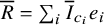 .
.
For every
$\gamma \in \Gamma $
 , let
$\gamma \mathcal {O} = \{x\in \mathrm {K}: \mathrm {v}(x)\geq \gamma \}$
, let
$\gamma \mathcal {O} = \{x\in \mathrm {K}: \mathrm {v}(x)\geq \gamma \}$
 and
$\gamma \mathfrak {m} = \{x\in \mathrm {K}: \mathrm {v}(x)> \gamma \}$
and
$\gamma \mathfrak {m} = \{x\in \mathrm {K}: \mathrm {v}(x)> \gamma \}$
 . We have
$\overline {\gamma \mathcal {O}} = \gamma \mathcal {O}$
. We have
$\overline {\gamma \mathcal {O}} = \gamma \mathcal {O}$
 and hence
$\mathfrak {m}\overline {\gamma \mathcal {O}} = \gamma \mathfrak {m}$
and hence
$\mathfrak {m}\overline {\gamma \mathcal {O}} = \gamma \mathfrak {m}$
 . If
$I_c$
. If
$I_c$
 is neither
$\gamma \mathcal {O}$
is neither
$\gamma \mathcal {O}$
 nor
$\gamma \mathfrak {m}$
nor
$\gamma \mathfrak {m}$
 for any
$\gamma \in \Gamma $
for any
$\gamma \in \Gamma $
 , then
$\mathfrak {m}\overline {I}_{c_i} = \mathfrak {m}\mathrm {I}_{c_i} = \mathrm {I}_{c_i}$
, then
$\mathfrak {m}\overline {I}_{c_i} = \mathfrak {m}\mathrm {I}_{c_i} = \mathrm {I}_{c_i}$
 . Finally, if
$\Gamma $
. Finally, if
$\Gamma $
 is dense then
$\overline {\gamma \mathfrak {m}} = \gamma \mathcal {O}$
is dense then
$\overline {\gamma \mathfrak {m}} = \gamma \mathcal {O}$
 and
$\mathfrak {m}\overline {\gamma \mathfrak {m}} = \gamma \mathfrak {m}$
and
$\mathfrak {m}\overline {\gamma \mathfrak {m}} = \gamma \mathfrak {m}$
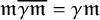 . It follows that
$\mathfrak {m} \overline {R} = \mathfrak {m} R$
. It follows that
$\mathfrak {m} \overline {R} = \mathfrak {m} R$
 .
.
The last assertion follows from the fact that
$\operatorname {red}_{\overline {R}}^{-1}(\operatorname {red}(R)) = R$
 .
.
Let us now recall, following [Reference Haskell, Hrushovski and Dugald Macpherson18, Lemma 2.6.4], how to code definable subspaces of
$\operatorname {red}(\overline {R})$
 . The following abstract conditions were isolated in [Reference Hrushovski19].
Proposition 3.16. Let M be some
$\mathfrak {L}$
 -structure,
$\mathrm {k}$
-structure,
$\mathrm {k}$
 be some stably embedded
$\mathfrak {L}$
be some stably embedded
$\mathfrak {L}$
 -definable field and
$\bigcup _{s} V_s$
-definable field and
$\bigcup _{s} V_s$
 be a collection of finite-dimensional
$\mathfrak {L}$
be a collection of finite-dimensional
$\mathfrak {L}$
 -definable
$\mathrm {k}$
-definable
$\mathrm {k}$
 -vector spaces which
-
○ is closed under tensors: for every $s,r$
, there is an
$\mathfrak {L}$
-definable injection from the interpretable set
$V_s\otimes V_r$
into some
$V_t$
; -
○ is closed under duals: for every s, there is an $\mathfrak {L}$
-definable injection from the interpretable set
$V_s^{\vee }$
into some
$V_t$
; -
○ has flags: For every s, there exists $r,t$
and a
$\mathfrak {L}$
-definable exact sequence
$0 \to V_r \to V_s \to V_t\to 0$
, with
$\dim (V_r) = 1$
.




Then any definable subspace
$W\subseteq V_s$
 , is coded in
$\bigcup _{s} V_s$
, is coded in
$\bigcup _{s} V_s$
 .
.
Proof. By (the proof of) [Reference Hrushovski19, Proposition 5.2], W is coded in some projective space
$\mathbb {P}(V_r)$
 . By [Reference Hrushovski19, Lemma 5.6], given that the family has flags,
$\mathbb {P}(V_r)$
. By [Reference Hrushovski19, Lemma 5.6], given that the family has flags,
$\mathbb {P}(V_r)$
 is coded in
$\bigcup _{s} V_s$
is coded in
$\bigcup _{s} V_s$
 .
.
We consider once again an (expansion of a) valued field M in some language
$\mathfrak {L}$
 .
.
Definition 3.17. For every
$A \subseteq M^{\mathrm {eq}}$
 , let
$\mathrm {Lin}_A = \coprod _{s\in \mathrm {Gr}(\mathrm {acl}(A))} \operatorname {red}(R_s)$
, let
$\mathrm {Lin}_A = \coprod _{s\in \mathrm {Gr}(\mathrm {acl}(A))} \operatorname {red}(R_s)$
 with its A-induced structure.
Before we prove that Proposition 3.16 can be applied to
$\mathrm {Lin}_A$
 , let us prove the following useful computation:
Lemma 3.18. Let
$I,J\leq \mathrm {K}$
 be (M-definable)
$\mathcal {O}$
be (M-definable)
$\mathcal {O}$
 -submodules. If
$(I:J) = \mathfrak {m}$
-submodules. If
$(I:J) = \mathfrak {m}$
 , then
$I = a\mathfrak {m}$
, then
$I = a\mathfrak {m}$
 and
$J = a\mathcal {O}$
and
$J = a\mathcal {O}$
 , for some
$a \in \mathrm {K}$
, for some
$a \in \mathrm {K}$
 .
.
Proof. We first argue that
$\mathrm {v}(I) \subsetneq \mathrm {v}(J)$
 . If
$\mathrm {v}(J) \subseteq \mathrm {v}(I)$
. If
$\mathrm {v}(J) \subseteq \mathrm {v}(I)$
 , then
$J \subseteq I$
, then
$J \subseteq I$
 so
$\operatorname {Stab}(J) \subseteq (I:J)$
so
$\operatorname {Stab}(J) \subseteq (I:J)$
 , where
$\operatorname {Stab}(J)=\{ x \in K : xJ=J\}$
, where
$\operatorname {Stab}(J)=\{ x \in K : xJ=J\}$
 . Since
$\operatorname {Stab}(J)=\mathcal {O}_{\Delta }^{\times }$
. Since
$\operatorname {Stab}(J)=\mathcal {O}_{\Delta }^{\times }$
 for some definable convex subgroup
$\Delta $
for some definable convex subgroup
$\Delta $
 of the value group, and
$\mathfrak {m}$
of the value group, and
$\mathfrak {m}$
 does not contain
$\mathcal {O}_{\Delta }^{\times }$
does not contain
$\mathcal {O}_{\Delta }^{\times }$
 then
$\mathrm {v}(I) \subsetneq \mathrm {v}(J)$
then
$\mathrm {v}(I) \subsetneq \mathrm {v}(J)$
 .
.
We aim to show that
$\mathrm {v}(J)$
 has a minimal element. Otherwise, given
$\gamma \in \mathrm {v}(J) \backslash \mathrm {v}(I)$
has a minimal element. Otherwise, given
$\gamma \in \mathrm {v}(J) \backslash \mathrm {v}(I)$
 there is some
$\beta \in \mathrm {v}(J)$
there is some
$\beta \in \mathrm {v}(J)$
 such that
$\beta <\gamma $
such that
$\beta <\gamma $
 , thus
$\gamma =\beta +\delta $
, thus
$\gamma =\beta +\delta $
 where
$\delta = \gamma -\beta>0$
where
$\delta = \gamma -\beta>0$
 . Take
$x \in \mathfrak {m}$
. Take
$x \in \mathfrak {m}$
 and
$y \in J$
and
$y \in J$
 such that
$v(x)=\delta $
such that
$v(x)=\delta $
 and
$v(y)=\beta $
and
$v(y)=\beta $
 . Consequently,
$xy \notin I$
. Consequently,
$xy \notin I$
 since
$v(xy)=\gamma $
since
$v(xy)=\gamma $
 , so
$(I:J)\neq \mathfrak {m}$
, so
$(I:J)\neq \mathfrak {m}$
 . Let
$\gamma _{0}$
. Let
$\gamma _{0}$
 be the minimal element of
$\mathrm {v}(J)$
be the minimal element of
$\mathrm {v}(J)$
 and
$a \in K$
and
$a \in K$
 such that
$v(a)=\gamma _{0}$
such that
$v(a)=\gamma _{0}$
 thus
$J=a\mathcal {O}$
thus
$J=a\mathcal {O}$
 . To show that
$I=a\mathfrak {m}$
. To show that
$I=a\mathfrak {m}$
 it is sufficient to argue that
$\mathrm {v}(J) \backslash \mathrm {v}(I)=\{\gamma _{0}\}$
it is sufficient to argue that
$\mathrm {v}(J) \backslash \mathrm {v}(I)=\{\gamma _{0}\}$
 . If there is some
$\beta \in \mathrm {v}(J) \backslash \mathrm {v}(I)$
. If there is some
$\beta \in \mathrm {v}(J) \backslash \mathrm {v}(I)$
 such that
$\beta \neq \gamma _{0}$
such that
$\beta \neq \gamma _{0}$
 , then
$\beta -\gamma _{0}>0$
, then
$\beta -\gamma _{0}>0$
 . Take
$x \in \mathfrak {m}$
. Take
$x \in \mathfrak {m}$
 such that
$v(x)=\beta -\gamma _{0}$
such that
$v(x)=\beta -\gamma _{0}$
 , then
$x \in \mathfrak {m}$
, then
$x \in \mathfrak {m}$
 but
$ax \notin I$
but
$ax \notin I$
 , hence
$(J:I) \neq \mathfrak {m}$
, hence
$(J:I) \neq \mathfrak {m}$
 . Thus,
$I=a\mathfrak {m}$
. Thus,
$I=a\mathfrak {m}$
 , as required.
Proposition 3.19. For every
$A \subseteq M^{\mathrm {eq}}$
 ,
$\mathrm {Lin}_A$
,
$\mathrm {Lin}_A$
 is a collection of finite dimensional
$\mathrm {k}$
is a collection of finite dimensional
$\mathrm {k}$
 -vector spaces which is closed under tensors, duals and has flags.
Proof. Let
$R_1\subseteq \mathrm {K}^n$
 and
$R_2\subseteq \mathrm {K}^m$
and
$R_2\subseteq \mathrm {K}^m$
 be two
$\mathrm {acl}(A)$
be two
$\mathrm {acl}(A)$
 -definable
$\mathfrak {m}$
-definable
$\mathfrak {m}$
 -avoiding
$\mathcal {O}$
-avoiding
$\mathcal {O}$
 -modules. Let
$f : \mathrm {K}^{n}\otimes \mathrm {K}^{n} \to \mathrm {K}^{nm}$
-modules. Let
$f : \mathrm {K}^{n}\otimes \mathrm {K}^{n} \to \mathrm {K}^{nm}$
 be the
$\mathfrak {L}$
be the
$\mathfrak {L}$
 -definable isomorphism induced by the canonical basis. By Lemma 3.15, we find an A-definable
$\mathfrak {m}$
-definable isomorphism induced by the canonical basis. By Lemma 3.15, we find an A-definable
$\mathfrak {m}$
 -avoiding
$\mathcal {O}$
-avoiding
$\mathcal {O}$
 -module
$R = \overline {f(R_1\otimes R_2)}$
-module
$R = \overline {f(R_1\otimes R_2)}$
 inducing an inclusion
$\operatorname {red}(f(R_1\otimes R_2)) \subseteq \operatorname {red}(R)$
inducing an inclusion
$\operatorname {red}(f(R_1\otimes R_2)) \subseteq \operatorname {red}(R)$
 . Since
$\operatorname {red}(R_1)\otimes \operatorname {red}(R_2)$
. Since
$\operatorname {red}(R_1)\otimes \operatorname {red}(R_2)$
 is A-definably isomorphic to
$\operatorname {red}(R_1\otimes R_2)$
is A-definably isomorphic to
$\operatorname {red}(R_1\otimes R_2)$
 , we conclude that
$\mathrm {Lin}_A$
, we conclude that
$\mathrm {Lin}_A$
 is closed under tensors.
As for duals, for every
$\mathcal {O}$
 -submodule
$I\subseteq \mathrm {K}$
-submodule
$I\subseteq \mathrm {K}$
 , let
$I^{\vee } = (\mathcal {O}:I) = \{x\in \mathrm {K}: xI \subseteq \mathcal {O}\}$
, let
$I^{\vee } = (\mathcal {O}:I) = \{x\in \mathrm {K}: xI \subseteq \mathcal {O}\}$
 . By Lemma 3.18,
$I^{\vee }\neq \mathfrak {m}$
. By Lemma 3.18,
$I^{\vee }\neq \mathfrak {m}$
 . Let
$g : (\mathrm {K}^n)^{\vee }\to \mathrm {K}^n$
. Let
$g : (\mathrm {K}^n)^{\vee }\to \mathrm {K}^n$
 be the
$\mathfrak {L}$
be the
$\mathfrak {L}$
 -definable isomorphism induced by the canonical basis composed with the map
$\mathrm {K}^n\to \mathrm {K}^n$
-definable isomorphism induced by the canonical basis composed with the map
$\mathrm {K}^n\to \mathrm {K}^n$
 reversing the order of the coordinates and let
$(a_i^{\vee })_i$
reversing the order of the coordinates and let
$(a_i^{\vee })_i$
 denote the dual basis. Then, as we reversed the order,
$g(a_i^{\vee })$
denote the dual basis. Then, as we reversed the order,
$g(a_i^{\vee })$
 is an upper triangular basis. If
$R = \sum _i \mathrm {I}_{c_i} a_i$
is an upper triangular basis. If
$R = \sum _i \mathrm {I}_{c_i} a_i$
 for some triangular basis
$(a_i)_i$
for some triangular basis
$(a_i)_i$
 , then
$g(\mathrm {Hom}_{\mathcal {O}}(R_1,\mathcal {O})) = \sum _i \mathrm {I}_{c_i}^{\vee }g(a_i^{\vee })$
, then
$g(\mathrm {Hom}_{\mathcal {O}}(R_1,\mathcal {O})) = \sum _i \mathrm {I}_{c_i}^{\vee }g(a_i^{\vee })$
 , which is
$\mathfrak {m}$
, which is
$\mathfrak {m}$
 -avoiding. This induces an A-definable isomorphism
$\operatorname {red}(\mathrm {Hom}_{\mathcal {O}}(R_1,\mathcal {O})) \simeq \operatorname {red}(g(\mathrm {Hom}_{\mathcal {O}}(R_1,\mathcal {O})))$
-avoiding. This induces an A-definable isomorphism
$\operatorname {red}(\mathrm {Hom}_{\mathcal {O}}(R_1,\mathcal {O})) \simeq \operatorname {red}(g(\mathrm {Hom}_{\mathcal {O}}(R_1,\mathcal {O})))$
 showing that
$\mathrm {Lin}_A$
showing that
$\mathrm {Lin}_A$
 is closed under duals.
Finally, regarding flags, let
$R = \sum _i \mathrm {I}_{c_i} a_i\subset \mathrm {K}^n$
 be an
$\mathrm {acl}(A)$
be an
$\mathrm {acl}(A)$
 -definable
$\mathfrak {m}$
-definable
$\mathfrak {m}$
 -avoiding
$\mathcal {O}$
-avoiding
$\mathcal {O}$
 -module, with a triangular. We find a flag for
$\operatorname {red}(R)$
-module, with a triangular. We find a flag for
$\operatorname {red}(R)$
 by induction on n. Let
$\pi $
by induction on n. Let
$\pi $
 be the projection on the last
$n-1$
be the projection on the last
$n-1$
 variables. Then, we have a split A-definable short exact sequence

which induces the following A-definable short exact sequence

If
$\mathrm {I}_{c_0} = \mathfrak {m} \mathrm {I}_{c_0}$
 , then
$\operatorname {red}(R) \simeq \operatorname {red}(\pi (R))$
, then
$\operatorname {red}(R) \simeq \operatorname {red}(\pi (R))$
 and we conclude by induction on n. If not,
$\mathrm {I}_{c_0}a_0/\mathfrak {m} \mathrm {I}_{c_0}a_0$
and we conclude by induction on n. If not,
$\mathrm {I}_{c_0}a_0/\mathfrak {m} \mathrm {I}_{c_0}a_0$
 is a dimension one
$\mathrm {k}$
is a dimension one
$\mathrm {k}$
 -vector space, and the above short exact sequence is a flag for
$\operatorname {red}(R)$
-vector space, and the above short exact sequence is a flag for
$\operatorname {red}(R)$
 .
.
Remark 3.20. Fix some
$A\subseteq M^{\mathrm {eq}}$
 .
.
-
1. Recall that we assumed that $\mathrm {k}$
is stably embedded in M. It follows that
$\mathrm {Lin}_{A}$
is stably embedded and its A-induced structure is definable with parameters in the structure with the
$\mathfrak {L}$
-induced structure on
$\mathrm {k}$
and the vector space structure on each sort
$R_s/\mathfrak {m} R_s$
. Indeed, once we name a basis of every vector space in
$\mathrm {Lin}_A$
, every definable subset in
$\mathrm {Lin}_A$
can be identified with a definable subset in
$\mathrm {k}$
. Similarly, if
$\mathrm {RV}$
is stably embedded, so is
$\mathrm {Lin}_A\cup \mathrm {RV}$
. -
2. Whenever $\mathrm {k}$
is a pure algebraically closed field, combining [Reference Hrushovski19, Lemma 5.6] with Proposition 3.19,
$\mathrm {Lin}_A$
, with its A-induced structure, eliminates imaginaries.


We can now improve Corollary 3.7:
Corollary 3.21. Any M-definable
$\mathcal {O}$
 -submodule R of type
$c\in \mathrm {Cut}^\star $
-submodule R of type
$c\in \mathrm {Cut}^\star $
 is coded in
$\mathcal {G}$
is coded in
$\mathcal {G}$
 .
.
Conversely, any element
$a + \mathfrak {m} s \in \mathrm {Lin}$
 is coded by the
$\mathcal {O}$
is coded by the
$\mathcal {O}$
 -submodule generated by
$(a + \mathfrak {m} s)\times \{1\}$
-submodule generated by
$(a + \mathfrak {m} s)\times \{1\}$
 . So any element of
$\mathcal {G}$
. So any element of
$\mathcal {G}$
 is coded in
$\mathrm {K}\cup \mathrm {Mod}$
is coded in
$\mathrm {K}\cup \mathrm {Mod}$
 .
.
Proof. By Lemma 3.15, for some
$\mathfrak {m}$
 -avoiding module
$\overline {R}$
-avoiding module
$\overline {R}$
 containing R such that
$\mathfrak {m} R = \mathfrak {m}\overline {R}$
containing R such that
$\mathfrak {m} R = \mathfrak {m}\overline {R}$
 , the lattice R is coded by
$\ulcorner \overline {R}\urcorner \in \mathrm {Gr}$
, the lattice R is coded by
$\ulcorner \overline {R}\urcorner \in \mathrm {Gr}$
 and
$\ulcorner \operatorname {red}(R)\urcorner $
and
$\ulcorner \operatorname {red}(R)\urcorner $
 where
$\operatorname {red}(R)\leq \operatorname {red}(\overline {R})$
where
$\operatorname {red}(R)\leq \operatorname {red}(\overline {R})$
 is a subspace. By Propositions 3.16 and 3.19,
$\operatorname {red}(R)$
is a subspace. By Propositions 3.16 and 3.19,
$\operatorname {red}(R)$
 is coded in
$\mathrm {Lin}_{\ulcorner R\urcorner } \subseteq \mathrm {Lin}$
is coded in
$\mathrm {Lin}_{\ulcorner R\urcorner } \subseteq \mathrm {Lin}$
 .
.
One of the main reason for isolating the
$\mathfrak {m}$
 -avoiding modules is the following result.
Proposition 3.22. Let M be an
$\mathrm {RV}$
 -expansion of a model of
$\mathrm {Hen}_{0,0}$
-expansion of a model of
$\mathrm {Hen}_{0,0}$
 with stably embedded dense value group. If
$X\subseteq \mathrm {Gr}$
with stably embedded dense value group. If
$X\subseteq \mathrm {Gr}$
 is M-definable and orthogonal to
$\Gamma $
is M-definable and orthogonal to
$\Gamma $
 – meaning that any function
$f : X \to \Gamma ^{\mathrm {eq}}$
– meaning that any function
$f : X \to \Gamma ^{\mathrm {eq}}$
 definable with parameters has finite image – then X is finite.
Proof. Let us first consider the case of some M-definable
$X\subseteq \mathrm {K}/\mathrm {I}_{c}$
 for some
$c\in \mathrm {Cut}^{\star \star }$
for some
$c\in \mathrm {Cut}^{\star \star }$
 . Let
$Y\subseteq \mathrm {K}$
. Let
$Y\subseteq \mathrm {K}$
 be the preimage of X. By Proposition 2.5, there exists a (nonempty) finite set
$C\subseteq \mathrm {K}(M)$
be the preimage of X. By Proposition 2.5, there exists a (nonempty) finite set
$C\subseteq \mathrm {K}(M)$
 such that, any ball b disjoint from C, is either contained in Y or is disjoint from it. If X is infinite, then there exists some
$a\in Y$
such that, any ball b disjoint from C, is either contained in Y or is disjoint from it. If X is infinite, then there exists some
$a\in Y$
 such that
$a+\mathrm {I}_c$
such that
$a+\mathrm {I}_c$
 is disjoint from C. Let b be the maximal ball around a that is disjoint from C – that is, the ball
$a + (a-c)\mathfrak {m}$
is disjoint from C. Let b be the maximal ball around a that is disjoint from C – that is, the ball
$a + (a-c)\mathfrak {m}$
 where
$v(a-c) = \min _{c\in C} \mathrm {v}(a-c)$
where
$v(a-c) = \min _{c\in C} \mathrm {v}(a-c)$
 . Then
$b\subseteq Y$
. Then
$b\subseteq Y$
 and b strictly contains b as
$\mathrm {I}_{c}\neq d\mathfrak {m}$
and b strictly contains b as
$\mathrm {I}_{c}\neq d\mathfrak {m}$
 , for any d. It follows that the function
$f : x\mapsto \mathrm {v}(x-a)$
, for any d. It follows that the function
$f : x\mapsto \mathrm {v}(x-a)$
 induces a well-defined function on
$(b\setminus \{a+\mathrm {I}_c\})/\mathrm {I}_c \subseteq X$
induces a well-defined function on
$(b\setminus \{a+\mathrm {I}_c\})/\mathrm {I}_c \subseteq X$
 with infinite image, contradicting our hypothesis.
Let us now fix some
$e\in X \subseteq \mathrm {Gr}$
 , in some elementary extension of M. Let
$b_\ell $
, in some elementary extension of M. Let
$b_\ell $
 be as in Proposition 3.10 and let us prove, by induction on
$\ell $
be as in Proposition 3.10 and let us prove, by induction on
$\ell $
 , that
$b_\ell \in M^{\mathrm {eq}}$
, that
$b_\ell \in M^{\mathrm {eq}}$
 . For all
$\ell < n$
. For all
$\ell < n$
 , we have
$b_\ell \in \Gamma /\Delta _\ell $
, we have
$b_\ell \in \Gamma /\Delta _\ell $
 , for some convex subgroup
$\Delta _\ell $
, for some convex subgroup
$\Delta _\ell $
 . Since
$e \in X$
. Since
$e \in X$
 and X is orthogonal to
$\Gamma $
and X is orthogonal to
$\Gamma $
 and
$b_\ell \in \mathrm {dcl}(e)$
and
$b_\ell \in \mathrm {dcl}(e)$
 , we must have
$b_\ell \in M^{\mathrm {eq}}$
, we must have
$b_\ell \in M^{\mathrm {eq}}$
 . Let now
$\ell \geq n$
. Let now
$\ell \geq n$
 and let us assume that
$b_{<\ell } \in M$
and let us assume that
$b_{<\ell } \in M$
 . We have
$b_\ell \in X_\ell $
. We have
$b_\ell \in X_\ell $
 which is an M-definable torsor for some
$\mathrm {K}/\mathrm {I}_\ell $
which is an M-definable torsor for some
$\mathrm {K}/\mathrm {I}_\ell $
 where, by Lemma 3.18,
$\mathrm {I}_\ell $
where, by Lemma 3.18,
$\mathrm {I}_\ell $
 is not a multiple of
$\mathfrak {m}$
is not a multiple of
$\mathfrak {m}$
 . Since
$b_i\in \mathrm {dcl}(e)$
. Since
$b_i\in \mathrm {dcl}(e)$
 , it is contained is an M-definable subset of
$\mathrm {K}/\mathrm {I}_\ell $
, it is contained is an M-definable subset of
$\mathrm {K}/\mathrm {I}_\ell $
 which is orthogonal to
$\Gamma $
which is orthogonal to
$\Gamma $
 , and hence, by the first paragraph, finite. So
$b_\ell \in M^{\mathrm {eq}}$
, and hence, by the first paragraph, finite. So
$b_\ell \in M^{\mathrm {eq}}$
 .
.
Since
$e\in \mathrm {dcl}(M b)$
 , it follows that
$e\in M^{\mathrm {eq}}$
, it follows that
$e\in M^{\mathrm {eq}}$
 . As this holds for any
$e\in X$
. As this holds for any
$e\in X$
 in some elementary extension, X is finite.
Recall that a definable set X is (resp. almost) internal to another definable set Y if, over a model, X admits a one-to-one (resp. finite-to-one) map to
$Y^{\mathrm {eq}}$
 .
.
Corollary 3.23. Let M be an
$\mathrm {RV}$
 -expansion of a model of
$\mathrm {Hen}_{0,0}$
-expansion of a model of
$\mathrm {Hen}_{0,0}$
 with dense value group. Assume that
$\mathrm {k}$
with dense value group. Assume that
$\mathrm {k}$
 and
$\Gamma $
and
$\Gamma $
 are stably embedded and orthogonal. Let
$A=\mathrm {acl}(A)\subseteq M^{\mathrm {eq}}$
are stably embedded and orthogonal. Let
$A=\mathrm {acl}(A)\subseteq M^{\mathrm {eq}}$
 and let X be an almost
$\mathrm {k}$
and let X be an almost
$\mathrm {k}$
 -internal A-definable subset of (some cartesian product of)
$\mathcal {G}$
-internal A-definable subset of (some cartesian product of)
$\mathcal {G}$
 , then
$X\subseteq \mathrm {K}(A)\cup \mathrm {Gr}(A)\cup \mathrm {Lin}_A$
, then
$X\subseteq \mathrm {K}(A)\cup \mathrm {Gr}(A)\cup \mathrm {Lin}_A$
 .
.
Proof. Any almost
$\mathrm {k}$
 -internal set is orthogonal to
$\Gamma $
-internal set is orthogonal to
$\Gamma $
 . By Proposition 2.5, any infinite definable subset of
$\mathrm {K}$
. By Proposition 2.5, any infinite definable subset of
$\mathrm {K}$
 contains a ball and hence is not orthogonal to
$\Gamma $
contains a ball and hence is not orthogonal to
$\Gamma $
 , so if
$X\subseteq \mathrm {K}$
, so if
$X\subseteq \mathrm {K}$
 , then
$X\subseteq \mathrm {K}(A)$
, then
$X\subseteq \mathrm {K}(A)$
 . By Proposition 3.22, if
$X\subseteq \mathrm {Gr}$
. By Proposition 3.22, if
$X\subseteq \mathrm {Gr}$
 , then
$X\subseteq \mathrm {Gr}(A)$
, then
$X\subseteq \mathrm {Gr}(A)$
 . Finally, if
$X\subseteq \mathrm {Lin}$
. Finally, if
$X\subseteq \mathrm {Lin}$
 , then the projection of X to
$\mathrm {Gr}$
, then the projection of X to
$\mathrm {Gr}$
 is finite and hence
$X\subset \coprod _{s\in \mathrm {Gr}(A)}\operatorname {red}(R_s) = \mathrm {Lin}_A$
is finite and hence
$X\subset \coprod _{s\in \mathrm {Gr}(A)}\operatorname {red}(R_s) = \mathrm {Lin}_A$
 .
.
Note that it is necessary to assume that
$\Gamma (M)$
 is dense. The pure valued field
$\mathbb {C}((t))$
is dense. The pure valued field
$\mathbb {C}((t))$
 eliminates imaginaries down to
$\mathcal {G}$
eliminates imaginaries down to
$\mathcal {G}$
 . However, the interpretable set
$\mathcal {O}/t^2\mathcal {O}$
. However, the interpretable set
$\mathcal {O}/t^2\mathcal {O}$
 is orthogonal to
$\Gamma $
is orthogonal to
$\Gamma $
 (in fact, it is
$\mathrm {k}$
(in fact, it is
$\mathrm {k}$
 -analyzable), but it is not
$\mathrm {k}$
-analyzable), but it is not
$\mathrm {k}$
 -internal; in particular, it cannot be a subset of
$\mathrm {K}(A)\cup \mathrm {Gr}(A)\cup \mathrm {Lin}_A$
-internal; in particular, it cannot be a subset of
$\mathrm {K}(A)\cup \mathrm {Gr}(A)\cup \mathrm {Lin}_A$
 .
.
4 Density of quantifier free definable types
Let M be a sufficiently saturated and homogeneous
$\mathrm {RV}$
 -expansion of a model of
$\mathrm {Hen}_{0,0}$
-expansion of a model of
$\mathrm {Hen}_{0,0}$
 with strongly stably embedded
$\Gamma $
with strongly stably embedded
$\Gamma $
 (cf. Proposition 2.2). We realize types over
$\mathbb {M}$
(cf. Proposition 2.2). We realize types over
$\mathbb {M}$
 in some a sufficiently saturated and homogeneous
$\mathbb {M}\succ M$
in some a sufficiently saturated and homogeneous
$\mathbb {M}\succ M$
 . Let
$M_1 = M^{\mathrm {ur}}$
. Let
$M_1 = M^{\mathrm {ur}}$
 be its maximal algebraic unramified extension (with the
$\mathfrak {L}$
be its maximal algebraic unramified extension (with the
$\mathfrak {L}$
 -induced structure on
$\Gamma $
-induced structure on
$\Gamma $
 ) and
$M_0 = M^{\mathrm {a}}$
) and
$M_0 = M^{\mathrm {a}}$
 be its algebraic closure (as a pure valued field). Note that, by quantifier elimination, we have
$M_0 \prec \mathbb {M}^{\mathrm {a}}$
be its algebraic closure (as a pure valued field). Note that, by quantifier elimination, we have
$M_0 \prec \mathbb {M}^{\mathrm {a}}$
 and
$M_1\prec \mathbb {M}^{\mathrm {ur}}$
and
$M_1\prec \mathbb {M}^{\mathrm {ur}}$
 .
.
In what follows, whenever we want to refer to the structure in
$M_0 = M^{\mathrm {a}}$
 (resp.
$M_1 = M^{\mathrm {ur}}$
(resp.
$M_1 = M^{\mathrm {ur}}$
 , resp. M), we will indicate this by a
$0$
, resp. M), we will indicate this by a
$0$
 (resp.
$1$
(resp.
$1$
 , resp. nothing): for example,
$\mathrm {acl}_0$
, resp. nothing): for example,
$\mathrm {acl}_0$
 ,
$\mathrm {acl}_1$
,
$\mathrm {acl}_1$
 , or
$\mathrm {acl}$
, or
$\mathrm {acl}$
 for the algebraic closure and
$\mathrm {S}^0(M)$
for the algebraic closure and
$\mathrm {S}^0(M)$
 for the space of types in
$M_0$
for the space of types in
$M_0$
 over M.
We also assume that the language
$\mathfrak {L}_i$
 of
$M_i$
of
$M_i$
 is morleyized, and we restrict ourselves to quantifier free
$\mathfrak {L}_i$
is morleyized, and we restrict ourselves to quantifier free
$\mathfrak {L}_i$
 -formulas when interpreting them in a substructure. Note that it follows from quantifier elimination in
$M_1$
-formulas when interpreting them in a substructure. Note that it follows from quantifier elimination in
$M_1$
 (Theorem 2.7) that the trace on M of any
$\mathfrak {L}_1$
(Theorem 2.7) that the trace on M of any
$\mathfrak {L}_1$
 -definable set in
$M_1$
-definable set in
$M_1$
 is
$\mathfrak {L}$
is
$\mathfrak {L}$
 -definable. Similarly, for
$\mathfrak {L}_0$
-definable. Similarly, for
$\mathfrak {L}_0$
 -definable sets. We also fix a sufficiently saturated extension of the triple
$(M_0,M_1,M)$
-definable sets. We also fix a sufficiently saturated extension of the triple
$(M_0,M_1,M)$
 in which we realize types.
The goal of this section is to prove the following density result:
Theorem 4.1. Assume that
$\Gamma (M)$
 satisfies Property
D
. Let
$A = \mathrm {acl}(A)\subseteq M^{\mathrm {eq}}$
satisfies Property
D
. Let
$A = \mathrm {acl}(A)\subseteq M^{\mathrm {eq}}$
 and
$X\subseteq \mathrm {K}^n$
and
$X\subseteq \mathrm {K}^n$
 be nonempty and
$\mathfrak {L}(A)$
be nonempty and
$\mathfrak {L}(A)$
 -definable in M. Then there exists an
$\mathfrak {L}(\mathcal {G}(A)\cup \Gamma ^{\mathrm {eq}}(A))$
-definable in M. Then there exists an
$\mathfrak {L}(\mathcal {G}(A)\cup \Gamma ^{\mathrm {eq}}(A))$
 -definable type
$p \in \mathrm {S}^1(M)$
-definable type
$p \in \mathrm {S}^1(M)$
 consistent with X.
This statement was proved in [Reference Vicaría7, Theorem 5.9] when
$M = M^{\mathrm {ur}}$
 and
$\Gamma $
and
$\Gamma $
 is an abelian ordered group of bounded regular rank. It also strengthens [Reference Hils and Rideau-Kikuchi6, Theorem 3.1.3] in two ways. The first is that it provides a definable type in a stronger reduct (i.e., a type in
$M^{\mathrm {ur}}$
is an abelian ordered group of bounded regular rank. It also strengthens [Reference Hils and Rideau-Kikuchi6, Theorem 3.1.3] in two ways. The first is that it provides a definable type in a stronger reduct (i.e., a type in
$M^{\mathrm {ur}}$
 and not just in
$M^{\mathrm {a}}$
and not just in
$M^{\mathrm {a}}$
 ). The second is that there is no hypothesis on the residue field: it is not required that the residue field eliminates
$\exists ^\infty $
). The second is that there is no hypothesis on the residue field: it is not required that the residue field eliminates
$\exists ^\infty $
 .
.
4.1 Codes of definable types
We start by proving the following useful fact allowing to compare types in M,
$M_1 = M^{\mathrm {ur}}$
 and
$M_0 = M^{\mathrm {a}}$
and
$M_0 = M^{\mathrm {a}}$
 .
.
Remark 4.2. Let
$c=(c_{1},\dots , c_{n})$
 be a finite tuple in
$\mathrm {Cut}^{**}$
be a finite tuple in
$\mathrm {Cut}^{**}$
 . Consider the natural map:

So the map above identifies the code of the
$\mathcal {O}(M)$
 -module
$R=\sum _{i\leq n}a_{i}I_{c_{i}}(M)$
-module
$R=\sum _{i\leq n}a_{i}I_{c_{i}}(M)$
 in M with the code of the
$\mathcal {O}(M_{1})$
in M with the code of the
$\mathcal {O}(M_{1})$
 -module
$R_1 = \sum _{i \leq n} a_{i} I_{c_{i}}(M_{1}) = \sum _{i \leq n} a_{i} \mathcal {O}(M_1) \cdot I_{c_{i}}(M)$
-module
$R_1 = \sum _{i \leq n} a_{i} I_{c_{i}}(M_{1}) = \sum _{i \leq n} a_{i} \mathcal {O}(M_1) \cdot I_{c_{i}}(M)$
 generated by R. Moreover, we have
$R_1(M) = R$
generated by R. Moreover, we have
$R_1(M) = R$
 .
.
Recall the Definition 1.1 of a definable
$\Delta $
 -type.
Proposition 4.3. Let
$A = \mathrm {dcl}(A)\subseteq M^{\mathrm {eq}}$
 and
$p(x)\in \mathrm {S}_{\mathrm {K}^{|x|}}^\varepsilon (M)$
and
$p(x)\in \mathrm {S}_{\mathrm {K}^{|x|}}^\varepsilon (M)$
 be finitely satisfiable in M and
$\mathfrak {L}(A)$
be finitely satisfiable in M and
$\mathfrak {L}(A)$
 -definable, for
$\varepsilon = 0$
-definable, for
$\varepsilon = 0$
 or
$1$
or
$1$
 . Then p has a unique extension
$q_\varepsilon \in \mathrm {S}^\varepsilon (M_\varepsilon )$
. Then p has a unique extension
$q_\varepsilon \in \mathrm {S}^\varepsilon (M_\varepsilon )$
 . Moreover,
$q_1$
. Moreover,
$q_1$
 is
$\mathfrak {L}_1(\mathcal {G}(A)\cup \Gamma ^{\mathrm {eq}}(A))$
is
$\mathfrak {L}_1(\mathcal {G}(A)\cup \Gamma ^{\mathrm {eq}}(A))$
 -definable and
$q_0|_{M_1}$
-definable and
$q_0|_{M_1}$
 is
$\mathfrak {L}_1(\mathcal {G}(A))$
is
$\mathfrak {L}_1(\mathcal {G}(A))$
 -definable.
We follow the proof of [Reference Vicaría7, Theorem 5.9], mutatis mutandis .
Proof. The uniqueness of
$q_\varepsilon $
 follows from [Reference Hils and Rideau-Kikuchi6, Lemma 3.3.7]; note that
$q_\varepsilon $
follows from [Reference Hils and Rideau-Kikuchi6, Lemma 3.3.7]; note that
$q_\varepsilon $
 is finitely satisfiable in M.
For every integer
$d\geq 0$
 , let
$V_{d} \simeq \mathrm {K}^\ell $
, let
$V_{d} \simeq \mathrm {K}^\ell $
 be the space of polynomials in
$\mathrm {K}(M)[x]_{\leq d}$
be the space of polynomials in
$\mathrm {K}(M)[x]_{\leq d}$
 of degree less or equal than d (in each
$x_i$
of degree less or equal than d (in each
$x_i$
 ). It comes with an
$\mathfrak {L}(A)$
). It comes with an
$\mathfrak {L}(A)$
 -definable valuation defined by
$v(P)\leq v(Q)$
-definable valuation defined by
$v(P)\leq v(Q)$
 if
$p(x)\vdash \mathrm {v}(P(x))\leq \mathrm {v}(Q(x))$
if
$p(x)\vdash \mathrm {v}(P(x))\leq \mathrm {v}(Q(x))$
 .
.
By Proposition 3.3 there exists a separated basis
$(P_i)_{i\leq \ell }\in V_d$
 such that, for every i,
$\gamma _i = v(P_i) \in \mathrm {dcl}(\ulcorner v\urcorner ) \subseteq A$
such that, for every i,
$\gamma _i = v(P_i) \in \mathrm {dcl}(\ulcorner v\urcorner ) \subseteq A$
 . By [Reference Hils and Rideau-Kikuchi6, Claim 3.3.5],
$(P_i)_{i}$
. By [Reference Hils and Rideau-Kikuchi6, Claim 3.3.5],
$(P_i)_{i}$
 is also a separated basis of
$V_d^1 = \mathrm {K}(M_1)[x]_{\leq d}$
is also a separated basis of
$V_d^1 = \mathrm {K}(M_1)[x]_{\leq d}$
 with the valuation
$v_{1}$
with the valuation
$v_{1}$
 where
$v_1(P)\leq v_{1}(Q)$
where
$v_1(P)\leq v_{1}(Q)$
 if
$q_1(x)\vdash \mathrm {v}(P(x))\leq \mathrm {v}(Q(x))$
if
$q_1(x)\vdash \mathrm {v}(P(x))\leq \mathrm {v}(Q(x))$
 . It follows that
$v_1(V_d^1) = v(V_d) = \bigcup _{i} \gamma _i + \Gamma (M)$
. It follows that
$v_1(V_d^1) = v(V_d) = \bigcup _{i} \gamma _i + \Gamma (M)$
 which we identify in
$\Gamma ^{\mathrm {eq}}$
which we identify in
$\Gamma ^{\mathrm {eq}}$
 over
$\mathcal {G}(A)$
over
$\mathcal {G}(A)$
 with disjoint copies of
$\Gamma $
with disjoint copies of
$\Gamma $
 .
.
By Corollary 3.7 the definable
$\mathcal {O}$
 -modules
$R_i = \{P \in V_d : v(P)\geq \gamma _i\}$
-modules
$R_i = \{P \in V_d : v(P)\geq \gamma _i\}$
 are coded by some tuple
$e_i$
are coded by some tuple
$e_i$
 in
$\mathrm {Mod}(A)$
in
$\mathrm {Mod}(A)$
 . We identify
$e_i$
. We identify
$e_i$
 with the code
$e^1_i \in \mathrm {Mod}^1(M)$
with the code
$e^1_i \in \mathrm {Mod}^1(M)$
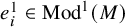 of
$R^1_i = \{P \in V^1_d : v_1(P)\geq \gamma _i\}$
of
$R^1_i = \{P \in V^1_d : v_1(P)\geq \gamma _i\}$
 via the map in Remark 4.2. Furthermore, the
$R_i^1$
via the map in Remark 4.2. Furthermore, the
$R_i^1$
 entirely determine
$v_1$
entirely determine
$v_1$
 which is therefore coded in
$\mathcal {G}(A)$
which is therefore coded in
$\mathcal {G}(A)$
 (cf. Corollary 3.21). Since
$q_0|_{M_{1}}$
(cf. Corollary 3.21). Since
$q_0|_{M_{1}}$
 is entirely determined by the valuations
$v_1$
is entirely determined by the valuations
$v_1$
 on
$V_d^1$
on
$V_d^1$
 , the proposition is proved in that case.
To conclude, let us prove the definability of
$q_1$
 . By Theorem 2.7, any
$\mathfrak {L}_1$
. By Theorem 2.7, any
$\mathfrak {L}_1$
 -formula
$\phi (x,y)$
-formula
$\phi (x,y)$
 (with variables in
$\mathrm {K}$
(with variables in
$\mathrm {K}$
 ) is equivalent to one of the form
$\psi (\mathrm {v}(P(x,y)))$
) is equivalent to one of the form
$\psi (\mathrm {v}(P(x,y)))$
 , where
$P\in \mathbb {Z}[x,y]$
, where
$P\in \mathbb {Z}[x,y]$
 is a tuple. Let
$X_\phi = \{v_1(P(x,a))\in v_1(V_d^1): q_1(x)\vdash \psi (\mathrm {v}(P(x,a)))\}$
is a tuple. Let
$X_\phi = \{v_1(P(x,a))\in v_1(V_d^1): q_1(x)\vdash \psi (\mathrm {v}(P(x,a)))\}$
 . Note that if
$v_1(P(x,b)) = v_1(P(x,a))$
. Note that if
$v_1(P(x,b)) = v_1(P(x,a))$
 , then
$q_1(x)\vdash \mathrm {v}(P(x,b)) = \mathrm {v}(P(x,a))$
, then
$q_1(x)\vdash \mathrm {v}(P(x,b)) = \mathrm {v}(P(x,a))$
 and hence
$q_1(x)\vdash \psi (\mathrm {v}(P(x,b)))$
and hence
$q_1(x)\vdash \psi (\mathrm {v}(P(x,b)))$
 if and only if
$v_1(P(x,b)) \in X_\phi $
if and only if
$v_1(P(x,b)) \in X_\phi $
 . So it suffices to show that the
$X_\phi $
. So it suffices to show that the
$X_\phi $
 are
$\mathfrak {L}_1(\mathcal {G}(A)\cup \Gamma ^{\mathrm {eq}}(A))$
are
$\mathfrak {L}_1(\mathcal {G}(A)\cup \Gamma ^{\mathrm {eq}}(A))$
 -definable, but this follows immediately from the identification
$v_1(V_d^1) = \bigcup _{i} \gamma _i + \Gamma (M)$
-definable, but this follows immediately from the identification
$v_1(V_d^1) = \bigcup _{i} \gamma _i + \Gamma (M)$
 .
.
From now on, we will identify
$\mathfrak {L}(A)$
 -definable types in
$\mathrm {S}^1(M)$
-definable types in
$\mathrm {S}^1(M)$
 that are finitely satisfiable in M with their unique extension to
$M_1 = M^{\mathrm {ur}}$
that are finitely satisfiable in M with their unique extension to
$M_1 = M^{\mathrm {ur}}$
 .
.
We now note that coding definable
$\mathfrak {L}_0$
 -types already allows us to code some imaginaries, namely certain germs of functions into the space of balls – see Section 2.1 for the definition of germs.
Definition 4.4. Let B be a chain of balls in
$M_0$
 (including points and
$\mathrm {K}$
(including points and
$\mathrm {K}$
 itself). We define the generic
$\eta _B$
itself). We define the generic
$\eta _B$
 of the generalized ball
$\bigcap _{b\in B} b$
of the generalized ball
$\bigcap _{b\in B} b$
 , to be the
$\mathfrak {L}_0(M_0)$
, to be the
$\mathfrak {L}_0(M_0)$
 -type generated by:

If b is a generalized ball, we write
$\eta _b$
 for the type
$\eta _B$
for the type
$\eta _B$
 where B is the set of balls containing b. If b is a definable generalized ball in M,
$\eta _b|_{M}(x)$
where B is the set of balls containing b. If b is a definable generalized ball in M,
$\eta _b|_{M}(x)$
 is an
$\mathfrak {L}(\ulcorner b\urcorner )$
is an
$\mathfrak {L}(\ulcorner b\urcorner )$
 -definable type (finitely) consistent with
$x\in b$
-definable type (finitely) consistent with
$x\in b$
 .
.
Lemma 4.5. Assume that
$\Gamma (M)$
 is dense. Let
$a\in \mathrm {K}(N)$
is dense. Let
$a\in \mathrm {K}(N)$
 , for some
$N\succ M$
, for some
$N\succ M$
 , be such that
$p_0(x) = \operatorname {tp}_0(a/M)$
, be such that
$p_0(x) = \operatorname {tp}_0(a/M)$
 is
$\mathfrak {L}(M)$
is
$\mathfrak {L}(M)$
 -definable. Let
$b(a)$
-definable. Let
$b(a)$
 be an
$\mathfrak {L}_0(Ma)$
be an
$\mathfrak {L}_0(Ma)$
 -definable open ball whose radius is in
$\Gamma (N)$
-definable open ball whose radius is in
$\Gamma (N)$
 – where b implicitly denotes some
$\mathfrak {L}_0(M)$
– where b implicitly denotes some
$\mathfrak {L}_0(M)$
 -definable map. Then the germ
$[b]_{p_0}$
-definable map. Then the germ
$[b]_{p_0}$
 is coded in
$\mathcal {G}(M)$
is coded in
$\mathcal {G}(M)$
 over
$\mathcal {G}(\ulcorner p_0\urcorner )$
over
$\mathcal {G}(\ulcorner p_0\urcorner )$
 .
.
Proof. We may assume that
$N^{\mathrm {a}}$
 is
$|M|^+$
is
$|M|^+$
 -saturated. Let
$q_0(x,y)$
-saturated. Let
$q_0(x,y)$
 be the
$\mathfrak {L}(M)$
be the
$\mathfrak {L}(M)$
 -definable
$\mathfrak {L}_0(M)$
-definable
$\mathfrak {L}_0(M)$
 -type of
$ac$
-type of
$ac$
 where c is generic in
$b(a)$
where c is generic in
$b(a)$
 over
$Ma$
over
$Ma$
 – that is
$c\models \eta _b|_{Ma}$
– that is
$c\models \eta _b|_{Ma}$
 . Note that, since we are in equicharacteristic zero,
$b(a)$
. Note that, since we are in equicharacteristic zero,
$b(a)$
 has a point in N and, in fact, since
$b(a)$
has a point in N and, in fact, since
$b(a)$
 is open and
$\Gamma (N)$
is open and
$\Gamma (N)$
 is dense, the generic of
$b(a)$
is dense, the generic of
$b(a)$
 in
$N^{\mathrm {a}}$
in
$N^{\mathrm {a}}$
 is satisfiable in N. It follows that
$q_0$
is satisfiable in N. It follows that
$q_0$
 is finitely satisfiable in M.
By Proposition 4.3,
$p_0$
 and
$q_0$
and
$q_0$
 are coded in
$\mathcal {G}(M)$
are coded in
$\mathcal {G}(M)$
 . Moreover, for every
$\sigma \in \mathrm {Aut}(M/\ulcorner p\urcorner )$
. Moreover, for every
$\sigma \in \mathrm {Aut}(M/\ulcorner p\urcorner )$
 and
$ac \models q_0$
and
$ac \models q_0$
 , we have
$\sigma (q_0) = q_0$
, we have
$\sigma (q_0) = q_0$
 if and only if
$b(a) = b^\sigma (a)$
if and only if
$b(a) = b^\sigma (a)$
 . So
$[b]_{p}$
. So
$[b]_{p}$
 is coded by
$\mathcal {G}(\ulcorner q_0\urcorner )$
is coded by
$\mathcal {G}(\ulcorner q_0\urcorner )$
 over
$\mathcal {G}(\ulcorner p_0\urcorner )$
over
$\mathcal {G}(\ulcorner p_0\urcorner )$
 .
.
4.2 Unary subsets of K
We first consider the case of Theorem 4.1 when
$X\subseteq \mathrm {K}$
 . The proof proceeds as in [Reference Vicaría7, Theorem 5.3] where, in the unary case, the hypothesis that
$M = M^{\mathrm {ur}}$
. The proof proceeds as in [Reference Vicaría7, Theorem 5.3] where, in the unary case, the hypothesis that
$M = M^{\mathrm {ur}}$
 is not used.
Lemma 4.6. Let
$A = \mathrm {acl}(A)\subseteq M$
 and
$X\subseteq \mathrm {K}$
and
$X\subseteq \mathrm {K}$
 be
$\mathfrak {L}(A)$
be
$\mathfrak {L}(A)$
 -definable in M. There exists an
$\mathfrak {L}_1(\mathrm {B_g}(A))$
-definable in M. There exists an
$\mathfrak {L}_1(\mathrm {B_g}(A))$
 -definable chain of balls E in
$M_1$
-definable chain of balls E in
$M_1$
 such that the
$\mathfrak {L}_1(\mathrm {B_g}(A))$
such that the
$\mathfrak {L}_1(\mathrm {B_g}(A))$
 -definable type
$\eta _E|_{M_1} \in \mathrm {S}^0(M_1)$
-definable type
$\eta _E|_{M_1} \in \mathrm {S}^0(M_1)$
 is consistent with X.
This follows from [Reference Hils and Rideau-Kikuchi6, Section 3] which states a relative version of that statement. However, since the machinery set up for the relative version of the statement is rather heavy, let us sketch a proof. A version of this proof can also be found in [Reference Vicaría7, Theorem 5.5].
Proof. Let
$\mathrm {B}(M_1)$
 be the set of all open and closed balls (including points and
$\mathrm {K}$
be the set of all open and closed balls (including points and
$\mathrm {K}$
 itself) in
$M_1$
itself) in
$M_1$
 . Given
$b_{1},b_{2} \in \mathrm {B}$
. Given
$b_{1},b_{2} \in \mathrm {B}$
 we write
$b_1 {\unicode{x2AA8}} b_2$
we write
$b_1 {\unicode{x2AA8}} b_2$
 if
$b_1\cap X \subseteq b_2\cap X$
if
$b_1\cap X \subseteq b_2\cap X$
 . This is a preorder with associated equivalence
$\equiv $
. This is a preorder with associated equivalence
$\equiv $
 and the associated order is a tree
$\mathcal {T}$
and the associated order is a tree
$\mathcal {T}$
 if we remove the class
$E_\emptyset $
if we remove the class
$E_\emptyset $
 of balls that don’t intersect X.
Note that any
$\equiv $
 -class
$E\neq E_\emptyset $
-class
$E\neq E_\emptyset $
 , the generalized ball
$b_E = \bigcap _{b\in E} b$
, the generalized ball
$b_E = \bigcap _{b\in E} b$
 is defined by knowing a point in
$b_E$
is defined by knowing a point in
$b_E$
 and the set
$\{\mathrm {v}(x-y): x,y\in b_E\}$
and the set
$\{\mathrm {v}(x-y): x,y\in b_E\}$
 which is definable in
$\Gamma (M) = \Gamma (M_1)$
which is definable in
$\Gamma (M) = \Gamma (M_1)$
 . So
$b_E$
. So
$b_E$
 and E are
$\mathfrak {L}_1(M)$
and E are
$\mathfrak {L}_1(M)$
 -definable. It follows that E is coded in
$\mathrm {B_g}(M)$
-definable. It follows that E is coded in
$\mathrm {B_g}(M)$
 and that the generic type
$\eta _{E}|_{M_1}(x) \in \mathrm {S}^0(M_1)$
and that the generic type
$\eta _{E}|_{M_1}(x) \in \mathrm {S}^0(M_1)$
 is
$\mathfrak {L}_1(\ulcorner E\urcorner )$
is
$\mathfrak {L}_1(\ulcorner E\urcorner )$
 -definable. If the type
$\eta _E$
-definable. If the type
$\eta _E$
 is not consistent with X, by compactness,
$X\cap b_E$
is not consistent with X, by compactness,
$X\cap b_E$
 is covered by finitely many disjoint balls of
$M_0$
is covered by finitely many disjoint balls of
$M_0$
 . But then the smallest ball
$b_0$
. But then the smallest ball
$b_0$
 in
$M_0$
in
$M_0$
 containing
$X\cap b_E$
containing
$X\cap b_E$
 is closed with radius in
$\Gamma (M) = \Gamma (M_1)$
is closed with radius in
$\Gamma (M) = \Gamma (M_1)$
 and
$X\cap b_E$
and
$X\cap b_E$
 is covered by finitely many maximal open subballs of
$b_0$
is covered by finitely many maximal open subballs of
$b_0$
 which are indeed balls of
$M_1$
which are indeed balls of
$M_1$
 . It follows that E has finitely many direct predecessors for
${\unicode{x2AA8}}$
. It follows that E has finitely many direct predecessors for
${\unicode{x2AA8}}$
 , each of them in
$\mathrm {acl}(A, \ulcorner E\urcorner )$
, each of them in
$\mathrm {acl}(A, \ulcorner E\urcorner )$
 .
.
Starting with the class of
$\mathrm {K}$
 and proceeding by induction, either the lemma holds or the tree
$\mathcal {T}$
and proceeding by induction, either the lemma holds or the tree
$\mathcal {T}$
 has an initial infinite discrete finitely branching tree. All the elements of this initial tree are
$\mathfrak {L}_1(\mathrm {B_g}(A))$
has an initial infinite discrete finitely branching tree. All the elements of this initial tree are
$\mathfrak {L}_1(\mathrm {B_g}(A))$
 -definable
$\equiv $
-definable
$\equiv $
 -classes.
By Proposition 2.5, there exists a finite set
$C\subseteq \mathrm {K}(M)$
 preparing X and can find an
$\equiv $
preparing X and can find an
$\equiv $
 -class E in the infinite initial discrete tree such that
$b_E\cap C = \emptyset $
-class E in the infinite initial discrete tree such that
$b_E\cap C = \emptyset $
 . Then
$b_E\subseteq X$
. Then
$b_E\subseteq X$
 and hence X is consistent with the
$\mathfrak {L}_1(\mathrm {B_g}(A))$
and hence X is consistent with the
$\mathfrak {L}_1(\mathrm {B_g}(A))$
 -definable type
$\eta _E|_{M_1}$
-definable type
$\eta _E|_{M_1}$
 .
.
Let us now show that the type
$\eta _E|_{M_1}$
 can then be completed to an
$\mathfrak {L}_1(\mathrm {B_g}(A)\cup \Gamma ^{\mathrm {eq}}(A))$
can then be completed to an
$\mathfrak {L}_1(\mathrm {B_g}(A)\cup \Gamma ^{\mathrm {eq}}(A))$
 -definable type
$p_1\in \mathrm {S}^1(M_1)$
-definable type
$p_1\in \mathrm {S}^1(M_1)$
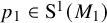 consistent with X:
Lemma 4.7. Assume that
$\Gamma (M)$
 satisfies Property
D
. Let
$A = \mathrm {dcl}(A) \subseteq M^{\mathrm {eq}}$
satisfies Property
D
. Let
$A = \mathrm {dcl}(A) \subseteq M^{\mathrm {eq}}$
 , let X be
$\mathfrak {L}(A)$
, let X be
$\mathfrak {L}(A)$
 -definable and let E be an
$\mathfrak {L}_1(\mathrm {B_g}(A))$
-definable and let E be an
$\mathfrak {L}_1(\mathrm {B_g}(A))$
 -definable chain of balls in
$M_1$
-definable chain of balls in
$M_1$
 such that
$\eta _{E}|_{M_1}$
such that
$\eta _{E}|_{M_1}$
 is consistent with X. Then, there exists an
$\mathfrak {L}_1(\mathrm {B_g}(A)\cup \Gamma ^{\mathrm {eq}}(\mathrm {acl}(A)))$
is consistent with X. Then, there exists an
$\mathfrak {L}_1(\mathrm {B_g}(A)\cup \Gamma ^{\mathrm {eq}}(\mathrm {acl}(A)))$
 -definable type
$p \in \mathrm {S}^1(M_1)$
-definable type
$p \in \mathrm {S}^1(M_1)$
 containing
$\eta _E|_{M_1}$
containing
$\eta _E|_{M_1}$
 and consistent with X.
Proof. Let
$b_E = \bigcap _{b\in E} b$
 and
$c\in X$
and
$c\in X$
 realize
$\eta _E|_{M_1}$
realize
$\eta _E|_{M_1}$
 . Then
$\gamma = \mathrm {v}(c-a)$
. Then
$\gamma = \mathrm {v}(c-a)$
 does not depend on
$a\in b_E(M_1)$
does not depend on
$a\in b_E(M_1)$
 . If
$\gamma \in \Gamma (M)$
. If
$\gamma \in \Gamma (M)$
 , then
$b_E$
, then
$b_E$
 is a closed ball and
$\eta _E|_{M_1}$
is a closed ball and
$\eta _E|_{M_1}$
 generates a complete type over
$M_1$
generates a complete type over
$M_1$
 .
.
If not, let C be the
$\mathfrak {L}_1(\Gamma ^{\mathrm {eq}}(A))$
 -definable cut of
$\gamma $
-definable cut of
$\gamma $
 over
$\Gamma (M_1)$
over
$\Gamma (M_1)$
 . For every
$a\in b_E(M_1)$
. For every
$a\in b_E(M_1)$
 , let
$Y_a =\mathrm {v}(X-a) = \{v(x-a) : x \in x\}$
, let
$Y_a =\mathrm {v}(X-a) = \{v(x-a) : x \in x\}$
 – it contains
$\gamma $
– it contains
$\gamma $
 . Let
$\eta _C(x) = \{x < \gamma : \gamma \in C\}\cup \{x> \gamma : \gamma \not \in C\}$
. Let
$\eta _C(x) = \{x < \gamma : \gamma \in C\}\cup \{x> \gamma : \gamma \not \in C\}$
 be the
$\mathfrak {L}_1(\Gamma ^{\mathrm {eq}}(A))$
be the
$\mathfrak {L}_1(\Gamma ^{\mathrm {eq}}(A))$
 -definable generic type of C over
$\Gamma (M_1)$
-definable generic type of C over
$\Gamma (M_1)$
 and let
$r(x) = \eta _C(x) \cup \{x\in Y_a : a\in b_E(M_1)\}$
and let
$r(x) = \eta _C(x) \cup \{x\in Y_a : a\in b_E(M_1)\}$
 . Then r is
$\mathfrak {L}_1(\Gamma ^{\mathrm {eq}}(A))$
. Then r is
$\mathfrak {L}_1(\Gamma ^{\mathrm {eq}}(A))$
 -definable and
$\gamma \models r$
-definable and
$\gamma \models r$
 . By property D, r is contained an
$\mathfrak {L}_1(\Gamma ^{\mathrm {eq}}(A))$
. By property D, r is contained an
$\mathfrak {L}_1(\Gamma ^{\mathrm {eq}}(A))$
 -definable complete type
$q(x)$
-definable complete type
$q(x)$
 over
$\Gamma (M_1)$
over
$\Gamma (M_1)$
 .
.
Let
$\delta \models q$
 and fix some
$a\in b_E(M_1)$
and fix some
$a\in b_E(M_1)$
 . Since
$\delta \in Y_a$
. Since
$\delta \in Y_a$
 , there exists
$c\in X$
, there exists
$c\in X$
 such that
$\mathrm {v}(c-a) = \delta $
such that
$\mathrm {v}(c-a) = \delta $
 , and since
$\delta \models \eta _C$
, and since
$\delta \models \eta _C$
 , we have
$c\models \eta _E|_{M_1}$
, we have
$c\models \eta _E|_{M_1}$
 . So the type
$p(x) = \eta _E|_{M_1}(x) \cup q(\mathrm {v}(x-a))$
. So the type
$p(x) = \eta _E|_{M_1}(x) \cup q(\mathrm {v}(x-a))$
 is consistent with X. It is complete by Theorem 2.7, and it is
$\mathfrak {L}_1(\mathrm {B_g}(A)\cup \Gamma ^{\mathrm {eq}}(A))$
is consistent with X. It is complete by Theorem 2.7, and it is
$\mathfrak {L}_1(\mathrm {B_g}(A)\cup \Gamma ^{\mathrm {eq}}(A))$
 -definable.
Corollary 4.8. Assume that
$\Gamma (M)$
 satisfies Property
D
. Let
$A = \mathrm {acl}(A) \subseteq M^{\mathrm {eq}}$
satisfies Property
D
. Let
$A = \mathrm {acl}(A) \subseteq M^{\mathrm {eq}}$
 . Then any
$\mathfrak {L}(A)$
. Then any
$\mathfrak {L}(A)$
 -definable subset of
$\mathrm {K}$
-definable subset of
$\mathrm {K}$
 is consistent with an
$\mathfrak {L}(\mathrm {B_g}(A)\cup \Gamma ^{\mathrm {eq}}(A))$
is consistent with an
$\mathfrak {L}(\mathrm {B_g}(A)\cup \Gamma ^{\mathrm {eq}}(A))$
 -definable type
$p \in \mathrm {S}^1(M)$
-definable type
$p \in \mathrm {S}^1(M)$
 .
.
4.3 Germs of functions
To prove density of definable types in general, we now wish to proceed by transitivity. However, since we are working with definable
$\mathfrak {L}_1$
 -types, we first need to address the potential difference between
$\mathrm {acl}$
-types, we first need to address the potential difference between
$\mathrm {acl}$
 and
$\mathrm {acl}_1$
and
$\mathrm {acl}_1$
 . For every tuple a in
$M^{\mathrm {eq}}$
. For every tuple a in
$M^{\mathrm {eq}}$
 , let
$a_{\mathrm {K}}$
, let
$a_{\mathrm {K}}$
 enumerate
$a\cap \mathrm {K}$
enumerate
$a\cap \mathrm {K}$
 .
.
Proposition 4.9. Assume that
$\Gamma $
 has property
D
. Let
$A = \mathrm {acl}(A)\subseteq M^{\mathrm {eq}}$
has property
D
. Let
$A = \mathrm {acl}(A)\subseteq M^{\mathrm {eq}}$
 and let X be pro-
$\mathfrak {L}(A)$
and let X be pro-
$\mathfrak {L}(A)$
 -definable in M in the sorts
$\mathcal {G}\cup \Gamma ^{\mathrm {eq}}$
-definable in M in the sorts
$\mathcal {G}\cup \Gamma ^{\mathrm {eq}}$
 . Let
$p(x)$
. Let
$p(x)$
 be an infinitary
$\mathfrak {L}(A)$
be an infinitary
$\mathfrak {L}(A)$
 -definable
$\mathfrak {L}_1(M)$
-definable
$\mathfrak {L}_1(M)$
 -type which is consistent with X. Assume that for any
$a\models p$
-type which is consistent with X. Assume that for any
$a\models p$
 , we have
$a \subseteq \mathrm {acl}_1(Ma_{\mathrm {K}})$
, we have
$a \subseteq \mathrm {acl}_1(Ma_{\mathrm {K}})$
 . Then, for every
$\mathfrak {L}(A)$
. Then, for every
$\mathfrak {L}(A)$
 -definable one-to-finite correspondence F into
$\mathcal {G}\cup \Gamma ^{\mathrm {eq}}$
-definable one-to-finite correspondence F into
$\mathcal {G}\cup \Gamma ^{\mathrm {eq}}$
 defined at all realizations of p in X, there exists an
$\mathfrak {L}(A)$
defined at all realizations of p in X, there exists an
$\mathfrak {L}(A)$
 -definable
$q(xy)\in \mathrm {S}^1(M)$
-definable
$q(xy)\in \mathrm {S}^1(M)$
 containing
$p(x)$
containing
$p(x)$
 and there exists
$ac\models q$
and there exists
$ac\models q$
 with
$a\in X$
with
$a\in X$
 such that
$c\in \mathrm {acl}_1(M a_{\mathrm {K}} c_{\mathrm {K}})$
such that
$c\in \mathrm {acl}_1(M a_{\mathrm {K}} c_{\mathrm {K}})$
 and
$F(a) \cap \mathrm {dcl}_1(ac) \neq \emptyset $
and
$F(a) \cap \mathrm {dcl}_1(ac) \neq \emptyset $
 .
.
Note that if
$a\in \mathcal {G}(M)\cup \Gamma ^{\mathrm {eq}}(M)$
 , then as the induced
$\mathfrak {L}_1$
, then as the induced
$\mathfrak {L}_1$
 -structure on M is
$\mathfrak {L}$
-structure on M is
$\mathfrak {L}$
 -definable, then
$\mathrm {acl}_1(a) \cap (\mathcal {G}(M)\cup \Gamma ^{\mathrm {eq}}(M))\subseteq \mathrm {acl}(a)$
-definable, then
$\mathrm {acl}_1(a) \cap (\mathcal {G}(M)\cup \Gamma ^{\mathrm {eq}}(M))\subseteq \mathrm {acl}(a)$
 . Furthermore, if
$a\subseteq \mathrm {K}(M)$
. Furthermore, if
$a\subseteq \mathrm {K}(M)$
 ,
$\mathrm {K}(\mathrm {acl}(a)) = \mathbb {Q}(a)^{\mathrm {a}}\cap \mathrm {K}(M) \subseteq \mathrm {K}(\mathrm {acl}_1(a))$
,
$\mathrm {K}(\mathrm {acl}(a)) = \mathbb {Q}(a)^{\mathrm {a}}\cap \mathrm {K}(M) \subseteq \mathrm {K}(\mathrm {acl}_1(a))$
 .
.
Proof. If the proposition holds for F, then for some
$\mathfrak {L}_1$
 -definable map, we have
$f(ac) \in F(a)$
-definable map, we have
$f(ac) \in F(a)$
 . So replacing p by q and X by
$x\in X \wedge f(xy)\in F(x)$
. So replacing p by q and X by
$x\in X \wedge f(xy)\in F(x)$
 , the hypothesis of the proposition stills holds and we may assume that if
$a \in X$
, the hypothesis of the proposition stills holds and we may assume that if
$a \in X$
 realizes p then
$F(a)\cap \mathrm {dcl}_1(a) \neq \emptyset $
realizes p then
$F(a)\cap \mathrm {dcl}_1(a) \neq \emptyset $
 . The proof now proceeds by proving the proposition for various specific F and changing p and X as above, until we exhaust all possible F. To do so, it suffices, by Corollary 3.12, to add a point to
$a_K$
. The proof now proceeds by proving the proposition for various specific F and changing p and X as above, until we exhaust all possible F. To do so, it suffices, by Corollary 3.12, to add a point to
$a_K$
 in every
$Aa$
in every
$Aa$
 -algebraic generalized ball and a lift of every element in
$\Gamma /\Delta (\mathrm {dcl}(Aa))$
-algebraic generalized ball and a lift of every element in
$\Gamma /\Delta (\mathrm {dcl}(Aa))$
 , for any convex
$\Delta \leq \Gamma $
, for any convex
$\Delta \leq \Gamma $
 .
.
We first consider the case where F is almost definable in
$M_1$
 .
.
Claim 4.9.1. If there exists an
$\mathfrak {L}_1(M)$
 -definable one-to-finite correspondence G such that
$p(x) \wedge x\in X \vdash F(x)\subseteq G(x)$
-definable one-to-finite correspondence G such that
$p(x) \wedge x\in X \vdash F(x)\subseteq G(x)$
 , then the proposition holds.
Proof. Since
$p\in \mathrm {S}^1(M)$
 , the cardinal of
$G(x)$
, the cardinal of
$G(x)$
 is constant when x varies over realizations of p; and we may assume that it is minimal. Then for every other such
$G'$
is constant when x varies over realizations of p; and we may assume that it is minimal. Then for every other such
$G'$
 , we have
$p(x)\wedge x\in X\vdash F(x) \subseteq G(x)\cap G'(x)$
, we have
$p(x)\wedge x\in X\vdash F(x) \subseteq G(x)\cap G'(x)$
 and hence
$p(x) \wedge x\in X \vdash G(x) = G'(x)$
and hence
$p(x) \wedge x\in X \vdash G(x) = G'(x)$
 . In other words, for some (and hence for every)
$a \models p$
. In other words, for some (and hence for every)
$a \models p$
 ,
$G(a) = G'(a)$
,
$G(a) = G'(a)$
 . This holds in particular of any
$G' = \sigma (G)$
. This holds in particular of any
$G' = \sigma (G)$
 , where
$\sigma \in \mathrm {Aut}(M/A)$
, where
$\sigma \in \mathrm {Aut}(M/A)$
 and thus
$[G]_{p} \in \mathrm {dcl}(A) = A$
and thus
$[G]_{p} \in \mathrm {dcl}(A) = A$
 – recall that we assumed M to be sufficiently saturated and homogeneous. Let
$G_0\subseteq G$
– recall that we assumed M to be sufficiently saturated and homogeneous. Let
$G_0\subseteq G$
 be minimal
$\mathfrak {L}_1(M)$
be minimal
$\mathfrak {L}_1(M)$
 -definable such that
$p(x) \vdash \emptyset \neq G_0(x) \subseteq G(x)$
-definable such that
$p(x) \vdash \emptyset \neq G_0(x) \subseteq G(x)$
 . Then
$[G_0]_{p} \in \mathrm {acl}(A) = A$
. Then
$[G_0]_{p} \in \mathrm {acl}(A) = A$
 . The type
$q(x y) = p(x)\wedge y\in G_0(x)$
. The type
$q(x y) = p(x)\wedge y\in G_0(x)$
 is complete as cardinality of
$G_0$
is complete as cardinality of
$G_0$
 is minimal and it is
$\mathfrak {L}(M)$
is minimal and it is
$\mathfrak {L}(M)$
 -definable and
$\mathrm {Aut}(M/A)$
-definable and
$\mathrm {Aut}(M/A)$
 -invariant; so it is
$\mathfrak {L}(A)$
-invariant; so it is
$\mathfrak {L}(A)$
 -definable. By construction, for any
$ac\models q$
-definable. By construction, for any
$ac\models q$
 , we have
$c\in G_0(a) \subseteq \mathrm {acl}_1(Ma) \subseteq \mathrm {acl}_1(M a_K)$
, we have
$c\in G_0(a) \subseteq \mathrm {acl}_1(Ma) \subseteq \mathrm {acl}_1(M a_K)$
 . Moreover, if
$q(xy)$
. Moreover, if
$q(xy)$
 is not consistent with
$x\in X\wedge y\in F(x)$
is not consistent with
$x\in X\wedge y\in F(x)$
 , then
$p(x) \wedge x\in X \vdash F(x)\subseteq G(x)\setminus G_0(x)$
, then
$p(x) \wedge x\in X \vdash F(x)\subseteq G(x)\setminus G_0(x)$
 , contradicting the minimality of G. So the type q is as required.
Let us now assume that the co-domain of F is
$\Gamma ^{\mathrm {eq}}$
 . By strong stable embeddedness of
$\Gamma $
. By strong stable embeddedness of
$\Gamma $
 and Lemma 2.3, for every
$a\models p$
and Lemma 2.3, for every
$a\models p$
 ,
,

and hence, by compactness, there exists an
$\mathfrak {L}_1(M)$
 -definable one-to-finite correspondence G such that
$p(x) \vdash F(x) \subseteq G(x)$
-definable one-to-finite correspondence G such that
$p(x) \vdash F(x) \subseteq G(x)$
 . We now conclude with Claim 4.9.1. As indicated at the start of the proof, we may therefore assume that a contains all of
$\Gamma ^{\mathrm {eq}}(\mathrm {acl}(Aa))$
. We now conclude with Claim 4.9.1. As indicated at the start of the proof, we may therefore assume that a contains all of
$\Gamma ^{\mathrm {eq}}(\mathrm {acl}(Aa))$
 .
.
Claim 4.9.2. Let
$b: p \to \mathrm {B_g}$
 be
$\mathfrak {L}_1$
be
$\mathfrak {L}_1$
 -definable. Then there exists an
$\mathfrak {L}(A)$
-definable. Then there exists an
$\mathfrak {L}(A)$
 -definable type
$q(xy)\in \mathrm {S}^1(M)$
-definable type
$q(xy)\in \mathrm {S}^1(M)$
 finitely satisfiable in M containing
$p(x)\cup \{y\models \eta _{b(x)}|_{Mx}\}$
finitely satisfiable in M containing
$p(x)\cup \{y\models \eta _{b(x)}|_{Mx}\}$
 .
.
Proof. Let
$a\models p$
 . Since
$\Gamma ^{\mathrm {eq}}(\mathrm {acl}_1(b(a))) \subseteq \Gamma ^{\mathrm {eq}}(\mathrm {acl}_1(a)) \subseteq \Gamma ^{\mathrm {eq}}(\mathrm {acl}(a))\subseteq a$
. Since
$\Gamma ^{\mathrm {eq}}(\mathrm {acl}_1(b(a))) \subseteq \Gamma ^{\mathrm {eq}}(\mathrm {acl}_1(a)) \subseteq \Gamma ^{\mathrm {eq}}(\mathrm {acl}(a))\subseteq a$
 , by Lemma 4.7 applied with M elementary extension of
$M_1$
, by Lemma 4.7 applied with M elementary extension of
$M_1$
 containing a, there exists an
$\mathfrak {L}_1(a)$
containing a, there exists an
$\mathfrak {L}_1(a)$
 -definable type
$r_a(y)$
-definable type
$r_a(y)$
 containing
$\eta _{b(a)}(y)$
containing
$\eta _{b(a)}(y)$
 and
$y\in b(a)$
and
$y\in b(a)$
 . Let
$c\models r_a|_{Ma}$
. Let
$c\models r_a|_{Ma}$
 . Then
$\operatorname {tp}_1(ac/M)$
. Then
$\operatorname {tp}_1(ac/M)$
 is as required.
For every
$\mathfrak {L}(Aa)$
 -definable convex subgroup
$\Delta \leq \Gamma $
-definable convex subgroup
$\Delta \leq \Gamma $
 and
$\gamma \in (\Gamma /\Delta )(\mathrm {acl}(Aa))\subseteq a$
and
$\gamma \in (\Gamma /\Delta )(\mathrm {acl}(Aa))\subseteq a$
 , the set
$\mathrm {v}_\Delta ^{-1}([\gamma ,\infty ])$
, the set
$\mathrm {v}_\Delta ^{-1}([\gamma ,\infty ])$
 is an
$\mathfrak {L}_1(a)$
is an
$\mathfrak {L}_1(a)$
 -definable generalized ball. Let q be as in Claim 4.9.2 applied to any
$\mathfrak {L}$
-definable generalized ball. Let q be as in Claim 4.9.2 applied to any
$\mathfrak {L}$
 -definable function b such that
$b(a) = \mathrm {v}_\Delta ^{-1}([\gamma ,\infty ])$
-definable function b such that
$b(a) = \mathrm {v}_\Delta ^{-1}([\gamma ,\infty ])$
 . If
$ac\models q$
. If
$ac\models q$
 , we have
$\mathrm {v}_\Delta (c) = \gamma $
, we have
$\mathrm {v}_\Delta (c) = \gamma $
 . Replacing p by q, we may assume that
$\mathrm {v}_\Delta (a_{\mathrm {K}})$
. Replacing p by q, we may assume that
$\mathrm {v}_\Delta (a_{\mathrm {K}})$
 contains all of
$(\Gamma /\Delta )(\mathrm {acl}(Aa))$
contains all of
$(\Gamma /\Delta )(\mathrm {acl}(Aa))$
 .
.
If the co-domain of F is
$\mathrm {k}$
 , let
$\eta _k(y) \in \mathrm {S}^1(M)$
, let
$\eta _k(y) \in \mathrm {S}^1(M)$
 be the
$\mathfrak {L}$
be the
$\mathfrak {L}$
 -definable generic of
$\mathrm {k}$
-definable generic of
$\mathrm {k}$
 – that is, the only nonalgebraic type concentrating on
$\mathrm {k}$
– that is, the only nonalgebraic type concentrating on
$\mathrm {k}$
 . If
$p(x)\otimes \eta _{\mathrm {k}}(y)$
. If
$p(x)\otimes \eta _{\mathrm {k}}(y)$
 is not consistent with
$x\in X \wedge y \in F(y)$
is not consistent with
$x\in X \wedge y \in F(y)$
 , then there exists an
$\mathfrak {L}_1(M)$
, then there exists an
$\mathfrak {L}_1(M)$
 -definable one-to-finite correspondence G such that
$p(x) \wedge x\in X \vdash F(x) \subseteq G(x)$
-definable one-to-finite correspondence G such that
$p(x) \wedge x\in X \vdash F(x) \subseteq G(x)$
 , by Claim 4.9.1 and Claim 4.9.2, we find
$q(xy)$
, by Claim 4.9.1 and Claim 4.9.2, we find
$q(xy)$
 consistent with
$x\in X \wedge \mathrm {res}(y) \in F(x)$
consistent with
$x\in X \wedge \mathrm {res}(y) \in F(x)$
 . On the other hand, if
$p(x)\otimes \eta _{\mathrm {k}}(y)$
. On the other hand, if
$p(x)\otimes \eta _{\mathrm {k}}(y)$
 is consistent with
$x\in X \wedge y \in F(x)$
is consistent with
$x\in X \wedge y \in F(x)$
 , let
$q(x z) = p(x)\otimes \eta _{\mathcal {O}}(z)|_{M}$
, let
$q(x z) = p(x)\otimes \eta _{\mathcal {O}}(z)|_{M}$
 , then, by hypothesis,
$q(xz)$
, then, by hypothesis,
$q(xz)$
 is consistent with
$x\in X \wedge \mathrm {res}(z) \in F(x)$
is consistent with
$x\in X \wedge \mathrm {res}(z) \in F(x)$
 . Changing X and p we may therefore assume that
$\mathrm {k}(\mathrm {acl}(Aa))\subseteq \mathrm {res}(a_{\mathrm {K}})$
. Changing X and p we may therefore assume that
$\mathrm {k}(\mathrm {acl}(Aa))\subseteq \mathrm {res}(a_{\mathrm {K}})$
 .
.
We may also assume that
$a_{\mathrm {K}}$
 is a field. Now, if
$\xi \in \mathrm {RV}(\mathrm {acl}(Aa))$
is a field. Now, if
$\xi \in \mathrm {RV}(\mathrm {acl}(Aa))$
 , then
$\mathrm {v}(\xi ) \in \Gamma (\mathrm {acl}(Aa)) \subseteq \mathrm {v}(a_{\mathrm {K}})$
, then
$\mathrm {v}(\xi ) \in \Gamma (\mathrm {acl}(Aa)) \subseteq \mathrm {v}(a_{\mathrm {K}})$
 . Let
$c\in a$
. Let
$c\in a$
 be such that
$\mathrm {v}(c) =\mathrm {v}(\xi )$
be such that
$\mathrm {v}(c) =\mathrm {v}(\xi )$
 , then
$\xi \mathrm {rv}(c)^{-1} \in \mathrm {k}(\mathrm {acl}(Aa)) \subseteq \mathrm {res}(a_{\mathrm {K}})$
, then
$\xi \mathrm {rv}(c)^{-1} \in \mathrm {k}(\mathrm {acl}(Aa)) \subseteq \mathrm {res}(a_{\mathrm {K}})$
 . It follows that
$\mathrm {RV}(\mathrm {acl}(Aa))\subseteq \mathrm {rv}(a_{\mathrm {K}})$
. It follows that
$\mathrm {RV}(\mathrm {acl}(Aa))\subseteq \mathrm {rv}(a_{\mathrm {K}})$
 .
.
Let us now assume that the co-domain of F is the set of generalized balls that are not open balls. For any
$a\models p$
 and
$b\in F(a) \subseteq \mathrm {acl}(Aa) \subseteq \mathrm {acl}(Ma_{\mathrm {K}})$
and
$b\in F(a) \subseteq \mathrm {acl}(Aa) \subseteq \mathrm {acl}(Ma_{\mathrm {K}})$
 , by Lemma 2.6, we have
$b(\mathrm {acl}_1(Ma_{\mathrm {K}})) \supseteq b(\mathrm {acl}(Ma_{\mathrm {K}})) \neq \emptyset $
, by Lemma 2.6, we have
$b(\mathrm {acl}_1(Ma_{\mathrm {K}})) \supseteq b(\mathrm {acl}(Ma_{\mathrm {K}})) \neq \emptyset $
 . Moreover, the radius of b is in
$\Gamma ^{\mathrm {eq}}(\mathrm {acl}(Aa))\subseteq \mathrm {acl}_1(Ma_{\mathrm {K}})$
. Moreover, the radius of b is in
$\Gamma ^{\mathrm {eq}}(\mathrm {acl}(Aa))\subseteq \mathrm {acl}_1(Ma_{\mathrm {K}})$
 , by strong stable embeddedness. Hence,
$b \in \mathrm {acl}_1(Ma)$
, by strong stable embeddedness. Hence,
$b \in \mathrm {acl}_1(Ma)$
 and we conclude with Claim 4.9.1. So we may assume that
$b\in a$
and we conclude with Claim 4.9.1. So we may assume that
$b\in a$
 . Applying Claim 4.9.2, we may further assume that b has a point in a.
Now, if
$b\in \mathrm {acl}(Aa)$
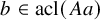 is an open ball, the smallest closed ball around b has a point
$c \in a$
is an open ball, the smallest closed ball around b has a point
$c \in a$
 and
$b-c \in \mathrm {RV}(\mathrm {acl}(Aa)) \subseteq \mathrm {rv}(a_{\mathrm {K}})$
and
$b-c \in \mathrm {RV}(\mathrm {acl}(Aa)) \subseteq \mathrm {rv}(a_{\mathrm {K}})$
 also has a point in a, hence so does b. Recall that we already assumed that, for every
$\mathrm {acl}(Aa)$
also has a point in a, hence so does b. Recall that we already assumed that, for every
$\mathrm {acl}(Aa)$
 -definable convex subgroup
$\Delta \leq \Gamma $
-definable convex subgroup
$\Delta \leq \Gamma $
 ,
$\Gamma /\Delta (\mathrm {acl}(Aa)) \subseteq \mathrm {v}_\Delta (a_{\mathrm {K}})$
,
$\Gamma /\Delta (\mathrm {acl}(Aa)) \subseteq \mathrm {v}_\Delta (a_{\mathrm {K}})$
 . By Corollary 3.12, we have
$\mathcal {G}(\mathrm {acl}(Aa)) \subseteq \mathrm {dcl}_1(a)$
. By Corollary 3.12, we have
$\mathcal {G}(\mathrm {acl}(Aa)) \subseteq \mathrm {dcl}_1(a)$
 .
.
Recall that to get to that point, we have replaced
$p(x)$
 by a type
$q(xy)$
by a type
$q(xy)$
 consistent with X and such that if
$ac\models q$
consistent with X and such that if
$ac\models q$
 , then
$c\in \mathrm {acl}(Ma_{\mathrm {K}} c_{\mathrm {K}})$
, then
$c\in \mathrm {acl}(Ma_{\mathrm {K}} c_{\mathrm {K}})$
 . So the proposition is proved.
Applying Proposition 4.9 to all possible F – as we have actually done in the proof of the proposition – we get:
Corollary 4.10. Let
$A = \mathrm {acl}(A) \subseteq M^{\mathrm {eq}}$
 , let X be
$\mathfrak {L}(A)$
, let X be
$\mathfrak {L}(A)$
 -definable and let
$p \in \mathrm {S}^1(M)$
-definable and let
$p \in \mathrm {S}^1(M)$
 be
$\mathfrak {L}(A)$
be
$\mathfrak {L}(A)$
 -definable and consistent with X. Then there exists
$a\models p$
-definable and consistent with X. Then there exists
$a\models p$
 in X such that

is
$\mathfrak {L}(A)$
 -definable.
The proof of Theorem 4.1 is now a standard induction.
Proof of Theorem 4.1
Recall that, by Proposition 4.3, we can identify
$\mathfrak {L}(A)$
 -definable types in
$\mathrm {S}^1(M)$
-definable types in
$\mathrm {S}^1(M)$
 which are finitely satisfiable in M with their unique
$\mathfrak {L}_1(\mathcal {G}(A)\cup \Gamma ^{\mathrm {eq}}(A))$
which are finitely satisfiable in M with their unique
$\mathfrak {L}_1(\mathcal {G}(A)\cup \Gamma ^{\mathrm {eq}}(A))$
 -definable extension to
$M_1$
-definable extension to
$M_1$
 . Let
$N\prec M$
. Let
$N\prec M$
 be small and contain A. Note that by Theorem 2.7,
$N_1 = N^{\mathrm {ur}} \prec M_1$
be small and contain A. Note that by Theorem 2.7,
$N_1 = N^{\mathrm {ur}} \prec M_1$
 . So it suffices to prove the theorem over N.
We proceed by induction on the integer n such that
$X\subseteq \mathrm {K}^n$
 . Let
$\pi : \mathrm {K}^n \to \mathrm {K}$
. Let
$\pi : \mathrm {K}^n \to \mathrm {K}$
 be the projection on the first coordinate. By Corollary 4.8, there exists an
$\mathfrak {L}(A)$
be the projection on the first coordinate. By Corollary 4.8, there exists an
$\mathfrak {L}(A)$
 -definable type
$p\in \mathrm {S}^1(M)$
-definable type
$p\in \mathrm {S}^1(M)$
 consistent with
$\pi (X)$
consistent with
$\pi (X)$
 . Let
$a\in X$
. Let
$a\in X$
 realize
$p|_{N}$
realize
$p|_{N}$
 and let c enumerate
$\mathcal {G}(\mathrm {acl}(Aa))\cup \Gamma ^{\mathrm {eq}}(\mathrm {acl}(Aa))$
and let c enumerate
$\mathcal {G}(\mathrm {acl}(Aa))\cup \Gamma ^{\mathrm {eq}}(\mathrm {acl}(Aa))$
 . By Corollary 4.10, we may assume that
$\operatorname {tp}_1(c/N)$
. By Corollary 4.10, we may assume that
$\operatorname {tp}_1(c/N)$
 is
$\mathfrak {L}(A)$
is
$\mathfrak {L}(A)$
 -definable.
By induction, there exists an
$\mathfrak {L}_1(c)$
 -definable
$r_c(z)\in \mathrm {S}^1(M_1)$
-definable
$r_c(z)\in \mathrm {S}^1(M_1)$
 consistent with
$X_a$
consistent with
$X_a$
 . In particular
$r_c|_{M}$
. In particular
$r_c|_{M}$
 is
$\mathfrak {L}(c)$
is
$\mathfrak {L}(c)$
 -definable. Let
$d\in X_a$
-definable. Let
$d\in X_a$
 realize
$r_c|_{M}$
realize
$r_c|_{M}$
 . Then
$q = \operatorname {tp}_1(acd/N)$
. Then
$q = \operatorname {tp}_1(acd/N)$
 is
$\mathfrak {L}(A)$
is
$\mathfrak {L}(A)$
 -definable and
$ad \in X$
-definable and
$ad \in X$
 . But q is
$\mathfrak {L}(\mathcal {G}(A)\cup \Gamma ^{\mathrm {eq}}(A))$
. But q is
$\mathfrak {L}(\mathcal {G}(A)\cup \Gamma ^{\mathrm {eq}}(A))$
 -definable, by Proposition 4.3, concluding the proof.
In the case
$M = M^{\mathrm {ur}}$
 , we can deduce a slight generalization of [Reference Vicaría7, Theorem 5.12]:
Corollary 4.11. Assume that:
-
○ $\Gamma (M)$
satisfies Property
D
; -
○ $\mathrm {k}(M)$
is a pure algebraically closed field.


Then M weakly eliminates imaginaries down to
$\mathcal {G} \cup \Gamma ^{\mathrm {eq}}$
 .
.
Proof. Fix some
$e\in M^{\mathrm {eq}}$
 . Let
$A = \mathrm {acl}(e)$
. Let
$A = \mathrm {acl}(e)$
 and let f be an
$\mathfrak {L}$
and let f be an
$\mathfrak {L}$
 -definable map with domain
$\mathrm {K}^n$
-definable map with domain
$\mathrm {K}^n$
 and such that
$X = f^{-1}(e) \neq \emptyset $
and such that
$X = f^{-1}(e) \neq \emptyset $
 . By Theorem 4.1, there exists an
$\mathfrak {L}(\mathcal {G}(A)\cup \Gamma ^{\mathrm {eq}}(A))$
. By Theorem 4.1, there exists an
$\mathfrak {L}(\mathcal {G}(A)\cup \Gamma ^{\mathrm {eq}}(A))$
 -definable type
$p(x)\in \mathrm {S}^1(M)$
-definable type
$p(x)\in \mathrm {S}^1(M)$
 consistent with X. But since
$M=M_1$
consistent with X. But since
$M=M_1$
 , this type is complete and we have
$p(x)\vdash f(x) = e$
, this type is complete and we have
$p(x)\vdash f(x) = e$
 . It follows that
$e\in \mathrm {dcl}(\mathcal {G}(A)\cup \Gamma ^{\mathrm {eq}}(A))$
. It follows that
$e\in \mathrm {dcl}(\mathcal {G}(A)\cup \Gamma ^{\mathrm {eq}}(A))$
 proving weak elimination.
5 Invariant extensions
In this section, we will consider the invariance of types over stably embedded definable sets, for example,
$\mathrm {RV}$
 . This gives rise to several notions of invariance isolated in [Reference Hils and Rideau-Kikuchi6, Section 4.2].
Whenever
$D = \bigcup _{i} D_{i}$
 is ind-
$\mathfrak {L}$
is ind-
$\mathfrak {L}$
 -definable and stably embedded, we denote by
$D^{\mathrm {eq}}$
-definable and stably embedded, we denote by
$D^{\mathrm {eq}}$
 the ind-
$\mathfrak {L}$
the ind-
$\mathfrak {L}$
 -interpretable union of all
$\mathfrak {L}$
-interpretable union of all
$\mathfrak {L}$
 -interpretable sets X that admit an
$\mathfrak {L}$
-interpretable sets X that admit an
$\mathfrak {L}$
 -definable surjection
$\prod _{j} D_{i_{j}} \rightarrow X$
-definable surjection
$\prod _{j} D_{i_{j}} \rightarrow X$
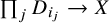 .
.
Let M be sufficiently saturated and homogeneous. Let
$C\subseteq M$
 be potentially large and let D be ind-
$\mathfrak {L}$
be potentially large and let D be ind-
$\mathfrak {L}$
 -definable and stably embedded. Let p be a partial type over M (closed under implication).
Definition 5.1. We say that the type p:
-
1. is $\mathrm {Aut}(M/C)$
-invariant if for every
$\sigma \in \mathrm {Aut}(M/C)$
, we have
$p=\sigma (p)$
; -
2. has $\mathrm {Aut}(M/C)$
-invariant D-germs if it is
$\mathrm {Aut}(M/C)$
-invariant and so is the p-germ of every (relatively) M-definable map
$f:p\rightarrow D^{\mathrm {eq}}$
; -
3. is $\mathrm {Aut}(M/D)$
-invariant if it has
$\mathrm {Aut}(M/D(M))$
-invariant D-germs.



A nice property of the stronger notion is that it is transitive – cf. [Reference Hils and Rideau-Kikuchi6, Lemma 4.2.4]:
Lemma 5.2. Let
$N \succ M$
 be saturatedFootnote 3 strictly larger than M. Let
$p \in S(M)$
be saturatedFootnote 3 strictly larger than M. Let
$p \in S(M)$
 have
$\mathrm {Aut}(M/C)$
have
$\mathrm {Aut}(M/C)$
 -invariant D-germs, let
$a \vDash p$
-invariant D-germs, let
$a \vDash p$
 in N and let
$q \in S(N)$
in N and let
$q \in S(N)$
 be
$\mathrm {Aut}(N/CD(N)a)$
be
$\mathrm {Aut}(N/CD(N)a)$
 -invariant. Then
$q|_{M}$
-invariant. Then
$q|_{M}$
 is
$\mathrm {Aut}(M/C)$
is
$\mathrm {Aut}(M/C)$
 -invariant.
Moreover, if q has
$\mathrm {Aut}(N/CD(N)a)$
 -invariant E-germs, for some (ind-)
$\mathfrak {L}$
-invariant E-germs, for some (ind-)
$\mathfrak {L}$
 -definable set E, then
$q|_{M}$
-definable set E, then
$q|_{M}$
 has
$\mathrm {Aut}(M/C)$
has
$\mathrm {Aut}(M/C)$
 -invariant E-germs.
The main goal of this section is to prove the following statement. Recall (Definition 3.17) that
$\mathrm {Lin}_A = \coprod _{s\in \mathrm {Gr}(\mathrm {acl}(A))} \operatorname {red}(R_s)$
 and that a bounded regular rank group is an ordered abelian group with countably many definable convex subgroups.
Theorem 5.3. Let M be sufficiently saturated and homogeneous
$\mathrm {RV}$
 -expansion of a model of
$\mathrm {Hen}_{0,0}$
-expansion of a model of
$\mathrm {Hen}_{0,0}$
 such that the value group
$\Gamma $
such that the value group
$\Gamma $
 and residue field are stably embedded and orthogonal and
$\Gamma $
and residue field are stably embedded and orthogonal and
$\Gamma $
 is either:
-
○ dense with property D ;
-
○ or, a pure discrete ordered abelian group of bounded regular rank – in that case we also add a constant for a uniformizer $\pi $
.

Let
$M_0 = M^{\mathrm {a}}$
 , let
$A =\mathrm {acl}(A)\subseteq M^{\mathrm {eq}}$
, let
$A =\mathrm {acl}(A)\subseteq M^{\mathrm {eq}}$
 be small and let a be a tuple in
$\mathrm {K}(N)$
be small and let a be a tuple in
$\mathrm {K}(N)$
 , for some
$N\succ M$
, for some
$N\succ M$
 . Assume that
$\operatorname {tp}_{0}(a/M)$
. Assume that
$\operatorname {tp}_{0}(a/M)$
 is
$\mathrm {Aut}(M/\mathcal {G}(A))$
is
$\mathrm {Aut}(M/\mathcal {G}(A))$
 -invariant, then
$\operatorname {tp}(a/M)$
-invariant, then
$\operatorname {tp}(a/M)$
 is
$\mathrm {Aut}(M/\mathcal {G}(A),\mathrm {RV}(M),\mathrm {Lin}_{A}(M))$
is
$\mathrm {Aut}(M/\mathcal {G}(A),\mathrm {RV}(M),\mathrm {Lin}_{A}(M))$
 -invariant.
We follow the general strategy of [Reference Hils and Rideau-Kikuchi6, Section 4]. The main new challenge is to prove the equivalent (Proposition 5.16) of [Reference Hils and Rideau-Kikuchi6, Corollary 4.4.6] in the present setting since the geometric sorts are now larger.
5.1 Germs of functions into the linear sorts
One important ingredient of the proof of Proposition 5.16 is a description of the germ of certain functions into the linear sorts (cf. Lemmas 5.9 and 5.13). We proceed in three steps. First, we consider the case of a valued field with algebraically closed residue field. Then we consider valued fields with dense value groups (and arbitrary residue fields). Finally, we consider valued fields with discrete value groups for which a serious obstruction arises: the classification of
$\mathrm {k}$
 -internal sets given in Corollary 3.23 does not hold for discrete value groups. This can be circumvented by considering a ramified extension with dense value group.
Let M be sufficiently saturated and homogeneous (
$\mathrm {RV}$
 -expansion of a) model of
$\mathrm {Hen}_{0,0}$
-expansion of a) model of
$\mathrm {Hen}_{0,0}$
 in a language
$\mathfrak {L}$
in a language
$\mathfrak {L}$
 , whose value group
$\Gamma $
, whose value group
$\Gamma $
 is stably embedded, has property D and is orthogonal to
$\mathrm {k}$
is stably embedded, has property D and is orthogonal to
$\mathrm {k}$
 , which is itself stably embedded.
We first prove that germs of functions into the linear sorts are internal to the residue field (see Proposition 5.7). We follow the general strategy of [Reference Hils and Rideau-Kikuchi6, Lemma 3.4.1] and first prove a result on the growth of
$\mathrm {dcl}$
 in
$\mathrm {Lin}_A^{\mathrm {eq}}$
in
$\mathrm {Lin}_A^{\mathrm {eq}}$
 . Recall the definition of an open generalized ball (Definition 2.4).
Lemma 5.4. Let
$A\subset M^{\mathrm {eq}}$
 be small and let U be an open
$\infty $
be small and let U be an open
$\infty $
 -A-definable generalized ball. Let a be a generic element of U over A in some
$N\succ M$
-A-definable generalized ball. Let a be a generic element of U over A in some
$N\succ M$
 . Then
$\mathrm {Lin}_{A}^{\mathrm {eq}}(\mathrm {dcl}(Aa)) \subseteq \mathrm {acl}(A)$
. Then
$\mathrm {Lin}_{A}^{\mathrm {eq}}(\mathrm {dcl}(Aa)) \subseteq \mathrm {acl}(A)$
 .
.
Proof. Let
$f : U \to \mathrm {Lin}_A^{\mathrm {eq}}$
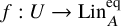 be some (relatively) A-definable function and let
$\mathrm {cut}(U)$
be some (relatively) A-definable function and let
$\mathrm {cut}(U)$
 be the cut of U. Fix some
$e \in U(M)$
be the cut of U. Fix some
$e \in U(M)$
 . For now, we work over M, so we can assume that
$e = 0$
. For now, we work over M, so we can assume that
$e = 0$
 and we identify
$\mathrm {Lin}_A^{\mathrm {eq}}$
and we identify
$\mathrm {Lin}_A^{\mathrm {eq}}$
 with
$\mathrm {k}^{\mathrm {eq}}$
with
$\mathrm {k}^{\mathrm {eq}}$
 . For every
$\gamma \in \mathrm {cut}(U)$
. For every
$\gamma \in \mathrm {cut}(U)$
 and
$d\in \mathrm {k}^{\mathrm {eq}}$
and
$d\in \mathrm {k}^{\mathrm {eq}}$
 , let
$X_{d,\gamma } = \{x\in U: \mathrm {v}(x) = \gamma $
, let
$X_{d,\gamma } = \{x\in U: \mathrm {v}(x) = \gamma $
 and
$f(x) = d\}$
and
$f(x) = d\}$
 . Then by Proposition 2.5, there exists a finite set
$C\subseteq \mathrm {K}(M)$
. Then by Proposition 2.5, there exists a finite set
$C\subseteq \mathrm {K}(M)$
 which does not depend on
$\gamma $
which does not depend on
$\gamma $
 or d, such that for every ball b, if
$b\cap C=\emptyset $
or d, such that for every ball b, if
$b\cap C=\emptyset $
 , then
$b\cap X_{d,\gamma }\neq \emptyset $
, then
$b\cap X_{d,\gamma }\neq \emptyset $
 implies that
$b\subseteq X_{d,\gamma }$
implies that
$b\subseteq X_{d,\gamma }$
 .
.
If
$a\in U$
 is not in the smallest ball b containing
$C\cap U(M)$
is not in the smallest ball b containing
$C\cap U(M)$
 and
$0$
and
$0$
 , then the open ball of radius
$\mathrm {v}(a)$
, then the open ball of radius
$\mathrm {v}(a)$
 around a – that is
$\mathrm {rv}(a)$
around a – that is
$\mathrm {rv}(a)$
 – is entirely contained in
$X_{f(a),\mathrm {v}(a)}$
– is entirely contained in
$X_{f(a),\mathrm {v}(a)}$
 . In other words, f induces a well-defined function
$\overline {f} : \mathrm {rv}(U\setminus b) \to \mathrm {k}^{\mathrm {eq}}$
. In other words, f induces a well-defined function
$\overline {f} : \mathrm {rv}(U\setminus b) \to \mathrm {k}^{\mathrm {eq}}$
 .
.
Claim 5.4.1. Let
$f : \mathrm {RV} \to k^{\mathrm {eq}}$
 be M-definable. Then there are finitely many
$\gamma _i\in \Gamma (M)$
be M-definable. Then there are finitely many
$\gamma _i\in \Gamma (M)$
 such that
$f(\{x\in \mathrm {RV}: \mathrm {v}(x)\neq \gamma _i\})$
such that
$f(\{x\in \mathrm {RV}: \mathrm {v}(x)\neq \gamma _i\})$
 is finite.
Proof. Let
$N\succ M$
 be sufficiently saturated and homogeneous. For any choice of
$\alpha \in \mathrm {k}$
be sufficiently saturated and homogeneous. For any choice of
$\alpha \in \mathrm {k}$
 and
$\gamma \in \Gamma (N)\setminus \Gamma (M)$
and
$\gamma \in \Gamma (N)\setminus \Gamma (M)$
 , we find an automorphism
$\sigma \in \mathrm {Aut}(\mathrm {RV}(N)/\mathrm {RV}(M),\mathrm {k}(N))$
, we find an automorphism
$\sigma \in \mathrm {Aut}(\mathrm {RV}(N)/\mathrm {RV}(M),\mathrm {k}(N))$
 such that, if
$\mathrm {v}(x) = \gamma $
such that, if
$\mathrm {v}(x) = \gamma $
 , then
$\sigma (x) = \alpha \cdot x$
, then
$\sigma (x) = \alpha \cdot x$
 . First, as
$\mathrm {k}^\times $
. First, as
$\mathrm {k}^\times $
 is divisible and thus injective, we find a group morphism
$h : \Gamma \to \mathrm {k}^\times $
is divisible and thus injective, we find a group morphism
$h : \Gamma \to \mathrm {k}^\times $
 sending
$\gamma $
sending
$\gamma $
 to
$\alpha $
to
$\alpha $
 and
$\Gamma (M)$
and
$\Gamma (M)$
 to
$0$
to
$0$
 . This h induces an automorphism
$\sigma \in \mathrm {Aut}(\mathrm {RV}(N)/\mathrm {RV}(M),\mathrm {k}(N))$
. This h induces an automorphism
$\sigma \in \mathrm {Aut}(\mathrm {RV}(N)/\mathrm {RV}(M),\mathrm {k}(N))$
 defined by
$\sigma (x) = h(\mathrm {v}(x)) \cdot x $
defined by
$\sigma (x) = h(\mathrm {v}(x)) \cdot x $
 .
.
Let
$x,y\in \mathrm {RV}$
 be such that
$\mathrm {v}(x) = \mathrm {v}(y)\not \in \Gamma (M)$
be such that
$\mathrm {v}(x) = \mathrm {v}(y)\not \in \Gamma (M)$
 . Then, by the above paragraph, there is an automorphism
$\sigma $
. Then, by the above paragraph, there is an automorphism
$\sigma $
 fixing
$\mathrm {k}$
fixing
$\mathrm {k}$
 and
$\mathrm {RV}(M)$
and
$\mathrm {RV}(M)$
 , and hence f, and such that
$\sigma (x) = y$
, and hence f, and such that
$\sigma (x) = y$
 . It follows that
$f(x) = \sigma (f(x)) = f(\sigma (x)) = f(y)$
. It follows that
$f(x) = \sigma (f(x)) = f(\sigma (x)) = f(y)$
 . By compactness, there are finitely many
$\gamma _i\in \Gamma (M)$
. By compactness, there are finitely many
$\gamma _i\in \Gamma (M)$
 such that f induces a function
$\Gamma \setminus \bigcup _i \gamma _i \to \mathrm {k}^{\mathrm {eq}}$
such that f induces a function
$\Gamma \setminus \bigcup _i \gamma _i \to \mathrm {k}^{\mathrm {eq}}$
 . This function has finite image by orthogonality of
$\mathrm {k}$
. This function has finite image by orthogonality of
$\mathrm {k}$
 and
$\Gamma $
and
$\Gamma $
 .
.
Thus, we have found an M-definable closed ball
$b'\subset U$
 such that
$|f(U\setminus b')| = n <\infty $
such that
$|f(U\setminus b')| = n <\infty $
 . By compactness, there exists an A-definable
$Z\supseteq U$
. By compactness, there exists an A-definable
$Z\supseteq U$
 such that
$|f(Z\setminus b')| = n$
such that
$|f(Z\setminus b')| = n$
 . If
$A = M$
. If
$A = M$
 , the proposition is proved. In general, we show that
$b'$
, the proposition is proved. In general, we show that
$b'$
 can be replaced by a generalized A-definable ball. If there are two such M-definable closed balls with empty intersection, then
$f(Z)$
can be replaced by a generalized A-definable ball. If there are two such M-definable closed balls with empty intersection, then
$f(Z)$
 is finite. If not, they form a chain which is A-definable. Hence, their intersection is an A-definable generalized sub-ball B of U such that
$f(U\setminus B)$
is finite. If not, they form a chain which is A-definable. Hence, their intersection is an A-definable generalized sub-ball B of U such that
$f(U\setminus B)$
 is finite.
In both cases, if a is generic in U over A,
$f(a)$
 is in a finite A-definable set. In other words,
$\mathrm {Lin}_A^{\mathrm {eq}}(\mathrm {dcl}(Aa)) \subseteq \mathrm {acl}(A)$
is in a finite A-definable set. In other words,
$\mathrm {Lin}_A^{\mathrm {eq}}(\mathrm {dcl}(Aa)) \subseteq \mathrm {acl}(A)$
 .
.
Proposition 5.5. Let
$A\subseteq M^{\mathrm {eq}}$
 and let a be a tuple in
$\mathrm {K}(M)$
and let a be a tuple in
$\mathrm {K}(M)$
 . There is a countable tuple
$c \in \mathrm {Lin}_A(\mathrm {dcl}(Aa))$
. There is a countable tuple
$c \in \mathrm {Lin}_A(\mathrm {dcl}(Aa))$
 such that

Proof. Let us first assume that
$|a| = 1$
 . Let
$W=\{b : a \in b$
. Let
$W=\{b : a \in b$
 and b is a A-definable generalized ball
$\}$
and b is a A-definable generalized ball
$\}$
 . Then a is generic over A in the
$\infty $
. Then a is generic over A in the
$\infty $
 -A-definable generalized ball

If U is open, by Lemma 5.4, we have
$\mathrm {Lin}_A^{\mathrm {eq}}(\mathrm {dcl}(Aa)) \subseteq \mathrm {acl}(A)$
 . If U is closed, let
$c_0=\mathrm {res}_{U}(a) \in \mathrm {Lin}_A^{\mathrm {eq}}(\mathrm {dcl}(Aa))$
. If U is closed, let
$c_0=\mathrm {res}_{U}(a) \in \mathrm {Lin}_A^{\mathrm {eq}}(\mathrm {dcl}(Aa))$
 . Let
$U_0$
. Let
$U_0$
 be the intersection of all
$Ac_0$
be the intersection of all
$Ac_0$
 -definable generalized balls containing a. Either
$U_0$
-definable generalized balls containing a. Either
$U_0$
 is open, or we set
$c_1 = \mathrm {res}_{U_0}(a) \in \mathrm {Lin}_A^{\mathrm {eq}}(\mathrm {dcl}(Aa))$
is open, or we set
$c_1 = \mathrm {res}_{U_0}(a) \in \mathrm {Lin}_A^{\mathrm {eq}}(\mathrm {dcl}(Aa))$
 . We continue this process unless
$U_i$
. We continue this process unless
$U_i$
 is open and we set
$U_\omega = \bigcap _j U_j$
is open and we set
$U_\omega = \bigcap _j U_j$
 . Then a is generic in the
$Ac_{\geq 0}$
. Then a is generic in the
$Ac_{\geq 0}$
 -definable open generalized ball
$U_\omega $
-definable open generalized ball
$U_\omega $
 . By Lemma 5.4, we have
$\mathrm {Lin}_A^{\mathrm {eq}}(\mathrm {dcl}(Aa)) \subseteq \mathrm {acl}(A c_{\geq 0})$
. By Lemma 5.4, we have
$\mathrm {Lin}_A^{\mathrm {eq}}(\mathrm {dcl}(Aa)) \subseteq \mathrm {acl}(A c_{\geq 0})$
 , concluding the proof.
Let us now assume that
$n> 1$
 and proceed by induction. Let
$d\in \mathrm {Lin}_A^{\mathrm {eq}}(\mathrm {dcl}(Aa_{<n}))$
and proceed by induction. Let
$d\in \mathrm {Lin}_A^{\mathrm {eq}}(\mathrm {dcl}(Aa_{<n}))$
 be such that
$\mathrm {Lin}_A^{\mathrm {eq}}(\mathrm {dcl}(Aa_{<n})) \subseteq \mathrm {acl}(Ad)$
be such that
$\mathrm {Lin}_A^{\mathrm {eq}}(\mathrm {dcl}(Aa_{<n})) \subseteq \mathrm {acl}(Ad)$
 . By the case
$n=1$
. By the case
$n=1$
 , let also
$c\in \mathrm {Lin}_A^{\mathrm {eq}}(\mathrm {dcl}(Aa))$
, let also
$c\in \mathrm {Lin}_A^{\mathrm {eq}}(\mathrm {dcl}(Aa))$
 be such that
$\mathrm {Lin}_A^{\mathrm {eq}}(\mathrm {dcl}(Aa)) \subseteq \mathrm {acl}(Aa_{<n}c)$
be such that
$\mathrm {Lin}_A^{\mathrm {eq}}(\mathrm {dcl}(Aa)) \subseteq \mathrm {acl}(Aa_{<n}c)$
 . For every
$e\in \mathrm {Lin}_A^{\mathrm {eq}}(\mathrm {dcl}(Aa))$
. For every
$e\in \mathrm {Lin}_A^{\mathrm {eq}}(\mathrm {dcl}(Aa))$
 , there exists an
$Aa_{<n}$
, there exists an
$Aa_{<n}$
 -definable one-to-finite correspondence f such that
$e \in f(c)$
-definable one-to-finite correspondence f such that
$e \in f(c)$
 . We have
$\ulcorner f\urcorner \in \mathrm {Lin}_A^{\mathrm {eq}}(\mathrm {dcl}(Aa_{<n})) \subseteq \mathrm {acl}(Ad)$
. We have
$\ulcorner f\urcorner \in \mathrm {Lin}_A^{\mathrm {eq}}(\mathrm {dcl}(Aa_{<n})) \subseteq \mathrm {acl}(Ad)$
 and hence
$e \in \mathrm {acl}(Adc)$
and hence
$e \in \mathrm {acl}(Adc)$
 .
.
Lemma 5.6. Let M be an
$\mathfrak {L}$
 -structure, let X and D be
$\mathfrak {L}$
-structure, let X and D be
$\mathfrak {L}$
 -definable sets and let
$a\in X(N)$
-definable sets and let
$a\in X(N)$
 , for some
$N\succ M$
, for some
$N\succ M$
 . Assume there exists a countable tuple c in M such that
$D(\mathrm {dcl}(Ma))\subseteq \mathrm {acl}(D(M)ac)$
. Assume there exists a countable tuple c in M such that
$D(\mathrm {dcl}(Ma))\subseteq \mathrm {acl}(D(M)ac)$
 . Then, for every
$\mathfrak {L}$
. Then, for every
$\mathfrak {L}$
 -definable family
$(f_\lambda )_{\lambda \in \Lambda } : X\to D$
-definable family
$(f_\lambda )_{\lambda \in \Lambda } : X\to D$
 , there exists an
$\mathfrak {L}(M)$
, there exists an
$\mathfrak {L}(M)$
 -definable one-to-finite correspondence
$(g_\delta )_{\delta \in D^m} : X\to D$
-definable one-to-finite correspondence
$(g_\delta )_{\delta \in D^m} : X\to D$
 such that, for every
$\lambda \in \Lambda (M)$
such that, for every
$\lambda \in \Lambda (M)$
 , there exists a
$\delta \in D^m(M)$
, there exists a
$\delta \in D^m(M)$
 with
$f_\lambda (a)\in g_\delta (a)$
with
$f_\lambda (a)\in g_\delta (a)$
 .
.
In particular, if
$p\in \mathrm {S}(M)$
 is definable, the interpretable set
$\{[f_\lambda ]_{p} : \lambda \in \Lambda \}$
is definable, the interpretable set
$\{[f_\lambda ]_{p} : \lambda \in \Lambda \}$
 is almost D-internal.
Proof. The existence of g follows by compactness, in a sufficiently saturated model of the pair
$(N,M)$
 . Now, if
$p\in \mathrm {S}(M)$
. Now, if
$p\in \mathrm {S}(M)$
 is definable, for every
$\lambda \in \Lambda (M)$
is definable, for every
$\lambda \in \Lambda (M)$
 , let
$Y_\lambda = \{\delta \in D^m: p(x) \vdash f_\lambda (x) \in g_\delta (x)\}$
, let
$Y_\lambda = \{\delta \in D^m: p(x) \vdash f_\lambda (x) \in g_\delta (x)\}$
 . Then
$h([f_\lambda ]_{p}) = \ulcorner Y_\lambda \urcorner $
. Then
$h([f_\lambda ]_{p}) = \ulcorner Y_\lambda \urcorner $
 lies in an interpretable D-internal set. Moreover, since
$p(x) \vdash f_\lambda (x) \in \bigcap _{\delta \in Y_\lambda } g_\delta (x)$
lies in an interpretable D-internal set. Moreover, since
$p(x) \vdash f_\lambda (x) \in \bigcap _{\delta \in Y_\lambda } g_\delta (x)$
 which is finite, the map h is finite-to-one.
Proposition 5.7. Assume that
$\mathrm {k}$
 is stable. Let
$A \subseteq M^{\mathrm {eq}}$
is stable. Let
$A \subseteq M^{\mathrm {eq}}$
 and let
$p(x)\in \mathrm {S}(M)$
and let
$p(x)\in \mathrm {S}(M)$
 be A-definable concentrating on
$\mathrm {K}^n$
be A-definable concentrating on
$\mathrm {K}^n$
 for some n. Let f be an M-definable function. Assume that for every
$a\models p$
for some n. Let f be an M-definable function. Assume that for every
$a\models p$
 , we have
$f(a)\in \mathrm {Lin}_{Aa}$
, we have
$f(a)\in \mathrm {Lin}_{Aa}$
 , then
$[f]_{p}$
, then
$[f]_{p}$
 lies in an almost
$\mathrm {k}$
lies in an almost
$\mathrm {k}$
 -internal A-definable set.
Proof. We may assume that
$A = \mathrm {acl}(A)$
 . As
$\mathrm {k}$
. As
$\mathrm {k}$
 is stable, there exists a
$\mathrm {acl}(Aa)$
is stable, there exists a
$\mathrm {acl}(Aa)$
 -definable type q of bases for
$\mathrm {Lin}_{Aa}$
-definable type q of bases for
$\mathrm {Lin}_{Aa}$
 . Let
$b\models q|_{Aa}$
. Let
$b\models q|_{Aa}$
 . Since
$\operatorname {tp}(\mathrm {acl}(Aa)/M)$
. Since
$\operatorname {tp}(\mathrm {acl}(Aa)/M)$
 is A-definable,
$\operatorname {tp}(ab/M)$
is A-definable,
$\operatorname {tp}(ab/M)$
 is also A-definable. Moreover, if
$g(ab)\in \mathrm {k}$
is also A-definable. Moreover, if
$g(ab)\in \mathrm {k}$
 enumerates the coordinates of
$f(a)$
enumerates the coordinates of
$f(a)$
 in the basis b, we have
$f(a) = h(b,g(ab))$
in the basis b, we have
$f(a) = h(b,g(ab))$
 where h is A-definable.
By Proposition 5.5, there exists a countable tuple c in M such that
$\mathrm {k}(\mathrm {dcl}(Mab))\subseteq \mathrm {acl}(M \mathrm {k}(\mathrm {dcl}(abc)))$
 . As
$\mathrm {k}$
. As
$\mathrm {k}$
 is stably embedded, it follows that
$\mathrm {k}(\mathrm {dcl}(Mab))\subseteq \mathrm {acl}(\mathrm {k}(M)abc)$
is stably embedded, it follows that
$\mathrm {k}(\mathrm {dcl}(Mab))\subseteq \mathrm {acl}(\mathrm {k}(M)abc)$
 . Therefore, by Lemma 5.6, the germ
$[g]_{q}$
. Therefore, by Lemma 5.6, the germ
$[g]_{q}$
 lies in an A-interpretable almost
$\mathrm {k}$
lies in an A-interpretable almost
$\mathrm {k}$
 -internal set. Moreover, if
$\sigma \in \mathrm {Aut}(M/A[g]_{q})$
-internal set. Moreover, if
$\sigma \in \mathrm {Aut}(M/A[g]_{q})$
 , then
$\sigma (g)(ab) = g(ab)$
, then
$\sigma (g)(ab) = g(ab)$
 and hence

So
$[f]_{p} \in \mathrm {dcl}(A[g]_{q})$
 also lies in an A-interpretable almost
$\mathrm {k}$
also lies in an A-interpretable almost
$\mathrm {k}$
 -internal set.
5.1.1 Dense value groups
As previously, let
$M_0 = M^{\mathrm {a}}$
 and
$M_1 = M^{\mathrm {ur}}$
and
$M_1 = M^{\mathrm {ur}}$
 .
.
Lemma 5.8. We have
$\mathcal {G}(\mathrm {dcl}_1(M)) = \mathcal {G}(M)$
 .
.
Proof. Let
$A = \mathrm {K}(M)$
 . Note that
$\Gamma (M_1) = \mathrm {v}(A)$
. Note that
$\Gamma (M_1) = \mathrm {v}(A)$
 . Also, any
$\mathfrak {L}_1(A)$
. Also, any
$\mathfrak {L}_1(A)$
 -definable ball b contains a point in
$a \in \mathrm {K}(M_1) \subseteq A^{\mathrm {a}}$
-definable ball b contains a point in
$a \in \mathrm {K}(M_1) \subseteq A^{\mathrm {a}}$
 . Since A is henselian, the Galois-conjugates of a in
$M_1$
. Since A is henselian, the Galois-conjugates of a in
$M_1$
 over A are all in the generalized ball b and their mean d is fixed by
$\mathrm {Gal}(M_1/A)$
over A are all in the generalized ball b and their mean d is fixed by
$\mathrm {Gal}(M_1/A)$
 . Since the extension
$A \leq \mathrm {K}(M_1)$
. Since the extension
$A \leq \mathrm {K}(M_1)$
 is normal,
$d\in A$
is normal,
$d\in A$
 . So we can apply Corollary 3.12 (in
$M_1$
. So we can apply Corollary 3.12 (in
$M_1$
 ) to see that
$\mathcal {G}(\mathrm {dcl}_1(M))\subseteq \bigcup _{c\in \mathrm {Cut}}\mu _c(\mathrm {B}_n(A)) = \mathcal {G}(M) \subseteq \mathcal {G}(\mathrm {dcl}_1(M))$
) to see that
$\mathcal {G}(\mathrm {dcl}_1(M))\subseteq \bigcup _{c\in \mathrm {Cut}}\mu _c(\mathrm {B}_n(A)) = \mathcal {G}(M) \subseteq \mathcal {G}(\mathrm {dcl}_1(M))$
 .
.
If we further assume that the value group is dense, what we have done so far is enough to show that germ of
$\mathfrak {L}_0$
 -definable open balls are coded in the linear part.
Lemma 5.9. Assume
$\Gamma (M)$
 is dense. Let
$A \subseteq \mathcal {G}(M)$
is dense. Let
$A \subseteq \mathcal {G}(M)$
 and let a be a tuple of
$\mathrm {K}$
and let a be a tuple of
$\mathrm {K}$
 -points in
$N\succ M$
-points in
$N\succ M$
 be such that
$p = \operatorname {tp}_0(a/M)$
be such that
$p = \operatorname {tp}_0(a/M)$
 is
$\mathfrak {L}(A)$
is
$\mathfrak {L}(A)$
 -definable. Let
$b(a)$
-definable. Let
$b(a)$
 be an open
$\mathfrak {L}_0(Ma)$
be an open
$\mathfrak {L}_0(Ma)$
 -definable ball whose radius is in
$\Gamma (\mathrm {dcl}_1(Aa))$
-definable ball whose radius is in
$\Gamma (\mathrm {dcl}_1(Aa))$
 . Then, in the structure
$M_1$
. Then, in the structure
$M_1$
 , the germ
$[b]_{p}$
, the germ
$[b]_{p}$
 is coded in
$\mathcal {G}(\mathrm {acl}(A))\cup \mathrm {Lin}_A(M)$
is coded in
$\mathcal {G}(\mathrm {acl}(A))\cup \mathrm {Lin}_A(M)$
 over A.
Proof. By Proposition 4.3 and property
$\textbf {D}$
 , we may assume that
$tp_1(a/M_1)$
, we may assume that
$tp_1(a/M_1)$
 is
$\mathfrak {L}_1(\mathrm {acl}_1(A))$
is
$\mathfrak {L}_1(\mathrm {acl}_1(A))$
 -definable. We have
$b(a) \in \mathrm {Lin}_{Aa}$
-definable. We have
$b(a) \in \mathrm {Lin}_{Aa}$
 , so, by Proposition 5.7 applied in
$M_1$
, so, by Proposition 5.7 applied in
$M_1$
 , the germ
$[b]_{p}$
, the germ
$[b]_{p}$
 lies in an
$\mathfrak {L}_1(A)$
lies in an
$\mathfrak {L}_1(A)$
 -definable
$\mathrm {k}$
-definable
$\mathrm {k}$
 -internal set. On the other hand, by Lemma 4.5, it is coded by some
$e\in \mathcal {G}(M_1)$
-internal set. On the other hand, by Lemma 4.5, it is coded by some
$e\in \mathcal {G}(M_1)$
 over A. It now follows from Corollary 3.23 that
$e\in \mathcal {G}(\mathrm {acl}_1(A))\cup \mathrm {Lin}_{\mathrm {acl}_1(A)}(M_1)$
over A. It now follows from Corollary 3.23 that
$e\in \mathcal {G}(\mathrm {acl}_1(A))\cup \mathrm {Lin}_{\mathrm {acl}_1(A)}(M_1)$
 . Since
$e \in \mathrm {dcl}_1(M)$
. Since
$e \in \mathrm {dcl}_1(M)$
 , by Lemma 5.8, we have
$e\in \mathcal {G}(M)$
, by Lemma 5.8, we have
$e\in \mathcal {G}(M)$
 and hence
$e\in \mathcal {G}(\mathrm {acl}(A)) \cup \mathrm {Lin}_A(M)$
and hence
$e\in \mathcal {G}(\mathrm {acl}(A)) \cup \mathrm {Lin}_A(M)$
 .
.
5.1.2 Discrete value groups
We now assume that
$\Gamma (M)$
 is a pure, discrete ordered abelian group of bounded regular rank. We add a constant
$\pi $
is a pure, discrete ordered abelian group of bounded regular rank. We add a constant
$\pi $
 for a uniformizer in M. We introduce
$M_1' = M_1[\pi ^{1/\infty }]$
for a uniformizer in M. We introduce
$M_1' = M_1[\pi ^{1/\infty }]$
 the extension of
$M_1$
the extension of
$M_1$
 obtained by adding n-th roots of
$\pi $
obtained by adding n-th roots of
$\pi $
 for all
$n> 0$
for all
$n> 0$
 . We assume the language
$\mathfrak {L}^{\prime }_1$
. We assume the language
$\mathfrak {L}^{\prime }_1$
 of
$M_1'$
of
$M_1'$
 is morleyized and we restrict ourselves to quantifier free
$\mathfrak {L}^{\prime }_1$
is morleyized and we restrict ourselves to quantifier free
$\mathfrak {L}^{\prime }_1$
 -formulas when interpreting them in a substructure. We write
${\mathrm {acl'}_{1}}$
-formulas when interpreting them in a substructure. We write
${\mathrm {acl'}_{1}}$
 and
${\mathrm {dcl'}_{1}}$
and
${\mathrm {dcl'}_{1}}$
 to indicate the algebraic and definable closure in
$M_{1}'$
to indicate the algebraic and definable closure in
$M_{1}'$
 .
.
Lemma 5.10. The definable convex subgroups of
$\Gamma (M_1')$
 are exactly the convex hulls of definable convex subgroups of
$\Gamma (M_1)$
are exactly the convex hulls of definable convex subgroups of
$\Gamma (M_1)$
 and
$\Gamma (M_1')$
and
$\Gamma (M_1')$
 has bounded regular rank. Furthermore, the definable cuts in
$\Gamma (M_1')$
has bounded regular rank. Furthermore, the definable cuts in
$\Gamma (M_1')$
 are exactly the upward closures of definable cuts in
$\Gamma (M_1)$
are exactly the upward closures of definable cuts in
$\Gamma (M_1)$
 and the cuts above or below a point of
$\kern1pt\Gamma (M_1')$
and the cuts above or below a point of
$\kern1pt\Gamma (M_1')$
 .
.
Proof. Fix some
$n\in \omega $
 . Since
$\Gamma (M)$
. Since
$\Gamma (M)$
 has bounded regular rank, for each n there is a finite sequence of convex subgroups
$0< \Delta _{1} < \dots < \Delta _{k}=\Gamma (M)$
has bounded regular rank, for each n there is a finite sequence of convex subgroups
$0< \Delta _{1} < \dots < \Delta _{k}=\Gamma (M)$
 such that
$\Delta _{i+1}/\Delta _{i}$
such that
$\Delta _{i+1}/\Delta _{i}$
 is n-regular. Note that
$\Gamma (M_{1}')=\mathbb {Q} v(\pi )+ \Gamma (M)$
is n-regular. Note that
$\Gamma (M_{1}')=\mathbb {Q} v(\pi )+ \Gamma (M)$
 and
$\overline {\Delta }_{i}=\mathbb {Q} v(\pi )+ \Delta _{i}$
and
$\overline {\Delta }_{i}=\mathbb {Q} v(\pi )+ \Delta _{i}$
 is also a convex subgroup of
$\Gamma (M_{1}')$
is also a convex subgroup of
$\Gamma (M_{1}')$
 . Then
$\overline {\Delta }_{1}$
. Then
$\overline {\Delta }_{1}$
 is n-divisible and
$\overline {\Delta }_{i+1}/ \overline {\Delta }_{i}$
is n-divisible and
$\overline {\Delta }_{i+1}/ \overline {\Delta }_{i}$
 is n-regular as it is isomorphic to
$\Delta _{i+1}/ \Delta _{i}$
is n-regular as it is isomorphic to
$\Delta _{i+1}/ \Delta _{i}$
 . Consequently, for each
$n< \omega $
. Consequently, for each
$n< \omega $
 ,
$\Gamma (M_{1}')$
,
$\Gamma (M_{1}')$
 has the same n-regular rank than
$\Gamma (M)$
has the same n-regular rank than
$\Gamma (M)$
 , thus by [Reference Farré20, Proposition 2.3]
$\Gamma (M_{1}')$
, thus by [Reference Farré20, Proposition 2.3]
$\Gamma (M_{1}')$
 is of bounded regular rank and each
$\overline {\Delta }_{i}$
is of bounded regular rank and each
$\overline {\Delta }_{i}$
 is definable in
$\Gamma (M_{1}')$
is definable in
$\Gamma (M_{1}')$
 . Furthermore, the map
$\Delta $
. Furthermore, the map
$\Delta $
 to
$\overline {\Delta }$
to
$\overline {\Delta }$
 is a one to one correspondence between the convex subgroups of
$\Gamma (M)$
is a one to one correspondence between the convex subgroups of
$\Gamma (M)$
 and
$\Gamma (M_{1}')$
and
$\Gamma (M_{1}')$
 .
.
Let
$S \subseteq \Gamma (M)$
 be a definable cut and
$\Delta _{S}= \{ \gamma \in \Gamma (M): \gamma +S=S\}$
be a definable cut and
$\Delta _{S}= \{ \gamma \in \Gamma (M): \gamma +S=S\}$
 . By [Reference Vicaría9, Fact 3.2]
$\Delta _{S}$
. By [Reference Vicaría9, Fact 3.2]
$\Delta _{S}$
 is a convex definable subgroup of
$\Gamma (M)$
is a convex definable subgroup of
$\Gamma (M)$
 , and it is the maximal convex subgroup such that S is a union of
$\Delta _{S}$
, and it is the maximal convex subgroup such that S is a union of
$\Delta _{S}$
 -cosets. If
$\Delta _S = \{0\}$
-cosets. If
$\Delta _S = \{0\}$
 , then there exists a
$\gamma \in S$
, then there exists a
$\gamma \in S$
 such that
$\gamma -\mathrm {v}(\pi ) \not \in S$
such that
$\gamma -\mathrm {v}(\pi ) \not \in S$
 . It follows that S is the cut below
$\gamma $
. It follows that S is the cut below
$\gamma $
 and so is its upwards closure in
$\Gamma (M_1')$
and so is its upwards closure in
$\Gamma (M_1')$
 . If
$\Delta _S \neq \{1\}$
. If
$\Delta _S \neq \{1\}$
 , then S can be identified with a subset of
$\Gamma (M)/\Delta _S$
, then S can be identified with a subset of
$\Gamma (M)/\Delta _S$
 which is isomorphic to
$\Gamma (M_1')/\overline {\Delta }_S$
which is isomorphic to
$\Gamma (M_1')/\overline {\Delta }_S$
 and hence the upwards closure of S in
$\Gamma (M_1')$
and hence the upwards closure of S in
$\Gamma (M_1')$
 is definable.
Conversely, let
$S' \subseteq \Gamma (M^{\prime }_1)$
 be a definable cut and
$\overline {\Delta }_{S'}= \{ \gamma \in \Gamma (M_1'): \gamma +S'=S'\}$
be a definable cut and
$\overline {\Delta }_{S'}= \{ \gamma \in \Gamma (M_1'): \gamma +S'=S'\}$
 . If
$\overline {\Delta }_{S'} \neq \{0\}$
. If
$\overline {\Delta }_{S'} \neq \{0\}$
 , then, as above,
$S'$
, then, as above,
$S'$
 is the upward closure of
$S'\cap \Gamma (M)$
is the upward closure of
$S'\cap \Gamma (M)$
 which is definable. If
$\overline {\Delta }_{S'} = \{0\}$
which is definable. If
$\overline {\Delta }_{S'} = \{0\}$
 , then, by [Reference Vicaría9, Proposition 3.3],
$S'$
, then, by [Reference Vicaría9, Proposition 3.3],
$S'$
 is of the form
$n x \square \beta $
is of the form
$n x \square \beta $
 for some
$\beta \in \Gamma (M_1')$
for some
$\beta \in \Gamma (M_1')$
 and
$\square \in \{>,\geq \}$
and
$\square \in \{>,\geq \}$
 . Growing n, we may assume that
$\beta \in \Gamma (M)$
. Growing n, we may assume that
$\beta \in \Gamma (M)$
 . Moreover, since
$\overline {\Delta }_{S'} = \{0\}$
. Moreover, since
$\overline {\Delta }_{S'} = \{0\}$
 , for some
$\gamma \in S'$
, for some
$\gamma \in S'$
 ,
$\gamma - \mathrm {v}(\pi ) \not \in S'$
,
$\gamma - \mathrm {v}(\pi ) \not \in S'$
 . As
$(\gamma -\mathrm {v}(\pi ),\gamma ] \cap \Gamma (M) \neq \emptyset $
. As
$(\gamma -\mathrm {v}(\pi ),\gamma ] \cap \Gamma (M) \neq \emptyset $
 , we may assume that
$\gamma \in \Gamma (M)$
, we may assume that
$\gamma \in \Gamma (M)$
 . Then
$\beta = n\gamma - i\mathrm {v}(\pi )$
. Then
$\beta = n\gamma - i\mathrm {v}(\pi )$
 , for some i, and
$S'$
, for some i, and
$S'$
 is the cut above or below
$\gamma - n^{-1}i\mathrm {v}(\pi )$
is the cut above or below
$\gamma - n^{-1}i\mathrm {v}(\pi )$
 .
.
It follows, by quantifier elimination in bounded regular rank group ([Reference Vicaría9, Theorem 2.17]), that
${M_1'\prec \mathbb {M}^{\mathrm {ur}}[\pi ^{1/\infty }]}$
 . Also, we can naturally identify the set
$\mathcal {G}(M_1)$
. Also, we can naturally identify the set
$\mathcal {G}(M_1)$
 with a subset of
$\mathcal {G}(M_{1}')$
with a subset of
$\mathcal {G}(M_{1}')$
 . We do, however, have to code the imaginaries of M that
$M_1'$
. We do, however, have to code the imaginaries of M that
$M_1'$
 believes to be geometric:
Lemma 5.11. Let
$R \in \mathrm {Gr}(\mathrm {dcl}_1'(M_1))$
 .
.
-
1. There is a $Q \in \mathrm {Gr}(M_1)$
such that
$R \in \mathrm {dcl}_1'(Q)$
and Q is definable from R in the pair
$(M_1',M_1)$
. -
2. For every $e\in \operatorname {red}(R)(\mathrm {dcl}_1'(M_1))$
, there exists
$\varepsilon \in \operatorname {red}(Q)(M_1)$
such that
$e \in \mathrm {dcl}_1'(\varepsilon )$
and
$\varepsilon $
is definable from e in the pair
$(M_1',M_1)$
.


Proof. For some
$n\geq 1$
 , we have
$R \in \mu _c(\mathrm {B}_m(\mathrm {K}(M_1)[\varpi ]))$
, we have
$R \in \mu _c(\mathrm {B}_m(\mathrm {K}(M_1)[\varpi ]))$
 , where c is a tuple in
$\mathrm {Cut}^{\star \star }$
, where c is a tuple in
$\mathrm {Cut}^{\star \star }$
 and
$\varpi ^n = \pi $
and
$\varpi ^n = \pi $
 . Let
$f_\varpi : \mathrm {K}(M_1)^n \to \mathrm {K}(M_1)[\varpi ]$
. Let
$f_\varpi : \mathrm {K}(M_1)^n \to \mathrm {K}(M_1)[\varpi ]$
 send a to
$\sum _{i<n} a_i \varpi ^i$
send a to
$\sum _{i<n} a_i \varpi ^i$
 . Then for every
$a\in \mathrm {K}(M_1)^n$
. Then for every
$a\in \mathrm {K}(M_1)^n$
 ,
$\mathrm {v}(f_\varpi (a)) = \min _i \mathrm {v}(a_i) + n^{-1} i \mathrm {v}(\pi )$
,
$\mathrm {v}(f_\varpi (a)) = \min _i \mathrm {v}(a_i) + n^{-1} i \mathrm {v}(\pi )$
 . It follows that the preimage of
$R(\mathrm {K}(M_1)[\varpi ])$
. It follows that the preimage of
$R(\mathrm {K}(M_1)[\varpi ])$
 by
$f_{\varpi }$
by
$f_{\varpi }$
 is an
$\mathfrak {L}(M_1)$
is an
$\mathfrak {L}(M_1)$
 -definable
$\mathcal {O}$
-definable
$\mathcal {O}$
 -submodule
$Q(M_1)$
-submodule
$Q(M_1)$
 with
$Q\in \mathrm {Gr}(M_1)$
with
$Q\in \mathrm {Gr}(M_1)$
 . If
$\varpi '$
. If
$\varpi '$
 is another n-th root of
$\pi $
is another n-th root of
$\pi $
 , then
$\varpi ' = \sigma (\varpi )$
, then
$\varpi ' = \sigma (\varpi )$
 for some
$\sigma \in \mathrm {Aut}(M_1'/M_1)$
for some
$\sigma \in \mathrm {Aut}(M_1'/M_1)$
 . Then, since
$\sigma (R) = R$
. Then, since
$\sigma (R) = R$
 , we have

So Q does not depend on the choice of
$\varpi '$
 and it is definable from R in the pair
$(M_1',M_1)$
and it is definable from R in the pair
$(M_1',M_1)$
 . Also, since
$f_\varpi $
. Also, since
$f_\varpi $
 is linear, it induces a surjective map
$Q(M_1') \to R(M_1')$
is linear, it induces a surjective map
$Q(M_1') \to R(M_1')$
 , whose image does not depend on
$\varpi $
, whose image does not depend on
$\varpi $
 . It follows that
$R\in \mathrm {dcl}_1'(Q)$
. It follows that
$R\in \mathrm {dcl}_1'(Q)$
 .
.
Let us now consider some
$e\in \operatorname {red}(R)(\mathrm {dcl}_1'(M_1))$
 . Growing n, we may assume that
$e\in \operatorname {red}(R)(\mathrm {K}(M_1)[\varpi ])$
. Growing n, we may assume that
$e\in \operatorname {red}(R)(\mathrm {K}(M_1)[\varpi ])$
 . Let
$\varepsilon $
. Let
$\varepsilon $
 be the preimage of e under the bijection
$\operatorname {red}(Q)(M_1)\to \operatorname {red}(R)(\mathrm {K}(M_1)\varpi )$
be the preimage of e under the bijection
$\operatorname {red}(Q)(M_1)\to \operatorname {red}(R)(\mathrm {K}(M_1)\varpi )$
 induced by f. As above,
$\varepsilon $
induced by f. As above,
$\varepsilon $
 does not depend on the choice of
$\varpi $
does not depend on the choice of
$\varpi $
 and it has the required properties.
We can now prove a variant of Proposition 4.3:
Lemma 5.12. Let
$A = \mathrm {dcl}(A)\subseteq M^{\mathrm {eq}}$
 and let
$a\in N\succ M$
and let
$a\in N\succ M$
 be such that
$\operatorname {tp}_0(a/M)$
be such that
$\operatorname {tp}_0(a/M)$
 is
$\mathfrak {L}(A)$
is
$\mathfrak {L}(A)$
 -definable. Then
$\operatorname {tp}_0(a/M)$
-definable. Then
$\operatorname {tp}_0(a/M)$
 has a unique extension to
$\mathrm {S}^0(M_1')$
has a unique extension to
$\mathrm {S}^0(M_1')$
 and this extension is
$\mathfrak {L}_1'(\mathcal {G}(A))$
and this extension is
$\mathfrak {L}_1'(\mathcal {G}(A))$
 -definable.
Proof. The uniqueness follows from Proposition 4.3 – in fact, there is a unique extension to
$M_0$
 . Let
$d \geq 0$
. Let
$d \geq 0$
 ,
$V_d = \mathrm {K}[x]_{\leq d}$
,
$V_d = \mathrm {K}[x]_{\leq d}$
 and v be the valuation on
$V_d$
and v be the valuation on
$V_d$
 defined by
$v(P)\leq v(Q)$
defined by
$v(P)\leq v(Q)$
 if
$\mathrm {v}(P(a))\leq \mathrm {v}(Q(a))$
if
$\mathrm {v}(P(a))\leq \mathrm {v}(Q(a))$
 . By Proposition 3.3, the space
$V_d(M)$
. By Proposition 3.3, the space
$V_d(M)$
 admits a separated basis
$(P_i)_{i\leq \ell } \in V_d(M)$
admits a separated basis
$(P_i)_{i\leq \ell } \in V_d(M)$
 . By [Reference Hils and Rideau-Kikuchi6, Claim 3.3.5], it is also a separated basis of
$V_d(M_1')$
. By [Reference Hils and Rideau-Kikuchi6, Claim 3.3.5], it is also a separated basis of
$V_d(M_1')$
 .
.
For every
$i,j$
 , let
$C_{i,j} = \{\gamma \in \Gamma : v(P_i) + \gamma v(P_j)\}$
, let
$C_{i,j} = \{\gamma \in \Gamma : v(P_i) + \gamma v(P_j)\}$
 . If the stabilizer
$\Delta $
. If the stabilizer
$\Delta $
 of
$C_{i,j}$
of
$C_{i,j}$
 is not
$0$
is not
$0$
 , then, since
$\Gamma /\Delta (M) = \Gamma /\Delta (M_1')$
, then, since
$\Gamma /\Delta (M) = \Gamma /\Delta (M_1')$
 (by Lemma 5.10),
$C_{i,j}(M)$
(by Lemma 5.10),
$C_{i,j}(M)$
 is co-initial in
$C_{i,j}(M_1')$
is co-initial in
$C_{i,j}(M_1')$
 which is indeed definable. If this stabilizer is
$0$
which is indeed definable. If this stabilizer is
$0$
 , since
$\Gamma (M_1)$
, since
$\Gamma (M_1)$
 is discrete,
$C_{i,j}$
is discrete,
$C_{i,j}$
 has a minimal element
$\gamma _{i,j}\in \Gamma (M)$
has a minimal element
$\gamma _{i,j}\in \Gamma (M)$
 and
$v(P_j) = v(P_i)+\gamma _{i,j}$
and
$v(P_j) = v(P_i)+\gamma _{i,j}$
 . So v is indeed definable in
$M_1'$
. So v is indeed definable in
$M_1'$
 . Moreover, the
$\mathcal {O}_1'$
. Moreover, the
$\mathcal {O}_1'$
 -module
$R_i(M_1') = \{P\in V_d(M_1'): v(P) \geq v(P_i)\}$
-module
$R_i(M_1') = \{P\in V_d(M_1'): v(P) \geq v(P_i)\}$
 is the
$\mathcal {O}_1'$
is the
$\mathcal {O}_1'$
 -module generated by
$R_i(M) = \{P\in V_d(M): v(P) \geq v(P_i)\}$
-module generated by
$R_i(M) = \{P\in V_d(M): v(P) \geq v(P_i)\}$
 whose codes we identify as in Proposition 4.3 via the natural inclusion map.
We can now recover the equivalent of Lemma 5.9 in the case of a discrete value group:
Lemma 5.13. Let
$A \subseteq \mathcal {G}(M)$
 and let a be a tuple of
$\mathrm {K}$
and let a be a tuple of
$\mathrm {K}$
 -points in
$N\succ M$
-points in
$N\succ M$
 such that
$p = \operatorname {tp}_0(a/M)$
such that
$p = \operatorname {tp}_0(a/M)$
 is
$\mathfrak {L}(A)$
is
$\mathfrak {L}(A)$
 -definable. Let
$b(a)$
-definable. Let
$b(a)$
 be an open
$\mathfrak {L}_0(Ma)$
be an open
$\mathfrak {L}_0(Ma)$
 -definable ball whose radius is in
$\Gamma (\mathrm {dcl}_{1}'(Aa))$
-definable ball whose radius is in
$\Gamma (\mathrm {dcl}_{1}'(Aa))$
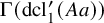 . Then, in the structure
$M_1$
. Then, in the structure
$M_1$
 , the germ
$[b]_{p}$
, the germ
$[b]_{p}$
 is coded in
$\mathcal {G}(\mathrm {acl}(A))\cup \mathrm {Lin}_A(M)$
is coded in
$\mathcal {G}(\mathrm {acl}(A))\cup \mathrm {Lin}_A(M)$
 over A.
Proof. Given Proposition 4.3 and Lemma 5.8, we may assume that
$M=M_1$
 . Growing
$M_1$
. Growing
$M_1$
 , we may also assume that
$M_1$
, we may also assume that
$M_1$
 is sufficiently saturated and homogeneous. By Lemma 5.12, the type
$\operatorname {tp}_0(a/M_1')$
is sufficiently saturated and homogeneous. By Lemma 5.12, the type
$\operatorname {tp}_0(a/M_1')$
 is
$\mathfrak {L}_1'(A)$
is
$\mathfrak {L}_1'(A)$
 -definable. Now, applying Lemma 5.9 in
$M_1'$
-definable. Now, applying Lemma 5.9 in
$M_1'$
 , the germ
$[b]_{p}$
, the germ
$[b]_{p}$
 is coded in
$\mathcal {G}(\mathrm {acl}_1'(A))\cup \mathrm {Lin}_{\mathrm {acl}_1'(A)}(M_1')$
is coded in
$\mathcal {G}(\mathrm {acl}_1'(A))\cup \mathrm {Lin}_{\mathrm {acl}_1'(A)}(M_1')$
 over A. In other words, there are some tuple t in
$\mathrm {K}(\mathrm {acl}_1'(A))\cap \mathrm {dcl}_1'(M_1) = \mathrm {K}(\mathrm {acl}(A))$
over A. In other words, there are some tuple t in
$\mathrm {K}(\mathrm {acl}_1'(A))\cap \mathrm {dcl}_1'(M_1) = \mathrm {K}(\mathrm {acl}(A))$
 , some
$R\in \mathrm {Gr}(\mathrm {acl}_1'(A))\cap \mathrm {dcl}_1'(M_1)$
, some
$R\in \mathrm {Gr}(\mathrm {acl}_1'(A))\cap \mathrm {dcl}_1'(M_1)$
 and some
$e\in \operatorname {red}(R)(\mathrm {dcl}_1'(M_1))$
and some
$e\in \operatorname {red}(R)(\mathrm {dcl}_1'(M_1))$
 which code
$[f]_{p}$
which code
$[f]_{p}$
 over A. Let Q and
$\varepsilon $
over A. Let Q and
$\varepsilon $
 be as in Lemma 5.11. Now, any automorphism of
$\sigma \in \mathrm {Aut}(M_1/A)$
be as in Lemma 5.11. Now, any automorphism of
$\sigma \in \mathrm {Aut}(M_1/A)$
 (extended in any way to
$M_1'$
(extended in any way to
$M_1'$
 ) fixes Q if and only if it fixes R – so
$Q \in \mathrm {Gr}(\mathrm {acl}_1(A))$
) fixes Q if and only if it fixes R – so
$Q \in \mathrm {Gr}(\mathrm {acl}_1(A))$
 – and
$\sigma $
– and
$\sigma $
 fixes
$[f]_{p}$
fixes
$[f]_{p}$
 if and only if it fixes t, R and e, if and only if it fixes t,Q and
$\varepsilon $
if and only if it fixes t, R and e, if and only if it fixes t,Q and
$\varepsilon $
 .
.
5.2 Invariant resolutions
Let M be as in Theorem 5.3. As before, let
$M_0 = M^{\mathrm {a}}$
 and
$M_1 = M^{\mathrm {ur}}$
and
$M_1 = M^{\mathrm {ur}}$
 . Given a subset A of
$\mathcal {G}$
. Given a subset A of
$\mathcal {G}$
 , our goal is now to find a subset C of
$\mathrm {K}$
, our goal is now to find a subset C of
$\mathrm {K}$
 whose type over M is invariant over A and some stably embedded set. This follows from the following lemma:
Lemma 5.14. Let
$N\succ M$
 , let
$D \subseteq M$
, let
$D \subseteq M$
 be potentially large, let a be a tuple in
$\mathrm {K}(N)$
be potentially large, let a be a tuple in
$\mathrm {K}(N)$
 and let
$\rho $
and let
$\rho $
 be a pro-
$\mathfrak {L}_1(M)$
be a pro-
$\mathfrak {L}_1(M)$
 -definable map. Assume that
$\mathrm {rv}(M(a)) \subseteq \mathrm {dcl}_1(D \rho (a))$
-definable map. Assume that
$\mathrm {rv}(M(a)) \subseteq \mathrm {dcl}_1(D \rho (a))$
 and that
$p_1 = \operatorname {tp}_1(a/M)$
and that
$p_1 = \operatorname {tp}_1(a/M)$
 and
$[\rho ]_{p_1}$
and
$[\rho ]_{p_1}$
 are
$\mathrm {Aut}(M/D)$
are
$\mathrm {Aut}(M/D)$
 -invariant. Then
$p = \operatorname {tp}(a/M)$
-invariant. Then
$p = \operatorname {tp}(a/M)$
 has
$\mathrm {Aut}(M/D)$
has
$\mathrm {Aut}(M/D)$
 -invariant
$\mathrm {RV}$
-invariant
$\mathrm {RV}$
 -germs.
This is essentially [Reference Hils and Rideau-Kikuchi6, Lemma 4.2.5] in a slightly different context and the proof is identical. The main ingredient is elimination of quantifier down to
$\mathrm {RV}$
 – see Theorem 2.1.
Proof. Let
$N_1$
 be a large saturated elementary extension of
$M_1$
be a large saturated elementary extension of
$M_1$
 containing N. Fix
$\sigma \in \mathrm {Aut}(M/D)$
containing N. Fix
$\sigma \in \mathrm {Aut}(M/D)$
 . Since
$p_1=\operatorname {tp}_{1}(a/M)$
. Since
$p_1=\operatorname {tp}_{1}(a/M)$
 is
$\mathrm {Aut}(M/D)$
is
$\mathrm {Aut}(M/D)$
 invariant, there is an
$\mathfrak {L}_{1}$
invariant, there is an
$\mathfrak {L}_{1}$
 -elementary embedding
$\tau : M(a) \rightarrow M(a)$
-elementary embedding
$\tau : M(a) \rightarrow M(a)$
 extending
$\sigma $
extending
$\sigma $
 . Because
$[\rho ]_{p_1}$
. Because
$[\rho ]_{p_1}$
 is
$\mathrm {Aut}(M/D)$
is
$\mathrm {Aut}(M/D)$
 -invariant, we have
$\rho (a)=\sigma (\rho )(a)$
-invariant, we have
$\rho (a)=\sigma (\rho )(a)$
 . Consequently, since
$\mathrm {rv}(M(a)) \subseteq \mathrm {dcl}_1(D\rho (a))$
. Consequently, since
$\mathrm {rv}(M(a)) \subseteq \mathrm {dcl}_1(D\rho (a))$
 ,
$\tau |_{\mathrm {rv}(M(a))}$
,
$\tau |_{\mathrm {rv}(M(a))}$
 is the identity map. By Theorem 2.1 in
$N_1$
is the identity map. By Theorem 2.1 in
$N_1$
 , extending
$\tau $
, extending
$\tau $
 by the identity on
$\mathrm {RV}(N_1)$
by the identity on
$\mathrm {RV}(N_1)$
 yields an
$\mathfrak {L}_{1}$
yields an
$\mathfrak {L}_{1}$
 -elementary embedding. Since
$\mathrm {RV}$
-elementary embedding. Since
$\mathrm {RV}$
 is stably embedded, this embedding further extends to an element
$\tau $
is stably embedded, this embedding further extends to an element
$\tau $
 of
$\mathrm {Aut}(N_{1}/D,\mathrm {RV}(N_{1}),a)$
of
$\mathrm {Aut}(N_{1}/D,\mathrm {RV}(N_{1}),a)$
 – cf. [Reference Tent and Ziegler12, Lemma 10.1.5].
By Theorem 2.1 (in M now),
$\tau |_{M(a)\cup \mathrm {RV}(N)}$
 is
$\mathfrak {L}$
is
$\mathfrak {L}$
 -elementary. Consequently,
$\operatorname {tp}(a,M)=\operatorname {tp}(a,\sigma (M))$
-elementary. Consequently,
$\operatorname {tp}(a,M)=\operatorname {tp}(a,\sigma (M))$
 and we conclude that
$\sigma (p)=p$
and we conclude that
$\sigma (p)=p$
 , as required. Lastly, we argue that
$\operatorname {tp}(a/M)$
, as required. Lastly, we argue that
$\operatorname {tp}(a/M)$
 has
$\mathrm {Aut}(M/C)$
has
$\mathrm {Aut}(M/C)$
 -invariant
$\mathrm {RV}$
-invariant
$\mathrm {RV}$
 -germs. Let
$X \subseteq \mathrm {RV}^{n}$
-germs. Let
$X \subseteq \mathrm {RV}^{n}$
 be
$\mathfrak {L}(Ma)$
be
$\mathfrak {L}(Ma)$
 -definable. Then, by Theorem 2.1, it is
$\mathfrak {L}(\mathrm {rv}(M(a)))$
-definable. Then, by Theorem 2.1, it is
$\mathfrak {L}(\mathrm {rv}(M(a)))$
 -definable and hence
$X(N)=\tau (X(N))=\tau (X)(N)$
-definable and hence
$X(N)=\tau (X(N))=\tau (X)(N)$
 . Equivalently,
$\sigma $
. Equivalently,
$\sigma $
 fixes the p-germ of any
$\mathfrak {L}(M)$
fixes the p-germ of any
$\mathfrak {L}(M)$
 -definable function
$f: p \rightarrow \mathrm {RV}^{\mathrm {eq}}$
-definable function
$f: p \rightarrow \mathrm {RV}^{\mathrm {eq}}$
 .
.
Let us now describe how
$\mathrm {RV}$
 grows when adding one field element:
Lemma 5.15. Let
$A\subseteq \mathcal {G}(M)\cup \Gamma ^{\mathrm {eq}}(M)$
 contain
$\mathcal {G}(\mathrm {acl}(A))$
contain
$\mathcal {G}(\mathrm {acl}(A))$
 and let a be a tuple of
$\mathrm {K}$
and let a be a tuple of
$\mathrm {K}$
 -points in
$N\succ M$
-points in
$N\succ M$
 such that
$p = \operatorname {tp}_1(a/M_1)$
such that
$p = \operatorname {tp}_1(a/M_1)$
 is
$\mathfrak {L}(A)$
is
$\mathfrak {L}(A)$
 -definable. Let
$b(a)$
-definable. Let
$b(a)$
 be an
$\mathfrak {L}_1(Aa)$
be an
$\mathfrak {L}_1(Aa)$
 -definable generalized ball. If
$\Gamma (M)$
-definable generalized ball. If
$\Gamma (M)$
 is discrete, we assume that the cut of
$b(a)$
is discrete, we assume that the cut of
$b(a)$
 is
$\mathfrak {L}_{1}'(\mathcal {G}(A)a)$
is
$\mathfrak {L}_{1}'(\mathcal {G}(A)a)$
 -definable. Let
$c\in N$
-definable. Let
$c\in N$
 realize the generic
$\eta _{b(a)}|_{M_1a}$
realize the generic
$\eta _{b(a)}|_{M_1a}$
 – that is, c is in
$b(a)$
– that is, c is in
$b(a)$
 but not in any proper generalized
$\mathrm {acl}_1(M_1a)$
but not in any proper generalized
$\mathrm {acl}_1(M_1a)$
 -definable sub-ball. Let
$q = \operatorname {tp}_1(ac/M_1)$
-definable sub-ball. Let
$q = \operatorname {tp}_1(ac/M_1)$
 . Then there is a pro-
$\mathfrak {L}_1(M)$
. Then there is a pro-
$\mathfrak {L}_1(M)$
 -definable map
$\rho $
-definable map
$\rho $
 into some power of
$\mathrm {RV}$
into some power of
$\mathrm {RV}$
 such that
$[\rho ]_{q} \in \mathrm {dcl}(A,\mathrm {Lin}_{A}(M))$
such that
$[\rho ]_{q} \in \mathrm {dcl}(A,\mathrm {Lin}_{A}(M))$
 and
$\mathrm {rv}(M(ac))\subseteq \mathrm {dcl}_1(\mathrm {rv}(M(a)),\rho (ac))$
and
$\mathrm {rv}(M(ac))\subseteq \mathrm {dcl}_1(\mathrm {rv}(M(a)),\rho (ac))$
 .
.
Proof. We proceed by cases.
Claim 5.15.1 [Reference Hils and Rideau-Kikuchi6, Lemma 4.3.10]
If
$b(a)$
 is not closed, there is a pro-
$\mathfrak {L}_0(M)$
is not closed, there is a pro-
$\mathfrak {L}_0(M)$
 -definable map
$\rho $
-definable map
$\rho $
 into some power of
$\mathrm {RV}$
into some power of
$\mathrm {RV}$
 such that
$[\rho ]_{q} \in \mathrm {dcl}(A)$
such that
$[\rho ]_{q} \in \mathrm {dcl}(A)$
 and
$\mathrm {rv}(M(ac))\subseteq \mathrm {dcl}_0(\mathrm {rv}(M(a)),\rho (ac))$
and
$\mathrm {rv}(M(ac))\subseteq \mathrm {dcl}_0(\mathrm {rv}(M(a)),\rho (ac))$
 .
.
Note that in equicharacteristic zero, condition (2) of [Reference Hils and Rideau-Kikuchi6, Lemma 4.3.10] is verified as soon as
$b(a)$
 is not closed. So we may assume that
$b(a)$
is not closed. So we may assume that
$b(a)$
 is closed. By Lemma 2.6, there is an
$\mathfrak {L}_0(Ma)$
is closed. By Lemma 2.6, there is an
$\mathfrak {L}_0(Ma)$
 -definable finite set
$G(a) \subseteq \mathrm {K}$
-definable finite set
$G(a) \subseteq \mathrm {K}$
 such that
$G(a)\cap b(a) = \{g\}$
such that
$G(a)\cap b(a) = \{g\}$
 is a singleton.
Claim 5.15.2 [Reference Hils and Rideau-Kikuchi6, Lemma 4.3.13]
If
$b(a)$
 is closed and
$G(a) \subseteq \mathrm {K}$
is closed and
$G(a) \subseteq \mathrm {K}$
 is an
$\mathfrak {L}_0(Ma)$
is an
$\mathfrak {L}_0(Ma)$
 -definable finite set such that
$G(a)\cap b(a) = \{g(a)\}$
-definable finite set such that
$G(a)\cap b(a) = \{g(a)\}$
 is a singleton, then

Note that such a
$G(a)$
 always exists by Lemma 2.6. Let
$\rho (ac) = \mathrm {rv}(c- g)\in \mathrm {dcl}_0(Mac)$
always exists by Lemma 2.6. Let
$\rho (ac) = \mathrm {rv}(c- g)\in \mathrm {dcl}_0(Mac)$
 . We have
$\gamma = \mathrm {v}(c-g) \in \Gamma (\mathrm {dcl}_1(Aa))$
. We have
$\gamma = \mathrm {v}(c-g) \in \Gamma (\mathrm {dcl}_1(Aa))$
 as it is the radius of b. If
$\Gamma (M)$
as it is the radius of b. If
$\Gamma (M)$
 is discrete, it is in
$\mathrm {dcl}_1'(\mathcal {G}(A)a)$
is discrete, it is in
$\mathrm {dcl}_1'(\mathcal {G}(A)a)$
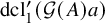 by assumption. So, by Lemmas 5.9 and 5.13, we have
$[h]_{q}\in \mathrm {dcl}_1(A\cup \mathrm {Lin}_A(M))$
by assumption. So, by Lemmas 5.9 and 5.13, we have
$[h]_{q}\in \mathrm {dcl}_1(A\cup \mathrm {Lin}_A(M))$
 . Then, as required, we have
$[\rho ]_{q}\in \mathrm {dcl}_1(A,\mathrm {Lin}_{A}(M))\cap \mathcal {G}(M)$
. Then, as required, we have
$[\rho ]_{q}\in \mathrm {dcl}_1(A,\mathrm {Lin}_{A}(M))\cap \mathcal {G}(M)$
 and
$\mathrm {rv}(M(ac)) \subseteq \mathrm {dcl}_1(\mathrm {rv}(M(a)),\rho (ac))$
and
$\mathrm {rv}(M(ac)) \subseteq \mathrm {dcl}_1(\mathrm {rv}(M(a)),\rho (ac))$
 .
.
We can now prove the existence of sufficiently invariant resolutions of geometric points:
Proposition 5.16. Let
$A = \mathrm {acl}(A)\subseteq M^{\mathrm {eq}}$
 . There exists
$C\subseteq \mathrm {K}(N)$
. There exists
$C\subseteq \mathrm {K}(N)$
 , for some
$N\succ M$
, for some
$N\succ M$
 , with:
-
1. $\mathcal {G}(A) \subseteq \mathrm {dcl}_1(C,\Gamma (M))$
; -
2. $\operatorname {tp}_1(C/M)$
is
$\mathfrak {L}(\mathcal {G}(A)\cup \Gamma ^{\mathrm {eq}}(A))$
-definable; -
3. $\operatorname {tp}(C/M)$
has
$\mathrm {Aut}(M/\mathcal {G}(A),\mathrm {RV}(M),\mathrm {Lin}_{A}(M))$
-invariant
$\mathrm {RV}$
-germs.





Proof. By transfinite induction, we construct a tuple c in
$N\succ M$
 and a (pro-)
$\mathfrak {L}_1(M)$
and a (pro-)
$\mathfrak {L}_1(M)$
 -definable function
$\rho $
-definable function
$\rho $
 such that:
-
○ $p_1=\operatorname {tp}_1(c/M)$
is finitely satisfiable in M and
$\mathfrak {L}(A)$
-definable; -
○ $\mathrm {rv}(M(c))\subseteq \mathrm {dcl}_1(\mathrm {RV}(M),\rho (c))$
; -
○ $[\rho ]_{p_1} \in \mathrm {dcl}_1(\mathcal {G}(A),\mathrm {RV}(M),\mathrm {Lin}_A(M))$
; -
○ any $\mathfrak {L}_{1}(\mathcal {G}(A)c)$
-definable generalized ball b has a point in C; -
○ for all $\mathfrak {L}_{1}(\mathcal {G}(A)c)$
-definable convex subgroup
$\Delta \leq \Gamma $
,
$\Gamma /\Delta (\mathrm {dcl}_1(Ac))\subseteq \mathrm {v}_{\Delta }(\mathrm {K}(C))$
.






Note that
$\operatorname {tp}_1(\mathrm {acl}_1(Ac)\cap N/M)$
 is definable over
$\mathcal {G}(\mathrm {acl}(A))\cup \Gamma (\mathrm {acl}(A))^{\mathrm {eq}}\subseteq A$
is definable over
$\mathcal {G}(\mathrm {acl}(A))\cup \Gamma (\mathrm {acl}(A))^{\mathrm {eq}}\subseteq A$
 (cf. Proposition 4.3). Let
$b(c)$
(cf. Proposition 4.3). Let
$b(c)$
 be an
$\mathfrak {L}_1(\mathcal {G}(A)c)$
be an
$\mathfrak {L}_1(\mathcal {G}(A)c)$
 -definable generalized ball whose cut is a
$\mathrm {v}(c)$
-definable generalized ball whose cut is a
$\mathrm {v}(c)$
 -translate of an
$\mathfrak {L}(A)$
-translate of an
$\mathfrak {L}(A)$
 -definable cut. By property D, the generic
$\eta _{b(c)}$
-definable cut. By property D, the generic
$\eta _{b(c)}$
 can be extended to a complete
$\mathfrak {L}(\mathrm {acl}_1(Ac)\cap N)$
can be extended to a complete
$\mathfrak {L}(\mathrm {acl}_1(Ac)\cap N)$
 -definable
$\mathfrak {L}_1$
-definable
$\mathfrak {L}_1$
 -type – and this type is finitely satisfiable in N. Using Lemma 5.15, we can thus add a generic of
$b(c)$
-type – and this type is finitely satisfiable in N. Using Lemma 5.15, we can thus add a generic of
$b(c)$
 to c. We then iterate this construction.
Given such a tuple c, by Corollary 3.12 applied in
$M_1$
 , we have
$\mathcal {G}(A)\subseteq \mathrm {dcl}_1(c,\Gamma (A)^{\mathrm {eq}}) \subseteq \mathrm {dcl}_1(c,\Gamma (M))$
, we have
$\mathcal {G}(A)\subseteq \mathrm {dcl}_1(c,\Gamma (A)^{\mathrm {eq}}) \subseteq \mathrm {dcl}_1(c,\Gamma (M))$
 . Moreover, the type
$\operatorname {tp}(c/M)$
. Moreover, the type
$\operatorname {tp}(c/M)$
 has
$\mathrm {Aut}(M/A,\mathrm {RV}(M),\mathrm {Lin}_A(M))$
has
$\mathrm {Aut}(M/A,\mathrm {RV}(M),\mathrm {Lin}_A(M))$
 -invariant
$\mathrm {RV}$
-invariant
$\mathrm {RV}$
 -germs by Lemma 5.14.
We deduce Theorem 5.3 from Proposition 5.16 and the machinery of [Reference Hils and Rideau-Kikuchi6, Section 4].
Proposition 5.17 ([Reference Hils and Rideau-Kikuchi6, Corollary 4.4.1] and Lemma 5.14)
Let
$A\subseteq \mathrm {K}(M)$
 and
$R\subseteq \mathrm {RV}(M)$
and
$R\subseteq \mathrm {RV}(M)$
 . There exists
$C\subseteq \mathrm {K}(N)$
. There exists
$C\subseteq \mathrm {K}(N)$
 , for some
$N\succ M$
, for some
$N\succ M$
 , such that and
$\operatorname {tp}(C/M)$
, such that and
$\operatorname {tp}(C/M)$
 is
$\mathrm {Aut}(M/A,\mathrm {RV})$
is
$\mathrm {Aut}(M/A,\mathrm {RV})$
 -invariant and
$R\subseteq \mathrm {dcl}_0(AC)$
-invariant and
$R\subseteq \mathrm {dcl}_0(AC)$
 .
.
Proposition 5.18 [Reference Hils and Rideau-Kikuchi6, Corollary 4.4.3]
Let
$A\subseteq \mathrm {K}(M)$
 . There exists
$C\prec N$
. There exists
$C\prec N$
 , for some
$N\succ M$
, for some
$N\succ M$
 , such that and
$\operatorname {tp}(C/M)$
, such that and
$\operatorname {tp}(C/M)$
 is
$\mathrm {Aut}(M/A,\mathrm {RV})$
is
$\mathrm {Aut}(M/A,\mathrm {RV})$
 -invariant and C contains a realization of every
$\mathfrak {L}(A)$
-invariant and C contains a realization of every
$\mathfrak {L}(A)$
 -type.
Proposition 5.19 [Reference Hils and Rideau-Kikuchi6, Corollary 4.3.17]
Let
$A\subseteq M^{\mathrm {eq}}$
 be small, let
$C\prec M$
be small, let
$C\prec M$
 contain a realization of every
$\mathfrak {L}(A)$
contain a realization of every
$\mathfrak {L}(A)$
 -type and let
$a\in \mathrm {K}(N)$
-type and let
$a\in \mathrm {K}(N)$
 , for some
$N\succ M$
, for some
$N\succ M$
 be such that
$\operatorname {tp}_0(a/M)$
be such that
$\operatorname {tp}_0(a/M)$
 is
$\mathrm {Aut}(M/A)$
is
$\mathrm {Aut}(M/A)$
 -invariant. Then
$\operatorname {tp}(a/M)$
-invariant. Then
$\operatorname {tp}(a/M)$
 is
$\mathrm {Aut}(M/C,\mathrm {RV})$
is
$\mathrm {Aut}(M/C,\mathrm {RV})$
 -invariant.
Proof of Theorem 5.3
Fix
$A = \mathrm {acl}(A)\subseteq M^{\mathrm {eq}}$
 and a in some elementary extension of M such that
$p_0 = \operatorname {tp}_0(a/M)$
and a in some elementary extension of M such that
$p_0 = \operatorname {tp}_0(a/M)$
 is
$\mathrm {Aut}(M/\mathcal {G}(A))$
is
$\mathrm {Aut}(M/\mathcal {G}(A))$
 -invariant.
-
○ By Proposition 5.16, we find $C\subseteq \mathrm {K}(N)$
, for some
$N \succ M$
(sufficiently saturated and homogeneous), such that
$\operatorname {tp}(C/M)$
has
$\mathrm {Aut}(M/\mathcal {G}(A),\mathrm {RV}(M),\mathrm {Lin}_{A}(M))$
-invariant
$\mathrm {RV}$
-germs and
$\mathcal {G}(A) \subseteq \mathrm {dcl}_1(C\gamma )$
for some (infinite) tuple
$\gamma $
in
$\Gamma (M)$
. -
○ By Proposition 5.17 and transitivity (Lemma 5.2), growing C, we may assume that $\gamma \in \mathrm {v}(C)$
. By Proposition 5.18 and transitivity, we can further assume that
$C\prec N$
contains a realization of every type over
$\mathcal {G}(A)$
. -
○ We may assume that $a\models p_0|_{N}$
– cf. [Reference Hils and Rideau-Kikuchi6, Claim 4.4.7]. Then
$\operatorname {tp}_0(a/N)$
is
$\mathrm {Aut}(N/C)$
-invariant and
$\operatorname {tp}(a/N)$
is
$\mathrm {Aut}(N/C,\mathrm {RV})$
-invariant by Proposition 5.19.


By transitivity
$\operatorname {tp}(a/M)$
 is
$\mathrm {Aut}(M/\mathcal {G}(A),\mathrm {RV}(M),\mathrm {Lin}_A(M))$
is
$\mathrm {Aut}(M/\mathcal {G}(A),\mathrm {RV}(M),\mathrm {Lin}_A(M))$
 -invariant.
6 Eliminating imaginaries
Following the general strategy of [Reference Hils and Rideau-Kikuchi6, Theorem 6.1.1], we can now deduce elimination of imaginaries. Let M be a sufficiently saturated and homogeneous, and as in Theorem 5.3. Let
$M_0 = M^{\mathrm {a}}$
 and
$M_1 = M^{\mathrm {ur}}$
and
$M_1 = M^{\mathrm {ur}}$
 .
.
Proposition 6.1. Let
$e \in M^{\mathrm {eq}}$
 and
$A=\mathrm {acl}(e)$
and
$A=\mathrm {acl}(e)$
 . Then

Proof. We may assume M is sufficiently saturated and homogeneous. There is an
$\mathfrak {L}$
 -definable map f and a tuple m in
$K(M)$
-definable map f and a tuple m in
$K(M)$
 such that
$f(m)=e$
such that
$f(m)=e$
 . Let
$X=f^{-1}(e)$
. Let
$X=f^{-1}(e)$
 . By Theorem 4.1 we can find a type
$p \in \mathrm {S}^{1}(M)$
. By Theorem 4.1 we can find a type
$p \in \mathrm {S}^{1}(M)$
 such that:
-
○ $p \cup X$
is consistent; -
○ p is $\mathfrak {L}_{1}(\mathcal {G}(A) \cup \Gamma ^{\mathrm {eq}}(A))$
-definable.


Take
$a\in X$
 satisfying p. Then
$\operatorname {tp}_{0}(a/M)$
satisfying p. Then
$\operatorname {tp}_{0}(a/M)$
 is
$\mathfrak {L}(\mathcal {G}(A))$
is
$\mathfrak {L}(\mathcal {G}(A))$
 -definable. By Theorem 5.3, the type
$q = \operatorname {tp}(a/M)$
-definable. By Theorem 5.3, the type
$q = \operatorname {tp}(a/M)$
 is
$\mathrm {Aut}(M/\mathcal {G}(A),\mathrm {RV}(M),\mathrm {Lin}_{A}(M))$
is
$\mathrm {Aut}(M/\mathcal {G}(A),\mathrm {RV}(M),\mathrm {Lin}_{A}(M))$
 -invariant. So, for every automorphism
$\sigma \in \mathrm {Aut}(M/\mathcal {G}(A),\mathrm {RV}(M),\mathrm {Lin}_{A}(M))$
-invariant. So, for every automorphism
$\sigma \in \mathrm {Aut}(M/\mathcal {G}(A),\mathrm {RV}(M),\mathrm {Lin}_{A}(M))$
 , we have
$e = \sigma (e)$
, we have
$e = \sigma (e)$
 since
$q = \sigma (q) \vdash \sigma (e) = f(x) = e$
since
$q = \sigma (q) \vdash \sigma (e) = f(x) = e$
 .
.
As
$\mathrm {RV}\cup \mathrm {Lin}_{A}$
 is stably embedded (cf. Remark 3.20), it follows (e.g., [Reference Hils and Rideau-Kikuchi6, Lemma 4.2.3]) that

So there is a
$\mathfrak {L}(\mathcal {G}(A))$
 -definable function g and a tuple c in
$\mathrm {RV}^{m}(M) \times \mathrm {Lin}_{A}^{n}(M)$
-definable function g and a tuple c in
$\mathrm {RV}^{m}(M) \times \mathrm {Lin}_{A}^{n}(M)$
 such that
$g(c)=e$
such that
$g(c)=e$
 . Let
$Y=g^{-1}(e)$
. Let
$Y=g^{-1}(e)$
 . This is an A-definable subset of
$\mathrm {RV}^{m} \times \mathrm {Lin}_{A}^{n}$
. This is an A-definable subset of
$\mathrm {RV}^{m} \times \mathrm {Lin}_{A}^{n}$
 . Consequently,
$\ulcorner Y\urcorner \in (\mathrm {RV} \cup \mathrm {Lin}_{A})^{\mathrm {eq}}(A)$
. Consequently,
$\ulcorner Y\urcorner \in (\mathrm {RV} \cup \mathrm {Lin}_{A})^{\mathrm {eq}}(A)$
 and
and

as required.
We now want to describe the imaginaries in
$\mathrm {RV}\cup \mathrm {Lin}_A$
 .
.
Proposition 6.2 [Reference Hils and Rideau-Kikuchi6, Proposition 5.3.1]
Further assume that M is a
$\mathrm {k}$
 -
$\Gamma $
-
$\Gamma $
 -expansion of
$\mathrm {Hen}_{0,0}$
-expansion of
$\mathrm {Hen}_{0,0}$
 and that for every
$n \in \mathbb {Z}_{\geq 2}$
and that for every
$n \in \mathbb {Z}_{\geq 2}$
 , one has
$[\Gamma : n\Gamma ]< \infty $
, one has
$[\Gamma : n\Gamma ]< \infty $
 and the preimage in
$\mathrm {RV}$
and the preimage in
$\mathrm {RV}$
 of any coset of
$n\Gamma $
of any coset of
$n\Gamma $
 contains a point which is algebraic over
$\emptyset $
contains a point which is algebraic over
$\emptyset $
 . Then, for
$A=\mathrm {acl}(A) \subseteq M^{\mathrm {eq}}$
. Then, for
$A=\mathrm {acl}(A) \subseteq M^{\mathrm {eq}}$
 , we have

Finally, let us relate
$\mathrm {Lin}_A^{\mathrm {eq}}$
 to the linear imaginaries
$\mathrm {k}^{\mathrm {leq}}$
to the linear imaginaries
$\mathrm {k}^{\mathrm {leq}}$
 :
:
Lemma 6.3. Let
$A=\mathrm {dcl}(A) \subseteq M$
 . Then
$\mathrm {Lin}_{A}^{\mathrm {eq}}(A) \subseteq \mathrm {dcl}(\mathrm {k}^{\mathrm {leq}}(A))$
. Then
$\mathrm {Lin}_{A}^{\mathrm {eq}}(A) \subseteq \mathrm {dcl}(\mathrm {k}^{\mathrm {leq}}(A))$
 .
.
Proof. Recall that
$\mathrm {Lin}_A$
 is a stably embedded collection of
$\mathrm {k}$
is a stably embedded collection of
$\mathrm {k}$
 -vector spaces – see Remark 3.20. Take
$e \in \mathrm {Lin}_{A}^{\mathrm {eq}}(A)$
-vector spaces – see Remark 3.20. Take
$e \in \mathrm {Lin}_{A}^{\mathrm {eq}}(A)$
 . Then e is the code of a definable set
$X \subseteq \prod _i\operatorname {red}(R_i)$
. Then e is the code of a definable set
$X \subseteq \prod _i\operatorname {red}(R_i)$
 where
$a\in \prod _j\operatorname {red}(R^{\prime }_j)$
where
$a\in \prod _j\operatorname {red}(R^{\prime }_j)$
 , the family
$(X_a)_a$
, the family
$(X_a)_a$
 is
$\mathfrak {L}(A)$
is
$\mathfrak {L}(A)$
 -definable and
$R_i$
-definable and
$R_i$
 and
$R^{\prime }_j$
and
$R^{\prime }_j$
 are A-definable
$\mathfrak {m}$
are A-definable
$\mathfrak {m}$
 -avoiding module. Then
$R = \prod R_i\times \prod _j R^{\prime }_j$
-avoiding module. Then
$R = \prod R_i\times \prod _j R^{\prime }_j$
 is an A-definable
$\mathfrak {m}$
is an A-definable
$\mathfrak {m}$
 -avoiding module. Adding zero coordinates, we may assume that we have
$X_a\subseteq \operatorname {red}(R)$
-avoiding module. Adding zero coordinates, we may assume that we have
$X_a\subseteq \operatorname {red}(R)$
 and
$a\in \operatorname {red}(R)$
and
$a\in \operatorname {red}(R)$
 .
.
For every basis b of
$\operatorname {red}(R)$
 , the set
$X_a$
, the set
$X_a$
 is
$\mathfrak {L}_{\mathrm {vect}}(\mathrm {k}^{\mathrm {eq}}(A)ab)$
is
$\mathfrak {L}_{\mathrm {vect}}(\mathrm {k}^{\mathrm {eq}}(A)ab)$
 -definable in
$(\mathrm {k},\operatorname {red}(R))$
-definable in
$(\mathrm {k},\operatorname {red}(R))$
 . Replacing a with
$ab \in \operatorname {red}(R)^{d+1}$
. Replacing a with
$ab \in \operatorname {red}(R)^{d+1}$
 , we may assume that
$X_a$
, we may assume that
$X_a$
 is
$\mathfrak {L}_{\mathrm {vect}}(a)$
is
$\mathfrak {L}_{\mathrm {vect}}(a)$
 -definable. Let
$a E a'$
-definable. Let
$a E a'$
 be the equivalence relation defined by
$X_a = X_a'$
be the equivalence relation defined by
$X_a = X_a'$
 and let c be the type of R. Then
$e\in \mathrm {dcl}(\mathrm {Lin}_{c,V^{d+1}}(A))$
and let c be the type of R. Then
$e\in \mathrm {dcl}(\mathrm {Lin}_{c,V^{d+1}}(A))$
 .
.
We can now prove our main results. Let M be as in Theorem 5.3.
Theorem 6.4. Assume that M is a
$\mathrm {k}$
 -
$\Gamma $
-
$\Gamma $
 -expansion of
$\mathrm {Hen}_{0,0}$
-expansion of
$\mathrm {Hen}_{0,0}$
 and that, for every
$n \in \mathbb {Z}_{\geq 2}$
and that, for every
$n \in \mathbb {Z}_{\geq 2}$
 , one has
$[\Gamma : n\Gamma ]< \infty $
, one has
$[\Gamma : n\Gamma ]< \infty $
 and the preimage in
$\mathrm {RV}$
and the preimage in
$\mathrm {RV}$
 of any coset of
$n\Gamma $
of any coset of
$n\Gamma $
 contains a point which is algebraic over
$\emptyset $
contains a point which is algebraic over
$\emptyset $
 . Then M weakly eliminates imaginaries down to
$K \cup \mathrm {k}^{\mathrm {leq}}\cup \Gamma ^{\mathrm {eq}}$
. Then M weakly eliminates imaginaries down to
$K \cup \mathrm {k}^{\mathrm {leq}}\cup \Gamma ^{\mathrm {eq}}$
 .
.
Proof. Let
$e \in M^{\mathrm {eq}}$
 and
$A=\mathrm {acl}(A)$
and
$A=\mathrm {acl}(A)$
 . By Proposition 6.1, we have

By Proposition 6.2, we have

where the last inclusion follows from Lemma 6.3.
Remark 6.5. In general, imaginaries in the short exact sequence
$\mathrm {k}^\times \to \mathrm {RV}^\times \to \Gamma $
 might be more complicated. We can embed the short exact sequence
$\mathrm {k}^\times (M)\to \mathrm {RV}^\times (M)\to \Gamma (M)$
might be more complicated. We can embed the short exact sequence
$\mathrm {k}^\times (M)\to \mathrm {RV}^\times (M)\to \Gamma (M)$
 into a sequence
$\mathrm {k}^\times (M)\to H \to \mathbb {Q}\otimes \Gamma (M)$
into a sequence
$\mathrm {k}^\times (M)\to H \to \mathbb {Q}\otimes \Gamma (M)$
 – this is clear after adding a section in some
$\aleph _1$
– this is clear after adding a section in some
$\aleph _1$
 -saturated elementary extension. A refinement of [Reference Hils and Rideau-Kikuchi6, Theorem 5.1.4] shows that any set X definable in
$\mathrm {RV}(M)$
-saturated elementary extension. A refinement of [Reference Hils and Rideau-Kikuchi6, Theorem 5.1.4] shows that any set X definable in
$\mathrm {RV}(M)$
 is weakly coded in
$\Gamma ^{\mathrm {eq}}(M)\cup (H_{\Delta }^{\mathrm {eq}} \cap \mathrm {dcl}(M))$
is weakly coded in
$\Gamma ^{\mathrm {eq}}(M)\cup (H_{\Delta }^{\mathrm {eq}} \cap \mathrm {dcl}(M))$
 , where
$\Delta $
, where
$\Delta $
 is the divisible hull of
$\Gamma (\ulcorner X\urcorner )$
is the divisible hull of
$\Gamma (\ulcorner X\urcorner )$
 .
.
The elements of
$H_{\Delta }^{\mathrm {eq}} \cap \mathrm {dcl}(\mathrm {RV})$
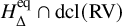 correspond to M-definable subsets of
$H_\delta $
correspond to M-definable subsets of
$H_\delta $
 for some tuple
$\delta $
for some tuple
$\delta $
 in
$\Delta \subseteq \mathbb {Q}\otimes \Gamma (M)$
in
$\Delta \subseteq \mathbb {Q}\otimes \Gamma (M)$
 . These are the imaginaries that we need to add, or classify, to obtain a version of Theorem 6.4 without any finiteness assumption on
$\Gamma /n\Gamma $
. These are the imaginaries that we need to add, or classify, to obtain a version of Theorem 6.4 without any finiteness assumption on
$\Gamma /n\Gamma $
 .
.
If
$[\Gamma : n\Gamma ]<\infty $
 for every
$n \geq 2$
for every
$n \geq 2$
 and we add constants as in Theorem 6.4, then any
$H_\delta $
and we add constants as in Theorem 6.4, then any
$H_\delta $
 , for
$\delta \in \Delta $
, for
$\delta \in \Delta $
 , is canonically isomorphic to some
$H_\gamma $
, is canonically isomorphic to some
$H_\gamma $
 with
$\gamma \in \Gamma (\ulcorner X\urcorner )$
with
$\gamma \in \Gamma (\ulcorner X\urcorner )$
 ; and we recover Theorem 6.4. In contrast, if
$\mathrm {k}$
; and we recover Theorem 6.4. In contrast, if
$\mathrm {k}$
 is a pure algebraically closed field, the
$\mathrm {k}$
is a pure algebraically closed field, the
$\mathrm {k}$
 -linear structure
$H_\Delta $
-linear structure
$H_\Delta $
 eliminates imaginaries and
$H_\Delta \cap \mathrm {dcl}(M) = H_{\Gamma (\ulcorner X\urcorner )}$
eliminates imaginaries and
$H_\Delta \cap \mathrm {dcl}(M) = H_{\Gamma (\ulcorner X\urcorner )}$
 , yielding back Corollary 4.11.
Theorem 6.6. Assume that M admits
$\mathfrak {L}$
 -definable angular components. Then M weakly eliminates imaginaries down to
$K \cup \mathrm {k}^{\mathrm {leq}} \cup \Gamma ^{\mathrm {eq}}$
-definable angular components. Then M weakly eliminates imaginaries down to
$K \cup \mathrm {k}^{\mathrm {leq}} \cup \Gamma ^{\mathrm {eq}}$
 .
.
Proof. Let
$e \in M^{\mathrm {eq}}$
 and
$A=\mathrm {acl}(A)$
and
$A=\mathrm {acl}(A)$
 . By Proposition 6.1,
$e \in \mathrm {dcl}(\mathcal {G}(A), (\mathrm {RV} \cup \mathrm {Lin}_{A}^{\mathrm {eq}})(A))$
. By Proposition 6.1,
$e \in \mathrm {dcl}(\mathcal {G}(A), (\mathrm {RV} \cup \mathrm {Lin}_{A}^{\mathrm {eq}})(A))$
 . Since
$\mathrm {RV}$
. Since
$\mathrm {RV}$
 is
$\mathfrak {L}$
is
$\mathfrak {L}$
 -definably isomorphic to
$\mathrm {k}^{\times } \times \Gamma $
-definably isomorphic to
$\mathrm {k}^{\times } \times \Gamma $
 , then
$(\mathrm {RV} \cup \mathrm {Lin}_{A})^{\mathrm {eq}} \subseteq (\Gamma \cup \mathrm {Lin}_{A})^{\mathrm {eq}}$
, then
$(\mathrm {RV} \cup \mathrm {Lin}_{A})^{\mathrm {eq}} \subseteq (\Gamma \cup \mathrm {Lin}_{A})^{\mathrm {eq}}$
 . The statement now follows from orthogonality of
$\Gamma $
. The statement now follows from orthogonality of
$\Gamma $
 and
$\mathrm {Lin}_A$
and
$\mathrm {Lin}_A$
 and Lemma 6.3.
As an illustration, we conclude this paper with the complete classification of (almost)
$\mathrm {k}$
 -internal sets, when the value group is dense.
Corollary 6.7. Let M be as in Theorem 6.4 or Theorem 6.6 and assume that
$\Gamma (M)$
 is dense. Let
$A\subseteq M^{\mathrm {eq}}$
is dense. Let
$A\subseteq M^{\mathrm {eq}}$
 and X be A-definable. The following statements are equivalent:
-
1. X is $\mathrm {k}$
-internal; -
2. X is almost $\mathrm {k}$
-internal; -
3. X is orthogonal to $\Gamma $
; -
4. $X \subseteq \mathrm {dcl}(\mathrm {acl}(A),\mathrm {Lin}_A)$
.



Proof. The fourth statement is a particular case of the first statement. The second statement is a particular case of the first, and it implies the third since
$\mathrm {k}$
 and
$\Gamma $
and
$\Gamma $
 are orthogonal. There remains to prove that if X is orthogonal to
$\Gamma $
are orthogonal. There remains to prove that if X is orthogonal to
$\Gamma $
 then it is a subset of
$\mathrm {acl}(A)\cup \mathrm {Lin}_A^{\mathrm {eq}}$
then it is a subset of
$\mathrm {acl}(A)\cup \mathrm {Lin}_A^{\mathrm {eq}}$
 . By Theorems 6.4 and 6.6, any element
$a\in X$
. By Theorems 6.4 and 6.6, any element
$a\in X$
 is weakly coded by some tuple
$\eta $
is weakly coded by some tuple
$\eta $
 in
$\mathrm {K}\cup \mathrm {k}^{\mathrm {leq}}\cup \Gamma ^{\mathrm {eq}}$
in
$\mathrm {K}\cup \mathrm {k}^{\mathrm {leq}}\cup \Gamma ^{\mathrm {eq}}$
 . Then
$\eta $
. Then
$\eta $
 also lies on a A-definable set orthogonal to
$\Gamma $
also lies on a A-definable set orthogonal to
$\Gamma $
 .
.
There remains to show that
$\eta \in \mathrm {dcl}(\mathrm {acl}(A)\cup \mathrm {Lin}_A^{\mathrm {eq}})$
 . We may assume that
$\eta $
. We may assume that
$\eta $
 is a single point. Since X is orthogonal to
$\Gamma $
is a single point. Since X is orthogonal to
$\Gamma $
 , if
$\eta \in \mathrm {K}\cup \Gamma ^{\mathrm {eq}}$
, if
$\eta \in \mathrm {K}\cup \Gamma ^{\mathrm {eq}}$
 , then
$\eta \in \mathrm {acl}(A)$
, then
$\eta \in \mathrm {acl}(A)$
 . If
$\eta \in \mathrm {Gr}$
. If
$\eta \in \mathrm {Gr}$
 , then, by Proposition 3.22,
$\eta \in \mathrm {acl}(A)$
, then, by Proposition 3.22,
$\eta \in \mathrm {acl}(A)$
 . Finally, if
$\eta \in \operatorname {red}(R_s)^{\mathrm {eq}}$
. Finally, if
$\eta \in \operatorname {red}(R_s)^{\mathrm {eq}}$
 , for some
$s\in \mathrm {Gr}$
, for some
$s\in \mathrm {Gr}$
 , then
$s\in \mathrm {acl}(A)$
, then
$s\in \mathrm {acl}(A)$
 and hence
$\eta \in \mathrm {Lin}_A^{\mathrm {eq}}$
and hence
$\eta \in \mathrm {Lin}_A^{\mathrm {eq}}$
 .
.
Acknowledgments
The authors are ever grateful to M. Hils whose decade-long collaboration with the first author was foundational to the present paper. They would also like to thank E. Hrushovski, T. Scanlon, and P. Simon for many enlightening discussions on this topic. Finally, they would like to thank anonymous referees for their many insightful comments on earlier versions of this paper.
Competing interests
The authors have no competing interests to declare.
Funding statement
S. Rideau-Kikuchi was partially supported by GeoMod AAPG2019 (ANR-DFG), Geometric and Combinatorial Configurations in Model Theory. M. Vicaría was supported by the Humboldt Research Fellowship Programme for Postdocs.


 Open access

