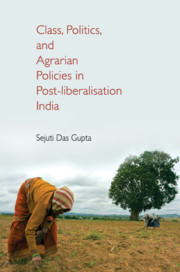

The book visits the idea of New India, studying how the political economy of India has changed significantly in post-liberalisation India. The book challenges the notion that all farmers in India are in agrarian distress, showing that some classes of farmers have gained under policies; it helps understand why farmer movement has weakened and control of industrial capitalist class has been bolstered. The book discusses the growing presence of petty bourgeoisie with both old and new fractions thriving. Gujarat and Karnataka are instances of these two kinds of fractions. Refuting to pre-suppose a uniformity across countries, this book upholds the significance of studying these dynamics within a nation state.
Loading metrics...
* Views captured on Cambridge Core between #date#. This data will be updated every 24 hours.
Usage data cannot currently be displayed.
This section outlines the accessibility features of this content - including support for screen readers, full keyboard navigation and high-contrast display options. This may not be relevant for you.
Accessibility compliance for the PDF of this book is currently unknown and may be updated in the future.
