





Introduction
Adult native speakers display a quasi-perfect symmetry between competences in producing and comprehending their mother tongue (Hendriks & Koster, Reference Hendriks and Koster2010). In language acquisition, there is robust evidence for comprehension of a particular linguistic phenomenon preceding its consistent production (Benedict, Reference Benedict1979; Clark, Reference Clark1999; Clark & Hecht, Reference Clark and Hecht1983; Fenson, Dale, Reznick, Bates, Thal, Pethick, Tomasello, Mervis, & Stiles, Reference Fenson, Dale, Reznick, Bates, Thal, Pethick, Tomasello, Mervis and Stiles1994). For German language acquisition, research shows that functional categories such as determiners and prepositions are successfully recognized by infants during their first year of life (Höhle & Weissenborn, Reference Höhle and Weissenborn2003), whereas these categories are not consistently produced before the age of three (Grimm, Müller, Hamann & Ruigendijk, Reference Grimm, Müller, Hamann and Ruigendijk2011). This production-comprehension asymmetry has recently been challenged by the findings of a ‘reverse asymmetry’ in various languages – that is, higher production compared to comprehension levels (Hendriks & Spenader, Reference Hendriks and Spenader2006; Johnson, de Villiers & Seymour, Reference Johnson, de Villiers and Seymour2004; Pérez-Leroux, Reference Pérez-Leroux and Gurski2005; Ünal & Papafragou, Reference Ünal and Papafragou2016), and symmetrical acquisition of both modalities (Ruigendijk, Friedmann, Novogrodsky & Balaban, Reference Ruigendijk, Friedmann, Novogrodsky and Balaban2010). Thus, the precise relationship between comprehension and production is still a matter of debate (Azpiroz, Allen, Katsika, & Fernandez, Reference Azpiroz, Allen, Katsika and Fernandez2019).
Regarding language production, the acquisition process is shaped by phases of non-target-like production (Kauschke, Reference Kauschke2012). For diagnostic purposes (e.g., the assessment of developmental language disorders, DLD), it would be valuable to investigate the individual comprehension competences within these non-target-like production phases to evaluate whether knowledge about a particular structure has already been built, although this knowledge may not yet have been transferred to a correctly produced output.
The present study focuses on comprehension and production of ditransitive structures, because long phases of non-target-like production have been documented (Schönenberger, Sterner, & Ruberg, Reference Schönenberger, Sterner and Ruberg2011; Scherger, Reference Scherger2015) and comprehension has rarely been investigated so far. In German, ditransitives are characterized by verbs (such as geben [to give], schenken [to donate/to gift]) selecting a nominative (NOM) subject (SUBJ), a direct object (DO) marked for accusative (ACC), and an indirect object (IO) marked for dative (DAT). Case marking is encoded morphologically, mostly on the determiner, which allows for a relatively free word order (see Example 1).

Example (1a) illustrates IO-DO word order, which is the most frequent order in child-directed speech (Sauerman & Höhle, Reference Sauerman and Höhle2018) and often the more acceptable word order for adults (Pechmann, Uszkoreit, Engelkamp & Zerbst, Reference Pechmann, Uszkoreit, Engelkamp, Zerbst, Habel, Kannengieser and Rickheit1996). Drenhaus (Reference Drenhaus2004) found word order effects on ditransitive case marking by children aged three to six. They were able to repeat only IO-DO sentences with correct word order and case marking, but not DO-IO. This preference for IO-DO structures was confirmed in cross-linguistic acquisition studies (e.g., for Russian and Ukrainian, see Mykhaylyk, Rodina & Anderssen, Reference Mykhaylyk, Rodina and Anderssen2013).
In languages with more transparent case marking paradigms than German, like e.g., Turkish (see Aksu-Koç, Reference Aksu-Koç, Topbaş and Yavaş2010; Rothweiler, Chilla & Babur, Reference Rothweiler, Chilla and Babur2010), case marking is acquired relatively fast by ages two to three. However, in case systems like e.g., Russian (Janssen, Meir, Baker & Armon-Lotem, Reference Janssen, Meir, Baker, Armon-Lotem and Grillo2015) or German (Schulz & Grimm, Reference Schulz and Grimm2019), case marking is a late acquisition phenomenon. Within the generative paradigm, Woolford (Reference Woolford2006) divided case marking in three subcategories: structural, lexical and inherent markings, comprising ditransitives as non-structural and inherent. Scherger (Reference Scherger2015, Reference Scherger2018) found that German children reached mastery around age seven with inherent case markings, whereas children aged four showed more difficulties with inherent > lexical > structural markings. However, to date, due to different methodologies used in various studies, no consensus has been reached for age of mastery in German, ranging from 4;6 to nine years in different studies (Grimm & Schulz, Reference Grimm and Schulz2016; Scherger, Reference Scherger2021; Schmitz, Reference Schmitz, Hole, Abraham and Meinunger2006; Ulrich, Berg, Penke, Lüdtke & Motsch, Reference Ulrich, Berg, Penke, Lüdtke and Motsch2016; Ulrich, Thater & Mennicken, Reference Ulrich, Thater and Mennicken2021).
Compared to German ditransitives in production, much less is known about comprehension. So far, case marking and word order have been studied only in less complex structures. Dittmar, Abbot‐Smith, Lieven, and Tomasello (Reference Dittmar, Abbot‐Smith, Lieven and Tomasello2008) showed that two- and five-year-old children relied on word order only and did not use case marking to correctly interpret causative sentences. Conversely, seven-year-old children already behaved like adults by relying on case markers over word order when both cues conflicted. Consistent with these findings, Schipke, Knoll, Friederici, and Oberecker (Reference Schipke, Knoll, Friederici and Oberecker2012) and Brandt, Lieven, and Tomasello (Reference Brandt, Lieven and Tomasello2016) found that only six-year-old children are able to use case marking to some extent for comprehension, whereas younger children fail to do so, relying on word order over case marking in object-initial sentences. For our purposes, therefore, it seems reasonable to examine children from the age of five. Cross-linguistically, the IO-DO preference found in production was reproduced in comprehension (for Japanese, see Sugisaki & Isobe, Reference Sugisaki, Isobe, Megerdoomian and Bar-el2001).
With respect to predictive processing, Altmann and Kamide (Reference Altmann and Kamide1999) were the first to demonstrate anticipatory eye-movements in adults triggered by the verb. Another trigger has shown to be case marking. When hearing the case-marked first nominal phrase (NP), adult native speakers of German anticipated the second NP (Kamide, Scheepers & Altmann, Reference Kamide, Scheepers and Altmann2003). Regarding German ditransitives, Schlenter (Reference Schlenter2019) found German adults to anticipate the second object. Mani and Huettig (Reference Mani and Huettig2012) have shown children by the age of two to be able to anticipate, e.g., the object of a cake, when hearing “the boy eats__”. However, a relatively high productive vocabulary size turned out to be a prerequisite for anticipatory eye-movements (see also Borovsky, Elman, & Fernald, Reference Borovsky, Elman and Fernald2012, for English children). In the same vein, it has been found for Turkish children that they were able to use nominative and accusative case marking predictively in transitive sentences by the age of four (Özge, Kornfilt, Münster, Knoeferle, Küntay & Snedeker, Reference Özge, Kornfilt, Münster, Knoeferle, Küntay, Snedeker, Scott and Waughtal2016; Özge, Küntay & Snedeker, Reference Özge, Küntay and Snedeker2019). To our knowledge, up to date, there are no studies on predictive processing in children using case marking cues in German ditransitives.
To summarize, the acquisition of comprehension of ditransitives is not yet fully understood. The comprehension of German ditransitives in children has not been investigated – a gap which we attempt to fill.
Research questions
Our main research question was whether comprehension precedes production in the acquisition process of five- to seven-year-old monolingual German children. Therefore, performance in an elicitation task (production) and a picture-sentence matching task (comprehension) was compared in children and young adults. The following research questions (RQs) are of particular interest:
RQ1: Are monolingual German children between age five and seven able to produce ditransitive target-like structures?
RQ2: How accurate are the comprehension abilities regarding ditransitive structures in these children?
RQ3: Is there a production-comprehension asymmetry at this age regarding ditransitive constructions?
RQ4 (provided that comprehension is target-like): Are participants able to anticipate the meaning of the sentence after hearing the first case marker on the direct/indirect object?
Considering previous findings on the production of dative case marking in ditransitive structures (Scherger, Reference Scherger2015), we expected the younger children in our sample (age: 5-6) to show non-target-like production patterns. Children around the age of seven may have already mastered the production of ditransitive structures. Thus, we hypothesized that not all of the children by the age of five are productively on target yet (H1).
According to previous results concerning comprehension preceding production in language acquisition, we expected comprehension to be more advanced compared to production. We expected children to master comprehension of ditransitive structures between age five and seven (H2) resulting in comprehension > production performance (H3).
Regarding RQ4, in line with previous findings (Mani & Huettig, Reference Mani and Huettig2012; Schlenter, Reference Schlenter2019), we expected adults and children to anticipate the second object in ditransitives (H4).
Methods
Participants
Forty-five TD monolingual German speakers participated in this study. Three children had to be excluded owing to technical problems (dropout rate = 6.6%). The final sample consisted of 16 children (8 males) aged 5;9-7;6 (median = 6;6 years, SD = 0.6) and 26 adults (7 males) aged 19-48 (median = 21 years, SD = 7.5). Children were recruited from a kindergarten and a primary school’s first grade in Lower Saxony, Germany. The children’s parents completed a background questionnaire including information on the socio-economic status (SES). All adults were university students and participated voluntarily, optionally receiving a course credit. All participants or their legal guardians provided written informed consent in keeping with the European General Data Protection Regulation.
To exclude children with intellectual and/or language impairments, we conducted a language assessment test (Sprachstandserhebungstest für Kinder im Alter von 5–10, SET 5–10, subtests 1, 3, 5, 7, 8; Petermann, Reference Petermann2018), a language assessment screening (non-word repetition task; Grimm & Hübner, Reference Grimm, Hübner, de Santos and de Almeidain press), and a non-verbal intelligence test (Colored Progressive Matrices [CPM]; Bulheller & Häcker, Reference Bulheller and Häcker2002). Adult participants performed a multiple-choice test and two cloze testsFootnote 1 targeting lexical, semantical, syntactical, pragmatical and orthographical knowledge. Furthermore, we controlled for working memory abilities in all participants by assessing forward and backward digit spans (Wechsler Intelligence Scale for Children [WISC V]; Petermann, Reference Petermann2017).
Procedure and stimulus material
We developed an elicitation task for production and a picture-sentence matching task with similar items for comprehension. We especially controlled for animacy and semantic constraints by excluding [-animate] and [+human] objects. Both direct and indirect objects were restricted to animals, so that participants could not use semantic cues for the assignment of thematic roles. Only definite nouns were included in the picture-sentence matching task, because we did not want to cumulate two different discourse entities that are acquired in a distinct manner (Schulz, Reference Schulz, Graf and Opitz2007; van Hout, Harrigan, & de Villiers, Reference van Hout, Harrigan and de Villiers2010). To control for auditory length, we excluded animal names of more than two syllables. The subject was kept consistent (1st person singular). In the comprehension task, we further controlled for gender by excluding feminine gender, because of the strong masculine nominative bias of the form der (which is also feminine dative), to avoid confusions in interpretations. Masculine gender was excluded, because of the low auditory discriminatory potential between accusative den and dative dem. For not confounding interpretations of phonetic and grammatical processing, we only included neuter nouns. Since reference expression (pronouns vs. full lexical phrases) influences the word order (Sauerman & Höhle, Reference Sauerman and Höhle2018), we excluded pronouns. Finally, to avoid a verb bias, we included only two verbs (jemandem etwas geben and jemandem etwas schenken ‘to give/ to donate something to somebody’) that were most likely to be acquired semantically at the age of testing. In order to not confound semantical and structural acquisition, we limited item construction to these two verbs.
Production: Elicitation task
To elicit ditransitive constructions, participants played a card game with three stuffed animals of various genders (der Hund-MASC ‘the dog’, die Schnecke-FEM ‘the snail’, and das Schaf-NEUTR ‘the sheep’). The game consisted of 27 pictures of various animals. The child/adult participant had to give each animal on the picture to one stuffed animal recipient, while describing his/her action by producing sentences like Ich gebe das Pferd dem Schaf ‘I give the horse to the sheep’. In order to clarify the task, the experimenter provided two examples prior to the task using IO-DO-sentences beginning with “ich schenke […]” (‘I give […]’). In the rare cases in which participants did not produce full sentences on their own, the experimenter intervened with a reminder of the sentence beginning. Since participants were free in their productions, both word orders DO-IO (example 2a) and IO-DO (example 2b) were produced.

Comprehension: Picture-sentence matching task
All stimuli were presented on a standard 24” flat-screen desktop computer with Windows 10, 1366*768 pixels resolution, and 60 Hz frame rate. A video, constructed in Microsoft PowerPoint 2016, containing auditory sentence recordings of a male voice, was used for stimulus presentation. All participants were seated at 60 cm viewing distance in front of the monitor, head fixed on a chin-headrest. We presented videos displaying two pictures (size: 408*491 pixels, 100 pixels apart, placed in the middle of the screen on a grey background; see Figure 1). We also tracked eye movements (not reported here). Participants were asked to press one of two buttons on a standard keyboard to choose between left and right as soon as they understood which picture matched the auditory input. The instruction was the same for children as for adults being told to respond as quickly as possible.
Exemplary item of the picture-sentence matching task. Ich gebe dem Schwein sicherlich das Schaf, ‘Certainly, I give the sheep to the pig’.
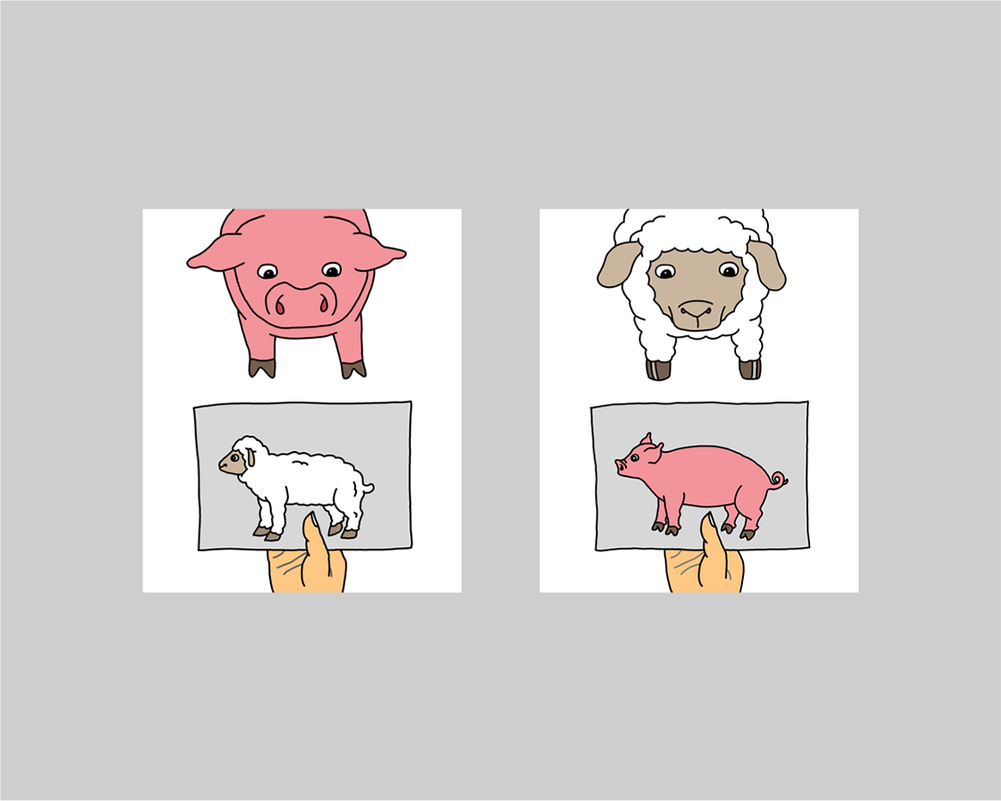
For the comprehension task, we added an adverb between the indirect and direct object to provide time to parse the first object and react before hearing the second object (example 3, Figure 1).

The experiment contained 58 items for adults and 50 for children. Among those, 20 were ditransitive experimental trials, 30 were unrelated fillers (e.g., die Katze schläft, ‘the cat is asleep’; das Dreieck ist blau, ‘the triangle is blue’). For adults, we added 8 ditransitive trials with masculine gender objects (not analyzed here). For children, we extended the response duration by 2 s (i.e., an inter-item interval of 6.5 s). In total, the comprehension task lasted 10 min for adults and around 9 min for children.
Prior to the proper experiment, participants performed four practice trials. The experiment was run with two different lists of pseudorandomized items. The production task was conducted prior to the comprehension task in order to avoid priming effects. Overall, each test session lasted about 60 min for adults and, owing to the more extensive language assessment, 2 x 45 min for children.
Data analysis
For the analysis of the elicitation task, target-like accusative case markings and target-like dative case markings were counted separately to calculate absolute and relative scores. Moreover, word orders (IO-DO, DO-IO) were analyzed separately.
On average, 3.2% (25/770 in children) and 1.8% (23/1288 in adults) of all produced objects were built with pronouns. Because pronouns have been shown to be acquired earlier than full DPs (Jaeger & Tily, Reference Jaeger and Tily2011; Scherger, Reference Scherger2016; Tracy, Reference Tracy1990), and to keep the analysis consistent with the one of the comprehension task comprising full lexical DPs only, pronouns were excluded from analysis. Furthermore, we excluded realizations of IOs by prepositional phrases (PP, see Example 4), since these structures do not mandatorily require a dative case marking. The insertion of a preposition within a ditransitive structure changes the licensing of case markings from the inherent v o to the lexical Po, going beyond the focus of our study.

Trial removal rates due to PPs were 16.1% in children and 2.6% in adults. Moreover, utterances including verbs other than geben/schenken (to give) were excluded from analysis (4 utterances in children, 2 utterances in adults). The remaining amount of analyzed utterances was 903 (309 in children; 594 in adults).
RTs were recorded via the annotation capture plugin of the eye-tracking software Pupil LabsFootnote 2 and were operationalized as the interval between auditory presentation of the first case marking and button press for the matching picture.
To assess the relative number of predictions, we followed Schlenter (Reference Schlenter2019, p. 2) in her assumption that “only effects visible prior to the onset of the critical perceptual input are taken as effects of prediction” in contrast to later effects that may reflect rapid integration rather than prediction. Therefore, we defined the time between the onset of the first object’s article and the onset of the second object as the critical window (Figure 2). Responses were marked as prediction when the response was made before auditory onset of the second case marking.
Critical window for anticipating the second object in the exemplary item Ich gebe das Schwein natürlich dem Pony ‘of course, I give the pig to the pony’.

Statistical analysis
Data were statistically analyzed using SPSS 24.0.0 for Mac OS (International Business Machines Corp., Armonk, New York, USA) and R for Windows OS (R Core Team, 2017, Version 3.6.3) for the regression analysis (using the package relaimpo; Grömping, Reference Grömping2006). We employed a mixed design with between-subjects factor Group {children, adults} and within-subjects factor Word Order {IO-DO, DO-IO}. RTs and accuracy scores (in percentages) served as dependent variables. For production data, we computed 2 x 2 repeated-measures analyses of variance (ANOVA) with Case {ACC, DAT} as a within-subjects factor and Group {children, adults} as a between-subjects factor. This means that we used either mean RT or the percentage of correct case markings for conditions child+ACC, child+DAT, adult+ACC, adult+DAT. For comprehension data, we computed a 2 x 2 ANOVA with Word Order as a within-subjects factor and Group as a between-subjects factor. Effect sizes were reported as partial eta squared (ηp2) for ANOVAs. In a subgroup of children, non-parametrical tests were used for comparison of the means.
Results
All children scored within the normal range in the SET 5–10, with T-values between 40 and 80 (mean = 57.8, SD = 11.2), within normal intellectual ability ranges in the CPM with percentiles between 31 and 100 (mean = 55.8, SD = 21.4). In adults, German proficiency levels were consistently above 90% (i.e., advanced level). As expected, and most likely due to neurocognitive maturation, digit spans were significantly higher for adults, who scored between 5 and 10 in forward digit spans (DS-FW, mean = 6.5, SD = 1.1) and between 4 and 8 in backward digit spans (DS-BW, mean = 6.1, SD = 1.2), than for children (DS-FW: t(40) = 5.87, p < .001; DS-BW: t(40) = 8. 64, p < .001). Children scored between 3 and 6 in DS-FW (mean = 4.7, SD = 0.7) and between 2 and 5 in DS-BW (mean = 3.2, SD = 0.8).
Production
A 2 x 2 repeated-measures ANOVA revealed main effects for Group (F[1, 40] = 19.33, p < .001, η2p = .326) and Case (F[1, 40] = 10.98, p = .002, η2p = .215). Most importantly, there was an interaction effect between both factors (F[1,40] = 15.88, p <.001, η2p = .284). Adults showed no difficulties in producing target-like utterances, mastering accusative markings by 100% (SD < .01) and overall dative markings by 99.4% (SD = 1.7). This applied for both word orders (DO-IO and IO-DO; see Table 1). However, children showed difficulties with dative case (mean = 68.3%, SD = 33.2), but not with the accusative (mean = 98.8%, SD = 2.6). This applied for both word orders. Differences between adults’ and children’s production were not significant with respect to the accusative (t(40) = 1.78, p = .095), but significant regarding the dative (t(40) = 3.30, p = .005).
Results of the elicited productions (raw scores and percentages correct), divided in overall correct accusative markings and overall correct dative case markings, as well as separate outcomes of the word orders

At this stage of language acquisition, children demonstrated consistent overgeneralizations of the accusative (see Example 5).

In sum, as depicted in Figure 3, all children had mastered accusative case marking in ditransitives, whereas there was high variability regarding dative case marking. Adults showed ceiling effects for both.
Target-like dative case markings produced by children (N = 16) and adults (N = 26), split by case. The thick line within the boxplot(s) represents the median.

Comprehension
With respect to comprehension, we identified two children as outliers. Both displayed clear response strategies. Whereas one child consistently interpreted the first object as DO, the other child interpreted the first object as IO, resulting in 100% correct answers in one order and 0% correct in the other. We therefore excluded them from statistical analysis.
A 2 x 2 repeated-measures ANOVA revealed a significant main effect of Group (F[1, 38] = 31.79, p <.001, η2p = .456) and of Word Order (F[1, 38] = 4.631, p = .038, η2p = .109). Moreover, a significant interaction effect was observed (F[1, 38] = 8.60, p = .006, η2p = .185). In contrast to adults, some children showed difficulties with correctly identifying the picture that matched the heard sentence. As Table 2 shows, children performed lower on non-default DO-IO items (mean = 79.1% correct selections, SD = 14.5) than on default IO-DO (mean = 87.8%, SD = 13.7, Wilcoxon-test: z = 2.27, p = .023). As Figure 4 shows, children’s overall performance on correctly selecting the matching picture (mean = 83.3%, SD = 11.9) was less accurate than that of adults (mean = 97.3%, SD = .04; t(38) =4.21, p =.001).
Accuracy in the picture-sentence matching task for comprehension assessment

Overall comprehension accuracy in children (N = 14) and adults (N = 26), split by word order.

Regarding RTs, a 2 x 2 repeated-measures ANOVA showed main effects of Group (F[1, 38] = 83.51, p <.001, η2p = .687) and Word Order (F[1, 38] = 5.27, p = .027, η2p = .122) but no interaction (F[1, 38] = 1.29, p =.262, η2p = .033). On average, adults reacted about 1.7 s faster than children, and participants responded faster to IO-DO word order than DO-IO, independent of group (see Table 3 and Figure 5).
Response times (in s) in the picture-sentence matching task

Overall response time (in s) for the comprehension task in children (N = 14) and adults (N = 26), split by word order.

Regarding anticipation ability, as expected, adults not only responded faster than children on the first case-marking cue they heard, they also responded even before hearing the second case marking in 65.0% of all trials (SD = 34.2%), indicating anticipation. In contrast, children responded only after hearing the second object.
Production-comprehension (a)symmetry on an individual level
To investigate the production-comprehension (a)symmetry, we compared means of comprehension and production. Since every child had mastered the accusative case marking, we only included the dative in the production performance for this analysis. On average, comprehension accuracy in children (mean = 83.3%, SD = 11.9) was not significantly above their production levels (mean = 68.3%, SD = 33.2, Wilcoxon-test: z = 0.35, p = .727).
Besides overall production and comprehension accuracy in ditransitives, it is of particular interest to compare these abilities in different word orders. A closer exploratory look into the data revealed that most of the variance could be explained by children who had not yet mastered dative production. We therefore split the group of children into those who had already mastered ditransitives in production (N = 8 scored > 90%) and those who had not (N = 6). Importantly, some five-year-old children outperformed some of the seven-year-olds. Thus, the grouping cannot be attributed to age alone. Figure 6 shows comprehension and production abilities in children. Those who have already mastered production do not show differences between comprehension and production abilities, neither in IO-DO (Wilcoxon-test: z = 1.83, p = .068) nor in DO-IO (Wilcoxon-test: z = 1.48, p = .138).
Comprehension and production abilities in word orders IO-DO and DO-IO. The left panel shows six children who had not yet mastered dative case production, the right panel shows eight children who had already mastered it (total N = 14).

However, children who had not yet mastered production (N = 6, with N = 2 outliers excluded, one male) showed differences between comprehension (mean = 80.0%, SD = 16.3) and production (mean = 41.0%, SD = 17.3) in IO-DO (Wilcoxon-test: z = -2.02, p = .043) and in DO-IO (comprehension mean = 73.4%, SD = 9.6; production mean = 31.5%, SD = 9.2; Wilcoxon-test: z = 2.03, p = .042). Overall, comprehension abilities were significantly better than production abilities, as supported by a bootstrapping comparison of the means (N = 1,000 samples, 95%-CI for the population difference = [0.17, 0.47], p = .019).
Analysis of potential confounding factors for the production of ditransitives
To determine influencing factors and their relative importance for the variability in children’s production performance, a mixed-effects regression was calculated. We investigated the explanatory factors comprehension (picture-sentence matching accuracy), age, SES (parents’ years of education), and working memory (digit spans), on the response variable production accuracy. Neither the model (p = .228, R2 = .38, R2adjusted = .15), nor any predictor reached significance (comprehension: β = 0.97, t = 1.921, p = .081, working memory: β = -0.02, t = 0.22, p = .825, age: β = 0.01, t = 0.72, p = .488, and SES β = 0.04, t = 1.12, p = .284). Nevertheless, the four variables explained 37.7% of the productive variance. Comprehension, by far, was the factor with the highest weight; it explained 22.8% of the production variance.
Discussion
This study aimed at illuminating the relationship between comprehension and production abilities regarding ditransitive structures in children between five and seven years. Regarding PRODUCTION, performance for dative production was significantly less accurate in children, with accusative production close to ceiling, while adults performed at ceiling regarding both cases. This supports earlier findings showing that accusative is acquired prior to dative in German (Clahsen, Reference Clahsen1982; Eisenbeiss, Bartke, & Clahsen, Reference Eisenbeiss, Bartke and Clahsen2006; Scherger, Reference Scherger2015, Reference Scherger2016; Tracy, Reference Tracy1986). Here, half of the tested children had not reached 90% accuracy in dative case production. While neither SES nor working memory nor age explained the variance in production performance, high comprehension ability appears to be the likeliest prerequisite, as was reflected by the highest predictive value of this factor. Note, however, that the regression model’s output was not significant, which is why this nominal finding can only be taken as tentative evidence.
It has been argued that dative case marking is subject to language change (DuBois, Reference DuBois and Metzler2013; Yager, Hellmold, Joo, Putnam, Rossi, Stafford & Salmons, Reference Yager, Hellmold, Joo, Putnam, Rossi, Stafford and Salmons2015). It is up to future research to identify influencing input factors rather than ascribing the development of case marking abilities to age and maturation alone.
Regarding COMPREHENSION, the investigated children showed an average accuracy of 83.3%, which is below our expectation of performing at ceiling. While adults performed at ceiling in both word orders, children performed less accurately in DO-IO order. This is in line with findings on Japanese (Sugisaki & Isobe, Reference Sugisaki, Isobe, Megerdoomian and Bar-el2001) and could be explained by IO-DO being the preferred word order in child-directed speech (Sauerman & Höhle, Reference Sauerman and Höhle2018). Our findings suggest that the age of five to seven represents a developmental stage during which the comprehension ability for IO-DO word order has already been mastered by most children, while non-canonical DO-IO structures are still more difficult to comprehend. Cross-linguistically, this is in line with the reported preference of IO-DO structures in production studies (Mykhaylyk et al., Reference Mykhaylyk, Rodina and Anderssen2013).
With respect to the RELATION OF PRODUCTION AND COMPREHENSION, we found children to produce some correct ditransitive structures prior to complete mastery of comprehension. This finding agrees with Clark and Hecht’s (Reference Clark and Hecht1983) assumption that comprehension does not need to be fully mastered prior to the start of the productive development. In our data, the difficulties attested in comprehension could be due to task demands. While the act of pointing is not problematic in this procedure, in line with Brandt-Kobele and Höhle (Reference Brandt-Kobele and Höhle2010), we suggest that storing visual and linguistic information simultaneously, evaluating both information, and finally deciding are additional demands that presumably are not yet fully established in children. This argument is supported by the fact that the prefrontal cortex and its executive functions, including working memory and decision making, are not fully developed until early adulthood (Amlien, Fjell, Tamnes, Grydeland, Krogsrud, Chaplin, Rosa, & Walhovd, Reference Amlien, Fjell, Tamnes, Grydeland, Krogsrud, Chaplin, Rosa and Walhovd2016; Moriguchi & Hiraki, Reference Moriguchi and Hiraki2013). It should be noted that the children in Brandt-Kobele and Höhle’s study were three to four years old. Our study showed that the described additional requirements of the picture-sentence matching task may still have been too demanding for the ages five to seven. Nevertheless, as the general task demands were held constant across our experimental conditions, the within-group differences cannot be solely explained by age-related neural development. It could also be that the inherent structural complexity of ditransitives masks the children’s ability to decode case markings. Therefore, future research should contrast the comprehension within transitive and ditransitive structures within an individual.
In sum, the assumption of a comprehension-production asymmetry can neither be confirmed nor rejected based on our data. Since the age of mastery of dative case marking is still under debate, choosing an appropriate age span for the present study was not easy. Our exploratory analysis of the subsample of six children who had not yet mastered both modalities suggests comprehension preceding production for ditransitives. This would be in line with research stating that comprehension precedes production (Clark & Hecht, Reference Clark and Hecht1983; Fenson et al., Reference Fenson, Dale, Reznick, Bates, Thal, Pethick, Tomasello, Mervis and Stiles1994).
Regarding PREDICTION, only adult speakers predicted upcoming input explicitly. This evidences the incrementality of language processing, “that comprehending utterances involves the continuous mapping of incoming items onto mental representations under construction” (Kamide, Reference Kamide2008, p. 648). The investigated children did not respond prior to the second case-marked object. Although this could be taken as evidence for lower predictive ability, the slow RTs in our children could also be explained by the developmental stage of their central nervous system. While the precentral gyrus, which is responsible for the execution of voluntary movements, should already have reached maturity by this age, the prefrontal regions, which are responsible for decision making and keeping the task and current auditory stimulus active, are still underdeveloped (Amlien et al., Reference Amlien, Fjell, Tamnes, Grydeland, Krogsrud, Chaplin, Rosa and Walhovd2016; Gogtay, Giedd, Lusk, Hayashi, Greenstein, Vaituzis, Nugent, Herman, Clasen, Toga, Rapoport & Thompson, Reference Gogtay, Giedd, Lusk, Hayashi, Greenstein, Vaituzis, Nugent, Herman, Clasen, Toga, Rapoport and Thompson2004). Besides these executive functions, coordinating the decision making and the response preparation are involved as potentially challenging requirements. Studies employing measurements with higher temporal resolution did report anticipatory abilities and incremental parsing in children age 4 to 5 (Huang, Zheng, Meng & Snedeker, Reference Huang, Zheng, Meng and Snedeker2013; Omaki & Lidz, Reference Omaki and Lidz2015; Özge et al., Reference Özge, Kornfilt, Münster, Knoeferle, Küntay, Snedeker, Scott and Waughtal2016). Thus, the conclusion of an overall absence of predictive abilities based on the current operationalization of prediction (button press) would be too narrow. More implicit measures, such as glances towards the target, could reveal covert predictive behavior.
Concluding remarks and limitations
Our data indicate a production-comprehension symmetry in adult native speakers and children who already mastered ditransitives in German productively, and a production-comprehension asymmetry in children who had not yet reached mastery of ditransitives in production. Production does not precede comprehension of ditransitives. Moreover, our findings contribute to cross-linguistic research, as Turkish children do not seem to have long-lasting difficulties with comprehension (Özge et al., Reference Özge, Kornfilt, Münster, Knoeferle, Küntay, Snedeker, Scott and Waughtal2016), in contrast to German children who struggle with comprehension up until the age of seven in our study, perhaps because of the fusional German morphology in which case interacts with gender. Therefore, the acquisition of ditransitives seems to be language-specific. For future research, the comprehension and production abilities in impaired language acquisition would be of interest as well as the development of comprehension measures that allow for differentiation between DLD and TD, even though children of both populations show similar difficulties in production by this age.
We are aware of the fact that small samples can distort the results, because outliers have a greater influence in small samples or may not even be discoverable as such (e.g., Leppink, Winston, & O`Sullivan, Reference Leppink, Winston and O`Sullivan2016). However, statistical significance reached with small samples should not be underestimated, as such findings can be due to large true effects in the population (Friston, Reference Friston2012). We would therefore like to highlight the differences between comprehension and production in the subsample of children, who had not yet mastered production. At the same time, we emphasize the need to replicate our findings with a larger sample size and with other verbs as well as masculine and feminine gender.
Acknowledgements
We thank David Mietzner and Clara Tittelbach-Helmrich for their support in data collection and analysis. We acknowledge financial support by the University of Hildesheim for a student assistant. We thank Hannes Elfers and the Elisabethschule in Hildesheim for their invaluable help with data collection and Julia Diedrich for illustrating the visual stimuli. Above all, we thank our participants.


 Open access

