


Introduction
The increased frequency of natural events and complex humanitarian crises has increased demands on both international and domestic emergency response systems.Reference Coronese, Lamperti and Keller1 The interplay of changing geopolitical relationships, extreme weather events, and increased population density has also amplified the scale and complexity of disaster impacts, increasing the likelihood that extreme events could overwhelm the capacity of a nation’s government and civilian emergency response system.2 In such situations, civilian federal organizations tasked with supporting U.S. interests abroad, such as the U.S. Department of State, may request vital humanitarian assistance and disaster relief (HADR) support from the U.S. Department of Defense (DoD).
The DoD has well-documented capabilities to execute rapid response and large-scale resource deployments, such as logistical support, transportation, medical assistance, and engineering services during a disaster.Reference Serafino, Dale and Grimmett3 Civilian agencies often rely on these capabilities to enhance HADR capacity, which ultimately furthers humanitarian mandates to alleviate suffering and protect human life.4 Additionally, through HADR, the DoD supports national security and geopolitical objectives by strengthening alliances, enhancing U.S. diplomacy, stabilizing regions of strategic importance, and countering influence efforts of near-peer adversaries.5, 6 Effective identification of capabilities that military and civilian (mil-civ) entities can provide during HADR events accelerates disaster response and recovery efforts.
While mil-civ collaboration is acknowledged as important to both sectors, there has been limited emphasis on the collection of empirical data to assess current trends in mil-civ humanitarian relations and drivers of military engagement, impeding optimized disaster response planning.Reference Grace, Alejandria and Bates7 Here, we aim to characterize DoD support to HADR efforts outside of the U.S. by examining trends in internally maintained records from the U.S. Department of State and narrative reports from DoD research centers specializing in disaster management. This understanding of DoD contributions to HADR activities can optimize future operational planning and coordination with responding civilian agencies and improve the overall ability to address large-scale emergencies and disaster events.
Methods
Data were obtained from the Department of State’s Bureau of Population, Refugees, and Migration (PRM), formerly the United States Agency for International Development’s Bureau for Humanitarian Assistance (BHA), to assess the disaster location, timing, and type, as well as deployed personnel and capabilities supplied by DoD during HADR events.8 To supplement BHA records, data were extracted from narrative reports tracking foreign disaster response efforts maintained by the DoD’s Center for Excellence in Disaster Management and Humanitarian Assistance (CFE-DM).9 Throughout this analysis, HADR refers only to international incidents in which DoD is providing support.
Data derived from PRM represents indirect support to a nation-state by DoD via received and completed requests from the State Department. In contrast, information provided by CFE-DM represents direct DoD support to a nation-state in the Indo-Pacific region. This support may have involved civilian U.S. organizations; however, the provided reports were not intended to fully capture this level of detail and were incorporated as supplemental information. Data extracted from both sources were collated into a single international dataset to represent DoD support to civilian organizations and nation-states for HADR events occurring outside of the U.S. The resulting de-duplicated dataset captured both direct and indirect HADR support provided to affected countries by DoD aligned to specific disaster or humanitarian incidents occurring outside the U.S. Here, each unit of observation (i.e., a specific disaster or humanitarian event) could potentially involve multiple unique assignments to the DoD.
Data were categorized by the area of responsibility associated with U.S. DoD Geographic Combatant Commands (GCCs); the calendar year during which the HADR event occurred; and the type of HADR event.10 HADR events could range from disasters triggered by natural hazards or complex emergencies. Complex emergencies were defined as humanitarian crises resulting from a breakdown of authority due to internal conflict or foreign aggression.11 Examples include hostage situations, terrorist attacks, refugee crises, famines, civil wars, and military conflicts. DoD response activities associated with each HADR event were categorized by the responding DoD entity, and the specific sectors of HADR action in which the DoD provided support. The HADR sectors were based on the United Nations (UN) Humanitarian Cluster System, which categorizes humanitarian coordination services formalized by the UN Inter-Agency Standing Committee into 11 clusters to improve the effectiveness and efficiency of response and meet the needs of the affected population.12 Alignment between the military assistance provided and the service cluster was supported by narrative review and proceeded by aligning the actions within each response with the qualifying actions defined by the UN Humanitarian Cluster. One response activity could reference numerous service clusters; therefore, clusters are not mutually exclusive. Descriptive statistics and univariate linear regression were conducted using Stata SE 18.0.13 Reference formatting and bibliography standardization were expedited using the Gemini large language model.14
Results
A total of 149 distinct HADR events resulting in indirect or direct DoD support were extracted from BHA and CFE-DM sources. The data included events that spanned a 28-year period from 1997 to 2024.
Geographic Analysis
These data showed HADR support by DoD to 68 distinct countries between 1997 and 2024. The Philippines (n = 10 [7%]), Iraq (n = 8 [5%]), and Indonesia (n = 7 [5%]) received support with the greatest frequency (Table 1).
Top 10 countries ranked by frequency of DoD-supported HADR events from 1997 to 2024

Table 1. Long description
The table consists of two columns: Country and Number (percent) of D o D-supported H A D R Events (1997–2024). The data is ranked as follows:
* Philippines: 10 (7 percent)
* Iraq: 8 (5 percent)
* Indonesia: 7 (5 percent)
* Haiti: 5 (3 percent)
* Honduras: 4 (3 percent)
* Nicaragua: 4 (3 percent)
* Pakistan: 4 (3 percent)
* Peru: 4 (3 percent)
* Syria: 4 (3 percent)
* Turkey: 4 (3 percent)
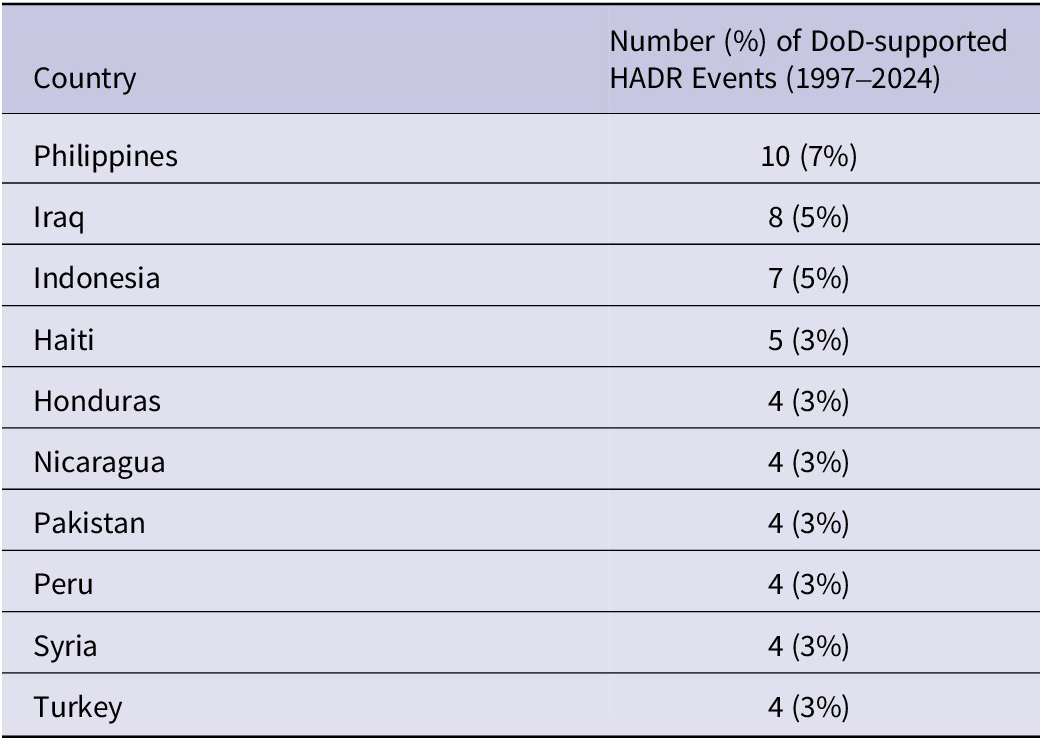
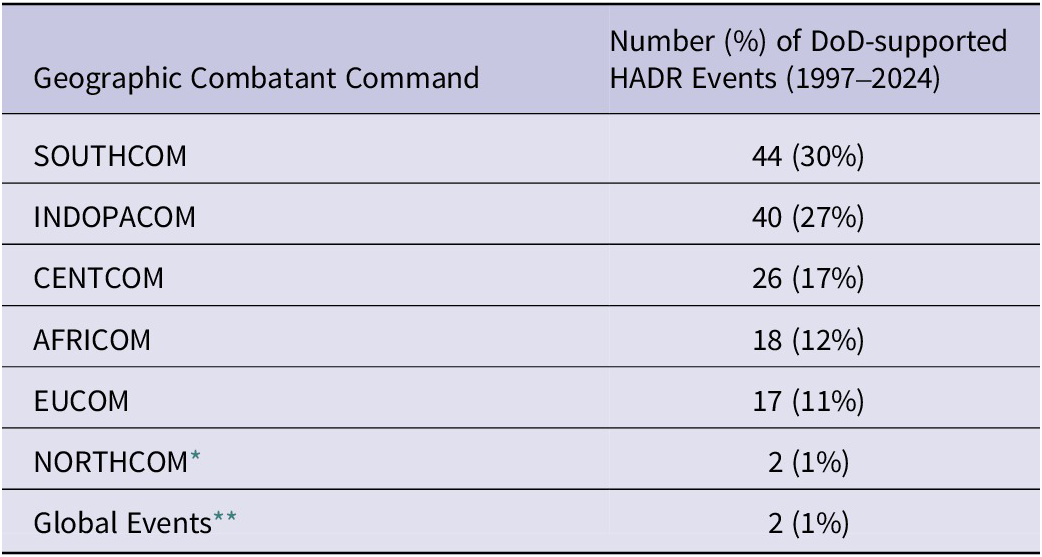
Across the GCCs, more than half of incidents that involved DoD support occurred within areas of responsibility associated with U.S. Southern Command (SOUTHCOM) (n = 44 [30%]) or U.S. Indo-Pacific Command (INDOPACOM) (n = 40 [27%]) (Table 2).
Frequency of DoD-supported events by Geographic Combatant Command from 1997 to 2024
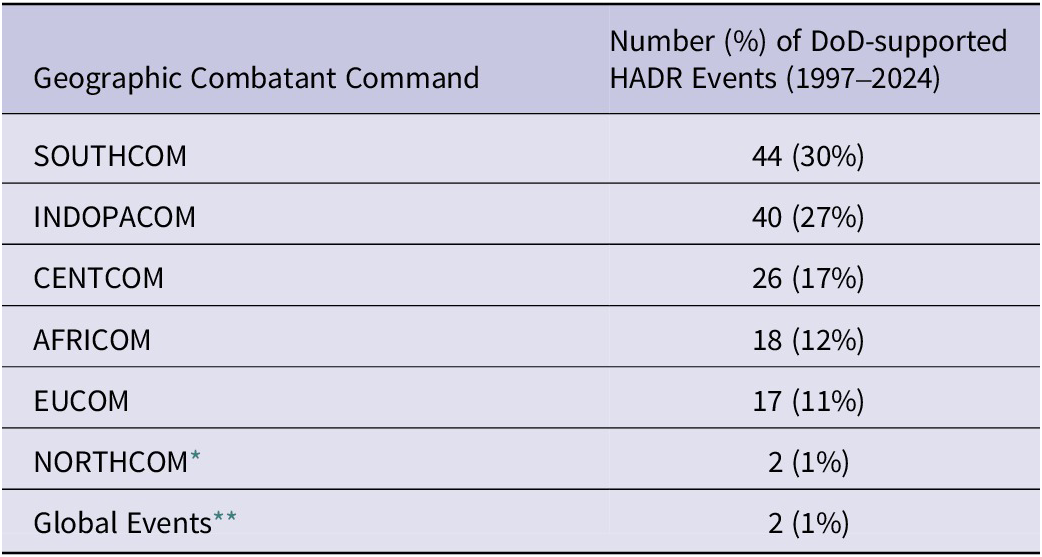
Table 2. Long description
The table consists of two columns: Geographic Combatant Command and Number (percentage) of D o D-supported H A D R Events (1997–2024). The data is listed as follows:
* SOUTHCOM: 44 (30 percent)
* INDOPACOM: 40 (27 percent)
* CENTCOM: 26 (17 percent)
* AFRICOM: 18 (12 percent)
* EUCOM: 17 (11 percent)
* NORTHCOM: 2 (1 percent). A footnote indicates this represents events in countries outside the U.S. but within the area of responsibility, specifically Canada and Mexico.
* Global Events: 2 (1 percent). A footnote indicates this represents events involving support across multiple areas of responsibility simultaneously, such as the C O V I D 19 pandemic response.
* Represents the frequency of DoD-supported HADR events in countries outside the U.S. yet still within NORTHCOM’s geographic area of responsibility (i.e., Canada and Mexico).
** Represents HADR events that involved DoD support across multiple areas of responsibility simultaneously (e.g., COVID-19 pandemic response).
Temporal Analysis
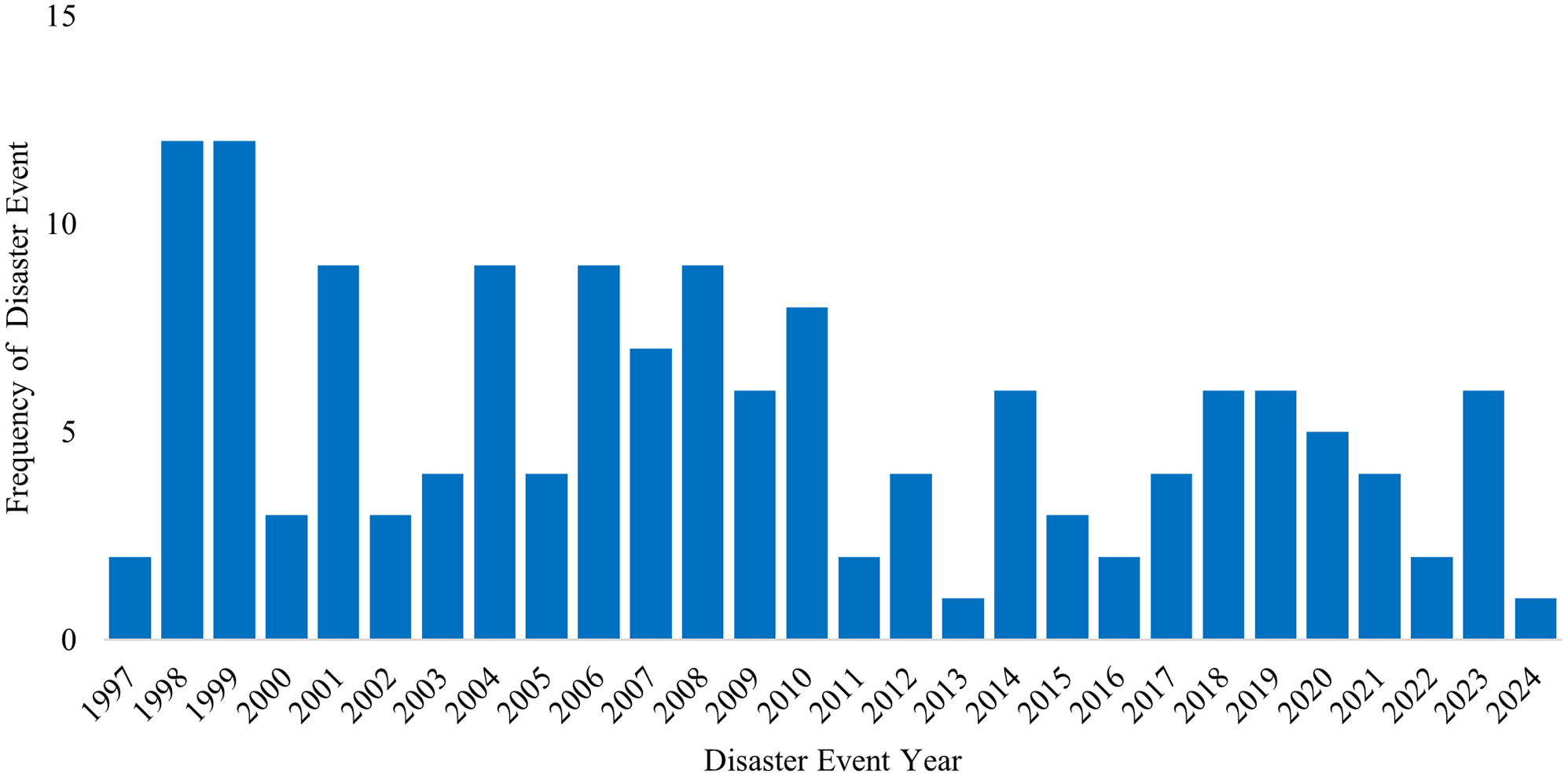
HADR support from the DoD was reported for at least 149 distinct disaster events from 1997 to 2024, averaging 5.5 HADR events per year. The years in which the DoD most frequently supported relief activities were in 1998 (n = 12) and 1999 (n = 12) (Figure 1). A sustained period of increased activity occurred from 2004 to 2010, a period covering 35% (n = 52) of the 149 captured HADR events.
Frequency of disaster events from 1997 to 2024.

Figure 1. Long description
A vertical bar chart with the y-axis labeled Frequency of Disaster Event, ranging from 0 to 15 in increments of 5, and the x-axis labeled Disaster Event Year, ranging from 1997 to 2024.
Data points by year:
* 1997: 2
* 1998 and 1999: Peaks at 12
* 2000: 3
* 2001: 9
* 2002: 3
* 2003: 4
* 2004: 9
* 2005: 4
* 2006: 9
* 2007: 7
* 2008: 9
* 2009: 6
* 2010: 8
* 2011: 2
* 2012: 4
* 2013: 1
* 2014: 6
* 2015: 3
* 2016: 2
* 2017: 4
* 2018 and 2019: 6
* 2020: 5
* 2021: 4
* 2022: 2
* 2023: 6
* 2024: 1
The chart illustrates a highly variable trend with the highest frequency occurring in 1998 and 1999, followed by several secondary peaks of 9 events throughout the early to late 2000s, and a general decrease in frequency toward 2024.
A linear regression model evaluating the relationship between the frequency of DoD-supported HADR events per year and the year in which disaster events occurred initially suggested a decrease in the number of DoD-supported HADR events reported over time (p = 0.03). However, this effect was likely driven by the large number of disaster events occurring in 1998–1999. By removing data from these outlier years to conduct a sensitivity analysis, no statistically significant change in the frequency of DoD-supported HADR events occurred over the remaining period (p = 0.25).
Disaster Type Analysis
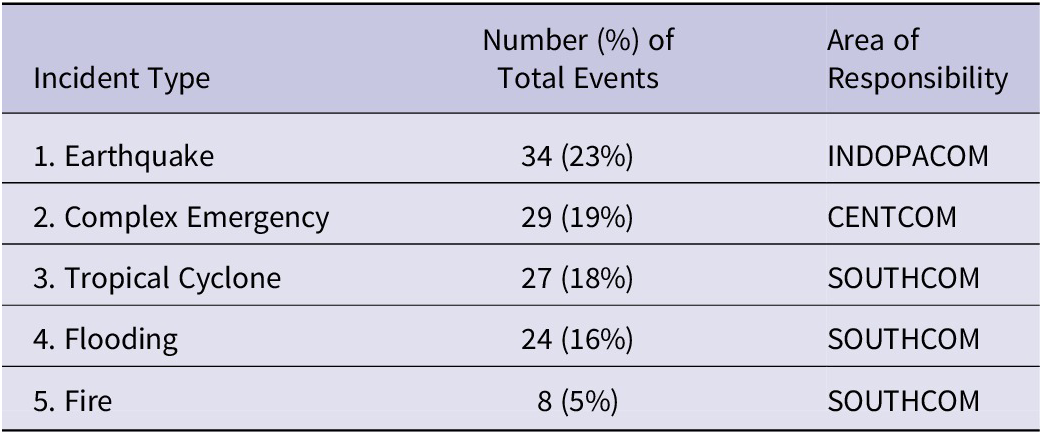
Of the 149 documented HADR events in the dataset, 96% (n = 143) of described events included details on the specific type of disaster or humanitarian incident triggering the need for DoD support. The most common HADR incident types resulting in DoD support were earthquakes (n = 34 [24%]), complex emergencies (n = 29 [19%]), tropical cyclones (n = 27 [19%]), floods (n = 24 [16%]), and fires (n = 8 [5%]) (Table 3). Earthquake incidents resulting in DoD support most commonly occurred in the INDOPACOM area of responsibility (AOR), whereas complex emergencies were most frequently supported by CENTCOM. Tropical cyclones, flooding, and fire incidents resulting in DoD support were most common within the SOUTHCOM AOR.
Top 5 HADR incident types resulting in DoD support by AOR from 1997 to 2024

Table 3. Long description
The table contains three columns: Incident Type, Number (percent) of Total Events, and Area of Responsibility (A O R).
* Rank 1: Earthquake, 34 events (23 percent), located in I N D O P A C O M.
* Rank 2: Complex Emergency, 29 events (19 percent), located in C E N T C O M.
* Rank 3: Tropical Cyclone, 27 events (18 percent), located in S O U T H C O M.
* Rank 4: Flooding, 24 events (16 percent), located in S O U T H C O M.
* Rank 5: Fire, 8 events (5 percent), located in S O U T H C O M.
When assessing the number of HADR incident types by region, SOUTHCOM’s AOR most commonly provided DoD support for tropical cyclone incidents (n = 14 [32% of events in the SOUTHCOM AOR]), whereas INDOPACOM provided support most often for earthquake events (n = 17 [43% of INDOPACOM events]). Flood events were the most common incident type resulting in support by AFRICOM (n = 6 [33% of AFRICOM events]), whereas EUCOM and CENTCOM responded most often to complex emergencies (n = 17 [65% of EUCOM events] and n = 6 [33% of CENTCOM events], respectively). Only 2 international (i.e., outside the U.S.) disaster events resulted in NORTHCOM support during the observed time period: a winter storm in Canada and a tropical cyclone in the Bahamas.
UN Humanitarian Aid Cluster and Personnel Analysis
Of the 149 documented cases, 53% (n = 79) included details on the operational activities performed by the DoD in response to HADR events, though systematic tracking of specific personnel, supplies, funding, and duration for all operational activities was unavailable. Seventy-seven percent (n = 114) of event descriptions included specific supplies or equipment items provided for DoD support of HADR efforts. However, these data included limited systematic tracking of the item type, quantity, and logistics. Of the 149 HADR events, 16% (n = 24) specified the Service Component or specific unit deployed to support a HADR event. As such, differences in Service-specific relief activities deployed could not be reliably determined from these data.
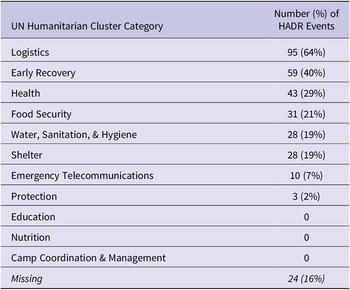
In 83% (n = 124) of recorded HADR events, the DoD operational activities, material assets, and personnel were mapped to the UN Humanitarian cluster categories (Table 4). These data showed that the DoD most commonly provided support to Logistics (n = 95 [64%]), Early Recovery (n = 59 [40%]), and Health (n = 43 [29%]) clusters.
Frequency of DoD-supported HADR events by UN Humanitarian Cluster category from 1997 to 2024

Table 4. Long description
The table consists of two columns: U N Humanitarian Cluster Category and Number (percentage) of H A D R Events. The data is listed as follows:
* Logistics: 95 (64 percent)
* Early Recovery: 59 (40 percent)
* Health: 43 (29 percent)
* Food Security: 31 (21 percent)
* Water, Sanitation, and Hygiene: 28 (19 percent)
* Shelter: 28 (19 percent)
* Emergency Telecommunications: 10 (7 percent)
* Protection: 3 (2 percent)
* Education: 0
* Nutrition: 0
* Camp Coordination and Management: 0
* Missing: 24 (16 percent)
A note at the bottom states that multiple clusters could be aligned to each event.
Note: Multiple clusters could be aligned to each event.
The majority of activities under the Logistics cluster included supply transportation to affected areas, primarily via DoD air assets, as well as operational planning to re-establish key societal emergency response functions (i.e., air traffic control systems), communications among local organizations, and supply distribution coordination. Early Recovery cluster activities primarily involved conducting damage assessments of impacted areas via DoD air assets. To a lesser extent, Early Recovery activities included search and rescue operations, evacuations, or major infrastructure repair. Health cluster activities included provisioning of medical supplies and health care personnel to support field hospitals or enhance host-nation hospital and health care staffing capacity. Overall, 56% (n = 83) of HADR events supported by DoD referenced air support as the primary means of material support for humanitarian or disaster relief operations.
Limitations
An element of selection bias was introduced as one of the 2 data sources, the CFE-DM reports, strictly included information on events in the Indo-Pacific region, thereby potentially underreporting support activities within the EUCOM, CENTCOM, SOUTHCOM, and AFRICOM AORs. From the data, EUCOM and CENTCOM most recently supported complex humanitarian emergencies associated with geopolitical instability (i.e., 2023 Israel-Gaza conflict, 2024 Houthi Deterrence Missile Attacks) to build partner states’ security capacity; SOUTHCOM most recently supported disaster relief efforts associated with Hurricanes Eta and Iota in 2020; and flooding events across Libya in 2023 led to the provision of response activations by AFRICOM. For these events, expanding data collection and summarization, like that of CFE-DM, to other AORs should be a priority for capturing not only data, but also context for DoD support to HADR events.
While general categories and locations of support were identified, we noted a lack of systematic, detailed data for evaluation. Personnel types and numbers, supply types and quantities, Service Components involved in each event response, and other key details of missions performed (e.g., exact number of missions performed, funding allocations per activity, duration of engagements for specific tasks) were publicly unavailable. Therefore, this dataset is not meant to represent all sources of governmental data tracking DoD contributions to HADR events. Additional formalized data sources were considered for this analysis including Mission Tracking Matrices (MiTaMs) from the former U.S. Agency for International Development’s Bureau of Humanitarian Affairs, which track requests to authorize and execute foreign disaster relief activities funded or reimbursed by the Defense Security Cooperation Agency, and the DoD’s Overseas Humanitarian Assistance Shared Information System (OHASIS), which is a system for managing funds attributed to Overseas Humanitarian, Disaster, and Civic Aid (OHDACA) projects.15 Neither are publicly accessible, and author access to OHASIS demonstrated substantial gaps and data consistency issues that were prohibitive for systematic analysis.
Discussion
Military-civilian collaboration is an important aspect of humanitarian emergency response and security assistance and cooperation with U.S. allies and partners. The DoD supports response activities to the extent that it does not interrupt military function and operations, supporting U.S. diplomacy efforts that support national security and global stability. These support activities align with United Nations guidelines that dictate civil defense assets focus on addressing immediate life-threatening capability gaps and not long-term involvement in host nation recovery, promoting civilian-led recovery efforts.4
This study provides a data-driven understanding of the DoD’s contributions to HADR operations through a retrospective analysis of DoD-supported HADR events. Of 149 DoD-supported international HADR events across 68 countries between 1997 and 2024, transport of material supplies, aerial damage assessments, and search and rescue with air assets were the predominant support functions by DoD. These functions typically involved supplying capabilities in large-scale lift (e.g., aircraft, naval vessels, ground transport) and extensively trained, specialized personnel (e.g., pilots, engineers, medical trauma teams) that could quickly deploy over long distances with self-sufficiency. These findings are congruent with the established understanding of the DoD’s unique capabilities in air lift and rapid deployment. Providing medical supplies and health care personnel further illustrated the DoD’s expert rapid response role in supporting immediate surge capacity needs until sustained services can be arranged by civilian governments or nongovernmental humanitarian organizations. In the aftermath of major disaster events, these capabilities become indispensable in austere environments where civilian federal organizations and local governments are overwhelmed, incapacitated, or nonexistent.
Simultaneous wide-ranging disaster events and geopolitical instability occurred across multiple regions during the exceptionally active years of 1998–1999, which coincided with an especially destructive hurricane season in Latin America and the Caribbean, the Kosovo War in former Yugoslavia, and combined earthquakes and political violence in East Asia.16–Reference .Panggabean and Smith20 Acute-onset natural events and complex humanitarian emergencies were common during the entire period under study in the areas of responsibility of SOUTHCOM and INDOPACOM. Countries in South and Central America have a wide range of climates prone to extreme weather events compared to other continents, while countries in Asia and the Pacific Ocean are cited as the most disaster-prone areas in the world, driven by a large number of island chains with high tsunami potential, frequent seismic activity, and intense monsoon seasons.21 Additionally, a large portion of DoD HADR support directed towards these regions may reflect security cooperation and diplomatic engagement activities with allies and partners in light of geopolitical competition between the U.S. and the People’s Republic of China.Reference Moroney, Pezard and Miller22–Reference Card, Grace and Sable24
To improve mil-civ coordination in preparing for disaster response, at least 2 specific steps must occur. First, accountability for the completion and types of information provided to OHASIS and other data systems must be created. This OHASIS does not require several data fields and allows minimal reporting that is insufficient for capability and resource accounting. Data from USAID were repeatedly noted to be incomplete and not updated after early entries due to the need to focus on response activities rather than data collection. While understandable, this prevents improvement. Second, additional data should be made available. Unlike domestic responses in which the Federal Emergency Management Agency creates mission assignments and documents information on each assignment, international HADR mission assignments across the DoD are directed and authorized by several entities. The Security Cooperation Information Portal Overview by DSCA should enable data integration across the Services, but DSCA lacks authority to enforce data reporting and creates additional data fragmentation and confusion.Reference Saum-Manning, Marquis, Chindea, Elinoff, Pigott and Brennan25, 26
Conclusion
Operational imperatives during humanitarian crises and disaster events may understandably result in a prioritization of coordinating rapid-response activities over meticulous data collection. However, a clear accounting of responding resources and assets permits an understanding of the unique contributions of DoD assets compared to the capabilities that can be provided by civilian response entities. These data illustrate DoD is contributing to HADR events and complements civilian organizations by providing air, naval, and land transport of materials along with specialized personnel to support search and rescue, infrastructure assessments, and medical response teams. Yet, the extent to which regional capabilities and experience are necessary to improve the military and civilian balance and forecasting of requirements during HADR events remains unclear. Proactive military and civilian dialogue contributes to understanding unique perspectives and challenges faced by military and civilian organizations that can contribute to readiness optimization. Addressing data deficiencies and coordinating military and civilian readiness for response are critical for enhancing the U.S.’s ability to learn from past events and optimize efficient future responses to humanitarian and disaster events abroad.
Data availability statement
Data that support the findings of this study are available upon reasonable request to the authors and pending approval for distribution by program leadership.
Acknowledgments
The authors acknowledge the support of NDMS Pilot leadership. The authors used Google Gemini 3.1 Pro to assist with the reformatting of citations to journal style. The authors reviewed and edited content and take full responsibility for the content of the manuscript.
Author contribution
Conceptualization—JF and JC; Methodology—EP, EM, KR, and JF; Software—EP and EM; Data Curation—JT, EP, and EM; Formal Analysis—EP and EM; Resources—EP; Writing—Original Draft, EP, EM, JT, CC, and KR; Writing—Review and Editing, EP, EM, JT, CC, KR, JC, and JF; Visualization—EM and EP; Project Administration—EM and EP; Supervision—KR, JF, and CC. All authors were involved in manuscript writing and approved the final manuscript.
Funding statement
I. Award No. HU00012120098: The Office of the Assistant Secretary of Defense for Health Affairs, 77000 Arlington Blvd., Suite 5101, Falls Church, VA 22042-5101, is the awarding office and the Uniformed Services University of the Health Sciences (USUHS), 4301 Jones Bridge Road, Bethesda, MD 20814, is the administering office.
II. This project is sponsored by USUHS; however, the information or content and conclusions reported in this work do not necessarily represent the official position or policy of, nor should any official endorsement be inferred on the part of, USUHS, the U.S. Department of Defense, the U.S. Government, or the Henry M. Jackson Foundation for the Advancement of Military Medicine, Inc.
Competing interests
The author(s) declare none.
Disclaimer
This project is sponsored by the Uniformed Services University of the Health Sciences (USUHS); however, the information, content, and conclusions reported in this work do not necessarily represent the official position or policy of, nor should any official endorsement be inferred on the part of USUHS, the U.S. Department of Defense, the U.S. Government, or the Henry M. Jackson Foundation for the Advancement of Military Medicine, Inc.
Institutional clearance
Approved by USUHS Office of the Vice President for External Affairs and HJF Regulatory Affairs.

 Open access

