


Introduction: Weird Serials
The thing about George Thompson: if you know, you know. And if you know his name, you also know that Thompson is well known for how little is definitively known about his personal history. Thompson was notorious in his own time for fiction featuring the social types populating flash press newspapers, figures who even inspired their titles: Rakes, Libertines, Venuses, and more.Footnote 1 His autobiography, My Life: The Adventures of Geo. Thompson, published in 1854, freely mingles history, exaggeration, and fantasy. A regional dilettante who wrote fiction and worked print shops in Boston, Philadelphia, Pittsburgh, New York, and even New Orleans, Thompson may well have seen the regional variations and flashy admirers of the original Broadway and Bowery flash press titles.Footnote 2
Whatever the inspiration and wherever derived, Thompson’s name appeared as “editor” in the inaugural issue of New York City’s The Broadway Belle, and Mirror of the Times. Making a grand splash on January first, 1855, The Broadway Belle declared its “main object” to be “keeping pace with the spirit of the age and ‘holding the mirror up to nature’.” The paper would be “fearless in its display of the NAKED TRUTH, witty in its jokes, and spicy without being obscene.”Footnote 3 This opening salvo, conventional for a fledgling racy paper, echoed the genre’s common goals and self-serving purview. Yet the rest of the issue – and existing subsequent numbers – undercut these claims almost immediately. The paper’s content, often patently absurd, strained the limits of credulity; its energetic obscenity tempted the stern eyes of the court.Footnote 4
Thompson’s lifetime of print labor straddled mass media and fictional environments. He had a long career writing fiction, often attributed to ‘Greenhorn,’ and published dozens of city mystery novels across the 1840s and 1850s.Footnote 5 Promiscuous pseudonymity has made it difficult to compile a comprehensive bibliography of Thompson’s original works, let alone an accurate biography of his life.Footnote 6 Across dozens of titles, Thompson’s writing career embodied a combination most colorfully classified as American “porno-gothic” literature.Footnote 7 Known for narratives of sexual and physical violence adulterated by populist social commentary, Thompson’s fervent pen proved smoothly suited to the insular world of shady self-promotion, shameless salaciousness, and local sociality that characterized the flash press. Donna Dennis describes Thompson’s mid century career as “part of a rambunctious, bohemian subculture of writers, reporters, [editors], actors, and theater impresarios who made their living from popular entertainment … . During his most productive years, Thompson maintained close professional ties with at least three men known for publishing or dealing in pornography, penning stories for George Akarman’s sexually explicit periodical, Venus’s Miscellany, and editing two semierotic newspapers, Thomas Ormsby’s Weekly Whip and Prescott Harris’s Broadway Belle.”Footnote 8 As Dennis’s description suggests, the publishing world of lower Broadway, the Bowery, Ann and Nassau streets in New York City was cliquey and circular. Mapped onto a neighborhood intersection of wealth and privation,Footnote 9 the location of the flash press’s social/professional community encouraged an unsettled mix of class affiliation and racialized categorization.Footnote 10
Hyper-local as the flash press could be, the expansion of its style and scope mirrored the development of professional editorship as a recognizable and increasingly mutable set of tasks, expectations, and goals.Footnote 11 In its overlapping circularities and opacities, George Thompson’s work at The Broadway Belle highlights how invention and invitation productively frame the distinct historical work of editorship. A scandalous, corpulent Dionysus of print professionalism, Thompson barrels into and recedes from historical view; a generously delimited, imaginatively abundant typeset Aphrodite, The Broadway Belle performs editorship as a rotating set of intimate practices. As this microhistory burrows through newsprint columns to piece together narratives of publication, professional authority, and audience interaction, we peep into a distant historical community of flimsily disguised New York locations hosting stylized local types. One of The Broadway Belle’s most compelling innovations is how the newspaper’s dramatizations of editorship – as job, as relationship, as sexual pursuit – reveal the guises and characters through which editors establish and maintain communities of print. Amongst the always incomplete archives of historical newspapers, The Broadway Belle is an especially slippery maiden; amongst the oft-misrepresented labors of serial editorship, Thompson is an outlandishly unreliable narrator. Taken together, the paper and its formative editor/reporter/paramour provide a Newspaper Row power couple’s account of editorship’s cultural importance.
One of the most important, perhaps misunderstood, tasks of editorship is this: Editors shape the chaos of the world into a meaningful set of perceptions, values, and cultural habits. One influential form molded from the world’s political chaos is the national identities Benedict Anderson names “imagined communities.”Footnote 12 And, as I argue in this book, another organization of sociality’s chaos is the set of activities, attractions, intimacies, and violences we call sexuality.Footnote 13 Much like the visible and invisible practices representing the broadest spectrum of editorial work, the received history of regionalized, Anglophone US sexualities has often been traced through ebbs and flows of revelation and secrecy, miniscule measures of affirmation or repugnance, sweeping categorizations of private or public behaviors, accountings of draped forms and bared selves, examinations of human-wielded tools fleshy or mechanical, depictions of regional attachments from Boston to shotgun. These negotiations permeate antebellum accounts of sexuality; they also offer varied avenues for exploring histories of editorship. The Broadway Belle’s short run was defined by wild swings between the poles of graphic and deferred knowledge, making it a productive example of the vacillations that characterize sexuality’s editorial impulses.
As an archival object, The Broadway Belle remains tempting and frustrating, for different reasons in our age than in its own. Even in the messy records of racy newspapers, the history of The Broadway Belle is actively confusing, with typical title changes, unusual numbering (in)continuities, and personnel upheavals dramatizing change and consistency. Assembling a basic timeline of titles, editors, and issues requires shifting across several catalogue holdings. At the American Antiquarian Society, the “racy newspaper collection” comprises sixty-three titles. Request any one and you’re likely to be delivered a slim envelope of archival paper, folded around at most a few dozen issues. These aren’t holdings like The New-York Daily Tribune or The Liberator, which number in the thousands of issues bound in giant volumes. Flash press titles beckon and challenge contemporary researchers in equal measure; their delicate pages hum a siren chorus of unabashedly trashy content and densely in-group references, distorted by uneven archiving.Footnote 14 Each title in the racy collection contains its own archivally precarious multitudes. This small volume introduces one racy newspaper’s story.
The heyday of the flash press, the major era of the racy newspaper, was the early 1840s. Editors on New York City’s Newspaper RowFootnote 15 sought to cash in on the sensationalism and popular appeal of 1830s penny daily papers by issuing small-format weekly newspapers covering police news, sports and theatrical productions, and a special combination of scandal reports, coverage of bawdy houses and bawdy women, and direct neighborhood gossip. Cohen et al. detail how “until the ‘flash’ papers came along, no newspapers dared to trumpet the attractions of prostitutes… and give voice to an otherwise hidden community in the city.”Footnote 16 As the novelty faded and editors of the famous titles exhausted the libel-suit-to-court-to-prison-to-editorial-vindication pipeline, minor characters and one-offs flourished in this landscape of semi-obscene print culture. Sampling the styles of New York’s Broadway and Ann Street, racy papers appeared in Manchester, NH, Boston, MA, and otherwhere.Footnote 17 In New York City, the original mixture of sporting news, theater updates, and social titillation had long since dispersed into a wide range of subsets and singularities, including The Libertine’s warmly tinted portraits of in/famous women (1842) and Venus’s Miscellany’s unvarnished smut (1856).
The publishing history of The Broadway Belle, and Mirror of the Times amplifies difficulties of reliable collection. According to the cataloguing system of the US Library of Congress – known as CONSER – serial titles may have “sequential relationships” or “horizontal” ones.Footnote 18 The many Broadway Belles and associates seem to represent sequential titles, each a relation to the former, each managed by a shifting set of the same few characters orbiting around proprietor Prescott Harris and mostly editor George Thompson. The original title ran from winter to early spring of 1855, published out of a lower Manhattan address at 102 Nassau Street. According to issue numbering, this title published eleven issues, one a week from January 1 to March 12, 1855. At the American Antiquarian Society, home of the US’s biggest and most diverse racy newspaper collection, nine original issues are preserved. The subsequent title, The New York Shanghai, had an even shorter run, publishing from July 16 to August 20, 1855 out of a 198 Broadway office. Of six possible issues, four remain, including the first and last. The first archived issue of The Broadway Belle, and New-York Shanghai, a happy (re)marriage of previous titles, editors, and financial backers, is marked vol. 1, no. 8 and dated September 3, 1855. This hybrid includes three whole issues, petering out after vol. 1, no. 10, September 17, 1855. Finally, then, the original proprietor comes full circle and The Broadway Belle, and Mirror of the Times returns for two issues: vol. 1, no. 11, September 24 and vol. 1, no. 12, October 01, 1855. In either 1856 or 1858, someone bought a single issue of a Broadway Belle and put it somewhere to be eventually collected and saved. It was vol. 1, no. III, dated Nov. 6. The title flag lists the year as 1858; the masthead as 1856. The copy requests any correspondence related to business be addressed to “J.C. Stockwell, 19 Ann street” while communications “designed for publication” should be addressed to “George Thompson, Editor of the Broadway Belle,” no listed address. This is the only issue; a miracle of type, it covers two years of November 6ths.Footnote 19
After the collapse of the original Broadway Belle, and Mirror of the Times, the New York Shanghai and two additional “Broadway Belles” use the same volume number as issues progress sequentially, suggesting that editors and financial backers saw these titles as so intimately connected they were essentially naming, and counting, the same print entity.Footnote 20 The first four issues in the original title are small in size and column width, using a single nineteen-inch sheet in half fold, comprising three columns per page (see Figure 1). Later enlargements expand the paper to twenty-four-inch sheets with four columns, with a final issue extending an intimidating eight pages. With title changes, versions after the original January–March 1855 Broadway Belle, and Mirror of the Times drop back to a single twenty-four-inch sheet in half fold, four columns per page.
Front page of The Broadway Belle, and Mirror of the Times, vol. 1, no. 4, January 22, 1855.
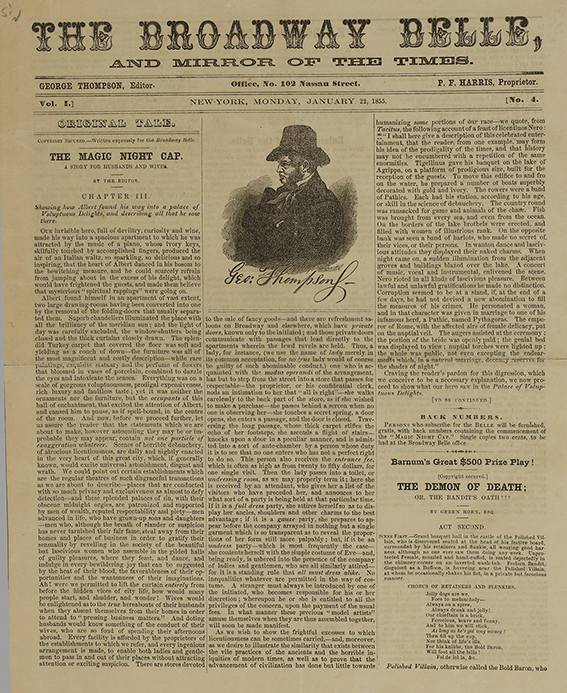
The major determining factor for the title changes, recombinations, and reversions seems to have been a battle for editorial control and legibility between proprietor Prescott Harris and Thompson. Thompson edited The Broadway Belle, and Mirror of the Times from January 1 to February 12, 1855. After the ambiguous scandals detailed in Chapter 2, Harris takes over editorship until March 12. The New York Shanghai, a new vehicle for Thompson, finds his editorship backed by a new financier, “WM. Kingsley & Co.”Footnote 21 But Harris, it seems, couldn’t stay away. The New York Shanghai merged with The Broadway Belle in September 1855, with Harris and Thompson back in their initial roles as proprietor and editor, respectively. Alas, this happy reunion proved fleeting. The September 24th issue of The Broadway Belle, and Mirror of the Times found Harris back in the double saddle as editor and proprietor, a seat he would occupy until the last known issue, two weeks later, on October 1, absent Thompson.
In assembling the characters and narratives that anchor this study’s chapters, various challenges and opportunities have emerged from the interplays of serial editorship and sexual expression this book takes as its topic. A newspaper in a self-consciously informal genre maintaining an unusually porous relationship between fiction and lived experience, The Broadway Belle resists simple reading for reliable information. Parsing basic local news, sketching various correspondents and special features, and following the dramatic editorial upheavals requires a generous array of methodological tools from periodical studies. These include careful attention to advertisements and other juxtaposed content, ongoing focus on the material of addresses, dates, and masthead listings, and grounded speculation about how the surface meaning of published content outlines social or professional dynamics pushed just below the printed page. These strategies provide the methodological framing for encounters with a distant social landscape multiply estranged: by virtue of the obscene and underground orientation of all flash press titles; by the slangy clannishness of lower Manhattan’s antebellum Newspaper Row; by the deliberate aesthetic and editorial choices of one George Thompson. Put simply, reading The Broadway Belle as anything like a stable print object is surprisingly hard. Despite – or perhaps because of – these challenges, The Broadway Belle offers discernable thickness, a density of referential possibility reflecting the girth of Thompson’s ambition and imagination.
Difficulty piles on difficulty, inviting various complexities into relation. Beyond the ambiguity of the Belle’s content, histories of printed obscenity and pornography in the US add additional intricacy. The term “pornography” did not appear in US dictionaries until 1864.Footnote 22 Instead, historical terms for sexually arousing texts or images in the antebellum period included words like “fancy… obscene, lascivious, lewd, libidinous” or, a personal favorite from an advertising catalogue, “works of the voluptuary.”Footnote 23 Despite its absence in official lexical records, both Dennis and Kathleen Lubey use “pornography” as a meaningful analytical category for contemporary analyses of sexually arousing historical printed matter. Dennis stipulates that her use “refers to literary or visual representations that presented sexual behavior or sexual organs in overt form … that intentionally violated… moral, cultural, and legal taboos.”Footnote 24 Lubey’s What Pornography Knows offers a definition both more specific and more theoretical, defining pornography as “accounts of genital activity that are embedded within narrative and that connect to a social world beyond the immediate action.”Footnote 25 Less strictly helpful is Supreme Court Justice Potter Stewart’s famously subjective definition, asserting of what he called “hard-core pornography,” “I know it when I see it.”Footnote 26
Although the term we recognize now may not have existed then, The Broadway Belle registers a desire to provoke titillation, arousal, or even something like erotic amusement that we recognize in content we might deem pornographic, from the gentler Skinimax variety through depictions of kink, BDSM, barebacking, and other practices.Footnote 27 In this book, terms like “erotic,” “arousing,” or “obscene” name the many ways The Broadway Belle leveraged innuendo, word play, and sexual association to situate the newspaper as a sexy/sexualized embodied female, her editors as husbands and pimps, her readers a vast net of sexual beings. Yet rarely do readers encounter a sexual specificity swelling to the tumescence of “explicit.”Footnote 28 At least, not until the ladies take charge. Chapter 3, which explores the Belle’s “Ladies’ Column,” notes the shifting tone and purpose of the paper’s sexual stratagems. Specifically, the Ladies’ Column letters and characters enthusiastically wield the tropes of explicitly sexual content of the time, many of which would come to be hallmarks of heterosexual pornography, including sexualized encounters with strangers in public, “confessions” from female-only communities, accidental exposures, and sex play prompted by the mutual reading of erotic texts. In the final chapter, the leering smirks and knowing winks of male editorship give way to deliberate representations of fondled and fondling female bodies.
The terms and theories of pornography help this study press on the tensions of historical and contemporary assumptions about sexually arousing content. Absent a term for “the thing,” would 1855 readers recognize the proliferating phallic references, the barely euphemistic erotic fiction, the elaborate textual come-ons for “mail/males” as sexually situated content? Without a doubt, they would. Thompson was counting on it, and the paper was selling on those very conceits. Additionally, the Belle could build on running sexual jokes, puns, and plots through the important mechanism of serial publication. Just as readers of “The Magic Night-Cap” – discussed in Chapter 2 – would tune in and turn on to read the latest installment in the lives of its nonmonogamous newlyweds, so too would readers of the correspondence columns and articles pick up where they left off, revisiting their Belle’s “ever open… columns,” relishing her tarries to “play with the mails,” and welcoming letters even so “rich” they might only be “insert[ed]” at a later time.Footnote 29 Part of the “sex work” of The Broadway Belle, then, was the recurring work of serial content creation and editorial address, how editorial correspondence and serialized fiction, minor squibs and even advertisement, worked across issues to develop a discourse community united by shared vocabulary and mutual coded references. These activities of shared meaning-making are the terrain of editorship. A set of collective norms and interpretations might as robustly emerge around questions of racial justice, or regional identity, or political goals. But in this case, they emerge from what are, at bottom, a long and diffuse series of dick jokes, “that’s what she said” set-ups, and quasi-feminist obscenities.Footnote 30
In the chapters that follow, I explore the first title across its many editorial dramas and dilemmas, focusing only on the nine issues of the founding iteration of The Broadway Belle, and Mirror of the Times. As a text that foregrounds editorial self-referentiality through depictions of sexual fantasy and erotic encounter, the first Broadway Belle offers an object lesson in the simultaneously emergent discourses of sexual proclivity and professional editorship.Footnote 31 Each chapter in this volume pairs a conceptual component of editorship with a culturally “sticky” idea about gender and sexuality gaining traction in the US. For example, Chapter 1 explores how masculinist representations of sex work were built into and developed through the newspaper’s serial affordances, uniting the city’s paper and its women as at once powerful and disposable. Chapter 2’s analysis of editorial supremacy shows that editorial labors to organize the world for readers include unrelenting displays of professional accomplishment and moral authority cast in distinctly male-dominated terms. In Chapter 3, the proto-Penthouse Forum dynamic of the Belle’s Ladies’ Column surveys the local embeddedness of effective print circulation: as representative “women on the town” in recognizable locations, the Belle’s presumptively female writers encouraged a wide assortment of identifications spanning actual byways and imagined gathering places of New York. Addressing overlaps of professional and sexual discursiveness in The Broadway Belle’s singular style, chapters offer narrative installments in the longer histories of sexuality and editorship in the US. Each briefly considers a distinct rhetorical gesture – the smirk, the wink, the “dropped item” – that operates at the intersection of erotic code and professional performance. Taken together, these chapters invite us to imagine histories of sexual encounter and erotic imagination through the fleeting connections and unstable representations of an exceptionally precarious serial form.
The constellation of Broadway Belles offers much to explore about the sex work of the flash press in cultural histories of iterative white metropolitan sociality. The newspaper’s fantasies of interlayered regional and gendered reading communities likewise enrich our understanding of the print possibilities for erotic attachment. Editorial Masculinity and the Sex Work of Print can only scratch the surface of this unusual set of connected serial publications. I hope it offers for readers a snapshot of the life of one weird serial in the US history of ephemeral erotica and encourages additional conversations about the intersecting relations between periodicals and sexualities.
1 Editorial Masculinity and Forms of Control
As typical for flash press titles, The Broadway Belle, and Mirror of the Times included thinly veiled references to local figures. Eager to stand out in a crowded field of small, cheap newspapers, the first issue of January 1, 1855 came out swinging at various neighborhood icons. The very first column on the very first front page was a first-time printing of a brand-new play that, the editor claimed, had just won P.T. Barnum’s award for the “best ORIGINAL PLAY” to be “especially adapted for performance at the American Museum.”Footnote 32 The first act, as printed in the Belle, appears to be an elaborate setup to troll Barnum. Even explaining the joke is laborious. But doing so helpfully demonstrates the assertive insularity characterizing the Belle’s engagement with the subcultures of New York City professional life.
At the curtain close of the single act of the purportedly award-winning play ostensibly selected by Barnum for performance at his museum, “enter a score of newsboys, with Bunkham’s Autobiography. Universal yells of fury, and curtain falls.”Footnote 33 As a punchline, this final sentence (as a final theatrical moment) is so self-referential and petty that it reads as a parody of a joke about New York provincialism. It presumes that at least some readers were at least vaguely aware of a dispute between these outsized actors of lower Manhattan print culture. Simultaneous to his editorial debut with The Broadway Belle, Thompson had written a satirical autobiography of P.T. Barnum called The Autobiography of Petite Bunkham, the Yankee Showman. The back page of the Belle advertised this non-autobiographical autobiography for sale, and a tiny squib in the paper’s middle clamored for “honor to whom honor is due,” breaking the news that “‘Petite Bunkham’ was not written by Mr. Barnum, as some people suppose, but by the editor of the Broadway Belle.”Footnote 34 Like many a newspaperman before and after, Thompson’s tenure in the editor’s chair was distinguished by self-promotion as an editorial strategy. In this, he bore a closer resemblance to Barnum than his ballyhooed antipathy might suggest.
Barnum, not one to have his obvious pufferies deflated or his bad reputation sullied, had already sued Prescott Harris, the publisher of Petite Bunkham and financial backer of the Belle, for libel and tried to suppress the false autobiography’s publication. The battle went back to November of 1854, when Barnum applied for an injunction against Harris from the New York Supreme Court. Barnum claimed Harris “has ordered five hundred copies of a showbill, to be publicly exhibited by booksellers and others” for a book titled, “‘Your Money or My Life – Autobiography of Petit Bunkum, the great Yankee showman.’”Footnote 35 Barnum viewed the book and egregious showbill campaign as attempts to “injure the sale of said book [Barnum’s actual autobiography], to bring this plaintiff into disrepute, to injure his character, and to hold him up to ridicule and contempt.”Footnote 36 Skeptical newspaper coverage viewed Barnum’s suit as a “dodge” and a stunt “to create an excitement.”Footnote 37 Presumably, some local readers of the new Broadway Belle had seen Harris’s showbills posted around Broadway, the Bowery, Ann Street, and otherwise. This feud was also trumpeted in the back-page ad for the edition printed by the Belle’s proprietor, Prescott Harris, and written by its editor, George Thompson.
Just as Thompson asserts in his opening column that “many of you will recognize me as an old acquaintance,”Footnote 38 so does this satirical drama invite the smirk of recognition, the flush of insider knowledge of the Belle’s dense byways of theaters, brothels, bars, and diversions of all sorts. The opening humbug on Barnum seems intended as a virtuoso performance of Thompson’s neighborhood resentments and professional dynamics. Many previous editors of flash ilk had likewise leveraged resentments, misdeeds, and legal proceedings to draw attention and capital to their titles. Even as some readers took blackmail threats seriously enough to expend money on them, it would have been difficult then – and almost impossible now, from historical and geographical distance – to assess what was real and what was an editorial gamble on street-level chatter.Footnote 39
The “Great Prize Play!” offers a preview of The Broadway Belle’s particular entry into New York City’s antebellum periodical history. As an opening gambit for The Broadway Belle, Thompson’s “Great Prize Play!” reveals his embeddedness in the shifting promotional and performative cultures of lower New York. It also offers a glimpse of the ironic pettiness and playfulness that will distinguish his time in the good and bad graces of the Belle’s financial backer. Additionally, the elaborate set-up highlights an indeterminate interpenetration between authentic texts (Barnum’s actual autobiography), publications pretending to be genuine entries in a recognizable genre (Thompson’s fake Bunkham autobiography), and invented, incomplete projects purporting to comment on the former two (“The Great Prize Play!” which may or may not be a “real play”). The mocking indeterminacy and local referentiality operate at the register of “the smirk,” asserting insolent knowledge at another’s expense.Footnote 40 Flaunting superiority adjacent to active disrespect, what Barnum’s lawsuit called “hold[ing] him up to ridicule and contempt,” Thompson’s drama sets a tone of mocking sportiveness that also permeates his editorial representations of women real and created.
As a serial novelist-turned-editor, one of Thompson’s major imaginative designs was to introduce a rich system of recurring characters in the creative life of the paper. We’ll meet them in a few paragraphs. Initially, the Belle’s back page – usually for advertisements and print job notices – uses a subscription posting to introduce a feminine energy of escalating explicitness. In the January 22 issue, a “Fashionable Introduction” details the charms of this Belle for “The Ladies and Gentlemen of America.” She’s “a lady of much celebrity and great personal beauty, known as The Broadway Belle, who is represented through the medium of a weekly journal… .We have secured the services of several LADY WRITERS whose lively, piquant pens will contribute much to the spice and sparkle of our columns. These fair ones, each of whom is entitled to the appellation of a ‘Belle,’ either on Broadway or else-where, will impart a recherche vivacity, an originality and a freshness, not, we venture to assert, to be found in any other periodical published in the United States.”Footnote 41 As is often true in the Belle’s serial landscape of ironic obscenity, the copy seeks to have it all ways: referring to these (apparently) fictional “lady writers” as “fair ones,” the introduction situates them in a social system that differentiates these women from their “frail sisters” by only the slimmest of margins.Footnote 42 The term “frail” was widely used in Anglophone print cultures as a euphemism for women in sexual underworlds, denoting their frail moral character. Some descriptions compress the two terms, deploying “fair frail ones” to describe sex workers and endangered women of other professions and social standings. What would otherwise be a typical invitation for subscribers casts infamous Broadway women as creators of the paper’s content and avatars of its persona.
As has been well documented in a host of scholarly works, the social and economic landscape of New York City’s illicit eroticism during the antebellum period rivaled only notorious New Orleans in popular imagination and moral outcry. Since the publication of Timothy Gilfoyle’s essential City of Eros (1992), studies of what was once called “prostitution” and is now more often referred to as “sex work” have continued apace.Footnote 43 The subscription invitation text elides the distinction between the newspaper as a print object, the celebrated and beautiful (paper) lady the Belle embodies, and the “lady writers” of “Broadway or else-where” who furnish the details decorating her pages. If a typical editor of the era imagined a paper as his “organ” for a distinct community of readers, Thompson goes several steps further in imagining the newspaper as a kind of sexualized ouroboros: The text is representative of a particular, elevated woman of the street, written by women of the street, circulating in print as a woman of the street.
1.1 Dramatic Interlude: Cast of Characters
The Broadway Belle. A beautiful, fashionable, irreverent, possibly polyamorous “girl on the town.”Footnote 44 Cut from the same cloth as Helen Jewett, minus the sordidly epic tragedy.Footnote 45 Although Belle is the major organizing persona of the newspaper’s identity and a singular source of its appeal, she almost never speaks for herself.
The Editorial Husbands. Enter two, both real historical persons.
George Thompson, original editor. Self-deprecating and self-confident in equal measure, witty, obscene, highly inventive. A very busy man who also writes successful serialized and published fiction of lurid exposé and licentiousness. Rotund; prone to gustatory and imbibatory excess. As editorial husband, has an expansive view of monogamy – not considering it highly relevant for marital success – but watches carefully and judiciously over the fortunes of this paper, his favorite.
Prescott Harris, original proprietor & eventual editor. Independently wealthy by his own published admission, inordinately fond of life’s little luxuries and, by all accounts, potentially litigious holder of grudges. More conventional than Thompson, perhaps a bit of a homebody. Almost never takes his Belle for a spin about Broadway; always happy to invite “mail” guests to her apartments.
The Gay Devil. A persona undertaking basic operational management at the paper, including reportage and fact checking, typesetting and print preparation, and correspondence. Variously described as “innocent” and “a mischievous, thieving rascal.”Footnote 46 Latterly depicted as gender indiscriminate.Footnote 47
Nina, AKA Miss Fanny Temple, possible AKA “Fashionable Courtezan.” Fiercely committed to editing for the Belle and her alone; “Director” of the exceptionally popular and busy “Ladies’ Department.” Self-confident enough to resist both rumor and direct appeal that she abandon the Belle. Invested in the modesty, wittiness, and brevity of her department, while also willing to mediate between lady letter-writers and “editorial husbands.” Possibly the same “Nina” featured in a long and complimentary interview detailing the daily life of a “Fashionable Courtezan.”Footnote 48
Delie from Brooklyn. Originally signs as “Adele” but affectionately known as Delie in her role as Brooklyn correspondent. From long lascivious experience, she views the Belle as a “Dear Little Sister” to whom she offers much praise and many suggestions for editorial success. Coquettish and inconstant, as evidenced by epistolary flirtations with “Ovid” and “Our Ned” and a penchant for obscene puns and sexual innuendo. Overwhelmingly interested in the queer revelations of “Kate M,” another regular correspondent.
Assorted Lady Writers: A Chorus
Kate M. of “Spinster Institution.” The edgiest of the Lady Writer Chorus. Finds in the Belle a cherished confidant to detail the “438 charms” of the “146 sweet girls” she rooms with.Footnote 49 Almost certainly polyamorous yet cautious to spare the Belle’s modesty, as when she dares not “tell… what took place in the study on Sunday night.”Footnote 50 Eventually ceases correspondence in response to increasing publicity. Susie Sumner of Fifth Avenue. Purported daughter of a Fifth Avenue swell who claims he’s proud of her published letters. Avid reader of softcore pornography from the Belle with her beau, the dashing Fred. Gay Widow, Carrie L., Emma, Josephine. Additional correspondents who share Valentine poems, dirty jokes, marriage invitations, and disclaimers.
L.C. Grimes. One-time letter writer and short-lived director of “Harris’s Sporting Life in America” department.Footnote 51 Professes an affinity with the values of Young America. As indicated by the immediate failure of the “Sporting Life” department under his charge, Grimes is an ineffective reporter.
Our Jake.Temporary substitute for the highly valued labors of Gay Devil and the local newsgathering of George Thompson. Arrives late to the Belle’s roster as an “invisible reporter.” Short accounts suggest he is highly pugilistic and possibly unpleasant: He “sleeps with his eyes open” and “is always prepared” for anybody who “wants to lick him.” Favorite place for said licks is the Artillery; office, where he sleeps open-eyed, is Harris’s print shop at 298 Broadway.Footnote 52
Although the titular Broadway Belle remains the most constant of inconstant companions, members of this expansive roster all take turns contributing to the Belle. It seems likely, with the exception of Harris and Thompson, none of them represent actual humans. Highly scripted and energetically sexualized characters float through the pages as editors and correspondents, and the degree to which they report genuine information about New York City is difficult to assess.
1.2 Seriality Meets Sexuality on the Street
Across the surviving original issues, the Belle proposes the print genre of the newspaper as a formal experiment in fictionality. Emphasizing stories about its own operations, the Belle offers an unusual encounter with periodical meta-fiction. If it’s hard to tell what’s news and what’s invention in the Belle’s city coverage and the details from various contributors, harder still to separate fact from fiction in the managerial dramas and alterations that become the newspaper’s coverage. Throughout the Belle’s expansions, personnel changes, and title alterations, its content increasingly details internal disputes and editorial calculations. As Molly Hardy and Lindsay DiCurici have described, following the Descriptive Catalogue of Rare Materials (Serials), “Newspaper news is ‘on current events of general interest.’”Footnote 53 What’s striking about the “news” in The Broadway Belle is its self-referentiality – the Belle is mostly interested in … . itself.Footnote 54 There are occasional reports of theatrical productions, sporting events, and, in one notable case, a discussion of a political candidate.Footnote 55 But mostly, the current events reported in the Belle are updates about the current state of the publication’s editorial control and the minutiae of professional jockeying for visibility amongst the Belle’s stable of contributing writers, many of whom are fictionalized women written into being by Thompson’s own hand. Elevating his Belle as singularly enticing and denigrating her as endlessly available, Thompson uses the temporal affordances of serial iteration to tease editorial access to a host of paying readers cast as willing johns.Footnote 56 Leering his way alongside a promenading Broadway Belle, that “lady … represented through the medium of a weekly journal,” Thompson’s early forays into editorial address connect long-standing assumptions about the physical appeal and moral flexibility of sex workers to the curatorial and representational labors of editorship writ large (see Figure 2).
Detail from a later version of The Broadway Belle and New-York Shanghai, vol. 1, no. 8, September 3, 1855.
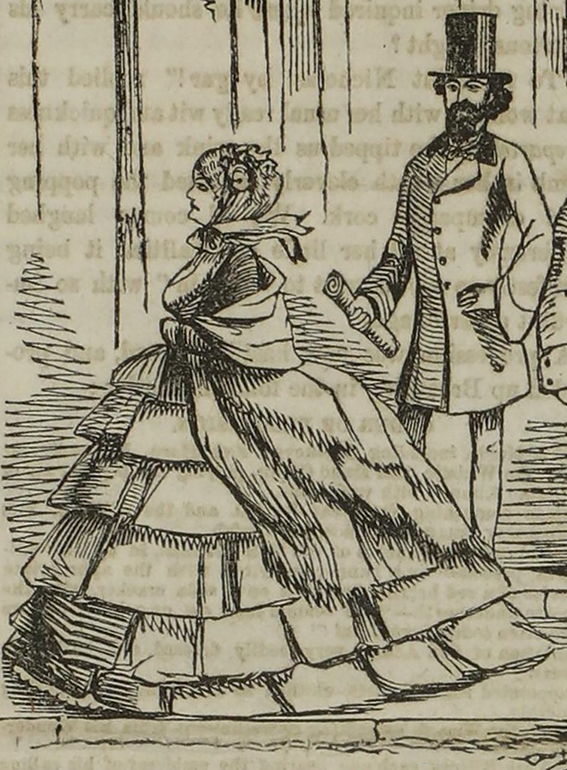
Thompson – perhaps with the contributions, and certainly with the approval, of Harris – presents the Belle less as a news-gathering operation and more as an extended performance piece where fictional opportunity is dictated by the conventions of newspaper styles cribbed from the penny press and the earlier flash papers.Footnote 57 Developing the Belle, Thompson made the most of a newspaper’s varied forms and features from the instrumental to the imaginative, leveraging components like correspondence columns, letters-to-the-editor, serial fiction, and local updates to present a glancingly-real New York City served by an almost newspaper edited by a mostly editor.Footnote 58 In the extended experiment of the Belle as a kind of newspaper “reality effect,” a formalized print setting “intended to excite the admiration of the audience (and no longer to persuade it),” Thompson’s creative license frees his representations of editors and editorship from the humdrum conditions of professional comportment; the dramatic editorial personae don’t quite reflect human individuals in any meaningful sense.Footnote 59 Instead, characters pick up and put down various starring roles in the insular drama that is the a-la-minute life of The Broadway Belle. As they do so, they illuminate various professional expectations and practical models that characterize the labors of editorship across the period when “editor” was emerging as a discreet print professional identity. The Belle’s particular editorial innovation lay in its intentional blurring of two arenas that sat lightly together in the lower rungs of the press: the crafting of editorial personae and the active invention of newsworthy detail. Thompson wrote his fictional pursuits into the plot of the Belle’s editorial apparatus, dramatizing masculine commitment to such a rare beauty as his model paper.
As a prolific city mystery writer and fleshy newspaperman, Thompson slid through a hyper-masculine quasi-professional space where barroom nights surrounded by questionable women were both pleasure seeking and news making. For all their self-reported involvement in the moral projects of exposé and social reform, the flash press editors – Thompson, a literary celebrity amongst them – were fundamentally a late-night boys club of sporting men who, more often than not, had served jail time for libel and defamation.Footnote 60 Thompson’s dramatization of editorship is in many ways a flashy extension of, but not a complete departure from, the self-mythologizing of landmark city editors like Horace Greeley and James Gordon Bennett.Footnote 61 Donna Dennis claims, “much of the output of the flash press can be read as a sarcastic response to the increasing visibility of evangelical proselytizing and bourgeois assertions of female moral authority. When the flash editors postured as self-righteous citizens… they expected their audience – men well versed in the city’s manifold types of commercial leisure and sexual pleasure – to be in on the joke.”Footnote 62 Dennis suggests that one major organizing address of the flash editors to each other and their male audiences was the very smirk of ridicule we’ve seen already, often set against “evangelical proselytizing … . and female moral authority.”
Self-aggrandizing self-referentiality was not a unique innovation of Thompson’s racy editorship. From its inception, the flash press depended on distinct forms of serial feedback and local insinuation. Reading across the Belle’s almost complete run of winter/early spring 1855, the bombast of initial columns marks a distinct tendency for Thompson’s first editorial tenure and the drama that follows. As Andie Tucher describes the penny press, sensationalist papers’ relation to truth was aspirational and symbolic: “a newspaper’s main duty was not to inform so much to regulate… . a true incident was one that harmonized with generally accepted and generally understood patterns.”Footnote 63 Tucher’s study of an editor’s eye view of the truth gives historical context for how editors shape the world: their newspapers give form to an era’s pandemonium and offer selective versions of collective meaning to readers.
A fundamental component of shaping periodical meaning from reality’s chaos is seriality. Seriality and the texts classified as “serials” are characterized by a wide range of strategies.Footnote 64 Many of these – such as repeated features, interactions with an audience, parceled-out fictions, distinct sections for types of news, reprinted content, and many more – are formal or structural mechanisms for shaping emergent, unanticipated, or ongoing events into a coherent and consistent package. That package, essentially, is the print object we call “newspaper.”Footnote 65 In Umberto’s Eco’s canonical survey of “modern and postmodern aesthetics,” he details a wide range of serial formats, distinguished by their “repetition, iteration, obedience to a pre-established schema, and redundancy.”Footnote 66 One way the Belle engages these formats is through the sheer number of letters, articles, and throw-away lines that partake of the serial fantasy of the printed Belle (a newspaper) as a professional Belle (of Broadway). This character, and the enthusiastic embrace of her as the original engine of the paper’s appeal, represent a singular innovation that ensures the paper’s popularity even through Thompson’s departure.
Serial works are by nature fragmented and iterative, so they may display greater attention to the mechanisms of their own production. Describing the balance of novelty and continuity across time, Matthieu Letourneux highlights the narrative self-consciousness and referentiality we encounter in the Belle’s hyper-self-awareness. According to Letourneux, the “serial,” form offers “a set of episodes or stories linked together by narrative and chronological features… . such stories diegetize the principle of seriality by incorporating the seriality of the format in which they appear (such as the newspaper) in the story lines.”Footnote 67 For Eco, a “work that speaks of itself … of its own structure, and of the way in which it was made” is a work capable of “self-irony,” rendering the line between “highbrow arts and lowbrow arts… very thin.”Footnote 68 While it’s unlikely that contemporary or contemporaneous readers of the Belle would mistake it for highbrow art, Eco’s insight about the blurring effects of meta-narrative self-irony informs other distinctions that the Belle unsettles, between fiction and news, between female bodies and print ones, between embodied and textualized sex acts.
1.3 Newspaper as Fiction, Fiction as Editorial Preparation
Unafraid to proclaim his identity and willing to leverage that notorious persona for newspaper content, Thompson was following the pattern of editorial giants like Bennett and Greeley. But Thompson’s mingling of editorial labor and novelistic design was also uniquely framed by long experience as a writer of serial fiction. By the time he shot his “Editor’s Bow” in the Belle’s first issue, Thompson could confidently declare, “Many of you will recognize me as an old acquaintance, and to such I will merely say, ‘How are you? You know me, and that is enough’.”Footnote 69 Thompson was already a famous fictionalizer of the subcultures and sexualities that rendered New York City such an exciting and dangerous place. The Broadway Belle didn’t have to start from the bottom to establish its flash press credibility or to clarify the sorts of “spice,” “talent,” and “experience” its readers might anticipate.Footnote 70 This was a departure from many of the genre’s earlier editors, who employed pseudonyms, routed their work through “publishing houses,” and otherwise sought to avoid the spotlight and hopefully the courtroom. Understanding a distinct opportunity to develop the Belle as a source of original content and “naked truth,” Thompson paraded his name, his previous publications, and his newly acquired newspaper companion with aggressive transparency.
As charismatic as Thompson’s editorial bluster might be, his attention to New York’s sexual cultures of excess, publicity, and dubious female empowerment did not emerge sui generis from personal predilection. The rise of commercialized companionship – erotic or otherwise – and ongoing public debates related to matters like contraception and abortion, seduction and abandonment, helped frame the conversations and values circulating in a range of flash titles. The Libertine, one of the most elusive and enticing papers in the AAS collection, seems to have had a semi-regular feature in its semi-regular print schedule entitled “Memoirs of Celebrated Females.”Footnote 71 Echoing the sexy pedestal on which Thompson would place his own Belle, the “memoirs” elevated in/famous women whomst ruination did not diminish. Among the profiles featured in the single preserved issue, common refrains of sympathy expand to less conventional admiration for beauty, wiles, even an almost wholesome identification: as The Libertine concedes, “the flower of American beauty being found amongst our common prostitutes.”Footnote 72 The Libertine was most likely short-lived; appearing in the heyday of more famous titles like The Flash and The Whip, it was mired in a competitive market and not diligently collected. But its single issue stands out for accessible coverage of “fallen women,” which humanized their lives and validated their achievements.
Four weeks into his editorship, Thompson settled on an original gimmick by doubling down on the racy tradition of celebrated females. Thompson may have had features like The Libertine’s in mind as he unspooled his most extended fictional foray into editorship: creating the newspaper as a feminized character.Footnote 73 Thompson had already appropriated this racy feature for his fiction. As Heike Steinhoff describes, the sympathetic portrayal of “erotic and sexual encounter, seduction, and exploitation” in Thompson’s and other city mysteries was a direct offshoot of the flash press; he asserts that the genre’s accounts of threatened and threatening women follow “a similar pattern as the ‘prostitute profiles’ featured in the flash press.”Footnote 74 But Thompson being Thompson, he took the gag one giant step farther, imagining a woman who lived not so much on the page as she issued forth from it. His Broadway Belle promenades the city decked in yards of newsprint and bejeweled with correspondence. This personification is essential to the apparatus of the paper’s serial world-making and part of the inventive charm that may have driven its circulation, as the Belle’s creators conceptualized print characters beyond the conventional scope of editorial mediation. The Broadway Belle offered a serial experiment in fictionalized form whose energy derived – at least in part – from the delicious promise of weekly anticipation.
Later chapters will discuss Editorial Husbands (Chap. 2) and lady writers (Chap.3). In the remainder of this chapter, I’ll explore more fully the character of the Belle herself, the major organizing figure of the paper’s many iterations. As a serialized intimate, the Belle can be understood, in John Mercer’s terms, as a sexual “Prototype… a fantasy object … possessed of an extreme or exaggerated iconography” produced through “a system of exchange and consumption.”Footnote 75 Such ample opportunity for projected meaning derives from repetition. Showcasing minor distinctions across representational moments and contexts, the Prototype is a meta-serialized character. As an “idealized object,” Mercer’s sexual Prototype invites an “active process” of meaning-making because of its highly iconic nature, as readers project their own activated fantasies and pleasures.Footnote 76 In another useful description of serial repetition’s erotic implications, Sarah Schaschek theorizes the “slut” through both pornographic and polyamorous iterations, which promise “utopian reappropriation of the slut – as both intimate and casual, committed and anonymous… . [which] reintroduce a rhetoric of intimacy and authenticity… particularly by readings of the slut as ethical, self-confident sexual agent.”Footnote 77 Personified as a flirtatious companion, an open-minded city gal, even a welcoming lover, the Belle offers encounters with a meta-layer of editorial commentary and a meta-representation of idealized illicit sexuality.
The Belle’s prototypical presentation of a high-end sex worker also exploits the representational affordances of seriality’s balance between repetition and difference. For the men who frequent or fantasize about commercial sexual encounters, part of the appeal may be the abstracted ideal captured in Mercer’s theorization: sex workers are differentiable but also substitutable. For women who recognize in the Belle their own lives or the lives of their “frail sisters,” the same might well appeal. As described in an interview with Nina, “The Fashionable Courtezan,” male companions too could be swapped in and out. Revealing the internal calculations that shape her business model, Nina narrates an evening’s partner negotiations: “perhaps some gentleman instantly attaches himself to me… . if I like his looks, the matter is settled at once; if not, I beg him to excuse me… [and] introduce him to the prettiest girl among my companions.”Footnote 78 Here, both the working woman and the pleasure-seeking man understand the serial nature of their exchange: Any attractive and moneyed man, any pretty and available girl, will suit just fine; each type is the same type; each encounter is both new and familiar. Thompson’s own dramatized editorial persona vacillated between heavy control over the Belle’s prospects and a rollicking invitation to prospective suitors in the roles of readers and correspondents. In the Belle’s Belle, Thompson presents a sex worker of textual proportions and installs himself as her pimp.
In this role, Thopson’s management of the Belle offers limited opportunities for her direct address to readers or writers. Very occasionally, the feminized Belle character will flash her racy credentials through sexual innuendo and gender experimentation. In one of the more direct examples, the correspondence column prints a letter from “Danbury” that reads, “‘Dear Belle, we have seen your face once, and as we wish for a continual feast of good things, we have come to the conclusion to have you show us your face weekly – that is, if you are not afraid to trust yourself with the mails.’ To this the BELLE replies – ‘You have sent me a fee – therefore, being a male, you are a fee-male–and I am not afraid to trust myself with any one of my own sex–or of any other. I will cheerfully become your weekly companion; I will bring you all the luxuries of choice reading which I can gather; my dress shall always be neat, my face pleasant and agreeable, and you may introduce me to as many of your friends as you please.’”Footnote 79 Beginning as an address to a recognizably masculine companion paying for her company, Belle transposes this male into a women – a “fee-male” – in whose company she would have nothing to fear. Beyond that, Belle reveals that she fears not the company of “any other” sex (gender) and is available for introduction to as many other friends as any of her companions – in any of their gendered bodies – might wish for.
As a serial publication, any one issue of The Broadway Belle may stand alone but also connect to its fellows. Thompson’s fictionalized style of editorial commentary and his use of the correspondence column as a particular narrative device encourage readers to imagine a continuity of embodiment and intimacy across the paper’s weekly printings. The many serialized imaginative fictions penned by Thompson, which represent a robust percentage of the paper’s content, operate similarly to invite extended engagement with each new issue. Printed notices of reprints and resales of “back numbers” heighten the effect, as updates about available previous issues encourage dedicated readers to lay their hands on what’s missing. In the Belle’s meta-narrative of sexual self-awareness and gender play, Thompson’s interest in serial narrative and his desire for editorial control find common cause. Imagining his Belle as saucy, welcoming, and good-humored, Thompson endows her with the characteristics of a most desirable urban maiden, always ready for a promenade and ever preparing for the next performance.
1.4 Editorship Enters the Chat
Using editorial columns to trumpet circulation, advance pet causes, or directly address the reader was nothing new by 1855. Penny Press and City Daily editors had been doing so for decades before Thompson. Seemingly less interested in using editorial statements to underscore readers’ “sense of self and communal identity,”Footnote 80 Thompson took on the Belle as a kind of virtuoso authorial experiment in editorial theory, pulling the affordances of newspaper format into flouncy new shapes.
The Broadway Belle in winter 1855 partook of several direct-address editorial conventions, running introductions and updates like “The Editor’s Bow” and “Enlargement of the Belle” in the typical second-page left-side columns.Footnote 81 The first issue also inaugurated the popular feature of correspondence from readers under the heading “Editor’s Chit-chat” (see Figure 3). As initially invited, “Correspondents must write plainly, briefly, and to the point… .We shall be happy to furnish our readers with any information which they may desire; and all proper questions shall receive suitable answers, if it be in our power to give them.”Footnote 82 At once, the chit-chat establishes a taste for innuendo and insularity on behalf of its editor and for the pleasure of its readers. The very first address is to “Sophia” – “accomplished, we know… beautiful, we think” – whose correspondence proves “altogether too spicy, too boldly voluptuous for publication… .to attempt its modification, would be like dimming the luster of burnished gold.” Revealing the lecher he’s been all along, the chatting editor confides, “We shall carefully deposit the effusion in our private cabinet, to serve for our own edification and that of our intimate friends.”Footnote 83 The column is bookended with an address to “A Fallen One,” advising the writer to “leave the brothel… and trust to Providence.” All well and good advice, gently managed, until the final line inviting her, “Come to us, and we will advise you further.”Footnote 84 Given that the chat begins with the thinly veiled confession that some correspondence furnishes meat for the editor’s own pornography collection, a liberatory invitation to an escaping woman provides a direct route from the frying pan to the fire for this fallen writer, who becomes another (textual) addition to the editor’s private collection.
“Editor’s Chit-chat with His Readers and Correspondents.” The Broadway Belle and Mirror of the Times, vol. 1, no. 1, January 1, 1855.
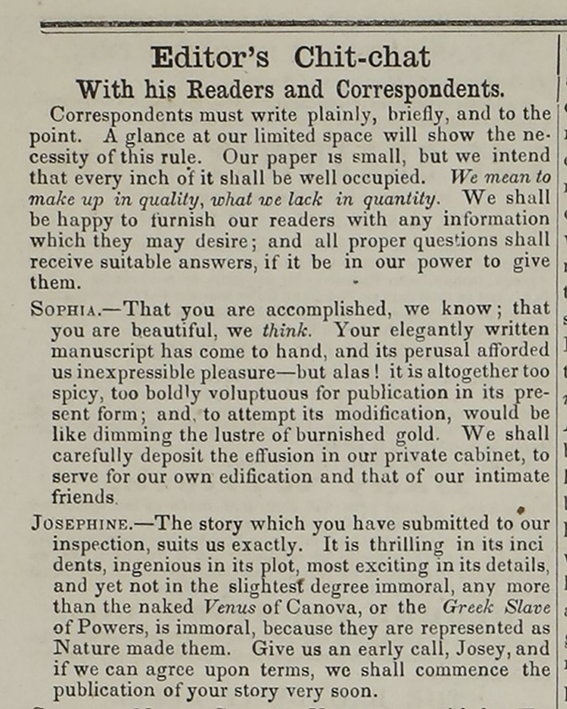
From the outset, “Editor’s Chit-chat” telegraphs intimacy in both form and content. This section appears in even smaller type than the rest of the paper, using roughly an 8pt font in contrast to the more common 10pt size. But the small type cannot contain the spontaneous overflows of powerful feeling that the chat records. By the fourth issue of January 22, 1855, it has ballooned to a page-length column plus overflow into the next, representing almost half an entire page in the Belle’s three-column four-page structure. In the tiniest font! In this issue, Thompson boasts, “we are very much attached to this particular department of our paper, for in it we can converse with our readers, subscribers and correspondents with as much friendly familiarity as if we were holding a personal interview with them. Therefore do we bestow especial attention upon our ‘Chit-chat.’”Footnote 85 Printed replies establish Thompson as a voice of authority. Addressing each letter writer by title, his responses remind them to keep in contact, scold those who exceed the bounds of writerly ability or decorum, and reprint praise for the new endeavor. It’s all fairly tame in content, if excessive in volume.
By the following week, Thompson had developed decidedly imaginative ambitions for his familiar chat. Along with a new four-column structure, the Belle has grown a whole new female body. This “Chit-chat” opens with an extended pregnancy metaphor tied to the newspaper’s measurable column expansion, as Thompson boasts, “you see that she has considerably enlarged her proportions – and this desirable pregnancy must soon result in the birth of something astonishing.”Footnote 86 Proving that no female body is beyond sexualization, Thompson delivers something astonishing indeed. “We must request of our contributors,” he continues, “on behalf of the BELLE,” he clarifies, “when they wish to insert their articles in her columns, to make those articles as pointed as possible – to push directly home to the subject under consideration – to remember that ‘brevity is the soul of wit,’ and to avoid being too lengthy beyond the capacity of the BELLE to receive their favors.”Footnote 87 For those keeping score at home, the opening paragraph for this conventional newspaper format – the correspondence column – includes a pregnancy metaphor, proposes a paternity conflict, with Thompson classifying himself the paper’s “editorial husband” and warning that “some of our correspondents may have the presumption to claim the paternity of several of her children,” and closes with the fantastical prospect of a polyamorous encounter as a range of epistolary girths and styles line up for a turn with his BELLE. And while this is an eye-opening (if not belt-popping) foray into column-inched arousal, Thompson’s virtuoso performance resounds the latent erotic encounters everywhere evident across issues. The collective sexual fantasy Thompson proposes straddles an all-too-recognizable line between sexual pleasure and sexual violence: absent a voice or even a body beyond the imagined torso, the week’s pregnant Belle, an icon for spread-legged and fecund femininity, is figured at the disposal of the many who ply with insertions. The sneer smears through the page. Especially in a correspondence feature like the “Chit-chat,” part of the ongoing intertextual pleasure of the serialized Belle character is the audience’s participation in sexualizing the print object itself as a woman, as writers and editors play with the limits of sexual punning and fantasy in the imagined community of male readers, racialized as white across varying classes, for whom the Belle is a female companion.Footnote 88
Expanding on a complementary vision of female sex workers, the January 29 issue features a long “Original Sketch by the Editor” entitled “The Fashionable Courtezan.”Footnote 89 Framed as an interview, the sketch draws heavily from The Libertine’s “Celebrated Females” tradition in introducing “Nina,” a “tip-top ‘woman of the pave’ … . a first-class courtezan.’” Isolated from “those who style themselves the ‘virtuous’ of her own sex,” Nina eschews the usual moralizing in favor of quotidian lifestyle details. Moving quickly past “the common occurrence of a woman’s being led astray and heartlessly abandoned by an unprincipled man,” Nina defines her ideal companion as “a man who can treat her… as a rational being worthy of some consideration and respect” and confesses that her life is “one of indolence and luxury.”Footnote 90 Lest a reader get the wrong idea, she hastens to add that “bodily comfort does not bring ease to the troubled mind nor happiness.” Thus lulled by gestures of conventional self-reflection and moral mea culpa, a reader may be less scandalized by Nina’s frank discussion of her daily walking habit – on Broadway, the pave – and her principles of companion selection. Describing how she manages the drunken, the handsy, and the otherwise unappealing, Nina could be any vivacious woman with exacting taste in men and self-composure. “My manners and general deportment in company are free and unrestrained, yet I never indulge in improper actions or language, and permit no undue liberties to be taken with my person … . I have an irresistible way of calming the turbulence of a wine-excited company.”Footnote 91 In her modesty, her self-awareness, her candor and her confession, Nina offers a presumptively real-life vision of the Belle’s own character.
Beyond the explicit line connecting the fashionable Nina and the generous Belle in their roles as New York City sex workers, the two highlight a professional dynamic driving the Belle’s imaginative sexual labor. Nina’s “day in the life” details her time as a “lady on the town” or “woman of the pave,” both euphemisms for feminized sex work with class pretentions.Footnote 92 “If the weather is fine,” Nina narrates, “I indulge in a promenade on Broadway, just to see the fashions, take the air, and, it may be, attract the notice of some desirable gentlemen.”Footnote 93 Almost a throwaway, Nina describes an essential part of her business outreach; far from a jaunt only for fashion or fresh air, Nina’s circulations are in part to “swell the number of my regular visitors.”Footnote 94 Evincing a strikingly similar logic, the Belle’s regional dissipation is dramatized as a series of engagements with “the mails,” a long-standing homophonic gag deployed in discussion of the size and range of her subscribers. Replying to John in “Black Rook Dam” (eastern Pennsylvania), the editor dismisses missing issues with a cavalier shrug: “Your Belle has been sent regularly, and if she has stopped to play with the mails on the way, it is not our fault.”Footnote 95 A single letter later, the editor expresses more concern to another Pennsylvanian, “C.L.B.” from Philadelphia: “I sent her [the Belle] along, and unless she was detained by the mails, she has presented herself to you ere this. Would you not like to see her every week?”Footnote 96 These two taken together illustrate what’s at stake for these puns – they establish the Belle as at once tending to tarry for mail play and as expressly vulnerable to mail detention.
The mutual representations of real and imagined courtesans – especially through the figure of Nina – previews the expansion of the Belle’s communicative universe in the coming weeks. Even as Thompson is forced out and brought back, disavowed and imprisoned, humiliated and vindicated, his once and future Belle undertakes something new: a Ladies’ Column “directed by Nina.” Perhaps suggesting the degree to which Nina the Courtezan is presented as a human avatar of the Belle herself, the Ladies’ Column is teased in the same issue recording the Belle’s uneven dalliances with Pennsylvania mails. Identified in a column called “It Pleases Us” as “Miss Fanny Temple,” Nina has a “binding contract… to write for the Belle and for no other paper.”Footnote 97 As the issues stroll by and Thompson’s stronghold on the Belle’s content gets decidedly more confusing, the Belle herself moves from a pose of open availability to all comers to serve as a kind of textual madam, especially through the use of Nina’s Ladies’ Column, directing spicy and exciting correspondence from women across the city into the hands of a slavering reading and writing public. But first, exit and return George Thompson, several times.
2 The Right Position: Professional Authority and Disavowal
When last we saw George Thompson, on January 29, 1855, he was riding high at the helm of The Broadway Belle, and Mirror of the Times. Circulation was spiking, with the January 22 issue claiming “thirteen thousand copies,” a mountain that exhausted the intrepid newsboys and necessitated the printer’s best efforts.Footnote 98 In the same “Chit-chat” where Thompson unfolded his expansive incitation for letter writers, he claimed no equal: “The editor of this paper does not acknowledge his superior in the United States, in his particular style of writing. This is not bombast, but… is presented as a satisfactory guarantee of the future excellence of the Belle, in all its departments.”Footnote 99 This suggests that Thompson writes all the Belle’s copy, for “all its departments,” on the basis of his vast experience fictionalizing at the edge of reality.Footnote 100
A scant two weeks later, all had crashed down and popped up again, in an eddying series of exchanges sunk just below the print deluge sightline. On January 31, The American and Commercial Advertiser in Baltimore prints the latest news from New York. According to the unattributed summary, “Yesterday [January 29, 1855], the police arrested a man named George Thompson, supposed to be the editor of a weekly known as the Broadway Belle, and PF Harris, for being engaged in the publication of the same. The charge brought against the parties is having published a scurrilous article entitled ‘Important to Husbands and Wives.’ The prisoners were brought before Judge Osborne, who held each of them to bail in the sum of $500 to answer the charge.”Footnote 101
Certainly, obscenity and libel suits – even jail sentences of up to thirty days – were nothing new to racy paper editors in New York City. Dennis describes how the early 1840s flash press and its editors became a testing ground for municipal obscenity regulation. Until pursuing the editors of the Sunday Flash and Dixon’s Polyanthos, “municipal authorities had never instituted obscenity charges against the proprietors of newspapers… despite widespread outcry that [penny papers] trafficked in scurrilous and licentious material.”Footnote 102 The first years of the 1840s were open season for these prosecutions; by 1843, “indictments were occasionally brought against the publishers of obscene papers,” as with The Broadway Belle, but “failed to stem the tide of sex and crime-filled weeklies.”Footnote 103 By the 1850s, what had once been editorial exposure to obscene libel prosecutions – often made on the basis of “whether [the offending contents] had a tendency to corrupt public morality” – shifted to threaten publishers instead of content creators like writers or editors.Footnote 104
Vulnerability to obscenity indictments was a calculated risk for a paper as cheekily sexual as The Broadway Belle. Unsurprisingly, the specter of legal proceedings failed to deter then-editor Thompson or proprietor/publisher Harris. Like others before him, Thompson recast legal disputes as funding opportunities, publishing a long-form newspaper article and book detailing a jail sentence. In September of 1855, the Belle’s “Picture Gallery” printed an image titled “Dinner Time in the Tombs” as part of the sales appeal for Thompson’s newly published Ten Days in the Tombs, presented “as a narrative of fact… equal to any romance ever issued from the press.”Footnote 105 Whatever happened to Harris and Thompson spun forth a web of accusations, apologies, recriminations, misdirections, and professional negotiations in the pages of the Broadway Belle.
In the extended narrative experiment of the original Broadway Belle, and Mirror of the Times, the editorial mêlée detailed in this chapter represents a central conflict in its fictional universe. At its root, this conflict is a drama of editorship prompted by the obscene experimentation that was the Belle’s publishing raison d’être. Spiraling out from a legal close call, the extended swordplay between Thompson and Harris clashes over essential frictions about who, how so, and to what ends we can identify or classify the responsibilities and privileges of the editor figure. The story of the stories about Thompson’s editorial relation to the Belle exposes the paper as a notable meta-commentary on professional editorship, with competing narratives about the Belle’s changing personnel dramatizing basic operations of editing and publishing. Ironically, in the process of calling each other out, the paper’s editors and writers obscured much about its internal operations. This drama offers an unusual vantage point on questions of professional legibility that have long characterized editorial labor.
2.1 The Infamous Issue
The issue that originally brought so much trouble to the Belle’s editor and proprietor, as indicated by the arrest date of January 29th and a reference to “Important to Husbands and Wives,” was Broadway Belle, and Mirror of the Times, volume I, number 5, January 29, 1855. The issue does contain an article entitled “Important to Husbands and Wives,” which is – certainly in context – only mildly objectionable. The piece offers advice from “a writer who has made matrimonial excesses, and their pernicious consequences, his principal theme.” Essentially, the article proposes sexual moderation as a social and interpersonal virtue: It calls for men to curb their “goatishness” and the “brutality of this passion” for the sake of their wives and themselves.Footnote 106 The content wouldn’t feel out of place in a moral reform newspaper either, those outlets being as imperfect a balancing act between titillation and morality as the racy papers themselves.Footnote 107 In the Belle too, this quasi-medical treatise complemented articles providing moral justification for city sex workers, editorials lamenting predatory men, and fictional narratives detailing sexual misadventure.
Part of the Belle’s regular front-page content was original serialized fiction written by George Thompson, later printed entire and sold at Harris’s print office and the paper’s business office. During January of 1855, this was 102 Nassau St. In these first issues of the Belle, including January 29, the featured serial was a story, “written expressly for the Broadway Belle,” called “The Magic Night Cap: A Story for Husbands and Wives.”Footnote 108 Unlike the “Important” article whose title it almost shared, the “Magic Night Cap” was quite baldly obscene and at least vaguely interpretable as libelous – that is to say, having a “tendency to corrupt public morality.” The issue also contained Nina’s interview in “The Fashionable Courtezan,” a shorter “Condensed History of a French Madame,” the extended orgy metaphor of the “Editor’s Chit-chat,” and a blackmail article detailing the attempted abduction of a fourteen-year-old girl by an “amorous financier.”Footnote 109 Even for the early Belle, this issue offered a zesty diversity of objectionable material, from celebrations of frail women to libelous exposé and an egregious sexual metaphor imagining the Belle as available for a wide array of letter writers’ instruments. Whatever sparked the arrest reported in the Baltimore Sun, this issue serves as a kind of watershed for the inaugural partnership between Thompson and Harris. As this chapter will detail, the Belle is about to get uniquely messy.
2.2 Where It All Went Wrong: Story the First
In the collections at the American Antiquarian Society, what would be the vol. I, no. 6, February 5th issue does not exist, one of only two missing issues in the original run of The Broadway Belle, and Mirror of the Times.Footnote 110 The collection of the original Belle otherwise runs from vol. I, no. 1 to vol. I, no. 11; this latter (March 12, 1855) appears to be the original’s final installment and comprises eight pages. Given the consistency of the spring 1855 issues, this Belle-sized hole in the record represents a notable absence – perhaps the February 5th issue was impossible to put out with Thompson and/or Harris in court appearances and proceedings.
In the next existing number, published February 12th as vol. I, no. 7, an unsigned and unidentified writer describes the precipitating kerfuffle under the triumphant headline “We Live!” Misunderstood by “would-be moralists,” the “splendid article, headed ‘Important to Husbands and Wives,’ copied from a medical work published by Fowler & Wells,” caused the original complaint. Upon detailing whence derived the offending excerpt, municipal attention was immediately withdrawn from the Belle’s editorial chair and trained instead on “the publishers of the works from which we made the extracts.”Footnote 111 Beginning with the February 12 issue, the author of this update avers that, “hereafter we shall be very careful that nothing improper, or any unworthy person is introduced to the Belle.”Footnote 112 This article ends by thanking the “enemies” who have “helped us unmeaningly” and offering threatening consolation: “Don’t be uneasy – you [enemies] shall have your reward,” the column promises.Footnote 113 This near miss has only increased enthusiasm and attention. But Thompson’s name had been removed from the front-page title flag, as his jauntily corpulent image, captioned “our former Editor,” graces the front page’s “Picture Gallery.” In this version of the story, the legal difficulties of Harris and Thompson derive from simple misunderstanding. “City Hall” has mistaken for obscene original content what is actually the most basic business of newspaper editorship: reprinting content from another source.Footnote 114 Clarifying how the “Important to Husbands and Wives” came to be printed through an unremarkable newspaper convention, the vindicated Belle waltzes right back into the printing fray.
The miniscule print of the “Editor’s Chit-chat” provides another shadowy update of sorts. In epic style, the unsigned narrator of the “Chit-chat” begins with a coy question and its reply, “To whom am I talking? Why the public, to be sure… . let me ask–how do you like the looks of the Belle to-day? Do you think our good friends at the City Hall will take the lady in from the street to-day, or try to prevent the boys from galanting her up Broadway? I hope they will not trouble her, but, if they should, will you not all rush to her rescue?… . We have tried to tame her, and believe her now to be perfectly harmless. We trust she will remain so, if she is let alone… . We are quite sorry the Belle ever got on a lark; and as our good father forgave her for her first offense, she promises to be more tame in future.”Footnote 115 This description, fulsome with ironic apology, offers a knowing wink to an audience who could anticipate no actual alteration in the Belle’s sexually experimental content. A gesture of plausible deniability, the editor’s wink here signals to readers a manipulated gulf between his manifest chagrin and the Belle’s grander serial project of arousal.Footnote 116
As the chat continues, not all escape unscathed. The apparent price of the Belle’s newfound quietude is the editorial exuberance of her first and most famous editor. In a tone of mock sorrow – with commentary at best back-handed – the writer laments, “We are very sorry Mr. Thompson has been divorced from the Belle, but he is with us. Yes, readers, George is with us, and his pen furnishes much good reading for you. He still loves his Belle, and age will not wean him from her.”Footnote 117 In the established format of direct reader address, the presumptive new editor, Prescott Harris, relitigates the non-scandal before revealing that he has taken George’s place beyond the editorial chair and into the metaphoric nuptial apartment: “friends and foes – as I have now become the lawful husband of Madame Belle let me assure that I like the married life… [and] the many luxuries connected with it.”Footnote 118 A related article titled “Stealing” invites any interested “brothers” to “pop into the Belle’s apartments. She likes a good many beaus – and she is no jilt.”Footnote 119 Thompson’s humiliation is framed as an emasculation, as Harris usurps Thompson’s previous role managing his Belle’s private chambers and its visitors.
The same three-sentence article exposes an imminent wrinkle in the smooth editorial fabric. The title addresses “the thousands who ask us to exchange” to clarify the paper’s content, “distinctly understand that we steal – when we see anything work stealing.”Footnote 120 This directly undercuts the founding claim that “the paper will always be original throughout”Footnote 121 and subsequent assertions that “every line in [the Belle] is original… . [unlike papers] filled with stale second hand stuff.”Footnote 122 As recently as January 29, his final issue as editor, Thompson was admonishing readers that the Belle’s success derived from his singular talent, “his particular style of writing” that stands as “satisfactory guarantee of the future excellence of the Belle.”Footnote 123 In that context, what might be a throwaway admission buried on a column’s bottom in an interior page becomes another “editor’s bow,” a shot across the chair aimed at Thompson’s swollen creative ego.
Staging the initial difficulty as a reprint misunderstanding, the new editor weakens inaugural claims to originality. In part, this may be basely strategic: If the Belle is known to “steal” content and reprint it, the appearance of “Important to Husbands and Wives” becomes even more unremarkable, part and parcel of simple editorial policy. Moreover, this deferral of responsibility provides preemptive cover for any additional misunderstood reprints. But the admission also flies in the face of what has been understood as the Belle’s special appeal: Thompson’s editorial and inventive eminence. If, instead of Thompson’s lewd imaginative fancies and blazing social commentary, the Belle’s columns are filled with stolen material, that “stale second hand stuff,” she risks fading into the similitude of New York City’s trashy weekly deluge. A tame homebody “editorial husband” like Harris wouldn’t seem to have the racy chops to carry the day, and yet his triumph as husband suggests he has what it takes to come swinging for Thompson’s pet project. Since Thompson’s removal from the editor’s chair is also an exile from the intimate space of the Belle’s apartments, this enervation of editorial authority highlights the simultaneous blow to Thompson’s sexual prospects.Footnote 124
2.3 The Plot Thickens: Story the Second
In the dangerous January 29th issue, the featured fiction was a fresh excerpt from “The Magic Night Cap: A Story for Husbands and Wives.” Begun in vol. 1, no. 2, “The Magic Night Cap” was advertised as “written expressly for the Broadway Belle… .by the Editor,” then still George Thompson.Footnote 125 Chapter I opens in the bridal chamber of newlyweds Estelle and Albert, who pursue “those transports in which the marriage ceremony had given them a right to indulge.”Footnote 126 Awakening aside his satiated wife, Albert muses aloud on “the wildest impulses, the most extravagant caprices” that rule his bride. “What if,” he catastrophizes, “she were to fancy someone else … . Would that I possessed the power of rendering myself invisible, so that I could be with her at all times and follow her.”Footnote 127 Affirming that he would sell his soul for this necessity, Albert’s wish is granted by the immediate arrival of demon “JEALOUSLY… the willing companion of suspicious husbands”.Footnote 128 Albert’s final wedding gift from this demon is the eponymous Night Cap that renders its wearer invisible. Much heartbreak and titillation follow as Albert spies on his wife’s covertly endrawered miniature of the rakish Rupert, the contemplation of which brings her “a lazy, voluptuous languor” as she lounges in bed.Footnote 129 He also uses his Night Cap to peep his charming housekeeper, the dangerously appelled Mrs. Loveit. The story is pure Thompson: sex, demons, misguided souls and household escapades abound. As such, it is suitable spicy fare for readers of the Belle while also being, in its Thompsonian glory, a predictable offering from his pen.
By January 22’s issue, the still-invisible Albert, “full of deviltry, curiosity and wine,” has found his way into the Palace of Voluptuous Delights, which bears a striking resemblance to the brothel houses elsewhere described in hand-wringy moral reform tracts and the Belle’s own articles.Footnote 130 It’s here that fiction cedes to “statements which… however astounding they may be or improbable they may appear, contain not one particle of exaggeration whatever. Scenes of horrible debauchery, of atrocious licentiousness, are daily and nightly enacted in the very heart of this great city.”Footnote 131 Parting ways from imagination, the narrative also parts ways from Albert, suggesting that he and Estelle’s marriage dramas have been the filmiest sheath covering the true pleasures of “men of wealth, reputed respectability and piety…the hidden vices of city life.”Footnote 132 This installment details managerial operations and coded conventions of an opulent underworld, laying bare entrance signals and fees, party styles and expectations; it ends with almost 300 words of description from “Tacitus… account[ing] of a feast of licentious Nero.”Footnote 133 In so doing, what has been passed as fiction becomes explicitly framed as legitimate, insider knowledge about the sexual habits of New York’s rich and the standard procedures of their palaces of pursuit.Footnote 134 As such, “The Magic Night Cap” leaps from serial fantasy into the treacherous landscape of “crim con” exposé and the attendant risk of obscene libel charges.Footnote 135
True to promise and form, Thompson delivers the details in “Magic Night Cap (Continuation of Chapter III)” in the legally precarious late January issue. According to the Belle’s editorial updates, the January 1855 court appearances of Thompson and Harris stemmed from a reprint excerpted from a “medical volume.” And while cheeky celebrations of frail sisters and sex puns about newspaper correspondence may have been outré for unsuspecting readers, that content didn’t represent a real danger. Most women of the pavé, whether real or imagined, weren’t imbued with respectable economic power or cultural cache in the small world of New York City elites. In the January 29th issue, Thompson gets close to naming names, describing in lurid detail the voluptuous soiree Albert finds himself invisibly observing. Amongst the mixed and naked company are “young and handsome” ladies, “a troop of rosy children,” the hideously handsome Rupert: all racy fictions. But Thompson pushes the scene into risky territory as Albert espies “married women of reputed piety and undoubted wealth, who were actively engaged in missionary enterprises… .a popular authoress… . [whose] partner in the waltz was a bald-headed and philosophical editor,” and, perhaps most dangerously, a “reverend Falstaff … believed by the female portion of the community to be a saint on earth… . we have sat listening to his buttery oratory, knowing as we did the emptiness of his words and the foul hypocrisy of his heart.”Footnote 136 After narrating many caresses and performances throughout the gathered company, the installment ends with the parson “tired of amorous dalliances with the ladies… [and] anxious to ‘get off’ the load of bombast which had accumulated in his prolific brain.”Footnote 137
Since the early 1840s, one of the most threatening conventions of the racy genre was the blackmail letter, often published as “from an editor” or in a distinct column.Footnote 138 Slightly more subtle in approach, Thompson used serial fiction to blur the line between urban reality and imagination in an entry like “The Magic Night Cap.” Reading across cryptic references to court appearances and the ambivalent failure of Harris and Thompson’s collaboration, it’s Thompson, the original creator of the Belle’s spicy content, who pays the price for this experiment.
Even as unsigned columns claim a reprint misunderstanding as the heart of the scandal, other entries in the same issue undercut this breezy dismissal, highlighting the slipperiness of the professional meltdown at the editorial office. On the front page of the February 12th issue, “The Magic Night Cap” had been replaced by another Thompson fiction, “The Locket,” already sunk deep into Chapter II. The issue’s “Picture Gallery” features a Thompson looking fresh and dandy, identified as “our former Editor.” (see Figure 4). The caption continues, “George Thompson, Esq., on seeing by the daily papers the report that he was arrested and held to bail in $500 …proceeds to the Tombs to ascertain what all the noise is about.”Footnote 139 The other image depicts a “Spunky Policeman” and an “Indignant Editor” who debate an arrest. Confronted with a request to show his warrant, the Spunky Policeman responds, “I haven’t got any, only some of the big-bugs thought you meant them in that story of the ‘Night Cap’ and they were afraid you’d expose them; so they got me to try and arrest you.”Footnote 140
“Our Picture Gallery,” The Broadway Belle and Mirror of the Times, vol. 1, no. 7, February 12 1, 1855.
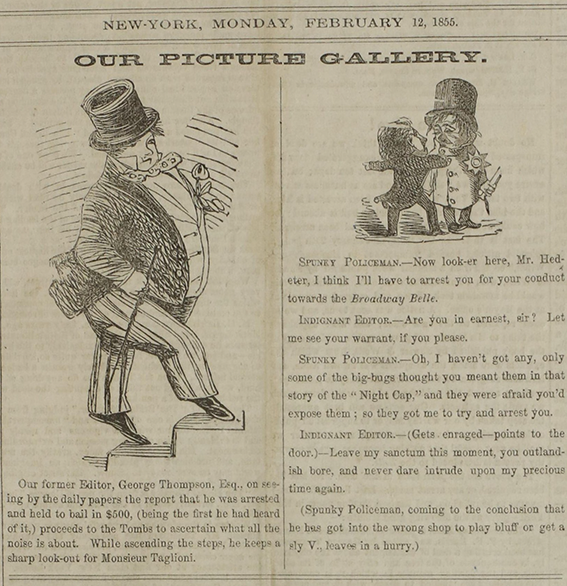
The “Night Cap” raises again its becovered head in the “Chit-chat’s” first letter, as a Fred Kingsley writes in, “I hope that you will continue the ‘Night Cap,” every word of which I have read with interest.” The editor responds with measured trepidation, “we think it hardly proper to go on with the story… .We understand law, and shall stand up for our rights, and protect the Belle with our last breath.”Footnote 141 In these examples, the danger represented by the Night Cap’s revelations exceeds the bounds of the otherwise innocuous story of the reprint confusion so easily resolved at the courthouse. Across and even internal to established features of the Belle, tensions between versions of the legal drama go unresolved. In this ambiguity, the constellated narratives surrounding the Night Cap/reprint histrionics become a sort of city mystery of their own, daring readers to develop individual interpretations and identify heroes and villains.
In subsequent issues, “Magic Night Cap” continues to haunt Harris’s Belle, an obscenely gossamer specter. Various letter writers refer to it for weeks to come, including at least one female signatory who loved to read it with her beau. It is also the source of a copyright dispute between Harris and Thompson detailed in vol. I, no. 10, March 5, as Harris asserts – contrary to an earlier claim – that “we have the copyright of ‘the Magic Night Cap’ and shall publish it complete.”Footnote 142 A mere week later, the Belle announces a new newspaper spin-off, The Bowery Boy and his Whip, with a lady editor called Miss Lizzie Du Vance, who promises to “switch off a fine slice of ‘The Magic Night Cap’… . Those who wish to wear the Magic Night Cap, must read the Bowery Boy and crack his whip.”Footnote 143 To date, I’ve found no record that this paper existed beyond reference in other titles.
The way that “The Magic Night Cap” slips containment to take on a life of its own in rumor and reference, looming large in the memories of editors, readers, and letter writers, highlights how thin is the line between claims about reality and the Belle’s inventions to spur interest and circulation. Thompson’s metaphorical characterization of the Belle as a female sex worker proved durable, innovative, and lucrative across the paper’s several iterations. In a more enigmatic compound of editorial and publication details, the original court appearance of Harris and Thompson (arrest? summons? nothingburger?) initiates an escalating set of recriminations, misleadings, and debates. “The Magic Night Cap” is but one of these, perhaps the most notable because perhaps the truest: This published serial fiction seems indeed to have been both danger and attraction.
2.4 The Saga Continues: Harris, Thompson, the Women and the Moralists
If the confusing similarity between “Important to Husbands and Wives” and the Magic Night Cap’s “Story for Husbands and Wives” wasn’t opaque enough, the spectacle of Thompson disgraced proves yet more illegible. With Thompson out of the editor’s chair, no longer husband-pimp to his Belle, but still installed as “first-cousin of his favorite,” the field clears for a new, and necessary, innovation.Footnote 144 Thus saunters forth a Ladies’ Department or “Ladies’ Column,” with a discreet female editor, several regular correspondents, and an expansive array of new textual females available for readerly fancies.
In some overt ways, the ascendence of the Ladies’ Column marks a break from Thompson, whose masculinist energy and aggressive sexualizing of women marked so many early issues. But in more aesthetic and formal ways, the advent of the Ladies’ Column and the creation of its parading female characters stem from Thompson’s initial willingness to join textual fantasy and female embodiment in the figure of the Belle. And as with the theatrical character development, the editorial mysteries at hand, and the Belle herself, we should view the ladies of this department as imagined and imaginative. Even still, Chapter 3 celebrates the opportunities for subversive identifications that this particular cast invites.
Before we address these many enticements, one final narrative of Thompson and his troubles – with Harris, with women, with intemperance – represents the last gasp of competing operational stories that permeate The Broadway Belle, and Mirror of the Times in the last five issues and five weeks before this version of the paper disappears. Following the off-stage spectacle of Harris and Thompson’s arrest and the internal blame-shifting about which obscenity represents the precipitating sin, the editorial transition of February 12th offers a clear and decisive break. Like many a lamented relationship, Harris and Thompson can’t seem to quit each other but can’t quite get right. Reasserting the paper’s originality and success the following week, Harris can’t repress the urge to get in a few jabs at Thompson even as he announces the new Ladies’ Column. Scornfully describing how “every brainless fool, that can keep sober long enough to get down town, [tries] to pattern after us,” the article “It Pleases Us” raises the stakes from New York City to America, declaring, “we employ the best talent in America; and we have this week made a binding contract with ‘Nina’ (Miss Fanny Temple) to write for the Belle and for no other paper.” And George is back too, despite some unnamed mishandling: “Mr Thompson has been made a tool of by others for the last week, but he is all right now.”Footnote 145
In the following week’s issue of February 26, Thompson is again a subject of scorn, this time with an illustration (see Figure 5).
“Our Picture Gallery,” The Broadway Belle and Mirror of the Times, vol. 1, no. 9, February 26, 1855.
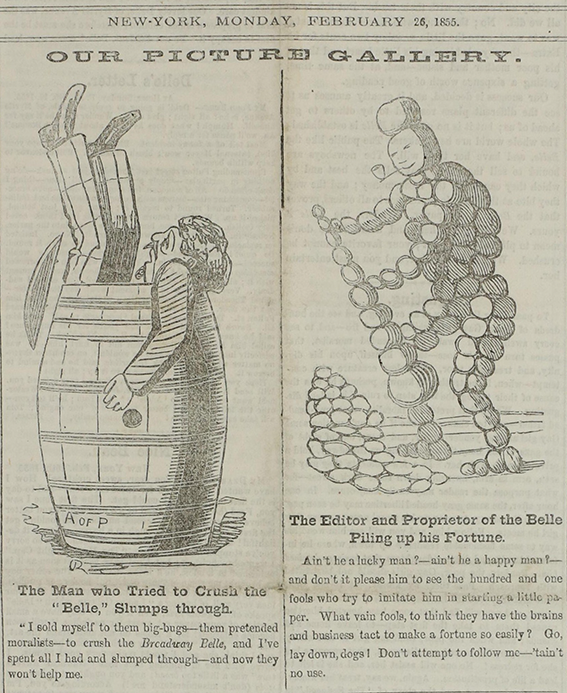
The front-page picture gallery features a mustached man folded into a barrel, with the caption “The Man who Tried to Crush the ‘Belle’” and includes a confession presumably in Thompson’s voice, “I sold myself to them big-bugs–them pretended moralists–to crush the Broadway Belle.”Footnote 146 In subsequent issues, both Harris and Thompson affirm that the paper’s first editor may have undertaken some undisclosed double-cross with a group of mysterious “moralists” to torpedo the Belle’s fortunes.Footnote 147 For this visual indignity, Thompson is rewarded with praise on the following page, as the “Second Enlargement of the Belle” affirms that “Mr Thompson… will contribute much good reading for the patrons of the Belle.”Footnote 148 And here, the story enters soap-operatic levels of he-said/he-said/she-said/who-really-knows debate about Thompson’s relation to the Belle and Harris’s capacity to forgive and forget. The disputations fly so fast and furious over the Belle’s final three weeks that parsing the action is as difficult as trying to ascertain what – if anything – is the “real story” of Harris and Thompson’s [temporary] professional dissolution. More existentially lurks a larger question: Why is this happening at all?
Across shifting terrains of blame and many newspaper figures in the landscape, competing representations of editorial authority stage a battle of individual moral character directly linked to masculine autonomy. This specifically tangled narrative and the larger inventive environment of the Belle call into question any claims to moral superiority, revealing fictions of editorial authority as just another tool to boost circulation. In the Belle, where the personal implications of editorial supremacy mingle freely with the sexual implications of patriarchal privilege – as in the “editorial husband” – the constructed, performative nature of moral character as a condition for editorial influence becomes especially clear. This power struggle occurs in the flash press, a genre long lamented by some for its lack of moral compass and lauded by others for its moral clarity as populist print culture, throwing into relief the incoherence of editorial claims that any one publication represents a “true” voice of the community. In doing so, the unlikely example of this short-lived scandal-plagued sex paper highlights a collective imagined substitution, as distinct and divergent perspectives about “what happened” become naturalized by editorship into statements of unimpeachable authority about “what’s real.” Humiliating Thompson as the vulnerable “tool,” of “pretended moralists,” as a weak drunkard, and as a once-powerful man brought low by a new female editor, Harris asserts that Thompson’s removal from the Belle’s orbit of influence represents a triumph of editorial vision and truth.
The February 26th issue lampooned Thompson as a tired, manipulated fool, an unfortunate failure compared to “The Editor and Proprietor of the Belle,” depicted in the same image, “Piling Up His Fortune.” Displaying notable editorial aggression, the issue’s contents claim indisputable primacy for the Belle as an ideal weekly paper and a tirelessly expansive companion. In articles, captions, and letters, the Belle’s writers (Thompson? Harris? Other and anonymous men?) peacock the paper’s successes and prospects. Taken together, these assertions read as more than a little thirsty.
In Harris’s voice: “Don’t it please [editor/proprietor] to see the hundred and one fools who try to imitate him in starting a little paper… . lay down, dogs! Don’t attempt to follow me.”Footnote 149
In diffuse editorial address: “Think of that, ye old fogies who tried to crush us. Yes, we have decided to make the Belle the paper–the greatest weekly paper published… . the Belle is yours; we will gallant her safely to the pinnacle of fame; and if you desire to insert your articles, we will use our best endeavors to gain her consent.”Footnote 150
In collective triumph: “Our success is decided, and it greatly amuses us to see the different plans resorted to by others to get ahead of us; but it is no go. The Belle is established; The whole world are her backers… Readers, the Belle is yours! We will guide her–and demd if we don’t mean to please! Fear not; your favorite cannot be crushed. We will protect her.”Footnote 151
In the voice of the “editorial husband”: “I have but a moment to spend with you to-night. Business and the care of the Belle takes all my time… .The Belle is far, far ahead in the race.”Footnote 152
From a diligent reader: “Dear Belle–The last number of the Belle is at hand, and proved as rich and spicey as the former numbers, and I hope that she may peramberlate Broadway as long as she conducts herself on the true Lady plan–that is, to keep well Oiled and Greased up, and puts on no French airs. Hope that she gets home by 12 or 1 o’clock P.M., and not over two or three Lovers on hand at once.”Footnote 153
The rampant masculinist chest-beating – on behalf of a serial publication hyper-stylized as a female sex worker – undercuts what’s actually most novel about the issue: the debut of the Ladies’ Column. In the column’s many letters, various female signatories return or are introduced; their writing will furnish the most provocative, sapphic, and engaging content of the Belle’s final issues.Footnote 154 The Ladies’ Column offers much to savor for the ostensible audience of male readers long enamored of the Belle. But somehow, Harris and Thompson are unable to let that good thing swell unimpededFootnote 155 and instead set much type and spill much ink in ongoing, incomprehensible fracas. Essentially, the last issues of The Broadway Belle, and Mirror of the Times present a bifurcated universe, with lady correspondents providing lively, inventive sexual reportage and male editors sniping at each other in increasingly impotent screeds. In the March 5th issue, the appeal of the Belle’s women writers becomes fodder for male-on-male ridicule.
Unsatisfied with the former editor’s humiliation as a fool in the barrel, Harris takes a scorched-earth approach to Thompson’s personal and professional reputation. The front page’s ubiquitous entry for “Our Picture Gallery” includes another visual takedown of Thompson, this time as “The Poor Deluded Editor, whom we Raised from the Gutter, Clothed and Fed” (see Figure 6).
“Our Picture Gallery,” The Broadway Belle and Mirror of the Times, vol. 1, no. 10, March 5, 1855.
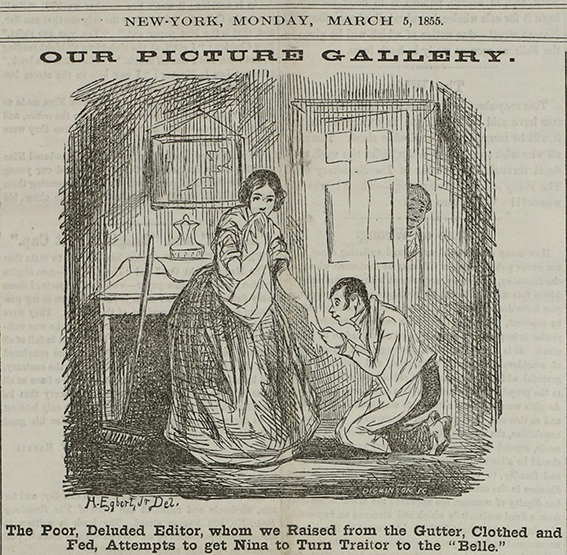
In this image, Thompson appeals to Nina to quit her new position heading the Ladies’ Column, offering Harris’s temperance as the reason for their split: “I hate Mr. Harris,” the Thompson avatar claims, “because he would not suffer me to become intoxicated while in his office.” Nina, righteous professional she is, rebuffs him with extreme prejudice, the scorn fairly secreting off the page, “You may have your rum–edit a leaded-out sheet–beg for your dram and lodgings–and disgrace yourself and those who have befriended [you]… . but I, sir, will lead a respectable life.”Footnote 156 Nina takes aim not only at Thompson’s debauched personal character but at his editorial prospects, damming him to write for a sheet so scruffy the type has been “leaded out.” Inside the front page, an article entitled “George Thompson” promises to lay it bare the following week. Anticipating contemporary vocabularies of sexual violence, the copy claims Thompson has brought textual ruination on himself and deserves what follows. “As Mr. Thompson has dragged us into the field, we are compelled, in justice to ourselves, to answer; and, in so doing, we shall make but one job of it… . we shall place his past career before the public in its true light… We shall state nothing but plain facts, such as have come under our own observation, and leave the public to say if we have not done our duty to a poor, fallen man. Read it, friends, and ask yourselves if you could have done more than we have done to lift a poor, degraded being from the gutter, and place him in a respectable position in the world.”Footnote 157 For readers who, a scant two months ago, had opened the debut issue with the pleasure of recognition, the assertion that The Broadway Belle made the fortune of an author as famous as Thompson might seem a bit nonsensical. Indeed, other material in the same issue gives the lie to any claim that the Belle needs Thompson like a fish needs a bicycle: The front-page serial fiction is Thompson’s own “The Locket”; a long article in the paper’s center pages cries impatiently that Thompson’s most appreciated stories, published and sold by Harris, are in fact under Harris’s copyright and not Thompson’s; numerous small ads trumpet the sale of many additional Thompson narratives.
In part, this self-contradictory presentation of Thompson as both disgraced and essential attempts to disarticulate Thompson’s editorial persona (traitorous, sloppy, unwelcome) from his authorial labor (valuable, appealing, exciting). In so doing, the current editor of the Belle, if indeed that figure is the historical person Prescott Harris, travels far afield from what was proposed as the paper’s original appeal: namely, that Thompson’s narrative prowess made him uniquely suited for the role of editor in the first place. As the first issue describes, “the editorial chair is occupied by… a gentleman of well-known and acknowledged literary ability.”Footnote 158 Initially, the newspaper proposed that the space between author and editor was, in the Belle, functionally shrunk to nil. And as we saw in Chapter 1, this overlap between roles paid dividends for early issues, from the metaphoric creation of the Belle as a sexualized woman to the energetic fictions that characterized obvious creative works and permeated the “newsy” content. This heady brew of meta-presentation, licentious fiction, and tongue-in-cheek local inventiveness created the audience of readers asked to roundly reject Thompson’s influence a scant twelve weeks later.
Given the tendency of the Belle to represent real people in obviously invented circumstances and to conjure concrete avatars from newsprint, the whip-sawing stories of Thompson, Harris, and now Nina’s professional disputes beg the fundamental question of print reality itself. What, readers might be tempted to ponder, is actually happening in the Belle’s offices: Who writes for this paper? Who edits it? On what terms? With what protections? Further still: are any of the stories, these presentations of editorial persecution and upheaval, true at all? Do they represent anyone’s lived experience? The news coverage of Harris and Thompson’s court appearance suggests that something happened in late January. But the resulting incoherence at the Belle, and the paper’s singular dramatizing of that incoherence as itself news, seems to have little precedent even in the wild and wooly world of flash press editorial shenanigans.
More practical and less existential than the question of reality as a shared, stable system of meaning, the ongoing and escalating plotline of the Belle’s editorial dissolution raises a pressing professional question of the era: What does an editor do? In partial answer, Thompson seems to imagine the Belle’s pages as a place to play with a newsprint cast lorded over by a series of cartoonishly rendered editorial eccentrics.
Periodical editors often occupied a shadowy and contested space of in/visibility. Scholars of editorship have compared editing to translation through shared negotiation of authority and deference.Footnote 159 As Susan L. Greenberg describes, at issue is “the invisibility of process… [which for translators] is shared with other intermediaries such as editors, who are parties to the making of a thing.”Footnote 160 In the earliest issues of the 1855 Broadway Belle, George Thompson intervened in this debate by proposing that an editor was not only party to the “making” of the paper as a practical matter, but was also the ultimate creative voice guiding the paper’s content. Further still, the editor was arbiter of a distinctly patriarchal, because distinctly heterosexualized, authority over the content and circulation of a given newspaper. At issue in the representation of the Belle as an available “gay girl” vulnerable to the predations of “the mails” and available for various and sundry “insertions” was the matter of where and how the paper, as a female body, circulated amongst (ostensibly) men who paid for the pleasure of her company. And if the editor is operating as her pimp, her husband, and, in essence, the creative god of her existence, how can the singular identity proposed through the continuity of a single title maintain coherence in the face of an editorial cataclysm?
Matthieu Letourneux refers to the crafting of a publication’s individuality as “editorial seriality… . an editorial reading pact that attaches the reader to a serial publication despite the heterogeneity of its content and its contributors.”Footnote 161 But the example of the early 1855 Broadway Belle raises the possibility of another kind of serial attachment, one that hollows out the importance of the editorial persona in favor of an organizing narrative character, the personification of every New York City frail sister in her most confident and purposeful guise, the Belle of Broadway herself. If Chapter 1 discussed Thompson’s serial innovation in marrying fictional strategies to newspaper formats, the spectacular breakdown of editorial integrity explored in this chapter highlights another innovation. Here, the newspaper itself becomes so tightly developed, so broadly referenced, and so roundly personified that the practical labor of editorship becomes almost superfluous. The “reading pact” that entices the reader back for more is forged not by a singular editor, nor through the deteriorating pageant of once potent masculine authority. The attraction instead lies in the Belle as a singular newsprint character, shining gorgeously through the bad behavior of competing and increasingly irrelevant men.
If editorship is usually understood as a complex balancing act of visibility and transparency, curation and juxtaposition, professional authority and audience address, this vision of the Belle as fundamental organizing character troubles assumptions about what editorship entails. Undercutting the editor as a source of authority as the two careen into incomprehensible squabbling, the Belle’s internal consistency, even despite Thompson and Harris’s heated battle, establishes the paper’s identity as a feat of imagination. The conventions of presumed editorial invisibility, and the unremarked assumption of neutrality that follows, cloud the basic operations that editors use to shape the world’s meaning from the world’s chaos. The Belle’s grand editorial meltdown suggests that a coherent epistemological system embodied by a singular editor, even one as robustly charismatic as Thompson, cannot hold. Luckily for the centuries of news-making to follow, her experiment was short-lived, unevenly archived, and, somehow, easily forgotten.
The final issue of the Broadway Belle, and Mirror of the Times is a whopping eight pages long. Twice as long as previous issues, this Belle’s swan song is almost entirely given over to correspondents, two new departments (including the Ladies’ Column now offered as “Ladies’ Department” and “Sporting Life in America”), and, shockingly, two extended fictions by Thompson, including the long-awaited return of “The Magic Night Cap’s” final extant installment. Although often invoked by name, Harris “the editor” appears very rarely here. Even his “Editor’s Chit-chat” credits not himself, but his readers, with the dramatic doubling of the Belle’s fortunes. “No doubt, readers, many of you will think that I am smart, when you look at the size of Mrs Belle to-day, but believe me, it is not I who have done it… . The honor belongs to you.”Footnote 162 This present absence reflects what I’ve been arguing about the strange hollowing-out effect of editorial incoherence at the paper. Harris’s ceding of the paper’s best material to letter writers and piecemeal editorial staff also frames the final chapter’s study of how the Ladies’ Department dramatizes circulation as a print condition of sexual and social community that is – even perhaps accidentally – potentially empowering for women readers.
Finally, the paper’s multiplicitous voices register the ultimate failure of Thompson to maintain his own editorial sovereignty over his favorite, his lady of the pavé, his paramour, wife, erotic partner, and imaginative equal. In a last missive postmarked “Boston, March 6, 1855,” Thompson writes directly to Harris: “Here, in our modern Athens, afar from the strange scenes of excitement in which I so lately participated, do I sit down to write you this letter, satisfied that you will overlook the past, and receive it as from a friend.” To make a clean professional break, the letter runs through the confession of Thompson’s “insane delusion” before clarifying, “I am going into the literary business here; and shall be happy… to contribute to any of your publications.” Claiming to be “disarmed” by this letter, Harris enjoins his readers to wish Thompson “every success.”Footnote 163 It’s hard to ignore that this final acceptance of Thompson’s apology, the olive branch of forgiveness and goodwill, the grace of acceptance, is predicated on Thompson’s leaving town and forgoing the editor’s chair in favor of the literary man’s pen. That distance won’t last, nor will Thompson’s renunciation of editorial labors. But that is, unfortunately or not, a story for another installment. Until then, let’s all look lively for the arrival of the Belle’s minor army of majorly enticing ladies.
3 “Is It In Yet?” Feminine Writers and Feminized Pleasure in The Broadway Belle
When last we saw George Thompson, on March 12th, 1855, he was laid low by external scandal and personal vice, exiled in Boston, “afar from the strange scenes of excitement in which I so lately participated.” In this final installment of the original Broadway Belle’s serial sexuality, we leave George Thompson the editorial character behind, or at least afar. Despite his absence as editorial husband, the fictional landscape of female personae he initiated with the Belle as newspaper lover expands into a bawdy house’s worth of additional female interlocutors. Indeed, as this later “Picture Gallery” image makes clear, the character of the Broadway Belle maintained her allure beyond the first flourishing of her power in winter and early spring of 1855Footnote 164 (see Figure 7). While the lady writers of Nina’s column do not manage similar longevity, in this final contribution of George Thompson’s expansive sexual imagination, the ladies of the Ladies’ Column tease feminist utopian promise long latent in the paper’s diegetic universe.Footnote 165
“Our Gallery of Fine Arts,” The Broadway Belle and New-York Shanghai, vol. 1, no. 8, September 3, 1855.
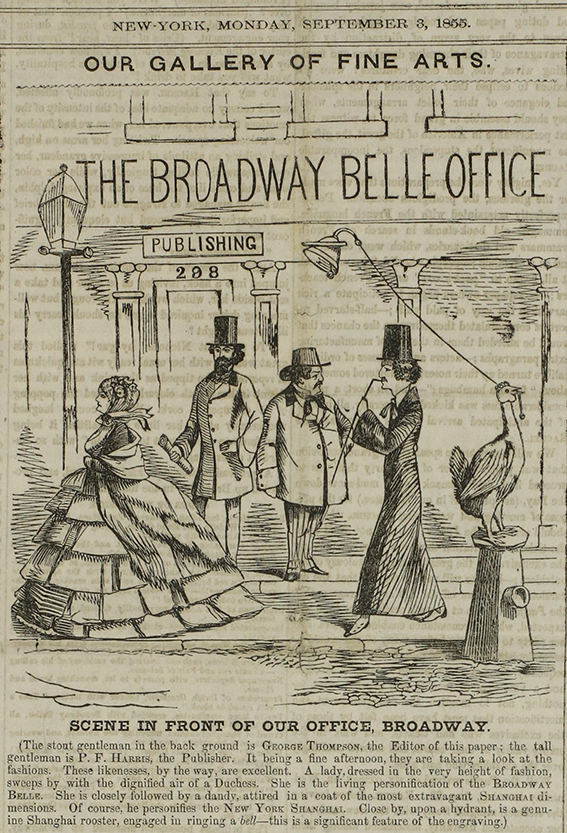
Following the masculinist meltdown of editorial management we traced previously, this chapter explores the spectacular rise and abrupt end of the Belle’s “Ladies’ Column.” An apparent outgrowth of the newspaper’s characterization as a successful female in the sexual economy of lower New York City, the Ladies’ Column began, like the figure of the Belle, with paternalist condescension. And as with the titular Belle, whose appeal exceeded Thompson’s grasp, the regulatory premise of male authority couldn’t keep pace with the energetically lewd and good-humored women the new feature empowered. From the very first issue, the promise of lady writers dangled the opportunity to imagine that celebrated “girls on the town” lent their perspectives to the Belle.Footnote 166
After an update on February 19th about his new “binding contract” to employ a female writer, Harris initially implants himself as her manager. Introducing “Our New Column,” the editor declares, “this column is dedicated to those fair ladies who contribute to the Belle. Under this head the Editor will attend to all his sweet lady correspondents, and answer all their funny questions.”Footnote 167 As it turns out, the Ladies’ Column ladies have zero questions for the male editor, nor many for any man. Instead, they address letters to their own sister Belle, “a Lady of Great experience an Knowledge”[sic],” “a dear, sweet creature,” and, improbably, too “modest” to print their richest descriptions.Footnote 168 While latter column entries will include some address to other male readers, even setting up systems for introductions in real life, whomsoever is at the larger editorial helm of The Broadway Belle becomes rather quickly irrelevant to the ladies’ internal conversations.
Ultimately, the Belle’s final three issues yield the most titillating content to lady letter writers. This may be a strategy to distance Thompson’s increasingly risky fictional offerings (a major part of the drama in the proceeding chapter) from the larger landscape of the paper. Simultaneously, the diverse constellation of lady letter writers should be read as the Belle’s ultimate fictional foray, calling forth a city’s worth of female characters through the established exchange network of letters to the editor. The rise of the lady writers also undercuts the editorial virility of Harris’s newly assumed position. As Derrick Spires describes in the 1850s Black press, the proliferation of lady’s letters in male-dominated publications risked the prerogative of a strong editor. If Thompson’s and Harris’s incomprehensible feud undercut their editorial power through printed pettiness, the “presence of purportedly unruly women” could become “yet another sign of … incompetence.”Footnote 169 As in Thompson’s blithe encouragement of assertively “mail” letter writers, “where a lively cast of male correspondents suggests a strong editor… women correspondents threaten this control.”Footnote 170 In Ladies’ Column correspondence, we see both the inverse logic and an obvious outcome of earlier letter trains from the “Chit-chat.” On the one hand, the ladies invite themselves into Belle’s apartment with intimate stories; on the other, the marvelous phenomenon of girl-on-girl letters anticipates one of contemporary pornography’s most common couplings. In taking up the lascivious exhibition that was a major draw of the Belle’s serial fiction and columns, the Ladies’ Column dramatizes the role of circulation and exchange in creating an eroticized universe that is, at least on paper, distinctly celebratory for women who represent different slices of New York City social life.
We’ve already seen how gloating reports about the paper’s clamoring newsboys and tens-of-thousands-issue print runs emphasize the importance of circulation for the paper’s fortunes. And of course, circulation numbers have long served as a measurement of potency for serial publications.Footnote 171 Circulation as a goal for successful serial titles differentiates this fictional universe of letter writers from the serial publication characterizing Thompson’s more traditional fictions. A tale like “The Magic Night Cap” was developed over serialized chapters but eventually published as a stand-alone text. A saleable complete printing would have cycled out of a circulation environment of regular and repeated publication and into the realm of codex-based “fancy books.” This chapter connects the circulation of The Broadway Belle in her guise as a newspaper escort to that of New York City’s “gay girls” as an embodied community. The paper’s representation of brash and far-flung lady writers aligns one structuring goal of a successful editor – to be at the helm of a widely circulating title – with the cultural perception that women’s illicit sexual activity was so in part because of its circulating character. In this chapter, a slut, a student, and a lady editor all walk into a bar on Fifth Avenue. The bar is made of newsprint; the women are all the same woman.Footnote 172
3.1 Letters as “Archives of Knowing”
As letters that give the impression of being written by readers and are “conducted by Nina,” the Ladies’ Column correspondences provide an archive of racy letters to the editor. As many have noted, letters to the editor are a distinct newspaper feature that “must be seen as a co-production between editors and letter writers… a fragmented and only partly convergent network of circulating texts.”Footnote 173 While many of the Belle’s letters bear a closer resemblance to the self-consciously arousing content in Penthouse Forum than to the literary-political musings in a publication like The Crisis, they both function temporally to highlight expansive possibilities for serial circulation, “bridg[ing] past, present, and future issues, spreading out beyond the boundaries of any single text.”Footnote 174 In Elizabeth Groeneveld’s analysis of reader-editor exchange in On Our Backs – a lesbian magazine debating feminism’s relationship to pornography – she describes letters to the editor as “archives of feeling” that “reveal how lesbians were thinking about their relationship to feminism and sexuality and the relationship between sexuality and politics. [They] can also be seen as a pedagogical project, educating its readers about the pleasures of lesbian sex and unhinging particular kinds of sexual practices from specific sexual identities.”Footnote 175
Much as the serialized character of the Belle promenades beyond the limits of Thompson’s editorial influence, the circulating characters in the Ladies’ Column letters build a community around fantasies of feminine experience and pleasure that exceed – or prove uninterested in – Harris’s editorial authority. The gulf between Harris’s editorship and Nina’s correspondents is especially dramatic in the issue that debuts the Ladies’ Column. As female signatories populate the Ladies’ Column with reports both positive and negative about the assertions of men, Harris includes a male-authored letter declaring “‘No’ an Ugly Word.” The writer proposes making the negation “a thing only of memory… . If you ask a question, nothing is received in answer from pretty lips but an unbidden yes!”Footnote 176 Juxtaposed against this pliant fantasy, the Ladies’ Column offers avenues for naming, and thus perhaps shaming, the normalization of sexual violence. One letter details an occurrence of what we would now call stalking, while another describes a fashionable woman disdaining a set of furs from a male suitor on the grounds that “she did not like the price asked for them.”Footnote 177 That is to say, in the presence of exhortation against a woman’s “no,” the Belle’s inaugural Ladies’ Column proposes that women may, and do, and even should, reject male coercion and imposition. Moreover, these writers demonstrate how and why.
This refusal is also part and parcel of their varied female pornographic imaginations, rendering the Ladies’ Column a surprisingly complex space of feminized sexual empowerment and vulnerability. Lubey describes how pornographic English-language texts develop “a mode of inquiry that takes for granted the relevance of sex acts to other fields of experience and knowledge… an integration, rather than a separation, of sex acts with a wide array of cultural concerns.”Footnote 178 This integration of sex and social experience has distinctly feminist purposes and implications – the “vernacular feminism” Lubey traces through genital narratives “reimagines women’s social roles based on inequities they suffer in genital realms” and “insists on the overlap of society and sexuality.”Footnote 179
In Chapter 1, we saw how Thompson’s development of the Belle as a woman of the pavé included a “Chit-chit” invitation for writers imagined as especially physically male. Describing letters as an outgrowth of male anatomy, the editor invites these writers to be “pointed,” “to push directly home” and “avoid being too lengthy beyond the capacity of the BELLE to receive their favors.”Footnote 180 To state the obvious, this solicitation hangs on the analogy between male letter-writers and their male members. But as feminist scholars of pornography and sexuality have long pointed out, women can wield penetrative power too, through a vigorous tradition of penile prosthesis.
Lubey’s study speculates on the feminist potential of dildos, objects of sexual pleasure disarticulated from the social control of heterosexuality. “The detachable penis,” she writes, “[offers] a fantasy of genital activity without conflicts of contested property and personhood… . a kind of wish to alienate genitals, nonviolently, from persons and from the heterosex they are often compelled to perform.”Footnote 181 Representations of dildos or other tools of sexual pleasure divorced from male bodies might also register the “wish” for non-coercive female-centric pleasures and female bodily sovereignty, placing “penetrative sex within a domain of feminine autonomy.”Footnote 182 Of course, such protheses are also tools for male fantasy and for misogynistic threats and cruelties.Footnote 183 It remains a sad truism, and is obvious everywhere in the Belle’s pages, that for women readers and ostensibly female writers in the newspaper, enjoying sex, writing and thinking about sex, and participating in discourses of sexual pleasure are all activities framed in a male-developed and dominated space. In a patriarchal world, masculinity is a constant constraint – explicit or implicit – in female pleasure.Footnote 184 Accordingly, the Ladies’ Column correspondents quickly dispatch with the façade of addressing Harris at all, generally rejecting the particular men represented in the Belle ’s epistolary universe. In the Ladies’ Column, it is women who “ply the Belle with insertions,” some gentle, some assertive, some double-pronged, pointing at multiple possibilities for erotic encounter at once.
The first letter featured in the first Ladies’ Column promises to “tell of a funny incident. Blush to write it.” Delie of Myrtle AvenueFootnote 185 describes how, while “promenading – all alone,” she “felt something drop – not a bracelet – something else – fastens with a clasp – made of silk and India rubber.”Footnote 186 Realizing what’s fallen, Delie turns around to find a “young gent” who has picked up the loose object and “wouldn’t return. Kept kissing it; I think acted very foolish”.Footnote 187 A recognizable obscene narrative, this story of the fallen garter – as a paradigmatic “dropped item” in pornography history – echoes opening details from another Thompson tale and from a feminist seduction scene in Fanny Hill, the most famous pornographic text of the era; it also anticipates a “found” letter from the succeeding week’s issue.Footnote 188 This version, a letter from “Rose” to “Kate,” reminds the latter of “the first night I let you show me how to spend a few minutes in pleasure” before continuing: “Kate: I am so ashamed. Oh, the other day when I was sitting at the piano taking my lesson, my garter came undone, and fell on the floor…. [Bernardo] put the garter on. I can’t go on; I am ruined.”Footnote 189 There are no direct connections between this Kate and “Spinster Institution” seductress “Kate M,” but the overlapping names of women who school other women in pleasure resonate across the issue they share.
In an unusual depiction of endangerment, Delie narrates being followed home and accosted in her own apartment by this determined youth, only to be saved by friend “Tom,” who also sex pests Delie, threatening to take her “article” before leaving her in temporary peace.Footnote 190 Despite her escalating tale of male menace, Delie will go on to be one of the most vivid regular contributors to the Ladies’ Column, her letters specializing in bawdy puns and voyeuristic accounts of her adventures around New York City.
Delie’s letter is a compressed version of the contradictions that make the Belle such a confusing and compelling print object. The discussion of Delie’s vulnerability – followed and accosted by not one but two men in her own home – echoes the constant racy paper lament about the dangers of seduction and frailty for women at the mercy of any “base-hearted libertine” in the city. The very column over from Delie’s letter is entitled “Disgusting” and laments the cruelty and “contempt” with which “every swell-headed swab, or pretended moralist” treats the city’s “Gay Girls.”Footnote 191 But the letter and Delie’s subsequent correspondence also portray a witty, sexually generous woman who derives quite a bit of pleasure from innuendo and sex play; a later letter provides a granular description of public transit’s erotic possibilities.Footnote 192 Despite the editor’s contradictory vision of “gay girls” as in need of dedicated male protection and as independently sexually adventurous, Delie’s persona, and her female fellows in the Ladies’ Column, invite a more nuanced exploration of the imaginative erotic potential in inviting female “insertions” of varying sizes and styles. The writers of the Ladies’ Column quickly leave behind the pretense of male editorial control to instead address each other and their “cunning little” sister, Thompson’s original Belle.
3.2 Girls On the Town Write In
In addition to the (optimistic) opportunity to imagine other women seeking and sharing erotic community, the Ladies’ Column leveraged a range of neighborhood types, representing an ideal of robust, diverse circulation for the paper. In editorial columns, “Picture Gallery” images, and reprinted praises, The Broadway Belle proposed again and again to address all New York readers from “the upper ten” to the “lower twenty.”Footnote 193 The range of letter writers in the Ladies’ Column, developed as serialized characters across several issues, underscores this claim.
For example, “our Delie, of Myrtle Avenue” is credited in the inaugural Ladies’ Column as “the first to propose” the feature. A street in Brooklyn and a stop on the Brooklyn City Railroad, Myrtle Avenue was near the Navy Yard and housed a decidedly “lower twenty” population. Edwin Burroughs and Mike Wallace’s monumental New York City history describes how, in that neighborhood in the mid nineteenth century, “row houses and tenements clustered around the Flushing and Myrtle Avenue lines… . [which] transported native-born lower-middle class clerical workers to Manhattan or to Brooklyn’s City Hall.”Footnote 194 Delie plays up the classed expectations of New York transportation in a letter postmarked “The Avenue of the Myrtles.” Detailing an epic journey on ferries and “omnibuses” to visit the Observatory “near the Crystal Palace,” Delie explains to her “little Belle” that crowded public transportation is just the place for cruisy petting amongst strangers. “The seats on the ferry-boats are so small that your neighbor continually crowds you… . Did you ever get into a ‘bus’ that was very crowded, and be compelled for want of another to make a seat of a gentleman’s knees?… every jolt and jar of the stage jostles his knees… . how hot his breath feels upon your neck… . how warm you are yourself.”Footnote 195 As a representative working-class girl with coquettish tendencies, Delie is one sexualized type that the Belle’s paternalistic columns advocate for and sympathize with. But in the Ladies’ Column, such pitiable abstractions transform through narrative specificity, presenting a jocular, engaging, and knowledgeable sister for her local companions. Delie proves amusedly skeptical of men’s excessive desire, receiving letters, invitations, and lamentations from a range of male writers, including extended epistolary flirtation with “Ovid” and “Our Ned,” whom she eventually roundly rejects. In promulgating the social fantasy of hyper-sexualized working women gallivanting across the city, Delie’s letters also underscore the newspaper’s organizing conceit that the Belle herself circulated promiscuously through New York’s increasingly stringent class distinctions.Footnote 196
By contrast, the figure of “Susie Sumner” is explicitly cast a rich man’s daughter in a “Picture Gallery” entry from the March 12th issue. Depicting a fantastical scene of the “upper ten’s” sexual liberality, various family members gather together “in Fifth Avenue” to read Susie’s letter together, delighting in its inclusion “right in the Ladies’ Column, with Delia’s’ [sic] and ‘Kate Milford’s spicy letters!’”Footnote 197 Susie first appeared in the inaugural Ladies’ Column, weighing in on “The Magic Night Cap” controversy described in Chapter 2. There, Susie expresses dismay that “you’ve stopped… The ‘Magic Night Cap’,” describing her reading pleasure in the Belle as introduced by her beau, Fred. In place of “that nice story,” Susie and Fred instead peruse “some of those delightful books you publish, and we read them together up stairs (ahem!).”Footnote 198 Published out of Harris’s print office in Nassau Street, these might have included any number of advertised titles, from Thompson classics like “The Bridal Chamber” and “The Gay Girls,” to assorted pornography like “Mary Anne Temple, or the Amours of a Lively Country Girl – six illustrations,” and “The History of a Rake,” to quasi-medical anatomy texts also often classed, and used, as erotica, the most famous being Aristotle’s Master-Piece, here listed in knock-off as Aristotle’s Complete Works.Footnote 199
While Delie proves a more consistent, entertaining, and energetic writer, it’s upper ten Susie who receives a job offer as potential editor of the Ladies’ Column, hinting at the class pretentions of the Belle’s editors, or the class expectations of its readers. Replying to Nina’s invitation, Susie begins with staged humility. Her letter gushes, “just think of it! that I, little Susie Sumner, should have control of part of the nicest, spiciest paper published!” But no, after all, Susie’s actually “afraid [that Nina] wouldn’t relinquish your right to it,” posing her distrust as sly question, “Do you think you would, eh?”Footnote 200 To clarify that Susie, in fact, imagines she could do a better – which is to say more accurate – job of editing the column, she scolds Nina in the letter for “a mistake in the latter part of my letter. I said, ‘I don’t think I’d make a very good correspondent,’ but you put it, ‘I think I’d make,’ &c.” Susie, of course, being “not given to praise myself.”Footnote 201 Vacillating between deflection, praise, and critique, Susie ends by conveying her “nice beau’s” desire to “to know [Nina]… in the scriptural sense of the term.”Footnote 202 Amongst the many lady writers of the column, Susie embodies the contradictions of the Belle’s larger diegetic environment most clearly: she’s modest, mean, and smutty all at once. Perhaps this combination is a way to align her perspective with Harris, the “prosperous” and triumphant ultimate editorial husband. Perhaps, pace Thompson’s own politics, Susie’s strange dissonance is a commentary on the moral vacuity at the heart of wealth and privilege.Footnote 203 Her echo of the male editors’ misogyny, evident in the active solicitation of a sexual favor, shows the seams of invention, suggesting that Susie, and by extension the Ladies’ Column entire, might be Thompson’s creation. It’s fun but fantastical to imagine Susie as a real person, writing salacious letters to a notably obscene newspaper, any thoughts of compositional continuity lost in the eagerness for print notoriety. In whatever ways a careful contemporary reader – or causal contemporaneous one – might choose to interpret Susie as a character, she illustrates the Belle’s complicated relationship to the class dynamics of its expansive ideal readership.
Before we leave the Ladies’ Column and close this brief chapter, we need to celebrate the arguably actual inspiration for the entire enterprise and the writer most explicitly poised as the most explicit proto-pornographer amongst the ladies’ set. This is the frankly Sapphic and coyly frank Kate M, whose “Study Talks” letters, posted from Spinster Institution, first appear in issue no. 8, one week before the Ladies’ Column debut.Footnote 204 While Kate writes only four letters across the final month of the Belle’s first run, her perspective expands the paper’s reach across the landscapes of the city and the torrents of sexual pleasure.
Distinguishing herself from fellow lady writers, Kate M’s erotic attachments and her communicative sympathies are decidedly female-oriented. Like others, Kate M opens with pleasure at the chance to address a female recipient (the Belle herself), expressing her suspicion of men entire: “I have long wanted to write to some of my own sex,” Kate begins, “out of school to tell some things that are going in it. Indeed, I came very near confiding these secrets to a gentleman [however]… If you say a word that is a little free, they take such liberties!”Footnote 205 In an ironic reversal of her disavowal of “such liberties,” Kate’s missive details late-night one-on-one prayer sessions with the school’s reigning Reverend, who “after a couple of hours of this rapturous ‘study talk’ he kisses me, and I return to bed. Of course, I cannot sleep any, I feel so.” As a commentary on the vulnerability of religious figures to the advantageous erotic positioning of their authority, the letter’s implied critique aligns with the larger political environment around sexual hypocrisy in the Belle. But Kate M, even already in her first letter, distances herself from worlds of masculine desire in describing the dorm, a scene of “146 sweet girls with their 438 charms.”Footnote 206
With such a tantalizing beginning, Kate M’s correspondence has no place to go but down, as it were. Her next missive chides the Belle, improbably, for the “modesty” that excised “half what I wrote.” As we saw in Delie’s letter about public transit, Kate M too plays up the possibilities of heavy petting, describing a marathon study session shot through with religious masochism framed as sexual sublimation: “when he is very pious,” she writes of her teacher the Reverend, “he is – oh, so loving! He had me on his lap for half an hour, and he was so uneasy!”Footnote 207 Detailing the play, tickling, gnashing of teeth, and swooning of their time together, Kate M. illustrates the narrative control and descriptive lubricity of a seasoned pornographer; passages of the notorious Fanny Hill couldn’t conjure a more charged scene of sexual hierarchy and voyeuristic ravishment.
By the following week, Kate M has drawn the readerly eye and feminine approval of Delie, that darling of Myrtle Avenue. Praising the “correspondent from the ‘Institute,” Delie encourages the Belle, here addressed as her “Dear Little Sister,” to carry on publishing Kate M’s letters, “for we long to hear of the doings of those pious guardians of female character.”Footnote 208 Even as seasoned a libertinx as Delie cannot evaluate Kate M’s narrative veracity, however, confessing finally, “I know not whether her account is tinged a little by her buoyant imagination.”Footnote 209 Next to Delie’s letter appears another from Kate M herself, who has moved away from the delightful predations of the Reverend Mr. B to pursue the decidedly more accessible pleasures of her own colleagues. Hinting at the pregnancy of one and the many pulmonary affectations of the Institution’s girls in the face of a “handsome young doctor… .[with] such wicked eyes,” Kate M declares her own wish to “be a physician to a school… . I can imagine the rapturous enjoyment of such ravishing sights as I see daily.”Footnote 210 Accompanying the turn to more direct fantasizing about her female companions, Kate M moves beyond the model of false sanctimony that Delie notes. While Delie’s interest is in the “doings of those pious guardians” (i.e. the hypocrisy of a reverend depicted in sensual assignation with his students), Kate M’s are swiftly recast as desire for intimacy in an imagined community of fellow schoolgirls. Her letter of March 5th ends with a rapturous description of a “Georgia girl… so plump and sensitive” one need only “touch them and they are on fire!”Footnote 211
Kate M’s missives offer a paradigmatic moment in the history of Sapphic representation in US mass media, even in a paper as short-lived as The Broadway Belle, and Mirror of the Times.Footnote 212 In many accounts of lesbian historiography, the nineteenth century was characterized as a time of romantic friendships, “Boston marriages,” and a range of ambiguous intimacies.Footnote 213 Emphatically unfurling the least-circumspect innuendo imaginable, Kate M’s barely disguised accounts of physical dalliances with reverends and doctors, boarding house trysts, and even pregnancies push the limits of the sexual history Martha Vicinus has described as “ghosting of lesbian desire.” Vicinus argues for “the possibility of a continuum of sexual behaviors for all women, [where] the lesbian is neither marginal nor phantasmic, but central.”Footnote 214 Dramatizing this continuum, Kate M’s study sessions with Reverend Mr. B and the Georgia girl, her fantasies about having and being the “handsome young doctor” amongst the “ravishing sights” of her schoolmates, all blend together into a highly articulate but sexually irresolute depiction of expansive female desire.Footnote 215
Much like the depiction of Delie’s “artifact,” the representation of schoolgirl sexualities codes as both liberatory and oppressive. Vicinus’s “Distance and Desire” offers a useful overview of “the schoolgirl crush” as both an erotic spectacle and an opportunity to practice self-control for young women in boarding schools. And certainly, the exploits of young women in collective housing has a long pornographic history across the twentieth century. Kate M’s contribution to this history may in part be her geographic citation; not abstracted into distant stone castles nor elevated literary cultures, Kate’s sororal fantasies refer directly to the streets of New York City, rendering explicit the private longings of young strangers encountered in the daily business of navigating the city.
3.3 The Column’s Concrete Imagination
The Spinster Institution and others are a useful example of how city circulation has both local purchase and broad imaginative appeal. By March 5, Kate M’s community of imagined female interlocutors, imitators, and inspirations has expanded beyond the confines of Spinster Institution, located in “Onion Square,” to encompass a wider, and widely recognizable, cultural geography of the city. As is common for the Belle’s writers and the racy paper backdrop more generally, these cultural geographies reverberate with class-based and thus political implications. The name of Kate’s school stitches the first braid in the ribbon connecting the Ladies’ Column’s sexual imagination to the city’s historical geography. By the mid-1840s, Reverend Gorham Dummer Abbott had founded Spingler Institute “for young ladies.”Footnote 216 Located at the “union” of Broadway and the Bowery, the location of Spingler/Spinster Institute would have situated Kate M in the thick of promenade territory as well as the at the mercy of yet another religious man dedicated to the education of young women.Footnote 217 Noting that her readership encompasses various educational institutions, Kate M goes out of her way to name the “beautiful girls” at “Candy school, in Lafayette Place,” the “panting lovers, at the Oakhill School,”Footnote 218 even the “innocent ladies immured within Gramarcy [sic] Park Hall.”Footnote 219 Far from pointing at random alleyways or unknown squares, Kate M’s list invokes some of the most notoriously “upper ten” neighborhoods of Old New York: Lafayette Place, founded by John Jacob Aster in the late 1820s; “Oakhill’s in Clinton Place,” smack in the middle of the upper-crust Young American offices and apartments of men like Evert Duyckinck and Cornelius Mathews; and of course, Gramercy Park, that most exclusive of neighborhoods with its own private park.Footnote 220 Nodding to the social realities of these settings, Kate M assures readers of the “quiet bevies” of Gramercy Park and describes how the “Oakhill girls” of Clinton Place “can’t speak English to each other” so they read the Belle together in French.Footnote 221
Kate M’s references complement Susie Sumner’s own discussions and depictions of Fifth Avenue. Together, their letters illustrate how the imaginative landscape of the Broadway Belle expanded beyond the reach of the more famous Bowery/Broadway arena and more notorious print alleys of Ann and Nassau streets. So much of New York City’s geography operates metonymically that many of its locales could be described as Roy Somlyo describes the most internationally famous of avenues: “Broadway is not necessarily geographic, it’s not a physical locale. It’s an idea.”Footnote 222 While Gramercy Park, for example, might not have quite the global recognition that Broadway did then or now, several of Kate M’s references, and certainly Susie’s Fifth Avenue, are similarly evocative, inviting associations of elevated class status and the luxury, privilege, and indulgence presumed as accompaniment. As Kate M’s more localized invocation of tony neighborhoods suggests, writers for or to the Belle used a range of spaces for cultural signification.
As female writers detailing insider revelations from the city’s privileged spaces, characters like Kate M and Susie provide an alternative to the political vision more closely associated with the flash press. Moving away from the seedier printer’s row and bawdy houses of Ann Street, Nassau Street, and the lower reaches of Broadway or the Bowery, these imagined rich girls don’t skewer wealthy hypocrites so much as illuminate their environs from an unexpected angle. While Thompson’s fictions and articles expose the fiendishness of the idle rich and their spiritual servants, as in “The Magic Night Cap,” Kate M and Susie suggest that there are sympathetic libertines too, young white women at the mercy of elder beaus and other male powers. Moreover, the blossoming mutual appreciation of the Belle’s decidedly “lower tenth” writers like Delie of Myrtle Avenue and Nina the Editress suggest that, amongst sexually vulnerable and adventurous women – here proposed as one and the same – class status may be a more fluid boundary where recognition and appreciation might flow both ways. The specific contours of this racy paper’s feminized pornographic imagination, then, push the political divides more often associated with the hyper-masculine flash press editors into a different space of multilingual, multi-borough attachment. Much as Susie’s letter to Nina affirms a latent misogyny and avows a manifest appreciation for female editorship, Kate M’s letters reflect a certain version of hyper sexualized upper-class student life filtered through the slumming tendencies of a Nassau Street interlocutor.
Kate M’s final letter appears in the final issue of this first iteration of The Broadway Belle. By this, her fourth installment of “Study Talks,” Kate M has become perhaps the most anticipated writer of the Ladies’s Column and an object of too much attention in and beyond its pages. “I don’t think I shall write you any more letters,” she laments after an update on her “Georgia girl,” “it makes such a row at the other schools.”Footnote 223 Though she teases the possibility of another friend’s updates, perhaps from Candy School’s “rich scenes,” Kate M disappears with the rest of Belle’s Ladies’s Column contributors.
The final issue of what I have called “the original” Broadway Belle, and Mirror of the Times was the March 12, 1855 issue. Its eight pages included no fewer than six letters addressed to or about the lady writers of what was by then called the “Ladies’ Department.” The “Department” entire contained warm appreciations and detailed directions from editor Nina with reports and reflections from eight lady writers including Susie, Delie, and Kate M. In case the sexual synergy wasn’t evident enough, the issue also included the final published installment of the celebrated “Magic Night Cap,” Chapter VII entitled “A Boarding-School Bedroom Frolic.”Footnote 224 Schoolgirls pile upon schoolgirls whilst a lecherous army of distant men write in with approbation from New York neighborhoods, New England towns, and distant points South like Charleston and “Okee Fe Nokee.”Footnote 225 Even the issue’s Picture Gallery image celebrates the ladies of the thriving department, depicting Susie Sumner’s posh family hard at work re-reading her letters from Fifth Avenue. This cascade of women seems to have swept away not only the masculine authority of Harris’s editorial encounters but the very fortunes of his paper. When next the newspaper world encounters either Harris or Thompson, the latter is editing the short-lived New York Shanghai (vol. 1, no. 1, 16 July 1855). Harris quickly attaches himself as financial backer; the two carry on their deliciously doomed partnership through three more titles, including the first New York Shanghai. But with the abrupt cessation of the archival record, if not the publication history, of the original Belle, so too ends this short study of the original nine issues, each a world unto itself, strange entries into an experiment of editorial fictionality in the New York City flash press.
Conclusion: Writing about the Writing I Am Writing
I was introduced to The Broadway Belle, and Mirror of the Times, New York Shanghai, Broadway Belle, and New-York Shanghai, and The Broadway Belle, and Mirror of the Times (the second) through an instrument much loved by archival researchers: a library expert who knew more than I. In this case, that expert was Vince Golden, long-time Curator of Newspapers and Periodicals at the American Antiquarian Society. When I arrived as a 2022–2023 Stephen Botein Fellow with an overview of my ongoing periodical sexualities research, Vince asked, “…but have you seen the racies yet?” And thus was born a beautiful relationship with an ambivalent print genealogy.
The original Broadway Belle and followers are archival objects whose complexity best flourishes under sustained attention. Because distinct titles are catalogued differently, stored differently, and accessed through different requests, it took a few days to understand what I was looking at. As they ever are, the library staff and curators were generous with their knowledge, and even so with their exceptions, granting the special privilege of checking several titles to my table at once.Footnote 226 Putting the titles, dates, and locations together like a puzzle, I came to see that I was looking at a nubby preservation pathway, an unreproducible assemblage that some people, me among them, dream about. To date, I’ve found a few studies that mention Thompson’s editorship of The Broadway Belle; I’ve cited these liberally. I’ve not seen a single study of the miniscule run of the unfortunately named New York Shanghai, nor one that accounts for the overlapping history of these titles. Eyeing the print mosaic laid before me, I knew I wanted to try and tell a story of this Belle and her many unruly fellows. I knew that story would be hard to tell for this very unruliness. This volume is the first entry in that story.
But the story also became hard to tell for another reason, one I had every reason to have anticipated and yet did not. This was the difficulty of Thompson’s, and maybe even more so of Harris’s, rampant patriarchal white supremacy. In many moments, and as I have posited in this book, I wanted to read the Belle and her “little sisters” as liberatory figures, as (even accidentally) appealing for a range of possible historical readers. I think these figures can appeal now and hope they may have done so then. But the weight of Thompson’s paternalism, condescension, misogyny, and racism was at times a heavier burden than I anticipated for what was framed as an essentially light-hearted fictional experiment in newspaper form. As a stably employed, cisgendered, white woman, I am cushioned from many brutalities of our current moment and from some of the dangers faced by even privileged women in Thompson’s time. And, of course, Thompson is not writing about me. In my own writing about the Belle, a print object distinguished in part by its writing about itself, I have addressed some ambivalence about Thompson by reappropriating his signature rhetorical flourish: the rampant use of sexual innuendo and humor. This outlet has served as a response to the patent ludicrousness of content in The Broadway Belle. Additionally, as has long been argued about humor, stylistic outlandishments offered a release value for my own frustrations about the endlessness of rape jokes, sex shaming, and casual exclusion in the archive of US white print culture.
Acknowledgments
This book is freely available in an open access edition thanks to the generous support of Emory University and the Andrew W. Mellon Foundation.
Dedication
This book is dedicated to any and all women, femmes, non-binary folks, queer people, and others who have had to grin and bear it in professional or social environments where white supremacist patriarchal humor is the coin of the realm.
Disacknowledgement
In the true tradition of the flash press editors, I start my acknowledgement section with disdains. At my first job, the department’s senior faculty had established a system of sabbaticals and course reassignments that made it impossible for their junior colleagues to take a dedicated leave entirely for research. It was simply not an option, per the bylaws. This was, as one faculty member said out loud in an open meeting, because “if you wrote books, you would leave.” Upon my being one of the youngest people, and a woman, to win the College of Liberal Arts’ annual Research and Scholarly Activity Award, this same colleague offered his opinion, not on my work, but on the quality of my professional headshot, projected onscreen at the award announcement. This book—and the time and labor and commitment and attention that created it—is a refutation of the logic of professional privation and of masculinist dismissal that permeated that job. I did it anyway, and left before I was even done. In fact, lots of us did.
Acknowledgments
The much better and more delightful task, though, lies in the thank yous and appreciations. So many people supported my work, encouraged my pleasures in it, and offered their generosity and expertise.
This book would not be possible without the community at the American Antiquarian Society, where I have been conducting newspaper research since 2013. Vince Golden, Curator of Newspapers and Periodicals, has granted me access to unimaginable riches, many collected by his own hand, in my decade-plus research life in the Society’s collections. Ashley Cataldo, Lauren Hewes, John Garcia, Elizabeth Pope, Laura Wasowicz, and Nan Wolverton have all spent hours searching, talking, brainstorming, and encouraging. Brianne Barrett and Dan Boudreau make working in the reading room’s “Generous Dome” a community delight. Joseph Haebler and Sally Talbot welcome me home every time I visit. In 2022-2023, I held the Stephen Botein Fellowship in US Print Culture, where I discovered The Broadway Belle and fell in love with all her messiness. My thanks especially to Nan for her support during that time and to the anonymous fellowship committee who selected me for the award. In summer of 2024, I was lucky enough to participate in the first Program of the History of the Book in American Culture (PHBAC) seminar dedicated to the study of “Sex, Gender, and Print.” The seminar leaders Greta LaFluer and Jordan Alexander Stein had long been print history heroes of mine, and I learned so much from them and from my colleagues that magical week, especially Dorri Beam, Kadin Henningsen, Austin Svedjan, and William-Claire Younts.
Two people I met at the AAS who have remained my mentors and friends even as our lives have taken us to other places and callings are Paul Erickson and Molly Hardy. I am so grateful for their print culture community.
In the summer of 2015, I attended an NEH Summer Seminar in New York City, “The City of Print,” with Mark Noonan and many many other people who subsequently became my closest colleagues and mentors. Many of them have helped me think about newspapers and especially New York City newspapers for more than a decade. Their conversations with me and their work in print culture histories has been an inspiration for all this time: Ayendy Bonifacio, Jim Casey, Jean Lee Cole, Brooks Hefner, Kelley Kreitz, Adam McKible, Karen Roggenkamp, and Jesse Schwartz. To this day, most everything I know about the actual geography of the city’s print cultures I learned from Mark Noonan.
At Emory, this book was made possible by a grant from the Program to Enhance Research and Scholarship Grant in 2023-24 and by the generous support of the Emory Open Access Publishing Fund administered by the Fox Center for Humanistic Inquiry. My especial thanks in this process to Mae Velloso-Lyons and Deboleena Roy. My colleagues have supported my work in writing groups with Robert Birdwell, Erica Rose Britt, Jason Ciejka, and Aminah Hasan-Birdwell, and in a draft exchange buddy system with Vani Kannan. I have also been buoyed in this writing by friends and encouragers at Emory including Daniel Bosch, Aaron Colton, Emma Davenport, Suchismita Dutta, Jo Guldi, Lex Hackney, Lauren Klein, Ben Miller, David Morgen, Ben Reiss, Dan Sinykin, Tiphanie Yanique.
No words of this book would have ever been written, because I never would have been able to think them, without the conversations and community of my long-term research “pod,” The Editorship Studies Collective: Jim Casey, Benjamin Charles Germain Lee, and Joshua Ortiz Baco.
My editor coven in the Council of Editors of Learned Journals has also given me encouragement, time, and the space to think about editorship, femininity, and shared spaces of pleasure over years of meetings and readings. Thank you, Cheryl Ball, Christina Cedillo, Debra Rae Cohen, and Eugenia Zuroski.
When our time at Texas A&M-Corpus Christi overlapped, these friends have contributed to my thinking and still support my work: Shawnrece Butler, Yndalecio Hinojosa, Amanda Marquez, Lucy Sheehan, Brenda Riojas, and Jarred Wiehe.
In the field of nineteenth-century studies, Ben Bascom, Marina Bilbija, Melissa Gniadek, Don James McLaughlin, Katie Walkiewicz, and Arielle Zibrak have all invited me to think more bigly and write more beautifully about newspapers, sexuality, and nineteenth-century collectives.
My oldest and dearest graduate school friends Colin Hogan and Erica Stevens have remained essential thinking partners in all matters. I recently reconnected with a theory friend of that era, Kimberly Quiogue Andrews, who helped me think about scholarly opportunities for humor across this book. Anything genuinely funny is inspired by our conversations; anything eliciting the groans of the cringe or the dad joke are my fault alone.
Lastly and mostly, thank you to my husband, who has believed in and supported me since I was a twenty-something hospitality worker contemplating an associate’s degree in the “liberal arts.” Thank you, hunny: everything I am proud of starts from where we’ve been together.
Series Editor
Samantha J. Rayner
University College London
Samantha J. Rayner is Professor of Publishing and Book Cultures at UCL. She is also Director of UCL’s Centre for Publishing, co-Director of the Bloomsbury CHAPTER (Communication History, Authorship, Publishing, Textual Editing and Reading) and co-Chair of the Bookselling Research Network.
Associate Editor
Leah Tether
University of Bristol
Leah Tether is Professor of Medieval Literature and Publishing at the University of Bristol. With an academic background in medieval French and English literature and a professional background in trade publishing, Leah has combined her expertise and developed an international research profile in book and publishing history from manuscript to digital.
Advisory Board
Simone Murray, Monash University
Claire Squires, University of Stirling
Andrew Nash, University of London
Leslie Howsam, Ryerson University
David Finkelstein, University of Edinburgh
Alexis Weedon, University of Bedfordshire
Alan Staton, Booksellers Association
Angus Phillips, Oxford International Centre for Publishing
Richard Fisher, Yale University Press
John Maxwell, Simon Fraser University
Shafquat Towheed, The Open University
Jen McCall, Central European University Press/Amsterdam University Press
About the Series
This series aims to fill the demand for easily accessible, quality texts available for teaching and research in the diverse and dynamic fields of Publishing and Book Culture. Rigorously researched and peer-reviewed Elements will be published under themes, or ‘Gatherings’. These Elements should be the first check point for researchers or students working on that area of publishing and book trade history and practice: we hope that, situated so logically at Cambridge University Press, where academic publishing in the UK began, it will develop to create an unrivalled space where these histories and practices can be investigated and preserved.
Editors and Editing
Gathering Editor: Susan Greenberg
Susan Greenberg is Senior Lecturer in the University of Roehampton’s School of Humanities and Social Sciences. She is also convener of the MA Publishing and Publisher of the School’s in-house imprint, Fincham Press. Her last book, A Poetics of Editing (2018), makes a case for a new field of Editing Studies.
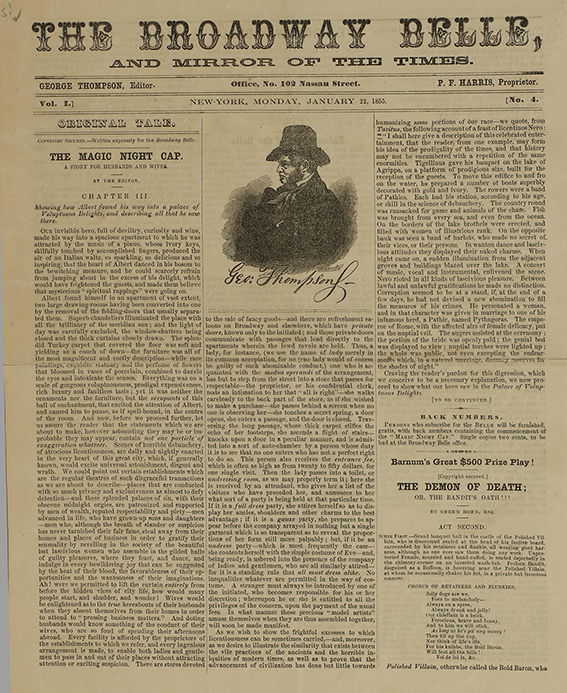
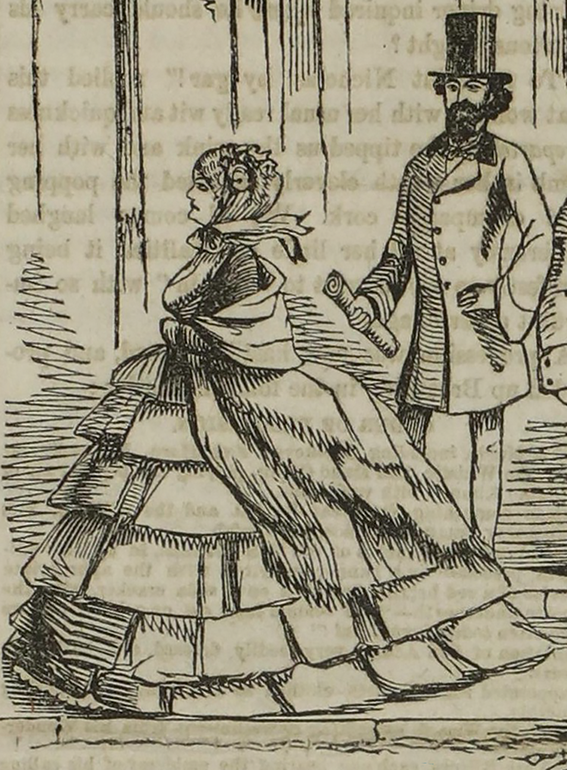
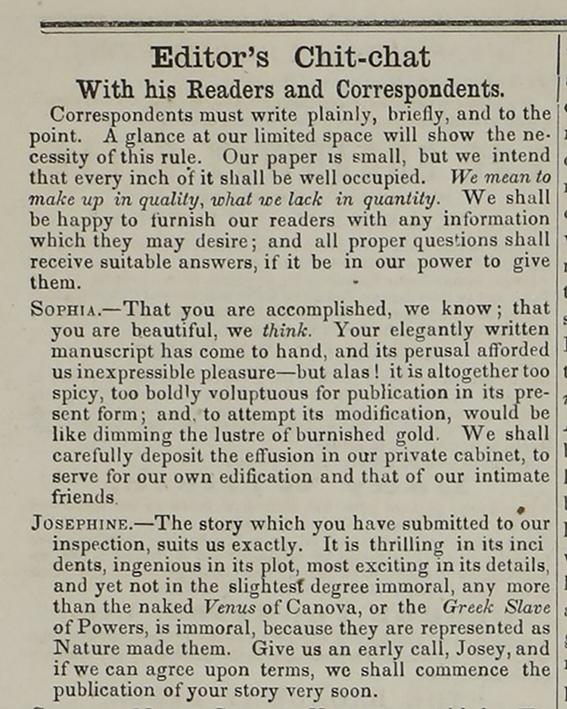
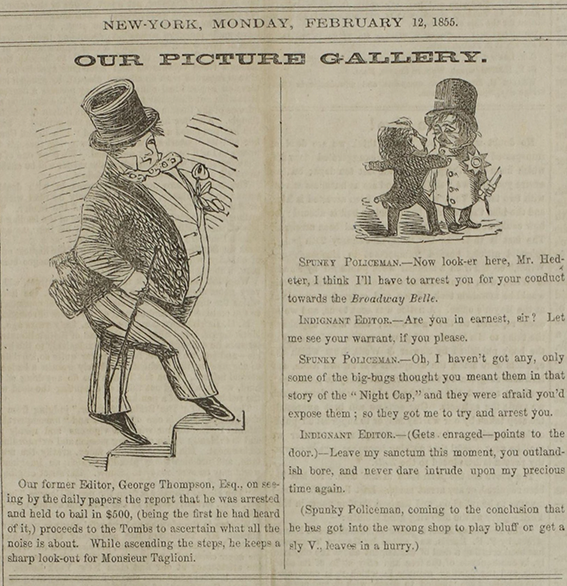
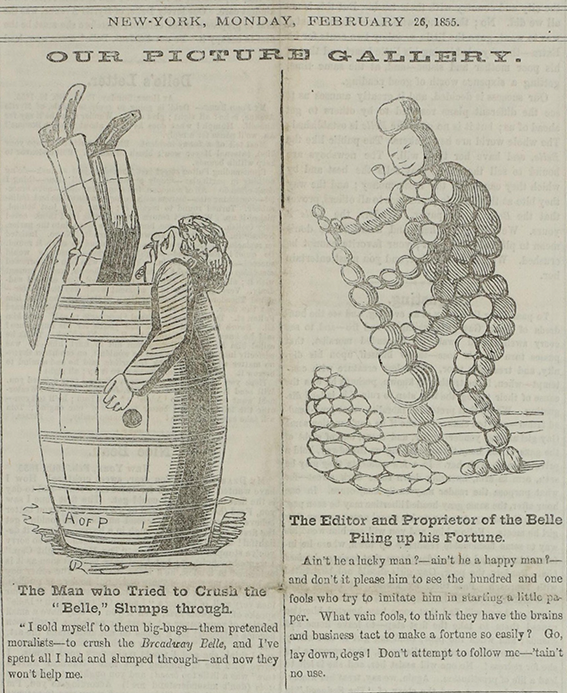
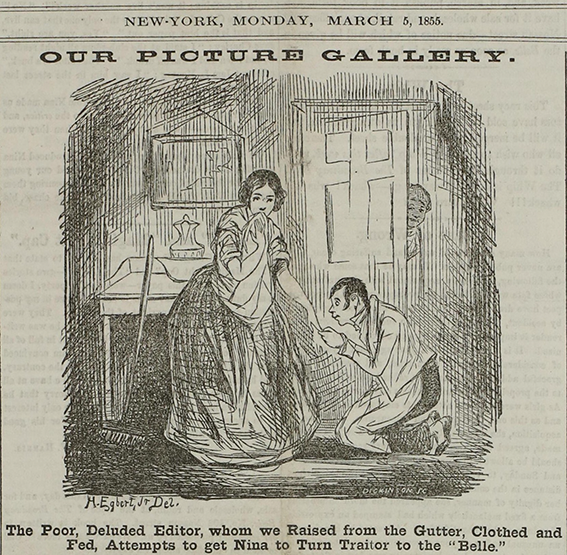
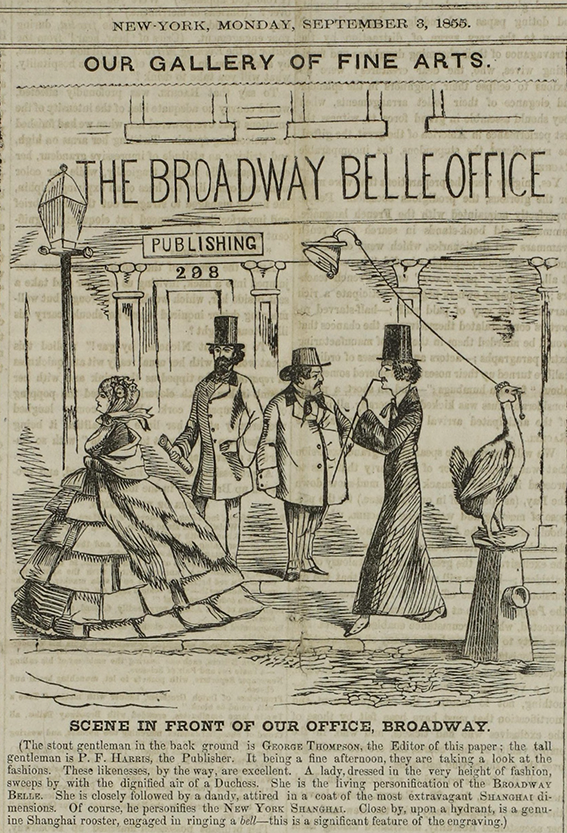

 Open access