




Introduction
The Fremouw Formation hosts the oldest record of tetrapod fossils from Antarctica and has figured prominently in palaeontologists’ understanding of vertebrate assemblages and ecosystems at high palaeolatitudes during the Triassic. Between 1967 and 2018, nine field seasons supported by the United States Antarctic Program have recovered at least 1300 vertebrate fossils from outcrops of the Fremouw Formation. These specimens demonstrate the establishment, and probable persistence, of a terrestrial community within the southern polar circle (75–85°S; van Hinsbergen et al. Reference van Hinsbergen, de Groot, van Schaik, Spakman, Bijl and Sluijs2015, Vaes et al. Reference Vaes, van Hinsbergen, van de Lagemaat, van der Wiel, Lom and Advokaat2023) during the Early to Middle Triassic (Sidor et al. Reference Sidor, McIntosh, Gee, Hammer, Makovicky and Smith2023), including over-wintering small-bodied species and possible evidence of hibernation (Fröbisch et al. Reference Fröbisch, Angielczyk and Sidor2010, Whitney & Sidor Reference Whitney and Sidor2020).
Vertebrate fossils found in the Fremouw Formation to date are predominantly from the informally recognized lower and upper members (Barrett Reference Barrett1969, Colbert Reference Colbert, Turner and Splettstoesser1982). Lower-member Fremouw Formation fossils were the first to be described, and they document a high-latitude assemblage with strong ties to the Lower Triassic (Induan-Olenekian) Lystrosaurus Zone (now the Lystrosaurus declivis Assemblage Zone (LAZ); Botha & Smith Reference Botha and Smith2020) of South Africa’s Karoo Basin (Barrett Reference Barrett1969, Kitching et al. Reference Kitching, Collinson, Elliot and Colbert1972, Collinson et al. Reference Collinson, Hammer, Askin and Elliot2006). Upper-member Fremouw Formation fossils were first reported almost 20 years later and were recognized as comprising a younger tetrapod assemblage (probably Middle Triassic (Anisian)), correlated with the Cynognathus Assemblage Zone of South Africa (Hammer et al. Reference Hammer, Ryan, Tamplin and DeFauw1986, 1988, Hammer Reference Hammer1995, Sidor et al. Reference Sidor, Smith, Huttenlocker and Peecook2014). In both cases, the Fremouw Formation assemblages have substantially poorer sampling than their South African Karoo Basin counterparts (Sidor et al. Reference Sidor, McIntosh, Gee, Hammer, Makovicky and Smith2023) but nonetheless have yielded endemic species (e.g. Kombusia antarctica for the lower member of the Fremouw Formation and Kryostega collinsoni for the upper member of the Fremouw Formation; Sidor et al. Reference Sidor, Damiani and Hammer2008a, Fröbisch et al. Reference Fröbisch, Angielczyk and Sidor2010), suggesting that biogeographical variation existed between the vertebrate faunas of the Antarctic and southern African regions of Pangaea during the early Mesozoic.
Cosgriff et al. (Reference Cosgriff, Hammer, Zawiskie and Kemp1978: 23) noted the discovery of a ‘small, partial reptilian skeleton … found 239 meters above the base of the [Shenk Peak] section’ during the 1978–1979 field season. To our knowledge, this is the sole instance of a middle-member vertebrate body fossil being reported in the literature, although Macdonald et al. (1990) later described tetrapod trackways from an equivalent stratigraphic interval at Gordon Valley. This changed as a result of the 2017–2018 field season in the Shackleton Glacier region, when temnospondyl, reptilian and therapsid fossils were recovered from the middle member (Sidor et al. Reference Sidor, Gee, Kulik, Makovicky, McIntosh and Smith2020). Subsequently, Sidor et al. (Reference Sidor, Kulik and Huttenlocker2022) described the endemic bauriamorph therocephalian Notictoides absens, and Gee & Sidor (Reference Gee and Sidor2024) described Micropholis stowi and indeterminate capitosaurians from the same strata. Micropholis is well known from the LAZ of the Karoo Basin as well as from the lower member of the Fremouw Formation (Gee & Sidor Reference Gee and Sidor2021), and capitosaurians are extremely rare in the LAZ (Damiani et al. Reference Damiani, Neveling and Hancox2001), despite its otherwise diverse temnospondyl assemblage (Botha & Smith Reference Botha and Smith2020), creating a picture of regionally differentiated faunas.
Here, we review and expand on the geology of the middle member of the Fremouw Formation to update its palaeoenvironmental interpretation and provide new data on its vertebrate fossil assemblage, including the first reptiles to be positively identified. We recognize the archosauromorph Prolacerta broomi and the procolophonid Procolophon trigoniceps, which, together with previously reported material, suggests that the middle member is probably Early Triassic in age and is biostratigraphically equivalent to the mid- and upper portions of the LAZ in South Africa.
Geological context
Transantarctic Basin and the Victoria Group
In southern Gondwana, after the Ediacaran–Early Ordovician Ross orogeny, the transition from the Late Devonian to the Triassic represents a shift in tectono-sedimentary regime from intra-continental to retro-arc foreland basin, here referred to as the Transantarctic Basin. The basin developed on the landward side of the rising Gondwanide thrust belt as the result of crustal loading (Elliot Reference Elliot and Campbell1975, Barrett et al. Reference Barrett, Elliot, Lindsay, Turner and Splettstoesser1986, Collinson et al. Reference Collinson, Isbell, Elliot, Miller, Miller, Veevers and Powell1994, Goodge Reference Goodge2020). The predominant source of the Beacon Supergroup sediments that fill the basin were uplifted blocks of Archaean basement and associated volcanics along the active margin to the south. The Victoria Group (of the Beacon Supergroup, Devonian–Triassic; Elliot Reference Elliot2013) crops out across Victoria Land and the Transantarctic Mountains, where the Central Transantarctic Mountains (CTM) host extensive exposures in the Shackleton-Beardmore Glacier region (Fig. 1; Elliot Reference Elliot2013, Elliot et al. Reference Elliot, Fanning, Isbell and Hulett2017).
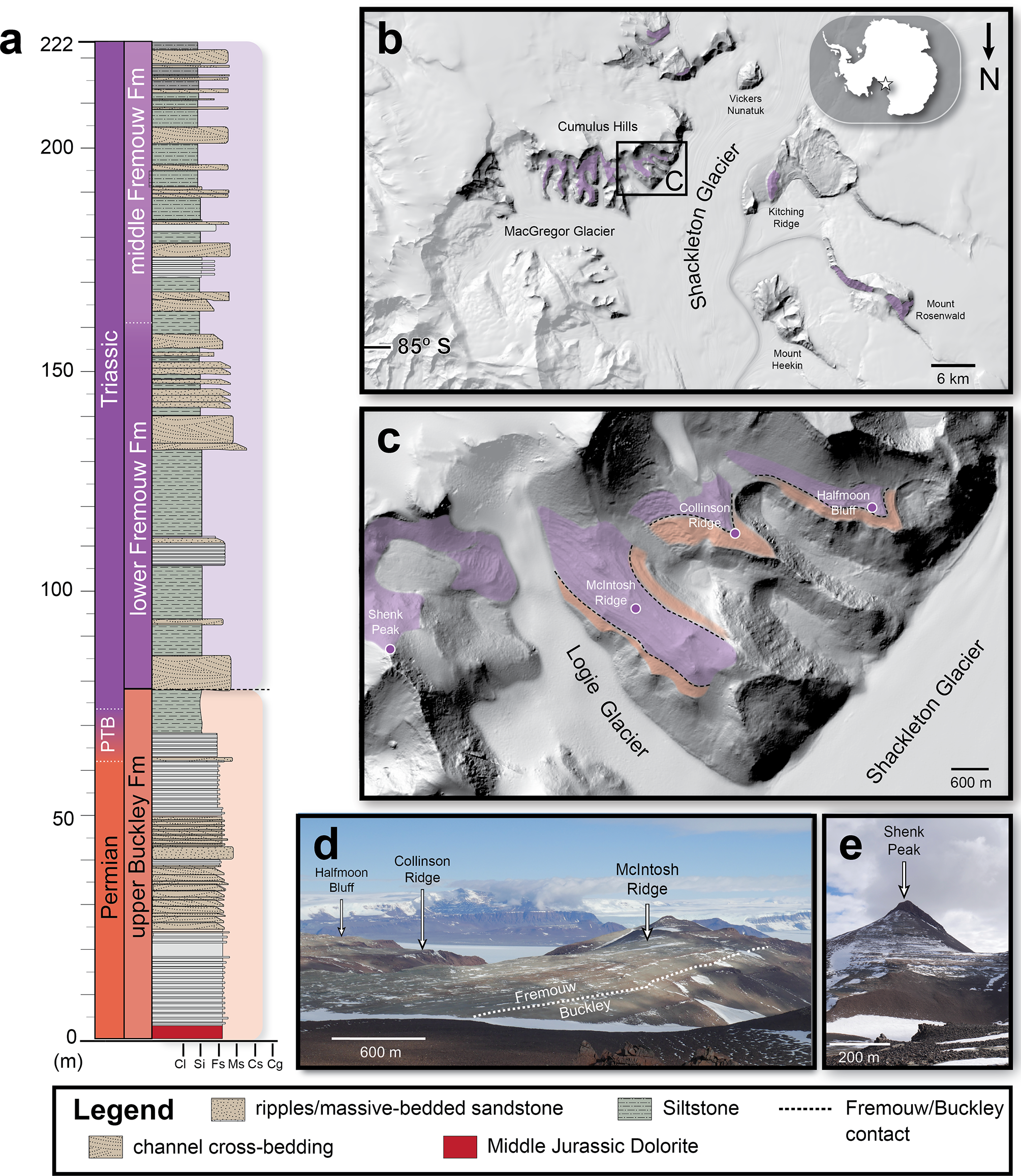
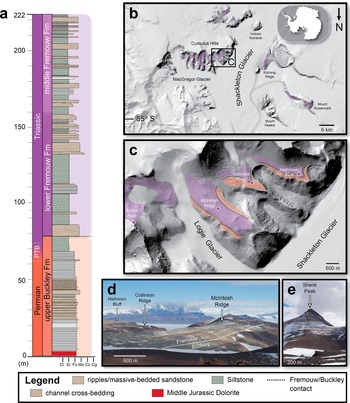
Locality and geological setting of the material described in this study. a. Stratigraphic column of the McIntosh Ridge locality, modified from Sidor et al. (Reference Sidor, McIntosh, Gee, Hammer, Makovicky and Smith2023). b. Geographical location of the field area (white star on silhouette of Antarctica, inset) and digital elevation map of the Shackleton Glacier region, with the Fremouw Formation outcrop mapped in purple. c. Digital elevation map of the Cumulus Hills field area, with the Buckley Formation outcrop mapped in red-orange and the Fremouw Formation outcrop mapped in purple. Dashed line: location of sandstone layer at the base of the Fremouw Formation overlaying the contact with the Buckley Formation. Fremouw Formation localities are demarcated by purple dots. d. & e. Photographs of the middle member of the Fremouw Formation outcrop and localities, taken by author CHW in January 2018 from the slopes of Mount Augustana. Digital elevation maps generated from the Reference Elevation Map of Antarctica (Howat et al. Reference Howat, Porter, Noh, Husby, Khuvis and Danish2022; https://doi.org/10.7910/DVN/X7NDNY). Cg = conglomerate; Cl = claystone; Cs = coarse-grained sandstone; Fm = Formation; Fs = fine-grained sandstone; Ms = medium-grained sandstone; Si = siltstone.
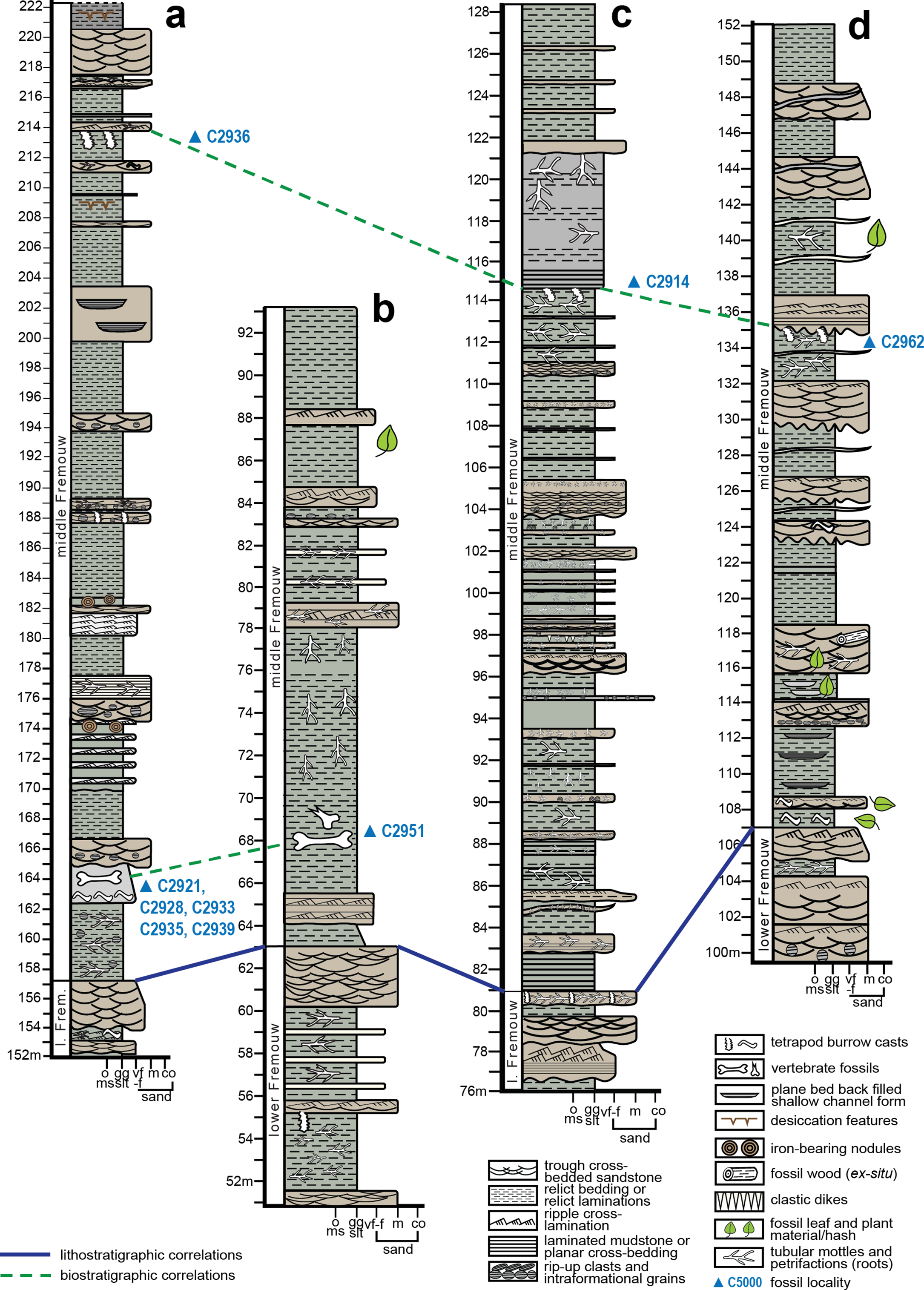
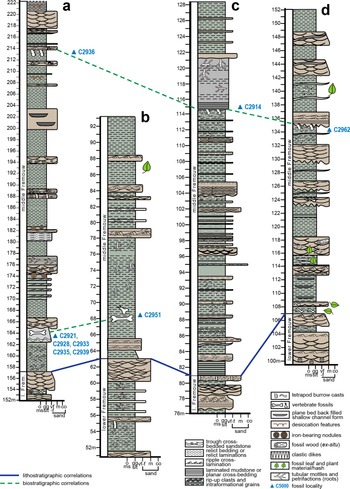
Fence diagrams connecting the sedimentology of the middle member of the Fremouw Formation across the Shackleton Glacier region. Stratigraphic columns are ordered from south (Cumulus Hills, left) to north (towards Beardmore Glacier, right). Localities depicted include a. McIntosh Ridge, b. Halfmoon Bluff, c. Kitching Ridge and d. McIntyre Promontory. Locations of vertebrate or trace fossils are marked by blue triangles and C-numbers associated with fossils in the University of Washington Burke Museum (UWBM) Vertebrate Paleontology collection, Seattle, Washington, USA. Abbreviations on the x-axes of the stratigraphic columns: co sand = coarse-grained sandstone; gg slt = grey-green siltstone; m sand = medium-grained sandstone; o ms = carbonaceous mudstone; vf-f sand = very fine- to fine-grained sandstone. Stratigraphic columns modified after Sidor et al. (Reference Sidor, McIntosh, Gee, Hammer, Makovicky and Smith2023).
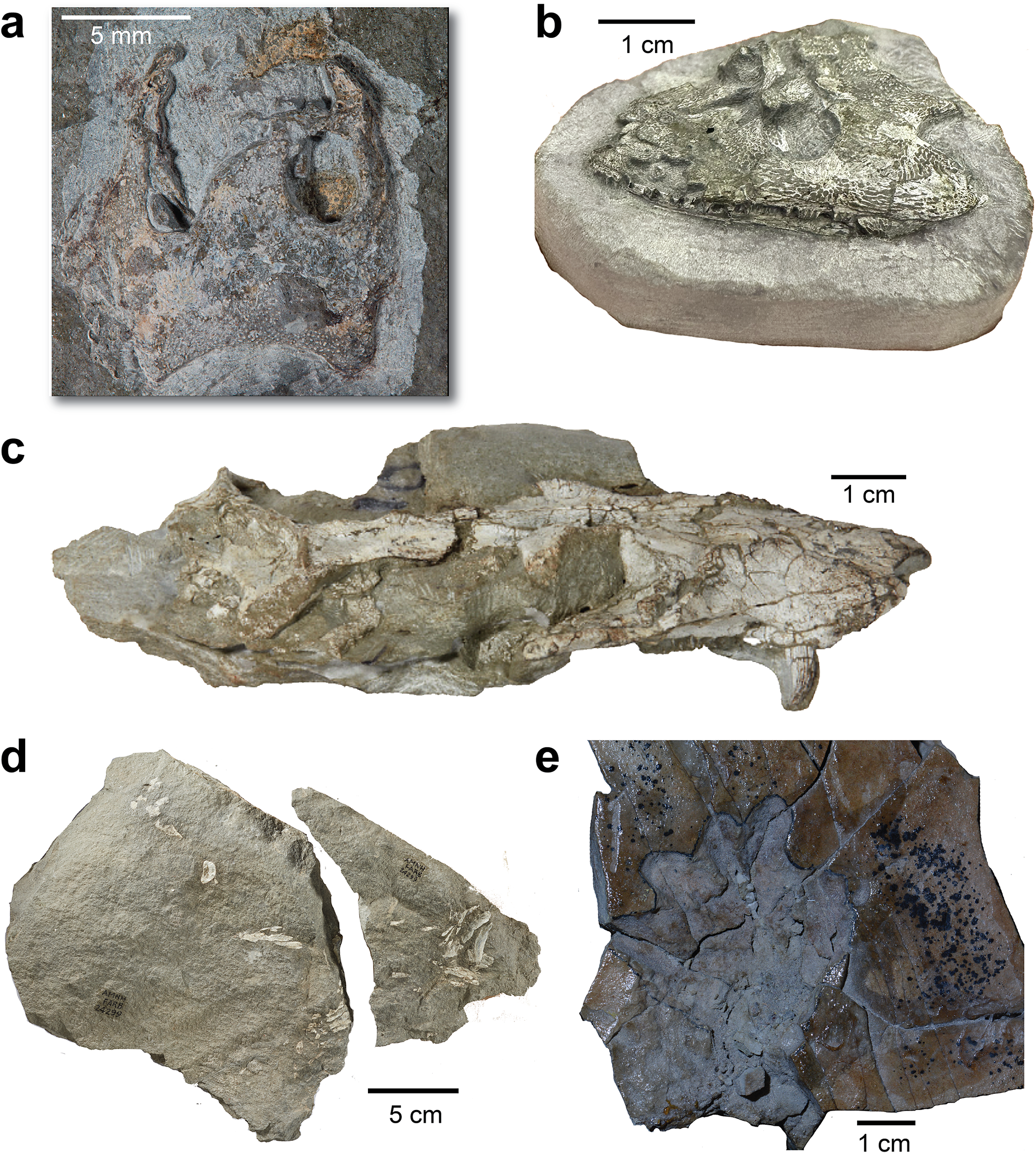
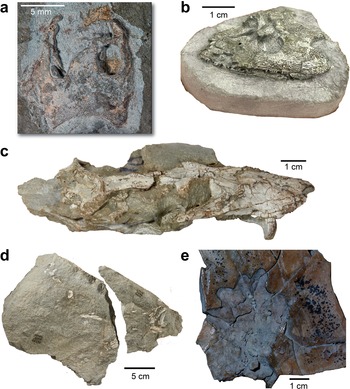
Examples of tetrapod taxa previously described from the middle member of the Fremouw Formation. a. Skull of Micropholis stowi (UWBM VP 120452) in dorsal view, with anterior towards the top of the page. b. Small skull of an indeterminate capitosaurian temnospondyl (UWBM VP 117535) in left anterodorsolateral view, with anterior towards the right of the page. c. Holotypic skull of the therocephalian Notictoides absens (UWBM VP 117466) in dorsolateral view, with anterior towards the left of the page. d. Indeterminate vertebrate fossil reported by Cosgriff et al. (Reference Cosgriff, Hammer, Zawiskie and Kemp1978; AMNH FARB 24299). e. Isolated tetrapod footprint reported by Isbell & Macdonald (Reference Isbell and MacDonald1991; LACM DI 160945).
The Victoria Group of CTM includes upper Carboniferous–Permian glacial and glacial-marine deposits of the Pagoda and Mackellar formations (Isbell et al. Reference Isbell, Koch, Szablewski and Lenaker2008). These are overlain by Permian–Triassic fluvial-lacustrine-deltaic deposits of the Fairchild, Buckley, Fremouw and Falla formations (Collinson & Elliot Reference Collinson, Elliot, Turner and Splettstoesser1984). More specifically, the Permian–earliest Triassic Buckley Formation is interpreted as a fluvio-lacustrine environment with coal-forming swamps and a flourishing Glossopteris floral assemblage (Barrett et al. Reference Barrett, Elliot, Lindsay, Turner and Splettstoesser1986, Isbell Reference Isbell1990). The Triassic Fremouw Formation is divided into three informal members (Barrett Reference Barrett1969), although all are interpreted to represent low sinuosity to braided fluvial and floodplain depositional environments (Barrett et al. Reference Barrett, Elliot, Lindsay, Turner and Splettstoesser1986, Isbell Reference Isbell1990, Collinson et al. Reference Collinson, Hammer, Askin and Elliot2006, Sidor et al. Reference Sidor, McIntosh, Gee, Hammer, Makovicky and Smith2023). The Triassic Falla Formation, which overlays the Fremouw Formation, is composed of fluvial channel sandstone and overbank mudstones interbedded with flood-basin swamp coals (Barrett et al. Reference Barrett, Elliot, Lindsay, Turner and Splettstoesser1986). Elliot et al. (Reference Elliot, Fanning, Isbell and Hulett2017) interpreted maximum depositional ages using U-Pb zircon geochronology recovered from sandstones of the Shackleton-Beardmore Glacier region, resulting in 253.5 ± 2.0 Ma and 250.3 ± 2.2 Ma for the upper part of the Buckley Formation, 245.9 ± 2.9 Ma for the middle member of the Fremouw Formation and 242.3 ± 2.3 Ma from the upper member of the Fremouw Formation. The Permian–Triassic boundary in Antarctica is defined biostratigraphically by the last occurrence of coals containing a Gondwanan Permian flora (i.e. Glossopteris) and the first occurrence of vertebrate fossils (i.e. Lystrosaurus). Therefore, in the CTM the biostratigraphic end-Permian mass extinction event (dated in the marine environment as ~252 Ma; e.g. Burgess et al. Reference Burgess, Bowring and Shen2014) is not at the lithostratigraphic contact between the Buckley and Fremouw formations (Collinson et al. Reference Collinson, Hammer, Askin and Elliot2006) but rather a stratigraphic interval (7–23 m thick in the Shackleton Glacier region; Sidor et al. Reference Sidor, McIntosh, Gee, Hammer, Makovicky and Smith2023) in the upper Buckley Formation (Fig. 1a), below the first multistoried channel sandstones forming the base of the Fremouw Formation.
Middle member of the Fremouw Formation
The Fremouw Formation of the CTM was divided into three informal members by Barrett (Reference Barrett1969) based on changes in dominant lithofacies: 1) the lower member comprises mainly medium- to coarse-grained sandstone and grey-green siltstone, 2) the middle member is mostly grey-green siltstone and 3) the upper member is characterized by fine- to medium-grained sandstone. As the informal members of the Fremouw Formation represent depositional facies, the boundaries and the characteristics of the members vary at different localities depending on local conditions and thus are predictably diachronous and disconformable (Collinson et al. Reference Collinson, Hammer, Askin and Elliot2006, Elliot et al. Reference Elliot, Fanning, Isbell and Hulett2017).
Sidor et al. (Reference Sidor, McIntosh, Gee, Hammer, Makovicky and Smith2023) identified the middle member of the Fremouw Formation at four localities in the CTM Shackleton Glacier region: McIntosh Ridge, Halfmoon Bluff, Kitching Ridge and McIntyre Promontory (Fig. 2). The middle member of the Fremouw Formation in the Shackleton Glacier region is characterized by tabular grey-green siltstone beds (beds are typically 1–2 m thick and often stacked, reaching a total thickness of 12 m) with interbedded medium-grained, moderately sorted, subrounded to subangular quartz and lithics-rich sandstones (ranging in thickness from 25 cm to 3 m), with the sandstone having limited lateral extent (Sidor et al. Reference Sidor, McIntosh, Gee, Hammer, Makovicky and Smith2023). In general, sandstones contain scoured basal contacts with rip-up clasts and trough cross-bedding grading to ripple cross-lamination for thicker beds (1–3 m) or only ripple cross-lamination for thinner beds (< 1 m). The siltstone commonly contains white, narrow, vertically or randomly oriented, downwardly bifurcating tubular petrifactions, interpreted as root traces (Sidor et al. Reference Sidor, McIntosh, Gee, Hammer, Makovicky and Smith2023) of herbaceous or shrub-type vegetation (Retallack & Alonso-Zarza Reference Retallack and Alonso-Zarza1998). Clastic dykes and desiccation features are rare in siltstones at McIntosh Ridge and Kitching Ridge and were not found elsewhere. Although plant fossils are rare in the lower member of the Fremouw Formation (Escapa et al. Reference Escapa, Taylor, Cúneo, Bomfleur, Bergene, Serbet and Taylor2011), the middle member contains fossilized leaves and logs in both siltstones and sandstones at Halfmoon Bluff and McIntyre Promontory (Sidor et al. Reference Sidor, McIntosh, Gee, Hammer, Makovicky and Smith2023). Tubular sandstone structures with dimensions of 90–100 cm in length, 5–15 cm in width, 7–10 cm in height and inclined at 20–30° from horizontal (Sidor et al. Reference Sidor, McIntosh, Gee, Hammer, Makovicky and Smith2023) are interpreted to be vertebrate burrows (e.g. Miller et al. Reference Miller, Hasiotis, Babcock, Isbell and Collinson2001, Sidor et al. Reference Sidor, Miller and Isbell2008b). These burrow casts occur in the grey-green siltstone, infilled with fine-grained sandstone derived from the overlying bed, and they occur ~30–50 m above the lower-middle member transition. Palaeosols show only root traces and relict sedimentary bedding, with no visible horizonation or other definitive pedogenic morphological features, suggesting early stages of soil formation or immature development (i.e. Protosol Pedotype C in Sidor et al. Reference Sidor, McIntosh, Gee, Hammer, Makovicky and Smith2023). Vertebrate fossils in the middle member of the Fremouw Formation are rare compared to in the lower member, but they are consistently found in the grey-green siltstone at all sites described herein.
Materials and methods
Specimen collection
Most specimens described and discussed in this study were collected from the Fremouw Formation in the Shackleton Glacier region during the 2017–2018 austral field season. Nearly all come from McIntosh Ridge (Fig. 1a,c), but the therocephalian N. absens was collected from a similar stratigraphic level at Halfmoon Bluff (Fig. 1c,d). These localities are located within 5 km of each other in the Cumulus Hills area of the CTM (Fig. 2a,b). The middle-member fossil reported by Cosgriff et al. (Reference Cosgriff, Hammer, Zawiskie and Kemp1978) was re-examined in the collections of the American Museum of Natural History, New York (AMNH) and reunited with a smaller piece of the same block that had been previously collected from Shenk Peak during the 1970–1971 field season but was never catalogued (Fig. 3d). One of the tetrapod footprint slabs discussed by Isbell & Macdonald (Reference Isbell and MacDonald1991) is housed at the Natural History Museum of Los Angeles County, Los Angeles (LACM DI) and is shown in Fig. 3e.
Systematic palaeontology
TETRAPODA
TEMNOSPONDYLI von Zittel, Reference von Zittel1890 sensu Schoch, Reference Schoch2013
DISSOROPHOIDEA Bolt, Reference Bolt1969
AMPHIBAMIFORMES Schoch, Reference Schoch2018
MICROPHOLIDAE Watson, Reference Watson1919 sensu Schoch, Reference Schoch2018
Micropholis stowi Huxley, Reference Huxley1859
Referred material
University of Washington Burke Museum, Seattle (UWBM) VP 117538, partial skull in dorsal view, partial maxilla and partial postorbital region preserved. UWBM VP 120452, posterior half of skull in dorsal view preserving complete right orbit and partial left orbit (Fig. 3a).
Locality and horizon
Both specimens were collected from the middle member of the Fremouw Formation at McIntosh Ridge (UWBM VP 117538 at UWBM locality C2935 and UWBM VP 120452 at C2939), ~7 m above the base of the middle member, in the grey-green siltstone.
Remarks
These specimens were previously discussed by Gee & Sidor (Reference Gee and Sidor2024).
TEMNOSPONDYLI von Zittel, Reference von Zittel1890 sensu Schoch, Reference Schoch2013
STEREOSPONDYLI von Zittel, Reference von Zittel1890 sensu Yates and Warren, Reference Yates and Warren2000
CAPITOSAURIA Yates and Warren, Reference Yates and Warren2000
CAPITOSAURIA indet.
Referred material
UWBM VP 117535, skull and occluded lower jaw preserving teeth, with pectoral girdle (Fig. 3b). UWBM VP 117747, skull in dorsal view, scattered fragmentary bones. UWBM VP 120675, bisected internal view of left half of skull.
Locality and horizon
UWBM VP 117535 and 120675 were collected from the middle member of the Fremouw Formation at UWBM locality C2933 at McIntosh Ridge, ~7 m above the base of the middle member, in the grey-green siltstone. UWBM VP 117747 was collected from the middle member of the Fremouw Formation at C2928 at McIntosh Ridge, ~7 m above the base of the middle member.
Remarks
These specimens were previously discussed by Gee & Sidor (Reference Gee and Sidor2024).
THERAPSIDA Broom, Reference Broom1905
THEROCEPHALIA Broom, Reference Broom1903
BAURIOIDEA Broom, Reference Broom1911
BAURIAMORPHA Watson, Reference Watson1917
Notictoides absens Sidor et al. Reference Sidor, Kulik and Huttenlocker2022
Holotype
UWBM VP 117466, a dorsoventrally crushed skull, mostly complete but lacking zygomatic arches and posterior half of the right hemimandible.
Locality and horizon
Greenish-grey ripple cross-laminated siltstone from near the base of the middle member of the Fremouw Formation at Halfmoon Bluff (UWBM locality C2951), ~5 m above the base of the middle member.
Remarks
This taxon was described by Sidor et al. (Reference Sidor, Kulik and Huttenlocker2022).
REPTILIA
PARAREPTILIA Olson, Reference Olson1947
PROCOLOPHONIA Seeley, Reference Seeley1888
PROCOLOPHONIDAE Romer, Reference Romer1956
PROCOLOPHONIDAE indet.
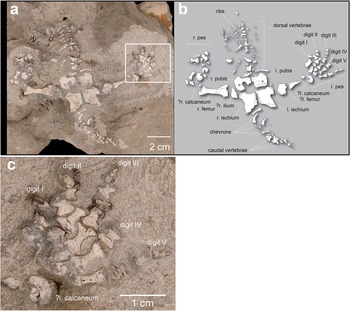
Articulated posterior skeleton of an indeterminate procolophonid from the middle member of the Fremouw Formation (UWBM VP 117756). a. Specimen exposed in ventral view, with anterior towards the top of the page. b. Line drawing of the specimen as orientated as in a. c. Detail of articulated left pes in ventral view.
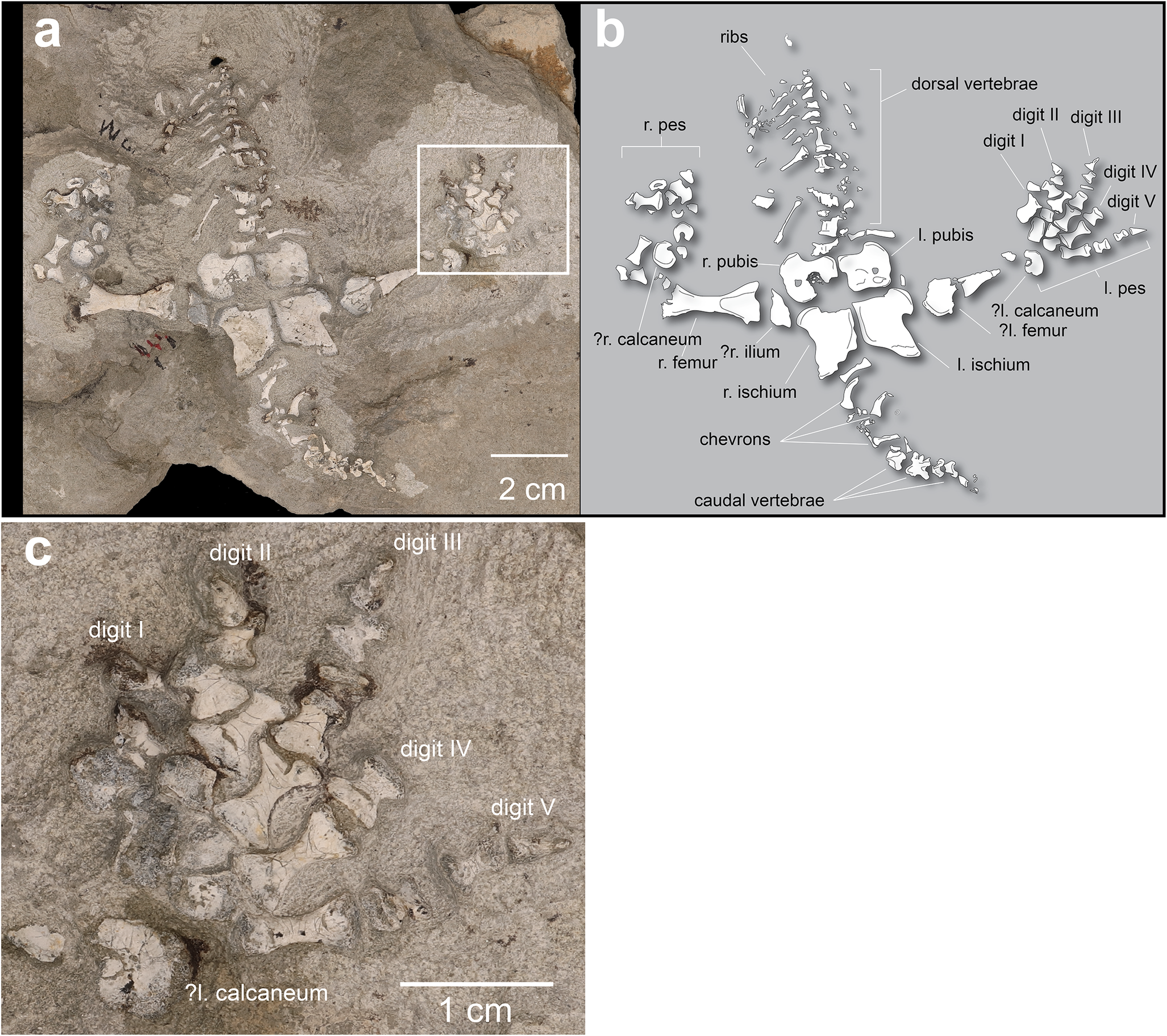
Referred material
UWBM VP 117756, posterior part of skeleton including articulated vertebrae with dorsal ribs, articulated caudal vertebrae, both femora, pubes and ischia, nearly complete left pes, disarticulated right pes, other scattered elements.
Locality and horizon
Collected from McIntosh Ridge at UWBM locality C2928, which occurs in the middle member of the Fremouw Formation ~7 m above the base of the middle member, in the grey-green siltstone.
Identification
Most middle-member procolophonid fossils are fragmentary and lack the cranial characteristics permitting identification below the family level (but see later). Indeterminate procolophonid material can be identified by the presence of swollen neural arches, the presence of intercentra, a T-shaped interclavicle with concave lateral processes and a smooth medial ridge, a robust femur, as well as short and stocky phalanges (Cisneros Reference Cisneros2008a).
UWBM VP 117756 (Fig. 4) preserves an almost entirely articulated posterior part of the skeleton, which is a first for a procolophonid from the Fremouw Formation. At least three ossified intercentra are preserved, although the vertebral column shows some signs of disarticulation. The preserved ribs are too incomplete to assess whether the rib cage is narrow or broad, which can be a distinguishing feature among procolophonid taxa (Cisneros Reference Cisneros2008a, phylogenetic character 45). At least five anterior caudal vertebrae are present in articulation, along with their associated chevrons. The vertebrae possess prominent pre- and postzygapophyses. The right ilium is mostly obscured in matrix. The left and right pubes are present. Much like the pubes observed in the South African specimen of an indeterminate procolophonid (SAM PK-K7711; deBraga Reference deBraga2003, Modesto & Damiani Reference Modesto and Damiani2007), the pubes of UWBM VP 117756 are flat and nearly square in outline. However, on UWBM VP 117756 there are more prominent anterolateral processes, which differs from some described South African specimens. The pubic foramen of UWBM VP 117756 is smaller in diameter relative to the total anteroposterior length of the pubis than SAM PK-K7711 but is similar to that observed in SAM PK-K10417 (deBraga Reference deBraga2003). The left and right ischia are exposed, and they are almost twice the anteroposterior length of the pubes. The dorsolateral margins of the left ischium are more complete than those of the right ischium. The process of the ischium that contributes to the acetabular margin rises more abruptly from the main body of the ischium than that observed in the ischium of other procolophonid specimens from South Africa (e.g. SAM PK-K7711; deBraga Reference deBraga2003). The right femur is mostly exposed, and it possesses broad proximal and distal ends that indicate a robust construction typically seen in Procolophon (Cisneros Reference Cisneros2008a). Interestingly, neither the tibia nor the fibula from either limb can be observed, although it is possible that they remain embedded in matrix. However, both the left and right pedes are preserved (Fig. 4a,c), and the calcaneum is similar to that observed in P. trigoniceps (deBraga Reference deBraga2003) and Eomurruna yurrgensis (Hamley et al. Reference Hamley, Cisneros and Damiani2021), in that it is not fused to the astragalus. Much of the left pes is in articulation. Five distal tarsals are present, as in specimens of Procolophon from South Africa (BMNH R-3375; deBraga Reference deBraga2003). All five metatarsals are present, and they are the longest element in each digit. The phalangeal series in digits II, III and V are complete. Digits II and V preserve three phalanges, and digit III preserves four phalanges. Pedal ungual phalanges are triangular and approximately the same length as the penultimate phalanx in each digit.
PROCOLOPHONIDAE Romer, Reference Romer1956
PROCOLOPHON Owen, Reference Owen1876
Procolophon trigoniceps
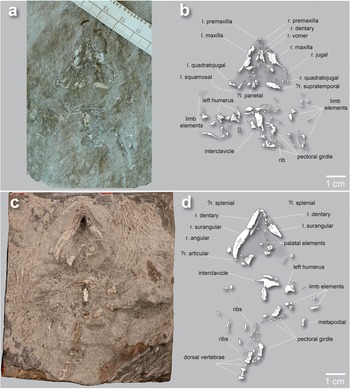
Procolophon trigoniceps from the middle member of the Fremouw Formation (UWBM VP 117540). a. Anterior skeleton as found, exposed in dorsal view. b. Line drawing of the dorsal view of the specimen. c. Specimen after being embedded in epoxy and prepared in ventral view. d. Line drawing of the ventral view of the specimen.
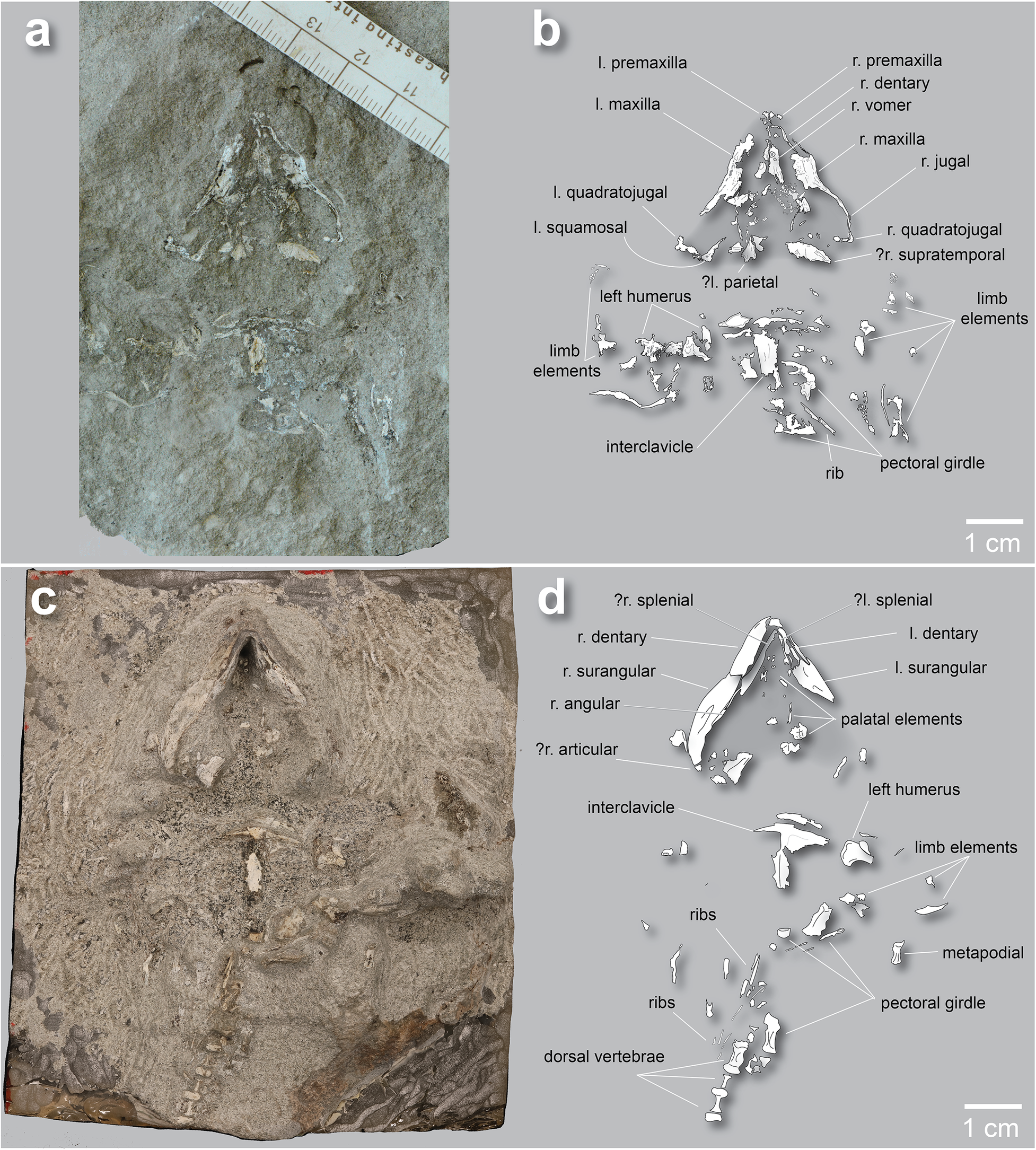
Referred material
UWBM VP 117540, articulated anterior skeleton prepared from both dorsal and ventral sides; cranium exposed in dorsal view; lower jaws and palate, interclavicle, articulated vertebrae with intercentra exposed in ventral view. UWBM VP 117757, maxilla preserved mostly as an impression with five bulbous teeth, the largest of which appears bicuspid.
Locality and horizon
McIntosh Ridge at locality C2921(UWBM VP 117540) and C2928 (UWBM VP 117757), which are both ~7 m above the base of the middle member of the Fremouw Formation, in the grey-green siltstone.
Description
UWBM 117540 (Figs 5 & 6) is a partially weathered but articulated anterior skeleton including portions of an articulated skull, the interclavicle, dorsal vertebrae and ribs and incomplete limb elements. This specimen was prepared from both the dorsal and ventral sides (Fig. 5). In dorsal view (Fig. 6a), the skull preserves partial left and right premaxillae, the left and right maxillae, the right jugal and right quadratojugals, the left squamosal, the left parietal, the right supratemporal, the left and right vomers, the left palatine, as well as the left and right pterygoids. In ventral view (Fig. 6c), the skull preserves the right quadrate, the left and right dentaries, the left and right splenials, the left and right surangulars, the right angular and the right articular.
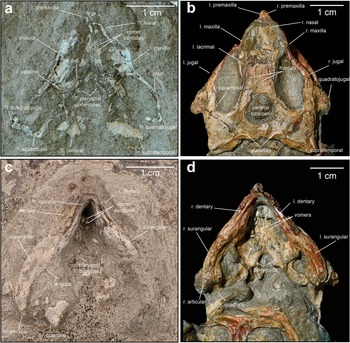
Comparison of the skull of Procolophon trigoniceps from the middle member of the Fremouw Formation (UWBM VP 117540; a. & c.) to the skull of P. trigoniceps from the lower member of the Fremouw Formation (AMNH FARB 9506; b. & d.). pal. d. = palatine denticles.
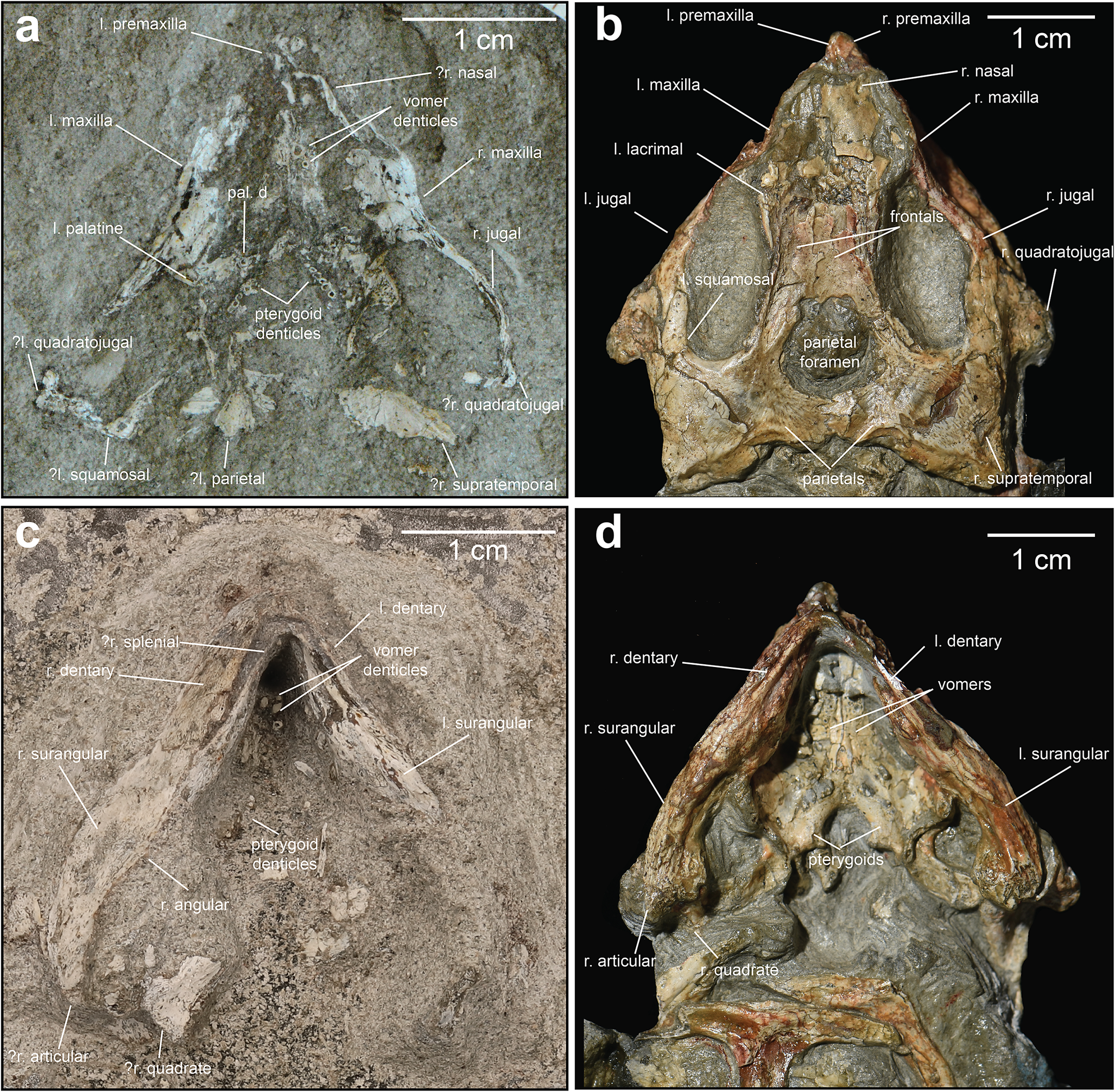
The skull is approximately triangular in shape, similar to all specimens referred to P. trigoniceps (e.g. Colbert & Kitching Reference Colbert and Kitching1975, Cisneros Reference Cisneros2008b, Silva-Neves et al. Reference Silva-Neves, Modesto and Dias-da-Silva2018, Smith et al. Reference Smith, Wolvaardt, Cisneros, Pinheiro, Bevitt and Benoit2025). Although the quadratojugals are incompletely preserved, the extent of the posterolateral margin of the posteroventral processes are moderately expanded, similar to AMNH FARB 9506 (Fig. 6; Colbert & Kitching Reference Colbert and Kitching1975, a nearly complete, three-dimensionally preserved skull and anterior skeleton), and differing from subadult and adult South African specimens (Colbert & Kitching Reference Colbert and Kitching1975, Cisneros Reference Cisneros2008b, Smith et al. Reference Smith, Wolvaardt, Cisneros, Pinheiro, Bevitt and Benoit2025). In ventral view, the mandible is nearly identical in shape and morphology to AMNH FARB 9506 (Fig. 6c,d; Colbert & Kitching Reference Colbert and Kitching1975). It is unclear whether the vomers possess the same medial depression that is observed in AMNH FARB 9506 (Fig. 6d), which, according to Cisneros (Reference Cisneros2008b), could be a feature diagnostic of a new Antarctic species within Procolophon.
The preserved presacral vertebrae of UWBM VP 117540 possess ossified intercentra (Fig. 5b), a character observed in a number of procolophonid taxa including P. trigoniceps (Cisneros Reference Cisneros2008a,b). UWBM VP 117540 also possesses a T-shaped interclavicle with concave lateral processes and a smooth medial ridge in ventral view, similar to that observed on AMNH FARB 9506 and other specimens referred to P. trigoniceps. Dorsal vertebrae with intercentra are preserved in ventral view, along with a fragmentary left humerus.
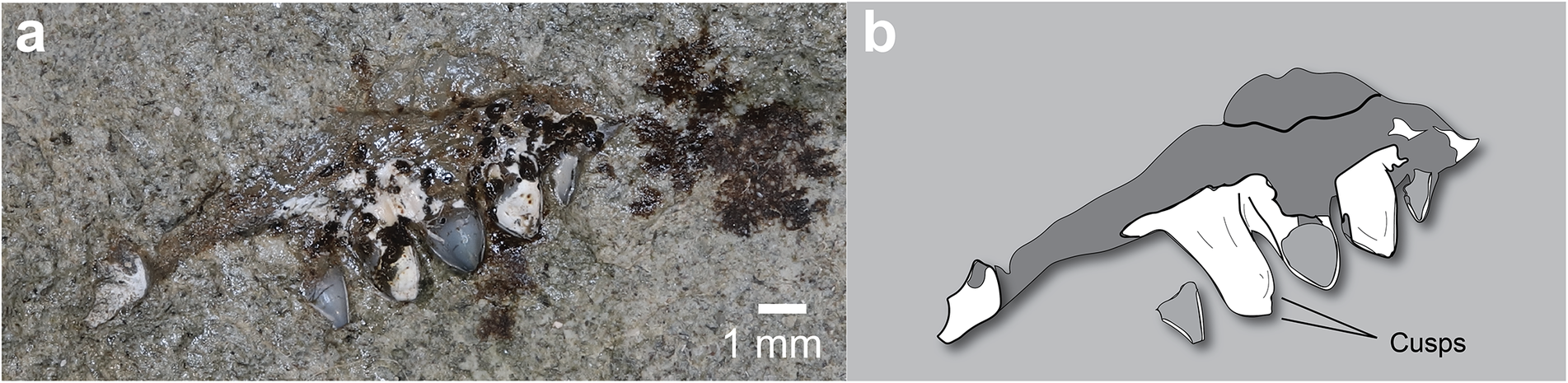
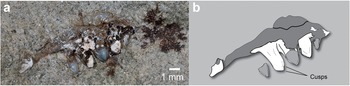
UWBM VP 117757 is an incomplete jaw fragment, here identified as a potential left maxilla due to the relative height of the bone where the teeth are attached (Fig. 7). Five partial teeth are preserved, with the third being the largest. The tooth crowns are bulbous and in some positions are represented only by a thin layer of enamel. Implantation is difficult to assess due to poor preservation, but the third tooth appears to possess a bicuspid tip, which is a diagnostic characteristic of P. trigoniceps (Cisneros Reference Cisneros2008b).
a. Photograph and b. line drawing of UWBM VP 117757, an incompletely preserved ?maxilla of Procolophon trigoniceps from the middle member of the Fremouw Formation.
Remarks
Procolophonids from the Lower Triassic Fremouw Formation were described by Colbert & Kitching (Reference Colbert and Kitching1975) and include relatively complete specimens identified as P. trigoniceps based on nearly complete anterior skeletons and skulls. Cisneros (Reference Cisneros2008b) refrained from naming a distinct Antarctic species but noted two features in the lower member of the Fremouw Formation Procolophon specimens (primarily visible on AMNH FARB 9506) that are not present in South African specimens: 1) relatively numerous foramina in the vomer and 2) a distinct medial depression at the suture line between the left and right vomers.
DIAPSIDA Osborn, Reference Osborn1903
ARCHOSAUROMORPHA Von Huene, Reference Von Huene1946
ARCHOSAUROMORPHA indet.
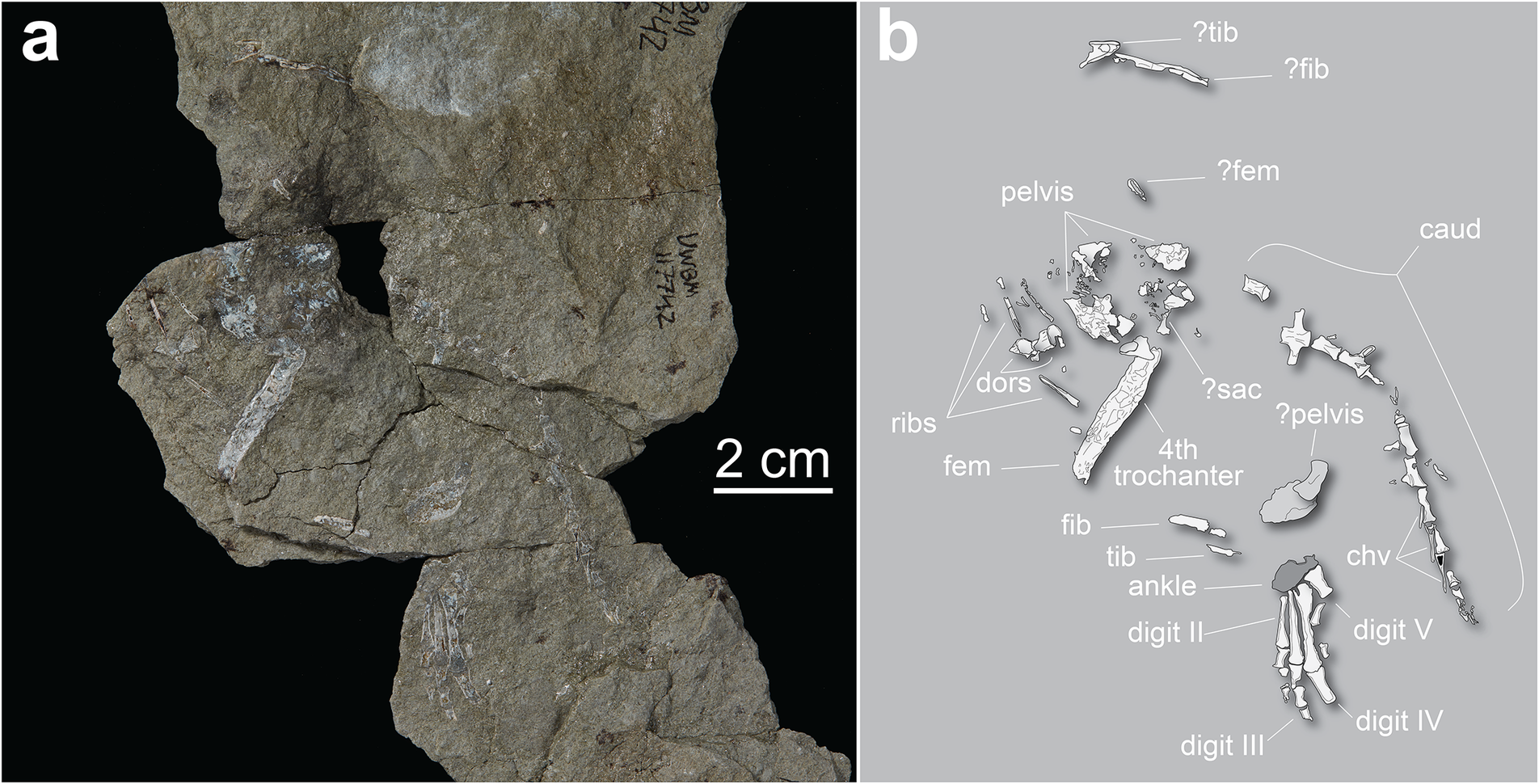
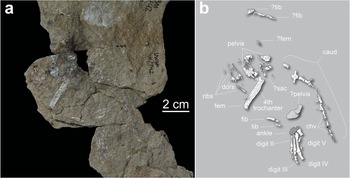
UWBM VP 117742, an articulated posterior skeleton of an archosauromorph from the middle member of the Fremouw Formation. a. Photograph of UWBM 117742, with specimen exposed in dorsal view. b. Line drawing of UWBM 117742. caud = caudal vertebrae; chv = chevron; dors = dorsal vertebrae; fem = femur; fib = fibula; sac = sacral vertebra; tib = tibia.
Referred material
UWBM VP 117742, semi-articulated posterior portion of a skeleton, including articulated partial left pes, articulated caudal vertebrae with haemal arches, impression of pelvis, partial left femur. UWBM VP 117754, dentary with small Prolacerta-like teeth, other scattered fragments.
Locality and horizon
Both specimens were collected from the middle member of the Fremouw Formation at McIntosh Ridge (UWBM VP 117742 from locality C2939 and 117754 from C2928), which come from ~7 m above the base of the middle member, in the grey-green siltstone.
Description
UWBM VP 117742 is a flattened, articulated posterior skeleton (Fig. 8). Two of the posterior-most dorsal vertebrae are partially preserved, along with four partial dorsal ribs. Two small, elongated elements (Fig. 8b) are preserved, and they may be gastralia, but they are too incomplete to confidently identify. One potential sacral vertebra is partially preserved, with a partial centrum and left sacral rib. The most anterior caudal vertebrae (~1–4) are either missing or disarticulated. Caudal vertebrae ~5–16 are partially preserved but in articulation. Three mostly complete chevrons also are preserved in articulation with caudal vertebrae 13–15. Four thin, flat elements are preserved, three of which are located in the pelvic region, and the fourth is preserved closer to the left ankle. These are interpreted as partial pelvic elements but are too incomplete to make confident anatomical assignments. Most of the left hindlimb is preserved, and remnants of the right hindlimb are present. The left femur is mostly preserved, but the proximal and distal ends appear either eroded or obscured in matrix. A moderate process is present on the dorsal margin of the femur (Fig. 8b). This is interpreted as the fourth trochanter. Remnants of the middle partitions of the left tibia and fibula are preserved. Elements of the ankle and tarsals are incompletely preserved, and it is impossible to determine the morphology of the astragalus, calcaneum and individual tarsals. The metatarsals of digit II–V are preserved, and the proximal articular surface of metatarsal V is located more proximally than the other digits to the incompletely preserved tarsal region (Fig. 8b). With the exception of metatarsal V, the metatarsals are proximodistally elongated. At least one phalanx is preserved for each digit, and digits II and III preserve partial unguals.
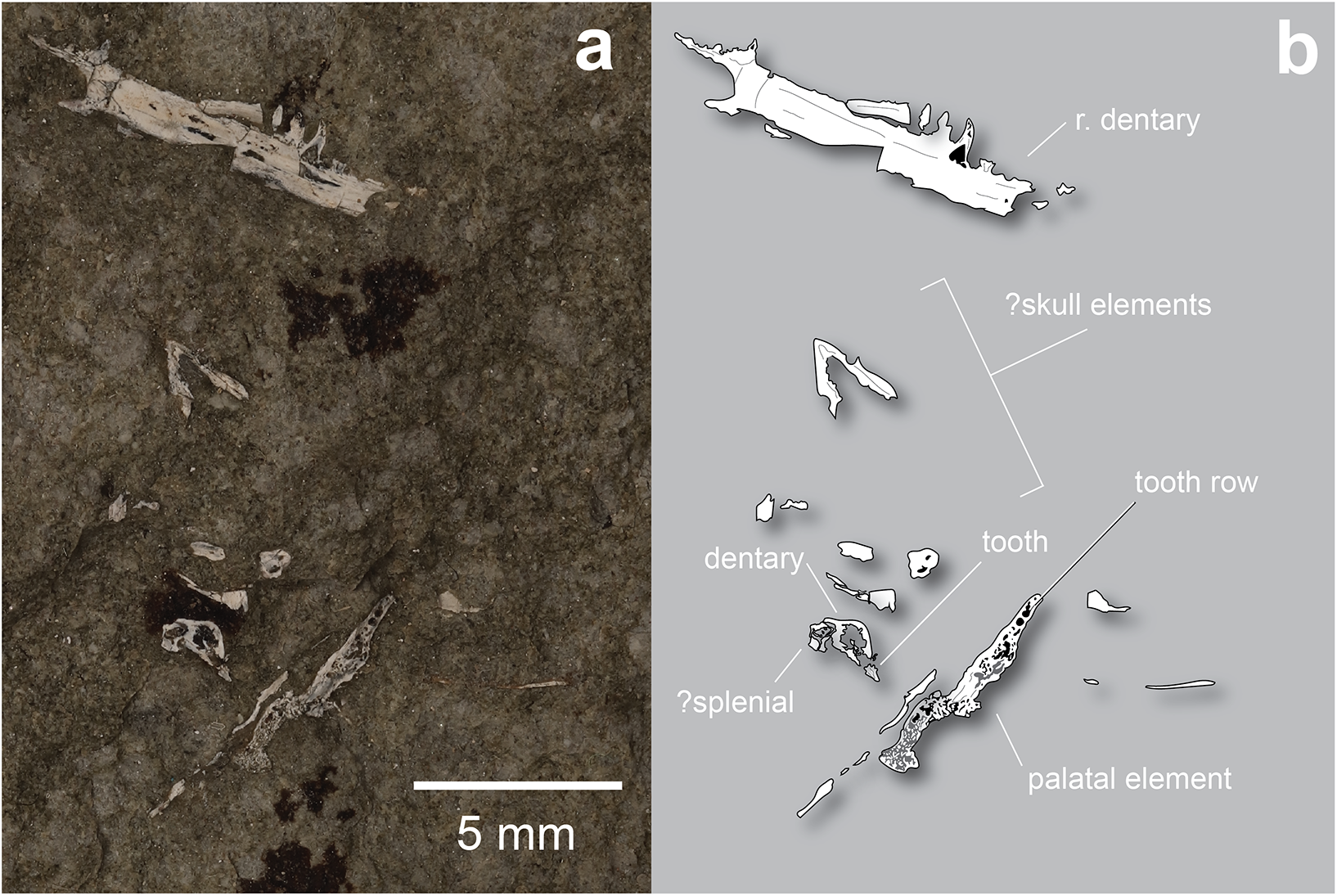
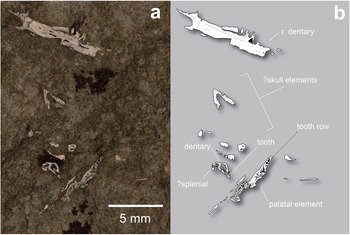
UWBM VP 117754 (Fig. 9) is a block containing several disarticulated skull elements, including a partial palatal element and two partial dentaries. The palatal element is partially eroded but possesses large tooth sockets in a single row, which is similar to the posterior tooth rows seen in the pterygoid and palatine of Prolacerta (e.g. UCMP 37151; Modesto & Sues Reference Modesto and Sues2004). Two dentaries are preserved: one in lateral view (right dentary) and the other in transverse cross-sectional view. The right dentary possesses an anterior, moderately recurved tooth crown and three more teeth that possess more conical crowns in sagittal view. The dentary preserved in transverse cross-sectional view exhibits labial and lingual facets approximately equal in height, separated by a gap interpreted here as an alveolus.
UWBM VP 117754: a. photograph and b. line drawing of associated archosauromorph skull elements.
Remarks
Neither UWBM VP 117742 nor UWBM VP 117754 preserve skeletal features that are diagnostic of P. broomi (e.g. Spiekman Reference Spiekman2018, Sobral Reference Sobral2023), thus we cannot confidently infer affinities to this taxon as currently constructed. However, the presence of a fourth trochanter on the femur of UWBM VP 117742 (Fig. 8b) and the thecodont tooth attachment on the marginal teeth on UWBM VP 117754 (Fig. 9) are consistent with early archosauromorph characteristics (Ezcurra Reference Ezcurra2016, Spiekman Reference Spiekman2018, Sobral Reference Sobral2023). The recurved dentary tooth on UWBM VP 117754 is more pronounced than in other described Antarctic Prolacerta specimens (AMNH FARB 9520; Colbert Reference Colbert1987, Spiekman Reference Spiekman2018), as well as some South African specimens (UCMP 37151), but certainly could be ascribed to intraspecific variation.
ARCHOSAUROMORPHA Von Huene, Reference Von Huene1946
PROLACERTA Parrington, Reference Parrington1935
Prolacerta broomi Parrington, Reference Parrington1935
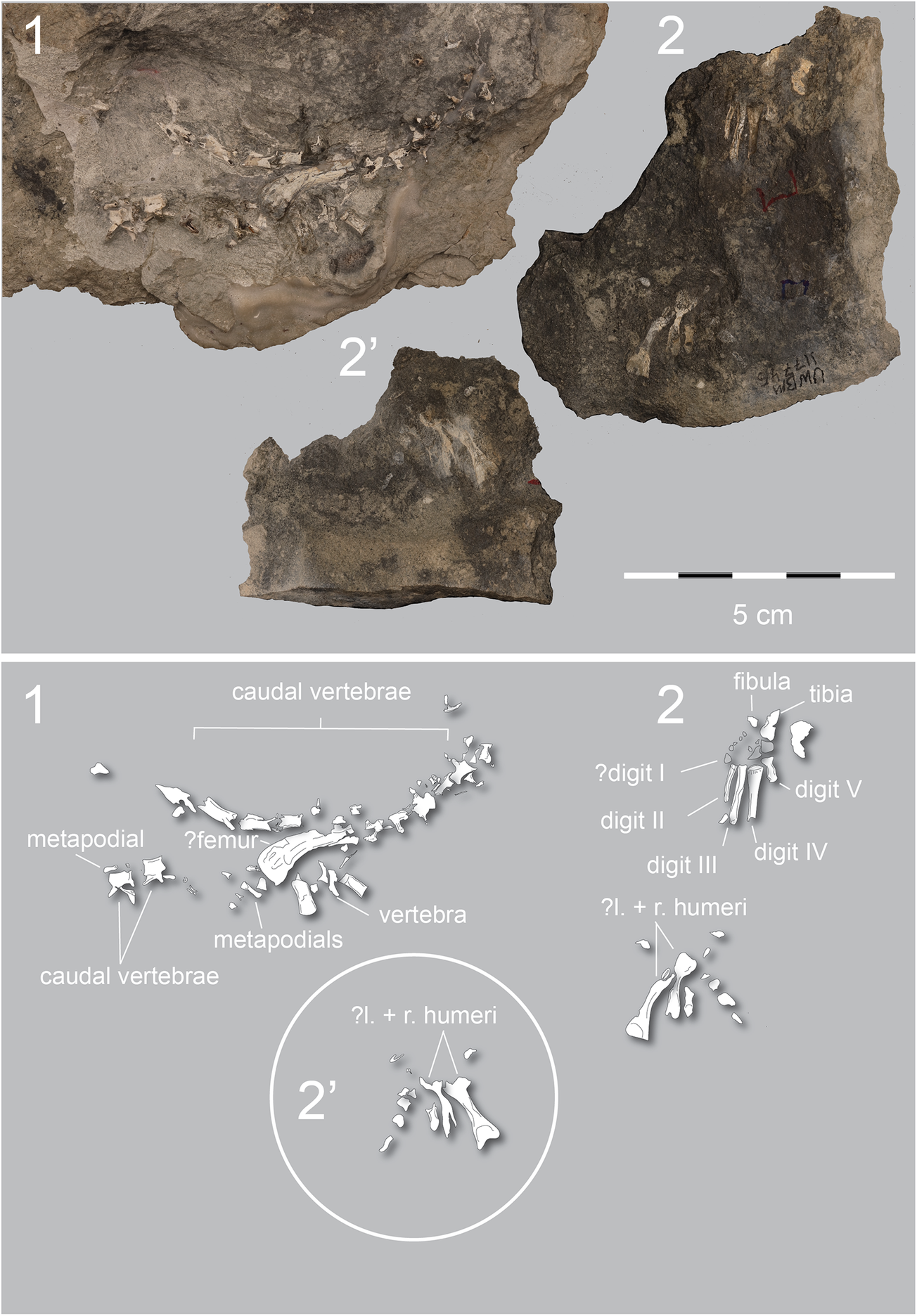
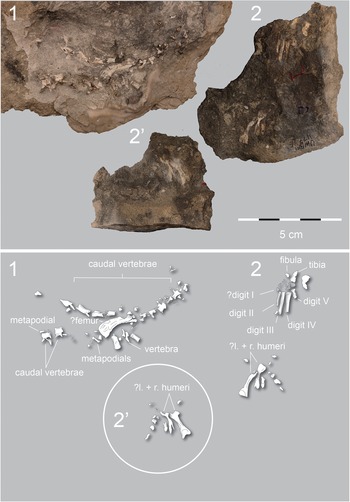
Photograph (top) and line drawing (bottom) of UWBM VP 117745, an associated archosauromorph (Prolacerta broomi) skeleton from the middle member of the Fremouw Formation. All blocks (1, 2 and 2’) were found in close association (~15 cm). Blocks 2 and 2’ are part and counterpart.
Referred material
UWBM VP 117745, partial, scattered skeleton; humerus (partially preserved as impression), vertebrae, hemal arches, partially articulated pes. UWBM VP 117762, anterior end of dentaries, right maxilla, pterygoid.
Locality and horizon
Both specimens were collected from the middle member of the Fremouw Formation at McIntosh Ridge; UWBM locality C2928, ~7 m above the base of the middle member, in the grey-green siltstone.
Description
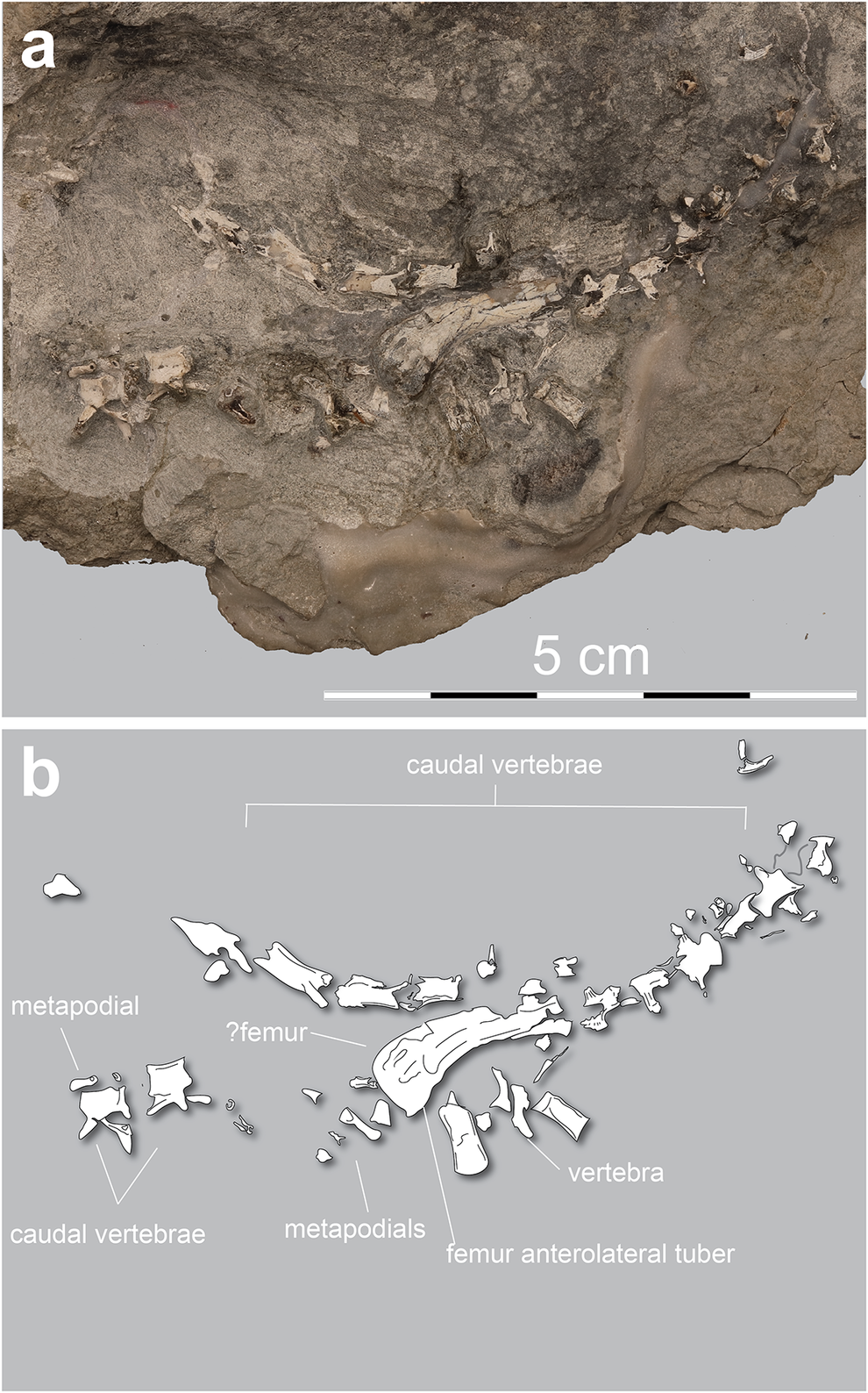
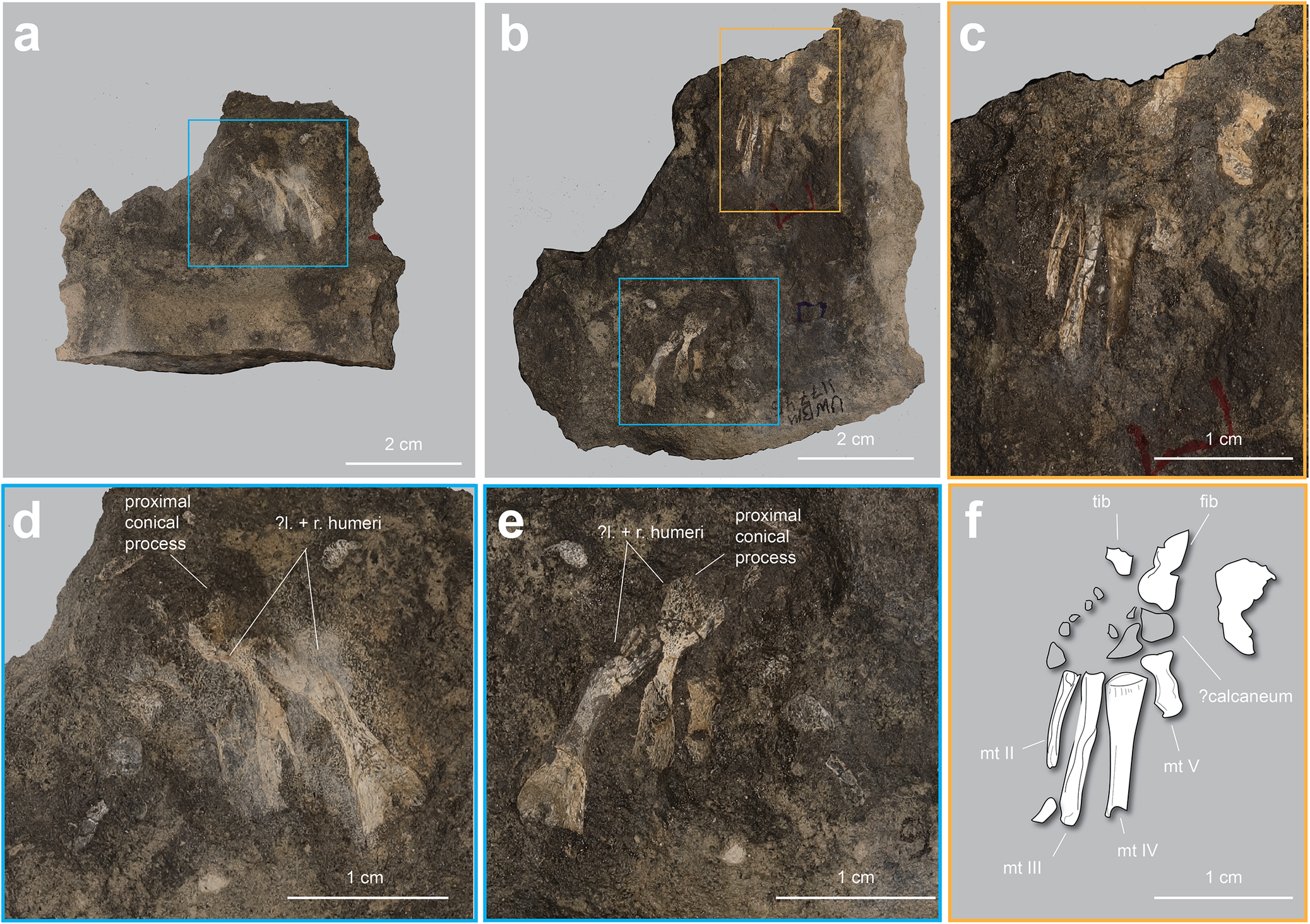
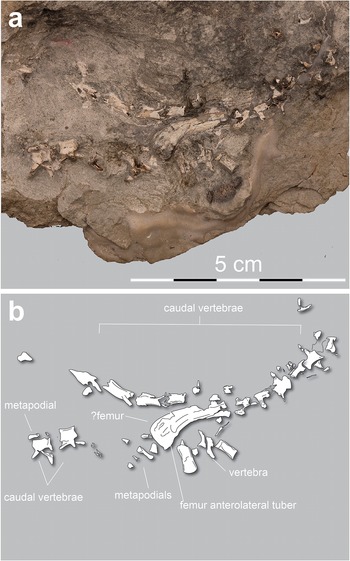
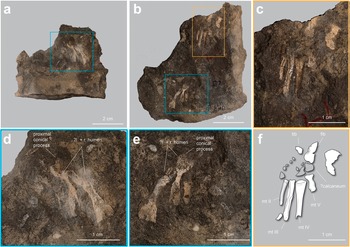
UWBM VP 117745 is an associated posterior skeleton, preserved in two blocks, one of which has a part and counterpart (Figs 10–12). The largest block (Block 1; Figs 10 & 11) contains an articulated caudal series with ~12 partial vertebrae and an additional three disarticulated caudal vertebrae, in addition to a partially preserved femur and metapodial elements. The caudal vertebrae all are from the anterior and middle portions of the tail, as evidenced by the anteroposteriorly shortened centra and elongate transverse processes. The proximal right femur is mostly preserved in anteromedial view. The anterolateral tuber is partially preserved (Fig. 11), but other aspects of the morphology have been lost. Several small bones are preserved that are interpreted as phalanges, either manual or pedal. Block 2 preserves the part and counterpart to what we interpret as left and right humeri due to the greatly expanded proximal and distal ends relative to the midshaft width. The proximal end of one of the humeri is fairly complete, and it preserves the conical process observed by Spiekman (Reference Spiekman2018) as a diagnostic character for Prolacerta (Fig. 12). Block 2 also preserves a partially articulated pes and distal portions of the tibia and fibula. Faint impressions of the tarsals are preserved, but not enough to identify their morphology. Metatarsals II–V are preserved, and they are proximodistally elongated, with the exception of metatarsal V. Metatarsal V is less robust than that observed in UWBM VP 117742, as well as AMNH FARB 9502 from the lower member of the Fremouw Formation.
Block 1 of UWBM VP 117745, an associated posterior skeleton of an archosauromorph (Prolacerta broomi) from the middle member of the Fremouw Formation: a. photograph and b. line drawing.
Block 2 of UWBM VP 117745, an articulated pes and associated humeri of an archosauromorph (Prolacerta broomi) from the middle member of the Fremouw Formation. a. Associated humeri in block 2’. b. Articulated pes and counterparts of the associated humeri in block 2. c. Zoomed-in image of the articulated pes. d. & e. Zoomed-in images of the associated humeri parts and counterparts. f. Line drawing of the articulated pes. fib = fibula; mt = metatarsal; tib = tibia.
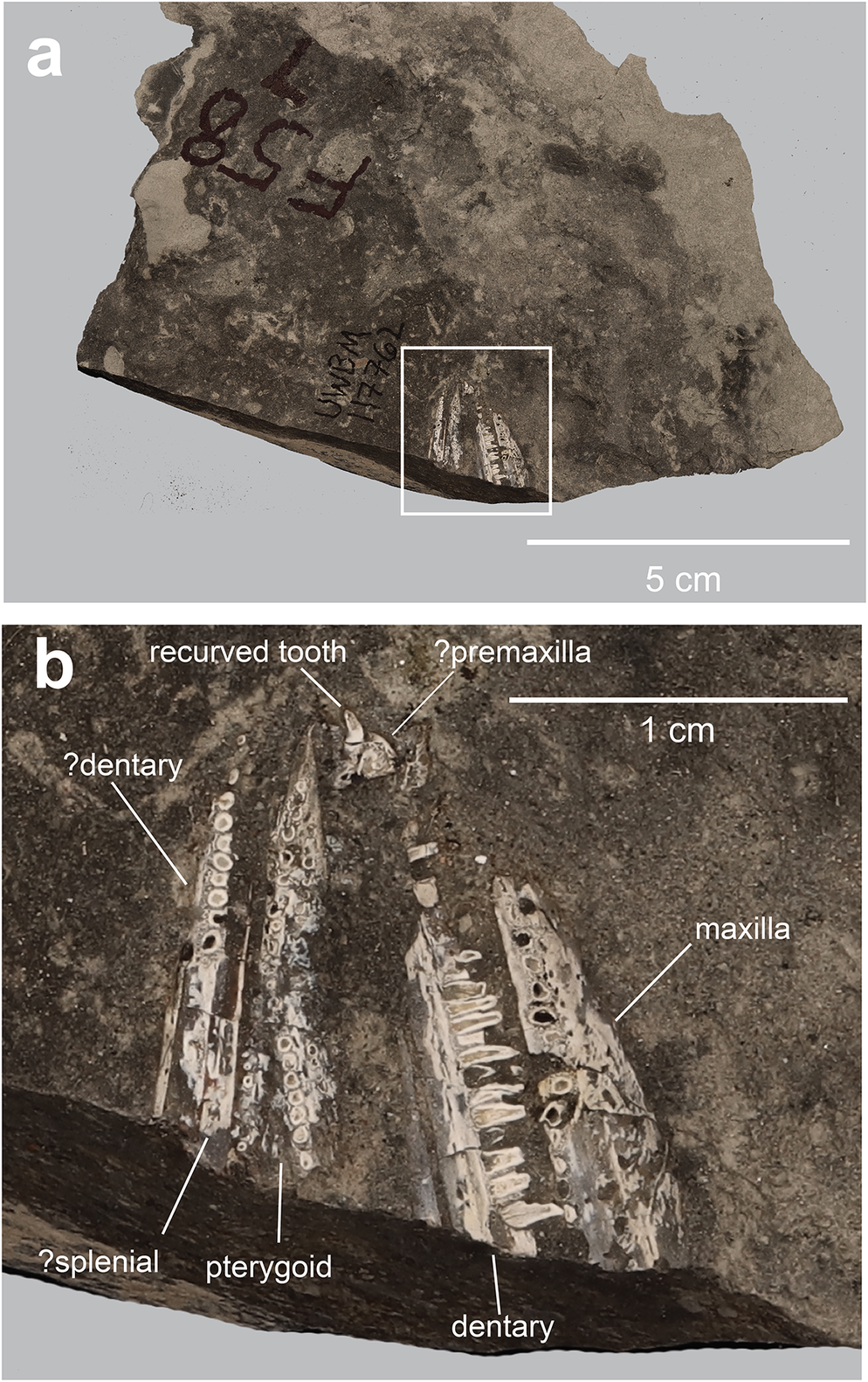
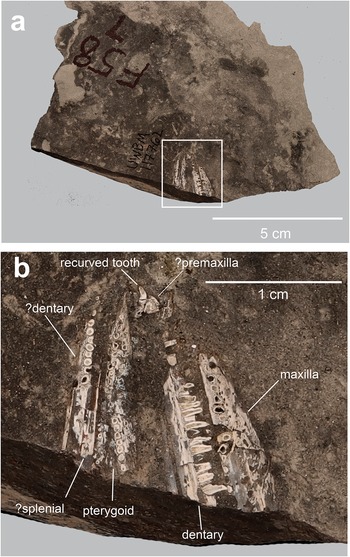
UWBM VP 117762 (Fig. 13) is a partially preserved, articulated anterior skull consisting of a partial premaxilla, partial left maxilla, pterygoid, partial left and right dentaries, as well as a potential splenial. All bones have been significantly weathered such that they are preserved in two-dimensional, approximately coronal cross-sections. The single preserved premaxillary tooth appears to exhibit some degree of curvature (Fig. 13b), which would be consistent with other premaxillary teeth from Antarctic material referred to Prolacerta (e.g. AMNH FARB 9520). The facial process of the maxilla is partially preserved and badly eroded, such that it is difficult to interpret whether the rugose texture it possesses (Fig. 13b) is an external morphological feature or a product of weathering and erosion. The maxillary tooth row is preserved in near-occlusal view. Attachment tissue can be observed encompassing each tooth. At different locations, both a bony labial wall and a lingual wall are present. The right pterygoid is partially preserved, with cross-sections of the pterygoid teeth outlining its shape in palatal view. Medially and anteriorly, the pterygoid possesses two closely spaced but offset tooth rows that run the anteroposterior length of the element. At approximately half its anteroposterior length, a third, more laterally placed tooth row is present. It is impossible to determine whether there are any medially directed tooth rows, which were listed as a diagnostic character for Prolacerta by Spiekman (Reference Spiekman2018) and Sobral (Reference Sobral2023). The left and right dentaries are partially preserved, with the left being preserved in coronal/occlusal cross-sectional view and the right being preserved in sagittal/medial cross-sectional view. The teeth in the left dentary, like those in the right maxilla, are encircled by attachment tissue as well as a bony labial wall. The lingual margin is either eroded away or obscured by matrix. In the right dentary, the teeth are mesiodistally separated by bone. The preserved cross-sections of the dentary teeth illustrate that they are not strongly recurved, which is similar to other Antarctic archosauromorph dentaries referred to Prolacerta (Colbert Reference Colbert1987).
UWBM VP 117762, articulated anterior skull (Prolacerta broomi): a. full block and b. zoomed-in image.
Remarks
Material from South Africa and Antarctica referred to the genus Prolacerta has generated much recent interest due to the repeatedly recovered phylogenetic position of Prolacerta as a close relative of Archosauriformes (Modesto & Sues Reference Modesto and Sues2004, Nesbitt Reference Nesbitt2011, Ezcurra Reference Ezcurra2016, Spiekman Reference Spiekman2018, Sobral Reference Sobral2023). Additionally, as pointed out by Spiekman (Reference Spiekman2018), Prolacerta remains an important taxon because it lacks the specialized morphologies seen in other non-archosauriform archosauromorph lineages, such as the elongated necks of the tanysaurs (e.g. Rytel et al. Reference Rytel, Böhmer, Spiekman and Tałanda2024), the blunted, beaked skulls of the rhynchosaurs (e.g. Gentil & Ezcurra Reference Gentil and Ezcurra2022) and the herbivorous adaptations of the allokotosaurs (e.g. Mellett et al. Reference Mellett, Kligman, Nesbitt and Stocker2023). However, the apparent morphological diversity of Prolacerta, a long-standing monospecific genus, remains underexplored (Modesto & Sues Reference Modesto and Sues2004, Spiekman Reference Spiekman2018, Sobral Reference Sobral2023). In the South African material alone, intraspecific variation in the skull is substantial (e.g. Modesto & Sues Reference Modesto and Sues2004, Spiekman Reference Spiekman2018), with some individuals possessing features such as a parietal foramen and well-developed supratemporal fossae on the parietal (e.g. BP/1/3575; Modesto & Sues Reference Modesto and Sues2004, fig. 7), whereas other individuals do not (e.g. BP/1/471; Modesto & Sues Reference Modesto and Sues2004 fig. 4). Differences between Antarctic Prolacerta material and South African Prolacerta material have been documented since the Antarctic material was first described (Colbert Reference Colbert1987, Modesto & Sues Reference Modesto and Sues2004, Ezcurra Reference Ezcurra2016, Spiekman Reference Spiekman2018, Sobral Reference Sobral2023). Moreover, a recent redescription of the holotype of P. broomi from South Africa by Sobral (Reference Sobral2023) showed that the type lacks several anatomical features used historically to diagnose the genus. As such, a major revision of Prolacerta is sorely needed in order to understand the nature of the variation and diversity of archosauromorphs in southern Pangaea during the Early Triassic. Three diagnostic characters are observable in the Antarctic material from the middle member of the Fremouw Formation: 1) UWBM 117745 potentially possesses a conical process on the proximal end of the humerus, 2) UWBM 117762 possesses teeth with attachment tissues and interdental ridges similar to those found in the holotypic skull of Prolacerta (Sobral Reference Sobral2023) and 3) UWBM 117762 possesses a recurved tooth that is attached to a premaxillary or maxillary skeletal element. This limited morphological detail suggests that material referrable to as P. broomi is preserved in the middle-member assemblage, at least as the genus is presently constructed (Sobral Reference Sobral2023).
Systematic ichnology
Reniformichnus sp. Krummeck and Bordy, Reference Krummeck and Bordy2018
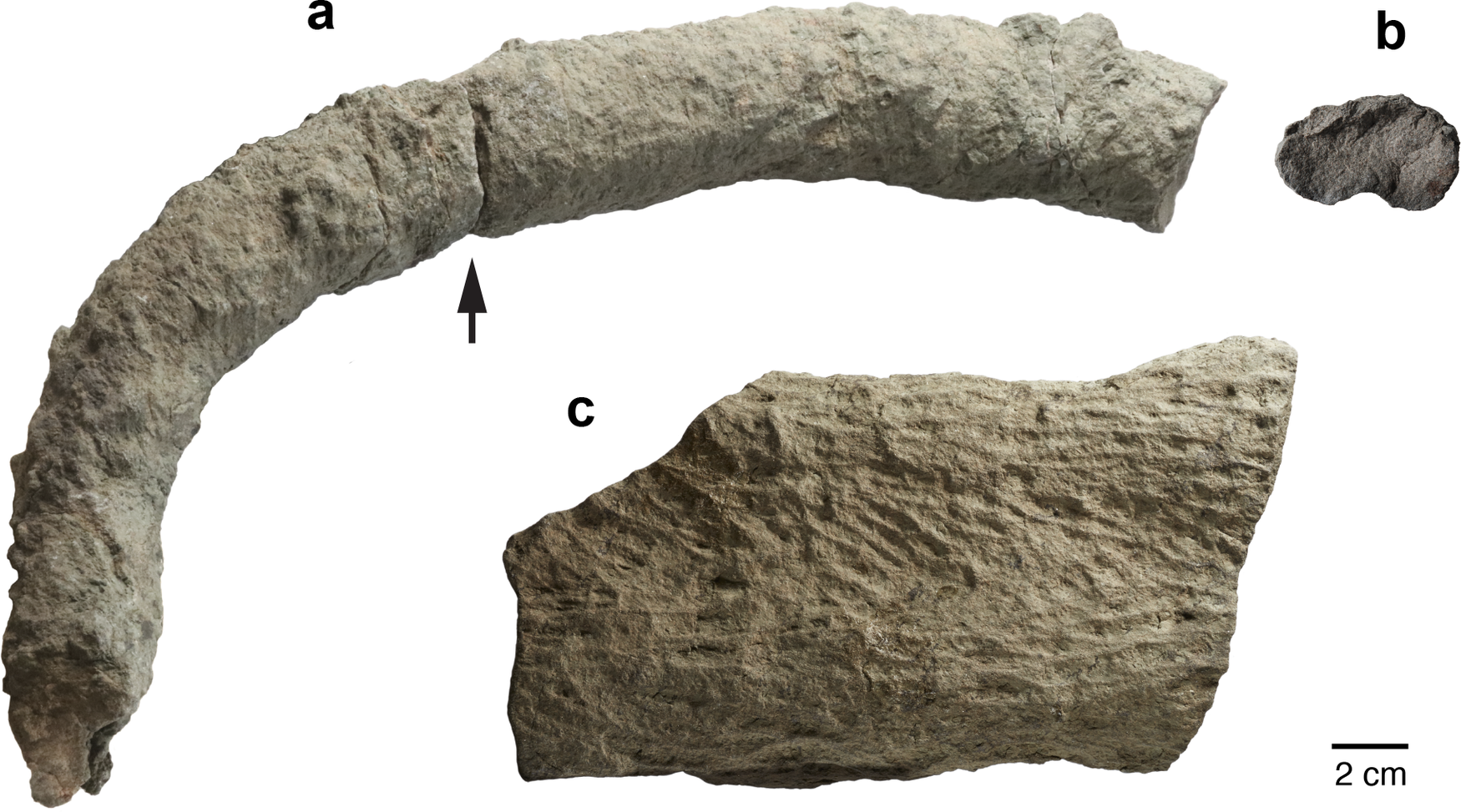
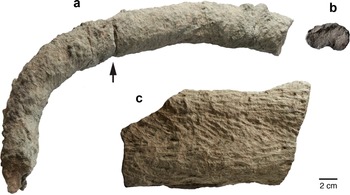
Reniformichnus burrow casts from the middle member of the Fremouw Formation. a. Dorsal view of UWBM VP 117545, with arrow indicating location of the cross-section shown in b. c. UWBM VP 117544 in ventral view, with well-preserved scratch marks evident on a weakly bilobate surface.
Referred material
UWBM VP 117533 and UWBM VP 117544, large-diameter burrow casts (maximum width ~11 cm) with their preserved ventral surfaces showing scratch marks and a shallow bilobate cross-section. UWBM VP 117545 and UWBM VP 117434 are a smaller-diameter burrow cast (maximum width ~5 cm) with a much deeper bilobate cross-section.
Locality and horizon
UWBM VP 117533 and UWBM VP 117544 were collected at McIntosh Ridge from UWBM locality C2921, ~7 m above the base of the middle member of the Fremouw Formation, in the grey-green siltstone. UWBM VP 117545 was also collected from McIntosh Ridge at locality C2936, located 56 m above the base of the middle member, in the grey-green siltstone. UWBM VP 117469 was collected at Kitching Ridge from C2914, ~34 m above the base of the middle member, in the grey-green siltstone. UWBM VP 117434 was collected at McIntyre Promontory from C2962, which occurs ~30 m above the base of the middle member, in the grey-green siltstone.
Description
Both of the larger burrow casts collected from McIntosh Ridge consist only of the ventral surface of the infilled cast. Longitudinal ridges and grooves, which we interpret as scratch marks, are present on the two lobes, whereas diagonal marks are prevalent in between the lobes, more centrally (Fig. 14c). In UWBM VP 117533, the dorsal surface of the cast shows that it was infilled by conglomerate-bearing clasts up to 2 cm in diameter. The smaller burrow cast from McIntosh Ridge is composed of angular to semi-rounded sand infill and has less surface detail preserved (Fig. 14a,b). Nonetheless, vague diagonal ridges are present in lateral view, orientated 20–30° from the horizontal, as seen in specimens described by Sidor et al. (Reference Sidor, Miller and Isbell2008b). The recovered burrow measures ~40 cm long and is gently curved.
Remarks
Tubular structures interpreted as infilled vertebrate burrows were previously described from the lower member of the Fremouw Formation (Miller et al. Reference Miller, Hasiotis, Babcock, Isbell and Collinson2001, Hasiotis et al. Reference Hasiotis, Wellner, Martin and Demko2004, Sidor et al. Reference Sidor, Miller and Isbell2008b) and conform to the diagnosis proposed by Krummeck & Bordy (Reference Krummeck and Bordy2018) for the ichnogenus Reniformichnus from the Triassic of South Africa. Burrow casts are less common in the middle member than in the lower member of the Fremouw Formation, at least in the Shackleton Glacier area, and they are commonly found weathered out of the host grey-green siltstone. All of the vertebrate taxa recognized from the middle Fremouw Formation (based on body fossils) are of small body size (e.g. < 1 kg), meaning that another taxon must have excavated the larger-diameter Reniformichnus. Based on body fossils associated with burrow casts of similar size in the LAZ, a probable candidate is the cynodont Thrinaxodon (Damiani et al. Reference Damiani, Modesto, Yates and Neveling2003), but medium-sized therocephalians are another possibility (e.g. Regisaurus, Tetracynodon or even Scaloposaurus; Huttenlocker et al. Reference Huttenlocker, Botha, Browning, Kulik, Tshibalanganda and du Plessis2022).
Discussion
Updated palaeoenvironmental interpretation
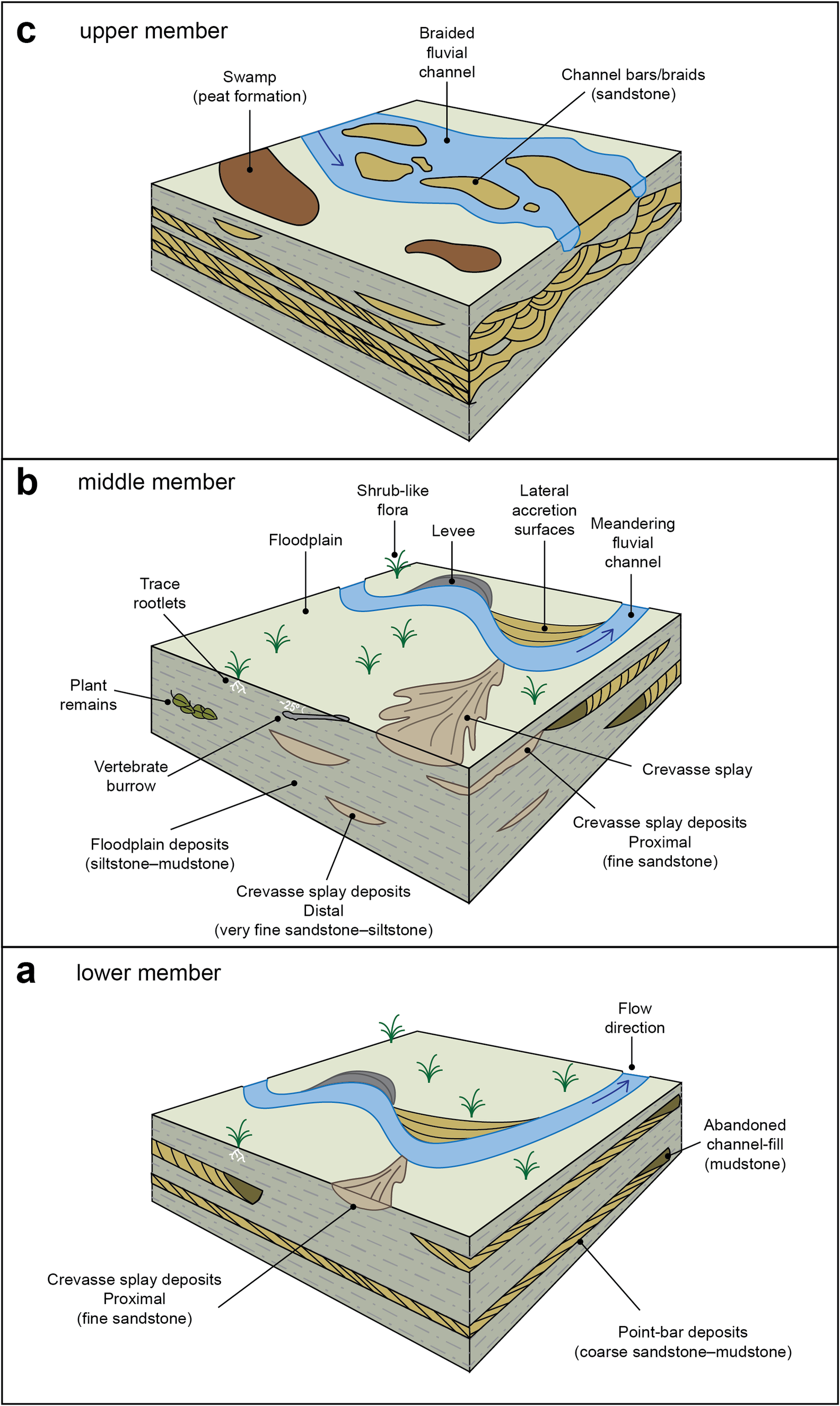
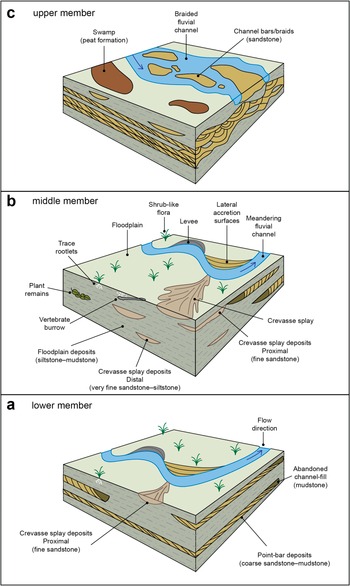
The lower member of the Fremouw Formation is interpreted to represent deposits of prograding crevasse splay complexes between large, multistoried, laterally extensive, low-sinuosity channel sandstones (Fig. 15a; Collinson & Elliot Reference Collinson, Elliot, Turner and Splettstoesser1984, Barrett et al. Reference Barrett, Elliot, Lindsay, Turner and Splettstoesser1986, Isbell Reference Isbell1990, Sidor et al. Reference Sidor, McIntosh, Gee, Hammer, Makovicky and Smith2023). The middle member of the Fremouw Formation is interpreted to represent overbank and crevasse splay deposits in a more meandering, fluvial-alluvial plain depositional system (Fig. 15b; Barrett et al. Reference Barrett, Elliot, Lindsay, Turner and Splettstoesser1986). The upper member of the Fremouw Formation is interpreted to represent a shallow, low-sinuosity, braided river system with overbank deposits and autochthonous coals (Fig. 15c; Barrett et al. Reference Barrett, Elliot, Lindsay, Turner and Splettstoesser1986). Relative to the lower member of the Fremouw Formation, the middle member has thicker siltstone beds and thinner sandstone beds, suggesting more extensive and probably more frequent overbank flooding events such as might be encountered on the more distal parts of a large distributive fluvial system (Hartley et al. Reference Hartley, Weissmann, Nichols and Maxwell2010). In addition to the dominant floodplain sedimentology, immature palaeosol Protosols in the middle member of the Fremouw Formation suggest limited chemical weathering in the subaerial environment owing to low annual precipitation, poor drainage and cold average temperatures, although the abundance of shrubby roots indicates seasonal water availability (Sidor et al. Reference Sidor, McIntosh, Gee, Hammer, Makovicky and Smith2023). Relative to the middle member of the Fremouw Formation, the upper member contains more mid-channel bar sandstones deposited within a braided river and coal formation, the latter being indicative of greater sediment supply and periods of waterlogging and accumulation of organic material on the floodplains.
Simple block diagram palaeoenvironmental reconstructions of the members of the Fremouw Formation in the Shackleton Glacier region. a. Lower member: meandering fluvial-alluvial depositional environment. b. Middle member: alluvial-meandering fluvial depositional environment. c. Upper member: braided fluvial-alluvial-swamp depositional environment.
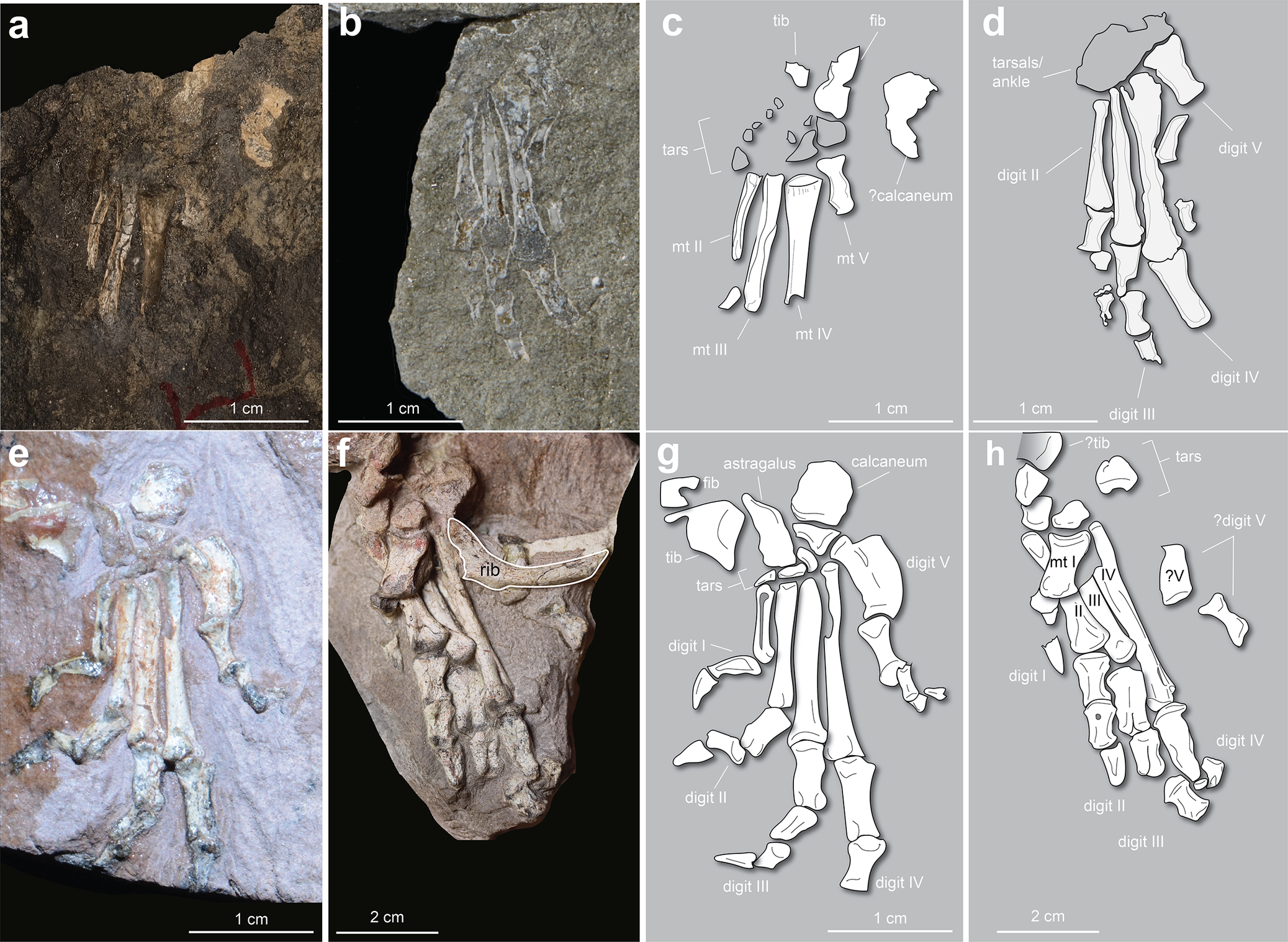
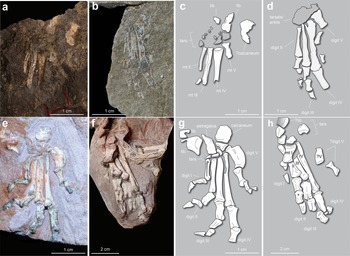
Comparisons of archosauromorph pedal and ankle elements from the middle (a.–d.) and lower (e.–h.) members of the Fremouw Formation. a. & c. UWBM VP 117745; b. & d. UWBM VP 117742; e. & g. AMNH FARB 9502 Prolacerta broomi (lower member of the Fremouw Formation); f. & h. UWBM VP 95531 Antarctanax shackletoni (lower member of the Fremouw Formation). fib = fibula; mt = metatarsal; tars = tarsal; tib = tibia.
Palaeogeographical reconstructions of the Permian and Triassic show that the CTM area was located between 75°S and 85°S during that time (van Hinsbergen et al. Reference van Hinsbergen, de Groot, van Schaik, Spakman, Bijl and Sluijs2015, Vaes et al. Reference Vaes, van Hinsbergen, van de Lagemaat, van der Wiel, Lom and Advokaat2023), similar to the modern latitude of 84–85°S (Fig. 1b). The dominant floodplain sedimentology of the middle member of the Fremouw Formation, with immature Protosols, shrubby flora and sediment-filled vertebrate burrows, is an indicator of a seasonal continental palaeoclimate, with cold winters and warm to cool summers, similar to subpolar regions today (Sidor et al. Reference Sidor, McIntosh, Gee, Hammer, Makovicky and Smith2023).
Vertebrate palaeontology and taphonomy
The presence of Micropholis and Procolophonidae (including P. trigoniceps) in the middle member of the Fremouw Formation, along with the apparent absence or rarity of Lystrosaurus, correlates with similar faunal assemblage compositions in the upper part of the Katberg Formation of South Africa (Neveling Reference Neveling2004, Botha & Smith Reference Botha and Smith2020, Smith et al. Reference Smith, Wolvaardt, Cisneros, Pinheiro, Bevitt and Benoit2025). This pattern, in which the abundance of L. declivis in lower strata is replaced by skeletal accumulation deposits of mostly P. trigoniceps, led a recent study (Smith et al. Reference Smith, Wolvaardt, Cisneros, Pinheiro, Bevitt and Benoit2025) to invite consideration that the original Procolophon Acme Zone (Broom Reference Broom1906, Hancox Reference Hancox2000) be reinstated. For the middle member of the Fremouw Formation, the occurrence of endemic species, such as N. absens (Sidor et al. Reference Sidor, Kulik and Huttenlocker2022), as well as a generally poorly sampled fossil record complicate potential diagnostic features of faunal assemblage turnover in the southernmost Pangaea during the Early Triassic. Additionally, these factors obscure whether patterns during deposition of the Fremouw Formation coincide with assemblage turnover in more northern syndepositional basins. However, some notable differences are present between the lower and middle members of the Fremouw Formation faunal assemblages beyond taxonomic occurrences. In particular, body fossils from the middle member from all major taxonomic groups are relatively diminutive in size compared to conspecific individuals and other taxa found in both the lower and upper members. For the temnospondyl components of the middle member of the Fremouw Formation assemblage, Micropholis are large for contemporary amphibamiforms (Gee & Sidor Reference Gee and Sidor2024), but they should be considered small-bodied components of the tetrapod assemblage. The capitosaur material almost certainly represents juveniles of taxa that could probably grow to over 1 m in body length as adults (Gee & Sidor Reference Gee and Sidor2024). All procolophonid material from the middle member of the Fremouw Formation represents individuals that are smaller in size than their lower-member counterparts (Colbert & Kitching Reference Colbert and Kitching1975) and those of the Katberg Formation (deBraga Reference deBraga2003, Modesto & Damiani Reference Modesto and Damiani2007). The size of the middle-member Fremouw Formation archosauromorph specimens are consistent with most previously reported Antarctic Prolacerta material from the lower member of the Fremouw Formation (Colbert Reference Colbert1987), but they are considerably smaller than the largest Prolacerta specimen (Spiekman Reference Spiekman2018) as well as the enigmatic archosauromorph, Antarctanax shackletoni (Peecook et al. Reference Peecook, Smith and Sidor2019). Unlike the temnospondyl material, the reptile material from the middle member of the Fremouw Formation is insufficiently preserved to accurately determine the skeletal maturity of individual specimens. However, due to the presence of vertebrate burrows that were probably made by individuals of greater size than is currently known from body fossils, it is most probable that larger individuals and taxa were present during the deposition of the middle-member sediments. Numerous factors, including facies shifts, lack of outcrop exposure and small sample size, could play a role in the lack of larger-bodied vertebrate body fossils from the middle member. Anecdotally, it is generally easier for workers to identify larger bones when surveying outcrop, and, given the number of localities sampled that preserve the outcrop of the middle member, it should be expected that remains of taxa greater than 1 kg in inferred body mass would have been recognized. At this time, we interpret the lack of large tetrapod body fossils in the middle member of the Fremouw Formation to be a product of a facies/taphonomic shift that favoured the preservation of smaller vertebrate body fossils rather than a true absence or decreased abundance of larger-bodied taxa.
Morphological variation in material referred to Prolacerta
Since the first report of fossils referrable to as P. broomi from the Fremouw Formation by Colbert (Reference Colbert1987), workers have observed morphological variation among Antarctic specimens similar to that recorded in their South African counterparts (Spiekman Reference Spiekman2018, Peecook et al. 2019). Intraspecific variability in the South African LAZ specimens referred to Prolacerta has been extensively documented (Modesto & Sues Reference Modesto and Sues2004, Spiekman Reference Spiekman2018, Sobral Reference Sobral2023), and this variability extends to the Prolacerta material in the lower and middle members of the Fremouw Formation (Colbert Reference Colbert1987, Spiekman Reference Spiekman2018). The archosauromorph postcranial remains reported here from the middle member of the Fremouw Formation provide additional evidence of this morphological variability within the genus Prolacerta. Importantly, in South African and Antarctic material, this intraspecific morphological variability is independent of body size or stratigraphy (Modesto & Sues Reference Modesto and Sues2004, Spiekman Reference Spiekman2018). In particular, the admittedly incomplete outlines of the preserved metatarsal V in the middle-member Fremouw Formation archosauromorph specimens (Fig. 16a–d) differ from that observed in AMNH FARB 9502 from the lower member of the Fremouw Formation in that they lack a distinctive, convexly curved lateral flange (Fig. 16e,g). The middle-member archosauromorph metatarsal V appears to be more similar in shape to metatarsal V of the lower-member Prolacerta UWBM VP 95529 (Spiekman Reference Spiekman2018), which itself is moderately similar to the hook-shaped metatarsal V of the South African specimen BP/1/2676 (Gow Reference Gow1975). The middle-member specimens are comparable in size to AMNH FARB 9502, so ontogenetic differences are less likely to be the explanation for the variability in morphology in the fifth metatarsals. Recovery of more complete material will be needed to elucidate the causes of these differences.
The relative length of metatarsal IV compared to metatarsal III in UWBM VP 117742 is nearly identical to that seen in AMNH FARB 9502, which contrasts with the considerable differences in relative length observed in the other named Fremouw Formation archosauromorph, A. shackletoni (UWBM VP 95531; Fig. 16f,h; Peecook et al. 2019). This dissimilarity, along with the consistently smaller size relative to the material referred to A. shackletoni, suggests that the middle-member archosauromorph specimens are not referable to the genus.
Taken together, the incomplete archosauromorph material from the middle member of the Fremouw Formation provides intriguing new information regarding morphological variation in cranial and postcranial osteological traits, either within P. broomi or potentially providing evidence for the appearance of novel archosauromorph taxa during the transition from the lower-member strata to the middle-member strata. Although definitive taxonomic assignments are not currently possible, recovery of more complete material in the future may help to provide additional details on the nature of archosauromorph assemblages and faunal succession at their southernmost locale during the earliest Mesozoic.
Conclusions
The middle member of the Fremouw Formation can be distinguished from the lower member of the Fremouw Formation by a facies shift from fluvial channels and proximal floodplain environments to the lower-energy, more distal portions of the large distributive fluvial system under a seasonally dry subpolar palaeoclimate. Based on the fossils recovered to date, the middle member of the Fremouw Formation preferentially preserves small-bodied tetrapod fossils. This interpretation can be further tested with future targeted collecting as well as broadly assessing the quality of Fremouw Formation fossil record, but the notable lack of body fossils of taxa greater than 1 kg in body mass is most probably a taphonomic signal, as large Reniformichnus burrows indicate the presence of larger taxa. At least one procolophonid taxon is present in the middle member of the Fremouw Formation, whereas the archosauromorph material, at a minimum, showcases some morphological variability within the enigmatic species P. broomi. Major detailed reassessment of all material referred to P. broomi is needed to better characterize the early evolutionary history of Archosauromorpha in southern Pangaea. Nevertheless, we are confident that in this future reassessment the Fremouw Formation archosauromorph assemblage has the potential to enhance our understanding of the early Mesozoic history of subpolar reptile assemblages and ecosystems.
Data archiving statement
All data associated with this study are contained within the manuscript.
Acknowledgements
Logistical support in Antarctica was provided by the United States National Science Foundation through the United States Antarctic Program. We thank the USAP Shackleton Glacier Camp staff and G-096 Expedition members N. Smith (LACM DI), P. Makovicky (University of Minnesota), N. Tabor (Southern Methodist University), M. Whitney (Loyola University Chicago), A. Shinya (Field Museum of Natural History) and P. Braddock for field-based support during the 2017–2018 summer field season. We thank R. Masek for preparation of specimens UWBM 117745, 117756 and 117540, K. Abrams for preparation of UWBM 117742 and A. Shinya for preparation of UWBM 117466. Special thanks are given to M. Rich for burrow specimen photography. We would also like to thank Z. Kulik (AMNH) for preliminary work on the middle member of the Fremouw Formation project, as well as B. Gee for thoughtful feedback on and discussion of the manuscript. Special thanks are given to Antarctic Science editor C. Atkins, reviewers S. Spiekman and K. Andrzejewski and an anonymous reviewer for providing detailed and insightful feedback that greatly improved the quality and breadth of the manuscript.
Author contributions
Conceptualization: CHW, JAM, RMHS, CAS; data curation: JAM, RMHS, CAS; investigation: CHW, JAM, RMHS, CAS; methodology: CHW, JAM, RMHS, CAS; project administration: CAS; validation: JAM, RMHS, CAS; writing - original draft preparation: CHW, CAS; writing - review & editing: CHW, JAM, RMHS, CAS.
Financial support
We acknowledge the ongoing financial support of the National Research Foundation’s African Origins Platform (RMHS GU-136503). C.H. Woolley is supported by NSF ANT-2313242 (to C. Sidor). J.A. McIntosh was supported by OPP-1341376 (to N. Tabor). This research was also supported by ANT-1341304 and ANT-1947094 (to C.A. Sidor).
Competing interests
The authors declare none.

 Open access

