


Introduction
The outbreak of coronavirus disease 2019 (Covid-19), which is caused by the highly contagious severe acute respiratory syndrome coronavirus 2 (SARS-CoV-2), was announced a pandemic in March 2020 by the World Health Organization.Reference Zhong, Luo, Li, Zhang, Liu and Li1 The disease mainly affects the respiratory system and spreads via aerosols released during sneezing and coughing.Reference Krajewska, Krajewski, Zub and Zatoński2 The main symptoms of Covid-19 are fever, cough, runny nose, nasal congestion, shortness of breath, headache and myalgia.Reference Krajewska, Krajewski, Zub and Zatoński2,Reference Wan, Xiang, Fang, Zheng, Li and Hu3 The disease can be diagnosed on the basis of clinical symptoms, polymerase chain reaction positivity and the presence of ground-glass opacities on computed tomography (CT) scans.Reference Li, Lei, Zeng, Li, Yu and Fan4
Recent studies have focused on the role of serum inflammatory markers that predict Covid-19, such as lymphocyte counts and C-reactive protein (CRP), homocysteine and D-dimer levels.Reference Yang, Shi, He, Lü, Xu and Ye5,Reference Tan, Huang, Shi, Tan, Ma and Chen6 The levels of ferritin, a crucial immune response mediator, increase in severe Covid-19 cases.Reference Vargas-Vargas and Cortés-Rojo7 Increased ferritin levels could cause a cytokine storm by exerting direct immunosuppressive and pro-inflammatory effects.Reference Vargas-Vargas and Cortés-Rojo7 Vitamin D, which affects the nuclear vitamin D receptor, enhances innate cellular immunity by inducing antimicrobial peptides.Reference Grant, Lahore, McDonnell, Baggerly, French and Aliano8 Vitamin D is thought to reduce the risk of viral infections through several mechanisms, and decreased vitamin D levels have been observed in patients with viral pneumonia.Reference Grant, Lahore, McDonnell, Baggerly, French and Aliano8 D-dimer is a fibrin degradation product used to exclude the diagnosis of thrombosis. Increased D-dimer levels have been observed in severe Covid-19 cases accompanied by microangiopathy and a hypercoagulable state.Reference Yao, Cao, Wang, Shi, Liu and Luo9
In addition to the typical Covid-19 symptoms, recent otolaryngology literature has focused on the association between anosmia and dysgeusia symptoms and the development of minimal-to-mild Covid-19.Reference Lechien, Chiesa-Estomba, De Siati, Horoi, Le Bon and Rodriguez10 The assessment of these symptoms does not require any intervention and is easy to perform. Yan et al. reported that patients with taste disorders have a 10-fold higher risk of developing Covid-19.Reference Yan, Faraji, Prajapati, Boone and DeConde11 However, there is a lack of evidence about the association between the levels of serum markers predicting disease severity and dysgeusia symptoms.Reference Yan, Faraji, Prajapati, Boone and DeConde11
The present study aimed to evaluate the association between serum D-dimer, ferritin and vitamin D levels, and dysgeusia symptoms, in patients with Covid-19.
Materials and methods
The clinical data of 300 patients confirmed to have Covid-19 via real-time reverse transcription polymerase chain reaction, who were hospitalised in a tertiary referral hospital between 28 March and 15 August 2020, were analysed. Ethical approval was obtained from the National Ministry of Health (Covid-19 study registration system) (approval number: 2020-05-04T08-34-29).
The Turkish national guidelines recommend that patients with persistent fever and a history of contact with a Covid-19 positive individual undergo a polymerase chain reaction test.12 The present study included patients aged over 18 years who were confirmed to have Covid-19 based on real-time reverse transcription polymerase chain reaction assessment of oropharyngeal and nasopharyngeal samples. Patients who had vomiting, diarrhoea, weakness, systemic diseases and lower oxygen saturation were hospitalised. Patients with previous olfactory or gustatory dysfunction, without polymerase chain reaction confirmed Covid-19, with a history of thromboembolism, with vitamin D deficiency, receiving vitamin D or ferritin treatment, or with a history of bowel resection, were excluded from the study.
The patients’ clinical data, including age, gender, systemic co-morbidities (e.g. diabetes mellitus, hypertension, chronic obstructive pulmonary disease and asthma) and intensive care unit admission, were recorded. Moreover, patients’ symptoms, such as cough, shortness of breath, rhinorrhoea, sore throat, loss of smell, dysgeusia, fever and vomiting, were documented. The patients were divided into two groups: without dysgeusia and with dysgeusia.
All patients underwent a CT scan (BrightSpeed CT scanner; GE Healthcare Systems, Milwaukee, Wisconsin, USA) according to national guideline recommendations for management of the disease. The presence of ground-glass opacities on CT scans was recorded.Reference Li, Lei, Zeng, Li, Yu and Fan4
Supportive care was provided and hydroxychloroquine was administered (two doses of 200 mg twice daily, followed by 100 mg twice daily for 5 days). Favipiravir (1600 mg by mouth on admission, followed by 600 mg by mouth for 5 days) and enoxaparin (0.4 IU daily, by subcutaneous injection) were also administered when needed.12
Statistical analysis
Data were analysed using SPSS statistical software, version 20.0 (SPSS, Chicago, Illinois, USA). All continuous data are presented as means and standard deviations, while categorical data are presented as numbers and percentages. The Shapiro–Wilk test was used to analyse the distribution of continuous variables. The student's t-test was used to analyse parametric variables, while the Mann–Whitney U test was used to analyse non-parametric variables. A chi-square test was used to compare categorical variables.
Multivariate regression analysis was performed to analyse relationships between age, white blood cell (WBC) count, CRP level, D-dimer level, fibrinogen level and vitamin D level, and dysgeusia symptoms. A primary regression model was generated using a stepwise procedure and included all potential interaction variables. This model was generated using independent variables achieving a p-value of 0.10 during bivariate analysis. Then, the best-fit model was generated without interaction variables. The presence of dysgeusia symptoms was considered to be the dependent variable.
For all calculations, a p-value of less than 0.05 was considered statistically significant.
Results
The mean age of the study population was 48.52 ± 13.73 years. Of the patients, 54.3 per cent were male. The most common co-morbidities were hypertension (5.3 per cent) and pulmonary disease (5 per cent). The most common presenting symptoms were cough (34.3 per cent), sore throat (26.7 per cent), fever (24.3 per cent), vomiting (23.7 per cent) and shortness of breath (20.3 per cent). In total, 181 patients (60.3 per cent) had Covid-19 findings on CT scans. Regarding the accompanying symptoms, 104 patients (34.7 per cent) had anosmia and 78 (26 per cent) had dysgeusia (Table 1).
Clinical characteristics and presenting symptoms of study population
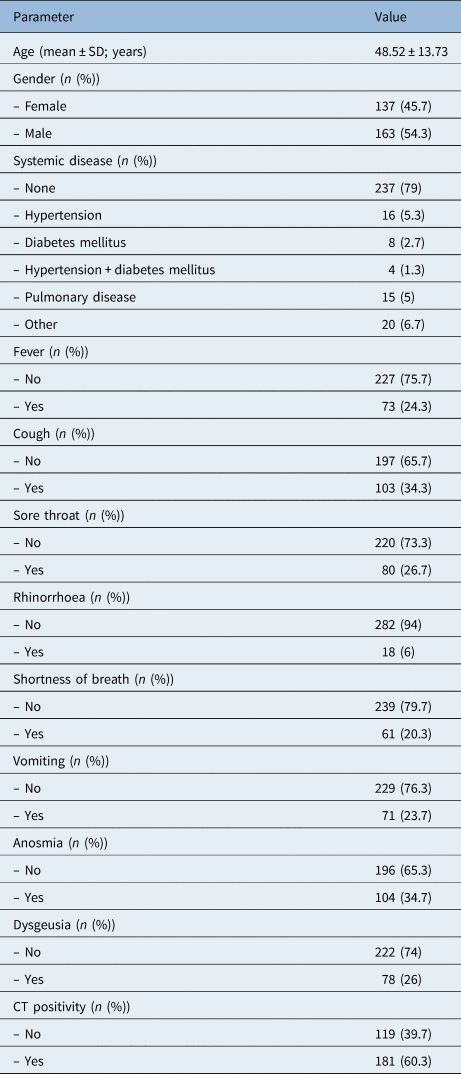
SD = standard deviation; CT = computed tomography
The mean patient age was significantly higher in the group without dysgeusia than in the group with dysgeusia (50.51 ± 13.67 years vs 42.83 ± 12.31 years, p < 0.001). The most commonly observed co-morbidity was hypertension, in both the groups; the incidence rates of systemic co-morbidities did not differ significantly between the groups. Regarding the patients’ symptoms, the incidence of fever was significantly higher in the dysgeusia group than in the non-dysgeusia group (32.1 per cent vs 21.6 per cent, p = 0.04). Moreover, the incidence of sore throat was significantly higher in the dysgeusia group than in the non-dysgeusia group (43.6 per cent vs 20.7 per cent, p < 0.001). On the other hand, no significant differences were observed in the incidence rates for cough, rhinorrhoea, shortness of breath, vomiting or anosmia between the two groups.
The number of patients with CT positivity in the group without dysgeusia (141 (63.5 per cent)) was significantly higher than that in the group with dysgeusia (40 (51.3 per cent)) (p = 0.03). No significant differences were observed in terms of the intensive care unit admission rate, oxygen saturation level or duration of hospitalisation between the two groups (Table 2).
Comparison of clinical characteristics and presenting symptoms of study groups

*Indicates statistical significance (p < 0.05). SD = standard deviation; CT = computed tomography; ICU = intensive care unit
Regarding the WBC count, CRP level, ferritin level, vitamin D level and the presence of dysgeusia symptoms, no significant differences were observed between the two groups. However, the D-dimer levels were significantly higher in the dysgeusia group than in the non-dysgeusia group (0.54 ± 0.32 mg/l fibrinogen-equivalent units (FEU) vs 0.49 ± 0.51 mg/l FEU, p = 0.008; Table 3).
Comparison of laboratory findings for study population
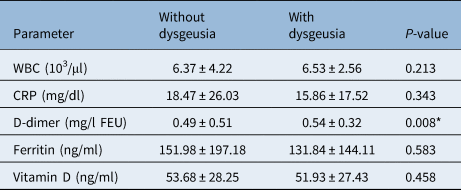
Data represent mean ± standard deviation values, unless indicated otherwise. *Indicates statistical significance (p < 0.05). WBC = white blood cells; CRP = C-reactive protein
Binary logistic regression analysis revealed that patients’ age (odds ratio = 0.95, 95 per cent confidence interval (CI) = 0.93–0.97) and D-dimer levels (odds ratio = 0.99, 95 per cent CI = 1.06–4.57) were significantly related to the presence of dysgeusia symptoms (Table 4).
Binary logistic regression analysis of age and serum markers, and dysgeusia symptoms

SE = standard error; CI = confidence interval; CRP = C-reactive protein; WBC = white blood cells
Discussion
In the present study, the patients with dysgeusia were significantly younger than those without dysgeusia. In addition, the incidence rates for fever and shortness of breath, and the D-dimer levels, were considerably higher in the dysgeusia group. However, CT positivity was significantly higher in the group without dysgeusia.
Previous studies have revealed that olfactory and gustatory dysfunctions could be associated with the development of Covid-19.Reference Yan, Faraji, Prajapati, Ostrander and DeConde13,Reference Menni, Valdes, Freydin, Ganesh, Moustafa and Visconti14 According to these studies, the infectious process of the virus begins by colonising the olfactory and gustatory epithelia, and then turns into an inflammatory process.Reference Lechien, Chiesa-Estomba, De Siati, Horoi, Le Bon and Rodriguez10,Reference Yan, Faraji, Prajapati, Ostrander and DeConde13 Avcı et al. reported incidence rates for anosmia and dysgeusia symptoms in patients with Covid-19 of 44.2 per cent and 43.9 per cent, respectively.Reference Avcı, Karabulut, Farasoglu, Boldaz and Evman15 These authors conducted a study with one of the largest sample sizes, and reported that anosmia was associated with out-patient follow up rather than in-patient management.Reference Avcı, Karabulut, Farasoglu, Boldaz and Evman15 In the present study, 34.7 per cent of the patients presented with loss of smell and 26 per cent presented with dysgeusia symptoms. The patients in the current study were divided on the basis of the presence of dysgeusia symptoms rather than anosmia symptoms, because the latter could also be affected by other virus-related infections.
The early diagnosis of Covid-19 and risk stratification of the disease may reduce morbidity and mortality rates.Reference Li, Wu, Wu, Guo, Chen and Fang16 However, because of non-specific disease symptoms, and false-negative and delayed polymerase chain reaction results, additional markers are needed for the diagnosis and surveillance of the disease.Reference Lechien, Chiesa-Estomba, De Siati, Horoi, Le Bon and Rodriguez10
A study involving 20 patients with Covid-19 evaluated ferritin, a serum inflammatory marker, and reported increased serum ferritin levels in patients with severe and very severe Covid-19, with the levels being significantly higher in the very severe group.Reference Zhou, She, Wang and Ma17 Another study involving 69 patients with severe Covid-19 reported significantly higher ferritin levels in patients with severe disease than in those with non-severe disease.Reference Liu, Zhang, Yang, Ma, Li and Zhang18 In addition, the serum marker vitamin D has been evaluated in patients with Covid-19. However, no significant decrease in vitamin D levels has been observed in comparative studies.Reference Grant, Lahore, McDonnell, Baggerly, French and Aliano8 In the present study, no significant difference was observed in ferritin or vitamin D levels between the patient groups. We postulate that these results are related to the small and heterogeneous number of severe Covid-19 cases.
Regarding the hypercoagulable state observed in patients with Covid-19, recent studies have evaluated the serum levels of D-dimer, a fibrin degradation product.Reference Yao, Cao, Wang, Shi, Liu and Luo9 Increased D-dimer levels have been reported in 3.75–68.0 per cent of patients with Covid-19; D-dimer levels above 1 μg/ml are accepted as a risk factor for increased mortality in adults.Reference Yan, Faraji, Prajapati, Boone and DeConde11 Moreover, Yao et al. reported an association between D-dimer levels and disease severity.Reference Yan, Faraji, Prajapati, Boone and DeConde11 In the present study, D-dimer levels were significantly increased in both groups; however, the levels were higher in patients with dysgeusia symptoms. The increased D-dimer levels in patients with dysgeusia symptoms could be associated with microvascular thrombosis that may be observed in highly vascularised taste buds located on the tongue.
• Severe acute respiratory syndrome coronavirus-2 disease is a highly contagious virus
• Recent otolaryngology literature has focused on the association between anosmia and dysgeusia symptoms
• Younger age, fever and shortness of breath were observed in patients with dysgeusia symptoms
• The D-dimer level was significantly higher in the dysgeusia group
Recent studies have evaluated various serum markers, such as lymphocyte counts, CRP and procalcitonin levels, and erythrocyte sedimentation rate (ESR), to obtain a reliable and easily accessible diagnostic tool, as an alternative to polymerase chain reaction and chest CT scans, and to predict disease severity.Reference Yang, Shi, He, Lü, Xu and Ye5,Reference Tan, Huang, Shi, Tan, Ma and Chen6,Reference Li, Wu, Wu, Guo, Chen and Fang16 Recently, Yasui et al. reported that decreased levels of zinc, an activator of immune cells that regulate cell-mediated immunity, could be related to Covid-19 severity.Reference Yasui, Yasui, Suzuki, Saitou, Yamamoto and Ishizaka19 Moreover, Tan et al. reported elevated CRP levels and ESR at a very early stage of Covid-19.Reference Tan, Huang, Shi, Tan, Ma and Chen6 They suggested that elevated CRP levels and ESR could predict the occurrence of severe disease before CT findings.Reference Tan, Huang, Shi, Tan, Ma and Chen6,Reference Ruan, Yang, Wang, Jiang and Song20 However, in the present study, no significant difference was observed in the serum inflammatory markers between the patient groups. This could be due to the heterogeneity of the study population and the different reactions of the host immune response.
Cough (76 per cent) and dyspnoea (55 per cent) are commonly reported symptoms of Covid-19.Reference Menni, Valdes, Freydin, Ganesh, Moustafa and Visconti14,Reference Huang, Wang, Li, Ren, Zhao and Hu21,Reference Habibzadeh and Stoneman22 This could be associated with severe pulmonary alveoli damage, which can be detected on CT. In the present study, the most common symptoms were cough (34.3 per cent), sore throat (26.7 per cent) and fever (24.3 per cent). However, no significant differences were observed between the patient groups, except for the incidence of fever and sore throat. Sixty per cent of the patients in our study had CT positivity. The CT positivity was higher in the group without dysgeusia than in the group with dysgeusia. We speculate that the lower CT positivity and the presence of typical symptoms are associated with mild Covid-19 in our study population.
The strength of the present study is that it included a large group of patients diagnosed with Covid-19. However, the study has several limitations. First, oropharyngeal and nasopharyngeal samples were assessed using real-time reverse transcription polymerase chain reaction; false-positive results are possible. Second, our study included heterogeneous Covid-19 cases. Long-term follow-up data are lacking.
In conclusion, the present study demonstrated that patients with dysgeusia symptoms might present with fever, shortness of breath and elevated serum D-dimer levels. The increased hypercoagulable state may cause loss of taste in patients with Covid-19. Further studies should be conducted to evaluate D-dimer levels and dysgeusia symptoms in patients with minimal, mild and severe Covid-19 using objective assessment methods.
Competing interests
None declared


 Open access

