


Introduction
In order to halt the ongoing declines of farmland birds, a variety of conservation measures has been developed to adapt land use practices to the requirements of bird populations (Aebischer et al. Reference Aebischer, Evans, Grice and Vickery2000, Vickery et al. Reference Vickery, Tallowin, Feber, Asteraki, Atkinson, Fuller and Brown2001). For grassland breeding birds, the date and method of mowing are crucial in determining breeding success (Newton Reference Newton2004, Grüebler et al. Reference Grüebler, Schuler, Horch and Spaar2012). Postponing first mowing dates is a common measure for grassland bird conservation, and it is associated with economic losses for farmers, who as a rule are financially compensated. The conflict between the needs of farmers and birds is particularly strong in late-breeding species (Aebischer et al. Reference Aebischer, Evans, Grice and Vickery2000). Where conservation measures target such species, tools have been developed to protect unfledged broods during mowing at earlier dates.
The Corncrake Crex crex is a medium-sized, ground-breeding rail inhabiting grasslands that are mostly agriculturally managed. Its long breeding season. which may last until early September (Donaghy et al. Reference Donaghy, Green and O’Halloran2011), makes it especially vulnerable to changes in grassland management. In the last century, populations declined all over Western Europe because mechanised mowing at earlier dates increased the mortality of nests and chicks (Green et al. Reference Green, Rocamora and Schäffer1997a, Schäffer and Green Reference Schäffer and Green2001). Since 1990 conservation measures have been established in several European countries and populations have locally recovered (O’Brien et al. Reference O’Brien, Green and Wilson2006). These measures usually include delaying mowing until August (Green et al. Reference Green, Tyler, Stowe and Newton1997b, Green Reference Green2010), or Corncrake-friendly mowing patterns (CFM) that allow adults and chicks to escape from the mown area. The most frequently applied CFM is mowing from the centre of the field outwards enabling birds to escape into field margins (Broyer Reference Broyer1996, Green et al. Reference Green, Tyler, Stowe and Newton1997b). This is, however, not feasible in large fields > 100 m wide (Tyler et al. Reference Tyler, Green and Casey1998), or if farmers cannot be convinced to apply CFM from the beginning of the mowing operation (Mammen et al. Reference Mammen, Bahner, Bellebaum, Eikhorst, Fischer, Geiersberger, Helmecke, Hoffmann, Kempf, Kühnast, Pfützke and Schoppenhorst2005). In these cases, an alternative CFM may be to leave refuge strips where Corncrakes can survive mowing until they can safely move to unmown fields. For mowing with refuge strips, plots are separated into 100-m wide blocks and each block is mown outside-in until the last 10-m wide strip remains uncut (Tyler et al. Reference Tyler, Green and Casey1998, Broyer Reference Broyer2003). Such refuge strips can be expected to reduce chick mortality, because during outside-in mowing most chicks are killed in the last swaths (Tyler et al. Reference Tyler, Green and Casey1998). The only study on the effectiveness of refuge strips found that 33% of Corncrake chicks present would have survived outside-in mowing in 10-m wide strips (Broyer Reference Broyer2003). To verify that Corncrakes actually survive in refuge strips, we studied the escape behaviour of adults and chicks during mowing and their use of unmown strips.
Material and methods
This study took place on about 14 km2 of grassland polders in the Lower Oder Valley National Park in north-eastern Germany (53°3’N, 14°18’E). It is dominated by eutrophic floodplain meadows where in the absence of management, vegetation succession and accumulation of dead plant material will cause Corncrakes to abandon breeding sites (Green et al. Reference Green, Rocamora and Schäffer1997a, Mammen et al. Reference Mammen, Bahner, Bellebaum, Eikhorst, Fischer, Geiersberger, Helmecke, Hoffmann, Kempf, Kühnast, Pfützke and Schoppenhorst2005). The study area holds the largest Corncrake population in Germany with 50–250 calling males per year (Sadlik Reference Sadlik2005). Because of high densities of territories in the study area and agro-economic interests of land owners, each year a variable proportion of meadows occupied by Corncrakes is mowed before the expected fledging dates. With an average field size of 14.7 ha (range: 1.4–53.2 ha) and limited compliance by farmers, mowing inside-out was not feasible (Mammen et al. Reference Mammen, Bahner, Bellebaum, Eikhorst, Fischer, Geiersberger, Helmecke, Hoffmann, Kempf, Kühnast, Pfützke and Schoppenhorst2005). Therefore, from 2009 onwards we introduced CFM with 10-m wide refuge strips in meadows where, according to previous observations, chicks were expected to be old enough (> 14 days) to escape from mowers.
Between 2012 and 2015 we attended mowing operations on 84 fields, with refuge strips at least 10 m wide on 44 fields. Mowing was conducted by one tractor equipped with a single or double mower resulting in a maximum swath width of 6 m. Vehicles drove at a regular speed of about 10 km/h. Mowing started with several full circuits of the mower (‘headland’) and then blocks were separated and mown outside-in until 10 m wide if refuge strips were left. On six of the fields we stopped mowing earlier to protect escaping chicks that returned to the remaining block when this was 15–30 m wide. All Corncrakes observed leaving the uncut vegetation were recorded and chicks were captured if possible.
To establish the presence of living birds inside refuge strips, we conducted capture attempts by setting up trammel nets in the middle of strips after mowing was completed. To chase the birds into the net a rope was dragged through the vegetation from each side towards the nets while simultaneously playing recordings of tractor noise (Green Reference Green2010). Captured Corncrakes were equipped with radio-tags (PIP legmounts, 1.7 g or PIP backmounts, 3.8 g, Biotrack, Wareham, UK) when older than 14 days. Chicks were aged based on body mass (Green and Tyler Reference Green and Tyler2005) and by comparing feather development with photographs of chicks of known age (D. Wend unpubl. data). We determined the sex of adults by using the presence of a brood patch and shorter wing lengths (Tyler et al. Reference Tyler, Green, Stowe and Newton1996) to identify females. Positions of birds were taken every day after tagging to verify their presence in refuge strips. Each bird was followed for several hours to document movements. We assumed that birds had left the study area, when no signal was received in a radius of 2 km from the last position.
During mowing operations, we recorded place of refuge and block width at first observation for all observed Corncrakes. Distances travelled for escape were assessed from the location where the birds left cover to the place of refuge or respectively to the point of return when running back to the unmown block. Fields in the Lower Oder Valley are mostly surrounded by ditches bordered with reeds Phragmites australis or tall forbs, which can be used by Corncrakes to reach neighbouring unmown meadows. Therefore, distances to the field edge were estimated for each bird at the start of escape using the number of mown swaths (∼ 3 m wide) as an indication. Distances > 80 m to the edge were calculated in a GIS using GPS positions taken at the starting point of escape.
We modelled the outcome of escape as a function of age (adult/chick) and the distance to the field edge at start of escape. Probabilities of the categories ‘escape to field edge’, ‘escape to refuge strip’ and ‘escape not successful’ were estimated with a multinomial logistic regression model using the R package ‘mlogit’ (Croissant Reference Croissant2013). Birds that survived in 15–30 m wide refuges were excluded from the model. All chicks from the same clutch were pooled to one observation (28 broods, including seven families), to account for similar behaviour of siblings. We ranked candidate models by assessing the difference in AICc (Akaike’s Information Criterion adjusted for small sample size) scores (Δ AICc) and the model with the smallest AICc in the set that was selected (Burnham and Anderson Reference Burnham and Anderson2002; Table 1). The Hosmer and Lemeshow test was conducted to validate goodness of fit of the final model using the R package ‘generalhoslem’ (Jay Reference Jay2016). The test is based on grouping observations according to their predicted probabilities and then testing the hypothesis of a difference between observed and estimated expected frequencies in each group using a chi-squared statistic (Hosmer et al. Reference Hosmer, Lemeshow and Sturdivant2013). All statistical analyses were performed using the programme R version 3.3.1 (R Core Team 2016).
Model selection of multinomial logistic regression models for the outcome of escape (‘escape to field edge’, ‘escape to refuge strip’ and ‘escape not successful’) of Corncrakes during mowing.

AGE: adult vs. chick, DISTANCE: distance to the field edge. Models are ranked based on the smallest AICc; K: number of parameters, AICc: Akaike’s Information Criterion adjusted for small sample size, ΔAICc: differences in the AICc scores, AICw: weights based on AICc scores.
Results
Observations
In total, we observed 98 escaping Corncrakes (51 chicks, 41 adults, six birds of unknown age) on 42 fields. We identified 10 females accompanying one to four pulli with an average age of 11.9 days (range: 5–15 days, n = 14) and independent chicks of 24 broods on average 21.3 days old (range: 14–29 days, n = 37).
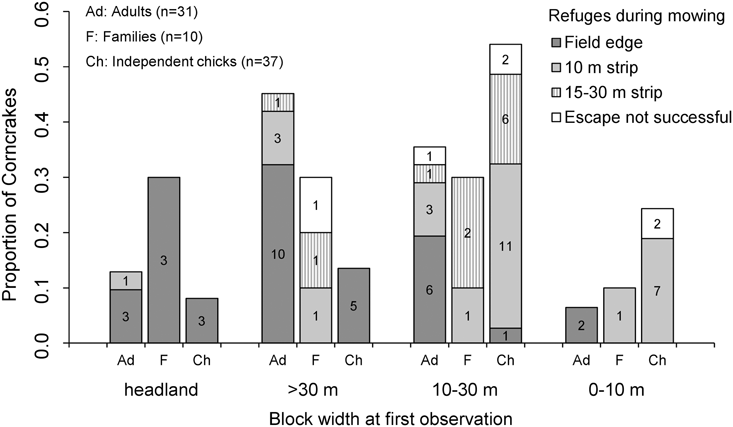
Whereas most of the adults (68%, n = 31) escaped to the field edge or neighbouring unmown meadows at the beginning of the mowing operation, the majority of families (70%, n = 10) and chicks (76%, n = 37) remained in the interior of the meadow. We verified 23% of adults, 30% of families and 49% of independent chicks in 10 m-wide strips until they were either mown or left as a refuge strip. Most chicks were observed for the first time when the uncut grass was ≤ 30 m wide (Figure 1). Nine chicks and five adults survived in 15–30 m wide strips after we stopped mowing operations. When mowing proceeded, escaping birds briefly left the cover but subsequently returned to the unmown block several times. Of all birds observed at > 10 m width 21% of adults, 33% of families and 50% of independent chicks survived until 10 m wide (15–30 m refuges not included; Figure 1). On fields or blocks without refuge strips, birds stayed until the last swaths were mown and started to escape straight in front of the mower. Although we found no dead chicks, not all Corncrakes escaped successfully without intervention. Four independent chicks and one nine days old were captured by hand as the last swaths were mown on fields without refuge strips. One adult male was killed during the completion of a refuge strip when the block was still 20 m wide. Later a female was captured in the strip.
Mowing block width at first observation and refuges of Corncrakes during mowing on fields with (n = 44) and without refuge strips (n = 40); headland = approx. 20 m wide first full circuits of mower; numbers of observed birds are indicated inside bars.
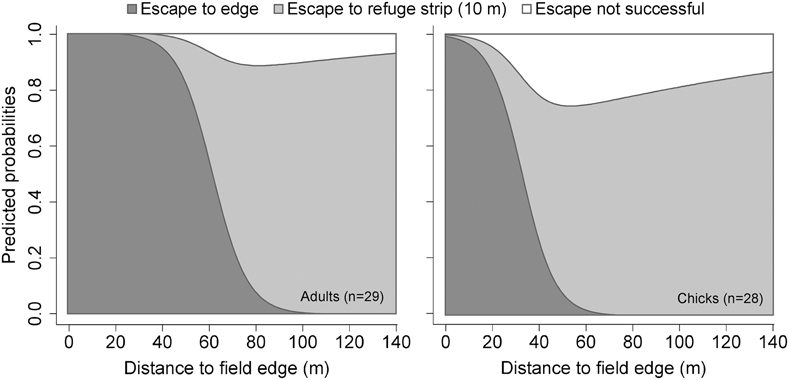
Taking all successful escapes (field edge and 10 m strips) into account, 97% of adults, 86% of families and 87% of the independent chicks survived outside-in mowing. The most parsimonious multinomial model (Table 1) showed that both age (adults vs. chicks) and the distance to the field edge at the start of escape had a significant effect on the outcome of escapes (Table 2). Adults were expected to successfully escape to the edge up to 59.6 m from the field edge, afterwards the probability of escaping into refuge strips and for unsuccessful escapes reached > 0.5. For chicks the respective distance was 31.3 m to the field edge. The probability of unsuccessful escapes increased with increasing distance to the next cover and was higher for chicks than for adults (Figure 2).
Effects of bird age (AGE: adult/chick) and the distance to the field edge (DISTANCE) on escapes of Corncrakes during mowing.
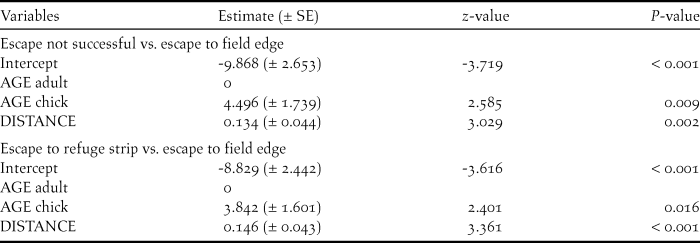
Estimates (± SE), z- and P-values are given for variables in a multinomial logistic regression model with the response categories: ‘escape to refuge strip’, ‘escape to field edge’ (reference level) and ‘escape not successful’. Hosmer and Lemeshow test: χ 2 = 19.58, df = 16, P = 0.24.
Differences of escape probabilities (categories: successful escape to ‘field edge’ or ‘refuge strip (10 m)’ and ‘escape not successful’) between adult and juvenile Corncrakes in relation to the distance to the field edge. Cumulative probabilities are predicted from the multinomial logistic regression model (see Table 2).
Distances travelled during escape differed significantly between adults and chicks (Mann-Whitney U-Test: P < 0.001). Adults crossed on average 29.5 m (max. 100 m) of mown area and were able to bridge greater distances in flight (78% of all observations, n = 41), while unfledged chicks covered only 8.5 m (max. 30 m) on open ground. However, we found no significant relationship between chick age and the travelled distance (r s = -0.12, P = 0.41, n = 51).
Radio-tracking
In total, 13 Corncrakes (five adults, eight chicks) were captured in refuge strips after mowing and further chicks were captured by hand and released into refuge strips. The fate of 11 birds was determined by radio-tracking (Table 3). Only one out of five adults captured in refuge strips was a male. This male moved to an adjacent meadow, one female departed the next day. Another radio-tagged male from a neighbouring unmown field moved into a refuge strip eight days after mowing, but also stayed only for one day. In contrast, independent chicks remained in 15–30 m wide refuges up to 22 days after mowing (tracked for 13 days; Table 3), although the next unmown meadow was < 60 m away. Three chicks could be tracked inside the refuge until departure after fledging (two were observed flying; one was 40 days old at departure).
Captures of Corncrakes in refuge strips after mowing operation and their duration of stay (bold).
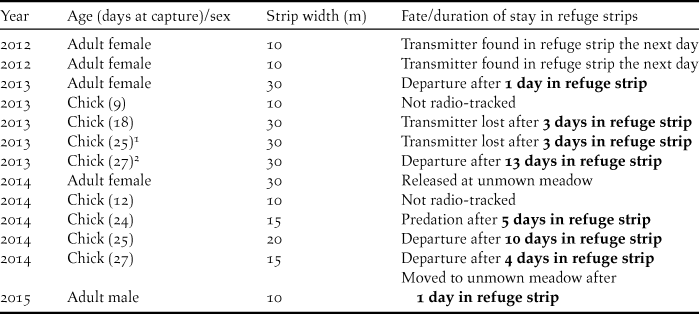
1) captured 7 days after mowing 2) captured 9 days after mowing
Discussion
We verified that during outside-in mowing both adults and unfledged chicks escaped into refuge strips and survived there. While 24% of the chicks escaped early or across the mown field, and would have survived without CFM, 10-m refuge strips were effective in protecting about half of all observed chicks. Assuming also that the birds (nine chicks and five adults) would have survived in 15–30 m strips until 10 m wide, even 65% of chicks staying in the interior of meadows had been rescued (Figure 1). This confirms the effectiveness of refuge strips as a CFM more clearly than the only previous study which suggested that one third of chicks were rescued in refuge strips (Broyer Reference Broyer2003). Altogether, we found that a majority of chicks survived mowing, either by escaping to adjacent fields or in refuge strips. Some Corncrakes might have escaped or were killed undetected. In large fields the probability of detecting birds will increase with decreasing block size. We expect only a small number of unobserved losses at > 30 m block width because Corncrakes are known to flee late from danger (Green et al. Reference Green, Tyler, Stowe and Newton1997b) and usually stay in the block until it is 30 m wide (Broyer Reference Broyer2003). Since adult Corncrakes are also killed during mowing (Mammen et al. Reference Mammen, Bahner, Bellebaum, Eikhorst, Fischer, Geiersberger, Helmecke, Hoffmann, Kempf, Kühnast, Pfützke and Schoppenhorst2005), the presence of females inside refuge strips further suggests that their survival is also positively affected. All females were observed in strips where chicks were also observed, indicating that females remain in the vicinity even of already independent chicks. When paired, both males and females apparently escape late and may be killed, too. In this study and a previous radio-tracking study (Mammen et al. Reference Mammen, Bahner, Bellebaum, Eikhorst, Fischer, Geiersberger, Helmecke, Hoffmann, Kempf, Kühnast, Pfützke and Schoppenhorst2005) a paired male was killed during mowing. Occasionally, we found males calling during mowing operations which in most cases indicated the presence of females.
Most birds tried to leave the block already during mowing when it was still wider than 10 m, often returning and running out several times. During such repeated attempts to escape or when hiding under the already mown swath, both adults and chicks are under an increased risk of being killed by the machines or by predators regularly present during and after mowing operations, especially White Storks Ciconia ciconia, raptors, and red foxes Vulpes vulpes (authors’ unpubl. obs.). Chicks and to some extent also adult Corncrakes avoided crossing already mown areas. Flightless chicks rarely covered > 20 m of open ground, and at distances of > 30 m to the next available cover, they usually returned to the unmown block. Tyler et al. (Reference Tyler, Green and Casey1998) estimated a similar critical distance for chicks to escape successfully.
With mowing inside-out the majority of chicks are able to escape to the field edge (Broyer Reference Broyer1996, Green et al. Reference Green, Tyler, Stowe and Newton1997b). But if farmers start mowing with several full circuits of the mower, thus creating approximately 20 m open space around the whole field, or if no adjacent uncut fields are available, refuge strips may be a more effective measure than inside-out mowing. Nevertheless, mowing with refuge strips will save fewer birds than delaying mowing date until all chicks have fledged. Therefore, delayed mowing would be the best strategy for Corncrake protection. In the case of habitats that are dependent on management, especially under eutrophic conditions e.g. in floodplains, delayed land use is often unattractive to farmers because of a probable low-quality hay harvest late in the season (Corbett and Hudson Reference Corbett and Hudson2010). As a consequence, farmers may abandon meadow management and habitat conditions for Corncrakes deteriorate. CFM methods allow farmers to mow with limited additional effort and lower financial losses at least on meadows where Corncrakes breed early. In productive grasslands with a high abundance of Corncrakes, a combination of delayed mowing and CFM may therefore be appropriate. For any type of CFM to be effective, no nests or chicks younger than at least 14 days should be present during mowing (Tyler et al. Reference Tyler, Green and Casey1998). That requires expert advice to farmers based on monitoring of calling males. Because of their long breeding season Corncrakes also depend on undisturbed meadows and unmown refuges during September (Donaghy et al. Reference Donaghy, Green and O’Halloran2011). We observed females accompanying chicks at the end of August, hence mowing with refuge strips should also take place after 15 August. Successful implementation of CFM depends on local mowing practices and may vary between breeding sites. Limiting machine size, driving speed and cutting height is generally known to increase the efficacy of CFM. In this study we observed that the majority of chicks escaped successfully from mowing devices with 3 m (maximum 6 m) width driving at a speed < 15 km/h. Mowing should be conducted by a single tractor, because chicks are more likely to be overtaken when mowing operates simultaneously from two sides (Tyler et al. Reference Tyler, Green and Casey1998).
Refuge strips are also beneficial for other organisms affected by mowing. We observed roe deer Capreolus capreolus fawns escaping into refuge strips. Active nests as well as recently fledged young of Reed Bunting Emberiza schoeniclus, Yellow Wagtail Motacilla flava, and Sedge Warbler Acrocephalus schoenobaenus were found in strips after mowing. Refuge strips in floodplain meadows also allow late-flowering plants to produce seeds, in the Lower Oder Valley especially the endangered umbellifer Cnidium dubium (authors’ unpubl. obs.). Late cut areas or uncut refuges were also found to host increased densities and species richness of arthropods in the subsequent year (Schmidt et al. Reference Schmidt, Rocker, Hanafi and Gigon2008, Buri et al. Reference Buri, Arlettaz and Humbert2013). While refuge strips in eutrophic floodplains should be mown or grazed late in the season to maintain habitat conditions, uncut patches form an important spring habitat for Corncrakes at breeding sites where vegetation growth starts late (Corbett and Hudson Reference Corbett and Hudson2010).
Refuge strips are designed to protect Corncrakes from being killed by mowing machines or predators during and shortly after mowing. We did not observe adults staying for more than one day inside refuge strips. In this study all radio-tracked adults moved to unmown meadows or left the study area. Larger refuges of 15–30 m width were, however, used by independent chicks for several days despite the presence of nearby unmown fields. Because our data suggest that only strips wider than 10 m serve as temporary habitat for chicks from mowing to departure, and the majority of birds tried to leave the unmown block for the first time when it was up to 30 m wide, 10 m should be considered as the absolute minimum width for refuge strips (Tyler et al. Reference Tyler, Green and Casey1998, Donaghy Reference Donaghy2007). In addition, in narrow strips the risk of predation probably increases (Tyler et al. Reference Tyler, Green and Casey1998). In the design of conservation measures and associated financial compensation, strip width is a trade-off between the protection of Corncrakes and economic interests of farmers. With 10 m wide strips, the unmown area in a field is restricted to 10%, thus limiting the loss of hay harvested. Therefore, further investigations are important to identify the optimal refuge strip width for achieving both the acceptance of farmers and sufficient protection of Corncrakes.
Acknowledgements
We are grateful to H.-J. Haferland, J. Sadlik, E. Franke and U. Kraatz for their great support and endurance during mowing attendance. We thank the authorities of Lower Oder Valley National Park and LUGV Brandenburg for permissions. This study was funded by the Federal Agency for Nature Conservation (BfN).



