





Introduction: 20 Years of Twin Research in Spain
The Murcia Twin Registry (MTR) was established in 2006 through a collaboration between the University of Murcia and the Murcia Health Council. The health authorities provided information on regional residents who shared two surnames and birthdate, along with additional identification and location data. This information was supplied for each subsequent data collection wave, including mortality data for earlier cohorts when longitudinal follow-up was planned. It is, so far, the only population-based twin registry in Spain. It was conceived as a fundamental research tool to investigate the genetic and environmental determinants of complex phenotypes, particularly those related to health and behavior. Initially, the registry focused on a small, geographically limited sample, with plans for progressive expansion (Ordoñana et al., Reference Ordoñana, Pérez-Riquelme, González-Javier, Carrillo, Gómez-Amor and Martínez-Selva2006). The MTR target population encompasses all twins living in the Region of Murcia, a southeastern Spanish province with approximately 1.5 million inhabitants (Ordoñana et al., Reference Ordoñana, Carrillo, Colodro-Conde, García-Palomo, González-Javier, Madrid-Valero, Martínez Selva, Monteagudo, Morosoli, Pérez-Riquelme and Sánchez-Romera2019). At present, the core registry includes data from individuals born between 1940 and 1977, and it is planning ongoing expansion to incorporate younger cohorts. Additional sources of information are also being explored, including record linkage with the regional health and education systems, as well as the development of parallel datasets on neighborhood characteristics and the use of geographic information systems to collect data on environmental conditions, such as climate and air pollution. In parallel, a satellite register keeps records of younger, university-educated twins (born 1981−1999).
Over the past two decades, the MTR has developed into a robust longitudinal research platform, comprising data from same-sex and opposite-sex twins, as well as higher order multiples. It includes both self-reported data and objective measurements, alongside a dedicated biobank. Its comprehensive approach has positioned the MTR as a key reference in the Spanish scientific community and a valuable resource for both national and international research collaborations. Despite the global proliferation of twin registries, the MTR remains unique in Spain, and its work continues to contribute significantly to the understanding of the interplay between genetics, lifestyle, and environmental factors in shaping health-related outcomes (Ordoñana et al., Reference Ordoñana, Sánchez Romera, Colodro-Conde, Carrillo, González-Javier, Madrid-Valero, Morosoli-García, Pérez-Riquelme and Martínez-Selva2018).
MTR Trajectory Since 2006
The MTR was established with the aim of forming a basic scientific research resource for the analysis of genetic and environmental factors involved in the development of health behaviours. In fact, the first data collection focused on collecting information on phenotypes previously assessed by the health surveys that the Spanish government carries out periodically (e.g., anthropometric data, reproductive history, or health status and quality of life). Currently, the information collected in subsequent data collections, as well as the performance of specific studies derived from specific collaborations with other research groups, has considerably expanded the traits and variables available in the MTR databases. A summary of the main phenotypes gathered in the MTR can be found in Table 1.
Summary of the main phenotypes collected across different waves
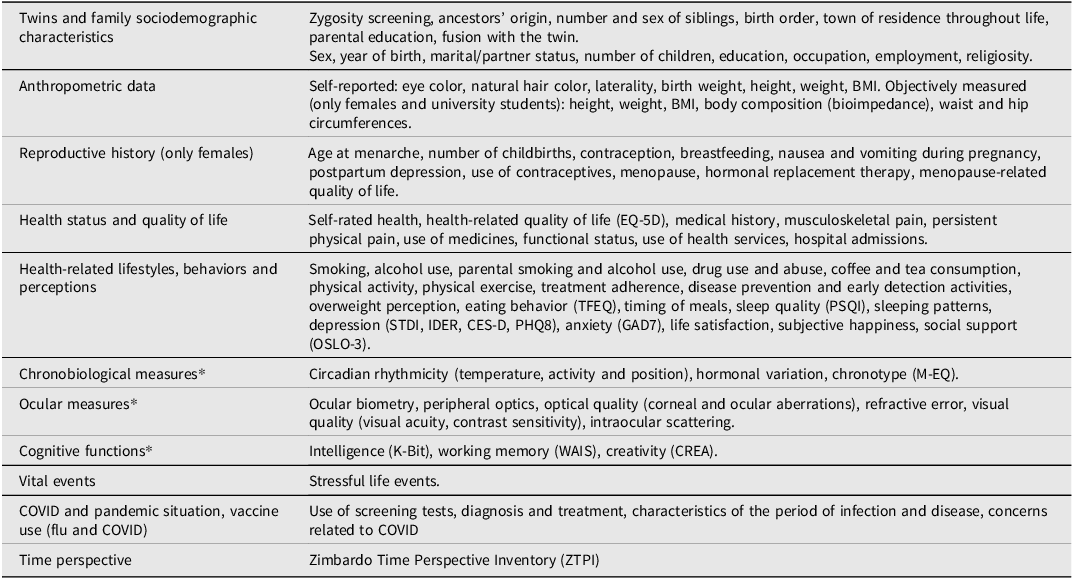
Note: *Only available from selected subsamples.
From its first steps, the MTR has been managed, specifically, by the area of Psychobiology of the University of Murcia. The inclusion criteria, in principle, would only consist of being a pair of twins who are resident in the Region of Murcia. Of course, collaboration with the MTR is completely voluntary and conditional on the signing of an informed consent form. In addition, registry protocols and procedures of specific projects are submitted to the Research Ethics Committee of the University of Murcia for approval. Moreover, and with the objective of ensuring future participation of twins, the MTR tries to take the maximum care of its members, looking after their interests in each of its collaborations. Finally, the register complies with all European legal requirements on personal data protection and was registered with the Spanish Data Protection Agency. The information provided by participants is not stored together with their identification data, and the process that would allow this connection to be re-established is totally limited.
Waves of Data Collection
The MTR is defined as a population-based twin registry. Thus, the twin recruitment procedure must ensure that all potential candidates who meet the general criteria (being eligible twins) and specific criteria (e.g. age for that specific wave) are invited to participate. For this purpose, information on potential twin pairs is obtained from public regional health system databases, which incorporates virtually all residents in the region. First, individuals with identical surnames and the same date of birth are selected from the database. A letter is then sent to all potential twins, jointly signed by the two participant institutions (the Health Council and Murcia University). The purpose of this letter is to introduce the MTR and explain its procedures, as well as to confirm the recipients’ twin status. This initial contact is usually followed by a phone call from registry researchers at the university; however, in more recent data collections, twins have also been given the option to participate directly via an online questionnaire. Participation in the MTR is voluntary, and each request to participate in a specific study is independent. Each specific invitation can be accepted or rejected without abandoning participation in the registry.
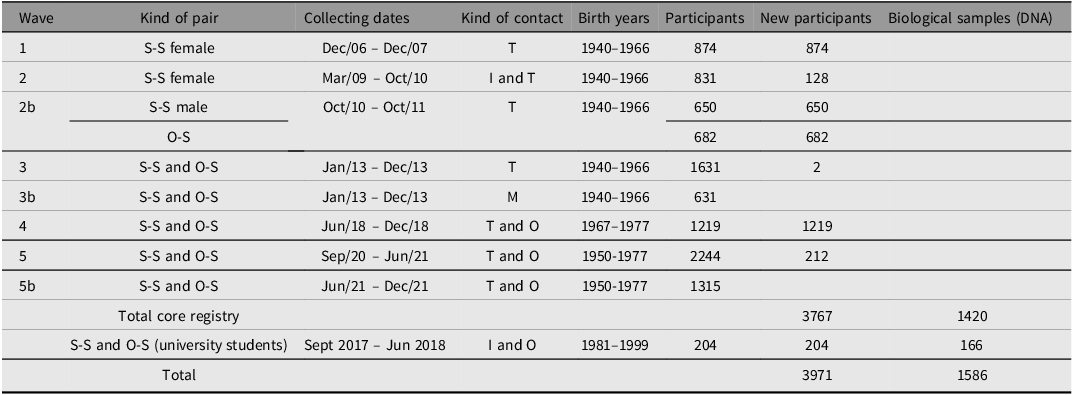
Over the past two decades the MTR has conducted several large data collections, each lasting between 6 and18 months depending on the objectives and volume of data collected. Main characteristics of these waves (i.e., date of collection, sex and birth year of participants, and interview method) are described in Table 2. In addition, selected subsamples of participants have taken part in specific small-scale studies.
Number of twin individuals interviewed and incorporated in the MTR by wave of data collection
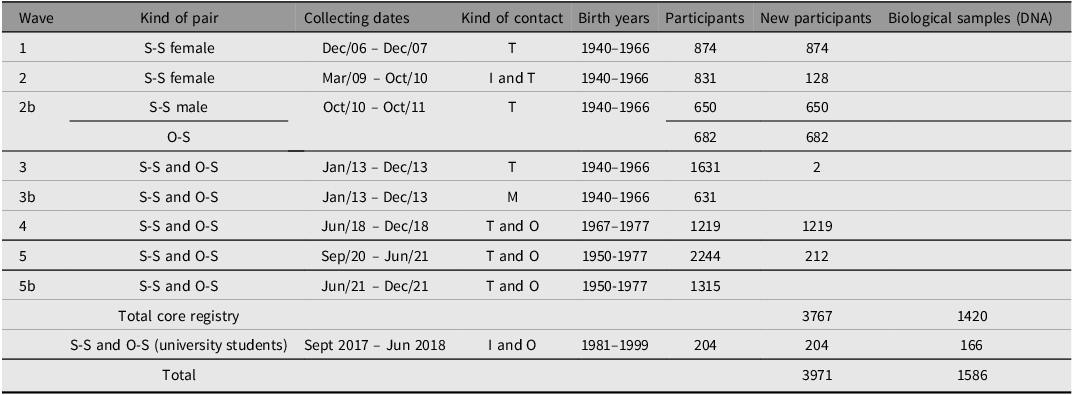
Note: S-S, same sex pairs; O-S, opposite sex pairs; T, telephone; I, in-person interview; M, mail; O, online.
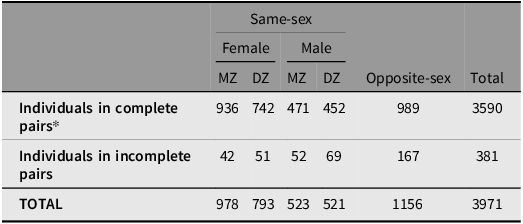
All in all, the MTR currently holds information on 3971 individual twins, comprising 1780 complete twin pairs, 381 unpaired twins, and 30 individuals from triplet sets, who have participated at any stage (Tables 2 and 3). Longitudinal data are available for a variable number of participants, depending on phenotype and collection wave involved. The MTR core registry is representative of the population of both the Region of Murcia and Spain, as evidenced by the distribution of sociodemographic characteristics and the prevalence of major health-related traits among individuals born between 1940 and 1977 (Ordoñana et al., Reference Ordoñana, Sánchez Romera, Colodro-Conde, Carrillo, González-Javier, Madrid-Valero, Morosoli-García, Pérez-Riquelme and Martínez-Selva2018).
Distribution of participants according to zygosity
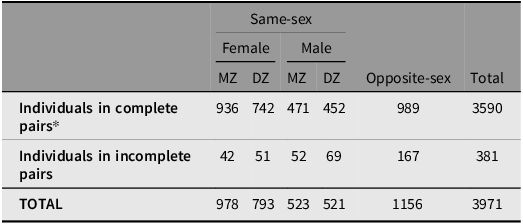
Note: *Includes higher order groups. MZ, monozygotic; DZ, dizygotic.
Zygosity Assessment
Zygosity of participant pairs has been ascertained by DNA analyses in 48% of complete same-sex pairs of the sample. Methods have included micro-satellite and SNP comparison. For those for whom biological determination has not been possible, a standard questionnaire focusing on physical similarity and difficulties in telling the twins apart has been used. The accuracy of zygosity determination by this method was determined by comparison with DNA testing in a subsample (342 pairs/triplets), and the questionnaire correctly classified 95.5% of the pairs (Ordoñana et al., Reference Ordoñana, Rebollo-Mesa, Carrillo, Colodro-Conde, García-Palomo, González-Javier, Sánchez-Romera, Aznar Oviedo, De Pancorbo and Pérez-Riquelme2013). Distribution of pairs by zygosity and sex is described in Table 3.
Scientific Highlights
The MTR was created to address key public health issues such as health-related traits and behaviors, wellbeing and quality of life, or health promotion and prevention of disease. By incorporating a behavioral genetics perspective, the MTR aims to unravel the complex interplay between genetic, environmental, psychological,S and social factors in shaping health outcomes.
The registry has yielded remarkable findings in both well studied and understudied areas. Main areas of work have focused on anthropometric measures (e.g., BMI) or mental health (e.g., anxiety and depression). In these realms, the MTR has offered new insights for such relevant health condition, such as chronic pain (Dario et al., Reference Dario, Ferreira, Refshauge, Sánchez-Romera, Luque-Suarez, Hopper, Ordoñana and Ferreira2016; Dario et al., Reference Dario, Loureiro Ferreira, Refshauge, Luque-Suarez, Ordoñana and Ferreira2017; Fernandez et al., Reference Fernandez, Colodro-Conde, Hartvigsen, Ferreira, Refshauge, Pinheiro, Ordoñana and Ferreira2017; Pinheiro et al., Reference Pinheiro, Ferreira, Refshauge, Colodro-Conde, Carrillo, Hopper, Ordoñana and Ferreira2015; Pinheiro, Morosoli, Colodro-Conde et al., Reference Colodro-Conde, Sánchez-Romera, Lind, Zhu, Martin, Medland and Ordoñana2018; Pinheiro, Morosoli, Ferreira et al., Reference Pinheiro, Morosoli, Ferreira, Madrid-Valero, Refshauge, Ferreira and Ordoñana2018) or sleep quality and biological rhythms (Andreucci et al., Reference Andreucci, Madrid-Valero, Ferreira and Ordoñana2020; Lopez-Minguez et al., Reference Lopez-Minguez, Colodro-Conde, Bandín, Ordoñana, Garaulet and Madrid2016; Lopez-Minguez et al., Reference Lopez-Minguez, Dashti, Madrid-Valero, Madrid, Saxena, Scheer, Ordoñana and Garaulet2019; Lopez-Minguez et al., Reference Lopez-Minguez, Morosoli, Madrid, Garaulet and Ordoñana2017; Madrid-Valero, Andreucci et al., Reference Madrid-Valero, Andreucci, Carrillo, Ferreira, Martínez-Selva and Ordoñana2022; Madrid-Valero et al., Reference Madrid-Valero, Kirkpatrick, González-Javier, Gregory and Ordoñana2023; Madrid-Valero et al., Reference Madrid-Valero, Martínez-Selva and Ordoñana2017, Madrid-Valero et al., Reference Madrid-Valero, Sánchez-Romera, Gregory, Martínez-Selva and Ordoñana2018; Madrid-Valero, Sánchez-Romera et al., Reference Madrid-Valero, Sánchez-Romera, Martínez-Selva and Ordoñana2022; Pinheiro, Morosoli, Ferreira et al., Reference Pinheiro, Morosoli, Ferreira, Madrid-Valero, Refshauge, Ferreira and Ordoñana2018).Furthermore, the information available in the registry, and the associated biobank, has been used in studies of forensic genetics (Illescas et al., Reference Illescas, Aznar, Cardoso, López-Oceja, Gamarra, Sánchez-Romera, Colodro-Conde, Ordoñana and De Pancorbo2012; Marqueta-Gracia et al., Reference Marqueta-Gracia, Álvarez-Álvarez, Baeta, Palencia-Madrid, Prieto-Fernández, Ordoñana and de Pancorbo2018), breastfeeding (Colodro-Conde et al., Reference Colodro-Conde, Sánchez-Romera, Lind, Zhu, Martin, Medland and Ordoñana2018; Colodro-Conde et al., Reference Colodro-Conde, Sánchez-Romera and Ordoñana2013; Colodro-Conde et al., Reference Colodro-Conde, Sánchez-Romera, Tornero-Gómez, Pérez-Riquelme, Polo-Tomás and Ordoñana2011), social psychology (Tornero et al., Reference Tornero, Sánchez-Romera, Morosoli, Vázquez, Gómez and Ordoñana2018), educational attainment (Colodro-Conde et al., Reference Colodro-Conde, Rijsdijk, Tornero-Gómez, Sánchez-Romera and Ordoñana2015) or ocular optics (Pusti et al., Reference Pusti, Benito, Madrid-Valero, Ordoñana and Artal2021, Reference Pusti, Benito, Madrid-Valero, Ordoñana and Artal2024; Tabernero et al., Reference Tabernero, Hervella, Benito, Colodro-Conde, Ordoñana, Ruiz-Sanchez, Marín and Artal2017), among others, further demonstrating its multidisciplinary value.
Biobanking: Collaboration With the National DNA Bank-Carlos III
The MTR has developed a biobank with biological samples from its participants, MZ twins and DZ twins of the same or opposite sex. Since the collection of biological material began in 2009, the biobank has been managed in collaboration with the National DNA Bank − Carlos III (NDNAB; www.bancoadn.org/en). The NDNAB, created in 2006, is located at the University of Salamanca (Spain), and its scientific management is supervised and advised by two external and independent committees, including an External Ethics Committee.
Regarding the collection of MTR biological samples, the first samples collected consisted of whole blood (10 ml of EDTA and 6 ml of ACD) or whole saliva (Oragene DNA collection kit) when blood extraction was not possible. In subsequent waves, saliva was collected using a chlorhexidine mouthwash (10 ml), a cost-effective and safe method for obtaining DNA of adequate quality (Pinto et al., Reference Pinto, Morante, Pérez-Caro, Márquez de Sousa, Quintas-Faria, González-Lopez and García-Montero2018). Detailed technical information on DNA extraction and storage can be found on the NDNAB website (www.bancoadn.org/en). The NDNAB collaborates with hospitals, transfusion centers, blood banks, and other public institutions. In this regard, samples originating from the MTR are available to both MTR researchers and other interested groups (www.bancoadn.org/en/samples) with the aim of facilitating, promoting, and developing national and international scientific research on human evolution, genetic/genomic diversity, and health-related risk factors, or the etiology and treatment of diseases. NDNAB currently stores DNA samples from 1586 MTR participants (Table 2) that have been genotyped using the Illumina GSA Beadchip v.3. Stored samples have been used for research on different areas such as Type-2 diabetes (Christiansen et al., Reference Christiansen, Potier, Martin, Villicaña, Castillo-Fernandez, Mangino, Menni, Tsai, Campbell, Mullin, Ordoñana, Monteagudo, Sachdev, Mather, Trollor, Pietilainen, Ollikainen, Dalgård, Kyvik, Christensen and Bell2024), psychiatric and neurodevelopmental phenotypes (Assary et al., Reference Assary, Coleman, Hemani, van de Weijer, Howe, Palviainen, Grasby, Ahlskog, Nygaard, Cheesman, Lim, Reynolds, Ordoñana, Colodro-Conde, Gordon, Madrid-Valero, Thalamuthu, Hottenga, Mengel-From, Armstrong and Keers2025), or nausea and vomiting during pregnancy (Colodro-Conde et al., Reference Colodro-Conde, Cross, Lind, Painter, Gunst, Jern, Johansson, Maegbaek, Munk-Olsen, Nyholt, Ordoñana, Paternoster, Sanchez-Romera, Wright and Medland2017). Researchers interested in using the samples can contact NDNAB via their website or the MTR, and their proposals will be reviewed by a committee of MTR and NDNAB members.
Widening Research Perspectives: Record Linkage to Health Databases
The MTR is able to combine survey responses with health, administrative or educational records, which requires approaches that address the unique challenges posed by multiple data sources. Its database can be integrated with the regional electronic health record system to obtain or verify medical information. With participants’ informed consent, data from both primary care and specialized health services may be linked to their survey responses. This may include data from medical visits, analytical records, or pharmaceutical prescriptions. Such linkage allows researchers to confirm self-reported information and to add further details on diagnoses, laboratory tests, and treatments. For this task, verification of linkage quality proceeds with diagnostics such as match rates, agreement indices, and probabilistic linkage scores to ensure that records correspond to the correct individuals. It also includes handling of missing data and identification of repeated measurements and/or cases. Once linkage accuracy is established, descriptive comparisons can identify systematic differences between linked and unlinked cases, helping to assess potential selection or linkage bias.
For twins recruited through the University of Murcia, and only after receiving their explicit authorization, the MTR is also able to access their university entrance examination results. These records contain standardized scores across core academic areas such as mathematics, history, and literature, which are used nationwide to determine eligibility and priority for admission into different university programs.
Within this framework, the MTR seeks to expand the available information by linking it to other datasets. Efforts are also underway to connect with the regional education system in order to gain access to relevant data on educational trajectories and academic achievement. In parallel, additional linked datasets are being developed on neighborhood conditions and characteristics, drawing on geocoding strategies and systematic social observation tools. Furthermore, a map of climatic and air pollution data is being constructed using information from regional (SINQLAIR) and national (AEMET) systems.
MTR in International Collaborative Infrastructures
The MTR was originally conceived as a collaborative and integrative research infrastructure, designed to foster partnerships and knowledge exchange across institutional, national, and international boundaries. In line with this ethos, it remains fully open to cooperation with a broad range of research groups and scientific networks. Over time, the registry has actively established and maintained collaborations with multiple research teams and has taken part in a diverse array of consortia and interdisciplinary initiatives. These partnerships have not only broadened the scientific scope of the MTR, but also significantly enhanced its visibility, multidisciplinary character, and potential for impact within the global research community. This interdisciplinary approach enhances the scope and impact of MTR studies, fostering innovative research that bridges genetics, health, and other domains. The primary focus of these joint endeavours has been the exploration of health-related topics, approached through a variety of methodological and theoretical frameworks.
The characteristics of the Spanish population provide a unique sample for the study of specific phenotypes, such as sleep, diet, or use of psychoactive medication due to factors such as climate, health system organization, or cultural habits. This uniqueness adds valuable diversity when MTR data are integrated into collaborative, multicohort projects, enhancing the generalizability and comparative power of genetic and environmental analyses.
Notable examples have included genetic investigations into quality of life by the GENEQOL Consortium (Sprangers et al., Reference Sprangers, Sloan, Veenhoven, Cleeland, Halyard, Abertnethy, Baas, Barsevick, Bartels, Boomsma, Chauhan, Dueck, Frost, Hall, Klepstad, Martin, Miaskowski, Mosing, Movsas and Zwinderman2009); studies examining nausea and vomiting during pregnancy by the NVP Genetics Consortium (Colodro-Conde et al., Reference Colodro-Conde, Cross, Lind, Painter, Gunst, Jern, Johansson, Maegbaek, Munk-Olsen, Nyholt, Ordoñana, Paternoster, Sanchez-Romera, Wright and Medland2017); the utilization of anthropometric measures for the Cohort Description of Collaborative Project of Development of Anthropometrical Measures in Twins by CODATwins Consortium (Silventoinen et al., Reference Silventoinen, Jelenkovic, Sund, Honda, Aaltonen, Yokoyama, Tarnoki, Tarnoki, Ning, Ji, Pang, Ordoñana, Sánchez-Romera, Colodro-Conde, Burt, Klump, Medland, Montgomery, Kandler and Kaprio2015; Silventoinen et al., Reference Silventoinen, Jelenkovic, Yokoyama, Sund, Sugawara, Tanaka, Matsumoto, Bogl, Freitas, Maia, Hjelmborg, Aaltonen, Piirtola, Latvala, Calais-Ferreira, Oliveira, Ferreira, Ji, Ning and Kaprio2019); as well as participation in twin research development initiatives (e.g., International Network of Twin Registries (Buchwald et al., Reference Buchwald, Kaprio, Hopper, Sung, Goldberg, Fortier, Busjhan, Sumathipala, Cozen, Mack, Craig and Harris2014), IGEMS (Pedersen et al., Reference Pedersen, Gatz, Finch, Finkel, Butler, Dahl Aslan, Franz, Kaprio, Lapham, McGue, Mosing, Neiderhiser, Nygaard, Panizzon, Prescott, Reynolds, Sachdev and Whitfield2019) and EuroDiscotwin (Willemsen et al., Reference Willemsen, Ward, Bell, Christensen, Bowden, Dalgård, Harris, Kaprio, Lyle, Magnusson, Mather, Ordoňana, Perez-Riquelme, Pedersen, Pietiläinen, Sachdev, Boomsma and Spector2015). Additionally, the registry has contributed to efforts in applied behavioural genetics (e.g., Enhancing Psychiatry Genetic Counselling, Testing and Training in Europe [EnGage]), thereby reinforcing its commitment to multidisciplinary and translational research.
Conclusion
The MTR has been very prolific during its first two decades, and many more initiatives still can be created and further developed. There are several aspects on which this fundamental research resource should focus: from the inclusion of participants from other age groups — including children — to fostering collaboration with other research structures and groups, as well as an increasing effort in public education on issues related to the impact of genetics in everyday life.
With these aims in view and maintaining a public health approach, the MTR intends to continue conducting traditional quantitative genetic analyses of relevant phenotypes, while also incorporating recent advances in molecular genetics into its research. Overall, by following a strategy that has proven effective so far, the MTR remains committed to advancing scientific knowledge and to acting as a key reference for twin research in Spain.
Acknowledgments
The authors thank all registry participants for their valuable and selfless contributions. We also express our gratitude to the researchers and colleagues in the twin research community who have been helping us in the development of the registry throughout all these years. We also thank the National DNA Bank-Carlos III for its invaluable support during the development of the MTR.
Financial support
The MTR is being funded by Seneca Foundation — Regional Agency for Science and Technology, Murcia, Spain (grants 03082/PHCS/05, 08633/PHCS/08, 15302/PHCS/10, 19479/PI/14 and 22649/PI/24); the Spanish Ministry of Science and Innovation (PSI2009–11560, PSI2014-56680-R; RTI2018-095185-B-I00; PID2022-137168OB-100); and Murcia Institute for Biosanitary Research (IMIB23/SINFINAN/06)
Competing interests
The authors declare no competing interest

 Open access

