





Introduction
The distribution and abundance of insects are influenced by the structure and composition of the landscape (Fahrig et al., Reference Fahrig, Baudry, Brotons, Burel, Crist, Fuller, Sirami, Siriwardena and Martin2011; Hunter, Reference Hunter2002; Tscharntke and Brandl, Reference Tscharntke and Brandl2004; Tscharntke et al., Reference Tscharntke, Steffan‐Dewenter, Kruess and Thies2002). For pests, it is often assumed that diversity of habitat types in a landscape should reduce pest abundance, primarily by enhancing biocontrol services (top-down effects) and by increasing the proportion of unsuitable habitats and dispersal barriers in the landscape (bottom-up effects) (Bhar and Fahrig, Reference Bhar and Fahrig1998; Cohen and Crowder, Reference Cohen and Crowder2017). Other studies have shown, conversely, that heterogeneous landscapes can also provide more suitable conditions for pest species (Tscharntke et al., Reference Tscharntke, Karp, Chaplin-Kramer, Batáry, DeClerck, Gratton, Hunt, Ives, Jonsson, Larsen, Martin, Martínez-Salinas, Meehan, O’Rourke, Poveda, Rosenheim, Rusch, Schellhorn, Wanger, Wratten and Zhang2016), and the impact of landscape diversity is likely dependent on the landscape composition. For example, wild areas can provide natural enemies with food, refuge and alternative hosts/prey (Santoiemma et al., Reference Santoiemma, Mori, Tonina and Marini2018). Consequently, the responses of pests to landscape use remain heterogeneous across studies and difficult to predict (Karp et al., Reference Karp, Chaplin-Kramer, Meehan, Martin, DeClerck, Grab, Gratton, Hunt, Larsen, Martínez-Salinas, O’Rourke, Rusch, Poveda, Jonsson, Rosenheim, Schellhorn, Tscharntke, Wratten, Zhang, Iverson, Adler, Albrecht, Alignier, Angelella, Zubair Anjum, Avelino, Batáry, Baveco, Bianchi, Birkhofer, Bohnenblust, Bommarco, Brewer, Caballero-López, Carrière, Carvalheiro, Cayuela, Centrella, Ćetković, Henri, Chabert, Costamagna, De la Mora, de Kraker, Desneux, Diehl, Diekötter, Dormann, Eckberg, Entling, Fiedler, Franck, Frank van Veen, Frank, Gagic, Garratt, Getachew, Gonthier, Goodell, Graziosi, Groves, Gurr, Hajian-Forooshani, Heimpel, Herrmann, Huseth, Inclán, Ingrao, Iv, Jacot, Johnson, Jones, Kaiser, Kaser, Keasar, Kim, Kishinevsky, Landis, Lavandero, Lavigne, Le Ralec, Lemessa, Letourneau, Liere, Lu, Lubin, Luttermoser, Maas, Mace, Madeira, Mader, Cortesero, Marini, Martinez, Martinson, Menozzi, Mitchell, Miyashita, Molina, Molina-Montenegro, O’Neal, Opatovsky, Ortiz-Martinez, Nash, Östman, Ouin, Pak, Paredes, Parsa, Parry, Perez-Alvarez, Perović, Peterson, Petit, Philpott, Plantegenest, Plećaš, Pluess, Pons, Potts, Pywell, Ragsdale, Rand, Raymond, Ricci, Sargent, Sarthou, Saulais, Schäckermann, Schmidt, Schneider, Schüepp, Sivakoff, Smith, Stack Whitney, Stutz, Szendrei, Takada, Taki, Tamburini, Thomson, Tricault, Tsafack, Tschumi, Valantin-Morison, Van Trinh, van der Werf, Vierling, Werling, Wickens, Wickens, Woodcock, Wyckhuys, Xiao, Yasuda, Yoshioka and Zou2018), particularly in agroecosystems where agricultural areas are often close to natural and inhabited environments.
In addition, pest populations are affected by the agricultural practices and the management decisions made by each farmer (Jasrotia et al., Reference Jasrotia, Kumari, Malik, Kashyap, Kumar, Bhardwaj and Singh2023; Lichtenberg et al., Reference Lichtenberg, Kennedy, Kremen, Batáry, Berendse, Bommarco, Bosque-Pérez, Carvalheiro, Snyder, Williams, Winfree, Klatt, Åström, Benjamin, Brittain, Chaplin-Kramer, Clough, Danforth, Diekötter, Eigenbrode, Ekroos, Elle, Freitas, Fukuda, Gaines-Day, Grab, Gratton, Holzschuh, Isaacs, Isaia, Jha, Jonason, Jones, Klein, Krauss, Letourneau, Macfadyen, Mallinger, Martin, Martinez, Memmott, Morandin, Neame, Otieno, Park, Pfiffner, Pocock, Ponce, Potts, Poveda, Ramos, Rosenheim, Rundlöf, Sardiñas, Saunders, Schon, Sciligo, Sidhu, Steffan-Dewenter, Tscharntke, Veselý, Weisser, Wilson and Crowder2017; Pujari et al., Reference Pujari, Badal Bhattacharyya and Mrinmoy Das2013; Rehman et al., Reference Rehman, Farooq, Lee and Siddique2022). Farmers can adopt some preventive measures by managing plant and soil health, implementing prophylaxis such as orchard sanitation, selecting suitable varieties, and using cultural practices such as sowing under plant cover and minimum tillage (Deguine et al., Reference Deguine, Rousse, Atiama-Nurbel, Larramendy Marcelo and Sonia2012). Other practices can promote the decrease of pest populations and increase beneficial organisms, such as using traps against pests, mating disruption practices or providing refuge or food areas for natural enemies (Brunner et al., Reference Brunner, Welter, Calkins, Hilton, Beers, Dunley, Unruh, Knight, Van Steenwyk and Van Buskirk2002; Deguine et al., Reference Deguine, Rousse, Atiama-Nurbel, Larramendy Marcelo and Sonia2012).
Pest management practices can be applied at various landscape scales. Traditional and integrated pest management (IPM) approaches typically focus on individual fields or farms, despite the mobility of insect pests (Hendrichs et al., Reference Hendrichs, Kenmore, Robinson, Vreysen, Vreysen, Robinson and Hendrichs2007; Barzman et al., Reference Barzman, Bàrberi, Birch, Boonekamp, Dachbrodt-Saaydeh, Graf, Jensen, Kiss, Kudsk, Lamichhane, Messéan, Moonen, Ratnadass, Ricci, J-L and Sattin2015; Stenberg, Reference Stenberg2017). In contrast, area-wide pest management (AWPM) treats larger regions simultaneously, reducing reinfestation from neighbouring areas and enabling the effectiveness of techniques like the sterile insect technique within integrated programs (Elliott et al., Reference Elliott, Onstad and Brewer2008). Given the mobility of insect pests, the success of these management strategies is likely influenced by the composition of the surrounding landscape stressing the role of landscape context in pest control.
In light of the agroecosystem metacommunity dynamics, where local communities are established in disparate farming systems and where distinct habitat patches interact, it is intelligible to assess both the efficacy of individual farmer strategies and the influence of landscape composition in the vicinity of the plot. This is particularly relevant in cases where crop plots are of modest size, situated in close proximity to one another or to other habitat patches potentially favourable to pests. It has been shown that pest density depends not only on the local characteristics of orchards, but also on the characteristics of the surrounding landscape, however, the way in which these parameters influence pest density depends on the organism being studied (Lavigne et al., Reference Lavigne, Maalouly, Monteiro, Ricci, Toubon, Bouvier, Olivares, Maugin, Thomas, Franck, Begg, Bianchi, Birch, Gerowitt, Holland, Lupi, Moonen, Ramsden and van Rijn2017; Le Provost et al., Reference Le Provost, Thiele, Westphal, Penone, Allan, Neyret, Van Der Plas, Ayasse, Bardgett, Birkhofer, Boch, Bonkowski, Buscot, Feldhaar, Gaulton, Goldmann, Gossner, Klaus, Kleinebecker, Krauss, Renner, Scherreiks, Sikorski, Baulechner, Blüthgen, Bolliger, Börschig, Busch, Chisté, Fiore-Donno, Fischer, Arndt, Hoelzel, John, Jung, Lange, Marzini, Overmann, Paŝalić, Perović, Prati, Schäfer, Schöning, Schrumpf, Sonnemann, Steffan-Dewenter, Tschapka, Türke, Vogt, Wehner, Weiner, Weisser, Wells, Werner, Wolters, Wubet, Wurst, Zaitsev and Manning2021; Ricci et al., Reference Ricci, Franck, Toubon, Bouvier, Sauphanor and Lavigne2009; Rusch et al., Reference Rusch, Valantin-Morison, Sarthou and Roger-Estrade2010).
Our study focuses on the oriental fruit fly, Bactrocera dorsalis (Hendel, 1912), (Diptera: Tephritidae), among the most invasive and polyphagous pests of fruits and vegetables (White and Elson-Harris Reference White and Elson-Harris1992), causing severe annual economic losses (Allwood et al., Reference Allwood, Leblanc, Allwood and Drew1997; Alvarez et al., Reference Alvarez, Evans and Hodges2016; Cugala et al., Reference Cugala, Massimiliano, Maulid, De Meyer and Canhanga2020; Papadopoulos et al., Reference Papadopoulos, De Meyer, Terblanche and Kriticos2024; Stonehouse et al., Reference Stonehouse, Mumford and Mustafa1998). This species has invaded Africa and Oceania (Zeng et al., Reference Zeng, Reddy, Li, Qin, Wang, Pan, Jiang, Gao and Zhao2019), has been repeatedly detected in the USA especially in California and Florida (Carey et al., Reference Carey, Papadopoulos and Plant2017), and in parts of Europe (Nugnes et al., Reference Nugnes, Carbone, Ascolese, Miele, Pica, Palmieri, Griffo and Bernardo2024). Farmers use different strategies to manage this pest. The generally used practices comprise (i) orchard sanitation (removal of infested/fallen fruits); (ii) protein-insecticide bait sprays attracting both sexes; (iii) trapping either with protein bait or with male attractant (Methyleugenol); and (iv) chemical treatments. While IPM is promoted, pesticides are still used. Studies have shown that fruit fly control based on a single technique is unlikely to be successful and that it is preferable to combine different approaches (Billah and Ekesi Reference Billah and Ekesi2006; Ekesi et al., Reference Ekesi, Mohamed and De Meyer2016; Hendrichs et al., Reference Hendrichs, Kenmore, Robinson, Vreysen, Vreysen, Robinson and Hendrichs2007; Vargas et al., Reference Vargas, Piñero, Leblanc, Manoukis, Mau, Sunday, Mohamed Samira and Marc2016; Zida et al., Reference Zida, Nébié, Sawadogo, Tassembédo, Kiénou, Dabiré and Nacro2023).
This study analysed how landscape composition and diversity, together with local farmer practices, were related to the infestation rate of B. dorsalis. We hypothesised that landscape richness increases infestation rates by providing alternative resources for this generalist species. In addition, we supposed that farmers can also influence infestation rates locally through their actions and practices. We assumed that orchards where sanitation and trapping were applied would experience lower levels of B. dorsalis infestation rates.
These hypotheses were tested within a specific tropical island agroecosystem characterised by relatively small, closely situated crop plots and diverse farming systems in La Réunion. La Réunion is a French Island in the Indian Ocean. Mango orchards occupy approximately 300 ha in this tropical island, mainly distributed in the West and Southwest. The production represents 1960 tons sold yearly on the local market or for export in 2022 (20%, Agreste, 2023). Many mango varieties are cultivated in La Réunion, however, the José and Cogshall varieties currently account for more than 80% of the orchard (Vincenot et al., Reference Vincenot, Normand, Amouroux, Hoarau, Joas and Léchaudel2009).
Materials and methods
Sampling area
Sample site was located in Saint-Paul (La Réunion, France), the municipality with the largest mango production, in the western part of the island (coordinates: −21.03805, 55.22963), in the area called ‘Grand-Fond’ where approximately 30% of the total area (150 ha) is mango orchards (Fig. 1).
The study location. The study of B. dorsalis infestation rates is taking place on La Réunion, a French tropical island in the Indian Ocean. The sampling site is located in the western part of the island (red circle), in 150 ha of mango orchards. In this area, we described the landscape according to 12 categories: agricultural wastelands, urbanised areas, hedgerows, horticulture plots, market gardening areas, savannahs, beaches, greenhouses, orchards (mango orchards), wooded and shrubby formations and bare grounds.

Infestation rate
We regularly collected mangoes between June 2020 and February 2022 to monitor Tephritidae infestation (Fig. 2). Among 15 farms, 1 to 3 orchards were visited each week to collect mangoes from trees if ripe mangoes on them or from the ground otherwise. The GPS location of the sampled plots was recorded. Fifteen ripe fruits were collected per variety, whenever possible, from orchards and dates. Fruits were randomly collected regardless of the presence or absence of potential holes. We collected a total of 1234 fruits belonging to the three main varieties: José, Cogshall, and Nam Doc Mai.
Number of collected fruits (A), proportion of infested fruits (B), and infestation rate (flies/kg; C) according to the month of sampling for the three mango varieties.

Fruits were taken to the laboratory and subjected to a standardised protocol (Boinahadji et al., Reference Boinahadji, Coly, Dieng, Diome and Sembene2019; FAO/IAEA, Reference Enkerlin, Reyes and Ortiz2019; Leblanc et al., Reference Leblanc, Vueti, Drew and Allwood2012; N’Dépo et al., Reference N’Dépo, My and Nl2019). Fruits were individually weighed, placed in plastic boxes with sand as a pupation substrate, and covered with fine mesh cloth. Fruit samples were kept in a climatic room until pupation in favourable conditions (25°C ± 2°C and 70% ± 20% humidity; Duyck et al., Reference Duyck, Sterlin and Quilici2004). Over a period of three weeks, the sand was sifted regularly to check for Tephritidae pupae. Pupae were then kept in plastic boxes until emergence. They were taxonomically identified at the species level (using a multi-entry identification key to African frugivorous flies, Virgilio et al., Reference Virgilio, White and De Meyer2014). For each fruit, we collected data on (i) the status of the fruit: The sample was considered ‘positive’ if at least one larva developed into a pupa. It is an indicator of the loss to the farmer, since a single individual in the fruit can make it unmarketable; and (ii) the number of emerging individuals of each fruit fly species. We calculated the infestation rate for positive samples as the number of flies per kilogram of fruit (Dominiak, Reference Dominiak2022; Follett et al., Reference Follett, Haynes and Dominiak2021).
Landscape composition description
We utilised high-resolution satellite imagery to map the study area’s landscape cover. The ‘pleiades’ satellite images used in this study were acquired on the Kalideos website of the CNES (National Centre for Space Studies). We carried out with the R package RandomForest (Liaw and Wiener, Reference Liaw and Wiener2002) an automatic processing chain using the Random Forest (RF) automatic classification algorithm through an object-oriented approach on this image to classify the land use. A manual reclassification of identification errors and refinement were then carried out using QGIS software (version 2.18.14) based on our knowledge of the land and the cartography of the agricultural plot.
We obtained 11 landscape categories: agricultural wastelands, urbanised areas, hedgerows, horticulture plots, market gardening areas, savannahs, beaches, greenhouses, orchards (including mango orchards), wooded and shrubby formations and bare grounds. The area of this landscape covers was calculated in a 500 m buffer (Putri et al., Reference Putri, Rizali and Ikawati2025; Wen et al., Reference Wen, Yang, Huang, Zhang, Zheng, Shen, Yang, Ouyang and Li2023) around each sampled orchard plot. Orchards (84% of which are mango orchards), market gardening areas and horticulture plots were environments with host plants for B. dorsalis. Hedgerows varied in composition and could include host plants (e.g. Pithecellobium dulce, Citrus spp., Ziziphus spp., etc.) or non-host plant species (e.g. Leucaena leucocephala). Urban areas were mixed, comprising non-vegetated areas and gardens with potential host plants. Then other categories such as agricultural wastelands, savannahs, beaches, greenhouses and most of the wooded and shrubby formations did not contain host plants.
Landscape diversity
From this landscape description we calculated the richness as the number of landscape categories in the 500 m buffer and the Shannon index expressed as: H =  $-{\textstyle\sum_{}}pi\;\log_2pi$ where pi is the proportion of the area occupied by the landscape categories in the 500 m buffer.
Typology of agricultural practices
We carried out a survey on 15 farms in the study area in 2021. The type of interview used in these surveys was semi-structured. First, the farmers spoke freely about the different themes addressed by the investigator, then precisions and quantitative data were asked. The questionnaire of 56 questions was organised around several themes: (1) presentation of the producer and his family, (2) general presentation of the farm and its context, (3) description of the agricultural production system, the mango place and its economic valorisation, (4) other productions and activities, (5) management of the orchard (mango tree), and (6) means of control against mango tree pests with a focus on B. dorsalis.
Farms were then categorised according to two modalities (Tables 1 and 2):
Farm typologies

Number of collected fruits of each mango variety according to the typology of farms (see Table 1 for the typology of farm structure and practices for B. dorsalis management)

Farm structure and mango production were assessed based on total farm size, mango area, mango’s share in farm income, and cooperative membership. Within the 150 ha study area, 67 ha were owned by two farmers (Group A). Other farms were classified as medium (∼10 ha, Group B), small (3–5 ha, Group C), and very small (<3 ha, Group D). Large, mango-specialised farms were generally part of cooperatives, unlike smaller, more diversified farms, which rarely were members.
Three main strategies were used to manage B. dorsalis. (i) Trapping with a male attractant (Methyleugenol), applied at low density (<10 traps/ha, Group 1) for monitoring or high density for control (Group 2 and 3). (ii) The orchard sanitation, mainly through the removal of fallen young fruits (Vargas et al., Reference Vargas, Piñero, Leblanc, Manoukis, Mau, Sunday, Mohamed Samira and Marc2016). We differentiated farmers according to whether they used this strategy (Group 1 and 2) or not (Group 3 and 4). (iii) Chemical treatments, including both conventional and organic-approved products; farmers were grouped based on systematic annual use of chemicals. Group 4, although represented by a single farm, was included as a control with no intervention against B. dorsalis.
Statistical analysis
All statistical analyses were performed using R software (R Core Team 2024).
To avoid the collinearity of environmental variables (the 11 landscape categories, richness and Shannon index) in statistical models, an exploratory analysis was carried out using PCA and correlation matrix visualisation (Supplemental data S1). We thus kept three variables with little or no correlation and a strong contribution of those variables to the total variance of the PCA: richness, Shannon index, and quantity of orchards in a 500 m buffer around each sampled orchard plot.
For each mango variety, we carried out a Generalised Linear Model (‘glm’ function) to test the effect of the main landscape category (orchards), landscape indices (richness and Shannon), farm categories (farm structure and practices for B. dorsalis management), and the fruiting season (season 1 from June 2020 to May 2021 and season 2 from June 2021 to February 2022) on fruit fly infestation. The interactions between the fruiting season and all other variables were included in the model. In addition, to test the effect of mango varieties on fruit fly infestation, we selected data for the periods (months) during which we collected fruits of the three varieties (August, September, November, and December 2020, and October and November 2021). Thus, we carried out a GLM analysis with mango varieties, the fruiting season, and their interaction.
Fruit fly infestation was modelled by (i) the proportion of infested fruits with a binomial response variable (infested = 1 vs. non-infested = 0) and a logit link function, and (ii) the infestation rate, calculated as the number of flies per kilogram of fruit in positive samples, with a gamma distribution and a logarithmic link function. We performed stepwise model selection (function stepAIC, Venables and Ripley, Reference Venables and Ripley2002) to identify a minimally adequate model based on AIC (Akaike information criterion). We started with a complete model and used a bidirectional mode (backwards and forward) of stepwise search. We visually checked for homoscedasticity, quasi-normality, and independence of residuals, and we tested for the presence of spatial autocorrelation in the residuals using a Moran’s I test (function testSpatialAutocorrelation, Hartig, Reference Hartig2018). When factor effects were significant, we performed pairwise post hoc tests on marginal means (using the emmeans or emtrends function, Lenth, 2024) to determine which parameters differed from each other.
Results
A total of 13,684 flies emerged from fruits of the three mango varieties studied (Cogshall, José, and Nam Doc Mai). Bactrocera dorsalis represented 99.6% of the emerging flies. Additionally, 32 Ceratitis capitata (Wiedemann, 1824) (Diptera: Tephritidae) individuals emerged from the José and Nam Doc Mai varieties.
There was no significant correlation between the proportion of infested fruit and infestation rate (F = 2.23, P = 0.091).
Proportion of infested fruits
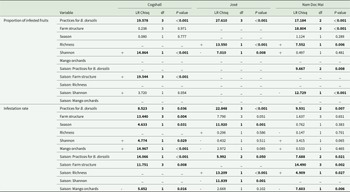
The proportion of infested fruit was significantly related to the landscape diversity: The Shannon diversity index had a significant and positive effect on the proportion of infested fruits for the Cogshall variety ( $\chi _2^2$ = 14.864, P < 0.001) and a significant negative effect for José Variety ( $\chi _1^2$ = 7.01, P = 0.008). The Richness index was positively related to the proportion of infested fruits for the José variety ( $\chi _1^2$ = 13.55, P < 0.001). The proportion of infested fruits was not significantly related to the quantity of orchards within the 500 m buffer area for all tested varieties (Table 3).
Generalised linear effects (GLM) model tables of the proportion of infested fruits (binomial, link = ‘logit’) and infestation rate (Gamma, link = log) according to the typology of farms (farm structure, practice for B. dorsalis), the landscape structure in a 500 m buffer (mango orchards, Shannon index and richness), the fruiting season (2020–2021 or 2021–2022) and the interaction between factors (only variables selected after stepwise model selection were represented)

_: variable removed of the model after stepwise model selection.
- or +: negative or positive estimate for quantitative variables.
Bold: significant parameter (P value < 0.05).
The practices for B. dorsalis management had a significant effect on the proportion of infested fruits for Cogshall ( $\chi _3^2$ = 19.578, P < 0.001), José ( $\chi _3^2$ = 27.607, P < 0.001) and Nam Doc Mai ( $\chi _3^2$ = 17.184, P < 0.001) varieties (Table 3, Fig. 3A). The farms of group 1 had a significantly lower proportion of infested fruits than farms of group 2 for Cogshall variety (z ratio = −3.470, P = 0.003), and than farms of group 3 for José variety (z ratio = −3.480, P = 0.003). For the Nam Doc Mai variety, there was an interaction between the fruiting season and the practices for B. dorsalis management ( $\chi _2^2$ = 9.667, P = 0.008) and the farms of group 1 had a significantly lower proportion of infested fruits than farms of group 3 only for the fruiting season 1 (z ratio = −3.610, P = 0.001) (Fig. 3A).
The farm structure had a significant effect on the proportion of infested fruits for the Nam Doc Mai varieties ( $\chi _3^2$ = 18.804, P < 0.001, Table 3, Fig. 3B): Farms of group C had a significantly lower proportion of infested fruits than the farms of group A (z ratio = – 2.668, P = 0.038) and B (z ratio = −3.089, P = 0.011).
Proportion of infested fruits (A, B) and infestation rate (flies/kg; C, D) for each mango variety according to farm typology: (A and C) practices for B. dorsalis management and (B and D) farm structure. Value is mean ± 1.96 standard error. Different letters indicate significant differences among tested conditions for each mango variety and each fruiting season. When there was significant interaction between the factors and the fruiting season, we differentiated the fruit seasons as follows: season 1 (2020–2021, solid lines, lower case letter) and season 2 (2021–2022, dashed lines, upper case letter). N.D.M: Nam Doc Mai variety.

Infestation rate
Landscape context had a significant effect on the infestation rate (number of flies per kg of fruit) only for the Cogshall variety. The Shannon index ( $\chi _1^2$ = 4.774, P = 0.029) and the quantity of orchards in the 500 m buffer ( $\chi _1^2$ = 14.967, P < 0.001) had a significant and positive effect on the infestation rate (Table 3). There was an interaction between the fruiting season and the quantity of orchards in the 500 m buffer ( $\chi _1^2$ = 5.852, P = 0.016). Increasing the quantity of orchards has the effect of increasing the infestation rate in season 1, while slightly decreasing the infestation rate in season 2.
The practices for B. dorsalis management had a significant effect on the infestation rate for all mango varieties (Cogshall:  $\chi _3^2$ = 8.523, P = 0.036; José: $\chi _3^2$ = 22.848, P < 0.001; Nam Doc Mai: $\chi _3^2$ = 9.931, P = 0.007). There were also significant interactions of the fruiting season with practices for B. dorsalis management for Cogshall ( $\chi _2^2$ = 14.066, P < 0.001), José ( $\chi _2^2$ = 5.992, P = 0.050) and Nam Doc Mai varieties: ( $\chi _2^2$ = 7.688, P = 0.021). For Cogshall, the infestation rate was significantly higher in group 2 than in group 1 during the first season (t = 2.660, P = 0.045), and group 2 was significantly higher than group 3 during the second fruiting season (t = 3.220, P = 0.002). For the José variety, the infestation rate was significantly higher in groups 1 and 3 than in group 2 (t = 3.580, P = 0.001; t = 4.600, P < 0.001, respectively). For the Nam Doc Mai variety, the infestation rate was significantly higher in group 2 than group 1 (t = 3.580, P = 0.001) and group 3 (t = 4.600, P < 0.001) only during the second fruiting season. The farm structure had a significant effect on the infestation rate of the Cogshall varieties ( $\chi _3^2$ = 13.440, P = 0.004) with a significant interaction between the farm structure and the fruiting season ( $\chi _3^2$ = 11.751, P = 0.008). Infestation rate was significantly lower in group A than group B (t = 2.770, P = 0.033) during the first season and was significantly lower in group A than group B (t = 3.750, P = 0.002), C (t = 2.900, P = 0.023), and D (t = 3.210, P = 0.009) during the second fruiting season.
Mango varieties
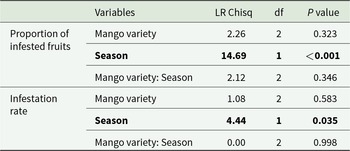
The proportion of infested fruits and infestation rate were not significantly different among mango varieties ( $\chi _2^2$ = 2.26, P = 0.323 and $\chi _2^2$ = 1.08, P = 0.583, respectively; Table 4).
Generalised linear effects (GLM) model tables of the proportion of infested fruits (binomial, link = ‘logit’) and infestation rate (Gamma, link = log) according to the mango varieties and fruiting for August, September, November, December 2020, and October, November 2021 (periods where data were available for the three varieties)

Discussion
This study demonstrates that the infestation of mangoes by B. dorsalis is influenced by the landscape structure and farmers’ practices within this specific tropical island agroecosystem characterised by relatively small, closely situated crop plots and diverse farming systems. Due to constraints in field availability under similar bioclimatic conditions, our dataset was unbalanced, limiting our ability to test all interactions between farm structure, control practices, landscape use, and mango varieties, factors known to interact and influence pest dynamics in complex ways, as shown in previous studies (Rusch et al., Reference Rusch, Valantin-Morison, Sarthou and Roger-Estrade2010).
Effect of landscape diversity on B. dorsalis infestation
As hypothesised, a correlation was observed between landscape diversity and B. dorsalis infestation. The landscape diversity, approximated by the Shannon and Richness indexes, was correlated with the proportion of infested fruits. For example, we observed that the Shannon diversity index was positively correlated with the proportion of infested fruits for the Cogshall variety, and the Richness index was positively correlated with the proportion of infested fruits for the José and Nam Doc Mai varieties. However, an inconsistent result was obtained, with the proportion of infested fruits exhibiting a negative correlation with the Shannon index for the José mango variety. This suggests that the interaction between diversity, infestation rate and mango varieties is complex and may be subject to variation due to numerous factors. The impact of landscape diversity on natural enemies of pest species has already been investigated across a range of cropping systems and study regions (Bianchi et al., Reference Bianchi, Booij and Tscharntke2006; Chaplin-Kramer et al., Reference Chaplin-Kramer, O’Rourke, Blitzer and Kremen2011; Priyadarshana et al., Reference Priyadarshana, Martin, Sirami, Woodcock, Goodale, Martínez-Núñez, Lee, Pagani-Núñez, Raderschall, Brotons, Rege, Ouin, Tscharntke and Slade2024). A literature review demonstrated that pest pressure was lower in more heterogeneous landscapes in 45% of the studied publications and higher in 15% (Bianchi et al., Reference Bianchi, Booij and Tscharntke2006). However, other studies suggest that increased landscape heterogeneity benefits different taxa, including pest species, by providing favourable resources (reviewed in Priyadarshana et al., Reference Priyadarshana, Martin, Sirami, Woodcock, Goodale, Martínez-Núñez, Lee, Pagani-Núñez, Raderschall, Brotons, Rege, Ouin, Tscharntke and Slade2024). For instance, Santoiemma et al., (Reference Santoiemma, Mori, Tonina and Marini2018) demonstrated that the density of the generalist species Drosophila suzukii is higher in heterogeneous landscapes. In addition, it was already shown that heterogeneity of landscape was positively correlated with the abundance of B. dorsalis (Putri et al., Reference Putri, Rizali and Ikawati2025; Wen et al., Reference Wen, Yang, Huang, Zhang, Zheng, Shen, Yang, Ouyang and Li2023). In the present study, the heterogeneity of the landscape may increase the probability of habitats with host plants around the plots studied, thereby facilitating the maintenance of larger fruit fly populations throughout the year. In particular, the Shannon index was found to be negatively correlated with the proportion of savannah (see Supplemental data S1), which is an unfavourable environment for fruit flies without host fruits for larvae in the area surrounding the study plots.
Effect of the mango orchards prevalence on B. dorsalis infestation
The results of our study did not reveal a specific relation between infestation and the quantity of orchards at landscape scale. The farm structure typology was mainly constructed around the level of crop diversity and the area under mango; thus, it can be considered as an index of mango orchard density on a more local scale. Despite observing a significant effect of the typology on the infestation indexes, the effects varied among different mango varieties, with no discernible trend. In addition, at the landscape scale, the proportion of infested fruits was not significantly related to the quantity of orchards (mainly mango orchards) in the 500-buffer area for all the tested varieties. Thus, the diversity of the landscape was not systematically impacted by an increase in the quantity of orchards in the landscape. It is generally accepted that, because crops provide habitats for pests, a positive relationship is expected between the abundance of pests in the field and the area of cultivated land at a landscape scale (Fahrig, Reference Fahrig2003). Bactrocera dorsalis, a generalist species, has been observed to be particularly prevalent in mango orchards (Grechi et al., Reference Grechi, Preterre, Lardenois and Ratnadass2022). Our results may be due to the high diversity in the agroecological model system. The study area is notable for the absence of strict monocultures, and other host plants may be present in and around the mango orchards, including lychee trees, pomegranate trees, soursop trees, or jujube trees. The quantity of mango orchards in the 500-buffer was correlated with the quantity of hedgerow and was not negatively correlated to the Shannon or richness index (Supplemental data S1). In addition, responses to landscape structure and composition are scale-dependent (Chaplin-Kramer et al., Reference Chaplin-Kramer, O’Rourke, Blitzer and Kremen2011; Priyadarshana et al., Reference Priyadarshana, Martin, Sirami, Woodcock, Goodale, Martínez-Núñez, Lee, Pagani-Núñez, Raderschall, Brotons, Rege, Ouin, Tscharntke and Slade2024). It is possible that the scale at which we conducted our measurements was not the most predictive for this insect species. However, in our study, the chosen scale of study reflects the smaller size of production areas (in this case, mango production) in insular environments compared to continental environments. Furthermore, it has been shown for B. dorsalis that the direction and strength of the relationships between landscape variables and its abundance did not change with spatial distance (from 0.5 to 1.5 km, Wen et al., Reference Wen, Yang, Huang, Zhang, Zheng, Shen, Yang, Ouyang and Li2023).
Effect of agricultural practices on B. dorsalis infestation
The findings of this study demonstrate a correlation between the practices of individual farmers and the proportion of infested fruits. Crop protection strategies can impact pest populations directly or indirectly by modifying natural enemy communities (Marliac et al., Reference Marliac, Penvern, Barbier, Lescourret and Capowiez2015). We observed a significant effect of the practices against B. dorsalis on the proportion of infested fruits and the infestation rate. It is particularly noteworthy to note that individual practices influenced infestation rates despite the landscape context, the proximity and different practices between farms. However, the limited number of replicates in each category does not allow us to identify precisely which practices should be favoured. However, among practice, sanitation is now recognised as the basis of all effective integrated pest management (IPM) to control fruit fly (Ekesi et al., Reference Ekesi, Mohamed and De Meyer2016; Vargas et al., Reference Vargas, Piñero, Leblanc, Manoukis, Mau, Sunday, Mohamed Samira and Marc2016; Verghese et al., Reference Verghese, Sreedevi and Nagaraju2006). The collection and removal of all discarded fruits from the trees and the ground has been shown to have a significant impact on the population dynamics of fruit flies, through the disruption of their lifecycle (Liquido, Reference Liquido1993). In our study, the farms of groups 1 and 2, which prioritise orchard sanitation over mass trapping and chemical treatments, exhibited a lower proportion of infested fruits compared to farms in group 3 for José and Nam Doc Mai varieties. We have focused our work on the sanitation of young fruit that has fallen to the ground. This fruit is susceptible to infestation by fruit flies (Amin, Reference Amin2017), yet is less frequently removed by farmers. Farmers who initiate fruit removal at the abscission stage tend to engage in this orchard sanitation throughout the fruiting season.
Mango varieties
We observed no significant difference in infestation between the three mango varieties when comparing fruits collected during the same period. However, the landscape diversity and composition, and farm typology had different effects on the level of fruit fly infestation according to mango variety. These results could be attributed to the fruiting period of the studied varieties. Cogshall is an early variety, Nam Doc Mai is more of a seasonal variety, and José has an irregular fruiting period (Jessu et al., Reference Jessu, Sinatamby and Normand2017). Due to their differing phenology, varieties may be subject to different climatic conditions and biological phenomena. The mango fruiting period provides abundant food resources for fruit flies, which, when combined with favourable weather conditions, leads to an outbreak of fruit fly populations (Bota et al., Reference Bota, Fabião, Virgilio, Mwatawala, Canhanga, Cugala and De Meyer2018; Motswagole et al., Reference Motswagole, Gotcha and Nyamukondiwa2019). At the onset of the fruiting season, the detection and subsequent colonisation of orchards within the agroecosystem is determinant and is probably influenced by the landscape structure (Singh and Satyanarayana, Reference Singh, Satyanarayana, Rajinder and Dhawan Ashok2009). During peak outbreaks, insect dispersal is shorter, and the high reproduction rate, facilitated by the availability of resources, leads to increased populations (Singh and Satyanarayana, Reference Singh, Satyanarayana, Rajinder and Dhawan Ashok2009).
Conclusion
Despite the constrained dataset, we were able to demonstrate that the infestation rates of B. dorsalis in mango orchards were influenced by both landscape and crop management factors in the case of a specific tropical island agroecosystem with small orchards in a diversified landscape. On a landscape scale, B. dorsalis was favoured by habitat diversity, which probably provided complementary larval food resources and enabled populations to be maintained throughout the year. On a local scale, despite disparate farming systems and the interaction of distinct habitat patches, individual farmers’ practices influenced infestation indexes. The proportion of infested fruits was lower in plots managed by farmers who prioritise monitoring and sanitation. It would be interesting to see, in an AW-IPM context, whether the application of these practices by a group of neighbouring farmers could increase the effectiveness of B. dorsalis control at a larger scale.
Supplementary material
The supplementary material for this article can be found at https://doi.org/10.1017/S0007485325100618.
Acknowledgements
The authors would like to thank the Chamber of Agriculture of La Réunion for facilitating contact with the farmers and farmers who participated in the surveys and consented to the collection of samples on their plots.
Financial support
This study was co-financed by CIRAD, the ‘Conseil Régional de La Réunion’, European Union, the French State, and the Réunion Region. Europe is committed to Réunion through the EAFRD (the European Agricultural Fund for Rural Development, REU77071-1-000011) and ERDF (the European Regional Development Fund, 2024-1248-005756). This study is part of GEMDOTIS projects (ODEADOM, ECOPHYTO 2).
Competing interests
The authors have no conflict of interest to declare.
Data availability statement
Data will be available on Cirad dataverse: https://dataverse.cirad.fr/
Ethics approval statement
The data were collected, analysed, and published with the agreement of the farmers concerned.





 Open access

