

Introduction
Transnational drug trafficking has profound consequences for politics throughout the world: from the heroin and methamphetamine trade fueling the consolidation of rebel governance in rural Myanmar [Brenner Reference Brenner2019; Meehan Reference Meehan2011; Winn Reference Winn2024], to Captagon production and trafficking in Sudan financing the Rapid Support Forces’ military campaignFootnote 1, to state power being used by political leaders and military officials to transform Guinea-Bissau into a trafficking hub for cocaine [Shaw Reference Shaw2015; UNODC 2013; Van Riper Reference Van Riper Stephen2014], to drug money being used to sway elections in countries including Colombia [Masullo and Steele Reference Masullo and Steele2025],Footnote 2 Mexico [Huerta Reference Huerta2020; Ponce Reference Ponce2018; Trejo and Ley Reference Trejo and Ley2020], and now Ecuador [ACLED 2025; Felbab-Brown and Paz García Reference Felbab-Brown and García2025]Footnote 3. The illicit drug trade has left deep marks on political processes and institutions across a wide array of contexts. And yet, while the potential for illegal drug trafficking to influence politics is self-evident, the rationale for why this is the case is not always clear.
In this article, we focus on key actors in the trade of illegal drugs—transnational drug-trafficking organizations (TDTOs)—and provide an analytical framework to explain how these illicit economic actors influence politics. We argue that TDTOs do so largely inadvertently, as an indirect consequence of their efforts to mitigate risk. Indeed, TDTOs face enormous risks in undertaking their activities. As they operate outside the legal order underwritten by the state, their exposure to threats is far greater than that confronted by conventional firms. Besides the loss of capital investments, actors involved in the illegal drugs trade risk being killed, imprisoned for life, and having their entire fortunes expropriated. Consequently, TDTOs have far greater need to mitigate risk than do legitimate firms. We argue that when TDTOs invest in protection to mitigate risk, this can have multiple secondary consequences for politics, consequences that are often unforeseen by traffickers.
To foreshadow our framework, when TDTOs invest in protection, they can, first, determine who is able to access political power in society. When investing in State Protection, TDTOs can influence the processes of democratic selection and institutional appointment; when investing in Nonstate Protection, they do so by empowering territorial armed nonstate actors. The selective allocation of TDTO resources can therefore empower some state and nonstate actors over others, influencing who “calls the shots” in society.
Second, having influenced who accesses political power, TDTO investments in protection can affect how this power is exercised, effectively reconfiguring the institutions used to govern society. We do not provide an exhaustive list of all the possible ways in which TDTOs and their resources can ultimately shape governance, but instead focus on a handful of salient examples, identified inductively from recent history. Where TDTOs invest in State Protection, a semi-patrimonial logic can become entrenched in the state itself, as systemic corruption takes root. Moreover, the use of violence for private ends can also become widespread. In cases of Nonstate Protection, TDTO financing can enable armed actors to impose oligopolies of coercion, creating institutions of governance that overlap and merge with those of the state [Duncan Reference Duncan2014]. The argument presented here is designed as a descriptive exercise for the purposes of theory-building, rather than being causally deterministic: it is not the case that the outcomes we outline will arise if and when TDTOs invest in protection. Rather, our purpose here is to elucidate how the pursuit of protection by traffickers can influence politics, and describe some of the possible ways in which this can manifest.
For obvious reasons, the outcomes we describe are far more likely in the lower-capacity states of the developing world. We therefore acknowledge from the outset that the types of risk-mitigation strategies chosen by TDTOs (secrecy/protection), as well as the extent to which they influence politics, are to some extent endogenous to the broader political environment in which TDTOs operate. Indeed, states in the developing world are especially susceptible to the political influence of the drug trade given the relative importance that this criminalized industry can acquire in their economies. As Feldmann and Luna note, while the drug trade may only represent a small proportion of an economy in absolute terms, in contexts where the “weight of illicit industries is relatively greater, the role of criminal politics rises” [2023: 15].
Moreover, as the reader will see throughout what follows, the political effects of TDTO investment in protection are most acute at the subnational level. While TDTOs can influence politics at higher levels of analysis, their resources tend to be far more influential in localized settings, giving them an outsized ability to shape local politics. Indeed, while drug trafficking—alongside other forms of cross-border organized crime—is fundamentally a transnational phenomenon, its consequences are above all experienced in localized settings [see UNODC].Footnote 4
With this in mind, this article offers new insights for the fast-growing literature on organized crime and criminal governance. The nexus between organized crime, politics, and governance has been the focus of increasing attention over the last decade. Numerous studies have examined the phenomenon of “gang rule”, particularly in micro-level urban settings [Arias Reference Arias Enrique2017; Barnes Reference Barnes2021, Reference Barnes2025; Blattman et al. Reference Blattman, Duncan, Lessing and Tobón2025; Campana, Varese and Meneghini Reference Campana, Varese and Meneghini2025; Lessing Reference Lessing2021; Varese and Zeng Reference Varese and Zeng2024], though important research has also underscored how illicit industries interact with rural systems of nonstate order [Arjona Reference Arjona2016; Idler Reference Idler2019]. More recently, scholars have shown how organized criminal groups can effectively capture subnational governments, as exemplified by Trejo and Ley’s [Reference Trejo and Ley2020] work on “subnational criminal governance regimes”. Our article seeks to complement this literature by explaining the ways in which TDTOs interact with state and nonstate actors, and by elucidating the ramifications (whether intended or not) of these interactions. The risk-mitigation needs of TDTOs, in conjunction with the vast wealth they command, produce particular varieties of politics in developing states that remain underacknowledged in extant studies focused on armed nonstate (chiefly gang and rebel) orders. As we underscore, self-interested investments in protection by TDTOs ultimately shape political ecosystems in which new and perverse processes for acquiring and exercising power arise.
We begin this article by contextualizing TDTOs and discussing the different risk-mitigation strategies that they pursue. We then focus on a particular risk-mitigation strategy adopted by these organizations, investment in protection, and discuss the political consequences this can entail. Lastly, we provide empirical evidence to illustrate the application of our framework. The evidence we use is chiefly drawn from the Colombian city of Medellín. Given its notorious history as a drug-trafficking center, Medellín presents an ideal plausibility probe with which to explore the distinct ways that TDTO investments in protection can influence politics.
TDTOs and Risk Mitigation
The Business of Transnational Drug Trafficking
While estimates vary, the global trade in illegal drugs is calculated to be worth hundreds of billions of dollars [UN 1997]. Heroin is trafficked west from Afghanistan and Southeast Asia’s Golden Triangle [Chalk Reference Chalk2000; Chin Reference Chin2009; Greenfield, Pardo and Taylor Reference Greenfield, Pardo and Taylor2021; Chin and Zhang Reference Chin Ko and Zhang2015], synthetic drugs are manufactured and distributed throughout Asia, Europe, and the Middle East [Steenkamp Reference Steenkamp2025; Tops et al. Reference Tops, Valkenhoef, Torre and Spijk2018; Wang and Lassi Reference Wang and Lassi2023], and cocaine is transported in vast (and growing) quantities northward from rural Andean production sites to the United States, and westwards to Europe via Africa [Arias and Grisaffi Reference Arias Enrique and Grisaffi2021; Gootenberg Reference Gootenberg2008; Lien and Feltran Reference Lien and Feltran2025]. Lucrative illicit supply chains therefore connect the global north and south, enriching different (criminal) actors and organizations between the point of production and consumption. As organizations dedicated to trade activities (rather than the production of illicit goods, or the governance of illegal markets),Footnote 5 TDTOs are pivotal actors in these supply chains.
However, TDTOs face significant threats, especially given that their trafficking activities necessarily involve passing through territories controlled by both (hostile) state and nonstate actors. Whether police, military, mafias, warlords, or rebels, any number of coercive actors can threaten both the business interests and survival of TDTOs, killing or detaining their members and shutting down or appropriating their economic activities. As organizations principally dedicated to trade, TDTOs are especially vulnerable as they lack recourse to coercion, unlike other organized criminal groups (OCGs) such as gangs or mafias, whose existence is predicated on their ability to inflict violence.
Still, the high risks associated with drug trafficking also add considerable value to the industry. Consider the vast difference between the costs of production for many illicit drugs and their market price: in 2019, for example, a kilo of cocaine in Colombia cost around $1500 USD wholesale (though much less for the base product), increasing to just under $12,500 in Mexico, and circa $69,000 in the United States.Footnote 6
TDTOs therefore operate in an extremely high-risk environment—facing the continuous threat of legal punishment and/or extralegal predation—though this very risk augments the added value of the goods they traffic, enabling them to reap enormous profits. These profits can in turn provide a means of mitigating risk, as we now discuss.
Mitigating Risk: Secrecy, State Protection, Nonstate Protection
TDTOs employ an array of different measures to mitigate the manifold risks they face. Firstly, trafficking groups can adopt flexible structures that allow them to limit the damage that law enforcement is able to inflict. Rather than operating as highly institutionalized “cartels”, trafficking networks are often now composed of dynamic and adaptable associations and partnerships that form around business transactions [Calderoni Reference Calderoni2012; Lien and Feltran Reference Lien and Feltran2025]. This “chain” networked approach ensures that the detention of any single member is unlikely to develop into a wider threat against the TDTO itself [Kenney Reference Kenney2007].
Moreover, while TDTOs do face threats from their competitors, coordination between these organizations routinely occurs. Thus, although much of the literature on organized crime-related violence and criminal governance has shown how OCG competition can dramatically exacerbate conflict [Arias Reference Arias Enrique2017; Barnes Reference Barnes2021; Durán-Martínez Reference Durán-Martínez2018; Moncada Reference Moncada2016],Footnote 7 peaceful collaboration between criminal enterprises also takes place. Criminal actors involved in drug trafficking appear to be especially skillful in this regard, collaborating to ensure mutual profitability; indeed, “drug trafficking has an apparent, strong, structuring effect on cooperation among OCGs” [Campana and Giovannetti Reference Campana and Giovannetti2025: 6]. The rapid expansion of the Primeiro Comando da Capital’s (PCC) trafficking network across South America and beyond in recent years illustrates this point. The organization’s success in this regard has been underpinned by its willingness to strike bargains and accommodations with other criminal groups [Feltran, Vianna Pinho and Bird Ruiz-Benitez de Lugo Reference Feltran, Pinho and de Lugo2023: 11]. Footnote 8 Indeed, criminal organizations can develop diverse mechanisms for ensuring credible commitments in business transactions, including information-sharing [Campana and Varese Reference Campana and Varese2013], and they can also maximize intergroup trust (and thus mitigate risk) by collaborating with groups known to their existing partners [Campana and Giovannetti Reference Campana and Giovannetti2025: 7].
Nonetheless, while recognizing that TDTOs can adopt flexible structures, and that they can coexist and collaborate with would-be rivals, it is important to bear in mind that these groups still face significant threats. Scholars have identified OCGs as responding to threats by: (1) hiding and employing secrecy to avoid prosecution; (2) forming corrupt linkages with officials to shield their operations; and 3) using violence strategically to resist attacks or “bargain” with hostile actors [Bailey and Taylor Reference Bailey and Taylor2009; Barnes Reference Barnes2017; LeoGrande and Kurten Reference LeoGrande and Kurten2022]. While TDTOs, as a subtype of OCGs, do not rely on this array of responses in precisely the same way as other criminal groups, considering these possibilities nonetheless provides us with key insights into how trafficking organizations mitigate risk.
To begin with Secrecy, the reason why actors dealing in illegal commodities seek to evade detection is self-evident. Indeed, the centrality of Secrecy in many organized criminal conspiracies is well documented [Gambetta Reference Gambetta1993; Varese Reference Varese2018]. Thus, OCGs that face threats have strong incentives to conceal their activities and minimize attention. Of course, certain criminal groups rely on notoriety, and thus operate openly, such as urban territorial gangs (e.g., the Comando Vermelho in Rio de Janeiro). Nonetheless, as Bailey and Taylor summarize “It is commonplace to imagine evasion as the overarching tactical objective for organized crime” [2009: 10]. This is especially so for TDTOs, who employ it as a core risk-mitigation strategy. TDTOs can ensure secrecy by concealing drugs in cargo shipments, transporting them across borders using secret airstrips and tunnels, or even using homemade semi-submersibles and small- to medium-sized recreational vessels to navigate the open ocean. They also transport drugs clandestinely and in small quantities, only aggregating them once they have reached their destination: individual drug shipments in these instances are more likely to go unnoticed, and their detection and seizure would only represent minor losses. The adaptability of TDTOs, and their innovative efforts to maintain Secrecy, have been key in enabling these groups to develop sophisticated, transnational logistics infrastructure while evading increased state detection efforts [Lien and Feltran Reference Lien and Feltran2025].
Still, Secrecy and evasion are often rendered impossible: “advertisement of illicit products, routine government inspections, ostensive policing, or even a dissatisfied member of a criminal organization may alert the state to potential malfeasance” [Bailey and Taylor Reference Bailey and Taylor2009: 10]. As such, criminal actors rarely rely on Secrecy alone: only certain organized criminal markets can do so, such as dark-web traders in illicit goods. Indeed, OCGs also routinely use corruption to safeguard their interests in conjunction with hiding their activities [Barnes Reference Barnes2017: 975].
Establishing ties with state officials ensures the smooth functioning of illegal markets by helping “neutralize” state oversight, making corruption one of the most important characteristics of organized crime [Del Pilar, Luján and Ponce Reference Del Pilar Fuerte, María and Ponce2019: 190]. In fact, maintaining corrupt ties with the state is so integral to the survival of OCGs that Trejo and Ley reason that it is “ontologically constitutive of organized crime” [2020: 83]. TDTOs are no different in this regard, and routinely channel resources toward state actors, using corrupt payoffs to ensure collaboration, diminished oversight, and selective law enforcement. We term this risk-mitigation strategy State Protection.
OCGs’ propensity for violence has long been recognized by scholars. Varese claims that OCGs require certain resources, the “most crucial of [which] is violence” [2017: 45], and indeed OCGs have been shown to use violence as a bargaining mechanism [Lessing Reference Lessing2018], deployed against the state to secure concessions (e.g., diminished repression, favorable policy changes). Nonetheless, as we have underscored, TDTOs generally lack recourse to coercion. Thus, unlike other OCGs, they only rarely use violence to mitigate risk. However, TDTOs can use their wealth to finance armed nonstate actors, effectively contracting these groups to carry out violent acts on their behalf. We classify this risk-mitigation strategy, whereby TDTOs outsource coercion, as Nonstate Protection.
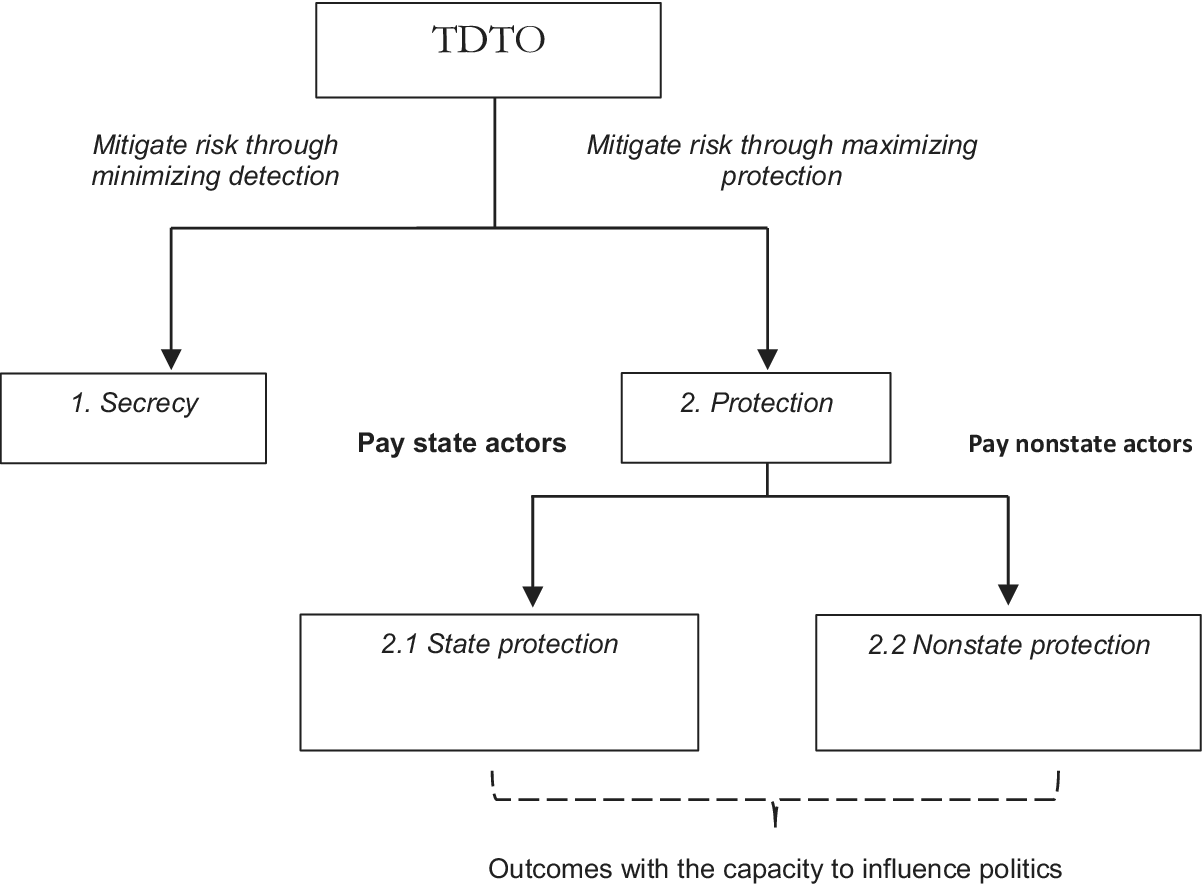
Figure 1 draws together the abovementioned points to show the risk-mitigation strategies that TDTOs can pursue. TDTOs can choose to minimize detection, the strategy of Secrecy. Or, alternatively, they can invest in maximizing protection, pursuing State Protection or Nonstate Protection. While Secrecy is generally politically neutral, both of these forms of protection have the potential to influence politics in important ways, as indicated above; this will be elaborated on in the next section. To be clear, the strategies of Secrecy, State Protection, and Nonstate Protection are not necessarily mutually exclusive, and in fact TDTOs can utilize all three. Indeed, we can expect to see TDTOs employing a distinct combination of these strategies to suit their needs, particularly across time and geographical space.
TDTO Risk-Mitigation Strategies

Figure 1 Long description
A flowchart organized into three vertical levels.
At the top is a central box labeled TDT O.
From the TDTO box, a line branches into two paths.
- The left path is labeled Mitigate risk through minimizing detection and points down to a box numbered 1. Secrecy.
- The right path is labeled Mitigate risk through maximizing protection and points down to a box numbered 2. Protection.
Below the 2. Protection box, the diagram branches again into two sub-categories.
- To the left, the text Pay state actors sits above an arrow pointing to box 2.1 State protection.
- To the right, the text Pay nonstate actors sits above an arrow pointing to box 2.2 Nonstate protection.
At the bottom, a dashed bracket spans across the base of both the 2.1 State protection and 2.2 Nonstate protection boxes. Below this bracket is the concluding text: Outcomes with the capacity to influence politics.
Note that in enlisting State Protection or Nonstate Protection, TDTOs generally remain separate from the actors who protect them: protection services are effectively contracted out, similar to how legitimate businesses pay for security. However, in some instances, high levels of integration occur between TDTOs and their protectors. Where states are actively involved in promoting the trade in illegal drugs, we might describe them as “narco-states”—a label that has been applied in contexts as diverse as North Korea [Kan, Bechtol and Collins Reference Kan Paul, Bechtol and Collins2010], Guinea-Bissau [Shaw Reference Shaw2015; Van Riper Reference Van Riper Stephen2014],Footnote 9 Ba’athist Syria,Footnote 10 and Myanmar [Winn Reference Winn2024]—or as exhibiting “state-sponsored protection rackets”, as in the case of PRI-era Mexico [Snyder and Durán-Martínez Reference Snyder and Durán-Martínez2009]. By contrast, we can characterize situations of narco-militarization as having arisen when TDTOs arm themselves directly, or when armed nonstate actors appropriate a TDTO’s business. Situations of this sort have arisen in many subnational locales in contemporary Mexico [see Trejo and Ley Reference Trejo and Ley2020]. We raise these possibilities here, but do not consider them further, given that their political consequences (the main focus of this paper) might differ in degree but not necessarily in kind from those of State Protection and Nonstate Protection. Moreover, given that organized criminal groups tend toward specialization [Varese Reference Varese2001], it makes analytical sense to consider TDTOs, other OCGs, and the state as separate entities here, rather than focus on instances in which they are highly integrated.
The Political Consequences of Investing in Protection
Before discussing how the pursuit of risk mitigation by TDTOs influences politics, we must first clarify how we understand “the political”. From a statist perspective, TDTOs can be considered inherently political, given their systematic efforts to facilitate criminalized, cross-border trade, exploit the infrastructure of legitimate commerce for illicit purposes, and accumulate significant wealth through illegal economic activities. Nonetheless, for the purposes of this article, we adopt a narrower definition of politics, tying “politics” and “the political” to the exercise of power and the production of governance. Footnote 11 Thus, we firstly understand TDTOs’ actions to be political insofar as they affect the distribution of decision-making power in society: where TDTOs’ investments in protection determine who has the de facto authority to “call the shots”, implement decisions, and enforce compliance with their mandates, they become politically consequential. Secondly, TDTOs’ actions take on an unequivocally political dimension when they influence how those with authority exercise their decision-making power. Put differently, TDTOs are also capable of influencing politics when they shape the formal and informal institutions of governance used to uphold social order.
Following this rationale, the pursuit of Secrecy by TDTOs can generally be considered politically negligible: in adopting measures to ensure that illicit goods remain undetected, TDTOs usually generate no direct or indirect political consequences, in the sense we use here. Similarly, where TDTOs invest in protection, the results may also be effectively apolitical. For instance, a drug-trafficking organization may pay port authorities to ensure that illegal cargo goes uninspected. In this low-level example of State Protection, illegal merchandise is protected, since its passage through the port is not kept a secret from state agents, but the broader political repercussions of this protection are minimal.
Still, TDTO investments in protection can rapidly acquire an explicitly political dimension. To adapt the language of Misse [Reference Misse2007, Reference Misse2018], the sale of protection by both state and nonstate actors can be considered an exchange of “political merchandise”; selective enforcement and preferential treatment are provided to TDTOs in exchange for their resources, which in turn enable providers of protection to strengthen their own positions vis-à-vis those of their competitors. Where TDTOs finance electoral campaigns or fund armed nonstate groups, they begin to influence who is able to access and exercise decision-making power, helping elevate some actors over others, and thus shaping which of them are able to acquire positions of authority in society. Moreover, by channeling their resources selectively to state or nonstate actors for protection, TDTOs can also provide their protectors with new incentives. This has knock-on effects on how these actors then wield their power and govern society. We elaborate further below.
Who Governs? Protection Influencing Access to Power
To reiterate, TDTO financing can tip the playing field in favor of some (state and nonstate) actors and against others, allowing those with illicit financing to consolidate positions of decision-making authority over their competitors. This applies equally to both democratic competition within the state and violent competition between armed nonstate groups.
Influencing Access to Power Within the State
In democratic systems, TDTOs can influence the ascent of both elected politicians and unelected state agents—those actors who are generally accepted as the legitimate authorities within the state and by society. Politicians create laws and make policy decisions, while state agents are charged with implementing these decisions and upholding these laws. Relevant state agents include police, military, and judicial officials—functionaries charged with enforcing the rule of law and ensuring order is maintained—as well as a host of other possible actors (e.g., bureaucrats involved in regulating and facilitating transportation and commerce [see Feldmann and Luna Reference Feldmann and Luna2023]).
One crucial avenue through which TDTOs affect these outcomes is that of channeling their resources into elections. Campaign finance is provided to politicians in exchange for protection. If a TDTO’s financial support influences the outcome of an election, then its investment in protection has a very direct political consequence. However, this can also entail secondary effects, as elected politicians who are paid off by TDTOs are then able to influence the appointment of (unelected) state agents. TDTOs can also pay for protection by striking bargains directly with unelected state agents—the rampant corruption of the military by drug traffickers in VenezuelaFootnote 12 and Guinea-Bissau [Bird Reference Bird2022] illustrates this trend.
Again, while not all payments to state agents can be considered politically consequential per se, when TDTOs pay off high-ranking state functionaries who influence internal appointment processes, they can shape who gains access to positions of power within the state. One such example is the network of senior federal police officers working under General Genaro García Luna, Mexico’s Secretary of Public Security from 2006 to 2012. For years, these high-ranking officials conspired to facilitate the activities and expansion of the Sinaloa Cartel [Golden 2023].Footnote 13 Another example is the case of Colombian police general Danilo González, who used his power over the national police, including its internal appointments and assignments, to help numerous actors throughout Colombia’s criminal underworld in the 1990s and early 2000s.Footnote 14
Still, we should be careful not to overstate the direct ability of TDTOs to influence who accesses power within the state. Even if TDTOs invest vast resources in financing political campaigns, this does not mean that elected officials owe their victories solely to these groups. For example, during the Colombian elections of 1994, the presidential campaign of Ernesto Samper received multi-million-dollar payments from the Cali Cartel, which could have contributed to his slim election victory. Still, Samper had widespread backing from other sectors of society, including many legal business interests: he was by no means beholden solely to the interests of this TDTO.
Indeed, TDTOs tend to be most influential in determining who accesses political power at the subnational level. These are the spaces in which the advantages for candidates with narco-financing are the greatest. There are numerous reasons for this. Firstly, clientelism is rife throughout the developing world, including Latin America, and is especially important in shaping party–voter linkages, and thus influencing elections, in localized settings [Auyero Reference Auyero2000; Szwarcberg Reference Szwarcberg2015]. This feature of electoral contestation favors resource-rich candidates. Moreover, in subnational spaces, the relative weight of narco-trafficking resources can be far greater than that of other, legitimate industries and actors. As such, TDTO financial support can easily outweigh the importance of other sources of campaign financing and political endorsement in determining subnational elections. Thus, where TDTOs choose to invest in State Protection by financing political campaigns, their resources can dramatically shape electoral contests. This can help minimize repression and oversight for TDTOs both in subnational arenas and beyond, as paid-off politicians can project their influence outward (territorially) and upward (hierarchically). The close entanglement of municipal governments with organized crime has become particularly evident in Mexico in recent decades [Trejo and Ley Reference Trejo and Ley2020]Footnote 15, and prior to that in Colombia [López Reference López2012], but is likely widespread across the region, having also been observed in other countries, including Guatemala, Peru,Footnote 16 and increasingly EcuadorFootnote 17. Beyond Latin America, ties between the lowest tier of government and OCGs have been found in Europe, including in Italy [Daniele and Dipoppa Reference Daniele and Dipoppa2017; Di Cataldo and Mastrorocco Reference DiCataldo and Mastrorocco2020] and throughout the Balkans; Africa, such as in South Africa [GITOC 2025a] and Nigeria;Footnote 18 and Asia, both in democratic states like the Philippines [GITOC 2025b] and authoritarian states such as China [Wang and Wang Reference Wang and Wang2025].
Nonetheless, politicians and state agents often renege on protection arrangements. Indeed, these actors have many (competing) interests that go far beyond protecting traffickers. If protecting a TDTO becomes too costly, state actors can be expected to abandon any bargains made for protection. For example, the Albanian security forces’ high-profile crackdown on the cannabis production hub of Lazarat in 2014 is considered to have been prompted by the government’s bid to attain European Union candidacy.Footnote 19 While figures within the Albanian state have long profited from the transnational drug trade and other organized criminal activities [Zhilla and Lamallari Reference Zhilla and Lamallari2016],Footnote 20 when corrupt state–OCG ties became politically salient due to the prospect of EU candidacy, efforts to repress illicit industries intensified. Likewise, President Samper dismantled the Cali Cartel only after the public revelation that the group had financed him, which meant that his association with the TDTO had become politically damaging.
Influencing Access to Power for Nonstate Actors
Territorial armed nonstate actors use coercion to control territories, as well as the markets and populations within them. Investments in Nonstate Protection by TDTOs can dramatically boost the financial capacity of these armed nonstate actors. Such resource injections can then be used to drive recruitment and training and fund armaments, allowing these groups to augment their organizational and coercive capacity. Thus, armed nonstate actors who protect TDTOs are capable of consolidating and expanding their territorial and social control, and are often able to do so more readily than armed nonstate actors who lack these ties to drug trafficking. Once again, then, we find that investments in protection made by TDTOs are capable of advantaging particular (armed nonstate actors) over others, thus influencing who acquires the power to govern segments of society.
A clear example of this is the FARC in Colombia, whose massive territorial expansion in the 1990s went hand in hand with their increasing involvement in cocaine production. By contrast, the ELN—another of Colombia’s insurgencies—at the time made comparatively limited military advances, which can be linked to their prohibition of coca cultivation in their territories and thus their rejection of the drug trade [Celis Reference Celis2019]. Rebel groups in Myanmar also historically benefited from the production and trade of heroin, and then in recent decades crystal meth, to consolidate power in subnational territories [Brenner Reference Brenner2019]Footnote 21. In Ecuador, criminal gangs have increased in notoriety in recent times, both inflicting extreme levels of violence and intervening in politics to an unprecedented extent. This has followed their expanded role in protecting international cocaine trafficking during the last decade.Footnote 22 While distinct in many ways from these other examples, China’s early-20th-century warlords provide a useful analogue: the profits they accrued from protecting the opium trade were key to allowing them to consolidate control and impose order on the provinces to which they laid claim [Slack Reference Slack2001].
Still, just as state actors can renege on their agreements with TDTOs and fail to protect them, so too can armed nonstate actors subvert the protection arrangements they establish with traffickers, and exploit or appropriate their businesses. TDTOs may have access to significant resources, but this does not mean that they are always in a position to determine the terms of their “protection”.
How Is Power Exercised? The Influence of Protection on Governance
Having influenced who can access political power, TDTO investments in protection can also then alter how this power is exercised by shaping the institutions used to govern society. We now outline three different ways in which TDTO protection arrangements can influence governance. While far from exhaustive, the examples we offer here are arguably among the most salient and politically impactful consequences of TDTOs’ investments in protection.
Semi-Patrimonial States
The first effect is applicable only under State Protection arrangements. This is the ascendance—or indeed deepening—of patrimonial practices, through which politicians and state agents flout laws and norms of legitimate conduct in order to concentrate power and capture public rents. The ultimate consequence of this is the institutionalization of corruption and the emergence of kleptocracy within the state. Munck refers to Latin America’s states as “semi-patrimonial”, insofar as their “state agents are willing to act in arbitrary ways at the behest of rulers on occasions but will also at times impose limits on the use of the State by rulers for personal or partisan ends” [Munck Reference Munck2024: 349]. The concept of semi-patrimonialism is useful here, as it is seldom the case that TDTO protection arrangements rid the state entirely of any Weberian rationality (or indeed undermine democratic institutions absolutely). Instead, they further exacerbate patrimonial tendencies within the state, as although the political elites and public officials who protect TDTOs continue to discharge (some of) their official functions, they simultaneously distort state agencies and institutions to facilitate their accumulation of power and personal wealth [see Feldmann and Luna Reference Feldmann and Luna2023].
In extreme cases, senior political elites at the national level have used the power of the state to systematically extract rents from (and facilitate) narco-trafficking. President Noriega of Panama personally negotiated the installation of cocaine laboratories in the jungles of Darien [Lehder Reference Lehder2024]; President Cartes of Paraguay has been accused of ties to the drug trade (his uncle was arrested for trafficking);Footnote 23 and in Honduras, former President Juan Orlando Hernández and his congressman brother have been convicted of drug-trafficking crimes [DOJ 2021].Footnote 24 In Guinea-Bissau, drug trafficking has been facilitated by figures at the highest political level [Bird Reference Bird2022]; there is considerable evidence showing that senior members of the Assad regime were involved in protecting Syria’s Captagon industry;Footnote 25 and the United States has accused high-ranking members of Maduro’s government in Venezuela of profiting from cocaine trafficking [State Department 2025].
Still, cases of this sort, in which political elites at the national level systematically profit from TDTO payments—effectively state-sponsored protection rackets—are rare. What is more common is the consolidation of a class of politicians and state agents beneath the executive, both at the national and the subnational level, who use their offices to support TDTO business interests. Politicians, such as members of congress elected in subnational contests, can influence legislation, senior appointments, and policy decisions. They can become even more effective if they coordinate with other (similarly financed) representatives to form legislative caucuses. Indeed, politicians from subnational dominions can not only work to protect TDTOs within their jurisdictions, but also mediate with national-level state actors. While unelected state agents often lack the leverage to bargain with politicians (though certainly many can, such as those in the military), they are crucial to stifling the implementation of policy and the integrity of the rule of law, and thus to ensuring that the illicit economies from which they profit thrive.
We reiterate that where this patrimonial class of politicians and state agents emerges, the state continues to provide public services, enforce mandates, and in many other ways to function as expected. Nonetheless, all the while, there are extremely high costs to state efficiency and efficacy, with evident impacts on democracy, development, and the provision of public goods. Indeed, thanks to the systemic corruption that TDTO financing helps entrench and reproduce, the logic of state institutions shifts away from the rational goal of facilitating wealth production and providing public goods and toward the patrimonial goal of ensuring private enrichment from a protected illicit economy.
The Institutionalization of Violence for Private Ends
A second consequence is that state actors safeguard their private interests through the use of coercion, effectively institutionalizing the use of violence for private ends. This contrasts with the use of coercion for the public good—in keeping with the Weberian ideal of the state—whereby state agents uphold security and public order. Where State Protection arrangements are in place, the military and police can be employed to act not in accordance with their legal mandates, but rather for the benefit of TDTOs and the political elites who protect them.
Additionally, security forces working for kleptocratic rulers can become tools for repressing political rivals, activists, journalists, and other members of civil society who oppose their interests. In this sense, the state’s coercive apparatus can become a means of inflicting violence for private ends. The discriminatory use of state coercion is far from unheard of across the world, and thus it is by no means solely associated with state–TDTO protection arrangements. Nonetheless, these arrangements can intensify the private use of state violence, as corrupt officials leverage state coercive power to ensure the flourishing of illicit economic activity, from which they directly benefit. Indeed, state–TDTO protection arrangements are predicated on the state’s ability to use violence prejudicially; violence is required to ensure that TDTO businesses survive and expand their market share.Footnote 26
Once more, the effects of this outcome are felt more acutely in subnational spaces, where corrupt officials are far less constrained. Local rulers can employ (state) coercive agents for their capacities in violence and surveillance to safeguard and develop their particular interests, as well as those of the TDTOs that finance them. That diverse elements of the Mexican security forces—from municipal, state, and federal police, as well as the army—have used violence and recourse to state coercion to advance their drug-trafficking interests is well documented [Bowden Reference Bowden2011; Sánchez and Pérez Reference Sánchez Victor and Pérez2017].Footnote 27 State-perpetrated and state-sponsored violence thus become a means for private enrichment and the consolidation of localized power.
Localized Oligopolies of Coercion
Of course, armed nonstate actors already frequently use violence for private ends. However, through providing Nonstate Protection to TDTOs, armed nonstate actors are sometimes able to dramatically escalate their coercive and organizational capacity, and thus consolidate localized oligopolies of coercion. Indeed, while armed nonstate actors generally have a heavily circumscribed influence at the national level, in subnational spaces they can significantly reconfigure the institutions of governance—especially when funded with TDTO resources. In these circumstances, armed nonstate actors use their might to impose systems of governance that are parallel to or intertwined with those of the state, or even capture state institutions outright. Thus, state and nonstate actors arrive at bargains and accommodations that determine how the institutions of subnational governance are distributed and constituted.
Armed nonstate actors with access to TDTO resources can, as we have seen, acquire greater influence and bargaining power vis-à-vis the state. This, in turn, enables them to negotiate which institutions of governance are de facto upheld in a territory, and which actors are responsible for enforcing them. In this sense, armed nonstate actors do not simply use TDTO resources to protect the interests of drug traffickers. Rather, these resources are employed to strengthen their own political power, reshaping subnational politics so that these are in greater alignment with their own particular interests. These can extend far beyond narco-trafficking.
The existence of relatively strong central states in many of the countries in which TDTOs proliferate means that armed nonstate actors generally share political power within subnational territories with state actors; hence we tend to observe the formation of localized oligopolies of coercion,Footnote 28 rather than monopolies. These are upheld through violence, negotiations, and economic exchange, with the result that state actors effectively cede the right to govern segments of society [Duncan Reference Duncan2014]. Power-sharing arrangements of this sort can be unstable and prone to violent renegotiation and collapse. Insofar as they can be sustained, though, these coercive oligopolies represent systems of order in which governance is (precariously) co-produced by both state and armed nonstate actors.
How these systems of order manifest in reality can vary considerably. In Colombia in the late-1990s and early-2000s, some paramilitary groups (heavily financed by narcotraffickers) exercised a strong influence on municipal politics and placed restrictions on residents’ behaviors. In certain cases, these groups even took de facto control of whole municipal governments [Gutiérrez Sanín Reference Gutiérrez Sanín2019, Reference Gutiérrez Sanín2015]. In Michoacan, Mexico, over the last two decades violent OCGs forced local politicians to relinquish control of municipal finances, which these actors then plundered [Le Cour Reference Le Cour2019]. Indeed, de facto “colonization” of entire municipalities has been observed elsewhere throughout Mexico [Trejo and Ley Reference Trejo and Ley2020].
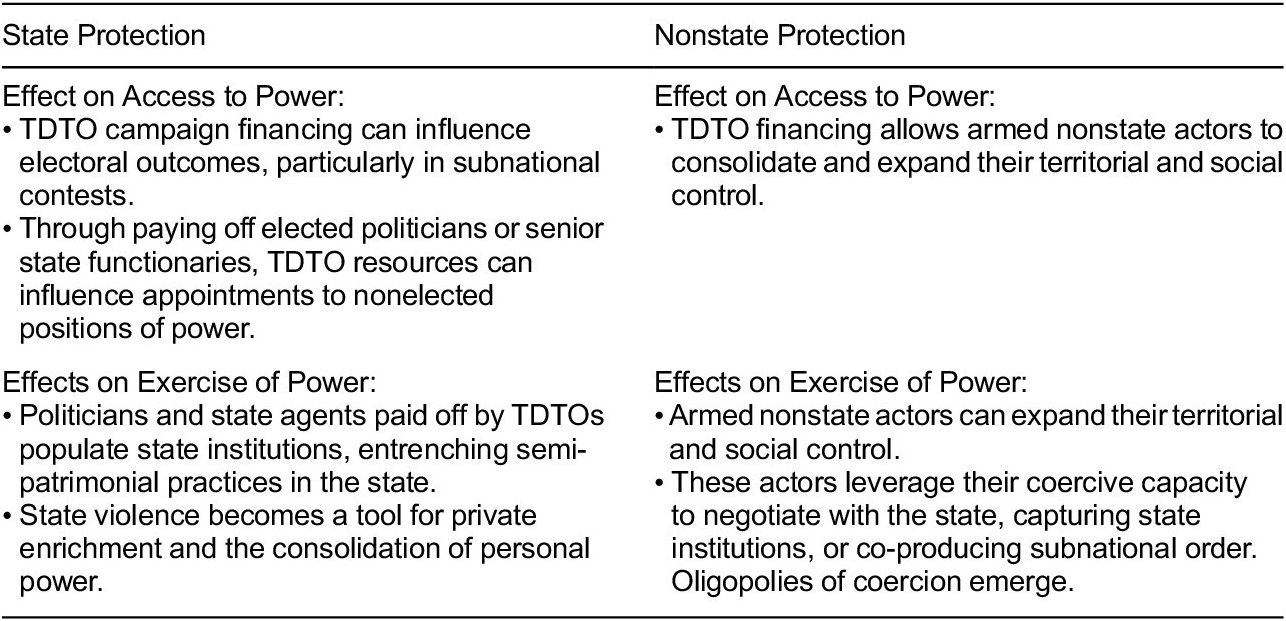
We summarize the discussion from this section in Table 1. This shows the distinct political consequences that can arise from TDTO investments in protection.
Summarizing the Political Consequences of TDTO Protection Arrangements

Table 1 Long description
The table is organized into two columns: State Protection and Nonstate Protection. It compares effects across two categories: Access to Power and Exercise of Power.
1. Effects on Access to Power:
* State Protection: TDTO campaign financing influences electoral outcomes, especially subnationally. Resources are used to pay off elected politicians or senior state functionaries to influence appointments to nonelected positions.
* Nonstate Protection: TDTO financing allows armed nonstate actors to consolidate and expand territorial and social control.
2. Effects on Exercise of Power:
* State Protection: Paid-off politicians and agents populate institutions, entrenching semi-patrimonial practices. State violence is used as a tool for private enrichment and personal power consolidation.
* Nonstate Protection: Armed nonstate actors expand territorial and social control. They leverage coercive capacity to negotiate with the state, capture institutions, or co-produce subnational order, leading to oligopolies of coercion.
The Consequences of Risk Mitigation: Empirical Illustrations from Colombia
We now present empirical evidence to substantiate the real-world relevance of our framework, focusing chiefly on Medellín, Colombia’s “second city”. Medellín has historically been an economic powerhouse in Colombia, and the site of intensive industrialization since the early 20th century. During the latter part of the 20th century, it also attracted the interest of TDTOs. Here, we present a simplified history of the different TDTO risk-mitigation strategies employed in the recent past, and how these have influenced—and continue to influence—politics at the local level and beyond.
In the span of just a few decades, TDTOs operating in the city employed different risk-mitigation strategies, ranging from Secrecy to State Protection and Nonstate Protection. These distinct strategies, in turn, had profound political consequences, shaping who acquired the ability to govern and how governance was constituted, both at the subnational and national levels. Cartel financing exerted a strong influence on elections, local narco-trafficking bankrolled and empowered gangs in the city, and as drug money fueled the rise of paramilitaries, an oligopoly of coercion ultimately emerged in Medellín, which was symptomatic of a wider trend throughout Colombia.
As a case, Medellín represents well-trodden ground in the scholarship on criminal governance [Arias Reference Arias Enrique2017; Blattman et al. Reference Blattman, Duncan, Lessing and Tobón2025; Moncada Reference Moncada2021], organized criminal violence [Durán-Martínez Reference Durán-Martínez2018; Martin Reference Martin2012; Salazar Reference Salazar2017], and drug trafficking [Thoumi Reference Thoumi1994]. Nonetheless, by foregrounding the risk-mitigation strategies adopted by TDTOs across time and charting how their capacity to influence politics evolved as a result, the historical narrative presented here not only illustrates the empirical relevance of our framework, but also underscores the mutability of relations between TDTOs and other OCGs, as well as their shifting relations to the state. Throughout the different stages of this analysis, we see distinct constellations of state–crime interaction, from the integration of TDTO financing into politics, to highly conflictual state–OCG relations following the ascendancy of Pablo Escobar, to more symbiotic collaboration and coexistence under the post-Escobar hegemony of “Don Berna”, a trafficker and paramilitary commander with close ties to elements of the Colombian state. Consequently, while we do not expect other cases to replicate Medellín’s trajectory, insights from the case may prove illuminating in other contexts. Indeed, within-case temporal variation reveals the trade-offs and accommodations that both states and criminal actors can be forced to confront as TDTO risk-mitigation strategies adapt to meet new market opportunities and diminish the dangers posed by new threats.
Data and Case Selection
It was not for its representativeness that Medellín was chosen as the case study to substantiate our framework; the outcomes seen in Medellín should not be considered typical results of TDTO investments in protection. Rather, Medellín represents something of an extreme case, one that exhibits some of the most dramatic political consequences that can arise from TDTO efforts to mitigate risk. Indeed, through showcasing some of the most visible and alarming ways in which protection arrangements can (inadvertently) warp politics, this case enables us to demonstrate the myriad ways in which TDTO resources shape state and nonstate actors’ access to, and exercise of, power.
Moreover, given the extraordinary ways in which the transnational drug trade has shaped the trajectory of Medellín’s politics in recent decades, this case allows us to make use of considerable within-case variation. Indeed, our discussion is divided into subsections, each of which analyzes a distinct period in the evolution of Medellín’s TDTOs, the risk-mitigation strategies they have pursued, and the consequences these have had for the politics of both state and nonstate governance. We are thus able to chart the evolution of local TDTOs’ risk-mitigation strategies, and point to how and why TDTOs have adopted different strategies in response to changing opportunities and constraints. While case-specific, these insights into why Medellín’s TDTOs have varied their risk-mitigation strategies across time may also provide clues into how and why criminal risk-mitigation strategies vary elsewhere.
With this in mind, we should clarify that while the case study of Medellín is presented sequentially, we are not suggesting that other TDTOs will necessarily follow this same sequence, nor that different risk-mitigation strategies cannot be pursued concurrently. Indeed, it is clear that many TDTOs do precisely this, simultaneously combining Secrecy, State Protection, and Nonstate Protection. While it is therefore somewhat case-specific and idiosyncratic that TDTOs in Medellín have only been able to prioritize certain of these strategies at particular moments in recent history, this fact is nonetheless theoretically useful for our purposes, enabling us to isolate with greater clarity how varieties of protection can produce distinct political consequences.
This case study draws on primary source literature, including numerous memoirs and autobiographies by narco-traffickers, as well as NGO reports and contemporaneous newspaper reports from Medellín. Given the wealth of scholarship that has already been published on Medellín, this case study also incorporates analytical insights gleaned from previous studies of the Colombian drug trade and its influence on the city in the late 20th century. Moreover, this paper’s authors have conducted extensive field research on the politics of organized crime in Medellín; therefore this case study is informed by their background knowledge of the subject, as well as the observations and interviews that the researchers carried out individually during their time in the field.
TDTO Secrecy Amid the Proliferation of Criminal Gangs (1970s–1980)
The production and trafficking of cocaine for global markets began in earnest in Medellín in the 1970s. Initially, smugglers—experienced in trafficking cigarettes, alcohol, and other goods—were key to the development of the trade. Many early TDTOs transported relatively modest quantities of cocaine (dozens of kilograms), and as such, risk was mitigated through strategies including concealing shipments and bribing middle-ranking police and customs officials. Feuds between traffickers sometimes developed, often related to disputes over the cigarette-smuggling market [Castro Caycedo Reference Castro Caycedo1996], but levels of violence were generally minimal.
Contemporaneously, other forms of criminality emerged that would play an important role in the future risk mitigation strategies of the city’s TDTOs. Mass rural migration led to the dramatic increase in informal settlements throughout Medellín, which would prove fertile terrain for predatory gangs. Meanwhile, in many working-class neighborhoods that were better integrated into the city, unemployed youth also turned to criminality [Duncan Reference Duncan2013; Salazar Reference Salazar1990], though of a more sophisticated and organized variety.Footnote 29
Despite the proliferation of these coercive groups throughout the city, TDTOs generally opted for Secrecy, hiding drug shipments in order to minimize state repression. Low-level bribery of state officials was also utilized, buying some limited State Protection during this period. Narco-trafficking thus had a negligible impact on local politics.Footnote 30
Increasing Risks: TDTOs Invest in State and Nonstate Protection (1980–1984)
In the early 1980s, cocaine trafficking reached new heights, with shipments increasing to many tons. This attracted significant hostile attention, and thus increased threats: indeed, an extradition treaty had been signed between Colombia and the United States in 1979 [Samper Reference Samper María2022]. Now transporting enormous volumes of cocaine, TDTOs could no longer realistically mitigate risk by relying on secrecy. They thus invested in widespread corruption across all levels of the state to minimize repression.
While the cocaine boom had heightened the risks to Medellín’s TDTOs, it had also made them immensely rich. Payments to state authorities therefore escalated to unprecedented levels. Rather than simply bribing cops and customs officials, traffickers began financing political campaigns, with the aim of acquiring State Protection on a grander scale [Sáenz Rovner Reference Sáenz Rovner2021]. With this move, TDTOs began tilting the electoral playing field in favor of particular candidates, influencing access to political power within the state. Indeed, Colombia’s TDTOs’ newfound concern with extradition meant that they began investing in political campaigns well beyond the subnational level.Footnote 31 TDTOs financed in the main contenders for the 1982 presidential election, the Conservative Party’s Belisario Betancur and the Liberal Party’s Alfonso López Michelsen, with payments designed to stop the implementation of the US extradition treaty [Lehder Reference Lehder2024; Rodríguez Orejuela Reference Rodríguez Orejuela2025].
TDTO involvement in campaign financing—from presidential races down to local elections—thus became endemic, as indicated by the numerous political scandals that would be revealed in the years since. TDTO investments quickly began to shape who acquired power within the state, with traffickers increasing their involvement (and investments) in politics across the country in order to influence elections and institutional appointments [Lehder Reference Lehder2024; Rodríguez Orejuela Reference Rodríguez Orejuela2025; Sáenz Rovner Reference Sáenz Rovner2021]. Consequently, this began to deepen patrimonial tendencies among politicians and state agents, indicating that narco-trafficking had begun to influence how these officials governed [CNMH 2017]. So widespread was narco-financing in politics that articles on dineros calientes (“hot money”)Footnote 32 abounded at this time [see CINEP 1983].
Still, as this occurred, TDTOs began to face a new threat, distinct from the state; guerrilla groups had begun targeting narcotraffickers, kidnapping them to extract hefty ransom payments. In 1981, Martha Nieves Ochoa, sister of the heads of the Clan Ochoa, was kidnapped. Carlos Lehder, also a trafficker, was targeted. Moreover, a landowner, Jesús Castaño, was kidnapped and killed. The Clan Ochoa, Lehder, and Jesús’ son, Fidel Castaño, were all traffickers affiliated with the nascent TDTO network known as the Medellín Cartel. In response to this predation by armed nonstate actors, several TDTOs began significantly increasing their armed capacity, pursuing self-protection [Ronderos Reference Ronderos María2014].
It was a trafficker named Pablo Escobar who led the efforts to rescue the Ochoas’ sister.Footnote 33 Contemporaneously, Escobar was buying the loyalty of different low-level criminal groups throughout Medellín’s poor neighborhoods with lavish spending, financed through his trafficking business. In return for access to narco-trafficking rents, Medellín’s criminal gangs—who were by now fast becoming ascendant authorities in the city’s deprived neighborhoods—would be used by Escobar for their services in violence [Duncan Reference Duncan2013; Salazar Reference Salazar2001]. With the support of these coercive actors, Escobar was able to acquire enough military capacity to offer Nonstate Protection to other local TDTOs. More importantly, this then enabled him to take control of the Medellín Cartel and subdue all other narco-traffickers operating in the area [Baquero Reference Baquero2012; Lehder Reference Lehder2024]. No other local TDTO could compete with Escobar’s military capacity. They were therefore obliged to pay Escobar a proportion of their income, and in return received the Nonstate Protection that this afforded. Those who did not comply would have to contend with his army of gang recruits, now spread across the city.
Thus, through funding what amounted to a private army in Medellín, Escobar had secured protection from the increasing predation of other armed nonstate actors (guerrilla groups), but also ensured his regional supremacy, allowing his group to dominate other TDTOs and provide them with Nonstate Protection in turn. Medellín’s criminal gangs, with the influx of narco-trafficking resources they now received, were simultaneously able to dramatically increase their coercive capacity, expanding their authority across the city [Bahamón Reference Bahamón1991; Martin Reference Martin2012].
State Persecution, Nonstate Protection (1984–1993)
Still, Escobar’s personal ambition would ultimately increase the risks faced by the Medellín Cartel and its associated TDTOs. Escobar was elected to the Chamber of Representatives in 1982, and although many politicians had been happy to accept his financial contributions (and those of other TDTOs), his entry into electoral politics attracted a great deal of hostile attention. The Minister of Justice, Rodrigo Lara Bonilla, eventually forced Escobar’s resignation. Escobar retaliated by ordering Lara Bonilla’s assassination, which was carried out in April 1984.
With this act, Escobar’s war against the Colombian state had begun. Consequently, the TDTOs allied with him could no longer receive State Protection with the same ease as before. While other rival TDTO networks, such as the Cali Cartel and the Norte del Valle group, could continue to pay off politicians and police, members of the Medellín Cartel were now actively persecuted.Footnote 34 The threat of state repression to their businesses had thus significantly increased. Lacking adequate State Protection, and facing heightened risks, these TDTOs became even more dependent on Escobar’s network of armed groups.
Throughout the second half of the 1980s, Escobar had a great deal of success in his war on the state. Massacres, terrorist attacks, and kidnappings helped deter the Colombian government from using extradition. Moreover, the territorial control exercised by the criminal gangs he financed allowed Escobar to remain free and protected. Indeed, Escobar paid gangs for each police officer they killed, with monetary rewards varying according to the victim’s rank. This ensured that many parts of the city were off-limits to authorities.Footnote 35 Armed, and given free rein to contest the state, Medellín’s gangs began using violence to uphold micro-level order in the territories they controlled.
Homicide rates quickly surpassed those seen in conflict settings at the time [Giraldo Reference Giraldo2008], as Escobar sought to promote mass and often indiscriminate violence in order to break the resolve of Colombia’s elite and thus gain greater leverage over the government.Footnote 36 Still, violence was not only driven by Escobar’s war on the state; there were also opportunistic and politically motivated killings. Amid the chaos of the Medellín Cartel’s war, different actors took advantage of the availability of hired killers throughout the city, as well as a corrupt and ineffective police force, to settle personal scores and remove opponents and rivals [CNMH 2017; Martin Reference Martin2012]. Human rights defenders, politicians, and student leaders were killed [Salazar Reference Salazar2017]. The use of violence for private ends had therefore become widespread.
By the early 1990s, Escobar’s strategy had proven largely successful. Indeed, with the new Colombian Constitution of 1991, extradition had been prohibited [Lemaitre Reference Lemaitre2011], and Escobar had willingly handed himself over to the authorities; to be imprisoned in a facility under his control. However, friction emerged between the TDTOs and the armed groups working for Escobar over the distribution of cocaine revenues, and resentment grew. Moreover, Medellín’s TDTOs understood that Escobar’s war on the state had been extremely costly, had heightened their vulnerability, and was limiting their capacity to acquire State Protection [Duncan Reference Duncan2013].
By the time Escobar fled imprisonment, he was severely weakened. Many of the hired guns he had used to protect his business interests had been killed, and many TDTOs who were part of the Medellín Cartel—and who had once helped finance his war efforts—now turned against him. These breakaway TDTOs now themselves invested resources in forming a paramilitary force, known as Los Pepes, Footnote 37 in order to secure protection from Escobar. Los Pepes was led by Fidel Castaño and his brother Carlos, and also included Escobar’s former ally “Don Berna” (the alias used by the trafficker Diego Fernando Murillo). Los Pepes then collaborated with the Cali Cartel and state security forces,Footnote 38 and in December 1993 killed Escobar.
Beyond Medellín: Illicit Campaign Financing and Oligopolies of Coercion Spread
With Escobar’s death, significant shifts occurred in how TDTOs acquired protection, not just in Medellín, but throughout Colombia. During the decline of the Medellín Cartel, the Cali Cartel had consolidated a massive system of bribery directed at Colombia’s political class, thereby distorting political competition with narco-trafficking resources. In 1994, a campaign finance scandal erupted around the recently elected President Ernesto Samper. Over the next two years, journalistic and judicial investigations showed that a significant portion of the national congress, and many other politicians across the nation, had acquired their positions of power with the financial backing of Colombia’s TDTOs [Vargas, Lesmes and Téllez Reference Vargas, LESMES and Téllez1996; Rodríguez Orejuela Reference Rodríguez Orejuela2025]. In other words, the scandal proved that narco-trafficking resources were reshaping the results of Colombia’s elections, and revealed the extent to which TDTOs influenced who governed within the state. In the fallout from the campaign finance scandal, the Cali Cartel would be dismantled.
During the collapse of the Medellín Cartel and then the Cali Cartel, the armed groups that had emerged initially to confront Pablo Escobar began to impose their own terms of protection on Colombia’s TDTOs, both in Medellín and beyond. Los Pepes would transform into a contingent of the Autodefensas Unidas de Colombia (AUC), a powerful paramilitary army led by the Castaño brothers, and whose forces in Medellín were headed by Don Berna.
The AUC’s ambitions went beyond protecting trafficking routes: they sought expansive territorial control. Across many regions in Colombia, they waged a counterinsurgency war [Gutiérrez Sanín Reference Gutiérrez Sanín2019], expelling guerrilla groups and governing large swathes of the population. Just as the fight against Pablo Escobar had forged alliances between Colombian security forces and Los Pepes, so too did the escalating war with the guerrillas deepen the ties between paramilitaries and the state. The AUC’s ties with senior state officials are well documented (exemplified most famously by the Parapolítica scandal). These connections—alongside their military might—ensured that by the mid-2000s the AUC were close to 30,000 men strong. This allowed them to eventually charge protection fees to TDTOs operating throughout Colombia. In many regions, they even monopolized cocaine production laboratories and determined which actors could participate in the drug trade [Camacho Reference Camacho and Buitrago2006]. Thanks to the revenue from narco-trafficking, the AUC grew to wield enormous coercive capacity. This enabled them to both influence and negotiate with the state, particularly in subnational locales, inserting themselves into the institutions of government and negotiating (or, rather, imposing) agreements with subnational authorities and politicians. Localized oligopolies of coercion therefore emerged throughout the country [Duncan Reference Duncan2014].
With the ascent of the AUC, and with TDTO financing having become widespread, corruption became rampant within Colombia’s political class. As the features of semi-patrimonialism across the country deepened, so the capture of public resources reached new heights. Scandals filled the newspapers. To give just two examples, these included AUC-associated politicians stealing resources from healthcare services,Footnote 39 and public contractors paying “fees” in order to operate in AUC-controlled territories [CNMH 2018].
State and Nonstate Protection for Medellin’s TDTOs (1993–2008)
In Medellín, Don Berna subdued the warring organizations that remained following the collapse of Escobar’s empire, creating the Oficina de Envigado. He then used his military capacity in Medellín, and his influence over the broader AUC structure in Colombia’s rural areas, to control narco-trafficking. TDTOs paid a cut of their earnings upward, and in return received the protection of the Oficina, the broader AUC, and the politicians and state officials who acted in alliance with these criminal and paramilitary structures.
Under Don Berna’s leadership, Medellín’s criminal groups became more rationalized and institutionalized. OCG members would receive a salary (paid for in part with TDTOs’ rents), and were able to monopolize certain businesses within their territories and extort locals. However, they were also expected to contain criminality and ensure order. Murders, rapes, theft, and kidnappings were prohibited.Footnote 40 Thus, Oficina hegemony brought with it an end to the institutionalization of private violence and the chaos that had begun under Escobar. Indeed, Don Berna sought to avoid friction with the local government, with whom his forces were now collaborating—evidenced most famously by the large-scale military operations that eliminated guerrilla presence in the city in late 2002. Subsequently, with the formal demobilization of the AUC, the Oficina monopolized control of Medellín’s criminal underworld, leading to a dramatic drop in violence and the emergence of the phenomenon known colloquially as donbernabilidad , a play on the alias of the narco-trafficker and the word “governability”. By minimizing violence and thus avoiding friction with state actors and local elite interests, the Oficina was able to maintain a stable oligopoly of coercion, under which it controlled significant portions of the urban territory. Thus, backed by TDTO wealth and considerable coercive force, Don Berna’s organization was now able to influence both local and national politics [CNMH 2017: 93].
Unlike during Escobar’s reign, then, TDTOs under Don Berna’s leadership now retained Nonstate Protection without losing their connections to the state. Indeed, with declining violence and the imposition of order in the city’s barrios, the police tolerated organized crime, collaborating with the Oficina for mutual gain, as has been widely acknowledged.
Criminal Fragmentation, Increasing State Protection for TDTOs (2008 Onward)
The order created under Don Berna broke down after his extradition in 2008. This severed the connections that TDTOs had maintained with local OCGs operating in the city. The conditions that subsequently emerged remain in place today. TDTOs are no longer obliged to pay local armed OCGs for protection. Rather than the periodic payments that existed under Don Berna, TDTOs now simply pay occasionally for specialized services, such as debt collection and bodyguard work. The end of this long-standing Nonstate Protection arrangement significantly reduced the resources available to local armed OCGs, who now rely on extracting rents from their territories in order to survive. Occasionally, these groups even rob TDTOs, which is emblematic of the changed relationship between these two sets of criminal actors.Footnote 41 The protection arrangements of the past have thus disappeared: TDTOs no longer pay to avoid predation by armed nonstate actors in the city, and are afforded no Nonstate Protection in return.
Whereas previously an oligopoly of coercion existed under Don Berna’s hegemony, whereby an articulated set of armed nonstate actors with access to narco-trafficking revenues directly bargained with the local state, the scope of such arrangements has now reduced. Neighborhood gangs maintain arrangements with police patrols and other street-level bureaucrats, but this is a far cry from the state–Oficina negotiations of the past. The rupturing of TDTO linkages with local armed nonstate actors and the breakdown of the arrangements this facilitated have severely weakened the ability of these armed groups to influence political processes beyond the micro-level. Indeed, without ties to narco-trafficking and the resources this afforded, Medellín’s armed OCGs lack the political influence they exercised prior to 2008.
Rather than investing in these local groups for Nonstate Protection, TDTOs now mainly rely on State Protection, paying off the local police and judiciary. Unlike in the past, during the times of Escobar and the AUC, the involvement of these groups in politics is significantly reduced. TDTOs do not invest heavily in campaign financing, and so are no longer significant players in influencing local electoral politics. These trafficking organizations therefore no longer shape who exercises power nor how it is exercised, at least not in the context of Medellín. Of course, traffickers retain significant influence in other subnational locales throughout Colombia; this is unsurprising, given the continued growth of cocaine exports [UNODC 2023].Footnote 42
Still, an important caveat should be noted. Money launderers, responsible for integrating TDTO wealth into the formal economy, now curry favor with political elites through campaign financing.Footnote 43 This allows them to protect smuggling operations—not of drugs, but rather of contraband goods, the resale of which is a major industry in ColombiaFootnote 44—as well as access state contracts [Ardila, Reference Ardila A.2023], both of which are key channels for inserting illicit funds into the legal economy. The influence of the money launderers, however, is not limited to local elections, but reaches other subnational—and even national—contexts, as shown by evidence of investments in congressional and even presidential elections.Footnote 45 Whereas money launderers in the past operated as part of TDTO networks, the changing nature of Medellín’s organized criminal landscape has led to their becoming increasingly autonomous over the course of the last two decades. Although these groups manage and “sanitize” TDTO cash, and while they evidently exert an important political influence, they are not involved in drug trafficking themselves, nor does their influence directly mitigate the risks that traffickers face. As such, while Colombia’s money launderers deserve far greater scholarly attention, their role in both the criminal and political world lies beyond the remit of the present discussion.
In sum, TDTO operations are still protected by the state, though seemingly with fewer of the overt political consequences witnessed in the recent past. This represents an important advancement for the state at the local level, as the political power of TDTOs in Medellín has evidently reduced drastically. Nonetheless, organized criminal power endures in the city (though in ways distinct from those of the past), entrenched semi-patrimonialism persists, and the political influence of drug trafficking still pervades throughout Colombian politics.
Conclusion
In this article we have presented a framework for understanding the ways in which TDTOs are able to (re)shape politics. We have argued that TDTOs are rarely political actors as such; these illicit enterprises are above all profit driven, and generally only influence politics indirectly, through their attempts to safeguard profits and mitigate risk. Indeed, it is in pursuing protection, and investing their resources in both state and nonstate actors, that TDTOs can exert an important influence on politics. These actors can be dramatically empowered by TDTO resources, which give them the edge over their competitors and provide them with new incentives, interests, and capabilities. Thus, by investing in protection, TDTOs become capable of redefining both who is able to acquire political power and how this power is exercised, albeit inadvertently.
Admittedly, this framework is not exhaustive; no doubt scholars will be able to conceive of other political consequences that result from the risk-mitigation strategies of TDTOs beyond those identified here. Moreover, we have steered clear of making a causal argument, and rather outlined possible outcomes that can result (and have resulted) from the investments made by traffickers in both State Protection and Nonstate Protection. Indeed, a task for future research will be to test, add to, and refine this framework. Going forward, research should also trace the processes and map the conditions that raise the likelihood of each of these outcomes emerging, as well as those that have precluded them from manifesting in many instances. Certainly, the forms of protection that TDTOs are able to acquire, and the extent to which they can either directly or indirectly influence politics, are to some extent endogenous to the political contexts in which they operate. As such, methodologically, comparative subnational research will be key to sharpening our understanding of how TDTOs influence politics. Not only (as we have sought to emphasize) are the political consequences of TDTO risk mitigation likely to be greater at lower spatial levels of analysis, but by comparing cases from within the same political system (e.g., states), researchers can develop “controlled comparisons” [Slater and Ziblatt Reference Slater and Ziblatt2013], and thus more convincingly isolate the factors that drive variation. Our aim here was simply to begin theorizing the ways in which TDTOs can affect politics, based on our observations of how this has occurred empirically. While the plausibility probe we include on Medellín provides illustrative evidence for our framework, many more empirical studies are needed to sharpen scholarly understanding in this regard. As with much of the literature on criminal governance, there is also a pressing need for more empirical work from beyond the Latin American context. As a theory-building exercise, we view this article as an initial inquiry that will, ideally, open up new avenues of research. This is by no means the last word on the subject.
Indeed, this paper underscores several themes that deserve greater attention from scholars of organized crime and criminal politics in future research. Through our framework, we show the concerning effects that drug trafficking can have on both the institutional politics of the state and on extralegal political processes in which armed nonstate actors exercise authority. This draws our attention to how particular illicit political economies shape the dynamics of power and governance in both state and society. Building on this finding, as well as other research that has shown how politics and illicit economies can interact in a mutually reinforcing manner [Feldmann and Luna Reference Feldmann and Luna2023; Koivu Reference Koivu2018], future studies should seek to unpack and typologize distinct types of illicit political economies (paralleling work on the distinct varieties of state–market ties under conventional capitalism) and understand how particular illicit industries both shape and are shaped by politics. That is, while we have focused on a specific type of criminal structure—the TDTO—further research is necessary to understand whether and how other trafficking groups and criminal enterprises influence politics. Whether TDTOs are unique in this regard, given how unusually lucrative the illegal drugs trade is, remains an open question.
Finally, and relatedly, this article underscores once more the importance of disaggregating organized crime as a phenomenon. This is of course conceptually useful in enabling us to distinguish between the activities in which different criminal structures participate [Varese Reference Varese, Carnevale, Forlati and Giolo2017; Breuer and Varese Reference Breuer and Varese2023], but it is also profoundly important in shedding light on the politics of (and between) OCGs. That is, only by distinguishing between different criminal groups, their incentives, capabilities, and resources, can we fully understand how and why they interact, and what consequences these interactions can produce. Durán-Martínez [Reference Durán-Martínez2018] drew attention to this when highlighting how criminal organizations that rely on their membership to inflict violence, versus those that “outsource coercion” to gangs, can produce dramatically different levels of bloodshed in contexts of criminal competition. Here, by distinguishing between organized criminal actors, and unpacking the nature of their interactions with one another, we help push this agenda forward, theorizing new ways in which the confluence of organized criminal interests, and the exchange of goods (whether financial or coercive) between them, can redefine how power is concentrated and exercised in society.

 Open access

