


Introduction
Member State (MS) governments have different alternatives at their disposal to demonstrate dissent from a proposal in the Council of the European Union (EU). In the final stage of decision making they can vote against a proposal, abstain or vote in favour but record a negative statement that expresses discontent.Footnote 1 Our main objective in this article is to analyse what determines the form of dissent MSs choose when they find themselves in disagreement with a proposal and wish to express it. Surprisingly, to our knowledge, no other contribution to the literature addresses this question. The low levels of recorded dissent may explain the absence of follow‐up studies. During the 2004–2014 period, MSs, on average, expressed dissent in only 3.5 per cent of their votes (1,138 out of 32,756 votes). Nonetheless, on 37.1 per cent of legislative proposals, at least one MS expressed dissent in that period (514 out of 1,387 proposals). A study of the form of dissent is thus worthwhile.
It is unlikely that governments randomly choose how to dissent. The form of dissent may reflect the level of disagreement, as Hosli et al. (Reference Hosli, Mattila and Uriot2011) suggest. Voting ‘No’, abstaining and recording a negative statement may then signal strong, medium and weak opposition, respectively. We contend, however, that the mechanism behind the choice of the form of dissent is more complex. We allow for the possibility that governments choose their forms of dissent strategically.
We present a game‐theoretical model and show that the more national parliaments control their governments, the more likely these governments vote ‘No’ when they choose to express dissent. They are not more likely to express dissent as such, however. In a study of Council voting on 1,387 legislative proposals in the 2004–2014 period we find empirical support for our theory. Our findings are consistent with the theory Stasavage (Reference Stasavage2004) formulates, to the extent that transparency enhances parliamentary control. He concludes that more transparency leads to more government posturing. Governments take uncompromising positions more often if negotiations are transparent.
In the context of EU policy making and the culture of consensus in the Council, however, governments risk being overlooked in future negotiations as well as squandering their influence on EU policy if they vote ‘No’. ‘No’ votes are considered as conflictual and can diminish MSs’ bargaining powers in negotiations (Lewis Reference Lewis, Naurin and Wallace2008). This reduces incentives to vote ‘No’.
The article is organised as follows. It begins with discussion of forms of dissent and how they relate to the Council's culture of consensus. Our game‐theoretical model is then presented, before the data and the results are explored. The final section of the article draws together our conclusions.
Forms of dissent and Council culture
The conventional approach in the analysis of voting behaviour in the Council is to disregard negative statements, and focus on ‘No’ votes and abstentions as ways for MSs to express dissent. Furthermore, the literature usually treats ‘No’ votes and abstentions as equivalent, with some notable exceptions, such as Hosli et al. (Reference Hosli, Mattila and Uriot2011). The reason for considering them to be equivalent is simple: under qualified majority voting, which is the standard under the EU's ordinary legislative procedure, neither contributes towards a majority.
The literature shows that dissent reflects the policy preferences and other characteristics of the MSs. Bailer et al. (Reference Bailer, Mattila and Schneider2015) find strong evidence, for example, that net contributors to the EU budget show dissent more often than do net recipients. Likewise, MSs with low levels of public support for EU membership are more likely to oppose the majority in the Council than those with high levels of support (Hosli et al. Reference Hosli, Mattila and Uriot2011). In addition, the further a government is located from the average left‐right Council position, the more likely it is to dissent (Hosli et al. Reference Hosli, Mattila and Uriot2011).Footnote 2 Van Aken (Reference Van Aken2012) finds that small MSs vote against the majority less often. Furthermore, governments that hold the rotating Presidency are less likely to oppose the majority (Mattila Reference Mattila2004). Van Gruisen et al. (Reference Van Gruisen, Vangerven and Crombez2017) study the effect of the Trio Presidencies, formally introduced by the Lisbon Treaty, and conclude that being a member of the Trio rather than holding the Presidency itself increases the probability of voting in favour of proposals.Footnote 3
Some studies do consider negative statements and include them in their analyses of dissent in the Council (Hagemann Reference Hagemann, Naurin and Wallace2008; Hagemann & Høyland Reference Hagemann and Høyland2008). Negative statements do not matter in the vote count, but can signal discontent with the legislation. However, these studies typically cluster negative statements with ‘No’ votes and abstentions into one analytical category that represents dissent.
Arregui and Thomson (Reference Arregui and Thomson2014) find that showing dissent, in any of the three forms, reflects the distance between preferred policies and outcomes. The greater is the distance, the more likely it is that a MS demonstrates dissent. They further show that MSs are more likely to dissent when others dissent as well, especially if the other dissenting MSs are close trading partners. This finding is consistent with liberal international relations theory that expects states’ behaviour to be affected by the policy preferences and behaviour of other states with which they have strong interdependencies, such as close trade relations (Moravcsik Reference Moravcsik1997; Keohane & Nye Reference Keohane and Nye2011). The frequent interactions within the Council create further interdependencies and opportunities for issue linkages and vote‐trading. Novak (Reference Novak2013) provides another explanation for why MSs’ votes may depend on those of other MSs: the cost of dissent may be smaller if other MSs have already broken the consensus.
Hagemann et al. (Reference Hagemann, Bailer and Herzog2019) provide evidence that the higher national parliaments’ formal powers in EU affairs are, the more likely it is that MSs vote ‘No’ or abstain, and issue negative statements. We also study the impact of national parliament involvement on MS voting behaviour. However, our study differs from that of Hagemann et al. in three important aspects. First, we address a different research question. In particular we focus on the impact parliamentary control has on the form of dissent, rather than the probability of dissent. Hagemann et al. do not consider that the different forms of dissent may send different signals. Our study thus complements their research. Second, we present a game‐theoretical model that explains when parliamentary control occurs and what impact it has on the form of dissent. Third, our study differs in the operationalisation of parliamentary involvement as we show in the data section. In particular we use a proxy that measures parliamentary behaviour, whereas Hagemann et al. consider formal parliamentary characteristics that determine institutional strength only.
We briefly discuss the political culture in the Council, and how it may affect the forms of dissent MSs choose. Putnam (Reference Putnam1988) argues that political leaders engaged in international negotiations play two‐level games. They need to weigh diplomacy with domestic political concerns. This holds for Ministers in the Council. They negotiate EU policy with their international peers, while interacting with national parliaments that control them. Often they are torn between facilitating policy making and maintaining good relations with their peers, on the one hand, and strictly pursuing the MSs’ self‐interests and pleasing their parliaments, on the other. Strategic cost‐benefit calculations arguably drive their behaviour.
Actual voting on a legislative proposal often does not occur in the Council. Moreover, when a proposal reaches the final stage of decision making, MSs are aware that they cannot block the proposal because the President made sure that there is enough support before submitting it to a vote. From this perspective the three forms of dissent can thus be considered as equivalent: they demonstrate dissent, but in practice do not prevent the adoption of a proposal. Only for 1.6 per cent of the proposals (8 out of a total of 514) covered in this article on which at least one MS expressed dissent would the outcome have been different if a MS had voted ‘No’ or abstained rather than issued a negative statement.Footnote 4
Accordingly, final votes serve primarily as a signaling device to national interest groups and parliaments, and EU‐level actors, such as other governments, the Council President and the Commission. Bailer et al. (Reference Bailer, Mattila and Schneider2015) argue that governments can use these signaling devices to indicate to other MSs that they are approving the proposal at great pain and expect concessions in future negotiations, or to send the message to their parliaments that they fought hard.
‘No’ votes, abstentions and negative statements are all forms of dissent, but the signals they send differ. Information gathered from ten interviews with (Deputy) Permanent Representatives from six MSs shows that ‘No’ votes are perceived as confrontational and have negative connotations relative to abstentions and statements.Footnote 5 In particular, Permanent Representatives describe the differences as follows:
The choice between a ‘No’ and an abstention is not arbitrary. … It is better to abstain in order not to destroy your picture in front of the others. The human factor plays a big role. A ‘No’ vote is very negative.
The difference between voting ‘No’ and abstaining is a political message. You try to be as positive as you can for the sake of other issues.
You should always try to withhold from voting ‘No’, because it will be good for your reputation and it could enable you to get something out of it.
Showing dissent by means of a ‘No’ vote is thus not appreciated by other MSs, while abstaining and recording negative statements allow governments to build a reputation for cooperative behaviour, which may pay off if other MSs later return the favour. Furthermore, the President seeks to avoid ‘No’ votes because they weaken the Council's bargaining position in negotiations with the European Parliament. Using abstentions and negative statements to express dissent rather than ‘No’ votes thus also creates goodwill with the President.
Novak (Reference Novak2013) goes a step further and argues that MSs prefer to vote in favour rather than to abstain, vote ‘No’ or issue a negative statement, even when they disagree with a proposal. However, this raises the question of how MSs would reap the benefits of their ‘good behaviour’. If it is not formally recorded, chances are that MSs do not get credit for it in future negotiations. Abstentions and negative statements address this problem.
Conversely, one could also argue that even those that are in favour of a proposal may abstain or record a negative statement to obtain benefits in the future. However, Smeets (Reference Smeets2015) argues that handing out favours is a resource that needs to be used with moderation. Handing them out all the time decreases their value. As a result, it is unlikely for this type of behaviour to occur when a MS agrees with a proposal.
As far as the domestic players are concerned, the governments’ role is to defend the national interest. They can be treated as agents of their national parliaments. These parliaments are in turn agents of the public. The public is not necessarily forward‐looking, but rather wants its Ministers to defend what they perceive as the national interest.
We illustrate the influence of parliaments on their governments’ voting behaviour with three examples from MSs that have relatively strong parliaments, as we will see below. First, the recorded statements that accompany Council votes may refer to national parliaments. In April 2004, Germany was the sole country that voted ‘No’ on regulation PE‐CONS 3621/1/04 REV 1 concerning Community statistics on the Information Society. It recorded a statement that included the following sentence: ‘The Bundesrat has, in a unanimous decision, asked the German Federal Government to vote against the proposed Regulation.’ Second, we learned from an interview with a Permanent Representative that Danish Ministers receive voting mandates from their parliament. If the proposed policy is not within the mandate they are required to vote ‘No’. Thus, even if there is no blocking minority and the Danish government can create goodwill by refraining from voting against, it has to adhere to the wishes of the parliament. Third, in June 2016 Dutch Justice Minister Van der Steur opposed a proposal to set up an EU prosecutors’ office to combat tax fraud. His ‘No’ vote would have been unremarkable if not for the fact that he was instrumental in negotiating the proposal. However, the Dutch parliament voted against the idea prior to the Council vote.Footnote 6
The model
Actors and preferences
We present a simple game‐theoretical model with two sets of players: the national parliaments and governments of the k EU MSs. In each MS
 the parliament has delegated responsibility to the government to defend its interests in the Council of the EU. To simplify the exposition in the remainder of this section, we refer to the ‘parliament and government in MS i’ merely as the ‘parliament and government’. Our analysis applies to any MS i.
We assume that the parliament and government have the same preferences on EU policy
 on a single dimension. This allows us to focus on conflicts of interests between the parliament and government that arise from incentives the government faces in the consensus‐oriented Council, rather than from policy disagreements. Hagemann et al. (Reference Hagemann, Hobolt and Wratil2017) and others have shown that governments are responsive to domestic policy preferences in the Council. Considering the parliament and government as having the same preferences is not inconsistent with these findings. In particular, we assume that parliament and government have Euclidean preferences over policies: they prefer policies that are closer to rather than farther away from their ideal policy
 .
.
Conflicts between parliament and government do not relate to the policy as such, but rather to rewards the government receives from other governments. Abstaining or issuing a negative statement rather than voting ‘No’ when the government prefers the status quo q to the proposal p demonstrates goodwill and gives it a good reputation in the Council. The government may enjoy having a good reputation as such, but may also anticipate that it will lead other governments to make policy concessions on other issues in the future. The government thus derives benefit
 from abstaining and issuing negative statements when it prefers the status quo. This benefit is a function of the vector v−i of votes of the other
 governments. For simplicity, we assume that the benefit is the same for abstentions and negative statements.Footnote 7
Consistent with Novak (Reference Novak2013) and Arregui and Thomson (Reference Arregui and Thomson2014), we consider this benefit to be lower if there is another government that votes ‘No’. In particular, we model the benefit b as follows, with
 ,
,
 = the vote of government j, and
 vote ‘No’:

The Government does not obtain this benefit if it votes ‘Yes’ even though it prefers the status quo, because it does not formally record any disagreement then.Footnote 8 As a result, it cannot refer to its disagreement to obtain concessions in future negotiations or get a reputation as a team player. A Permanent Representative we interviewed expressed the importance of having the disagreement recorded as follows: ‘[E]ven two years after we have recorded a statement on a particular issue we can use it as an instrument to persuade others to do us a favour in return.’
The utility of the government also depends on the parliament's actions. The parliament may organise control or oversight
 and discipline the government based on this oversight, thus imposing a cost
 on it. The discipline cost includes the costs of being subjected to parliamentary inquiry, bad publicity in the media and the risk of undergoing a no‐confidence vote. The parliament's oversight
 is a function of the government's vote, and takes the value 1 when the parliament organises oversight and 0 otherwise.
In sum, the government's utility as a function of its vote
 can be characterised as follows, with
 vote ‘Yes’,
 issue a negative statement and
 abstain:

The function 1α is an indicator function that takes the value 1 whenever the government's vote
 is a negative statement or abstention even though it prefers the status quo, and 0 otherwise.
The parliament is directly accountable to voters, in contrast to the government, as in a parliamentary system. We assume that voters have the same preferences as the parliament and government. They are satisfied with the parliament's performance and therefore reward it at the next election under two circumstances: if the government votes according to its policy preferences, and if the parliament exercises oversight and disciplines it otherwise. The government votes according to its policy preferences, if it prefers the proposal to the status quo and votes ‘Yes’ and if it prefers the status quo and votes ‘No’. Voters are thus not concerned with the government's reputation in the Council and the potential long‐term effects thereof.
The prospect of receiving the reward
 motivates the parliament to discipline the government if it does not vote according to its policy preferences. In addition, the parliament may be intrinsically motivated to discipline the government. For simplicity, we assume that the parliament does not enjoy a reward if the government abstains and it does not discipline the government.Footnote 9
To discipline the government the parliament needs to get organised and incur an oversight cost
 . Oversight consists of holding hearings, questioning the government about its votes, organising no‐confidence votes and so on. The costs reflect the parliament's institutional oversight capabilities and resources, such as the presence of standing committees that deal with EU affairs and the extent of the parliament's rights to call no‐confidence votes. For a parliament that has few such resources available it can be challenging to oversee the decision‐making process in the Council. Its oversight cost is then high. We refer to parliaments with high (low) oversight costs as weak (strong). The government's discipline cost is a negative function of the oversight cost. If it is cheap for the parliament to engage in oversight, it can impose a high cost on the government. In particular, we assume that
 .
.
The utility function of the parliament as a function of its oversight
 then is as follows:

The function 1β is an indicator function that takes the value 1 when the government votes according to its policy preferences or the parliament exercises oversight, and 0 otherwise.
The sequence of events
The game starts with a draw by Nature. Nature chooses a vector r, a vector of values of the aforementioned variables
 . Second, upon observing
 , the k governments vote on the proposal: the government of each MS i chooses
 . The governments do so simultaneously and independently. The proposal is adopted if the ‘Yes’ votes, with and without negative statement, surpass the required qualified majority threshold. Otherwise the status quo prevails. Finally, the parliament of each MS i observes the vote of its government and decides whether to engage in EU affairs oversight
 . Figure 1 illustrates the sequence of events.
The sequence of events.

There is complete and perfect information. The governments and parliaments know the location of the status quo and proposal, the policy preferences of the other governments and parliaments, the benefit b, the oversight costs
 and the rewards
 . Thus we use the Subgame Perfect Nash Equilibrium concept and solve the model by backward induction.Footnote 10
The equilibrium
The first terms in the utility functions of the government and parliament, as shown in Equations (2) and (3), reflect their policy preferences. When the parliament decides whether to engage in oversight, it cannot affect the location of the policy, however. So, we can ignore the first term of its utility in our analysis of its decision. The government affects the location of the policy only if it is pivotal for its adoption. A government that is pivotal then has an extra incentive, particularly a policy incentive, to vote according to its policy preferences, compared to a government that is not pivotal.Footnote 11 So, in our analysis of the decision of a non‐pivotal government we can ignore the first term of its utility, and when we consider a pivotal government we can keep in mind that it has an extra incentive to vote according to its policy preferences.
In our analysis we focus on the equilibrium strategies when the government prefers the status quo to the proposal. The equilibrium when the government prefers the proposal instead is fairly straightforward because the government's domestic and international considerations are not in conflict then. They both push it toward a ‘Yes’ vote. Thus, in equilibrium the government votes ‘Yes’ when it prefers the proposal to the status quo, and the parliament does not exercise oversight. This holds whether or not the government is pivotal.
The equilibrium when the government prefers the status quo to the proposal is more interesting. Suppose that the government is not pivotal. In the final stage the parliament decides whether to engage in oversight. It knows the oversight cost
 and the reward
 . Equation (3) shows that if the parliament engages in oversight, it receives utility
 . Not engaging in oversight leads to zero utility, if the government voted ‘Yes’, issued a negative statement or abstained. The parliament then engages in oversight if the cost
 is smaller than the reward
 . If the government voted ‘No’, by contrast, not engaging in oversight leads to
 Thus, the parliament does not engage in oversight if the government voted ‘No’. If it did, it would incur the cost of oversight, but no extra benefit.
In the penultimate stage the government votes on the proposal. It does not vote ‘Yes’ because it can do better by abstaining or issuing a negative statement. If
 , the parliament engages in oversight. A ‘Yes’ vote then leads to discipline costs and utility
 , as Equation (2) shows, whereas abstaining or issuing a negative statement yields the higher utility
 . If
. If
 , the parliament does not engage in oversight. The government's utility is then zero if it votes ‘Yes’, whereas abstaining or issuing a negative statement yield utility b. Voting ‘Yes’ is thus a dominated strategy for the government. This holds also if the government is pivotal, because it does not have an extra incentive to vote ‘Yes’ then.
1 Proposition The government does not vote ‘Yes’ in equilibrium when it prefers the status quo to the proposal, but rather expresses its dissent. Voting ‘Yes’ is strictly dominated by abstaining or issuing a negative statement.
If the government votes ‘No’, the parliament does not engage in oversight. The government then receives zero utility. Suppose that the parliament engages in oversight if the government abstains or issues a negative statement – that is,
 . Then the government receives utility
 if it abstains or issues a negative statement. It is then optimal for the government to vote ‘No’ if
 , and abstain or issue a negative statement otherwise. The government votes ‘No’ if the discipline cost is larger than the reward. Suppose, by contrast, that the parliament does not engage in oversight if the government abstains or issues a negative statement. Then the government abstains or issues a negative statement, because it gets the reward b rather than a utility of zero. So, the government votes ‘No’ if
 and
and
 . Otherwise it abstains or issues a negative statement. This holds also if the government is pivotal, because it does not have an extra incentive to vote ‘No’ rather than abstain then, nor does it have an extra incentive to abstain or issue a negative statement rather than vote ‘No’.
2 Proposition If the parliament is sufficiently strong – that is, it has a relatively low oversight cost
 – and it is also motivated enough intrinsically or by voter reward
 , the government votes ‘No’ when it prefers the status quo to the proposal. Otherwise it abstains or issues a negative statement.
The voting behaviour of the other governments does matter. For intermediate values of the oversight cost, such that
 the government votes ‘No’ only if other governments vote ‘No’ as well.
3 Proposition If its discipline cost
 is larger than the benefit
 , but smaller than benefit
 , a government that prefers the status quo to the proposal votes ‘No’ only if other governments vote ‘No’ as well.
These results have important implications. First, contrary to Novak (Reference Novak2013), we find that a government does not hold back from recording its dissent when it opposes a proposal, as Proposition 1 shows. If it prefers the status quo, it expresses dissent. Whether a government expresses dissent does not depend on the strength of parliament, parliament's motivation to engage in oversight, or the interaction of its strength and motivation. The proposition thus suggests that governments that voice reservations about a proposal during negotiations, but vote ‘Yes’ on it in the end, are being strategic during the negotiations and pretend that their acceptance set is smaller than it really is. When the negotiations are over, they vote ‘Yes’ because they are in fact satisfied with the proposal. This leads to the following hypothesis we will test in our empirical analysis.
H1: The strength of the parliament, its motivation to engage in oversight of EU affairs, and the interaction of its strength and motivation do not affect the likelihood that the government expresses dissent on a proposal in the Council.
Second, we can test whether the parliament's strength and its motivation affect the form of dissent. Proposition 2 shows that the parliament needs to be sufficiently strong and motivated for the government to vote ‘No’. Thus we expect that neither the parliament's formal strength nor its motivation by themselves are sufficient to make the government vote ‘No’. This leads to the following hypothesis.
H2: Neither parliament's formal strength nor its motivation to engage in oversight of EU affairs are sufficient on their own to induce the government to vote ‘No’ on a proposal in the Council.
Based on Proposition 2 we expect the interaction of parliament's strength and motivation to significantly affect voting behaviour of the government. When both are sufficiently high, the government votes ‘No’. Hence we formulate the following hypothesis.
H3: The interaction term of parliament's formal strength and its motivation has a positive effect on the likelihood that the government votes ‘No’ rather than abstains or records a negative statement, when the government prefers the status quo to the proposal.
Proposition 3 shows that the government has relatively more to gain from pleasing its parliament if the benefit b of abstaining or issuing a negative statement is low. This benefit is lower if other governments are voting ‘No’. We thus hypothesise the following:
H4: The number of other ‘No’ votes has a positive effect on the probability that the government votes ‘No’ as well, rather than abstains or records a negative statement, when it prefers the status quo to the proposal.
Data
We analysed MS votes and negative statements on 1,387 legislative proposals that cover more than a decade of EU policy making, from May 2004 till December 2014. The data encompass a total of 32,756 vote observations. The voting data and recorded statements were obtained from the Monthly Summaries of Council Acts that are available on the Council website and list all legislative and non‐legislative acts the Council approved in that month. The data include acts voted on by qualified majority only, because under unanimity ‘No’ votes obviously prevent the proposal from being approved.
As far as statements are concerned, we only include negative statements that accompany ‘Yes’ votes. Statements that accompany a ‘No’ vote or an abstention are disregarded because these votes are recorded as dissent regardless of whether they are accompanied by statements. Positive and neutral statements are not considered because they obviously do not indicate dissent.
We hand‐coded MS statements as positive, neutral or negative. To test the reliability of our coding, an external researcher independently re‐coded the statements. A large majority of the statements (1,019 out of 1,325, or 76.9 per cent) accompanied ‘Yes’ votes. The authors coded 674 of these 1,019 statements as negative, whereas the external researcher considered 852 statements as negative. One of the authors and the external researcher then met to reconcile their differences. This reconciliation resulted in 771 statements being coded as negative. We use the authors’ coding in the main analysis. To check the robustness of our results we repeated our analysis, with the coding of the external researcher and the reconciliation coding. The results were similar.Footnote 12
To test H1 we first study whether the MSs dissent more often, whether it be by casting a ‘No’ vote, abstaining or issuing a negative statement, when there is strong parliamentary control. The dependent variable is the probability of dissent in any of the three forms. This variable takes the value 1 for ‘No’ votes, abstentions and negative statements, and 0 for ‘Yes’ votes without negative statements.
Next, to test H2–H4, we examine whether the level of parliamentary control affects the way MSs chose to express dissent, when they do indeed dissent. This analysis includes the 1,338 observations of MS dissent: the ‘No’ votes, abstentions and negative statements. This dissent was expressed on a total of 514 legislative proposals. We do not worry about selection effects because MSs should not cast ‘Yes’ votes without issuing negative statements when they dissent from a proposal, as seen above.Footnote 13
Given the different connotations of a ‘No’ vote, on the one hand, and abstentions and negative statements, on the other, and in line with our theoretical model, we treat our dependent variable in the second analysis as binary with ‘No’ votes receiving the value of 1, and 0 for abstentions and negative statements.Footnote 14 Our dependent variable is thus the likelihood of voting ‘No’, conditional on the MS expressing dissent with the contents of a proposal.
We conduct mixed‐effect logistic regression analyses with random effects for legislative acts and fixed effects for MSs. We use random effects for acts because votes are clustered within proposals and thus cannot be assumed to be entirely independent. We include country fixed effects to control for other country‐level confounders that are time‐invariant and could drive the choice for ‘No’ votes. In addition, we include time fixed effects for each year.Footnote 15
Our main interest consists of analysing whether more parliamentary control leads to more aggressive voting and posturing to express dissent – that is, voting ‘No’ rather than abstaining or recording a negative statement. As our theoretical model showed, actual EU affairs control levels of parliaments depend on two variables: institutional strength and Member of Parliament (MP) motivation.
We measure Institutional strength using the scores of Winzen (Reference Winzen2012). These scores are based on codified rules such as parliamentary rules of procedure and specific legislation, but also on highly institutionalised practices.Footnote 16 As a result, they are stable during the period of our analysis. Hagemann et al. (Reference Hagemann, Bailer and Herzog2019) also use these scores, but as measures of parliamentary scrutiny. However, formal strength does not necessarily translate to active scrutiny. In fact, Auel et al. (Reference Auel, Rozenberg, Tacea and Hefftler2015a) argue that it reveals little about the actual behaviour of MPs. They suggest that Euroscepticism, both among the public and political elites, provides incentives for MPs to exercise control.
We follow this suggestion and use Euroscepticism as a proxy for parliament motivation. Scholars of national parliaments suggest that MPs have two distinct types of incentives to control the government's conduct of EU affairs: electoral and policy incentives (Winzen Reference Winzen2013). Public opinion on EU integration arguably provides electoral incentives. We use Eurobarometer data on the question ‘Generally speaking, do you tend to trust the European Union?’ to measure public attitudes toward the EU. Specifically, we consider the percentage of citizens who do not trust the EU as a measure of Euroscepticism. If it is high, we expect MPs to control the government more. In Eurosceptic countries voters tend to pay more attention to EU politics. As a result, the positions governments take in EU negotiations can become the subject of domestic political debate (Winzen Reference Winzen2013).
With regard to policy incentives, we assume that MPs are more involved in control of the government on EU affairs if they themselves are Eurosceptic. We calculate the seat share of Eurosceptic parties in parliaments based on the Chapel Hill Expert Survey dataset. Parties received scores for their attitudes towards European integration on a scale from 1 (strongly opposed) to 7 (strongly in favour). We consider a party as Eurosceptic if it has a score below 3.5, as did Auel et al. (Reference Auel, Rozenberg and Tacea2015b), for example.Footnote 17 We normalise the public and party Euroscepticism variables to a 0–1 scale and take their average. This provides us with a single variable that captures Euroscepticism.Footnote 18
Our theoretical model concluded that Institutional strength interacts with Motivation, as far as their impact on the form of dissent is concerned. Hence, we expect the interaction variable Institution # Euroscepticism to be positive and significant. Because the main effects of two continuous variables are difficult to interpret when their interaction variable is included, we mean‐centre Institutional strength. This has no effect on the economic or statistical significance, but renders the interpretation easier.Footnote 19 In addition, interacting Institutional strength with Euroscepticism allows us to control for MS fixed effects and study within‐country variation. In this respect, our research again complements Hagemann et al. (Reference Hagemann, Bailer and Herzog2019).
The variable Other ‘No’ votes stands for the aggregate number of other MSs’ ‘No’ votes on the legislative proposal. The benefits b government receives from abstaining or recording a negative statement rather than voting ‘No’ when it prefers the status quo to the proposal, arguably are lower when other MSs vote ‘No’, as in our theoretical model. A government then has relatively more to gain from pleasing its parliament and voting ‘No’.
We control for several other variables that may affect the likelihood of voting ‘No’. In terms of Minority governments, MPs arguably have incentives to get more involved in EU affairs if they anticipate having more impact on policy. The Comparative Political Dataset (CPD) (Armingeon et al. Reference Armingeon, Isler, Knöpfel, Weisstanner and Engler2016) provides information on the type of government. Our variable takes on the value 1 if the type was ‘single‐party minority government’ or ‘multiparty minority government’, and 0 otherwise. We control for MSs that chair the Council using the variable Rotating Presidency. This variable is a dummy that takes the value 1 when a MS holds the six‐month Presidency and (0) otherwise. Holding the Presidency may moderate a MS's voting behaviour because MPs may defer more to the government during its term as President, for example.Footnote 20 The likelihood of voting ‘No’ may depend on government composition, therefore we include the variable Government EU position. Specifically, Eurosceptic parties may be more inclined to signal their disagreement by a ‘No’ vote when in government than their Europhile counterparts. We control for the average government position on European integration using the Chapel Hill dataset. Finally, we control for the Left‐right position of the government and the Net contribution to the EU – two variables often broached as determinants of voting behaviour in the Council, as seen above. The left‐right position is measured by the distance from the Council weighted average position based on data from the ParlGov database (Döring & Manow Reference Döring and Manow2018). A MS's net contribution is measured by its EU budget balance in terms of percentage of gross national income, and is based on Commission estimates.Footnote 21
Empirical results
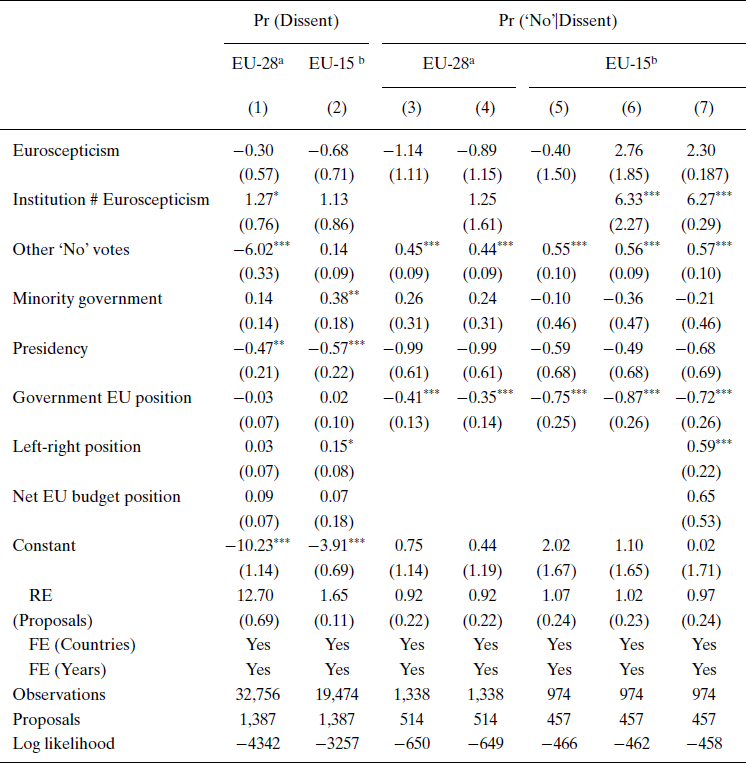
Table 1 presents the results of our main regression analyses. In model 1 the dependent variable is dissent – that is, ‘No’ votes, abstentions and negative statements – for the EU‐28. Euroscepticism is not significant, while its interaction with institutional strength is only marginally significant at the 10 per cent level with a p‐value of 0.095. For the EU‐15, as model 2 shows, neither Euroscepticism nor its interaction with institutional strength are significant. Parliamentary control thus does not affect the frequency of dissent, consistent with H1. This also suggests that parliament's and government's preferences on EU policy are often aligned. Furthermore, we find evidence that holding the Presidency leads to a lower probability of dissent, consistent with previous studies. Presidents set the agenda and accordingly move policies into their acceptance sets. They dissent less as a result.
The likelihood of showing dissent and voting ‘No’, mixed‐effects logistic regressions

Notes: Standard errors in parentheses: *P < 0.10; **P < 0.05; ***P < 0.01.
a EU‐28 minus Croatia, Cyprus, Luxembourg and Malta due to missing values.
b EU‐15 minus Luxembourg.
In models 3–7 the dependent variable is the probability that a MS cast a ‘No’ vote given that it dissents. Models 3 and 4 represent the EU‐28 without and with the interaction term, respectively. Neither Euroscepticism nor its interaction with institutional type reaches statistical significance. This is consistent with H2, but not with H3. We discuss this at the end of this section.
When we focus on the EU‐15, as we do in models 5–7, we obtain very strong results, however. First, in model 5 we find that Euroscepticism by itself is not significant and even has the opposite sign of what would be expected. MPs’ motivational incentives by themselves thus are not sufficient to influence governments’ votes, consistent with H2. In model 6 we find that the interaction term is strongly significant, even when controlling for country and time fixed effects. The effect of Euroscepticism on the voting behaviour of the government is stronger the stronger the institution. We thus find support for our hypothesis that more parliamentary control leads to a higher probability of voting ‘No’ to express dissent, consistent with H3. The more governments are controlled, the more they ‘posture’ to show that their preferences are aligned with those of the parliament. The strongest way to show this is by voting ‘No’. Furthermore, we find that governments are more likely to vote ‘No’ when others vote ‘No’ as well, in line with H4. When others vote ‘No’, the costs of also issuing a ‘No’ vote decreases. In our theoretical model, b then becomes relatively smaller, and the government is more likely to choose its role of defender of the national interest, thus adhering to the wishes of its parliament. Regarding the control variables, governments’ own positions on EU integration also matter. The more governments favour EU integration, the less likely they show dissent by a ‘No’ vote. The Presidency variable, in contrast, has no effect. Results are robust in model 7 where we include the Left‐right position of the government and Budget position of the MS. The further a government is located from the average left‐right MS position, the more likely it is to vote ‘No’ to show its dissent. Net EU budget position does not seem to matter.
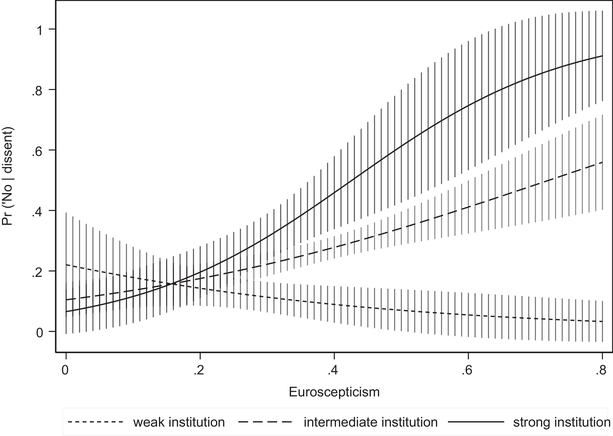
To illustrate our results, Figure 2 shows the predicted probabilities of voting ‘No’, conditional on the expression of dissent, as functions of the degrees of Euroscepticism, for different levels of parliamentary strength. The predicted probabilities are based on model 7 in Table 1. The different lines refer to different levels of parliamentary strength. The slopes are clearly steeper for higher values of institutional strength: the stronger the parliament is, the larger the marginal effect of Euroscepticism on the probability of a ‘No’ vote. For weak parliaments, an increase in Euroscepticism does not make governments vote ‘No’ more frequently. The slope is then even slightly downward sloping. This result indicates that, even though MPs have stronger incentives to control the government when Euroscepticism is high, MPs cannot control their governments’ voting behaviour without formal powers. For strong parliaments, by contrast, the increase in the probability of voting ‘No’ to express dissent is enormous. When Euroscepticism changes from 0.1 to 0.8, the probability that the government votes ‘No’ when it does not agree with a proposal increases from 15 to almost 90 per cent.
Predicted probabilities of voting ‘No’.
Note: Weak, intermediate and strong institutions represent the 5th, 50th and 95th percentiles of institutional strength, respectively.

Our results show that parliaments can and do affect the voting behaviour of their governments. Strongly accountable governments cast ‘No’ votes significantly more often to express dissent than abstentions and statements. However, this effect does not seem to apply to the new MSs. While our results for the EU‐15 are very robust, we do not find a significant effect of parliamentary control for the MSs that joined in or after May 2004. All these MSs’ parliaments have strong formal powers, but rising Euroscepticism does not lead to more ‘No’ votes.
We offer four potential explanations for this finding. First, the new MSs oppose legislation less often and abstain rather than vote ‘No’ when they do dissent (Van Aken Reference Van Aken2012). Field (Reference Field2001) predicted that the new MSs would adapt to the culture of consensus in the Council. This adaptation may have been so strong that domestic considerations such as the level of Euroscepticism do not significantly affect voting behaviour in the Council despite the presence of strong parliaments. Other studies have found similarly divergent effects for the new MSs with respect to other variables that determine voting behaviour. Hosli et al. (Reference Hosli, Mattila and Uriot2011), for example, show that the variables EU budget position and Public support for EU membership even have the opposite effects compared to the EU‐15.
In the context of our theoretical model it could be argued that the new MSs’ governments have stronger incentives to curry favours in the Council, and in fact vote ‘Yes’ rather than express dissent at all in order not to antagonise their colleagues from the outset. This could play a role at least in the first few years of their membership, long enough to affect our results. Moreover, the new MSs are almost all small and have little influence (Smeets Reference Smeets2015). In addition, they receive considerable financial transfers from the EU. Their governments may be less inclined to oppose EU legislation for that reason, whatever their rhetoric may be in the domestic political arena. Marks et al. (Reference Marks, Hooghe, Nelson and Edwards2006) argue that in the run‐up and aftermath of EU accession political elites in the new MSs perceived EU membership as a bundle. They realised that membership is a give and take, and may be more reluctant to oppose as a result.
Second, our analysis does not consider the salience of European integration in the domestic political debate. Scholars have found it to be generally low, albeit increasing (Mudde Reference Mudde2012). The party politics on European integration in the new MSs differ from the EU‐15, however. In the EU‐15, European integration seems to be more salient for parties that are strongly opposed to it, whereas in the new MSs the issue may have been salient for mainstream pro‐integration parties as well (Whitefield & Rohrschneider Reference Whitefield and Rohrschneider2015). As a result, our Euroscepticism variable may capture party preferences as well as salience in the EU‐15, whereas salience may confound our analysis in the new MSs.
Third, the Chapel Hill data measure sentiments toward European integration rather than toward the EU. These constitute distinct forms of Euroscepticism (Kopecky & Mudde Reference Kopecky and Mudde2002). Parties could favour European integration, but dislike the set‐up and functioning of the EU. This arguably is more the case in the new MSs than in the EU‐15. In Hungary, for example, Prime Minister Orban argues against the EU, while favouring integration of a different form. As a result Fidesz is not a Eurosceptic party according to the measure we use, even though it is often considered to be.
Our fourth argument relates to the measure of institutional strength of the parliaments. Several studies have analysed the institutional strength of the parliaments of the EU‐15, but few have done so for the new MSs. As a result, the scores for the new MSs may be less reliable. To check this we calculated the correlation between the Winzen (Reference Winzen2012) and Karlas (Reference Karlas2012) scores. The correlation between the scores for the EU‐15 was 0.84, whereas it was less than half for the new MSs at 0.41.
Conclusions
In this article we explore the different forms of dissent governments use to express disagreement in the Council of the EU. We argue that governments act strategically and take into account their dual roles: they negotiate at the supranational level, but are accountable domestically. We introduce a game‐theoretical model that studies the form of dissent, and analyses how national parliaments’ levels of control over their governments affect it.
We find that governments want their opposition to legislation recorded to obtain concessions in future negotiations. If they prefer the status quo to the proposal, they express their dissent, as stated in Proposition 1. They can choose to express dissent in different ways, however. Due to the culture of consensus, ‘No’ votes are not valued in the Council. From that perspective it is better for governments to show their displeasure through abstentions or formal statements. However, this may put governments at odds with their parliaments and electorates who may prefer ‘No’ votes as signals of discontent. In our model governments perform cost‐benefit analyses that result from this interplay between domestic and international politics.
We show that the costs depend on the strength and motivation of national parliaments in EU affairs. If parliaments are strong and motivated, they hold their governments accountable. Governments, in turn, then take uncompromising positions and vote ‘No’, as shown in Proposition 2, whether it be because parliaments formally instruct them to do so or because they feel otherwise compelled to show that their preferences are aligned. If parliaments are weak or not motivated to engage in EU affairs scrutiny, by contrast, Ministers have room to show their dissent more diplomatically. They then abstain or record statements to obtain concessions from the Council later on.
The benefits of abstaining or issuing negative statements rather than voting ‘No’ are larger if no other governments vote ‘No’. For intermediate values of parliamentary strength and motivation the government votes ‘No’ only if other governments do so as well, as shown in Proposition 3.
We find empirical support for our theory by analysing all contested votes during more than a decade of Council decision making. First, we conclude that governments that prefer the status quo, express their dissent, regardless of the strength and motivation of their parliaments, consistent with H1. Furthermore, we show that parliaments do indeed influence their governments’ voting behaviour. Governments that express dissent are more likely to do so by voting ‘No’ when they are heavily controlled by their parliaments. Parliaments exercise such control if the following two conditions are both fulfilled: they have the formal powers to do so, and are sufficiently motivated by Euroscepticism, either their own or that of their voters. This is consistent with H2 and H3.
Our results are in line with Hagemann et al. (Reference Hagemann, Bailer and Herzog2019), who found that the stronger national parliaments are, the more likely governments are to vote ‘No’ or abstain, and issue negative statements. Our findings suggest that the increase in negative statements they observed may be due to an increase in such statements that accompany abstentions and ‘No’ votes.
We further show that the probability of a ‘No’ vote depends on the voting behaviour of other MSs, consistent with the findings of Arregui and Thomson (Reference Arregui and Thomson2014). If other governments vote ‘No’, the cost to also vote ‘No’ is lower and governments thus vote ‘No’ more often, consistent with H4.
Apart from being the first to present a theory about MSs’ choice of the form of dissent, we also contribute to the debate on national parliaments’ involvement in EU matters. The EU is often criticised for not being democratic enough. With this in mind, the Lisbon Treaty gave national parliaments a formal role in the legislative process under the Early Warning System (EWS). We show, however, that parliaments can control the voting behaviour of their governments even in the absence of the EWS. If parliaments fail in this respect, it is due to the weakness of political institutions at the national level, rather than the design of the EU institutions. If parliaments find that they cannot control their governments, it is their responsibility to alter their domestic institutional framework.
In addition, our findings have broader implications for international organisations in general. Standard principal‐agent theory suggests that control reduces agency problems. More openness leads to more accountability and makes it easier to judge whether political representatives act in the public interest. We show that parliaments can indeed set up institutions to hold their governments accountable for the decisions they make in international organisations. However, others highlight inefficiencies that may result from an increase in transparency (Stasavage Reference Stasavage2004). When government officials bargain in front of an audience they face a greater incentive to posture and adopt uncompromising bargaining positions. This may lead to the breakdown of negotiations or delay. Our study is consistent with this theory. Furthermore, when majority rule is used in international organisations, constrained negotiators who feel the need to posture may be ignored in present and future negotiations, in contrast to the view that domestic constraints are beneficial in international negotiations (Putnam Reference Putnam1988). From a strategic point of view it may be prudent for parliaments to give their representatives more leeway to strike deals.
Acknowledgements
This article has benefitted from presentations at the 2016 EPSA conference in Brussels and the 2016 ECPR Graduate Student Conference in Tartu. Furthermore, we thank Dirk Czarnitzki, Bjørn Høyland, Sara Hagemann, Bart Van Looy and Christopher Wratil for their very usefull comments and suggestions on earlier versions. Finally, a sincere thanks to all the anonymous referees of the EJPR for their excellent feedback.
Supporting Information
Additional supporting information may be found in the Online Appendix section at the end of the article:
Table A1: Examples of statements and coding decisions.
Table A2: The Likelihood of Showing Dissent and Voting ‘No’ (mixed‐effects logistic regressions)
Table A3: The Likelihood of Showing Dissent and Voting ‘No’ (mixed‐effects logistic regressions).
Table A4: Multinomial probit regression analyses (baseline category: negative statements).
Table A5: Set of robustness checks for the EU‐15 (mixed‐effect logistic regressions unless stated differently).
Table A6: Descriptive statistics.
Table A7: Correlation matrix.a
Table A8: MSs’ voting records (May 2004‐December 2014).
Figure A1: Predicted probabilities of abstaining and voting ‘No’ (statements is baseline category).
Figure A2: Institutional strength of Parliaments in EU affairs for the EU‐15.
Figure A3: Marginal effect of motivation for institutional strength categorized in weak and strong.
Figure A4: Marginal effect of motivation, with institutional strength categorized in weak and strong, on abstentions (left) and ‘No’‐votes (right). Negative statements are the baseline.
Figure A5: Frequency of ‘No’‐votes relative to expressions of dissent for the EU‐15.



 Open access

