


Introduction
The speed and diversity of changes in recent years in consumer behavior patterns, the wide variety of products and services available, as well as the different consumption methods all underpin the interest in analyzing consumption in its multiple and interrelated dimensions. These changes have been linked, to a large extent, to the incorporation of information and communication technologies in people’s lifestyles. Especially, in those of young people, whose habits will play a decisive role in future consumption patterns and will guide many companies when it comes to developing products that fit young people’s tastes and lifestyles.
The Smartphone has quickly become a fundamental tool for most people, although its use is particularly frequent among younger generations, the so-called millennium and Z generations. The consumption of this technology has both positive aspects, linked to personal well-being, and negative ones that can significantly affect the younger population segment, where its use is most extensive. One negative effect that may be associated, among others, is the loss of control when purchasing these products. This aspect is interesting because several studies point toward a growing trend in compulsive buying behavior.
Indeed, compulsive buying behavior has become a problem that affects an increasing number of people in contemporary consumer societies, where the availability of a wide variety of goods, greater disposable income and greater leisure offer favor its occurrence. It is characterized by a maladaptive behavior of persistent and irresistible purchases, which causes serious negative consequences for both the individual and those around them. Some studies of compulsive buying point out the symbolic importance of acquiring a particular product as an element of communication and personal integration, especially, among younger consumers.
Given this context and the scarcity of studies that examine the compulsive buying behavior of a specific product, it is interesting to deepen our knowledge of compulsory buying behavior of Smartphones among young people. Considering the potential influence that this behavior can exert, both individually and socially, it is relevant to detect and analyze it. In this paper, a risk profile is obtained for compulsive Smartphone buyers that can serve as a guide for public-policy makers to implement measures that could contribute to the prevention of such behavior among young people.
To obtain this profile, the main sociodemographic characteristics of individuals prone to compulsiveness in the purchase of Smartphones are studied, as well as others related to shopping addiction, feelings of post-purchase guilt or subjective well-being. In addition, a predictive behavioral model is estimated (binomial logit), which determines the traits that characterize these individuals and quantifies the probability of showing a tendency to compulsiveness.
Compulsive Buying
Compulsive buying occurs when there is frequent concern and anxiety about shopping or irresistible urges to buy and continuously purchase unnecessary items, and when purchases are beyond what an individual can financially afford. This causes serious negative consequences both for the individual and for people surrounding her or him.Reference Christenson, Faber and de Zwaan1–Reference Müller, Brand and Claes10 Despite its serious repercussions, compulsive buying still does not appear as a distinct diagnostic category in the Diagnostic and Statistical Manual of Mental Disorders-5.Reference McElroy, Keck and Pope11, Reference Díez, Valdepérez and Aragay12
The urge to buy is often accompanied by intense states of conflict between positive and negative feelings.Reference Lawrence and Elphinstone13–Reference Rook15 Frequently, compulsive buying occurs in response to negative emotions. Thus, low self-esteem,Reference Black16–Reference Raab, Elger and Neuner18 propensity to depression,Reference Otero-López and Villardefrancos5, Reference Black16, Reference Raab, Elger and Neuner18–Reference Mueller, Claes and Georgiadou21 and low levels of self-controlReference Maccarrone-Eaglen and Schofield22–Reference Maccarrone-Eaglen and Schofield25 are some of the characteristics that have a close relationship with compulsive buying. These negative emotions seek to be relieved.Reference Christenson, Faber and de Zwaan1, Reference O’Guinn and Faber26–Reference Roberts, Manolis and Pullig30 However, this relief is transitory and is usually followed by increased anxiety and feelings of guilt after buying.Reference Faber31, Reference Fischer, Espejo and Méndez32 On the other hand, positive moods (well-being, enthusiasm, excitement, etc.) can also trigger compulsive buying behavior.Reference Faber and Christenson2, Reference Black, Aboujaoude and Koran33, Reference Rose and Segrist34
Compulsive buying has been defined as a behavioral addiction.Reference Lejoyeux and Weinstein28, Reference Aboujaoude35, Reference Andreassen36 For example, Villardefrancos and Otero-LópezReference Villardefrancos and Otero-López37 highlight some studies that consider addictive shopping an obsessive–compulsive disorder.Reference O’Guinn and Faber26, Reference McElroy, Philips and Keck38–Reference Scherhorn, Reisch and Raab40
Moreover, the symbolic capacity of products is a fundamental element that is associated with compulsive buying, especially among young people. Symbols are elements of communication and personal integration in today’s consumer society. In this context, a product can cross the barriers of rational analysis and is used to satisfy symbolic needs such as acceptance, status, identity and belonging to a social group.Reference Elliott41–Reference Zhang, Howell and Howell45 These symbolic needs motivate individuals to acquire a certain product in order to satisfy them. Deci and Ryan’s Self-Determination Theory of human needsReference Ryan and Deci46 postulates that there are intrinsic motivations, related to the natural behavior of satisfaction and enjoyment, and extrinsic motivations related to the search for external incentives or consequences. In accordance with this theory, relatedness combined with autonomy and competence are basic human needs to be satisfied for individual well-being and even self-determination. In this regard, Smartphones would constitute a way to satisfy the need for relatedness, particularly for young people in modern societies.
Moreover, an individual’s behavior may be motivated not only by the value of the incentive itself, but also by the individual’s expectations of achieving it, as pointed out by Expectancy-value models.Reference Ajzen47 In this type of model, based on Lewin’s Theory,Reference Lewin48 the decision for adopting a certain conduct in a given context depends on the value of the outcome pursued by the conduct, and the probability of attaining it by means of the conduct (expectancy). So, the conduct of acquiring Smartphones would be contingently associated with a high valued outcome (relationship improvements) with a high probability. Expectancy-value models have been adopted by researchers in behavioral economics given their utility for improving economic behavior in several aspects, such as sustainability.Reference Zheng, Xu and He49
In particular, Smartphones are considered as symbols that young compulsive consumers use to define themselves, to increase their self-confidence and project their ideal self-image, due to these devices’ high communicative value. Smartphone compulsive buying can, therefore, be a way to gain approval and recognition.
Method
Participants
The data used come from a survey conducted at the end of 2016 on a sample of 500 students from the Faculty of Economics, Business and Tourism of the University of La Laguna (Tenerife, Canary Islands). The survey, consisting of 54 items, contained three scales to measure compulsive buying, post-purchase guilt, shopping addiction and subjective well-being. In addition, there were sociodemographic issues, including some related to the use of social networks, number of devices that an individual had owned, and the expense incurred when purchasing, among others. Beforehand, a pilot survey was carried out with a sample of 100 students to evaluate the items belonging to the different scales used. The selection of the individuals in the sample was made by proportional quota sampling, stratified according to degree, with the maximum admitted error of ±4% to 95.5% confidence.
Measurements
This section describes which scales have been used to evaluate compulsive buying, postpurchase guilt, shopping addiction, and subjective well-being that are presented in the results section.
Compulsive buying and postpurchase guilt
In this work, a 9-item scale has been designed based on the adaptation of the Valence, D´Astous and Fortier scaleReference Valence, D´Astous and Fortier50 by Scherhorn et al,Reference Scherhorn, Reisch and Raab40 with five response modalities of a Likert type (1: totally disagree and 5: totally agree). The Valence scale has served as a reference in numerous empirical studies.Reference Maccarrone-Eaglen and Schofield22, Reference Maccarrone-Eaglen and Schofield25
To analyze the internal consistency of the scale, Cronbach’s alpha was used, obtaining a value of 0.776. In the exploratory factor analysis (EFA), two dimensions or factors are obtained that explain 59.1% of the variance. The first factor, which explains 39.1%, includes items 1, 2, 3, and 4 (with an alpha of 0.771) and the second, items 5, 7, 8, and 9, explaining 20.0% of the variance (with an alpha of 0.748). It was decided to eliminate item 6, which did not fit any of the factors found because the results of the EFA improved after its elimination.
The first factor is associated with a tendency to compulsive buying, insofar as it seems to reflect an individual’s response to strong buying urges. By contrast, the second is associated with feelings of guilt that occur after purchasing. The items of the latter factor will be used in order to assess whether the individual has negative feelings and/or guilt following the purchase.
For the identification of individuals with compulsive tendencies, hereinafter referred to as “compulsive,” the four items that embody the first factor will be used. Specifically, those whose average score in the four items is higher than the average score of all the individuals in the sample plus a standard deviation are considered compulsive individuals. This classification criterion is similar to that used in Faber and O’Guinn,Reference Faber, O’Guinn and Srull51, Reference Faber and O’Guinn52 Olábarri and García,Reference Olabarri and García53 Otero-López and Villardefrancos,Reference Otero-López and Villardefrancos54 and Villardefrancos and Otero-López.Reference Otero-López, Santiago and Castro8, Reference Villardefrancos and Otero-López37 According to this criterion, the percentage of compulsive individuals in the sample is 13.2%.
This result does not depart much from that obtained in works such as Faber and O’Guinn,Reference Faber, O’Guinn and Srull51 Olábarri and García,Reference Olabarri and García53 Fischer et al,Reference Fisher, Espejo and Méndez55 and Weinstein et alReference Otero-López, Santiago and Castro8, Reference Weinstein, Maraz and Griffiths56 for the general population. Although it differs somewhat more from that obtained in samples of university students.Reference Li, Unger and Bi7, Reference Harvanko, Lust and Odlaug19, Reference Villardefrancos and Otero-López37, Reference Maraz, Griffiths and Demetrovics57 However, as noted by Otero-López and Villardefrancos,Reference Otero-López and Villardefrancos54 the variability in prevalence could increase, depending on factors such as the sample used, its size, the sociocultural context and the compulsive buying measures used.
Shopping addiction
The questionnaire used consists of ten dichotomous response items (yes/no), which include the main elements of an addictive shopping pattern, such as the perception of behavior control difficulties, the positive and negative feelings generated by the purchase (feeling of relief, improvement of self-esteem, anxiety or excitement, etc.) and the negative consequences of it at on an economic and family level.
Of the 10 items, nine come from the Compulsive Buying Questionnaire of Lejoyeux et al,Reference Lejoyeux, Tassain and Solomon58 proposed as a specific diagnostic scale for compulsive buying from a clinical perspective. The 10th item (number 6 in the questionnaire) corresponds to the Shopping Addiction Test questionnaire by Echeburúa et alReference Echeburúa, De Corral, García and Olábarri59 and has been incorporated to reinforce the perception of behavioral control difficulties. Cronbach’s alpha has a value of 0.68 here.
Subjective well-being
The questionnaire used is based on the SPANAS scale of Joiner et al,Reference Joiner, Sandín and Chorot60 the Spanish translation of the Watson et alReference Watson, Clark and Tellegen61 scale. Of the 20 items, Likert type (1: nothing to 5: very much), 4 were eliminated because they generated confusion among the individuals surveyed in the pilot sample. The remaining 16 items refer to adjectives that describe the feelings of respondents when buying a Smartphone. The individual responds taking into account the intensity of each of the feelings when making the purchase. The value of Cronbach’s alpha was 0.86.
Statistical analysis
Chi-square tests have been used to determine if there is a relationship between a tendency to compulsiveness and sociodemographic variables. Also, if there is a relationship with the items of the different scales used. In addition, an analysis of variance (ANOVA) has been used to verify if there are significant differences between the average values of some sociodemographic variables for compulsive and noncompulsive individuals.
The results of these analyses identify some of the characteristics of individuals with a tendency toward compulsiveness. However, to evaluate the joint effect of these characteristics on the probability that an individual presents this tendency, a discrete choice model has been estimated.
In these models, the decision taken by an individual is expressed as a categorical variable, Yi = j, with the probability that an individual i chooses alternative j being a function of a set of factors, that is:
 $$ P\left({Y}_i=\operatorname{j}\right)=F\left(x{\prime}_i\beta \right), $$
where, x i, is the vector of characteristics that influence the choice of each of the alternatives and β the vector of parameters associated with them, which reflect the impact that each of the characteristics has on the above probability. If function F is specified as a logistic distribution function, a logit model is obtained, which is binomial if the individual chooses between two alternatives and specifies that:
 $$ P\left({Y}_i=1\right)=\frac{e^{x^{\prime}\hskip-1.2pt {}_i\beta }}{1+{e}^{x^{\prime}\hskip-1.2pt {}_i\beta }}. $$
To extract the profile of a young university student with a tendency to compulsiveness in the purchase of Smartphones, a binomial logit model has been estimated, where the dependent variable takes the value 1 if the individual has a tendency to compulsiveness and 0 otherwise. The explanatory variable vector, which is detailed in the following section, includes some sociodemographic variables, and others related to shopping addiction, feelings of postpurchase guilt and the degree of subjective well-being.
In these models, it is interesting to analyze discrete changes, odds ratios, and predicted average probabilities. Discrete changes are calculated as the difference between the probability that the individual chooses each alternative when showing a certain characteristic and when not showing it.
 $$ P\left(\operatorname{Y}=\operatorname{j}|\operatorname{x},{x}_k=1\right)-P\left(\operatorname{Y}=\operatorname{j}|\operatorname{x},{x}_k=0\right). $$
Odds ratios provide information on the pattern of substitution between alternatives for individuals with different feature vectors. In other words, they make it possible to assess the preference of one alternative over another for an individual with certain characteristics compared to another individual with different characteristics. So, the ratio between the probabilities of two alternatives (odds) is:
 $$ \frac{P\left({Y}_i=1|\operatorname{x}\right)}{P\left({Y}_i=0|\operatorname{x}\right)}={e}^{x^{\prime}\hskip-1.2pt {}_i\beta }. $$
Thus, for example, the odds ratio for the variable $ {x}_k $
is obtained in the model estimated from
$ {x}_k $
is obtained in the model estimated from $ {e}^{\beta_k} $
. This ratio is evaluated considering a unit change in the quantitative explanatory variable or a change in the modality of a qualitative explanatory variable.
$ {e}^{\beta_k} $
. This ratio is evaluated considering a unit change in the quantitative explanatory variable or a change in the modality of a qualitative explanatory variable.
The predicted average probabilities represent the average of the probabilities of each alternative for the individuals of the sample defined by each of the modalities of the characteristic analyzed.
Results
Sociodemographic characteristics of a compulsive buyer
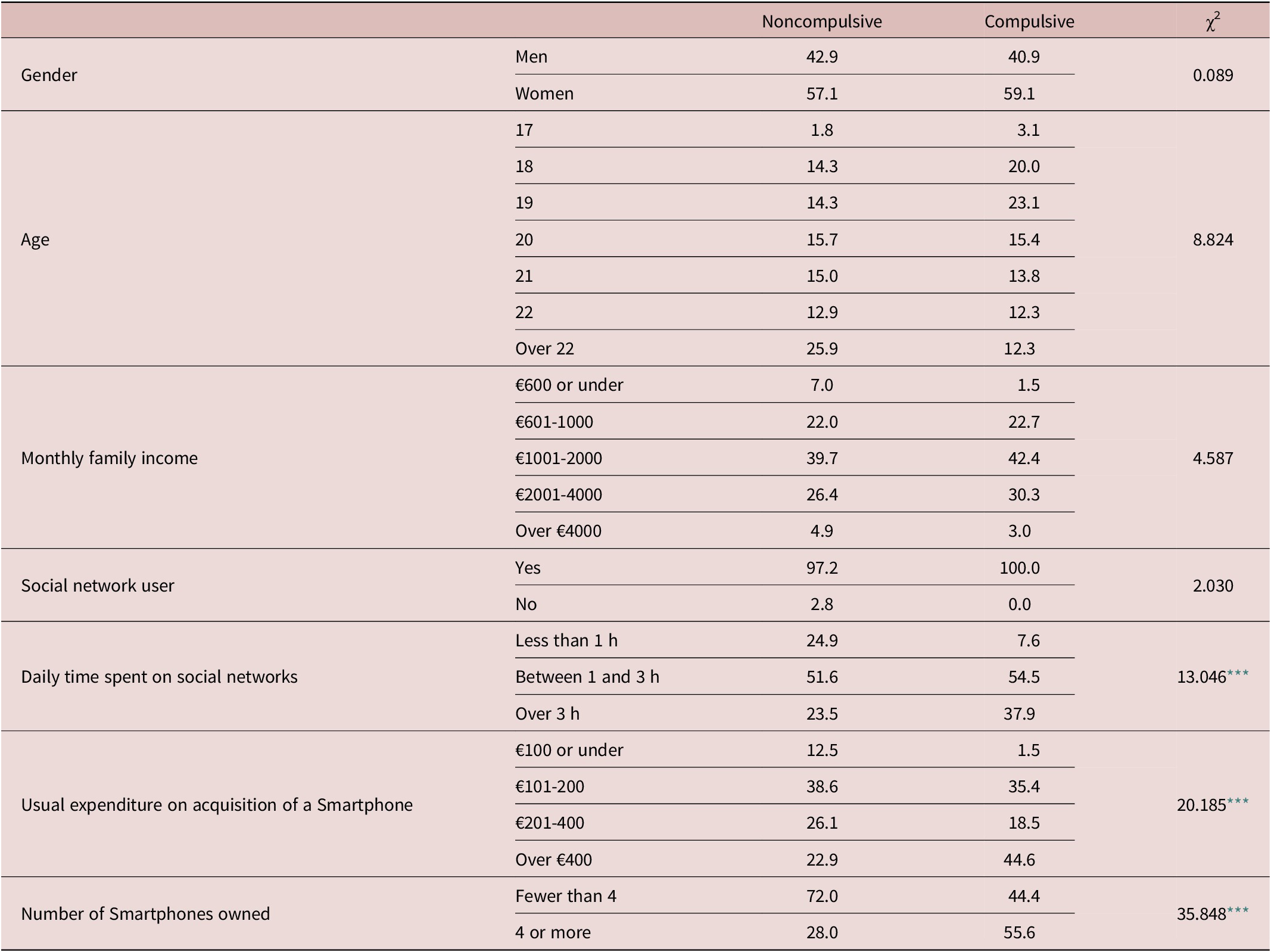
The Chi-square test shows the existence of a statistical relationship between the compulsiveness variable and the daily number of hours that an individual devotes to social networks, the normal expense incurred in the acquisition of a Smartphone and the number of Smartphones owned (Table 1).
Sociodemographic Characteristics of Individuals (% of Noncompulsive and Compulsive)
*** Significant at 1%.
The percentage of compulsive buyers who spend more than 3 hours a day on social networks (37.9%) is much higher and statistically different from noncompulsive ones (23.5%). Statistically significant differences were also found in relation to spending, especially above 400 euros and concerning the number of Smartphones owned.
There is no evidence of a statistical relationship between gender and compulsiveness. However, using a test of proportions (likelihood ratio test), the percentage of compulsive women differs statistically and exceeds that of compulsive men by 18.2 percentage points.
Through ANOVA, which allows us to test the absence of significant differences in the mean values of the quantitative variables between compulsive and noncompulsive individuals, it is found that compulsive individuals have a lower average age, make use of social networks for more time per day and, on average, spend more on the acquisition of a Smartphone and have owned more devices (Table 2).
ANOVA (Sociodemographic Variables and Compulsiveness)

** Significant at 5%.
*** Significance at 1%.
Shopping addiction
The hypothesis of independence between the compulsiveness variable and almost all items of the shopping addiction scale is rejected (Table 3). The proportion of individuals who answer yes to all items is always statistically higher in the group of compulsive individuals. Especially in items that refer to the irresistible urge to spend money, relief after purchase or irritation when the desired model is not acquired. In addition, the percentage of compulsive individuals who claim to have negative consequences after the purchase almost triples that of the non-compulsive ones (items 7 and 8).
Purchase Addiction (% of Noncompulsive and Compulsive)
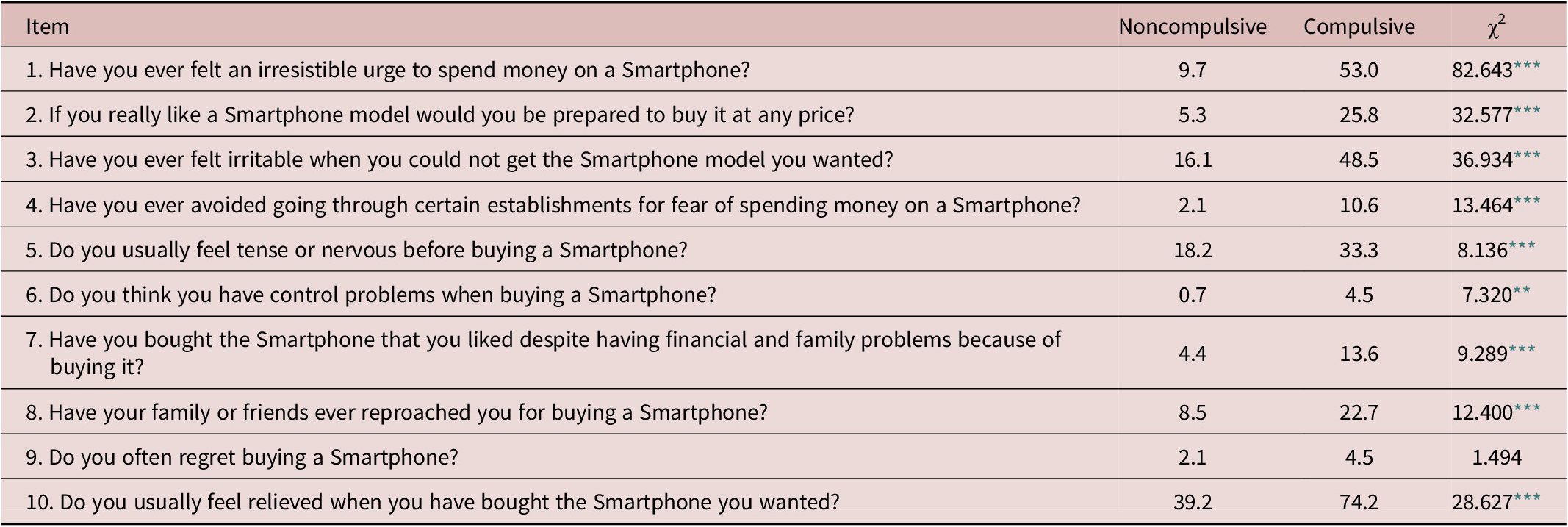
The response to the items on this scale are “Yes” and “No.” Percentages calculated considering noncompulsive and compulsive individuals who answer “Yes” in each of the items, respectively.
** Significant at 5%.
*** Significant at 1%.
Feelings of postpurchase guilt
There is evidence of a relationship between compulsiveness and all the items that reflect feelings of guilt after having bought a Smartphone (Table 4), the percentage of compulsive buyers being always higher in this regard. Specifically, the percentage of compulsive buyers who claim to have often bought a Smartphone model that they could not afford is more than three times that of noncompulsive ones. And regarding the compulsive buyers who do not dare to show the Smartphone they have bought because they could appear to be an irresponsible person is more than five times higher. Also, those who have regrets of conscience after the purchase is more than double.
Feeling of Postpurchase Guilt (% of Noncompulsive and Compulsive)

Percentages calculated considering the individuals who chose the modalities of response 4 (in agreement) or 5 (totally in agreement) of the Likert scale, with respect to the total of non-compulsive and compulsive individuals, respectively.
** Significant at 5%.
*** Significant at 1%.
Subjective well-being
A relationship is found between compulsiveness and practically all the items on the scale (Table 5). The compulsive individual when buying a Smartphone states feeling, with a high frequency, interested, motivated, enthusiastic, proud, inspired, determined, attentive, and active. In addition, with a lower frequency they report feeling tense, upset, guilty, scared, irritable, embarrassed, nervous, and fearful. Although similar behavior can be observed in the noncompulsive group, the proportion of individuals is much lower. Thus, the compulsive individual seems to manifest greater positive and negative emotional bonds when buying a Smartphone.
Subjective Well-Being (% of Noncompulsive and Compulsive)
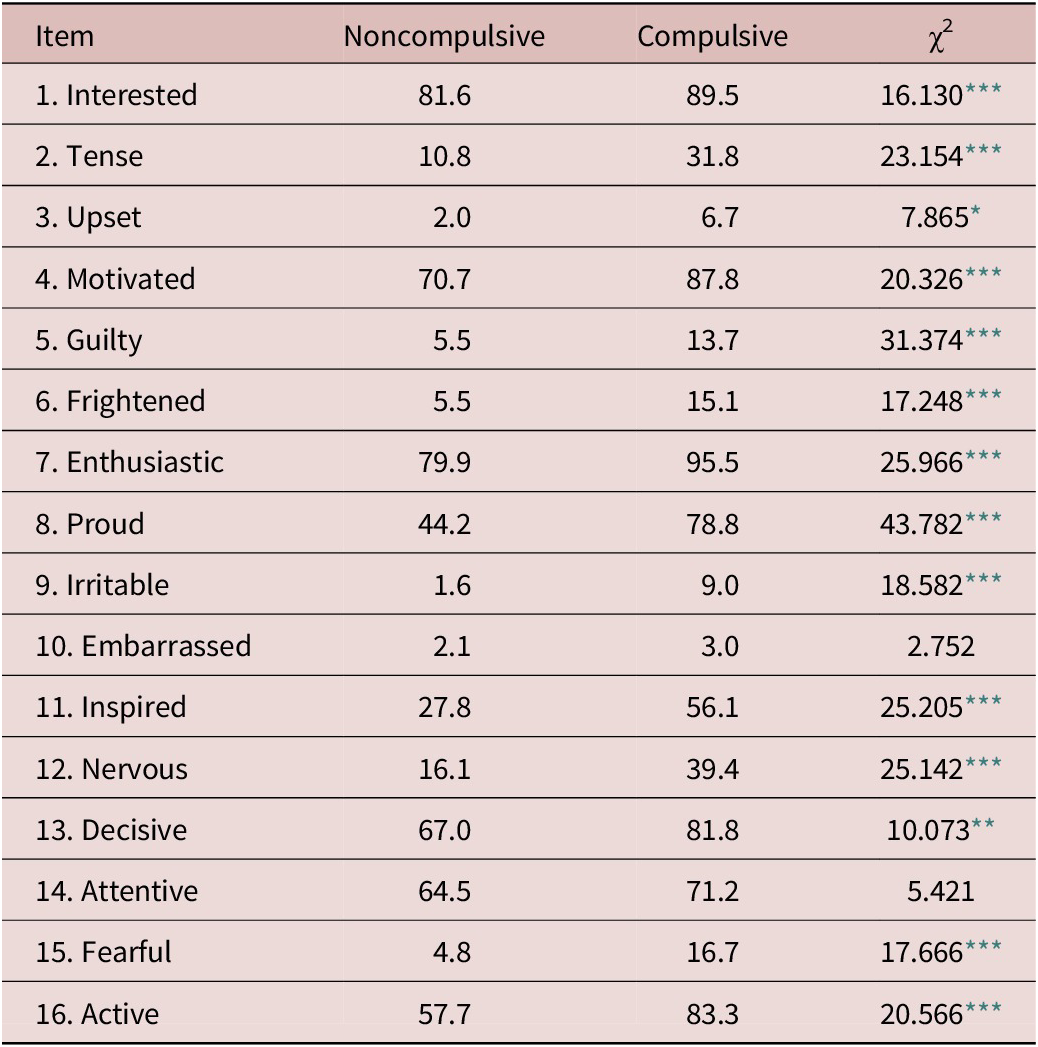
The percentages have been calculated considering the individuals who chose the response modalities 3 (rather), 4 (very), or 5 (extremely) of the Likert scale, with respect to the total of noncompulsive and compulsive individuals, respectively.
* Significant at 10%.
** Significant at 5%.
*** Significant at 1%.
Predictive behavioral model of compulsive buyer traits
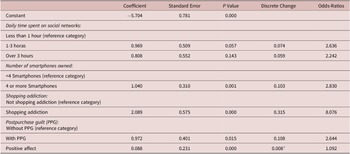
The risk profile of the compulsive buyer is approximated through the estimation of a binomial logit model. The variables that have been significant in the estimated model are: the time spent on social networks, the number of Smartphones an individual has had, addiction to shopping, feelings of postpurchase guilt and the degree of subjective well-being (link positive emotional). Gender, age, expenditure, and negative affect were not significant variables.
To incorporate time spent on social networks in the model, three dichotomous variables have been defined that correspond to the modalities: less than 1 hour per day, between 1 and 3 hours, and more than 3 hours. Regarding the number of Smartphones, two dichotomous variables have been considered that represent whether the individual has owned less than four Smartphones or at least four. The variable that represents shopping addiction takes the value 1 for those individuals that show addiction and value 0 for those who do not. Individuals who show addiction are those whose total number of affirmative answers is equal to or greater than half the number of items on the addiction scale. In the variable that reflects feelings of post-purchase guilt (PPG), the value 1 refers to individuals who have feelings of postpurchase guilt, which are those individuals whose average in all the items of this scale is higher than the average of the sample plus one standard deviation. The value 0 refers to individuals who do not show these feelings. Finally, in relation to the positive affect of subjective well-being, a variable has been constructed that represents the sum of the responses of each of the individuals in the sample to the eight items that make up the positive affective component.
A positive effect of all the explanatory variables on the probability that an individual tends to compulsiveness is observed (Table 6). Discrete changes, which have been calculated for all individuals in the sample and then averaged, indicate that an individual who has had four or more devices is 10.3% more likely to show a tendency toward compulsiveness than one who has had fewer than four. Individuals who show shopping addiction and feelings of postpurchase guilt have a probability of showing a tendency to compulsiveness 31.5% and 10.8% higher than those who do not, respectively. Regarding the degree of subjective well-being, there is also a higher probability for individuals with greater positive effects to be compulsive. Moreover, an individual with shopping addiction is approximately eight times more likely to show a tendency to compulsiveness than not to show it, compared to a nonaddicted individual (see odds-ratios). In addition, the pattern of substitution among individuals with a tendency to compulsiveness and without it is more than double for those who spend at least 1 hour a day on social networks than for those who spend less than 1 hour a day. Likewise, the odds ratio among individuals who have had four or more mobile devices almost triples those who have had less than four.
Logit Binomial Estimation

N = 483b; LnL = −148.197; $ {\operatorname{R}}_{\mathrm{MCF}}^2 $
=0.191;
$ {\operatorname{R}}_{\mathrm{MCF}}^2 $
=0.191; $ {}^{\lambda_{\mathrm{RV}}} $
(7) = 69.992; % correct predictions: 87.6.
$ {}^{\lambda_{\mathrm{RV}}} $
(7) = 69.992; % correct predictions: 87.6.
a Marginal effect.
b Individuals who responded to all the variables in the model.
A notable difference in the predicted probability of individuals with the traits that determine a greater and lesser propensity to compulsiveness is detected. Thus, individuals who spend more than 3 hours a day on social networks, have had at least four Smartphones, are addicted to shopping, show feelings of postpurchase guilt, and have a medium positive subjective well-being level, have a predicted probability of 78.8% of being compulsive. On the contrary, for individuals who spend less than 1 hour a day on social networks, have had fewer than four devices, are not addicted to shopping, lack postpurchase guilt and have a medium positive subjective well-being, the probability is only 2.7%.
Likewise, the estimated probabilities of individuals with greater and lesser tendency toward compulsiveness have been calculated over the range of the variable that measures the degree of positive subjective well-being (Figure 1). It is observed that both probabilities increase as the intensity of the positive effect does. In addition, the differences between the two vary in a range between 0.47 and 0.84 percentage points depending on the degree of positive affect.
Predicted probabilities according to positive affect.

Figure 2 shows the evolution of the predicted probabilities for individuals with and without shopping addiction based on the number of daily hours spent on the use of social networks. Figure 3 shows this for feelings of postpurchase guilt. In both graphs, it is observed that the greatest difference in the probability of being compulsive is reached when the time spent on social networks is greater than one hour.
Predicted probabilities according to shopping addiction and daily time spent on social networks.
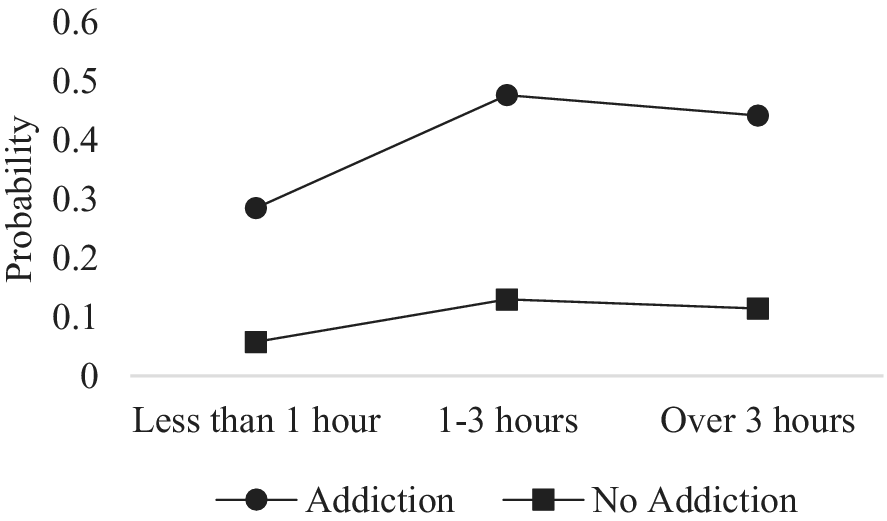
Predicted probabilities according to feeling of postpurchase guilt (PPG) and daily time spent on social networks.

Discussion
With the aim of furthering our knowledge on compulsive buying behavior of Smartphones among university students, a scale that identifies those individuals who show a greater tendency toward compulsive buying has been designed. These individuals represent 13.2% in the sample.
Compulsive individuals are characterized by spending more hours a day on social networks (above 3 hours), spending more on the acquisition of the Smartphone (more than €400) and having had more devices than noncompulsive individuals. This could show the symbolic importance that young university students attach to Smartphones as a way of reinforcing their identity and their integration into the group.
Regarding gender, it is observed that a compulsive individual is mainly a woman.Reference O’Guinn and Faber26, Reference Villardefrancos and Otero-López37, Reference Otero-López and Villardefrancos54, Reference Neuner, Raab and Reisch62–Reference Odlaug and Grant65 However, no statistical relationship between gender and compulsiveness is evident. One possible explanation is that younger individuals are less likely to adopt traditional sexual roles. Therefore, young men also enjoy shopping as a recreational activity.Reference Dittmar66 In the literature, there is no consensus regarding the gender of the individual with a tendency to compulsive buying, since there are also studies that do not find significant differences based on gender.Reference Koran, Faber and Aboujaoude67, Reference Mueller, Mitchell and Crosby68
The average age of compulsive individuals is lower and differs significantly from that of noncompulsive individuals.Reference Harvanko, Lust and Odlaug19, Reference Villardefrancos and Otero-López37, Reference Otero-López and Villardefrancos54, Reference Neuner, Raab and Reisch62, Reference Dittmar66–Reference Grant, Potenza and Krishnan-Sarin69 Compulsive buying begins at an early age and can lead to a distorted development of personality and autonomy.Reference Scherhorn, Reisch and Raab40 The onset of this disorder generally ranges from late adolescence to early adulthood,Reference Kuzma and Black70 a period that is fundamental in the formation of personality. As Otero-Lopez and VillardefrancosReference Otero-López and Villardefrancos54 point out, the greater presence of materialistic values, together with the desire for new experiences and the greater need to reaffirm their identity are some of the justifications that explain the higher tendency to compulsive buying in most young people.
The elements that define the pattern of addictive shopping are present in young people with a tendency to compulsive buying in the acquisition of a Smartphone. These are young people with greater difficulties of self-control and greater alteration in emotions, both positive (feeling of relief and improved self-esteem) and negative (anxiety and excitement) during and after the purchase. This seems to reflectReference Scherhorn, Reisch and Raab40, Reference Valence, D´Astous and Fortier50, Reference D’Astous, Maltais and Roberge71 that people with a tendency to compulsive buying are characterized by the use of shopping as a form of escape or emotional repair.
Compulsive individuals have much more intense regrets or feelings of guilt after having bought a Smartphone than noncompulsive ones. This result coincides with studies indicating that compulsive buyers express feelings of guilt and anxiety about their behavior and that this reaction to buying distinguishes compulsive consumers from other buyers more clearly.Reference Faber31, Reference Valence, D´Astous and Fortier50–Reference Faber and O’Guinn52 In addition, the purchase does not culminate with the satisfaction of the need, since, once made, a postpurchase context is produced in which feelings and thoughts of dissatisfaction or frustration are born in relation to the product purchased.Reference Fischer, Espejo and Méndez32
In relation to the degree of subjective well-being, the behavior of the group of noncompulsive individuals is similar to that of compulsive ones. Since, they both show positive feelings more frequently than the negative ones. Although, the compulsive individuals when buying a Smartphone seem to manifest more intense emotional bonds, both positively and negatively. These results show that compulsive consumers experience more extreme positive and negative moods.Reference Faber and Christenson2
Compulsive buyers often feel positive emotions immediately after buying, although these are usually quickly replaced by more negative feelings (guilt, anxiety, and excitement). In line with Gray’s Reinforcement Sensitivity Theory,Reference Gray, Stahl, Iversen and Goodman72, Reference Gray and Eysenck73 these positive emotions may serve as a reward and a form of positive reinforcement, leading compulsive shoppers to repeat this behavior.
Finally, based on the estimated model, the characteristics that define an individual with a greater propensity to compulsiveness are the following: using social networks for a longer time, having had a greater number of Smartphones, presenting addiction to shopping, showing feelings of post-purchase guilt and a greater positive emotional bond. In addition, through this model, which jointly quantifies the effects of the explanatory variables on the probability that an individual shows a tendency to compulsiveness, it has been found that an individual with the above traits has a probability of showing a tendency to compulsiveness 29 times higher than that of the individual who does not present these traits.
Conclusions
The analysis carried out here not only determines the characteristics that define young individuals with a tendency toward compulsiveness in the purchase of Smartphones, but also contributes to quantifying the probability of having this tendency.
Regarding the limitations of the work, considering that the population under study is very homogeneous regarding age and educational level, it would be desirable in future studies to expand the variability of the sample, so that the results obtained can be generalized to the entire young population. It is also necessary to delve more into this area by comparing the results obtained using different scales of compulsive buying as well as designing new ones to expand knowledge on this phenomenon. All this with the purpose of implementing policies that could avoid this type of behavior, and promote attitudes and behaviors of responsible consumption, especially among young people.
Funding
This paper was supported by Plan Propio de Investigación de la Universidad de La Laguna (0001394/2016).
Disclosure
The authors do not have any disclosures, and they do not have any affiliation with or financial interest in any organization that might pose a conflict of interest.
Supplementary Materials
To view supplementary material for this article, please visit http://doi.org/10.1017/S1092852921000602.




 Open access

