Book contents
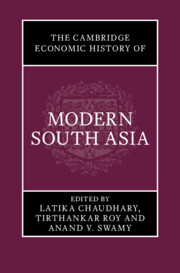
- The Cambridge Economic History of Modern South Asia
- The Cambridge Economic History of Modern South Asia
- Copyright page
- Contents
- Figures
- Tables
- Contributors to Part 1
- Preface and Acknowledgements
- 1 Introduction to Part 1
- 2 Regions, States and Economies in Transition, 1750–1850
- 3 The Colonial Origins of India’s Service Sector Advantage
- 4 Agriculture
- 5 Industry
- 6 Small-Scale Industries
- 7 Trade and Finance
- 8 Business History
- 9 Regional Patterns of Economic Change
- 10 Regional Patterns of Economic Change
- 11 Regional Patterns of Economic Change
- 12 Regional Patterns of Economic Change
- 13 Political Economy
- 14 Law and the Economy
- 15 Infrastructure
- 16 Infrastructure
- 17 Population and Health
- 18 Education
- 19 Women, Wives and Workers
- 20 Labour
- 21 Internal Migration, c. 1850–2020
- 22 Colonial Cities and Urbanization
- 23 The Environment and the Economy
- 24 Princely States
- Transition to Part 2
- Index
- References
4 - Agriculture
Published online by Cambridge University Press: 21 February 2026

Book contents
- The Cambridge Economic History of Modern South Asia
- The Cambridge Economic History of Modern South Asia
- Copyright page
- Contents
- Figures
- Tables
- Contributors to Part 1
- Preface and Acknowledgements
- 1 Introduction to Part 1
- 2 Regions, States and Economies in Transition, 1750–1850
- 3 The Colonial Origins of India’s Service Sector Advantage
- 4 Agriculture
- 5 Industry
- 6 Small-Scale Industries
- 7 Trade and Finance
- 8 Business History
- 9 Regional Patterns of Economic Change
- 10 Regional Patterns of Economic Change
- 11 Regional Patterns of Economic Change
- 12 Regional Patterns of Economic Change
- 13 Political Economy
- 14 Law and the Economy
- 15 Infrastructure
- 16 Infrastructure
- 17 Population and Health
- 18 Education
- 19 Women, Wives and Workers
- 20 Labour
- 21 Internal Migration, c. 1850–2020
- 22 Colonial Cities and Urbanization
- 23 The Environment and the Economy
- 24 Princely States
- Transition to Part 2
- Index
- References
Summary
Agriculture was the main pillar of the Indian economy under British rule. Production increased in the second half of the nineteenth century, when the agricultural area expanded, the cultivation of cash crops spread, irrigation networks were extended and export of agricultural commodities increased. In the first half of the twentieth century, production stagnated as room for further area expansion vanished, technical breakthroughs to enhance per-acre yield were limited, and the public investment in infrastructure lost its momentum. Bengal and eastern Indian areas experienced the most stagnation, while Punjab and Madras continued to grow with improvement in land productivity, including shifts to higher-value-added crops. Nevertheless, on average, the absolute level of land productivity of major crops in colonial India lagged behind global standards of that time. The chapter suggests that limited resource endowments constrained by inadequate technical breakthroughs and institutional constraints, such as the structure of land rights, were the main causes of stagnation.
Information
- Type
- Chapter
- Information
- The Cambridge Economic History of Modern South Asia , pp. 69 - 90Publisher: Cambridge University PressPrint publication year: 2026
References
Selected Bibliography
Amrith, S., Unruly Waters: How Rains, Rivers, Coasts, and Seas Have Shaped Asia’s History (New York, Basic Books, 2018).Google Scholar
Andrabi, T., Bharat, S. and Kuehlwein, M., ‘Post offices and British Indian grain price convergence’, Economic History of Developing Regions, 35, no. 1 (2020), 23–49.CrossRefGoogle Scholar
Andrabi, T. and Kuehlwein, M., ‘Railways and price convergence in British India’, Journal of Economic History, 70, no. 2 (2010), 351–77.CrossRefGoogle Scholar
Banerjee, A. and Iyer, L., ‘History, institutions and economic performance: The legacy of colonial land tenure systems in India’, American Economic Review, 95, no. 4 (2005), 1190–1213.CrossRefGoogle Scholar
Bassino, J. P. (ed.), Asian Historical Statistics 2: Vietnam (Tokyo, Toyo Keizai Inc., in press).Google Scholar
Blyn, G., Agricultural Trends in India, 1891–1947: Output, Availability, and Productivity (Philadelphia, University of Pennsylvania Press, 1966).CrossRefGoogle Scholar
Broadberry, S., Custodis, J. and Gupta, B., ‘India and the Great Divergence: An Anglo-Indian comparison of GDP per capita, 1600–1871’, Explorations in Economic History, 55, no. 1 (2015), 58–75.CrossRefGoogle Scholar
Chaudhary, L., Gupta, B., Roy, T. and Swamy, A. V., ‘Agriculture in colonial India’, in Chaudhary, L., Gupta, B., Roy, T. and Swamy, A. V. (eds), A New Economic History of Colonial India (London, Routledge, 2016), 100–16.Google Scholar
Donaldson, D., ‘Railroads of the Raj: Estimating the impact of transportation infrastructure’, American Economic Review, 108, no. 4–5 (2018), 899–934.CrossRefGoogle Scholar
Guha, S. (ed.), Growth, Stagnation or Decline? Agricultural Productivity in British India (Delhi, Oxford University Press, 1992).Google Scholar
Gupta, B., ‘From free trade to regulation: The political economy of India’s development’, in Broadberry, S. and Fukao, K. (eds), The Cambridge Economic History of the Modern World: Volume 2, 1870 to the Present (Cambridge, Cambridge University Press, 2021), 151–75.Google Scholar
Heston, A., ‘National income’, in Kumar, D. (ed.), The Cambridge Economic History of India: Volume 2, c. 1750–1970 (Cambridge, Cambridge University Press, 1983), 376–462.CrossRefGoogle Scholar
Hirashima, S., The Structure of Disparity in Developing Agriculture: A Case Study of the Pakistan Punjab (Tokyo, Institute of Developing Economies, 1978).Google Scholar
Islam, M. M., Irrigation, Agriculture and the Raj: Punjab, 1887–1947 (Delhi, Manohar, 1997).Google Scholar
Iversen, V., Palmer-Jones, R. and Sen, K., ‘On the colonial origins of agricultural development in India: A re-examination of Banerjee and Iyer, “History, institutions and economic performance”’, Journal of Development Studies, 49, no. 12 (2013), 1631–46.Google Scholar
Iyer, L., ‘The long-run consequences of colonial institutions’, in Chaudhary, L., Gupta, B., Roy, T. and Swamy, A. V. (eds), A New Economic History of Colonial India (London, Routledge, 2016), 117–39.Google Scholar
Kurosaki, T., ‘Agriculture in India and Pakistan, 1900–95: Productivity and crop mix’, Economic and Political Weekly, 34, no. 52 (1999), A160–8.Google Scholar
Kurosaki, T., ‘The agriculture–macroeconomy growth link in India, Pakistan, and Bangladesh: 1900–2000’, in Pinilla, V. and Wilelbald, H. (eds), Agricultural Development in the World Periphery: A Global Economic History Approach (Palgrave Studies in Economic History, 2018), 207–34.Google Scholar
Kurosaki, T., Comparative Economic Development in India, Pakistan, and Bangladesh: Agriculture in the 20th Century (Tokyo, Maruzen Publishers, 2017).Google Scholar
Kurosaki, T., ‘Crop specialization and long-term productivity growth in Indian agriculture: A district-level analysis’, in Mizushima, T. (ed.), Transformation of Indian Economy in the Rural–Urban Nexus (London, Routledge, 2023), 25–46.Google Scholar
Kurosaki, T., ‘Specialization and diversification in agricultural transformation: The case of West Punjab, 1903–1992’, American Journal of Agricultural Economics, 85, no. 2 (2003), 373–87.CrossRefGoogle Scholar
Minami, R. and Makino, F. (eds), Asian Historical Statistics 3: China (Tokyo, Toyo Keizai Inc., 2014).Google Scholar
Mishra, S. N. and Sharma, R. K., Livestock Development in India: An Appraisal (New Delhi, Vikas, 1990).Google Scholar
Raj, K. N., Bhattacharya, N., Guha, S. and Padhi, S. (eds), Essays on the Commercialization of Indian Agriculture (Delhi, Oxford University Press, 1985).Google Scholar
Richards, A., ‘Technical and social change in Egyptian agriculture: 1890–1914’, Economic Development and Cultural Change, 26 (1978), 725–45.CrossRefGoogle Scholar
Rönnbäck, K. and Theodoridis, D., ‘Cotton cultivation under colonial rule in India in the nineteenth century from a comparative perspective’, Economic History Review, 75, no. 2 (2022), 374–95.CrossRefGoogle Scholar
Roy, T., The Economic History of India 1857–1947 (Delhi, Oxford University Press, 2000).Google Scholar
Sen, A. K., Poverty and Famines: An Essay on Entitlement and Deprivation (Oxford, Clarendon Press, 1981).Google Scholar
Sivasubramonian, S., National Income of India in the Twentieth Century (Delhi, Oxford University Press, 2000).Google Scholar
Studer, R., ‘India and the Great Divergence: Assessing the efficiency of grain markets in eighteenth- and nineteenth-century India’, Journal of Economic History, 68, no. 2 (2008), 393–437.CrossRefGoogle Scholar
USDA (United Sates Department of Agriculture), Crop Production Historical Track Records (Washington, DC, USDA, 2018).Google Scholar
van der Eng, P., ‘Growth and productivity change in Indonesian agriculture, 1880–1985’, Institute of Economic Research Memorandum No. 348, Faculty of Economics, University of Groningen, 1990.Google Scholar
Accessibility standard: WCAG 2.0 A
Why this information is here
This section outlines the accessibility features of this content - including support for screen readers, full keyboard navigation and high-contrast display options. This may not be relevant for you.Accessibility Information
The HTML of this chapter
conforms to version 2.0 of the
Web Content Accessibility Guidelines
(WCAG), ensuring core accessibility principles are addressed and meets the basic
(A)
level of WCAG compliance, addressing essential accessibility barriers.
Content Navigation
Table of contents navigation
Allows you to navigate directly to chapters, sections, or non‐text items through a linked table of contents, reducing the need for extensive scrolling.
Allows you to navigate directly to chapters, sections, or non‐text items through a linked table of contents, reducing the need for extensive scrolling.
Index navigation
Provides an interactive index, letting you go straight to where a term or subject appears in the text without manual searching.
Provides an interactive index, letting you go straight to where a term or subject appears in the text without manual searching.
Reading Order & Textual Equivalents
Single logical reading order
You will encounter all content (including footnotes, captions, etc.) in a clear, sequential flow, making it easier to follow with assistive tools like screen readers.
You will encounter all content (including footnotes, captions, etc.) in a clear, sequential flow, making it easier to follow with assistive tools like screen readers.
Short alternative textual descriptions
You get concise descriptions (for images, charts, or media clips), ensuring you do not miss crucial information when visual or audio elements are not accessible.
You get concise descriptions (for images, charts, or media clips), ensuring you do not miss crucial information when visual or audio elements are not accessible.
Full alternative textual descriptions
You get more than just short alt text: you have comprehensive text equivalents, transcripts, captions, or audio descriptions for substantial non‐text content, which is especially helpful for complex visuals or multimedia.
You get more than just short alt text: you have comprehensive text equivalents, transcripts, captions, or audio descriptions for substantial non‐text content, which is especially helpful for complex visuals or multimedia.
Structural and Technical Features
ARIA roles provided
You gain clarity from ARIA (Accessible Rich Internet Applications) roles and attributes, as they help assistive technologies interpret how each part of the content functions.
You gain clarity from ARIA (Accessible Rich Internet Applications) roles and attributes, as they help assistive technologies interpret how each part of the content functions.