





Introduction
Institutional theory has long viewed institutionalization as a dynamic process that evolves over time, embedding an organization’s history, people, stakeholders, and interests (Scott, Reference Scott2008). According to Selznick (Reference Selznick2011), institutionalization goes beyond merely meeting technical requirements; it infuses an organization with values that shape its identity, character, and purpose. Selznick also recognized that institutionalization is not a one-size-fits-all concept but varies in degree based on an organization’s defined goals and technologies. However, within the context of Civil Society Organizations (CSOs), institutionalization often fails to transcend technical objectives. Instead, it becomes confined to rigid governing structures, shifting from horizontal, board-led organizations to more vertical, professionalized roles (Lang, Reference Lang2012). This shift aligns CSOs with governmental practices, focusing primarily on efficiency and compliance rather than the broader values and missions that originally defined them (Harwood & Creighton, Reference Harwood and Creighton2008; Meyer, Reference Meyer2025). Recent scholarship shows that shrinking civic space under spreading authoritarian practices increases regulatory scrutiny and institutional pressure on CSOs (Chimiak et al., Reference Chimiak, Kravchenko and Pape2024). This contrast raises critical questions about the true purpose of institutionalization in CSOs. Is it a means to preserve organizational values and identity, or has it become a tool for bureaucratization and professionalization for donors and governments?
We situate our argument within the Non-Governmental Organization (NGOization) literature, initially articulated by Jad (Reference Jad2004) in relation to the professionalization and co-optation of Palestinian and Arab women’s movements. Subsequently developed across a broader peer-reviewed literature, NGOization denotes the donor-driven professionalization and bureaucratization of civil society, in which managerial accountability and project logics displace locally defined priorities and political mobilization (Choudry & Kapoor, Reference Choudry and Kapoor2013; Lang, Reference Lang2012). We note that NGOization overlaps with, but is analytically distinct from the broader phenomenon of nonprofit professionalization. Professionalization denotes the adoption of managerial expertise, credentialed staffing, and rational-bureaucratic practices such as strategic planning and quantitative evaluation (Hwang & Powell, Reference Hwang and Powell2009). It can strengthen voluntary transparency (Sanzo-Pérez et al., Reference Sanzo-Pérez, Rey-Garcia and Alvarez-Gonzalez2017) and when members remain closely engaged, need not displace grassroots influence (Heylen et al., Reference Heylen, Willems and Beyers2020). NGOization, however, extends beyond managerial rationalization to encompass depoliticization, projectization, and the systematic displacement of downward accountability by donor-driven compliance logics; and as Baillie Smith and Jenkins (Reference Baillie Smith and Jenkins2011) demonstrate, even professionalization itself can produce new disconnections between cosmopolitan NGO staff and the communities they serve when it operates within neoliberal institutional frameworks. This phenomenon has diffused beyond Palestine to the broader Arab region and internationally (Atia & Herrold, Reference Atia and Herrold2018; Zencirci & Herrold, Reference Zencirci and Herrold2022; Jacobsson & Saxonberg, Reference Jacobsson and Saxonberg2016). Despite two decades of critique, NGOization remains the dominant operating logic for CSOs, largely because the field lacks actionable, design-oriented alternatives. Comparative work from Latin America and Central/Eastern Europe documents the limitations of upward accountability, projectization, and audit-centric governance and explores partial workarounds, but it rarely specifies how organizations can transition out of NGOized routines (Alvarez, Reference Alvarez2009; Jacobsson & Saxonberg, Reference Jacobsson and Saxonberg2016). One exception is Herrold (Reference Herrold2022), who shows how voluntary grassroots organizations (VGOs) in the West Bank and East Jerusalem resist NGOization by operating outside the foreign-aid system and rebuilding broad volunteer bases; our focus instead is on how NGOized Palestinian Civil Society Organizations (PCSOs) reinstitutionalize locally while retaining minimal compliance. The gap is sharpest in settings of high aid dependency, deeply embedded NGO fields, and long histories of conflict and occupation, where imported templates are most entrenched and least responsive.
This study reexamines institutionalization from institutional and managerial lenses, asking how externally imposed formality can be regrounded as an endogenous, value infusing process that reflects a CSO’s identity and community ties over time. We advance informalization as a deliberate, community-anchored response to rigid institutionalization. It represents a shift from donor-driven formalities to light, patterned practices that restore local flexibility and legitimacy while retaining a minimal formal backbone. Informalization is not an undoing of institutions but their local reconfiguration. Our guiding question is: How can CSOs in extreme contexts reinstitutionalize in a community-anchored way that meets local needs while maintaining essential compliance?
The article focuses on PCSOs, which operate under prolonged Israeli settler colonial rule and military occupation since 1967, alongside the current post-7 October 2023 Gaza war, which has generated extensive documentation of mass civilian harm and allegations of genocide under international law (Amnesty International, 2024; Human Rights Watch, 2024; International Court of Justice, 2024). This context provides a critical case for our research question because it concentrates the structural conditions including aid dependency, stringent vetting, and shrinking civic space under which NGOized templates become most entrenched and least responsive. This has intensified since October 2023, as aid has shifted from conditionality toward weaponization, deepening surveillance and control over civil society (Iqtait, Reference Iqtait2025). PCSOs’ long experience under occupation has also shaped distinctive resilience strategies and elevated Sumud (steadfastness) as a normative and practical anchor for community survival and resistance. Sumud is a Palestinian socio-political ethic of staying and enduring under occupation through everyday practices of resilience (Marie et al., Reference Marie, Hannigan and Jones2018). At the same time, a substantial share of writing on Palestine has taken the form of “grey literature,” contributing to research fatigue and mistrust among communities (Challand, Reference Challand2008; de Barcena Myrsep, Reference de Barcena Myrsep2022; Sukarieh & Tannock, Reference Sukarieh and Tannock2013). Accordingly, we situate our findings within their political and social contexts and adopt the stance of engaged scholarship that bridges academic inquiry and practitioner knowledge (Van de Ven, Reference Van de Ven2007). Studying PCSOs thus illuminates how community-based reinstitutionalization can be designed under extreme constraints, while offering broader insights into NGOization and civil society governance in comparable contexts. Drawing on semi-structured interviews, a survey and document analysis, we identify three practice pillars through which CSOs reinstitutionalize under constraint: (1) governance decentralization (horizontal structures); (2) knowledge sharing routines and organized bricolage/social innovation; and (3) the operationalization of Sumud within service delivery. We integrate these into a process model of informalization as reinstitutionalization light, patterned practices supported by a minimal formal structure that remobilizes the community. This article extends a preliminary note (Al Jayousi & Nishide, Reference Al Jayousi and Nishide2024b) by: (1) specifying mechanisms and boundary conditions that make informalization a durable governance mode; (2) integrating Sumud as a place-based institutional logic; (3) adding comparative and robustness discussion; and (4) providing a complete conclusions section and practical indicators for design.
Reframing institutional theory in extreme contexts
NGOization and its discontents
Institutional theory posits that organizations achieve stability and legitimacy by embedding shared norms, values, and practices into their structures (Scott, Reference Scott2008; Selznick, Reference Selznick2011). Yet numerous studies show that, for CSOs, this very process of embedding often morphs into a constraining formalism, also known as “NGOization.” Arda and Banerjee (Reference Arda and Banerjee2021) documents how donor conditionalities reshape governance bodies into replica steering committees that prioritize external priorities over local needs, while Zencirci & Herrold (Reference Zencirci and Herrold2022) detail the rise of professionalized staffing models and audit-centric reporting regimes that marginalize grassroots volunteers and informal networks. In contexts of chronic crisis, whether it be under occupation, state collapse, or severe resource scarcity, these externally imposed bureaucracies not only fail to support responsiveness but actively undermine community trust. Barin Cruz et al. (Reference Barin Cruz, Aguilar Delgado, Leca and Gond2016), Jarzabkowski et al. (Reference Jarzabkowski, Smets, Bednarek, Burke, Spee, Lounsbury and Boxenbaum2013) and Mair and Marti (Reference Mair and Marti2009) further highlight how CSOs in institutional voids navigate external pressures through selective coupling and other adaptive strategies. This volatile environment often leads to inflexible institutional practices, where the norms and regulations set by governments and donors become hindrances rather than support mechanisms in such extreme settings (Al Jayousi & Nishide, Reference Al Jayousi and Nishide2024a; Morrar & Baba, Reference Morrar and Baba2022). Consequently, CSOs struggle with limited responsiveness and effectiveness during crises, which ultimately jeopardizes their survival.
Under neoliberal and managerialist imperatives, NGOization’s bureaucratic machinery gives way to mission drift and depoliticization. Choudry and Kapoor (Reference Choudry and Kapoor2013) show that the imperative to meet short-term project milestones and quantified deliverables often diverts CSO attention from long-term community empowerment. Ismail and Kamat (Reference Ismail and Kamat2018) argue that this focus on technocratic outputs fragments cohesive social action into narrowly defined, donor approved interventions. Within the Palestinian context, Jad (Reference Jad2004) recounts how women’s movement autonomy was eroded by rigid donor templates, and Challand (Reference Challand2008) reveal recurring legitimacy crises when grassroots voices are sidelined in favor of externally driven agendas. Sukarieh and Tannock (Reference Sukarieh and Tannock2013) caution that communities subjected to “over-researched” interventions grow skeptical when research and program priorities mirror donor rather than local interests. Despite more than 20 years of critique, NGOization persists because clear and actionable alternatives have not been theorized or institutionalized. One partial exception is the community philanthropy and community foundation literature, which theorizes concrete ways of shifting power by rooting resources and accountability in local constituencies rather than distant donors (Hodgson, Reference Hodgson2020). In this view, bringing local giving into the funding mix can reorient organizational accountability and legitimacy toward community stakeholders and enable more locally led decision-making (Herrold, Reference Herrold2018; Hodgson, Reference Hodgson2020). Evidence from Jordan and Palestine shows that local foundations often develop rich internal knowledge-sharing practices that incorporate beneficiary perspectives, yet remain structurally isolated from international philanthropy knowledge circuits (Harrow & Sola, Reference Harrow and Sola2023). This aligns with our RAWA vignette later in the paper, which illustrates a locally anchored, trust-based funding and governance arrangement that reduces reliance on donor templates while keeping accountability grounded in the community.
Related concepts: Informality, bricolage, institutional work, and hybridity
Against this backdrop, the literature on informality emerges as a vital counterpoint, yet one that remains under-theorized in terms of continuous institutional renewal. Scholars have long observed that formal structures in organizations often serve a symbolic function rather than a purely operational one. Institutional theorists have long noted that organizations adopt formal structures for symbolic legitimacy while decoupling them from daily practice to maintain flexibility (DiMaggio & Powell, Reference DiMaggio and Powell1983; Meyer & Rowan, Reference Meyer and Rowan1977). In the nonprofit sector, this results in CSOs emulating donor imposed models and bureaucratic routines, even when these are misaligned with grassroots realities.
During crises, however, formal structures falter, nonprofit actors frequently rely on informal organizing, improvisation, and adaptive collaboration to maintain operations. Andersson (Reference Andersson2022) emphasizes how nonprofit evolution is often nonlinear, shaped by improvised judgments and informal processes in the early or crisis phases of organizational life. Waerder et al. (Reference Waerder, Thimmel, Englert and Helmig2022) complement this by showing how nonprofits sustain resilience through adaptive partnerships that bypass formal mechanisms. Jayousi and Nishide (Reference Jayousi and Nishide2025) extend this to the internal mechanisms of NGOs, showing how knowledge sharing acts as a “process of organizational adaptation” that builds resilience from within (Hilhorst & Jansen, Reference Hilhorst and Jansen2010) ethnographic account captures the “everyday politics” of frontline staff, who deploy off-the-books negotiations, community assemblies, and personal networks to carve out operational space. These studies underscore informality’s power to bridge institutional gaps but typically frame such practices as reactive or episodic, rather than as elements of a deliberate organizational wide strategy. Recent work on aid practice shows that episodic informality is partly produced by top-down aid controls, and that easing these controls can enable more continuous adaptation by local organizations. Honig highlights shifting from rigid indicator-and-reporting compliance toward field judgment and narrative accountability, while Autesserre documents how flexible, locally driven approaches avoid template- and timeline-driven constraints on adaptation (Autesserre, Reference Autesserre2021; Honig, Reference Honig2018).
Bricolage theory offers a complementary lens, emphasizing how actors under resource constraints recombine whatever materials, norms, and relationships are at hand to craft workable solutions. Cleaver (Reference Cleaver2002) conceptualizes institutional bricolage as culturally embedded problem-solving, drawing on local repertoires instead of external blueprints, while Baker and Nelson (Reference Baker and Nelson2005) extend the notion to entrepreneurial contexts, showing how micro-entrepreneurs repurpose tools and networks when formal mechanisms fail. In CSOs operating under extreme constraints, bricolage explains many improvisations but treats these as short-term, tactical responses rather than as components of a sustained institutional transformation, a limitation also found in institutional work and hybridity frameworks (Battilana & Lee, Reference Battilana and Lee2014; Lawrence et al., Reference Lawrence, Suddaby and Leca2009).
Framing informalization
Taken together, the preceding bodies of literature reveal critical dimensions of how CSOs adapt the need for flexibility (informality), the creative recombination of resources (bricolage), the enactment of agency within structures (institutional work), and the juggling of logics (hybridity). What remains missing is an integrative theory explaining how these elements coalesce into a purposeful, patterned process by which CSOs can reinstitutionalize themselves from the ground up. The process of informalization is a deliberate, community-anchored response to rigid institutionalization. It represents a shift from donor-driven formalities to light, patterned practices that restore local flexibility and legitimacy while retaining a minimal formal backbone. We do not advance informalization as a new, field-wide phenomenon. Rather, we theorize it as a deliberate response to rigid institutionalization that can scale beyond episodic micro-acts into a patterned approach to reinstitutionalizing governance and everyday routines under constraint. The main aim here is to remake institutionalization locally.
Methodology
Research design
This study adopts a single case design of the Palestinian CSO field under prolonged occupation, examining how organizations operationalize informalization under shared institutional pressures and extreme constraints. A single case approach enables an in-depth examination of organizational processes within their real-world context and the constraints that PCSOs face (Patton, Reference Patton2002; Todres & Galvin, Reference Todres and Galvin2005). Such a design is particularly appropriate here given the unique and extreme nature of the Palestinian-Israeli conflict, which provides rich insights into adaptive mechanisms that may nonetheless offer transferable lessons for other crisis affected settings (Bluhm et al., Reference Bluhm, Harman, Lee and Mitchell2011; Yin, Reference Yin2009). Additionally, it was found that qualitative research in complex and evolving contexts, particularly in the case of Palestine, demands a nuanced and reflexive approach, highlighting the potential for such research to yield valuable insights and contribute to broader understandings within the social sciences (Kacen & Chaitin, Reference Kacen and Chaitin2006).
To capture both the depth of organizational experiences and broader patterns across CSOs, the research employs a concurrent triangulation mixed methods strategy. Qualitative data includes 30 semi-structured interviews, with senior and mid-level managers and comprehensive document analysis, serve as the primary source for unpacking the processes and meanings of informalization, while a small, purposive survey (n = 18) provides descriptive triangulation of perceived rigidity and informal practices (Creswell & Clark, Reference Creswell and Clark2017; Morse, Reference Morse1991). Both data streams were collected contemporaneously (February–April 2022; September 2023–January 2024), analyzed separately to respect their methodological integrity, and then merged in the interpretation phase to identify convergent evidence. This design ensures that thematic insights are grounded in rich narrative accounts.
Sampling and data collection
This study used maximum variation purposive sampling (Patton, Reference Patton2002) to capture the diversity of Palestinian civil society dynamics. Three criteria guided case selection. First, organizations were drawn from all 12 fields of the International Classification of Non-Profit Organizations (ICNPO), health, education, culture, advocacy, relief, development, and so forth to ensure sectoral breadth (Salamon & Anheier, Reference Salamon and Anheier1996). Second, variation in organizational scale and age was built in by including long established charities (founded pre-1995), mid-sized post-Oslo NGOs and several post-2015 startups; this allowed comparison of legacy governance routines with newer, donor-driven templates. Third, geographic spread was secured by selecting PCSOs headquartered in both the West Bank and the Gaza Strip, thereby incorporating the differential effects of occupation regimes and recurrent hostilities on organizational practice. Gaza-based interviews were conducted in 2022 pre-October 2023, so Gaza evidence primarily reflects pre-war organizational conditions.
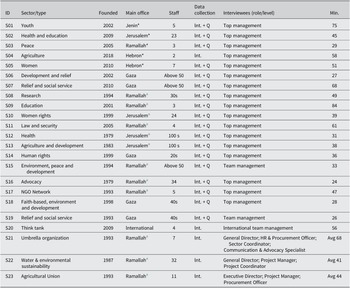
Qualitative interviews formed the core data source. Thirty semi-structured interviews with executive directors or program heads and with project or field coordinators were conducted in two waves February–April 2022 and September 2023–January 2024. Please see Table 1 for detailed information on all interviewed PCSOs, interviewee roles, and the data collected. The table highlights the diversity of organizations across sectors and regions, and shows that in some cases we interviewed multiple managerial roles within the same organization to examine intra-organizational knowledge sharing. It also covers a wide range of CSO types and sizes, from small community-based and grassroots groups to umbrella organizations and larger NGOs, including both pre-Oslo and post-Oslo organizations. The interview guide probed six organizational dynamics identified in the thesis (governance, knowledge sharing, social innovation, advocacy, relief, and development). Interviews averaged 45 minutes (range 24–84) were conducted primarily in Arabic, recorded with oral consent and transcribed verbatim (Jamshed, Reference Jamshed2014). To triangulate perceptions, an 18 item structured questionnaire was administered to the interviewees. Items were derived from interview themes, formatted on five-point Likert scales and pretested for clarity, following Dillman et al. (Reference Dillman, Smyth and Christian2014) tailored design method.
Interviewed PCSOs

Table 1. Long description
The table contains 8 columns: I D, Sector/type, Founded, Main office, Staff, Data collection, Interviewees (role/level), and Min. (duration).
* S 01: Youth, 2002, Jenin, 5 staff, Int. + Q, Top management, 75 min.
* S 02: Health and education, 2009, Jerusalem, 23 staff, Int. + Q, Top management, 45 min.
* S 03: Peace, 2005, Ramallah, 3 staff, Int. + Q, Top management, 29 min.
* S 04: Agriculture, 2018, Hebron, 2 staff, Int., Top management, 58 min.
* S 05: Women, 2010, Hebron, 7 staff, Int. + Q, Top management, 51 min.
* S 06: Development and relief, 2002, Gaza, Above 50 staff, Int. + Q, Top management, 27 min.
* S 07: Relief and social service, 2010, Gaza, Above 50 staff, Int. + Q, Top management, 68 min.
* S 08: Research, 1994, Ramallah, 30s staff, Int. + Q, Top management, 49 min.
* S 09: Education, 2001, Ramallah, 3 staff, Int. + Q, Top management, 84 min.
* S 10: Women rights, 1999, Jerusalem, 24 staff, Int. + Q, Top management, 39 min.
* S 11: Law and security, 2005, Ramallah, 4 staff, Int. + Q, Top management, 61 min.
* S 12: Health, 1979, Jerusalem, 100s staff, Int. + Q, Top management, 31 min.
* S 13: Agriculture and development, 1983, Jerusalem, 100s staff, Int. + Q, Top management, 38 min.
* S 14: Human rights, 1999, Gaza, 20s staff, Int. + Q, Top management, 36 min.
* S 15: Environment, peace and development, 1994, Ramallah, Above 50 staff, Int. + Q, Team management, 33 min.
* S 16: Advocacy, 1979, Ramallah, 34 staff, Int. + Q, Top management, 24 min.
* S 17: N G O Network, 1993, Ramallah, 5 staff, Int. + Q, Top management, 47 min.
* S 18: Faith-based, environment and development, 1998, Gaza, 40s staff, Int. + Q, Top management, 28 min.
* S 19: Relief and social service, 1993, Gaza, 40s staff, Int. + Q, Team management, 26 min.
* S 20: Think tank, 2009, International, 4 staff, Int., International team management, 56 min.
* S 21: Umbrella organization, 1993, Ramallah, 7 staff, Int., General Director and others, Avg 68 min.
* S 22: Water and environmental sustainability, 1987, Ramallah, 32 staff, Int., General Director and others, Avg 41 min.
* S 23: Agricultural Union, 1993, Ramallah, 11 staff, Int., Executive Director and others, Avg 44 min.
Footnotes indicate that Int. stands for interview, Q for questionnaire, and several cities are located in the West Bank.
a Cities located in the West Bank.
lnt., interview; lnt. + Q, interview + questionnaire.
Data were collected online between February and April 2022 and analyzed descriptively to surface cross-organizational patterns for each question. A third strand consisted of documentary analysis (Bowen, Reference Bowen2009). Annual reports, strategic plans, bylaws of sectoral networks, meeting minutes, donor proposals, and media releases were coded for references to governance changes, innovation routines, and accountability practices. These texts provided historical context and corroborated (or contradicted) interview claims. All procedures adhered to the Research Ethics Committee of the hosting Graduate School of Economics and Management at Tohoku University. Oral informed consent in Arabic or English at the interviewee’s choice was obtained prior to recording; pseudonyms were assigned, and any potentially identifying organizational details were masked in transcripts to protect anonymity. Given the sensitive context of occupation, donor surveillance and the ongoing Gaza war, interview guides avoided questions that could endanger participants. Consent was taken for publication excerpts of interviews. The interview guide, linking representative probes to initial codes, themes, and aggregate dimensions, is available as Online Supplementary Material.
Data analysis
The study followed a concurrent triangulation design in which qualitative and quantitative strands were first analyzed separately and then merged for interpretation. For the qualitative strand, all Arabic and English interview recordings were transcribed verbatim and imported into ATLAS.ti. We selected reflexive thematic analysis for data analysis because our aim was interpretive concept development rather than coder agreement (Clarke & Braun, Reference Clarke and Braun2021). Accordingly, the first author conducted the primary coding in ATLAS.ti and made positionality and analytic decisions explicit through reflexive memoing and documented theme development, rather than aiming for intercoder reliability. A five phase, iterative thematic analysis (familiarisation + initial open coding + codebook refinement + theme construction + final synthesis) provided the backbone of interpretation (Clarke & Braun, Reference Clarke and Braun2021). Coding began inductively from participants language, but a set of deductive seed codes derived from Powell (Reference Powell2006) knowledge-source framework were applied in a directed content analysis pass; new concepts that did not fit the seed codes were logged as emergent categories in keeping with a critical realist stance. Consistent with qualitative guidance on developing concepts that remain faithful to lived experience, we used participants’ accounts as the primary basis for concept specification and only then related emergent categories to the literature (Gephart & Rynes, Reference Gephart and Rynes2004). Survey data (18 responses) were summarized with descriptive statistics and juxtaposed against the thematic matrix to corroborate or disconfirm patterns. The first author is a Palestinian scholar practitioner who spent 3 years working inside CSOs before the study and is fluent in colloquial and formal Arabic as well as English.
Findings
This section introduces and develops the concept of informalization as it emerges from our empirical data. By examining the lived experiences of Palestinian civil-society organizations operating under occupation, we identify a series of practices that collectively signal a move toward informalization. These practices are often small and dispersed as one interviewee called “little revolutions” rather than a coherent system. The findings below group these micro-acts into three overarching themes: community-driven governance, innovation and knowledge sharing, and sustainable transformation. Each theme reflects how organizations attempt to circumvent the constraints of NGOization and create space for autonomy and resilience. Building on our preliminary note (Al Jayousi & Nishide, Reference Al Jayousi and Nishide2024b), we refine and substantiate the definition of informalization here through new interview evidence and triangulation.
The process of informalization
Community-driven governance
Almost every organization in our sample has formal governance mechanisms namely boards, executive directors and general assemblies mandated by Palestinian law and donor requirements. One health-sector leader explained, “without a board, we cannot register; without registration, we cannot operate; donors will not touch us.” Survey data reflect this compliance as 17 respondents report having a board and an executive director, and 15 maintain general assemblies. Yet interviewees frequently criticized how these structures have ossified. A director of a youth organization lamented that “general assemblies meet only to approve the annual report. Members have no say in the budget or program design.” Another respondent noted that board membership is often hereditary “We were founded in the 1990s, and our founding members still control the board. Young staff feel excluded.”
In response, organizations are quietly redefining participation. A gender rights coordinator recounted how her network replaced appointed committee members with elected representatives from grassroots women’s clubs “It was chaotic at first, but women felt respected. They proposed activities we never imagined, like teaching digital marketing to rural women.” In an agricultural cooperative, local clusters now submit project proposals directly to the finance committee. A cooperative leader reported, “instead of writing our proposals in Ramallah, we train local teams to draft and budget their own projects. We then consolidate them and advocate for funding.” These micro-acts redistribute power and gradually erode the old top-down model. Beyond changing membership, organizations are creating informal spaces for participation. A research organization hosts open forums where farmers, students and municipal officials discuss draft policies. An interviewee said these gatherings “give people a chance to shape our advocacy priorities” and that summary notes are sent to lawmakers.
Decentralization features prominently in the governance reforms. Several organizations have established branch offices or research units in multiple regions, enabling them to recruit local talent and respond quickly to crises without waiting for head-office approval. During a pandemic lockdown, a southern branch of a medical aid organization was able to set up a vaccination drive in a Bedouin community without waiting for head of office approval. Another organization has organized sector-specific forums on health, agriculture, culture, and youth that self-coordinate advocacy and share resources. Respondents argued that decentralization not only speeds responses but also builds trust by giving each community a sense of ownership. The survey shows that all organizations communicate with the public and claim to incorporate community needs, yet they rate public participation in decision-making as moderate, indicating that these experiments are still limited in scope.
Community driven governance focuses on the involvement of CSO constituents in decision making processes both internally and externally but also allows efficient responses and structural flexibility. The aim of this pillar is for CSOs that informalize to be not only transparent and accountable but also to engage with the community informally through informal networks, horizontal organizational structures, inclusive internal governance structures, decentralized governance, and active policy dialogue. This will help CSOs get support and guidance from their community and stakeholders enhance transparency and improve local trust.
Social innovation and knowledge sharing
Innovation is sustained through deliberate knowledge management. The survey shows that 17 of the 18 organizations archive reports and 13 document ideas during project implementation. Interviewees described multiple channels an environmental NGO produces fact sheets and maps on settler violence and waste dumping; a water organization shares success stories via videos and children’s books; agricultural NGOs maintain databases on land reclamation and crop yields; and a health network circulates best-practice manuals and hosts webinars with diaspora experts. Organizations also emphasized peer-learning a research institute director noted that their scientists mentor younger peers through journal clubs, while a gender-rights advocate explained that her network organizes reflection circles where members analyze campaign outcomes.
Several CSOs deliver vocational programs aimed at economic self-reliance. A director of a youth-oriented organization in Gaza highlighted a vocational training program that offers unemployed youth “specialized training in various fields such as sewing and embroidery, food production, home maintenance, e-commerce and marketing” and combines theory with practice so that graduates can find jobs or start businesses. A manager at an agricultural association described a project to repurpose treated sewage water, irrigating 200 dunums (around 50 hectares) of farmland and recycling 120–150 tons of waste in partnership with the local municipality. These ventures illustrate how CSOs blend innovation with service delivery to improve livelihoods. Scholarship on social innovation and social entrepreneurship helps specify a mechanism also visible here, namely that problem-centered innovation can build legitimacy and attract support by demonstrating practical value and deepening engagement with affected communities (Dacin et al., Reference Dacin, Dacin and Tracey2011; Mair & Marti, Reference Mair and Marti2006).
Here, social innovation and knowledge sharing constitute the dynamic core of informal CSOs operating in extreme contexts. Social innovation endows CSOs with the adaptability necessary for organizational resilience, particularly in conflict settings, by devising unique, context specific solutions leveraging community resources and capacities. Implementing these tailored solutions within communities not only addresses local challenges effectively but also facilitates the dissemination of this knowledge to other CSOs and communities, thereby enhancing mobilization and gaining trust from the community, donors, and government.
Sustainable organizational transformation
Many interviewees insisted that their work cannot be reduced to technocratic projects. A medical-relief leader traced the organization’s origins to the late 1970s, when volunteer doctors provided clandestine healthcare under occupation, and argued that the organization’s identity is still shaped by “resistance medicine.” A human-rights activist explained that even their legal aid is framed as part of a broader struggle for self-determination, not merely as humanitarian relief. A gender activist connected her water-governance work to environmental justice and colonial exploitation. These narratives illustrate how CSOs embed Sumud into services where programs are designed to build solidarity, preserve land and culture, and challenge the occupation.
To sustain informal CSOs in the long term, there is a need for the remobilization of civil society and the adoption of organizational resilience as well as collective Sumud. This requires services that are not only innovative but also built on political ideology. In the case of Palestinian CSOs, this means not only resilience for survival but also the end of the occupation and liberation. This pillar addresses the need for CSOs to not only adapt to changing environments but also actively engage in political and social protests and advocacy to drive long term sustainable development.
The process of informalization
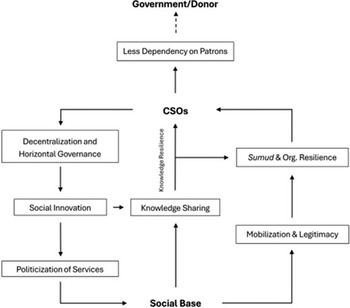
Figure 1 illustrates the process of informalization as a strategic pathway for transforming NGOized CSOs into resilient, community driven entities. This process is neither episodic nor reactive, but a patterned and deliberate adaptation to the constraints of occupation, shrinking civic space, and donor dependency. It begins with a recognition of rigidity in formalized governance and donor-driven logic, often triggered by a loss of legitimacy, flexibility, or relevance. In response, CSOs adopt decentralized and horizontal governance structures that shift the locus of authority toward grassroots actors; selective coupling (Pache & Santos, Reference Pache and Santos2013), enabling rapid, localized responses and cultivating trust.
Process model for informalization. Source: Adapted from Al Jayousi and Nishide (Reference Al Jayousi and Nishide2024b).

Fig. 1. Long description
The flowchart is structured around a central vertical axis and two lateral feedback loops.
At the bottom center is the Social Base. A vertical arrow points upward from the Social Base to Knowledge Sharing. From Knowledge Sharing, a vertical arrow labeled Knowledge Resilience points upward to C S O s. Above C S O s, a solid arrow points to a box labeled Less Dependency on Patrons, which then connects via a dashed arrow to Government forward slash Donor at the very top.
On the left side, a downward flow begins from C S O s pointing to Decentralization and Horizontal Governance. This leads down to Social Innovation, which then leads down to Politicization of Services. An arrow from Politicization of Services points back to the Social Base. Additionally, a horizontal arrow connects Social Innovation to the central Knowledge Sharing box.
On the right side, an upward flow begins from the Social Base pointing to Mobilization and Legitimacy. This leads up to Sumud and Org. Resilience. From Sumud and Org. Resilience, an arrow points back to C S O s. A horizontal arrow also connects the central Knowledge Resilience path to Sumud and Org. Resilience.
These adaptive changes reflect bricolage and institutional work as CSOs repurpose available resources, relationships, and cultural practices to create solutions outside formal donor templates. Knowledge sharing routines such as peer reflection circles, field level learning sessions, and inter organizational mentoring codify experience into repeatable, flexible practices. Rather than eliminating formal structures, CSOs selectively retain minimal norms and embed feedback loops that enable iterative learning and community engagement. Central to this reinstitutionalization is the integration of the concept of Sumud, which anchors services not only in resilience but in collective political and cultural identity. Programs are designed to restore dignity and social solidarity such as legal aid framed as resistance, or environmental justice projects rooted in indigenous stewardship. This politicized service delivery mobilizes communities, reinforces trust, and enhances CSO legitimacy beyond metrics or reporting lines.
Ultimately, informalization leads to a form of hybrid organizing that rebalances power with donors, resists the depoliticizing effects of NGOization, and restores institutional identity grounded in local values. As demonstrated, this process reduces dependency on foreign aid by cultivating endogenous systems of accountability, innovation, and governance laying the groundwork, for long term autonomy and social transformation.
From NGO work to de-NGOized practice: RAWA
We include RAWA as a contrast case. It is not a professionalized NGO that later informalized, but a community-led participatory grantmaking foundation created by former NGO workers to institutionalize an alternative to NGOization from inception. RAWA, whose slogan is “For liberatory, resilient Palestinian community work” (RAWA, Reference Rawa2024), was founded in 2018 by former NGO workers disillusioned by the restrictive and conditional nature of traditional aid, which they found stifling to vision, discourse, objectives, management methods, and work culture. RAWA’s mission is to provide social initiatives with flexibility, trust, and partnership, focusing on societal capabilities, resources, agency, and independence through participatory grantmaking, where donors share grantmaking power with beneficiaries. The organization employs decentralized governance structures, including advisory boards and local and regional clusters. Their 2024 plan aimed to “intensify collaboration with initiatives, learn with and from them, and be creative in developing our financial and organizational structures toward independence” (RAWA, Reference Rawa2024). In June 2024, RAWA highlighted its operational priorities post Gaza war, emphasizing flexibility to increase resilience despite disruptions and a lack of pre allocated funding. They addressed urgent needs such as water desalination, solar energy, food, and tent construction, while building trust in initiative leaders and their adaptive capabilities. RAWA has actively resisted international donors who weaponize aid to suppress support for Gaza, creating a fund to support Palestinian institutions that reject conditional aid and developing strategies for mobilizing collectives against malicious foreign funding (Al Jayousi & Nishide, Reference Al Jayousi and Nishide2024b). RAWA’s response to the war unfolded amid donor withdrawals and politicized funding, reinforcing its founding emphasis on flexibility, trust, and independence. This approach foregrounds collaborative problem-solving and shared learning, and it shows how practitioners can translate critiques of NGOized routines into a deliberately redesigned institutional model.
RAWA is therefore best read as a practitioner-led, community-based alternative to NGOized organizational forms, extending beyond operations to grantmaking itself. While it did not “informalize” or “de-NGOize” in the literal sense of reforming an existing professionalized NGO, it illustrates the institutional logic that a de-NGOized, community-led model makes possible. Its design hard-wires decentralized governance, trust-based resourcing, and rapid knowledge sharing with initiatives, so decisions and learning remain close to community realities rather than being driven by upward compliance routines. In this sense, RAWA shows how reducing rigid proceduralism and formal gate-keeping can be institutionalized into a durable organizing architecture, offering a concrete reference point for the mechanisms highlighted in our findings. RAWA also aligns with the community philanthropy and participatory grantmaking literature, which treats locally rooted funds as an institutional infrastructure for shifting power, embedding downward accountability, and providing flexible, trust-based resources to civic actors (Harrow & Jung, Reference Harrow and Jung2016; Hodgson, Reference Hodgson2020; Kilmurray, Reference Kilmurray2015). Empirical accounts show that such models operationalize flexibility through long-term, largely unrestricted support and a “funder as learner” stance that lightens reporting burdens and centers community knowledge (Ahmad & Khadse, Reference Ahmad and Khadse2022). Read this way, RAWA extends this literature by showing how these grantmaking designs can be institutionalized in an NGOized, high-surveillance setting so that decision-making and learning remain close to initiatives and enabling de-NGOized forms of reinstitutionalization among CSOs.
Discussion
Informalization as reinstitutionalization: What this adds to institutional theory and CSOs
This study speaks to institutional theory by reframing informality from episodic coping into a design-oriented pathway of reinstitutionalization in extreme contexts. The NGOization literature typically portrays CSOs as trapped by coercive audit regimes that produce ceremonial compliance and depoliticization. Our evidence suggests CSOs can counter this trajectory not by abandoning institutions, but by recoupling core activities to community logics through “light” routines while retaining a minimal formal backbone. In doing so, informalization replaces heavy donor templates with repeatable, feedback-rich practices that restore responsiveness and grassroots legitimacy under scrutiny. This resonates with the inhabited institutions perspective, in which formal structures acquire local force and significance only through the social interactions of the people who populate them (Hallett & Ventresca, Reference Hallett and Ventresca2006); informalization, in this reading, is the deliberate reinhabitation of institutional forms by community actors. The study specifies micro-foundations that institutional theory often leaves implicit. We show how bricolage and institutional work combine to move from ad hoc improvisation to durable routines. Unlike prior work that describes informality as reactive “everyday politics” (Hilhorst & Jansen, Reference Hilhorst and Jansen2010), our cases indicate a patterned, meso-level strategy where successful micro-acts of bricolage are deliberately codified into horizontal governing structures.
Moreover, the findings extend research on hybridity and selective coupling by specifying selective formalization as a design move rather than only a descriptive state. Work on hybrid organizing shows how actors juggle and sometimes blend competing logics (Battilana & Lee, Reference Battilana and Lee2014; Greenwood & Hinings, Reference Greenwood and Hinings1996). Studies of selective coupling explain that organizations attach to elements of one logic while buffering others (Pache & Santos, Reference Pache and Santos2013). Administrative capacity is therefore not absent from informalization. Informalization is capacity-dependent, but it does not imply weak administration; rather, it reallocates organizational capacity from producing donor-facing compliance artefacts toward locally anchored problem-solving and resilience work. Over time, this shift supports reinstitutionalization by rebuilding rules-in-use from field-based know-how and community priorities while maintaining essential compliance. Our contribution is to show how that selectivity is made durable in practice, a deliberately small set of non-negotiable controls (finance, safeguarding) kept explicit, while community-anchored routines remain light and adjustable without being drawn back into donor audit logic. This design recouples rules to work in settings where decoupling would otherwise be rational (DiMaggio & Powell, Reference DiMaggio and Powell1983; Meyer & Rowan, Reference Meyer and Rowan1977). Following Ray (Reference Ray2019), decoupling is shaped by asymmetric control over legitimacy and resources. In our case, donor templates can function as credentialing devices, while informalization keeps minimal compliance but recenters legitimacy in community-visible stewardship and locally anchored priorities, aligning with resilience-oriented accounts of organizing under adversity (Waerder et al., Reference Waerder, Thimmel, Englert and Helmig2022). In short, rather than treating formalization and effectiveness as tightly coupled, our cases show that effectiveness can be maintained when formality is intentional, minimal, and instrumental. This addresses a common concern in the informality literature by keeping probity strict and decision traces public through open minutes, learning notes, and simple logs (Harriss, Reference Harriss2002).
Crucially, we do not treat formality or professionalization as inherently problematic. We begin from the view that institutionalization is a dynamic, historical process that evolves over time through organizations’ embeddedness in people, stakeholders, and contested collective interests, not only through donor templates. Formality and professionalization can therefore be enabling, as they can secure organizational durability, fiduciary probity, and legitimacy, and they can increase access to donors, ministries, and policy and coordination forums (Meyer & Rowan, Reference Meyer and Rowan1977; Scott, Reference Scott2008). The central question in this paper is thus not whether to institutionalize, but what kinds of institutionalization enable Palestinian CSOs to remain effective and negotiate external demands without losing community accountability. Our cases suggest that organizations that consolidated core structures earlier before Oslo and donor emergence were often better positioned to work with donor funding while retaining mission control, whereas others faced more rigid, upward-facing institutional pressures. We therefore treat informalization as a transitional pathway to locally led reinstitutionalization and selective formalization, recovering agency over rules-in-use and rebalancing accountability across stakeholders, rather than rejecting formality as such.
We foreground the importance of local logics because they turn values into the everyday procedures that keep organizations honest, fast, and politically meaningful in Palestine. Sumud ties service delivery to dignity, solidarity, and stewardship, so decisions are not just technical fixes but steps that face the structure of Israeli occupation. Seen through a sensegiving lens, such rhetorical framing is part of the practical work of informalization as it stabilizes shared meaning and legitimizes local agency from rigid templates (Levine Daniel & Eckerd, Reference Levine Daniel and Eckerd2019). It is how CSOs act on root causes when donors will not name them publicly. Where external templates avoid land, mobility, dispossession, and rights, Sumud-based routines let programs defend access to water, protect livelihoods, and support legal and social resilience while staying answerable through clear traces. In practice, this mix reduces delay, builds trust, and makes it harder to strip politics from service. It gives coalitions credible ground to ask for lighter formats and faster cycles, and it lets communities see that action is aligned with their demands, not only with the safety of a donor’s script by replacing resistance with resilience (Elhendi and Buzzanell, Reference Elhendi and Buzzanell2024).
Informalization in this study is not a detour from institutions but a way to rebuild them from the community outward. In Palestine, NGOization has pushed organizations toward technical delivery, donor-led reporting, and safe advocacy, which weakened links to social bases and narrowed room for collective action (Stroup and Wong, Reference Stroup and Wong2017). Informalization recouples organizations with their publics by moving authority closer to where problems are felt and solved.
Practically, CSOs can redesign governance by delegating routine approvals to regional clusters and institutionalizing “light traces” that ensure probity without delay. Teams should maintain a minimal compliance spine (safeguarding, finance) while granting field staff explicit discretion to adapt. Donors can align with this by shifting from heavy ex-ante prescription to light ex-post transparency, assessing effectiveness via community-anchored indicators that reflect Sumud. This aligns with foreign-aid localization arguments that call for shifting decision authority and resources toward local actors and privileging contextual judgement over standardized compliance (Roepstorff, Reference Roepstorff2020). It also echoes work showing that adaptive, problem-driven management outperforms tight top-down control in complex settings (Autesserre, Reference Autesserre2021; Honig, Reference Honig2018). Together these steps operationalize disciplined flexibility, keep authority close to the ground, and translate informalization into reliable practice without sacrificing integrity. While NGOization pressures appear across both Gaza and the West Bank, its intensity varied with security risk and access. Gaza-based organizations and similarly constrained locales such as Jenin and Hebron reported more hierarchical procedures, extra vetting/verification, and greater bureaucratic burden around aid delivery and coordination than donor-proximate centers such as Ramallah and Jerusalem. This risk-gradient shaped who could access funding and reinforced external governance logics rather than countering them.
When informalization becomes viable
Our claim is not that informalization is widespread, but that it becomes a viable organizational response under particular field conditions. Palestine is an extreme case of an NGOized and securitized aid environment, where short-term funding, dense compliance, and legitimacy policing make “standard” professionalization both costly and unevenly accessible (El Kurd, Reference El Kurd2019; Stroup & Wong, Reference Stroup and Wong2017; Wildeman & Tartir, Reference Wildeman, Tartir, Bicchi, Challand and Heydemann2018). We therefore aim for analytic generalization as the mechanisms we identify should travel most to settings that share high aid dependency, heavy upward accountability, and constrained civic space (Honig, Reference Honig2018; Roepstorff, Reference Roepstorff2020; Yin, Reference Yin2009). At the same time, informalization is not a cure-all. Formalization and professionalization can secure continuity, safeguard financial integrity, and open seats at coordination and policy tables; they also reduce “key-person” fragility and preserve organizational memory. But in NGOized fields, sustainability is already fragile because project cycles and audit logics reward short-term deliverables over long-run capacity (Choudry & Kapoor, Reference Choudry and Kapoor2013). Informal practices can also take harmful forms such as brokerage, unequal access to donors, opaque decision-making, and in high-surveillance contexts they may increase exposure to derisking and politicized delegitimation from the Israeli government and even attacks. In practice, staff may have limited slack to “redesign” governance comprehensively. Under audit-heavy, short-cycle funding, informalization often operates as triage; reducing governance overhead so organizations can sustain delivery despite chronic time and energy constraints. Future research should track when such designs remain viable over time and how they intersect with localization and community-philanthropy infrastructures that can provide flexible, trust-based resourcing in constrained settings.
Conclusion
Informalization in this study emerges as a context-grounded mode of reinstitutionalization that restores flexibility, accelerates decisions, and re-centers legitimacy by relocating authority to the field. Through horizontal governance with rotating decision forums, regional or cluster coordination, and peer-reflection routines, organizations keep a lean compliance spine while empowering practitioners closest to shifting risks and needs to exercise informed discretion. In Palestine’s constraint-laden environment, Sumud works as an anchoring institutional logic that orients everyday work toward dignity, stewardship, and community accountability, so that innovation and knowledge sharing remain locally owned. Rather than abandoning formality, selective formalization protects financial integrity while enabling experimentation, rapid iteration, and cross-site learning to circulate across programs.
This study establishes informalization not as a rejection of professional standards, but as a design-oriented pathway for relocalizing institutional rules in extreme contexts. We do not argue that formality is inherently negative; indeed, formal structures remain essential for securing continuity, safeguarding financial integrity, and preserving organizational memory. However, in deeply NGOized and securitized environments like Palestine, standard professionalization often morphs into a constraining cage that severs links to the community. We offer these insights as an analytic generalization. This model is not a universal “cure-all” and comes with its own risks, including potential key-person fragility or opacity if the formal spine is too weak. Rather, it is a specific viability strategy for settings defined by high aid dependency, heavy upward accountability, and constrained civic space. Future research must therefore track how these “relocalized” designs endure over time, and whether they can eventually reshape the rigid donor architectures that make them necessary in the first place.
Supplementary material
The supplementary material for this article can be found at http://doi.org/10.1017/S0957876526000392.
Acknowledgements
We would like to extend our sincere thanks to all PCSOs and the participants involved in the interviews and questionnaire. This article could not have been realized without their thoroughness and genuineness during the interviews. We sincerely thank Prof. Aya Okada who served on the advisory board for her critical feedback, which was instrumental in bringing this work to completion. Finally, we thank the International Society for Third-Sector Research for its enlightening conference in Belgium which helped develop this study. The authors used the generative AI tool ChatGPT 5.0 to assist with language polishing and outline refinement. No text, data, analyses, or figures were generated without subsequent human verification and revision, and the authors take full responsibility for all content.
Funding statement
No specific grant funded the research. The author received general support from JSPS KAKENHI (No. 25KF0098). The funders had no role in the study design, data collection and analysis, decision to publish, or preparation of the manuscript.
Competing interests
All authors certify that they have no affiliations with or involvement in any organization or entity with any financial interest or non-financial interest in the subject matter or materials discussed in this manuscript.


 Open access

