

The Cognitive Revolution was an intellectual movement in the 1950s and 1960s focused on using the scientific method to understand human cognition, otherwise known as the process of learning and memory. This revolution in the field of psychology was happening at the same time that neuroscientists like Hubel and Wiesel were exploring how neurons in the brain are organized to enable behaviors such as visual perception. It was in this environment that both Peter and Janellen developed further as scientists. The connections between their respective fields provided fodder for discussion and debate throughout their careers. Peter focused on cellular events and biological processes in developmental neuroscience, while Janellen probed the mechanisms of human verbal and mathematical learning and memory.
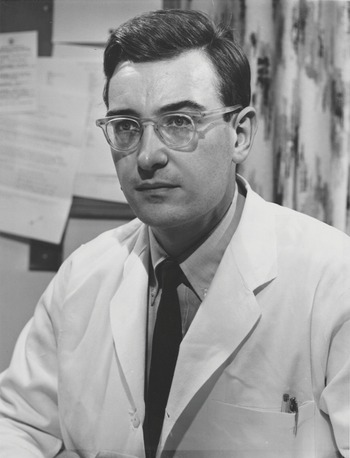
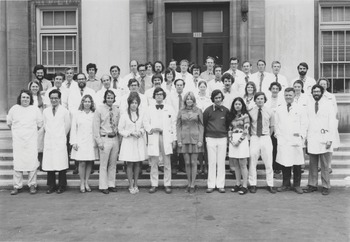
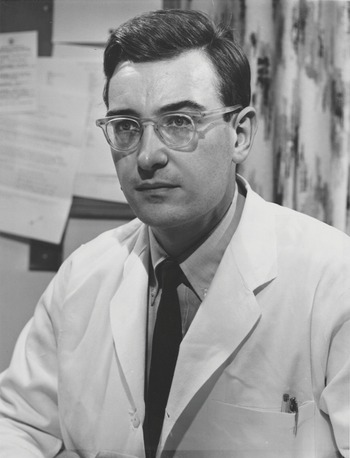
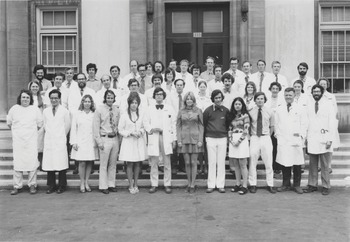
Returning to Boston after a few whirlwind years at the National Institutes of Health was a shocking transition for both Peter and Janellen. Peter had to jump back into the demanding hours of clinical training in neurology at Massachusetts General Hospital (MGH), often clocking 100 hours per week in the hospital (Figure 10.1). During these years Peter spent more time with his neurology colleagues at MGH than with his own family (Figure 10.2). Peter’s mother Else commented more than once: “Janellen, you really are as good as an heiress,” referring to Janellen providing both the care for their growing family and the financial support while Peter engaged in clinical training with limited pay. In the 1950s and 1960s, the era of the “happy homemaker,” Janellen worked full-time jobs. She finished her PhD and started a postdoctoral fellowship at Harvard in the Department of Psychology. In the midst of the Cognitive Revolution, Janellen was well prepared for the quantitative focus of this new field because she had completed her PhD with a talented statistician, Professor Frederick Mosteller. On the scientific publication database PubMed Janellen’s first listed publication is a single-authored paper entitled “Development of formal reasoning on concept formation problems,” published in Child Development in 1964.
Peter and Janellen searched for a place to live in Boston close to the MGH, so that Peter could see his family during breaks in his work schedule. They found a dilapidated old brownstone home on Myrtle Street in the Beacon Hill neighborhood of Boston. They could not afford to buy a home, even in what was then a run-down neighborhood, but a close friend of Janellen’s and fellow graduate student from Radcliffe, the economist Barbara Bergmann, offered to pay the down payment on the home. They swiftly formed an agreement and, during the next years, between shifts in the hospital, Peter spent his spare time – with his children close by – fixing up this old home. The house is in the now very upscale and gentrified Beacon Hill neighborhood. Ironically, at the time, break-ins and other disruptions were common. One dark night, a man who was climbing over a wall in the rear of their home was met by Peter holding the nearest thing he could grab – an alarm clock – out of the window and shouting – in his thick German accent – “Get out or I will shoot!” It worked. By the time Peter and Janellen sold the home it had gained significantly in value. Peter and Janellen were able to pay back their friend for the down payment and retain sufficient funds for a down payment on a home near their next academic destination, Yale University.
In the late 1950s, a neuroscience hub was developed at Harvard University. Otto Krayer, Peter’s first research mentor and the chair of the Department of Pharmacology at Harvard Medical School, recognized the growing importance of neurobiology to the field of pharmacology. He recruited Stephen W. Kuffler to join his department, and Kuffler brought a group of four younger colleagues to form a new Department of Neurobiology. Kuffler was a famous neuroscientist who pioneered the use of crayfish to study dendrites, one of the connecting projections of neurons. As a supporter of simple model systems in neuroscience, Kuffler provided important support and mentorship for Eric Kandel and his work with the sea slug Aplysia. The core faculty recruited by Kuffler included significant young talent: David Hubel, Torsten Wiesel, Ed Furshpan and David Potter.
Key to navigating these years for Janellen was her network of career-oriented women friends, whose success as females in academia was not common in the late 1950s and early 1960s. During Janellen’s PhD and postdoctoral training she developed a close and lifelong friendship with David Potter’s wife, Molly Potter, a fellow PhD student and postdoctoral fellow at Harvard in cognitive psychology. Molly Potter, Denise Kandel and the economist Barbara Bergmann were all close friends of Janellen who combined successful academic careers with raising children, which was even more unusual at that time. Indeed, Janellen, Molly and Denise were all pregnant at the same time in 1961. Peter and Janellen socialized frequently with this network of neuroscientists and psychologists, many of whom went on to remarkable scientific careers. Molly Potter became a named professor at Massachusetts Institute of Technology, with interests in rapid visual processing. She discovered that people understand pictures faster than writing. Denise Kandel became a professor at Columbia University and studied the sequence of first-time use of various legal and illegal drugs. Barbara Bergmann worked for multiple US government agencies, University of Maryland and American University, as a feminist economist focused on increasing the status of women. There is no question that this network of female and male colleagues/friends/spouses provided an important influence for both Janellen and Peter. They provided uncommon examples of how both women and men could successfully balance high-powered careers with long-term marriages and child rearing.
Peter was the only member of this group who continued with clinical medicine and basic science. Eric Kandel had initially pursued dual clinical (psychoanalysis) and basic research in his first faculty position at Harvard Medical School. As quoted in Eric’s book In Search of Memory, his wife Denise said to him at the time: “What, compromise your scientific career by trying to combine basic research with clinical practice and administrative responsibilities!” [Reference Kandel1]. Eric agreed that his basic research goals were not compatible with continued clinical work, and in the mid-1960s the Kandels moved to New York City where Eric built his very successful scientific career.
Peter made a different decision and did both clinical medicine and science for the rest of his career. Carter Snead, his first fellow at Yale, later said: “Peter taught me to be a clinician and a scientist before there was such a term.” After completing clinical training, Peter performed fundamental research as a junior faculty member at Harvard Medical School. During this time Peter published a Letter (peer-reviewed paper) in Nature, in 1966, entitled “Development of neuronal activity in the neocortex of the kitten” [Reference Huttenlocher2]. In that paper he wrote: “The results indicate that large parts of neocortex in the kitten are electrically silent at birth, but that neuronal activity rapidly develops in the postnatal period.” This was one of his first studies trying to address the developmental changes in brain connections, in this case using single neuron recordings. He concluded: “The earliest activity in cortical neurons shows little of the complexity seen in the adult cerebral cortex.” This question – how the brain normally develops and makes connections over development – drove his future research on synaptogenesis during human brain development.
The Nobel Prize-winning work of David Hubel and Torsten Wiesel on the plasticity of neuronal connections in the visual system (described in Chapter 2) had a significant influence on Peter. Their discovery that there is a window of plasticity during the development of the visual system provided important new insights into the mammalian brain. Understanding this plasticity became a major focus of the later work of both Peter and Janellen, who asked: How does the environment influence brain development and childhood learning?