


INTRODUCTION
Over the past two decades, studies have highlighted the important role of absorptive capacity in achieving higher innovation and performance (Cohen & Levinthal, Reference Cohen and Levinthal1990; Tsai, Reference Tsai2001; Zahra & George, Reference Zahra and George2002; Verreynne, Reference Verreynne2011; Huang, Rice, & Martin, Reference Huang, Rice and Martin2015; Ferreras-Méndez, Fernández-Mesa, & Alegre, Reference Ferreras-Méndez, Fernández-Mesa and Alegre2016). Through absorptive capacity, firms can identify, assimilate, and exploit more than one kind of knowledge to improve innovation and performance (Cohen & Levinthal, Reference Cohen and Levinthal1990; Laursen & Salter, Reference Laursen and Salter2006; Volberda, Foss, & Lyles, Reference Volberda, Foss and Lyles2010). Previous studies have also pointed out that knowledge may be characterized in breadth of knowledge and depth of knowledge (Volberda, Foss, & Lyles, Reference Volberda, Foss and Lyles2010; Judge et al., Reference Judge, Witt, Zattoni, Talaulicar, Chen, Lewellyn, Hu, Shukla, Bell, Gabrielsson, Lopez, Yamak, Fassin, McCarthy, Rivas, Fainshmidt and Van Ees2015). Breadth of knowledge reflects the extent to which knowledge spans multiple domains (diverse and heterogeneous knowledge), while depth of knowledge reflects the level of knowledge sophistication and specialization (Van Den Bosch, Van Wijk, & Volberda, Reference Van Den Bosch, Van Wijk and Volberda2003; Volberda, Foss, & Lyles, Reference Volberda, Foss and Lyles2010; Judge et al., Reference Judge, Witt, Zattoni, Talaulicar, Chen, Lewellyn, Hu, Shukla, Bell, Gabrielsson, Lopez, Yamak, Fassin, McCarthy, Rivas, Fainshmidt and Van Ees2015). Both the breadth and depth of knowledge are important to a firm’s innovation and performance. For instance, Taylor and Greve (Reference Taylor and Greve2006) believe that a firm with diverse and heterogeneous knowledge tends to generate cutting-edge ideas and a novel linkage of knowledge components that benefit firm innovation and performance, while Zahra and George (Reference Zahra and George2002) indicate that professional and complex knowledge is essential to radical innovation due to the knowledge depth in facilitating and realizing the novel ideas.
The breadth and depth of knowledge, however, should match its related absorptive capacity (Kogut & Zander, Reference Kogut and Zander1992; Volberda, Foss, & Lyles, Reference Volberda, Foss and Lyles2010). When a firm develops absorptive capacity that matches the breadth and depth of knowledge, it can improve the performance of knowledge absorption. On the basis of absorbing breadth and depth of knowledge, Zahra, Larraneta, and Galán (Reference Zahra, Larraneta and Galán2015) introduced the concepts of ‘breadth of absorptive capacity’ and ‘depth of absorptive capacity.’ Breadth of absorptive capacity refers to ‘the extent to which the knowledge contained in the firm’s absorptive capacity is multifaceted and comprehensive in its coverage of a multitude of fields’ (Zahra, Larraneta, & Galán, Reference Zahra, Larraneta and Galán2015: 3), while depth of absorptive capacity refers to ‘the extent to which the firm has developed expert-type mastery of a particular technological domain’ (Zahra, Larraneta, & Galán, Reference Zahra, Larraneta and Galán2015: 3).
Although Zahra, Larraneta, and Galán (Reference Zahra, Larraneta and Galán2015) have indicated that the breadth and depth of absorptive capacity are positive related to innovation and performance, there is a lack of empirical study on its antecedents and outcomes. As Lane, Koka, and Pathak point out, ‘in addition to the lack of empirical evidence, the influence of knowledge type on a firm’s ability to utilize it has received relatively little attention’ (Reference Lane, Koka and Pathak2006: 846). In order to address these research gaps, this paper explores the antecedents and outcomes of the breadth and depth of absorptive capacity from the view of social capital theory. The empirical results indicate that weak tie sources and knowledge breadth can enhance the breadth of absorptive capacity; that strong tie sources and knowledge depth can strengthen the depth of absorptive capacity; that breadth of absorptive capacity positively impacts depth of absorptive capacity; and that both breadth and depth of absorptive capacity are positively related to innovation performance.
In addition to filling research gaps, this paper attempts to make several contributions. First, this paper develops the measurements to operate the concepts of breadth of absorptive capacity and depth of absorptive capacity. Although Zahra, Larraneta, and Galán (Reference Zahra, Larraneta and Galán2015) introduced the concepts of the breadth of absorptive capacity and depth of absorptive capacity, a new typology of absorptive capacity, measurement scales to operate these concepts have not yet been developed. This paper develops the scales to operate the concepts, which is the development of the typology associated with breadth and depth of absorptive capacity. Second, this paper reveals the formation mechanism of the breadth and depth absorptive capacity from the view of social capital theory. The results indicate that weak tie sources and knowledge breadth are conductive to the formation of breadth of absorptive capacity and that strong tie sources and knowledge depth contribute to the formation of depth of absorptive capacity. This result is consistent with previous studies: prior related knowledge is the most important antecedent to absorptive capacity (Cohen & Levinthal, Reference Cohen and Levinthal1990; Van Den Bosch, Volberda, & De Boer, Reference Van Den Bosch, Volberda and De Boer1999), weak tie sources contain a breadth of knowledge resources (Coradi, Heinzen, & Boutellier, Reference Coradi, Heinzen and Boutellier2015), and strong tie sources are greatly beneficial in the acquisition of useful (tacit and specialized) knowledge (Szulanski, Reference Szulanski1996; Uzzi, Reference Uzzi1997; Hansen, Reference Hansen1999; Suseno & Ratten, Reference Suseno and Ratten2007). Third, this paper explores the different effects of breadth and depth of absorptive capacity on innovation performance. Although previous studies have suggested that absorptive capacity is key to innovation and performance (Cohen & Levinthal, Reference Cohen and Levinthal1990; Tsai, Reference Tsai2001; Zahra & George, Reference Zahra and George2002; Verreynne, Reference Verreynne2011; Huang, Rice, & Martin, Reference Huang, Rice and Martin2015; Ferreras-Méndez, Fernández-Mesa, & Alegre, Reference Ferreras-Méndez, Fernández-Mesa and Alegre2016), they did not explore the different kinds of absorptive capacity based on knowledge feature effects of innovation performance. This paper reveals that depth of absorptive capacity is better than breadth of absorptive capacity in improving innovation performance. Finally, this paper reveals that breadth of absorptive capacity is beneficial to the formation of depth of absorptive capacity. Although Zahra, Larraneta, and Galán (Reference Zahra, Larraneta and Galán2015) introduced the concepts of breadth and depth of absorptive capacity and indicated that such capacity is important to firm innovation, they did not study the relationship between the breadth and depth of absorptive capacity. Therefore, this paper validates and develops the theory of absorptive capacity.
This article is organized as follows. We begin by building the theory background of the paper. Next, we present our hypotheses based on the existing literature. We then describe our research method and findings. In the final section, we discuss the contributions and limitations of the study, provide suggestions for future research, and conclude.
THEORY BACKGROUND
Absorptive capacity
Cohen and Levinthal define the concept of absorptive capacity as ‘the ability of a firm to recognize the value of new, external information, assimilate it, and apply it to commercial ends’ (Reference Cohen and Levinthal1990: 128). Other scholars have further explored this definition and enhanced the meaning of absorptive capacity from the dimensions of process, utility, level, knowledge feature, and so on. Table 1 shows the various treatments of absorptive capacity in the extant literature.
Past conceptualizations of absorptive capacity

Among the above-mentioned studies, Vasudeva and Anand (Reference Vasudeva and Anand2011) discuss features of knowledge in their study of absorptive capacity. The authors conceptualize the learning component that allows a firm to utilize scope, breadth, and diversity in knowledge as ‘latitudinal absorptive capacity.’ They also propose the concept of ‘longitudinal absorptive capacity,’ which refers to a firm’s capacity to use unfamiliar or unrelated – that is, ‘distant’ – technological knowledge. The research of Vasudeva and Anand (Reference Vasudeva and Anand2011) provides insight into the relationship between features of knowledge and absorptive capacity, but does not clarify how these features of absorptive capacity are created. In this study, we focus on two features of knowledge – breadth and depth of knowledge. We propose that the two features of knowledge interact differently with breadth and depth of absorptive capacity. According to Zahra, Larraneta, and Galán, breadth of absorptive capacity refers to ‘the extent to which the knowledge contained in the firm’s absorptive capacity is multifaceted and comprehensive in its coverage of a multitude of fields’ (Reference Zahra, Larraneta and Galán2015: 3), while depth of absorptive capacity refers to ‘the extent to which the firm has developed expert-type mastery of a particular technological domain’ (Reference Zahra, Larraneta and Galán2015: 3).
The breadth and depth of absorptive capacity is a new typology of absorptive capacity that is different from previous studies. This new typology especially differs from the concepts of potential absorptive capacity and realized absorptive capacity which are also proposed by Zahra. Potential absorptive capacity and realized absorptive capacity are divided based on the dimension of process. Potential absorptive capacity includes knowledge acquisition and assimilation, which mainly focusses on knowledge exploration, while realized absorptive capacity includes knowledge transformation and exploitation, which mainly focusses on knowledge exploitation (Zahra & George, Reference Zahra and George2002; Jansen, Van Den Bosch, & Volberda, Reference Jansen, Van Den Bosch and Volberda2005). Breath of absorptive capacity and depth of absorptive capacity, however, are divided on features of knowledge (breadth and depth of knowledge). Two points should be noted. First, the breadth of absorptive capacity concentrates on diverse and heterogeneous knowledge (breadth of knowledge), while depth of absorptive capacity focusses on specialized and complex knowledge (depth of knowledge) (Van Den Bosch, Van Wijk, & Volberda, Reference Van Den Bosch, Van Wijk and Volberda2003). Second, the breadth of absorptive capacity stresses whether a firms’ absorptive capacity is narrow (covering only a few fields) or broad (covering a wide range of fields), while depth of absorptive capacity underlines whether a firms’ absorptive capacity is shallow (where a firm has any level of skill in a given field) to deep (where the firm has great expertise in a given field) (Zahra, Larraneta, & Galán, Reference Zahra, Larraneta and Galán2015). The breadth and depth of absorptive capacity provides a convenient way to conceptualize the effect of absorptive capacity on innovation from the view of knowledge features (Zahra, Larraneta, & Galán, Reference Zahra, Larraneta and Galán2015). In the process of organizational innovation, a firm needs breadth and depth of absorptive capacity to advance the scope and efficiency of innovation – that is, the breadth of absorptive capacity benefits the scope of innovation, while the depth of absorptive capacity is conductive to the efficacy of innovation (Van Den Bosch, Van Wijk, & Volberda, Reference Van Den Bosch, Van Wijk and Volberda2003).
Social capital theory
Since social capital theory was introduced by Coleman (Reference Coleman1988), it has attracted wide interest and has permeated to firm level (Burt, Reference Burt1992; Koka & Prescott, Reference Koka and Prescott2002). It has been generally acknowledged that a firm establishes diverse interfirm ties in the course of its business activities (Koka & Prescott, Reference Koka and Prescott2002). Such interfirm relationships are a part of social capital for the following reasons. First, interfirm relationships are conduits of information and generate opportunities for firms and second, such relationships form a pattern of obligations and expectations that are beneficial to the firms (Burt, Reference Burt1992; Koka & Prescott, Reference Koka and Prescott2002).
Tie strength is an important concept in social capital theory and enable firms to exchange information, knowledge, and other social capital (Koka & Prescott, Reference Koka and Prescott2002). According to Granovetter (Reference Granovetter1973), the strength of a tie is determined by a combination of amount of time, emotional intensity, intimacy (mutual confiding), and reciprocal services that characterize the relationship. According to previous studies, tie strength may be divided into two types – strong and weak tie sources (Granovetter, Reference Granovetter1973; Michelfelder & Kratzer, Reference Michelfelder and Kratzer2013; Paliokaitė & Pačėsa, Reference Paliokaitė and Pačėsa2015). Weak tie sources refer to a firm’s external linkages with which it does not maintain regular contact – such as temporary customers and suppliers, short-term partners, and so on – that can expand the knowledge zone of the firm and develop knowledge breadth; strong tie sources refers to a firm’s external linkage with which it maintains consistent interactions – such as long-term suppliers, stable customers, and strategic alliances – that can enhance the firm’s knowledge depth (Michelfelder & Kratzer, Reference Michelfelder and Kratzer2013; Paliokaitė & Pačėsa, Reference Paliokaitė and Pačėsa2015).
HYPOTHESES DEVELOPMENT
Antecedents of breadth of absorptive capacity
Many studies have affirmed that the key advantage of weak tie sources is access to diverse knowledge. For example, Granovetter (Reference Granovetter1973) maintains that weak tie sources are often more important in spreading information or resources because they tend to serve as a bridge between otherwise disconnected social groups. Following that line of thought, Coradi, Heinzen, and Boutellier (Reference Coradi, Heinzen and Boutellier2015) points out that as weak tie sources have a low degree of connectivity, they do not provide the deep social support of dense networks; thus such sources provide more opportunities to secure new information and diverse perspectives that can facilitate ideas (Fleming, Mingo, & Chen, Reference Fleming, Mingo and Chen2007). Previous research has also found that weak tie sources transfer and secure codified knowledge efficiently and easily (Hansen, Reference Hansen1999). For example, a knowledge worker that has mostly weak tie sources with direct exchange partners would have few obligations to those partners (McFadyen, Semadeni, & Cannella, Reference McFadyen, Semadeni and Cannella2009). Furthermore, Perry-Smith (Reference Perry-Smith2006) finds a positive link between the number of weak tie acquaintances in scientists’ networks and creativity. Similarly, Granovetter (Reference Granovetter1973) states that an increasing number of weak tie sources coincides with elevated levels of creativity and innovation. Hence, a knowledge network of weak ties can bring about a breadth of knowledge and innovation opportunities for firms. We therefore hypothesize the following:
Hypothesis 1a: Weak tie sources are positively related to breadth of absorptive capacity.
Research on individual, organizational, and interorganizational learning indicates that prior knowledge facilitates the process of new knowledge acquisition (Szulanski, Reference Szulanski1996). Knowledge breadth refers to the extent to which the firm’s knowledge repository contains distinct and multiple domains, and it reflects a firm having possessed diverse and heterogeneous knowledge (Zhou & Li, Reference Zhou and Li2012). The breadth of knowledge within a firm increases the potential for absorption of information from multiple knowledge areas (Sapienza, Autio, George, & Zahra, Reference Sapienza, Autio, George and Zahra2006). This broader knowledge base provides the firm with increased flexibility and adaptability to environmental changes (Rusly, Sun, & Corner, Reference Rusly, Sun and Corner2015) that help the firm to identify and acquire external knowledge. Conversely, if a firm’s knowledge base is narrow, its core capabilities are likely to evolve into core rigidities (Leonard-Barton, Reference Leonard-Barton1992) that will limit its knowledge search ability. We therefore hypothesize the following:
Hypothesis 1b: Knowledge breadth is positively related to breadth of absorptive capacity.
Antecedents of depth of absorptive capacity
Strong tie sources are characterized by multiplex relationships and long-term general reciprocity as well as deep trust and shared values that are important for mutual support and collective action(Suseno & Ratten, Reference Suseno and Ratten2007). Strong tie sources contain much overlapping, but less diverse, knowledge (McFadyen, Semadeni, & Cannella, Reference McFadyen, Semadeni and Cannella2009). Research has established several benefits of strong tie sources relevant to knowledge transfer, acquisition, and creation. Individuals who experience interactions with others are more helpful, provide more assistance and support to one another, and show higher levels of trust (Seibert, Kraimer, & Liden, Reference Seibert, Kraimer and Liden2001; Levin & Cross, Reference Levin and Cross2004). Trusting relationships facilitate the sharing of exclusive knowledge (Szulanski, Reference Szulanski1996; De Jong & Dirks, Reference De Jong and Dirks2012). Moreover, fine-grained, information that is more detailed, tacit, and holistic is efficiently transferred through strong tie sources that aids in generating solutions to problems (Uzzi, Reference Uzzi1997; Obstfeld, Reference Obstfeld2005). We therefore hypothesize the following:
Hypothesis 2a: Strong tie sources are positively related to depth of absorptive capacity.
Previous studies have pointed out that organizations need prior knowledge to assimilate and apply new knowledge (Cohen & Levinthal, Reference Cohen and Levinthal1990; Kogut & Zander, Reference Kogut and Zander1992). Knowledge depth refers to the level of sophistication and complexity of knowledge in key fields, and a firm’s knowledge depth represents its having owned professional and complex knowledge (Zhou & Li, Reference Zhou and Li2012). Kotabe, Martin, and Domoto (Reference Kotabe, Martin and Domoto2003) show that firms with in-depth knowledge are likely to facilitate transferring higher-level technological capabilities. In light of cooperation, when a firm possesses more specialized knowledge in a particular field, such additional knowledge will then exist between the firm and its partners. The similarity of knowledge between the acquirer and the target is crucial to the acquirer’s ability to absorb the target’s knowledge (Mowery, Oxley, & Silverman, Reference Mowery, Oxley and Silverman1996). Furthermore, if a firm has a sufficient deep knowledge base, it will facilitate the transformation and exploitation of professional and complex knowledge (Zhou & Li, Reference Zhou and Li2012). We therefore hypothesize the following:
Hypothesis 2b: Knowledge depth is positively related to depth of absorptive capacity.
The relationship between breadth and depth of absorptive capacity
As previously mentioned, breadth of absorptive capacity can identify, assimilate, and exploit diverse and heterogeneous knowledge that provide the knowledge base for the depth of absorptive capacity. The greater a firm’s breadth of absorptive capacity, the greater the knowledge base of the firm, which facilitates the firm to acquire and assimilate professional and complex knowledge in related fields in a more effective and creative manner (Kogut & Zander, Reference Kogut and Zander1992; Nonaka, Reference Nonaka1994). Meanwhile, as the breadth of absorptive capacity increases, it enables the firm to understand and integrate the required specialized and complex knowledge from different viewpoints (Zahra, Larraneta, & Galán, Reference Zahra, Larraneta and Galán2015), which is beneficial in transforming and exploiting the depth of knowledge. Finally, the breadth of absorptive capacity facilitates the formation of procedures and routines in acquiring, assimilating, transforming, and exploiting knowledge (Cohen & Levinthal, Reference Cohen and Levinthal1990; Zahra, Larraneta, & Galán, Reference Zahra, Larraneta and Galán2015), which is beneficial to the formation of procedures and routines in regards to the depth of absorptive capacity. We therefore hypothesize the following:
Hypothesis 3: Breadth of absorptive capacity is positively related to depth of absorptive capacity.
Outcomes of breadth and depth of absorptive capacity
Previous scholars have noted that absorptive capacity is important in promoting and sustaining innovation and performance (Cohen & Levinthal, Reference Cohen and Levinthal1990; Zahra & George, Reference Zahra and George2002; Zahra, Larraneta, & Galán, Reference Zahra, Larraneta and Galán2015). Breadth of absorptive capacity is closely related to innovation performance. On the one hand, a broad absorptive capacity may identify and acquire diverse and heterogeneous knowledge that gives a firm diverse options to decide when it conducts innovation and increases the opportunities of innovation (Zahra, Larraneta, & Galán, Reference Zahra, Larraneta and Galán2015). On the other hand, a broad absorptive capacity benefits a firm by applying the diverse and heterogeneous knowledge to extend, refine, and upgrade the firm’s technology-based products and improve innovation performance (Laursen & Salter, Reference Laursen and Salter2006; Zahra, Larraneta, & Galán, Reference Zahra, Larraneta and Galán2015). We therefore hypothesize the following:
Hypothesis 4a: Breadth of absorptive capacity is positively related to innovation performance.
Not only is breadth of absorptive capacity positively related to innovation performance, but depth of absorptive capacity is also conductive to the promotion of innovation performance. The depth of absorptive capacity helps a firm to identify and acquire special and professional knowledge in the firm’s core business fields for innovation application. On the one hand, special and professional knowledge may strengthen the leading products by innovation (Laursen & Salter, Reference Laursen and Salter2006); on the other hand, transforming and exploiting such knowledge benefits generate new-to-the world innovations and major technological shifts that qualitatively exceed what currently exists in the market and promote the firm’s innovation performance (Laursen & Salter, Reference Laursen and Salter2006; Zahra, Larraneta, & Galán, Reference Zahra, Larraneta and Galán2015). Therefore, we hypothesize the following:
Hypothesis 4b: Depth of absorptive capacity is positively related to innovation performance.
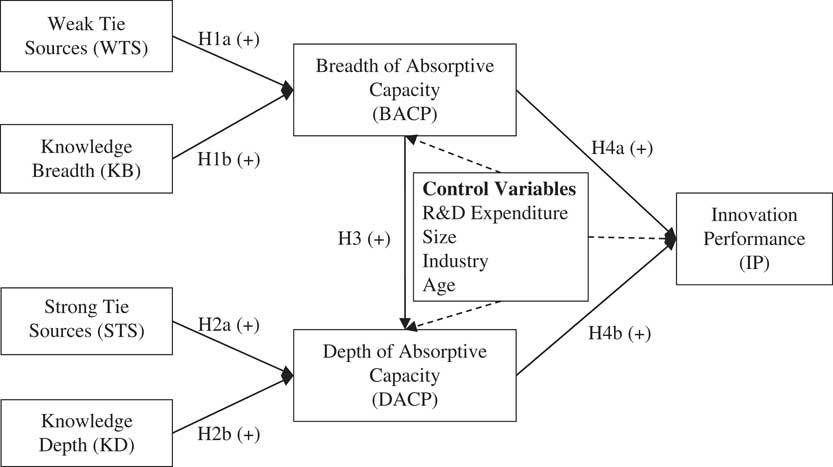
Figure 1 shows the research model and hypotheses.
Research model and hypotheses. R&D=research and development
METHOD
Construction of the survey
In our survey questionnaire, we mainly used existing scales from previous research. When no suitable measurements could be found in the literature, however, we developed new ones. A group of university staff and academics reviewed the questionnaire to ensure its content validity. The questionnaire was created in English, but translated to Chinese for administration. Two professional translators independently translated the English questionnaire into Chinese, analyzed the two Chinese versions, and reached an agreement on the final version. Another professional translator confirmed that the translation was consistent and valid and then translated the final version into Chinese.
The questionnaire was sent to a panel of academics and practitioners to check for ease of use and correct interpretation of the measurement items. These reviews helped in refining a number of items. The revised questionnaire was then submitted to eight experienced research and development (R&D) managers based in China to check for clarity and appropriateness. Based on their feedback, some items were removed and others were modified. Prior to the large-scale survey, a final pretest was conducted with four executives from a software company and an automotive company in China. The executives were asked to complete the survey and raise any issues of concern. This stage of pretesting resulted in only minor refinements to a few of the measurement items. Participants responded to all questions using a 5-point Likert-type scale. The Appendix presents the items used in this study.
Dependent variables
We measured innovation performance with three items adopted from Ferreras-Méndez, Newell, Fernández-Mesa, and Alegre (Reference Ferreras-Méndez, Newell, Fernández-Mesa and Alegre2015) and Su and Linderman (Reference Su and Linderman2016). We measured breadth of absorptive capacity with four items based on Jaworski and Kohli (Reference Jaworski and Kohli1993), Jansen, Van Den Bosch, and Volberda (Reference Jansen, Van Den Bosch and Volberda2006), Hurmelinna-Laukkanen and Ritala (Reference Hurmelinna-Laukkanen and Ritala2012), and Prabhu, Chandy, and Ellis (Reference Prabhu, Chandy and Ellis2005). We measured depth of absorptive capacity with four items based on Burt (Reference Burt1992), Lin and Wu (Reference Lin and Wu2010), and Jansen, Van Den Bosch, and Volberda (Reference Jansen, Van Den Bosch and Volberda2006).
Independent variables
We measured weak tie sources and strong tie sources with three items, respectively, adopted from Paliokaitė and Pačėsa (Reference Paliokaitė and Pačėsa2015). We measured knowledge breadth and knowledge depth with three items, respectively, adopted from Zhou and Li (Reference Zhou and Li2012).
Control variables
Based on previous studies (Kim, Im, & Slater, Reference Kim, Im and Slater2013; Qian, Cao, & Takeuchi, Reference Qian, Cao and Takeuchi2013; Huang, Rice, & Martin, Reference Huang, Rice and Martin2015; Lakshman, Kumra, & Adhikar, Reference Lakshman, Kumra and Adhikar2017), we controlled firm-level variables that included R&D expenditure, size, industry, and age. R&D expenditure was measured by three items adopted from Kim, Im, and Slater (Reference Kim, Im and Slater2013). Five ranges, from below 20 to above 1,000, measured size. Eight items, including electrical equipment manufacturing, information services, scientific and technical services, retail, machinery manufacturing, pharmaceuticals, financial service, and others, measured industry. Four ranges, beginning with less than 1 year and ending with more than 10 years, measured age.
Data collection
We empirically tested our hypotheses using survey data from 218 Chinese firms. The sampling frame for this study was derived from lists of registered companies purchased from the local governments of six cities in China (Harbin, Shenyang, Dalian, Beijing, Shanghai, and Huhehot). For inclusion in our sample, there were two criteria: (1) the firms had to have experience with new product development, and (2) during the new product development process, the firms cooperated with and absorbed knowledge from external organizations. The data collection includes two data sets.
First data set
On the basis of our budget, a total of 600 randomly selected companies were contacted by phone to seek their participation: 42 companies did not meet the research requirements, 73 declined to participate, 51 did not return phone calls, 48 could not be reached, and 386 agreed to participate. Following the procedure outlined in Dillman (Reference Dillman1978), we emailed the questionnaire that contained independent variables, control variables, and basic information to the 386 companies that provided a contact person in an ‘innovation intensive’ division/strategic business unit who was knowledgeable in innovation capability and willing to complete the questionnaire. The contact persons included senior managers, middle managers, junior managers, and grass-roots staff. A total of 337 questionnaires were returned, of which 31 were excluded because of incomplete answers, leaving 306 usable questionnaires.
Second data set
After 6 months, we collected the second data set in a similar manner, emailing the questionnaire that contained dependent variables and basic information to the 306 corresponding firms. Although we merged the two data sets, only 218 firms fit the criteria that included information on breadth of absorptive capacity, depth of absorptive capacity, and innovation performance. We also tested nonresponse bias by comparing the key attributes between respondents and nonrespondents and the T-tests showed no significant differences. Therefore, our valid samples were limited to 218 firms.
The final sample included 119 men and 99 women. The number of respondents in positions of senior managers, middle-junior managers, junior managers, and grass-roots staff was 105, 76, and 37, respectively. Firms in the final sample were from the following industries: electrical equipment manufacturing (47), information services (40), pharmaceuticals (36), machinery manufacturing (34), scientific and technical services (15), retail (15), financial service (10), and other (21). Informants’ descriptive statistics are presented in Table 2.
Descriptive statistics of informants

RESULTS AND ANALYSIS
Data analysis
Before the regression analysis, we conducted an exploratory factor analysis and a confirmatory factor analysis to ensure the reliability and validity of the constructs (Zhang, Waldman, Han, & Li, Reference Zhang, Waldman, Han and Li2015; Wang, Yin, & Huang, Reference Wang, Yin and Huang2016). According to Zhang et al. (Reference Zhang, Waldman, Han and Li2015), we split the sample into subsamples: subsample 1 (data from 109 firms) and subsample 2 (data from 109 firms). We performed factor analyses using all multi-item scales and retained items for each theoretical construct according to the following criteria (Nerur, Rasheed, & Natarajan, Reference Nerur, Rasheed and Natarajan2008): (1) the item must load to the correct theoretical construct and the factor loading for the item must be >0.4, and (2) no double loadings (the item loaded to two constructs with factor loadings >0.4). We applied subsample 1 to conduct the exploratory factor analysis and the results indicated that the entire 27-item factor loadings were over 0.4 and had no high cross-loadings except for item STS4, and thus we removed it. We next carried out a confirmatory factor analysis with subsample 2 and the results showed that all 26 items formed eight suitable factors: knowledge breadth (KB), three items; weak tie sources (WTS), three items; knowledge depth (KD), three items; strong tie sources (STS), three items; R&D expenditure (R&DE), three items; breadth of absorptive capacity (BACP), four items; depth of absorptive capacity (DACP), four items; and innovation performance (IP), three items.
Based on the exploratory factor analysis and confirmatory factor analysis, we submitted the whole data for reliability and validity analysis using partial least squares (PLS). PLS is a component-based structural equation modeling technique, with less strict distributional assumptions, which provides an ideal fit for relatively small sample sizes (Brinkhoff, Özer, & Sargut, Reference Brinkhoff, Özer and Sargut2015; Castro, Roldán, & Acedo, Reference Castro, Roldán and Acedo2015). The PLS is also suitable for exploratory researches (Castro, Roldán, & Acedo, Reference Castro, Roldán and Acedo2015; Jalalkamali, Iranmanesh, Nikbin, & Hyun, Reference Jalalkamali, Iranmanesh, Nikbin and Hyun2016). Our sample is relatively small (218), and we aim to explore and develop theory, and thus PLS is a suitable application. The results are shown in Tables 3–5. As shown in Table 2, Cronbach’s α values, composite reliability and the variable average variances extracted for all variables are above the suggested cutoff values of 0.7, 0.7, and 0.5, respectively (Wetzels, Odekerken-Schröder, & Van Oppen, Reference Wetzels, Odekerken-Schröder and Van Oppen2009). Therefore, the internal consistency of all variables in our model is high and the reliability is good.
The test results of variable reliability

Note. AVE=average variances extracted; R&D=research and development.
The test results of convergence validity
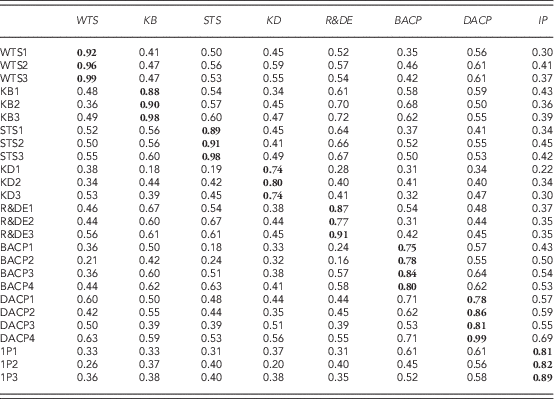
Note. BACP=breadth of absorptive capacity; DACP=depth of absorptive capacity; IP=innovation performance; KB=knowledge breadth; KD=knowledge depth; R&DE=research and development expenditure; STS=strong tie sources; WTS=weak tie sources. Significance of bold values at 0.01.
The test results of discriminant validity

Note. Diagonal elements are average variances extracted and off-diagonal elements are correlations.
BACP=breadth of absorptive capacity; DACP=depth of absorptive capacity; IP=innovation performance; KB=knowledge breadth; KD=knowledge depth; R&DE=research and development expenditure; STS=strong tie sources; WTS=weak tie sources. Significance of bold values at 0.01.
As shown in Table 4, all items’ factor loadings are >0.7 in relevant factors, thus the convergent validity is good (Fornell & Larcker, Reference Fornell and Larcker1981). To test discriminant validity, we compared the latent variable average variances extracted square root with the correlation coefficient of other latent variables(Fornell & Larcker, Reference Fornell and Larcker1981). Table 5 shows the average variances extracted square root values in the diagonal cells with the correlation coefficients between each latent variable in the other cells. The average variances extracted square root values are greater than the other numerical values, indicating that the model has good discriminant validity (Fornell & Larcker, Reference Fornell and Larcker1981). In other words, the validity of the measurement is good.
Hypotheses testing
As PLS software is appropriate for testing the one-item variables and control variable (Peng, Heim, & Mallick, Reference Peng, Heim and Mallick2014), we used it to test our hypotheses to determine the significance of the path coefficients between latent variables. Table 6 shows the testing results in which all of our hypotheses are supported.
Results from path model analyses
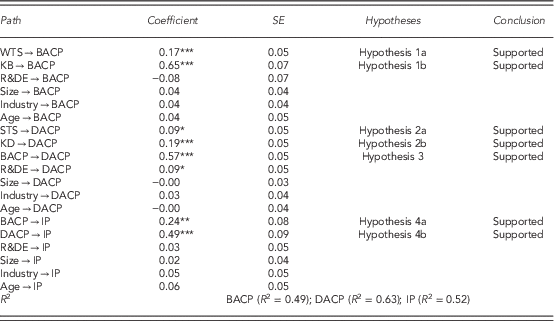
Note. BACP=breadth of absorptive capacity; DACP=depth of absorptive capacity; IP=innovation performance; KB=knowledge breadth; KD=knowledge depth; R&DE=research and development expenditure; STS=strong tie sources; WTS=weak tie sources. *p<0.1, **p<0.05, ***p<0.01.
Post hoc analysis
In order to rule out the possible reverse causalities (knowledge breadth and breadth of absorptive capacity, knowledge depth, and depth of absorptive capacity), we adopt the advice of Landis and Dunlap (Reference Landis and Dunlap2000) by applying theory and empirical data. In theory, knowledge breadth refers to the extent to which the firm’s knowledge repository contains distinct and multiple domains, while knowledge depth refers to the level of knowledge sophistication and complexity in key fields (Zhou & Li, Reference Zhou and Li2012). These two concepts represent the knowledge that a firm owned before it absorbs knowledge. In other words, these types of knowledge are previous knowledge. Breadth and depth of absorptive capacity may also be involved in complex industries with high innovation rates and multiple inputs or value-adding processes, which brings new knowledge to the firm and forms a new knowledge storage. However, new knowledge storage is new knowledge, not previous knowledge. Therefore, knowledge breadth is the antecedent of absorptive capacity breadth and knowledge depth is the antecedent of absorptive capacity depth.
In empirical data, as a complementary test, we follow the method recommended by Landis and Dunlap (Reference Landis and Dunlap2000) and Cao, Simsek, and Jansen (Reference Cao, Simsek and Jansen2015). We use knowledge breadth as the independent variable of breadth of absorptive capacity and knowledge depth as the independent variable of depth of absorptive capacity. The coefficient of interaction item between knowledge breadth and weak tie sources to breadth of absorptive capacity (b=0.17, p<.01) and the coefficient of interaction item between knowledge depth and strong tie sources to depth of absorptive capacity (b=−0.23, p<.10) are significant. We then use breadth of absorptive capacity as the independent variable of knowledge breadth and depth of absorptive capacity as the independent variable of knowledge depth. The coefficient of interaction item between breadth of absorptive capacity and weak tie sources to knowledge breadth (b=0.15, p>.10), and the coefficient of interaction item between depth of absorptive capacity and strong tie sources to knowledge depth (b=−0.09, p>.10) are insignificant, which alleviates concerns for reverse causalities.
DISCUSSION
This study aimed to extend the conceptual understanding of the antecedents and outcomes of breadth and depth of absorptive capacity from the viewpoint of social capital theory. Based on a sample of 218 Chinese firms, our empirical results show that weak tie sources and knowledge breadth can enhance the breadth of absorptive capacity, while strong tie sources and knowledge depth can strengthen the depth of absorptive capacity. We also find that breadth of absorptive capacity positively impacts depth of absorptive capacity and that both breadth and depth of absorptive capacity are positive related to innovation performance. The theory contribution, implications for practice, limitations, and future directions are discussed in the following section.
Theory contribution
This study makes four major contributions to the existing literature. First, we address the issue of measuring the concepts of breadth and depth of absorptive capacity. As we know, Zahra, Larraneta, and Galán (Reference Zahra, Larraneta and Galán2015) introduced the concepts of breadth and depth of absorptive capacity, a new typology of absorptive capacity. However, because a means of measuring the operations of the concepts has not been proposed, thus their application and effect may be limited. This paper is based on the previous studies and has proposed a measurement for the concepts, which may serve as a foundation for study of new typology of absorptive capacity (Flatten, Engelen, Zahra, & Brettel, Reference Flatten, Engelen, Zahra and Brettel2011). In other words, this paper operates the concepts of breadth and depth of absorptive capacity and develops the new typology associated with breadth and depth of absorptive capacity.
Second, the paper reveals the formation mechanism of absorptive capacity breadth and depth from the view of social capital theory. Although previous studies have extended the concept originally introduced by Cohen and Levinthal (Reference Cohen and Levinthal1990) to reflect a new notion of absorptive capacity in the organizational field, no clear definition of absorptive capacity with regard to different features of knowledge has appeared (Vasudeva & Anand, Reference Vasudeva and Anand2011). Even though Zahra, Larraneta, and Galán (Reference Zahra, Larraneta and Galán2015) introduced the concepts of breadth and depth of absorptive capacity and based on different features of knowledge, they did not explore the factors that influence the formation of breadth and depth of absorptive capacity. This study, which takes the social capital theory perspective, empirically investigates the formation mechanism of breadth and depth of absorptive capacity. The results indicate that weak tie sources and knowledge breadth are conductive to the formation of breadth of absorptive capacity and that strong tie sources and knowledge depth contribute to the formation of depth of absorptive capacity. Our results are consistent with previous studies. Prior related knowledge is the most important antecedent to absorptive capacity (Cohen & Levinthal, Reference Cohen and Levinthal1990; Van Den Bosch, Volberda, & De Boer, Reference Van Den Bosch, Volberda and De Boer1999) and weak tie sources contain the breadth of knowledge resources (Coradi, Heinzen, & Boutellier, Reference Coradi, Heinzen and Boutellier2015); therefore, a larger knowledge breadth and network of weak ties will have more nodes and provide broader sources of knowledge to breadth of absorptive capacity. Many studies have shown that prior related knowledge is important to absorptive capacity (Cohen & Levinthal, Reference Cohen and Levinthal1990; Van Den Bosch, Volberda, & De Boer, Reference Van Den Bosch, Volberda and De Boer1999) and that strong tie sources are greatly beneficial in the acquisition of useful (tacit and specialized) knowledge (Szulanski, Reference Szulanski1996; Uzzi, Reference Uzzi1997; Hansen, Reference Hansen1999). As a result, absorptive capacity could be deepened by increasing knowledge depth and by fostering strong tie sources.
Third, this paper explores the different effects of breadth and depth of absorptive capacity on innovation performance. Although previous studies have suggested that absorptive capacity is key to innovation and performance (Cohen & Levinthal, Reference Cohen and Levinthal1990; Tsai, Reference Tsai2001; Zahra & George, Reference Zahra and George2002; Rusly, Sun, & Corner, Reference Rusly, Sun and Corner2015), they did not explore the different kinds of absorptive capacity based on features of knowledge effects on innovation performance. Although Zahra, Larraneta, and Galán (Reference Zahra, Larraneta and Galán2015) indicated that breadth and depth of absorptive capacity is important to firm innovation, they did not study the different effects of breadth and depth of absorptive capacity on innovation performance. The empirical results of this study show that both breadth of absorptive capacity and depth of absorptive capacity are conductive to the promotion of innovation performance. It is worthwhile to emphasize that depth of absorptive capacity is better than breadth of absorptive capacity to improve innovation performance, as the coefficient of depth of absorptive capacity (b=0.49) is larger than breadth of absorptive capacity (b=0.24). It is interesting to note that R&D expenditure is significantly positive related to depth of absorptive capacity (b=0.09, p<.1) but not to breadth of absorptive capacity (b=−0.08, p>.1). This may suggest that absorptive capacity depth is difficult and needs more R&D expenditures in order to acquire, assimilate, transform, and exploit special and professional knowledge rather than diverse and heterogeneous knowledge. This finding is consist with the previous study in which depth of knowledge is difficult for firms to absorb because it involves knowledge that is tacit, sticky, complex, and difficult to codify (Kogut & Zander, Reference Kogut and Zander1992; Szulanski, Reference Szulanski1996).
Finally, this paper reveals that breadth of absorptive capacity is beneficial to the formation of depth of absorptive capacity. Although Zahra, Larraneta, and Galán (Reference Zahra, Larraneta and Galán2015) introduced the concepts of breadth and depth of absorptive capacity and indicated that they are important to firm innovation, they did not study the relationship between absorptive capacity breadth and absorptive capacity depth. We empirically test the effect of breadth of absorptive capacity on depth of absorptive capacity and find that the former positively influences the latter. Breadth of absorptive capacity and depth of absorptive capacity is similar to latitudinal absorptive capacity and longitudinal absorptive capacity that were introduced by Vasudeva and Anand (Reference Vasudeva and Anand2011) and are different aspects of absorptive capacity and important to firm innovation and performance. Therefore, this paper validates and develops the theory of absorptive capacity.
Implications for practice
From a practical standpoint, we offer a useful tool for decision-makers and practitioners to assess the strengths and weaknesses of their firms’ breadth and depth of absorptive capacity. This paper makes it possible for firms’ decision-makers and practitioners to evaluate their breadth and depth of absorptive capacity and adjust these two types of absorptive capacity. We also provide the way for decision-makers and practitioners to cultivate their firms’ breadth and depth of absorptive capacity. As we know, weak tie sources and knowledge breadth can enhance the breadth of absorptive capacity and strong tie sources, and knowledge depth can strengthen the depth of absorptive capacity. Firms’ decision-makers and practitioners may be able to actively manage their social capital (weak ties and strong ties) and prior related knowledge (knowledge breadth and depth) to stimulate different types of knowledge absorption and build a competitive advantage. Moreover, our empirical results reveal that, to improve innovation performance, depth of absorptive capacity is better than breadth of absorptive capacity. Therefore, if firms want to improve innovation performance, they should improve the breadth and, in particular, the depth of absorptive capacity. Finally, as depth of knowledge is the essential factor of innovation success, we suggest two pathways for firms’ decision-makers and practitioners to improve their depth absorptive capacity. Firms with strong tie sources and knowledge depth can enhance their depth of absorptive capacity, while firms with inadequate strong tie sources and knowledge depth can focus on improving their breadth of absorptive capacity first and strengthen their depth of absorptive capacity later.
Limitations and future directions
This study has several limitations that should be considered when interpreting the findings, and that offer opportunities for future research in absorptive capacity development. First, the sample survey in this study is made up of companies in China, which constrains any generalization of the results to other countries. It would be very interesting to see if the findings of this study are duplicated in other settings. Second, the participants in this study responded to the survey items using a Likert-type scale rather than quantitative data. We used this data collection method because firms are unlikely to give actual figures due to confidentiality reasons. We also used the survey approach to facilitate data collection from different industries. However, as a result, the survey responses are subject to respondents’ estimation errors. Future research may consider collecting data from multiple respondents at each firm to improve data reliability. Finally, in this study, we did not further explore the breadth and depth of absorptive capacity that should be developed under specific circumstances. The features of external knowledge that firms need are different under different conditions and developmental stages. For example, in the early stages of a firm’s development, in order to generate more development opportunities, the firm needs to absorb more breadth of external knowledge. However, when a firm’s strategic position is determined, it needs to absorb a depth of knowledge that is consistent with the determined strategy. In sum, firms should improve their breadth and depth of absorptive capacity according to their specific needs. In this study, there is no in-depth investigation of this issue, thus providing an opportunity for future study.
CONCLUSION
This paper explores the antecedents and outcomes of breadth and depth of absorptive capacity from a social capital theory viewpoint. The empirical results suggest that weak tie sources and knowledge breadth enhance the breadth of absorptive capacity while strong tie sources and knowledge depth can strengthen the depth of absorptive capacity. In addition, breadth of absorptive capacity positively impacts depth of absorptive capacity, and both breadth and depth of absorptive capacity are positive related to innovation performance. We suggest that firms should take advantage of weak tie sources and knowledge breadth as well as strong tie sources and knowledge depth to form breadth and depth of absorptive capacity based on their social capital to improve innovation performance.
Acknowledgments
The authors would like to acknowledge the editor’s contribution and show appreciation to the reviewers for their helpful comments and recommendations. This research was funded by National Natural Science Foundation of China (Award No.: 71672049, 71202159).
Appendix: STUDY MEASURESFootnote 1
Weak tie sources (WTS)
1. We have an active network of contacts with the scientific and research community.
2. We collect information on patents.
3. We survey experts on their opinions, for example, by using questionnaires, panels, focus groups, workshops, interviews, one-to-one meetings.
4. We attend scientific conferences.Footnote 2
Knowledge breadth (KB)
1. We possess market information from a diversified and wide-ranging customer portfolio.
2. We have accumulated knowledge of multiple market segments.
3. Our R&D expertise consists of technical knowledge from a variety of backgrounds.
Strong tie sources (STS)
1. We participate in trade shows.
2. Employees of my company work jointly with suppliers in order to develop solutions.
3. Employees of my company work jointly with customers to develop solutions.
Knowledge depth (KD)
1. We have thorough understanding and experience of current customers.
2. We have accumulated in-depth knowledge of the key market segment that we focus on.
3. Our R&D experts have thorough technical knowledge and skills within our specialized domain.
R&D expenditure (R&DE)
1. Compared with major competitors in your industry, to what degree does your company engage in R&D expenditures?
2. Compared with major competitors in your industry, to what degree does your company emphasize R&D activities?
3. Compared with other activities in your company, to what degree does your company engage in R&D expenditures?
Breadth of absorptive capacity (BACAP)
1. We collect industry information through informal means (e.g., lunch with industry friends, talks with trade partners).
2. We quickly analyze and interpret changing market demands.
3. We can identify and quickly acquire the different types of information we need.
4. We grasp the opportunities for our firm from new external knowledge.
Depth of absorptive capacity (DACAP)
1. We can acquire the professional knowledge we need from long-term, cooperative partners.
2. We quickly recognize the usefulness of new external knowledge to existing knowledge.
3. We constantly consider how to better exploit knowledge (based on Jansen, Van Den Bosch, & Volberda, Reference Jansen, Van Den Bosch and Volberda2006).
4. By using the professional knowledge obtained from outside, we improve our innovation success.
Innovation Performance (IP)
1. The overall performance of our new product development program has met our objectives.
2. From an overall profitability standpoint, our new product development program has been successful.
3. Compared with our major competitors, our overall new product development program is far more successful.



