

Introduction
The liberal portrayal of the United States, which presents a pluralistic image of American identity in which all are welcome to claim American personhood and be a “real American,” is incongruent with the dominant view of American nationhood. This portrayal undermines the notion that certain privileged racial characteristics determine who embodies the American archetype and who does not. In a country where one’s sense of “Americanness” is traditionally defined by proximity to the phenotypic and cultural characteristics of Whiteness, those positioned outside this archetype are typically relegated to the status of Other, regardless of how intimately tied to the nation one may be (Carter and Pérez, Reference Carter and Pérez2016; Collins Reference Collins2001; Du Bois Reference Du Bois1897, Reference Du Bois1903c, Reference Du Bois1940).
W. E. B. Du Bois was keenly aware of the paradox of American liberalism and its influence on the subjectivities of racialized peoples in the United States. He theorized that the phenomenological realities of Black and White Americans cannot be divorced from the “religion of whiteness” upon which the country was founded (Du Bois Reference Du Bois1920, p. 18). Phenomenology refers to how people understand the world through their subjective perspectives and interactions (Schutz Reference Schutz1967; Smith-Lovin Reference Smith-Lovin, Burke, Owens, Serpe and Thoits2003). In a dialectical sense, then, if White Americans are the quintessential Americans, Black Americans must be perpetual outsiders. To Du Bois, all Black Americans aware of their position in the country face this “[puzzling] dilemma” and ask themselves: “What, after all, am I? Am I an American or am I a Negro? Can I be both? Or is it my duty to cease to be a Negro as soon as possible and be an American?” (Reference Du Bois1897, p. 11).
Du Bois’s contentions on race and nation have long been interrogated in the contemporary era, as evidenced by a robust social science literature that illustrates the distinct ways different ethnoracial groups in the United States express national pride, allegiance, and belonging (Greene et al., Reference Greene, Gray, Carter and Block2020; Huddy and Khatib, Reference Huddy and Khatib2007; Li and Brewer, Reference Li and Brewer2004; Sidanius et al., Reference Sidanius, Feshbach, Levin and Pratto1997; Uemura Reference Uemura2017; Zou and Cheryan, Reference Zou and Cheryan2017). One finding has remained fairly consistent: Black Americans possess fewer attachments to the United States than White Americans and, in some cases, than other racial minorities. Another strand of this literature, however, tells a different story, one that suggests Black Americans are cultivating “a nation within a nation” (Johnson Reference Johnson2018) to reclaim American nationhood. Scholars who have sought to problematize the notion that Blackness is entirely analogous to Whiteness/Americanness have done so by investigating Black American support for Donald Trump and the concurrent rise of “Black patriotism” (Johnson Reference Johnson2018; Loury Reference Loury2022) and the “(new) Black far right” (Brooks Reference Brooks2024; also see Smith et al., Reference Smith, Shugars, Khanam, Mbonu, Lella and Myers2025).
The present study contributes to this literature by examining White-Black attachments to national identity during Trump’s first presidential administration. National identity captures individual subjectivities of affinity for the nation; that is, the extent to which nationhood is central to an individual’s self-concept and self-definition. These subjectivities are historically rooted and intrinsically racialized. Understanding the distinct ways Americans connect to or disconnect from the nation offers unique insight into how the cultural logics that classify American nationhood concurrently shape personal subjectivities. Such insight has yet to be examined in contemporary sociological literature as comprehensively as studies of expressions of patriotism (national pride) and nationalism (a sense of superiority of one’s country over another), leaving a widening theoretical and empirical gap in the examination of identity-specific processes of race and nation.
Rarely do scholars in sociological canons adopt both theories of racialized subjectivities (e.g., Du Bois Reference Du Bois1897, Reference Du Bois1903c; Itzigsohn and Brown, Reference Itzigsohn and Brown2015) and social psychological theories of identity (e.g., Burke and Stets, Reference Burke and Stets2023a; Stets Reference Stets2021; Stets and Burke, Reference Stets and Burke2000; Thoits Reference Thoits, Serpe, Stryker and Powell2020) to ground their investigations of racial stratification in American citizens’ expressions of national attachment. For instance, social psychological approaches typically do not prioritize the role of enduring racial-colonial structures in shaping identity processes, which are necessary to understand how the racialized subjectivities of different social actors are enacted. In contrast, though Du Boisian frameworks acknowledge how the country’s racial histories shape the “phenomenological experience of racialization” among its subjects (Itzigsohn and Brown, Reference Itzigsohn and Brown2015, p. 5), they don’t typically evaluate how these “phenomenological experiences” are manifested through micro-social identity processes, such as identity prominence and identity change.
Identity prominence, or “the subjective importance of an identity” (Burke and Stets, Reference Burke and Stets2023b, p. 381), is one example of an identity process that, when paired with Du Boisian theories of racialized subjectivity, offers unique insight into how strongly people connect to their racial identities in a given setting. The boundaries and meanings associated with a social actor’s identity are susceptible to alteration or transformation when their environment becomes chaotic, atypical, or unstable (Stets Reference Stets2021). Prolonged exposure to disarray and polarity may engender short- or long-term fluctuations in identity, which I refer to hereafter as identity change (Burke and Stets, Reference Burke and Stets2023a; Stets Reference Stets2021; Vignoles et al., Reference Vignoles, Schwartz, Luyckx, Schwartz, Luyckx and Vignoles2011). Scholars widely characterize Donald Trump’s first presidential term from 2016 to 2020 as one of the most polarizing administrations in American history (Abramowitz and McCoy, Reference Abramowitz and McCoy2019; Baker and Bader, Reference Baker and Bader2022). The Trump administration masterfully reinforced and deepened racial divides in the country by mobilizing historically-precedented rhetoric that distinguished “Us”—meaning “the ‘real’ Americans who [hunger] for a return to an idealized past” when White domination was at its peak (Abramowitz and McCoy, Reference Abramowitz and McCoy2019, p. 138)—from “Them,” the racial minorities who stand in the way of this idealized vision of the nation. As such, this period exemplifies a turbulent sociopolitical environment that, according to identity change theory, had the power to shift the national attachments of Americans across racial lines.
Using cross-sectional survey data from the 2012, 2016, and 2020 American National Election Studies (ANES) time series, this study examines racial differences in the national attachments of White and Black Americans before, during, and after the first Trump administration, addressing the temporal and phenomenological dimensions of American national identity. I pose the following questions: To what extent did the likelihood of White and Black Americans expressing a strong sense of national identity prominence (the subjective importance of American national identity to oneself) vary by racial identity prominence (the subjective importance of White/Black identity to oneself) and election year? Was racial identity prominence or election year a stronger indicator of national identity prominence than racial self-classification, and if so, for whom?
Conceptual Framework
The Quintessential American: A Du Boisian Approach to Race and National Identity
One of W. E. B. Du Bois’ contributions to sociologyFootnote 1 was his contention that the color line shapes the subjectivities of racialized actors in American society. The “color line” is a metaphor for the permeation and reification of enduring global structures of Western empire and White domination that condition the modern world (Du Bois Reference Du Bois1903c). Among other uses, the color line has long been adopted by social scientists to understand racialized actors’ subjectivities and subsequent identity formations and enactments. Subjectivity refers to “the forms and patterns of understanding, thinking, and feeling about the self, other people, and the world we live in” (Itzigsohn and Brown, Reference Itzigsohn and Brown2020, p. 17, emphasis added). Du Bois’s writings shed light on how the subjectivities of racial actors in the U.S. shape their national attachments in distinct ways. This process is best documented in the first essay of The Souls of Black Folk, “Of Our Spiritual Strivings,” where he writes:
[A] sort of seventh son, born with a veil, and gifted with second-sight in this American world—a world which yields him no true self-consciousness, but only lets him see himself through the revelation of the other world. It is a peculiar sensation, this double-consciousness, this sense of always looking at one’s self through the eyes of others, of measuring one’s soul by the tape of a world that looks on in amused contempt and pity. One ever feels his two-ness—an American, a Negro; two souls, two thoughts, two unreconciled strivings; two warring ideals in one dark body (Du Bois Reference Du Bois1903b, p. 2).
Du Bois’ main contention was that the country’s racial histories and structures have created a “veil” in American society, and that this veil represents the phenomenological boundaries which shape the identities of all racialized subjects. The veil also underscores the notion that Whiteness is the interpellation of Blackness. Said another way, Whiteness is the “ownership of the earth” (Du Bois Reference Du Bois1920, p. 18) that brought Blackness into Being and thus gives it a name, an identity. Thus, the color line and its manifestations, like the veil, “[create different processes] of self-formation among racializing and racialized groups” (Itzigsohn and Brown, Reference Itzigsohn and Brown2015, p. 3). This articulation of race and nation is often used to explain differences in how Black and White Americans express national attachments to the United States.
National attachment refers to an individual’s sense of connection to and belonging in the nation they reside in, two core characteristics of national identity. Political scientists Stacey Greene and colleagues (Reference Greene, Gray, Carter and Block2020) distinguish national identity from patriotism (national pride) and nationalism (sense of superiority of one’s country over another) by asserting that “American identity is dependent upon whether and how individuals see themselves in relationship to the body politic” (p. 397). To feel American, “it is not enough to love the nation; the nation also has to love you back” (Greene et al., Reference Greene, Gray, Carter and Block2020, p. 397). Full membership in the American national imaginary, then, is a subjective experience that conveys one’s affinity for and belonging to the nation. Moreover, it highlights the cultural underpinnings between the “self” and American nationhood that have historically marginalized and excluded those who do not fit within the mold of the “self-indigenized” (Dunbar-Ortiz Reference Dunbar-Ortiz2021) White American identity. To lay claim to this identity, racialized subjects in the United States must be on the dominant side of the veil, defined by Whiteness.
The notion that Whiteness represents the quintessential American did not originate or end with Du Bois, though scholars have argued that he was among the first to theorize it systematically and canonically (e.g., Brown Reference Brown2025; Itzigsohn and Brown, Reference Itzigsohn and Brown2015, Reference Itzigsohn and Brown2020; Morris et al., Reference Morris, Schwartz, Itzigsohn, Abrutyn and Lizardo2021). A great deal of research has examined how Whiteness has, over time, become culturally indistinguishable from American nationhood (e.g., Hughey and Rosino, Reference Hughey, Rosino, Ray and Mahmoudi2022; Omi and Winant, Reference Omi and Winant2014) and even been legally codified as such (Bashi Treitler Reference Bashi Treitler2004; Carbado Reference Carbado2005; Lopez Reference Lopez2006) to ensure its inaccessibility to those racialized as non-White. More recent studies on White Americans’ national attachments reveal that Whites typically do not experience inner conflict between their racial and national identities because they view them as one and the same (Devos and Banaji, Reference Devos and Banaji2005; Devos and Mohamed, Reference Devos and Mohamed2014; Masuoka and Junn, Reference Masuoka and Junn2013). In fact, White Americans are widely understood by most Americans, both White and non-White, to exemplify the American standard (Carter and Pérez, Reference Carter and Pérez2016; Zou and Cheryan, Reference Zou and Cheryan2017). The latent aspects of White Americans’ racial and national identities that render them indistinguishable have also been found to produce expressions of blind or uncritical patriotism (Metzl Reference Metzl2019; Perry and Schleifer, Reference Perry and Schleifer2023), suggesting that an attack on American nationhood is tantamount to an attack on Whiteness. In this way, White identities are “individualistic and normalized, ‘color-blind’ and besieged” (Winant Reference Winant1997, p. 74).
Empirical validation of these studies, coupled with decades of research confirming similar trends in other national attachments such as patriotism and nationalism (e.g., Dowley and Silver, Reference Dowley and Silver2000; Perry and Schleifler, Reference Perry and Schleifer2023; Sidanius et al., Reference Sidanius, Feshbach, Levin and Pratto1997), indicate that White Americans play a seminal role in maintaining the racialized aspects of American identities, whether intentionally or not. The strong national attachments of White Americans often mirror the racial status quo of American society because “white racial identities…share a common allegiance to dominant racial (and often racist) ideologies” that the country was founded upon (Hughey Reference Hughey2010, p. 1306). In this way, the veil is also prominent in White Americans’ racialized subjectivities and national identity enactments.
In contrast, the “phenomenological experience of racialization for Black Americans” is unique in that both sides of the veil shape their subjectivities (Itzigsohn and Brown, Reference Itzigsohn and Brown2015, p. 5). Du Bois (Reference Du Bois1903b) called this socio-cognitive process a “second sight,” a lens that provides Black subjects with an intimate understanding of themselves and the dominant White world. In the words of James Baldwin (Reference Baldwin1963), “the American Negro has the great advantage of having never believed the collection of myths to which White Americans cling” while, in contrast, White people have the distinct privilege of being “slightly mad victims of their own brainwashing” (p. 110).
Though the general consensus holds that “White identity is undeniably American” (Greene et al., Reference Greene, Gray, Carter and Block2020, p. 397), recent research suggests that these trends may not be so clear-cut for Black Americans and their relationship to American nationhood. The intricacies of Black racial and national identity bring us back to Du Bois’s theorizations of “twoness.” While Du Bois saw the exclusion of Blackness from the national imaginary as an opportunity for Black Americans to combat their ascribed “second-class” status through radical solidarity (Reference Du Bois1903c), he also acknowledged that the color line produces “contradictory forces, facts, and tendencies” (Reference Du Bois1940). As such, when Black Americans reckon with these “warring ideals” of the color line, which deny them full access to the American identity, they may adopt diverse strategies to make sense of their place in American society. One strategy may be to adopt a strong American identity to feel fully accepted and integrated into the national imaginary, despite being viewed by the dominant society as a racialized Other (see Du Bois Reference Du Bois1903a). Though Du Bois described assimilationist and accommodationist strategies as a “false means of salvation” in Souls of Black Folk (Reference Du Bois1903b, p. 7) and later, in Dusk of Dawn (Reference Du Bois1940), as a product of the “illogical trends” that the concept of race produces (p. 66), he recognized the plausibility of such a stance among Black Americans. The diversity in Black Americans’ responses to the color line is reflected in contemporary race-and-nation scholarship.
One side of this literature argues that Black Americans do not embody the American archetype and therefore do not view or express their American identity in the same way as those with a stronger claim to Americanness. These studies have found that, compared with Whites and, in most cases, other racial minorities, Black Americans are “less nationalistic, less patriotic, and less proud of US history” (Uemura Reference Uemura2017, p. 944) and tend to separate their racial and national identities more than their White and non-White counterparts (Carter and Pérez, Reference Carter and Pérez2016; Devos and Mohammed, Reference Devos and Mohamed2014; Masuoka and Junn, Reference Masuoka and Junn2013). Other recent studies, however, have drawn different conclusions, indicating that Black Americans indeed express positive attachments to the country that, at times, are on par with those of White Americans (e.g., Tafoya et al., Reference Tafoya, Corral and Leal2022). For example, Greene and colleagues (Reference Greene, Gray, Carter and Block2020) found evidence that experiences of discrimination do not significantly deter Black Americans’ allegiance to the country, refuting claims that expressions of prejudicial treatment and patriotic attitudes among the Black community are mutually exclusive.
The rise of Black conservatism and what Marcus A. Brooks (Reference Brooks2024) calls “colorblind nationalism” may also foster positive national attachments among Black Americans (also see Arhin Reference Arhin2025 and Smith et al., Reference Smith, Shugars, Khanam, Mbonu, Lella and Myers2025). As Udi Sommer and Idan Franco (Reference Sommer and Franco2024) explain, “[p]eople may self-identify as Black…but their detachment from recurrent discriminatory experiences unique to Blacks, or from the acknowledgement of those experiences, concurrently implies their lack of Black sociopolitical identity” (p. 926; also see Lewis and Nelson, Reference Lewis and Nelson2022). For these groups, detachment from a Black political identity, which is implicitly dialectically opposed to Whiteness, opens the door to a closer attachment to American nationhood. I expand on the implications of this in the following section.
The Influence of the Political Arena on National Attachments
The 2008 and 2012 U.S. presidential elections marked the first time in American history that a person of African descent, Barack Obama, was elected and re-elected to the nation’s highest office. Christopher Timothy Stout and Danvy Le (Reference Stout and Le2012) note that “Obama’s successful candidacy [represented] the destruction of the proverbial glass ceiling” for many Black Americans, transitioning members of this group from “persistent pessimists of the American Dream to unrelenting optimists of this American ideal” (p. 1339). Despite the stark economic conditions during his presidencies, Black Americans reported feeling more optimistic about the nation, believed more strongly that they could attain the “American Dream,” and viewed racial progress more positively while Obama was in office (Gaither et al., Reference Gaither, Wilton and Young2014; Hunt and Wilson, Reference Hunt and Wilson2009). Obama “offered [B]lacks hope and a positive self-image” (Parker Reference Parker2016, p. 226), which contributed to more positive reports of national attitudes and attachments among Black Americans at the time compared with previous presidencies (Seltzer and Hutto, Reference Seltzer and Hutto2016; Stout and Le, Reference Stout and Le2012).
The socio-political landscape of the United States shifted dramatically when Obama’s second presidential term ended and Donald Trump announced his presidential campaign in 2015. I use the term Trumpism to identify and evaluate the politics associated with Donald Trump, though its elements have a deep-rooted and well-documented history in the United States (Du Bois Reference Du Bois1920, Reference Du Bois1935; Dunbar-Ortiz Reference Dunbar-Ortiz2021; Jung Reference Jung2015). Scholars have defined Trumpism as a political ideology and a style of authoritarian governance that endorses and promotes racist, nativist, and White nationalist principles, creating divisions within American institutions and social groups classified along racial and ethnic lines, among others (Bobo Reference Bobo2017; Canizales and Vallejo, Reference Canizales and Vallejo2021; Drakulich et al., Reference Drakulich, Wozniak, Hagan and Johnson2020; Mukherjee Reference Mukherjee2018; Thompson Reference Thompson2020; Yang Reference Yang2018). Although the term was catalyzed by Trump’s rise in American politics, the historical orientations of Trumpism mean its elements can persist with or without Trump at its center. After Trump’s first term, for example, hate crimes motivated by White nationalist ideals surged by twenty percent, a significant share of which were motivated by what the U.S. House Judiciary Committee labeled as “anti-black bias” (U.S. House Judiciary Committee 2019).
The national surge in racially biased hate crimes is not the only racial corollary of Trump’s first presidency. A president’s rhetoric—that is, their use of language and style of communication—is a strategic tool for shaping the political environment and persuading specific audiences. During his presidency, Trump employed the rhetoric of nativism, ethno-nationalism, and blind patriotism to justify racial exclusivity and to weaponize the symbolic undertones of what it means to be a “real” American (Long Reference Long2023; Schrock et al., Reference Schrock, Buggs, Buyukozturk, Erichsen and Ivey2022). In doing so, Trump and his administration mobilized a vision of American national identity that confirmed the American archetype as analogous to Whiteness. At the same time, however, in both 2016 and 2020, the administration attracted the support of non-White voters who held similar conservative views on immigration, government-sanctioned religion, gender roles, sexual orientation, abortion, and queer rights, regardless of whether the President would prioritize their own racial interests (Arhin Reference Arhin2025; Bell Reference Bell and Bangura2023; Brooks Reference Brooks2024, Reference Brooks2025; Cadena Reference Cadena2023, Reference Cadena2025; Sommer and Franco, Reference Sommer and Franco2024). In this way, the administration was able to simultaneously appeal to Whites while offering the racialized Other a sense of belonging and agency.
The nuances of Trumpism are important to consider when studying identity processes. While Whites tend to cling more tightly to their racial and national identities when they perceive a threat to their collective status (Wetts and Willer, Reference Wetts and Willer2018), Black Americans have been found to enact varying degrees of attachment to their racial identity under perceived group threat, leading to differences in their perceptions of and engagement with the nation (Arhin Reference Arhin2025; Johnson Reference Johnson2018). During Trump’s presidential campaign, for instance, White American voters often rallied around the candidate’s ethno-nationalist candor and invoked their American identities when expressing support, despite Trump’s polarizing and discriminatory rhetoric (e.g., Baker et al., Reference Baker, Perry and Whitehead2020; Levchak and Levchak, Reference Levchak and Levchak2020; Long Reference Long2023; Schrock et al., Reference Schrock, Buggs, Buyukozturk, Erichsen and Ivey2022). These studies contribute to a longstanding body of literature that explores how ethno-nationalist ideologies manifest in the racial identity enactments of White Americans, reinforcing the racial order of American society (Du Bois Reference Du Bois1920, Reference Du Bois1935; Hughey Reference Hughey2010; McDermott and Samson, Reference McDermott and Samson2005).
On the other hand, recent studies have found that the presumed political cohesion and racial linked fate among contemporary Black voters are misleading and warrant more scholarly attention. Sommer and Franco (Reference Sommer and Franco2024), for example, found that racial resentment may have been a driving force behind Black Americans’ support for Trump in 2016, and even more so in 2020. As the authors note, “[w]hereas for Whites, racial resentment means symbolic racism, for Blacks the indicator entails a different meaning. […] Racially resentful Blacks could be characterized by disdain and negative feelings toward their own racial group. Given Trump’s long history of downgrading Black people, the distinction between these two trends may explain why racial resentment manifests itself into a vote for Trump in some Black people and not others” (p. 942). Other studies suggest that Black Americans with weaker ties to their racial identity may be less likely to exhibit normative political behaviors expected of them, such as voting against the candidate whose agenda goes against that of the greater Black community (Arhin Reference Arhin2025; Brooks Reference Brooks2024; Johnson Reference Johnson2018). Rather than relying on their racial identity as a marker of linked fate, Black voters who had more identity salience or “issue salience” (Arhin Reference Arhin2025) with Christian religiosity and other markers of conservatism mobilized these identities to guide their political decisions, resulting in support for Trump and, thus, a greater connection to American nationhood that the administration promised to revive and protect. With this, it is possible that “when Blackness is not the dominant identity, the identity which replaces Blackness moderates [Black Americans’] behavior” (Arhin Reference Arhin2025, p. 103).
Identity Change and Identity Prominence
Agency and structure are central to individual processes of identity (Du Bois Reference Du Bois2000 [1905]). Identity Theory holds that the identities individuals hold reflect their subjective selves inasmuch as they reflect the social order of the society in which they are situated (Burke and Stets, Reference Burke and Stets2023a; Stets Reference Stets2021; Stets and Burke, Reference Stets and Burke2000). There is an agentic quality to identity enactments. Human actors define, negotiate, and interpret their individual realities to construct a sense of self, a self-concept. The subjectivities that individuals construct throughout their lives are essential for everyday functions, from decision-making to expressions of group membership (Dawson Reference Dawson1994; Nunnally Reference Nunnally2010; Smith et al., Reference Smith, Bunyasi and Smith2019; Vignoles et al., Reference Vignoles, Schwartz, Luyckx, Schwartz, Luyckx and Vignoles2011). Still, structural factors play a significant role in how identities are defined, appraised, and enacted. As Peter J. Burke and Jan E. Stets (2022) explain, “if society is organized, so too must the self be organized” (p. 39).
Identities are not as stable or fixed as they appear. “The self,” Stets (Reference Stets2021) argues, “is a dynamic, changing entity” (p. 286). Identity change describes changes in “how people define themselves” (Stets Reference Stets2021, p. 292), as well as how an individual’s social context may engender shifts in identity meaning or importance. Exogenous factors, such as a nation’s political climate, may stimulate drastic changes in an individual’s connection to their identity, even if they do not experience identity nonverification. The context or setting an individual occupies may also influence the levels of commitment or regard they have for one or more of their identities. The degree to which an individual views their identity as important in a given setting is called identity prominence (Burke Reference Burke, Stets, Reichelmann and Kiecolt2023; Burke and Stets, Reference Burke and Stets2023b; Thoits Reference Thoits, Serpe, Stryker and Powell2020). Macro-social factors that generate chaos, uncertainty, or perceived threat may trickle down to the micro-level, resulting in fluctuations in the importance individuals place on their identities (Stets Reference Stets2021; Stets and Serpe, Reference Stets, Serpe, DeLamater and Ward2013).
Identity prominence captures subjectivity more effectively than a fixed identity characteristic, especially in the case of race. Racial identity, in its most general sense, is often expressed as a fixed or rigid dimension of race that society assigns to individuals, but for which individuals may or may not feel an affinity (Roth Reference Roth2016). For example, individuals often report their racial identity on official forms and surveys according to their racialization, or their perceived racial classification, rather than classifying themselves relative to their personal sense of self (Croll and Gerteis, Reference Croll and Gerteis2019; Lowe and Irizarry, Reference Lowe and Irizarry2025). Thus, racial identity prominence is a more nuanced dimension of race because it captures the subjective “internal self-identification process” that may or may not align with one’s ascribed racial category (Roth Reference Roth2016, p. 1314). In this vein, racialized subjectivity and racial identity prominence share similar phenomenological logic.
The study uses American national identity prominence (the subjective importance an individual attributes to their American national identity) to evaluate differences in national attachments between White and Black Americans. Du Boisian historical-structural frameworks of racialized subjectivity, combined with the tenets of prominence and change in Identity Theory, buttress the study’s central claim that both Black and White Americans develop their national attachments by invoking their unique racial subjectivities vis-à-vis racial identity prominence, or the subjective importance an individual assigns to their racial identity.
Hypotheses
In line with the conceptual framework and literature presented above, I anticipate the following:
H1: Racial self-classification (Black/White) will be significantly associated with national identity prominence, regardless of racial identity prominence and election year. Black Americans will be less likely than White Americans to report strong national identity prominence.
H2: Racial identity prominence will be a stronger predictor of national identity prominence than racial self-classification alone. White Americans with strong racial identity prominence will be most likely to report strong national identity prominence, followed by White Americans with weak racial identity prominence, Black Americans with weak racial identity prominence, and, finally, Black Americans with strong racial identity prominence. These trends will be statistically significant across all election years.
H3: The election year will be significantly associated with national identity prominence. Both Black and White Americans will have a lower probability of reporting strong national identity prominence in 2016 and 2020 than in 2012.
H4: Racial identity prominence will have a stronger confounding (mediating) effect on the relationship between racial self-classification and national identity prominence than the election year.
Methods
Data from the 2012 (n = 4,530), 2016 (n = 3,435), and 2020 (n = 6,689) American National Election Studies (ANES) time series surveys are used to examine differences in reports of national identity prominence among self-identified White and Black respondents across three presidential election cycles. ANES are nationally representative cross-sectional surveys of voting-age (18+) U.S. citizens that collect information on American voters’ social backgrounds and political behaviors, including a number of sociopolitical items that ask respondents about their national attachments.
Pre- and post-election surveys were conducted using independently drawn probability samples of the eligible voter population in the United States, stratified by Census region and selected at random, and then aggregated into a single survey. Data collection methods included face-to-face and Internet/web in 2012 and 2016. In 2020, data were gathered through web-only (Internet), mixed web (Internet and phone), or mixed video (Internet, phone, and video) due to the constraints of the COVID-19 pandemic. After adjusting for missing values, the combined sample consists of 14,654 voting-aged U.S. citizens. All respondents completed the pre- and post-election surveys using the same mode conditions, and the full sample is included in all analyses.
Variables
American national identity prominence (NIP)
Identity prominence is “the subjective importance of an identity” (Burke and Stets, Reference Burke and Stets2023b, p. 381). Thus, American national identity prominence, used interchangeably with national identity prominence, is the subjective importance an individual places on their American national identity. This measure is assessed through survey respondents’ answers to the question, “How important is being American to your identity?” Responses are coded on a five-point Likert scale, with higher values indicating greater importance (1 = Not at all important, 2 = A little important, 3 = Moderately important, 4 = Very important, 5 = Extremely important). In binomial analyses, national identity prominence is categorized as “Strong NIP” (Very/Extremely Important) and “Weak NIP” (Not at all/A little/Moderately important). This question was consistently asked as a post-election variable across all three waves of the surveys used in the present study, ensuring that all respondents were aware of the president-elect from the respective election year. Respondents who declined to answer, did not complete their post-election survey, or whose responses were otherwise marked as inapplicable were removed from the sample.
Racial self-classification (RSC)
The racial self-classification measure was developed by combining questions with fixed responses on respondents’ self-reported race (White, Black) and ethnic group membership (Hispanic, non-Hispanic). After accounting for missing data, the final subsample comprises 12,510 (85.4%) White non-Hispanic and 2,144 (14.6%) Black non-Hispanic respondents.
Racial Identity Prominence (RIP)
Racial identity prominence reflects the subjective importance assigned to one’s ascribed racial identity. Unlike racial self-classification, which is a fixed aspect of race that individuals must declare on official forms or surveys regardless of whether they feel an affinity for it, racial identity prominence is a more nuanced measure of race that captures one’s racialized subjectivity. It is assessed through survey respondents’ answers to the question, “How important is being [White/Black] to your identity?” Responses are coded on a five-point ordered scale, with higher values indicating greater importance (1= Not at all important, 2= A little important, 3= Moderately important, 4= Very important, 5= Extremely important). Similar to national identity prominence, this question was consistently asked as a post-election variable across all three waves of the surveys used in the present study. In binomial analyses, racial identity prominence is categorized as “Strong RIP” (Very/Extremely Important) and “Weak RIP” (Not at all/A little/Moderately important).
Presidential election year
Three waves of the ANES were used in the analyses: 2012, 2016, and 2020. After appending each dataset, which included both pre- and post-election variables, the presidential election year variable was generated using each time series’ wave ID.
Controls
To isolate associations among national identity prominence, racial self-classification, racial identity prominence, and election year, the following controls are included in all relevant analyses: age (eighteen to ninety years), sex (ref= male), immigrant statusFootnote 2 (ref= non-immigrant), education (ref= ≤ high school degree), annual income (ref= $0-$49,999), region of residence (ref= non-southerner), religious identity (ref= not religious), and political affiliation (ref= democrat or independent).
Analytical Techniques
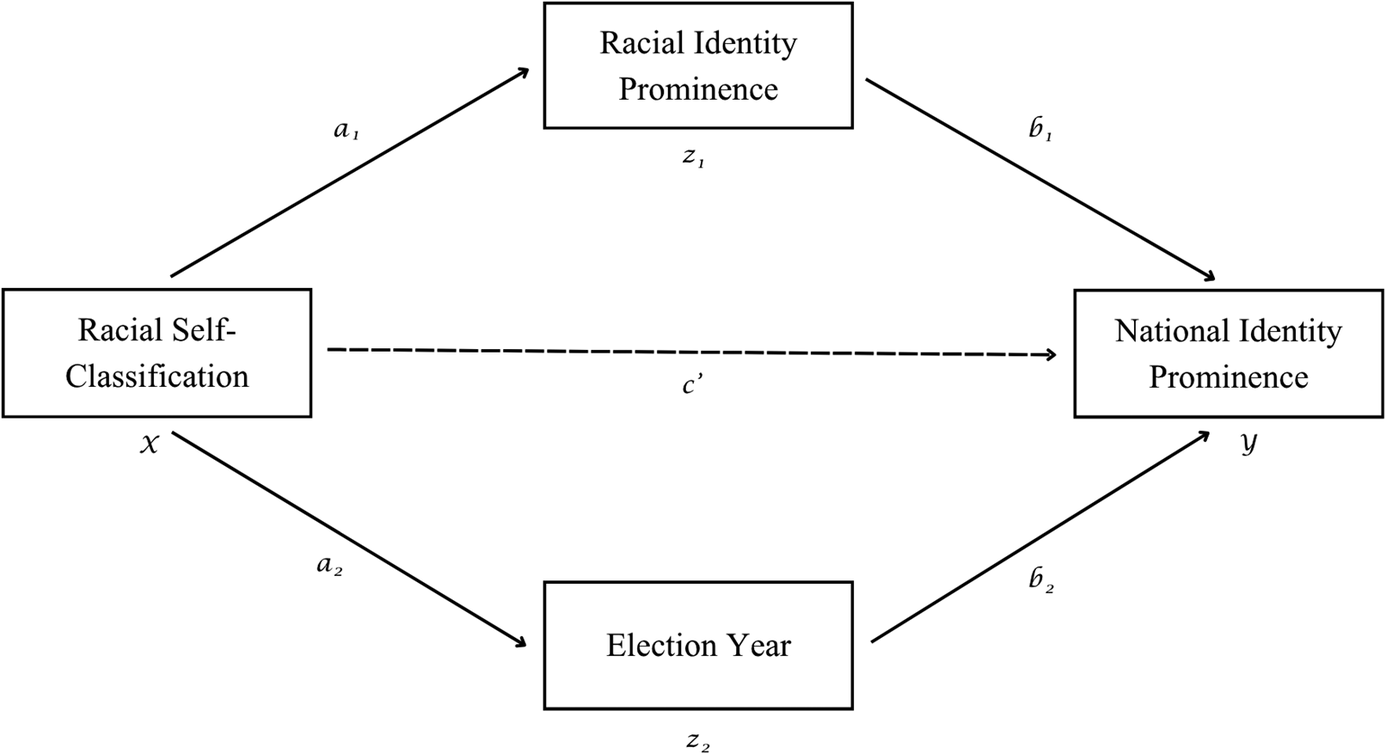
A series of nested binomial logistic regressions was conducted to test whether racial identity prominence (RIP) and election year mediate the relationship between racial self-classification (RSC) and national identity prominence (NIP), controlling for socio-demographic characteristics. The model for this mediation analysis is depicted in Figure 1. Regression coefficients are reported as odds ratios to interpret the probability of strong national identity prominence, Prob(Y=1), given the primary predictors (RSC, RIP, year).
Conceptual Model of Mediation Analysis.
Source: 2012, 2016, 2020 American National Election Studies (ANES) time series.
Notes: The relationships mediated by z are called the indirect effect (a1 * b1 and a2 * b2), while the relationship unmediated by z is called the direct effect (a1 * b1 and a2 * b2). The sum of the indirect and direct effects is called the total effect [(a1 * b1) + (a2 * b2) + c’].

Model 1 regresses national identity prominence (1=Strong NIP) on racial self-classification (ref= White). Model 2 adds racial identity prominence (ref= Weak RIP). Model 3 adds election year (ref=2012). Using these models as the baseline framework, the Karlson-Holm-Breen (KHB) decomposition method (Breen et al., Reference Breen, Karlson and Holm2013; Karlson et al., Reference Karlson, Holm and Breen2012; Kohler et al., Reference Kohler, Karlson and Holm2011) was then applied to assess the degree to which racial identity prominence and election year mediate the relationship between racial self-classification and national identity prominence. This method produces robust estimates of the degree to which confounding variables (RIP and election year) mediate differences between the primary predictor (RSC) and the outcome of interest (NIP).
Marginal effects were also computed to obtain predicted probabilities of White and Black respondents reporting strong national identity prominence, both with and without racial identity prominence in the model, while holding all controls constant. These values were derived from a logistic regression model that included a three-way interaction term among the predictor variables and their impact on national identity prominence. The interaction term demonstrates the effect of the main predictor variable (RSC) on NIP and its dependence, or lack thereof, on the values of the auxiliary predictors (RIP and election year). Computing marginal effects, or predictive probabilities, from this regression model provides a more robust understanding of whether White and Black respondents’ reports of national identity prominence differ across expressions of racial identity prominence and whether they vary by election year.
Results
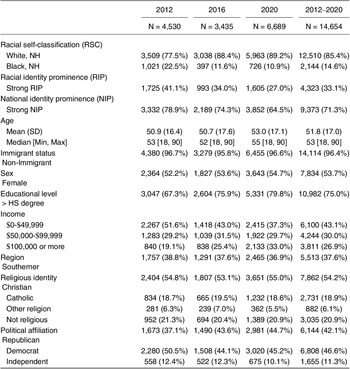
A summary of the key variables—racial self-classification, racial identity prominence, and national identity prominence—along with socio-demographic control variables, stratified by election year, is presented in Table 1.
Sample Characteristics

Table 1. Long description
The table contains four columns for the years 2012, 2016, 2020, and the combined period 2012 to 2020, with sample sizes N equals 4,530, 3,435, 6,689, and 14,654 respectively. Each row details a demographic or identity variable. For racial self-classification, White non-Hispanic counts are 3,509 (77.5 percent) in 2012, 3,038 (88.4 percent) in 2016, 5,963 (89.2 percent) in 2020, and 12,510 (85.4 percent) overall. Black non-Hispanic counts are 1,021 (22.5 percent), 397 (11.6 percent), 726 (10.9 percent), and 2,144 (14.6 percent) respectively. For racial identity prominence, strong R I P is 1,725 (41.1 percent), 993 (34.0 percent), 1,605 (27.0 percent), and 4,323 (33.1 percent). For national identity prominence, strong N I P is 3,332 (78.9 percent), 2,189 (74.3 percent), 3,852 (64.5 percent), and 9,373 (71.3 percent). Age is reported as mean with standard deviation: 50.9 (16.4), 50.7 (17.6), 53.0 (17.1), and 51.8 (17.0). Median ages with minimum and maximum are 53 [18, 90], 52 [18, 90], 55 [18, 90], and 53 [18, 90]. For immigrant status, non-immigrant counts are 4,380 (96.7 percent), 3,279 (95.8 percent), 6,455 (96.6 percent), and 14,114 (96.4 percent). For sex, female counts are 2,364 (52.2 percent), 1,827 (53.6 percent), 3,643 (54.7 percent), and 7,834 (53.7 percent). For educational level above high school degree, counts are 3,047 (67.3 percent), 2,604 (75.9 percent), 5,331 (79.8 percent), and 10,982 (75.0 percent). Income brackets are as follows: 0 to 49,999 dollars, 2,267 (51.6 percent), 1,418 (43.0 percent), 2,415 (37.3 percent), and 6,100 (43.1 percent); 50,000 to 99,999 dollars, 1,283 (29.2 percent), 1,039 (31.5 percent), 1,922 (29.7 percent), and 4,244 (30.0 percent); 100,000 dollars or more, 840 (19.1 percent), 838 (25.4 percent), 2,133 (33.0 percent), and 3,811 (26.9 percent). For region, Southerner counts are 1,757 (38.8 percent), 1,291 (37.6 percent), 2,465 (36.9 percent), and 5,513 (37.6 percent). For religious identity, Christian counts are 2,404 (54.8 percent), 1,807 (53.1 percent), 3,651 (55.0 percent), and 7,862 (54.2 percent); Catholic, 834 (18.7 percent), 665 (19.5 percent), 1,232 (18.6 percent), and 2,731 (18.9 percent); other religion, 281 (6.3 percent), 239 (7.0 percent), 362 (5.5 percent), and 882 (6.1 percent); not religious, 952 (21.3 percent), 694 (20.4 percent), 1,389 (20.9 percent), and 3,035 (20.9 percent). For political affiliation, Republican counts are 1,673 (37.1 percent), 1,490 (43.6 percent), 2,981 (44.7 percent), and 6,144 (42.1 percent); Democrat, 2,280 (50.5 percent), 1,508 (44.1 percent), 3,020 (45.2 percent), and 6,808 (46.6 percent); Independent, 558 (12.4 percent), 522 (12.3 percent), 675 (10.1 percent), and 1,655 (11.3 percent). Source is the 2012, 2016, and 2020 American National Election Studies time series.
Source: 2012, 2016, 2020 American National Election Studies (ANES) time series.
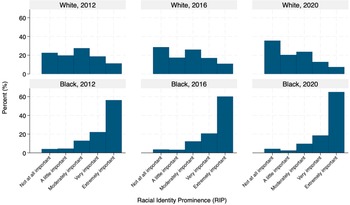
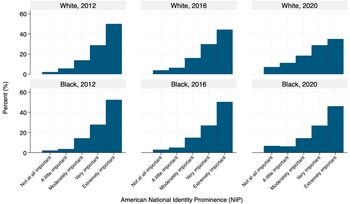
Before evaluating the main hypotheses, I begin with a brief discussion of the distributions of racial and national identity prominence by racial self-classification and election year. Baseline racial differences in the reported prominence of racial and national identity in 2012, 2016, and 2020 are shown in histograms that display response distributions as percentage frequencies (see Figures 2-3). The results reveal substantial variation in racial identity prominence but not in national identity prominence. Black Americans reported much stronger attachment to their racial identities across all election years than White Americans, whose reports remained relatively moderate and consistent, except in 2020, when reports of White racial identity being “Not at all important” to White Rs increased. In contrast, reports of national identity prominence were similar for Black and White Americans in 2012 and 2016, with most respondents from both racial groups reporting that national identity is “Very important” or “Extremely important” to their identity. Compared to earlier years, in 2020, fewer White respondents reported their national identity as “Extremely important” and instead reported it as “A little important” or “Not at all important.” Black respondents’ reports of national identity prominence remained relatively consistent across all three election years.
White and Black R’s Racial Identity Prominence by Election Year.

Figure 2. Long description
The grid contains six bar charts. The x axis of each chart is labeled Racial Identity Prominence with five categories from left to right Not at all important, A little important, Moderately important, Very important, Extremely important. The y axis is labeled Percent with tick marks at 0, 20, 40, and 60. Top row panels are labeled White, 2012 White, 2016 and White, 2020. In all three White panels, the distribution is relatively flat with each bar between roughly 10 and 25 percent, and no clear peak. Bottom row panels are labeled Black, 2012 Black, 2016 and Black, 2020. In all three Black panels, the distribution is highly skewed with the bar for Extremely important exceeding 60 percent, and the other categories much lower, with Not at all important and A little important near zero, Moderately important and Very important increasing gradually. The pattern for Black respondents is consistent across years, while the pattern for White respondents remains flat across years.
White and Black R’s National Identity Prominence by Election Year.

Figure 3. Long description
From top-left to bottom-right, the panels are labeled White 2012, White 2016, White 2020 in the top row, and Black 2012, Black 2016, Black 2020 in the bottom row. Each panel displays a vertical bar chart with the x-axis labeled American National Identity Prominence N I P, divided into five categories from left to right Not at all important, A little important, Moderately important, Very important, Extremely important. The y-axis is labeled Percent percent and ranges from 0 to 60. In all panels, the distribution is right-skewed, with the highest bars at Extremely important and the lowest at Not at all important. For White respondents, the proportion selecting Extremely important decreases slightly from 2012 to 2020, while the proportion for Very important and Moderately important increases. For Black respondents, the Extremely important category remains the highest and relatively stable across years, with minor increases in the lower importance categories. The overall pattern shows that both groups rate Extremely important as the most common response, but the distribution for White respondents shifts slightly toward lower importance over time, while Black respondents’ distribution remains more stable.
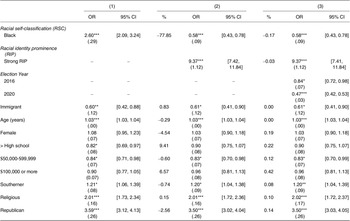
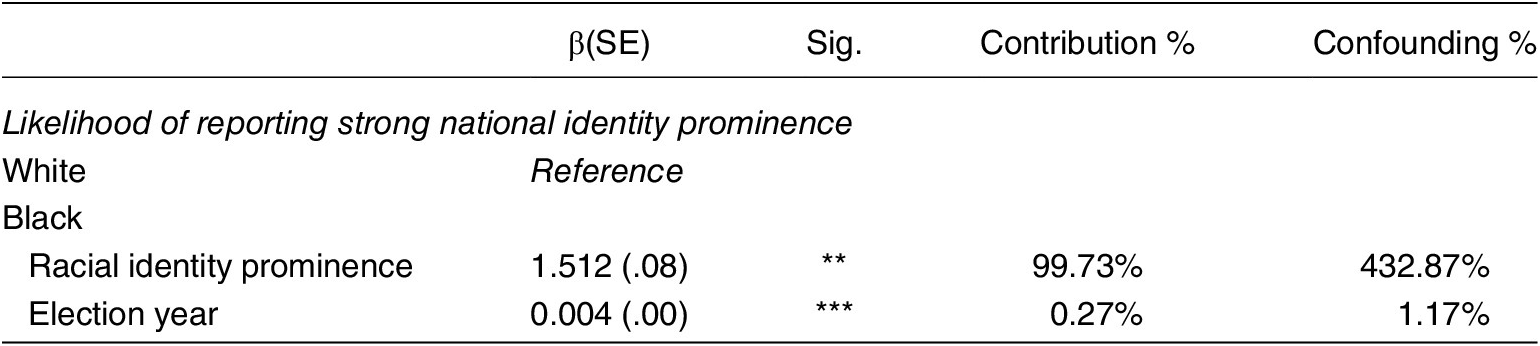
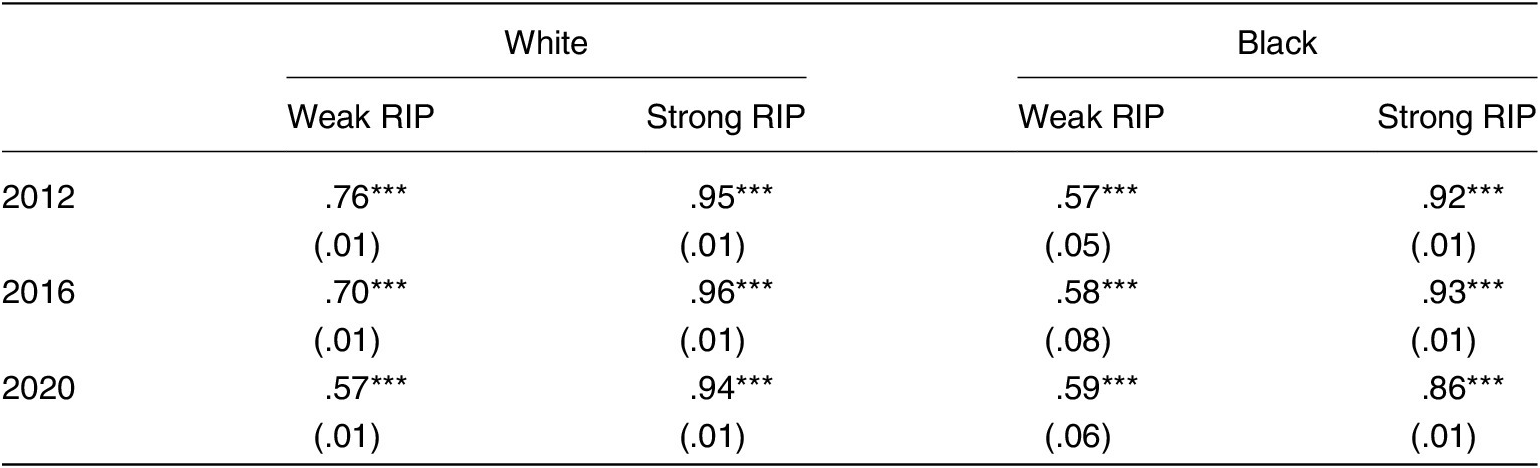
As noted in the previous sections, the main hypotheses and analyses focus on the relationship between racial self-classification and national identity prominence, and on the extent to which racial identity prominence and election year mediate this relationship. The regression models used in the mediation analysis are presented in Table 2. Model 1 depicts the association between national identity prominence and racial self-classification. Model 2 adds racial identity prominence. Model 3 adds election year. Table 3 contains key measures from the KHB decomposition, derived from the regression models. The reported values indicate which mediating variables (RIP, election year) contribute most to confounding. The coefficients in the first column represent the effect difference (indirect effect) of each mediator on the total effect (relationship between RSC and NIP). The corresponding significance for each coefficient is shown in the second column. The “Contribution %” column shows the contribution of each mediator to the indirect effect. The “Confounding %” column shows the proportion of the total effect attributable to confounding by the respective mediator. Finally, Table 4 presents the predicted probabilities of reporting strong national identity prominence for Black and White respondents in 2012, 2016, and 2020, with and without accounting for racial identity prominence, while keeping all controls constant at their means.
Nested binomial logistic regression of national identity prominence on racial self-classification, racial identity prominence, and presidential election year
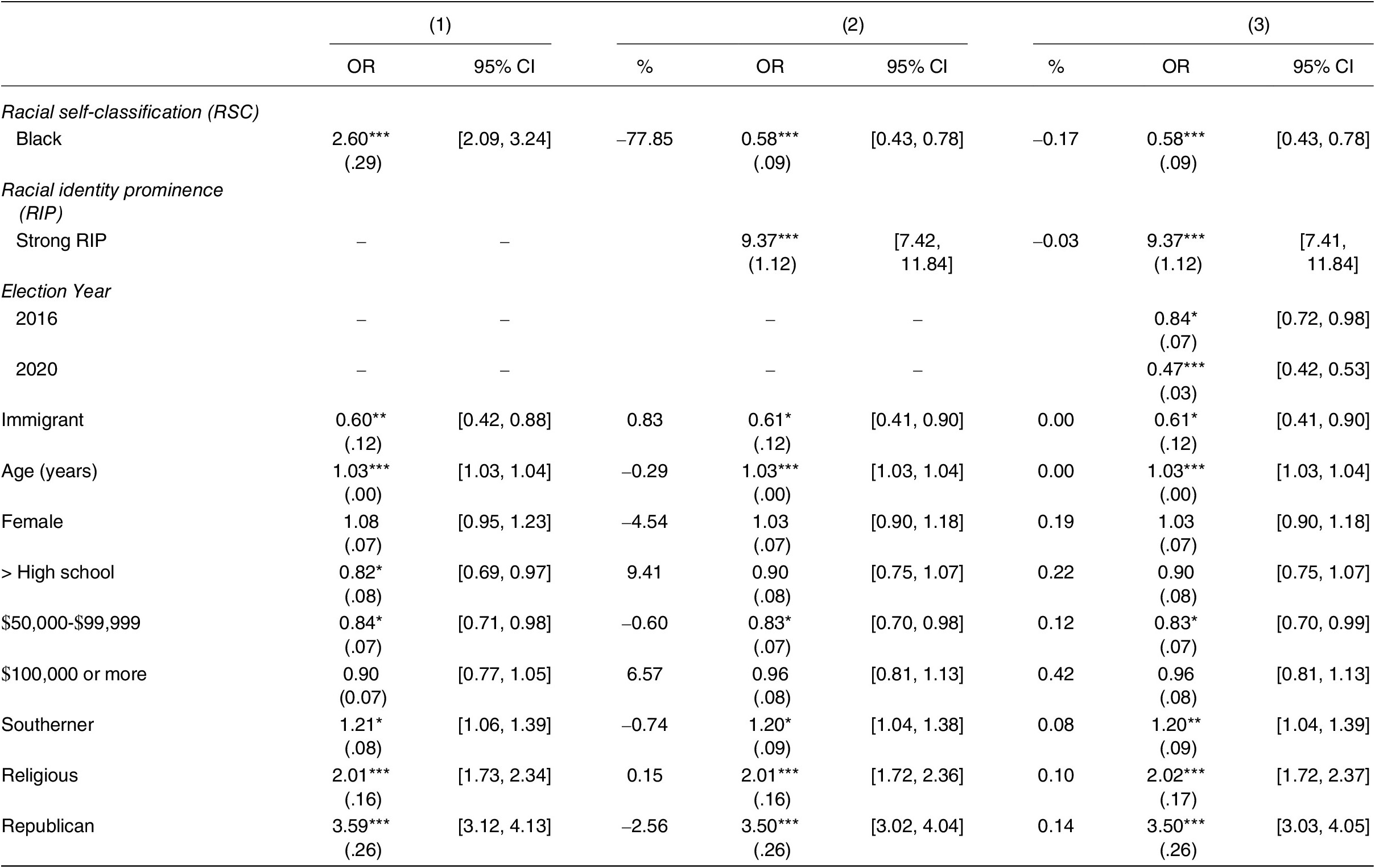
Table 2. Long description
The table presents three models of nested binomial logistic regression predicting national identity prominence. Columns are grouped by model: Model 1, Model 2, and Model 3, each with odds ratio (OR), 95 percent confidence interval (CI), and percentage columns. The first section lists Racial self-classification (RSC) with a subrow for Black, showing for Model 1 an OR of 2.60 with three asterisks, standard error 0.29, CI [2.09, 3.24], and percentage 77.85. For Model 2 and Model 3, Black has OR 0.58 with three asterisks, standard error 0.09, CI [0.43, 0.78], and percentage 0.17. The next section is Racial identity prominence (RIP) with a subrow for Strong RIP, which is not present in Model 1, but in Model 2 and Model 3 has OR 9.37 with three asterisks, standard error 1.12, CI [7.42, 11.84] for Model 2 and [7.41, 11.84] for Model 3, and percentage 0.03. The Election Year section has subrows for 2016 and 2020. For 2016, only Model 3 has data: OR 0.84 with one asterisk, standard error 0.07, CI [0.72, 0.98]. For 2020, only Model 3 has data: OR 0.47 with three asterisks, standard error 0.03, CI [0.42, 0.53]. The next rows are Immigrant (Model 1: OR 0.60 with two asterisks, standard error 0.12, CI [0.42, 0.88], percentage 0.83; Model 2 and 3: OR 0.61 with one asterisk, standard error 0.12, CI [0.41, 0.90], percentage 0.00), Age in years (all models: OR 1.03 with three asterisks, standard error 0.00, CI [1.03, 1.04], percentage 0.29 for Model 1, 0.00 for Models 2 and 3), Female (Model 1: OR 1.08, standard error 0.07, CI [0.95, 1.23], percentage 4.54; Model 2 and 3: OR 1.03, standard error 0.07, CI [0.90, 1.18], percentage 0.19 and 0.19), Greater than high school education (Model 1: OR 0.82 with one asterisk, standard error 0.08, CI [0.69, 0.97], percentage 9.41; Model 2 and 3: OR 0.90, standard error 0.08, CI [0.75, 1.07], percentage 0.22 and 0.22), Income 50,000 to 99,999 dollars (Model 1: OR 0.84 with one asterisk, standard error 0.07, CI [0.71, 0.98], percentage 0.60; Model 2 and 3: OR 0.83 with one asterisk, standard error 0.07, CI [0.70, 0.98] and [0.70, 0.99], percentage 0.12), Income 100,000 dollars or more (Model 1: OR 0.90, standard error 0.07, CI [0.77, 1.05], percentage 6.57; Model 2 and 3: OR 0.96, standard error 0.08, CI [0.81, 1.13], percentage 0.42), Southerner (Model 1: OR 1.21 with one asterisk, standard error 0.08, CI [1.06, 1.39], percentage 0.74; Model 2: OR 1.20 with one asterisk, standard error 0.09, CI [1.04, 1.38], percentage 0.08; Model 3: OR 1.20 with two asterisks, standard error 0.09, CI [1.04, 1.39]), Religious (Model 1: OR 2.01 with three asterisks, standard error 0.16, CI [1.73, 2.34], percentage 0.15; Model 2: OR 2.01 with three asterisks, standard error 0.16, CI [1.72, 2.36], percentage 0.10; Model 3: OR 2.02 with three asterisks, standard error 0.17, CI [1.72, 2.37]), and Republican (Model 1: OR 3.59 with three asterisks, standard error 0.26, CI [3.12, 4.13], percentage 2.56; Model 2 and 3: OR 3.50 with three asterisks, standard error 0.26, CI [3.02, 4.04] and [3.03, 4.05], percentage 0.14). The table footnotes state all values are weighted, asterisks indicate significance levels, and the sample size is N equals 12,351.
Source: 2012, 2016, 2020 American National Election Studies (ANES) time series.
Notes: All values are weighted. * p < 0.05, ** p < 0.01, *** p < 0.001.
N= 12,351.
Decomposition using KHB-Method, Mediating Components of Difference in NIP

Table 3. Long description
The table presents a decomposition analysis of the difference in likelihood of reporting strong national identity prominence, using the K H B method. The header row lists columns as follows from left to right: an empty label column, beta with standard error in parentheses, significance, contribution percent, and confounding percent. The first section label is ‘Likelihood of reporting strong national identity prominence’. The next row lists ‘White’ as the reference group, with all other columns marked as ‘Reference’. The following section is for ‘Black’, with two indented mediating components. The first is ‘Racial identity prominence’, with a beta of 1.512 (0.08), significance marked by two asterisks, contribution percent of 99.73 percent, and confounding percent of 432.87 percent. The second is ‘Election year’, with a beta of 0.004 (0.00), significance marked by three asterisks, contribution percent of 0.27 percent, and confounding percent of 1.17 percent. Table notes specify that standard errors are in parentheses, a single asterisk indicates p less than 0.05, two asterisks indicate p less than 0.01, and three asterisks indicate p less than 0.001. The data source is the 2012, 2016, and 2020 American National Election Studies time series, with a sample size of 12,351.
Source: 2012, 2016, 2020 American National Election Studies (ANES) time series.
Note: Standard errors in parentheses. * p < 0.05, ** p < 0.01, *** p < 0.001.
N= 12,351.
Predictive Margins of Strong National Identity Prominence

Table 4. Long description
The table presents predictive margins for strong national identity prominence, organized by year in rows (2012, 2016, 2020) and by group in columns. The columns are White with Weak R I P, White with Strong R I P, Black with Weak R I P, and Black with Strong R I P. For 2012, values are 0.76 with standard error 0.01 for White Weak R I P, 0.95 with 0.01 for White Strong R I P, 0.57 with 0.05 for Black Weak R I P, and 0.92 with 0.01 for Black Strong R I P. For 2016, values are 0.70 with 0.01 for White Weak R I P, 0.96 with 0.01 for White Strong R I P, 0.58 with 0.08 for Black Weak R I P, and 0.93 with 0.01 for Black Strong R I P. For 2020, values are 0.57 with 0.01 for White Weak R I P, 0.94 with 0.01 for White Strong R I P, 0.59 with 0.06 for Black Weak R I P, and 0.86 with 0.01 for Black Strong R I P. All predictive margin values are marked with three asterisks, indicating p less than 0.001. Standard errors are shown in parentheses below each value.
Source: 2012, 2016, 2020 American National Election Studies (ANES) time series.
Note: Standard errors in parentheses. * p < 0.05, ** p < 0.01, *** p < 0.001.
N= 12,351.
Mediation by Racial Identity Prominence
Racial identity prominence accounted for much of the difference in reported national identity prominence between White and Black Americans, even when demographics were held constant. Model 1 in Table 2 reveals that Black Americans were significantly more likely than White Americans to report strong national identity prominence (OR = 2.60, p = .000). Although the association between racial self- classification and national identity prominence was expected to be significant, this finding contradicts the expected direction of the relationship (H1: Black Rs will be less likely to report strong national identity prominence than White Rs). However, when racial identity prominence is added to the model (Model 2), the odds of Black Americans reporting higher national identity prominence than White Americans drop significantly (OR = 0.58, p = .000), partially supporting H2 (RIP will be a stronger predictor of NIP than RSC alone). Compared to Model 1, the odds of Black Americans reporting strong national identity prominence decreased by about 78%, relative to White Americans. KHB decomposition further confirms that racial identity prominence mediates this difference in reported national identity prominence by 99.73% (Table 4). Racial identity prominence also has a significant isolated main effect on national identity prominence. The odds of respondents with strong racial identity prominence reporting their national identity as “Very important” or “Extremely important,” regardless of whether they identify as White or Black, are significantly higher than those with weak racial identity prominence (OR = 9.37, p = .000), holding all controls constant. Results from the controls are relatively consistent across Model 1 and Model 2. Older Americans (OR = 1.03, p = .000), Southerners (OR = 1.21, p = .006), respondents who identify as religious (OR = 2.01, p = .000), and Republicans (OR = 3.59, p = .000) are significantly more likely than their counterparts to report strong national identity prominence. In contrast, immigrants are less likely to report strong national identity prominence than U. S.-born American citizens (OR = 0.60, p = .008), and respondents who earn between $55,000 and $99,000 a year are less likely to report strong national identity prominence than respondents who earn less than $55,000 a year (OR = 0.84, p = .028). In Model 1, respondents with a high school degree or less are less likely to report strong national identity prominence than respondents with a degree beyond high school (OR = 0.82, p = .021), but when racial identity prominence is added to the model, the association between education level and national identity prominence loses significance.
Mediation by Presidential Election Year
When the election year is accounted for (Model 3), the significant relationships in reported national identity prominence from Model 2 remain consistent. This finding indicates that the election year neither diminishes nor intensifies the extent to which Black Americans and respondents with strong racial identity prominence (regardless of RSC) report strong national identity. The KHB decomposition results confirm this: while the election year significantly confounds White and Black Americans’ reports of national identity prominence, the degree of mediation is much lower (0.27%) than that of racial identity prominence (99.73%). KHB results further reveal that, compared to the coefficients in the reduced model (Model 1), the coefficients in the full model have increased by 434.04%, with 432.87% of this confounding coming from racial identity prominence and 1.17% from the election year. These findings support H4 (RIP will have a more substantial confounding effect in the relationship between RSC and NIP than year). While the election year did not notably change the relationship between racial self-classification and national identity prominence or between racial identity prominence and national identity prominence in Model 3, it produced significant isolated main effects for national identity prominence that support H3 (all Rs will have a lower probability of reporting strong NIP in 2016 and in 2020 than in 2012). The odds of respondents reporting strong national identity prominence in 2016, regardless of their racial self-classification or racial identity prominence, were significantly lower than the odds in 2012 (OR = 0.84, p = .023), holding all controls constant. The odds in 2020 were even lower than in 2012 (OR = 0.47, p = .000). Significant results from the controls are consistent across Model 2 and Model 3.
Predictive Probabilities
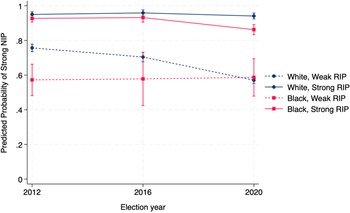
Table 4 presents the marginal effects, or predictive probabilities, of reporting strong national identity prominence by respondents’ racial self-classification, racial identity prominence, and the election year, with all controls held at their means. These results are derived from a logistic regression that interacts racial self-classification with racial identity prominence and election year, demonstrating how the effect of racial self-classification on national identity prominence varies across levels of racial identity prominence and election year. Regression results are included in the online appendices, and the values presented in the article are predictive probabilities. The predicted probabilities for White and Black Americans with varying degrees of racial identity prominence reporting strong national identity prominence are far more complex than expected (H2). Across all election years, for both White and Black Americans, the probability of strong national identity prominence is significantly higher among those who view their racial identity as “Very/Extremely important” (strong RIP) and lower among those who view their racial identity as “Not at all/A little/Moderately important” (weak RIP). White Americans with strong racial identity prominence are more likely to report strong national identity prominence than Black Americans with strong racial identity prominence, but the difference is only a few percentage points, especially in 2012 (WStrong RIP = 94.9%, p = .000; BStrong RIP = 92.6%, p = .000) and 2016 (WStrong RIP = 95.8%, p = .000; BStrong RIP = 93.2%, p = .000). In 2020, the probability for Black Americans with strong racial identity prominence dropped by about 7% (BStrong RIP = 86.2%, p = .000), while the probability for White Americans with strong racial identity prominence remained fairly consistent (WStrong RIP = 94.1%, p = .000). Conversely, in 2012, White Americans with weak racial identity prominence had a higher likelihood of strong national identity prominence than Black Americans with weak racial identity prominence by about 18% (WWeak RIP = 75.7%, p = .000; BWeak RIP = 57.2%, p = .000). In 2016, the likelihood for White Americans with weak racial identity prominence reporting strong national identity prominence dropped by about 5% (WWeak RIP = 70.4%, p = .000), while Black Americans with weak racial identity prominence stayed relatively consistent (BWeak RIP = 57.8%, p = .000). In 2020, the likelihood for White Americans with weak racial identity prominence dropped even more compared to 2016, by about 13% (WWeak RIP = 57.1%, p = .000), while the likelihood for Black Americans with weak racial identity prominence increased by only about one percent from the previous election year (BWeak RIP = 58.7%, p = .000). Still, this small increase exposed a shift: in contrast to previous years, in 2020, Black Americans with weak racial identity prominence had a slightly higher probability of reporting strong national identity prominence than White Americans with weak racial identity prominence. Taken together, the marginal effects results also reveal that, excluding Blacks with weak racial identity, the likelihood of reporting a strong national identity decreased from 2012 to 2020 across all groups, especially among Whites with weak racial identity. This finding nuances previously reported support for H3. These relationships are visualized in Figure 4.
Marginal Effects of Strong National Identity Prominence by Racial Self-Classification, Racial Identity Prominence, and Election Year.

Figure 4. Long description
The x-axis is labeled Election year with tick marks at 2012, 2016, and 2020. The y-axis is labeled Predicted Probability of Strong N I P, ranging from 0 to 1 in increments of 0.2. Four groups are shown: White, Weak R I P (blue dashed line with circles), White, Strong R I P (blue solid line with circles), Black, Weak R I P (red dashed line with squares), and Black, Strong R I P (red solid line with squares). For White, Strong R I P, the line remains near 1.0 across all years with minimal decline. White, Weak R I P starts near 0.8 in 2012 and declines to about 0.6 by 2020. Black, Strong R I P remains close to 0.9 in 2012 and 2016, then declines to about 0.8 in 2020. Black, Weak R I P stays near 0.6 across all years. Error bars are present for each data point, with the largest error for Black, Weak R I P. The legend at the right identifies each line by color, marker, and line style.
Discussion
Racialized subjectivity, as described by W. E. B. Du Bois, is evident in the national attachments of Black and White Americans. As a result of racial histories and politics that define American identity, Du Bois explained that Black Americans reconcile their “twoness”— Black and American—in ways that White Americans, who view themselves as the quintessential American, do not. Drawing on Identity Theory’s identity prominence and identity change, this study sought to examine how the relationships Du Bois theorized between racialized subjectivity and national identity were reified in a contemporary period of American political life: the Trumpism era. Specifically, the period before, during, and after Trump’s first presidency (2012, 2016, 2020).
As anticipated, White Americans with strong ties to their racial identity expressed the strongest attachment to national identity between 2012 and 2020. However, contrary to the hypothesis that all White Americans would express stronger national attachments, the findings showed that in 2012 and 2016, Black Americans with strong racial identity reported similar attachment to national identity as Whites with strong racial identity, followed by White Americans with weak racial identity and Black Americans with weak racial identity. In 2020, an interesting shift occurred: expressions of strong national identity among White Americans with weak racial identity dropped sharply from 2016, resulting in a slightly lower national attachment than that of Black Americans with weak racial identity. This finding departs from previous assumptions that most Whites see their Whiteness and Americanness as one and the same, even in hyper-racialized environments. Although expressions of strong national identity also declined among Black Americans in 2020 compared to previous years, a strong racial identity remained a robust predictor of strong national identity. This finding, while unexpected, still aligns with Du Bois’ acknowledgment that Black Americans may respond to the color line in diverse and, at times, opposing ways (see Du Bois Reference Du Bois1903b, Reference Du Bois1940). In the Trumpism era, it appears that Black Americans adopted a stance that aligned their strong attachment to their racial identity with their national identity.
Prior research from Du Boisian scholars has found that Black Americans with strong ties to their racial identity and critical of the country’s racist practices may reject the notion of “White America” and instead “describe belonging to two, often opposing nations: the American nation and the Black nation” (Johnson Reference Johnson2018, p. 1979, emphasis added). This “nation-within-a-nation” hypothesis raises an important consideration: perhaps what America represents to the Black community matters more than who the archetypal Americans are perceived to be. Black Americans in the study may have envisioned contrasting visions of America, either the paradigmatic White America or the revisionist Black America, when responding to the national identity survey question. Understanding how the “two warring ideals” of American nationhood and Blackness (Du Bois Reference Du Bois1903a) are cognized differently may provide insight into the surprising yet noteworthy finding that strong racial identity is associated with strong national identity among Black Americans.
Interesting findings on identity change across election years also emerged. These findings contribute to Du Boisian epistemology, which holds that racialized actors’ subjectivities cannot be fully understood without the histories and structures that shape them (Itzigsohn Reference Itzigsohn2024, Reference Itzigsohn2025; Meghji Reference Meghji2024), by integrating temporal dimensions of identity and subjectivity. As anticipated, both White and Black Americans, regardless of the prominence of their racial identity, viewed their national identities as less important in 2016 than in 2012, and even less so in 2020 than in 2012. This downward trend was especially pronounced among Whites with weak ties to their racial identity. Given the political context of the period, these findings suggest that the rise of Trumpism in 2016 may have partially served as a mobilizing force that prompted a decline in how much White and Black Americans valued their national identities. As S. Romi Mukherjee (Reference Mukherjee2018) notes, Trumpism “testifies to the gradual collapse of reason, …common decency, and also cordiality” (p. 55).
While the election year certainly influenced White and Black Americans’ national attachments, the mediation analysis showed that the degree of mediation between racial self-classification (White/Black) and national identity prominence was substantially larger for racial identity prominence than for the election year. This finding was anticipated, given the centrality of identity prominence in individuals’ self-formation and self-verification processes (Burke and Stets, Reference Burke and Stets2023b; Morris Reference Morris2013; Stryker and Serpe, Reference Stryker and Serpe1994). Moreover, an identity becomes more prominent when it shares meanings with other identities (Burke Reference Burke, Stets, Reichelmann and Kiecolt2023; Burke and Stets, Reference Burke and Stets2023a). Because racial identity and American national identity share similar dialectical, phenomenological structures, it makes sense that racial identity prominence is a significant mechanism through which attachment to national identity is expressed.
This study makes several methodological contributions by using racial identity prominence to capture the racialized subjectivity of Black and White Americans. By employing diverse measures of race, researchers can assess not only how individuals classify themselves but also how they express connection and belonging. Doing so mitigates the conceptual and analytical issues that arise from relying solely on nominal racial categories to understand how race manifests in the social world. The lived realities of racialized actors are not as clear-cut as rigid, categorical analyses of race often suggest (Conwell and Loughran, Reference Conwell and Loughran2023; Zuberi and Bonilla-Silva, Reference Zuberi and Bonilla-Silva2008). As Ellis P. Monk (Reference Monk2022) observes, “the world of human perception and categorization (natural or social) is fundamentally gradational, continuous, and subcategorical, not discrete and superordinate” (p. 11). A Du Boisian framework requires that researchers “[theorize] within history—analyzing cases within their own logic and attending to the complexities of specific historical moments—rather than constructing theories and concepts that aim to apply universally across time and place” (Itzigsohn Reference Itzigsohn2025, p. 2). Therefore, its methodologies must also be rooted in a specific and intricate epistemology.
Future research may opt for longitudinal panel data instead of cross-sectional data to provide more robust claims of temporality. In lieu of longitudinal data, adding additional waves of cross-sectional time-series data may benefit future research. Due to limitations in variable availability and the lack of uniformity in survey response categories across previous ANES datasets, additional time-series data could not be included in the present study. Moreover, despite the ANES’s efforts to oversample racial minorities through cluster sampling, Black respondents were underrepresented across all three datasets used in this study, especially in 2016 and 2020. Future researchers should seek larger samples of Black respondents to test similar claims made in this study.
Future studies may also further explore how immigrant status, age, region, religious identity, or political affiliation influences national identity attachments, given their consistent significant associations in the present study. Across all models, older Americans, Southerners, respondents who identify as religious (Christian, Catholic, Jewish, or other religion), and Republicans were significantly more likely than younger Americans, non-Southerners, non-religious people, and non-Republicans (Democrats and Independents) to report strong national identity prominence. In contrast, immigrants and higher-earning respondents were less likely than U.S.-born Americans and lower-earning respondents to report strong national identity prominence. These trends should continue to be teased apart through empirical inquiry, whether survey-based or qualitative.
Conclusion
Trumpism is as American as apple pie. Although the manner in which Trumpism operates may appear to be a novel disruption to American politics and culture, its racist-nativist rhetoric and tactics have a historical precedent, as Du Bois himself documented. In this sense, Trumpism represents a particular iteration of the “Soul” (Du Bois Reference Du Bois1903c, Reference Du Bois1920) of the United States. This study provides evidence for this. As the findings indicate, racial identity prominence was a much stronger predictor of strong national attachments than election year, even as expressions of strong national identity declined between 2012 and 2020. The deep-rooted nature of Trumpism may explain this: the temporal dimensions of identity may not account for attachment to national identity when the elements that make up an unstable or turbulent sociopolitical environment are pervasive and well-established.
Moreover, White Americans with a strong racial identity were more likely than all other groups to view their national identity as important to their personal identities. The political mobilization of White racial identity has historically been the raison d’être for White nationalism, demonstrating what can occur when White Americans with deep ties to their racial identities become emboldened by a political figure who appeals to the racist-nativist character of American identity. At the same time, it is crucial to critically attend to the reality that “Black people have agency in the reproduction of white supremacy” and are increasingly becoming “enthusiastic reproducers” of a system set up for their demise (Brooks Reference Brooks2025, pp. 705, 706). While strong identification with American national identity alone does not imply the reproduction of White supremacy, national attachment is often validated by nativist or Christian nationalist logics (Perry et al., Reference Perry, Schleifer, Whitehead and Frantz2024; Perry and McDaniel, Reference Perry and McDaniel2023). Complicity in endorsing or upholding such structures is likely to impede racial progress and liberatory praxes. Still, in line with the warnings Niambi M. Carter and Tyson D. King-Meadows (Reference Carter and King-Meadows2019) stress in their study of Black identity politics in the Trumpism era, the study’s findings and conclusions must be “tempered” with criticality (p. 23). Black Americans are Americans, and “this fact should not be read as a betrayal of their groups’ politics” (Carter and King-Meadows, Reference Carter and King-Meadows2019, p. 23).
Today, more than ever, scholars must consider the intricacies of Americans’ racialized subjectivities and national attachments. Trumpism is a testament to “the machinery of Americanization” (Dunbar-Ortiz Reference Dunbar-Ortiz2021, p. 82), a racial colonial project that has persisted for centuries and will continue to persist with or without Donald Trump himself. By examining the historical-structural and phenomenological dimensions of national attachments, researchers will better understand social phenomena associated with national identity, including support for social policy (Carter and King-Meadows, Reference Carter and King-Meadows2019; Huynh et al., Reference Huynh, Devos and Altman2015; Molina and Preddie, Reference Molina and Preddie2020; Mukherjee et al., Reference Mukherjee, Molina and Adams2012; Transue Reference Transue2007), voting behavior (Baker et al., Reference Baker, Perry and Whitehead2020; Garand et al., Reference Garand, Qi and Magaña2022; Huddy and Khatib, Reference Huddy and Khatib2007; Levchak and Levchak, Reference Levchak and Levchak2020), electoral and non-electoral political participation (Greene et al., Reference Greene, Gray, Carter and Block2020), and the concurrent rise of Black conservatism and Christian nationalism (Brooks Reference Brooks2024, Reference Brooks2025; Perry et al., Reference Perry, Schleifer, Whitehead and Frantz2024; Perry and McDaniel, Reference Perry and McDaniel2023). Regardless of utility, Du Boisian approaches to race, nation, and identity offer a compelling starting point for uncovering the nuanced aspects of American national identity attachments.
Acknowledgements
I am very grateful to the two anonymous reviewers for their very constructive feedback, which greatly strengthened the article. I would also like to thank Karida L. Brown, Cathryn Johnson, Karen Hegtvedt, Alyasah “Ali” Sewell, Heeju Sohn, Nicholas Vargas, and Charles Peek for their helpful comments on early drafts of this paper. Versions of this paper were presented at the Legacy of W. E. B. Du Bois: Crossing Boundaries for Social Justice Conference at Brown University (2024), the Culture and Social Psychology Empirical Research (CASPER) Workshop at Emory University, and the Race & Racism Empirical Research (RARER) Workshop at Emory University.

 Open access

