

Introduction
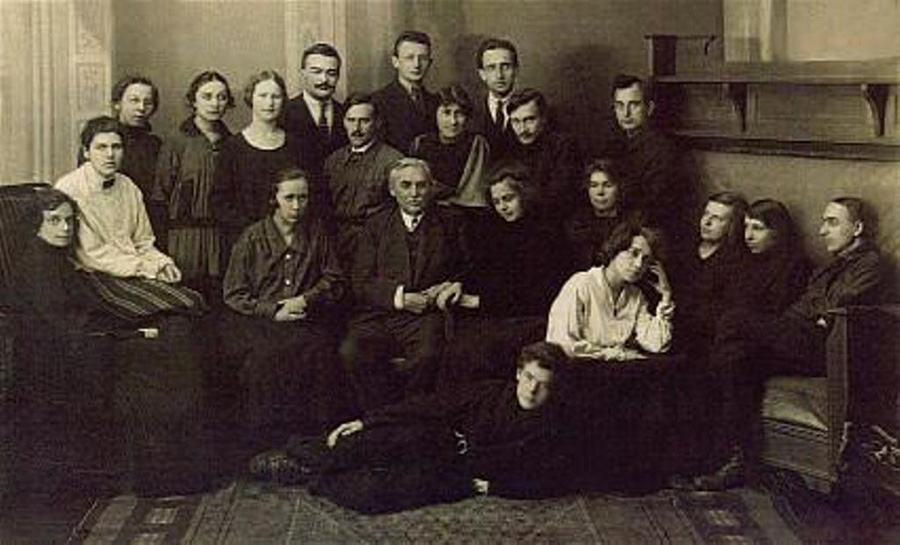
Vasiliy Gorodtsov with students in Moscow in 1926. Professor Gorodtsov is in the centre, Varvara Levashova is to his right.

A scholar's life is an unpredictable journey: some make astonishing discoveries by sheer accident, where others persevere and keep working against all the odds. Many archaeologists' lives illustrate an unreserved devotion to science and a constant struggle for survival — such was the life of Varvara Pavlovna Levashova. Levashova was born to a priest on 25 July 1901 in Saint-Petersburg, Russia. In 1926 she defended her graduate dissertation at Moscow State University, which she had completed under the guidance of Vasiliy Gorodtsov (Klein 1999) (Figure 1). The theme of her thesis was 'Iron axes in Eastern Europe in the Early Iron Age'. That same year she moved to Omsk, where she worked for four years as head of the archaeology department at the State Museum of West Siberia (Reference KitovaKitova 2007: 1313).
In December 1929 Levashova moved to Minusinsk, a small town in the south of Krasnoyarsk Krai, where she joined the staff of the Minusinsk Museum of Local Lore. She married and had two daughters. In 1937 her husband was arrested as a 'public enemy' and shot; the same year her father was repressed by the government. With two young daughters, aged 2 and 5, Levashova was forced out of her apartment and dismissed from her job. In 1938 she was able to return to work at the museum, but her living conditions were dreadful: she and her daughters lived in a basement room of about 8m2, with no electricity. Every day, in all weather, she had to carry water to pay for her lodging. The small family lived on the verge of starvation. Bread was rationed: Levashova received 500g a day for herself and 300g for her daughters, but even these meagre rations were not always available. Growing potatoes was a means of survival, but this was dangerous, as they had to plant potatoes 15km from the city and guard them to prevent theft.
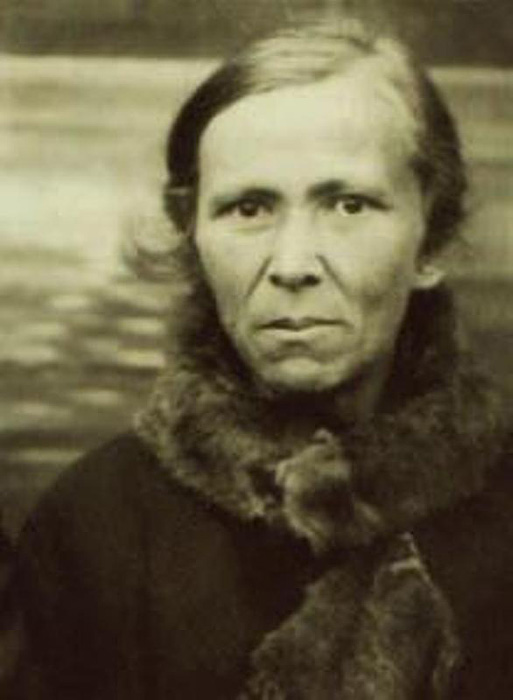
In the early 1940s, though she was close to starving and weighed only 39kg (Figure 2), Levashova wrote her doctoral dissertation on the history of Khakassia. As she was preparing to defend her thesis, she wrote of both her work and her health to her colleague and friend Lydia Evtukhova:
'I wrote to the Khakas publishing house asking them to return my drawings; should I not get them back I will prepare new ones — not all of them, depending on how much time I have and how much paper I can get. I'm also thinking of adding some new, recent material, it might be useful. Don't worry about my health, my 11th pneumonia went on as smoothly as the previous ones' (Reference Sveshnikova and KorzunSveshnikova 2006: 476).
'I feel I have hardly any strength to go on, like a wretched nag who is about to drop dead in the street. [...] The girls are in good health. Both take turns to go to school wearing my overshoes; it is fortunate that one has classes in the morning and the other in the afternoon' (Reference Sveshnikova and KorzunSveshnikova 2006: 479).
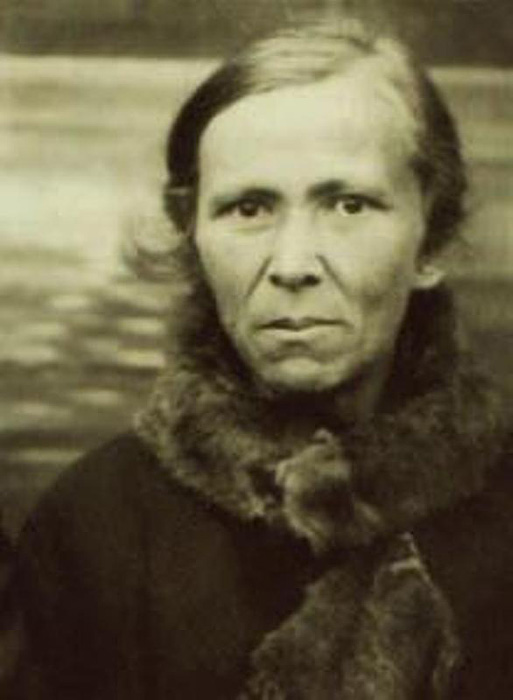
Varvara Levashova, Krasnoyarsk 1943.
Against all the odds, Levashova kept working. The hardest yet most productive period of her life was the years she lived in Minusinsk. She organised archaeological exhibitions for Siberian museums in Krasnoyarsk, Khakas and Tuvan and every year until 1945 she led archaeological expeditions in Krasnoyarsk Krai. The Khakas-Minusinsk basin, where Minusinsk is located, is often called the 'archaeological Mecca' of Siberia as the area, thanks to its climate, which is unusually mild for Siberia, was densely populated from the end of the Stone Age onwards. Her excavations uncovered Bronze Age and Early Iron Age settlements and burial mounds of the Andronov, Karasuk, Tagar and Tashtyk archaeological cultures (Reference LevashovaLevashova 1939, 1941, 1949, 1952). For nine years Levashova also studied ancient iron forges and open hearth furnaces (so-called Catalan hearths) in the environs of Minusinsk (Reference LevashovaLevashova 1946). She later summarised her archaeological discoveries in a map entitled 'Archaeological research of the Minusinsk Museum in 19281943', which was widely used by archaeologists in determining the sites targeted for excavations in later years.
In February and March 1945 the First All-Soviet Archaeological Congress took place and Levashova contributed four reports to it: a paper (with L. Evtukhova) on her joint excavations in 194041 of a governor's palace of the Huns; a related report on the contemporary mirrors of the Chinese Han dynasty found in the territory of the Krasnoyarsk Krai; a report on the materials of the first Kapchal burial mound, excavated by her in 1934, dated to the seventhninth centuries AD and attributed to the Tashtyk archaeological culture; and finally a report on archaeological research carried out since 1928 by the Minusinsk Museum, accompanied by the map mentioned above. It is not known whether she herself presented the four reports; the Congress information only mentions that Levashova took part (Russian Academy of Sciences Archive, Fund 1909, Inventory 1, p. 61).
In 1945 Levashova defended her doctoral dissertation, 'The history of Khakassia from the earliest times to the seventeenth century', at Moscow State University. In 1946 she managed to move to Moscow where she worked at the State Historic Museum for many years (Reference Kyzlasova, Kamenetskyi and SorokinKyzlasova 2010: 757). Levashova died in 1972.
We can but marvel at the strength of this small, seemingly fragile woman. Even in the most desperate conditions she remained dedicated to science, and produced work that was crucial to the developing discipline of Russian and Soviet archaeology, especially the archaeology of South Siberia.
Acknowledgements
Supported by Alexander von Humboldt Foundation.