

INTRODUCTION
After Mr. Haddad and his two codefendants had pleaded guilty to grievous bodily harm and wounding, their sentencing hearing began (State of Israel v. Haddad 2015). The prosecutor asked for a prison sentence of fourteen months and Judge Beeri knew that, based on sentencing practices, the appropriate sentence should include several months of imprisonment. However, when the prosecutor presented Haddad’s criminal record, Judge Beeri had to pause. Apparently, Haddad had been subjected to a twenty-four-month suspended sentence. The current conviction was a breach of this previously imposed suspended sentence. If Judge Beeri had sentenced Haddad even to a short prison term, he would have had to activate the two-year suspended sentence. The probation reports showed Haddad’s promising progress in an alcohol rehab program, and the judge thought that such a long prison term would harm this rehabilitation. Yet the law is clear. If a defendant with an activatable suspended sentence, like Haddad, breaches the condition of a suspended sentence and commits a further offense (a breach offense), the suspended sentence must be activated.
The only way to avoid this harsh result is to prolong the suspension period of the sentence. However, prolonging the suspension term is only allowed if the breach offense is so minor that the sentence for that breach offense does not include imprisonment (not even a suspended prison sentence). How could Judge Beeri hold that a sentence for an offense of grievous bodily harm and wounding should not include imprisonment? Based on sentencing practices and precedents it obviously should.
Still, Judge Beeri decided that it would be wrong to sentence Haddad to such a long term of imprisonment. Although the Israeli Supreme Court has clearly stated that sentences for breach offenses should not be decided based on such tactical considerations (Mahageneh v. State of Israel 2009), Judge Beeri refused to activate such a long suspended sentence in this case. Faced with the dilemma of imposing either a two-year prison sentence or no prison at all, he chose the latter. The judge explained that, because of the positive probation report and due to the long activatable suspended sentence, he had decided to prolong the suspension period. Haddad was sentenced to three hundred hours of community service and a twelve-month probation. The two codefendants, who were not in breach of a suspended sentence, were sentenced to six months of prison terms and additional penalties, and although their prison terms were served as service labor, their sentence was still much harsher than Haddad’s.Footnote 1
Haddad was probably confused. When he had previously been convicted and sentenced to twenty-four months of suspended sentence, he had been warned that if he was convicted of a breach offense, he would serve a twenty-four-month term in prison, in addition to the sentence for the breach offense. Yet when he was convicted of such an offense, he was sent to the probation office, while his codefendants, who did not have a substantial criminal record like he did and were not subject to an activatable suspended sentence, were sent to the prison authorities.
The suspended sentence was a strange punishment; instead of inflicting harm, it provided a benefit. Instead of prompting a long prison term, it set him free.
This study examines the effect of suspended sentences in Israel. It shows that Mr. Haddad is not unique in benefiting from being subject to a suspended sentence. In fact, for different types of offenses, convicted offenders are less likely to be sent to prison if they are in breach of a suspended sentence compared to similarly situated offenders who are not in breach. Suspended sentences were supposed to threaten defendants that if they reoffended, they would serve at least the suspended term. Instead, they often gave these defendants a get-out-of-jail-free card.
The Israeli suspended sentence is, de facto, a type of mandatory minimum sentence. Unlike most mandatory minimum sentences, it is set by a judge for a specific offender, not by the legislature for a specific offense. Yet, for the sentencing judge, a minimum sentence and an activatable suspended sentence have a similar effect. Both limit his or her sentencing discretion in a similar way. Thus, although this study examines the effect of suspended sentences in Israel, its findings are relevant to many other types of mandatory minimum sentences. If we find that the attempts to bypass the mandatory prison sentence produce fewer prison sentences, the result questions the effectiveness of some other forms of mandatory minimum sentences.
This is not the first study to show that mandatory minimum sentencing is sometimes circumvented. Numerous empirical studies have documented different ways in which mandatory sentencing laws are circumvented (see, for example, Bjerk Reference Bjerk2005; for a review of the literature, see Tonry Reference Tonry1996, Reference Tonry2009). Several scholars argue that, in some cases, mandatory sentences yield fewer convictions because judges or juries are reluctant to convict offenders who are subject to harsh mandatory sentences (see, for example, Loftin, Heumann, and McDowall Reference Loftin, Heumann and McDowall1983; US Sentencing Commission 1991; Oliss Reference Oliss1995; Sauer Reference Sauer1995; Barkow Reference Barkow2003; Leipold Reference Leipold2005). Others show that judges find ways to sentence defendants to shorter terms than the law or guidelines prescribe (US Sentencing Commission 1991; Bowman and Heise Reference Bowman and Heise2001). Still other studies point to changes in prosecutorial practices as a main locus of circumvention, finding that prosecutors are reluctant to prosecute charges carrying a mandatory sentence or that they alter such charges in exchange for a guilty plea (US Sentencing Commission 1991). For example, Bjerk (Reference Bjerk2005) shows how such sentencing laws lead prosecutors to reduce felony charges to misdemeanors when three-strikes laws require a harsh mandatory sentence for repeat felony offenders.
Still, as a study of judicial sentencing practices, this study is unique. First, most (though not all) previous studies examined the effect of minimum sentencing by comparing decisions made in two different periods: before minimum sentencing was introduced and afterward. However, before-and-after studies are challenged by an infinite number of other changes that occurred around the same time as the change examined (National Institute for Occupational Safety and Health (NIOSH) 2001, 17–28; Torgerson and Torgerson Reference Torgerson and Torgerson2008, 9–16). This study uses a unique setting in which, during the same period, some of the defendants are subject to mandatory minimum sentences (that is, the activatable suspended sentence) and others, who have committed the same offenses, are not, thus overcoming the limitations of the before-and-after methodology. We use propensity score matching to match defendants with and without an activatable suspended sentence. This analysis, accompanied by sensitivity analysis and additional examinations, assists in isolating the effect of the minimum sentence. Second, we find that in relatively severe offenses, not only do some of the defendants benefit from the suspended sentence, but the likelihood of a prison sentence decreases if the convicted defendant is subject to a suspended sentence. In other words, if avoiding a prison sentence is the aim of defendants, the number of defendants who benefit from the minimum sentence (the suspended sentence) is higher than the number of those who are disadvantaged by it. In serious offenses, a suspended sentence does not increase the likelihood of a prison sentence—it decreases it.
Background
A suspended sentence, officially called “Conditional Imprisonment Penalty” (Hok HaOnshin (Penal Law) 5737–1977, §§ 52–60), is the most common type of criminal penalty imposed in Israel. A suspended sentence is a term of imprisonment that results in actual imprisonment only if the offender is convicted of a further offense during the term of suspension (Emmanuel and Gazal-Ayal Reference Emmanuel and Gazal-Ayal2019). More than 85 percent of criminal sentences adjudicated by the magistrates’ courts and more than 94 percent of criminal decisions adjudicated by district courts in Israel include such a penalty, often alongside other types of penalties such as immediate imprisonment and fines (Gazal-Ayal, Galon, and Weinshall-Margel Reference Gazal-Ayal, Galon and Weinshall-Margel2012, 19–21).
According to the Israeli Penal Law (§ 52), “[w]hen a Court imposes a sentence of imprisonment, it may—in the sentence—direct that all or part of that penalty be conditional.”Footnote 2 The sentence should specify the conditional period (between one and three years) and the type of offenses that are breach offenses and thus activate the sentence. In most cases, the sentence is suspended for three years.
For example, a sentencing decision can state, “the defendant is hereby sentenced to nine months of imprisonment conditioned on committing a property offense in the next three years.” This is a nine-month suspended sentence. If the defendant commits a theft (a breach offense) a year later and is later convicted of that theft, the nine-month sentence becomes an activatable suspended sentence.Footnote 3 In that case, the court “shall order” the activation of the suspended sentence (Hok HaOnshin (Penal Law) 5737–1977, §§ 55(a), 58).
In many instances, the suspended sentence is imposed in addition to an immediate imprisonment term. As we show elsewhere (Emmanuel and Gazal-Ayal Reference Emmanuel and Gazal-Ayal2019, 121), magistrates’ courts add a suspended sentence to 97 percent of the sentences that include immediate imprisonment. Such sentencing decisions often state something like “I hereby sentence the defendant to twenty-four months of imprisonment, of which six months are immediate and eighteen months are conditioned on committing a drug offense within three years.” Thus, a suspended sentence is usually not imposed as a means of relieving the defendant’s sentence, nor should it be viewed as such. Suspended sentences are regularly added to immediate prison sentences in both minor cases and severe cases (including manslaughter, rape, and aggravated assault cases).
Note that a suspended sentence in Israel is substantially different than in most other jurisdictions. In other countries, a suspended sentence is limited, usually to two years at most, and cannot be added to an immediate prison sentence (see, for example, Aarten Reference Aarten2019; Freiburg 2019; Irwin-Rogers and Roberts Reference Irwin-Rogers and Roberts2019; Varona and Kemp Reference Varona and Kemp2020). Thus, it mainly replaces short prison sentences. In Israel, on the other hand, it is imposed in almost every sentence, for minor and severe offenses, either along with an immediate prison sentence or as an independent component.
This legal framework means that the court imposing a suspended sentence sets a de facto minimum sentence for a breach offense. When the defendant is convicted of a breach offense, a second sentencing court must activate the suspended sentence and add that activated prison term to any term imposed for the breach offense.
In some cases, though, the activation of the suspended sentence might be excessively harsh. When the breach offense is minor, and the suspended sentence is long, activation might result in disproportionally harsh punishment. After hearing of several stories of such unjust prison terms imposed following the activation of suspended sentences, in 1963 the Israeli Parliament added an amendment allowing courts, in unique and exceptional instances, to extend the period of suspension in lieu of activating the suspended sentence (see Emmanuel and Gazal-Ayal Reference Emmanuel and Gazal-Ayal2019, 125). However, allowing courts to refrain from activating the suspended sentence in this manner might undermine the effectiveness of this type of penalty, to deter defendants through a credible threat of a certain and substantial prison sentence for reoffending. Thus, the law imposes three cumulative restrictions on courts’ power to extend the suspension period. First, an extension of the suspension period is only allowed for one breach. If the offender breaches twice, the court must activate the suspended sentence.Footnote 4 Second, judges must explain why it is unjust to activate the suspended sentence in their written opinion; this written explanation is meant to curtail the use of the exception, making these decisions more amenable to appeals.
Third, and most important for our study, extending the suspension period after a breach is only allowed if the breach offense is minor to the extent that the sentence for that offense is noncustodial. If the appropriate sentence for the breach offense is a prison term, even only a suspended prison term, the court must activate the suspended sentence.
But, as this study shows, this third condition has led courts to reverse the order of decisions in many cases. Rather than first determining the sentence for the breach offense, and only then, if the defendant is not sentenced to imprisonment, deciding whether to extend the suspension period, courts first determine whether they want to activate the suspended sentence, and then, accordingly, decide whether to impose a term of imprisonment for the breach offense. As a result, in some cases, they refrain from imposing a prison sentence for an offense because the offender is subject to a suspended sentence. In other words, in some cases, an activatable suspended sentence shields the defendant from a prison sentence rather than increasing the likelihood of such a sentence following a breach. By restricting courts from extending the suspended term following a breach to minor offenses, the legislature encourages courts to treat serious offenses as minor ones when defendants are in breach of suspended sentences. In this study, we found that when a defendant is convicted of a serious offense, the likelihood of a prison sentence is lower if she or he has an activatable suspended sentence, compared to offenders without an activatable suspended sentence ceteris paribus. In such cases, the activatable suspended sentence reduces the likelihood of a prison sentence, instead of increasing it.
From a research standpoint, studying suspended sentences creates a unique setting for evaluating the effect of minimum sentencing; it allows us to compare between punishments imposed on defendants who are subject to “mandatory minimum sentence” (the suspended sentence), and those imposed on similar defendants—those who were tried in close time proximity and for similar offenses—but who are not subject to this mandatory sentence. This comparison is unattainable through the examination of traditional mandatory sentencing statutes due to the lack of a control group.
In what follows, we explain our study and its findings. After specifying our hypotheses, in the second section, we present the database we employed and the methodology adopted to examine our hypotheses. The third section describes the results of the study. Our analysis shows that an activatable suspended sentence increases the probability of a prison sentence for minor offenses but has the opposite effect for serious offenses. Following a conviction for a serious offense, defendants are less likely to be sent to prison if they have an activatable suspended sentence, ceteris paribus. In this section, we also show that suspended sentences reduce the effect of offense severity on the sentence.
The fourth section, in turn, discusses the different results we obtained for minor and serious offenses. We explain that an activatable suspended sentence has two contradictory effects. On the one hand, because judges are instructed to activate the sentence following a breach, a suspended sentence can increase the likelihood of a prison sentence. On the other hand, because judges must refrain from sentencing the defendant to prison if they do not want to activate the sentence, a suspended sentence might reduce the likelihood of a prison sentence. Our discussion explains why the former effect is dominant in minor offenses and the latter in serious offenses. This section also discusses what the present study can teach us about the distortive effects of mandatory sentences in general. We then end with a summary of our conclusions.
Hypotheses
Several studies have examined how judges circumvent rules that require them to impose sentences that they believe to be excessive. In Israel, Gazal-Ayal, Turjeman, and Fishman (Reference Gazal-Ayal, Turjeman and Fishman2013) showed that in 70 percent of the sentences, magistrates’ courts did not follow the binding Supreme Court precedent requiring a prison sentence for aiding illegal aliens. Studies preceding United States v. Booker (2005), examining the effect of the then-binding US sentencing guidelines, show similar results (see US Sentencing Commission 1991; Greenblatt Reference Greenblatt2008–2009).
We thus hypothesize that judges invoke the exception in a substantial percentage of the cases despite its strict conditions. More importantly, we hypothesize that, other things being equal, an offender with an activatable suspended sentence is less likely to be sentenced to imprisonment than an offender who is not subject to a suspended sentence. Put differently, the suspended sentence becomes defendants’ insurance against imprisonment rather than a means of deterrence. In what follows, the present study examines this hypothesis.
METHODOLOGY
The Data
The data for this study were extracted from the police criminal record database. The variables in the database include: (i) defendant demographics (gender, age, religion); and (ii) offense/sentencing histories (number of previous convictions; details of sentences imposed for previous convictions, including length of suspension period for suspended sentence; current offense type; sentence type imposed for current conviction; date of latest conviction; whether the defendant has activatable suspended sentences; the instance—trial or appellate court; and the district).Footnote 5
From this database, we extracted all the sentences imposed on adult defendants in Israel during a three-year period (2014–2016). We restricted ourselves to Israeli defendants (excluding foreigners) and to magistrate court cases, which usually handle offenses for which the maximum sentence is seven years of imprisonment or less. Ninety-five percent of all criminal cases in Israel are tried in magistrates’ courts (Israeli Judicial Authority 2017).
We received the information in eight separate databases (including the offenses database, defendants’ demographics database, police files database, court judgments database, penalties database, etc.).Footnote 6 We linked the databases to each other through three main keys: the defendant ID, the police file number,Footnote 7 and the court file number.Footnote 8 Then, we flattened the information from these databases into a single two-dimensional database made up of 75,528 court files, which include all the variables linked to that court file from the different databases. In this flattened database, 8,797 of the defendants had an activatable suspended sentence. Our flattened database also allowed up to five police files and up to four offenses per police file, meaning we coded no more than twenty offenses for each case.Footnote 9 We thus deleted 1,856 (∼2.5 percent) court files that included too many police files or offenses for each sentence.Footnote 10 Among the remaining 73,672 cases (8,240 with an activatable suspended sentence), we removed records of defendants with multiple cases during that period and left only the most recent court case for each defendant in the database. The resulting database was thus made up of 61,472 court files (5,764 with an activatable suspended sentence). Since prior convictions are a substantial sentencing factor, and since all defendants with an activatable suspended sentence had at least one prior conviction, we also excluded first-time offenders from the database. This allowed us to examine the effect of an activatable suspended sentence rather than the effect of the defendant’s criminal record. This removal of first-time offenders from the database left us with 32,764 cases (27,000 without an activatable suspended sentence, but still 5,764 cases with an activatable suspended sentence). We also removed 1,172 cases in which a defendant with an already prolonged suspended sentence was sentenced by the court, in which case the court had to activate the suspended term. This, in turn, reduced the database to 4,592 activatable suspended sentence cases, but still 27,000 cases without an activatable suspended sentence.
Table 1 contains detailed information about the characteristics of the sample with respect to defendants with and without an activatable suspended sentence.
Descriptive Characteristics—By Research Group (Without/With an Activatable Suspended Sentence (A.S.S.)) (Unmatched Sample)

These descriptive statistics show that defendants with an activatable suspended sentence were more likely to be young (up to thirty-four years of age), Jewish, without minor children, with a previous activated suspended sentence, with a previous imprisonment sentence, and with a prior juvenile record. These defendants also tended to have a higher number of prior convictions and to be remanded in custody when the indictment was issued.Footnote 11 Additionally, their indictment also tended to include more drug and property offense charges, and the mean of the maximum sentence for their principal offense was higher.
Independent and Outcome Variables
The key independent variable of interest in the present study was whether the defendant had an activatable suspended sentence when sentenced. The independent variable was coded 1 if the defendant had an activatable suspended sentence and 0 if she or he did not. The dependent variable (outcome) in the present study was whether the defendant was sentenced to imprisonment (1 for a prison sentence, 0 for a nonprison sentence).Footnote 12 For defendants with an activatable suspended sentence, we treated all decisions to activate the sentence as imprisonment sentences even if the court did not impose a prison term for the breach offense. That way, if we find that defendants with an activatable suspended sentence are less likely to be sent to prison as hypothesized, it will be despite the inclusion of these cases as imprisonment decisions.Footnote 13
We controlled for a large set of covariates that were available in the database (both legal and extralegal factors) and that are known to exert an impact on sentencing. All the control variables are listed in Table 2.
Covariates Included in the Propensity Score Model

a Since the data is restricted to Israelis, immigration offenses are mainly offenses pertaining to Israelis who host, employ, or drive a person who entered Israel illegally.
Propensity Score Methods
To infer causation, it is best to assign activatable suspended sentences randomly to defendants. This is, of course, impossible. Matching each activatable suspended sentence case to an otherwise identical case is another way to reach the same result. But when the number of confounds is large, exact matching of all the individual variables results in the loss of too many samples and hence in a biased outcome (Stuart Reference Stuart2010, 5, 7). An alternative measure is thus to assure that the examined cases with and without an activatable suspended sentence are otherwise similar in the factors that affect sentences.
We used propensity score to match cases from the two groups (Williamson and Forbes Reference Williamson and Forbes2014). Using propensity score matching (PSM) we created two similar sets of cases for defendants with and without activatable suspended sentences, assuring that the known confound cannot explain any difference we might find in the likelihood of prison sentences for each group.Footnote 14 Propensity score matching assures that the distribution of the variables in the two groups is similar without the loss of too many samples that occurs when using exact matching (Stuart Reference Stuart2010). Still, to further reduce any potential difference between the treatment and control groups, we required exact matching in the most substantial confounds: the type of principal offense (the most serious offense) and the severity of the principal offense (measured by the maximum sentence prescribed for that offense). The exact matching of these two variables de facto divided our database into eighteen datasets for each combination of offense type (six types)Footnote 15 and offense severity (three levels—minor, midrange, and serious offense). Samples were only matched within each of those eighteen sets.
The propensity score of each sample is the conditional probability of receiving the treatment (having an activatable suspended sentence) given a set of observed covariates. This score is estimated through a logistic regression model predicting treatment status using a range of covariates related to both treatment allocation and outcome (prison sentence) (Williamson and Forbes Reference Williamson and Forbes2014).Footnote 16 Each defendant receives such a score, between 0 and 1, representing the probability of having an activatable suspended sentence.
We then matched every defendant with an activatable suspended sentence to a defendant without an activatable suspended sentence who had the most similar score (PSM 1:1). To reduce the loss of samples, we allowed PSM with replacement, meaning some defendants without an activatable suspended sentence were matched to more than one treated sample (with an activatable suspended sentence).Footnote 17 Following Austin (Reference Austin2009, Reference Austin2011), we used a caliper width of 0.2 of the standard deviation of the logit of the propensity score (hereafter: caliper width = 0.2 SD LPS or 0.2 SD caliper) to exclude pairs that did not reside within the caliper limits. This means that, for a match to be made, the difference in the logits of the propensity scores (LPS) for pairs of individuals from the two groups had to be less than or equal to 0.2 times the standard deviation of logit of the PS (0.2 SD LPS).
One of the main confounds we examined is offense severity. Unfortunately, for historical reasons, the sentence prescribed in the penal law for each offense does not adequately represent the offense severity.Footnote 18 Hence, for each offense, we calculated the proportion of convictions that resulted in prison sentences following conviction for that offense, removing from our database a few uncommon offenses that were too rare to be categorized into one of the three severity groups.Footnote 19 When less than one-third of the convictions resulted in prison sentences, the offense severity (OS) was categorized as minor (OS = 0). When more than two-thirds of the convictions resulted in prison, the offense severity was categorized as serious (OS = 2). For the remaining midrange offenses, OS = 1. For example, the database contained 2,391 cases with threatFootnote 20 as the main offense; 24 percent ((574/2,391) * 100) of these convictions resulted in an imprisonment sentence. Since less than one-third of the convictions of threat resulted in prison, threat was categorized as a minor offense (OS = 0). On the other hand, burglary,Footnote 21 an offense that resulted in prison sentences in 87.1 percent ((346/397) * 100) of the cases, was categorized as a serious offense (OS = 2).
This process resulted in a dataset of 8,013 cases: 4,575 defendants with an activatable suspended sentence and 3,438 defendants without an activatable suspended sentence. After adding the weighted variable, the sample includes 9,150 cases, half with an activatable suspended sentence and half without, meaning less than 0.2 percent of the treated group were lost (4,575 from 4,580).
After running the propensity score matching and having two matched groups, treatment and control, we examined whether the propensity score analysis indeed provided balanced samples that eliminated the differences between the groups at each level of the offense severity. If the absolute values of standardized differences are lower than 20 percent across all variables, the result is considered well balanced (Apel and Sweeten Reference Apel, Sweeten, Weisburd and Alex2010, 543). As Table 4 shows, our post-PSM groups are balanced even if we use a much stricter standard of 10 percent (Williamson and Forbes Reference Williamson and Forbes2014).
Frequency (Numbers and Percentages) of Control Group Cases by the Number of Treatment Group Cases They Were Matched to

Note: We used PSM with replacement, meaning that some defendants without an activatable suspended sentence (control group) were matched to more than one defendant with an activatable suspended sentence (treatment group). The table shows that 97 percent of the matched nonactivatable suspended sentence cases were matched to up to three activatable suspended sentence cases. This process resulted in a dataset of 3,438 defendants without an activatable suspended sentence. After taking into account the number of times each control is matched by using frequency weights, the sample includes 4,575 weighted matched cases without an activatable suspended sentence that were matched to 4,575 cases with an activatable suspended sentence.
Standardized Differences %—By an A.S.S.: Before and After Matching
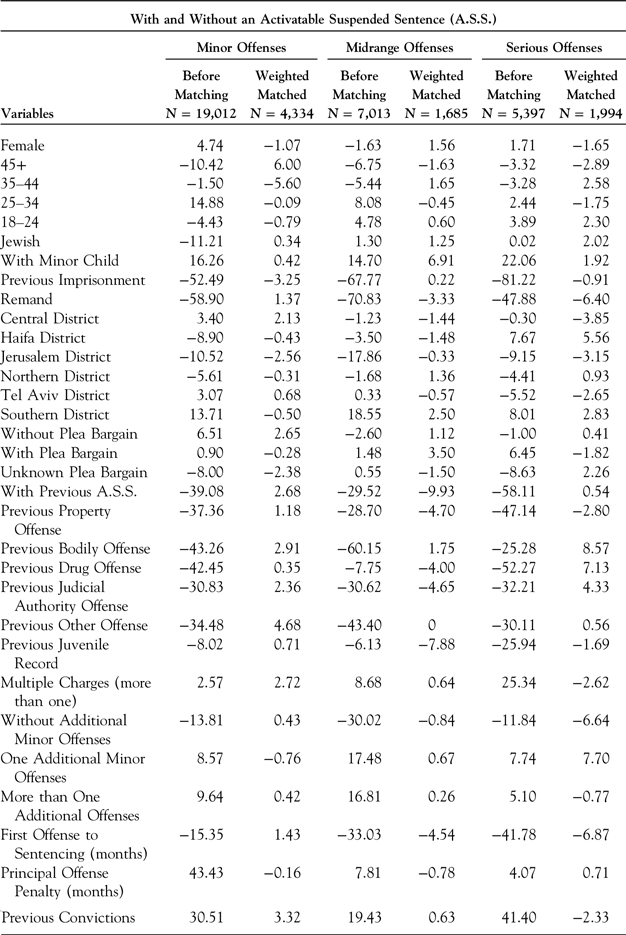
Note: Table 4 presents the standardized differences in percentages (%) for all the covariates included in the propensity score model before and after matching at the different levels of the offense severity variable. Before matching, the two groups were unbalanced at each level of offense severity.
In the minor offenses category, a total of eighteen variables were unbalanced. In the midrange offenses category, a total of fifteen variables were unbalanced and in serious offenses category, a total of fourteen variables were unbalanced. After matching (weighted matched) at each level of the offense severity variable, none of the covariates were unbalanced. In minor offenses category, the variable with the largest standardized differences in absolute value was age (45+) (Standardized Differences = 6 percent). In the midrange offenses category, the variable with the largest absolute value of standardized differences was with previous activatable suspended sentence (Standardized Differences = 9.93 percent), and in the serious offenses category, the variable with the largest standardized differences in absolute value was previous bodily offense (Standardized Differences = 8.57 percent). These data provide good evidence that the treated and control groups were matched adequately at each level of the offense severity variable.
Simple Logistic Regression of the Likelihood of Imposing Imprisonment

**p < 0.01; *** p ≤ 0.001
Table 4 shows that, while eighteen variables were unbalanced before matching in the minor offense group (and fewer in the other groups), after matching all the variables were well balanced in all three levels of the offense severity variable. We separately examined the balance of the main continuous variables (age, number of offenses, and offense severity) before they were converted to categorical variables and found that they were well balanced in the matched groups.Footnote 22 We can thus examine the effect of the activatable suspended sentences on imprisonment in the matched dataset.
The Analysis
Following Stuart (Reference Stuart2010, 11) we added the variable “frequency weights” to the matched sample to account for the nonactivatable suspended sentence cases that were matched to more than one activatable suspended sentence case. We then analyzed the data in two stages, using descriptive statistics first and inferential statistics second. The first stage presents the frequency (as a percentage) of imprisonment sentences (out of all sentences) imposed on defendants with and without an activatable suspended sentence. We present the data separately for each of the samples: before PSM and after PSM with a caliper and with replacement. We then show the imprisonment rate again, but now separately for three categories of offense severity. This separate analysis allows us to examine whether an activatable suspended sentence plays a different role with respect to different severity levels.
In the second stage, the inferential statistics stage, we first used two simple logistic regressions to estimate the impact of having an activatable suspended sentence on the probability of an imprisonment sentence for all defendants and for the matched sample. We then ran two logistic regressions: one for the post-PSM sample and one for the entire sample. In the post-PSM sample, we added the offense severity (OS) variable and the interaction between the OS and the activatable suspended sentence to the regression in order to examine whether the effect of offense severity on the likelihood of an imprisonment sentence varies for defendants with and without an activatable suspended sentence. As for the entire sample, we ran a multivariate logistic regression by controlling all the covariates we included in the PS model, with one major difference: we included the newly created OS variable instead of using the principal offense penalty (in months) variable.Footnote 23
RESULTS
Descriptive Statistics
Figure 1 presents the rate of imprisonment sentences for defendants with and without an activatable suspended sentence in the two samples.
Imprisonment (%)—All Research Groups Before and After Matching (Weighted Matched).
Note: This figure displays the rate of imprisonment sentences for defendants with and without an activatable suspended sentence (A.S.S.) in the unmatched sample and in the sample after propensity score matching.

Figure 1 shows that the sentences are more likely to include imprisonment for defendants with an activatable suspended sentence. However, while the difference is large for the unmatched sample, it is reduced to about 5 percent after matching. Even so, it seems that the result does not support the hypothesis that defendants with an activatable suspended sentence are less likely to receive an imprisonment sentence.
Analyzing the data for different levels of offense severity, in turn, shows that these trends are not homogenous. As expected, for the matched sample, Figure 2 shows that the probability of an imprisonment sentence increases with the severity of the offenses. More interestingly, changes in offense severity (OS) exert a smaller effect on the probability of imprisonment for defendants with an activatable suspended sentence. Even more importantly, for serious offenses (OS ≥ 0.66) defendants with an activatable suspended sentence are less likely to be sent to prison than defendants without an activatable suspended sentence. For these serious offenses, the rate of imprisonment sentences decreases from 87.2 percent to 80.4 percent if the defendant has an activatable suspended sentence.Footnote 24 The activatable suspended sentence increases the probability of a nonprison sentence for these offenders by more than 50 percent (from 12.8 percent to 19.6 percent). In other words, the results support the hypothesis that an activatable suspended sentence reduces the likelihood of imprisonment, but only for serious offenses.
Rates of Imprisonment by Research Group and Offense Severity—Matched with Caliper (Weighted Matched).
Note: This figure displays the proportion of sentences that include immediate imprisonment for defendants with and without an activatable suspended sentence (A.S.S.), for the three different offense severity categories in the matched sample.

Inferential Statistics
The results of both simple logistic regressions (for the unmatched and matched samples), present in Table 5 support the finding presented above in Figure 1, meaning that when all offenses are taken together, an activatable suspended sentence increases the likelihood of imprisonment (in the unmatched sample, OR = 2.82, p > 0.001; in the matched sample OR = 1.25, p > 0.001). Although the tendency is identical, in the matched sample the effect of the activatable suspended sentence on the probability of a prison sentence is reduced by about half.
However, when we add offense severity (OS) and the interaction term between offense severity (OS) and an activatable suspended sentence to the regression, we find, once again, that an activatable suspended sentence variable plays a very different role at different levels of offense severity.
Table 6 shows the main effects of an activatable suspended sentence.Footnote 25 For minor offenses (OS ≤ 0.34) the odds ratio of an imprisonment sentence is 1.67 times higher for defendants with an activatable suspended sentence (p < 0.001). A smaller effect but with similar direction is found for midrange offenses (OR = 1.26, p = 0.016).Footnote 26
Logistic Regression of the Likelihood of Imposition of an Imprisonment Sentence Before and After Matching

*p < 0.05; *** p ≤ 0.001
Note: Sample before matching. We controlled for all covariates included in the Propensity Score Model. The full analysis is presented in the Online Appendix (see Table A3).
However, for serious offenses (OS ≥ 0.66) the opposite effect is found. By subtracting the interaction effect (-1.02) from the coefficient of the main effect (0.51), we find that defendants with an activatable suspended sentence are less—not more—likely to be sentenced to a term of imprisonment than similar defendants without an activatable suspended sentence (e0.51-1.02 = 0.60 (95 percent CI 0.48, 0.75)). This result suggests that an activatable suspended sentence does, in fact, reduce the likelihood of imprisonment, as we hypothesized, but only for serious offenses. In other words, defendants convicted of serious offenses are less likely to be sentenced to prison if they have an activatable suspended sentence, ceteris paribus.
Judges do not need to circumvent the rule when the activatable suspended sentence is shorter than the sentence for the breach offense. In such cases they can activate the suspended sentence and, if needed, hold that the activated sentence and the sentence for the breach offense will be served concurrently. Hence, if the result is driven by the activatable suspended sentences as hypothesized, we should find more circumventions when the activated suspended sentences are longer than the otherwise expected sentence for the breach offense.
To examine whether this is the case, we divided the matched sample of severe offenses into two separate subsamples. Subsample one includes the cases in which the activatable suspended sentence is longer than the median sentence for the principal offense and the cases without an activatable suspended sentence that were matched to them. Subsample two includes the remaining cases, meaning those in which the activatable suspended sentence is shorter than or equal to the median sentence for the principal offense and the cases without an activatable suspended sentence that were matched to them. As expected, in the first subsample, the gap between the likelihood of a prison sentence in the two groups was larger than we found for the combined sample of severe offenses (OR = 0.51, p < 0.001). On the other hand, in the second subsample we found no significant difference in the likelihood of a prison sentence between defendants with and without an activatable suspended sentence (OR = 0.87, p = 0.49). The full results of this analysis are reported in Table A4 in the Online Appendix.
Additional Consequences of Activatable Suspended Sentences
The present study concentrated on the effect of an activatable suspended sentence on incarceration. However, an activatable suspended sentence has a mitigating effect in many other cases too. The most common nonincarceration sentence in Israel is a suspended sentence (Gazal-Ayal, Galon, and Weinshall-Margel Reference Gazal-Ayal, Galon and Weinshall-Margel2012, 19–21). In fact, 95.9 percent of the convicted defendants who do not have an activatable suspended sentence when sentenced receive a suspended term of imprisonment (that is, a suspended sentence) (usually alongside other types of sanctions). Yet when convicted defendants with an activatable suspended sentence are sentenced, only 59.1 percent of them are sentenced to a suspended term of imprisonment. The others only face milder penalties, such as probation and a fine. If we exclude defendants who have been sentenced to an immediate prison sentence, the gap between the two groups (with and without an activatable suspended sentence) is even greater. Figure 3 shows that 92.4 percent of the defendants without an activatable suspended sentence are sentenced to a suspended term of imprisonment, compared to only 5.7 percentFootnote 27 of those with an activatable suspended sentence. This serves as just another example of the unintended consequence of suspended sentences as a mitigating factor. Since courts must activate a suspended sentence when sentencing defendants to prison, whether suspended or not, they sometimes refrain from including a suspended prison term in the sentence, merely in order to circumvent the obligation of activating a previously imposed suspended sentence.
Rate of Sentences that Include a Suspended Sentence.
Note: This figure displays the rate of suspended sentences for defendants with and without an activatable suspended sentence (A.S.S.) in the whole sample and in a subsample of defendants who were not sentenced to immediate imprisonment. It shows that while almost all defendants without activatable suspended sentences are sentenced to a suspended sentence, less than 60 percent of the defendants with an activatable suspended sentence received such a sentence. This result is driven by the lack of suspended sentence for defendants with an activatable suspended sentence that courts do not send for immediate imprisonment. When a court wishes not to activate the suspended sentence it must also refrain from imposing a suspended sentence for the breach offense. Note that in 5.7 percent of the activated suspended sentences cases that did not result in a prison sentence, the court misapplied the law and refrained from activation even though it imposed a suspended sentence for the breach offense.

Activation Rate
As previously mentioned, § 55 of the Penal Law states that following a conviction of the further offense, “the Court shall order the conditional imprisonment to be activated.” Only when three strictly crafted cumulative conditions are fulfilled may the court extend the period of suspension (§ 56). Consistent with our hypothesis, we found that courts made extensive use of prolonging suspensions despite these strict conditions. Our finding of the distorted effect of suspended sentences is the result of the extensive use of this exception, much beyond the legislative intent. Figure 1 conveys the extensive use of the exception. In the full unmatched sample, only 57.5 percent of activatable suspended sentences were activated. In the remaining 42.5 percent of the cases, courts extended the term of suspension instead of activating it following a breach. This is hardly what the legislature envisioned. In fact, when we asked judges how they estimate the rate of decisions to extend the period of suspension, most estimated it to be around 10 or 15 percent (Gazal-Ayal and Emmanuel Reference Gazal-Ayal and Emmanuel2018).
Figure 2 also presents the activation rate according to offense severity.Footnote 28 This figure shows that, for minor breach offenses, only 41 percent of the convictions resulted in activation of the suspended sentence. For serious offenses the rate is, of course, higher, but still, in almost 20 percent of the cases, judges prolong the period of suspension following a conviction for a serious offense.
Sensitivity Analysis
The post-PSM results suggest that an activatable suspended sentence reduces the probability of an imprisonment sentence for defendants convicted of serious offenses. By using PSM with so many covariates that are known to affect sentencing, we substantially reduced the risk that there would be biasing differences between the defendants with and without an activatable suspended sentence. Still, theoretically, there might be an unobserved covariate that is linked to the activatable suspended sentence and explains the lower rate of imprisonment sentences following serious offenses in that group.
Before turning to the sensitivity analysis, it is worth explaining why it is unlikely that a hidden bias explains our result for serious offenses. First, the distinction between repeat offenders with an activatable suspended sentence and repeat offenders without an activatable suspended sentence is not as pivotal as one might think, since almost all of the nonactivatable suspended sentence offenders have had a suspended sentence imposed on them in the past. As Gazal-Ayal, Galon, and Weinshall-Margel (Reference Gazal-Ayal, Galon and Weinshall-Margel2012) show, a suspended sentence is a component of almost every sentence, including the most severe offenses. It is often imposed on top of an immediate prison term or in addition to other types of penalties. Thus, almost all the defendants in our nonactivatable suspended sentence group either committed the offense after the suspension period of a previous suspended sentence had expired or (in fewer cases) their new offense was different in kind than the previous one and hence did not trigger a breach.Footnote 29 Furthermore, since a suspended sentence is imposed in virtually every sentence, and since it can be added to an immediate prison term, being subject to a suspended sentence is by no means an indication that the previous offense was minor.
In fact, when applying conventional sentencing factors, defendants with an activatable suspended sentence should probably receive a harsher sentence than ostensibly similar defendants without an activatable suspended sentence. While we cannot rule out that some judges will be deliberately harsh on defendants because they do not have an activatable suspended sentence—for example, because they think that these defendants have strategically waited until a previous suspended sentence has expired—it is much more likely that judges will see the breach of a suspended sentence as an aggravating factor, for several reasons. First, having a suspended sentence that has not yet expired usually means that the previous conviction was more recent. Second, it might also mean that the most recent offense has been more severe, and thus has resulted in a longer period of suspension. When the suspension period is longer, it is more likely that the defendant’s suspended sentence is still activatable when she or he reoffends. Hence, on average, defendants with an activatable suspended sentence should expect harsher sentences for the breach offense than defendants without an activatable suspended sentence who have committed a similar offense in similar circumstances. Third, and finally, courts might also regard the breach of suspended sentence terms as an aggravating factor and as an indication that the defendant disregards court orders. Committing an offense despite being warned by the previous sentencing court that you are under a sort of tryout is an aggravating factor. For these reasons, we should thus have expected harsher sentences for defendants with an activatable suspended sentence.
Still, a sensitivity analysis can assist in examining how likely it is that such a hidden confounding variable, if one exists, can explain the significant treatment effect. Therefore, the present section examines the sensitivity of our results to the potential existence of an unknown covariate.
To test the sensitivity of our findings we use Greenland’s approach (Greenland Reference Greenland1996). The Greenland approach examines whether a potential unobserved binary variable, with values that are distributed differently for the treated (with an activatable suspended sentence) and untreated (without an activatable suspended sentence), and with an effect on the outcome, is likely to explain the results. It seeks to estimate the “true” relationship between the treated and the outcome and an associated confidence interval, adjusting for the potential unobserved binary confounder (Liu, Kuramoto, and Stuart Reference Liu, Kuramoto and Stuart2014, 7–8). In other words, the goal of this approach is to obtain the “true” value of the OR YX*CU (c = the variables included in the PS model and u = the unobserved binary confounder), assuming there is such an unobserved variable, where OR YX*CU is a function of the relationship between the unobserved binary confounder and the outcome, and the prevalence of the value “1” for this confounding variable among treated and untreated controls.
Since the relationship between such a potential unobserved confounding variable (u) and the outcome (imprisonment) is not available, we first examine the relationships of observed confounding variables and the outcome (OR YC ) after running a logistic regression, to estimate the likely effect of such unobserved confound. The ORs between the observed confounding variables and the outcome ranged from 0.10 to 9.05, while only three variables with (OR YC ) were more than 5 or less than 0.2. These are known and uniquely influential factors and it is highly unlikely that an unknown factor would have a similar effect.Footnote 30 We thus fixed the value of OR YU to between 1.5 and 5 for a positive relationship and the inverse value (between 0.2 and 0.67) for a negative relationship.
Next, we specified a range of P U1 (the prevalence of the unobserved confounding variable among the treated group) and P U0 (the prevalence of the unobserved confounding variable among the untreated group) from 5 percent to 50 percent. Following Greenland (Reference Greenland1996, 1107) there is no reason to suspect that the prevalence of the unobserved will be higher in the treatment group rather than in the control group. Still, since Table 1 shows two variables that differ between the two groups by more than 20 percent, we set the difference of prevalence of the unobserved variable to up to 30 percent.
Following Liu, Kuramoto, and Stuart (Reference Liu, Kuramoto and Stuart2014) and Greenland (Reference Greenland1996), we conducted a sensitivity analysis. We conducted Greenland analyses twice: once for all the defendants in the matched sample, and once for the serious offenses sample, examining the potential positive and negative effect of the unobserved covariate on the outcome.
Table A5 in the Online Appendix shows that the results for the whole sample are insufficiently stable. For a positive association and an OR YU of 3 and above, the relationship between an activatable suspended sentence and imprisonment may change direction to negative for some of the combinations. Yet, as Table 7 shows, there are only four variables with an OR YC higher than 3 among the thirty-four considered variables. The result is somewhat more stable for negative associations with the unobserved confounding variable, but it is still not robust. This means that our first conclusion—that an activatable suspended sentence increases the chance of an imprisonment sentence in the whole sample—might be affected by an unobserved confounding variable.
Logistic Regression to Determine the Range of Odds Ratio (ORS)—Entire Matched Sample

*p < 0.05; **p < 0.01; *** p ≤ 0.001
Note: This table presents the range of the odds ratio for all the observed variables in order to estimate the relationship between a potential unobserved variable and the outcome, which is not available, to examine how likely it is that such variable, if one exists, explains the significant treatment effect.
More importantly, Table A6 in the Online Appendix presents the analysis for serious offenses only. In these offenses, we find that the results are robust with respect to the existence of a potential unobserved confounding variable. For instance, for negative associations with the unobserved confounding variable on the outcome, the negative effect of an activatable suspended sentence on imprisonment in this group neither changed its direction nor lost its significance in almost all considered combinations of the values of OR YU and prevalence of the unobserved confounding variable in defendants with and without an activatable suspended sentence. Only when the OR YU is equal to or less than 0.25 and the difference in prevalence is 30 percent does the OR YX*CU lose its significance.
The results of the Greenland sensitivity test show that it is very unlikely that a potential unobserved variable explains the relations between an activatable suspended sentence and imprisonment in serious offenses.Footnote 31
DISCUSSION
The results show that an activatable suspended sentence reduces the likelihood of an imprisonment sentence in serious offenses—offenses that usually result in imprisonment. While the legislature believed that suspended sentences would lead to harsh consequences for those who breached them, the present study shows that the opposite occurs in serious offenses. Thus, people committing an offense in violation of a suspended sentence are often better off than offenders who are not associated with such a violation (ceteris paribus).
However, when the offense is minor, defendants without an activatable suspended sentence have a better chance of evading prison. How can this be explained?
It seems that suspended sentences exert two conflicting effects. On the one hand, suspended sentences may be activated and lead to the imprisonment of defendants who would not have otherwise served a prison term. This is the activation effect .
On the other hand, activating the suspended sentences might result in a sentence that judges deem to be disproportionality harsh. It is in such cases that judges seek to circumvent the obligation to activate the sentence, which they can only do by refraining from imposing a prison sentence for the breach offense. They thus refrain from imprisoning defendants with an activatable suspended sentence even though the offense justifies imprisonment. This is the circumvention effect .
For minor offenses, most defendants without an activatable suspended sentence are not sent to prison.Footnote 32 Insofar as these minor offenses are concerned, defendants are likely to lose from having a suspended sentence because a noncustodial sentence might turn into a custodial sentence following the activation of the suspended sentence. Having a suspended sentence may thus occasionally lead to activation that increases the chances of an imprisonment sentence.
On the other hand, the activation effect is less substantial for serious offenses, where imprisonment is the likely result even without an activatable suspended sentence.Footnote 33 Insofar as these offenses are concerned, defendants are likely to be sentenced to prison regardless of the presence of suspended sentences. However, the circumvention effect can—in some cases—lead to a noncustodial sentence. Therefore, the activation effect is the dominant effect with respect to less severe offenses while the circumvention effect is the dominant one with respect to the more severe offenses.
There is another interesting consequence to these results. While the severity of the offense affects the severity of the sentence, suspended sentences mitigate this effect. The likelihood of imprisonment changes dramatically for offenders without an activatable suspended sentence as the severity of the offense increases. However, the change is much milder for offenders with an activatable suspended sentence. They, too, are more likely to be imprisoned when committing a more severe offense, but this effect is mitigated by the activation and circumvention effects. This can also be seen in the different slopes of the trend lines in Figure 4.
Predictive Probability of Prison Sentence—Matched Sample According to Offense Severity.
Note: This figure presents the predictive probability of an imprisonment sentence based on a logistic regression model, matched with a caliper and with replacement, for defendants with and without an activatable suspended sentence (A.S.S.), for different offense severity categories.

Another important contribution of the present study is its relevance to the mandatory minimum sentence literature. Several scholars have argued that mandatory minimum sentence laws are often circumvented (Bowman and Heise Reference Bowman and Heise2001, Reference Bowman and Heise2002; Gazal-Ayal, Turjeman, and Fishman Reference Gazal-Ayal, Turjeman and Fishman2013). Some of these studies even show that acquittal rates increase when mandatory sentences are introduced (Leipold Reference Leipold2005), indicating that defendants benefit from the mandatory sentence in some cases. Yet none of these studies show that judges are less likely to sentence defendants to imprisonment when they are subject to a mandatory minimum sentence law. For example, the studies that showed an increase in acquittal rates following the introduction of mandatory minimum sentences did not show that the increase in the number of acquittals was higher than the increase in the number of imprisonment sentences resulting from the mandatory sentence.Footnote 34 More importantly, these studies applied an uncontrolled before-and-after examination to examine the effects of mandatory penalties. Such a framework is methodologically problematic since many other factors can lead to changes between two different periods. The present study shows that the likelihood of judges sentencing defendants to imprisonment might decline when defendants are subjected to a mandatory minimum sentence (in this case to a suspended sentence), at least if the judges can avoid imposing a custodial sentence altogether.
Another surprising finding is the very high overall rate of suspended sentence extensions. As we show, when the legislature empowered judges to extend, rather than activate, suspended sentences, it made every effort to ensure that this power would only be used in exceptional cases (Hok HaOnshin (Penal Law) 5737–1977, § 56). The data show that approximately 42.5 percent of the activatable suspended sentences cases (sample before matching) do not result in activation. The exception has almost become the rule. This is another example of the legislature’s failure in conveying its message to the courts.
As indicated, the present study focuses on the effect of suspended sentences on prison sentences. However, the results show that a suspended sentence has a mitigating effect in minor offenses too, in cases that are unlikely to result in imprisonment. In these cases, the appropriate sanction is usually a suspended sentence. But when a defendant reaches the sentencing phase with an activatable suspended sentence from a previous conviction, courts cannot impose a new suspended sentence without activating the old one.Footnote 35 The courts thus refrain from imposing a new suspended sentence in many of these cases in order to circumvent the duty to activate the old one. Again, in these cases, defendants receive a lighter sentence because of being subjected to a previous suspended sentence. Note, though, that in these cases the offenders will still be subject to the previously imposed suspended sentence since the court prolonged the suspension term, meaning that the lighter sentence is mainly de jure but not de facto.
Our study examines a specific type of judicial circumvention of the law. Judicial circumvention of the law, or, at least, the spirit of the law, is not rare. The factors allowing lower courts to pave an independent road despite Supreme Court precedents have been extensively studied in the literature (Murphy Reference Murphy1959; Baum Reference Baum1976; Tokson Reference Tokson2015). Still, the case at issue should not be categorized as an instance of lower courts disobeying the Supreme Court or the legislature. First, the Israeli Supreme Court, which also functions as an appellate court, has similarly circumvented the law in specific cases without openly stating that such circumvention is allowed.Footnote 36 Second, the sentencing judges are both the judges who impose suspended sentences and those required to activate them. In fact, in rural areas, a defendant is sometimes sentenced by the same judge in the first and second round and then a judge sometimes extends a suspended sentence she or he imposed on the same defendant previously.Footnote 37
It seems that judges’ resistance to the legal rule is not a stable preference. They show a different attitude toward the suspended sentence when they sentence a defendant in the first round than when they are instructed to activate the suspended sentence in the second round, following a breach. When they are first-round judges, they include a suspended sentence in almost every sentence. For first-round judges, the need to deter the defendant from reoffending is clear and salient, and the possibility that the defendant will not be deterred, breach the terms, and thus face an excessive sentence is speculative and distant. When they become second-round judges, the activation of the suspended sentence has an immediate and clear effect on the defendant, while the effect of one decision not to activate the suspended sentence on the credibility of suspended sentences and their deterring effect is remote and speculative. It might be the result of the “certainty effect”—people’s tendency to overweight outcomes that are considered certain—that leads to such incoherent behavior (Kahneman and Tversky Reference Kahneman and Tversky1979). That means that judges in each round do not fully consider the effect of their decision on the other round.
This finding might have a broader implication on our understanding of judicial resistance to mandatory sentencing laws. Judges might circumvent such laws because they believe the laws are wrong and should not have been adopted (Tonry Reference Tonry2009). But this study indicates that they might circumvent those laws even if they have no such general objection. The fact that judges add suspended sentences to almost every sentence implies that they do not oppose such minimum sentences. After all, they impose these often harsh suspended sentences. Still, they often circumvent the law when they believe it’s wrong to apply it. In other words, judges might agree that a minimum sentence law is justified if asked about it in the abstract, and still circumvent it frequently when faced with the results of implementing it.
Our results question the effectiveness of suspended sentences, or at least the Israeli version of suspended sentences. Any type of sanction adopted should fulfill the objectives of a properly considered and coherent system of punishment (Bagaric Reference Bagaric1999, 543). In Israel, the main principle in sentencing is proportionality between the seriousness of the offense and the severity of the punishment (Roberts and Gazal-Ayal Reference Roberts and Gazal-Ayal2013). Our results suggest that the Israeli suspended sentence fails to achieve this main goal, especially in the case of serious offenses. Furthermore, suspended sentences were supposed to be a sword hanging over the head of offenders. Offenders were supposed to know that they would serve a prison term as prescribed in their original sentence if they reoffended. Yet, if suspended sentences can often save offenders from prison, as this study shows, they are often counterproductive. Under these terms, suspended sentences do not necessarily increase specific deterrence, but might rather undermine it.
Future studies should examine more nuanced questions. For example, it might be the case that the likelihood of imprisonment is smaller for offenders with activatable suspended sentences, but that their sentences are longer when they are nevertheless sent to prison. If that is indeed the case, it would be possible to argue that suspended sentences can still increase deterrence and prevent offenders from committing a breach offense—even for serious offenses with a high probability of imprisonment. We will examine this question in future studies.
LIMITATIONS
Like most field studies it is always possible that despite the robustness check, an unobservable variable drives the result. Judges might be harsher on defendants without activatable suspended sentences for a reason that is not captured by the data we possess. Still, we believe that a false positive is highly unlikely. First, we have read dozens of decisions to extend the period of suspension, and these decisions did not mention any mitigating variable that was unique to defendants with activatable suspended sentences. While such a variable may exist even if judges do not mention it, its lack of appearance is an indication, especially since judges do from time to time mention the excessiveness of the suspended term as a reason to extend it, even though, legally, that should not be a factor in the decision. Second, in the serious offenses sample, we found that the treatment effect is concentrated where the suspended sentence is longer than the median sentence for the principal offense. In these cases, activation is likely to result in a sentence that is harsher than the judges want to impose. On the other hand, when the suspended sentence was shorter, it did not have a significant effect. If defendants with an activatable suspended sentence are less likely to be sentenced to prison for other reasons, one would expect a similar effect for shorter and longer suspended sentences.
Charging practices and plea bargains also challenge sentencing studies. The data did not allow us to directly observe prosecutorial charging discretion. It is possible that, especially in plea bargaining, prosecutors remove some provable charges that can activate a suspended sentence in return for a guilty plea to other charges. As Bjerk (Reference Bjerk2005) shows, prosecutors might manipulate the charges that way to circumvent mandatory minimum sentences. If prosecutors sometimes dismiss charges to prevent activation, some of the defendants in our control group should have been in the treatment group.
Yet this does not seem to pose a substantial limitation on our conclusion. Prosecutors are probably more willing to dismiss the activating charges when they believe that the sentence resulting from activation would be too harsh or, at least, a shortened sentence would be sufficiently harsh. Hence, in these cases activation is probably perceived, on average, as less justified than in other cases in the treatment group. In other words, if these cases had been in our treatment group, the likelihood of nonactivation would have probably increased. Hence, including these cases in the treatment group would have probably strengthened the circumvention effect, not weakened it.
CONCLUSIONS
Consistent with other studies, this study shows how difficult it is to restrain judicial sentencing discretion by introducing mandatory minimum sentencing, and how attempts to impose such restraints might fail. An attempt to ensure harsher sentences for defendants who are subject to suspended sentences gives rise to a very peculiar sentencing regime. True, judges sometimes activate the sentence even when they would have refrained from incarcerating the defendant if she or he had not had an activatable suspended sentence. This activation effect seems to indicate that suspended sentences operate as expected.
Yet, and unintentionally, the law has created another contradictory effect—the circumvention effect. By permitting courts to extend the term of suspension only when they impose a nonprison sentence for the breach offense, the law has incentivized courts to refrain from sentencing defendants with an activatable suspended sentence to prison when they deem the resulting sentence as being too harsh. This unintended circumvention effect undermines the activation effect. Because of the circumvention effect, suspended sentences reduce the likelihood of an imprisonment sentence in serious offenses. In these offenses, the attempt to harshen the sentences of defendants who breach a suspended sentence fails. Indeed, in these cases, the suspended sentence, which was supposed to be a punishment, turns out to be a benefit.
In addition, suspended sentences reduce the correlation between the severity of the offense and the severity of the sentence. All in all, suspended sentences undermine the principle of proportionality in sentencing, an outcome that was neither intended nor expected when the legislature adopted this version of a suspended sentence.
When a law prohibits judges from adjusting the sentence to the case, they might wish to circumvent the law. If circumvention is only possible by refraining from convicting the defendant or refraining from imprisoning him, judges might sometimes do exactly that. This “all or nothing” feature of the legislation is aimed at forcing judges to choose “all” but might result in many of them choosing “nothing” instead.
Supplementary material
To view supplementary material for this article, please visit https://doi.org/10.1017/lsi.2022.53


 Open access

