




INTRODUCTION
This study presents a compositional analysis of metal artifacts at the Postclassic period (a.d. 1100–1450) city of Mayapan and identifies the range of copper alloy objects available through its commercial networks, as well as the technological decisions made by its metalworkers. We use a combination of X-ray fluorescence spectrometry (XRF) and scanning electron microscopy and energy dispersive X-ray spectroscopy (SEM-EDS) to investigate copper alloy composition and production techniques. Among the most significant metallurgical production contexts documented at the city to date is the R-183 group, where salvage excavations in 1998 recovered a metalworking cache containing 282 copper bells, two miniature ceramic vessels filled with metal, and other production debris including loose casting sprues, a prill, miscast bells, bell clusters (4–18 miscast miniature bells), and lumps of metal composed of miscast bells and casting sprues that may have been previously stored in a third miniature vessel (Paris Reference Paris2008:51, Figures 6–7, 9–12). In 2015, additional salvage excavations resulted in the excavation of the R-183 group, as well as its neighboring group, R-189, resulting in the discovery of 113 metal objects. The results provide new insights into the diverse origins of imported and remelted metal artifacts that were produced and consumed at the city, and the ways in which metalworking was practiced in tandem with other high-skill crafts at elite households.
Metalworking at Mayapan corresponds with the period of expansion of metal goods and production technologies from West Mexico to southeastern Mesoamerica (Hosler Reference Hosler1994, Reference Hosler, Smith and Berdan2003; Hosler and Macfarlane Reference Hosler and Macfarlane1996). These goods and technologies circulated through commercial networks, which greatly expanded through Mesoamerica during this period and significantly increased the availability of new commodities, raw materials, and high-skill craft technologies (Smith and Berdan Reference Smith, Berdan, Smith and Berdan2003). Four Maya political capitals in southeastern Mesoamerica show evidence of substantial local metalworking activity, including Mayapan (Meanwell et al. Reference Meanwell, Paris, Alvarado and Lope2013, Reference Meanwell, Paris, Lope, Seymour and Masic2020; Paris Reference Paris2008, Reference Paris, Masson, Hare, Lope and Russell2021; Paris and Peraza Lope Reference Paris, Lope, Shugar and Simmons2013; Paris et al. Reference Paris, Lope, Masson, Delgado Kú and del Carmen Escamilla Ojeda2018), Lamanai in Belize (Hosler Reference Hosler1994; Simmons Reference Simmons2005; Simmons and Shugar Reference Simmons, Shugar, Shugar and Simmons2013a, Reference Simmons and Shugar2013b; Simmons et al. Reference Simmons, Pendergast and Graham2009), Q'umarkaj (Utatlan) in Guatemala (Weeks Reference Weeks1975, Reference Weeks, Wallace and Carmack1977, Reference Weeks1983, Reference Weeks, Shugar and Simmons2013), and El Coyote in Honduras (Urban et al. Reference Urban, Shugar, Richardson, Schortman, Shugar and Simmons2013). These local production spheres imported finished goods, raw materials, and technical knowledge from established production zones in West Mexico, central Mexico, and/or Central America (Hosler Reference Hosler1994; Paris Reference Paris2008). Mayapan was a center of both local metal consumption, allowing a broad spectrum of residents to obtain metal objects, and also local metallurgical production, including remelting and casting activities. The recovery of metal artifacts, production debris, and metallurgical ceramics from a range of spatially dispersed contexts suggests that metalworking activities were likely practiced in a decentralized manner at a number of different production sites (Meanwell et al. Reference Meanwell, Paris, Alvarado and Lope2013, Reference Meanwell, Paris, Lope, Seymour and Masic2020; Paris Reference Paris2008, Reference Paris, Masson, Hare, Lope and Russell2021; Paris and Peraza Lope Reference Paris, Lope, Shugar and Simmons2013; Paris et al. Reference Paris, Lope, Masson, Delgado Kú and del Carmen Escamilla Ojeda2018).
METALWORKING AT MAYAPAN
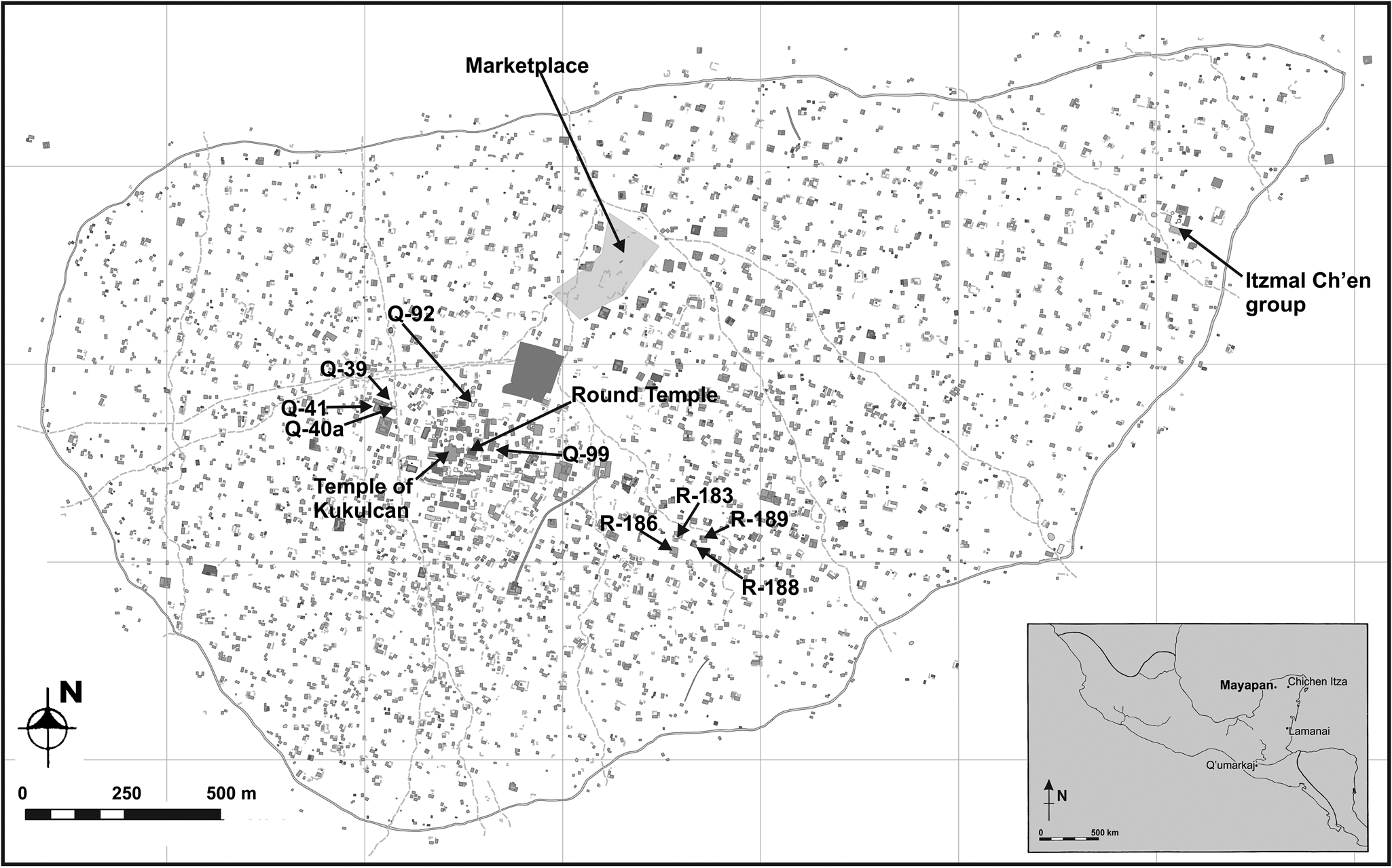
Mayapan was the largest and most powerful political center of the Postclassic lowland Maya world from approximately a.d. 1100 to 1450, and it was a central economic node in a circumpeninsular trade network that spanned the northern Yucatan Peninsula from the Gulf Coast to the Caribbean (Figure 1; Brown Reference Brown1999; Milbrath and Peraza Lope Reference Milbrath and Lope2003; Peraza Lope and Masson Reference Peraza Lope, Masson, Masson and Lope2014b; Pollock et al. Reference Pollock, Roys, Proskouriakoff and Ledyard Smith1962). It was notable among its contemporaries for its large size and high population density, and its diverse social composition (Peraza Lope and Masson Reference Peraza Lope, Masson, Masson and Lope2014b). Documentary sources such as Diego de Landa's (Reference Landa and Tozzer1941) Relación de las Cosas de Yucatan claimed that Mayapan was founded as the capital of a regional confederacy, which collapsed dramatically in the mid-fifteenth century due to violence between its noble lineages (see also Kennett et al. Reference Kennett, Masson, Lope, Serafin, George, Spencer, Hoggarth, Culleton, Harper, Prufer, Milbrath, Russell, Gonzalez, McCool, Aquino, Paris, Curtis, Marwan, Zhang, Asmerom, Polyak, Carolin, James, Mason, Henderson, Brenner, Baldini, Breitenbach and Hodell2022; Milbrath and Peraza Lope Reference Milbrath and Lope2003; Peraza Lope and Masson Reference Peraza Lope, Masson, Masson and Lope2014b; Paris et al. Reference Paris, Serafin, Masson, Lope, Guzmán and Russell2017). The city is enclosed by a large defensive wall with 12 constructed gates (Russell Reference Russell2013; Shook Reference Shook1952). Recent settlement survey outside the city's walls has increased population estimates to between 15,000 and 17,000 inhabitants during the height of its power (Russell Reference Russell2008; Peraza Lope and Masson Reference Peraza Lope, Masson, Masson and Lope2014b:28). The site has a tightly nucleated monumental center filled with temples, administrative halls, and attendant houses, and other minor centers such as Itzmal Ch'en in the eastern city sector (Figure 2a; Delgado et al. Reference Delgado Kú, Lope, Masson, Escamilla Ojeda, Alvarado, Russell, Masson, Hare, Lope and Russell2021b; Milbrath and Peraza Lope Reference Milbrath and Lope2003; Peraza Lope and Masson Reference Peraza Lope, Masson, Masson and Lope2014a:126–136; Reference Peraza Lope, Masson, Masson and Lope2014b). Its outlying zone is filled with residences in walled houselots (solares) ranging from grand palaces to humble one-room dwellings (Bullard Reference Bullard1954; Hare et al. Reference Hare, Masson and Russell2014). A marketplace located immediately northeast of the monumental center provided a forum for commercial exchange (Figure 1; Bair et al. Reference Bair, Terry, Hare, Dahlin, Grayson, Steffen, Masson, Masson, Hare, Lope and Russell2021; Masson and Peraza Lope Reference Masson, Lope, Masson and Lope2014b; Peraza Lope and Masson Reference Peraza Lope, Masson, Masson and Lope2014b; Terry et al. Reference Terry, Bair, Coronel and King2015).
Map of Mayapan, showing selected structures mentioned in the text. Map by Timothy Hare and Paris.
Mayapan, Yucatán, Mexico. (a) Monumental zone, featuring the Round Temple and Temple of Kukulkan. (b) Structure R-183a. (c) Structure R-183b. (d) Structure R-183c. (e) Structure R-189. (f) Test excavation between Structures R-183b and R-183c showing the gravel fill used to level the group plaform. (a–b, d–f) Photographs by Paris; (c) photograph by Mario Garrido Euán.

Surplus craft production was a major part of Mayapan's economy, and this created the foundation for a commercial exchange system that promoted independencies both within the urban center, and also between the city and outlying provinces (Masson and Peraza Lope Reference Masson, Lope, Masson and Lope2014b). While some productive activities are associated with elite halls and palaces, the bulk of utilitarian craft activities is associated with commoner dwellings, and the scale of production refuse suggests that most production was performed on a part-time basis (Masson et al. Reference Masson, Hare, Lope, Escamilla Ojeda, Paris, Kohut, Russell and Alvarado2016). The spatial distribution of crafting debris at stone tool and shell-working contexts suggests that many, but not all, commoner households engaged in artisanal production, and that multiple crafts were frequently (not always) produced in tandem (Masson et al. Reference Masson, Hare, Lope, Escamilla Ojeda, Paris, Kohut, Russell and Alvarado2016; Paris and France Reference Paris, France, Masson, Hare, Lope and Russell2021), a process known as multicraft production (Hirth Reference Hirth2009; Shimada Reference Shimada and Shimada2007). The city's large crafts barrio, which supported many full-time and part-time crafting households, was located on the western edge of the monumental zone and was composed mostly of typical commoner dwellings. At the eastern edge of the barrio is a large elite group (Q-41), and two smaller houses associated with the group (Q-39 and Q-40a) whose residents engaged in many high-skill and high-status crafts including metalworking and effigy incense burner production (Delgado et al. Reference Delgado Kú, Escamilla Ojeda, Masson, Lope, Kennett, Masson, Hare, Lope and Russell2021a; Masson and Peraza Lope Reference Masson, Lope, Masson and Lope2014b; Paris Reference Paris, Masson, Hare, Lope and Russell2021).
As Mayapan is in the karstic terrain of the northern Yucatan Peninsula, far from any geological sources of ore or native metal, its local metalworking activities focused exclusively on the later stages of production, including remelting imported metals, principally made from copper alloys, and casting remelted metal objects into ingots, small copper bells, and other ornaments. The Mayapan region, however, supplied several other raw materials necessary for metalworking, including clay, charcoal, and beeswax from Melipona beecheii stingless bees, which could be adapted to secondary metalworking activities like remelting, open-mold, and lost-wax casting (Paris et al. Reference Paris, Lope, Masson, Delgado Kú and del Carmen Escamilla Ojeda2018).
Evidence for metal artifact consumption is abundant within Mayapan's urban center, and includes contexts within and beyond the monumental zone, including both elite and commoner residences. Metal artifacts have been recovered from 63 different pre-Hispanic archaeological contexts at the site, and a total of 559 likely-pre-Hispanic metal artifacts have been identified to date (568 total metal artifacts from all contexts; updated from Paris Reference Paris, Masson, Hare, Lope and Russell2021:Table 13.1). This total includes artifacts from the Carnegie Institution of Washington Project (directed by Pollock), the Economic Foundations of Mayapan Project (directed by Masson, Peraza Lope, Hare, and Russell), the Proyecto Mayapán (directed by Peraza Lope), and salvage excavations since 1996 (directed by Peraza Lope). The majority of metal artifacts at Mayapan are personal ornaments such as small copper bells (N = 482), finger rings (N = 21), an anthropomorphic effigy finger ring (N = 1), tweezers (N = 6), a filagree earspool (N = 1), a sewing needle (N = 1), a miniature axe (N = 1), fishhooks (N = 5), a filigree bead (N = 1), and sheet metal ornaments (N = 33; Paris Reference Paris2008, Reference Paris, Masson, Hare, Lope and Russell2021; Paris and Peraza Lope Reference Paris, Lope, Shugar and Simmons2013; see also Proskouriakoff Reference Proskouriakoff, Pollock, Roys, Proskouriakoff and Ledyard Smith1962:388, Figure 48; Root Reference Root, Pollock, Roys, Proskouriakoff and Ledyard Smith1962). The total count of 568 objects lumps all of the individual fragments of production debris from the R-183b cache as a single observation, many of which were (and many still are) held together by corrosion products, including bell clusters (N = 25), clumps of production debris (N = 4), miscast bells (N = 2), and prills (N = 1). The total count does include miniature vessels filled with metal production debris from R-183b (N = 2) and Q-92 (N = 2), with each vessel counted as a single artifact. While some of the artifacts, such as miniature axes, tweezers, chisels, zoomorphic effigy bells, and effigy face rings are stylistically similar to those recovered in other areas of Mesoamerica (Paris Reference Paris2008; see also Bray Reference Bray and Hammond1977; Coggins and Shane Reference Coggins and Shane1984; Hosler Reference Hosler1994; Pendergast Reference Pendergast1962; Pinto Bojorquez Reference Pinto Bojorquez1997; Root Reference Root, Pollock, Roys, Proskouriakoff and Ledyard Smith1962; Simmons and Shugar Reference Simmons, Shugar, Shugar and Simmons2013a, Reference Simmons and Shugar2013b), others are either unique to Mayapan to date, or else are rarely identified at other sites. For example, a set of copper bells from a burial cist in elite residence Q-39 had a distinctive, braided style of suspension loop and a skillfully crafted monkey head effigy bell (Paris Reference Paris, Masson, Hare, Lope and Russell2021).
In addition to imported metal commodities, evidence suggests that Mayapan also had a robust local metalworking industry (Meanwell et al. Reference Meanwell, Paris, Alvarado and Lope2013, Reference Meanwell, Paris, Lope, Seymour and Masic2020; Paris Reference Paris2008, Reference Paris, Masson, Hare, Lope and Russell2021; Paris and Peraza Lope Reference Paris, Lope, Shugar and Simmons2013; Paris et al. Reference Paris, Lope, Masson, Delgado Kú and del Carmen Escamilla Ojeda2018). Metalworking production debris has previously been found in two locations within Mayapan (Paris Reference Paris2008). At Structure R-183b, production debris includes miscast copper bells, two miniature ceramic vessels filled with casting debris, discarded casting sprues and prills, and small clusters and clumps of sprues and miscast bells adhered by corrosion products (Paris Reference Paris2008; Paris and Peraza Lope Reference Paris, Lope, Shugar and Simmons2013). At Structure Q-92, two additional miniature vessels were filled with metalworking production debris such as miscast copper bells, casting sprues and prills, and were subsequently interred as a funerary offering (Paris Reference Paris2008:Figure 5; Paris and Peraza Lope Reference Paris, Lope, Shugar and Simmons2013). Casting sprues are the solid-state impression of the aperture in a bivalve or lost-wax casting mold, where the casting reservoir connects to the cast object, allowing the metal to enter the mold while in liquid state. They are often trimmed away from the finished object. Prills are small globules of metal in the solid state, which are formed as droplets while the metal was in the liquid state, during the smelting or casting process (Simmons and Shugar Reference Simmons and Shugar2013b:111). Structures R-183b and Q-92 represent different types of elite residential spaces: R-183b is a small house in an elite residential group in the southeast city sector, and Q-92 is an attendant house for temple Q-95 in the monumental center (Paris Reference Paris2008).
Evidence of local metalworking at Mayapan also includes the identification of metallurgical ceramics (Meanwell et al. Reference Meanwell, Paris, Alvarado and Lope2013, Reference Meanwell, Paris, Lope, Seymour and Masic2020; Paris et al. Reference Paris, Lope, Masson, Delgado Kú and del Carmen Escamilla Ojeda2018). A total of 173 metallurgical ceramics have been recovered at Mayapan to date, including metallurgical molds and mold fragments, small pestles, and ceramic tuyères (ceramic blowpipe tips; Meanwell et al. Reference Meanwell, Paris, Alvarado and Lope2013, Reference Meanwell, Paris, Lope, Seymour and Masic2020; Paris et al. Reference Paris, Lope, Masson, Delgado Kú and del Carmen Escamilla Ojeda2018). The ceramic artifacts were first identified by Mayapan project ceramicist Wilberth Cruz Alvarado due to their distinctive dark gray paste and high-fired appearance. The extensive vitrification of these ceramics is visible in petrographic thin sections of two tripod feet from Structure Q-99, hypothesized to be fragments of metallurgical molds (Meanwell et al. Reference Meanwell, Paris, Alvarado and Lope2013), and two tuyères from Structures Q-99 and Q-40a (Meanwell et al. Reference Meanwell, Paris, Lope, Seymour and Masic2020); the vitrification was further confirmed by scanning electron microscopy of the paste (Meanwell et al. Reference Meanwell, Paris, Lope, Seymour and Masic2020). Some of the metallurgical ceramics constitute open molds for casting metal ingots (Figure 4b), and lost-wax mold fragments for casting three-dimensional objects such as copper bells (Meanwell et al. Reference Meanwell, Paris, Alvarado and Lope2013:Figures 2–4). XRF analysis of the metallurgical ceramics also identified copper alloy residues on mold surfaces (Meanwell et al. Reference Meanwell, Paris, Alvarado and Lope2013) as well as copper alloy prills embedded in the fabrics of the ceramics (Meanwell et al. Reference Meanwell, Paris, Alvarado and Lope2013, Reference Meanwell, Paris, Lope, Seymour and Masic2020). The presence of the prills within the fabrics of the metallurgical ceramics may be due to either accidental incorporation of metal debris or through recycling of metallurgical ceramics as grog temper, which suggests that these ceramics were produced at the site by the metalworkers themselves (Meanwell et al. Reference Meanwell, Paris, Alvarado and Lope2013, Reference Meanwell, Paris, Lope, Seymour and Masic2020). If, as we have proposed, metallurgical ceramics were typically recycled into new objects (Meanwell et al. Reference Meanwell, Paris, Alvarado and Lope2013, Reference Meanwell, Paris, Lope, Seymour and Masic2020), the number of metallurgical ceramics recovered to date likely represents a small proportion of the total scale of metalworking activity.
As with metallurgical production debris, the spatial distribution of metallurgical ceramics also suggests that elites were heavily involved in metalworking at Mayapan (Paris et al. Reference Paris, Lope, Masson, Delgado Kú and del Carmen Escamilla Ojeda2018). The city had two, large-scale concentrations of metallurgical ceramics, both associated with tuyères: one at Q-99, a colonnaded hall on the east side of the monumental zone, with 51 metallurgical ceramics; and the small houses at the southern end of the crafts barrio, Q-40a (33 metallurgical ceramics) and Q-39 (nine metallurgical ceramics; Meanwell et al. Reference Meanwell, Paris, Lope, Seymour and Masic2020; Paris Reference Paris, Masson, Hare, Lope and Russell2021; Paris et al. Reference Paris, Lope, Masson, Delgado Kú and del Carmen Escamilla Ojeda2018:Table 1). Houses Q-39 and Q-40a both neighbor a high-ranking elite platform residence, Q-41; the residents of Q-39 were likely of elite status, as reflected in house size and burial goods, possibly extended lineage members of the Q-41 residents; while the residents of Q-40a were likely attached luxury craft specialists of lower social rank (Delgado et al. Reference Delgado Kú, Escamilla Ojeda, Masson, Lope, Kennett, Masson, Hare, Lope and Russell2021a:149; Masson and Peraza Lope Reference Masson, Lope, Masson and Lope2014a; Paris Reference Paris, Masson, Hare, Lope and Russell2021). Although Q-41 has not yet been excavated, its size and proximity to two metalworking residences raises the possibility of elite patronage of neighboring artisans. House Q-39 contained a burial cist containing 42 metal artifacts and other high-value offerings, representing the most elaborate funerary assemblage of metal objects recovered at Mayapan to date (Paris Reference Paris, Masson, Hare, Lope and Russell2021:321). The metal objects from this context were distinctive; many of the bells had a braided-style suspension loop, and the assemblage included a skillfully crafted, monkey-head effigy bell (Paris Reference Paris, Masson, Hare, Lope and Russell2021). Together with the concentrations of metallurgical ceramics at both Q-39 and Q-40a, these suggest that the offering may have been produced by metalworkers from these houses (Paris Reference Paris, Masson, Hare, Lope and Russell2021:333). Smaller quantities of metallurgical ceramics, however, have been found in association with 30 other structures at Mayapan to date. These structures include the temples and halls of the monumental zone as well as residential structures and small shrines in the southeast city sector (Paris et al. Reference Paris, Lope, Masson, Delgado Kú and del Carmen Escamilla Ojeda2018). Most of these other structures (26 of 30) have five metallurgical ceramic objects or less, suggesting that intensive production was concentrated at or near elite residential or public buildings.
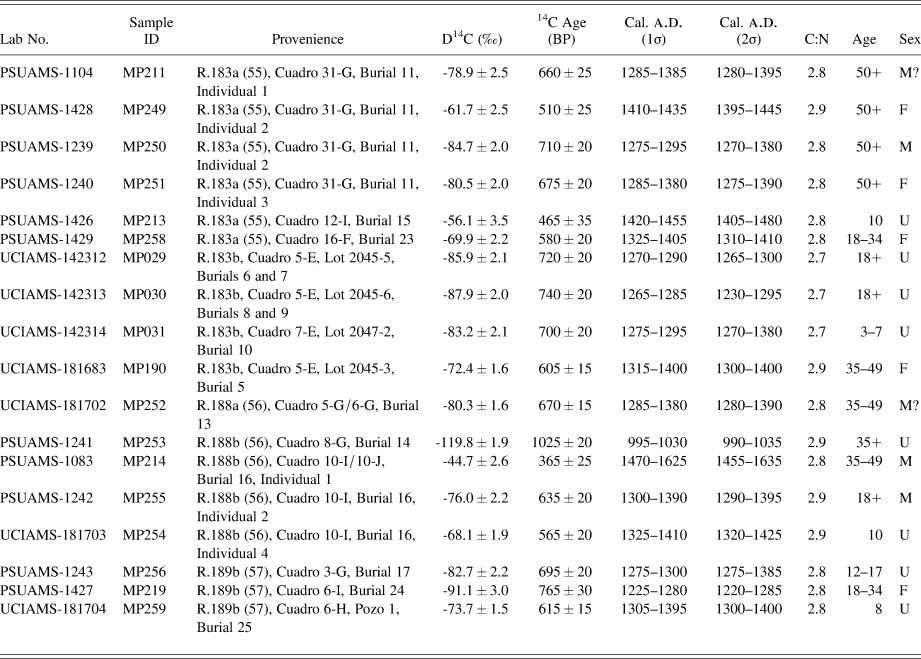
Accelerator mass spectrometry radiocarbon dates and osteological data cited within text from R-183 and neighboring groups, Mayapan, by Kennett and Serafin. All samples are from human bone (mandible, femur, tibia, or unspecified).
As we have suggested previously (Paris et al. Reference Paris, Lope, Masson, Delgado Kú and del Carmen Escamilla Ojeda2018), many of Mayapan's urban residents were also engaged in stingless beekeeping, which would have facilitated the production of beeswax for lost-wax casting. Contexts with metallurgical ceramics are often also associated with limestone disks (mak tuun; Batún Alpuche 2019) used to plug the ends of traditional log hives (hobones; Paris et al. Reference Paris, Lope, Masson, Delgado Kú and del Carmen Escamilla Ojeda2018:Table 1; Paris et al. Reference Paris, Castrejón, Walker and Lope2020). Of the 75 structures at Mayapan that are associated with limestone disks (mak tuun) and 32 structures associated with metallurgical ceramics, 15 structures are associated with both limestone disks and metallurgical ceramics (Paris et al. Reference Paris, Lope, Masson, Delgado Kú and del Carmen Escamilla Ojeda2018). Archaeological associations of metallurgical ceramics and limestone disks may indicate multicraft production of metalworking and beekeeping at some structures; in other cases, they may indicate close working relationships between different craftspeople (Paris et al. Reference Paris, Lope, Masson, Delgado Kú and del Carmen Escamilla Ojeda2018). Limestone disks could be reused among log hives (retouched through flintknapping techniques if necessary to modify the shape and size), so the scale of stingless beekeeping is also likely archaeologically underrepresented (Paris et al. Reference Paris, Lope, Masson, Delgado Kú and del Carmen Escamilla Ojeda2018).
Two of the groups associated with metalworking (the R-183 residential cluster, including R-183 and R-189; and Q-39/Q-40a; see section Materials and Methods) contained a strikingly high proportion of Mayapan's pre-Hispanic metal wealth; 440 of 559 metal artifacts (78.7 percent) were recovered from these contexts. Metal items as commodities, however, were widely available to individuals of all social ranks at Mayapan, as evident in their distribution throughout residences of different sizes and degrees of elaboration (Paris Reference Paris2008). The other 119 out of 559 pre-Hispanic metal artifacts were found in 55 other structures at Mayapan, including elite palaces, intermediate-scale houses, commoner houses, as well as the temples and halls of the monumental zone, the Itzmal Ch'en outlying administrative complex, the city wall, and a cenote (updated from Paris [Reference Paris, Masson, Hare, Lope and Russell2021]). This suggests that metal items did not function as sumptuary items that were exclusively available to elite craftspersons and/or their patrons, or were not available to commoners. Instead, the most parsimonious explanation for this broad spatial and social distribution is that many metal artifacts were purchased in the city's marketplace by those who could afford them, and that many of the bells were used as currency (Paris Reference Paris2008), as documented in Spanish accounts (Cogolludo Reference Cogolludo and Ignacio Rubio Mañé1957; Landa Reference Landa and Tozzer1941; Sahagún Reference Sahagún1950–1975:bk. 9). This pattern is consistent with the distribution of several other imported items at Mayapan, including greenstone axes and beads, obsidian blades, and shell ornaments and beads; greenstone and shell beads were also used as currency (Masson and Freidel Reference Masson and Freidel2012; Masson and Peraza Lope Reference Masson, Lope, Masson and Lope2014a). Most structures at Mayapan, including monumental buildings, elite houses, and commoner residences, were archaeologically associated with five metal objects or less. While some of these metal items were found in caches and funerary contexts (Paris and Peraza Lope Reference Paris, Lope, Shugar and Simmons2013), they were also commonly recovered around the edges of structures and platforms, suggesting possible accidental loss during everyday activity, or during the structure's abandonment.
MATERIALS AND METHODS
Excavations at the R-183 Group
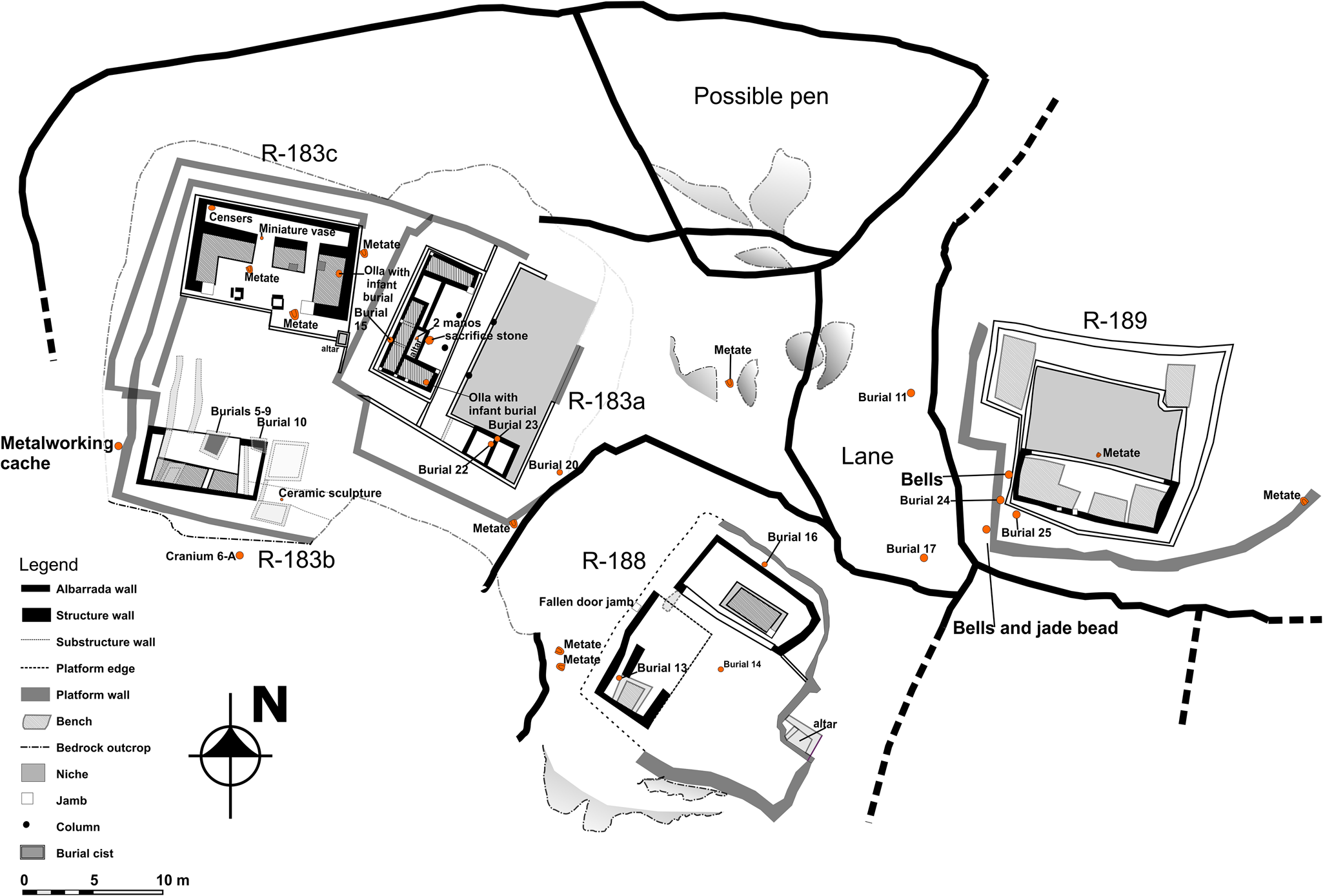
The R-183 group is a small elite residential group in the southeast city sector, an area of the city associated with a diverse array of high-skill craft activities (Figure 1). The group consists of three structures: R-183a, a c-shaped structure centered on a domestic oratory, and two smaller structures at the base which face each other, R-183b, a small, rectangular residential structure to the south, and R-183c, a larger c-shaped structure to the north (Figures 2 and 3). All three structures were remodeled and amplified over numerous construction phases, suggesting a lengthy, multi-generational occupation (Peraza Lope Reference Peraza Lope1998). The entire group sits atop a leveled platform, created through gravel fills in conjunction with the natural small hills occurring in the limestone bedrock (Figure 2f). Other elite residential groups adjacent to the R-183 group include R-186, R-188, and R-189, which lack shrines, but are similarly situated on culturally-modified hilltops (altillos), and are broadly similar in the size and style of residential architecture.
The R-183 residential cluster of Mayapan. Map by Paris.
Metal artifacts from Mayapan. (a) Miniature ceramic vessels filled with metal from the R-183b cache. (b) Rectangular ingot mold from Q-88a. (c and d) Copper alloy bells from the R-183b cache. (e) Polished section with bell and wires. (f) Bells from R-189. (g) Miniature axe from R-189. (h) Filagree earspool fragment and four fishhooks from R-112. (i) Tweezers from R-183c. (j) Filagree bead from R-8. (k) Two finger rings from R-4. (l) Copper alloy artifacts and shell ornaments from the Q-39 burial cist. (a–k) Photographs by Paris; (l) photograph by Masson.

The association of the group with metalworking was initially discovered in salvage excavations in 1998, directed by Peraza Lope, due to the widening of the Merida-Chetumal highway, which passes through Mayapan's residential zone, just to the east of the monumental zone, and immediately to the west of the R-183 group (Peraza Lope Reference Peraza Lope1998). The highway impacted the platform edge and southwest corner of Structure R-183b, the smaller of the two residences. In 1998, the structure was horizontally excavated in its entirety, supervised by Mario Garrido Euán.
In 2014, the proposed further expansion of the Merida-Chetumal highway included the destruction of the R-183 group and several neighboring structures. Salvage excavations at the group in 2015 directed by Peraza Lope and supervised by Delgado Kú and Escamilla Ojeda, with assistance from Paris and colleagues, included the full horizontal excavation of Structures R-183a and R-183c, as well as targeted test excavations within the enclosed yard area (solar). Neighboring Structures R-188 and R-189 also fell within the expansion zone, and were horizontally excavated as part of the salvage project, with over half of each structure excavated. Following the excavations, the R-183 group and R-188 were destroyed, among others that fell within the path of the highway expansion.
Eighteen burials from Groups R-183, R-188, and R-189 were recently analyzed using AMS radiocarbon dating by Kennett (Table 1; Kennett et al. Reference Kennett, Masson, Lope, Serafin, George, Spencer, Hoggarth, Culleton, Harper, Prufer, Milbrath, Russell, Gonzalez, McCool, Aquino, Paris, Curtis, Marwan, Zhang, Asmerom, Polyak, Carolin, James, Mason, Henderson, Brenner, Baldini, Breitenbach and Hodell2022); all were excavated during the 1998 and 2015 excavations. Sixteen burials date between 1220 to 1480 cal. a.d. (Table 1; Kennett et al. Reference Kennett, Masson, Lope, Serafin, George, Spencer, Hoggarth, Culleton, Harper, Prufer, Milbrath, Russell, Gonzalez, McCool, Aquino, Paris, Curtis, Marwan, Zhang, Asmerom, Polyak, Carolin, James, Mason, Henderson, Brenner, Baldini, Breitenbach and Hodell2022), supporting architectural evidence for a lengthy occupation of the residential cluster (Peraza Lope Reference Peraza Lope1998). Six of these burials date to the late thirteenth century, while eight burials date to the fourteenth century, and two burials date to the early fifteenth century (including two from R-183a), suggesting that the residential cluster remained occupied up to the city's abandonment in the mid-fifteenth century (Table 1). The remaining two burials were both from R-188b, and included a possible ancestor burial and a late intrusive burial, suggesting that the group was perhaps a particularly important locus for establishing claims to land and lineage status (e.g., McAnany Reference McAnany1995), and utilized for funerary and ritual activities after the city's abandonment.
Compositional Analysis
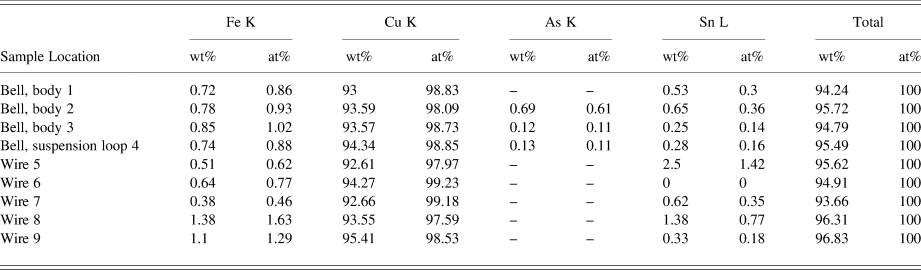
A small button-shaped bell and fragments of wires and casting sprues from the R-183b cache (Figure 4e) were exported to University College London by Baquedano and Peraza Lope and analyzed in collaboration with John Merkel and Maria Inés Velarde; we summarize their findings here (Table 2). The selected bell was approximately 5 mm in diameter, with a small suspension loop. Together with the wire and sprue fragments, the bell was mounted and polished for metallographic study and compositional analysis (Figure 4e). Three points on the bell were measured, and one point was measured on the wire suspension loop. The mounted bell fragments were repolished and reimaged at MIT using a Tescan Vega3 microscope in low vacuum (30 Pa) mode with an accelerating voltage of 20 keV. SEM images were acquired using the backscattered electron (BSE) detector. EDS data were processed and quantified using the Bruker Esprit 2.1 software and linemarker PB-ZAF correction.
Scanning electron microscopy and energy dispersive X-ray spectroscopy analysis of a small bell and wires from Structure R-183b, Mayapan, by John Merkel and Maria Ines Velarde, University College London. Values are given in weight percent (wt%) and atomic percent (at%). The analyzed bell and wires appear in Figure 4e.
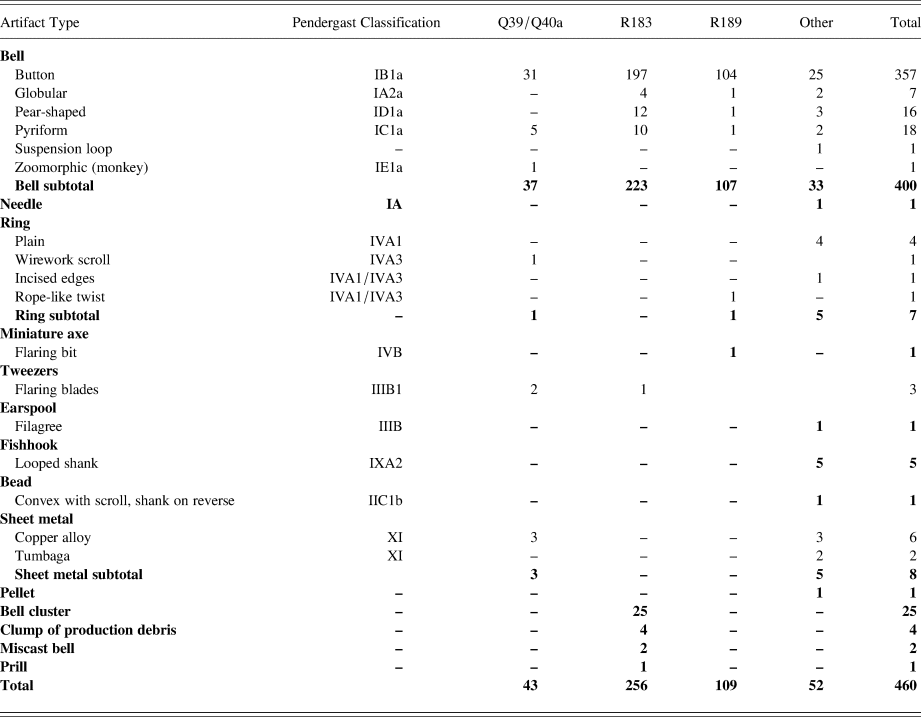
In 2016, Paris conducted the XRF analysis at the Mayapan field lab using a portable Bruker Tracer IV Spectrometer. The analysis includes elemental spectra for 460 out of a total 559 likely pre-Hispanic excavated metal artifacts from Mayapan (1996–2016), including elemental spectra for 256 of 285 excavated metal artifacts from the R-183 group, and 109 of 110 excavated metal artifacts from R-189 (Figure 4f and Table 3). The specimens from the R-183 group include 253 artifacts that were excavated from Structure R-183b by Peraza Lope and his team in 1998, and three artifacts from neighboring Structures R-183a and R-183c by Paris, Peraza Lope, and colleagues in 2015. The artifacts analyzed from R183b included mostly small, copper alloy bells, as well as two clumps of production debris (casting sprues and miscast bells), two miscast bells, 25 bell clusters, and a small, round metal prill (Table 3). The remaining artifacts from the R-183b cache not analyzed during the present study were on display at the Palacio Cantón in Mérida, and were not available for XRF analysis due to the time constraints of the study. The small bell and wires that were analyzed using SEM-EDS (Figure 4e and Table 2) were also not available for XRF analysis at the time of the study. The R-183b copper bells and production debris were subject to professional restoration by the staff of INAH-Yucatan, including the removal of corrosion productions from exterior surfaces and adding a clear coating to prevent further corrosion; with thin-walled bells, however, it is typically impossible to fully remove corrosion products due to interior surface geometry (Schulze Reference Schulze, Shugar and Simmons2013). Artifacts excavated in 2015 were not subject to professional restoration prior to analysis. While corrosion layers exhibit differential element loss relative to the original metal composition, and surfaces are often enriched with copper oxides, however, the large beam size of the portable XRF instrument (4 mm) and the choice of a high accelerating voltage help to mitigate these issues, and in some ways are advantageous because they reduce the problems caused by metallic heterogeneity in cast objects (Schulze Reference Schulze, Shugar and Simmons2013).
Artifacts by type and context that were analyzed by x-ray fluorescence spectrometry by Paris. The sample includes 460 out of a total 559 pre-Hispanic metal artifacts from the Mayapan assemblage (1996–2016). “Pendergast classification” refers to the typology developed for pre-Hispanic Mesoamerica metal artifacts by Pendergast (Reference Pendergast1962).
The Bruker Tracer IV-SD is a portable ED-XRF spectrometer with a silicon drift detector, and adjustable voltage and current. One of the advantages of this particular model is the use of an automated filter changer, as the manual positioning of filters is a potential source of user-induced analytical error in portable XRF spectrometers. In all cases, artifacts were analyzed in benchtop mode using an automated timer, with an accelerating voltage of 40 kV and a 16.5 μA beam current, using Filter 1, for 60 seconds each. These settings maximize the accuracy of measurements for heavier metallic elements, and the accuracy of Bruker's empirical calibration for historic copper alloy (CU2). Samples were placed on the beam window in order to minimize curvature in the artifact surface geometry, and to provide maximum coverage across the beam window. Bruker's empirical calibration, customized for the instrument, calculates the weight percent and ppm values for the following elements: magnesium, iron, nickel, copper, zinc, arsenic, lead, bismuth, zirconium, silver, tin, and antimony. Together with the SEM-EDS analysis, these results build on previous semiquantitative analyses performed by Root (Reference Root, Pollock, Roys, Proskouriakoff and Ledyard Smith1962) on a selection of artifacts from the Carnegie Institution of Washington's excavations at Mayapan.
RESULTS
The R-183 Group and Cache
During the excavation of R-183b, a small cache was discovered at the base of the western wall of the structure (Peraza Lope Reference Peraza Lope1998). The cache consisted of a small, short-necked jar (olla) containing 282 copper bells. It contained two miniature ceramic vessels filled with casting sprue fragments, prills, and miscast bells (one miniature tecomate and one miniature tripod vase), and 24 bell clusters, surrounded by manufacturing debris and loose casting sprues, together with the remains of small white strings encrusted with greenish blue copper oxides (likely cotton encrusted with malachite crystals; Figure 4; Paris Reference Paris2008). Unlike many other caches at Mayapan, the deposit lacked evidence of other types of offerings, and was not associated with an altar or other religious structure (Paris and Peraza Reference Paris, Lope, Shugar and Simmons2013:Table 7.6). Metallurgical ceramics were associated with R-183 (N = 1) and several other in the residential cluster, including R-183a (N = 2), R-188 (N = 5), R-189a (N = 4), Y-43 (N = 4), and Y-44 (N = 5), including a rectangular ingot mold and other mold fragments, tripod feet, and thin cylinders (Meanwell et al. Reference Meanwell, Paris, Alvarado and Lope2013). Collectively, it is an unusually high concentration of metal artifacts, production debris, and metallurgical ceramics, suggesting that this residential cluster in general, and R-183b, in particular, played a central role in metallurgical production and trade at Mayapan. Furthermore, the metal scraps recovered from the miniature vessels in the Structure R-183b cache suggest the metallurgists at Mayapan removed and saved sprues, other excess casting material from finished objects, and copper dust produced during the casting and finishing processes to store as much high-value raw material as possible for future remelting and casting (Meanwell et al. Reference Meanwell, Paris, Alvarado and Lope2013).
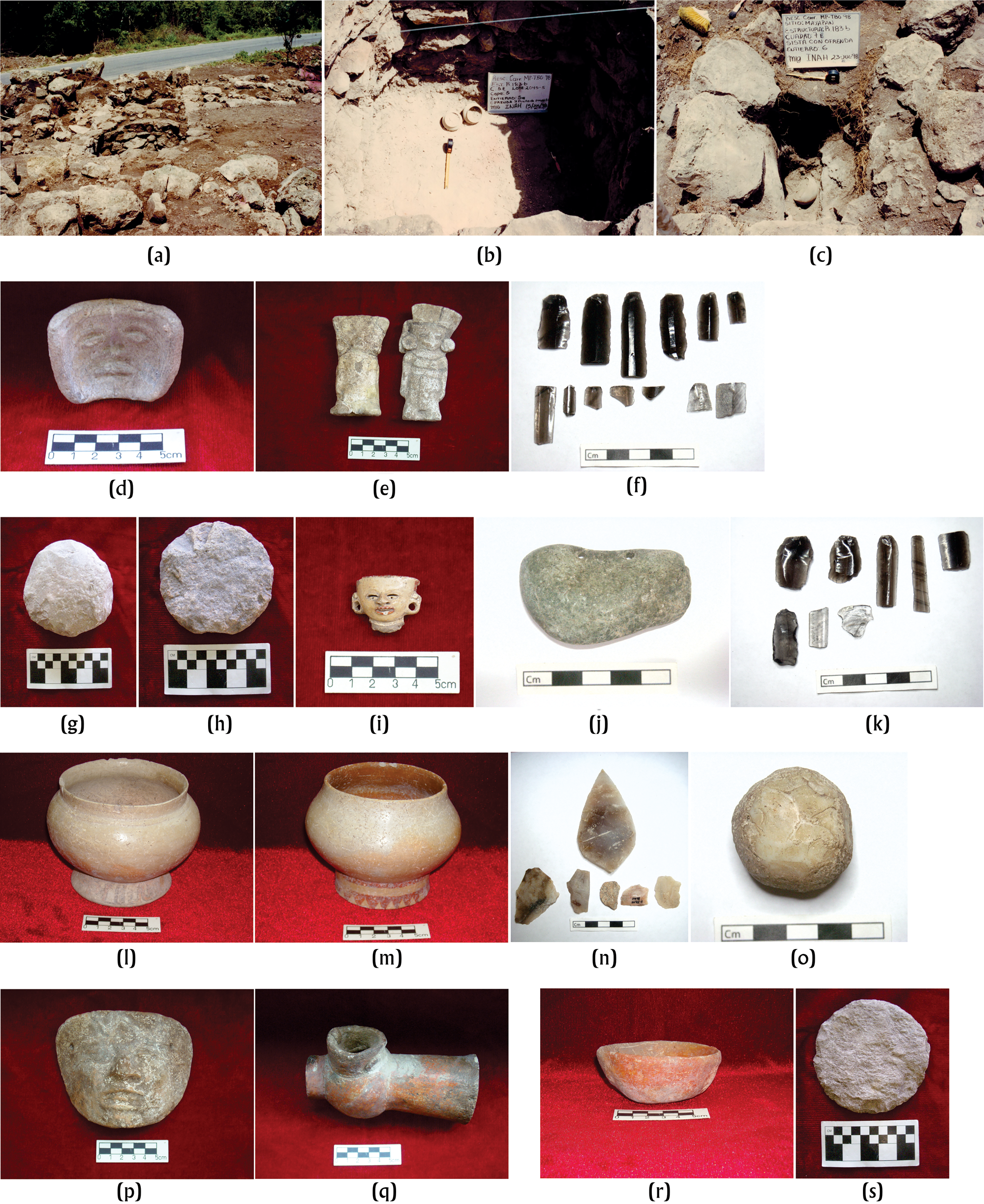
Surprisingly few metal artifacts were found in other depositional contexts in the R-183 group, suggesting that the cache served as a locus of accumulation for the majority of metal objects at the group, possibly during the period immediately prior to its abandonment. A single bell was recovered from a burial cist in the smallest structure, R-183b, in association with Burial 5 (Figure 5a). Two small bells were found in near-surface deposits at R-183a, both on the southeast, or “front” side, of the basal platform, and a pair of tweezers was found in above-floor deposits in R-183c (Figure 4i).
Funerary contexts and offerings, R-183b, Mayapan. (a) Burial cist in Cuadro. 5-E. (b) Annular-base bowls in situ, Cuadro 5-E. (c) Burial cist in Cuadro 7-E. (d–f) Burial 5. (d) Ceramic mask mold. (e) Ceramic figurines. (f) Obsidian prismatic blade fragments. (g–k) Burial 5a. (g and h) Limestone disks. (i) Articulated figurine head. (j) Greenstone pendant. (k) Obsidian prismatic blade fragment. (l–o) Burials 6/7. (l and m) Annular-base bowls. (n) Chert bifacial knife and flakes. (o) Chalcedony hammerstone. (p and q) Burials 8/9. (p) Ceramic mask. (q) Ceramic effigy vessel. (r and s). Burial 10. (r) Mama Red bowl. (s) Limestone disk. (a–c) Photographs by Mario Garrido Euán; (d–s) photographs by Paris.
At the neighboring structure group R-189, 106 copper bells were found in a relatively tight spatial association near the southwest corner of the structure; a finger ring and a miniature copper axe were found nearby at the base of the structure platform, and two additional bells were found near the northeast corner of the structure platform (Figures 4f and 4g). The 106 bells, the miniature axe, and the ring may have once been part of a cache similar to the R-183b cache. No vessel or cache context was identified during excavations, as observed in the field by Paris. If the bells were originally part of a cache, this may suggest that residents of this residential cluster had similar practices regarding short-term storage of high-value metal items. We speculate that metalworkers from R-183b could have produced many or most of the metal artifacts found in the cache, as well as those from R-189 and other neighboring structures.
As we have previously suggested (Paris et al. Reference Paris, Lope, Masson, Delgado Kú and del Carmen Escamilla Ojeda2018), there were likely strong connections between metalworking and stingless beekeeping activities at Mayapan since beeswax was an essential material for lost-wax casting. Three limestone disks were recovered from R-183b; two of these disks were recovered from the burial with the copper bell (Burial 5a; see Figures 5a and 5b), while a third was found in near-surface deposits above a young child's burial (Burial 10; Figure 5c). Additional limestone disks were recovered from excavations at R-183a (N = 3), R-183c (N = 4), R-188 (N = 3), and R-189 (N = 2), suggesting that small-scale beekeeping was practiced by many residents of this residential cluster.
In addition to beekeeping, the R-183 group supported several other craft industries. The R-183b residence was associated with low-volume stone tool production, including the production of chalcedony bifacial knives, obsidian prismatic blades, and projectile points (Figure 5). Horizontal excavations from the 1998 salvage project identified 550 obsidian artifacts; most (86.5 percent) were third-series prismatic blade segments but others reflect on-site prismatic blade and projectile point production, such as percussion flakes, exhausted prismatic blade cores, and prismatic blade core rejuvenation flakes, as well as 14 projectile points and a notched eccentric. The assemblage also included evidence of chert and chalcedony tool production, with 70 tools that included 19 additional projectile points and preforms, seven bifacial knives and a bifacial spearpoint, a variety of other tools, 96 utilized debitage flakes, and 626 non-utilized debitage flakes. While the quantities of production tools and debris suggest a small scale for these activities, production was likely focused on making important tools related to craft production, as well as a variety of weaponry. The R-183c residence may have housed religious specialists, possibly scribe-painters (aj tz'i[h]b’), due to the number and variety of effigy incense burner fragments identified in the rear room of the structure. The incense burners were painted in intricate detail, representing a variety of deities, including fragments of a Monkey Scribe (four examples have been previously documented from the site, including a mostly-complete example from Burial Shaft temple Q-58, two examples from the Round Temple group Q-152, and one from the R-86 noble residence; Peraza and Masson Reference Peraza Lope, Masson, Masson and Lope2014b:471), a large felid (possibly a puma), and an unidentified deity with a youthful face featuring yellow circles on each cheek (c.f. Thompson Reference Thompson1957:Figure 40.2h). Two face molds for effigy incense burners were found at R-183b, suggesting that its residents may have crafted the molded ceramic elements of these elaborate ritual vessels (Peraza et al. Reference Peraza Lope, Masson, Alvarado and Russell2022). The above-floor structure interior of R-183b also contained a variety of ground stone tools, including a well-shaped ground stone pestle possibly used in pigment preparation, suggesting that residents may have performed some of the plastering and painting stages of effigy incense burner production, as well.
A variety of miniature ceramic vessels were recovered during excavations at the R-183 group. In addition to the tecomate and miniature tripod vase filled with metal in the R-183b cache (Figure 4), R-183b also contained a miniature vessel in Burial 10, while R-183c contained three miniature tripod vases (two in fragmentary condition) and a tecomate. These miniature vessels represent the two most prevalent local ceramic types at Mayapan, Navula Unslipped and Mama Red (Figure 6). Other than the two vessels in the R-183b cache that were used to store metal production debris, all other miniature vessels lacked visible contents, and their use remains uncertain.
Miniature vessels from the R-183 group, Mayapan. (a) Miniature tripod vases and tecomate from R-183c. (b) Miniature tripod vase from R-183b, Burial 10. Photographs by Paris.

The funerary practices and offerings of the R-183b residence suggest an association between the group's occupants and high-status crafting, but further suggest some unusual nonlocal connections. As mentioned previously, the residence contained a burial cist (Burials 5–9; Figure 4), which was carefully excavated during the 1998 salvage project (Figures 5a and 5b; Peraza Lope Reference Peraza Lope1998). Within the structure was a large burial cist containing five different burials in three different stratigraphic layers. The youngest layer contained the primary burial (Burial 5, Lot 2045-3), associated with a copper bell located at the individual's knee joint; two unusual, molded figurines; a ceramic mold of an anthropomorphic face (possibly for crafting effigy figures such as incense burners or sculptures); 12 obsidian prismatic blades; 36 chert flakes; a hammerstone made from chert; a fragment of coral; and a stalactite (Figures 5d–5f). The individual was identified as biologically female, between 35 and 49 years old, and was associated with cranial and rib fragments of an infant. Several offerings were present immediately below the interred individual, and above the remains of a highly deteriorated stucco floor that separated Burial 5 from Burials 6 and 7 (labeled Burial 5a, Lot 2045-4); these included two limestone disks, a head from an articulated figurine, a greenstone pectoral, a bifacial knife (Type A), 15 chert flakes, eight obsidian blades, and two shell fragments (Figures 5g–5k). Below the stucco floor were two relatively complete but disarticulated adult burials (Burials 6 and 7, Lot 2045-5), one identified as biologically male and the other as biologically female and between 35 and 49 years of age-at-death, with offerings that included two well-preserved annular-base bowls, a bifacial knife (Type B), five chert flakes, a deer-bone awl, three obsidian prismatic blade sections, and a chalcedony core reused as a hammerstone (Figures 5l–5o). One skull and numerous commingled postcranial remains representing an adult between 18 and 34 years of age-at-death and an adult 50 years or older, were found in the deepest stratigraphic layer (Burials 8 and 9, Lot 2852-3). Offerings from this layer included a thin ceramic mask and an unusual ceramic effigy vessel (Figures 5p and 5q). Recent AMS radiocarbon dating places Burial 5 during the fourteenth century (1300–1400 cal. a.d., 2σ; Table 1; Kennett et al. Reference Kennett, Masson, Lope, Serafin, George, Spencer, Hoggarth, Culleton, Harper, Prufer, Milbrath, Russell, Gonzalez, McCool, Aquino, Paris, Curtis, Marwan, Zhang, Asmerom, Polyak, Carolin, James, Mason, Henderson, Brenner, Baldini, Breitenbach and Hodell2022), suggesting that metalworking activity at the structure was associated with this period. The other burials in the cist were dated to the latter half of the thirteenth century (Table 1; Kennett et al. Reference Kennett, Masson, Lope, Serafin, George, Spencer, Hoggarth, Culleton, Harper, Prufer, Milbrath, Russell, Gonzalez, McCool, Aquino, Paris, Curtis, Marwan, Zhang, Asmerom, Polyak, Carolin, James, Mason, Henderson, Brenner, Baldini, Breitenbach and Hodell2022). A separate young child's burial (three to seven years old) was recovered in a small cist just outside the northeast structure corner (Burial 10, Lot 2047-2; Figure 5c), and was associated with two Mama Red ceramic bowls, a Mama Red miniature ceramic vessel, a fragment of a ceramic whistle (silbato), an obsidian blade fragment, and two chert flakes (Figure 5r); it was dated to 1270–1380 cal. a.d., 2σ (Table 1; Kennett et al. Reference Kennett, Masson, Lope, Serafin, George, Spencer, Hoggarth, Culleton, Harper, Prufer, Milbrath, Russell, Gonzalez, McCool, Aquino, Paris, Curtis, Marwan, Zhang, Asmerom, Polyak, Carolin, James, Mason, Henderson, Brenner, Baldini, Breitenbach and Hodell2022). As mentioned above, one of the limestone disks associated with beekeeping was found in the stratigraphic layer above the burial (Figure 5s). An isolated, partial cranial vault of an adult exhibiting a healed, depressed fracture of the left parietal was recovered just to the south of the R-183b structure platform (Unit 6-A, Lot 2006-1; Serafin et al. Reference Serafin, Lope and González2014).
The funerary offerings of these burials emphasize long-distance connections and stylistic influences, including those from Veracruz and central Mexico, in many cases, the materials are stylistic hybrids executed with local materials. The two annular-base bowls from the R-183b burial cist are similar to the “cacao goblet” vessel style observed in central Mexico in association with cacao consumption in Aztec culture (Smith et al. Reference Smith, Wharton, Olson and Bray2003:294, Figure 4c). The Florentine Codex frequently depicts goblet-shaped vessels in association with feasting, especially among merchants (Sahagún Reference Sahagún1950–1975:bk. 9:pl. 24), although Smith et al. (Reference Smith, Wharton, Olson and Bray2003:294) note that the beverage may not always have been chocolate. A headless anthropomorphic sculpture was found in the above-floor room debris of residential Structure R-183c; the squatting, cross-arm pose of the figure has strong similarities to the famous statues from the offerings of the Aztec Templo Mayor. While a firm identification of the sculpture is not possible without the head, it should be noted that most of the Templo Mayor statues in this pose are thought to depict the Old Fire God, Huehueteotl/Xiuhtecuhtli. The statue is actually a stylistic hybrid, as its sandals and garments are executed in the same style as those of Mayapan's effigy incense burners.
One of the neighboring residential groups, R-188b, included a burial with a ceramic sculpture wearing a quechquemitl, a triangular women's garment. New AMS radiocarbon dates, however, associate the burial with the period from 1455 to 1635 cal. a.d. (2σ), post-dating the ethnohistorically-documented abandonment of Mayapan between a.d. 1441 and 1461 (Table 1; Kennett et al. Reference Kennett, Masson, Lope, Serafin, George, Spencer, Hoggarth, Culleton, Harper, Prufer, Milbrath, Russell, Gonzalez, McCool, Aquino, Paris, Curtis, Marwan, Zhang, Asmerom, Polyak, Carolin, James, Mason, Henderson, Brenner, Baldini, Breitenbach and Hodell2022; see also Masson and Peraza Lope Reference Masson, Lope, Masson and Lope2014a; Milbrath and Peraza Lope Reference Milbrath and Lope2003). Furthermore, even though the quechquemitl was historically a women's garment, skeletal markers identify the interred individual as biologically male and between 35 and 49 years old, raising many questions about the social identity of this individual, and how they came to be interred in the structure. While the rectangular huipil garment was also a popular women's garment, the quechquemitl is frequently identified in Postclassic period Maya art, including in the northern lowlands (Stone Reference Stone2011:169), and is frequently found on limestone sculptures and other artworks at Mayapan depicting women, including a limestone sculpture from Round Temple Q-214 (Shook Reference Shook1954:19) and effigy incense burners (Peraza Lope and Masson Reference Peraza Lope, Masson, Masson and Lope2014c:465).
It is possible that the metal items produced at R-183 were exchanged outside the household, rather than being used exclusively for the enrichment of the group's elite residents. The bells in the cache represent a tremendous storage of wealth and money, following Diego de Landa's claim that copper bells and miniature axes both functioned as pre-Hispanic currencies (Tozzer Reference Tozzer1941:95, 231). Notably, metal items were not commonly found outside of the cache context in R-183b, as only one bell was used as a funerary offering in R-183b, and metal items were absent from the many other burials in Structures R-183a and R-183c and those of neighboring structures. Thus, the R-183b cache may represent most of the copper wealth and production debris retained at the group; the same is likely true for the metal objects found at R-189. Many questions remain regarding the circumstances of the formation of these deposits, and why the metal items were not removed during the abandonment of these structures.
SEM-EDS Analysis
SEM-EDS provided evidence for the composition of one of the small bells from the R-183b cache, as well as five of the wires (production debris) recovered in association with it (Figure 4e and Table 2). Three spots were analyzed on the bell (on one lateral edge exposed through polishing), and one spot on the suspension loop, while the five wires were analyzed with one spot each (Figure 4e). The composition of the bell ranged from 93.00–94.34 weight percent (wt%) copper (due to small metallographic variations), with most areas reflecting 0.74–0.85 wt% iron, 0–0.69 wt% arsenic, and 0.25–0.65 wt% tin (Table 2). The composition of the wires was very similar: 92.61–95.41 wt% copper, 0.38–1.38 wt% iron, and 0.33–2.5 wt% tin (Table 2). No arsenic was detected in the sample of wires; however, trace element quantities may fall below the 0.5 wt% detection limit for the instrument. Most are slightly above the percentages that would occur naturally as trace elements in unalloyed ores and native metals, but below the percentages that significantly affect alloy strength, melting point, and fluidity (Hosler Reference Hosler1994:206), suggesting that both the bell and wires are a byproduct of recycling and remelting finished objects (see Discussion; Hosler Reference Hosler, Shugar and Simmons2013:229).
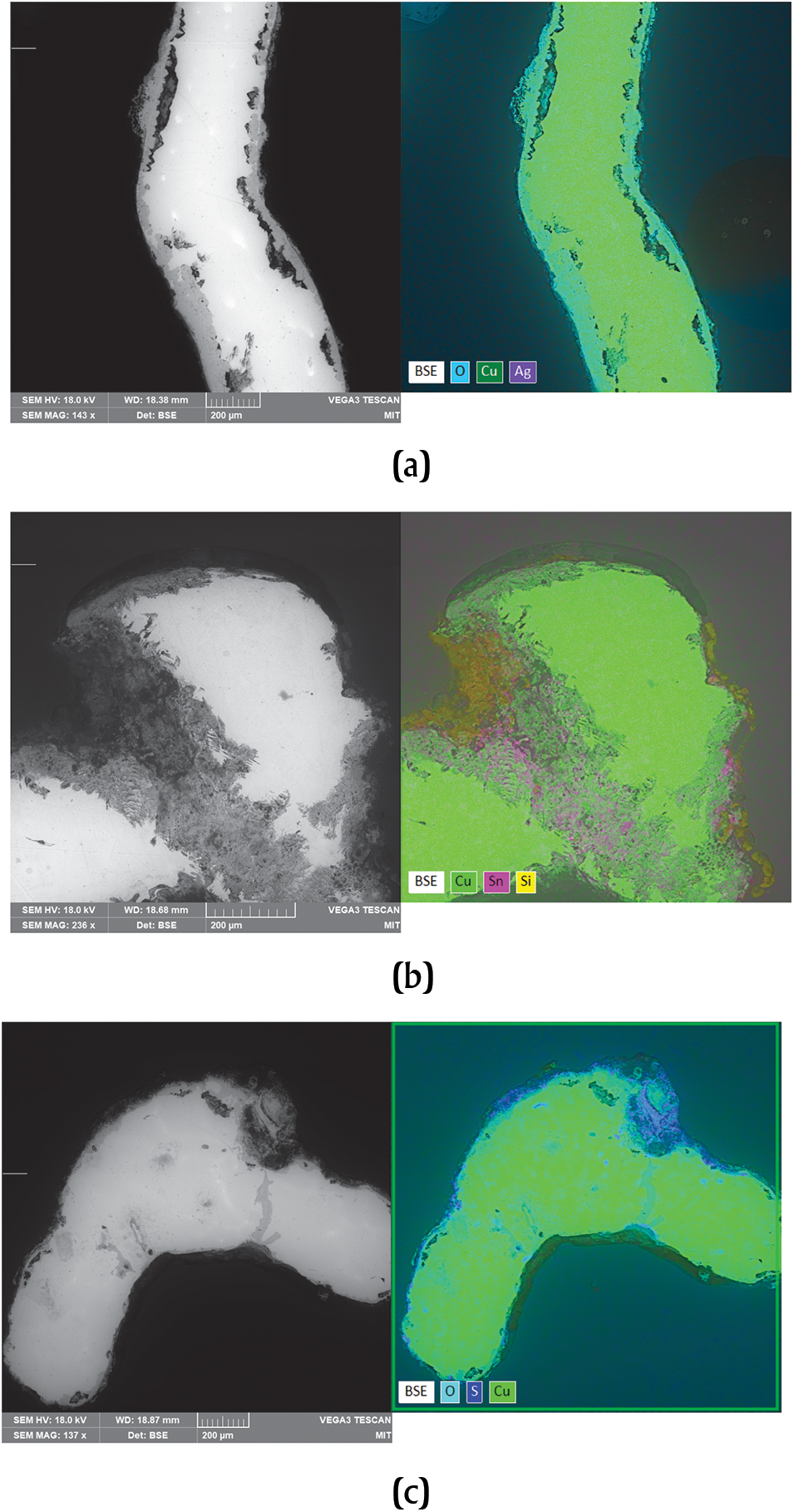
Elemental mapping of several of the same wire and bell wall fragments performed in 2021 are consistent with the results above (Figure 7). The areas mapped were all primarily copper, with tin, arsenic, and iron detected in small amounts. Imaging the pieces demonstrates areas along the exterior of the objects where corrosion products are present on the surface and, in some cases, are detaching from the pure metal beneath. Mapping the elemental concentrations across the thickness of the metal objects shows that most of the corrosion products are copper oxides (Figure 7a), but preferential enrichment in tin and small areas richer in sulfur were also observed (Figures 7b and 7c).
Backscattered scanning electron microscopy and color overlay energy dispersive X-ray spectroscopy images showing the various layers of copper corrosion product visible on fragments of production debris from the R-183 cache. (a) Copper oxide corrosion layer detaching from the underlying copper. (b) Corrosion layers on the exterior of the bell are slightly preferentially enriched in Sn. (c) Although most of the copper corrosion product here is copper oxide, areas in the upper right are enriched in sulfur, suggesting a sulfide corrosion product as well. Images by William Gilstrap and Meanwell.
The metallographic analysis by Merkel and Ines Velarde revealed that the small bell has a cast microstructure. The bell and suspension loop were likely cast as a single object using the lost-wax casting technique, as there is no apparent join between the bell and the wire loop; a small casting sprue fragment remain is present at the top of the suspension loop (Figure 4e). They also note that the suspension loop has a microstructure that suggests cold-working, which is unusual, as it seems unlikely that the suspension loop was deliberately hammered to increase its hardness. We speculate that this may have resulted from the process of removing the casting sprues and smoothing the sprue joins, which occurred for some, but not all, copper bells. Differences are apparent in the microhardness of the bell wall and the wire, measured at 68–70 Hv for the bell, and at 120 Hv for the suspension loop. Similarly, metallographic analysis of the wire and pin fragments surrounding the bell revealed mostly cast microstructures, but some pin fragments had cold-worked microstructures. No evidence of annealing was observed.
X-ray Fluorescence (XRF) Analysis
The XRF analysis of metal artifacts from Mayapan suggests that most specimens were copper alloy with 96–97.5 wt% copper, with varying concentrations of magnesium, iron, nickel, arsenic, lead, silver, tin, and antimony (Tables 4 and 5). The concentration of copper increases in most specimens to 97–99 wt% when zinc measurements are added to copper measurements; since the copper and zinc K-Alpha peaks are adjacent, the XRF detector frequently mistakes copper photons for zinc. It is also worth noting that the addition of zinc to copper to create brass is not documented for Mesoamerican pre-Hispanic metalworking traditions, and zinc tends to occur only as a trace element in pre-Hispanic metal objects (Hosler Reference Hosler1994). The technological and cultural significance of the varying concentrations of these elements is presented in the Discussion below.
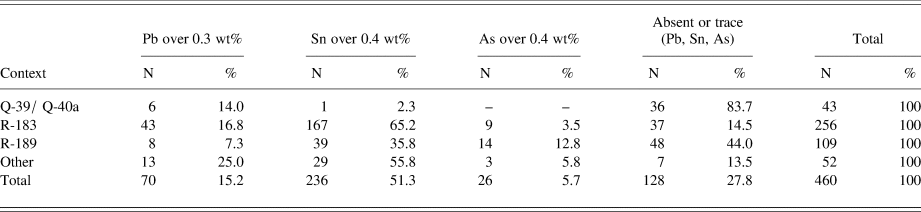
Numbers (N) and percentages (%) of Mayapan artifacts per context with high levels of Pb, Sn and As, compared to artifacts with absent or trace concentrations. Note that the categories are not mutually exclusive; an object may be listed in more than one category. Analysis by Paris, using a portable Bruker Tracer IV XRF Spectrometer.
Average lead (Pb), tin (Sn), and arsenic (As) concentrations by artifact type, Mayapan. Analysis by Paris, using a portable Bruker Tracer IV XRF Spectrometer.

DISCUSSION
Metals Exchange and Local Production in Postclassic Mesoamerica
Copper was the most widespread metal used in pre-Hispanic Mesoamerica, and copper and copper alloy metal artifacts frequently contain traces of tin, arsenic, silver, nickel, antimony, and iron, which often occur unintentionally in the native metals and ores, and are not eliminated by smelting, remelting or casting processes (Hosler Reference Hosler1994). Ancient metalworkers in Mesoamerica, however, frequently added metals to copper to create alloys with particular technical and optical properties, including tin, arsenic, lead, gold, and silver, either through intentional alloying or co-smelting (Hosler Reference Hosler1994; Hosler and MacFarlane Reference Hosler and Macfarlane1996; Hosler and Stresser-Pean Reference Hosler and Stresser-Pean1992). The concentrations at which these metals are present, and the known technical characteristics of particular alloys, can provide insight into the technological choices of ancient metalworkers in specific regions, as well as the metalworking traditions and exchange networks that supplied and influenced secondary production sites in distant areas.
The metal items from the R-183b cache provide an important window into the metal alloys and production techniques in use among Postclassic period Maya metalworkers. As noted previously, Mayapan is one of only four Maya sites where local metalworking has been identified archaeologically to date, although others may be identified in the future. The raw materials used to make metal objects originated in one of the metal-bearing geological zones for copper, tin, and arsenic. Most copper deposits are located in West Mexico, with the larger deposits in north and central Michoacan (Hosler Reference Hosler1994:29). The largest tin deposits are located slightly further to north in Zacatecas, but deposits are located along the northern border of Michoacan, and the southern border of Mexico state (Hosler Reference Hosler1994:27). Following the introduction of metallurgy from South America around a.d. 650, native metals and ores in West Mexico, central Mexico, the Huastec region, and Oaxaca were extracted by early Mesoamerican metalworkers; many of these regions developed local metalworking traditions after a.d. 1100–1200 (García Zaldúa and Hosler Reference García Zaldúa and Hosler2020; Hosler Reference Hosler1994, Reference Hosler2009; Hosler and Stresser-Pean Reference Hosler and Stresser-Pean1992; Hosler et al. Reference Hosler, Lechtman and Holm1990; Levine Reference Levine2019; Maldonado Reference Maldonado2008, Maldonado and Engelhorn-Zentrum Reference Maldonado and Engelhorn-Zentrum2009; Maldonado and Rehren Reference Maldonado and Rehren2009; Maldonado et al. Reference Maldonado, Rehren, Howell, Vandiver, Mass and Murray2005). Copper-arsenic and copper-tin alloys may have developed in West Mexico around a.d. 1040, where the earliest evidence occurs at Caseta, Jalisco (Hosler Reference Hosler2009:196). Copper-arsenic alloy bells are also found in the Huastec region, but it is not certain whether they are imported from West Mexico or locally made (Hosler Reference Hosler1994:187); evidence for local metalworking in the Huastec region dates to the Late Postclassic period, and some production activities may post-date Mayapan's abandonment in a.d. 1440–1460 (Hosler and Stresser-Pean Reference Hosler and Stresser-Pean1992:1217). While the arsenopyrite used in copper-arsenic alloys is widely available in West Mexican ore deposits, the most likely source of tin for pre-Hispanic metalworkers to produce copper-tin alloys was the cassiterite deposit in the modern state of Mexico, from which tin ingots were likely produced and exported to West Mexico and other production areas (Hosler Reference Hosler1994:201). Deposits of galena (the likely source of elemental lead in metal objects) were widely available in the states of Mexico, Morelos, Michoacan, and Veracruz (Hosler Reference Hosler1994:201). Copper-lead alloy artifacts are argued to have been produced in or very near the Valley of Mexico (Hosler Reference Hosler1994:201; Lothrop Reference Lothrop, Root, Proskouriakoff and Harvey1952), and we follow these authors by referring to this area as the Valley of Mexico production zone, recognizing that many of these objects were also widely distributed, not only to nearby consumer sites in central Mexico but also to other areas of Mesoamerica through long-distance exchange networks (Hosler Reference Hosler1994:202).
During the Postclassic period, high-skill crafting knowledge used to make metal objects expanded from the West Mexican metalworking zone to many other areas of Postclassic Mesoamerica (Hosler Reference Hosler1994:201), including the Valley of Mexico (King Reference King2015; Schulze Reference Schulze, Shugar and Simmons2013), the Huastec region (Hosler and Stresser-Pean Reference Hosler and Stresser-Pean1992), and Oaxaca (Levine Reference Levine2019). A second metalworking tradition developed in and around the copper-bearing ore deposits of Honduras, strongly influenced by metalworking traditions from Central America (Blackiston Reference Blackiston1910; Urban et al. Reference Urban, Shugar, Richardson, Schortman, Shugar and Simmons2013). El Coyote in Honduras represents a locus of primary metallurgical production, as identified through the presence of ore beneficiation anvils, smelting furnaces, ore and slag fragments, and processing waste dumps (Urban et al. Reference Urban, Shugar, Richardson, Schortman, Shugar and Simmons2013:83). In contrast, secondary metalworking sites, including Mayapan (Paris Reference Paris2008), Lamanai (Hosler Reference Hosler1994; Simmons Reference Simmons2005; Simmons and Shugar Reference Simmons, Shugar, Shugar and Simmons2013a, Reference Simmons and Shugar2013b; Simmons et al. Reference Simmons, Pendergast and Graham2009) and Q'umarkaj (Weeks Reference Weeks1975, Reference Weeks, Wallace and Carmack1977, Reference Weeks1983, Reference Weeks, Shugar and Simmons2013) represent loci where local Maya metalworkers created new products by recycling and remelting imported metal goods, casting new items using metallurgical ceramic molds and blowpipe technology (see Hosler Reference Hosler1994; Meanwell et al. Reference Meanwell, Paris, Alvarado and Lope2013, Reference Meanwell, Paris, Lope, Seymour and Masic2020). Without local deposits of native metals and ores, metalworkers at secondary metalworking sites relied on long-distance trade networks to supply metal raw materials, as either ingots or finished objects.
From a compositional perspective, most of the Mayapan metal artifact assemblage is consistent with the values expected for objects made from recycling imported metal goods. The presence or absence of particular elements can provide some insight into the pathways through which metal items reached Mayapan. This could include the possible origins of the metal items themselves, or the contributing constituent components of some remelted items. It is not usually possible to distinguish whether the metal items or the constituent metals of a remelted object were imported based on elemental composition alone, although archaeological context and stylistic criteria can sometimes be used to preferentially support one interpretation over another:
(1) Metal items with trace amounts of tin (less than 0.45 wt%), arsenic, lead, nickel, and bismuth were likely produced from unalloyed copper smelted from chalcopyrite, which is typical of early West Mexican metallurgy (Hosler Reference Hosler1994:34).
(2) Copper-arsenic alloys are associated with early West Mexican metallurgy, as chalcopyrite deposits in West Mexico are often associated with arsenopyrite, allowing early metallurgists to easily smelt copper-arsenic alloys. Hosler (Reference Hosler1994:119, 138) observes that arsenic levels above 0.4 wt% change the properties of the metal, allowing the metalworker to reduce thickness and increase hardness; copper-arsenic alloys may change color to silver-pink at 1.0 to 2.0 wt% arsenic, and silver-white at 10 wt% arsenic. For the Mayapan assemblage, we use values over 0.4 wt% as the concentration for identifying imported copper-arsenic alloy items from West Mexico or the Huastec region, or substantial copper-arsenic alloy contributions to remelted artifacts (Hosler Reference Hosler1994:187).
(3) Copper-tin alloys (including bronze) are typical of late West Mexican metallurgy after a.d. 1100 (Hosler Reference Hosler1994:197, Reference Hosler, Shugar and Simmons2013:229); and of alloys in the Valley of Mexico, often co-present with lead (Schulze Reference Schulze, Shugar and Simmons2013). Artifacts containing tin above 0.4 wt% provide evidence for imported copper-tin alloy items from West Mexico after approximately a.d. 1100, or substantial copper-tin alloy contributions to remelted artifacts (Hosler Reference Hosler1994:206, Reference Hosler, Shugar and Simmons2013:229). The addition of tin to copper increases alloy strength, lowers the melting point, and increases fluidity, which allowed ancient metalworkers to achieve thin, intricate castings (Hosler Reference Hosler1994:135, 197). Hosler (Reference Hosler1994:206) suggests that recycled metal objects have anomalous tin concentrations that are too low to significantly affect the working properties of the metal (less than 0.75 wt%), but too high to represent trace elements derived from the smelting process (Hosler Reference Hosler1994:206).
(4) Lead is commonly present in artifacts from the Valley of Mexico in concentrations above 0.3 wt%, whereas it is typically present in trace concentrations below 0.3 wt% in West Mexican metals (Hosler Reference Hosler1994:201; Maldonado and Rehren Reference Maldonado and Rehren2009:Table 2). Copper-lead alloys melt at lower temperatures than pure copper, allowing the metal to fill mold cavities completely and easily, and increasing the likelihood of successful castings for small, intricate objects such as bells and filigree ornaments (Hosler Reference Hosler, Shugar and Simmons2013:239). In copper alloys from the Valley of Mexico, trace amounts of lead are often co-present with tin, arsenic, and/or silver; for example, copper alloy bells from the Aztec Templo Mayor have an average of 2.92% arsenic, 2.34% tin, and 3.86% lead (Schulze Reference Schulze2008:Table 1), while a metal chisel from the Valley of Mexico, found in Morelos, had a composition of 1.23 wt% arsenic, 4.35 wt% tin, and 0.66 wt% lead (Hosler Reference Hosler1994:Table 7.2).
(5) Silver is another alloying metal that was often used in late West Mexican metallurgy, which became common after a.d. 1100, particularly at Tarascan sites (Grinberg Reference Grinberg1989; Hosler Reference Hosler1994:140, Reference Hosler, Shugar and Simmons2013:229; Pollard Reference Pollard1987), and in the Mixtec metalworking traditions of the Central Valleys of Oaxaca, particularly in the offerings of Monte Albán Tomb 7 (Ruvalcaba Sil et al. Reference Sil, Luis, Guerrero, Vargas, Díaz and Vázquez2009). Concentrations of above 7.0 wt% silver in copper alloy add strength and toughness to the materials, as well as creating silvery colors that are manifested using surface enrichment techniques (Hosler Reference Hosler1994:113). Concentrations for some ornaments reached between 20 wt% silver in Mixtec metalworking (Ruvalcaba et al. Reference Sil, Luis, Guerrero, Vargas, Díaz and Vázquez2009:294) and 55 wt% silver in Tarascan metalworking (Grinberg Reference Grinberg1989).
The patterns observed in the Mayapan metal assemblage are highly consistent with an assemblage composed of both imported objects, and locally produced objects made from remelted metals from a variety of sources. The group of objects from Mayapan contexts other than those from local metalworkers at R-183, R-189, and Q-39/Q-40a (“Other” in Tables 3 and 4) has the highest proportion of artifacts with high lead concentrations (25.0 percent), including 13 artifacts with over 0.3 wt% lead, of which five have over 6.0 wt% lead (Figure 8). These include a tumbaga fragment with 14.93 wt% lead, two finger rings, a sheet metal fragment, and an unusual large bell that had a miniature bell inside it to serve as its clapper. Several objects from the R-183 and Q-39/Q-40a production contexts also contained objects with significant lead alloy concentrations, approximately 15 percent of each assemblage (Figure 8 and Table 4). In total, 15.2 percent of metal objects from Mayapan have at least 0.3 wt% lead, such that we are confident that they have significant contributions from remelted Valley of Mexico objects (Figure 8, Tables 4 and 5). We cannot rule out the possibility that recycled artifacts with trace amounts of lead below 0.3 wt% may also have minor contributions from Valley of Mexico artifacts, but traces of lead below 0.3 wt% may also occur in tin produced from smelted cassiterite (Hosler Reference Hosler1994:34).
Bar plots showing the distribution of artifacts with different alloy compositions for: (a) Q-39/Q-40; (b) R-183 group; (c) R-189; and (d) all other contexts at Mayapan where metal objects were recovered, including monumental and residential zone contexts. Concentrations are in weight percent. Drafted by Paris.

When the relationship between bell styles and compositional groups is examined, the results suggest that many bells with high lead content were often either imported objects or cast in styles that also reflected West and/or central Mexican tastes. The most prevalent style of copper bell at Mayapan has an elliptical, “button-shaped” transverse section, while less common styles include “globular,” “pyriform,” and “pear-shaped” forms (Figure 4c and Table 5; see Paris Reference Paris2008; Pendergast Reference Pendergast1962; Root Reference Root, Pollock, Roys, Proskouriakoff and Ledyard Smith1962). Although all these forms are found at sites throughout Mesoamerica, it is worth noting that pear-shaped and globular bells are particularly dominant in West Mexican and central Mexican collections (Hosler Reference Hosler1994; Schulze Reference Schulze, Shugar and Simmons2013:205). Most globular, pyriform, and pear-shaped bells at Mayapan frequently, but not always, had over 0.3 wt% lead and had much higher average concentrations of lead and tin (but not arsenic) compared to button-style bells (Table 5). Production debris included specimens with both high and low lead concentrations (Table 5), supporting an interpretation that many, but not all, imported Valley of Mexico artifacts were remelted and recast by Mayapan metalworkers.
Copper-tin alloy artifacts constitute 51.3 percent of the Mayapan assemblage and are classified here as having compositions with over 0.4 wt% tin and less than 0.3 wt% lead (Table 4). Hosler (Reference Hosler1994:197) suggests that most artifacts containing tin above 0.4 wt% provide evidence for the deliberate production of copper-tin alloy, or for recycled metal containing a high proportion of copper-tin alloy. As Hosler observes, artifacts with these concentrations are typical of West Mexican metal objects created after a.d. 1100, suggesting that copper-tin artifacts at Mayapan may have been either imported, or remelted predominantly from, late West Mexican metal objects. A wide variety of artifacts from Mayapan fell into this compositional category, including many of the bells, but also finger rings, needles, beads, ear spools and fishhooks (Table 5), including several specimens with two to six wt% tin. Four of the R-189 bells and one bell from R-183 had between six and 15 wt% tin, some of the highest proportions in the Mayapan assemblage (Figure 8); these may be imported objects but could also be remelted from objects with particularly high tin concentrations (Figure 8). Notably, these five bells with high tin content also did not have lead concentrations in any detectable amount, meaning that, if they were remelted, they were remelted entirely from copper-tin objects; there was no detectable contribution from Valley of Mexico objects containing lead. A total of 123 artifacts from the Mayapan assemblage have tin concentrations between 0.4 and 0.75 wt% tin, of which 87 were from the R-183 group; following Hosler (Reference Hosler1994:206), these artifacts almost certainly represent recycled metal objects, since the concentrations are higher than objects smelted from chalcopyrite, but too small to alter the working properties of the metal.
Copper-arsenic alloys from West Mexico or the Huastec region constituted a smaller proportion of the Mayapan assemblage overall (5.7 percent), which included bells from R-183 and R-189 (all elliptical-shaped), and two small pear-shaped bells from Structures Q-81 and Q-161 in the monumental zone. These artifacts may have been either imported from West Mexico and/or the Huastec region but may also have been produced from remelted metals that were predominantly from those regions. It is worth noting that at Mayapan, many artifacts that contain arsenic also contain over 0.4 wt% tin. Four artifacts at Mayapan had concentrations of arsenic between one and two wt%; three out of the four artifacts also had tin concentrations between two and five wt%. Only one bell, a large pear-shaped bell from Q-161, had 1.86 wt% arsenic, less than 0.05 wt% tin, and no lead; thus, it is slightly more likely that this object was imported from West Mexico or the Huastec region (Figure 8).
The remaining objects had trace values of lead, tin, and arsenic, suggesting that they were fabricated from remelted metals. Trace amounts of tin and arsenic are most common, while trace amounts of lead are rare. This suggests that these remelted objects derived from a variety of sources, but that the majority of remelted objects used to cast these particular artifacts were unalloyed copper and/or were smelted from chalcopyrite, with some contribution from West Mexican copper-tin objects (Hosler Reference Hosler1994:34). It is also possible that copper artifacts from Honduran (Blackistion Reference Blackiston1910; Urban et al. Reference Urban, Shugar, Richardson, Schortman, Shugar and Simmons2013) or Guatemalan (Weeks Reference Weeks, Shugar and Simmons2013) sources were also imported to Mayapan and/or were remelted as well.
The miniature axe at R-189 is the only one identified at the site to date, and its composition suggests that it was cast from unalloyed copper, and/or was smelted from chalcopyrite (Hosler Reference Hosler1994:34). It contains no lead and less than 0.4 wt% tin and arsenic (Table 5). There is no significant scratching, pitting, or deformation of the bit; unalloyed copper is soft, and use would be evident. At Lamanai, 23 axes and axe fragments were recovered with varying alloy compositions; two of the axe fragments also have very pure copper compositions, with little alloying (Simmons and Shugar Reference Simmons, Shugar, Shugar and Simmons2013a, Reference Simmons and Shugar2013b; Simmons et al. Reference Simmons, Pendergast and Graham2009). Many of the axes and chisels exhibited clear signs of heavy use, including battered polls and dulled bits, while others showed only minimal modifications to their working edges (Simmons et al. Reference Simmons, Pendergast and Graham2009:65). Two of the axes from Lamanai were broken into five separate pieces and were found together with two casting reservoirs in a large midden deposit in the Spanish Church Zone (Simmons Reference Simmons2005). Simmons and Shugar (Reference Simmons, Shugar, Shugar and Simmons2013a:142–143) speculate that the two axes may have been broken to fit inside a crucible and therefore melt more efficiently during recasting activities at that site. We hypothesize that miniature axes at Mayapan may have circulated as currency, as reported by Landa (in Tozzer Reference Tozzer1941:95), which is consistent with the lack of visible usewear on the R-189 specimen, but others could have been melted down by local metalworkers to cast bells and other objects.
Notably, copper-silver alloys are absent in the assemblage, although they were important in West Mexican (Grinberg Reference Grinberg1989; Hosler Reference Hosler1994:113) and Oaxacan metallurgy (Ruvalcaba Sil et al. Reference Sil, Luis, Guerrero, Vargas, Díaz and Vázquez2009). Although many Mayapan objects have trace amounts of silver, the maximum concentration is 0.42 wt% silver, which is below the concentration needed to significantly affect hardness or optical properties (Hosler Reference Hosler1994).
The results here are fairly consistent with the results of Root's (Reference Root, Pollock, Roys, Proskouriakoff and Ledyard Smith1962:391) previous analysis of a sample of metal objects from Mayapan that were excavated by the Carnegie Institution of Washington. Root (Reference Root, Pollock, Roys, Proskouriakoff and Ledyard Smith1962:393) similarly noted that many of the copper bells at Mayapan may have been produced by “melting down unfashionable objects;” he correctly hypothesized that this would make it difficult to identify the original sources of traded metal objects, if objects of varying composition were remelted and recast, with tin and lead potentially manifesting in trace concentrations. Root (Reference Root, Pollock, Roys, Proskouriakoff and Ledyard Smith1962:Table 3) identified artifacts with lead but no tin, or both tin and lead together, presumably exported from the Valley of Mexico, in areas as diverse as Oaxaca, Tabasco (specifically Tamulte), Yucatan (specifically the Sacred Cenote), Honduras (particularly the Bell Cave), Belize, Guatemala, and El Salvador, suggesting that these objects were widely distributed through long-distance exchange networks. Of a sample of 19 copper alloy artifacts that he analyzed from Mayapan, he identified a wide variety of copper alloy compositions that included tin, lead, arsenic, antimony, and silver in an array of highly variable combinations (Root Reference Root, Pollock, Roys, Proskouriakoff and Ledyard Smith1962:Table 6). Root's sample also included copper-arsenic-silver, copper-tin-silver, copper-arsenic-tin-silver, and copper-arsenic-lead-silver alloys, which were absent in our sample; most were finger rings, and were likely imported, perhaps from Oaxaca. One of the finger rings was a finely crafted anthropomorphic effigy ring, recovered from Structure R-142a, just to the northeast of the R-183 group (Proskouriakoff Reference Proskouriakoff, Pollock, Roys, Proskouriakoff and Ledyard Smith1962:Figure 48n).
The results of the metallographic analysis corroborate our previous hypotheses that the Mayapan bells produced at R-183b were produced through lost-wax casting; evidence from the microstructure of the wires suggests either cold-working or processes producing a similar result as the casting sprues and wires were removed from the finished objects. The presence of metallurgical ceramics at the group, including the previously identified fragment from R-183b, and the newly identified fragments from the neighboring structures described above, lend further support to our hypothesis that metalworkers at R-183 used lost-wax casting to create the bells and production debris recovered in the R-183b cache. The small number of metallurgical ceramic fragments recovered from this residential cluster (N = 21), however, is far below the number that would have been necessary to produce the number of metal artifacts found in the R-183 and R-189 assemblages. While our previous findings suggest that some of the metallurgical ceramics were recycled into new molds (Meanwell et al. Reference Meanwell, Paris, Alvarado and Lope2013, Reference Meanwell, Paris, Lope, Seymour and Masic2020; Paris et al. Reference Paris, Lope, Masson, Delgado Kú and del Carmen Escamilla Ojeda2018), this does not entirely explain their scarcity at R-183 itself (N = 3). It is possible that the recycling of metallurgical ceramics at Mayapan was a complex process, and possibly subject to broader networks of production and depositional behavior among multiple groups of producers. Alternatively, the primary depositional context for metallurgical ceramics could have been destroyed by any one of multiple phases of highway construction that impacted the western edge of the group. The metallurgical ceramics are also extremely friable due to their vitrified paste, and some fraction may have disintegrated into pieces too small to be easily identified during excavation.
Like Mayapan, many other sites in Mesoamerica present evidence of both imported and locally manufactured metal items from recycled metal. Hosler (Reference Hosler1994:204) presents evidence for recycled metal objects and imports from West Mexico and the Valley of Mexico at Cuexcomate and Capilco in Morelos, which were incorporated into the Aztec empire during the Late Postclassic period. The West Mexican imports include copper with trace elements, copper-arsenic alloy, and copper-tin alloy, while the Valley of Mexico imports have high lead, arsenic and tin (over 0.4 wt%), and the recycled metal objects have anomalous concentrations that are too low to significantly affect the working properties of the metal (less than 0.75 wt%), but too high to represent trace elements derived from the smelting process (Hosler Reference Hosler1994:206). Similar compositional patterns were observed by Hosler (Reference Hosler1994:210, Table 7.6) and by Simmons and Shugar (Reference Simmons, Shugar, Shugar and Simmons2013a, Reference Simmons and Shugar2013b) for metal objects from Lamanai, Belize, thought to include both artifacts from West Mexico, items hypothesized to be from southeast Mesoamerica (with high silver and lead concentrations), locally made metal objects from recycled imported metal, and production debris including prills, casting reservoirs, and miscast bells. SEM-EDS analysis of the casting reservoirs identified between 0.3 and 2.9 percent tin, 0.5 to 1.5 percent arsenic and 0.3 to 1.9 percent silver, with an inclusion in the large reservoir containing 19.7 percent lead (Simmons and Shugar Reference Simmons, Shugar, Shugar and Simmons2013a:Table 3, Reference Simmons and Shugar2013b:Table 6.3), indicating recycled metals. Metal objects from the Huastec region include copper, copper-tin, copper-arsenic, and copper-arsenic-tin alloys, including artifacts manufactured locally (Hosler and Stresser-Pean Reference Hosler and Stresser-Pean1992). Artifacts from multiple regions could plausibly have been exchanged through circumpeninsular trade networks to Maya metalworkers at Mayapan and Lamanai, as well as via overland routes (Piña Chan Reference Piña Chan, Lee and Navarrete1978).
Urban Metalworking at Mayapan
An enduring question is the degree to which elite households in ancient states were integrated into broader systems of production, exchange, and state finance. Elite artistic production could be channeled into wealth, prestige, and power in support of particular rulers, dynasties, or houses (e.g., Inomata Reference Inomata2001; Reents-Budet et al. Reference Reents-Budet, Bishop, Taschek and Ball2000). Within the context of a commercial economy, elites potentially had even more available strategies for enhancing their wealth. These could have included the ability to host and tax central marketplaces (generally reserved for ruling elites), patronize specialized artisans, purchase scarce raw materials in the marketplace, and even serve as merchants themselves. At Mayapan, elite sponsorship or practice of high-value crafts may have facilitated special access to rare materials and provided demand for luxury products (Delgado et al. Reference Delgado Kú, Escamilla Ojeda, Masson, Lope, Kennett, Masson, Hare, Lope and Russell2021a).
Our results suggest that local metalworking at Mayapan was practiced at multiple locations and by different groups of crafters associated with different types of elite residential and administrative spaces. The R-183b cache is one of several metalworking contexts associated with elite/public structures at Mayapan, including colonnaded hall Q-99, producer household Q-40a (attached to elite household Q-41), and temple Q-95's custodial house Q-92. These four structures are diverse in size, elaboration, and interpreted function; furthermore, they exist within a spatially dispersed and socially diverse network of metallurgical ceramic distribution and metal object consumption at Mayapan. This suggests that while metalworking was a high-skill craft, it was not centrally controlled by a single group of elite patrons. Rather, these patterns suggest that multiple elite officials or households engaged in or sponsored the acquisition of scarce raw materials for metalworking, developed advanced technical skills and esoteric knowledge, and crafted metal objects that enhanced their wealth and social position.
As observed at Mayapan more broadly (Masson and Peraza Lope Reference Masson, Lope, Masson and Lope2014b; Masson et al. Reference Masson, Hare, Lope, Escamilla Ojeda, Paris, Kohut, Russell and Alvarado2016), despite the high-skilled nature of metalworking, R-183 residents engaged in multiple types of craft and knowledge production (multicraft household production; see Hirth Reference Hirth2009). Complimentary activities included beekeeping and flintknapping at R-183b (particularly chert and obsidian weapons production), neighborhood-scale religious rituals at the R-183a shrine (likely using the diverse array of effigy incense burners recovered at R-183c), scribal activities at R-183c, effigy incense burner production at R-183b, and domestic and funerary activities that actively engaged with non-local goods and symbols. This is similar to the Q-40a metalworking context, which was also a domestic workshop for effigy incense burner and figurine production and may have fabricated special-purpose cloth (Delgado et al. Reference Delgado Kú, Escamilla Ojeda, Masson, Lope, Kennett, Masson, Hare, Lope and Russell2021a; Peraza Lope et al. Reference Peraza Lope, Masson, Alvarado and Russell2022). Similarly, metalworking at colonnaded hall Q-99 and custodial house Q-92 likely took place in preparation for political and/or religious activities. Colonial-period sources suggest that major dynastic families at Mayapan often had members in several specialized professions, including politics, the high priesthood, and long-distance merchants such as the pplom (professional merchants) or ah’ pplom yoc (traveling merchants; Roys Reference Roys1939:61), reflecting participation in a broader knowledge economy.
The evidence from the R-183 group further supports the hypothesis that many metallurgical production activities at Mayapan took place within the socioeconomic context of patronage by the city's elites or by these elites themselves. It remains unclear whether elites or their sponsored artisans were the ones actually practicing metallurgy; it may also have been a cooperative endeavor involving crafters of different social ranks who were responsible for different tasks within the process. If not producing the objects themselves, elites may have heavily weighed in on the design process, possibly dictating the use of specific design elements and motifs or commissioning particular products for special occasions or purposes (Paris Reference Paris, Masson, Hare, Lope and Russell2021). While nearly 80 percent of Mayapan's metal objects were recovered in association with a small number of metalworking-associated structures, however, the remaining objects were found in association with a diverse array of temples, elite houses, and commoner residences throughout the city. Based on the range of elemental compositions reflected in these items (Table 4 and Figure 8d), they likely included both imported metal objects and remelted objects crafted by local metalworkers, and some may have been obtained through the city's marketplace.
CONCLUSION
The metal items from Mayapan provide a unique window into its local metalworking contexts, particularly the R-183 group, including the diverse sources of imported metal used to create local objects, and the range of production techniques and metal alloys that were used by its metalworkers. The metallographic analysis confirms the use of lost-wax casting techniques, previously hypothesized for copper bell production at the site (Meanwell et al. Reference Meanwell, Paris, Alvarado and Lope2013, Reference Meanwell, Paris, Lope, Seymour and Masic2020; Paris Reference Paris2008, Reference Paris, Masson, Hare, Lope and Russell2021; Paris and Peraza Lope Reference Paris, Lope, Shugar and Simmons2013; Paris et al. Reference Paris, Lope, Masson, Delgado Kú and del Carmen Escamilla Ojeda2018). Our findings strongly suggest the use of remelting and recasting techniques, as previously observed at Lamanai and other sites, likely produced from remelted metals of both West Mexican and Valley of Mexico origin, together with the use of imported goods made from a range of copper alloys with lead, tin and/or arsenic (Cockrell and Simmons Reference Cockrell and Simmons2017; Hosler Reference Hosler1994, Reference Hosler, Smith and Berdan2003; Schulze Reference Schulze, Shugar and Simmons2013; Simmons et al. Reference Simmons, Pendergast and Graham2009; Simmons and Shugar Reference Simmons, Shugar, Shugar and Simmons2013a, Reference Simmons and Shugar2013b). The present study forms an important foundation for the continuing investigation of metalworking at Mayapan, informing future analyses of commerce, high-skill production activities, and merchant activity at the site, as well as broader comparisons with other pre-Hispanic metal producer and consumer sites throughout Mesoamerica.
RESUMEN
Este artículo presenta un análisis de la composición química de artefactos de metal del período Postclásico (1100–1450 d.C.) de la ciudad de Mayapan, Yucatán, México. Como centro político y económico del norte de la península de Yucatán, la ciudad contaba con numerosos tipos de producción artesanal, incluyendo los de producción metalúrgica. La recuperación de artefactos de metal, restos de producción y cerámicas metalúrgicas asociadas a contextos en toda la ciudad sugiere varios sitios de producción independiente. Uno de los contextos arqueológicos más significativos asociados con la producción metalúrgica proviene del grupo R-183, un grupo residencial ubicado en el sector medio sureste. Durante las excavaciones de salvamento de 1998 se recuperó un pequeño escondrijo en la estructura R-183b que contenía 282 cascabeles, dos vasijas cerámicas miniatura llenas de metal y restos del moldeo incluyendo ganchos de suspensión y cascabeles fallidos. Otras excavaciones en 2015 en estructuras vecinas revelaron más objetos metálicos de consumo y fragmentos de cerámicas metalúrgicas.
El análisis metalográfico de un pequeño cascabel de cobre y de fragmentos metálicos proveniente del escondrijo de la estructura R-183b se realizó usando SEM-EDS, el cual revela técnicas de producción de fundición de cera perdida usando tecnologías también sugeridas por fragmentos cerámicos de moldes encontrados en el grupo. La espectrometría de fluorescencia de rayos x (XRF) de artefactos de metal y cerámicas metalúrgicas del grupo R-183, nos proporciona conocimiento de la gama de aleaciones de cobre y de las decisiones tomadas por los artesanos. Los resultados indican el uso de técnicas de fundición y refundición de los trabajadores de metales de Mayapan, probablemente producto de la refundición de metales provenientes del centro y del occidente de México, junto con el uso de bienes importados hechos de una variedad de aleaciones de cobre con plomo, estaño y/o arsénico. Dentro de Mayapan también observamos diferencias en la composición de los bienes hallados en los varios contextos de producción y del consumo, unos que favorecen aleaciones de plomo típicamente asociados con el centro de México, y otros favoreciendo artefactos fabricados con una aleación de cobre-estaño o cobre fundido.
El hecho de que los contextos de producción metalúrgica están dispersos dentro de la ciudad de Mayapan, así como la diversidad de composiciones de aleación utilizadas, sugiere que mientras la metalurgia era una artesanía que requería gran habilidad, no era controlada centralmente por un grupo particular de patrocinadores de la élite. La evidencia actual más bien sugiere que la metalurgia y otras artesanías que requerían gran talento se practicaron dentro de una red más amplia de conocimiento especializado, donde múltiples oficiales y/o hogares de la élite patrocinaban a artistas y artesanos calificados facilitándoles la adquisición de materias primas escasas, y el desarrollo de técnicas avanzadas y conocimientos habilidosos, que resultaron en objetos que favorecieron su riqueza y posición social. Sugerimos que la élite del grupo R-183 realizó y/o apoyó las actividades de metalurgia en la residencia R-183b y especulamos que algunos miembros pueden haber sido miembros de—o por lo menos auspiciaron—enlaces de comerciantes profesionales (pplom).
ACKNOWLEDGMENTS
The metal objects and metallurgical ceramics were excavated by the Economic Foundations of Mayapan Project (2001–2009) directed by Marilyn Masson, Carlos Peraza Lope, and Timothy S. Hare, and by the Proyecto Mayapan (1996–2009) and Salvamento Mérida-Chetumal projects (1997–1998, 2015–present) directed by Carlos Peraza Lope. We thank the Consejo de Arqueología, Instituto Nacional de Antropología e Historia for their continued permission granted to the Economic Foundations of Mayapan Project and the Proyecto Mayapán over the years, including fieldwork and export permits. We thank these directors and staff members of these projects for their support, particularly Wilberth Cruz Alvarado, Luis Flores, Pedro Delgado Kú, Bárbara Escamilla Ojeda, Fernando Flores, and the people of Telchaquillo, Tecoh, and Pixyá. Funding for this research was provided by a Dumbarton Oaks Project Grant (2014–2015, EHP and CPL) and a National Geographic Society Committee for Research and Exploration Grant (9486-14; EHP, CPL, JLM). Research in Mayapan's settlement zone has been facilitated by grants from the National Science Foundation's Archaeology Program (Grant Numbers 1144511, 0742128, 0109426; MM, CPL) and by the National Geographic's Committee for Research and Exploration Grant (8598-1; MM, CPL). Special thanks to John Merkel and Maria Ines Velarde for their SEM-EDS analysis, metallography, and microhardness testing, and Will Gilstrap for additional SEM-EDS work.


 Open access

