





Introduction
The centralization of power, and even the unification of previous sovereign entities, has historically been considered by political elites as the way to overcome the difficulties in coordination when facing an external threat. This was the case at the end of the $XVII{I^{th}}$
century, when the North American colonies, in revolution against the British Empire, decided to form the United States of America mainly due to their military insecurity and their need for a common defense (Maddox Reference Maddox1941; Riker Reference Riker1964). A similar explanation accounts for the unification of Canadian provinces or German states in the second half of the
$XVII{I^{th}}$
century, when the North American colonies, in revolution against the British Empire, decided to form the United States of America mainly due to their military insecurity and their need for a common defense (Maddox Reference Maddox1941; Riker Reference Riker1964). A similar explanation accounts for the unification of Canadian provinces or German states in the second half of the $XI{X^{th}}$
century.Footnote
1
The centralization of authority has been characterized in the literature as a ‘classic’ crisis response (Boin and ’t Hart Reference Boin and ’t Hart2010) that reduces complexity and improves efficiency in decision making (’t Hart, Rosenthal, and Kouzmin Reference ’t Hart, Rosenthal and Kouzmin1993). Yet, we know little about the demand side for centralization in general, and even less about it in the context of a crisis. How do citizens react in these situations? Does the way in which governments perform in responding to the crisis have an effect on citizens’ preferences for vertical authority distribution? Despite the crucial role of popular preferences in the design and evolution of institutions in democracies (Easton Reference Easton1975; Manin Reference Manin1997), we still have a limited understanding of the drivers of territorial preferences of individuals.
$XI{X^{th}}$
century.Footnote
1
The centralization of authority has been characterized in the literature as a ‘classic’ crisis response (Boin and ’t Hart Reference Boin and ’t Hart2010) that reduces complexity and improves efficiency in decision making (’t Hart, Rosenthal, and Kouzmin Reference ’t Hart, Rosenthal and Kouzmin1993). Yet, we know little about the demand side for centralization in general, and even less about it in the context of a crisis. How do citizens react in these situations? Does the way in which governments perform in responding to the crisis have an effect on citizens’ preferences for vertical authority distribution? Despite the crucial role of popular preferences in the design and evolution of institutions in democracies (Easton Reference Easton1975; Manin Reference Manin1997), we still have a limited understanding of the drivers of territorial preferences of individuals.
In this paper, we argue that citizens in multilevel democracies will prefer to centralize authority when they are exposed to unsuccessful intergovernmental coordination in response to a crisis. We define crises as actions or events against the collective well-being in which failure to act to prevent or minimize their consequences may incur massive costs to citizens. We hereafter use the terms threat, shock, crisis, and disaster interchangeably, as all refer to ‘large-scale, threatening, urgent and uncertainty-filled disruptions of the statu quo in a community or organization’ (Boin and ’t Hart Reference Boin and ’t Hart2010: 358). Then, when citizens realize that issues related to the vertical authority distribution complicate a coordinated response to a crisis, a centralized solution will emerge as a focal point in authority allocation. In search of a more efficient response against the threat, we expect individuals to demand that the central government play a stronger role, that is, to prefer an entity that is organizationally able to coordinate smaller autonomous jurisdictions to avoid ‘anarchy’ (Madison, Federalist Papers n. 15).Footnote 2
We formalize these intuitions in an original formal model that represents a key theoretical contribution of the paper, as, to our knowledge, no prior work has formalized territorial preferences in this way. The model builds on classical utility maximization problems in which an agent chooses the territorial structure that maximizes the distance between the value she assigns to the production of public goods by the system and the costs derived from coordination with other actors (which increase as the decision-making process becomes more inclusive). Our framework yields a number of predictions that are generalizable to different crisis contexts in which coordinated responses among different actors are required.
This theoretical model guided the design and analysis of the priming experiment we fielded in 2020,Footnote 3 in which we exposed individuals to coordination problems between central and subcentral governments in fighting the Covid-19 pandemic. The latter has probably represented the greatest threat to states since World War II and a formidable coordination challenge that state governmental apparatuses often failed to meet. This country-level coordination challenge was particularly intense in the early period of the pandemic, from March to December 2020, when states’ immediate response was to use their national sovereignty to, among other things, impose border controls, restrict human mobility, or compete for scarce supplies. This challenge became highly salient in federal and decentralized countries, where the authority over health care, public health, and social services is vertically fragmented (Downey and Myers Reference Downey and Myers2020). For instance, in the midst of the crisis, the President of the United States, Donald Trump, claimed ‘total authority over state decisions’,Footnote 4 whereas in Brazil, state governors rose up against Jair Bolsonaro’s inactivity by imposing their own measures to close businesses, schools, and public spaces.Footnote 5 Even in the quintessential model of cooperative federalism, the German chancellor Angela Merkel warned early on in the pandemic against a ‘passing the buck’ dynamic: ‘Federalism is not there so people can push away responsibility. It is there so that everyone takes responsibility in their area’.Footnote 6 However, coordination failures were not an exceptional feature of the Covid-19 pandemic. According to organizational theories, coordination problems are a well-documented and frequent challenge in crisis response (Boin and Bynander Reference Boin and Bynander2015). These problems are not only more likely to arise during such periods, but they also become more visible to the public, as citizens expect rapid, coherent, and effective action from government officials (Boin, Hart, and Kuipers Reference Boin, Hart and Kuipers2018). This high level of public scrutiny and urgency (Rosenthal, Boin and Comfort Reference Rosenthal, Boin and Comfort2001) makes coordination failures particularly consequential in shaping political attitudes, including preferences about the vertical distribution of authority.
Using a comparative sample of 13 federal (Australia, Austria, Brazil, Canada, Germany, and the USA), quasi-federal (Italy, Spain, and the UK), and decentralized unitary countries (France, New Zealand, Poland, and Sweden), we analyze whether individuals who were treated in country-level intergovernmental coordination failures during the early period of the pandemic experienced a centralization shift in their territorial preferences. We then test for the role of contextual and individual-level moderators when shaping our main effect of interest. Our results show that exposure to vertical coordination failures in the context of the pandemic prompted citizens to support a centralized redrawing of authority boundaries, although this effect was significantly conditioned by the particular characteristics of the coordination failure, the incidence of the pandemic, the stringency of the adopted policies, and individual-level characteristics such as respondents’ territorial attachment and political identification. Moreover, we demonstrate that as long as the threat continued to be salient, this effect survived over time.
Our work contributes in a relevant way to the advancement of different strands of academic research. First, we still lack a robust comparative body of scholarship on the determinants of individuals’ attitudes and preferences toward the distribution of authority within states (Henderson, Jeffery, and Wincott Reference Henderson, Jeffery and Wincott2014; Kincaid and Cole Reference Kincaid and Cole2015; Henderson and Medeiros Reference Henderson and Medeiros2021; Schakel and Smith Reference Schakel and Smith2022). Notwithstanding the excellent contributions that have compiled the analysis of citizens’ attitudes based on different country cases (Henderson, Jeffery, and Wincott Reference Henderson, Jeffery and Wincott2014), there are very few works that use comparable data on attitudes towards authority distribution (León, Jurado, and Garmendia Madariaga Reference León, Jurado and Garmendia Madariaga2018; Schakel and Smith Reference Schakel and Smith2022), in part because the existence of those data is very limited, which narrows the analysis to individual country cases, particularly those riddled with ethnolinguistic tensions. Our paper expands the existing comparative horizons in the literature by presenting original survey data on preferences for decentralization across a group of countries that exhibit significant heterogeneous institutional characteristics.
Second, our argument helps to underscore the importance of individual territorial preferences for understanding federal and decentralization dynamics. While there is extensive scholarly work on secessionist and autonomist preferences (Henderson, Jeffery, and Wincott Reference Henderson, Jeffery and Wincott2014; Guinjoan and Rodon Reference Guinjoan and Rodon2015), the role of individual preferences in driving institutional territorial reforms in federations and decentralized systems has typically been approached only indirectly.Footnote 7 With the exception of the literature on secessionism (Bartkus et al. Reference Bartkus1999; Spolaore Reference Spolaore2008; Sambanis and Milanovic Reference Sambanis and Milanovic2014; Muñoz and Tormos Reference Muñoz and Tormos2020), citizens’ preferences regarding territorial institutional reform are often studied through the evolution of party strategies on a second (territorial) dimension of electoral competition (Toubeau and Wagner Reference Toubeau and Wagner2015), usually in countries where this dimension is especially salient (Alonso Reference Alonso2012; Dandoy and Schakel Reference Dandoy and Schakel2013; Elias, Szöcsik and Zuber Reference Elias, Szöcsik and Zuber2015).Footnote 8 As a result, little is known about whether territorial reforms are driven by – or at least aligned with – changes in individual territorial preferences. In light of our empirical findings, we reflect at the end of the article on the extent to which crises can change individual preferences and open a window of opportunity for politicians to redraw authority boundaries.
Third, while territorial preferences are generally assumed to be related to stable individual-level characteristics (Guinjoan and Rodon Reference Guinjoan and Rodon2015; Hobolt and De Vries Reference Hobolt and De Vries2016; Henderson and Medeiros Reference Henderson and Medeiros2021), we know that certain events have the potential to significantly shape public opinion (Atkeson and Maestas Reference Atkeson and Maestas2012). In fact, the failure to pass the Meech Lake Agreement in Canada (Morton Reference Morton1995), the Spanish Constitutional Court’s decision on the new Catalan Statute of Autonomy (Casas, Curci, and De Moragas Reference Casas, Curci and De Moragas2024), or Brexit (Daniels and Kuo Reference Daniels and Kuo2021) have caused changes in the territorial preferences of citizens in the past. In fact, this empirical evidence aligns with classical theories of European integration – such as Ernst Haas’s neofunctionalism – suggesting that citizens can change their identities and preferences from the national to the European level based on utilitarian considerations, that is, short-term individual-level cost-benefit analyses (Kuhn Reference Kuhn2024). Furthermore, recent studies on the Covid-19 pandemic have shown how the outbreak of the virus increased support for technocrats (Lavezzolo, Ramiro, and Fernández-Vázquez Reference Lavezzolo, Ramiro and Fernández-Vázquez2022) and incumbent governments (Merkley, Bridgman, Loewen et al. Reference Merkley, Bridgman, Loewen, Owen, Ruths and Zhilin2020; Blais, Bol, Giani et al. Reference Blais, Bol, Giani and Loewen2021), activated selective evaluation mechanisms, with partisanship relevantly determining support for measures (Grossman, Kim, Rexer et al. Reference Grossman, Kim, Rexer and Thirumurthy2020; Gadarian, Goodman, and Pepinsky Reference Gadarian, Goodman and Pepinsky2021; Jacobs Reference Jacobs2021). In addition, some studies provide empirical evidence of strong federal or central bias (Amat, Arenas, Falcó et al. Reference Amat, Arenas, Falcó and Muñoz2020; Juhl, Lehrer, Blom et al. Reference Juhl, Lehrer, Blom, Wenz, Rettig, Krieger, Fikel, Cornesse, Naumann and Möhring2022); however, unlike our article, their findings lack specific theorization and a comparative approach.
Although all of these strands of literature inform our contribution, our article introduces an original theoretical model that can be used to generalize the impact of crises on the territorial preferences of citizens beyond the pandemic. It provides predictions on people’s reactions in situations where crisis response requires coordinated action at multiple levels of government, and this coordination breaks down. For example, this model could be applied to climate change, a crisis that has an international/global nature and thus requires coordinated mitigation efforts, primarily between country central governments. Furthermore, the empirical section of this paper is original in providing a cross-country analysis within a literature that has largely lacked such approaches. In doing so, our work paves the way for a better understanding of (de)centralization reforms that may follow shock or unexpected events (Lago, Lago-Peñas, and Martinez-Vazquez Reference Lago, Lago-Peñas and Martinez-Vazquez2020) in multilevel regimes.
Crisis, coordination failures, and centralization
The increased interconnectedness and interdependence of people, organizations, and countries – due to globalization (Garrett and Rodden Reference Garrett and Rodden2006) and the widespread development of decentralized decision making (Jurado and León Reference Jurado and León2021) and public administration (Peters Reference Peters2018) – have all turned coordination into one of the most fundamental functions of our time. The frequent and complex interactions between local, regional, national, and sometimes supranational actors require a minimum level of collaboration to guarantee coherence of regulation and public good provision (Hooghe and Marks Reference Hooghe and Marks2003). However, coordination becomes difficult because transaction costs increase with the number of affected agents (Scharpf Reference Scharpf1997: 70). As a result, lack of consultation, negotiation, or information exchange between different levels of government on mutually important issues can result in inefficient policy outcomes (Painter Reference Painter2001; Peters Reference Peters2018). Therefore, in systems where central and subcentral governments’ fates are administratively, politically, and fiscally more connected through the institutionalization of intergovernmental bodies and mechanisms for vertical co-decision, joint decision may end up biasing policies towards the statu quo (Benz Reference Benz2011). Because no single actor is able to unilaterally exit the decision-making process and veto points systematically benefit those actors who support or defend the statu quo, these types of institutional settings are more likely to result in a ‘joint-decision trap’ (Scharpf Reference Scharpf1988; Benz and Broschek Reference Benz and Broschek2013). In contrast, where intergovernmental relations are not institutionally structured, the overlap of functions between different levels of government can result in overspending, lack of rationalization of policies, and contradictory policies (Painter Reference Painter2001; Bolleyer Reference Bolleyer2006).
These inefficiencies generally go unnoticed by citizens, as they form part of the institutional milieu in which multilevel systems operate. Yet, as the costs derived from coordination failures accrue or become more intense for individuals, we may expect them to become aware of the role of these failures in the provision of inefficient policy outcomes. When and how do these costs shape citizens’ preferences? Here, we argue that, in the context of a crisis, intergovernmental coordination failures will prompt a change in citizens’ preferences towards the vertical authority distribution in their countries.
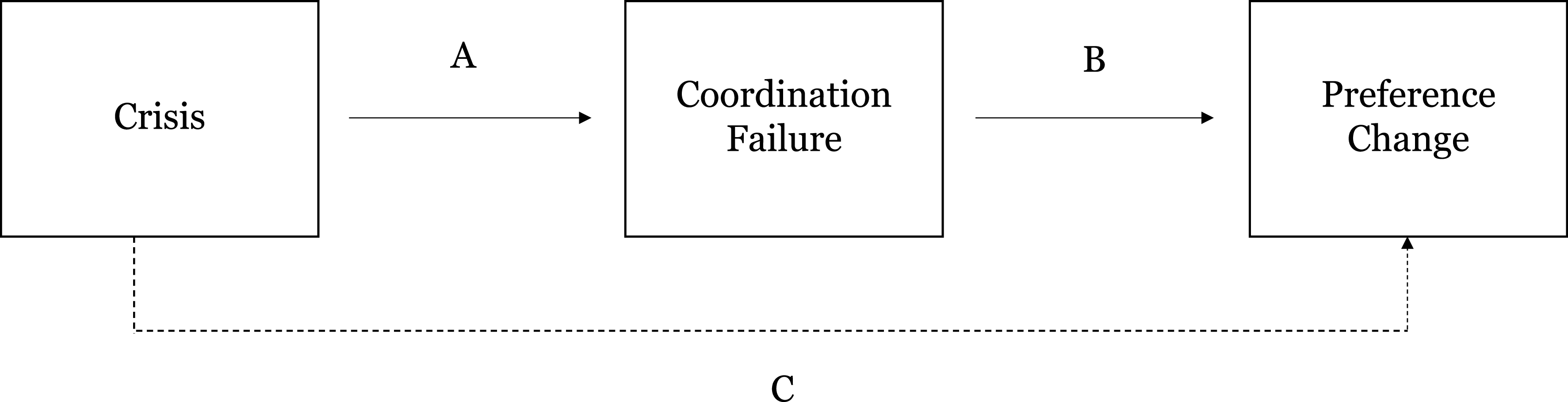
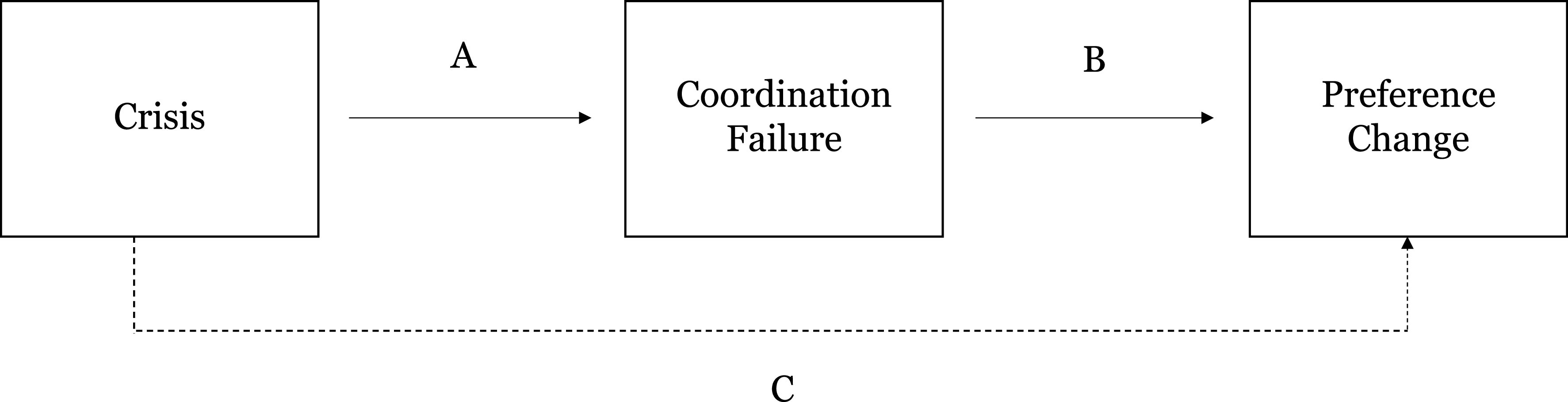
The causal mechanism goes as follows. On the one hand, external threats make coordination failures more likely and visible (arrow A in Figure 1). Comparative case research on crisis management shows that under extraordinary circumstances, citizens are more likely to be exposed to coordination failures. For example, governmental responses to different past disasters, such as Hurricane Katrina in the United States in 2005, the Japanese Fukushima Nuclear Disaster in 2011, or the Australian wildfires of 2019–2020, uncovered problems of coordination between local, regional, and central governments (Malhotra and Kuo Reference Malhotra and Kuo2008; Downey and Myers Reference Downey and Myers2020). In fact, poor information sharing and coordination of decisions ‘lies at the heart of many crisis response pathologies’ (Boin and ’t Hart Reference Boin and ’t Hart2010: 367). In the case of the Covid-19 pandemic, intergovernmental conflict on when and how to ease restrictions after lockdowns was frequent (Hegele and Schnabel Reference Hegele and Schnabel2021). In addition, since external threats require urgent remedial action from crisis managers (Rosenthal et al., Reference Rosenthal, Boin and Comfort2001), coordination becomes one of the most important challenges of crisis response (Boin and ’t Hart Reference Boin and ’t Hart2010), increasing its importance. In summary, coordination problems are more likely to occur and become more visible to citizens in the context of a crisis. On the other hand, we expect coordination failures to prompt a change in individuals’ preferences for authority distribution (arrow B in Figure 1). Specifically, we argue that, in the presence of inefficient coordination, citizens will prefer a more centralized decision-making structure to prevent or minimize the consequences posed by the crisis.
Crisis, coordination failures, and changes in citizens’ territorial preferences.
The question then is, how do citizens move from considering that there is a problem in the response to the threat to a common solution? Societal coordination around the solution is facilitated by the specific nature of the commonly acknowledged problem: Because fragmentation of authority hinders the response to the threat, citizens will coordinate their preferences around a prominent single decision-maker. It is important to note that we conceptualize a specific type of crisis – one that poses a collective action problem that requires coordinated, large-scale responses – whose nature may range from local to global. Then, we argue that as the crisis reveals coordination problems, citizens increasingly look to hierarchically superior authorities, relative to the scope and nature of the threat, as focal points for the allocation of decision-making power (Schelling Reference Schelling1960).
Although coordination failures are the mechanism by which we connect external threats with centralizing shifts, a crisis can also prompt centralization independently of the role of intergovernmental coordination failures (arrow C in Figure 1). For instance, observational and experimental studies have shown that individuals perceive the central government as more responsible for the management of a sanitary crisis or natural disasters (Birkland and Waterman Reference Birkland and Waterman2008). In addition, there is a well-established literature that shows that a temporary increase in approval ratings for incumbents or governing bodies may follow after a crisis in the form of a war, terrorist attack, or natural disaster occurs (Fair, Kuhn, Malhotra et al. Reference Fair, Kuhn, Malhotra and Shapiro2013; Lazarev, Sobolev, Soboleva et al. Reference Lazarev, Sobolev, Soboleva and Sokolov2014). Yet, whereas this temporary rally-around-the-flag effect focuses on support for incumbents or short-term popularity metrics, our theoretical expectation addresses a more structural and enduring shift, namely, support for institutional centralization that alters the existing distribution of powers. Moreover, the idea that crises can induce a general ’centralized’ mindset among individuals does not, by itself, clarify the specific mechanism that triggers a change in their preferences regarding the distribution of authority. In this article, we focus on government performance when responding to the crisis as a fundamental mechanism to understand the pro-centralization shift in public territorial preferences. Therefore, demonstrating the validity of our mechanism (arrow B) in relation to the possible independent effect of the crisis per se (arrow C) becomes a crucial theoretical and empirical effort for our purposes here. In the following section, we develop a model that formalizes the argument presented so far.
The model
Consider a model in which the preferences of individuals for a multilevel democracy depend on a) the value assigned by each individual to the public goods produced by the system ( ${G_i}$
); and b) the cost assigned by each individual to the lack of inclusion of the decision process that leads to the provision of public goods (
${G_i}$
); and b) the cost assigned by each individual to the lack of inclusion of the decision process that leads to the provision of public goods ( ${C_i}$
). Formally, individuals’ payoffs are the following:
${C_i}$
). Formally, individuals’ payoffs are the following:
 $${U_i} = {G_i}\left( \delta \right)P\left( {N,\delta } \right) - {C_i}\left( N \right)$$
where $P\left( {N,\delta } \right)$
is the probability that multilevel governments (central and subcentral) make the decision to provide public policies.
$P\left( {N,\delta } \right)$
is the probability that multilevel governments (central and subcentral) make the decision to provide public policies. $P$
is decreasing in the number of multilevel actors
$P$
is decreasing in the number of multilevel actors $N$
who participate in the decision that produces specific public policy results (formally, the concavity function of
$N$
who participate in the decision that produces specific public policy results (formally, the concavity function of ${P_N} \lt 0$
and
${P_N} \lt 0$
and ${P_{NN}} \lt 0$
and, according to our theoretical argument, also decreases in
${P_{NN}} \lt 0$
and, according to our theoretical argument, also decreases in $\delta $
, which is a parameter that captures inefficiencies in coordination between these actors. According to the theoretical argument developed above,
$\delta $
, which is a parameter that captures inefficiencies in coordination between these actors. According to the theoretical argument developed above, $\delta $
has different baselines depending on the country-specific institutions that govern intergovernmental action; yet it always increases in the context of a crisis. Conversely,
$\delta $
has different baselines depending on the country-specific institutions that govern intergovernmental action; yet it always increases in the context of a crisis. Conversely, $G$
depends positively on
$G$
depends positively on $\delta $
(
$\delta $
( ${G_\delta } \gt 0$
), an assumption that follows from the scarcity principle – as inefficiencies increase in the context of a crisis, we assume that citizens will value public policies (
${G_\delta } \gt 0$
), an assumption that follows from the scarcity principle – as inefficiencies increase in the context of a crisis, we assume that citizens will value public policies ( $G$
) more when these policies are more urgently needed to respond to the crisis. Moreover, according to our theoretical argument,
$G$
) more when these policies are more urgently needed to respond to the crisis. Moreover, according to our theoretical argument, ${C_i}$
is decreasing in the number of actors who participate in the decision (
${C_i}$
is decreasing in the number of actors who participate in the decision ( ${C_N} \lt 0$
). That is, the higher the number of multilevel actors that participate in the decision to provide a public good, the lower the costs from the lack of inclusiveness. This premise derives from the subsidiarity principle, which establishes that decentralization of authority to local governments results in decisions that are closer to individuals’ policy preferences. Likewise, given the democratic nature of the regime, for every individual in the system, there will always be a
${C_N} \lt 0$
). That is, the higher the number of multilevel actors that participate in the decision to provide a public good, the lower the costs from the lack of inclusiveness. This premise derives from the subsidiarity principle, which establishes that decentralization of authority to local governments results in decisions that are closer to individuals’ policy preferences. Likewise, given the democratic nature of the regime, for every individual in the system, there will always be a $N \gt 0$
representative government structure preferable to a dictatorship (
$N \gt 0$
representative government structure preferable to a dictatorship ( $N = 0$
).
$N = 0$
).
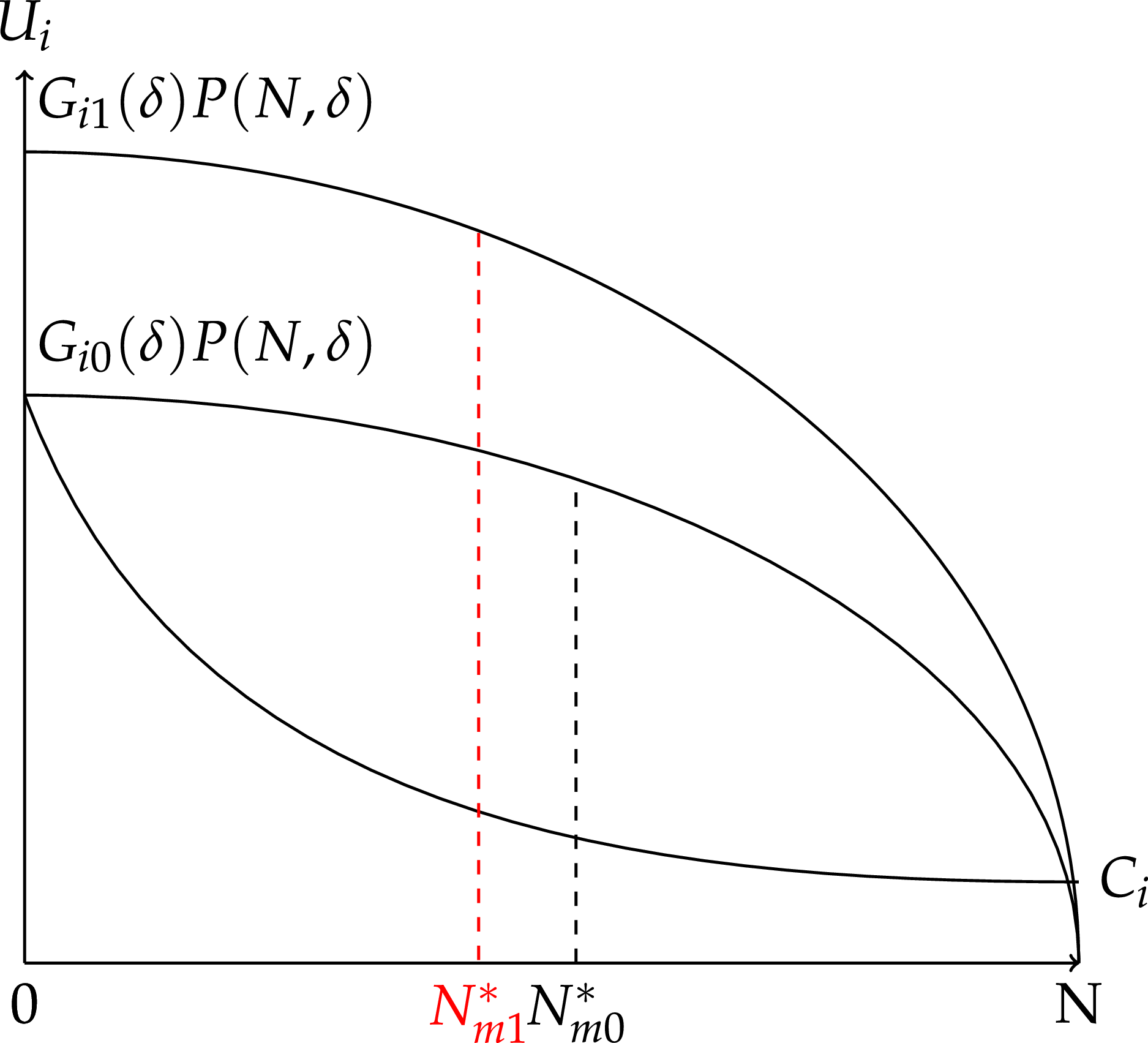
This model yields several predictions that we evaluate throughout the article. First, for a median voter, there is an optimal number of decision-making actors participating in the political system ( $N_m^{\rm{*}}$
) that maximizes her utility.
$N_m^{\rm{*}}$
) that maximizes her utility. $N_m^{\rm{*}}$
is a negative function of
$N_m^{\rm{*}}$
is a negative function of $\delta $
(see online Appendix) and represents the statu quo distribution of authority in a multilevel democracy, as shown in Figure 2. A higher
$\delta $
(see online Appendix) and represents the statu quo distribution of authority in a multilevel democracy, as shown in Figure 2. A higher $N$
means more decentralization of power (more multilevel actors participating in the decision-making process), whereas a lower
$N$
means more decentralization of power (more multilevel actors participating in the decision-making process), whereas a lower $N$
represents higher levels of centralization (fewer multilevel actors participating in the decision-making process).
$N$
represents higher levels of centralization (fewer multilevel actors participating in the decision-making process).
Utility maximization with ( ${{\rm{\;}}_1}$
) and without (
${{\rm{\;}}_1}$
) and without ( ${{\rm{\;}}_0}$
) a crisis.
${{\rm{\;}}_0}$
) a crisis.
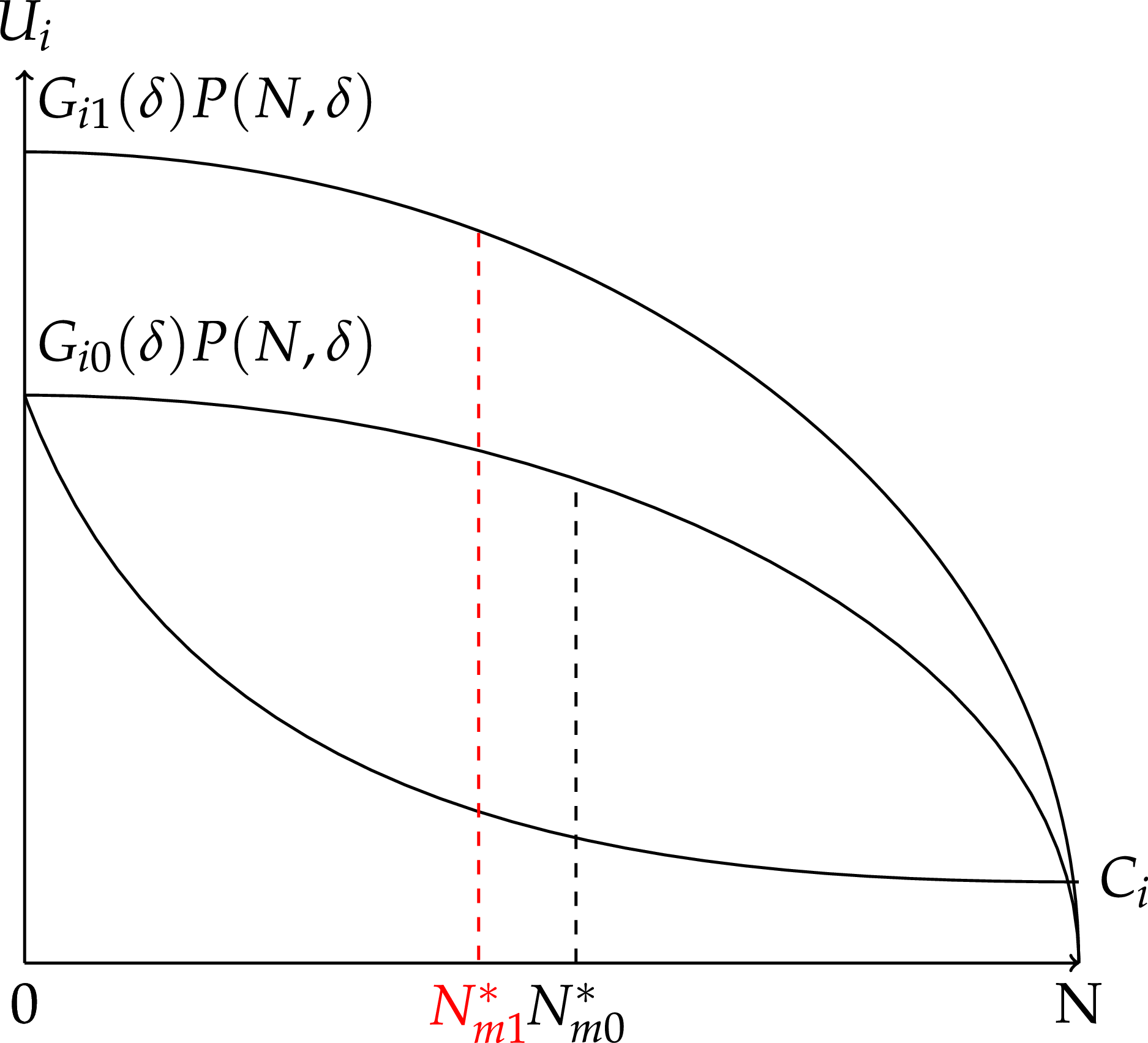
Second, when a crisis hits, the probability that government actors will reach an agreement ( $P$
) decreases with
$P$
) decreases with $N$
and at a rate that depends on the intensity of the inefficiencies derived from the crisis (
$N$
and at a rate that depends on the intensity of the inefficiencies derived from the crisis ( ${P_{N\delta }} \lt 0$
). Consequently, when
${P_{N\delta }} \lt 0$
). Consequently, when $\delta $
increases, the difference between both curves increases as
$\delta $
increases, the difference between both curves increases as $N$
increases, and thus the optimal number of multilevel actors that maximize the utility of the median voter decreases (
$N$
increases, and thus the optimal number of multilevel actors that maximize the utility of the median voter decreases ( $N_{m1{\rm{\;}}}^{\rm{*}}$
<
$N_{m1{\rm{\;}}}^{\rm{*}}$
< $N_{m0}^{\rm{*}}$
). In a crisis context, the median voter prefers a system where the decision-making process is more centralized (as represented by the new utility maximization dashed line in red in Figure 2).
$N_{m0}^{\rm{*}}$
). In a crisis context, the median voter prefers a system where the decision-making process is more centralized (as represented by the new utility maximization dashed line in red in Figure 2).
Third, since each individual values the inclusiveness of decision making ( $C$
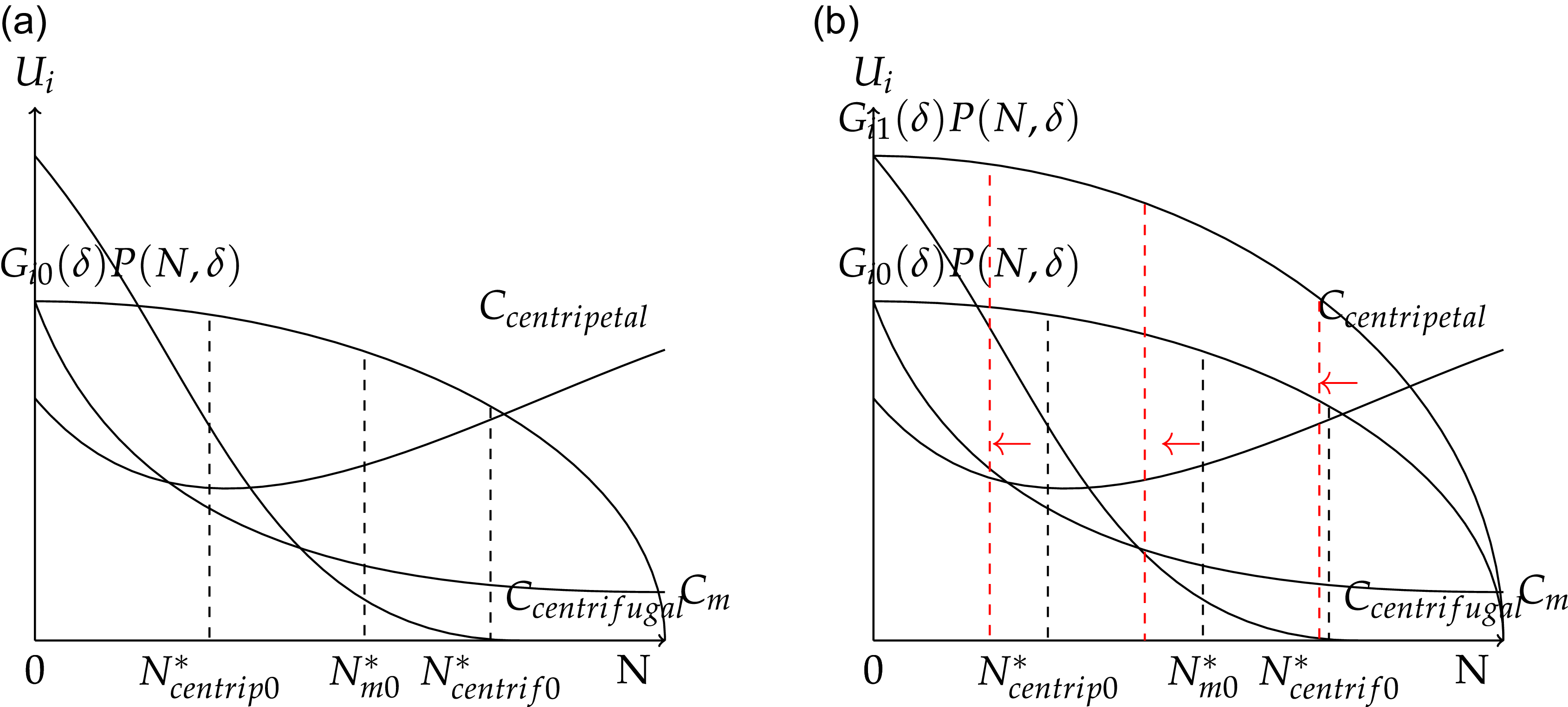
) differently, the optimal number of government actors that maximizes utility varies between individuals. Figure 3A represents the heterogeneity in
$C$
) differently, the optimal number of government actors that maximizes utility varies between individuals. Figure 3A represents the heterogeneity in ${C_i}$
. For simplicity, we consider two types of individuals in this regard: those with centripetal preferences (they prefer decision-making processes with fewer government actors than the median voter, that is,
${C_i}$
. For simplicity, we consider two types of individuals in this regard: those with centripetal preferences (they prefer decision-making processes with fewer government actors than the median voter, that is, $N_{m0}^{\rm{*}}$
>
$N_{m0}^{\rm{*}}$
> ${N_{centripetal0}}$
) and those with centrifugal preferences (they prefer decision-making processes with more government actors than the median voter, that is,
${N_{centripetal0}}$
) and those with centrifugal preferences (they prefer decision-making processes with more government actors than the median voter, that is, $N_{m0}^{\rm{*}}$
<
$N_{m0}^{\rm{*}}$
< ${N_{centrifugal0}}$
).
${N_{centrifugal0}}$
).
Utility maximization under varying preferences for system inclusiveness.
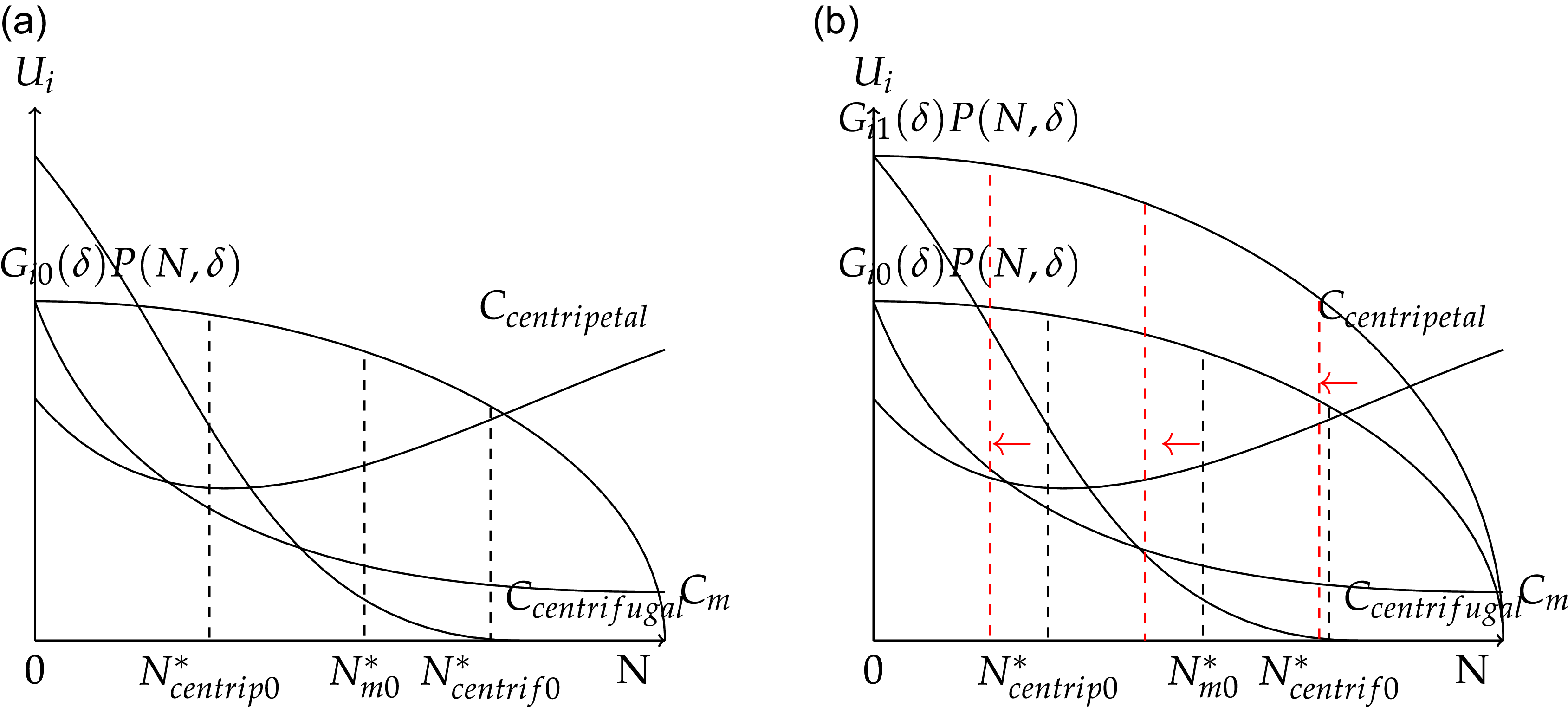
Last, in the context of a crisis and thus high coordination failures, assuming that all individuals value $G$
equally, the parameter N that maximizes the utility of any possible individual
$G$
equally, the parameter N that maximizes the utility of any possible individual $i$
will always be smaller than under no crisis (as represented by the new utility maximization dashed lines in red in Figure 3B). However, the magnitude of this centralizing shift will depend largely on each individual’s preference structure.
$i$
will always be smaller than under no crisis (as represented by the new utility maximization dashed lines in red in Figure 3B). However, the magnitude of this centralizing shift will depend largely on each individual’s preference structure.
In summary, this theoretical framework yields the following predictions.
-
1. As coordination failures increase in the context of a crisis, citizens will support a change in the statu quo distribution of powers, supporting the centralization of power in fewer political actors.
-
2. Preferences for the centralization of power will be increasing in coordination failures: the higher the level of coordination inefficiencies, the more pronounced the centralizing drift in individuals’ preferences for authority distribution.
-
3. The preferred distribution of power varies between individuals, depending on their preferences for inclusion. Those individuals who experience higher (lower) costs from the lack of inclusiveness of multilevel actors will prefer a more (less) decentralized distribution of power.
-
4. In the context of a crisis, the increase in coordination failures will result in a shift toward centralization of power for all individuals, regardless of their type of preferences for inclusiveness, although the former will shape the magnitude of this shift.
Experimental design in the context of the pandemic
The Covid-19 crisis presented a particularly interesting test of public performance and intergovernmental coordination in countries with some level of authority decentralization, as the main policy areas affected by the pandemic (health care and social services) tended to be in the hands of subcentral governments in most of these countries. Given the large scale of the crisis, coordination was particularly important in order to overcome a collective action problem. Since responses and decisions at one level of government had spillovers in the evolution of the pandemic elsewhere, the lack of coordination among central and subcentral governments’ decisions, each level implementing measures that were less intense than what is globally optimal, could result in an extension of the damage.
To test our theoretical predictions, we conducted an online priming survey experiment in 13 decentralized democracies, with a subset of these countries being surveyed at two different points in time during 2020. In the experiment, we manipulated the parameter $\delta $
of our model by randomly exposing participants to information about intergovernmental coordination failures. Specifically, our main treatment consisted of a short statement in which we exposed those treated to information about the World Health Organization’s (WHO) recommendationsFootnote
9
in respect of intergovernmental coordination and the difficulties of multilevel cooperation in the context of the Covid-19 pandemic.Footnote
10
Our dependent variable represented a scale of 0 to 10 regarding the respondents’ preferences toward the vertical distribution of the authority at the country level; therefore, the distributive choice was restricted to two alternatives: stronger regional governments (0) or stronger central governments (10), being 5 the statu quo.
$\delta $
of our model by randomly exposing participants to information about intergovernmental coordination failures. Specifically, our main treatment consisted of a short statement in which we exposed those treated to information about the World Health Organization’s (WHO) recommendationsFootnote
9
in respect of intergovernmental coordination and the difficulties of multilevel cooperation in the context of the Covid-19 pandemic.Footnote
10
Our dependent variable represented a scale of 0 to 10 regarding the respondents’ preferences toward the vertical distribution of the authority at the country level; therefore, the distributive choice was restricted to two alternatives: stronger regional governments (0) or stronger central governments (10), being 5 the statu quo.
Three premises guided the design of our dependent variable. First, during the first year of the pandemic, citizens perceived it primarily as a national problem rather than an international one. This was a period when global vaccine production and distribution schemes were still in their infancy, and among members of the European Union, SURE loans had not gained public prominence and Next Generation funds had yet to be disbursed. Therefore, during this period, the crisis was primarily national in nature, a perception we believe shifted later as international governmental organizations, such as the WHO and, in the EU, the Commission, began to play a more active role in its management. In fact, in the online Appendix, we present evidence supporting this assumption.Footnote 11 Our second premise was that this question concerns individual preferences towards vertical authority distribution, an issue that anyone should be able to answer, regardless of their prior knowledge of the actual distribution of vertical authority in their country. The third assumed that, logically, in a democracy, the majority of respondents in the control group should have an average territorial preference around the statu quo, that is, a 5. It is important to note that at the time of the survey, the respondents in our sample might have been pretreated on the severity of the crisis, as well as on the inefficiencies of coordination that were taking place in their countries. This hardens our empirical effort, as we test our treatment’s effect against the potential downward bias that the pretreatment effect of the crisis and the coordination failures could have introduced in the estimation of our potential main effect of interest.
The exact wording of the implemented vignettes is as follows:Footnote 12
Treatment group. The World Health Organization has warned countries about the importance of collaboration and coordination between governments in the fight against Covid-19. However, experts have pointed out that the management of the crisis is being particularly difficult in [your country] due to the collaboration and cooperation problems between the central/federal government and the [name of the second tier in your country]. What should be the actual power distribution between the central/federal government and the [name of the second tier in your country]?
[0–10 scale provided to respondents, where 0 means ‘Grant more power to the [name of the second tier in your country]’, 5 ‘statu quo’ and 10 ‘Grant more power to the central/federal government’.]
Control group. Which should be the actual power distribution between the central/federal government and the [name of the second tier in your country]?
[0–10 scale provided to respondents, where 0 means ‘Grant more power to the [name of the second tier in your country]’, 5 ‘statu quo’ and 10 ‘Grant more power to the central/federal government’.]
Given the set of predictions that follow from our model, we derive some empirical hypotheses to test in the described experimental setting. Our first hypothesis focuses on understanding whether individuals primed on coordination failures exhibit higher levels of pro-centralization territorial preferences than those in the control group. Specifically,
H1 In the context of a crisis, giving people information about multilevel coordination failures will affect how they think vertical authority should be distributed, favoring pro-centralization positions.
The following hypotheses introduce individual-level heterogeneous treatment effects based on predictions 3 and 4. In the model, individuals assessed the inclusion of the system differently ( ${C_i}$
), that is, the number of multilevel governments (
${C_i}$
), that is, the number of multilevel governments ( $N$
) participating in the decision-making process. From an empirical point of view, in a decentralized democracy, we consider that the value assigned by individuals to
$N$
) participating in the decision-making process. From an empirical point of view, in a decentralized democracy, we consider that the value assigned by individuals to $C$
depends largely on a) their territorial identity and b) their partisanship – two strong moderators of citizens’ attitudes when it comes to authority distribution (Tilley and Hobolt Reference Tilley and Hobolt2011; León, Jurado, and Garmendia Madariaga Reference León, Jurado and Garmendia Madariaga2018). Consequently, we assume that people with strong national identities will be less favorable to the inclusion of subcentral governments in the decision-making process than individuals with strong regional or local identities. Likewise, ceteris paribus, we assume that those voters who are politically aligned with central government incumbents will be more prone to have centripetal preferences than the rest of the voters in the system. Given the identities and partisanship of the subjects before treatment, we therefore predict a stronger effect of the treatment among those whose identities (H2) or partisanship (H3) are more aligned with the central government. Specifically,
$C$
depends largely on a) their territorial identity and b) their partisanship – two strong moderators of citizens’ attitudes when it comes to authority distribution (Tilley and Hobolt Reference Tilley and Hobolt2011; León, Jurado, and Garmendia Madariaga Reference León, Jurado and Garmendia Madariaga2018). Consequently, we assume that people with strong national identities will be less favorable to the inclusion of subcentral governments in the decision-making process than individuals with strong regional or local identities. Likewise, ceteris paribus, we assume that those voters who are politically aligned with central government incumbents will be more prone to have centripetal preferences than the rest of the voters in the system. Given the identities and partisanship of the subjects before treatment, we therefore predict a stronger effect of the treatment among those whose identities (H2) or partisanship (H3) are more aligned with the central government. Specifically,
H2 Exposure to the treatment will have a greater effect on centralization among those with a country national identity than among those with a regional national identity.
H3 Exposure to the treatment will have a higher effect on centralization among central government incumbent partisans than among partisans of opposition parties.
In addition, we consider two contextual conditions that could explain the variation in the intensity of coordination failure (the level of $\delta $
) and thus could moderate the main effect of the treatment. On the one hand, respondents may perceive coordination failures more or less intensely depending on the actual response that each multilevel government provided to their citizens. On the other hand, respondents may also perceive coordination failures more or less intensely depending on the actual prevalence of the crisis. The Covid-19 pandemic had a varying impact in time and territory, so we expect coordination failures to be more acute when the depth of the crisis increases the urgency of a coordinated response. Specifically,
$\delta $
) and thus could moderate the main effect of the treatment. On the one hand, respondents may perceive coordination failures more or less intensely depending on the actual response that each multilevel government provided to their citizens. On the other hand, respondents may also perceive coordination failures more or less intensely depending on the actual prevalence of the crisis. The Covid-19 pandemic had a varying impact in time and territory, so we expect coordination failures to be more acute when the depth of the crisis increases the urgency of a coordinated response. Specifically,
H4 Exposure to the treatment will have a greater effect on centralization in countries where multilevel policy efforts against the pandemic were low.
H5 Exposure to the treatment will have a greater effect on centralization when the threat is more relevant to citizens.
Our comparative sample of 13 democracies was composed of six federations (Australia, Austria, Brazil, Canada, Germany, and the USA), three quasi-federations (Italy, Spain, and the UK), and four decentralized unitary systems (France, New Zealand, Poland, and Sweden).Footnote 13 With the exception of India, the sample comprises the most important democratic federations and decentralized systems in the world. Moreover, in general, these countries have a high income per capita and advanced health systems. Interestingly, though, they were affected very differently by the pandemic, increasing the external validity of our results. In addition, two main empirical observations suggest that the coordination problems that motivated this study were actually common to the countries in our sample, regardless of their level of decentralization. First, the debate about central versus decentralized management of the crisis was a widespread one, even among decentralized unitary countries. For example, the French Prime Minister, Jean Castex, called for a regionalized approach, stating that ‘most of the measures should not be decided from Paris’.Footnote 14 Second, from a competence point of view, many of the unitary countries in the sample had decentralized health systems, and some of them, like Sweden, had a much more decentralized healthcare provision than federations like Germany.
We estimate a set of linear regression models (through OLS), with standard errors clustered at the country level, including individual controls (pretreatment age, sex, employment situation, exposure to the Covid-19 pandemic, and ideology)Footnote 15 as well as a set of country-fixed effects. The latter are used to deal with the fact that the intensity of the virus outbreak varied significantly across countries and also because there might be a compound treatment effect between the outbreak and the slightly varying political and institutional responses to fight it across countries. Therefore, to fully benefit from the richness of our data, we tested H2 and H3 using our pooled cross-sectional sample of countries and estimated three-way interactions between our treatment, the specific individual-level moderator, and an individually constant country identification variable. We use the same sample to test for H4, yet in this case we interact our treatment with a country-invariant measure of multilevel policy stringency.
Finally, in order to capture within-country variation regarding the intensity of the pandemic, we conducted a replication study in December 2020 in a subsample of six countries (Brazil, France, Germany, Poland, Spain, and the UK). While we followed a possibilist approach in the selection of the follow-up countries, the latter pondered both institutional variation (2 federations, 2 quasi-federations, and 2 decentralized unitary systems) and crisis intensity. Then, by repeating the experiment in the fall of 2020 we aimed at capturing whether the magnitude of the effect of our treatment varied depending on the longitudinal variation in the prevalence of the crisis. Then we tested the differential effect of Covid-19 intensity in H5 using country wave-specific samples.
Main effect
The first thing to be highlighted from our results is that the average response in the country-grouped control group was 4.96, which confirms that the preferred authority distribution among the non-treated was located around the institutional statu quo in these countries (that is, 5). Therefore, respondents’ preferences for vertical authority distribution at the time were largely congruent with the existing institutional territorial structures in their countries. However, the existing variation between countries in this regard also shows that these countries had different structure-induced opinion baselines that we should carefully consider in our analyses.
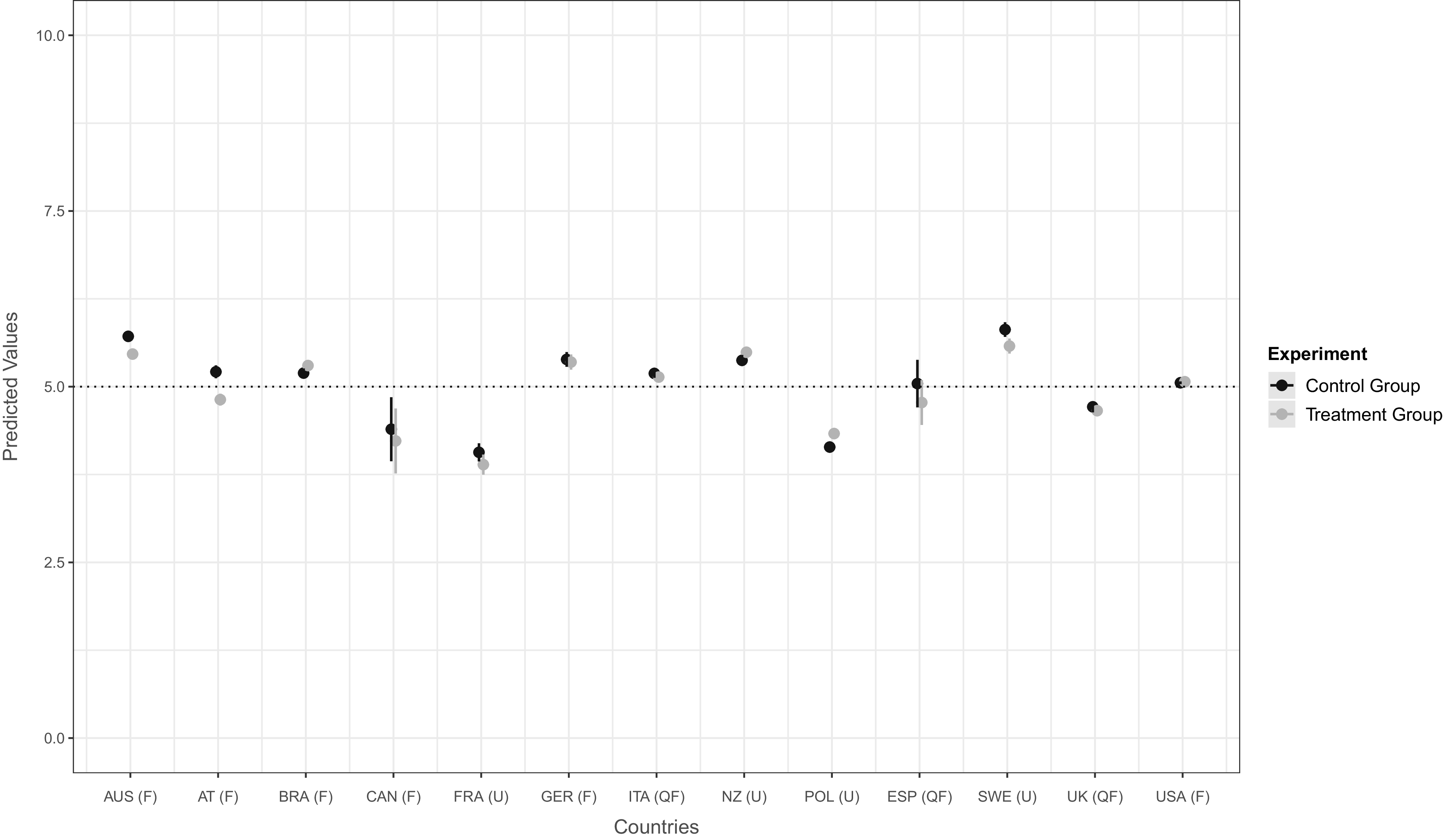
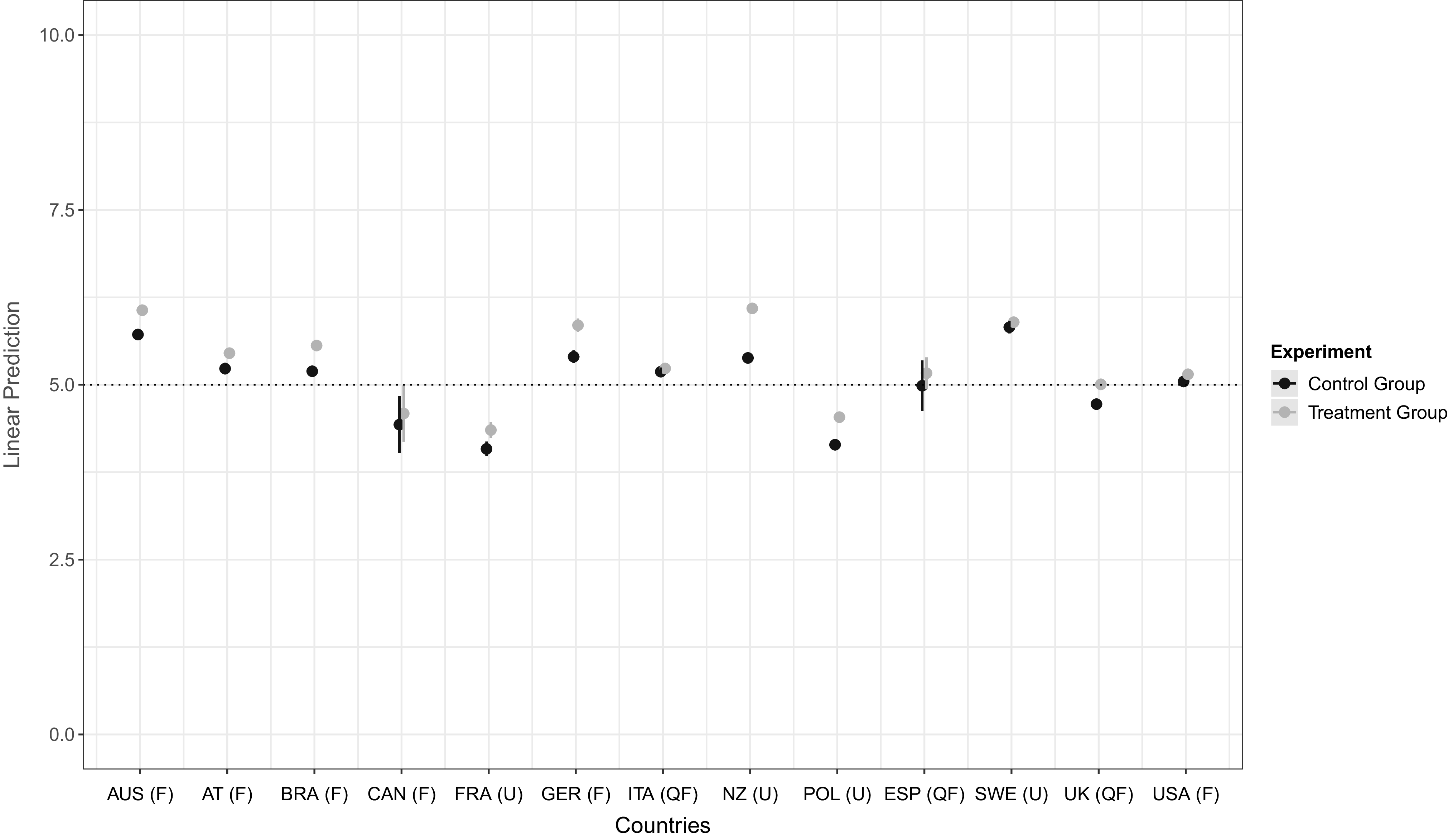
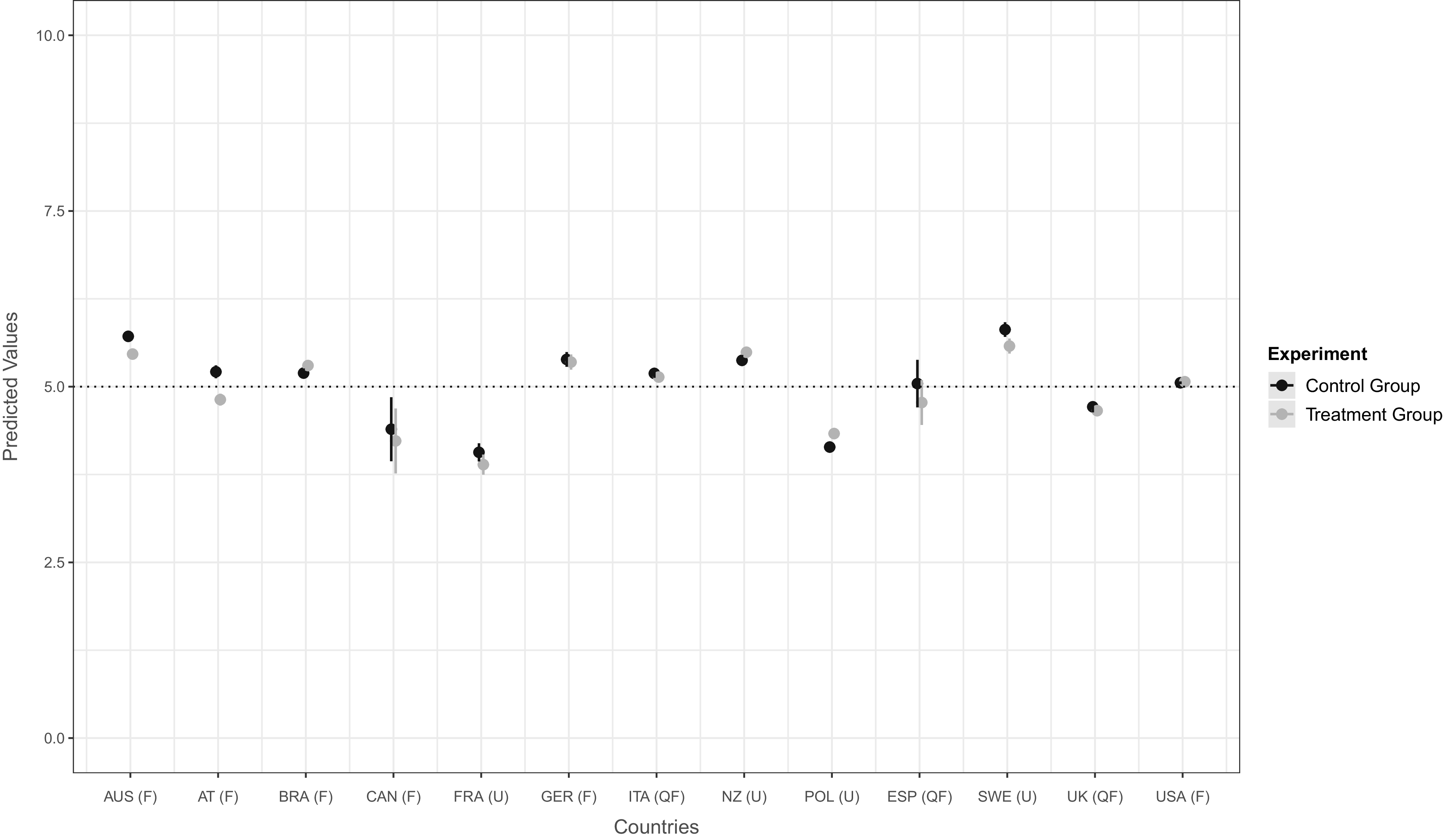
Moving into a more analytical perspective, Figure 4 presents the predicted values of the treatment and control groups by country during our first wave.Footnote 16 The average treatment effect (ATE) represented an increase of 2.7% on the scale of 0 to 10 of the dependent variable. Moreover, it was positive in every single case and significant in Australia, Austria, Brazil, France, Germany, New Zealand, Poland, the UK, and the USA. This test presents a first confirmation of the main hypothesized effect. That is, learning about territorial coordination failures in the context of Covid-19 activated the same centralizing solution mechanism at the individual level in each of the countries in the sample.
Predicted values by country in the sample.
Note: The figure displays the average predicted preferred distribution of vertical authority both in the control and treatment groups by country (in a pooled sample).
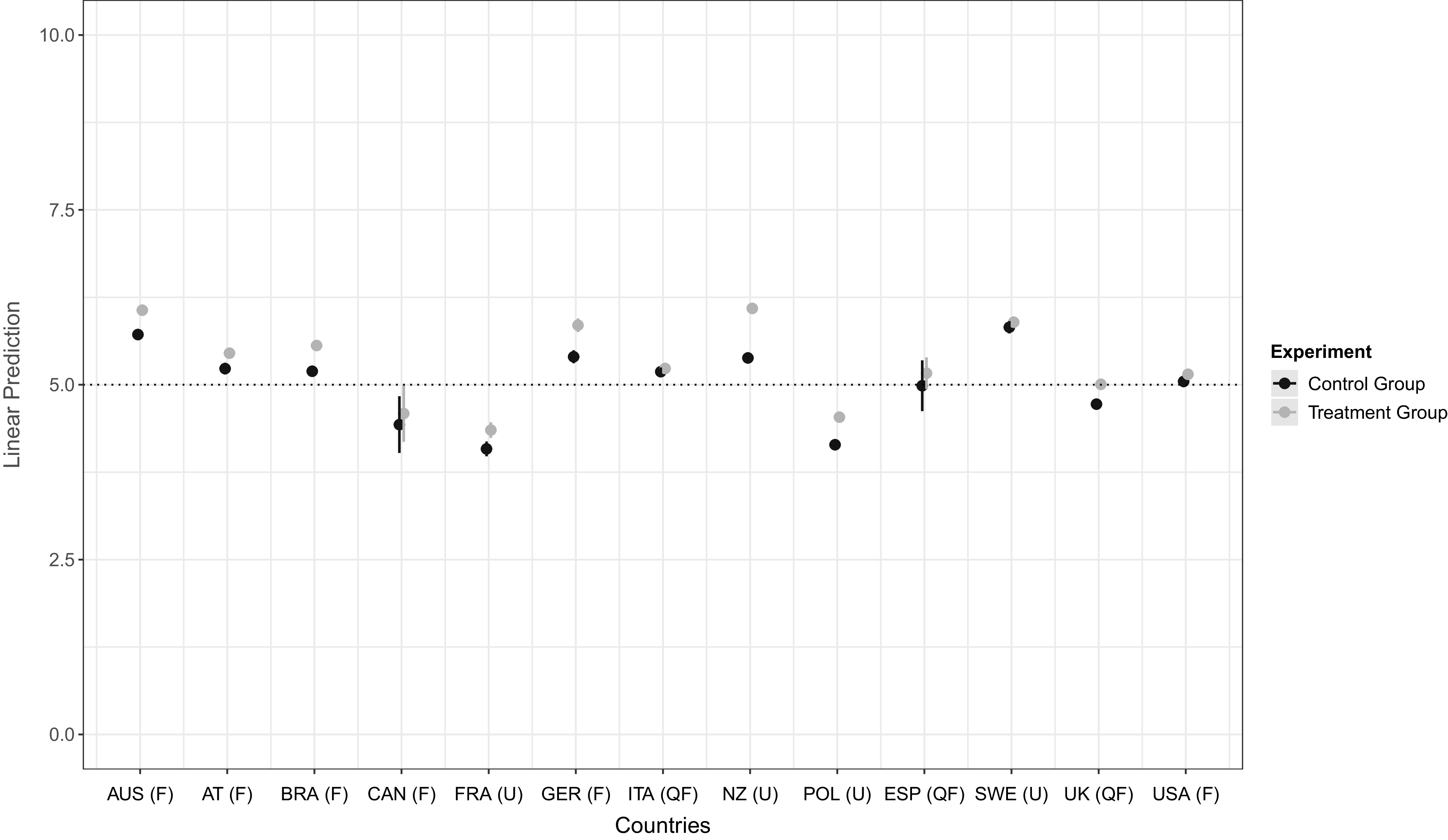
The effect ranged from around 0.1 in the USA to around 0.7 in New Zealand, which represents a non-negligible change between 1% and 7% in public opinion, respectively. There seem to be three groups of countries here: (1) federations (Australia, Austria, Brazil, Germany, and the USA) where the control group was above 5 and the treatment showed a solid positive effect; (2) with the only exception of New Zealand, unitary or quasi-federal countries like France, Poland, and the UK, where the control group was below 5 and the treatment showed a solid positive effect; and (3) countries like Canada, Italy, or Spain, where the ATE was not significant and the control and treatment groups showed large levels of uncertainty around their average position.Footnote 17 In fact, variance in the dependent variable in countries like Brazil (7.58), Italy (6.60), and Spain (9.37) almost doubled that in countries like Austria (4.01), France (4.25), and New Zealand (3.57).Footnote 18 As the following section demonstrates, this result seems to be largely connected to the politicization of territorial preferences in these countries.
Individual-level moderators
Territorial identity
The pretreatment questionnaire contained a group of questions about the attachment of respondents to different levels of government in these multilevel systems. Specifically, the questions asked about ‘How attached do you feel…? (To your country, your state or region, or your municipality)’ on a 0 to 10 scale, where 0 meant ‘Not at all attached’ and 10 ‘Extremely attached’. By combining responses regarding individual attachment to the country and regional levels, we create a new variable that ranges from −10 to 10, where −10 means ‘Only extremely attached to the regional level’, 10 means ‘Only extremely attached to the country level’, and 0 means the same attachment to both levels. We use this new variable as a proxy for respondents’ territorial identity.
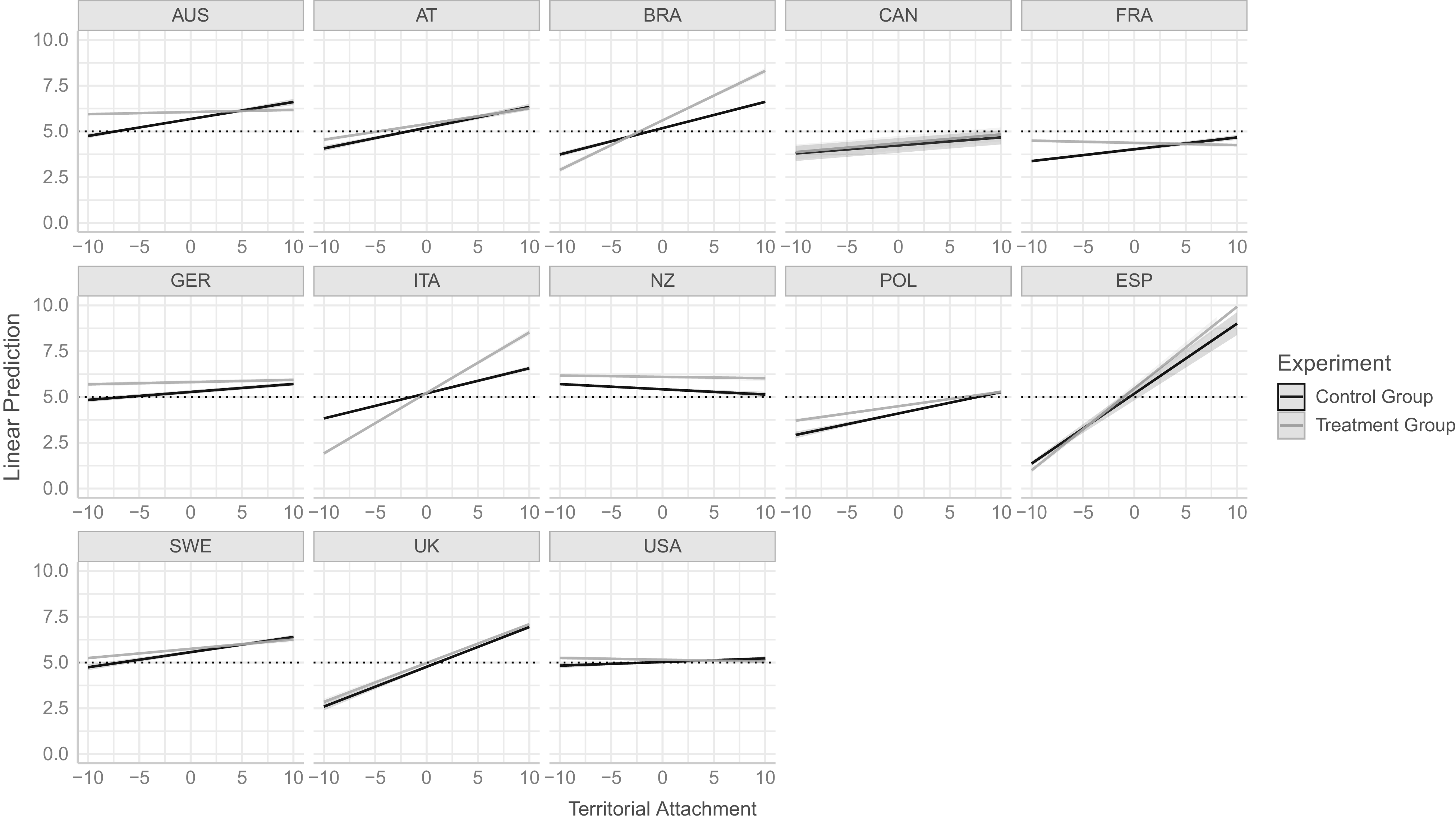
Figure 5 presents the conditional effect of our treatment as the territorial identity of the respondents varies in each country. As can be observed, the countries in the sample could be categorized into two very different groups. On the one hand, we have Brazil, Italy, Spain, and the UK, countries where territorial identity has a clear effect on territorial preferences (rate of change of the slope) and plays a clear role when moderating the ATE (separation between treatment and control groups’ predicted effects). In Brazil, Italy, and Spain, our main effect of interest showed a positive and increasing trend as respondents reported stronger attachment to the national level (as predicted in H2). In contrast, it showed a negative and increasing trend as the attachment to the regional level increased, although the pattern and significance of this effect varied between countries. While Italy and Spain exemplify multilevel democracies where territorial competition polarizes the relationship between identity and preferences, in Brazil, the effect seems more closely tied to Bolsonaro’s polarizing leadership and his ability to centralize power at the federal level, particularly among his supporters (as we show in the next subsection).Footnote 19 On the other hand, we have the rest of the countries in the sample, where our territorial identity variable had a very limited effect on our dependent variable in the control group and a very limited moderating effect on the ATE. Contrary to what was hypothesized, in countries like Australia, Austria, France, Germany, Poland, Sweden, and the US, the centralizing effect of coordination failures was mostly concentrated among those who only felt attached to their regions. Canada stands out as a separate case, as preferences for decentralization are broadly distributed throughout the country and are evident even among individuals with moderate attachment to the national level.
The country predicted effects for control and treatment groups conditional on individuals’ level of national territorial attachment.
Note: The figure displays the average predicted preferred distribution of vertical authority both in the control and treatment groups by country (in a pooled sample) conditional on individual-level territorial attachment.
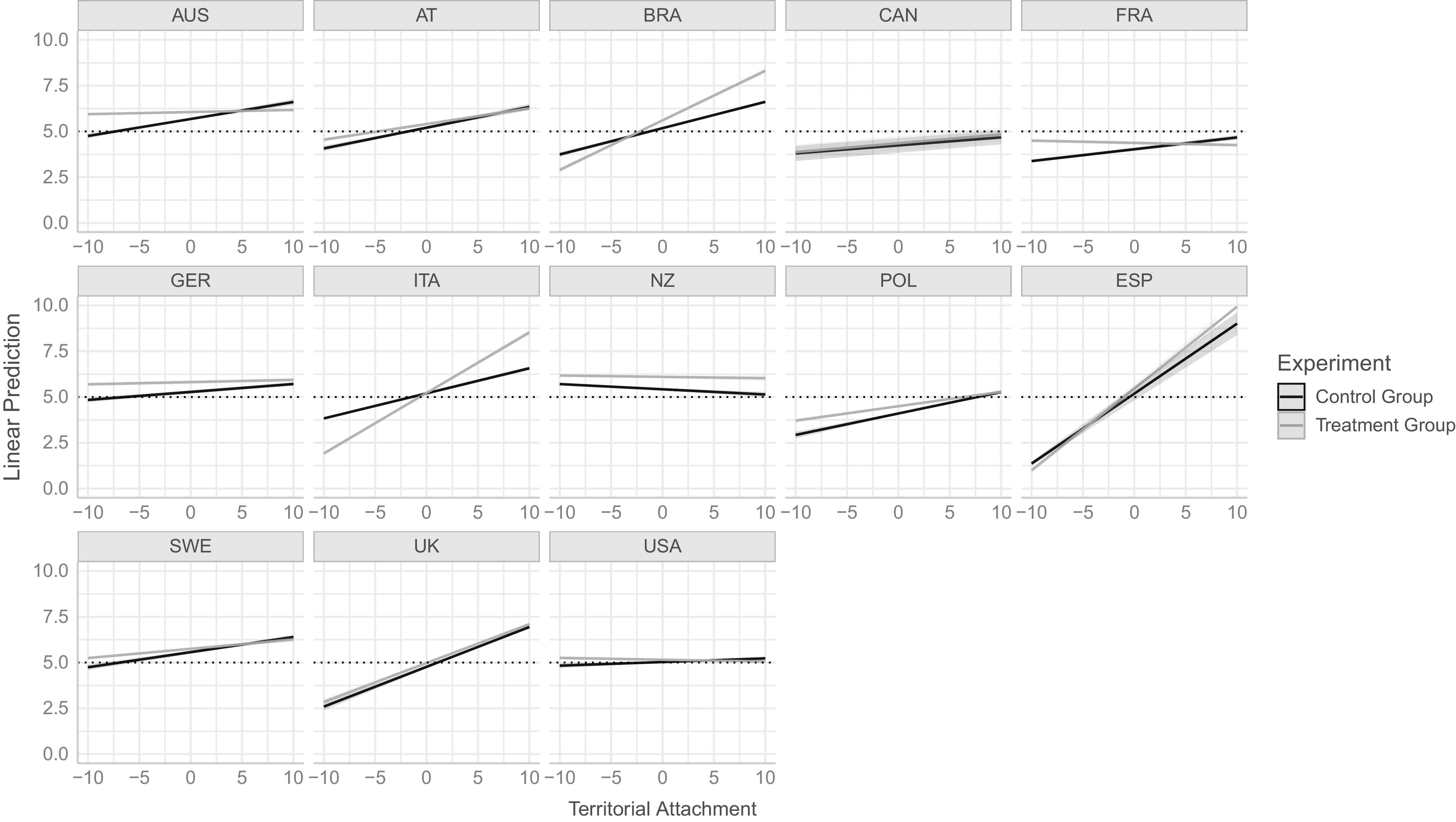
These findings relevantly uncover the different nature that territorial attachment played in these two groups of countries: while in Brazil, Italy, or Spain, territorial identity represented a polarizing attitude that largely confirmed our H2, in the latter it took a much less exclusionary form. In fact, those who felt more attached to the national (country) level experienced no treatment effect, which goes against our hypothesis. This finding may result from the fact that the variance in territorial preferences in this second group of countries was very low, and therefore the effect of our treatment vanished among those who had extreme centripetal identities.
Partisanship
In the pretreatment questionnaire, we also included a question on vote intention with which we measure respondents’ party attachment. Specifically, the wording of the question looked as follows: ‘If elections were held next Saturday and were without health risks, for which party would you vote first in the [specific name of general elections by country]?’ In order to test for the second hypothesized source of individual-level heterogeneity in our treatment, we code the respondents’ answers as 1 if the chosen party was a central/federal level incumbent at that time and 0 otherwise.Footnote 20 Our goal is to understand how much of the centralizing shift was actually driven by those voters in our country samples who supported central government incumbent parties at the time of the experiment.
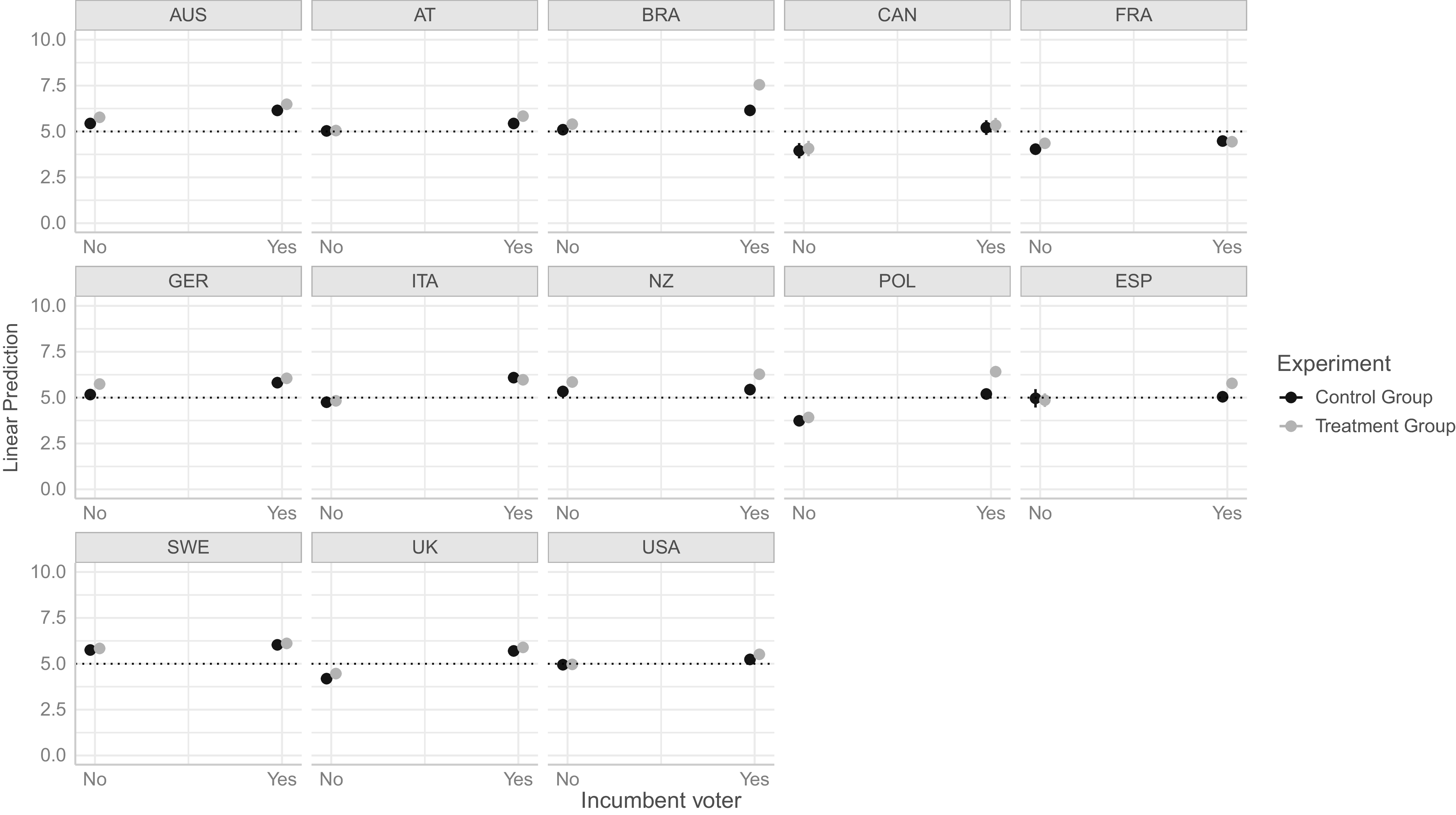
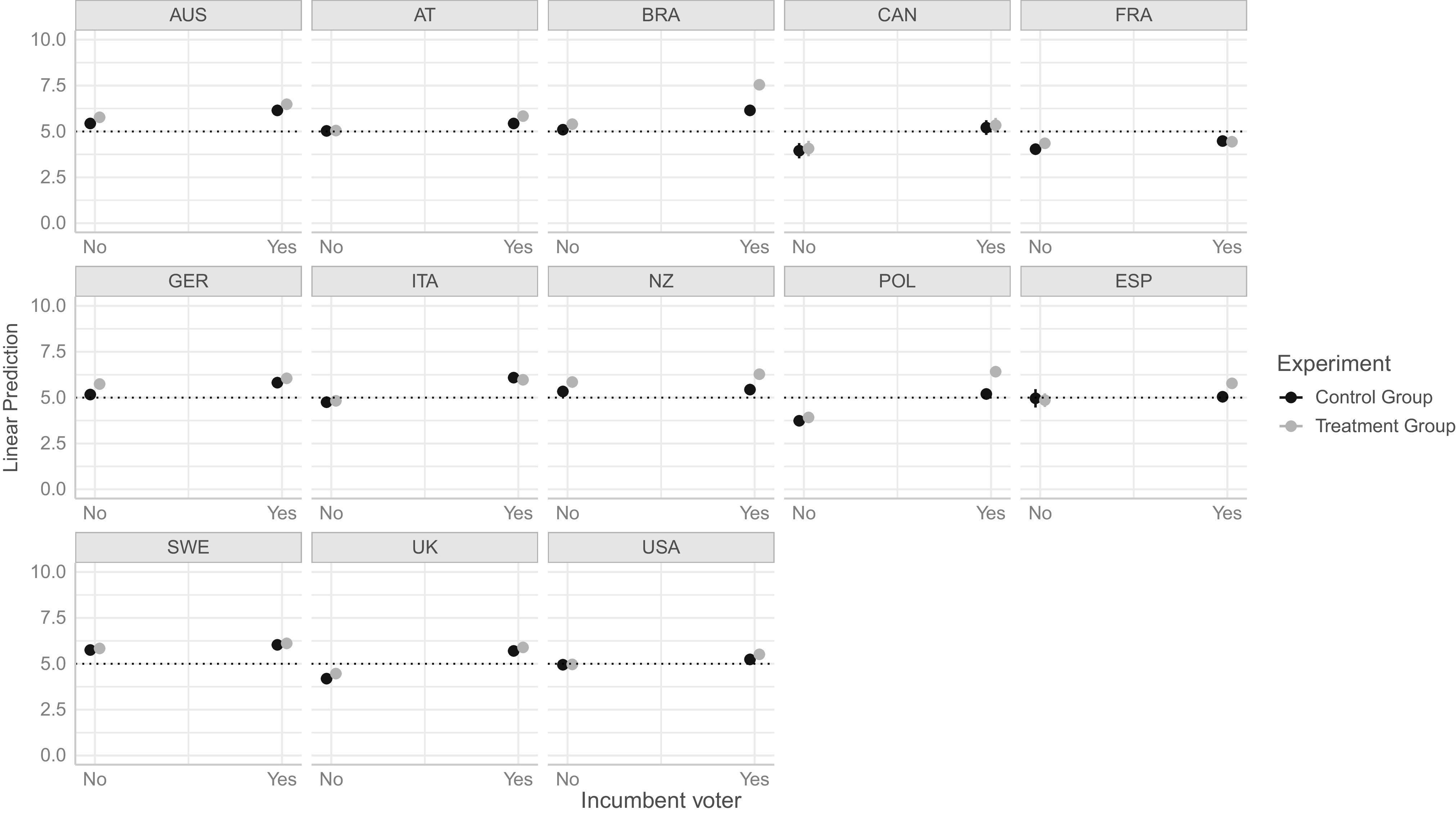
Figure 6 presents the conditional effect of our treatment based on the intention of the respondents to vote in each country. Interestingly, in a great majority of the countries, incumbent party(ies)’ voters, whether treated or not, tended to have significantly more centripetal territorial preferences than the rest of the voters. In fact, in Brazil, Poland, and the UK, these two groups of voters showed very distant preference structures with respect to the vertical distribution of authority in their countries. However, regardless of these baseline differences in the control group, we found a significant centralization effect among treated incumbent voters in various countries. In fact, following the expectations of our H3, in some of the countries in the sample (Austria, Brazil, New Zealand, Poland, and Spain), the effect of treatment was more prominent among incumbent partisans than among opposition partisans. In summary, these empirical findings show that, when exposed to the incidence of coordination failures, individuals’ preferred distribution of power was not independent from their attitudes towards those political parties ruling at each government level.
Country ATE conditional on individuals’ vote choice.
Note: The figure displays the average predicted preferred distribution of vertical authority both in the control and treatment groups by country (in a pooled sample) conditional on reported individual vote choice in past general elections.
Contextual moderators
Multilevel policy stringency
Next, we explore whether citizens’ perceptions of coordination inefficiencies moderate the effect of our treatment. We assume that the perceptions of inefficiencies by individuals (the value of $\delta $
in our model) are affected by multilevel governments’ policy efforts to counteract the consequences of the pandemic. Assuming that efforts are proportional to the coordination capacity among multilevel actors, we expect lower perceptions of inefficiencies where multilevel governments have been able to implement a panoply of initiatives in fighting the pandemic. We then test H4, which predicts a greater effect of our treatment where multilevel policy efforts were lower.
$\delta $
in our model) are affected by multilevel governments’ policy efforts to counteract the consequences of the pandemic. Assuming that efforts are proportional to the coordination capacity among multilevel actors, we expect lower perceptions of inefficiencies where multilevel governments have been able to implement a panoply of initiatives in fighting the pandemic. We then test H4, which predicts a greater effect of our treatment where multilevel policy efforts were lower.
We proxy these multilevel policy efforts through Shvetsova, Zhirnov, Adeel et al.’s (Reference Shvetsova, Zhirnov, Adeel, Bayar, Bayrali, Catalano, Catalano, Chu, Giannelli and Muftuoglu2022) Protective Policy Index (PPI), which captures the total policy stringency of the measures put in place by central and subcentral governments. The database identifies and codes policies that fall into several categories: border closures, school closures, social gatherings and social distancing limitations, homebound policies, medical isolation policies, closure/restriction of businesses and services, the introduction of the state of emergency, and requiring mandatory personal protection equipment and physical distancing (Shvetsova, Zhirnov, Adeel et al. Reference Shvetsova, Zhirnov, Adeel, Bayar, Bayrali, Catalano, Catalano, Chu, Giannelli and Muftuoglu2022: 2). Since there was variation in stringency within the policy categories, with some policy adoptions being more stringent than others (i.e., self-isolation versus lockdowns, partial school closings versus full school closings), the Index weights more stringent policies in each category more heavily.Footnote 21 These values are normalized to range between 0 and 1. Unfortunately, although the total policy stringency of the measures put in place by central and subcentral governments varies at the regional level, since our sampling method was designed to be representative at the national level and thus we lack enough power in our regional samples, we here employ their Average Total PPI measure. The latter is a country-level measure that averages between the subcentral values of policy stringency weighed according to the share of the population of the units. This decision reduces the variation in the main moderator to 13 observations, one per country: the variable ranges from 0.25 in the case of Austria to 0.7 in Canada.Footnote 22
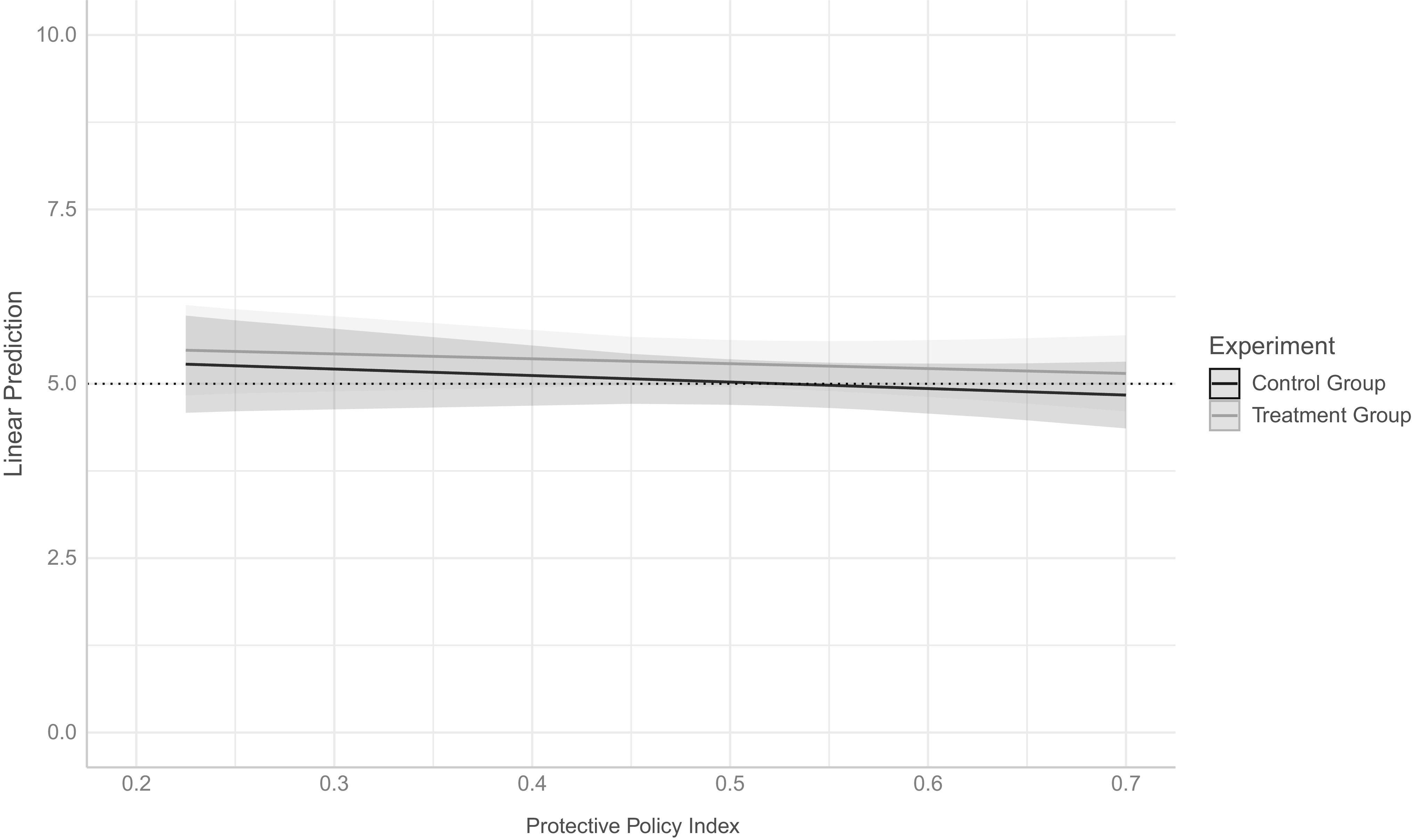
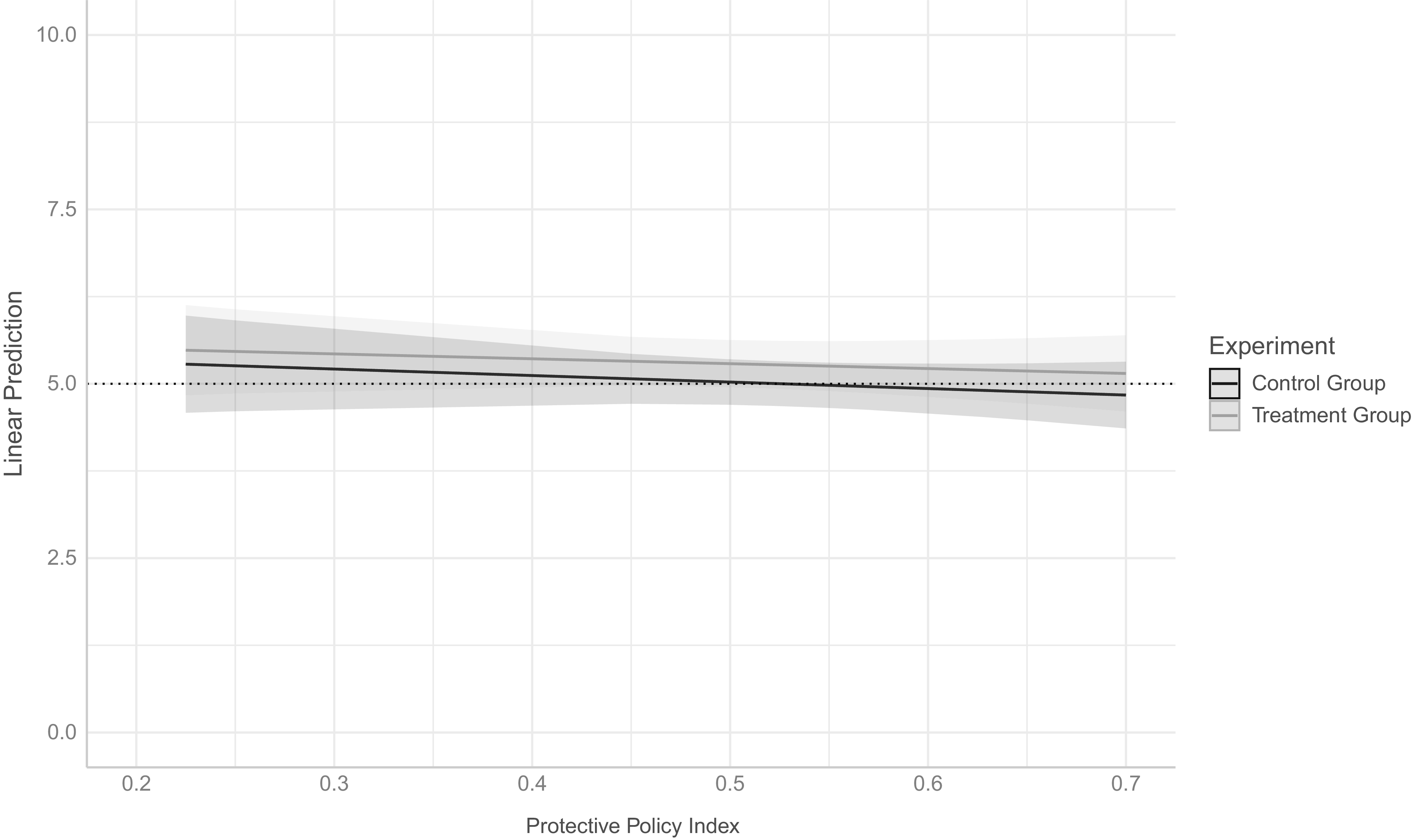
Figure 7 presents the results of the conditional effect of our treatment depending on the country-specific average total policy stringency. As can be observed, the ATE does not reach significance at any point, and the moderating effect of the PPI is rather weak. If anything, Figure 7 shows that as the PPI increased and thus the efficiency of the system increased (lower levels of $\delta $
), the average territorial preferences in the control and treatment groups accumulated around 5, that is, the territorial statu quo. Putting it in another way, the results appear to show a weak tendency for centripetal preferences to be concentrated among countries where multilevel policy stringency was lower. In fact, analyses in the Appendix using Shvetsova, Zhirnov, Adeel et al.’s (Reference Shvetsova, Zhirnov, Adeel, Bayar, Bayrali, Catalano, Catalano, Chu, Giannelli and Muftuoglu2022) regional variant variable demonstrate that similar interregional negative effects can be found within countries in the sample, with several cases even showing a significant ATE among citizens living in regions with very low levels of PPI. However, given the above-mentioned sample restrictions, we stick to the most conservative test results here, which do not allow us to confirm H4.
$\delta $
), the average territorial preferences in the control and treatment groups accumulated around 5, that is, the territorial statu quo. Putting it in another way, the results appear to show a weak tendency for centripetal preferences to be concentrated among countries where multilevel policy stringency was lower. In fact, analyses in the Appendix using Shvetsova, Zhirnov, Adeel et al.’s (Reference Shvetsova, Zhirnov, Adeel, Bayar, Bayrali, Catalano, Catalano, Chu, Giannelli and Muftuoglu2022) regional variant variable demonstrate that similar interregional negative effects can be found within countries in the sample, with several cases even showing a significant ATE among citizens living in regions with very low levels of PPI. However, given the above-mentioned sample restrictions, we stick to the most conservative test results here, which do not allow us to confirm H4.
The moderating effect of multilevel efforts.
Note: The figure displays the average predicted preferred distribution of vertical authority both in the control and treatment groups (in a pooled sample) conditional on the country variant Total Protective Policy Index.
The varying intensity of the pandemic across time
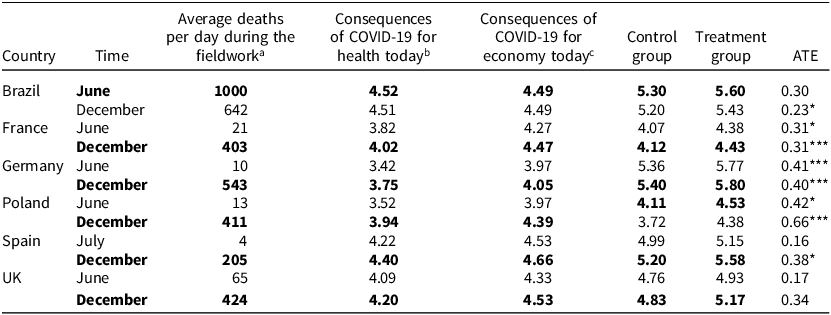
The different intensity of the pandemic through its different waves allows us to explore whether variation in the salience of the threat can moderate the average treatment effect of our experiment in each country. To this end, we replicated our experiment in six out of the 13 countries in the comparative sample in December 2020 (Brazil, France, Germany, Poland, Spain, and the UK), with the aim of understanding how the varying levels of intensity of the Covid-19 pandemic across countries could have shaped the effect of treatment. After the generalized implementation of national lockdowns, and with the exception of Brazil, June 2020 brought the mildest incidence of the virus to the countries in the sample. In contrast, during the replication study in December 2020, the incidence of the virus had increased by approximately 2000% in the number of daily deaths. Table 1 shows data on the average deaths per day during the two moments of fieldwork, as well as respondents’ perceptions of the sanitary and economic severity of the pandemic in both periods. Relevantly, changes in the perceptions of the severity of the pandemic were correlated with variation in the average number of deaths per day, except in Brazil, where the impact of the pandemic was very high in both periods.Footnote 23
Comparing the ATE in two moments across countries
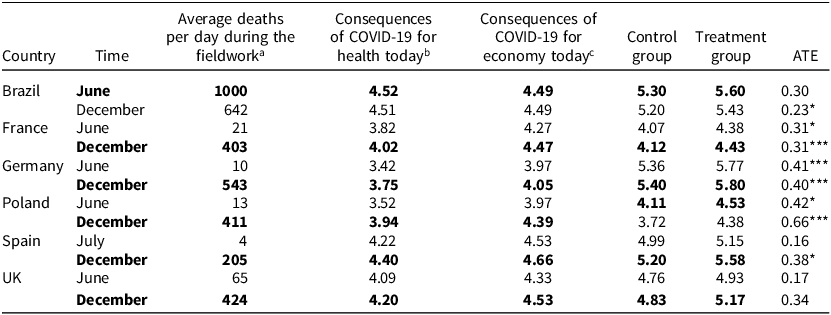
a Data on deaths comes from the Covid-19 Data Repository by the Center for Systems Science and Engineering (CSSE) at John Hopkins University.Footnote 24
b,c Responses to the questions on the severity of the crisis: 1 = Not at all serious; 2 = Not serious; 3 = Somewhat serious; 4 = Quite serious; 5 = Very serious.
Predicted values are reported.
*** ${\rm{P}} \lt 0.01$
, **
${\rm{P}} \lt 0.01$
, ** ${\rm{P}} \lt 0.05$
, *
${\rm{P}} \lt 0.05$
, * $P \lt 0.1$
.
$P \lt 0.1$
.
The results in Table 1, which are based on a country-specific sample linear regression analysis with regional fixed effects, show that during the second wave of the experiment in December 2020, our treatment continued to have a generalized positive effect, which reached significance in most cases (France, Germany, Poland, and Spain). This positive effect survived even in those cases where the average preference for (de)centralization among respondents in the control group had increased from the first to the second wave of the experiment. In the second wave, the significance of the ATE increased in France, and the magnitude of the ATE increased from almost 2 to 4 percentage points in Spain and the UK (although the effect in the latter was not significant), whereas in Germany the ATE remained stable at 4 percentage points. In contrast, in Poland, both the control and treatment groups exhibited a lower preference for centralization in December compared to June, although the magnitude of ATE increased and continued to be significant. As for Brazil, a relatively high and constant death toll was correlated in time with respondents’ relatively high pretreatment concerns about the severity of the crisis and with very procentralizing average preferences in both the control and the treatment groups. The case of Brazil confirms the logic of our argument by showing a decrease in the average centralization of preferences in both the control and treatment groups as the importance of the crisis decreases, although the magnitude of the ATE is not significant.
Validity test: Isolating the effect of coordination failures
Our main empirical finding in this article, that is, the centralization shift in territorial preferences of individuals, could be the result of the conflated effect of exposure to a coordination failure with the initialization of the crisis (Covid-19) in our treatment. Although the inclusion of the latter was a deliberate decision to provide respondents with information on the relationship between the crisis and coordination failures (arrow A in our theoretical model in Figure 1), the effect of the crisis may have affected our dependent variable independently of coordination failures (arrow C in Figure 1).
In order to show that the effect of our treatment on territorial preferences occurred through the specific mechanism of coordination failures (arrow B in Figure 1), we divided our country samples from June to July 2020 into three groups, and thus, in addition to the control group and the group receiving the main treatment (T1), we introduced a second treatment (T2). T2 presented our third sample of respondents with another short statement on the Organization for Economic Cooperation and Development (OECD) recommendations regarding subsidiarity in policy responses and the central government’s difficulties when acting at the local level in the context of the pandemic. Then, while T1 briefed the respondents on the incidence of multilevel coordination failures, T2 primed them on a directional statement in which inefficiencies were targeted at a particular level (central government). In summary, T2 changed the proposed type of performance failure from coordination inefficiencies to the targeted inability of the central government to adequately manage the crisis.
We were motivated by the possibility that inefficiencies arising from flagrant cases of failure to act by a particular level of government may have different effects on territorial preferences. While the incapacity of regional/state governments to act efficiently should reinforce a centralizing effect similar to the one behind T1, following our logic, if a threat uncovers the central government’s role in inefficient actions, this should prompt citizens to prefer to deviate authority downward, towards the, in this case, more efficient subcentral governments. In fact, contrary to the hypothesized main effect of T1, we expected a decentralizing effect among those primed with the directional statement (T2). The exact wording of the designed vignette is as follows:
Treatment group. The Organization for Economic Cooperation and Development (OECD) says that the impact of Covid-19 has been very uneven between regions in the same country and has called for policy responses that adapt to the local situation. However, some experts state that in your country the management of the crisis is more difficult due to the problems of the central government’s lack of relevant information and policy capacity at the local level. Which should be the actual power distribution between the central/federal government and the [name of the second tier in your country]?
[0–10 scale provided to respondents where 0 means ‘Grant more power to the [name of the second tier in your country]’, 5 ‘statu quo’ and 10 ‘Grant more power to the central/federal government’.]
Figure 8 presents the effect of T2, which we employ to test the extent to which our experimental design captured the reactions of respondents to coordination failures (arrow B). In this case, the sample comprises those respondents in the control group, as well as the other third of the respondents in the samples from our country that were exposed to T2. By moving from the multilevel coordination failure priming in T1 to the directional statement in T2 – and fixing an international organization’s specific advice in the context of the pandemic – the effect in the pooled cross-sectional sample changed its sign. Specifically, the ATE represented a 0.85% decrease on the dependent variable and was negative in 9 out of 13 of the countries in the sample and significant only in Australia, Austria, and Sweden. As an exception, Poland was the only country in the sample with a positive and significant ATE after both treatments.
Predicted values of T2 by country in the sample.
Note: The figure displays the average predicted preferred distribution of vertical authority both in the control and treatment groups by country (in a pooled sample).
We take the difference between the ATE in Figures 4 and 8 as proof of the validity of our experimental design. In fact, there are several points to underscore from these results. First, the almost generalized respondents’ average differential reaction to the two treatments across countries supports the idea that citizens were able to understand the logic behind the inclusion of governmental action, performance, and authority distribution in our experiment. Secondly, the difference in the magnitude between the effects of T1 and T2 suggests the following two considerations. On the one hand, this might be a direct manifestation of the salience of the threat through arrow C, which in the case of T2 might counteract the captured effect of arrow B. On the other hand, it speaks to the potentially relatively larger centralizing effect that a hypothetical opposite directional statement, where subcentral governments’ management is the source of inefficiencies, could have upon individuals’ territorial preferences.
Conclusion
In this paper, we argue that citizens will prefer to centralize powers when multilevel coordination failures hamper a country’s capacity to respond to a crisis. These failures are not uncommon in multilevel governance settings, but individuals are generally oblivious to them. However, in the context of a crisis, coordination inefficiencies are more likely to occur and become more relevant to citizens. As public opinion acknowledges that unsuccessful intergovernmental coordination represents an obstacle to tackling the crisis effectively, we expect hierarchically superior authorities to emerge as a focal point in authority distribution, prompting a centralizing shift in preferences. This argument is formalized in a model that yields several predictions that we used to guide the empirical analysis of the paper, which consisted of several survey experiments using online representative samples in 13 countries in 2020, the first year of the Covid-19 pandemic.
Our findings are largely consistent with our preregistered expectations and provide, to our knowledge, the first comparative analysis of territorial preferences across a set of federal, quasi-federal, and unitary decentralized countries. Although citizens’ preferences for (de)centralization are frequently surveyed in many countries, particularly in quasi-federal systems, there remains a scarcity of mid- to large-N studies offering a cross-national overview based on a comparable methodological design. Moreover, our findings provide strong support for our main hypothesis, as citizens who were primed on intergovernmental coordination failures in fighting the Covid-19 pandemic were more likely to report more centripetal territorial preferences. The significance of our results becomes even more exceptional if one considers that the main empirical test was conducted in a context where the intensity of the pandemic and the frequent intergovernmental bickering were priming individuals on the crisis and failures, respectively, which could introduce a non-negligible downward bias in the estimation of our main hypothesis.
In addition, the analyses of the individual-level moderators show that in the context of the crisis, coordination failures prompted more prominent changes in territorial preferences in countries where the territory was a salient dimension of competition, resulting in a more polarized distribution of individual preferences. In these countries, therefore, coordination failures in managing the crisis can result in a deepening of the territorial conflict. Empirical findings also show that partisanship was a strong predictor of territorial preferences and that people who were partisans of the incumbent parties at the central level were more likely to support centralization when exposed to failures in multilevel coordination. This means that when coordination inefficiencies are filtered by the lenses of individual partisan alignments, the polarization of territorial preferences may actually increase.
As for the contextual moderators of the main hypothesized effect, results of the experiment in two different moments of the pandemic confirm that in a selection of countries the centralizing shift continued to survive over time. Interestingly, the results of the experiment hold even against the centralization of territorial preferences in the control group during the second analyzed period. Furthermore, actual multilevel policy efforts do not appear to have played a relevant role in shaping territorial preferences during the pandemic. Although the presented country-level test and the complementary regional-level estimations in the Appendix seem to show that centripetal preferences were concentrated in countries and regions with low levels of multilevel governmental action and thus high levels of coordination inefficiencies, our representative samples at the country level were not able to fully capture these dynamics. Future scholarly efforts should then take the need for regional-level public opinion data seriously; as over the past decades authority has spread vertically to different degrees, filling in this void seems a logical next research step.
Finally, our empirical findings have significant implications for two of the most important theoretical questions in the area of multilevel governance: first, the coordination of public preferences in vertical authority distribution around an efficient level of government; and second, the stability of the territorial contract and its drivers in democracies, where party strategies should in theory be the outcome of public preference aggregation processes.
Regarding the first point, changes in citizens’ preferences on the vertical distribution of authority, such as those identified in this paper, are largely dependent on the nature of the crisis in question, which delineates its scope and, consequently, shapes the perceptions of citizens about which levels of government should be responsible for managing its consequences. We have argued and shown that during the early stages of the Covid-19 pandemic, citizens predominantly viewed the crisis as a national concern. In this context, coordination failures reinforced the perception of central governments as the most efficient and hierarchically superior actors to address the situation. However, our theoretical framework is generalizable and could be applied to crises of a different nature in future work. In contexts where a crisis is inherently global – such as climate change – and all else being equal, individuals may instead prefer that authority be centralized at the international level.
As for the second one, shifts in citizens’ preferences over authority boundaries, such as those we have explored in the paper, may fade away when the exposure to the crisis ends or declines. However, these shifts may still have implications for the redrawing of authority boundaries that last beyond the crisis. Extraordinary events create a public opinion environment favorable to political changes that otherwise would be difficult or unlikely to be implemented. In our case, intergovernmental failures open a window of opportunity for centripetal institutional reforms that could be followed by politicians’ opportunistic adjustments of authority, weakening the safeguards of territorial arrangements (Bednar Reference Bednar2008). Future research in this area could explore whether, once preferences for a redrawing of authority boundaries are publicly acknowledged, changes in the distribution of authority follow in the form of beneficial adjustments or in the form of opportunistic transgressions of the territorial contract.
Supplementary material
The supplementary material for this article can be found at https://doi.org/10.1017/S1475676525100558.
Data availability statements
Replication materials, including scripts and datasets used in our analysis, are publicly accessible through Harvard Dataverse (https://doi.org/10.7910/DVN/F64HSM).
Acknowledgements
We are grateful to the discussants, panel members, and attendees at MPSA 2021, the MZES AB B-Kolloquium at the Mannheim Centre for European Social Research, and the Political Behavior Colloquium at the European University Institute, among others, for their valuable feedback. We also thank the editors and anonymous reviewers for their insightful comments, which have greatly improved this article.
Funding statement
This research was funded by the Spanish Agencia Estatal de Investigación and the European Union (grant PID2021-128287NB-I00), as well as by the Comunidad de Madrid (grant 2018-T1/SOC-10661).





 Open access

